AI-Powered Content Creation Market By Content Type (Text, Image, Video, Audio, 3D & Immersive), By Technology (Language, Image, Video, Speech, and Custom Models), By Deployment (Cloud, On-Premises, Hybrid), By Pricing Model (Subscription, Transaction, Consumption, Freemium), By Application (Marketing, E-commerce, Media, Learning, Corporate, Creator Tools), and By End User (Large Enterprises, SMEs, Agencies, Individual Creators) – Global Opportunity Analysis and Industry Forecast, 2025–2030
Industry Outlook
The global AI-Powered Content Creation Market size was valued at USD 2.98 billion in 2024 and is expected to reach USD 3.54 billion by 2025. Looking ahead, the industry is projected to expand significantly, reaching USD 8.31 billion by 2030, registering a CAGR of 18.65% from 2025 to 2030.
The market is expanding rapidly, driven by the increasing demand for scalable, personalised, and data-driven content solutions across industries such as marketing, media, e-commerce, and education. Organisations are leveraging AI tools to automate text, image, video, and audio generation, enhancing productivity and consistency while reducing time-to-market. The growing adoption of generative AI models, natural language processing, and machine learning algorithms is transforming creative workflows, enabling hyper-personalised storytelling and multilingual content delivery. Rising emphasis on cost efficiency, content optimisation, and audience engagement is prompting businesses to integrate AI platforms into their digital strategies. By combining creativity, automation, and analytics, the AI-powered content creation market is reshaping the global content ecosystem while driving innovation, accessibility, and competitive advantage for enterprises.
What Are the Key Trends in the AI-Powered Content Creation Market?
How is Enterprise Integration of Generative AI Transforming Content Workflows?
Enterprises are rapidly embedding generative AI into their core productivity, creative, and marketing ecosystems, signalling a shift from experimental tools to fully integrated business platforms. Microsoft’s Copilot integration across M365 and Adobe’s Custom Models within Creative Cloud exemplify this evolution, enabling employees to automate content creation, ideation, and workflow execution at scale. According to Google Cloud’s 2024 Data & AI Trends Report, organisations increasingly view generative AI as a catalyst for faster insights, personalisation, and operational efficiency. This transformation compresses campaign cycles, enhances brand responsiveness, and demands stronger governance frameworks.

The chart shows AI adoption by organizations rising sharply from 20% in 2017 to 78% in 2024, reflecting the mainstreaming of AI tools across business functions. This surge directly accelerates the AI-powered content creation market trends, with rapid growth driven by enterprises and creators using generative AI platforms to automate, personalize, and scale text, image, video, and audio production; consequently, the market size for AI content creation tools is soaring, expected to reach USD 8–80 billion by 2030 with double-digit growth rates, as businesses seek faster, more cost-efficient, and customizable content solutions to stay ahead in a digital-first world.
How is Multimodal Creativity Expanding Creative Output and Lowering Cost?
Advances in multimodal large language models (LLMs) and image/video generation are transforming creative production into end-to-end AI-driven asset pipelines, from scriptwriting and storyboarding to full video output. Announcements from Google and Adobe in 2024 underscore this shift toward seamless, multi-format content ecosystems. NVIDIA’s continued GPU innovations further enhance rendering speed and scalability, reducing the marginal cost per digital asset and enabling real-time A/B testing at unprecedented volume. Content and marketing teams should restructure creative briefs as “model prompts plus brand guardrails”, integrate human-in-the-loop quality assurance, and forecast GPU/cloud usage as a defined cost line within campaign P&L models to manage scalability and compliance.
How are Creators and Smes Monetising AI Outputs While Navigating IP and Trust Challenges?
Creators are rapidly adopting AI tools to scale content output, using templates, localised variants, and synthetic voices to expand reach and productivity. However, intellectual property attribution, licensing clarity, and audience trust remain major obstacles. Reports from the World Economic Forum and Reuters emphasise how misinformation and authenticity concerns shape public acceptance of AI-generated media. In response, enterprises increasingly favour vendors offering training-data provenance, content traceability, and brand-safe generation filters, as demonstrated by Adobe and Google. Platforms should implement transparent provenance metadata, verifiable licensing guarantees, and optional human-review certifications to strengthen user trust, support regulatory alignment, and enable scalable AI-content marketplace monetisation.
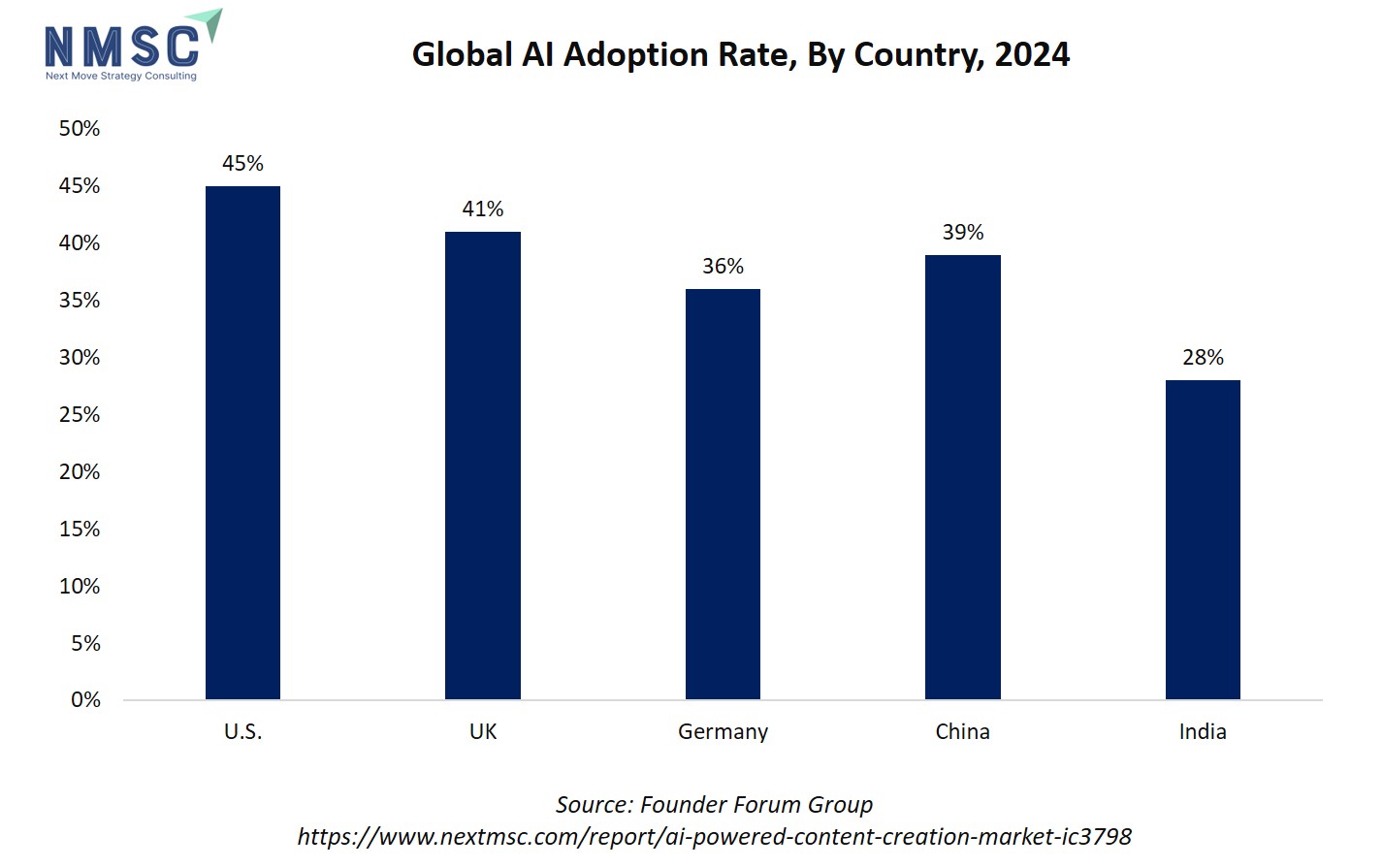
This chart highlights the global AI adoption rate by country in 2024, with the U.S. leading at 45%, followed by the UK (41%), China (39%), Germany (36%), and India (28%). These figures indicate strong engagement with AI technologies in North America, Europe, and China, while emerging markets are beginning to accelerate their adoption. Higher country-level AI adoption drives growth and competitive innovation in the AI-powered content creation market analysis, as organizations seek AI-driven solutions for automating written, visual, and multimedia production; countries with higher adoption rates tend to generate greater demand and investment in advanced content creation platforms, fueling global expansion and rapid enhancement of generative AI tools
What Are the Key Market Drivers, Breakthroughs, and Investment Opportunities that Will Shape the AI-Powered Content Creation Market in the Next Decade?
Key market drivers include enterprise productivity goals, the democratisation of creator tools, and rapid advances in model efficiency and affordability. Organisations increasingly seek to shorten content production cycles, while creators leverage accessible AI tools for faster, more scalable output. Breakthroughs in model architectures and GPU performance have enabled commercially viable synthetic imagery, voice, and video generation, accelerating adoption across media and marketing sectors. Yet, misinformation risks, IP ownership uncertainty, and escalating compute costs continue to constrain widespread deployment. The establishment of robust governance frameworks, standardised provenance systems, and transparent content validation protocols will be pivotal in driving enterprise confidence and unlocking sustained, large-scale AI integration.
Growth Drivers:
How are Advancements in Generative AI and NLP technologies Accelerating Market Growth?
Rapid innovation in generative artificial intelligence (AI) and natural language processing (NLP) is transforming digital content creation and communication globally. The OECD.0020AI Policy Observatory 2025 reports that AI-related patent filings and R&D investments have surged by more than 30% since, with notable acceleration in language and multimodal systems that integrate text, image, and video. Advances in transformer-based architectures and open foundation models, supported by public initiatives such as the U.S. National AI Research Resource (NAIRR) and the EU Horizon Europe AI Program, are improving contextual reasoning and creative realism. These capabilities empower enterprises, educators, and creators to automate and personalise engagement at scale, fueling rapid adoption across media, marketing, and knowledge-driven industries.
How are the Growth of Digital Channels and the Creator Economy Driving the Market?
The rapid expansion of digital communication ecosystems is intensifying the demand for scalable, AI-enabled content generation. As reported by the UNESCO Broadband Commission 2024, more than 5.4 billion people now access the internet, with social and creator platforms representing over 65% of total digital media consumption. Complementary data highlights steady growth in the digital media and online entertainment industries, reaffirming the economic significance of creator-led content. AI-driven creative tools are empowering independent creators, educators, and small enterprises to produce multilingual, inclusive, and engaging media at scale, advancing both digital accessibility and participation in the global knowledge economy.

This chart tracks the number of AI-related regulations enacted in the U.S. between 2018 and 2024, showing a dramatic increase from just 3 in 2018 to 59 in 2024, especially spiking in the last two years. This rapid regulatory growth reflects growing public, industry, and government scrutiny over AI usage, prompting clarity on compliance, transparency, and accountability. For the AI-powered content creation market demand, tightening regulations introduce new requirements and barriers, compelling providers to invest in responsible AI, data privacy, and ethical content generation, these shifts spur innovation and quality but also raise operating costs and slow time-to-market for new features as players adapt to evolving rules.
Growth Inhibitors:
How will Trust, Misinformation and IP Disputes Inhibit Broad Adoption?
Concerns over misinformation, authenticity, and copyright ambiguity are slowing large-scale adoption of generative AI across media and enterprise sectors. Brands and publishers remain cautious due to audience scepticism and the absence of standardised provenance systems. Regulated industries, in particular, require verified content sourcing and human oversight before deploying synthetic assets publicly. Organisations should prioritise transparent provenance tagging, human-in-the-loop quality control, and vendor assurances on data training integrity to overcome adoption barriers.
Where Should Investors Allocate to capture Outsized Returns?
Investor focus is shifting toward platforms that integrate generative AI responsibly, notably those offering brand-safe custom models, provenance-verified asset marketplaces, GPU-efficient inference systems, and controllable multimodal creation pipelines. Companies embedding governance, traceability, and seamless enterprise integrations into their AI workflows are positioned to command higher valuations. Prioritise firms demonstrating enterprise-grade deployments, recurring SaaS operation revenue, and strong alliances with major cloud or GPU infrastructure providers.

This chart ranks countries by their AI Preparedness Index scores, with Singapore at the top (0.80), followed by Denmark (0.78), the United States (0.77), Switzerland (0.76), and New Zealand (0.75). These scores reflect the readiness of each nation to implement, scale, and benefit from AI technologies, through strong digital infrastructure, policy support, and workforce skills. Higher preparedness translates to faster and broader adoption of sophisticated AI applications, including AI-powered content creation platforms, as governments and enterprises in these markets are better equipped to invest in, deploy, and regulate advanced content generation technologies, driving innovation and market expansion.
How AI-Powered Content Creation Market Segmented in This Report, and What Are the Key Insights from the Segmentation Analysis?
By Content Type Insights
Is Text Content Generation Dominating the Market in 2025?
Based on content type, the market is segmented into text content, image content, video content, audio content, and 3D & immersive content.
Text content remains the largest revenue and usage segment by breadth due to the immediate productivity impact across enterprises. LLM integration into collaboration suites and publishing workflows accelerates adoption. However, enterprise willingness to pay hinges on governance and quality validation. Insight: vendors should offer domain-tuned models, controllable verbosity, and plagiarism/provenance features to capture high-value enterprise customers.
By Technology Insights
Are Image and Creative Asset Generation Rapidly Closing the gap?
Based on technology, the market is segmented into language models, image generation models, video generation models, speech and voice models, and custom trained models.
Image generation is growing fast thanks to tools like Adobe Firefly embedded into Creative Cloud and Google’s image model improvements. These tools reduce designer time and enable mass variant creation for A/B testing. Insight: integrate model outputs into DAM systems and enforce brand style transfer via Custom Models.
By Deployment Insights
Is Video Content Generation the Frontier for the AI-Powered Content Creation Market Growth in 2025–2026?
Based on deployment, the market is segmented into cloud, on-premises, and hybrid.
Video is the fastest-growing but most technically demanding segment, advances in text to video research and vendor pilots are accelerating capability, yet compute and editing quality remain constraints. Enterprises with large video needs (e-commerce, edtech) will be early adopters for templated and localised variants. Insight: invest in hybrid workflows where AI produces rough cuts and human editors finalise assets to control quality and cost.
By Pricing Model Insights
Is Cloud Deployment Dominating Platform Delivery in 2025?
Based on pricing model, the market is segmented into subscription, transaction-based, consumption-based, and freemium.
Cloud delivery is dominant because it provides scalable GPU and managed model services; Google Cloud, Microsoft Azure, and AWS provide GenAI stacks and tooling, while on-prem is reserved for high-security or latency-sensitive use cases. Insight: prioritise cloud-native offerings with private-endpoint and VPC integration for enterprise security.
By Application Insights
Is Subscription / Consumption Pricing the Most Common Monetisation Model?
Based on application, the market is segmented into marketing and advertising, e-commerce, media and entertainment, learning and training, corporate communications, and creator and agency tools.
Most enterprise and creator platforms use subscription and consumption (pay-per-generation) hybrids to reflect compute variability; leading vendors also offer enterprise contracts and revenue share marketplaces. Insight: design hybrid pricing that aligns incentives, base subscription for governance & consumption for heavy generation.
By End User Insights
Which Applications and End Users are Highest Value?
Based on end user, the market is segmented into large enterprises, small and medium enterprises, agencies and service providers, and individual creators.
Marketing & advertising, e-commerce and enterprise communications show the highest immediate ROI; large enterprises and agencies are the highest-value customers because of volume and willingness to pay for governance. Insight: focus enterprise GTM on measurable KPIs (CTR lift, time saved).
Regional Outlook
The AI-powered content creation market is geographically studied across North America, Europe, Asia Pacific, Middle East & Africa, and Latin America and each region is further studied across countries.
AI-Powered Content Creation Market in North America
North America remains the global hub for AI-powered content creation, supported by vast cloud infrastructure, GPU capacity, and deep software integrations. Platforms such as Microsoft Copilot and Adobe Firefly have transformed generative AI from an experimental capability into a core productivity feature within enterprise workflows. Businesses increasingly deploy AI for marketing automation, design, and communications while adhering to strict governance frameworks and brand-safety standards. Creative professionals benefit from end-to-end toolchains that streamline ideation, editing, and publishing. With robust investment pipelines and active vendor expansion, North America is expected to maintain its leadership through continued enterprise pilots, multi-cloud partnerships, and accelerating SaaS integration across verticals.
AI-Powered Content Creation Market in United States
The United States dominates global commercialisation of AI-driven content tools, supported by extensive cloud ecosystems, enterprise software integration, and a strong venture-backed startup landscape. Rapid deployment of Microsoft Copilot across Microsoft 365, Adobe Firefly in Creative Cloud, and Google Gemini integrations exemplify how generative AI is reshaping professional content creation. U.S. enterprises deploy AI for personalized marketing, product visualization, and corporate communication, emphasizing governance and model provenance. Venture capital continues to fund vertical AI platforms addressing industry-specific creative needs. The country’s technology leadership, enterprise readiness, and regulatory evolution ensure that the U.S. will remain the key market for scaling multimodal, compliant generative workflows.
AI-Powered Content Creation Market in Canada
Canada’s market is characterized by steady enterprise adoption, a strong creative technology sector, and clear government guidance on responsible AI. Federal programs promoting ethical development, digital sovereignty, and public-private collaboration enable local companies to experiment while maintaining compliance with privacy laws. Businesses use generative tools to enhance productivity, marketing, and education, in partnership with universities and research hubs. Adoption remains measured but strategic, prioritizing transparency, data localization, and accessibility. Canada’s combination of policy maturity, public trust, and growing compute infrastructure positions it as a stable and innovation-friendly market for responsible, AI-driven content production across both private and public sectors.
AI-Powered Content Creation Market in Europe
Europe is expanding under a highly regulated environment shaped by the AI Act and GDPR compliance standards. Creative industries leverage generative tools for design, marketing, and localization, but adoption is tempered by strict governance and data protection requirements. Vendors localize offerings such as Adobe Firefly and Google Vertex AI for on-premise or private-cloud deployment to ensure compliance. Enterprises prioritize content provenance, watermarking, and ethical model training to meet regulatory and consumer expectations. While adoption speed is slower compared to North America, European enterprises are building resilient, trustworthy AI ecosystems that emphasize transparency, traceability, and long-term compliance readiness.
AI-Powered Content Creation Market in United Kingdom
The United Kingdom is fostering a balanced approach to AI innovation, encouraging enterprise experimentation while ensuring strong governance frameworks. Government white papers highlight a pro-innovation yet safety-conscious stance, promoting early adoption across creative, advertising, and corporate sectors. Agencies increasingly deploy AI tools for video, localisation, and campaign management, supported by human oversight and content verification systems. U.K. enterprises value brand-safety controls, data transparency, and ethical design features, particularly for regulated industries such as finance and healthcare. As investments in digital upskilling and infrastructure expand, the country is set to become a European center for responsible, creative AI applications that combine agility with robust governance.
AI-Powered Content Creation Market in Germany
Germany’s market reflects its broader focus on engineering precision, compliance, and digital sovereignty. Enterprises in automotive, manufacturing, and media industries deploy AI to streamline visualisation, documentation, and marketing workflows while adhering to strict data-protection standards. Demand is strong for solutions offering on-premise or hybrid deployment, certified provenance, and measurable efficiency gains. Vendors emphasise explainability, energy reporting, and integration with enterprise software such as SAP. While adoption is deliberate, Germany’s commitment to industrial-grade AI infrastructure and its preference for certified, sustainable systems create a foundation for scalable and ethically governed creative automation across professional and industrial applications.
AI-Powered Content Creation Market in France
France’s market thrives within its creative economy and cultural industries, combining artistic innovation with regulatory discipline. Enterprises in advertising, fashion, and media increasingly leverage generative AI for imagery, campaign localisation, and visual storytelling. However, adoption decisions remain closely tied to EU compliance mandates and national standards on cultural representation and ethics. Vendors emphasise French-language training data, transparent model provenance, and inclusive design. Public-private initiatives promoting responsible AI further support experimentation within defined safety frameworks. This combination of creative excellence and regulatory oversight positions France as a benchmark for culturally aligned, ethically governed generative AI deployment.
AI-Powered Content Creation Market in Italy
Italy’s market is shaped by its luxury, fashion, and design industries, where brand integrity and aesthetic precision are critical. Enterprises and creative studios adopt AI for product visualization, campaign localization, and digital asset design, emphasizing human oversight to preserve craftsmanship and brand tone. Hybrid cloud deployments and on-premise integrations are preferred to maintain data residency and IP protection. Generative tools that enhance creativity without compromising heritage appeal to Italy’s design-centric economy. Vendors offering high-quality image generation, localized language models, and regulatory compliance features are well positioned to support Italian enterprises’ evolving digital transformation goals.
AI-Powered Content Creation Market in Spain
Spain’s market is gaining traction, driven by growing demand from advertising agencies, e-commerce retailers, and digital studios. Businesses increasingly use generative tools to automate creative production, translate marketing content, and localize campaigns for multilingual audiences. The country’s high mobile and social media engagement rates accelerate adoption, especially in short-form video and influencer marketing. Vendors are adapting compliance features to EU data protection and transparency standards, helping enterprises balance creativity with accountability. With expanding cloud availability and digital transformation programs, Spain is emerging as a fast-growing hub for scalable, AI-assisted marketing and creative production workflows.
AI-Powered Content Creation Market in Nordics
Nordic countries lead in digital maturity and ethical AI development, underpinned by strong transparency, sustainability, and privacy standards. Public institutions, media firms, and creative agencies use AI to streamline production while demanding documentation of energy consumption, model training data, and fairness metrics. Generative tools are increasingly integrated into public communication, education, and design workflows, with emphasis on explainability and low-carbon operations. Nordic buyers favor vendors that combine creative flexibility with traceable data governance and carbon reporting. The region’s high trust in technology and commitment to responsible innovation make it a model for sustainable, human-centered AI adoption in content creation.
AI-Powered Content Creation Market in the Asia-Pacific
The Asia Pacific region presents highly diverse adoption patterns for AI-driven content generation. Mature markets such as Japan, South Korea, and Australia integrate enterprise-grade tools and localized language models into creative and marketing systems, while Southeast Asia leads in mobile-first creator economies. Rapid cloud expansion and localization initiatives by global vendors enable greater accessibility across price tiers. Key drivers include rising digital ad spend, multilingual content needs, and social commerce growth. Challenges such as regulatory fragmentation, compute access, and content moderation remain. Nonetheless, APAC’s expanding digital ecosystem positions it as the fastest-growing region for AI-driven creative workflows.
AI-Powered Content Creation Market in China
China’s market is dynamic, combining rapid innovation with strict regulatory oversight. Domestic tech firms develop generative platforms aligned with government content standards, incorporating labelling, censorship, and provenance verification. State-approved foundation models power creative tools used in advertising, social media, and e-commerce applications. The emphasis is on compliant, high-volume content generation that supports domestic platforms such as WeChat, Douyin, and Baidu. While global players face restrictions, local AI vendors capitalise on scale and speed within a tightly controlled regulatory framework. China’s model demonstrates how generative AI expand under centralised governance and industry-aligned innovation incentives.
AI-Powered Content Creation Market in Japan
Japan’s approach to automated content creation tools blends precision engineering with a focus on responsible, human-centric design. Enterprises in media, manufacturing, and marketing integrate AI tools for content localisation, visualisation, and workflow automation while adhering to government-issued AI guidelines that stress safety, accountability, and data integrity. Japanese firms prioritise vendor reliability, explainability, and long-term support contracts. Public agencies and universities also explore AI for cultural and educational content, reinforcing ethical innovation. Japan’s disciplined approach, balancing creative adoption with social trust and governance, positions it as a mature, sustainable market for AI-powered creative technologies across multiple professional domains.
AI-Powered Content Creation Market in India
India’s market is expanding rapidly, driven by its vibrant creator economy, multilingual population, and digital transformation across SMEs and public institutions. Startups and global vendors deploy tools for video generation, localization, and automated marketing content to reach diverse linguistic audiences. Government programs promoting AI innovation and digital entrepreneurship support growth, though regulatory clarity and data governance remain key concerns. Cloud accessibility and cost-efficient GPU resources are enhancing adoption in education, media, and e-commerce sectors. India’s scale, creative diversity, and skilled digital workforce make it a critical growth hub for AI-driven content and design solutions.
AI-Powered Content Creation Market in South Korea
South Korea’s tech-savvy, mobile-first economy fuels strong adoption of AI-driven creative tools across entertainment, retail, and digital marketing sectors. Local companies leverage generative models for video, animation, and synthetic voices, catering to the nation’s globally influential K-content and e-commerce industries. Regulatory scrutiny on misinformation, deepfakes, and data labeling ensures responsible deployment and shapes product design. Partnerships between technology giants and creative agencies are driving the emergence of localized AI ecosystems. South Korea’s combination of digital infrastructure, cultural export power, and government-backed ethical AI frameworks positions it among Asia’s most advanced markets for AI content creation.
AI-Powered Content Creation Market in Taiwan
Taiwan’s strong semiconductor base and high digital literacy underpin its growing machine learning content solutions ecosystem. Startups and enterprises deploy image and video generation tools for manufacturing visualization, marketing, and education, leveraging local cloud and GPU infrastructure. The government’s digital policy initiatives emphasize intellectual property protection, AI ethics, and multilingual accessibility, encouraging responsible experimentation. Collaboration between academia and industry supports model development tailored to Mandarin and local dialects. As a result, Taiwan is emerging as a high-tech hub for innovation in creative AI applications, combining hardware leadership with software excellence and robust governance standards.
AI-Powered Content Creation Market in Indonesia
Indonesia’s vibrant creator economy and mobile-first audience are accelerating adoption of generative AI for video, music, and social media marketing. Startups and global vendors develop lightweight, low-cost creative tools optimized for bandwidth constraints and regional languages. The government emphasizes ethical AI usage and content moderation as digital literacy and influencer-driven marketing grow rapidly. AI enables small businesses and independent creators to scale localized content efficiently, particularly across TikTok, Instagram, and YouTube. Despite infrastructure challenges, Indonesia’s youthful population, social commerce growth, and creator ecosystem position it as one of Southeast Asia’s most promising markets for AI-driven creativity.
AI-Powered Content Creation Market in Australia
Australia’s market is growing steadily, with strong participation from media agencies, enterprise marketers, and government organisations. National AI and cybersecurity strategies guide responsible adoption, emphasising data protection, provenance tracking, and transparency. Companies use generative tools to streamline advertising, design, and educational content workflows, integrating them with secure cloud or on-premise systems. Collaboration between tech firms and universities supports model innovation and ethical deployment. As digital transformation accelerates across industries, Australia’s combination of regulatory stability, technical capability, and creative expertise positions it as a mature, governance-driven AI content creation market.
AI-Powered Content Creation Market in Latin America
Latin America’s industry is evolving rapidly, led by Brazil, Mexico, and Colombia, where digital marketing, e-commerce, and media industries embrace generative tools for multilingual and cost-efficient campaigns. Cloud access and localized language models are improving creative scalability. However, adoption remains uneven due to infrastructure gaps and variable regulatory frameworks. Regional startups focus on Spanish and Portuguese model development to support brand localization. Despite challenges, the region’s expanding online population and social commerce growth create strong potential for AI tools that democratize content creation and empower small businesses to compete in the digital economy.
AI-Powered Content Creation Market in Middle East & Africa
The Middle East and Africa present contrasting adoption trajectories. Gulf states lead regional uptake, integrating generative AI into luxury marketing, government communication, and tourism content as part of national digital transformation strategies. Investments in AI hubs and cloud infrastructure support scalable enterprise deployment. In Africa, creator economies are nascent but growing, aided by mobile connectivity, NGO digital initiatives, and early-stage AI localisation projects. Challenges include limited compute access and regulatory diversity. However, as infrastructure improves, the region is poised for inclusive growth in AI-assisted storytelling, education, and digital marketing applications.
Competitive Landscape
Which Companies Dominate the AI-Powered Content Creation Market and How do they Compete?
Market Dominated by AI-Powered Content Creation Giants and Specialists
The AI-powered content creation industry features a blend of global technology leaders and specialised innovators. Major platforms such as Microsoft, Google, Adobe, NVIDIA, and OpenAI anchor the ecosystem with end-to-end generative capabilities integrated into productivity, cloud, and creative suites. Their scale advantages, spanning distribution channels, GPU access, and enterprise SLAs, enable rapid adoption across industries. Complementing them, niche startups such as Synthesia (video), CopyAI and Copysmith (text), and Synthesys and Descript (audio/video) differentiate through focused user experience and vertical-specific automation. Competition increasingly revolves around model accuracy, governance assurances, brand-safe customisation, and cost efficiency. Platform incumbents consolidate share through ecosystem integration and workflow embedding.
Innovation and Adaptability Drive Market Success
Innovation in AI-powered content creation is defined by advances in custom model development, brand safety tooling, and compute efficiency. Adobe’s Firefly suite and Custom Models framework enable brand-aligned creative generation within enterprise compliance boundaries. Microsoft extends Copilot integrations across Office 365 and Azure, while Google’s Gemini product family combines multimodal fluency with robust provenance tracking. Vendors increasingly optimise latency, GPU utilisation, and content authenticity verification to deliver enterprise-grade reliability. Emerging startups target niche needs such as multilingual localisation, synthetic video, and generative post-production. Insight: vertical specialisation and workflow-native integration remain the most effective differentiation routes for challengers in a maturing ecosystem.
Market Players to Opt for Merger & Acquisition Strategies to Expand their Presence
Consolidation and partnership activity are accelerating as vendors expand capabilities and secure enterprise contracts. Large platforms pursue acquisitions in areas such as generative video, voice synthesis, and creative automation to deepen vertical coverage. Cloud providers and model developers form strategic alliances to optimise distribution, compliance, and compute cost structures. Bundled offerings, embedding AI tools into productivity or creative platforms, help reinforce user retention and subscription growth. Investors are closely monitoring collaborations between hyperscalers, model startups, and digital asset marketplaces as signals of value creation and exit potential. Over the next cycle, M&A dynamics will shape market concentration and competitive differentiation.
List of Key AI-Powered Content Creation Companies
-
CopyAI, Inc
-
OpenAI
-
Paramatrix
-
Pepper Content Inc.
-
Adobe
-
Google
-
Scalenut
-
Synthesia
-
Article Forge
-
Salesforce
-
Microsoft
-
ContentBot
-
Wordtune
What Are the Latest Key Industry Developments?
-
December 2024 - Google’s Gemini and multimodal model updates embedded across Search, Ads, and Workspace; Google Cloud Data & AI Trends highlights enterprise priorities.
-
November 2024 - Adobe’s Firefly and Custom Models integrated across Creative Cloud; Adobe emphasizes brand-safe training and enterprise model controls to enable scaled creative workflows.
-
2024 - Microsoft’s Widespread Copilot rollouts in M365 and enterprise platforms; Copilot adoption cited as productivity accelerator for content workflows.
What Are the Key Factors Influencing Investment Analysis & Opportunities in the AI-Powered Content Creation Market?
Investors increasingly assess generative AI content platforms through measurable enterprise traction, annual recurring revenue (ARR) stability, and defensibility of proprietary fine-tuned models. Key evaluation pillars include governance and provenance tooling, compute cost optimization through cloud partnerships, and scalability of verticalized workflows. Funding interest is strongest in model-operations platforms, attribution and provenance marketplaces, and GPU-efficient inference stacks that improve unit economics. Valuations reward companies with documented ROI case studies, such as marketing conversion uplift or productivity gains, and predictable enterprise renewals. Principal risks include regulatory constraints on synthetic media, copyright litigation, and escalating inference costs. Investors should prioritize firms with transparent cost pass-through models, retention-driven GTM strategies, and embedded governance features.
Key Benefits for Stakeholders:
Next Move Strategy Consulting (NMSC) presents a comprehensive analysis of the Artificial Intelligence powered content creation market, covering historical trends from 2020 through 2024 and offering detailed forecasts through 2030. Our study examines the market at regional and country levels, providing quantitative projections and insights into key growth drivers, challenges, and investment opportunities across all major AI-Powered content creation segments.
Report Scope
|
Parameters |
Details |
|
Market Size in 2025 |
USD 3.54 Billion |
|
Revenue Forecast in 2030 |
USD 8.31 Billion |
|
Growth Rate |
CAGR of 18.65% from 2025 to 2030 |
|
Analysis Period |
2024–2030 |
|
Base Year Considered |
2024 |
|
Forecast Period |
2025–2030 |
|
Market Size Estimation |
Billion (USD) |
|
Growth Factors |
|
|
Companies Profiled |
15 |
|
Countries Covered |
33 |
|
Market Share |
Available for 10 companies |
|
Customization Scope |
Free customization (equivalent to up to 80 analyst-working hours) after purchase. Addition or alteration to country, regional & segment scope. |
|
Pricing and Purchase Options |
Avail customized purchase options to meet your exact research needs. |
|
Approach |
In-depth primary and secondary research; proprietary databases; rigorous quality control and validation measures. |
|
Analytical Tools |
Porter's Five Forces, SWOT, value chain, and Harvey ball analysis to assess competitive intensity, stakeholder roles, and relative impact of key factors. |
Key Market Segments
By Content Type
-
Text Content
-
Image Content
-
Video Content
-
Audio Content
-
3D and Immersive Content
By Technology
-
Language Models
-
Image Generation Models
-
Video Generation Models
-
Speech and Voice Models
-
Custom Trained Models
By Deployment
-
Cloud
-
On-Premises
-
Hybrid
By Pricing Model
-
Subscription
-
Transaction Based
-
Consumption Based
-
Freemium
By Application
-
Marketing and Advertising
-
E-Commerce
-
Media and Entertainment
-
Learning and Training
-
Corporate Communications
-
Creator and Agency Tools
By End User
-
Large Enterprises
-
Small and Medium Enterprises
-
Agencies and Service Providers
-
Individual Creators
Geographical Breakdown
-
North America: U.S., Canada, and Mexico.
-
Europe: U.K., Germany, France, Italy, Spain, Sweden, Denmark, Finland, Netherlands, and rest of Europe.
-
Asia Pacific: China, India, Japan, South Korea, Taiwan, Indonesia, Vietnam, Australia, Philippines, Malaysia and rest of APAC.
-
Middle East & Africa (MEA): Saudi Arabia, UAE, Egypt, Israel, Turkey, Nigeria, South Africa, and rest of MEA.
-
Latin America: Brazil, Argentina, Chile, Colombia, and rest of LATAM
Conclusion & Recommendations
Our report equips stakeholders, industry participants, investors, and consultants with actionable intelligence to capitalise on AI-powered content creation transformative potential. By combining robust data-driven analysis with strategic frameworks, NMSC’s AI-Powered Content Creation Market Report serves as an indispensable resource for navigating the evolving landscape.
AI-powered content creation is transitioning from experimental to enterprise-grade, driven by platform integration, compute scale and measurable marketing outcomes. Governance, provenance and cost controls will determine winners.


About the Author
 Ridip Gogoi is a research associate recognized for his strong analytical thinking and meticulous attention to detail. He specializes in transforming complex datasets into meaningful insights that support informed business decisions and strategic planning. With a proactive mindset and strong commitment to accuracy, he contributes effectively to market analysis, data validation, and insight generation. Ridip is driven by continuous learning and consistently works to enhance research quality, analytical depth, and reporting clarity across projects.
About the Reviewer
 Supradip Baul is an accomplished business consultant and strategist with over a decade of rich experience in market intelligence, strategy, technology, and business transformation. His work has included rigorous qualitative and quantitative analysis across multiple industries, helping clients shape investment decisions and long-term roadmaps. Earlier in his career, he was associated with Gartner, where he contributed to industry-leading reports and market share analyses. He has worked with leading global companies and holds an MBA with a dual specialization in Marketing and Finance.
At Next Move Strategy Consulting, we understand that insightful market research is the cornerstone of successful business decisions. That's why we employ a robust and multifaceted approach, combining various methodologies to deliver the most accurate and actionable data for our clients.

Research Landscape
We navigate the world of research with two primary approaches:
Qualitative Approach
Our qualitative research methodologies involve immersive techniques such as in-depth interviews, focus groups, and observational studies. By engaging directly with individuals and stakeholders, we uncover valuable insights that quantitative data alone may overlook.

Quantitative Research
In tandem with qualitative methodologies, NMSC leverages the power of Quantitative Research to provide a robust foundation of numerical insights. Through systematic data collection and analysis, we quantify patterns, preferences, and market trends, offering a comprehensive view of the business landscape.
Our quantitative research approach employs diverse tools, including surveys, experiments, and statistical modelling. These methodologies enable us to gather data from a large and representative sample, ensuring the statistical significance of our findings. By employing structured questionnaires and standardized data collection methods, we guarantee the reliability and validity of the information we present to our clients.
Quantitative research is particularly effective in measuring the prevalence of trends, assessing market size, and gauging the impact of various factors on consumer behavior. The numerical precision attained through this approach equips our clients with actionable insights, facilitating data-driven decision-making and strategy formulation.


Our Specialized Toolbox for Industry-Specific Market Research
We deploy a specialized arsenal of techniques tailored to meet your unique requirements. Here's a glimpse into our comprehensive toolbox:

Information Procurement
The stage entails acquiring market data or relevant information through various sources and methodologies.


Market Research Approach
We utilize both top-down and bottom-up approaches in market research analysis to achieve a comprehensive understanding of the market dynamics, leveraging the broad perspective of industry trends and macroeconomic factors alongside detailed insights from specific segments and individual companies.

Porters Five Forces Analysis
We conduct Porter's Five Forces analysis to evaluate the competitive landscape of an industry, providing us with insights into factors that affect profitability and strategic positioning.

SWOT Analysis

Forecasting
We utilize a forecasting model to predict future consumption by considering parameters like population, economics, regulations, market competition, drivers, constraints, technology, and pricing. We also employ statistical techniques such as multilinear regression, exponential smoothing, moving average, ARIMA, and Monte Carlo simulations for accurate predictions. In econometric forecasting, we analyzed short-term and long-term event impacts, attributing values based on regulatory frameworks, economic factors, and market events.





 Speak to Our Analyst