The global AI-powered Cybersecurity platforms solutions market size was valued at USD 24.50 billion in 2025 and is estimated at USD 28.10 billion in 2026, forecast to reach USD 145.00 billion by 2035, expanding at a 20.0% CAGR between 2026 and 2035. North America leads with approximately 35% share, while network and SASE platforms dominate all other platform categories with approximately 17% share.
We observed that growth is broad based across every segmentation axis, with cloud-delivered consumption and AI-driven exposure management adoption driving the dominant structural shifts through 2035.
|
Key Takeaways |
|
By Platform Category: Network and SASE held the largest share of approximately 17% (USD 4.17 Billion) in 2025; Exposure Management is the fastest-growing sub-segment at 23.5% CAGR from 2026–2035. |
|
By Deployment Mode: Cloud Delivered held the largest share of approximately 54% (USD 13.23 Billion) in 2025; Hybrid is the fastest-growing sub-segment at 24.2% CAGR from 2026–2035. |
|
By Organization Size: Large Enterprise held the largest share of approximately 58% (USD 14.21 Billion) in 2025; Small Business is the fastest-growing sub-segment at 23.9% CAGR from 2026–2035. |
|
By Revenue Stream: Subscription and License held the largest share of approximately 82% (USD 20.09 Billion) in 2025; Professional Services is the fastest-growing sub-segment at 24.5% CAGR from 2026–2035. |
|
By Sales Channel: Direct Sales held the largest share of approximately 40% (USD 9.80 Billion) in 2025; Cloud Marketplaces is the fastest-growing sub-segment at 29.6% CAGR from 2026–2035. |
|
By End User Industry: BFSI held the largest share of approximately 22% (USD 5.39 Billion) in 2025; Industrial and Manufacturing is the fastest-growing sub-segment at 22.7% CAGR from 2026–2035. |
|
Dominant Region: North America dominated with approximately 35% revenue share (USD 8.57 Billion) in 2025. |
|
Fastest-Growing Region: Asia-Pacific is expected to register the highest CAGR of 23.9% during 2026–2035. |
|
Dominant Country: U.S. led with approximately USD 6.00 Billion in 2025. |
|
Fastest-Growing Country: India is the fastest-growing country at approximately 27.9% CAGR from 2026–2035. |
Source: www.nextmsc.com
Market Opportunity: The AI-powered Cybersecurity platforms solutions market is expected to create an absolute dollar opportunity of USD 116.90 billion between 2026 and 2035, presenting significant investment potential across the enterprise security, managed services, and cloud-native protection value chain.
According to Next Move Strategy Consulting analysis, enterprises are increasingly consolidating point security tools onto unified, AI-native platforms to reduce alert fatigue and analyst workload, a shift that favors vendors with broad platform breadth over single-function specialists as security operations budgets tighten through 2035.
The AI-powered Cybersecurity platforms solutions market encompasses software and cloud-delivered platforms that embed machine learning and behavioral analytics into threat detection, prevention, and response workflows across endpoints, networks, identities, cloud workloads, and data. Our assessment indicates that the scope spans platforms supplied to enterprises, government agencies, and managed security service providers across BFSI, technology, public sector, healthcare, retail, industrial, telecom, and energy end markets. The category has evolved from signature-based detection tools into autonomous, AI in Cybersecurity platforms that correlate telemetry across the full attack surface, driven by rising attack sophistication and chronic security-analyst shortages worldwide.
Regulatory frameworks such as the U.S. NIST Cybersecurity Framework and the European Union's NIS2 Directive shape mandatory incident-reporting and risk-management requirements, while sector rules increasingly influence platform adoption. We observed that technology adoption is shifting toward agentic AI and autonomous response capabilities that reduce mean time to containment. Next Move Strategy Consulting's analysis indicates that this structural shift, combined with cloud-first architecture demands, is redefining sourcing criteria across the AI-powered Cybersecurity platforms solutions market.
|
Parameter |
Details |
|
Market Size in 2025 |
USD 24.50 Billion |
|
Market Size in 2026 |
USD 28.10 Billion |
|
Revenue Forecast in 2035 |
USD 145.00 Billion |
|
Growth Rate |
CAGR of 20.0% from 2026 to 2035 |
|
Analysis Period |
2025–2035 |
|
Base Year Considered |
2025 |
|
Forecast Period |
2026–2035 |
|
Market Size Estimation |
Revenue (USD Billion) |
|
Companies Profiled |
20 |
|
Countries Covered |
33 |
|
Market Share |
Available for Top 10 Companies |
Source: www.nextmsc.com
Our findings suggest that platform convergence and autonomous defense are reshaping vendor roadmaps and buyer evaluation criteria across the industry.
Agentic AI is transforming security operations centers by automating triage, investigation, and containment steps that previously required analyst intervention. We observed that vendors such as Microsoft Corporation have introduced autonomous security agents that correlate signals across endpoints, identities, and cloud workloads. This transformation reduces mean time to respond, reallocates analyst time to complex investigations, and reshapes staffing models for enterprise security operations teams navigating persistent talent shortages.
Platform consolidation is reshaping vendor selection as enterprises replace fragmented point tools with unified suites spanning endpoint, cloud, and identity protection. Our analysis shows that CrowdStrike Holdings, Inc. and Palo Alto Networks, Inc. have expanded module portfolios to capture consolidation spend. This shift lowers integration overhead and licensing complexity for buyers, while intensifying competitive pressure on narrowly scoped point-product vendors across the AI-powered Cybersecurity platforms solutions market.
<Identity is emerging as the primary security perimeter as workforce and machine identities proliferate across hybrid environments. Based on research conducted by Next Move Strategy Consulting, we found that identity threat detection and response is now a board-level priority following high-profile credential-based breaches. Vendors including Okta, Inc. have extended identity and access management capabilities to non-human identities, reshaping procurement priorities for enterprise identity governance programs.
Cloud-native security adoption is accelerating as enterprises migrate production workloads to multi-cloud and container environments. We found that Palo Alto Networks, Inc. and Zscaler, Inc. have scaled cloud workload protection offerings to match this migration pace. This trend is reshaping budget allocation toward runtime protection and posture management, benefiting cloud-native vendors over legacy perimeter-focused suppliers across enterprise buying cycles through 2035.
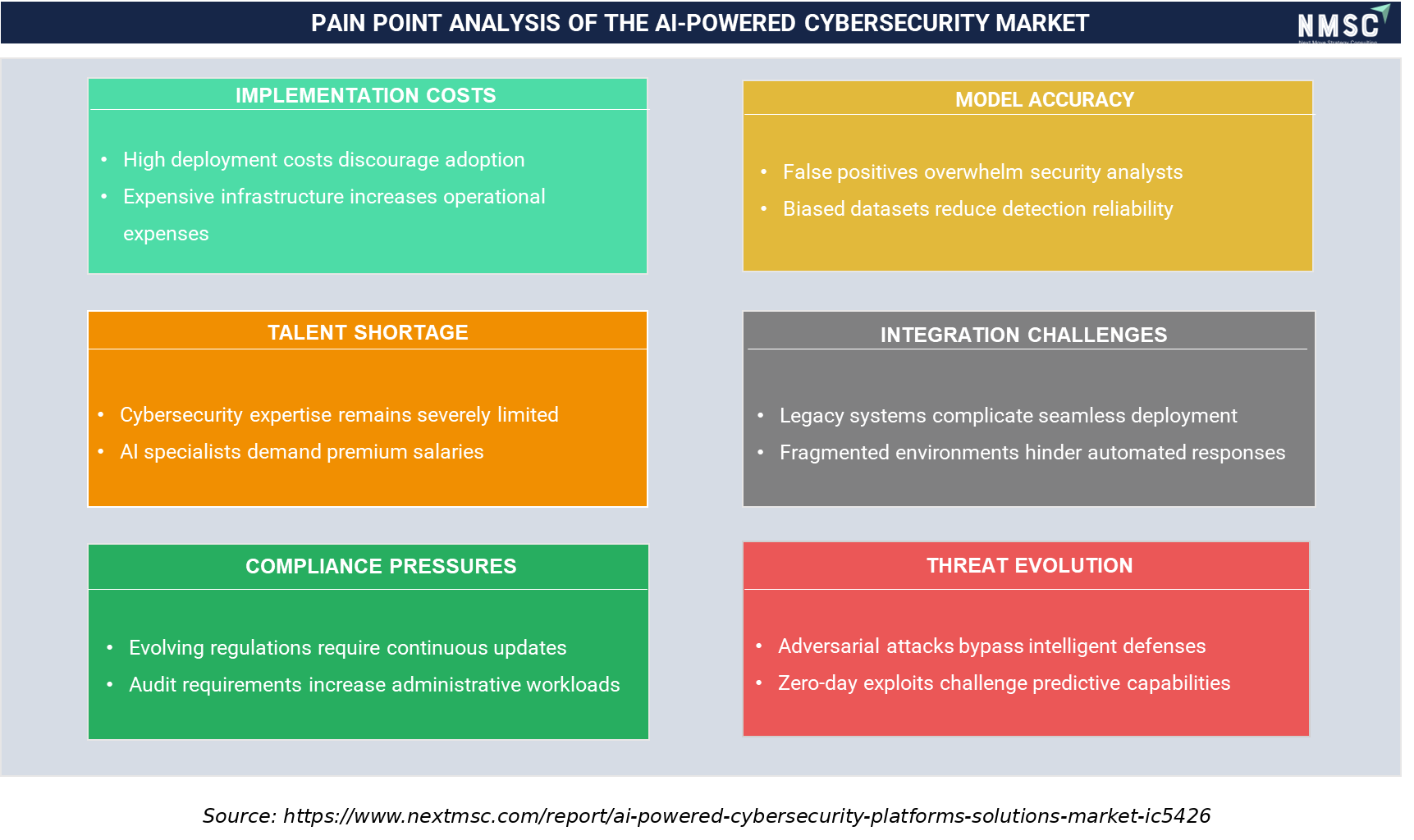
Our analysis indicates that the AI-Powered Cybersecurity Platforms Solutions Market faces persistent challenges associated with implementation costs, threat detection accuracy, platform integration, and regulatory compliance. High deployment expenses, false positives, legacy infrastructure compatibility, and shortages of skilled Cybersecurity professionals continue to slow enterprise adoption. Intensifying vendor competition and evolving cyber threats further increase operational complexity, encouraging solution providers to enhance automation, interoperability, detection precision, and cost efficiency across modern Cybersecurity environments.
Growth Catalyst and Risk Assessment Matrix
|
Factors |
Type |
(+/−) % Impact on CAGR |
Geographic Relevance |
Impact Timeline |
|
Rising frequency of AI-enabled cyberattacks |
Driver |
+4.2% |
Global |
2026–2035 |
|
Chronic Cybersecurity talent shortage |
Driver |
+3.6% |
Global |
2026–2035 |
|
Regulatory mandates (NIS2, SEC disclosure rules) |
Driver |
+2.8% |
North America, Europe |
2026–2030 |
|
Cloud and hybrid workload migration |
Driver |
+3.1% |
Global |
2026–2035 |
|
Platform consolidation spending shift |
Driver |
+2.4% |
Global |
2026–2032 |
|
Rising insurance-linked security spending |
Driver |
+1.5% |
North America, Europe |
2026–2035 |
|
High platform switching and integration costs |
Restraint |
−1.8% |
Global |
2026–2030 |
|
Data residency and sovereignty constraints |
Restraint |
−1.2% |
Europe, MEA |
2026–2032 |
|
Budget constraints among small enterprises |
Restraint |
−0.9% |
LATAM, MEA |
2026–2030 |
Source: www.nextmsc.com
The primary growth driver is the rising frequency and sophistication of AI-enabled cyberattacks that outpace signature-based defenses. According to the U.S. Cybersecurity and Infrastructure Security Agency, reported ransomware and intrusion incidents against critical infrastructure operators have climbed steadily in recent years. Our findings suggest that this threat escalation is compelling enterprises to prioritize AI-native detection and autonomous response investment over incremental point-tool upgrades.
The global Cybersecurity talent shortage is driving adoption of AI-powered platforms that automate triage and reduce reliance on scarce analyst headcount. Data from the U.S. Bureau of Labor Statistics indicates continued strong projected employment growth for information security analysts, underscoring persistent supply constraints. We observed that enterprises are redirecting budget toward autonomous platforms capable of operating with leaner security operations teams.
High platform switching and integration costs are restraining market growth, as enterprises with entrenched legacy tool stacks face significant migration effort when adopting unified AI platforms. Our assessment indicates that data residency requirements under frameworks such as the EU General Data Protection Regulation further complicate multi-region deployment. These factors moderate near-term adoption velocity among risk-averse, heavily regulated organizations.
Segment Sizing: By Platform Category
|
Segment |
2025 (USD) |
2035 (USD) |
CAGR% (2026–2035) |
|
Endpoint and XDR |
USD 3.67 Billion |
USD 18.76 Billion |
18.1% |
|
Network and SASE |
USD 4.17 Billion |
USD 20.04 Billion |
17.3% |
|
Cloud and Workload |
USD 3.19 Billion |
USD 22.51 Billion |
22.4% |
|
Identity Security |
USD 2.94 Billion |
USD 21.94 Billion |
23.1% |
|
Security Operations |
USD 2.69 Billion |
USD 15.35 Billion |
19.5% |
|
Data Security and Resilience |
USD 1.96 Billion |
USD 11.55 Billion |
19.9% |
|
Application and API Security |
USD 1.72 Billion |
USD 10.61 Billion |
20.6% |
|
Email and Collaboration Security |
USD 1.23 Billion |
USD 5.29 Billion |
15.9% |
|
Exposure Management |
USD 1.47 Billion |
USD 11.26 Billion |
23.5% |
|
Edge Security and Delivery |
USD 0.73 Billion |
USD 3.61 Billion |
17.5% |
|
OT and IoT Security |
USD 0.49 Billion |
USD 2.65 Billion |
18.8% |
|
Other Security Platforms |
USD 0.24 Billion |
USD 1.43 Billion |
19.8% |
|
Total |
USD 24.50 Billion |
USD 145.00 Billion |
— |
Source: www.nextmsc.com
Network and SASE platforms dominate the platform category segment with approximately 17% share in 2025, reflecting sustained enterprise investment in secure access service edge architectures replacing legacy perimeter firewalls. Our analysis shows that Exposure Management is the fastest-growing sub-segment at a 23.5% CAGR from 2026 to 2035, driven by demand for continuous attack-surface visibility. This divergence reflects a shift from static perimeter defense toward proactive, continuously validated security posture management.
Segment Sizing: By Deployment Mode
|
Segment |
2025 (USD) |
2035 (USD) |
CAGR% (2026–2035) |
|
Cloud Delivered |
USD 13.23 Billion |
USD 87.00 Billion |
21.4% |
|
On-Premises |
USD 5.88 Billion |
USD 14.50 Billion |
8.9% |
|
Hybrid |
USD 5.39 Billion |
USD 43.50 Billion |
24.2% |
|
Total |
USD 24.50 Billion |
USD 145.00 Billion |
— |
Source: www.nextmsc.com
Cloud Delivered platforms lead deployment mode adoption with approximately 54% share in 2025, supported by lower infrastructure overhead and faster time to deployment. We observed that Hybrid deployment is the fastest-growing mode at a 24.2% CAGR from 2026 to 2035, as regulated enterprises retain on-premises control for sensitive workloads while extending cloud-delivered detection to distributed environments.
Segment Sizing: By End User Industry
|
Segment |
2025 (USD) |
2035 (USD) |
CAGR% (2026–2035) |
|
BFSI |
USD 5.39 Billion |
USD 31.90 Billion |
20.0% |
|
Technology |
USD 4.90 Billion |
USD 27.55 Billion |
19.3% |
|
Public Sector |
USD 3.43 Billion |
USD 18.85 Billion |
19.0% |
|
Healthcare |
USD 20.30 Billion |
22.1% |
|
|
Retail |
USD 2.21 Billion |
USD 11.60 Billion |
18.4% |
|
Industrial and Manufacturing |
USD 2.21 Billion |
USD 15.95 Billion |
22.7% |
|
Telecom |
USD 1.47 Billion |
USD 7.25 Billion |
17.6% |
|
Energy and Utilities |
USD 1.23 Billion |
USD 7.25 Billion |
20.0% |
|
Other Industries |
USD 0.73 Billion |
USD 4.35 Billion |
20.0% |
|
Total |
USD 24.50 Billion |
USD 145.00 Billion |
— |
Source: www.nextmsc.com
BFSI holds the largest end user industry share at approximately 22% in 2025, reflecting stringent regulatory scrutiny under frameworks that shape Cybersecurity spending in financial services. Our findings suggest that Industrial and Manufacturing is the fastest-growing vertical at a 22.7% CAGR from 2026 to 2035, driven by converging IT-OT security requirements across connected production environments.
Next Move Strategy Consulting's analysis indicates three forward-looking whitespace opportunities emerging across the AI-powered Cybersecurity platforms solutions market.
Managed detection and response bundled with AI platforms presents a significant opportunity for managed security service providers to serve mid-market and small enterprises lacking in-house security operations capacity. This mechanism converts subscription platform access into recurring services revenue, directly benefiting managed security service providers and mid-market organization segments.
The proliferation of non-human identities across cloud and API environments presents an opportunity for machine identity security specialization within identity platforms. This mechanism monetizes a previously under-served governance gap, directly benefiting identity security vendors and technology-sector end users managing large service-account estates.
Converging IT and operational technology security requirements present an opportunity for platforms extending detection into industrial control and IoT device protection use cases. This mechanism opens adjacent revenue in energy, utilities, and manufacturing, directly benefiting OT and IoT security vendors and industrial end users.
|
Region |
2025 (USD) |
2035 (USD) |
CAGR% (2026–2035) |
Key Driver |
|
North America |
USD 8.57 Billion |
USD 40.60 Billion |
17.1% |
AI-driven SOC modernization across large enterprises |
|
Europe |
USD 5.88 Billion |
USD 29.00 Billion |
17.6% |
GDPR and NIS2-linked security investment |
|
Asia-Pacific |
USD 6.62 Billion |
USD 52.20 Billion |
23.9% |
Rapid cloud migration and digital economy expansion |
|
Middle East & Africa |
USD 1.96 Billion |
USD 14.50 Billion |
23.0% |
National Cybersecurity strategies and critical infrastructure protection |
|
Latin America |
USD 1.47 Billion |
USD 8.70 Billion |
20.0% |
Financial-sector digitization and rising ransomware exposure |
|
Total |
USD 24.50 Billion |
USD 145.00 Billion |
— |
— |
Source: www.nextmsc.com
North America's AI-powered Cybersecurity platforms solutions market has reached full maturity, anchored by dense enterprise security budgets and early adoption of AI-native platforms. Regulatory drivers including SEC cyber-disclosure rules and sector-specific mandates sustain steady investment. We observed strong technology adoption of autonomous response tools, and the region's strategic outlook favors continued platform consolidation among large enterprises through 2035.
Europe's AI-powered Cybersecurity platforms solutions market reflects a maturing landscape shaped heavily by the NIS2 Directive and General Data Protection Regulation compliance obligations. Our analysis shows steady technology adoption tempered by data residency requirements that favor regional cloud hosting. The strategic outlook points toward sustained public-sector and critical-infrastructure investment across the forecast period.
Asia-Pacific's market is in a growth stage, propelled by rapid digital economy expansion and rising enterprise cloud migration. Regulatory frameworks across China, India, and South Korea are tightening data-protection and critical-infrastructure requirements. We found that technology adoption is accelerating fastest among mid-market enterprises, positioning the region for the highest CAGR through 2035.
The Middle East & Africa market is in an early growth stage, driven by national Cybersecurity strategies and critical-infrastructure protection mandates. Our assessment indicates rising technology adoption in government and energy sectors, supported by sovereign digital-transformation programs. The strategic outlook favors continued public-sector-led investment through 2035.
Latin America's market remains emerging, with adoption concentrated among financial-sector and large enterprise buyers. Regulatory momentum around data-protection legislation is gradually strengthening compliance-driven demand. We observed that technology adoption is expanding steadily as ransomware exposure rises, with a strategic outlook favoring managed-service-led delivery models through 2035.
Based on our estimates, the U.S. market was valued at approximately USD 6.00 billion in 2025, projected to reach USD 27.90 billion by 2035 at a 16.9% CAGR. Adoption levels continue to rise across enterprise and government buyers, supported by strengthening regulatory influence, deepening technology penetration, and a competitive vendor landscape that favors continued platform investment through 2035.
The market in Canada was valued at approximately USD 1.55 billion in 2025 and is projected to reach USD 7.60 billion by 2035 at a 17.3% CAGR. Demand structure is anchored by enterprise and public-sector adoption, with rising technology penetration, moderate to strong regulatory influence, and intensifying competitive activity shaping a favorable strategic outlook through the forecast period.
As per our estimate, the UK market was valued at approximately USD 1.55 billion in 2025, projected to reach USD 7.70 billion by 2035 at a 17.5% CAGR. Adoption levels continue to rise across enterprise and government buyers, supported by strengthening regulatory influence, deepening technology penetration, and a competitive vendor landscape that favors continued platform investment through 2035.
According to our analysis, the Germany market was valued at approximately USD 1.30 billion in 2025, projected to reach USD 6.60 billion by 2035 at a 17.8% CAGR. Adoption levels continue to rise across enterprise and government buyers, supported by strengthening regulatory influence, deepening technology penetration, and a competitive vendor landscape that favors continued platform investment through 2035.
Based on our estimates, the France market was valued at approximately USD 0.95 billion in 2025, projected to reach USD 4.80 billion by 2035 at a 17.6% CAGR. Adoption levels continue to rise across enterprise and government buyers, supported by strengthening regulatory influence, deepening technology penetration, and a competitive vendor landscape that favors continued platform investment through 2035.
The market in China was valued at approximately USD 2.05 billion in 2025 and is projected to reach USD 16.50 billion by 2035 at a 25.6% CAGR. Demand structure is anchored by enterprise and public-sector adoption, with rising technology penetration, moderate to strong regulatory influence, and intensifying competitive activity shaping a favorable strategic outlook through the forecast period.
As per our estimate, the India market was valued at approximately USD 0.95 billion in 2025, projected to reach USD 8.90 billion by 2035 at a 27.9% CAGR. Adoption levels continue to rise across enterprise and government buyers, supported by strengthening regulatory influence, deepening technology penetration, and a competitive vendor landscape that favors continued platform investment through 2035.
According to our analysis, the Japan market was valued at approximately USD 1.10 billion in 2025, projected to reach USD 7.10 billion by 2035 at a 20.3% CAGR. Adoption levels continue to rise across enterprise and government buyers, supported by strengthening regulatory influence, deepening technology penetration, and a competitive vendor landscape that favors continued platform investment through 2035.
Based on our estimates, the South Korea market was valued at approximately USD 0.70 billion in 2025, projected to reach USD 5.10 billion by 2035 at a 21.9% CAGR. Adoption levels continue to rise across enterprise and government buyers, supported by strengthening regulatory influence, deepening technology penetration, and a competitive vendor landscape that favors continued platform investment through 2035.
The market in Australia was valued at approximately USD 0.55 billion in 2025 and is projected to reach USD 3.60 billion by 2035 at a 20.4% CAGR. Demand structure is anchored by enterprise and public-sector adoption, with rising technology penetration, moderate to strong regulatory influence, and intensifying competitive activity shaping a favorable strategic outlook through the forecast period.
As per our estimate, the UAE market was valued at approximately USD 0.55 billion in 2025, projected to reach USD 4.10 billion by 2035 at a 22.4% CAGR. Adoption levels continue to rise across enterprise and government buyers, supported by strengthening regulatory influence, deepening technology penetration, and a competitive vendor landscape that favors continued platform investment through 2035.
According to our analysis, the Saudi Arabia market was valued at approximately USD 0.50 billion in 2025, projected to reach USD 3.85 billion by 2035 at a 22.7% CAGR. Adoption levels continue to rise across enterprise and government buyers, supported by strengthening regulatory influence, deepening technology penetration, and a competitive vendor landscape that favors continued platform investment through 2035.
South Africa AI-Powered Cybersecurity Platforms Solutions Market
Based on our estimates, the South Africa market was valued at approximately USD 0.28 billion in 2025, projected to reach USD 1.85 billion by 2035 at a 20.8% CAGR. Adoption levels continue to rise across enterprise and government buyers, supported by strengthening regulatory influence, deepening technology penetration, and a competitive vendor landscape that favors continued platform investment through 2035.
The market in Brazil was valued at approximately USD 0.72 billion in 2025 and is projected to reach USD 4.30 billion by 2035 at a 19.8% CAGR. Demand structure is anchored by enterprise and public-sector adoption, with rising technology penetration, moderate to strong regulatory influence, and intensifying competitive activity shaping a favorable strategic outlook through the forecast period.
As per our estimate, the Argentina market was valued at approximately USD 0.24 billion in 2025, projected to reach USD 1.40 billion by 2035 at a 19.3% CAGR. Adoption levels continue to rise across enterprise and government buyers, supported by strengthening regulatory influence, deepening technology penetration, and a competitive vendor landscape that favors continued platform investment through 2035.
Our analysis indicates that the AI-Powered Cybersecurity Platforms Solutions Market is strengthened by AI-driven threat detection, automated incident response, continuous monitoring, and predictive threat analytics that enhance enterprise security operations. However, high implementation costs and complex integration across legacy infrastructures remain key adoption barriers. Growing cloud adoption creates strong opportunities for intelligent Cybersecurity automation, while rapidly evolving cyberattacks and increasingly sophisticated threats continue to challenge AI model accuracy, platform effectiveness, and long-term market resilience.
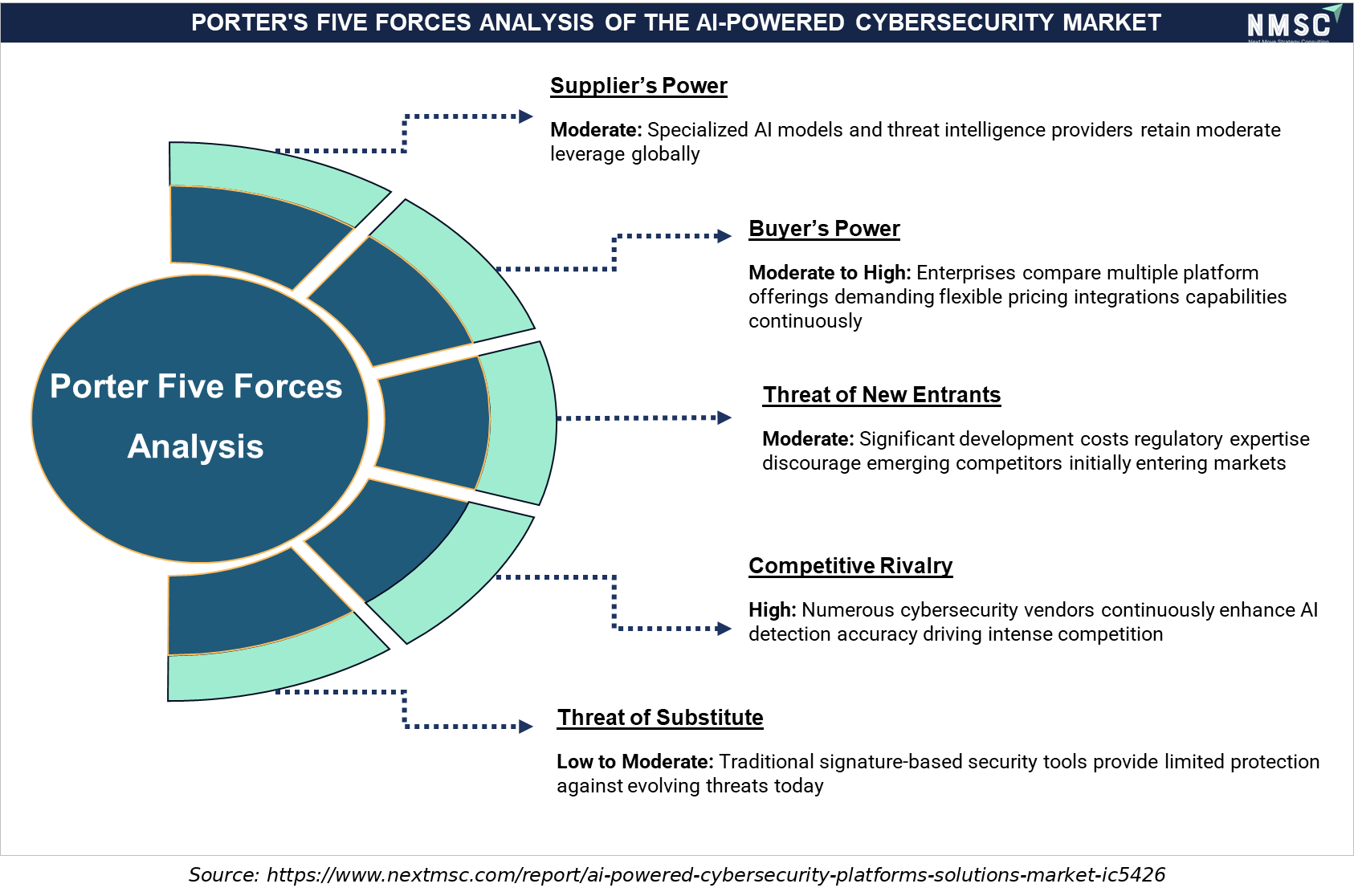
We observed that the competitive landscape is intensifying as platform vendors race to embed autonomous AI capabilities across the full security stack.
|
Aspect |
Details |
|
Market Structure |
Moderately fragmented with a core group of large platform vendors and numerous point-solution specialists across sub-segments |
|
Innovation Focus |
Agentic AI, autonomous response, and unified data-lake correlation across telemetry sources |
|
M&A Activity |
Elevated, led by platform vendors acquiring identity, exposure management, and data security specialists |
Source: www.nextmsc.com
Companies compete primarily on breadth of platform coverage, detection accuracy, and integration ease across existing enterprise technology stacks. Our analysis shows that pricing increasingly follows consumption-based models tied to endpoint or identity counts rather than flat licensing, intensifying competition on total cost of ownership across enterprise renewal cycles.
Two archetypes dominate the industry: broad platform consolidators such as Microsoft Corporation and CrowdStrike Holdings, Inc. that bundle endpoint, identity, and cloud modules, and focused specialists such as Tenable Holdings, Inc. and Varonis Systems, Inc. that lead narrowly in exposure management and data security respectively. This bifurcation shapes differentiated go-to-market strategies across the vendor landscape.
Vendors are pursuing differentiation through proprietary threat-intelligence graphs, autonomous remediation agents, and expanding geographic sales coverage via cloud marketplace listings. We found that Zscaler, Inc. and Cloudflare, Inc. have expanded channel partnerships to accelerate mid-market penetration, reflecting a broader industry shift toward partner-led go-to-market expansion.
M&A activity remains elevated as platform vendors acquire specialists to close capability gaps rather than build organically. Our assessment indicates that this consolidation trend is compressing the pool of independent point-solution vendors and accelerating platform-breadth competition, particularly across identity, exposure management, and data security resilience niches.
Next Move Strategy Consulting's analysis indicates that the following companies represent the leading validated participants shaping the AI-powered Cybersecurity platforms solutions market.
Microsoft Corporation
Palo Alto Networks, Inc.
Fortinet, Inc.
CrowdStrike Holdings, Inc.
Check Point Software Technologies Ltd.
Zscaler, Inc.
Akamai Technologies, Inc.
F5, Inc.
Cloudflare, Inc.
Proofpoint, Inc.
Trend Micro Incorporated
Okta, Inc.
SentinelOne, Inc.
SailPoint, Inc.
Rubrik, Inc.
Tenable Holdings, Inc.
Qualys, Inc.
Rapid7, Inc.
Varonis Systems, Inc.
ESET, spol. s r.o.
We observed continued platform-expansion activity among leading vendors through 2025 and 2026.
|
Date |
Event |
|
July 2026 |
CrowdStrike Holdings, Inc. expanded its strategic partnership with Schwarz Digits to deliver sovereign Cybersecurity across Europe on the STACKIT cloud platform, and signed a definitive agreement to acquire the intellectual property of attack path visualization firm XM Cyber. |
|
March 2026 |
Cloudflare, Inc. launched advanced AI-native security tools during Developer Week 2026, introducing an AI Firewall and specialized WAF rulesets engineered to inspect incoming requests and block prompt injection attacks, data exfiltration, and model abuse. |
|
September 2025 |
CrowdStrike Holdings, Inc. unveiled the Fall release of the Falcon platform, introducing the Enterprise Graph AI-ready data layer and Charlotte AI AgentWorks to enable organizations to build, deploy, and govern trusted security agents at scale. |
Source: www.nextmsc.com
“AI is changing how businesses operate, but traditional security approaches were not designed to secure AI. Business leaders are looking for a comprehensive solution—not more point products. At Zscaler, we're providing the security necessary for leaders to move forward with confidence and embrace the full spectrum of AI. We aren't just securing the AI era; we're accelerating it.”
— Jay Chaudhry, CEO, Chairman, and Founder, Zscaler
Statement made during the launch of Zscaler's AI Security Suite, discussing the need for comprehensive AI-powered Cybersecurity platforms to enable secure enterprise AI adoption.
The statement highlights the growing demand for AI-powered Cybersecurity platforms that can securely support enterprise AI adoption while addressing emerging cyber risks associated with generative and agentic AI. As organizations rapidly integrate AI into business operations, conventional security architectures are proving inadequate for protecting AI applications, data, and workflows. Consequently, enterprises are increasingly investing in unified AI-driven Cybersecurity platforms that combine Zero Trust security, AI governance, threat detection, data protection, and automated risk management to secure AI ecosystems while enabling innovation and accelerating digital transformation.
Capital inflows into AI-native security platforms have remained strong, with venture and private-equity funding concentrated in exposure management, identity security, and data resilience specialists. Our assessment indicates that this funding pattern reflects investor conviction in categories showing the fastest projected CAGR through 2035, ahead of more mature endpoint and network security segments.
Infrastructure investment is concentrated in expanding cloud-native detection capacity and global data-processing footprints to satisfy data-residency requirements. We observed that vendors including Akamai Technologies, Inc. and Cloudflare, Inc. continue to expand edge infrastructure to support low-latency threat detection at scale across distributed enterprise environments.
ESG considerations increasingly influence vendor selection, as enterprises weigh data-governance practices and disclosure transparency alongside platform capability. Rising Cybersecurity insurance requirements are also reinforcing governance-linked procurement criteria, with insurers increasingly requiring documented AI-platform coverage as a condition of favorable premium terms.
Enterprise security leaders gain access to reconciled market-sizing data, segmentation benchmarks, and competitive positioning analysis that inform platform procurement and vendor-consolidation decisions. Our findings suggest that this analysis supports budget justification for autonomous AI platform investment ahead of 2035 forecast milestones.
Investors and financial analysts benefit from reconciled revenue forecasts, CAGR benchmarks, and competitive-landscape insights that support capital-allocation decisions across platform categories. This report's data enables comparative evaluation of growth trajectories across sub-segments through the 2026–2035 forecast period.
Technology vendors and product teams benefit from segmentation and regional analysis that identify whitespace opportunities across platform categories, deployment modes, and geographies. Our analysis supports product-roadmap prioritization and go-to-market sequencing across the fastest-growing sub-segments identified in this report.
By Platform Category
Endpoint and XDR
Endpoint Protection Platform
Endpoint Detection and Response
Endpoint Extended Detection and Response
Autonomous Response
Other Endpoint and XDR
Network and SASE
Next-Generation Firewall
Secure Web Gateway
Cloud Access Security Broker
Zero Trust Network Access
Firewall as a Service
Secure Access Service Edge
DNS Security
Other Network and SASE
Cloud and Workload
Cloud-Native Application Protection Platform
Cloud Security Posture Management
Cloud Workload Protection Platform
Kubernetes Security Posture Management
Container Security
Serverless Security
Other Cloud and Workload
Identity Security
Identity and Access Management
Customer Identity and Access Management
Identity Governance and Administration
Privileged Access Management
Machine Identity Security
Identity Threat Detection and Response
Other Identity Security
Security Operations
Security Information and Event Management
Security Orchestration Automation and Response
Security Operations Centre Analytics
Security Operations Extended Detection and Response
Other Security Operations
Data Security and Resilience
Data Loss Prevention
Data Security Posture Management
Data Classification and Governance
Backup and Recovery
Ransomware Recovery
Other Data Security and Resilience
Application and API Security
Static Application Security Testing
Dynamic Application Security Testing
Web Application Firewall
API Security
Bot Management
Other Application and API Security
Email and Collaboration Security
Secure Email Gateway
Phishing Defence
Business Email Compromise Defence
Collaboration Security
Other Email and Collaboration Security
Exposure Management
Vulnerability Management
Attack Surface Management
Cyber Asset Attack Surface Management
Continuous Threat Exposure Management
Attack Path Analysis
Other Exposure Management
Edge Security and Delivery
CDN Security
Edge DDoS Protection
Application Delivery Security
Other Edge Security and Delivery
OT and IoT Security
Industrial Control System Security
SCADA Security
Industrial IoT Security
Connected Device Security
Other OT and IoT Security
Other Security Platforms
Threat Intelligence
AI Security Governance
By Deployment Mode
Cloud Delivered
On-Premises
Hybrid
By Organization Size
Large Enterprise
Mid-Market
Small Business
By Revenue Stream
Subscription and License
Professional Services
By Sales Channel
Direct Sales
Channel Partners
Managed Security Service Providers
Cloud Marketplaces
By End User Industry
BFSI
Technology
Public Sector
Healthcare
Retail
Industrial and Manufacturing
Telecom
Energy and Utilities
Other Industries
By Region
North America: U.S., Canada, Mexico.
Europe: UK, Germany, France, Italy, Spain, Sweden, Denmark, Finland, Netherlands, Rest of Europe.
Asia-Pacific: China, India, Japan, South Korea, Taiwan, Indonesia, Vietnam, Australia, Philippines, Malaysia, Rest of APAC.
Middle East & Africa: Saudi Arabia, UAE, Egypt, Israel, Turkey, Nigeria, South Africa, Rest of MEA.
Latin America: Brazil, Argentina, Chile, Colombia, Rest of LATAM.
The long-term outlook remains strongly positive, with the market projected to expand from USD 28.10 billion in 2026 to USD 145.00 billion by 2035 at a 20.0% CAGR. Our analysis shows sustained demand across every segmentation axis, positioning AI-native platforms as the default architecture for enterprise security operations through the forecast period.
Vendors should prioritize platform breadth and autonomous response capability to capture consolidation-driven spend. Our findings suggest that expanding managed-service and marketplace channels will be critical for penetrating mid-market and small-business segments that currently register the fastest projected growth rates through 2035.
The market presents high investment attractiveness given its double-digit CAGR and structural tailwinds from regulatory mandates and escalating threat activity. Our assessment indicates that exposure management, identity security, and hybrid deployment sub-segments offer the most favorable risk-adjusted growth profiles for capital allocation.
Key shifts include accelerating platform consolidation and agentic AI adoption, while primary risks include high switching costs and data-residency constraints that could slow enterprise migration. Our analysis shows these risks are most pronounced among heavily regulated organizations in Europe and the Middle East & Africa.
Primary growth pathways include expanding cloud-delivered and hybrid deployment options, deepening managed security service provider partnerships, and extending platform coverage into OT and IoT environments. We observed that vendors pursuing these pathways are best positioned to capture the USD 116.90 billion incremental opportunity through 2035.