
AI Roof Inspection Market Size, Share, Trends and Growth Analysis, By Component (Software, and Services), By Deployment Mode (Cloud, On-Premises, and Hybrid), By Inspection Method (Drone-Based, Ground-Based, and Hybrid), By Imaging Technology (Visual Imaging, Thermal Imaging, LiDAR Imaging, Multispectral Imaging, and Multi-Modal Imaging), By Application, By Roof Type, By Building Type, By End User— Global Industry Report and Forecast, 2026–2035
Industry: Construction & Manufacturing | Publishing Date: July 14, 2026 | Last Updated: September 30, 2026 | No of Pages: N/A | No. of Tables: N/A | No. of Figures: N/A | Format: PDF | Report Code: CM5137
What Is the AI Roof Inspection Market Size?
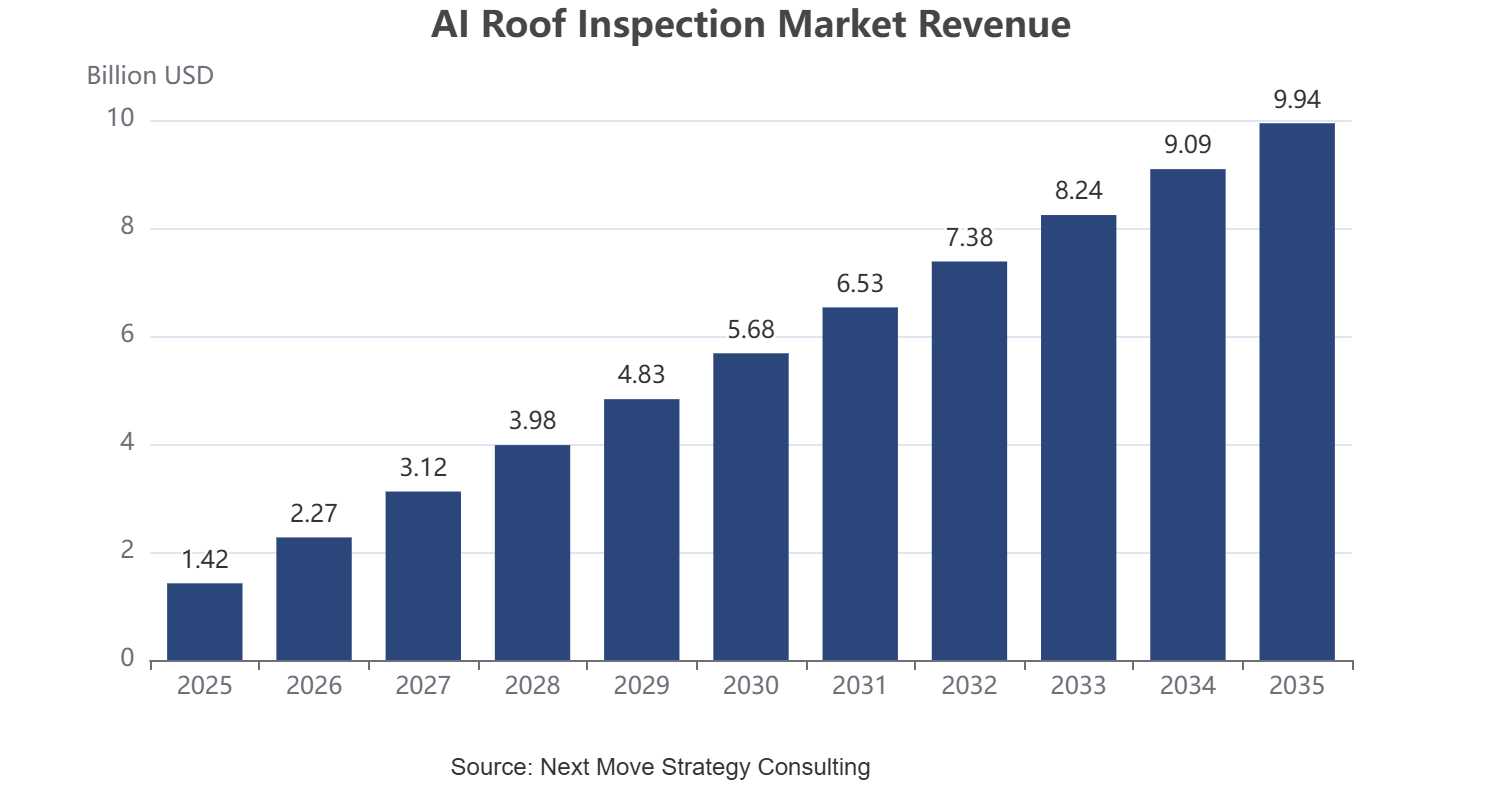
The global AI Roof Inspection Market size was valued at USD 1.42 Billion in 2025 and is estimated at USD 1.71 Billion in 2026, forecast to reach USD 9.94 Billion by 2035, expanding at a 21.6% CAGR between 2026 and 2035. North America leads with approximately 36% share, while under component, Software dominates with approximately 58% share.
We observed that adoption is broad-based across every segmentation axis, with drone-based imaging and insurance-claims workflow integration driving the dominant structural shifts through 2035.
Key Takeaways
The following table consolidates the dominant and fastest-growing sub-segments across every segmentation axis of the AI Roof Inspection Market as of 2025.
|
Key Takeaways |
|
By Component: Software held the largest share of approximately 58% (USD 824.0 Million) in 2025; Services is the fastest-growing sub-segment at 20.2% CAGR from 2026–2035. |
|
By Deployment Mode: Cloud held the largest share of approximately 64% (USD 908.8 Million) in 2025; Hybrid is the fastest-growing sub-segment at 24.1% CAGR from 2026–2035. |
|
By Inspection Method: Drone-Based held the largest share of approximately 61% (USD 867.0 Million) in 2025; Ground-Based imaging trails, while Hybrid is the fastest-growing sub-segment at 21% CAGR from 2026–2035. |
|
By Imaging Technology: Visual Imaging held the largest share of approximately 46% (USD 653.2 Million) in 2025; Thermal Imaging is the fastest-growing sub-segment at 23.8% CAGR from 2026–2035. |
|
By Application: Damage Detection held the largest share of approximately 34% (USD 483.0 Million) in 2025; Preventive Maintenance is the fastest-growing sub-segment at 24.9% CAGR from 2026–2035. |
|
By Roof Type: Steep-Slope held the largest share of approximately 57% (USD 809.4 Million) in 2025; Low-Slope is the fastest-growing sub-segment at 22.9% CAGR from 2026–2035. |
|
By Building Type: Residential held the largest share of approximately 49% (USD 695.8 Million) in 2025; Commercial is the fastest-growing sub-segment at 22.4% CAGR from 2026–2035. |
|
By End User: Roofing Contractors held the largest share of approximately 31% (USD 440.2 Million) in 2025; Insurance Carriers is the fastest-growing sub-segment at 23.2% CAGR from 2026–2035. |
|
Dominant Region: North America dominated with approximately 36% revenue share (USD 511.0 Million) in 2025. |
|
Fastest-Growing Region: Asia-Pacific is expected to register the highest CAGR of 25.3% during 2026–2035. |
|
Dominant Country: U.S. led with approximately USD 419.0 Million in 2025. |
|
Fastest-Growing Country: India is the fastest-growing country at approximately 26.8% CAGR from 2026–2035. |
Between 2026 and 2035, the AI Roof Inspection Market is set to generate an absolute dollar opportunity of USD 8.23 Billion, positioning drone-based analytics and insurance-claims automation as a compelling area for capital allocation.
According to Next Move Strategy Consulting analysis, sustained investment in autonomous drone platforms and predictive maintenance analytics is reshaping procurement criteria for property owners, as inspection turnaround time increasingly determines vendor selection across insurance and roofing-contractor channels.
What Does the AI Roof Inspection Market Encompass?
The AI Roof Inspection Market encompasses software platforms and inspection services that apply computer vision, machine learning, and aerial or ground-based imaging to assess roof condition, detect damage, and generate measurement and claims-ready reports without manual ladder-based inspection. Our assessment indicates that the scope spans inspection analytics, workflow software, and property intelligence tools supplied to roofing contractors, insurance carriers, property owners, and construction companies across residential, commercial, industrial, and institutional building categories. The category has evolved from manual drone photography into an integrated analytics discipline, driven by insurance-claims automation, contractor productivity demands, and the premiumization of proactive property-risk management.
Regulatory frameworks such as the U.S. Federal Aviation Administration's Part 107 small unmanned aircraft rules and the European Union Aviation Safety Agency's drone operation regulations shape commercial inspection-flight requirements, while state-level insurance department guidelines increasingly influence claims-documentation standards. We observed that technology adoption is shifting toward autonomous, AI-driven flight and analytics pipelines that reduce reliance on pilot-assisted operations. Next Move Strategy Consulting's analysis indicates that this structural shift, combined with rising catastrophe-driven claims volume, is redefining sourcing criteria across the AI Roof Inspection Market.
|
Parameters |
Details |
|
Market Size in 2025 |
USD 1.42 Billion |
|
Market Size in 2026 |
USD 1.71 Billion |
|
Revenue Forecast in 2035 |
USD 9.94 Billion |
|
Growth Rate |
CAGR of 21.6% from 2026 to 2035 |
|
Analysis Period |
2025–2035 |
|
Base Year Considered |
2025 |
|
Forecast Period |
2026–2035 |
|
Market Size Estimation |
Revenue (USD Billion) |
|
Companies Profiled |
17 |
|
Countries Covered |
37 |
|
Market Share |
Available for Top 10 Companies |
Key Emerging Trends
Based on research conducted by Next Move Strategy Consulting, we found that four structural trends are reshaping product development, service delivery, and stakeholder engagement across the AI Roof Inspection Market.
How Is Autonomous Drone Technology Transforming Roof Inspection Accuracy?
Autonomous drone platforms capable of pre-programmed flight paths and obstacle avoidance are replacing pilot-assisted operations across large-scale inspection programs. We observed that Loveland Innovations expanded its Sherpa autonomous capture platform in 2025 to support multi-property portfolio inspections without dedicated on-site pilots. Insurance carriers and roofing contractors are adopting these platforms to standardize image capture consistency, while reducing per-inspection labor costs across residential and commercial claims workflows nationwide.
Why Is Thermal and Multispectral Imaging Gaining Adoption in Damage Detection?
Thermal and multispectral imaging technologies are gaining share as insurers and contractors seek to detect subsurface moisture intrusion and latent hail damage invisible to conventional visual imaging. Our findings suggest that hybrid inspection programs increasingly pair visual capture with thermal overlays to substantiate claims documentation. Manufacturers such as Flyability are expanding sensor payload options, positioning multi-modal imaging as a premium, higher-accuracy category within the broader AI Roof Inspection Market segmentation structure.
How Is Insurance Claims Integration Reshaping Workflow Software Requirements?
Direct integration between inspection analytics platforms and carrier claims-management systems is pushing suppliers toward standardized, API-driven reporting formats. We observed that inspection platforms increasingly generate carrier-ready estimates compatible with major claims-processing software before dispatch to adjusters. This trend is elevating demand for claims-integration modules among insurance-carrier end users, while software vendors redesign workflows to minimize manual data re-entry during first-notice-of-loss processing.
What Role Does Predictive Maintenance Analytics Play in Property Intelligence?
Predictive maintenance analytics is emerging as a proactive alternative to reactive, damage-triggered inspection cycles. Our analysis shows that property owners and managers in commercial real estate are piloting portfolio-wide condition-scoring tools that flag roofs approaching end-of-life before failure occurs. Cape Analytics' portfolio risk-scoring expansion, announced in 2025, exemplifies this direction with property-level digital-twin analytics engineered for repeat use across multi-site commercial portfolios.
Regulatory Framework Impacting the AI Roof Inspection Industry
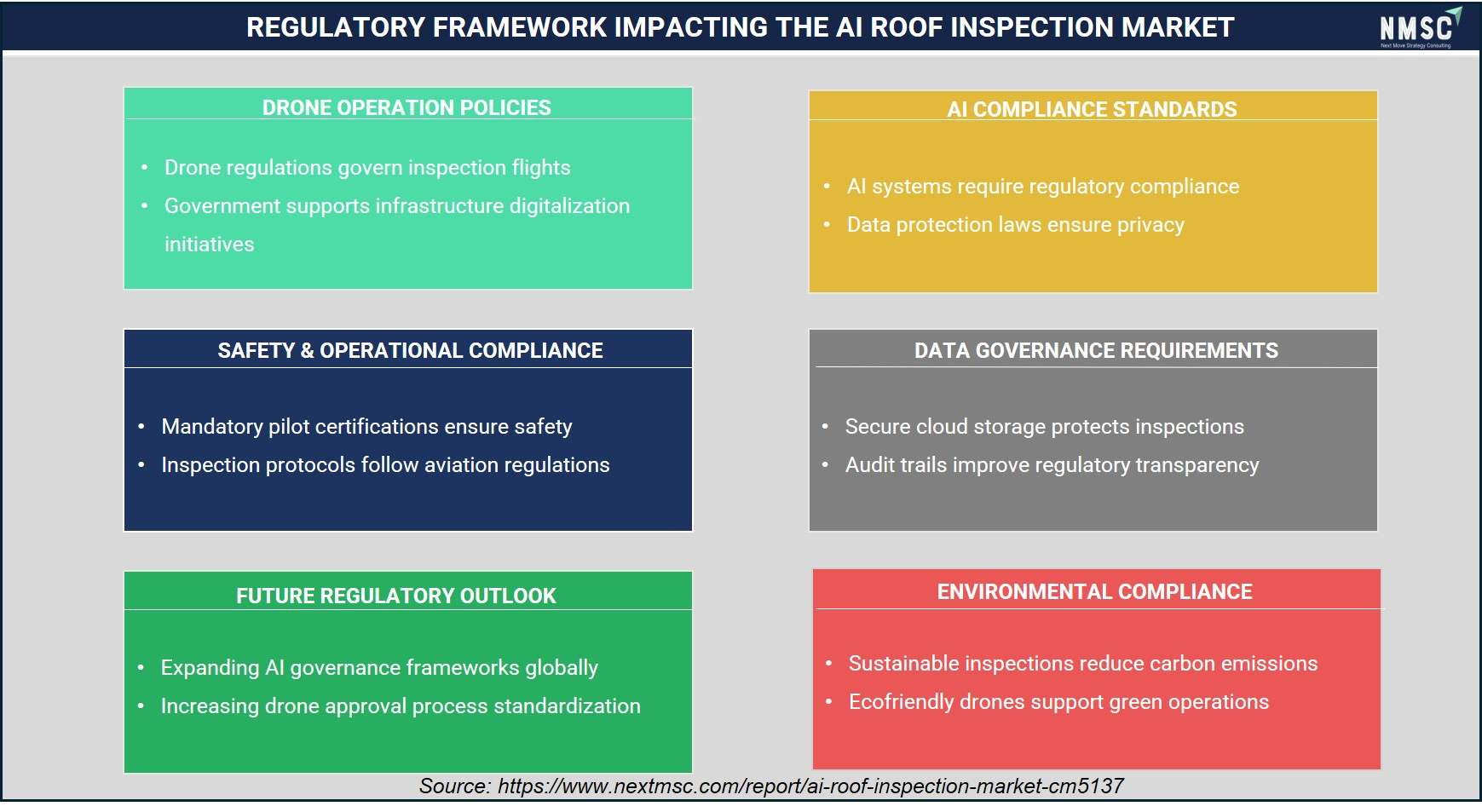
Based on our regulatory assessment, we observed that drone operation policies, AI compliance standards, aviation safety regulations, data governance requirements, and environmental compliance collectively shape the AI roof inspection market. Moreover, our industry evaluation indicates that standardized regulatory frameworks enhance operational transparency, strengthen inspection reliability, and accelerate secure adoption of AI-powered roof inspection solutions across global markets.
Growth Drivers and Restraints
Growth Catalyst and Risk Assessment Matrix
|
Factors |
Type |
(+/−) % Impact on CAGR |
Geographic Relevance |
Impact Timeline |
|
Rising frequency of severe convective storms and hail events |
Driver |
+2.4% |
North America, Europe |
2026–2035 |
|
Insurance carrier adoption of AI-based claims automation |
Driver |
+2.0% |
Global |
2026–2035 |
|
Expansion of commercial autonomous drone regulations |
Driver |
+1.7% |
North America, Europe, Asia-Pacific |
2026–2035 |
|
Growing property portfolio digitization by REITs |
Driver |
+1.3% |
North America, Asia-Pacific |
2026–2035 |
|
Contractor productivity and labor-shortage pressures |
Driver |
+1.1% |
Global |
2026–2032 |
|
Rising institutional and government roof-asset audits |
Driver |
+0.8% |
Global |
2026–2035 |
|
Airspace and drone-operation regulatory restrictions |
Restraint |
−1.3% |
Asia-Pacific, Middle East & Africa |
2026–2035 |
|
Data privacy and property-imagery consent concerns |
Restraint |
−0.9% |
Europe, North America |
2026–2032 |
|
High upfront cost of sensor-equipped inspection hardware |
Restraint |
−0.7% |
Latin America, Middle East & Africa |
2028–2035 |
What Is the Primary Growth Driver of the AI Roof Inspection Market?
Rising frequency of severe convective storms and hail events is the primary driver of the AI Roof Inspection Market. The U.S. National Oceanic and Atmospheric Administration's Storm Events Database continues to record elevated annual hail and wind-damage event counts across central and southeastern states, sustaining insurance-carrier demand for rapid, standardized roof-damage assessment. We observed that this climate-driven claims volume, reinforced by rebuilding-cycle timelines, continues to anchor baseline consumption of drone-based and thermal-imaging inspection tools across developed markets.
How Is Insurance Automation Driving AI Roof Inspection Market Growth?
Insurance carrier adoption of AI-based claims automation is accelerating AI Roof Inspection Market growth toward integrated software platforms. The U.S. Federal Emergency Management Agency's disaster-response coordination guidance is pushing carriers toward faster, evidence-backed claims cycles following declared catastrophe events. Our assessment indicates that this operational pressure, combined with contractor productivity demands, is compressing adoption timelines for cloud-based inspection analytics across North America and Europe.
What Is Restraining AI Roof Inspection Market Expansion?
Airspace and drone-operation regulatory restrictions, tied to varying national aviation authority requirements, restrain expansion across the AI Roof Inspection Market supply chain. The U.S. Federal Aviation Administration's Part 107 licensing and waiver requirements govern commercial drone-flight operations and can delay large-scale inspection-program rollouts. We found that smaller regional service providers face particular exposure, as limited scale reduces their ability to secure beyond-visual-line-of-sight waivers compared with larger, nationally licensed inspection firms.
Segmentation Analysis
Segment Sizing: By Component
|
Segment |
2025 (USD) |
2035 (USD) |
CAGR% (2026–2035) |
|
Software |
USD 824.0 Million |
USD 6.17 Billion |
22.5% |
|
Services |
USD 596.0 Million |
USD 3.77 Billion |
20.2% |
|
Total |
USD 1.42 Billion |
USD 9.94 Billion |
21.6% |
Which Component Segment Dominates the AI Roof Inspection Market?
Software, encompassing inspection analytics, workflow software, and property intelligence tools, led the AI Roof Inspection Market with USD 824.0 Million in 2025, supported by recurring subscription revenue and deep integration with insurance claims systems. We observed that Services is the fastest-growing component, expanding at a 20.2% CAGR from 2026 to 2035, as roofing contractors and property owners increasingly outsource drone and ground-based inspection execution to specialized providers.
Segment Sizing: By Inspection Method
|
Segment |
2025 (USD) |
2035 (USD) |
CAGR% (2026–2035) |
|
Drone-Based |
USD 867.0 Million |
USD 6.65 Billion |
22.8% |
|
Ground-Based |
USD 383.0 Million |
USD 2.15 Billion |
18.6% |
|
Hybrid |
USD 170.0 Million |
USD 1.14 Billion |
21% |
|
Total |
USD 1.42 Billion |
USD 9.94 Billion |
21.6% |
Which Inspection Method Leads AI Roof Inspection Market Adoption?
Drone-Based inspection remained the leading method within the AI Roof Inspection Market, valued at USD 867.0 Million in 2025 on sustained autonomous and pilot-assisted flight adoption across residential and commercial portfolios. Our findings suggest that Hybrid inspection is the fastest-growing method, registering a 21% CAGR from 2026 to 2035, as insurers increasingly combine aerial and ground-based capture to improve claims-documentation completeness across complex roof geometries.
Segment Sizing: By Application
|
Segment |
2025 (USD) |
2035 (USD) |
CAGR% (2026–2035) |
|
Damage Detection |
USD 483.0 Million |
USD 3.34 Billion |
21.4% |
|
Measurement Estimation |
USD 227.0 Million |
USD 1.40 Billion |
19.9% |
|
Condition Assessment |
USD 256.0 Million |
USD 1.74 Billion |
21.2% |
|
Preventive Maintenance |
USD 170.0 Million |
USD 1.52 Billion |
24.9% |
|
Claims Assessment |
USD 185.0 Million |
USD 1.40 Billion |
22.6% |
|
Compliance Quality Assurance |
USD 99.0 Million |
USD 546.0 Million |
18.4% |
|
Total |
USD 1.42 Billion |
USD 9.94 Billion |
21.6% |
Which Application Segment Leads AI Roof Inspection Market Demand?
Damage Detection remained the leading application within the AI Roof Inspection industry, valued at USD 483.0 Million in 2025 on sustained hail, wind, and water-intrusion assessment volume. Based on research conducted by Next Move Strategy Consulting, we found that Preventive Maintenance is the fastest-growing application, registering a 24.9% CAGR from 2026 to 2035, as property owners increasingly shift from reactive damage claims toward proactive, condition-based roof-asset management programs.
Growth Opportunities
Our analysis shows that three forward-looking opportunities stand out for stakeholders positioning within the AI Roof Inspection industry over the 2026–2035 forecast period.
How Are Predictive Maintenance Platforms Creating Opportunities for Institutional Property Owners?
Predictive maintenance analytics present a whitespace opportunity for institutional and commercial property owners seeking to shift from reactive to condition-based roof-asset management. Suppliers that commercialize portfolio-wide risk-scoring tools stand to capture recurring subscription revenue as property owners and managers move toward continuous monitoring models across multi-site commercial and institutional building portfolios.
Why Are Claims-Integration APIs Emerging as a Growth Opportunity for Insurance Carriers?
Insurance carriers represent an underpenetrated opportunity for vendors offering direct, API-based integration between inspection analytics and claims-management systems. Providers that develop validated, carrier-certified reporting pipelines can secure long-term enterprise contracts with insurance-carrier end users, benefiting from recurring per-claim licensing revenue tied to catastrophe-response and first-notice-of-loss workflows.
How Are Digital Twin Analytics Unlocking Opportunities for Construction Companies?
Construction companies and roofing contractors seeking as-built documentation accuracy create an opportunity for vendors offering digital twin analytics integrated with project-management platforms. Early movers that secure adoption among large national construction companies can differentiate with property owners pursuing lifecycle roof-asset documentation across new-build and renovation portfolios.
Regional Outlook
|
Region |
2025 (USD) |
2035 (USD) |
CAGR% (2026–2035) |
Key Driver |
|
North America |
USD 511.0 Million |
USD 3.11 Billion |
19.7% |
Severe convective storm frequency and insurance claims automation |
|
Europe |
USD 341.0 Million |
USD 2.19 Billion |
20.4% |
Drone regulation harmonization and property digitization |
|
Asia-Pacific |
USD 312.0 Million |
USD 2.86 Billion |
25.3% |
Construction boom and rising contractor productivity demand |
|
Middle East & Africa |
USD 142.0 Million |
USD 1.02 Billion |
21.9% |
Government infrastructure audit programs |
|
Latin America |
USD 114.0 Million |
USD 770.0 Million |
21.1% |
Expanding insurance-sector claims digitization |
|
Total |
USD 1.42 Billion |
USD 9.94 Billion |
21.6% |
|
North America AI Roof Inspection Market
North America leads the AI Roof Inspection industry with USD 511.0 Million in 2025, reflecting mature insurance-carrier adoption and dense catastrophe-driven claims volume. We observed that the region benefits from established Part 107 drone-operation frameworks and widespread contractor familiarity with aerial inspection tools. Technology adoption is advancing through claims-integration APIs and predictive maintenance analytics, with the region's growth strategy centered on deepening enterprise software penetration among national insurance carriers and roofing-contractor networks.
Europe AI Roof Inspection Market
Europe held USD 341.0 Million in 2025, supported by growing property-portfolio digitization among commercial real estate owners and harmonized drone-operation rules under the European Union Aviation Safety Agency. Our assessment indicates that data-privacy considerations shape imagery-handling protocols across member states. Regulatory clarity and rising institutional roof-audit programs are driving steady technology adoption, with strategic outlook favoring vendors that demonstrate compliant, privacy-conscious data-capture workflows.
Asia-Pacific AI Roof Inspection Market
Asia-Pacific reached USD 312.0 Million in 2025 and is projected to register the fastest regional CAGR of 25.3% through 2035. Our findings suggest that rapid construction activity and rising contractor productivity demands are accelerating adoption across China, India, and Southeast Asian markets. Regulatory frameworks remain uneven across countries, and technology penetration is advancing fastest among large national construction companies, with strategic outlook favoring vendors that localize compliance and language support.
Middle East & Africa AI Roof Inspection Market
Middle East & Africa accounted for USD 142.0 Million in 2025, driven by government-led infrastructure audit programs and expanding commercial construction in the Gulf states. We observed that regulatory frameworks governing commercial drone operations remain a key adoption consideration across the region. Technology penetration is concentrated among public agencies and large construction companies, with strategic outlook favoring vendors offering government-compliant deployment models.
Latin America AI Roof Inspection Market
Latin America generated USD 114.0 Million in 2025, supported by expanding insurance-sector claims digitization in Brazil and Argentina. Our analysis shows that regulatory frameworks for commercial drone operation continue to mature across the region, moderating near-term adoption pace. Technology penetration remains concentrated among larger insurance carriers and property-management firms, with strategic outlook favoring vendors that offer flexible, lower-cost deployment models suited to price-sensitive contractor segments.
U.S. AI Roof Inspection Market
Based on our engagements, the U.S. AI Roof Inspection industry was valued at approximately USD 419.0 Million in 2025 and is projected to reach approximately USD 2.49 Billion by 2035, expanding at a 19.4% CAGR. Demand structure remains anchored in insurance-carrier claims automation, with high technology penetration and dense contractor adoption. Regulatory clarity under Part 107 supports competitive intensity among national and regional inspection providers, and strategic outlook favors continued claims-integration deepening.
Canada AI Roof Inspection Market
Through our analysis, the Canada AI Roof Inspection industry was valued at approximately USD 92.0 Million in 2025 and is projected to reach approximately USD 598.0 Million by 2035, expanding at a 20.6% CAGR. Demand structure centers on residential contractor adoption and provincial insurance-claims digitization. Technology penetration trails the U.S. modestly, while Transport Canada's drone regulations shape commercial flight operations, and strategic outlook favors expansion of cloud-based inspection analytics among mid-sized contractors.
UK AI Roof Inspection Market
From our assessment, the UK AI Roof Inspection industry was valued at approximately USD 82.0 Million in 2025 and is projected to reach approximately USD 513.0 Million by 2035, expanding at a 20.1% CAGR. Demand structure reflects growing commercial property-portfolio digitization and Civil Aviation Authority drone-operation compliance. Technology penetration is concentrated among larger property-management firms, and strategic outlook favors vendors offering data-privacy-compliant capture and reporting workflows.
Germany AI Roof Inspection Market
According to evaluation, the Germany AI Roof Inspection industry was valued at approximately USD 75.0 Million in 2025 and is projected to reach approximately USD 495.0 Million by 2035, expanding at a 20.8% CAGR. Demand structure is shaped by institutional roof-audit programs and stringent data-protection requirements under national implementation of European Union rules. Technology penetration is advancing among construction companies and public agencies, and strategic outlook favors compliance-certified analytics providers.
France AI Roof Inspection Market
Based on our engagements, the France AI Roof Inspection industry was valued at approximately USD 55.0 Million in 2025 and is projected to reach approximately USD 339.0 Million by 2035, expanding at a 19.9% CAGR. Demand structure reflects rising adoption among commercial property owners and construction companies pursuing digitized asset documentation. Regulatory oversight from the Direction Générale de l'Aviation Civile shapes drone-flight compliance, and strategic outlook favors partnerships with regional inspection-service providers.
China AI Roof Inspection Market
Through our analysis, the China AI Roof Inspection industry was valued at approximately USD 94.0 Million in 2025 and is projected to reach approximately USD 819.0 Million by 2035, expanding at a 24.6% CAGR. Demand structure is driven by large-scale construction activity and rapid contractor digitization. Technology penetration is expanding quickly among national construction companies, and strategic outlook favors vendors that localize software and secure domestic drone-operation approvals.
India AI Roof Inspection Market
From our assessment, the India AI Roof Inspection industry was valued at approximately USD 69.0 Million in 2025 and is projected to reach approximately USD 704.0 Million by 2035, expanding at a 26.8% CAGR. India is the fastest-growing country in the AI Roof Inspection industry, with demand structure centered on emerging contractor adoption and government infrastructure audit programs. Technology penetration remains early-stage but accelerating, and strategic outlook favors vendors offering cost-efficient, mobile-device-based inspection tools.
Japan AI Roof Inspection Market
According to evaluation, the Japan AI Roof Inspection industry was valued at approximately USD 50.0 Million in 2025 and is projected to reach approximately USD 286.0 Million by 2035, expanding at a 18.9% CAGR. Demand structure reflects institutional adoption among construction companies and public agencies focused on aging building-stock assessment. Technology penetration is steady but measured, and strategic outlook favors vendors integrating with established domestic construction-technology platforms.
South Korea AI Roof Inspection Market
Based on our engagements, the South Korea AI Roof Inspection industry was valued at approximately USD 31.0 Million in 2025 and is projected to reach approximately USD 219.0 Million by 2035, expanding at a 21.7% CAGR. Demand structure is shaped by dense urban commercial construction and rising contractor productivity demands. Technology penetration is advancing among mid-sized inspection firms, and strategic outlook favors partnerships with domestic drone-service operators.
Australia AI Roof Inspection Market
Through our analysis, the Australia AI Roof Inspection industry was valued at approximately USD 28.0 Million in 2025 and is projected to reach approximately USD 178.0 Million by 2035, expanding at a 20.3% CAGR. Demand structure reflects strong insurance-carrier adoption following recurring severe weather events. Technology penetration is comparatively high relative to regional peers, and strategic outlook favors continued claims-integration expansion among national insurers.
UAE AI Roof Inspection Market
From our assessment, the UAE AI Roof Inspection industry was valued at approximately USD 37.0 Million in 2025 and is projected to reach approximately USD 296.0 Million by 2035, expanding at a 23.4% CAGR. Demand structure centers on government-led infrastructure audit programs and expanding commercial construction. Technology penetration is concentrated among public agencies and large construction companies, and strategic outlook favors vendors offering government-compliant deployment models.
Saudi Arabia AI Roof Inspection Market
According to evaluation, the Saudi Arabia AI Roof Inspection industry was valued at approximately USD 34.0 Million in 2025 and is projected to reach approximately USD 284.0 Million by 2035, expanding at a 24% CAGR. Demand structure is driven by large-scale giga-project construction activity and rising institutional roof-asset audits. Technology penetration is expanding among government agencies and construction companies, and strategic outlook favors vendors supporting large-portfolio digital-twin analytics.
South Africa AI Roof Inspection Market
Based on our engagements, the South Africa AI Roof Inspection industry was valued at approximately USD 20.0 Million in 2025 and is projected to reach approximately USD 139.0 Million by 2035, expanding at a 21.5% CAGR. Demand structure reflects early-stage adoption among property owners and construction companies. Technology penetration remains limited relative to Gulf peers, and strategic outlook favors vendors offering flexible, lower-cost ground-based inspection tools.
Brazil AI Roof Inspection Market
Through our analysis, the Brazil AI Roof Inspection industry was valued at approximately USD 52.0 Million in 2025 and is projected to reach approximately USD 372.0 Million by 2035, expanding at a 21.9% CAGR. Demand structure is shaped by expanding insurance-sector claims digitization and growing contractor adoption. Technology penetration is advancing fastest among larger insurance carriers, and strategic outlook favors partnerships with regional inspection-service providers.
Argentina AI Roof Inspection Market
From our assessment, the Argentina AI Roof Inspection industry was valued at approximately USD 23.0 Million in 2025 and is projected to reach approximately USD 147.0 Million by 2035, expanding at a 20.4% CAGR. Demand structure reflects emerging adoption among property-management firms and insurance carriers. Technology penetration remains nascent, and strategic outlook favors vendors offering cost-efficient, mobile-device-based inspection tools suited to price-sensitive segments.
Pain Point Analysis of the AI Roof Inspection Industry
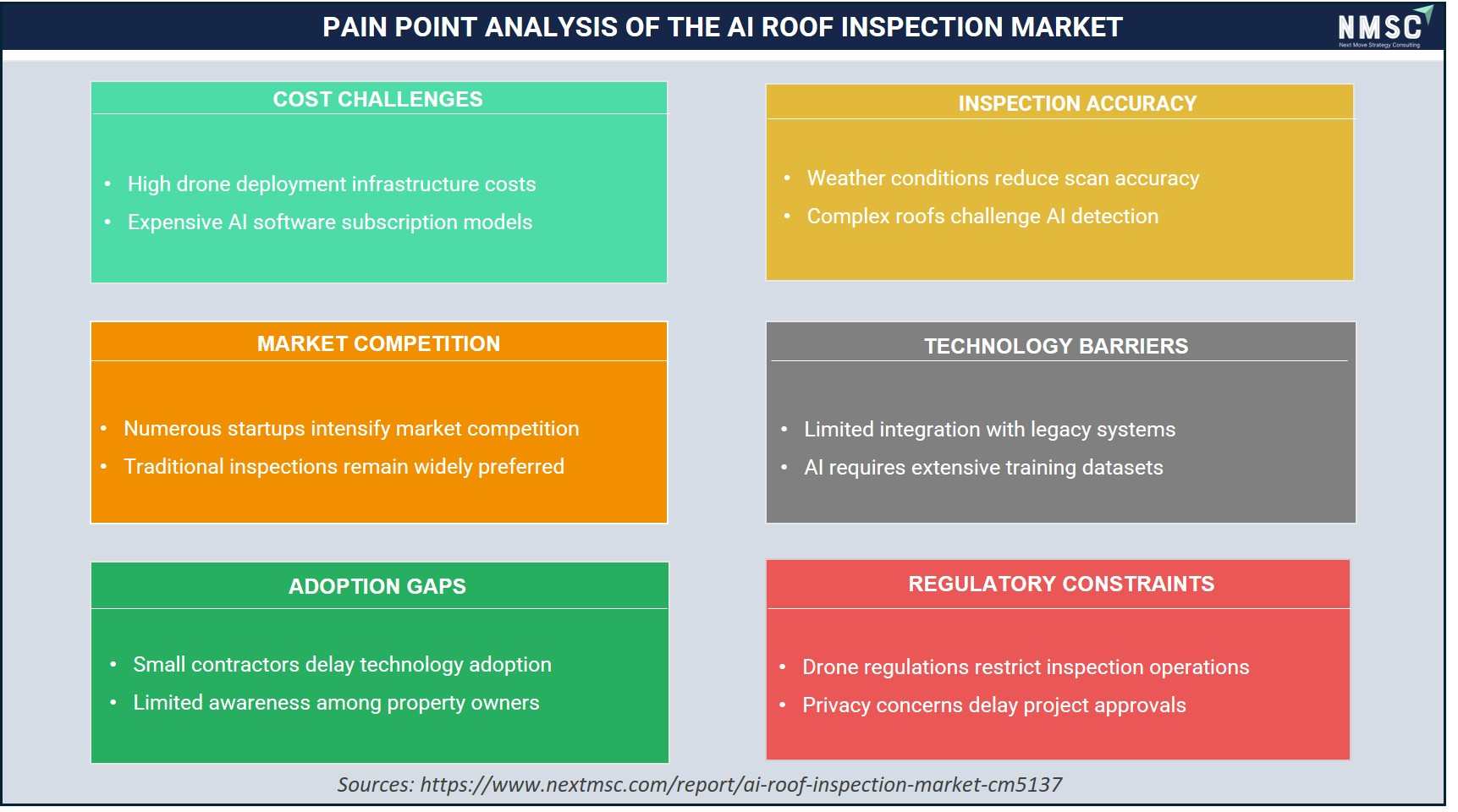
Based on our pain point assessment, we identified that high deployment costs, inspection accuracy limitations, technology integration barriers, and evolving regulatory requirements continue to influence adoption across the AI roof inspection market. Furthermore, our industry analysis indicates that addressing these operational challenges strengthens inspection efficiency, improves customer confidence, and supports broader deployment across residential and commercial infrastructure.
Competitive Landscape
We observed that the competitive landscape of the AI Roof Inspection Market spans established aerial-imagery providers, specialized inspection-analytics startups, and diversified property-data platforms, each pursuing distinct differentiation strategies.
|
Dimension |
Key Takeaway |
|
Market Structure |
Fragmented among aerial-imagery incumbents, analytics-focused startups, and diversified property-data platforms. |
|
Innovation Focus |
Autonomous flight, thermal and multispectral imaging, and claims-integration application programming interfaces. |
|
M&A Activity |
Selective acquisitions of analytics startups by larger aerial-imagery and property-data platforms to expand software capabilities. |
How Do Companies Compete in the AI Roof Inspection Market?
Companies compete primarily on inspection-analytics accuracy, turnaround speed, and depth of integration with insurance claims-management systems. We observed that vendors differentiate through proprietary damage-detection algorithms trained on large historical imagery datasets, alongside service-level agreements guaranteeing rapid report delivery to contractors and adjusters following catastrophe events.
Which Competitive Archetypes Dominate the AI Roof Inspection Market?
Three archetypes dominate the AI Roof Inspection Market: aerial-imagery incumbents with large historical property-data libraries, analytics-focused specialists offering deep damage-detection and measurement software, and diversified property-intelligence platforms bundling inspection with broader portfolio-risk analytics. Our findings suggest that data-library scale and claims-integration depth explain sustained dominance among the largest players.
What Innovation and Differentiation Strategies Define Competitive Advantage?
Innovation strategy centers on expanding autonomous flight capability, thermal and multispectral sensor integration, and predictive maintenance analytics. Our analysis shows that leading vendors are investing in machine-learning model refinement using proprietary imagery libraries, while smaller entrants differentiate through niche vertical focus such as institutional or agricultural roof-asset monitoring.
What Level of M&A Activity Characterizes the AI Roof Inspection Market?
Merger and acquisition activity remains selective, concentrated on larger aerial-imagery and property-data platforms acquiring specialized analytics startups to expand software capability and geographic reach. We observed that such transactions typically target companies with proprietary damage-detection models or established insurance-carrier relationships, reflecting a strategic preference for capability acquisition over horizontal consolidation.
Key Market Players
We observed that the AI Roof Inspection Market features a competitive set of established aerial-imagery providers, analytics specialists, and property-intelligence platforms operating across the global inspection value chain.
-
EagleView Technologies, Inc.
-
Nearmap Ltd.
-
Verisk Analytics, Inc.
-
HOVER Inc.
-
Roofr Inc.
-
Loveland Innovations, LLC
-
Cape Analytics, Inc.
-
vHive Tech Ltd.
-
SkySpecs, Inc.
-
Flyability SA
-
QEA Tech Inc.
-
Hammer Missions GmbH
-
Kespry, Inc.
-
AgEagle Aerial Systems Inc.
-
Defy Hi Pty Ltd.
-
ScanShield AI
-
JobNimbus, LLC
Latest Developments
We observed that recent product launches and platform expansions reflect accelerating innovation across the AI Roof Inspection Market.
|
Date |
Event |
|
February 2026 |
Nearmap introduced a major AI-powered capability for commercial property owners and government facility management teams. The solution allows for remote evaluation of roof conditions across entire portfolios using high-resolution aerial imagery. By replacing fragmented, subjective site visits with a centralized system of record, Nearmap enables organizations to prioritize capital investments and monitor thousands of sites without deploying inspectors. |
|
February 2025 |
Marking a significant move toward consumer-facing AI, HOVER launched its "Instant Design" platform. This AI-powered tool allows homeowners and contractors to instantly visualize home renovations (including roofing) using a single photo. This continues the industry trend of "bringing the visual economy to home renovation," where AI is used to drive lead conversion and sales before a physical inspection even occurs. |
Expert Insights
 "Traditional roof age estimates tend to come from two sources, The first is homeowner-supplied roof age (HOSRA), which is generally underestimated by five to even fifteen years. The other source is permit data, which again gives an incomplete and outdated picture of roof age. Insurers need a reliable source and we decided there needed to be a better way."
– Jason Janofsky, Chief Technology Officer at Betterview
Statement made during the launch of an AI-powered roof intelligence solution, highlighting limitations in traditional roof data sources and the need for more accurate property insights.
Market Interpretation:
The statement highlights a critical structural gap in traditional roof inspection practices, where reliance on homeowner-reported data and permit records often leads to inaccurate and outdated assessments. This limitation creates inefficiencies in underwriting, risk evaluation, and claims processing within the insurance sector. AI-powered roof inspection solutions address this challenge by leveraging aerial imagery and computer vision to generate precise, real-time roof condition and age insights. As insurers increasingly prioritize data accuracy and risk transparency, the adoption of AI-driven roof intelligence platforms is accelerating, driving growth in the AI roof inspection market.
Investment Opportunities
Where Are Capital Inflows Concentrated in the AI Roof Inspection Market?
Capital inflows are concentrated among software vendors developing proprietary damage-detection algorithms and claims-integration platforms. We observed that venture and strategic investors favor companies with large historical imagery datasets, given the data-scale advantage such libraries provide in training accurate machine-learning damage-classification models across diverse roof types and geographies.
How Is Infrastructure Investment Shaping the AI Roof Inspection Market?
Infrastructure investment is expanding cloud-computing capacity to support large-scale imagery processing and storage. Our assessment indicates that vendors are prioritizing scalable data-pipeline architecture to accommodate rising drone-capture volume, particularly following major catastrophe events that generate concentrated surges in inspection demand across affected regions.
What ESG Considerations Influence AI Roof Inspection Market Investment?
Environmental, social, and governance considerations increasingly influence investment decisions, particularly around data privacy in property imagery and equitable access to inspection technology across underserved communities. We found that investors are also evaluating drone-operation safety records and carbon-efficient flight-planning software as differentiating governance factors within portfolio company selection.
Key Benefits for Stakeholders
How Does This Report Benefit Enterprise and Industry Leaders?
Enterprise and industry leaders gain a comprehensive view of segmentation, regional demand patterns, and competitive positioning across the AI Roof Inspection Market. Our analysis, data, and forecasts equip roofing contractors and construction companies to prioritize technology investment and identify high-growth application and regional opportunities through 2035.
How Does This Report Benefit Investors and Financial Analysts?
Investors and financial analysts benefit from validated market-sizing figures, segment-level CAGR data, and competitive-landscape analysis that support capital-allocation decisions. Our forecasts and strategic insights help identify which segments, regions, and company archetypes present the strongest risk-adjusted growth potential within the AI Roof Inspection Market.
How Does This Report Benefit Technology Vendors and Product Teams?
Technology vendors and product teams gain insight into emerging trends, growth drivers, and whitespace opportunities that inform product-roadmap prioritization. Our segmentation and competitive analysis help teams benchmark differentiation strategies and identify underserved application and end-user segments across the AI Roof Inspection Market.
Key Market Segments
By Component
-
Software
-
Inspection Analytics
-
Damage Detection
-
Roof Measurement
-
Condition Assessment
-
Report Generation
-
-
Workflow Software
-
Inspection Planning
-
Data Capture Management
-
Claims Integration
-
-
Property Intelligence
-
Portfolio Analytics
-
Predictive Maintenance Analytics
-
Digital Twin Analytics
-
-
-
Services
-
Inspection Services
-
Drone Inspection
-
Ground Inspection
-
Hybrid Inspection
-
-
Managed Analytics
-
Professional Services
-
Deployment
-
Integration
-
Training
-
Consulting
-
-
By Deployment Mode
-
Cloud
-
On-Premises
-
Hybrid
By Inspection Method
-
Drone-Based
-
Autonomous
-
Pilot-Assisted
-
-
Ground-Based
-
Mobile Device
-
Handheld
-
Robotic
-
-
Hybrid
By Imaging Technology
-
Visual Imaging
-
Thermal Imaging
-
LiDAR Imaging
-
Multispectral Imaging
-
Multi-Modal Imaging
By Application
-
Damage Detection
-
Hail Damage
-
Wind Damage
-
Water Intrusion
-
Impact Damage
-
-
Measurement Estimation
-
Condition Assessment
-
Preventive Maintenance
-
Claims Assessment
-
Compliance Quality Assurance
By Roof Type
-
Steep-Slope
-
Asphalt Shingle
-
Tile
-
Metal
-
Slate
-
Other Steep-Slope
-
-
Low-Slope
-
Single-Ply Membrane
-
Built-Up
-
Modified Bitumen
-
Metal
-
Other Low-Slope
-
By Building Type
-
Residential
-
Single-Family
-
Multi-Family
-
-
Commercial
-
Office
-
Retail
-
Hospitality
-
Mixed-Use
-
-
Industrial
-
Institutional
By End User
-
Roofing Contractors
-
Insurance Carriers
-
Property Owners Managers
-
Inspection Engineering Firms
-
Construction Companies
-
Government Agencies
-
Public Agencies
By Region
-
North America: U.S., Canada, Mexico.
-
Europe: UK, Germany, France, Italy, Spain, Sweden, Denmark, Finland, Netherlands, Rest of Europe.
-
Asia-Pacific: China, India, Japan, South Korea, Taiwan, Indonesia, Vietnam, Australia, Philippines, Malaysia, Rest of APAC.
-
Middle East & Africa: Saudi Arabia, UAE, Egypt, Israel, Turkey, Nigeria, South Africa, Rest of MEA.
-
Latin America: Brazil, Argentina, Chile, Colombia, Rest of LATAM.
Conclusion and Recommendations
What Is the Long-Term Outlook for the AI Roof Inspection Market?
The AI Roof Inspection Market is positioned for sustained expansion, growing from USD 1.42 Billion in 2025 to USD 9.94 Billion by 2035 at a 21.6% CAGR. We observed that this trajectory reflects durable demand from insurance-carrier claims automation and rising climate-driven damage-assessment volume, positioning the market for continued double-digit growth well beyond the current forecast window.
What Strategic Positioning Should Vendors Pursue?
Vendors should prioritize deepening claims-integration capability with major insurance carriers while expanding autonomous drone and multi-modal imaging portfolios. Our assessment indicates that companies combining proprietary imagery datasets with standardized reporting APIs are best positioned to capture enterprise contracts across both North American and European markets.
How Attractive Is the AI Roof Inspection Market for Investment?
Investment attractiveness remains high, underpinned by an absolute dollar opportunity of USD 8.23 Billion between 2026 and 2035. Our findings suggest that software-oriented business models with recurring subscription revenue offer more favorable risk-adjusted returns than hardware-centric service providers exposed to drone-equipment capital costs.
What Market Shifts and Key Risks Should Stakeholders Monitor?
Stakeholders should monitor evolving drone-operation regulations, particularly beyond-visual-line-of-sight rules that could accelerate or constrain autonomous flight adoption. We found that data-privacy requirements governing property imagery represent an additional risk factor, particularly across European markets where consent and imagery-retention rules continue to evolve.
What Are the Primary Growth Pathways Through 2035?
Primary growth pathways include deepening insurance-carrier claims-integration penetration, expanding predictive maintenance analytics among commercial property owners, and scaling autonomous drone operations across underpenetrated Asia-Pacific and Middle Eastern markets. Our analysis shows that vendors pursuing multiple pathways simultaneously are best positioned to sustain above-market growth through the forecast period.
About the Author
 Saista Faiyaz
— Saista Faiyaz is Research Associate at Next Move Strategy Consulting, where she has covered consumer markets and healthcare technologies for 3 years. Her work includes primary interview review, secondary-source validation, market sizing, and structured analysis of company and industry data. She supports research by comparing evidence across sources, organizing findings into market narratives, and documenting assumptions used in analysis. Her scope includes cross-market benchmarking, and reports.
Saista Faiyaz
— Saista Faiyaz is Research Associate at Next Move Strategy Consulting, where she has covered consumer markets and healthcare technologies for 3 years. Her work includes primary interview review, secondary-source validation, market sizing, and structured analysis of company and industry data. She supports research by comparing evidence across sources, organizing findings into market narratives, and documenting assumptions used in analysis. Her scope includes cross-market benchmarking, and reports.
About the Reviewer
 Supradip Baul
— Supradip Baul is an accomplished business consultant and strategist with over a decade of rich experience in market intelligence, strategy, technology, and business transformation. His work has included rigorous qualitative and quantitative analysis across multiple industries, helping clients shape investment decisions and long-term roadmaps. Earlier in his career, he was associated with Gartner, where he contributed to industry-leading reports and market share analyses. He has worked with leading global companies and holds an MBA with a dual specialization in Marketing and Finance.
Supradip Baul
— Supradip Baul is an accomplished business consultant and strategist with over a decade of rich experience in market intelligence, strategy, technology, and business transformation. His work has included rigorous qualitative and quantitative analysis across multiple industries, helping clients shape investment decisions and long-term roadmaps. Earlier in his career, he was associated with Gartner, where he contributed to industry-leading reports and market share analyses. He has worked with leading global companies and holds an MBA with a dual specialization in Marketing and Finance.
At Next Move Strategy Consulting, we understand that insightful market research is the cornerstone of successful business decisions. That's why we employ a robust and multifaceted approach, combining various methodologies to deliver the most accurate and actionable data for our clients.

Research Landscape
We navigate the world of research with two primary approaches:
Qualitative Approach
Our qualitative research methodologies involve immersive techniques such as in-depth interviews, focus groups, and observational studies. By engaging directly with individuals and stakeholders, we uncover valuable insights that quantitative data alone may overlook.

Quantitative Research
In tandem with qualitative methodologies, NMSC leverages the power of Quantitative Research to provide a robust foundation of numerical insights. Through systematic data collection and analysis, we quantify patterns, preferences, and market trends, offering a comprehensive view of the business landscape.
Our quantitative research approach employs diverse tools, including surveys, experiments, and statistical modelling. These methodologies enable us to gather data from a large and representative sample, ensuring the statistical significance of our findings. By employing structured questionnaires and standardized data collection methods, we guarantee the reliability and validity of the information we present to our clients.
Quantitative research is particularly effective in measuring the prevalence of trends, assessing market size, and gauging the impact of various factors on consumer behavior. The numerical precision attained through this approach equips our clients with actionable insights, facilitating data-driven decision-making and strategy formulation.


Our Specialized Toolbox for Industry-Specific Market Research
We deploy a specialized arsenal of techniques tailored to meet your unique requirements. Here's a glimpse into our comprehensive toolbox:

Information Procurement
The stage entails acquiring market data or relevant information through various sources and methodologies.


Market Research Approach
We utilize both top-down and bottom-up approaches in market research analysis to achieve a comprehensive understanding of the market dynamics, leveraging the broad perspective of industry trends and macroeconomic factors alongside detailed insights from specific segments and individual companies.

Porters Five Forces Analysis
We conduct Porter's Five Forces analysis to evaluate the competitive landscape of an industry, providing us with insights into factors that affect profitability and strategic positioning.

SWOT Analysis

Forecasting
We utilize a forecasting model to predict future consumption by considering parameters like population, economics, regulations, market competition, drivers, constraints, technology, and pricing. We also employ statistical techniques such as multilinear regression, exponential smoothing, moving average, ARIMA, and Monte Carlo simulations for accurate predictions. In econometric forecasting, we analyzed short-term and long-term event impacts, attributing values based on regulatory frameworks, economic factors, and market events.





 Speak to Our Analyst