
Bulbs & Tubers Market Size, Share, Trends and Growth Analysis, By Product Type (Flower Bulbs, Ornamental Tubers, and Rhizomes and Corms), By Application (Home Gardening and Landscaping, Commercial Floriculture and Cut Flower Production, and Public and Municipal Landscaping), By Distribution Channel (Wholesale and Export Distributors, Garden Centers and Retail Nurseries, and Online and Direct-to-Consumer Sales), and Region -- Global Industry Report and Forecast, 2026-2035
Industry: Agriculture | Publishing Date: August 3, 2026 | Last Updated: August 3, 2026 | No of Pages: N/A | No. of Tables: N/A | No. of Figures: N/A | Format: PDF | Report Code: AG5530
What Is the Bulbs & Tubers Market Size?
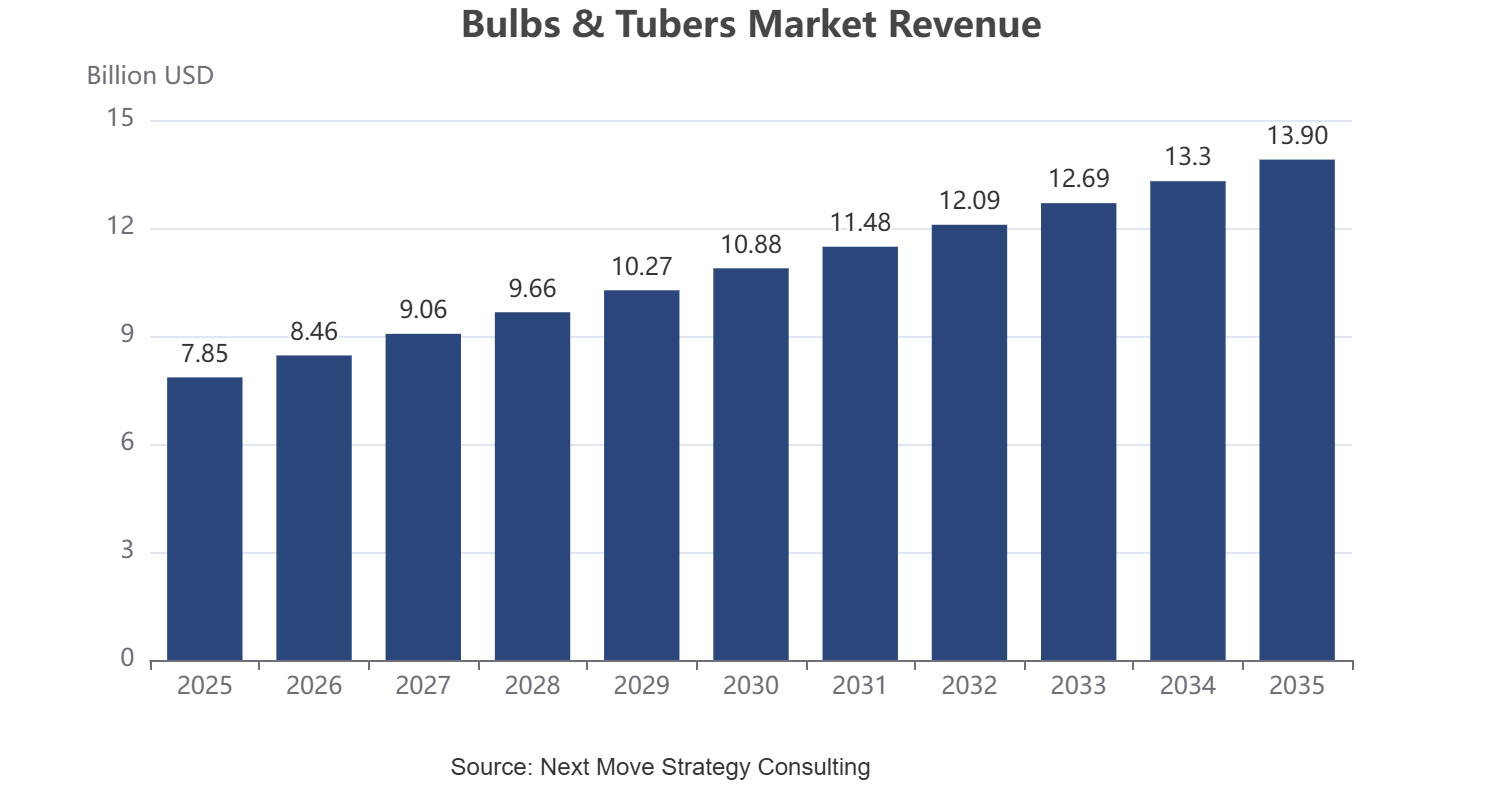
The Bulbs and Tubers Market size was valued at USD 7.85 Billion in 2025, reaching USD 8.28 Billion in 2026, and is forecast to hit USD 13.90 Billion by 2035, growing at a 5.90% CAGR from 2026 to 2035, led by Europe at approximately 44% share and Flower Bulbs at approximately 58% share.
|
Key Takeaways |
|
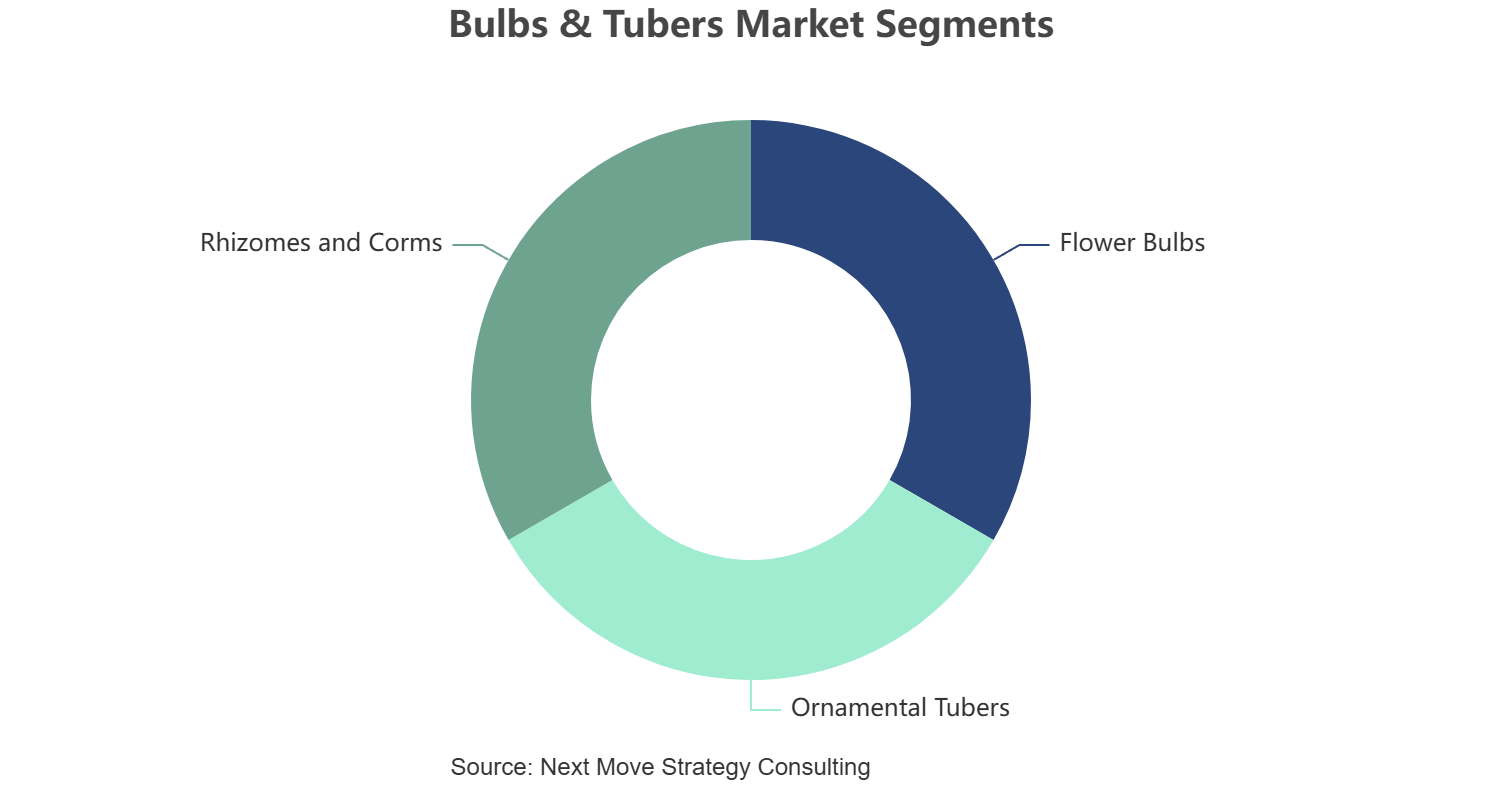
By Product Type: Flower Bulbs held the largest share of approximately 58% (USD 4.55 Billion) in 2025; Rhizomes and Corms is the fastest-growing sub-segment at 8.10% CAGR from 2026-2035. |
|
By Application: Home Gardening and Landscaping held the largest share of approximately 46% (USD 3.61 Billion) in 2025; Public and Municipal Landscaping is the fastest-growing sub-segment at 6.57% CAGR from 2026-2035. |
|
By Distribution Channel: Wholesale and Export Distributors held the largest share of approximately 61% (USD 4.79 Billion) in 2025; Online and Direct-to-Consumer Sales is the fastest-growing sub-segment at 12.16% CAGR from 2026-2035. |
|
Dominant Region: Europe dominated with approximately 44% revenue share (USD 3.45 Billion) in 2025. |
|
Fastest-Growing Region: Asia-Pacific is expected to register the highest CAGR of 8.42% during 2026-2035. |
|
Dominant Country: U.S. led with approximately USD 1.48 Billion in 2025. |
|
Fastest-Growing Country: Philippines is the fastest-growing country at approximately 11.23% CAGR from 2026-2035. |
|
Market Opportunity: The Bulbs and Tubers Market is expected to create an absolute dollar opportunity of USD 5.62 billion between 2026 and 2035, presenting significant investment potential across export-scale flower bulb production, commercial floriculture supply, and direct-to-consumer garden retail. |
Market Opportunity: The Bulbs and Tubers Market is expected to create an absolute dollar opportunity of USD 5.62 billion between 2026 and 2035, presenting significant investment potential across export-scale flower bulb production, commercial floriculture supply, and direct-to-consumer garden retail
According to NMSC analysis, Dutch export cooperatives are consolidating tulip and lily trading activity faster than the broader market is growing, a structural shift not fully captured by 2025 baseline figures alone.
Bulbs & Tubers Market Overview
The bulbs and tubers market report encompasses the global cultivation, breeding, and trade of ornamental flower bulbs, tubers, rhizomes, and corms sold for home gardening, commercial floriculture, and municipal landscaping, excluding edible tuber crops such as potatoes and cassava that fall under separate agricultural commodity markets. During our market evaluation, we noticed that the market has evolved from fragmented, family-owned Dutch export houses toward a consolidated structure of cooperative breeders, regional trading groups, and direct-to-consumer online retailers, with 2026 consolidation activity in the Netherlands' tulip and lily trade illustrating this shift toward scale.
Regulatory oversight is shaped by phytosanitary import controls administered by national agriculture ministries and plant-health certification requirements for cross-border bulb shipments. We found that digital agriculture tools, including climate-controlled storage tracking and automated grading, are becoming standard across large Dutch and North American exporters, a technology adoption pattern that is improving bulb viability rates and shortening lead times for commercial floriculture buyers across every covered region through 2035.
|
Parameter |
Details |
|
Market Size in 2025 |
USD 7.85 Billion |
|
Market Size in 2026 |
USD 8.28 Billion |
|
Revenue Forecast in 2035 |
USD 13.90 Billion |
|
Growth Rate |
CAGR of 5.90% from 2026 to 2035 |
|
Analysis Period |
2025-2035 |
|
Base Year Considered |
2025 |
|
Forecast Period |
2026-2035 |
|
Market Size Estimation |
Revenue (USD Billion) |
|
Companies Profiled |
20 |
|
Countries Covered |
38 |
|
Market Share |
Available for Top 10 Companies |
Key Emerging Trends
Our analysis shows that four structural trends are reshaping how growers, exporters, and retailers engage with the bulbs and tubers market through 2035, spanning breeding technology, trade consolidation, retail channels, and commercial floriculture demand.
How Is Climate-Resilient Breeding Reshaping Bulb Varieties?
Based on research conducted by NMSC, we found that breeders are prioritizing climate-resilient bulb varieties supported by plant growth regulator applications that improve dormancy control and forcing consistency under variable storage temperatures. Dümmen Orange has expanded climate-adaptive breeding programs, a transformation that shortens development cycles for new cultivars while helping growers manage yield risk from increasingly variable seasonal weather patterns.
How Are Export Cooperatives Consolidating Trading Activity?
NMSC's analysis indicates that Dutch export houses are consolidating trading activity into fewer, larger cooperative structures to preserve breeding expertise and customer relationships amid rising operating costs. Tuberbulb Export's 2026 acquisition of Van Zanten Flowerbulbs' summer-goods trading division is a named example of this consolidation, strengthening specialized tulip-forcing capability while preserving 164 years of accumulated breeding knowledge within a single, larger export entity.
How Is Direct-to-Consumer Retail Expanding Market Reach?
Our findings suggest that online and catalog-based direct-to-consumer bulb retailers are expanding reach beyond traditional garden-center distribution, particularly across North America, where fall planting-season demand drives concentrated seasonal order volume. This stakeholder shift benefits smaller specialty growers who can now reach home gardeners directly without relying on wholesale distributor margins.
How Is Commercial Floriculture Demand Shifting Toward Cut-Flower Bulb Varieties?
Our assessment indicates that commercial floriculture buyers are increasingly specifying bulb varieties bred specifically for cut-flower vase-life performance rather than garden display, a transformation led by lily and tulip breeders serving European and North American florist supply chains. This shift is raising average per-unit pricing for premium cut-flower-grade bulb varieties relative to standard garden bulbs.
Supply Chain Structure of the Bulbs and Tubers Market
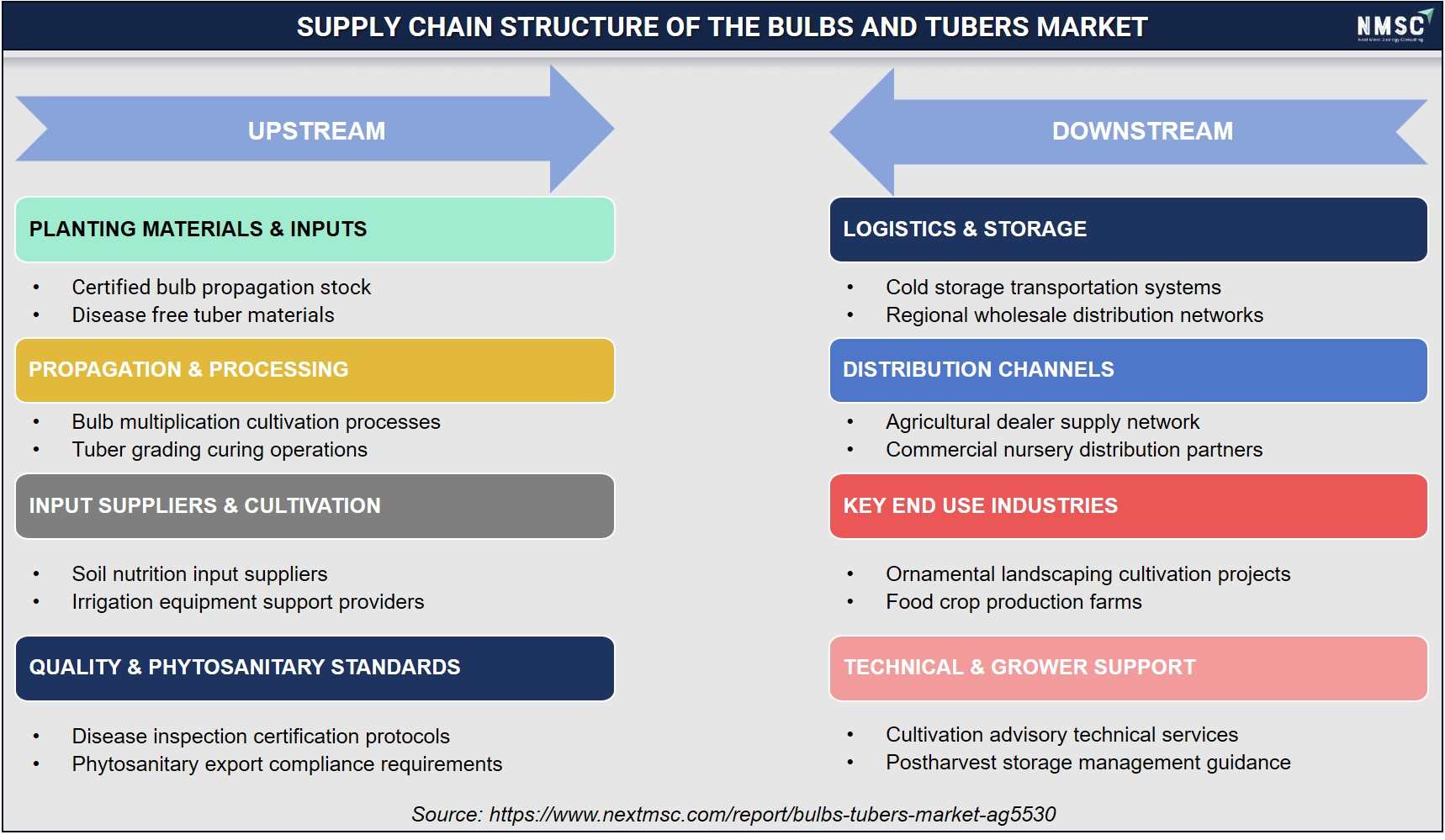
The above supply chain analysis maps the key operational stages, such as upstream and downstream, shaping the bulbs and tubers market. From our analysis, we observed that upstream activities include certified bulb propagation stock, disease-free tuber materials, bulb multiplication cultivation, tuber grading, soil nutrition inputs, irrigation equipment, and phytosanitary compliance, while downstream activities encompass cold storage transportation, agricultural dealer networks, commercial nursery distributors, ornamental landscaping, food crop production, and cultivation advisory services, reflecting a well-integrated supply chain across the market.
Growth Drivers & Restraints
Growth Catalyst & Risk Assessment Matrix
|
Factors |
Type |
(+/-) % Impact on CAGR |
Geographic Relevance |
Impact Timeline |
|
Rising home gardening and landscaping spend |
Driver |
+1.8% |
North America, Europe |
2026-2028 |
|
Expanding commercial floriculture and cut-flower demand |
Driver |
+1.4% |
Europe, Latin America |
2026-2030 |
|
Growth in direct-to-consumer online bulb retail |
Driver |
+1.1% |
North America, Europe |
2026-2029 |
|
Municipal and public landscaping investment |
Driver |
+0.9% |
Middle East & Africa, Asia-Pacific |
2026-2031 |
|
Export-cooperative consolidation improving trade efficiency |
Driver |
+0.7% |
Europe |
2026-2028 |
|
Climate-resilient breeding reducing crop loss |
Driver |
+0.6% |
Global |
2028-2035 |
|
Phytosanitary import restrictions and border delays |
Restraint |
-0.8% |
Asia-Pacific, Middle East & Africa |
2026-2029 |
|
Rising greenhouse and cold-storage energy costs |
Restraint |
-0.6% |
Europe |
2026-2028 |
|
Land-use pressure on traditional Dutch bulb-growing regions |
Restraint |
-0.4% |
Europe |
2028-2035 |
What Is the Primary Growth Driver for the Bulbs & Tubers Market?
We observed that rising home gardening and landscaping spend remains the primary growth driver, with retail lawn and garden consumable purchases climbing alongside fall bulb-planting season demand across North America and Europe. According to the U.S. Department of Agriculture, nursery and floriculture crop sales have shown sustained multi-year growth, reinforcing consistent demand, growth, and trends across retail bulb distribution channels.
How Is Commercial Floriculture Driving Market Growth?
During our market evaluation, we noticed that expanding commercial floriculture and cut-flower production is driving market growth as florist supply chains specify bulb varieties bred for vase-life performance over standard garden display quality. This pattern is most visible in European and Latin American cut-flower export operations, where growers report increasing willingness to pay premium pricing for certified, high-performance lily and tulip cultivars.
What Is Restraining the Bulbs & Tubers Market?
We found that phytosanitary import restrictions and border inspection delays remain the primary restraint, particularly across Asia-Pacific and Middle Eastern markets where plant-health certification requirements can extend customs clearance timelines for perishable bulb shipments. This restraint disproportionately affects smaller exporters without dedicated regulatory-compliance staff managing multi-country certification requirements.
Segmentation Analysis
Segment Sizing: By Product Type
|
Segment |
2025 (USD) |
2035 (USD) |
CAGR% (2026-2035) |
|
Flower Bulbs |
USD 4.55 Billion |
USD 7.23 Billion |
4.66% |
|
Ornamental Tubers |
USD 2.12 Billion |
USD 4.17 Billion |
7.15% |
|
Rhizomes and Corms |
USD 1.18 Billion |
USD 2.50 Billion |
8.10% |
|
Total |
USD 7.85 Billion |
USD 13.90 Billion |
5.90% |
How Is the Market Segmented by Product Type?
NMSC's analysis indicates that product type segmentation separates flower bulbs, ornamental tubers, and rhizomes and corms. Flower Bulbs held the largest 2025 share on established tulip, daffodil, and lily export volume, while Rhizomes and Corms is the fastest-growing sub-segment as commercial floriculture buyers expand demand for dahlia and gladiolus varieties suited to extended cut-flower production cycles.
Segment Sizing: By Application
|
Segment |
2025 (USD) |
2035 (USD) |
CAGR% (2026-2035) |
|
Home Gardening and Landscaping |
USD 3.61 Billion |
USD 6.12 Billion |
5.41% |
|
Commercial Floriculture and Cut Flower Production |
USD 2.90 Billion |
USD 5.28 Billion |
6.25% |
|
Public and Municipal Landscaping |
USD 1.34 Billion |
USD 2.50 Billion |
6.57% |
|
Total |
USD 7.85 Billion |
USD 13.90 Billion |
5.90% |
How Is the Market Segmented by Application?
Our findings suggest that application segmentation covers home gardening and landscaping, commercial floriculture and cut-flower production, and public and municipal landscaping. Home Gardening and Landscaping retains the largest 2025 share on broad-based seasonal consumer demand, while Commercial Floriculture and Cut Flower Production is the fastest-growing application as florist supply chains specify higher-value, vase-life-optimized bulb varieties.
Segment Sizing: By Distribution Channel
|
Segment |
2025 (USD) |
2035 (USD) |
CAGR% (2026-2035) |
|
Wholesale and Export Distributors |
USD 4.79 Billion |
USD 7.51 Billion |
4.51% |
|
Garden Centers and Retail Nurseries |
USD 2.12 Billion |
USD 3.61 Billion |
5.45% |
|
Online and Direct-to-Consumer Sales |
USD 0.94 Billion |
USD 2.78 Billion |
12.16% |
|
Total |
USD 7.85 Billion |
USD 13.90 Billion |
5.90% |
How Is the Market Segmented by Distribution Channel?
Our assessment indicates that distribution channel segmentation distinguishes wholesale and export distributors, garden centers and retail nurseries, and online and direct-to-consumer sales. Wholesale and Export Distributors dominate 2025 revenue on established Dutch trading infrastructure, while Online and Direct-to-Consumer Sales is the fastest-growing channel as specialty growers reach home gardeners without intermediary distributor margins.
Growth Opportunities
Our analysis shows that three forward-looking whitespace opportunities stand out for growers, exporters, and retailers positioning ahead of 2035 demand.
What Opportunity Exists in Premium Cut-Flower Bulb Breeding?
Breeders that develop vase-life-optimized lily and tulip cultivars can capture premium pricing from commercial floriculture buyers, a mechanism already benefiting specialized European breeders supplying florist export chains. This opportunity favors growers with dedicated cut-flower breeding programs over general garden-bulb producers.
What Opportunity Exists in Direct-to-Consumer Export Expansion?
Dutch and North American exporters that build direct online ordering platforms for home gardeners can bypass traditional wholesale distributor margins, a mechanism benefiting mid-sized specialty growers seeking higher per-unit realization. Van Engelen and Longfield Gardens exemplify this direct-to-consumer expansion pathway.
What Opportunity Exists in Municipal Landscaping Contracts?
Growers securing multi-year municipal and public landscaping supply contracts gain recurring, volume-backed revenue less exposed to seasonal home-gardening demand swings, a mechanism benefiting large-scale wholesale exporters with certified, high-volume production capacity across Middle Eastern and Asia-Pacific urban-greening programs.
Regional Outlook
Geographic Performance Snapshot
|
Region |
2025 (USD) |
2035 (USD) |
CAGR% (2026-2035) |
Key Driver |
|
Europe |
USD 3.45 Billion |
USD 5.56 Billion |
4.82% |
Dutch bulb export infrastructure and dense home-gardening culture |
|
North America |
USD 2.12 Billion |
USD 3.48 Billion |
5.02% |
Fall planting season demand and expanding garden-retail chains |
|
Asia-Pacific |
USD 1.33 Billion |
USD 2.92 Billion |
8.42% |
Rising urban landscaping investment and floriculture exports |
|
Latin America |
USD 0.55 Billion |
USD 1.11 Billion |
7.48% |
Growing cut-flower export production and municipal landscaping |
|
Middle East & Africa |
USD 0.40 Billion |
USD 0.83 Billion |
8.15% |
Urban greening initiatives and luxury landscaping demand |
|
Total |
USD 7.85 Billion |
USD 13.90 Billion |
5.90% |
- |
Europe Bulbs & Tubers Market Outlook
We observed that Europe's bulbs and tubers market reflects mature, high-adoption demand anchored by the Netherlands' concentrated breeding and export infrastructure. Regulatory influence is significant, given EU plant-health passport requirements for intra-bloc bulb movement, while technology adoption of climate-controlled storage runs ahead of other regions, and strategic outlook favors export cooperatives consolidating trading scale.
North America Bulbs & Tubers Market Outlook
During our market evaluation, we noticed that North America's market reflects strong seasonal home-gardening demand concentrated around fall planting cycles across the U.S. and Canada. Regulatory influence remains moderate, centered on USDA phytosanitary import inspection, while technology adoption of direct-to-consumer online ordering continues to expand, and strategic outlook favors catalog and e-commerce-driven specialty retailers.
Asia-Pacific Bulbs & Tubers Market Outlook
We found that Asia-Pacific combines rising urban landscaping investment with growing floriculture export ambitions in China and India, producing the fastest regional CAGR through 2035. Regulatory influence varies widely by market, technology adoption of protected cultivation is accelerating in Japan and South Korea, and strategic outlook favors exporters that localize phytosanitary compliance capability.
Latin America Bulbs & Tubers Market Outlook
Our findings suggest that Latin America's market is driven primarily by expanding cut-flower export production in Brazil and Argentina, supplying North American and European florist supply chains. Regulatory influence remains moderate, technology adoption of controlled-environment cultivation is rising among larger commercial growers, and strategic outlook favors producers integrating forward into export logistics.
Middle East & Africa Bulbs & Tubers Market Outlook
NMSC's analysis indicates that Middle East & Africa demand structure is shaped by large-scale urban greening and municipal landscaping programs across the UAE and Saudi Arabia, alongside emerging South African commercial floriculture. Regulatory influence is increasing as import certification requirements tighten, and strategic outlook favors exporters with dedicated regional compliance and cold-chain logistics capability.
UK Bulbs & Tubers Market
Based on our engagements, the UK bulbs and tubers market was valued at approximately USD 0.48 Billion in 2025 and is projected to reach USD 0.72 Billion by 2035, expanding at a 3.95% CAGR from 2026 to 2035. Locally, demand structure remains concentrated among home gardeners, adoption of retail and catalog channels is high, regulatory influence is moderate through phytosanitary inspection, technology penetration continues to widen through climate-controlled storage, competitive intensity is increasing among mid-sized importers, and the strategic outlook favors direct-to-consumer expansion.
Germany Bulbs & Tubers Market
Through our analysis, the Germany bulbs and tubers market was valued at approximately USD 0.59 Billion in 2025 and is projected to reach USD 0.94 Billion by 2035, expanding at a 4.81% CAGR from 2026 to 2035. Locally, demand structure is increasingly commercial-floriculture-driven, adoption of cut-flower-grade bulb varieties is accelerating, regulatory influence remains centered on plant-health certification, technology penetration is above the regional average, competitive intensity is moderate, and the strategic outlook favors continued export-cooperative consolidation.
France Bulbs & Tubers Market
From our assessment, the France bulbs and tubers market was valued at approximately USD 0.38 Billion in 2025 and is projected to reach USD 0.61 Billion by 2035, expanding at a 4.84% CAGR from 2026 to 2035. Locally, demand structure combines home-garden and municipal landscaping buyers, adoption of premium cultivars remains steady, regulatory influence is expanding through import compliance requirements, technology penetration is rising quickly through protected cultivation, competitive intensity is high among local and international entrants, and the strategic outlook favors localized breeding partnerships.
U.S. Bulbs & Tubers Market
According to evaluation, the U.S. bulbs and tubers market was valued at approximately USD 1.48 Billion in 2025 and is projected to reach USD 2.30 Billion by 2035, expanding at a 4.33% CAGR from 2026 to 2035. Locally, demand structure is led by export-oriented commercial growers, adoption of controlled-environment cultivation is common, regulatory influence is developing, technology penetration is accelerating with cold-chain logistics investment, competitive intensity remains low relative to mature European markets, and the strategic outlook favors first-mover export infrastructure investment.
Canada Bulbs & Tubers Market
Based on our engagements, the Canada bulbs and tubers market was valued at approximately USD 0.38 Billion in 2025 and is projected to reach USD 0.66 Billion by 2035, expanding at a 5.65% CAGR from 2026 to 2035. Locally, demand structure remains concentrated among home gardeners, adoption of retail and catalog channels is high, regulatory influence is moderate through phytosanitary inspection, technology penetration continues to widen through climate-controlled storage, competitive intensity is increasing among mid-sized importers, and the strategic outlook favors direct-to-consumer expansion.
China Bulbs & Tubers Market
Through our analysis, the China bulbs and tubers market was valued at approximately USD 0.32 Billion in 2025 and is projected to reach USD 0.64 Billion by 2035, expanding at a 7.39% CAGR from 2026 to 2035. Locally, demand structure is increasingly commercial-floriculture-driven, adoption of cut-flower-grade bulb varieties is accelerating, regulatory influence remains centered on plant-health certification, technology penetration is above the regional average, competitive intensity is moderate, and the strategic outlook favors continued export-cooperative consolidation.
India Bulbs & Tubers Market
From our assessment, the India bulbs and tubers market was valued at approximately USD 0.17 Billion in 2025 and is projected to reach USD 0.47 Billion by 2035, expanding at a 10.97% CAGR from 2026 to 2035. Locally, demand structure combines home-garden and municipal landscaping buyers, adoption of premium cultivars remains steady, regulatory influence is expanding through import compliance requirements, technology penetration is rising quickly through protected cultivation, competitive intensity is high among local and international entrants, and the strategic outlook favors localized breeding partnerships.
Japan Bulbs & Tubers Market
According to evaluation, the Japan bulbs and tubers market was valued at approximately USD 0.21 Billion in 2025 and is projected to reach USD 0.41 Billion by 2035, expanding at a 6.81% CAGR from 2026 to 2035. Locally, demand structure is led by export-oriented commercial growers, adoption of controlled-environment cultivation is common, regulatory influence is developing, technology penetration is accelerating with cold-chain logistics investment, competitive intensity remains low relative to mature European markets, and the strategic outlook favors first-mover export infrastructure investment.
South Korea Bulbs & Tubers Market
Based on our engagements, the South Korea bulbs and tubers market was valued at approximately USD 0.12 Billion in 2025 and is projected to reach USD 0.26 Billion by 2035, expanding at a 8.42% CAGR from 2026 to 2035. Locally, demand structure remains concentrated among home gardeners, adoption of retail and catalog channels is high, regulatory influence is moderate through phytosanitary inspection, technology penetration continues to widen through climate-controlled storage, competitive intensity is increasing among mid-sized importers, and the strategic outlook favors direct-to-consumer expansion.
Australia Bulbs & Tubers Market
Through our analysis, the Australia bulbs and tubers market was valued at approximately USD 0.17 Billion in 2025 and is projected to reach USD 0.35 Billion by 2035, expanding at a 7.47% CAGR from 2026 to 2035. Locally, demand structure is increasingly commercial-floriculture-driven, adoption of cut-flower-grade bulb varieties is accelerating, regulatory influence remains centered on plant-health certification, technology penetration is above the regional average, competitive intensity is moderate, and the strategic outlook favors continued export-cooperative consolidation.
Brazil Bulbs & Tubers Market
From our assessment, the Brazil bulbs and tubers market was valued at approximately USD 0.22 Billion in 2025 and is projected to reach USD 0.42 Billion by 2035, expanding at a 6.87% CAGR from 2026 to 2035. Locally, demand structure combines home-garden and municipal landscaping buyers, adoption of premium cultivars remains steady, regulatory influence is expanding through import compliance requirements, technology penetration is rising quickly through protected cultivation, competitive intensity is high among local and international entrants, and the strategic outlook favors localized breeding partnerships.
Argentina Bulbs & Tubers Market
According to evaluation, the Argentina bulbs and tubers market was valued at approximately USD 0.11 Billion in 2025 and is projected to reach USD 0.21 Billion by 2035, expanding at a 6.87% CAGR from 2026 to 2035. Locally, demand structure is led by export-oriented commercial growers, adoption of controlled-environment cultivation is common, regulatory influence is developing, technology penetration is accelerating with cold-chain logistics investment, competitive intensity remains low relative to mature European markets, and the strategic outlook favors first-mover export infrastructure investment.
Saudi Arabia Bulbs & Tubers Market
Based on our engagements, the Saudi Arabia bulbs and tubers market was valued at approximately USD 0.08 Billion in 2025 and is projected to reach USD 0.17 Billion by 2035, expanding at a 8.72% CAGR from 2026 to 2035. Locally, demand structure remains concentrated among home gardeners, adoption of retail and catalog channels is high, regulatory influence is moderate through phytosanitary inspection, technology penetration continues to widen through climate-controlled storage, competitive intensity is increasing among mid-sized importers, and the strategic outlook favors direct-to-consumer expansion.
UAE Bulbs & Tubers Market
Through our analysis, the UAE bulbs and tubers market was valued at approximately USD 0.09 Billion in 2025 and is projected to reach USD 0.17 Billion by 2035, expanding at a 7.60% CAGR from 2026 to 2035. Locally, demand structure is increasingly commercial-floriculture-driven, adoption of cut-flower-grade bulb varieties is accelerating, regulatory influence remains centered on plant-health certification, technology penetration is above the regional average, competitive intensity is moderate, and the strategic outlook favors continued export-cooperative consolidation.
South Africa Bulbs & Tubers Market
From our assessment, the South Africa bulbs and tubers market was valued at approximately USD 0.04 Billion in 2025 and is projected to reach USD 0.08 Billion by 2035, expanding at a 7.04% CAGR from 2026 to 2035. Locally, demand structure combines home-garden and municipal landscaping buyers, adoption of premium cultivars remains steady, regulatory influence is expanding through import compliance requirements, technology penetration is rising quickly through protected cultivation, competitive intensity is high among local and international entrants, and the strategic outlook favors localized breeding partnerships.
Porter's Five Forces Analysis of the Bulbs and Tubers Market
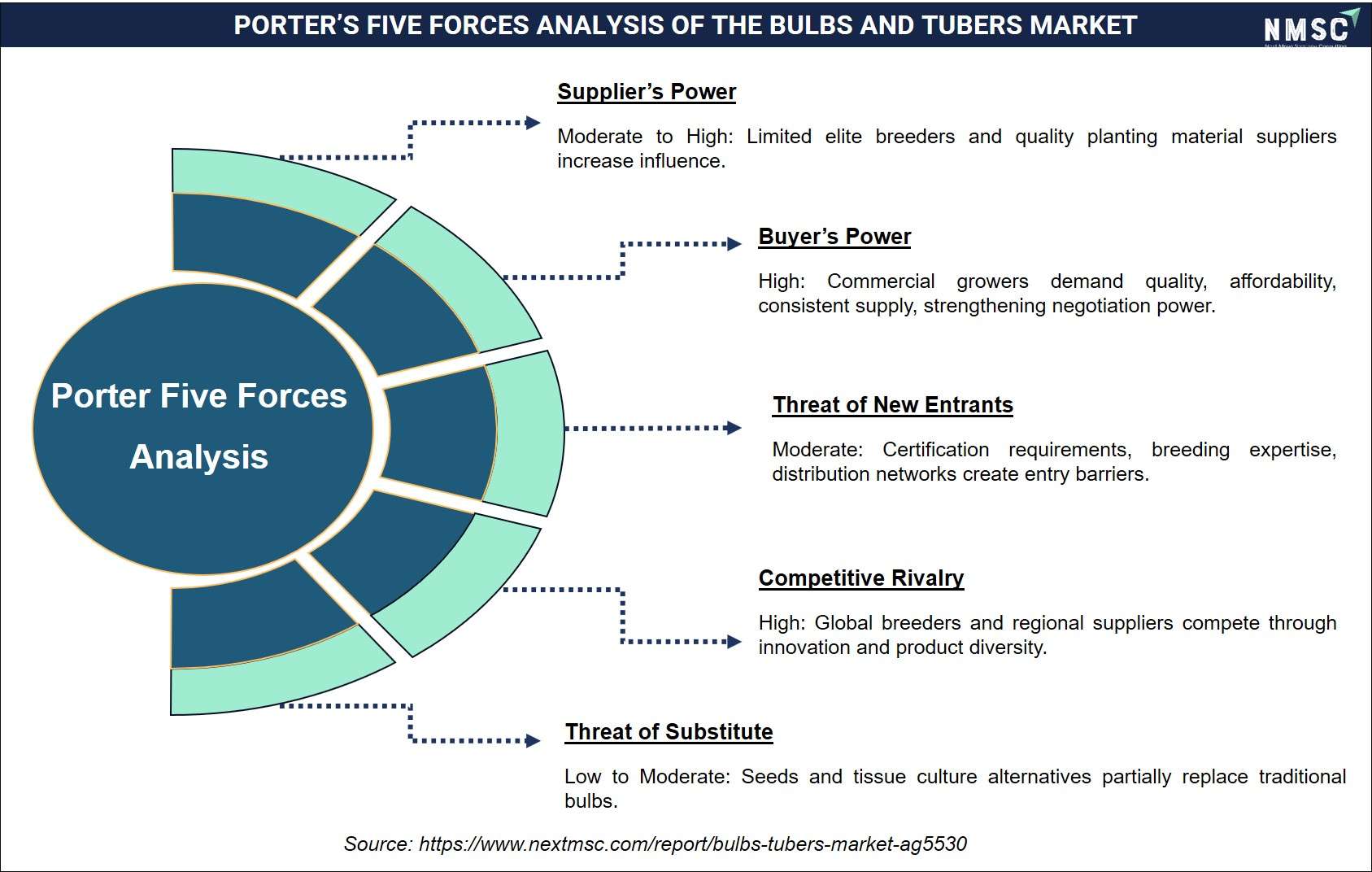
The above Porter's Five Forces analysis maps the key competitive forces, such as threat of new entrants, bargaining power of suppliers, bargaining power of buyers, threat of substitutes, and industry rivalry, shaping the bulbs and tubers market. From our analysis, we observed that industry rivalry remains moderate with numerous regional growers competing, while the bargaining power of suppliers is influenced by seasonal production and climate dependencies. The threat of new entrants is limited by high agricultural investment requirements, whereas the bargaining power of buyers is growing with retail and food processing demand, and the threat of substitutes remains moderate with alternative starch and vegetable sources available.
Competitive Landscape
|
Key Takeaways |
|
Market Structure: Moderately concentrated among Dutch export cooperatives, with the top ten providers holding a combined mid-range share following 2026 consolidation activity. |
|
Innovation Focus: Climate-resilient breeding, cut-flower vase-life optimization, and cold-chain storage technology. |
|
M&A Activity: Active and ongoing, concentrated among Dutch export houses consolidating trading divisions following recent company closures and divestitures. |
How Do Companies Compete Within the Bulbs & Tubers Market?
Our assessment indicates that providers compete primarily on bulb viability rates, breeding pedigree, and export logistics reliability rather than price alone. Century-old Dutch export relationships and cooperative breeding networks function as durable competitive moats, while newer entrants without established grower relationships face difficulty securing consistent, certified supply volume across the industry.
Which Competitive Archetypes Dominate the Market?
Our analysis shows that three archetypes dominate the industry: large Dutch export cooperatives with global trading reach, such as Tuberbulb Export following its 2026 consolidation; specialty North American direct-to-consumer retailers, such as Longfield Gardens and Van Engelen; and diversified horticultural breeders extending into bulb varieties, such as Dümmen Orange.
What Innovation and Differentiation Strategies Are Providers Pursuing?
Based on research conducted by NMSC, we found that leading providers are differentiating through climate-resilient breeding programs and cut-flower-grade cultivar development, positioning premium varieties for commercial floriculture buyers willing to pay above standard garden-bulb pricing. Providers with strong cold-chain logistics are also extending shelf viability, reducing spoilage-related revenue loss across export shipments.
What M&A and Geographic Expansion Activity Characterizes the Landscape?
We observed that M&A activity remains concentrated among Dutch export houses absorbing trading divisions from exiting competitors, exemplified by Tuberbulb Export's 2026 acquisition of Van Zanten Flowerbulbs' summer-goods business following that company's 164-year operating history. Geographic expansion is increasingly directed toward Asia-Pacific and Middle Eastern markets with rising landscaping investment.
Key Market Players
During our market evaluation, we noticed that the following validated set of providers represents the largest identifiable participants in the bulbs and tubers market as of 2026.
-
Dümmen Orange B.V.
-
Tuberbulb Export B.V.
-
Hobaho B.V.
-
Onings Holland Flowerbulbs B.V.
-
K. van Bourgondien & Sons, Inc.
-
Colorblends LLC
-
Van Engelen Inc.
-
American Meadows, Inc.
-
C. van Waveren & Zonen B.V.
-
Jub Holland B.V.
-
Vletter & Den Haan Beheer B.V.
-
Fluwel B.V.
-
W.F. Alkema Export B.V.
-
P.J.M. Vreeken B.V.
-
Sonneveld Bulb B.V.
-
Deroose Plants NV
-
Ball Horticultural Company
-
Florensis B.V.
-
Gardens Alive, Inc.
Latest Developments
We found that recent developments in the bulbs and tubers market reflect significant consolidation among established Dutch export operators through 2026.
|
Date |
Event |
|
May 2026 |
Dümmen Orange and Syngenta Flowers signed a formal agreement to divest and combine their global ornamental breeding and propagation operations into a strategic joint venture, establishing a consolidated entity to integrate advanced research, optimize production capacity, and expand commercial distribution for growers worldwide |
|
November 2025 |
Tuberbulb Export B.V. acquired Royal Van Zanten's summer bulb trading business in the Netherlands, expanding its tulip expertise, product portfolio, and flower bulb export operations from the 2026 crop season. |
|
June 2025 |
Hobaho B.V. acquired Van Zanten Flowerbulbs' lily breeding activities in the Netherlands, integrating breeding programs, R&D expertise, and specialist teams to strengthen lily variety development and commercial breeding capabilities |
Expert Insights
 "The consumer and market demand a sustainable product. It is important that we offer that and that we talk about it; in other words, improve the image of floriculture."
— Steven van Schilfgaarde, CEO, Royal FloraHolland
Statement made during an industry interview discussing the growing importance of sustainability, certification, and consumer expectations across the floriculture sector (2024).
Market Interpretation
The statement highlights the growing consumer preference for sustainably produced flowers, bulbs, and ornamental plants, making sustainability a key competitive factor across the floriculture industry. As environmental certifications, responsible cultivation practices, and transparent supply chains become increasingly important purchasing criteria, bulb and tuber producers are investing in sustainable production methods to strengthen market acceptance and meet evolving demand from retailers and consumers.
Investment Opportunities
Where Is Capital Investment Concentrated Within the Market?
Our assessment indicates that capital investment is concentrated among Dutch export cooperatives absorbing trading divisions from exiting competitors, alongside North American direct-to-consumer retailers scaling online ordering infrastructure. Investors favor providers with established grower relationships and certified export compliance over undifferentiated wholesale traders.
What Infrastructure Investment Is Required to Scale Distribution?
Our findings suggest that scaling export distribution requires sustained investment in climate-controlled storage and cold-chain logistics that preserve bulb viability across multi-week international shipments. Providers underinvesting in this infrastructure risk higher spoilage rates and reduced customer confidence relative to competitors offering certified, temperature-tracked delivery.
How Do ESG Considerations Factor Into Investment Decisions?
Our analysis shows that ESG-oriented investors increasingly favor growers demonstrating reduced water and energy use in cultivation, consistent with sustainable agriculture practices promoted by European agricultural policy. Social-impact metrics tied to land-use stewardship in traditional Dutch growing regions are becoming a standard due-diligence component for institutional investors evaluating the sector.
Key Benefits for Stakeholders
What Benefits Does This Report Offer Industry Leaders and Growers?
Based on research conducted by NMSC, we found that industry leaders and growers gain segment-level sizing across product type and distribution channel, detailed in Section 6, to benchmark breeding and export investment against market-wide demand shifts toward cut-flower-grade cultivars.
What Benefits Does This Report Offer Investors and Financial Analysts?
We observed that investors and financial analysts gain a validated competitive-landscape assessment, detailed in Section 10, alongside regional and country-level sizing in Section 9 to evaluate provider positioning and consolidation opportunity ahead of capital-allocation decisions.
What Benefits Does This Report Offer Garden Retailers and Distribution Partners?
During our market evaluation, we noticed that garden retailers and distribution partners gain visibility into the shift toward direct-to-consumer and online channels, detailed in Section 7's growth-opportunity analysis, informing channel-strategy prioritization ahead of the fall planting season.
Key Market Segments
By Product Type
-
Flower Bulbs
-
Ornamental Tubers
-
Rhizomes and Corms
By Application
-
Home Gardening and Landscaping
-
Commercial Floriculture and Cut Flower Production
-
Public and Municipal Landscaping
By Distribution Channel
-
Wholesale and Export Distributors
-
Garden Centers and Retail Nurseries
-
Online and Direct-to-Consumer Sales
By Region
-
North America: U.S., Canada, Mexico, Rest of North America
-
Europe: UK, Germany, France, Italy, Spain, Sweden, Denmark, Finland, Netherlands, Rest of Europe
-
Asia-Pacific: China, India, Japan, South Korea, Taiwan, Indonesia, Vietnam, Australia, Philippines, Malaysia, Rest of APAC
-
Middle East & Africa: Saudi Arabia, UAE, Egypt, Israel, Turkey, Nigeria, South Africa, Rest of MEA
-
Latin America: Brazil, Argentina, Chile, Colombia, Rest of LATAM
Conclusion & Recommendations
What Is the Long-Term Outlook for the Bulbs & Tubers Market?
The bulbs and tubers market is positioned for steady expansion through 2035, growing from USD 7.85 Billion in 2025 to USD 13.90 Billion at a 5.90% CAGR from 2026 to 2035. Growth is underpinned by durable home-gardening demand and expanding commercial floriculture specification that are unlikely to reverse within the forecast window, positioning the sector for steady, export-anchored growth relative to broader agricultural spending.
What Strategic Positioning Should Bulb Exporters Pursue?
Exporters should prioritize cold-chain infrastructure investment, pursue direct-to-consumer channel expansion ahead of competitors, and consider consolidation opportunities as smaller operators exit the market. Providers without differentiated breeding pedigree face increasing difficulty competing against scaled, consolidated export cooperatives across covered geographies through the forecast period.
How Attractive Is the Bulbs & Tubers Market for New Investment?
The sector offers steady investment attractiveness relative to broader agriculture, driven by recurring seasonal demand and expanding commercial floriculture contract revenue. Investment attractiveness is highest among providers combining certified export compliance with cold-chain logistics capability, and comparatively lower among undifferentiated, single-region wholesale traders facing consolidation pressure.
What Market Shifts and Key Risks Should Stakeholders Monitor?
Key risks include continued land-use pressure on traditional Dutch growing regions, rising energy costs for climate-controlled storage, and phytosanitary import restrictions that could slow cross-border shipment timelines. Providers must monitor these shifts closely, as they represent the primary downside scenarios to the CAGR forecast presented throughout this report.
What Are the Key Growth Pathways for the Bulbs & Tubers Market?
The clearest growth pathways run through premium cut-flower bulb breeding, direct-to-consumer export expansion, and municipal landscaping contract growth. Providers that combine these three pathways with continued export-cooperative consolidation are best positioned to capture disproportionate share of the USD 13.90 Billion addressable market forecast for 2035.
About the Author

About the Reviewer

At Next Move Strategy Consulting, we understand that insightful market research is the cornerstone of successful business decisions. That's why we employ a robust and multifaceted approach, combining various methodologies to deliver the most accurate and actionable data for our clients.

Research Landscape
We navigate the world of research with two primary approaches:
Qualitative Approach
Our qualitative research methodologies involve immersive techniques such as in-depth interviews, focus groups, and observational studies. By engaging directly with individuals and stakeholders, we uncover valuable insights that quantitative data alone may overlook.

Quantitative Research
In tandem with qualitative methodologies, NMSC leverages the power of Quantitative Research to provide a robust foundation of numerical insights. Through systematic data collection and analysis, we quantify patterns, preferences, and market trends, offering a comprehensive view of the business landscape.
Our quantitative research approach employs diverse tools, including surveys, experiments, and statistical modelling. These methodologies enable us to gather data from a large and representative sample, ensuring the statistical significance of our findings. By employing structured questionnaires and standardized data collection methods, we guarantee the reliability and validity of the information we present to our clients.
Quantitative research is particularly effective in measuring the prevalence of trends, assessing market size, and gauging the impact of various factors on consumer behavior. The numerical precision attained through this approach equips our clients with actionable insights, facilitating data-driven decision-making and strategy formulation.


Our Specialized Toolbox for Industry-Specific Market Research
We deploy a specialized arsenal of techniques tailored to meet your unique requirements. Here's a glimpse into our comprehensive toolbox:

Information Procurement
The stage entails acquiring market data or relevant information through various sources and methodologies.


Market Research Approach
We utilize both top-down and bottom-up approaches in market research analysis to achieve a comprehensive understanding of the market dynamics, leveraging the broad perspective of industry trends and macroeconomic factors alongside detailed insights from specific segments and individual companies.

Porters Five Forces Analysis
We conduct Porter's Five Forces analysis to evaluate the competitive landscape of an industry, providing us with insights into factors that affect profitability and strategic positioning.

SWOT Analysis

Forecasting
We utilize a forecasting model to predict future consumption by considering parameters like population, economics, regulations, market competition, drivers, constraints, technology, and pricing. We also employ statistical techniques such as multilinear regression, exponential smoothing, moving average, ARIMA, and Monte Carlo simulations for accurate predictions. In econometric forecasting, we analyzed short-term and long-term event impacts, attributing values based on regulatory frameworks, economic factors, and market events.





 Speak to Our Analyst