Nursery and Floriculture Production Market Size, Share, Trends and Growth Analysis, By Product Type (Cut Flowers, Potted and Flowering Plants, Nursery Plants, and Propagation Materials), By Production Method (Protected Cultivation, and Open Field Cultivation), By End Use (Landscaping and Gardening, Retail and Floristry, and Institutional and Events), By Crop Category, By Sales Channel, and Region — Global Industry Report and Forecast, 2026–2035
Industry: Agriculture | Publishing Date: August 12, 2026 | Last Updated: August 13, 2026 | No of Pages: N/A | No. of Tables: N/A | No. of Figures: N/A | Format: PDF | Report Code: AG5688
What Is the Nursery and Floriculture Production Market Size?
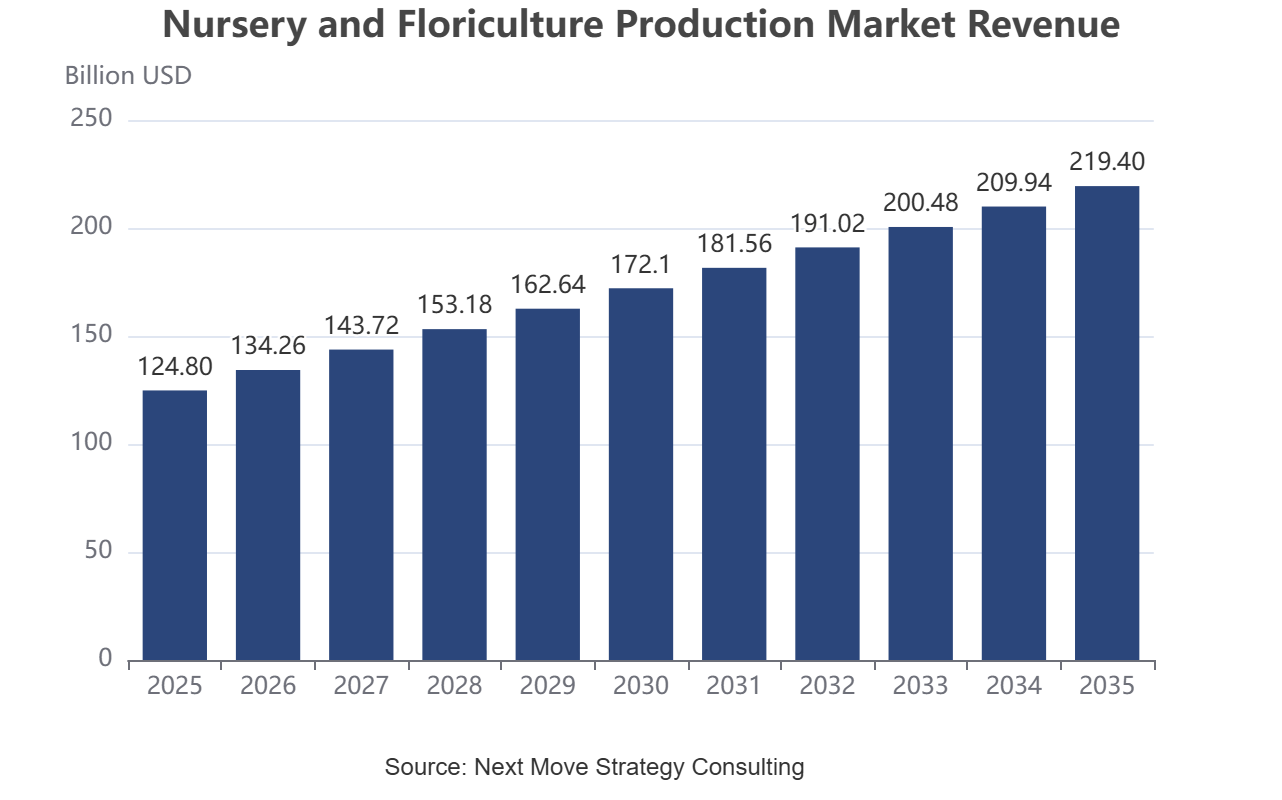
The global Nursery and Floriculture Production Market size was valued at USD 124.80 billion in 2025 and is estimated at USD 131.60 billion in 2026, forecast to reach USD 219.40 billion by 2035, expanding at a 5.85% CAGR between 2026 and 2035. Asia-Pacific leads with approximately 34% share, while cut flowers dominate all other product types with approximately 34% share.
We observed that growth is anchored in expanding protected-cultivation acreage and rising demand for potted and flowering plants across urban landscaping and retail floristry channels through 2035.
|
Key Takeaways |
|
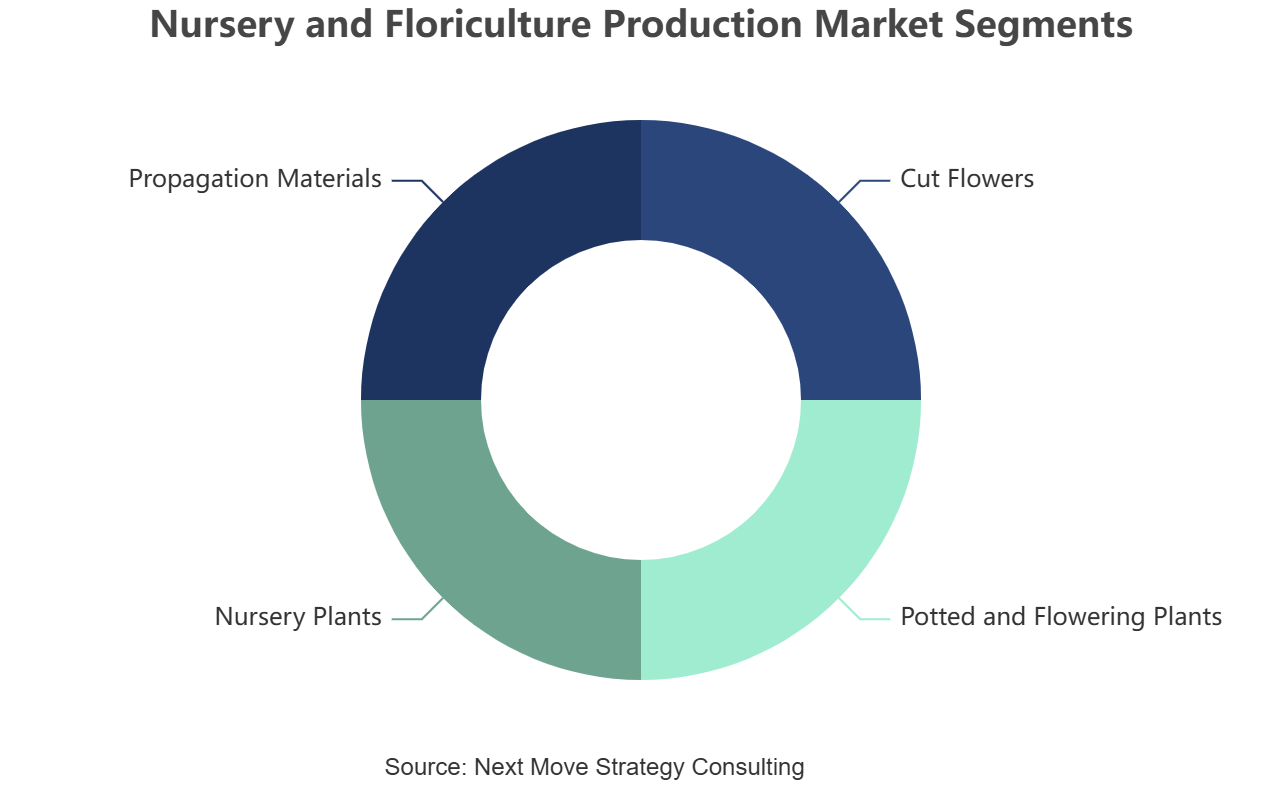
By Product Type: Cut Flowers held the largest share of approximately 34% (USD 42.43 Billion) in 2025; Potted and Flowering Plants is the fastest-growing sub-segment at 6.7% CAGR from 2026–2035. |
|
By Production Method: Protected Cultivation held the largest share of approximately 57% (USD 71.14 Billion) in 2025; Protected Cultivation is also the fastest-growing sub-segment at 7.2% CAGR from 2026–2035. |
|
By End Use: Landscaping and Gardening held the largest share of approximately 38% (USD 47.42 Billion) in 2025; Institutional and Events is the fastest-growing sub-segment at 6.3% CAGR from 2026–2035. |
|
Dominant Region: Asia-Pacific dominated with approximately 34% revenue share (USD 42.43 Billion) in 2025. |
|
Fastest-Growing Region: Latin America is expected to register the highest CAGR of 7.1% during 2026–2035. |
|
Dominant Country: China led with approximately USD 14.85 billion in 2025. |
|
Fastest-Growing Country: India is the fastest-growing country at approximately 9.8% CAGR from 2026–2035. |
Market Opportunity: The nursery and floriculture production market is expected to create an absolute dollar opportunity of USD 87.80 billion between 2026 and 2035, presenting significant investment potential across the protected-cultivation, potted-plant retail, and urban landscaping value chain.
According to Next Move Strategy Consulting analysis, growers are increasingly integrating climate-controlled greenhouse infrastructure with direct-to-retail logistics networks, a shift that favors vertically integrated producers over fragmented open-field growers as post-harvest quality and shelf-life requirements tighten across export-oriented floriculture supply chains through 2035.
What Does the Nursery and Floriculture Production Market Encompass?
The nursery and floriculture production market report covers the commercial cultivation of cut flowers, potted and flowering plants, nursery plants, and propagation materials grown under open-field and protected-cultivation systems for landscaping, retail floristry, and institutional use. Our assessment indicates that the market has evolved from smallholder, seasonal open-field growing toward year-round, climate-controlled greenhouse production integrated with cold-chain logistics and direct retail distribution.
Regulatory frameworks such as the European Union's plant health and phytosanitary certification requirements and the U.S. Department of Agriculture's Animal and Plant Health Inspection Service import standards shape cross-border floriculture trade, while national horticulture development programs in India and Kenya increasingly support export-oriented flower-farm infrastructure. We observed that technology adoption is shifting toward LED supplemental lighting and automated irrigation systems, and based on research conducted by Next Move Strategy Consulting, we found that this structural shift, combined with rising urban landscaping demand, is redefining sourcing criteria across the market.
|
Parameters |
Details |
|
Market Size in 2025 |
USD 124.80 Billion |
|
Market Size in 2026 |
USD 131.60 Billion |
|
Revenue Forecast in 2035 |
USD 219.40 Billion |
|
Growth Rate |
CAGR of 5.85% from 2026 to 2035 |
|
Analysis Period |
2025–2035 |
|
Base Year Considered |
2025 |
|
Forecast Period |
2026–2035 |
|
Market Size Estimation |
Revenue (USD Billion) |
|
Companies Profiled |
20 |
|
Countries Covered |
33 |
|
Market Share |
Available for Top 10 Companies |
Key Emerging Trends
Based on research conducted by Next Move Strategy Consulting, we found that four structural trends are reshaping product development, sourcing, and stakeholder engagement across the industry.
How Is Climate-Controlled Greenhouse Technology Transforming Production?
LED supplemental lighting and automated climate-control systems that extend growing seasons and improve flower quality are replacing uncontrolled open-field cultivation across export-oriented operations. We observed that Dümmen Orange Group B.V.'s breeding-and-propagation facilities, expanded with climate-controlled greenhouse capacity in 2025, sustain year-round cut-flower and pot-plant output for European retail chains. Large growers are adopting these systems to stabilize yield, while smaller producers retool propagation houses to support supplemental-lighting infrastructure across ornamental catalogs.
Why Is Direct-to-Consumer Flower Delivery Gaining Adoption?
Direct-to-consumer subscription and same-day delivery models are gaining traction as urban consumers increasingly purchase cut flowers and potted plants online rather than through traditional florists. Our findings suggest that growers increasingly partner with e-commerce logistics providers to shorten farm-to-doorstep transit time. Producers are expanding cold-chain packaging capability, positioning direct-to-consumer distribution as a premium, higher-margin category within the broader market segmentation structure.
How Is Sustainable and Biodegradable Packaging Reshaping the Value Chain?
Biodegradable sleeves and plastic-free pot alternatives are expanding as retailers and consumers demand reduced packaging waste across floriculture supply chains. We observed that Costa Farms LLC's compostable pot initiative, scaled across additional potted-plant lines in 2025, continues to anchor sustainability positioning that competitors are replicating across nursery-plant categories. This trend is elevating demand for fiber-based and recycled-content packaging among growers targeting environmentally conscious retail partners.
What Role Does Flower Breeding Innovation Play in Market Differentiation?
Proprietary flower-variety breeding programs that improve vase life, disease resistance, and color range are emerging as a key differentiation lever for propagation-material suppliers. Our analysis shows that breeders in the cut-flower and pot-plant categories are pairing genetic development with licensed-variety royalty models to protect intellectual property. Selecta Klemm GmbH & Co. KG's new poinsettia and calibrachoa variety launches, scaled through 2025, exemplify this direction by pairing breeding innovation with licensed grower networks.
Ecosystem Analysis of the Nursery and Floriculture Production Market
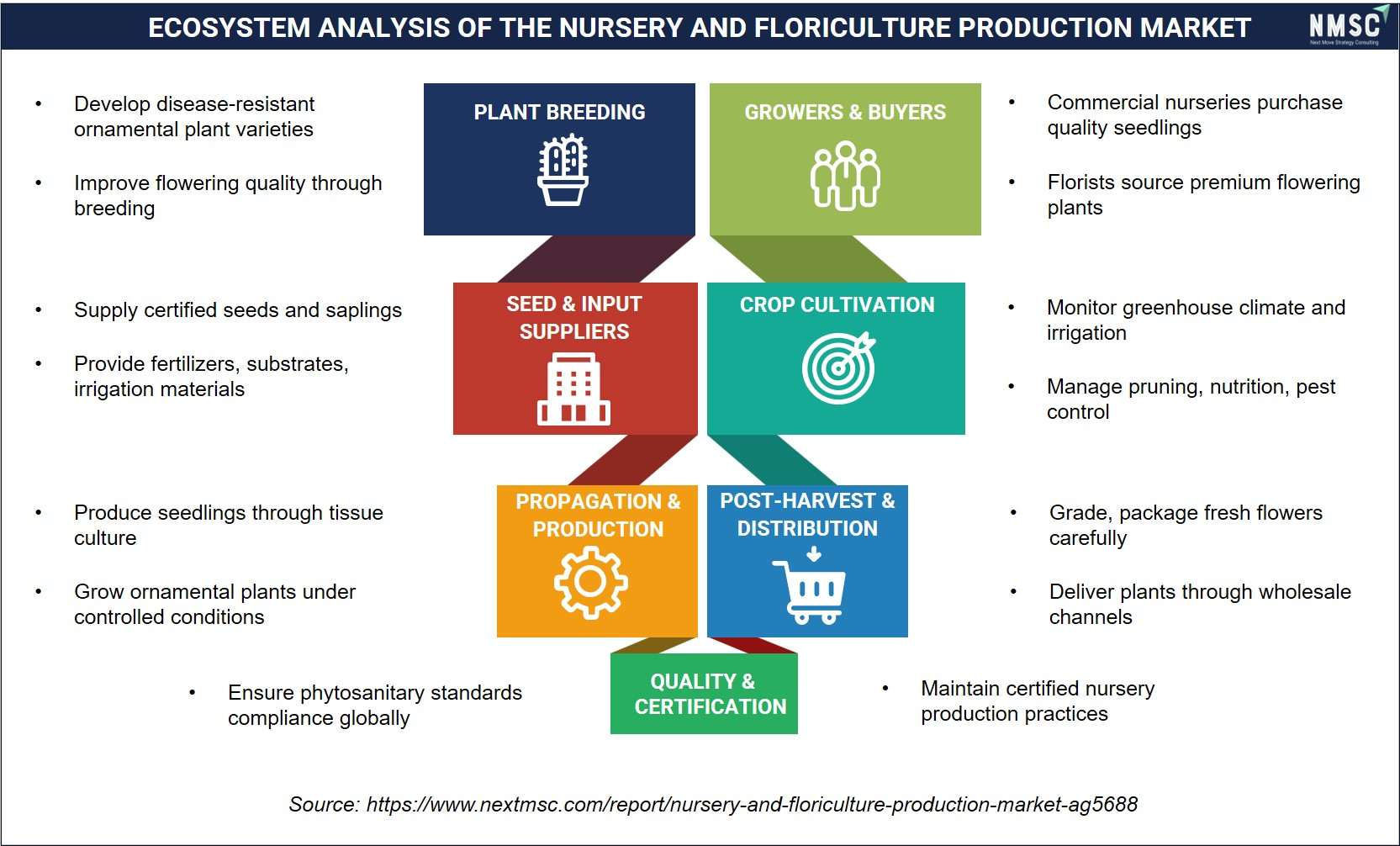
NMSC's analysis indicates that the Nursery and Floriculture Production Market operates through an integrated ecosystem spanning plant breeding, tissue culture propagation, and controlled greenhouse cultivation. Input suppliers provide certified seeds, substrates, and specialized fertilizers. Subsequently, post-harvest grading and wholesale channels supply commercial nurseries and florists. Adherence to strict global phytosanitary standards ensures product quality and compliance across international markets.
Growth Drivers and Restraints
Growth Catalyst and Risk Assessment Matrix
|
Factors |
Type |
(+/-) % Impact on CAGR |
Geographic Relevance |
Impact Timeline |
|
Expanding protected-cultivation greenhouse acreage |
Driver |
+1.5% |
Global |
2026-2035 |
|
Rising urban landscaping and gardening spend |
Driver |
+1.1% |
North America, Europe, Asia-Pacific |
2026-2035 |
|
Growth of export-oriented flower farms in Africa and Latin America |
Driver |
+0.9% |
MEA, Latin America |
2026-2035 |
|
Expansion of e-commerce and direct-to-consumer flower delivery |
Driver |
+0.7% |
North America, Europe |
2026-2035 |
|
Government horticulture-development subsidy programs |
Driver |
+0.6% |
Asia-Pacific, MEA |
2026-2035 |
|
Rising demand for event and institutional floral decor |
Driver |
+0.5% |
Global |
2026-2032 |
|
Perishability and cold-chain logistics cost |
Restraint |
-0.6% |
MEA, Latin America, Asia-Pacific |
2026-2035 |
|
Plant health and phytosanitary compliance costs |
Restraint |
-0.5% |
Europe, North America |
2026-2035 |
|
Vulnerability to weather and climate variability |
Restraint |
-0.4% |
Global |
2026-2035 |
What Is the Primary Growth Driver of the Nursery and Floriculture Production Market?
Expanding protected-cultivation greenhouse acreage is the primary driver of the market. The U.S. Department of Agriculture continues to report rising greenhouse and nursery production value through its census of horticultural specialties, reflecting sustained grower investment in climate-controlled infrastructure. We observed that this capital-investment trend, reinforced by year-round yield stability, continues to anchor baseline production-capacity expansion across developed and emerging floriculture markets alike.
How Is Urban Landscaping Demand Driving Market Growth?
Rising urban landscaping and gardening spend is accelerating demand for nursery plants and potted ornamentals across residential and commercial development projects. The European Commission's agriculture directorate continues to support green-infrastructure initiatives that incorporate ornamental planting into urban development standards. Our assessment indicates that this policy-supported demand, combined with growing residential gardening participation, is compressing replacement cycles for nursery-plant inventory among landscaping contractors.
What Is Restraining Nursery and Floriculture Production Market Expansion?
Perishability and cold-chain logistics cost restrain margins for cut-flower exporters serving distant retail markets. The Food and Agriculture Organization continues to highlight post-harvest loss as a persistent challenge for perishable horticultural exports from developing regions. We found that growers lacking cold-chain infrastructure face particular exposure, as transit-related quality loss reduces their ability to compete with vertically integrated exporters serving premium retail channels.
Segmentation Analysis
Segment Sizing: By Product Type
|
Segment |
2025 (USD) |
2035 (USD) |
CAGR% (2026–2035) |
|
Cut Flowers |
USD 42.43 Billion |
USD 68.01 Billion |
4.8% |
|
Potted and Flowering Plants |
USD 34.94 Billion |
USD 65.82 Billion |
6.7% |
|
Nursery Plants |
USD 32.45 Billion |
USD 59.24 Billion |
6.3% |
|
Propagation Materials |
USD 14.98 Billion |
USD 26.33 Billion |
5.8% |
|
Total |
USD 124.80 Billion |
USD 219.40 Billion |
5.85% |
Which Product Type Dominates the Nursery and Floriculture Production Market?
Cut Flowers led the market with USD 42.43 billion in 2025, supported by sustained demand from retail floristry, event decor, and gifting occasions across mature and emerging economies. Our findings suggest that Potted and Flowering Plants is the fastest-growing product type, expanding at a 6.7% CAGR from 2026 to 2035, as residential and commercial landscaping demand increasingly favors longer-lasting potted ornamentals over cut-stem arrangements.
Segment Sizing: By Production Method
|
Segment |
2025 (USD) |
2035 (USD) |
CAGR% (2026–2035) |
|
Protected Cultivation |
USD 71.14 Billion |
USD 140.42 Billion |
7.2% |
|
Open Field Cultivation |
USD 53.66 Billion |
USD 78.98 Billion |
3.8% |
|
Total |
USD 124.80 Billion |
USD 219.40 Billion |
5.85% |
Which Production Method Leads Nursery and Floriculture Production Market Demand?
Protected Cultivation remained the leading production method within the market, valued at USD 71.14 billion in 2025 on sustained grower investment in climate-controlled greenhouse infrastructure. We observed that Protected Cultivation is also the fastest-growing production method, registering a 7.2% CAGR from 2026 to 2035, as growers increasingly prioritize year-round yield consistency and quality control over seasonal open-field output.
Segment Sizing: By End Use
|
Segment |
2025 (USD) |
2035 (USD) |
CAGR% (2026–2035) |
|
Landscaping and Gardening |
USD 47.42 Billion |
USD 78.98 Billion |
5.2% |
|
Retail and Floristry |
USD 44.93 Billion |
USD 81.18 Billion |
6.2% |
|
Institutional and Events |
USD 32.45 Billion |
USD 59.24 Billion |
6.3% |
|
Total |
USD 124.80 Billion |
USD 219.40 Billion |
5.85% |
Which End Use Segment Is Most Significant in the Nursery and Floriculture Production Market?
Landscaping and Gardening remained the largest end-use segment, reaching USD 47.42 billion in 2025 on sustained residential and commercial development demand for nursery plants and ornamentals. Based on research conducted by Next Move Strategy Consulting, we found that Institutional and Events is the fastest-growing end use at a 6.3% CAGR from 2026 to 2035, reflecting rising corporate, hospitality, and event-sector spending on floral decor.
Growth Opportunities
Our analysis shows that three forward-looking opportunities stand out for stakeholders positioning within the nursery and floriculture production market over the 2026-2035 forecast period.
How Can Cold-Chain Investment Unlock Value for Export-Oriented Growers?
Cold-chain and post-harvest handling investment presents a whitespace opportunity for export-oriented growers seeking to reduce transit-related quality loss. Producers that build integrated cold-chain logistics stand to capture premium retail contracts as buyers increasingly specify vase-life guarantees across the cut-flowers product-type segment.
Where Do Direct-to-Consumer Platforms Create New Demand?
Direct-to-consumer subscription and delivery platforms represent an underpenetrated opportunity across urban North American and European markets. Growers that partner with logistics-enabled e-commerce platforms can secure recurring-revenue relationships, benefiting from rising online floral-purchase adoption within the retail and floristry end-use segment.
How Can Proprietary Variety Breeding Benefit Propagation Suppliers?
Growers and retailers seeking differentiated, longer-vase-life flower varieties create an opportunity for proprietary breeding and licensing programs. Early movers that secure licensed-grower distribution networks can differentiate with retail buyers pursuing exclusive varietal catalogs within the propagation-materials product-type segment.
Regional Outlook
Geographic Performance Snapshot
|
Region |
2025 (USD) |
2035 (USD) |
CAGR% (2026–2035) |
Key Driver |
|
Asia-Pacific |
USD 42.43 Billion |
USD 81.18 Billion |
6.8% |
National horticulture-development subsidy programs |
|
Europe |
USD 36.19 Billion |
USD 57.04 Billion |
4.6% |
Plant health regulation and greenhouse modernization |
|
North America |
USD 27.46 Billion |
USD 46.07 Billion |
5.3% |
Urban landscaping demand and e-commerce delivery growth |
|
Latin America |
USD 11.23 Billion |
USD 21.94 Billion |
7.1% |
Expanding export-oriented flower-farm capacity |
|
Middle East and Africa |
USD 7.49 Billion |
USD 13.16 Billion |
5.8% |
Government food and horticulture diversification investment |
|
Total |
USD 124.80 Billion |
USD 219.40 Billion |
5.85% |
– |
Asia-Pacific Nursery and Floriculture Production Market Outlook
Asia-Pacific leads the market on national horticulture-development subsidy programs and rapidly expanding protected-cultivation acreage across China and India. We observed that public procurement of greenhouse infrastructure continues to scale across state-supported horticulture zones, while domestic producers expand nursery-plant distribution to meet urban landscaping demand. Technology adoption remains uneven, with advanced climate-control systems concentrated among larger commercial operations.
Europe Nursery and Floriculture Production Market Outlook
Europe's market reflects a mature landscape shaped by the European Union's plant health and phytosanitary certification requirements and greenhouse-modernization incentives. Our findings suggest that producers across Germany, the Netherlands, and France are accelerating adoption of energy-efficient climate-control retrofits to meet sustainability-linked subsidy eligibility. Technology adoption favors LED supplemental lighting and automated irrigation across the region's greenhouse-intensive production base.
North America Nursery and Floriculture Production Market Outlook
North America's market is propelled by rising urban landscaping demand and expanding e-commerce flower-delivery adoption across the U.S. and Canada. We observed that large growers continue to scale direct-to-consumer distribution capability, while regional nurseries expand plant-inventory breadth to serve residential and commercial landscaping contractors. Competitive intensity is elevated given the concentration of large, vertically integrated growers.
Latin America Nursery and Floriculture Production Market Outlook
Latin America is the fastest-growing region, driven by expanding export-oriented flower-farm capacity across Colombia, Ecuador, and Brazil serving North American and European retail demand. Our assessment indicates that regulatory support for agricultural-export infrastructure is expanding grower investment, while currency volatility continues to concentrate near-term capital spending within larger, export-financed operations.
Middle East and Africa Nursery and Floriculture Production Market Outlook
The Middle East and Africa market is shaped by government food and horticulture diversification investment in Saudi Arabia and the UAE, alongside established export-oriented rose-farming capacity in Kenya. We found that regulatory support for agricultural-export certification is expanding institutional procurement, while limited cold-chain infrastructure in parts of Sub-Saharan Africa continues to moderate near-term growth relative to production potential.
U.S. Nursery and Floriculture Production Market Outlook
Based on our estimates, U.S.'s nursery and floriculture production market was valued at approximately USD 20.32 billion in 2025 and is projected to reach approximately USD 33.63 billion by 2035, expanding at approximately a 5.1% CAGR from 2026 to 2035. The U.S. remains the largest single country market, anchored by extensive nursery and greenhouse infrastructure and strong urban landscaping demand. Demand structure favors potted plants and nursery stock over cut-stem imports, with USDA phytosanitary oversight shaping import standards. Technology penetration is advanced across large commercial growers, and competitive intensity remains high among domestic producers and importers targeting the country's large residential and commercial landscaping base.
Canada Nursery and Floriculture Production Market Outlook
Canada's nursery and floriculture production market was valued at approximately USD 4.39 billion in 2025 and is projected to reach approximately USD 7.83 billion by 2035, expanding at approximately a 6.0% CAGR from 2026 to 2035. Canada's market benefits from strong seasonal gardening demand and growing greenhouse-production investment in Ontario and British Columbia. Demand structure is weighted toward potted plants and nursery stock, with moderate regulatory influence from federal plant-health inspection standards. Technology penetration is high in commercial greenhouse operations, and competitive intensity is moderate, with domestic growers holding meaningful share alongside U.S. imports.
UK Nursery and Floriculture Production Market Outlook
As per our estimate, UK's nursery and floriculture production market was valued at approximately USD 5.79 billion in 2025 and is projected to reach approximately USD 8.56 billion by 2035, expanding at approximately a 3.8% CAGR from 2026 to 2035. The UK market reflects steady demand from garden centers and landscaping contractors navigating post-Brexit plant-health certification requirements. Demand structure favors nursery plants and potted ornamentals, with the Department for Environment, Food and Rural Affairs shaping import biosecurity standards. Technology penetration is advanced among larger growers, and competitive intensity remains elevated given import competition from Dutch and other European suppliers.
Germany Nursery and Floriculture Production Market Outlook
According to our analysis, Germany's nursery and floriculture production market was valued at approximately USD 6.88 billion in 2025 and is projected to reach approximately USD 10.84 billion by 2035, expanding at approximately a 4.6% CAGR from 2026 to 2035. Germany's market is shaped by extensive greenhouse-production capacity and strong retail garden-center distribution networks. Demand structure favors potted and flowering plants alongside cut flowers, with federal plant-health authorities enforcing strict phytosanitary compliance. Technology penetration is high among large commercial growers, and competitive intensity is elevated given the concentration of major European breeders and producers.
France Nursery and Floriculture Production Market Outlook
Based on our estimates, France's nursery and floriculture production market was valued at approximately USD 5.43 billion in 2025 and is projected to reach approximately USD 8.56 billion by 2035, expanding at approximately a 4.6% CAGR from 2026 to 2035. France's market benefits from established horticultural regions and growing consumer demand for locally grown ornamentals. Demand structure is weighted toward cut flowers and nursery plants, with regulatory influence from national plant-health authorities shaping import and biosecurity standards. Technology penetration is expanding steadily, and competitive intensity is moderate, with domestic and Dutch-imported supply both prominent.
China Nursery and Floriculture Production Market Outlook
China's nursery and floriculture production market was valued at approximately USD 14.85 billion in 2025 and is projected to reach approximately USD 27.60 billion by 2035, expanding at approximately a 6.5% CAGR from 2026 to 2035. China's market is the largest in Asia-Pacific, propelled by strong domestic demand and expanding state-supported horticulture zones. Demand structure favors nursery plants and cut flowers across urban landscaping and retail floristry, with the Ministry of Agriculture and Rural Affairs shaping production-zone standards. Technology penetration is extensive across major production provinces, and competitive intensity is high, dominated by large domestic producers.
India Nursery and Floriculture Production Market Outlook
As per our estimate, India's nursery and floriculture production market was valued at approximately USD 7.64 billion in 2025 and is projected to reach approximately USD 18.67 billion by 2035, expanding at approximately a 9.8% CAGR from 2026 to 2035. India's market is the fastest-growing country market, driven by national horticulture-mission subsidy programs and rapidly expanding protected-cultivation acreage. Demand structure spans cut flowers and nursery plants across domestic retail and export-oriented rose and gladiolus production, with the Ministry of Agriculture and Farmers Welfare shaping subsidy-linked procurement. Technology penetration continues to expand across state horticulture zones, and competitive intensity is intense among domestic growers.
Japan Nursery and Floriculture Production Market Outlook
According to our analysis, Japan's nursery and floriculture production market was valued at approximately USD 6.79 billion in 2025 and is projected to reach approximately USD 10.55 billion by 2035, expanding at approximately a 4.4% CAGR from 2026 to 2035. Japan's market reflects steady demand amid an aging domestic grower base and strong consumer preference for high-quality potted ornamentals. Demand structure favors potted and flowering plants for gifting and seasonal occasions, with regulatory influence from national agriculture ministries shaping import phytosanitary standards. Technology penetration is high among large commercial greenhouses, and competitive intensity is moderate, with domestic producers holding meaningful share.
South Korea Nursery and Floriculture Production Market Outlook
Based on our estimates, South Korea's nursery and floriculture production market was valued at approximately USD 3.39 billion in 2025 and is projected to reach approximately USD 5.68 billion by 2035, expanding at approximately a 5.3% CAGR from 2026 to 2035. South Korea's market benefits from strong urban gift-flower culture and government support for greenhouse modernization. Demand structure favors cut flowers and potted plants for gifting occasions, with regulatory influence from national agriculture authorities shaping quarantine and import standards. Technology penetration is high relative to farm size, and competitive intensity is moderate among domestic and imported supply.
Australia Nursery and Floriculture Production Market Outlook
Australia's nursery and floriculture production market was valued at approximately USD 2.97 billion in 2025 and is projected to reach approximately USD 4.87 billion by 2035, expanding at approximately a 5.0% CAGR from 2026 to 2035. Australia's market reflects steady demand from landscaping and retail garden-center channels supported by strong biosecurity-compliant domestic production. Demand structure favors nursery plants and potted ornamentals, with regulatory influence from national agriculture departments shaping strict quarantine import standards. Technology penetration is advanced among larger commercial nurseries, and competitive intensity is moderate, with domestic producers holding meaningful share.
UAE Nursery and Floriculture Production Market Outlook
As per our estimate, UAE's nursery and floriculture production market was valued at approximately USD 1.50 billion in 2025 and is projected to reach approximately USD 2.63 billion by 2035, expanding at approximately a 5.8% CAGR from 2026 to 2035. The UAE market is propelled by government-led horticulture diversification investment supporting controlled-environment ornamental production. Demand structure favors potted plants and cut flowers procured through retail and hospitality-sector channels, with regulatory bodies shaping import and quarantine requirements. Technology penetration is expanding from a small production base given import reliance, and competitive intensity is moderate, with international suppliers holding meaningful share.
Saudi Arabia Nursery and Floriculture Production Market Outlook
According to our analysis, Saudi Arabia's nursery and floriculture production market was valued at approximately USD 1.65 billion in 2025 and is projected to reach approximately USD 2.90 billion by 2035, expanding at approximately a 5.8% CAGR from 2026 to 2035. Saudi Arabia's market benefits from Vision 2030-linked agricultural diversification and expanding domestic greenhouse-production investment. Demand structure favors potted plants and cut flowers procured through public and private landscaping programs, with the Ministry of Environment, Water and Agriculture shaping import and biosecurity standards. Technology penetration is expanding rapidly, and competitive intensity is moderate, with international suppliers increasingly partnering with domestic distributors.
South Africa Nursery and Floriculture Production Market Outlook
Based on our estimates, South Africa's nursery and floriculture production market was valued at approximately USD 1.80 billion in 2025 and is projected to reach approximately USD 3.16 billion by 2035, expanding at approximately a 5.8% CAGR from 2026 to 2035. South Africa's market reflects established export-oriented rose and protea production alongside growing domestic retail floristry demand. Demand structure favors cut flowers for export and nursery plants for domestic landscaping, with regulatory influence from national agriculture authorities shaping export-certification standards. Technology penetration remains concentrated among larger commercial farms, and competitive intensity is moderate, with export-focused growers holding meaningful share.
Brazil Nursery and Floriculture Production Market Outlook
Brazil's nursery and floriculture production market was valued at approximately USD 5.17 billion in 2025 and is projected to reach approximately USD 9.87 billion by 2035, expanding at approximately a 6.8% CAGR from 2026 to 2035. Brazil's market is the largest in Latin America, driven by extensive domestic ornamental-plant production and growing export-oriented cut-flower capacity. Demand structure favors nursery plants and cut flowers across domestic retail and export channels, with regulatory influence from national agricultural-export certification programs shaping compliance requirements. Technology penetration continues to expand across major production states, and competitive intensity is moderate, with domestic producers dominant.
Argentina Nursery and Floriculture Production Market Outlook
As per our estimate, Argentina's nursery and floriculture production market was valued at approximately USD 2.25 billion in 2025 and is projected to reach approximately USD 4.39 billion by 2035, expanding at approximately a 7.1% CAGR from 2026 to 2035. Argentina's market reflects steady growth in domestic ornamental-plant demand amid macroeconomic volatility affecting import-dependent input costs. Demand structure favors nursery plants and cut flowers for domestic retail and landscaping use, with regulatory influence from national agricultural authorities shaping phytosanitary compliance. Technology penetration is expanding steadily among larger commercial growers, and competitive intensity is moderate, with regional producers holding meaningful share.
Supply Chain Structure of the Nursery and Floriculture Production Market
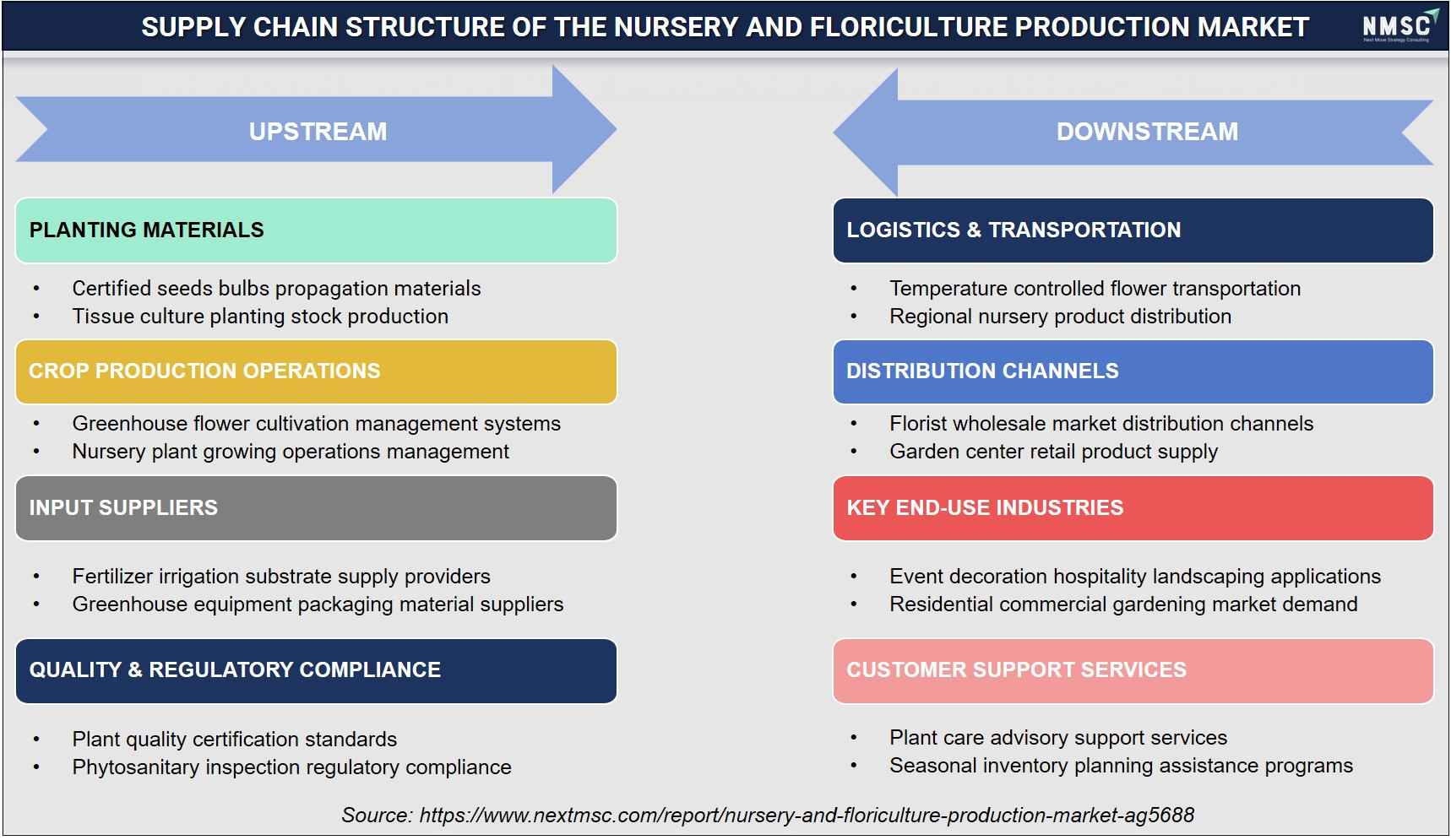
Based on research conducted by NMSC, we found that the supply chain of the Nursery and Floriculture Production Market connects certified planting stock, greenhouse management, and quality compliance with downstream execution. Cold-chain logistics and regional wholesale channels supply flowers and plants to event, hospitality, and landscaping sectors. Furthermore, dedicated plant care advisory and seasonal inventory support help maintain long-term product viability and retail satisfaction.
Competitive Landscape
We observed that the nursery and floriculture production market remains moderately fragmented, with global breeding-and-propagation firms, vertically integrated potted-plant growers, and regional export-oriented flower farms all competing for retail, landscaping, and institutional procurement budgets.
|
Dimension |
Details |
|
Market Structure |
Moderately fragmented, with the Top 10 companies accounting for a defined share of Industry revenue |
|
Innovation Focus |
Proprietary variety breeding, climate-controlled greenhouse technology, and cold-chain logistics |
|
M&A Activity |
Consolidation among breeding firms and vertically integrated growers to broaden varietal catalogs |
How Do Companies Compete Within the Nursery and Floriculture Production Market?
Companies compete primarily on proprietary variety breadth, greenhouse-production scale, and cold-chain distribution reliability to retail and landscaping customers. Our analysis shows that producers increasingly differentiate through licensed-variety exclusivity and sustainability certification rather than volume alone, as retail buyers prioritize verified provenance and post-harvest quality.
Which Competitive Archetypes Dominate the Nursery and Floriculture Production Market?
Three archetypes dominate: global breeding-and-propagation firms such as Dümmen Orange Group B.V. and Selecta Klemm GmbH & Co. KG; vertically integrated potted-plant growers such as Costa Farms LLC and Metrolina Greenhouses, Inc.; and export-oriented flower farms such as Oserian Development Company Limited and Rosaprima S.A. Each archetype leverages distinct distribution channels, from licensed-grower networks to direct retail and wholesale export relationships.
What Innovation and Differentiation Strategies Are Companies Pursuing?
Companies are pursuing proprietary variety breeding, climate-controlled greenhouse expansion, and cold-chain logistics investment as core differentiation strategies. We found that Industry leaders are also investing in biodegradable packaging and direct-to-consumer delivery capability to expand reach across sustainability-conscious retail partners.
What M&A Activity Is Shaping the Competitive Landscape?
M&A activity is concentrated on acquiring complementary breeding programs and regional propagation facilities to broaden varietal and geographic coverage. Our assessment indicates that this consolidation trend is expected to continue as producers seek to reduce customer-acquisition cost through broader, cross-sellable catalog scope.
Key Market Players
Our findings suggest that the following 20 companies represent the leading verified producers active in the nursery and floriculture production market as of 2026, ranked by market-specific revenue and scale of operations.
-
Dümmen Orange Group B.V.
-
Ball Horticultural Company
-
Costa Farms LLC
-
Danziger – "Dan" Flower Farm
-
Selecta Klemm GmbH & Co. KG
-
Suntory Flowers Limited
-
Metrolina Greenhouses, Inc.
-
Green Circle Growers, Inc.
-
Bailey Nurseries, Inc.
-
Hines Growers, LLC
-
Van Zanten Plants B.V.
-
Florensis B.V.
-
Beekenkamp Group
-
W. Kordes' Söhne Rosenschulen GmbH & Co KG
-
Terra Nova Nurseries, Inc.
-
Monrovia Nursery Company
-
Oserian Development Company Limited
-
Rosaprima S.A.
Latest Developments
We observed that recent facility expansions and product launches reflect the industry's continued shift toward greenhouse capacity and varietal innovation.
|
Date |
Event |
|
June 2026 |
Beekenkamp Group entered into a long-term, multi-year agreement with Selecta One for the exclusive production of propagation material. Under this contract, production of young plant materials for Deliflor Chrysanthemums and Beekenkamp Plants Ornamentals will be hosted at Selecta One's specialized facilities located in Uganda. |
|
May 2026 |
Dümmen Orange Group B.V. and Syngenta Flowers signed an agreement to establish a global strategic joint venture combining their ornamental breeding and propagation operations. The entity unites Dümmen Orange's cut flower expertise with Syngenta Flowers' seed varieties, annuals, perennials, and potted plant portfolios to optimize supply chains. |
|
February 2026 |
Ball Horticultural Company's UK division, Ball Colegrave Ltd., announced a major production expansion project in partnership with Cambridge HOK. The company submitted planning to consolidate operations and build expanded production greenhouse facilities, trial grounds, and distribution capacity at its Bordon Hill site in Stratford-upon-Avon. |
|
January 2026 |
Selecta Klemm GmbH & Co. KG formed a strategic distribution and logistics partnership with Tapp Paper Dataloggers. The company began integrating paper-based data loggers into its global transport and temperature monitoring operations, replacing plastic USB loggers to cut electrical and plastic waste by up to 90 percent. |
Expert Insights
 “Plants native to the continental United States seem to be taking a greater market share of landscape plant sales for American consumers. The trajectory is slow and steady.”
— Debbie Hamrick, Founding Publisher, FloraCulture International
Statement made in an interview published by the International Association of Horticultural Producers (AIPH) discussing the increasing adoption of native plants in the U.S. nursery and landscaping industry and their growing commercial significance.
Market Interpretation
The statement highlights the gradual shift in consumer preferences toward native plant species, driven by increasing awareness of biodiversity conservation, sustainable landscaping, and climate-resilient horticultural practices. As demand for environmentally adapted plants continues to rise, nursery producers are expanding the cultivation of native species to meet evolving landscaping and restoration requirements. This trend is encouraging investments in diversified plant portfolios, sustainable production techniques, and region-specific nursery operations, thereby supporting the long-term growth of the nursery and floriculture production market.
Investment Opportunities
What Capital Inflows Are Targeting the Nursery and Floriculture Production Market?
Capital inflows continue to target greenhouse-infrastructure expansion and cold-chain logistics, with vertically integrated growers attracting sustained investor interest. Our assessment indicates that investors favor producers demonstrating measurable yield-stability and post-harvest quality outcomes over pure acreage-growth metrics.
How Is Infrastructure Investment Shaping Market Expansion?
Greenhouse and cold-chain infrastructure investment continues to expand production reliability, supporting the 7.2% CAGR projected for Protected Cultivation through 2035. We found that producers are prioritizing packhouse and cold-storage expansion to serve export-oriented demand across Latin America, Africa, and Asia-Pacific regions.
What ESG Considerations Are Relevant to Nursery and Floriculture Investment?
Environmental, Social, and Governance considerations increasingly favor producers adopting water-efficient irrigation and biodegradable packaging while maintaining fair-labor certification across export-oriented flower farms. Our analysis shows that institutional investors are prioritizing producers with transparent sustainability and labor-practice disclosures aligned with international horticultural-trade standards.
Key Benefits for Stakeholders
How Does This Report Benefit Grower and Industry Leaders?
Grower and industry leaders gain access to verified segmentation, regional sizing, and competitive benchmarking that inform greenhouse-investment and varietal-portfolio decisions. Our analysis, data, and forecasts help leaders prioritize protected-cultivation and cold-chain investments aligned with projected segment growth.
How Does This Report Benefit Investors and Financial Analysts?
Investors and financial analysts benefit from validated market-sizing, CAGR methodology, and company-level competitive positioning that support capital-allocation and valuation decisions. Our findings suggest that segment-level growth differentials, particularly in Protected Cultivation and Institutional and Events end use, offer actionable signals for portfolio construction.
How Does This Report Benefit Retail and Landscaping Product Teams?
Retail and landscaping product teams gain strategic insight into emerging trends, competitive archetypes, and regional demand patterns that inform assortment-planning and sourcing prioritization. We observed that this analysis supports go-to-market planning for sustainable-packaging and direct-to-consumer delivery partnerships across target end-use segments.
Key Market Segments
By Product Type
-
Cut Flowers
-
Potted and Flowering Plants
-
Nursery Plants
-
Propagation Materials
By Production Method
-
Protected Cultivation
-
Open Field Cultivation
By End Use
-
Landscaping and Gardening
-
Retail and Floristry
-
Institutional and Events
By Region
-
North America: U.S., Canada, Mexico.
-
Europe: UK, Germany, France, Italy, Spain, Sweden, Denmark, Finland, Netherlands, Rest of Europe.
-
Asia-Pacific: China, India, Japan, South Korea, Taiwan, Indonesia, Vietnam, Australia, Philippines, Malaysia, Rest of APAC.
-
Middle East & Africa: Saudi Arabia, UAE, Egypt, Israel, Turkey, Nigeria, South Africa, Rest of MEA.
-
Latin America: Brazil, Argentina, Chile, Colombia, Rest of LATAM.
Conclusion and Recommendations
What Is the Long-Term Outlook for the Nursery and Floriculture Production Market?
The long-term outlook remains positive, with the market projected to expand from USD 131.60 billion in 2026 to USD 219.40 billion by 2035 at a 5.85% CAGR. Our assessment indicates that sustained greenhouse-infrastructure investment and rising urban landscaping demand will anchor growth across both mature and emerging economies through the forecast horizon.
What Strategic Positioning Should Companies Pursue?
Companies should prioritize proprietary varietal development and cold-chain distribution capability to differentiate within an increasingly quality-focused retail landscape. Our findings suggest that producers combining broad breeding portfolios with verified sustainability credentials will be best positioned to retain premium retail-partner contracts.
How Attractive Is the Market for New Investment?
The market presents an attractive investment case, supported by a USD 87.80 billion absolute dollar opportunity between 2026 and 2035 and above-average growth in Latin America and the Protected Cultivation segment. We found that investment attractiveness is highest for producers combining greenhouse-scale production with integrated cold-chain logistics.
What Market Shifts and Key Risks Should Stakeholders Monitor?
Stakeholders should monitor perishability-related logistics cost, phytosanitary compliance requirements, and weather-related production variability as key risks. Our analysis shows that producers unable to demonstrate reliable cold-chain and quality-assurance infrastructure risk losing premium retail contracts to competitors with stronger post-harvest capability.
What Are the Key Growth Pathways for the Market?
Key growth pathways include expanding protected-cultivation capacity, scaling direct-to-consumer delivery infrastructure, and deepening export-oriented production across Latin America and Africa. Next Move Strategy Consulting's analysis indicates that producers pursuing these pathways while maintaining varietal breadth will be best positioned to capture the market's projected growth through 2035.
What Are the Key Growth Pathways for the Market?
Key growth pathways include expanding protected-cultivation capacity, scaling direct-to-consumer delivery infrastructure, and deepening export-oriented production across Latin America and Africa. Next Move Strategy Consulting's analysis indicates that producers pursuing these pathways while maintaining varietal breadth will be best positioned to capture the market's projected growth through 2035.
About the Author
 Saista Faiyaz
— Saista Faiyaz is Research Associate at Next Move Strategy Consulting, where she has covered consumer markets and healthcare technologies for 3 years. Her work includes primary interview review, secondary-source validation, market sizing, and structured analysis of company and industry data. She supports research by comparing evidence across sources, organizing findings into market narratives, and documenting assumptions used in analysis. Her scope includes cross-market benchmarking, and reports.
Saista Faiyaz
— Saista Faiyaz is Research Associate at Next Move Strategy Consulting, where she has covered consumer markets and healthcare technologies for 3 years. Her work includes primary interview review, secondary-source validation, market sizing, and structured analysis of company and industry data. She supports research by comparing evidence across sources, organizing findings into market narratives, and documenting assumptions used in analysis. Her scope includes cross-market benchmarking, and reports.
About the Reviewer
 Supradip Baul
— Supradip Baul is an accomplished business consultant and strategist with over a decade of rich experience in market intelligence, strategy, technology, and business transformation. His work has included rigorous qualitative and quantitative analysis across multiple industries, helping clients shape investment decisions and long-term roadmaps. Earlier in his career, he was associated with Gartner, where he contributed to industry-leading reports and market share analyses. He has worked with leading global companies and holds an MBA with a dual specialization in Marketing and Finance.
Supradip Baul
— Supradip Baul is an accomplished business consultant and strategist with over a decade of rich experience in market intelligence, strategy, technology, and business transformation. His work has included rigorous qualitative and quantitative analysis across multiple industries, helping clients shape investment decisions and long-term roadmaps. Earlier in his career, he was associated with Gartner, where he contributed to industry-leading reports and market share analyses. He has worked with leading global companies and holds an MBA with a dual specialization in Marketing and Finance.
At Next Move Strategy Consulting, we understand that insightful market research is the cornerstone of successful business decisions. That's why we employ a robust and multifaceted approach, combining various methodologies to deliver the most accurate and actionable data for our clients.

Research Landscape
We navigate the world of research with two primary approaches:
Qualitative Approach
Our qualitative research methodologies involve immersive techniques such as in-depth interviews, focus groups, and observational studies. By engaging directly with individuals and stakeholders, we uncover valuable insights that quantitative data alone may overlook.

Quantitative Research
In tandem with qualitative methodologies, NMSC leverages the power of Quantitative Research to provide a robust foundation of numerical insights. Through systematic data collection and analysis, we quantify patterns, preferences, and market trends, offering a comprehensive view of the business landscape.
Our quantitative research approach employs diverse tools, including surveys, experiments, and statistical modelling. These methodologies enable us to gather data from a large and representative sample, ensuring the statistical significance of our findings. By employing structured questionnaires and standardized data collection methods, we guarantee the reliability and validity of the information we present to our clients.
Quantitative research is particularly effective in measuring the prevalence of trends, assessing market size, and gauging the impact of various factors on consumer behavior. The numerical precision attained through this approach equips our clients with actionable insights, facilitating data-driven decision-making and strategy formulation.


Our Specialized Toolbox for Industry-Specific Market Research
We deploy a specialized arsenal of techniques tailored to meet your unique requirements. Here's a glimpse into our comprehensive toolbox:

Information Procurement
The stage entails acquiring market data or relevant information through various sources and methodologies.


Market Research Approach
We utilize both top-down and bottom-up approaches in market research analysis to achieve a comprehensive understanding of the market dynamics, leveraging the broad perspective of industry trends and macroeconomic factors alongside detailed insights from specific segments and individual companies.

Porters Five Forces Analysis
We conduct Porter's Five Forces analysis to evaluate the competitive landscape of an industry, providing us with insights into factors that affect profitability and strategic positioning.

SWOT Analysis

Forecasting
We utilize a forecasting model to predict future consumption by considering parameters like population, economics, regulations, market competition, drivers, constraints, technology, and pricing. We also employ statistical techniques such as multilinear regression, exponential smoothing, moving average, ARIMA, and Monte Carlo simulations for accurate predictions. In econometric forecasting, we analyzed short-term and long-term event impacts, attributing values based on regulatory frameworks, economic factors, and market events.





 Speak to Our Analyst