Alzheimer’s disease diagnostics Market Analysis and Forecast (2026–2035)

Rising anti amyloid therapy use and new FDA cleared blood tests lift revenue from USD 1.02 Billion in 2025 to USD 4.05 Billion by 2035, a 14.6% CAGR for 2026–2035, with North America leading.

Download Free Sample PDF
Base Year (2025)
$1.02 Billion
Forecast (2035)
$4.05 Billion
CAGR (2026-2035)
14.6%
Top Region
North America

What Is the Alzheimer’s Disease Diagnostics Market Size?

The Alzheimer’s Disease Diagnostics Market was valued at USD 1.02 Billion in 2025 and is estimated at USD 1.19 Billion in 2026. It is forecast to reach USD 4.05 Billion by 2035, growing at a 14.6% CAGR from 2026 to 2035. North America leads with about 45% share, while PET imaging holds roughly 38% of 2026 revenue.

Three factors shape the market outlook: regulated blood-based tests, amyloid and tau PET radiotracers, and cerebrospinal fluid biomarker assays .The key takeaways below summarize leadership by segment and geography for the forecast window.

Alzheimer’s disease diagnostics Market Analysis and Forecast Revenue Forecast

Values in USD Billion

2025 $1.02 Billion
2025
2026 $1.19 Billion
2026
2027 $1.36 Billion
2027
2028 $1.56 Billion
2028
2029 $1.79 Billion
2029
2030 $2.05 Billion
2030
2031 $2.35 Billion
2031
2032 $2.70 Billion
2032
2033 $3.09 Billion
2033
2034 $3.54 Billion
2034
2035 $4.05 Billion
2035

Key Takeaways

By Diagnostic Method: PET imaging held the largest share, expanding from USD 0.40 Billion in 2025 to USD 1.27 Billion by 2035; Blood-based biomarker tests are the fastest-growing at 20.6% CAGR from 2026–2035.

By Biomarker Target: Amyloid pathology held the largest share, expanding from USD 0.58 Billion in 2025 to USD 1.70 Billion by 2035; Tau pathology is the fastest-growing at 19.1% CAGR from 2026–2035.

By End User: Reference and diagnostic laboratories held the largest share, with revenue projected to increase from USD 0.33 Billion in 2025 to USD 1.62 Billion by 2035. The segment is also projected to be the fastest-growing, at a 16.8% CAGR from 2026 to 2035.

Dominant Region: North America accounted for about 45.4% of 2026 revenue, rising from USD 0.47 Billion in 2025 to USD 1.65 Billion by 2035.

Fastest-Growing Region: Asia-Pacific is expanding at 18.4% CAGR from 2026–2035, reaching USD 1.14 Billion by 2035.

Dominant Country: The U.S. is the largest national market, growing from USD 0.43 Billion in 2025 to USD 1.50 Billion by 2035.

Fastest-Growing Country: India leads growth at 23.5% CAGR from 2026–2035, reaching USD 0.20 Billion by 2035.

Our findings suggest that the Alzheimer’s Disease Diagnostics Market adds an incremental revenue opportunity of USD 2.86 Billion between 2026 and 2035, which positions diagnostic infrastructure as an attractive investment theme.

According to NMSC analysis, the share of revenue from blood tests rises from 30% in 2026 to 48% in 2035 as screening workflows shift away from lumbar puncture.

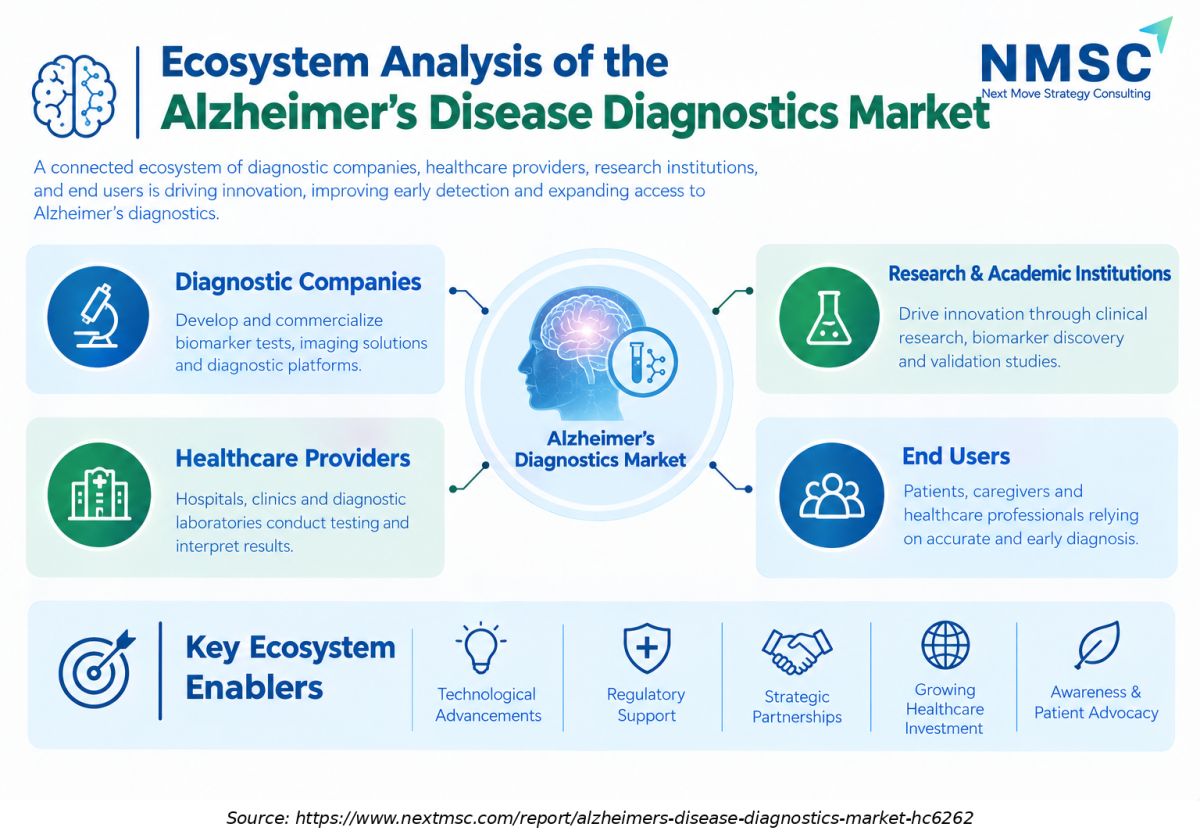
Ecosystem Analysis of the Alzheimer’s Disease Diagnostics Market

The infographic outlines the Ecosystem Analysis of the Alzheimer’s Disease Diagnostics Market, highlighting key stakeholders such as diagnostic companies, healthcare providers, research institutions, and end users. It emphasizes how biomarker discovery, diagnostic innovation, regulatory support, and strategic partnerships contribute to early detection, improved diagnostic accuracy, wider access to testing, and long-term market growth

What Does the Alzheimer’s Disease Diagnostics Market Encompass?

This Alzheimer’s Disease Diagnostics market report covers in vitro and imaging products that help clinicians confirm or exclude Alzheimer’s pathology in symptomatic adults. Scope includes plasma and cerebrospinal fluid biomarker assays for amyloid beta, phosphorylated tau, neurofilament light and glial fibrillary acidic protein, amyloid and tau PET radiotracers, and genetic risk testing such as APOE genotyping. Digital cognitive screening, treatments and caregiver services fall outside the revenue definition.
We observed that regulation now defines the structure of the field. In May 2025, the U.S. FDA cleared the first blood test to aid diagnosis, and additional clearances followed in 2026. Laboratory developed tests still account for a large share of volume, while instrument makers push standardized kits onto installed immunoassay platforms. Reimbursement, guideline updates and therapy labelling continue to widen the eligible patient pool for neurological biomarkers.

Market Drivers & Dynamics

Interactive Dataset
Regulatory clearance of blood tests driver +2.8% U.S., Europe, Japan 2026–2030
Anti amyloid therapy patient selection driver +2.4% North America, Europe 2026–2032
Ageing population and rising prevalence driver +1.9% Global 2026–2035
Multi biomarker and automated platforms driver +1.2% Global 2026–2031
Reimbursement and coverage gaps restraint −1.8% Global, notably Europe and APAC 2026–2029
Indeterminate and confirmatory testing burden restraint −1.1% Global 2026–2030
PET tracer cost and scanner access restraint −0.9% Emerging markets 2026–2031
Source: Next Move Strategy Consulting

Growth Drivers

What Is the Primary Growth Driver?

The leading driver is demand for accurate patient selection as anti-amyloid antibodies reach clinics. The Alzheimer’s Association estimates that 7.4 million Americans aged 65 and older live with Alzheimer’s dementia in 2026. The World Health Organization estimated that more than 57 million people worldwide were living with dementia in 2021. Patients being considered for anti-amyloid therapies generally require confirmation of amyloid pathology. This makes appropriate biomarker testing an important part of treatment eligibility assessment.

How Is Regulatory and Payer Progress Driving Market Growth?

Our analysis shows that clearances and coverage decisions convert scientific validity into purchasable volume. C2N Diagnostics received FDA clearance for PrecivityAD2 in August 2026 for its indicated patient population, including adults aged 40 and older. Roche Diagnostics also received FDA clearance for Elecsys pTau217, developed in collaboration with Eli Lilly. Anthem revised its medical policy for Alzheimer’s biochemical marker testing effective July 1, 2026; coverage depends on the policy’s clinical criteria. Each decision lowers the administrative cost of ordering and invites wider primary care adoption.

Growth Inhibitors

What Is Restraining the Market?

The main restraint is uneven reimbursement combined with residual diagnostic uncertainty. The FDA reported that fewer than 20% of patients in the study of the first cleared plasma ratio received indeterminate results. The test’s results must be interpreted in accordance with its cleared indication and clinical context, and FDA clearance should not be interpreted as eliminating the risk of incorrect results. Confirmatory PET or spinal fluid testing therefore persists, and payers in many countries still limit coverage to specialist settings.

Segmentation Analysis

2025 (USD Billion)
2035 (USD Billion)
Blood-based biomarker tests 2025: $0.28 Billion | 2035: $1.95 Billion
Blood-based
CSF biomarker tests 2025: $0.27 Billion | 2035: $0.62 Billion
CSF biomarke
PET imaging 2025: $0.40 Billion | 2035: $1.27 Billion
PET imaging
Genetic testing 2025: $0.07 Billion | 2035: $0.21 Billion
Genetic test
Blood-based biomarker tests $0.28 Billion $1.95 Billion 20.6%
CSF biomarker tests $0.27 Billion $0.62 Billion 8.8%
PET imaging $0.40 Billion $1.27 Billion 12.2%
Genetic testing $0.07 Billion $0.21 Billion 9.9%

Which Diagnostic Method Leads the Market and Which Grows Fastest?

PET imaging is the largest method in 2026 at USD 0.45 Billion, supported by established radiotracers and their role in therapy eligibility. Blood tests are the fastest growing at 20.6% because clearances, instrument compatibility and lower cost per patient widen access. CSF testing grows more slowly at 8.8%. Genetic testing stays small at 9.9%, although falling next generation sequencing costs support steady demand for APOE and familial panels.

2025 (USD Billion)
2035 (USD Billion)
Amyloid path
Tau patholog
Neurodegener
Genetic risk
Segment Item 2025 (USD Billion) 2035 (USD Billion) CAGR
Amyloid pathology $10.0 USD Billion $40.0 USD Billion 23.0%
Tau pathology $17.1 USD Billion $51.1 USD Billion 25.0%
Neurodegeneration and neuroinflammation $24.2 USD Billion $62.2 USD Billion 11.0%
Genetic risk $31.3 USD Billion $73.3 USD Billion 17.0%

Segment-wise data is locked

Unlock complete segment-wise numbers for By Biomarker Target.

Unlock Full Data
2025 (USD Billion)
2035 (USD Billion)
Hospitals an
Reference an
Imaging cent
Pharmaceutic
Segment Item 2025 (USD Billion) 2035 (USD Billion) CAGR
Hospitals and memory clinics $10.0 USD Billion $40.0 USD Billion 26.0%
Reference and diagnostic laboratories $17.1 USD Billion $51.1 USD Billion 16.0%
Imaging centers $24.2 USD Billion $62.2 USD Billion 18.0%
Pharmaceutical and research institutions $31.3 USD Billion $73.3 USD Billion 8.0%

Segment-wise data is locked

Unlock complete segment-wise numbers for By End User.

Unlock Full Data
2025 (USD Billion)
2035 (USD Billion)
North Americ
U.S.
Canada
Mexico
Europe
Segment Item 2025 (USD Billion) 2035 (USD Billion) CAGR
North America $10.0 USD Billion $40.0 USD Billion 10.0%
U.S. $17.1 USD Billion $51.1 USD Billion 8.0%
Canada $24.2 USD Billion $62.2 USD Billion 18.0%
Mexico $31.3 USD Billion $73.3 USD Billion 8.0%
Europe $38.4 USD Billion $84.4 USD Billion 15.0%

Segment-wise data is locked

Unlock complete segment-wise numbers for By Region.

Unlock Full Data

Growth Opportunities

We observed three concrete openings that extend revenue beyond specialist memory clinics over the forecast period.

Can Primary Care Rule Out Testing Unlock New Volume?

Blood tests that confidently exclude amyloid pathology let general practitioners avoid unnecessary specialist referrals, so laboratories and kit makers selling to primary care networks gain a large untapped test base. Beneficiaries include national reference laboratories and platform vendors whose analyzers already sit in community hospitals, and the opportunity grows as guidelines endorse dual cutoff interpretation.

Will Emerging Markets Create the Next Wave of Demand?

Countries across Asia-Pacific and the Middle East are building memory clinic capacity while PET access stays limited, which favors affordable plasma assays and local laboratory partnerships for regional distributors and instrument suppliers. Beneficiaries include assay makers with CE marked or locally registered kits, and the largest gains arise in China, India, Japan and Saudi Arabia where governments fund dementia programs.

How Can Pharmaceutical Partnerships Create Recurring Revenue?

Drug developers need screening, enrolment and treatment response monitoring across large trials. Diagnostic companies offering validated plasma and tau PET assays can secure multiyear service contracts with sponsors and central laboratories. Beneficiaries include specialist assay companies and PET tracer suppliers, because trial screening failure rates are high and each enrolled patient generates repeated testing across the treatment period.

Regional Outlook

2025 (USD Billion)
2035 (USD Billion)
North Americ
Europe
Asia-Pacific
Middle East
Latin Americ
Region 2025 (USD Billion) 2035 (USD Billion) CAGR (%)
North America $10.0 USD Billion $40.0 USD Billion 9.0%
Europe $17.1 USD Billion $51.1 USD Billion 27.0%
Asia-Pacific $24.2 USD Billion $62.2 USD Billion 25.0%
Middle East & Africa $31.3 USD Billion $73.3 USD Billion 23.0%
Latin America $38.4 USD Billion $84.4 USD Billion 12.0%

Regional data is locked

Unlock complete regional numbers for this market.

Unlock Full Data

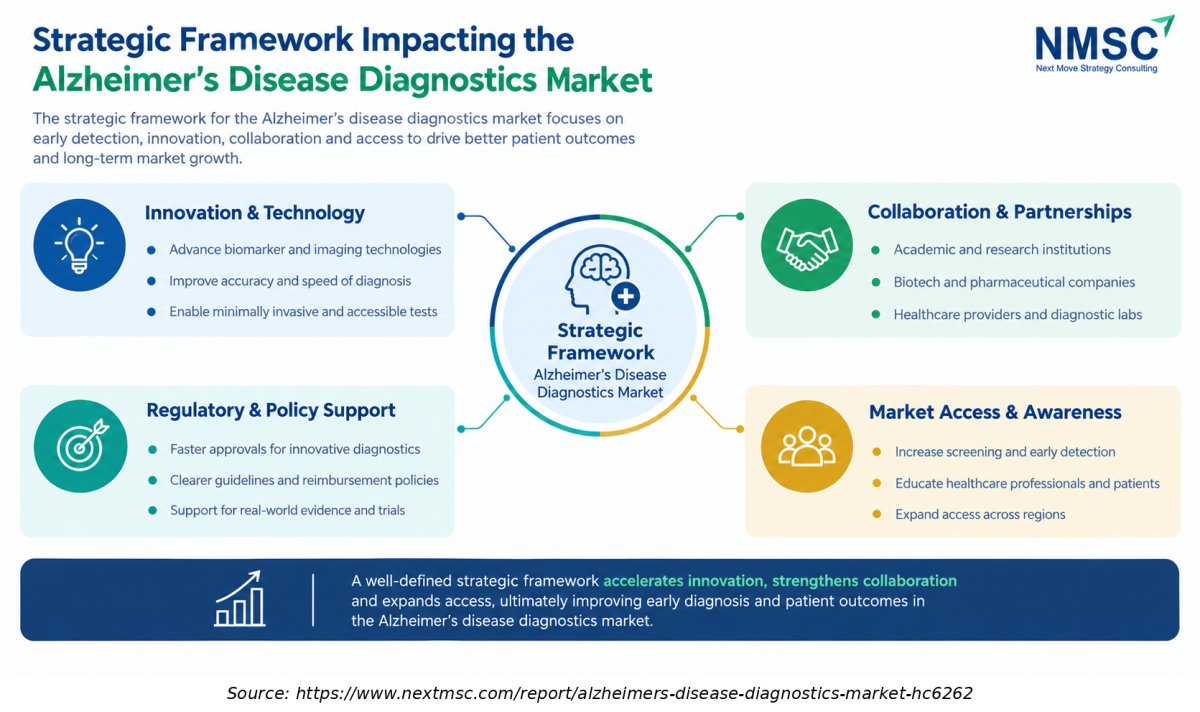
Strategic Framework of the Alzheimer’s Disease Diagnostics Market

Strategic Framework of the Alzheimer’s Disease Diagnostics Market
The infographic highlights the Strategic Framework Impacting the Alzheimer’s Disease Diagnostics Market, focusing on innovation and technology, regulatory and policy support, collaboration and partnerships, and market access and awareness. It illustrates how advancements in biomarker and imaging technologies, improved diagnostic accuracy, streamlined approvals, and greater awareness of early detection support wider access to diagnostic solutions, better patient outcomes, and long-term market growth

Competitive Landscape

Our findings suggest that the Alzheimer’s diagnostics industry is consolidating around platform owners, national laboratories and radiotracer suppliers.

How Do Companies Compete in This Market?

Competition runs along three lines. Instrument makers such as Roche, Beckman Coulter and Fujirebio win by placing validated kits on analyzers laboratories already own. Laboratory networks including Quest Diagnostics and LabCorp compete on access, branding and physician education. Specialists such as C2N and Quanterix compete on analytical performance and proprietary algorithms, and regulatory clearance is a decisive advantage.

Which Company Archetypes Dominate?

Three archetypes dominate. Platform incumbents offer broad immunoassay menus and global service networks. Service laboratories offer branded tests with national physician reach. Specialist innovators bring mass spectrometry or ultra-sensitive immunoassay technology. Differentiation themes include indeterminate result rates, age range of cleared use, throughput per instrument and the strength of clinical evidence generated in real world cohorts.

How Are Companies Differentiating Through Innovation?

Innovation centers on narrowing the intermediate zone and widening clinical use. C2N obtained clearance from age 40, Quest introduced a multi biomarker panel with a 10% indeterminate rate, and Quanterix has submitted its multi marker test to the FDA. Vendors also pursue companion roles with drug developers and add pricing models that bundle reagents, instruments and software.

What Is the Level of M&A Activity?

Deal activity is selective rather than broad. Lantheus acquired Life Molecular Imaging in July 2025 to obtain Neuraceq, and Roche partnered with Eli Lilly on Elecsys pTau217 development. Laboratory networks sign supply and licensing agreements with assay makers. We expect geographic expansion through distributors in Asia-Pacific, and pricing strategies to shift toward bundled contracts as clinical volumes increase.

Key Market Players

NMSC’s analysis indicates that the following eight companies, ranked qualitatively by diagnostic scale and relevance, shape competition in this industry.

Roche Holding AG Danaher Corporation (Beckman Coulter Diagnostics) H.U. Group Holdings, Inc. (Fujirebio) Lantheus Holdings, Inc. Quest Diagnostics Incorporated Laboratory Corporation of America Holdings (Labcorp) Quanterix Corporation C2N Diagnostics, LLC

Latest Developments

We found that regulatory and reimbursement milestones dominated company activity in 2025 and 2026.

Date Event
August 2026 The FDA cleared Roche Diagnostics’ Elecsys pTau217 blood test, developed in collaboration with Eli Lilly. Quest Diagnostics separately announced plans to offer the test through its AD-Detect portfolio.

Expert Insights

Maria C. Carrillo

Maria C. Carrillo

Chief Science Officer and Medical Affairs Lead | Alzheimer’s Association

"“Each FDA clearance gives clinicians another validated option to work with when evaluating patients showing signs of cognitive impairment.”"

Analyst Interpretation

The statement highlights the expanding range of validated blood-based biomarkers available for Alzheimer’s disease assessment. As testing options develop, clinicians can incorporate these tools into diagnostic workflows alongside clinical evaluation and other established methods. This is supporting the evolution of the market toward more accessible biomarker testing and broader diagnostic options

Market Interpretation

The statement highlights the expanding range of validated blood-based biomarkers available for Alzheimer’s disease assessment. As testing options develop, clinicians can incorporate these tools into diagnostic workflows alongside clinical evaluation and other established methods. This is supporting the evolution of the market toward more accessible biomarker testing and broader diagnostic options

Investment Opportunities

Where Are Capital Inflows Concentrated?

Capital flows toward assay development, laboratory build out and radiopharmaceutical acquisitions. Quanterix developed LucentAD Complete with funding from the Alzheimer’s Drug Discovery Foundation Diagnostics Accelerator, and Lantheus paid for Life Molecular Imaging to secure amyloid and tau imaging assets. Investors favor companies with regulatory clearances, reimbursement codes and recurring reagent revenue tied to installed instruments.

How Does Infrastructure Investment Shape Returns?

Returns depend on installed analyzers, PET manufacturing sites and laboratory capacity. Lantheus reports continued expansion of PET manufacturing sites to extend geographic access, while diagnostic makers target platforms already present in thousands of laboratories. Infrastructure that serves many biomarkers per instrument lowers cost per test and supports multi-year contracts with national laboratory networks.

What Are the ESG Considerations?

Access and equity are central. Older Black Americans are about twice as likely to have Alzheimer’s or other dementias as older White Americans, and about 200,000 Americans under 65 have younger onset disease. Blood tests reduce invasive procedures and travel burden, yet validated performance across diverse populations and fair reimbursement remain priorities for responsible investors.

Key Benefits for Stakeholders

How Does the Report Help Enterprise and Industry Leaders?

Executives at diagnostic, laboratory and imaging companies receive a segmented forecast from 2025 to 2035, regional and country sizing, and a view of competitive archetypes. These insights support platform selection, regulatory prioritization and partnership decisions, particularly on whether to build laboratory developed tests or pursue cleared kits, and where to expand geographically.

How Does the Report Help Investors and Financial Analysts?

Investors obtain a reconciled market model showing a USD 1.19 Billion base in 2026, a 14.6% CAGR and a USD 2.86 Billion incremental opportunity. Segment growth rates highlight where returns concentrate, including blood tests and tau markers, while the restraint analysis clarifies reimbursement and confirmatory testing risks that affect valuation assumptions.

How Does the Report Help Technology Vendors and Clinical Teams?

Vendors and clinical leaders gain evidence on where automation, multi biomarker algorithms and tau imaging create advantages. The analysis outlines adoption barriers in primary care, differences between countries and the role of guidelines, helping product teams and memory clinic leaders prioritize indications, age ranges, sample workflows and staffing models for deployment.

Key Market Segments Evaluated

By Diagnostic Method

  • Blood-based biomarker tests
  • CSF biomarker tests
  • PET imaging
  • Genetic testing

By Biomarker Target

  • Amyloid pathology
  • Tau pathology
  • Neurodegeneration and neuroinflammation
  • Genetic risk

By End User

  • Hospitals and memory clinics
  • Reference and diagnostic laboratories
  • Imaging centers
  • Pharmaceutical and research institutions

By Region

  • North America 
    • U.S.
    • Canada
    • Mexico
  • Europe 
    • UK
    • Germany
    • France
    • Italy
    • Spain
    • Sweden
    • Denmark
    • Finland
    • Netherlands
    • Rest of Europe
  • Asia-Pacific 
    • China
    • India
    • Japan
    • South Korea
    • Taiwan
    • Indonesia
    • Vietnam
    • Australia
    • Philippines
    • Malaysia
    • Rest of APAC
  • Middle East & Africa 
    • Saudi Arabia
    • UAE
    • Egypt
    • Israel
    • Turkey
    • Nigeria
    • South Africa
    • Rest of MEA
  • Latin America 
    • Brazil
    • Argentina
    • Chile
    • Colombia
    • Rest of LATAM

Conclusion & Recommendations

The outlook is strongly positive. Revenue rises from USD 1.19 Billion in 2026 to USD 4.05 Billion in 2035 as blood tests become routine and PET imaging stabilizes as the confirmatory standard. Regulatory clearances and payer coverage are converting clinical evidence into volume, and Asia-Pacific supplies the fastest incremental growth over the period.

What Strategic Positioning Recommendations Does NMSC Offer?

NMSC recommends that vendors prioritize cleared kits on widely installed analyzers, secure reimbursement codes early and invest in multi biomarker algorithms that reduce indeterminate results. Laboratory networks should pair branded panels with physician education, while radiotracer companies should defend therapy selection labels and add tau imaging to complete diagnostic portfolios.

What Is the Investment Attractiveness of the Market?

Investment attractiveness is high but selective. Growth above 14% a year, recurring reagent revenue and strong regulatory barriers favor leading participants. Valuation risk arises from reimbursement uncertainty and competition from laboratory developed tests. Capital is best directed to companies with cleared assays, scalable manufacturing and partnerships with drug developers or national laboratory networks.

What Are the Market Shifts and Key Risks?

Shifts include movement from specialist to primary care testing, adoption of dual cutoff interpretation and wider use of tau markers. Risks include uneven coverage, false results affecting patient trust, workforce shortages in memory clinics and price erosion once multiple cleared tests compete. Companies should monitor guideline updates because they can quickly change eligible populations.

What Are the Primary Growth Pathways Through 2035?

Growth pathways include rule out testing in primary care, expansion into Asia-Pacific and Middle East memory clinics, companion testing for therapies and longitudinal monitoring. Multi biomarker panels and automation extend existing instruments into new indications. Combined, these pathways support the forecast increase of USD 2.86 Billion between 2026 and 2035.

FAQs

Sources & References

1.

Alzheimer’s Association, 2026 Alzheimer’s Disease Facts and Figures

alz.org/facts
2.

World Health Organization, Dementia

who.int
3.

U.S. Food and Drug Administration, FDA Clears First Blood Test Used in Diagnosing Alzheimer’s Disease (May 16, 2025)

fda.gov
4.

Quanterix Corporation, Form 10-Q for the period ended June 30, 2026

sec.gov
5.

Quanterix Corporation, Form 8-K second quarter 2026 results

sec.gov
6.

Lantheus Holdings, Inc., Form 10-Q for the period ended June 30, 2026

sec.gov
7.

Lantheus Holdings, Inc., Form 10-K for the year ended December 31, 2025

sec.gov
8.

Beckman Coulter Diagnostics, FDA Breakthrough Device Designation press release (January 28, 2025)

beckmancoulter.com
9.

Quest Diagnostics, news release on Elecsys pTau217 and AD-Detect (August 24, 2026)

s2.q4cdn.com

About the Author

Mayurima Roy

Mayurima Roy

Mayurima Roy is Research Analyst at Next Move Strategy Consulting, where she has spent 4 years working across the firm's full industry coverage rather than a single fixed vertical. Her work centers on structured research, ongoing trend tracking, competitive assessment, and insight-led content development, translating complex market data into clear, decision-ready narratives that support informed client decision-making across diverse global industries, market sectors, and world regions every day.

About the Reviewer

Supradip Baul

Supradip Baul

Supradip Baul is an accomplished business consultant and strategist with over a decade of rich experience in market intelligence, strategy, technology, and business transformation. His work has included rigorous qualitative and quantitative analysis across multiple industries, helping clients shape investment decisions and long-term roadmaps. Earlier in his career, he was associated with Gartner, where he contributed to industry-leading reports and market share analyses. He has worked with leading global companies and holds an MBA with a dual specialization in Marketing and Finance.

Download Free Sample

Henri Knyphausen

HENRI KNYPHAUSEN

Partner at Singulier [Ex-BCG]

Singulier

I recently engaged NEXTMSC.com for a commercial due diligence project within the intralogistics sector, and I am pleased to provide a reference based on my experience. In utilizing NEXTMSC.com's services, I found their report to offer valuable insights into market dynamics and key industry players. The initial report provided a solid foundation for our analysis. However, as we were investigating a smaller target in the market, and I had specific customization requests requiring additional research. These requests included detailed information on product portfolios of various players and sub-market sizes, both inclusive and exclusive of certain product categories. NEXTMSC.com demonstrated commendable responsiveness and agility in accommodating these customization requests. Within a timeframe of 1-2 weeks, they delivered a revised report that met our specific needs. Furthermore, they were receptive to my follow-up inquiries, ensuring clarity and understanding of the data provided. The final deliverable significantly contributed to our due diligence efforts. One of NEXTMSC.com's notable strengths lies in their qualitative research capabilities. However, for future engagements, I would recommend the inclusion of a quantified market model in Excel format. Such a model would offer the ability to conduct in-depth analyses and explore various market segments, including country-specific data and subcomponent breakdowns. Based on my positive experience, I would not hesitate to work with NEXTMSC.com again. Their responsiveness, willingness to accommodate customization requests, and commitment to delivering actionable insights make them a reliable partner for commercial research projects.

Ross J Mckenzie

ROSS J MCKENZIE

Business Insight Manager

Staysure Group

“Next MSC have been incredibly helpful in providing detailed & robust information on our market, alongside quantifying growth by different segments. The process to procure was simple and easy, with sample reports and regular contact to ensure we had what we needed. Succinct detail on their sources & methodologies is also greatly received, allowing transparency in this respect helps build trust in the detail you pay for. Joseph in particular was fantastic, and helped ensure efficient provision of the insight pack – thank you NMSC!”.

Pratyush Kumar Das

PRATYUSH KUMAR DAS

Assistant Manager

Polycab India Limited

We would like to express our appreciation for the data and insights provided by nextmsc. We are very pleased with the quality and depth of the information, which has proven to be highly valuable and beneficial for our business decision-making.

Gaurav Jaiswal

GAURAV JAISWAL

Founder & CEO

Yano Charge Private Limited

The EV Charging market research report provided by the NextMSC was exceptionally detailed and insightful. It offered a comprehensive analysis that proved to be a game-changer for our strategic planning. Truly a testament to the NextMSC’s expertise and thoroughness in EV market landscape & analysis.

Semih Kavaklioglu

SEMIH KAVAKLIOGLU

Co-Founder & Sales Manager

Decortie

I work a lot in the marketing industry and I know that research is an essential part of any campaign. I have used Market research reports for my own products and I found them to be very informative and well-researched. The team here produces insightful reports for a good price

Custom Market Research Services

We will customize the research for you if the listed report does not fully match your requirements.

Get 30% Free Customization

Select License

This website uses cookies to ensure you get the best experience on our website. Learn more

✖