GPU Cloud Market Size, Share, Trends and Growth Analysis, By Revenue Stream (Compute Infrastructure, Managed AI Platform, & Managed Services), By Deployment Model (Public Cloud, Private Cloud, Hybrid Cloud, and Sovereign Cloud), By Consumption Model (Pay-as-You-Go, Reserved Capacity, Spot Capacity, Dedicated Capacity, and Subscription), By GPU Architecture, By Workload Type, By Organization Size, By Sales Channel, By End User Industry, By Region – Global Industry Report and Forecast, 2026–2035
Industry: ICT & Media | Publishing Date: July 18, 2026 | Last Updated: September 30, 2026 | No of Pages: N/A | No. of Tables: N/A | No. of Figures: N/A | Format: PDF | Report Code: IC5219
What Is the GPU Cloud Market Size?
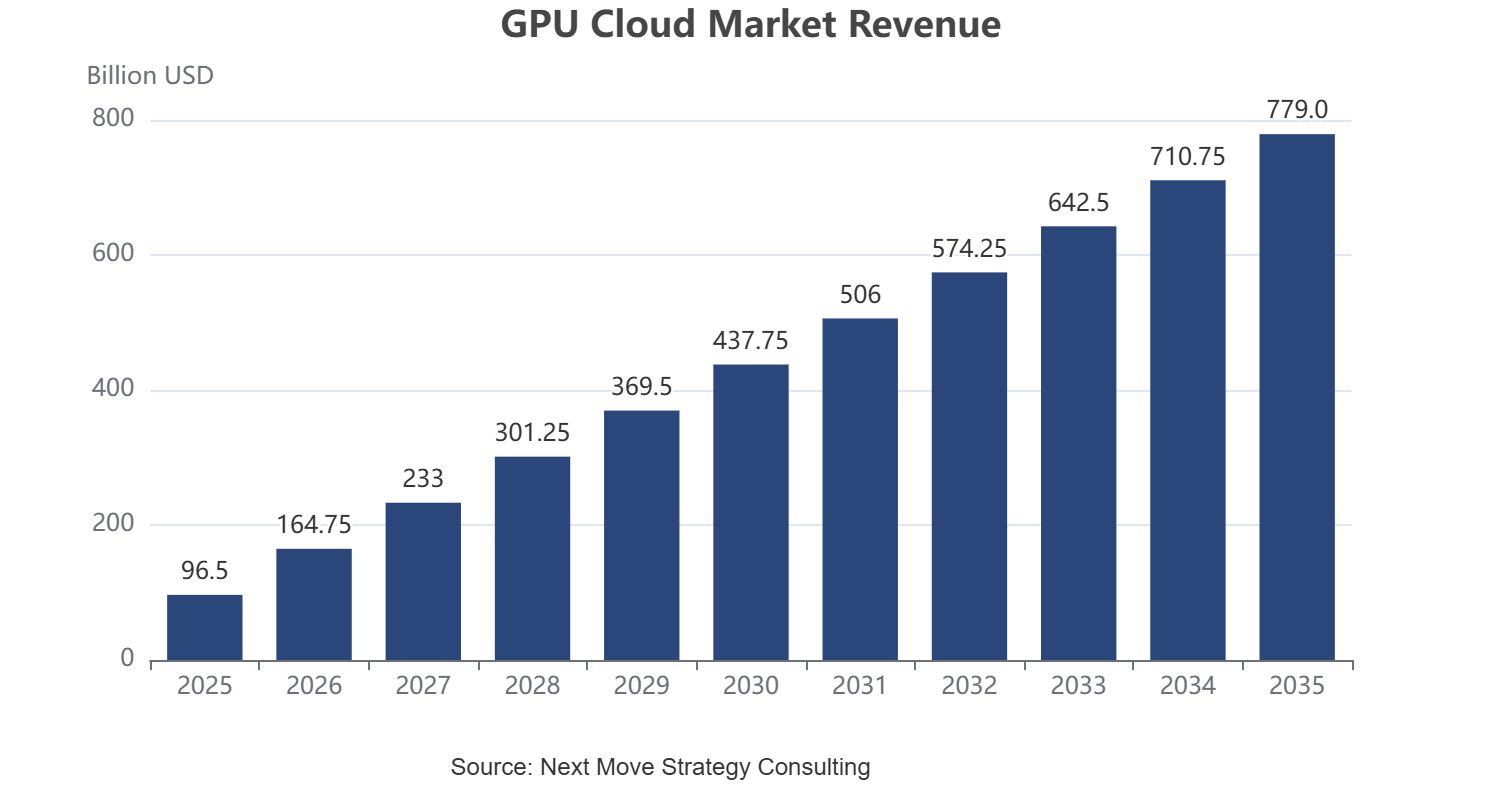
The global GPU Cloud Industry size was valued at USD 96.5 billion in 2025 and is estimated at USD 132.0 billion in 2026, forecast to reach USD 779.0 billion by 2035, expanding at a 21.8% CAGR between 2026 and 2035. North America leads with approximately 52% share, while compute infrastructure dominates all other revenue streams with approximately 58% share.
We observed that growth is broad-based across every segmentation axis, with inference-driven consumption and sovereign cloud deployment emerging as the dominant structural shifts reshaping the GPU cloud market through 2035.
|
Key Takeways |
|
By Revenue Stream: Compute Infrastructure held the largest share of approximately 58% (USD 56.0 billion) in 2025; Managed AI Platform is the fastest-growing sub-segment at 25.9% CAGR from 2026–2035. |
|
By Deployment Model: Public Cloud held the largest share of approximately 68% (USD 65.6 billion) in 2025; Sovereign Cloud is the fastest-growing sub-segment at 29.4% CAGR from 2026–2035. |
|
By Consumption Model: Pay-as-You-Go held the largest share of approximately 46% (USD 44.4 billion) in 2025; Dedicated Capacity is the fastest-growing sub-segment at 27.3% CAGR from 2026–2035. |
|
By GPU Architecture: NVIDIA GPUs held the largest share of approximately 82% (USD 79.0 billion) in 2025; Proprietary AI Accelerators is the fastest-growing sub-segment at 29.5% CAGR from 2026–2035. |
|
By Workload Type: AI Training held the largest share of approximately 35% (USD 34.0 billion) in 2025; AI Inference is the fastest-growing sub-segment at 26.6% CAGR from 2026–2035. |
|
By Organization Size: Large Enterprises held the largest share of approximately 38% (USD 36.7 billion) in 2025; Startups is the fastest-growing sub-segment at 30.1% CAGR from 2026–2035. |
|
By Sales Channel: Direct Enterprise Sales held the largest share of approximately 48% (USD 46.3 billion) in 2025; Cloud Marketplace is the fastest-growing sub-segment at 28.4% CAGR from 2026–2035. |
|
By End User Industry: Information Technology and Software held the largest share of approximately 29% (USD 28.0 billion) in 2025; Healthcare and Life Sciences is the fastest-growing sub-segment at 27.1% CAGR from 2026–2035. |
|
Dominant Region: North America dominated with approximately 52% revenue share (USD 50.2 billion) in 2025. |
|
Fastest-Growing Region: Middle East & Africa is expected to register the highest CAGR of 27.2% during 2026–2035. |
|
Dominant Country: U.S. led with approximately USD 39.5 billion in 2025. |
|
Fastest-Growing Country: Saudi Arabia is the fastest-growing country at approximately 29.3% CAGR from 2026–2035. |
Market Opportunity: The GPU cloud market is expected to create an absolute dollar opportunity of USD 647.0 billion between 2026 and 2035, presenting significant investment potential across the AI training, inference, and managed AI platform value chain.
According to NMSC analysis, we found that enterprises are increasingly shifting GPU procurement from spot and on-demand consumption toward dedicated and reserved capacity commitments to secure supply amid persistent GPU and power availability constraints, a structural shift that favors diversified, multi-region GPU cloud providers over single-region specialists through 2035.
What Does the GPU Cloud Market Encompass?
The GPU cloud Industry encompasses the delivery of graphics processing unit compute capacity, managed artificial intelligence platforms, and related professional services through public, private, hybrid, and sovereign cloud infrastructure. Our assessment indicates that the scope spans virtual GPU instances, bare metal GPU servers, and managed GPU clusters supplied to startups, enterprises, research institutions, and government organizations for AI training, fine-tuning, inference, high performance computing, and visual rendering workloads. The category has evolved from a niche high-performance-computing accessory into foundational digital infrastructure, driven by generative AI adoption, rising enterprise inference volumes, and hyperscale capital investment worldwide.
Regulatory frameworks such as European Union data sovereignty requirements and national AI infrastructure initiatives across the Middle East and Asia-Pacific increasingly shape where GPU capacity is deployed and how it is governed. We observed that technology adoption is shifting toward custom and proprietary AI accelerators alongside traditional merchant GPUs, as hyperscalers seek to diversify supply and improve cost-per-token economics. NMSC's analysis indicates that this structural shift, combined with escalating power and grid-capacity constraints, is redefining sourcing criteria and capital allocation priorities across the GPU cloud Industry.
|
Field |
Details |
|
Market Size in 2025 |
USD 96.5 Billion |
|
Market Size in 2026 |
USD 132.0 Billion |
|
Revenue Forecast in 2035 |
USD 779.0 Billion |
|
Growth Rate |
CAGR of 21.8% from 2026 to 2035 |
|
Analysis Period |
2025–2035 |
|
Base Year Considered |
2025 |
|
Forecast Period |
2026–2035 |
|
Market Size Estimation |
Revenue (USD Billion) |
|
Companies Profiled |
20 |
|
Countries Covered |
33 |
|
Market Share |
Available for Top 10 Companies |
Key Emerging Trends
Based on research conducted by NMSC, we found that four structural trends are reshaping infrastructure design, capacity allocation, and stakeholder engagement across the GPU cloud industry.
How Is the Shift from Training to Inference Reshaping GPU Cloud Demand?
Enterprise GPU consumption is shifting from large-scale model training toward continuous inference as generative AI applications move into production environments. Growing adoption of AI-powered assistants, intelligent search, and real-time decision-making applications is increasing demand for scalable, low-latency inference infrastructure. In response, cloud providers are expanding serverless and batch inference capabilities, while chip developers are optimizing accelerators to deliver higher throughput and improved cost efficiency for production inference workloads.
Why Are Specialized Neocloud Providers Gaining Enterprise Share?
Specialized GPU cloud providers designed exclusively for AI workloads are gaining traction among enterprises and AI developers by offering purpose-built infrastructure, rapid provisioning, and optimized GPU utilization. As demand for advanced AI compute continues to outpace available capacity, organizations are diversifying their cloud strategies across both hyperscalers and neocloud providers to improve resource availability, reduce deployment delays, and ensure access to high-performance GPU infrastructure.
How Is Custom Silicon Changing GPU Cloud Architecture Choices?
Cloud providers are increasingly integrating proprietary AI accelerators alongside merchant GPUs to diversify compute options and improve workload efficiency. This shift is enabling enterprises to leverage heterogeneous cloud architectures that combine multiple accelerator types, allowing organizations to optimize infrastructure based on specific workload requirements, performance objectives, and cost considerations. The growing adoption of custom silicon is also encouraging greater flexibility in AI training and inference deployments.
What Role Does Sovereign Cloud Play in GPU Infrastructure Expansion?
Sovereign cloud deployments are emerging as a key growth driver for GPU cloud infrastructure as governments and regulated industries prioritize data residency, security, and compliance. Countries are investing in localized AI computing infrastructure to strengthen digital sovereignty and reduce dependence on foreign cloud providers. Consequently, GPU cloud vendors are expanding regional data center partnerships and developing country-specific compliance capabilities to support national AI initiatives and public-sector procurement requirements.
Ecosystem Analysis of the GPU Cloud Market
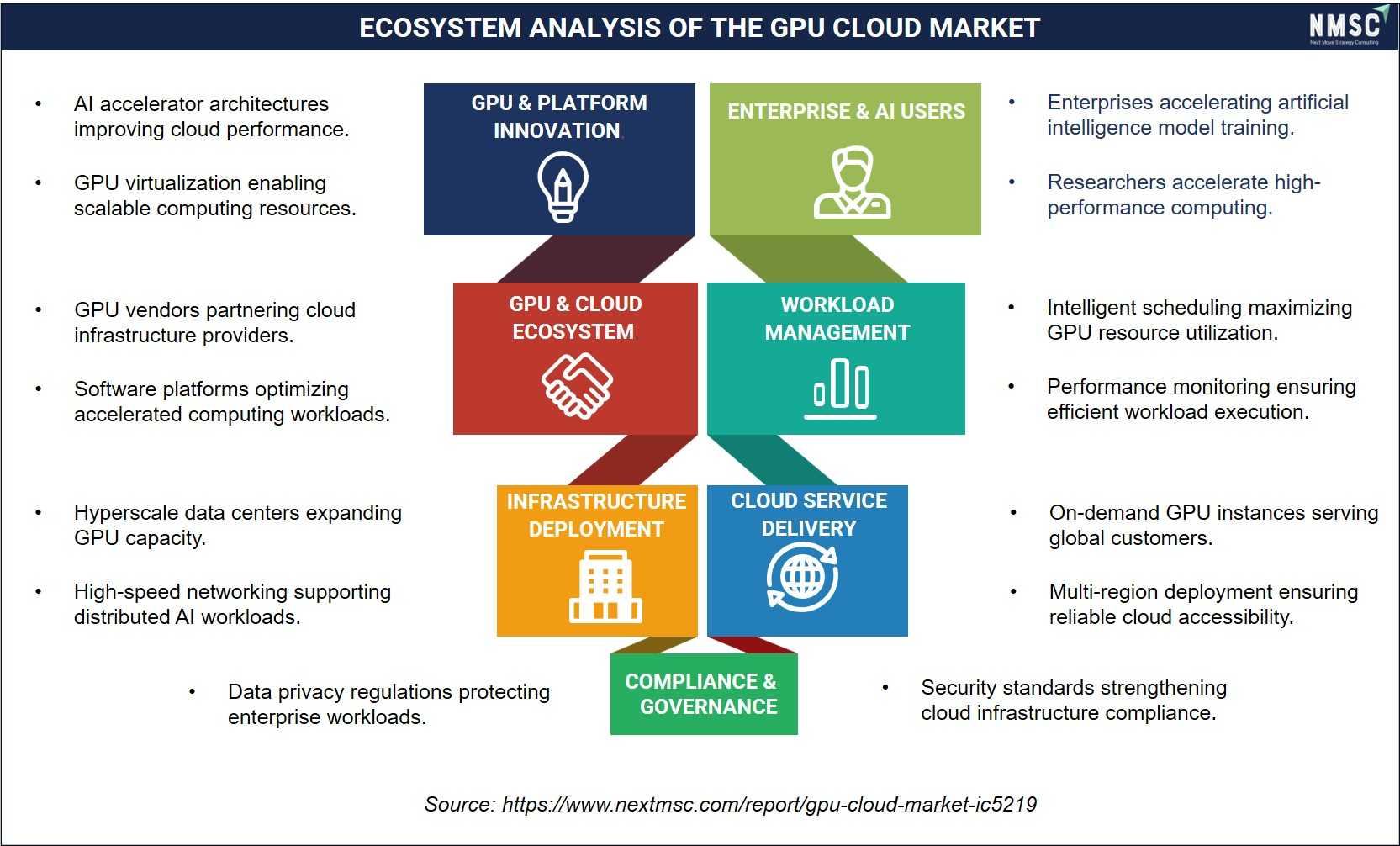
The GPU cloud market ecosystem is driven by collaboration among GPU manufacturers, cloud platform providers, AI software developers, infrastructure operators, and enterprise users. Continuous advancements in accelerated computing, workload orchestration, and cloud delivery models are strengthening AI adoption, while investments in scalable infrastructure, compliance, and multi-region deployments support reliable, secure, and high-performance GPU cloud services.
Growth Drivers and Restraints
Growth Catalyst and Risk Assessment Matrix
|
Factors |
Type |
(+/−) % Impact on CAGR |
Geographic Relevance |
Impact Timeline |
|
Hyperscale AI capital expenditure expansion |
Driver |
+4.8% |
Global |
2026-2035 |
|
Rising enterprise generative AI inference volumes |
Driver |
+3.6% |
Global |
2026-2035 |
|
Custom AI accelerator diversification |
Driver |
+2.4% |
North America, Asia-Pacific |
2026-2035 |
|
Sovereign AI infrastructure programs |
Driver |
+2.1% |
Middle East, Asia-Pacific, Europe |
2026-2035 |
|
Enterprise cloud migration of AI workloads |
Driver |
+1.7% |
Global |
2026-2035 |
|
Expansion of managed AI development platforms |
Driver |
+1.5% |
North America, Europe |
2026-2032 |
|
Power and grid interconnection constraints |
Restraint |
-2.2% |
North America, Europe |
2026-2035 |
|
GPU and memory component price inflation |
Restraint |
-1.6% |
Global |
2026-2030 |
|
Customer concentration among a few hyperscale buyers |
Restraint |
-0.9% |
North America |
2026-2032 |
|
Data sovereignty and export control compliance costs |
Restraint |
-0.7% |
Asia-Pacific, Middle East |
2028-2035 |
What Is the Primary Growth Driver of the GPU Cloud Market?
Hyperscale capital expenditure directed at AI infrastructure is the primary driver of the market. Amazon disclosed a planned USD 200 billion capital expenditure program for 2026 focused mainly on AI infrastructure, while Microsoft guided to approximately USD 190 billion in capital expenditures for calendar year 2026, according to company financial disclosures filed with the U.S. Securities and Exchange Commission. We observed that this sustained investment, anchored by multi-year customer commitments, continues to expand available GPU cloud capacity across training and inference workloads alike.
How Is Enterprise AI Adoption Driving GPU Cloud Market Growth?
Rising enterprise consumption of managed inference and model-training services is accelerating market growth across cloud platforms. Amazon reported that AI-specific revenue within AWS reached an annualized run rate exceeding USD 15 billion in the first quarter of 2026, while Microsoft disclosed that its AI business surpassed a USD 37 billion annual revenue run rate in the same period, per company earnings filings. Our assessment indicates that this monetization trajectory, combined with expanding managed AI platform adoption, is compressing enterprise procurement cycles for GPU cloud services.
What Is Restraining GPU Cloud Market Expansion?
Power availability and grid interconnection delays restrain the pace of GPU cloud capacity expansion across developed markets. Microsoft executives disclosed on the company's fiscal third-quarter 2026 earnings call that the company expects to remain capacity-constrained through at least the end of calendar year 2026 due to power, GPU, and memory supply limitations. We found that smaller regional providers face particular exposure, as limited scale reduces their ability to secure long-lead power and component commitments compared with large, vertically integrated hyperscale operators.
Segmentation Analysis
Segment Sizing: By Revenue Stream
|
Segment |
2025 (USD) |
2035 (USD) |
CAGR% (2026–2035) |
|
Compute Infrastructure |
USD 56.0 Billion |
USD 360.0 Billion |
19.2% |
|
Managed AI Platform |
USD 28.5 Billion |
USD 340.0 Billion |
25.9% |
|
Managed Services |
USD 12.0 Billion |
USD 79.0 Billion |
20.0% |
|
Total |
USD 96.5 Billion |
USD 779.0 Billion |
21.8% |
Which Revenue Stream Segment Dominates the GPU Cloud Market?
Compute Infrastructure, encompassing virtual GPU instances, bare metal GPU, and GPU clusters, led the market with USD 56.0 billion in 2025, supported by broad enterprise demand for raw training and inference capacity. We observed that Managed AI Platform is the fastest-growing revenue stream, expanding at a 25.9% CAGR from 2026 to 2035, as enterprises increasingly adopt managed model training, inference, and AI development environments over self-managed infrastructure to reduce operational complexity.
Segment Sizing: By GPU Architecture
|
Segment |
2025 (USD) |
2035 (USD) |
CAGR% (2026–2035) |
|
NVIDIA GPUs |
USD 79.0 Billion |
USD 520.0 Billion |
19.6% |
|
AMD GPUs |
USD 8.0 Billion |
USD 95.0 Billion |
26.5% |
|
Intel GPUs |
USD 2.0 Billion |
USD 24.0 Billion |
27.0% |
|
Proprietary AI Accelerators |
USD 7.5 Billion |
USD 140.0 Billion |
29.5% |
|
Total |
USD 96.5 Billion |
USD 779.0 Billion |
21.8% |
Which GPU Architecture Leads the GPU Cloud Market?
NVIDIA GPUs remained the dominant architecture across the market, reaching USD 79.0 billion in 2025, reflecting NVIDIA's Data Center segment revenue of USD 193.7 billion in fiscal 2026 and its entrenched software ecosystem advantage. Based on research conducted by NMSC, we found that Proprietary AI Accelerators represent the fastest-growing category at a 29.5% CAGR from 2026 to 2035, as hyperscalers expand custom silicon programs such as Amazon's Trainium to diversify supply and improve inference cost efficiency.
Segment Sizing: By Workload Type
|
Segment |
2025 (USD) |
2035 (USD) |
CAGR% (2026–2035) |
|
AI Training |
USD 34.0 Billion |
USD 230.0 Billion |
20.2% |
|
AI Fine-Tuning |
USD 9.5 Billion |
USD 68.0 Billion |
20.2% |
|
AI Inference |
USD 22.0 Billion |
USD 280.0 Billion |
26.6% |
|
High Performance Computing |
USD 10.0 Billion |
USD 68.0 Billion |
20.2% |
|
Scientific Computing |
USD 5.0 Billion |
USD 34.0 Billion |
20.2% |
|
Engineering Simulation |
USD 4.0 Billion |
USD 27.0 Billion |
20.1% |
|
Visual Rendering |
USD 4.5 Billion |
USD 28.0 Billion |
19.1% |
|
Cloud Gaming |
USD 2.5 Billion |
USD 16.0 Billion |
19.6% |
|
Virtual Desktop Infrastructure |
USD 2.0 Billion |
USD 12.0 Billion |
18.5% |
|
Data Analytics |
USD 2.0 Billion |
USD 11.0 Billion |
17.4% |
|
Other GPU Workloads |
USD 1.0 Billion |
USD 5.0 Billion |
7.5% |
|
Total |
USD 96.5 Billion |
USD 779.0 Billion |
21.8% |
Which Workload Type Leads GPU Cloud Market Demand?
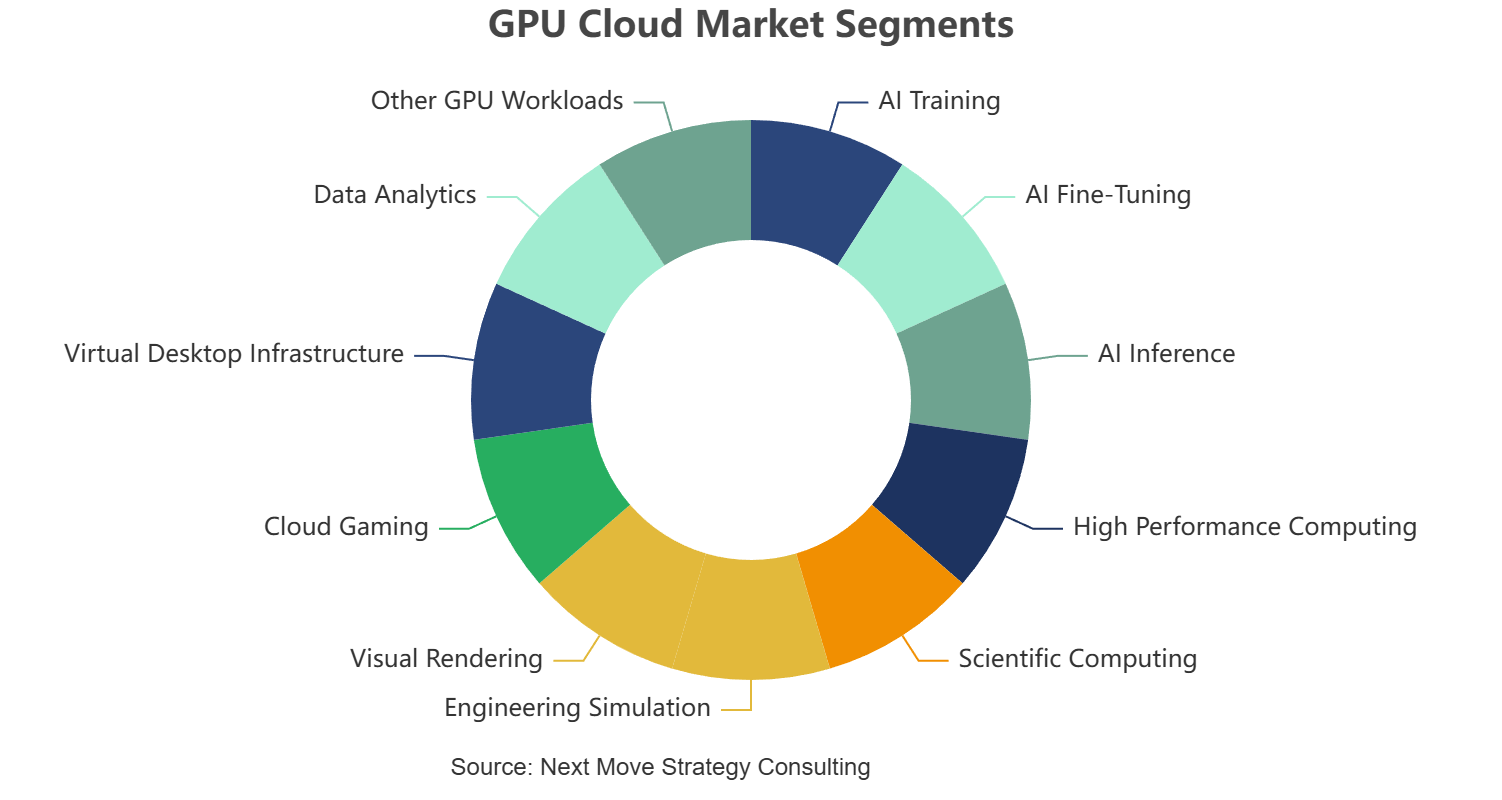
AI Training remained the leading workload type within the market, valued at USD 34.0 billion in 2025 on sustained large language model and foundation model development activity. Our findings suggest that AI Inference is the fastest-growing workload type, registering a 26.6% CAGR from 2026 to 2035 and overtaking training in absolute size by the end of the forecast period, as production AI applications scale token consumption well beyond model development requirements.
Growth Opportunities
Our analysis shows that three forward-looking opportunities stand out for stakeholders positioning within the GPU cloud market over the 2026-2035 forecast period.
How Can Serverless Inference Platforms Unlock Value for AI Application Developers?
Serverless inference platforms present a whitespace opportunity for suppliers serving startups and mid-market enterprises seeking to avoid fixed GPU capacity commitments. Providers that commercialize consumption-priced, auto-scaling inference endpoints stand to capture recurring usage-based revenue as application developers prioritize deployment speed over infrastructure management, particularly among software and gaming end users building production-grade generative AI features.
Where Do Sovereign AI Cloud Programs Create New Demand?
Government and public sector entities across the Middle East and Asia-Pacific represent an underpenetrated opportunity for providers offering data-localized, compliance-ready GPU cloud infrastructure. Companies that establish in-country data center partnerships can secure long-term national procurement contracts, benefiting from durable, government-backed capacity commitments tied to sovereign AI infrastructure programs.
How Can Proprietary Accelerator Access Benefit Research Institutions?
Research institutions and mid-market enterprises seeking lower-cost training and inference create an opportunity for providers offering proprietary AI accelerator access alongside merchant GPU capacity. Early movers that broaden access to custom silicon platforms can differentiate with research institution and government organization end users pursuing cost-efficient large-scale compute allocations for scientific and academic workloads.
Regional Outlook
Geographic Performance Snapshot
|
Region |
2025 (USD) |
2035 (USD) |
CAGR% (2026–2035) |
Key Driver |
|
North America |
USD 50.2 Billion |
USD 340.0 Billion |
19.6% |
Hyperscale capex concentration and early enterprise AI adoption |
|
Europe |
USD 16.4 Billion |
USD 115.0 Billion |
20.2% |
EU data sovereignty rules and sovereign cloud investment |
|
Asia-Pacific |
USD 22.8 Billion |
USD 245.0 Billion |
25.1% |
Expanding hyperscale capacity and national AI programs |
|
Middle East & Africa |
USD 4.3 Billion |
USD 54.0 Billion |
27.2% |
Vision 2030-linked sovereign AI infrastructure investment |
|
Latin America |
USD 2.8 Billion |
USD 25.0 Billion |
25.2% |
Growing enterprise cloud migration and data center buildout |
|
Total |
USD 96.5 Billion |
USD 779.0 Billion |
21.8% |
— |
North America GPU Cloud Market Outlook
North America leads the GPU cloud market with the world's largest concentration of hyperscale data center capacity and enterprise AI spending. We observed that record capital expenditure programs from Amazon, Microsoft, and Alphabet continue to expand regional GPU capacity, while U.S. Department of Energy initiatives support AI-linked national infrastructure priorities. Technology adoption remains concentrated among large enterprises and AI labs, though power and grid interconnection constraints are increasingly shaping where new capacity is sited.
Europe GPU Cloud Market Outlook
Europe's GPU cloud market is shaped by data sovereignty requirements and growing sovereign cloud investment across the region. Our assessment indicates that European Commission digital policy priorities are accelerating demand for in-region GPU capacity among regulated industries such as banking and healthcare. Regulatory influence remains significant, with data residency and cross-border transfer rules increasingly determining vendor selection among enterprise and government customers across the region.
Asia-Pacific GPU Cloud Market Outlook
Asia-Pacific is the fastest-growing major region as hyperscalers and domestic cloud providers expand GPU capacity to serve rising enterprise and government AI demand. We found that national AI infrastructure programs across China, India, and Japan are accelerating data center investment, while competitive intensity is rising among regional cloud providers seeking to capture enterprise workloads. Strategic outlook favors providers that combine local compliance capabilities with access to advanced GPU architectures.
Middle East & Africa GPU Cloud Market Outlook
The Middle East & Africa region is registering the fastest regional CAGR in the GPU cloud market, driven by sovereign AI infrastructure programs linked to national economic diversification strategies. Our findings suggest that government-backed investment in data center capacity is drawing global GPU cloud providers into local partnerships to meet public sector and enterprise demand. Regulatory influence is significant, with data localization requirements shaping infrastructure siting decisions across the region.
Latin America GPU Cloud Market Outlook
Latin America's GPU cloud market is expanding as enterprises accelerate cloud migration and regional data center capacity grows. We observed that Brazil and Argentina are emerging as the region's primary demand centers, supported by growing financial services and media sector adoption of AI-enabled applications. Strategic outlook favors providers expanding regional points of presence to reduce latency for enterprise and government customers across the region.
U.S. GPU Cloud Market
Based on our estimates, the U.S. GPU cloud market was valued at USD 39.5 billion in 2025 and is projected to reach USD 205.0 billion by 2035, expanding at an 18.9% CAGR from 2026 to 2035. Demand is concentrated among hyperscalers, AI labs, and large enterprises running frontier model training and production inference. Technology penetration is the highest globally, though power availability and grid interconnection timelines are increasingly shaping where new capacity is sited, with competitive intensity remaining highest among hyperscale and neocloud providers.
Canada GPU Cloud Market
The market in Canada reached approximately USD 7.5 billion in 2025 and is forecast to reach USD 46.0 billion by 2035, registering a 20.5% CAGR from 2026 to 2035. Demand is supported by favorable renewable power economics that attract data center investment from U.S.-headquartered cloud providers. Adoption is concentrated among enterprise and research institution customers, with strategic outlook favoring providers that leverage low-cost hydroelectric power to offer competitively priced GPU capacity to cross-border customers.
UK GPU Cloud Market
As per our estimate, the UK GPU cloud market stood at USD 5.2 billion in 2025 and is projected to reach USD 32.0 billion by 2035, growing at a 20.6% CAGR from 2026 to 2035. Demand structure is led by financial services and media enterprises adopting managed inference platforms. Regulatory influence from UK data protection requirements shapes vendor selection, while technology penetration continues to rise among mid-market enterprises seeking managed AI development environments over self-managed infrastructure.
Germany GPU Cloud Market
According to our analysis, Germany's GPU cloud market was valued at USD 4.3 billion in 2025 and is expected to reach USD 27.5 billion by 2035, at a 21.0% CAGR from 2026 to 2035. Demand is anchored by automotive and manufacturing enterprises deploying engineering simulation and AI training workloads. Regulatory influence from European Union data protection and sovereignty rules remains significant, with strategic outlook favoring providers offering in-country data residency for regulated industry customers.
France GPU Cloud Market
Based on our estimates, France's GPU cloud market reached USD 3.1 billion in 2025 and is forecast to expand to USD 19.5 billion by 2035, at a 20.8% CAGR from 2026 to 2035. Demand structure is led by government and aerospace sector adoption of sovereign-compliant GPU infrastructure. Technology penetration is rising among research institutions, with competitive intensity increasing as regional providers expand sovereign cloud offerings aligned with national digital autonomy priorities.
China GPU Cloud Market
The market in China was valued at USD 7.8 billion in 2025 and is projected to reach USD 68.0 billion by 2035, expanding at a 25.3% CAGR from 2026 to 2035. Demand is driven by domestic cloud providers scaling AI training and inference capacity to serve enterprise and government customers. Regulatory influence from export control restrictions on advanced GPU architectures shapes technology adoption, with strategic outlook favoring providers investing in domestically manufactured accelerator alternatives.
India GPU Cloud Market
As per our estimate, India's GPU cloud market stood at USD 4.6 billion in 2025 and is forecast to reach USD 52.0 billion by 2035, registering a 28.5% CAGR from 2026 to 2035, the fastest pace in Asia-Pacific. Demand structure is led by IT services and software enterprises scaling AI development environments. Adoption is accelerating among startups and mid-market enterprises, with competitive intensity rising as global GPU cloud providers expand regional data center footprints to serve rising national demand.
Japan GPU Cloud Market
According to our analysis, Japan's GPU cloud market reached USD 3.9 billion in 2025 and is expected to reach USD 27.0 billion by 2035, at a 22.5% CAGR from 2026 to 2035. Demand is supported by manufacturing and automotive enterprises adopting engineering simulation and visual rendering workloads. Regulatory influence from national AI governance guidelines shapes vendor selection, with strategic outlook favoring providers partnering with domestic technology conglomerates to expand regional GPU capacity.
South Korea GPU Cloud Market
Based on our estimates, South Korea's GPU cloud market was valued at USD 2.7 billion in 2025 and is projected to reach USD 19.5 billion by 2035, at a 23.4% CAGR from 2026 to 2035. Demand structure is led by semiconductor and electronics manufacturers deploying AI training workloads. Technology penetration is rising rapidly among large enterprises, with competitive intensity increasing as domestic telecommunications operators expand sovereign GPU cloud offerings.
Australia GPU Cloud Market
The market in Australia reached USD 1.9 billion in 2025 and is forecast to expand to USD 12.5 billion by 2035, registering a 22.2% CAGR from 2026 to 2035. Demand is driven by mining, financial services, and research institution adoption of AI training and data analytics workloads. Regulatory influence from national data residency guidance shapes infrastructure siting, with strategic outlook favoring providers expanding regional points of presence to serve enterprise and government customers.
UAE GPU Cloud Market
As per our estimate, the UAE GPU cloud market stood at USD 1.6 billion in 2025 and is projected to reach USD 17.0 billion by 2035, at a 27.9% CAGR from 2026 to 2035. Demand structure is led by government-backed sovereign AI infrastructure programs and financial services adoption. Regulatory influence from national data localization requirements is significant, with strategic outlook favoring providers establishing in-country partnerships to qualify for public sector procurement contracts.
Saudi Arabia GPU Cloud Market
According to our analysis, Saudi Arabia's GPU cloud market was valued at USD 1.4 billion in 2025 and is forecast to reach USD 17.5 billion by 2035, at a 29.3% CAGR from 2026 to 2035, the fastest pace globally. Demand is anchored by Vision 2030-linked sovereign AI infrastructure investment and government organization adoption. Competitive intensity is rising as global providers establish joint ventures with domestic entities to access national AI infrastructure programs.
South Africa GPU Cloud Market
Based on our estimates, South Africa's GPU cloud market reached USD 0.5 billion in 2025 and is expected to reach USD 4.0 billion by 2035, at a 24.7% CAGR from 2026 to 2035. Demand structure is led by financial services and telecommunications enterprises adopting managed inference services. Technology penetration remains nascent relative to developed markets, with strategic outlook favoring providers expanding regional data center capacity to serve broader Sub-Saharan African demand.
Brazil GPU Cloud Market
The market in Brazil was valued at USD 1.7 billion in 2025 and is projected to reach USD 14.0 billion by 2035, expanding at a 25.1% CAGR from 2026 to 2035. Demand is driven by financial services and media enterprises adopting AI inference and visual rendering workloads. Regulatory influence from national data protection rules shapes vendor selection, with competitive intensity rising as global providers expand regional data center footprints to serve Latin America's largest economy.
Argentina GPU Cloud Market
As per our estimate, Argentina's GPU cloud market stood at USD 0.5 billion in 2025 and is forecast to reach USD 3.7 billion by 2035, at a 23.3% CAGR from 2026 to 2035. Demand structure is led by software and financial services enterprises adopting cloud-based AI development environments. Technology penetration is rising among startups and mid-market enterprises, with strategic outlook favoring providers offering competitively priced on-demand GPU capacity to price-sensitive regional customers.
Competitive Landscape
We observed that competitive dynamics within the GPU cloud market are increasingly shaped by capacity availability, backlog visibility, and accelerator diversification rather than pricing alone.
Key Takeaways
|
Field |
Details |
|
Market Structure |
Moderately concentrated among hyperscale providers, with specialized neocloud operators capturing rising enterprise and AI-lab share. |
|
Innovation Focus |
Custom accelerator development, managed inference platforms, and high-density liquid-cooled data center architecture. |
|
M&A Activity |
Consolidation through MLOps and developer-tooling acquisitions, alongside strategic equity investments between chip suppliers and cloud operators. |
How Do Companies Compete in the GPU Cloud Market?
Companies compete primarily on GPU capacity availability, backlog-to-revenue conversion, and price-performance rather than headline pricing alone. Our analysis shows that CoreWeave's revenue backlog grew to USD 66.8 billion by the end of 2025, more than four times its starting level, illustrating how contracted capacity has become the dominant competitive currency. Providers increasingly differentiate through power procurement scale, multi-year chip supply agreements, and managed software layered atop raw compute.
Which Competitive Archetypes Dominate the GPU Cloud Market?
Three competitive archetypes dominate the market: diversified hyperscalers offering GPU cloud as one layer within a broader enterprise cloud stack, specialized neoclouds built exclusively for AI workloads, and regional or sovereign providers serving compliance-sensitive government and enterprise customers. We found that neoclouds such as CoreWeave differentiate through faster GPU deployment cycles and closer chip-supplier partnerships, while hyperscalers leverage integrated software ecosystems and global data center footprints.
How Are Companies Differentiating Through Innovation in GPU Cloud?
Providers are differentiating through custom silicon development, managed reinforcement-learning tooling, and workload-aware orchestration software. We observed that CoreWeave launched Serverless RL, described as the first publicly available fully managed reinforcement learning capability, enabling developers to train AI agents with faster feedback loops. Hyperscalers are similarly embedding proprietary accelerators and agent-development frameworks directly into their managed AI platforms to lock in enterprise workloads.
What M&A and Expansion Activity Is Shaping the GPU Cloud Market?
Merger and acquisition activity is concentrated on developer-tooling capabilities and vertical integration with chip suppliers. Our findings suggest that CoreWeave's acquisition of Weights & Biases, an experiment-tracking and model-monitoring platform, closed in May 2025 for approximately USD 1.0 billion, positioning the company as an integrated compute-plus-developer-tooling provider. NVIDIA's private placement investment in CoreWeave in January 2026 further illustrates deepening strategic alignment between chip suppliers and cloud capacity operators.
Key Market Players
Our assessment indicates that the following 20 companies are actively shaping capacity expansion, accelerator strategy, and managed AI platform innovation within the global GPU cloud market.
-
Amazon Web Services, Inc.
-
Microsoft Corporation
-
Oracle Corporation
-
CoreWeave, Inc.
-
Alibaba Group Holding Limited
-
Tencent Holdings Limited
-
Huawei Technologies Co., Ltd.
-
Nebius Group N.V.
-
Baidu, Inc.
-
DigitalOcean Holdings, Inc.
-
Crusoe Energy Systems LLC
-
Lambda Labs, Inc.
-
OVH Groupe S.A.
-
The Constant Company, LLC (Vultr)
-
Fluidstack Ltd.
-
Scaleway S.A.S.
-
RunPod Inc.
-
Hetzner Online GmbH
Porter’s Five Forces Analysis of the GPU Cloud Market
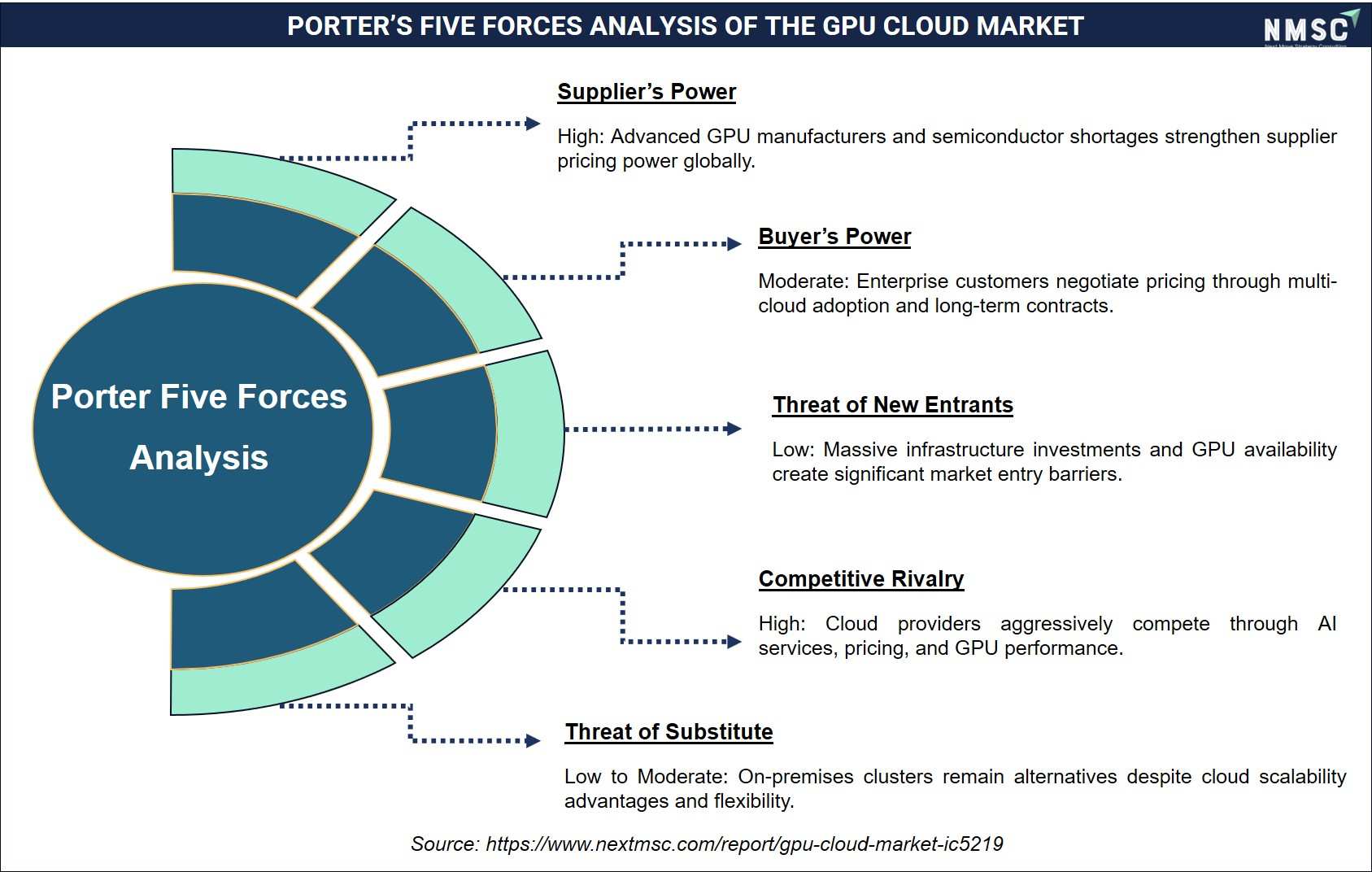
The GPU cloud market exhibits strong competitive intensity due to increasing investments in AI infrastructure and cloud innovation. Supplier power remains high because of limited advanced GPU availability, while significant capital requirements restrict new entrants. Moderate buyer influence and limited substitutes reinforce market stability, encouraging providers to differentiate through performance, pricing, scalability, and managed AI capabilities.
Latest Developments
We found that recent capacity announcements and platform launches within the GPU cloud market are concentrated on backlog expansion, custom silicon adoption, and managed AI platform innovation.
|
Date |
Event |
|
April 2026 |
Vultr launched NVIDIA Nemotron Nano 3 Omni on its GPU Cloud platform, enabling deployment via dedicated GPU clusters and serverless inference. |
|
April 2026 |
Google Cloud announced NVIDIA RTX PRO 6000 Blackwell GPU availability on Cloud Run to expand serverless GPU infrastructure for AI inference workloads. |
|
March 2026 |
AWS and NVIDIA expanded their strategic collaboration, with AWS announcing plans to deploy more than one million NVIDIA Blackwell and Rubin GPUs across AWS Regions beginning in 2026. |
|
March 2026 |
Microsoft announced Azure will deploy NVIDIA Vera Rubin NVL72 AI systems to expand GPU cloud capacity for large-scale AI training and inference. |
Investment Opportunities
What Capital Inflows Are Targeting the GPU Cloud Market?
Capital inflows into the GPU cloud market are increasingly directed toward specialized neocloud operators and custom silicon development programs. Strategic investors continue to fund capacity expansion, as seen in NVIDIA's USD 2.0 billion private placement investment in CoreWeave in January 2026. We observed that investors favor providers demonstrating contracted backlog visibility, viewing multi-year customer commitments as a proxy for long-term revenue durability amid capital-intensive infrastructure build-out.
How Is Infrastructure Investment Supporting GPU Cloud Expansion?
Infrastructure investment is expanding data center and power capacity globally, with combined 2026 capital expenditure plans from Amazon, Microsoft, and Alphabet exceeding USD 550 billion according to company disclosures. Our findings suggest that power procurement and grid interconnection capacity, rather than chip availability alone, increasingly determine how quickly providers can convert capital investment into revenue-generating GPU cloud capacity across constrained regional power markets.
What ESG Considerations Are Shaping GPU Cloud Investment Decisions?
Environmental, social, and governance considerations are increasingly central to GPU cloud investment decisions, with energy-efficient data center design and renewable power sourcing as key criteria. The U.S. Department of Energy's Genesis Mission initiative, which CoreWeave joined in 2025, links AI infrastructure investment to national energy innovation priorities. We found that investors increasingly favor providers with transparent power-sourcing disclosures, treating energy strategy as a governance indicator alongside data center reliability and capacity commitments.
Key Benefits for Stakeholders
How Does This Report Benefit Enterprise and Industry Leaders?
Enterprise and industry leaders gain access to validated segmentation, competitive benchmarking, and regional demand forecasts that support GPU procurement and workload-placement decisions across the GPU cloud industry. Our analysis shows that detailed workload-type, GPU architecture, and consumption-model breakdowns help technology teams align sourcing strategy with cost and performance requirements while identifying underserved regions for capacity expansion.
How Does This Report Benefit Investors and Financial Analysts?
Investors and financial analysts benefit from consistent, single-point market size and CAGR estimates that support valuation and capital-allocation decisions across the GPU cloud supply chain. We observed that the report's regional and segment-level growth differentials help identify which hyperscalers, neoclouds, and accelerator suppliers are best positioned to capture above-market growth in managed AI platform and inference categories through 2035.
How Does This Report Benefit Technology Vendors and Product Teams?
Technology vendors and product teams gain insight into emerging architecture requirements, including custom silicon integration, serverless inference, and sovereign cloud compliance, that are reshaping the industry. Our findings suggest that this analysis helps product roadmap teams prioritize development around workload-aware orchestration and managed AI development environments increasingly required by enterprise procurement processes.
Key Market Segments
By Revenue Stream
-
Compute Infrastructure
-
Virtual GPU Instances
-
On Demand
-
Reserved
-
Spot
-
-
Bare Metal GPU
-
GPU Clusters
-
Managed GPU Clusters
-
Dedicated GPU Clusters
-
-
-
Managed AI Platform
-
Model Training
-
Pre-training
-
Fine-tuning
-
Batch Training
-
-
Model Inference
-
Real-Time Inference
-
Batch Inference
-
Serverless Inference
-
-
AI Development Environment
-
Notebooks
-
AI Studios
-
ML Workbenches
-
-
-
Managed Services
-
Premium Support
-
Managed Operations
-
Professional Services
-
Migration
-
Integration
-
Consulting
-
Custom Deployment
-
-
By Deployment Model
-
Public Cloud
-
Private Cloud
-
Hybrid Cloud
-
Sovereign Cloud
By Consumption Model
-
Pay-as-You-Go
-
Reserved Capacity
-
Spot Capacity
-
Dedicated Capacity
-
Subscription
By GPU Architecture
-
NVIDIA GPUs
-
AMD GPUs
-
Intel GPUs
-
Proprietary AI Accelerators
By Workload Type
-
AI Training
-
AI Fine-Tuning
-
AI Inference
-
High Performance Computing
-
Scientific Computing
-
Engineering Simulation
-
Visual Rendering
-
Cloud Gaming
-
Virtual Desktop Infrastructure
-
Data Analytics
-
Other GPU Workloads
By Organization Size
-
Startups
-
Small and Medium Businesses
-
Mid-Market Enterprises
-
Large Enterprises
-
Research Institutions
-
Government Organizations
By Sales Channel
-
Self-Service Platform
-
Direct Enterprise Sales
-
Channel Partners
-
Cloud Marketplace
By End User Industry
-
Information Technology and Software
-
Banking, Financial Services, and Insurance
-
Telecommunications
-
Healthcare and Life Sciences
-
Manufacturing
-
Automotive
-
Aerospace and Defense
-
Retail and E-commerce
-
Media and Entertainment
-
Gaming
-
Education and Research
-
Energy and Utilities
-
Government and Public Sector
-
Other Industries
By Region
-
North America: U.S., Canada, Mexico.
-
Europe: UK, Germany, France, Italy, Spain, Sweden, Denmark, Finland, Netherlands, Rest of Europe.
-
Asia-Pacific: China, India, Japan, South Korea, Taiwan, Indonesia, Vietnam, Australia, Philippines, Malaysia, Rest of APAC.
-
Middle East & Africa: Saudi Arabia, UAE, Egypt, Israel, Turkey, Nigeria, South Africa, Rest of MEA.
-
Latin America: Brazil, Argentina, Chile, Colombia, Rest of LATAM.
Conclusion and Recommendations
What Is the Long-Term Outlook for the GPU Cloud Market?
The long-term outlook for the GPU cloud market remains strongly positive, with revenue projected to grow from USD 96.5 billion in 2025 to USD 779.0 billion by 2035 at a 21.8% CAGR. We observed that this trajectory is anchored by durable hyperscale capital commitments and expanding enterprise inference consumption rather than speculative demand alone, suggesting the current investment cycle rests on a broadening, monetizing customer base extending well beyond model developers.
What Strategic Positioning Should GPU Cloud Providers Pursue?
Providers should pursue strategic positioning around accelerator diversification, backlog-visible contracting, and managed platform differentiation rather than competing on raw capacity pricing alone. Our assessment indicates that providers combining merchant GPU access with proprietary silicon options and managed AI development tooling are best positioned to retain enterprise customers as workload requirements diversify across training, fine-tuning, and inference use cases.
How Attractive Is the GPU Cloud Market for New Investment?
The GPU cloud market presents high investment attractiveness given its 21.8% forecast CAGR and the scale of disclosed hyperscale capital commitments exceeding USD 600 billion for 2026 alone. We found that investment attractiveness is strongest in managed AI platform and inference categories, which are growing faster than the broader compute infrastructure segment, alongside sovereign cloud programs backed by government procurement commitments in the Middle East and Asia-Pacific.
What Market Shifts and Key Risks Should Stakeholders Monitor?
Stakeholders should monitor power and grid interconnection constraints, GPU and memory component price inflation, and customer concentration risk among a small number of hyperscale buyers. Microsoft disclosed that it expects to remain capacity-constrained through at least the end of calendar year 2026, illustrating how power availability, rather than capital alone, increasingly determines the pace of GPU cloud capacity conversion into recognized revenue.
What Are the Key Growth Pathways for the GPU Cloud Market?
Key growth pathways include serverless and batch inference platform expansion, proprietary accelerator adoption, and sovereign cloud program participation across the Middle East and Asia-Pacific. Our analysis shows that providers expanding managed AI development environments and reinforcement-learning tooling alongside raw GPU capacity are best positioned to capture recurring, higher-margin revenue as enterprise AI adoption matures beyond initial pilot deployments.
About the Author
 Mihul Sharma
— Mihul Sharma is Research Associate at Next Move Strategy Consulting, where he has covered technology, industrial, and healthcare markets for 3 years. His work applies structured business research, market analysis, and secondary-source review to assess market trends, competitive developments, and growth opportunities. He supports report development by fully synthesizing industry data, company information, and market signals into concise findings for strategy and investment-focused research teams.
Mihul Sharma
— Mihul Sharma is Research Associate at Next Move Strategy Consulting, where he has covered technology, industrial, and healthcare markets for 3 years. His work applies structured business research, market analysis, and secondary-source review to assess market trends, competitive developments, and growth opportunities. He supports report development by fully synthesizing industry data, company information, and market signals into concise findings for strategy and investment-focused research teams.
About the Reviewer
 Supradip Baul
— Supradip Baul is an accomplished business consultant and strategist with over a decade of rich experience in market intelligence, strategy, technology, and business transformation. His work has included rigorous qualitative and quantitative analysis across multiple industries, helping clients shape investment decisions and long-term roadmaps. Earlier in his career, he was associated with Gartner, where he contributed to industry-leading reports and market share analyses. He has worked with leading global companies and holds an MBA with a dual specialization in Marketing and Finance.
Supradip Baul
— Supradip Baul is an accomplished business consultant and strategist with over a decade of rich experience in market intelligence, strategy, technology, and business transformation. His work has included rigorous qualitative and quantitative analysis across multiple industries, helping clients shape investment decisions and long-term roadmaps. Earlier in his career, he was associated with Gartner, where he contributed to industry-leading reports and market share analyses. He has worked with leading global companies and holds an MBA with a dual specialization in Marketing and Finance.
At Next Move Strategy Consulting, we understand that insightful market research is the cornerstone of successful business decisions. That's why we employ a robust and multifaceted approach, combining various methodologies to deliver the most accurate and actionable data for our clients.

Research Landscape
We navigate the world of research with two primary approaches:
Qualitative Approach
Our qualitative research methodologies involve immersive techniques such as in-depth interviews, focus groups, and observational studies. By engaging directly with individuals and stakeholders, we uncover valuable insights that quantitative data alone may overlook.

Quantitative Research
In tandem with qualitative methodologies, NMSC leverages the power of Quantitative Research to provide a robust foundation of numerical insights. Through systematic data collection and analysis, we quantify patterns, preferences, and market trends, offering a comprehensive view of the business landscape.
Our quantitative research approach employs diverse tools, including surveys, experiments, and statistical modelling. These methodologies enable us to gather data from a large and representative sample, ensuring the statistical significance of our findings. By employing structured questionnaires and standardized data collection methods, we guarantee the reliability and validity of the information we present to our clients.
Quantitative research is particularly effective in measuring the prevalence of trends, assessing market size, and gauging the impact of various factors on consumer behavior. The numerical precision attained through this approach equips our clients with actionable insights, facilitating data-driven decision-making and strategy formulation.


Our Specialized Toolbox for Industry-Specific Market Research
We deploy a specialized arsenal of techniques tailored to meet your unique requirements. Here's a glimpse into our comprehensive toolbox:

Information Procurement
The stage entails acquiring market data or relevant information through various sources and methodologies.


Market Research Approach
We utilize both top-down and bottom-up approaches in market research analysis to achieve a comprehensive understanding of the market dynamics, leveraging the broad perspective of industry trends and macroeconomic factors alongside detailed insights from specific segments and individual companies.

Porters Five Forces Analysis
We conduct Porter's Five Forces analysis to evaluate the competitive landscape of an industry, providing us with insights into factors that affect profitability and strategic positioning.

SWOT Analysis

Forecasting
We utilize a forecasting model to predict future consumption by considering parameters like population, economics, regulations, market competition, drivers, constraints, technology, and pricing. We also employ statistical techniques such as multilinear regression, exponential smoothing, moving average, ARIMA, and Monte Carlo simulations for accurate predictions. In econometric forecasting, we analyzed short-term and long-term event impacts, attributing values based on regulatory frameworks, economic factors, and market events.





 Speak to Our Analyst