Asia-Pacific Battery Market By Battery Type (Primary Batteries and Secondary Batteries), By Voltage Type (Low Voltage Batteries, Medium Voltage Batteries, and High Voltage Batteries), By Power Capacity (Low Capacity Batteries, Medium Capacity Batteries, High Capacity Batteries, and Ultra High Capacity Batteries), By Self-Discharge Rate (Low, Medium, and High Self-Discharge Rate Batteries), and By Application – Analysis & Forecast, 2025–2035
Industry: Energy & Power | Latest Edition: July 9, 2026 | No of Pages: 536 | No. of Tables: 526 | No. of Figures: 514 | Format: PDF | Report Code: EP721
Asia-Pacific Battery Market Size & Forecast
|
Parameters |
Details |
|
Market Size in 2025 |
USD 129.50 Billion |
|
Market Size in 2026 |
USD 172.66 Billion |
|
Revenue Forecast in 2035 |
USD 970.93 Billion |
|
Growth Rate |
CAGR of 21.15% from 2026 to 2035 |
|
Market Volume in 2025 |
3.09 Billion Units |
|
Market Volume in 2026 |
4.66 Billion Units |
|
Volume Forecast in 2035 |
39.91 Billion Units |
|
Growth Rate |
CAGR of 26.95% from 2026 to 2035 |
|
Analysis Period |
2025–2035 |
|
Base Year Considered |
2025 |
|
Forecast Period |
2026–2035 |
|
Market Size Estimation |
Billion (USD) |
|
Companies Profiled |
15 |
|
Market Share |
Available for 10 Companies |
Industry Outlook
The Asia-Pacific Battery Market size was valued at USD 129.50 billion in 2025 and reached USD 172.66 billion by 2026. Looking ahead, the industry is projected to expand significantly, reaching USD 970.93 billion by 2035, registering a compound annual growth rate (CAGR) of 21.15% from 2026 to 2035. In terms of volume, the market recorded 3.09 billion units in 2025, with forecasts indicating growth to 4.66 billion units by 2026 and further expansion to 39.91 billion units by 2035, reflecting a CAGR of 26.95% over the same period.
What Are the Key Drivers, Restraints, and Opportunities Shaping the Asia-Pacific Battery Market Through 2035?
Growth Catalyst & Risk Assessment Matrix
|
Drivers / Trends / Restraints |
(+/–) % Impact on CAGR Forecast |
Geographic Relevance |
Impact Timeline |
|
Dominance in global battery manufacturing led by countries like China, Japan, and South Korea is establishing the region as the world's leading production and innovation hub for advanced battery technologies |
+3.1% |
China, Japan, South Korea |
Short to medium term (1–4 years) |
|
Rapid EV adoption and large-scale renewable energy deployments across emerging economies are accelerating battery procurement across automotive and stationary storage applications throughout the region |
+2.8% |
China, India, Southeast Asia |
Short to medium term (1–4 years) |
|
Government-led industrial policies and subsidies supporting battery technology R&D and gigafactory expansion are reinforcing the region's long-term competitive advantage in next-generation cell manufacturing |
+2.2% |
China, Japan, South Korea, India |
Medium term (2–5 years) |
|
Supply-demand imbalance in critical raw materials due to rapid scaling of battery manufacturing capacity is creating procurement challenges and price volatility across the regional battery value chain |
–1.8% |
China, India, Southeast Asia |
Short to medium term (1–4 years) |
|
Expansion of regional supply chain integration from mining to cell manufacturing is creating new opportunities for cost optimization, vertical integration, and sustainable sourcing across Asia-Pacific |
+2.5% |
Australia, China, Indonesia |
Medium to long term (3–7 years) |
Through our market assessment, we observed that the Asia-Pacific Battery Market is experiencing exceptional growth driven by the region's established manufacturing dominance, accelerating electric vehicle adoption, and increasing deployment of renewable energy infrastructure across diverse economies. Growing governmental support for battery technology innovation, expanding gigafactory investments, and strengthening supply chain integration from raw material extraction through cell manufacturing are shaping long-term demand. Meanwhile, supply-demand imbalances in critical minerals continue to create procurement and pricing pressures, even as regional sourcing and vertical integration efforts present new opportunities for manufacturers.
Growth Driver:
How Is the Region's Dominance in Global Battery Manufacturing Driving the Asia-Pacific Battery Market Growth?
Through our market assessment, we observed that the Asia-Pacific region's unrivaled dominance in global battery manufacturing is a primary growth catalyst, underpinned by China's massive production scale, Japan's materials and technology expertise, and South Korea's advanced cell manufacturing capabilities. These countries collectively account for the majority of global battery cell production capacity, attracting substantial foreign investment and driving economies of scale. Strong government policies, specialized industrial clusters, and vertically integrated supply chains further reinforce the region's position, enabling faster technology adoption and competitive cost structures across automotive, storage, and consumer electronics applications.
How Is Rapid EV Adoption and Renewable Energy Deployment Fueling the Asia-Pacific Battery Market?
Rapid EV adoption across China, India, and Southeast Asian emerging markets is substantially accelerating battery demand across the automotive segment. Based on our market evaluation, we noted that government mandates, consumer incentives, and expanding EV model availability are driving high volume battery procurement across passenger vehicles, two-wheelers, and commercial transportation. Simultaneously, large-scale renewable energy projects across the region are creating sustained demand for grid-scale energy storage systems. Rising power generation from solar and wind sources requires effective storage solutions, reinforcing the need for advanced lithium-ion and flow battery technologies throughout the Asia-Pacific energy transition.
How Are Government Industrial Policies and R&D Subsidies Strengthening the Asia-Pacific Battery Market?
Based on research conducted by NMSC, we found that proactive government industrial policies and substantial R&D subsidies across major Asia-Pacific economies are reinforcing long-term market competitiveness and innovation momentum. National battery technology roadmaps in China, Japan, South Korea, and India are directing significant public funding toward next-generation cell chemistries, solid-state battery development, and manufacturing automation. Special economic zones, gigafactory incentives, and public-private R&D partnerships are attracting global battery manufacturers and component suppliers. These coordinated government efforts are accelerating commercialization timelines and supporting capacity expansion at a pace unmatched in other global regions.
Growth Inhibitor:
How Is the Supply-Demand Imbalance in Critical Raw Materials Acting as a Restraint for the Asia-Pacific Battery Market?
The rapid scaling of battery manufacturing capacity across Asia-Pacific has created a significant supply-demand imbalance in critical raw materials including lithium, cobalt, and manganese. Through our market analysis, we observed that procurement competition among manufacturers has contributed to price volatility and supply uncertainty, complicating long-term production planning across the region. While resource-rich countries such as Australia and Indonesia offer opportunities for localized sourcing, processing capacity constraints and logistical complexities continue limiting supply chain flexibility. Geopolitical trade dynamics and export regulations further expose regional manufacturers to external disruptions, increasing cost pressures and reducing margin stability.
Growth Opportunity:
How Is the Expansion of Regional Supply Chain Integration Unlocking New Growth Opportunities for the Asia-Pacific Battery Market?
Through NMSC's assessment, we found that the expansion of regional supply chain integration from mining and mineral processing through cell manufacturing and recycling presents substantial growth opportunities across the Asia-Pacific Battery Market. Countries like Australia and Indonesia, rich in lithium, nickel, and cobalt, are increasingly partnering with battery manufacturers in China, Japan, and South Korea to develop vertically integrated supply chains. Strategic government frameworks, cross-border investment agreements, and battery recycling initiatives are reinforcing circular supply chain development. This integration is reducing import dependence, improving cost efficiency, and strengthening regional resilience against global commodity market disruptions throughout the forecast period.
Which Country is Dominating the Asia Pacific Battery Market?
Our comprehensive market assessment indicates that China holds the dominant share in the Asia Pacific Battery Market, supported by its extensive battery manufacturing ecosystem, global leadership in electric vehicle production, and strong investments across the battery value chain. The country benefits from large-scale gigafactory capacity, abundant access to battery raw material processing, advanced research and development capabilities, and favorable government policies promoting electrification and energy storage deployment. Growing demand for electric vehicles, renewable energy integration, grid-scale energy storage systems, and consumer electronics, coupled with continuous investments in battery technology innovation and manufacturing expansion, reinforces China's position as the leading battery market in the Asia Pacific region.
Which Country is Set to Witness the Fastest Growth?
Based on our review of industrial development trends, electrification initiatives, and manufacturing investments, India is positioned to witness the fastest growth in the Asia Pacific Battery Market. Rapid expansion of the electric vehicle sector, increasing investments in domestic battery manufacturing facilities, and strong government support through production-linked incentive (PLI) schemes and clean energy programs are driving market growth. Rising deployment of renewable energy projects, growing demand for energy storage solutions, and increasing adoption of consumer electronics are further accelerating battery demand. Continued investments in battery production infrastructure, supply chain localization, and energy transition initiatives are expected to strengthen India's growth trajectory throughout the forecast period.
Strategic Framework of the Asia-Pacific Battery Market
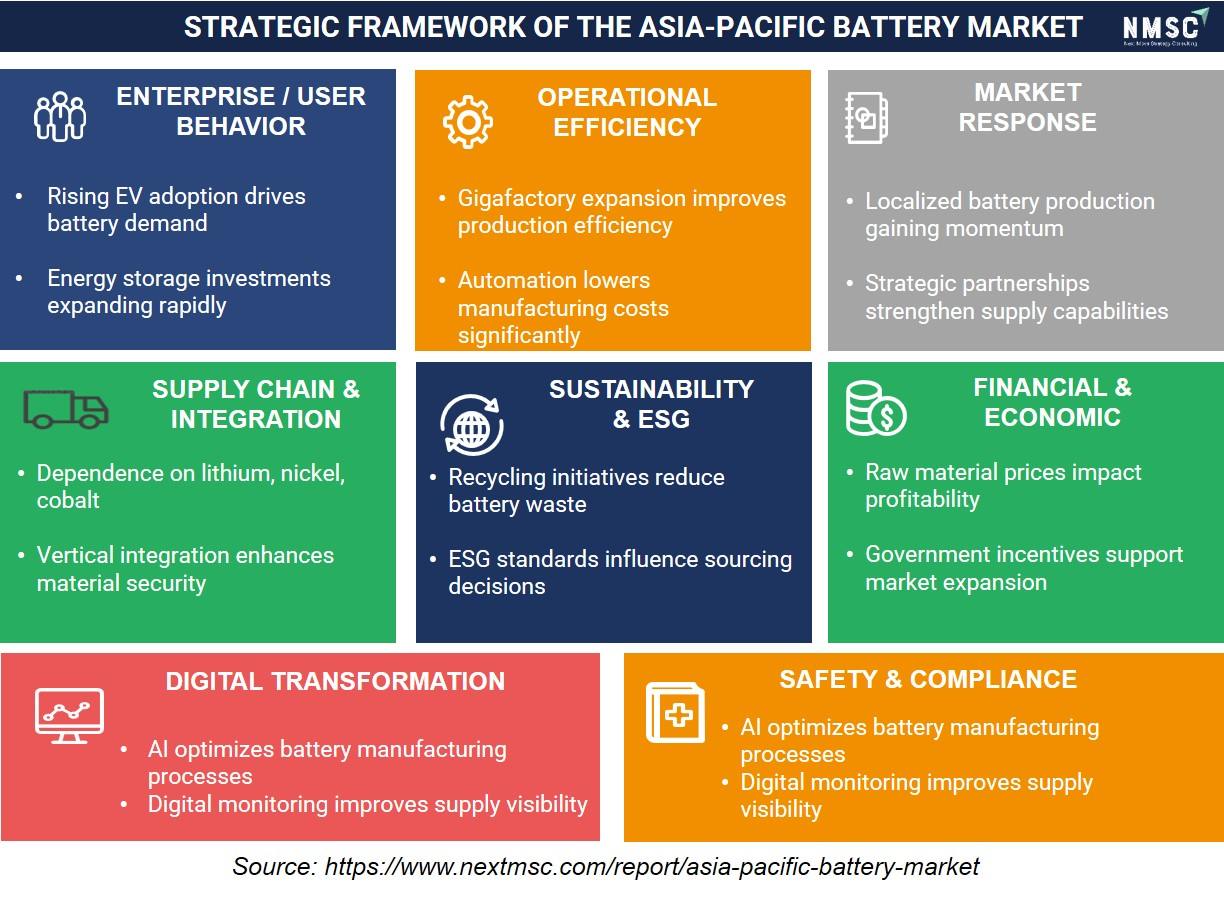
The Asia-Pacific Battery Market is evolving through rapid electrification, large-scale manufacturing expansion, and increasing investments in energy storage infrastructure. Industry participants are prioritizing operational efficiency, supply chain integration, and sustainability initiatives to strengthen competitiveness and secure critical raw materials. Advancements in automation, artificial intelligence, and digital monitoring are enhancing production performance, while supportive government policies, localization strategies, and ESG-driven practices continue to accelerate market growth and long-term resilience across the region.
How Is the Asia-Pacific Battery Market Segmented in This Report, and What Are the Key Insights from the Segmentation Analysis?
By Voltage Type
How Is Voltage Type Segmentation Reflecting Technology and Demand Trends in the Asia-Pacific Battery Market?
Based on voltage type, the Asia-Pacific Battery Market is segmented into low voltage batteries (1V–12V), medium voltage batteries (24V–100V), and high voltage batteries (200V–1000V).
Based on our analysis, we observed that high voltage batteries account for a significant share of market demand, primarily driven by the rapid expansion of electric vehicles, electric buses, and large-scale energy storage systems across China, Japan, South Korea, and India. These battery systems are essential for delivering the power and energy requirements of modern mobility and grid applications. Medium voltage batteries are witnessing growing adoption in industrial equipment, telecom infrastructure, material handling systems, and commercial energy storage applications. Meanwhile, low voltage batteries continue to maintain substantial demand across consumer electronics, portable devices, automotive auxiliary systems, and backup power applications, supported by the region's strong manufacturing base and large consumer market.
By Power Capacity
How Is Power Capacity Segmentation Driving Diverse Battery Demand Across the Asia-Pacific Battery Market?
Based on power capacity, the Asia-Pacific Battery Market is segmented into low capacity batteries (up to 1,000 mAh), medium capacity batteries (1,000 mAh to 10,000 mAh), high capacity batteries (10,000 mAh to 100,000 mAh), and ultra high capacity batteries (more than 100,000 mAh).
Based on our evaluation, we identified that high capacity batteries represent a major share of demand across Asia-Pacific, supported by their extensive use in electric vehicles, industrial equipment, telecommunications infrastructure, and stationary energy storage systems. Ultra high capacity batteries are experiencing the fastest growth, driven by increasing deployment of grid-scale energy storage projects, renewable energy integration initiatives, and utility-scale backup power systems. Medium capacity batteries continue to generate strong demand from laptops, tablets, power tools, and portable electronic devices, while low capacity batteries remain widely utilized in wearables, medical devices, sensors, remote controls, and other compact consumer electronics, ensuring broad-based demand across multiple end-use sectors.
Key Segments
By Battery Type
-
Primary Batteries (Non-rechargeable)
-
Alkaline
-
Zinc-Carbon
-
Lithium Primary
-
Lithium Manganese Dioxide (Li-MnO2)
-
Lithium Thionyl Chloride (Li-SOCl2)
-
-
Other Primary Batteries
-
-
Secondary Batteries (Rechargeable)
-
Lead-Acid Batteries
-
Flooded
-
VRLA
-
-
Nickel-Based
-
Nickel-Cadmium (NiCd) Batteries
-
Nickel-Metal Hydride (NiMH) Batteries
-
-
Lithium-ion Batteries
-
Lithium Nickel Manganese Cobalt (LI-NMC)
-
Lithium Iron Phosphate (LFP)
-
Lithium Cobalt Oxide (LCO)
-
Lithium Titanate Oxide (LTO)
-
Lithium Manganese Oxide (LMO)
-
Lithium Nickel Cobalt Aluminum Oxide (NCA)
-
-
Sodium-Ion
-
Flow Batteries
-
Other Secondary Batteries
-
By Voltage Type
-
Low Voltage Batteries (1V - 12V)
-
Medium Voltage Batteries (24V - 100V)
-
High Voltage Batteries (200V - 1000V)
By Power Capacity
-
Low Capacity Batteries (Up to 1,000 mAh)
-
Medium Capacity Batteries (1,000 mAh to 10,000 mAh)
-
High Capacity Batteries (10,000 mAh to 100,000 mAh)
-
Ultra High Capacity Batteries (More than 100,000 mAh)
By Self-Discharge Rate
-
Low Self-Discharge Rate Batteries
-
Medium Self-Discharge Rate Batteries
-
High Self-Discharge Rate Batteries
By Application
-
Automotive
-
ICE Engines
-
Passenger Cars and Motorcycles
-
Commercial Trucks and Buses
-
-
Electric Vehicles
-
E-Bikes & 3-Wheelers
-
Passenger Electric Vehicles
-
Commercial Trucks and Buses
-
Off-Highway Electric Vehicles
-
-
-
Consumer Electronics
-
Portable Computing
-
Mobile Communication
-
Wearables and Hearables
-
Power Tools and Garden Equipment
-
Portable Power Banks
-
-
Energy Storage Systems
-
Grid-Scale Storage
-
Commercial and Industrial Storage
-
Residential Storage
-
-
Industrial and Infrastructure
-
Telecom Infrastructure
-
Uninterruptible Power Supply
-
Aerospace and Defense
-
Marine
-
Medical Devices
-
Oil and Gas
-
-
Other Applications
Competitive Landscape
The Asia-Pacific Battery Market is characterized by an intensely competitive and rapidly evolving structure, anchored by a combination of global cell manufacturing leaders, domestic battery producers, and increasingly capable new market entrants. Market growth is being driven by expanding EV production volumes, accelerating deployment of grid-scale energy storage systems, and substantial investments in gigafactory capacity across the region. The integration of advanced lithium-ion and emerging battery chemistries, automated manufacturing processes, and expanding recycling capabilities is enhancing production efficiency and supporting broader market development across automotive, consumer electronics, and stationary storage applications.
Strategic Developments:
-
April 2026 - CATL signed China's first large-scale 60 GWh sodium-ion battery supply agreement with Beijing HyperStrong for energy storage applications, accelerating commercialization of sodium-ion batteries in China.
-
March 2026 - Exide Industries Limited invested USD 52.5 million into subsidiary Exide Energy Solutions to support its Bengaluru lithium-ion cell manufacturing project, one of India's largest battery-cell investments.
-
February 2026 - GS Yuasa received METI certification for its “Stable Supply Assurance Plan” covering development and mass production of stationary lithium-ion batteries in Japan. The project involves approximately ¥70.3 billion of investment and 2 GWh annual production capacity.
-
November 2025 - Panasonic Energy announced a multi-year agreement to supply lithium-ion batteries from Japan-based production operations for Zoox autonomous vehicles beginning in 2026, strengthening Japan's advanced battery manufacturing base.
-
December 2025 - At Marintec China 2025 in Shanghai, EVE Energy announced cooperation agreements including Nantong Chengrui Battery Technology and introduced new marine battery management technologies for the Chinese market.
Key Players
-
Contemporary Amperex Technology Co., Limited
-
BYD Company Limited
-
LG Energy Solution, Ltd.
-
Samsung SDI Co., Ltd.
-
SK On Co., Ltd.
-
Gotion High-tech Co., Ltd.
-
EVE Energy Co., Ltd.
-
REPT BATTERO Energy Co., Ltd.
-
Sunwoda Electronic Co., Ltd.
-
GS Yuasa Corporation
-
Panasonic Energy Co. Limited
-
Exide Industries Limited
-
Amara Raja Energy & Mobility Limited
-
Ganfeng Li-Energy Technology Co., Ltd.
-
Automotive Energy Supply Corporation
NMSC's analysis indicates that competitive dynamics in the Asia-Pacific Battery Market are increasingly influenced by cell manufacturing scale, technology differentiation, supply chain control, and strategic expansion across key regional markets. Key companies such as Contemporary Amperex Technology Co., Limited, BYD Company Limited, LG Energy Solution, Ltd., Samsung SDI Co., Ltd., SK On Co., Ltd., Gotion High-tech Co., Ltd., EVE Energy Co., Ltd., REPT BATTERO Energy Co., Ltd., Sunwoda Electronic Co., Ltd., GS Yuasa Corporation, Panasonic Energy Co. Limited, Exide Industries Limited, Amara Raja Energy & Mobility Limited, Ganfeng Li-Energy Technology Co., Ltd., and Automotive Energy Supply Corporation are reinforcing their market positions through capacity expansion, advanced chemistry development, and strategic partnerships.
Supply Chain Structure of the Asia-Pacific Battery Market
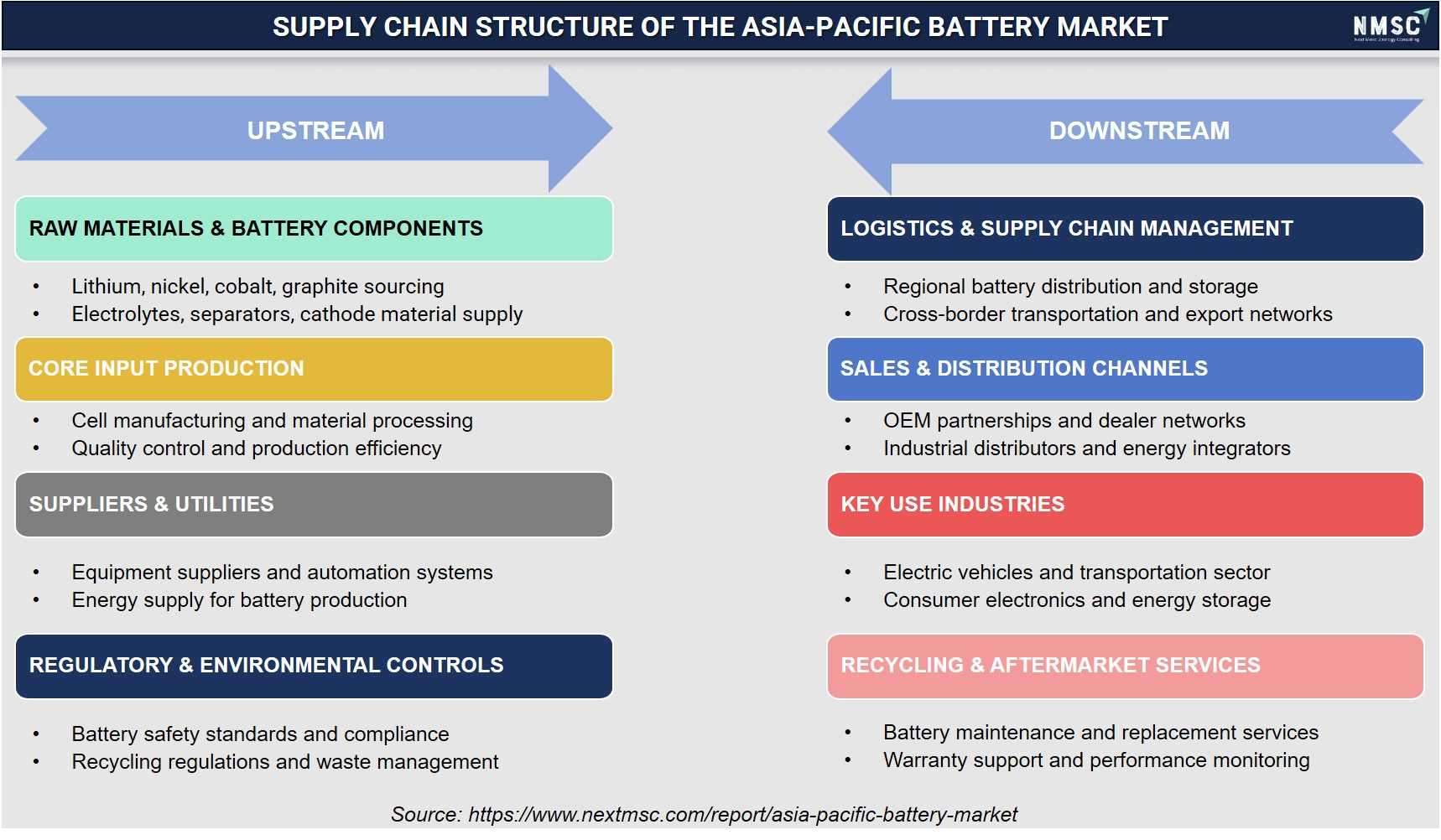
The Asia-Pacific Battery Market features a highly integrated supply chain spanning raw material sourcing, battery component manufacturing, cell production, distribution, and end-use deployment. Strong regional capabilities in lithium processing, battery manufacturing, and electronics production support market competitiveness. Growing demand from electric vehicles, consumer electronics, and energy storage systems is strengthening downstream activities, while increasing emphasis on regulatory compliance, recycling infrastructure, and aftersales services is enhancing supply chain resilience and long-term sustainability across the region.
Key Benefits for Stakeholders
Next Move Strategy Consulting (NMSC) presents a comprehensive analysis of the Asia-Pacific Battery Market, covering historical developments from 2020 to 2025 and providing detailed forecasts through 2035. Our study evaluates the market across key economies in the region, delivering quantitative outlooks alongside qualitative insights into battery chemistry advancements, gigafactory expansion, regional supply chain integration, and renewable energy deployment trends shaping the Asia-Pacific battery ecosystem and its long-term competitive trajectory across automotive, energy storage, and consumer electronics end-use industries.
Investors benefit from growing investment opportunities in domestic battery manufacturing, recycling infrastructure, and vertically integrated supply chains, while automakers, energy storage developers, consumer electronics manufacturers, and battery component suppliers benefit from rising demand for advanced lithium-ion, sodium-ion, and emerging battery technologies. Stakeholders gain access to detailed segmentation insights spanning battery type, voltage, capacity, self-discharge rate, and application, supporting informed decision-making across the rapidly evolving Asia-Pacific battery value chain and its diverse end-use applications.
|
Parameters |
Details |
|
Customization Scope |
Free customization (equivalent to up to 80 analyst-working hours) after purchase. |
|
Pricing and Purchase Options |
Avail customized purchase options to meet your exact research needs. |
|
Approach |
In-depth primary and secondary research; proprietary databases; rigorous quality control and validation measures. |
|
Analytical Tools |
Porter's Five Forces, SWOT, value chain, and Harvey ball analysis to assess competitive intensity, stakeholder roles, and relative impact of key factors. |
Conclusion
The Asia-Pacific Battery Market is poised for extraordinary growth over the forecast period, driven by the region's unmatched manufacturing capacity, rapid electric vehicle adoption, expanding renewable energy infrastructure, and strong government support for battery technology innovation. Rising demand across automotive, energy storage, and consumer electronics segments, combined with deepening regional supply chain integration and ongoing advancements in lithium-ion and next-generation battery chemistries, is reinforcing the market's long-term competitive trajectory. Leading manufacturers are leveraging scale advantages and strategic partnerships to sustain growth momentum across the region's diverse and rapidly evolving battery ecosystem through 2035.


About the Author
 Mihul Sharma
— Mihul Sharma is Research Associate at Next Move Strategy Consulting, where he has covered technology, industrial, and healthcare markets for 3 years. His work applies structured business research, market analysis, and secondary-source review to assess market trends, competitive developments, and growth opportunities. He supports report development by fully synthesizing industry data, company information, and market signals into concise findings for strategy and investment-focused research teams.
Mihul Sharma
— Mihul Sharma is Research Associate at Next Move Strategy Consulting, where he has covered technology, industrial, and healthcare markets for 3 years. His work applies structured business research, market analysis, and secondary-source review to assess market trends, competitive developments, and growth opportunities. He supports report development by fully synthesizing industry data, company information, and market signals into concise findings for strategy and investment-focused research teams.
About the Reviewer
 Supradip Baul
— Supradip Baul is an accomplished business consultant and strategist with over a decade of rich experience in market intelligence, strategy, technology, and business transformation. His work has included rigorous qualitative and quantitative analysis across multiple industries, helping clients shape investment decisions and long-term roadmaps. Earlier in his career, he was associated with Gartner, where he contributed to industry-leading reports and market share analyses. He has worked with leading global companies and holds an MBA with a dual specialization in Marketing and Finance.
Supradip Baul
— Supradip Baul is an accomplished business consultant and strategist with over a decade of rich experience in market intelligence, strategy, technology, and business transformation. His work has included rigorous qualitative and quantitative analysis across multiple industries, helping clients shape investment decisions and long-term roadmaps. Earlier in his career, he was associated with Gartner, where he contributed to industry-leading reports and market share analyses. He has worked with leading global companies and holds an MBA with a dual specialization in Marketing and Finance.
At Next Move Strategy Consulting, we understand that insightful market research is the cornerstone of successful business decisions. That's why we employ a robust and multifaceted approach, combining various methodologies to deliver the most accurate and actionable data for our clients.

Research Landscape
We navigate the world of research with two primary approaches:
Qualitative Approach
Our qualitative research methodologies involve immersive techniques such as in-depth interviews, focus groups, and observational studies. By engaging directly with individuals and stakeholders, we uncover valuable insights that quantitative data alone may overlook.

Quantitative Research
In tandem with qualitative methodologies, NMSC leverages the power of Quantitative Research to provide a robust foundation of numerical insights. Through systematic data collection and analysis, we quantify patterns, preferences, and market trends, offering a comprehensive view of the business landscape.
Our quantitative research approach employs diverse tools, including surveys, experiments, and statistical modelling. These methodologies enable us to gather data from a large and representative sample, ensuring the statistical significance of our findings. By employing structured questionnaires and standardized data collection methods, we guarantee the reliability and validity of the information we present to our clients.
Quantitative research is particularly effective in measuring the prevalence of trends, assessing market size, and gauging the impact of various factors on consumer behavior. The numerical precision attained through this approach equips our clients with actionable insights, facilitating data-driven decision-making and strategy formulation.


Our Specialized Toolbox for Industry-Specific Market Research
We deploy a specialized arsenal of techniques tailored to meet your unique requirements. Here's a glimpse into our comprehensive toolbox:

Information Procurement
The stage entails acquiring market data or relevant information through various sources and methodologies.


Market Research Approach
We utilize both top-down and bottom-up approaches in market research analysis to achieve a comprehensive understanding of the market dynamics, leveraging the broad perspective of industry trends and macroeconomic factors alongside detailed insights from specific segments and individual companies.

Porters Five Forces Analysis
We conduct Porter's Five Forces analysis to evaluate the competitive landscape of an industry, providing us with insights into factors that affect profitability and strategic positioning.

SWOT Analysis

Forecasting
We utilize a forecasting model to predict future consumption by considering parameters like population, economics, regulations, market competition, drivers, constraints, technology, and pricing. We also employ statistical techniques such as multilinear regression, exponential smoothing, moving average, ARIMA, and Monte Carlo simulations for accurate predictions. In econometric forecasting, we analyzed short-term and long-term event impacts, attributing values based on regulatory frameworks, economic factors, and market events.





 Speak to Our Analyst