Asia-Pacific Room Air Conditioner Market By Product Type (Window AC, Portable AC, Single Split AC, Multi Split, & Others), By Speed Type (Fixed Speed & Inverter), By Cooling Capacity (≤ 1.0 Ton, >1.0 to ≤1.5 Ton, >1.5 to ≤2.0 Ton, & Others), By Efficiency Band (Entry, Standard, & Others), By Refrigerant (R22, R410A, R32, Hydrocarbon, & Others), By Function (Cooling Only, Heat Pump, Cooling with Electric Heat, & Others), By End-User (Residential & Commercial) – Analysis & Forecast, 2026-2035
Industry: Retail and Consumer | Latest Edition: June 23, 2026 | No of Pages: 1038 | No. of Tables: 572 | No. of Figures: 554 | Format: PDF | Report Code: RC4749
Asia-Pacific Room Air Conditioner Market Size & Forecast
|
Parameters |
Details |
|
Market Size in 2026 |
USD 50.43 billion |
|
Revenue Forecast in 2035 |
USD 85.86 billion |
|
Growth Rate |
CAGR of 6.09% from 2026 to 2035 |
|
Market Volume in 2026 |
67 million units |
|
Volume Forecast in 2035 |
124 million units |
|
Growth Rate |
CAGR of 7.13% from 2026 to 2035 |
|
Analysis Period |
2025–2035 |
|
Base Year Considered |
2025 |
|
Forecast Period |
2026–2035 |
|
Market Size Estimation |
Billion (USD) |
|
Countries Covered |
10 |
|
Companies Profiled |
15 |
|
Market Share |
Available for 10 companies |
Industry Outlook
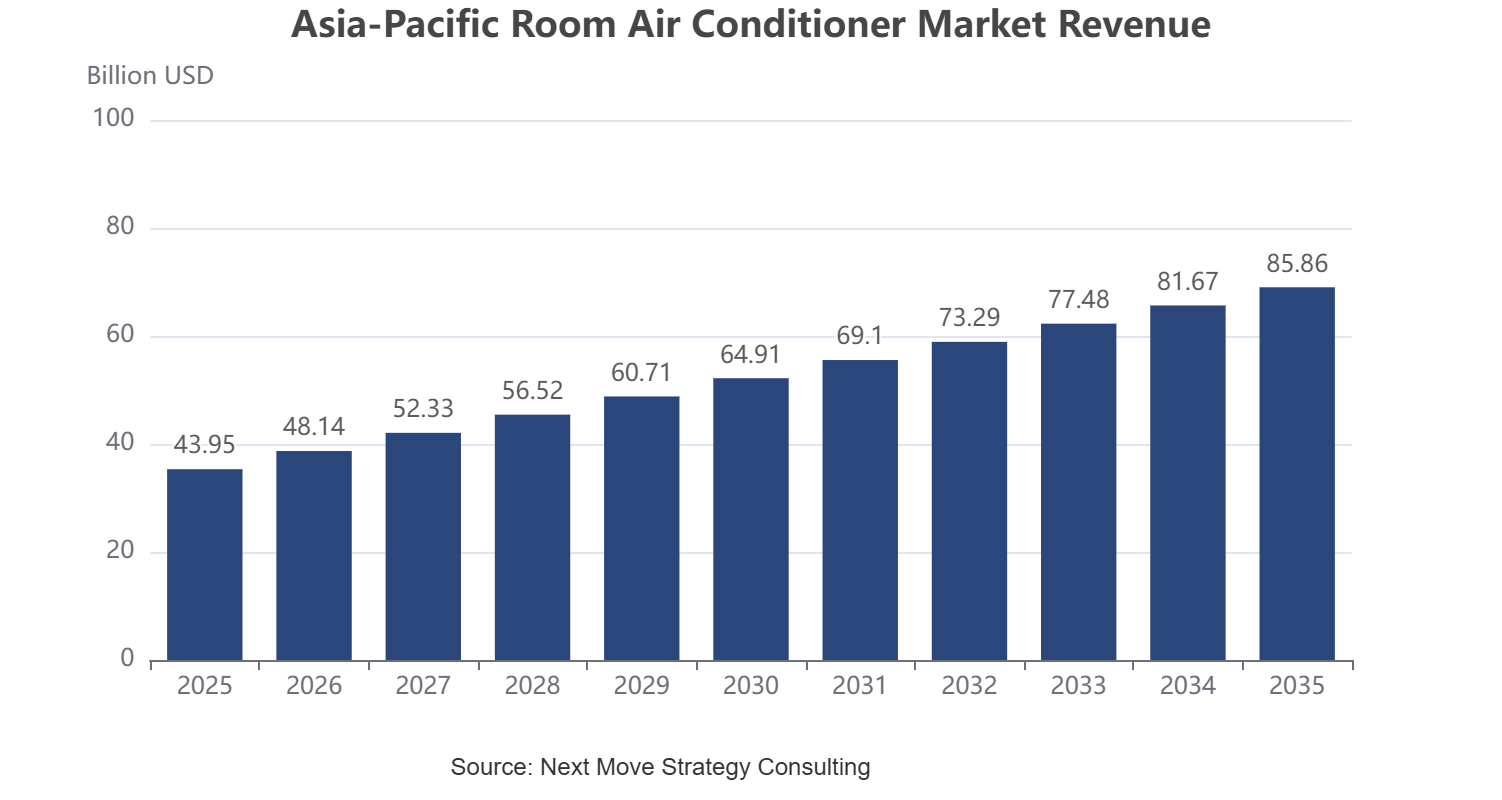
The Asia-Pacific Room Air Conditioner Market size was valued at USD 43.95 billion in 2025, and is expected to be valued at USD 50.43 billion by the end of 2026. The industry is projected to grow, hitting USD 85.86 billion by 2035, with a CAGR of 6.09% between 2026 and 2035. In terms of volume, the market recorded 56 million units in 2025, with forecasts indicating growth to 67 million units by 2026 and further to 124 million units by 2035, reflecting a CAGR of 7.13% over the same period.
Ecosystem Analysis of the Asia-Pacific Room Air Conditioner Market:
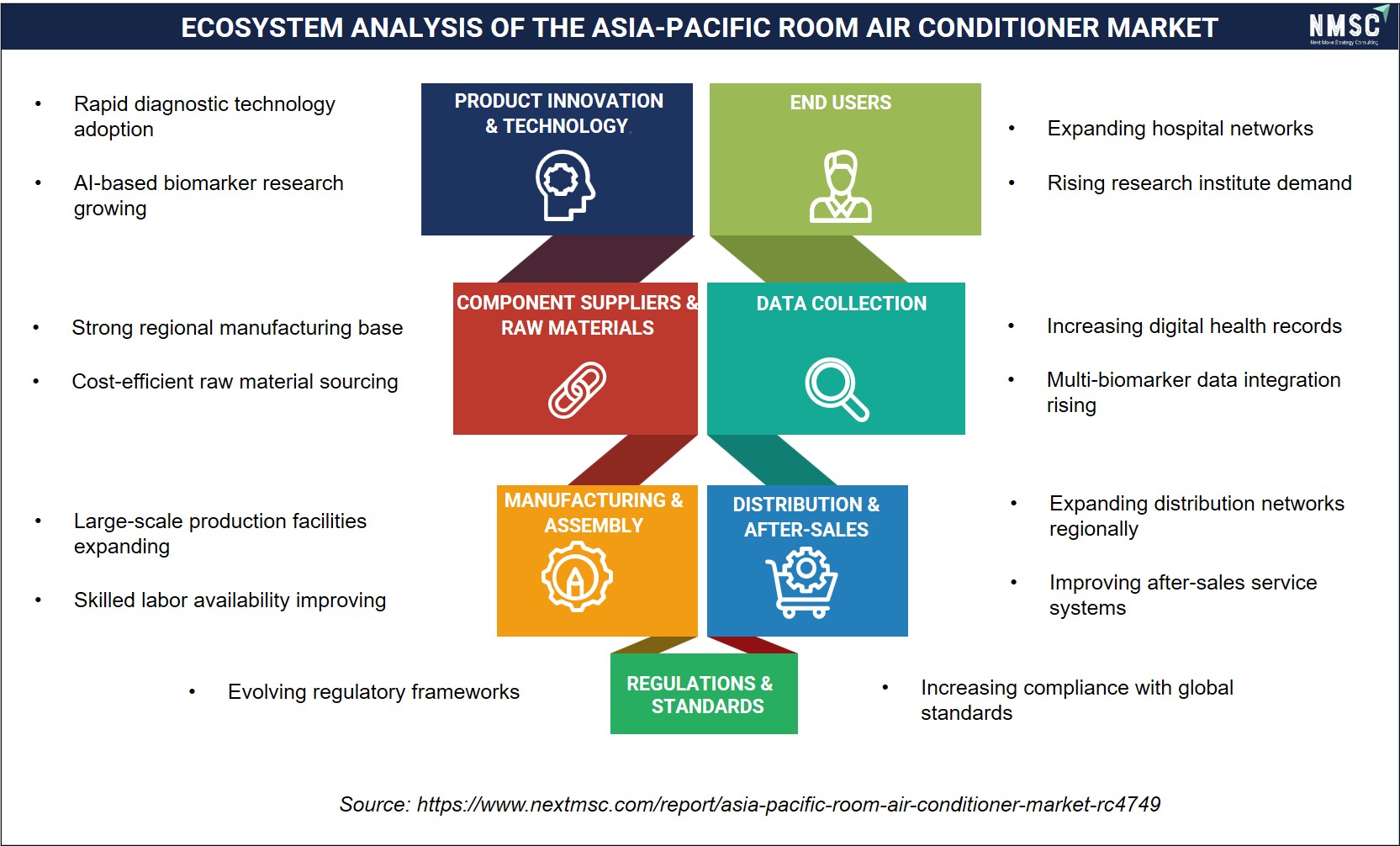
The infographic presents an ecosystem analysis of the Asia-Pacific room air conditioner market, illustrating the interconnected value chain from raw material sourcing to end-user engagement. It reflects strong industry expertise by identifying component suppliers and manufacturing assembly as the operational foundation supporting large-scale production and market supply. The analysis further highlights how product innovation and advancing technologies drive competitive differentiation across regional markets. Distribution networks and after-sales service infrastructure play a critical role in strengthening customer access and long-term service reliability, while regulatory standards maintain compliance across the ecosystem. Data collection and performance monitoring function as integrated enablers supporting consumer insight generation and operational visibility. This structured assessment provides stakeholders with a credible framework for evaluating supply chain resilience, innovation trends, and regulatory exposure across the Asia-Pacific market.
What are the Key Market Drivers, Breakthroughs, and Investment Opportunities that will Shape the Asia-Pacific Room Air Conditioner Market in the Next Decade?
Growth Catalyst & Risk Assessment Matrix
|
Drivers / Trends / Restraints |
(+/-) % Impact on CAGR Forecast |
Geographic Relevance |
Impact Timeline |
|
Rapid urbanisation increasing demand for residential room air conditioners |
+5.02% |
China, India, Indonesia, Vietnam, Philippines |
Medium to Long term (3–6 years) |
|
Rising disposable incomes improving RAC affordability and household penetration |
+4.41% |
India, China, Southeast Asia, emerging Asia-Pacific economies |
Medium to Long term (3–6 years) |
|
Expanding residential infrastructure supporting long-term RAC integration |
+4.16% |
China, India, Southeast Asia, urban growth corridors |
Medium to Long term (3–6 years) |
|
Mass adoption of inverter ACs driving energy-efficient upgrade demand |
+3.84% |
Japan, South Korea, China, India, Southeast Asia |
Medium to Long term (3–6 years) |
|
High energy consumption concerns limiting large-scale RAC adoption |
-3.67% |
India, Southeast Asia, power-constrained developing economies |
Short to Medium term (1–4 years) |
NMSC analysis indicates that the Asia-Pacific room air conditioner market is witnessing rapid expansion supported by accelerating urbanisation, rising middle-class population, and increasing household purchasing power across emerging and developed economies. Expanding urban housing infrastructure, rising residential construction activity, and growing demand for indoor thermal comfort are significantly strengthening RAC adoption across countries such as China, India, Japan, South Korea, and Southeast Asian economies. Consumers are increasingly shifting toward technologically advanced and energy-efficient cooling systems equipped with smart connectivity and inverter-based functionality. At the same time, concerns regarding electricity consumption and power infrastructure pressure continue to influence purchasing decisions and regulatory frameworks across several regional markets. Industry analysis indicates that strong population density, expanding appliance penetration, and rising adoption of high-efficiency inverter air conditioners continue to reinforce the market’s long-term growth trajectory.
Growth Drivers:
How is Rapid Urbanisation Accelerating the Asia-Pacific Room Air Conditioner Market?
Rapid urbanisation across the Asia-Pacific is substantially increasing demand for room air conditioning systems by expanding residential and commercial infrastructure across densely populated urban centers. Major economies, including China, India, Indonesia, Vietnam, and the Philippines, are witnessing continuous migration toward metropolitan areas, resulting in rising construction of apartments, high-rise residential complexes, and compact urban housing units. We observed that urban households increasingly prioritise indoor cooling systems due to higher population density, rising ambient temperatures, and changing lifestyle expectations associated with modern city living. This urban infrastructure expansion is generating large-scale demand for compact and energy-efficient RAC systems suited for smaller residential spaces and mixed-use developments. Industry evidence suggests that urbanisation is also accelerating organised retail penetration and e-commerce appliance distribution, improving product accessibility across middle-income consumer groups. As urban housing development continues to expand across the region, room air conditioners remain an increasingly essential component of residential infrastructure planning.
How are Rising Disposable Incomes Supporting the Asia-Pacific Room Air Conditioner Market Adoption?
Based on our market assessment, we analysed that rising disposable incomes across Asia-Pacific are significantly strengthening room air conditioner affordability and accelerating household appliance ownership. Expanding middle-class populations are increasingly allocating household expenditure toward lifestyle-enhancing consumer appliances, including advanced cooling systems. Higher income levels are enabling consumers to transition from basic cooling alternatives such as fans and air coolers toward technologically advanced room air conditioners offering improved efficiency, smart connectivity, and enhanced comfort. Furthermore, aspirational purchasing behaviour is particularly strong among younger urban consumers seeking premium home appliances integrated with modern digital ecosystems. In addition, improving access to consumer financing and instalment-based purchasing models is further supporting RAC penetration across emerging economies. Industry trends indicate that rising purchasing power continues to expand the addressable customer base for both entry-level and premium air conditioning systems across the Asia-Pacific region.
How is Expanding Residential Infrastructure Supporting the Long-Term Asia-Pacific Room Air Conditioner Market Demand?
The rapid expansion of residential infrastructure across the Asia-Pacific is creating sustained long-term demand for room air conditioners across both emerging and mature markets. Governments and private developers across the region continue to invest heavily in affordable housing projects, urban residential developments, and smart city initiatives to accommodate rising population density and urban migration. We noticed that newly developed housing units increasingly incorporate dedicated electrical and structural provisions for air conditioning systems, strengthening RAC integration within modern residential construction standards. This trend is particularly evident across rapidly developing economies where homeownership growth and urban apartment construction remain strong. Industry analysis suggests that residential expansion is also increasing replacement opportunities as consumers upgrade older cooling systems with inverter-based and smart-enabled technologies. As housing infrastructure development continues to accelerate, room air conditioners are becoming a standardised residential utility across a broader range of income groups and geographic markets.
Growth Inhibitor:
How are High Energy Consumption Concerns Limiting the Asia-Pacific Room Air Conditioner Market Adoption?
Concerns surrounding high electricity consumption and rising energy demand continue to limit large-scale room air conditioner adoption across several Asia-Pacific economies. Many developing countries within the region continue to face power infrastructure constraints, electricity pricing pressures, and seasonal peak-load challenges associated with increasing cooling demand. Consumers remain highly sensitive to long-term operational expenses, particularly in price-conscious markets where electricity costs represent a significant share of household expenditure. Governments and regulatory agencies are therefore intensifying focus on appliance efficiency standards and energy conservation policies to manage grid stability and environmental impact. Industry evidence suggests that concerns regarding excessive electricity consumption continue to influence purchasing decisions, particularly among first-time buyers and lower-income households. These factors are slowing the adoption of conventional fixed-speed systems while increasing market pressure for higher-efficiency cooling technologies.
Growth Opportunity:
How is Mass Adoption of Inverter ACs Driving Long-Term Growth in the Asia-Pacific Room Air Conditioner Market?
From our research, we found that the mass adoption of inverter-based room air conditioners is emerging as one of the most significant long-term growth opportunities across the Asia-Pacific market. Consumers are increasingly prioritizing systems that deliver lower electricity consumption, quieter operation, faster cooling performance, and improved temperature stability compared to conventional air conditioners. Inverter ACs are gaining substantial traction across both residential and light commercial segments due to rising awareness regarding energy efficiency and long-term cost optimisation. Governments across major Asia-Pacific economies are also supporting high-efficiency appliance adoption through labelling programs, efficiency mandates, and incentive-driven initiatives aimed at reducing national energy consumption. We noticed that manufacturers are rapidly expanding inverter product portfolios across premium and mid-range price categories to capture rising regional demand. Over the long term, inverter penetration is expected to strengthen product premiumization, technological differentiation, and sustainable cooling infrastructure development throughout the region.
Which Country is Dominating the Asia-Pacific Room Air Conditioner Market?
Based on our assessment, we found that China dominates the Asia-Pacific room air conditioner market due to its massive residential consumer base, strong manufacturing ecosystem, and extremely high urban cooling demand. Rapid urbanisation, rising disposable incomes, and expanding middle-class households have significantly accelerated room air conditioner penetration across both Tier 1 and lower-tier cities. In addition, rising summer temperatures and prolonged heatwaves across several provinces continue to strengthen demand for residential cooling solutions. The country also benefits from extensive apartment-based housing infrastructure, where split and window air conditioners remain highly suitable and widely adopted. Strong domestic consumption combined with recurring replacement demand from ageing installed units further reinforces China’s leadership position in the regional market.
Also, China’s dominance is supported by its globally integrated HVAC manufacturing and supply chain network, which enables large-scale production, cost competitiveness, and rapid product innovation. The presence of major domestic appliance manufacturers such as Gree Electric Appliances, Midea Group, and Haier Smart Home has accelerated the adoption of inverter-based, energy-efficient, and smart-connected room air conditioners across the country. At the same time, government emphasis on energy efficiency standards and smart home development continues to support premiumization within the market. The combination of scale-driven manufacturing strength, climate-driven cooling demand, and rapid technological adoption positions China as the dominant force in the Asia-Pacific room air conditioner market.
Which Country is Set to Witness the Fastest Growth?
India is set to witness the fastest growth in the Asia-Pacific room air conditioner market due to rising urbanisation, expanding middle-class income levels, and rapidly increasing exposure to extreme summer temperatures. Our analysis indicates that room air conditioner penetration in India remains comparatively lower than in several developed Asia-Pacific markets, creating substantial untapped growth potential across residential households. Increasing affordability of entry-level split ACs, easier financing options, and rising consumer awareness regarding indoor comfort are significantly accelerating first-time adoption in Tier 2 and Tier 3 cities. In addition, prolonged heatwaves and rising humidity levels across northern, western, and central regions are strengthening dependence on residential cooling solutions, particularly during extended summer seasons.
India’s fast growth trajectory is also supported by large-scale residential construction activity, improving electrification infrastructure, and the rapid expansion of organised retail and e-commerce appliance distribution. The increasing shift toward inverter-based and energy-efficient room air conditioners is further driving replacement demand among urban consumers seeking lower electricity consumption and better cooling performance. At the same time, government initiatives supporting domestic electronics manufacturing and production-linked incentive programs are strengthening local HVAC manufacturing capacity and supply chain development. The combination of low existing penetration, climate-driven demand growth, rising household purchasing power, and expanding domestic production positions India as the fastest-growing Asia-Pacific room air conditioner market region through the forecast period.
How is the Asia-Pacific Room Air Conditioner Market segmented in this report, and what are the key insights from the segmentation analysis?
By Refrigerant Insights
How is Refrigerant Transition Reshaping the Asia-Pacific Room Air Conditioner Market?
Based on refrigerant, the Asia-Pacific room air conditioner market is segmented into R22, R410A, R32, Low-GWP HFO/HFC blend, hydrocarbon, and other refrigerants.
R22-based room air conditioners continue to retain a limited presence across older installations and replacement-driven demand in cost-sensitive markets, particularly where legacy servicing infrastructure remains active. However, regulatory pressure and environmental compliance requirements are steadily reducing their long-term market relevance. R410A systems maintain broad adoption across conventional residential cooling applications due to established supply chains and widespread compatibility with existing manufacturing ecosystems. At the same time, R32 refrigerants are witnessing stronger market penetration as manufacturers prioritize higher energy efficiency and lower global warming potential within new-generation room air conditioners. Low-GWP HFO/HFC blend refrigerants are gradually expanding across technologically advanced markets focused on sustainability-led cooling transitions and regulatory alignment. Hydrocarbon refrigerants continue gaining attention in niche, environmentally focused applications, while other refrigerant categories remain concentrated within specialised commercial, retrofit, and region-specific operational requirements.
By Distribution Channel Insights
How are Distribution Channels Influencing Sales Dynamics in the Asia-Pacific Room Air Conditioner Market?
Based on distribution channel, the Asia-Pacific room air conditioner market is segmented into retail, dealer network, online, project sales, and OEM.
Based on our segmental analysis, we found that retail channels continue to account for significant room air conditioner sales across the Asia-Pacific region, supported by strong consumer preference for physical product evaluation, immediate product availability, and in-store promotional financing schemes. Dealer networks maintain an important role in regional distribution, particularly in emerging markets where localised relationships, installation support, and after-sales service strongly influence purchasing decisions. Alongside traditional channels, online platforms are witnessing accelerated traction as urban consumers increasingly prioritise pricing transparency, product comparison, doorstep delivery, and seasonal digital discount campaigns. Project sales remain closely linked to expanding residential and commercial construction activity, with developers integrating room air conditioning systems into large-scale housing and infrastructure projects. Meanwhile, OEM channels continue to support private-label manufacturing, regional brand partnerships, and supply agreements that strengthen market penetration across both organised and cost-competitive consumer segments.
Competitive Landscape
The Asia-Pacific room air conditioner industry demonstrates a highly competitive yet moderately consolidated structure led by large-scale regional manufacturers with extensive production capabilities, vertically integrated supply chains, and strong domestic as well as export-oriented distribution networks. NMSC analysis indicates that competition across the region is strongly influenced by rapid urbanisation, rising middle-class appliance adoption, and increasing demand for energy-efficient inverter air conditioning systems. Market participants are actively investing in smart connectivity features, AI-enabled climate optimisation, and localisation of manufacturing operations to improve pricing competitiveness and operational scalability. In parallel, strong replacement demand in mature economies and first-time AC adoption across emerging Southeast Asian markets continue to intensify competitive activity.
Strategic Developments:
-
April 2026 - TCL celebrated the production of its 100 millionth AC unit at its new smart manufacturing base. This facility is strategically central to TCL's goal of reaching 3 billion yuan in annual output by 2026, leveraging automation to produce one premium air conditioner every seven seconds.
-
February 2026 - Panasonic Corporation announced plans to double its India air-conditioner manufacturing capacity to two million units by fiscal 2028. The strategy positions India as a major export and production hub while strengthening Panasonic’s long-term growth outlook in the Asia-Pacific residential cooling market.
-
January 2026 - Samsung introduced its 2026 lineup of 100% Bespoke AI WindFree air conditioners in India. The strategic focus is on AI Energy Mode, which reduces consumption by up to 30%, and smart connectivity via SmartThings to address India's rising electricity costs and extreme heat.
-
February 2026 - Mitsubishi Electric Corporation inaugurated a USD 250 million air conditioner and compressor manufacturing facility in Chennai, India. The plant enhances localisation, increases inverter AC production capacity, and strengthens Mitsubishi Electric’s position within India’s rapidly expanding residential air conditioning sector.
-
July 2025 - Daikin Industries, Ltd. established a Global Capability Centre (GCC) in India in collaboration with EY. The initiative supports digital transformation, AI integration, and operational optimization across Daikin’s regional HVAC business, strengthening technological competitiveness in the Asia-Pacific room air conditioner market.
-
May 2025 - Daikin Industries, Ltd. officially commenced operations at its first full-scale residential air conditioner manufacturing facility in Indonesia. The investment strengthens Daikin’s Southeast Asian supply chain, improves localized production, and supports rising regional demand for energy-efficient room air conditioners across Asia-Pacific markets.
-
March 2025 - Panasonic Corporation expanded its Matter-enabled smart air conditioner portfolio in India with 61 new residential AC models. The launch strengthens Panasonic’s smart cooling ecosystem strategy and addresses growing Asia-Pacific demand for AI-enabled, energy-efficient, and IoT-connected room air conditioning systems.
Key Players of the Asia-Pacific Room Air Conditioner Market:
-
Daikin Industries, Ltd.
-
Gree Electric Appliances Inc. of Zhuhai
-
Midea Group Co., Ltd.
-
Panasonic Corporation
-
Samsung Electronics Co., Ltd.
-
Trane Technologies India Private Limited
-
Hisense Home Appliances Group Co., Ltd.
-
Mitsubishi Electric Corporation
-
Sharp Corporation
-
Hitachi Air Conditioning Japan, Ltd.
-
Fujitsu General Limited
-
Haier Appliances India Private Limited
-
TCL Sun, Inc.
Industry analysis suggests that leading manufacturers, including Daikin Industries, Ltd., Gree Electric Appliances Inc. of Zhuhai, and Midea Group Co., Ltd., maintain significant market influence through large-scale manufacturing ecosystems, broad product portfolios, and aggressive regional expansion strategies in the Asia-Pacific room air conditioner market. At the same time, Carrier Air Conditioning (China) Co., Ltd. is strengthening its position through commercial-residential integration capabilities and premium energy-efficient systems, while LG Electronics Inc. and Panasonic Corporation continue to focus on connected cooling technologies, air purification integration, and premium inverter-based product innovation. Further, future competitive differentiation across Asia-Pacific increasingly depends on manufacturing scale, technological efficiency, affordability optimisation, and smart-home ecosystem compatibility tailored to highly diverse regional consumer demand patterns.
Consumer Behaviour Analysis of the Asia-Pacific Room Air Conditioner Market:
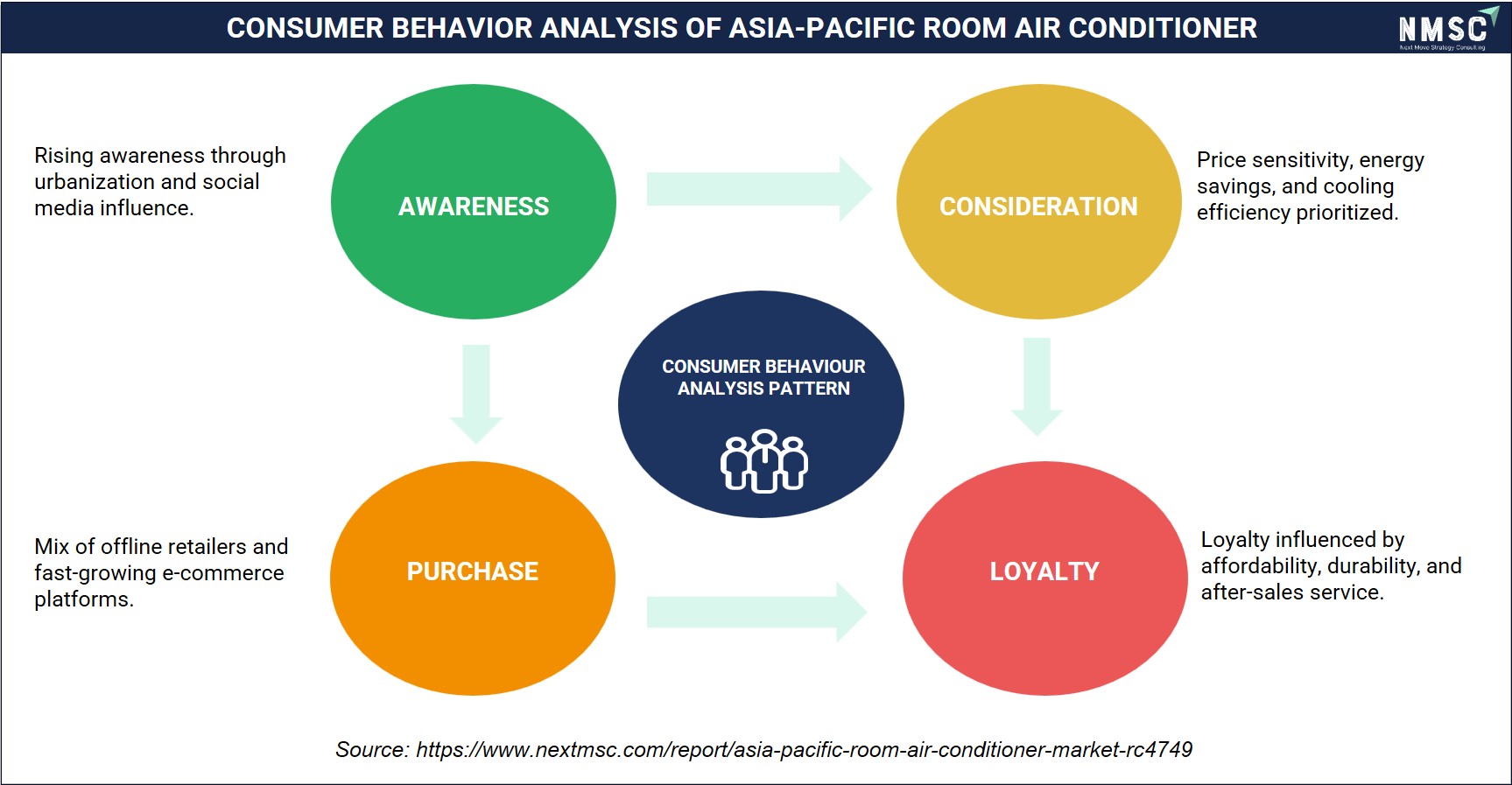
The infographic reflects strong market expertise by illustrating how urbanisation trends and social media engagement shape early consumer awareness. During the consideration stage, purchasing decisions are primarily influenced by price sensitivity, energy efficiency, and cooling performance, highlighting practical consumer priorities observed across the market. The purchase journey is supported by both offline retail networks and the rapid expansion of e-commerce platforms, strengthening accessibility across customer segments. Loyalty is reinforced through affordability, product durability, and dependable after-sales service, which remain central to long-term customer retention. This data-driven assessment provides stakeholders with a credible foundation for aligning marketing initiatives and product positioning with evolving consumer decision-making patterns.
Asia-Pacific Room Air Conditioner Market Key Segments
By Product Type
-
Window AC
-
Fixed Chassis
-
Through-the-Wall
-
-
Portable AC
-
Single Hose
-
Dual Hose
-
-
Single Split AC
-
Wall Mounted
-
Floor Standing
-
Ceiling Cassette
-
Ceiling Suspended
-
Ducted Single Zone
-
-
Multi Split AC
-
2 Indoor Units
-
3 Indoor Units
-
4+ Indoor Units
-
-
Packaged Room AC
-
Packaged Terminal AC
-
Vertical Packaged
-
Other Packaged
-
-
Other Room AC
By Speed Type
-
Fixed Speed
-
Inverter (Variable Speed)
By Cooling Capacity
-
≤ 1.0 Ton
-
>1.0 to ≤1.5 Ton
-
>1.5 to ≤2.0 Ton
-
>2.0 to ≤3.0 Ton
-
>3.0 Ton
By Efficiency Band
-
Entry
-
Standard
-
High
-
Premium
-
Unrated
By Refrigerant
-
R22
-
R410A
-
R32
-
Low-GWP HFO/HFC Blend
-
Hydrocarbon
-
Other refrigerant
By Function
-
Cooling Only
-
Heat Pump
-
Cooling with Electric Heat
-
Other Function
By Distribution Channel
-
Retail (Brick and Mortar)
-
Multi-Brand Store
-
Brand Exclusive Store
-
Hypermarkets
-
-
Dealer Network
-
HVAC Dealers
-
Distributor & Wholesaler
-
-
Online
-
Marketplace
-
Brand website
-
-
Project Sales
-
Real Estate Developer
-
Hospitality Chain
-
Institutional
-
-
OEM
By End-User
-
Residential
-
Commercial
-
Retail
-
Hospitality
-
Office
-
Healthcare
-
Education
-
Government/Public
-
Other Commercial
-
By Region
-
China
-
Japan
-
India
-
South Korea
-
Vietnam
-
Philippines
-
Malaysia
-
Australia
-
Indonesia
-
Taiwan
Key Benefits for Stakeholders:
Next Move Strategy Consulting (NMSC) presents a comprehensive analysis of the Asia-Pacific room air conditioner market trends, covering historical trends from 2020 through 2025 and offering detailed forecasts through 2035. Our study examines the market at regional and country levels, providing quantitative projections and insights into key growth drivers, challenges, and investment opportunities across all major room air conditioner segments.
From our analysis of the Asia-Pacific room air conditioner market, we found investors and customers benefit from a highly dynamic demand environment shaped by urban expansion, rising appliance penetration, and accelerating infrastructure development. Investors gain long-term value creation opportunities through expanding middle-class consumption, large-scale residential construction activity, and continuous product innovation across inverter and energy-efficient systems. Our assessment also indicates that manufacturing scale advantages and regional supply chain integration strengthen revenue continuity and operational competitiveness. Customers benefit from improved cooling accessibility, enhanced energy management, and broader availability of smart and compact air conditioning solutions suited to diverse climatic and housing conditions. Moreover, government efficiency initiatives and electrification policies reinforce product quality standards, consumer protection, and long-term market confidence across the region.
|
Parameters |
Details |
|
Customization Scope |
Free customization (equivalent to up to 80 analyst-working hours) after purchase. |
|
Pricing and Purchase Options |
Avail customized purchase options to meet your exact research needs. |
|
Approach |
In-depth primary and secondary research; proprietary databases; rigorous quality control and validation measures. |
|
Analytical Tools |
Porter's Five Forces, SWOT, value chain, and Harvey ball analysis to assess competitive intensity, stakeholder roles, and relative impact of key factors. |
About the Author
 Mayurima Roy
— Mayurima Roy is Research Analyst at Next Move Strategy Consulting, where she has spent 4 years working across the firm's full industry coverage rather than a single fixed vertical. Her work centers on structured research, ongoing trend tracking, competitive assessment, and insight-led content development, translating complex market data into clear, decision-ready narratives that support informed client decision-making across diverse global industries, market sectors, and world regions every day.
Mayurima Roy
— Mayurima Roy is Research Analyst at Next Move Strategy Consulting, where she has spent 4 years working across the firm's full industry coverage rather than a single fixed vertical. Her work centers on structured research, ongoing trend tracking, competitive assessment, and insight-led content development, translating complex market data into clear, decision-ready narratives that support informed client decision-making across diverse global industries, market sectors, and world regions every day.
About the Reviewer
 Supradip Baul
— Supradip Baul is an accomplished business consultant and strategist with over a decade of rich experience in market intelligence, strategy, technology, and business transformation. His work has included rigorous qualitative and quantitative analysis across multiple industries, helping clients shape investment decisions and long-term roadmaps. Earlier in his career, he was associated with Gartner, where he contributed to industry-leading reports and market share analyses. He has worked with leading global companies and holds an MBA with a dual specialization in Marketing and Finance.
Supradip Baul
— Supradip Baul is an accomplished business consultant and strategist with over a decade of rich experience in market intelligence, strategy, technology, and business transformation. His work has included rigorous qualitative and quantitative analysis across multiple industries, helping clients shape investment decisions and long-term roadmaps. Earlier in his career, he was associated with Gartner, where he contributed to industry-leading reports and market share analyses. He has worked with leading global companies and holds an MBA with a dual specialization in Marketing and Finance.
At Next Move Strategy Consulting, we understand that insightful market research is the cornerstone of successful business decisions. That's why we employ a robust and multifaceted approach, combining various methodologies to deliver the most accurate and actionable data for our clients.

Research Landscape
We navigate the world of research with two primary approaches:
Qualitative Approach
Our qualitative research methodologies involve immersive techniques such as in-depth interviews, focus groups, and observational studies. By engaging directly with individuals and stakeholders, we uncover valuable insights that quantitative data alone may overlook.

Quantitative Research
In tandem with qualitative methodologies, NMSC leverages the power of Quantitative Research to provide a robust foundation of numerical insights. Through systematic data collection and analysis, we quantify patterns, preferences, and market trends, offering a comprehensive view of the business landscape.
Our quantitative research approach employs diverse tools, including surveys, experiments, and statistical modelling. These methodologies enable us to gather data from a large and representative sample, ensuring the statistical significance of our findings. By employing structured questionnaires and standardized data collection methods, we guarantee the reliability and validity of the information we present to our clients.
Quantitative research is particularly effective in measuring the prevalence of trends, assessing market size, and gauging the impact of various factors on consumer behavior. The numerical precision attained through this approach equips our clients with actionable insights, facilitating data-driven decision-making and strategy formulation.


Our Specialized Toolbox for Industry-Specific Market Research
We deploy a specialized arsenal of techniques tailored to meet your unique requirements. Here's a glimpse into our comprehensive toolbox:

Information Procurement
The stage entails acquiring market data or relevant information through various sources and methodologies.


Market Research Approach
We utilize both top-down and bottom-up approaches in market research analysis to achieve a comprehensive understanding of the market dynamics, leveraging the broad perspective of industry trends and macroeconomic factors alongside detailed insights from specific segments and individual companies.

Porters Five Forces Analysis
We conduct Porter's Five Forces analysis to evaluate the competitive landscape of an industry, providing us with insights into factors that affect profitability and strategic positioning.

SWOT Analysis

Forecasting
We utilize a forecasting model to predict future consumption by considering parameters like population, economics, regulations, market competition, drivers, constraints, technology, and pricing. We also employ statistical techniques such as multilinear regression, exponential smoothing, moving average, ARIMA, and Monte Carlo simulations for accurate predictions. In econometric forecasting, we analyzed short-term and long-term event impacts, attributing values based on regulatory frameworks, economic factors, and market events.





 Speak to Our Analyst