Inside the RAC Market: Heatwaves Reshape Global Cooling
Introduction
In June 2026, as a record-breaking heatwave swept across Western Europe—claiming lives, shuttering schools, and triggering power cuts—a quieter commercial story unfolded in the background. Asian manufacturers of room air conditioners, including South Korea's Samsung Electronics, China's Midea, and Japan's Mitsubishi Electric, reported a sudden boom in demand as European households scrambled for relief. This convergence of climate stress and consumer urgency has placed the global landscape of room air conditioner manufacturers and inverter AC suppliers squarely at the center of an accelerating structural shift in residential cooling.
For B2B investors, system integrators, and C-level executives, the implications extend far beyond a single hot summer. The Room Air Conditioner (RAC) Market is transitioning from a seasonal, discretionary category into essential climate infrastructure. With rising temperatures redefining demand patterns and energy-efficiency regulations reshaping product portfolios, understanding the forces driving energy-efficient AC providers and residential cooling solution providers has become a strategic imperative. This guide synthesizes the latest globally impactful developments with proprietary NMSC market intelligence to map where value will be created next.
For More Information – Download FREE Sample on RAC Market Report
Heatwaves, Policy Shifts, and the New Cooling Economy
The most significant recent catalyst arrived in late June 2026, when Europe endured record-breaking temperatures that exposed a profound infrastructure gap. According to the International Energy Agency, total ownership of air conditioning units in Europe stands at only around 20%, leaving the majority of households unequipped for extreme heat. The market response was immediate. Samsung reported double-digit sales growth across Italy, Spain, and France in the first half of the year, while LG operated its South Korean production lines at full capacity since April.
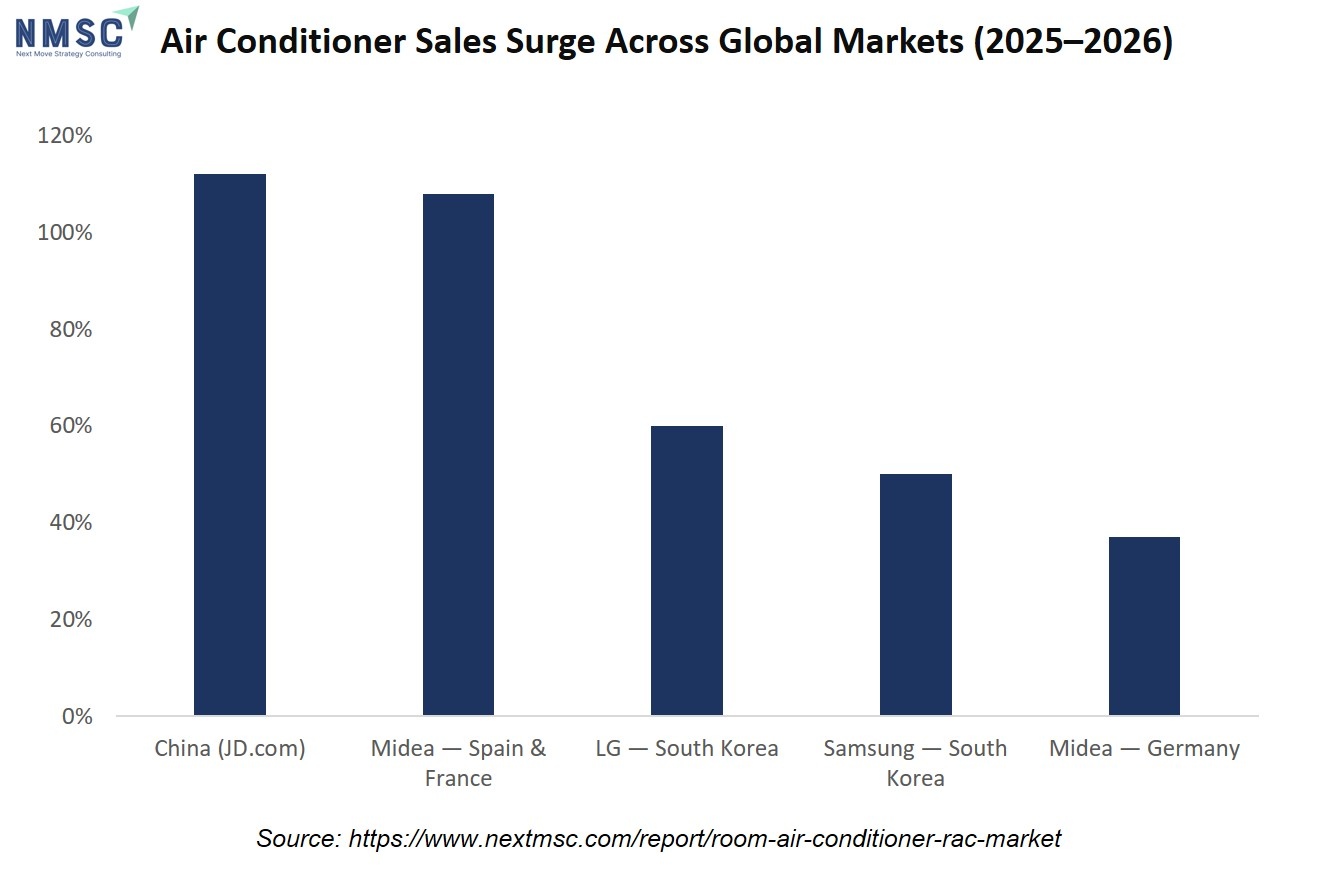
Midea's experience was particularly striking: demand for its PortaSplit air conditioner was so intense that second-hand prices exceeded those of new units. The company reported that sales through German e-commerce channels rose approximately 37% in May year-on-year, while shipments in Spain and France jumped 108% from a year earlier.
This European surge mirrors a broader Asian pattern observed in 2025. During China's record-breaking summer heat, sales of air conditioners surged 112% month-on-month, according to e-commerce giant JD.com. In South Korea, Samsung's domestic home AC sales grew by 50% in the first quarter of 2025 versus the prior year, while LG recorded 60% higher domestic sales over the same period—despite an estimated 98% of South Korean households already owning air conditioning.
Simultaneously, the regulatory environment is tightening. In January 2026, China released two national policy instruments to accelerate the transition to energy-efficient, climate-friendly residential air conditioners, including a consumer subsidy of 15% of the product sale price (capped at RMB 1,500 per unit) for purchasing the highest energy-efficiency level units.
NMSC Strategic Perspective on the Cooling Shift
NMSC's assessment indicates that the increasing frequency and intensity of heatwaves across key markets such as India, Southeast Asia, and Southern Europe is acting as a primary catalyst for RAC demand, transforming cooling from a discretionary purchase into essential infrastructure. Our analysis interprets the European 2026 episode not as an anomaly but as confirmation of a structural climate shift that compresses procurement cycles and strains supply chains. Manufacturers with localized production hubs and flexible inventory management are best positioned to capture this demand volatility, while those reliant on long, single-source supply chains face margin and fulfillment risk. For HVAC equipment distributors and residential cooling infrastructure providers, the strategic priority is building responsive, regionally diversified capacity ahead of increasingly unpredictable demand peaks.
Section Summary: Record heatwaves across Europe and Asia, combined with tightening efficiency regulations, are converting room air conditioners from seasonal goods into essential climate infrastructure, generating sharp, geographically dispersed demand spikes.
-
European AC penetration of only ~20% represents a substantial white-space opportunity for residential cooling solution providers.
-
Asian manufacturers (Samsung, LG, Midea, Mitsubishi Electric) are the primary beneficiaries of the 2026 European demand surge.
-
China's January 2026 efficiency subsidies are accelerating the shift toward premium, low-GWP, high-efficiency units.
-
Supply chain localization and inventory agility have become decisive competitive differentiators.
Industry Impact Analysis
The surge in cooling demand carries a critical second-order consequence: pressure on national power grids. During China's July 2025 heatwave, power demand topped 1.5 billion kilowatts—an all-time record and an increase of 55 million kilowatts over the previous year's maximum. In South Korea, the energy ministry warned that peak demand could reach a record 97.8 GW, with residential air conditioning accounting for 16% of annual power demand, up from 14% before the pandemic.
The structural trajectory is even more consequential. The International Energy Agency projects that global power demand for cooling systems is set to rise by around 1,200 terawatt hours by 2035, outstripping a projected 800 TWh increase in demand from data centres. The IEA further expects 50% of households globally to own air conditioners by 2035, up from 36% in 2022.
Over the longer horizon, the IEA's landmark "Future of Cooling" analysis warns that the global stock of air conditioners will grow to 5.6 billion by 2050, up from 1.6 billion, equivalent to 10 new units sold every second for the next three decades. Critically, the IEA notes that ACs sold in Japan and the European Union are typically 25% more efficient than those sold in the United States and China, underscoring the substantial efficiency dividend available through stronger minimum energy performance standards.
This grid-strain dynamic creates a powerful regulatory and commercial tailwind for inverter AC suppliers and energy-efficient AC providers. As governments confront peak-load constraints, the policy gravity shifts decisively toward high-efficiency, inverter-driven systems—precisely the segment where premium manufacturers command stronger margins.
Section Summary: Soaring cooling demand is straining power grids worldwide, prompting regulatory action that strongly favors energy-efficient and inverter-based systems, with cooling set to become the single largest driver of incremental building electricity demand.
-
Cooling demand is projected to add 1,200 TWh to global power needs by 2035, exceeding data centre growth.
-
Global AC household penetration is expected to rise from 36% (2022) to 50% (2035).
-
The 25% efficiency gap between EU/Japan and US/China units highlights a major upgrade opportunity.
-
Grid constraints are accelerating mandatory minimum energy performance standards across key markets.
Pros and Cons of Recent Market Developments
|
Pros |
Cons |
|
Structural, climate-driven demand converts RAC into essential infrastructure with recurring replacement cycles |
Surging electricity consumption strains national grids, risking outages and rationing during peak periods |
|
Regulatory subsidies (e.g., China's 15% efficiency rebate) accelerate premium, high-margin unit adoption |
High operating costs limit sustained usage among price-sensitive, lower-income households |
|
Large untapped European market (~20% penetration) offers significant growth runway |
Costly and complex installation in older European buildings (often exceeding €1,000) constrains uptake |
|
Smart, connected, and inverter technologies unlock service-led recurring revenue streams |
Supply chain volatility and demand unpredictability complicate inventory and capacity planning |
|
Low-GWP refrigerant transition aligns portfolios with tightening environmental mandates |
Refrigerant compliance and lifecycle management increase manufacturing complexity and cost |
Key Data & Statistics
Key Market Indicators: The Immediate Impact of Extreme Heat
|
Indicator |
Figure |
|
China AC sales surge (July 2025 heatwave, MoM) |
+112% |
|
Samsung South Korea home AC sales growth (Q1 2025, YoY) |
+50% |
|
LG South Korea domestic AC sales growth (Q1 2025, YoY) |
+60% |
|
Midea Germany e-commerce AC sales (May 2026, YoY) |
+37% |
|
Midea Spain & France shipments (2026, YoY) |
+108% |
|
European AC household ownership |
~20% |
|
China record peak power demand (July 2025) |
1.5 billion kW |
The Future of Global Cooling: Adoption and Energy Forecasts
|
Global Cooling Trajectory |
Value |
|
Global AC household penetration (2022) |
36% |
|
Global AC household penetration (2035 projected) |
50% |
|
Incremental cooling power demand by 2035 |
~1,200 TWh |
|
Global AC stock (today) |
1.6 billion units |
|
Global AC stock (2050 projected) |
5.6 billion units |
|
EU/Japan efficiency advantage vs. US/China units |
25% |
Future Outlook & Forecast
The market's forward trajectory reflects a durable, climate-anchored growth narrative. According to NMSC, the global RAC Market was valued at USD 80.62 billion in 2025 and is expected to reach USD 91.79 billion by the end of 2026. The industry is projected to grow to USD 146.11 billion by 2035, registering a CAGR of 5.3% between 2026 and 2035. In volume terms, the market is forecast to expand from 120 thousand units in 2026 to 211 thousand units by 2035, reflecting a robust volume CAGR of 6.42%.
Segment dynamics reinforce the premiumization thesis. NMSC's analysis indicates that inverter (variable speed) RACs lead the speed-type segment with a 75.7% share, while Single Split AC dominates by product type at 43%, and R32 leads refrigerant adoption at 34.2% due to its lower global warming potential and regulatory advantages. The residential end-user segment commands a 60.4% share, supported by urbanization and first-time adoption.
Geographically, Asia-Pacific dominates with a 54.5% global share, followed by Europe at 16.8% and North America at 14.2%, with India and Indonesia representing substantial low-penetration growth frontiers. Industry sentiment aligns with this optimism; as Mukundan Menon, Managing Director of Voltas Limited, observed, air conditioners "have now become more like a necessity than a luxury," with the industry expected to grow 15–20%.
Strategically, the next decade rewards players who combine inverter technology leadership, low-GWP refrigerant compliance, and AI-enabled smart connectivity. The shift toward subscription-based services, predictive maintenance, and IoT-driven energy optimization positions leading smart air conditioner manufacturers to monetize beyond hardware—an essential evolution as the RAC market matures into a service-enabled ecosystem.
Section Summary: The RAC market is positioned for steady value and volume growth through 2035, driven by climate necessity, premiumization toward inverter and smart systems, and the strategic monetization of energy-efficient, service-led offerings.
-
NMSC projects the RAC market to reach USD 146.11 billion by 2035 at a 5.3% CAGR.
-
Inverter systems (75.7% share) and R32 refrigerants (34.2%) define the efficiency-led product mix.
-
Asia-Pacific (54.5%) leads globally, while India and Indonesia offer high-growth, low-penetration upside.
-
Smart connectivity and service-based revenue models represent the next competitive frontier.
Next Steps for Stakeholders
For C-level executives and institutional investors seeking to capitalize on the RAC market's structural momentum, the following actions are recommended:
-
Prioritize efficiency-led portfolios: Allocate capital toward inverter-based, low-GWP, and high-SEER product lines that align with tightening regulations such as China's 2026 subsidy framework and the EU Eco-design standards.
-
Target underpenetrated geographies: Establish or strengthen distribution and RAC installation service provider networks in low-penetration, high-growth markets including Europe, India, and Indonesia.
-
Invest in supply chain resilience: Develop regionalized manufacturing hubs and agile inventory systems to absorb the increasingly unpredictable demand peaks driven by extreme heat events.
-
Monetize the service layer: Build recurring-revenue models around AI-driven energy optimization, predictive maintenance, and extended warranties to diversify beyond hardware margins.
-
Embed ESG credentials: Pursue low-GWP refrigerant adoption and lifecycle refrigerant management to satisfy regulatory mandates and ESG-aligned investment criteria.
Conclusion
The 2026 European heatwave was more than a weather event; it was a market signal. As cooling demand surges across continents and grids strain under peak loads, the Room Air Conditioner (RAC) Market has firmly transitioned from a discretionary appliance category into essential climate infrastructure. The convergence of climate necessity, regulatory acceleration toward energy efficiency, and technological premiumization is redrawing the competitive map for room air conditioner manufacturers, inverter AC suppliers, and energy-efficient AC providers alike.
For stakeholders, the path forward is clear: durable value will accrue to those who combine efficiency leadership, supply chain agility, and service-enabled innovation. With NMSC projecting the market to reach USD 146.11 billion by 2035, the RAC market stands as one of the most resilient, necessity-driven growth segments in the global consumer infrastructure landscape.
About the Author
 Sanyukta Deb
— Sanyukta Deb is Digital Marketing Team Lead at Next Move Strategy Consulting, where she has led content strategy and technical SEO for the firm's B2B market research publications for over 2 years. Her editorial process translates NextMSC's primary and secondary research — spanning technology, industrial, and consumer sectors — into commercial narratives, backed by search-intent, keyword, and competitive analysis. She brings 5 years of overall experience in digital marketing and content strategy.
Sanyukta Deb
— Sanyukta Deb is Digital Marketing Team Lead at Next Move Strategy Consulting, where she has led content strategy and technical SEO for the firm's B2B market research publications for over 2 years. Her editorial process translates NextMSC's primary and secondary research — spanning technology, industrial, and consumer sectors — into commercial narratives, backed by search-intent, keyword, and competitive analysis. She brings 5 years of overall experience in digital marketing and content strategy.
About the Reviewer
 Debashree Dey
— Debashree Dey is Assistant Manager at Next Move Strategy Consulting, where she supports cross-vertical market content and communications across diverse industries for 6 years. Her professional background includes senior content writing, communications, and published manuscript authorship, with experience developing audience-focused business narratives and maintaining clear, consistent messaging. Her role supports research-led content development and editorial quality across NextMSC publications.
Debashree Dey
— Debashree Dey is Assistant Manager at Next Move Strategy Consulting, where she supports cross-vertical market content and communications across diverse industries for 6 years. Her professional background includes senior content writing, communications, and published manuscript authorship, with experience developing audience-focused business narratives and maintaining clear, consistent messaging. Her role supports research-led content development and editorial quality across NextMSC publications.

















Add Comment