Automotive Radar Integrated Circuit Market Size, Share, Growth, and Forecast By Product Type (Radar Transceiver IC, Others), By Frequency Band (24 GHz, 76 GHz, 77 GHz), By Radar Range (Short, Medium, Long), By Vehicle Type (Passenger Vehicle, Light Commercial Vehicle), By Propulsion Type (Internal Combustion Engine Vehicle, Hybrid Electric Vehicle), By Automation Level, Semiconductor Technology (CMOS, RFCMOS, SiGe BiCMOS, FD-SOI), and By Sales Channel — Global Analysis 2025–2035
Industry: Automotive & Transportation | Publishing Date: July 6, 2026 | Last Updated: September 30, 2026 | No of Pages: N/A | No. of Tables: N/A | No. of Figures: N/A | Format: PDF | Report Code: AT4974
What Is the Automotive Radar Integrated Circuit Market Size?
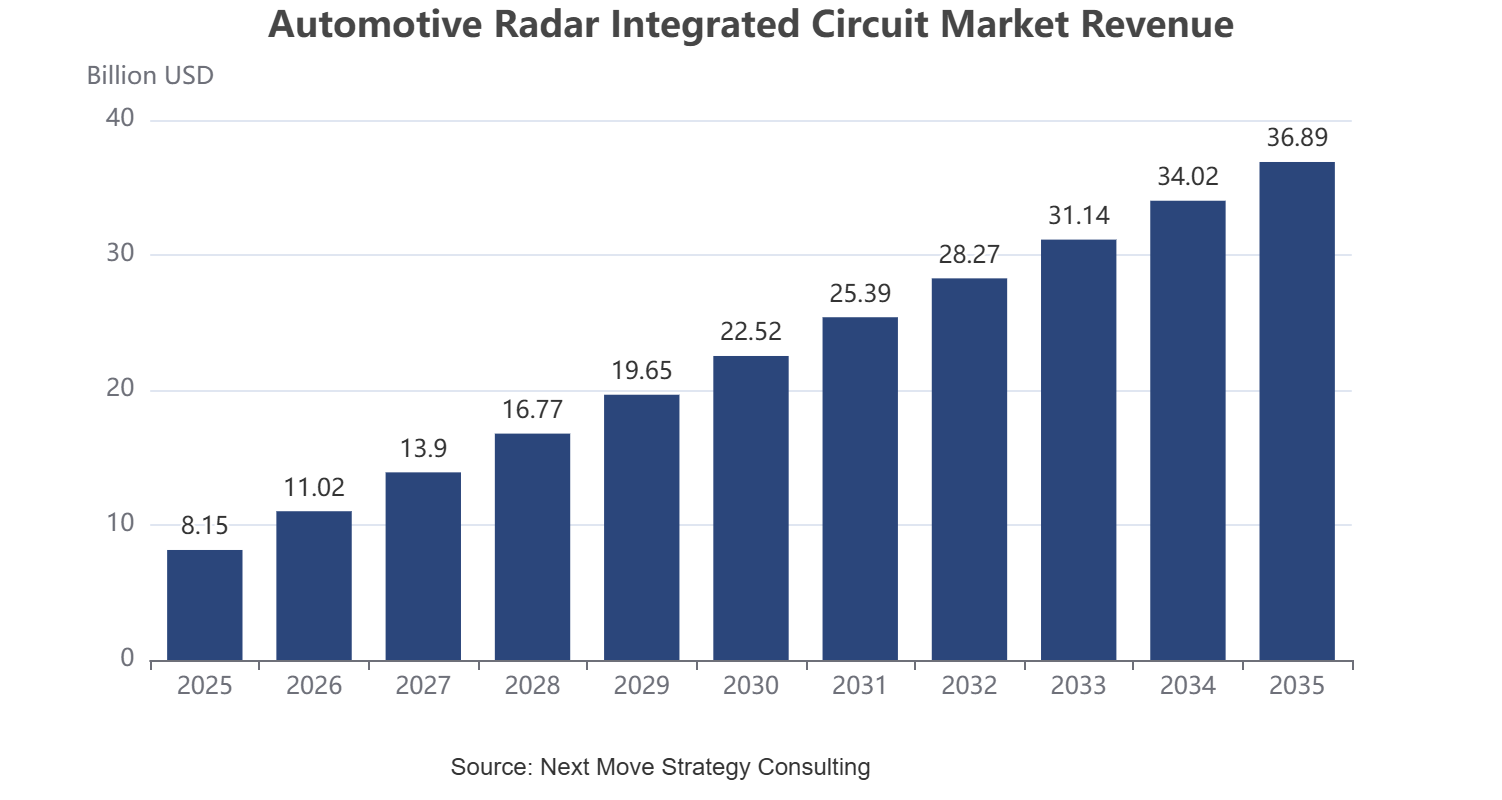
The global Automotive Radar Integrated Circuit Market was valued at USD 8.15 billion in 2025 and is estimated to reach USD 9.48 billion in 2026. Rising adoption of advanced driver assistance systems, mandatory automatic emergency braking regulations across North America and Europe, increasing radar sensor count per vehicle, and the transition toward 4D imaging radar architectures are projected to drive the market to USD 36.89 billion by 2035, expanding at a CAGR of 16.3% from 2026 to 2035. Additional momentum stems from rising battery electric vehicle production, expanding Level 2 automation penetration, and growing integration density across radar transceiver, processor, and system-on-chip architectures.
|
Parameters |
Details |
|
Market Size in 2025 |
USD 8.15 Billion |
|
Market Size in 2026 |
USD 9.48 Billion |
|
Revenue Forecast in 2035 |
USD 36.89 Billion |
|
Growth Rate |
CAGR of 16.3% from 2026 to 2035 |
|
Analysis Period |
2025–2035 |
|
Base Year Considered |
2025 |
|
Forecast Period |
2026–2035 |
|
Market Size Estimation |
USD Billion |
|
Companies Profiled |
20 |
|
Countries Covered |
33 |
|
Market Share |
Top 10 |
Automotive Radar Integrated Circuit Market Overview
What Is the Automotive Radar Integrated Circuit Market?
The Automotive Radar IC Market encompasses the global ecosystem of semiconductor chips that enable radar-based object detection, ranging, and velocity measurement in passenger and commercial vehicles. NMSC's analysis indicates that these integrated circuits, spanning transceivers, system-on-chip devices, processors, RF front ends, and companion power and interface chips, form the electronic core of advanced driver assistance functions, including adaptive cruise control, automatic emergency braking, blind spot detection, and parking assistance across the global vehicle fleet.
How Has the Automotive Radar Integrated Circuit Market Evolved?
The market has evolved through successive semiconductor generations, moving from discrete SiGe BiCMOS components toward integrated RFCMOS and CMOS single-chip transceivers. Based on research conducted by NMSC, we found that this transition has compressed module size and cost while increasing channel count, enabling the shift from single-function long-range radar toward multi-function and 4D imaging radar systems capable of elevation resolution, a capability increasingly demanded by Level 2 and Level 3 automation programmes across global OEM platforms.
How Do Regulations Influence the Automotive Radar Integrated Circuit Market?
Vehicle safety regulation is a primary structural force in the market. The U.S. National Highway Traffic Safety Administration finalised a rule in 2024 mandating automatic emergency braking, including pedestrian detection, on all new light vehicles by September 2029. The European Union's General Safety Regulation similarly mandates advanced driver assistance systems on all new vehicle registrations. UNECE Regulation No. 152 further standardises AEB system performance requirements, collectively anchoring sustained radar IC demand across regulated markets.
How Is Technology Adoption Expanding Across the Automotive Radar Integrated Circuit Market?
Technology adoption across the market is accelerating as OEMs integrate higher radar sensor counts per vehicle and migrate toward centralised sensor fusion architectures. Our findings suggest that AI accelerator-equipped radar system-on-chip devices are gaining traction as automakers seek on-chip object classification to reduce central compute load. Adoption of 79 GHz high-resolution radar and in-cabin sensing radar for occupant detection is expanding fastest among premium and electric vehicle platforms globally.
|
Key Takeaways |
|
Radar Transceiver IC held the largest share of the market at USD 3.10 billion in 2025, reflecting its foundational role across single chip, cascadable, and multi-channel radar architectures deployed in nearly every ADAS-equipped vehicle produced globally. |
|
Radar System on Chip is the fastest-growing product type at a CAGR of 23.5% from 2026 to 2035, driven by rising integration of AI accelerators and MCU-paired SoC architectures that reduce sensor fusion latency for Level 2 and Level 3 platforms. |
|
The 77 GHz frequency band led the market at USD 4.24 billion in 2025, supported by its global regulatory harmonisation and its established role as the workhorse band for short, medium, and long range automotive radar. |
|
The 79 GHz frequency band is the fastest-growing band at a CAGR of 27.1% from 2026 to 2035, propelled by its wider bandwidth allocation that enables higher-resolution 4D imaging radar required for advanced object classification. |
|
Long-range radar led the market at USD 3.10 billion in 2025 and is also the fastest-growing range category at a CAGR of 17.6%, driven by expanding highway-speed adaptive cruise control and automatic emergency braking deployment. |
|
Passenger vehicles dominated the Automotive Radar Integrated Circuit Market at USD 5.87 billion in 2025, anchored by mass-market ADAS feature penetration across hatchbacks, sedans, sport utility vehicles, and luxury vehicle platforms worldwide. |
|
Heavy Commercial Vehicle is the fastest-growing vehicle type at a CAGR of 18.3% from 2026 to 2035, as regulatory mandates extend automatic emergency braking requirements to trucks and buses across North America and the European Union. |
|
Internal Combustion Engine vehicles represented the largest propulsion category in 2025 at USD 4.73 billion, reflecting their continued majority share of global vehicle production despite the accelerating electrification transition. |
|
Battery Electric Vehicle is the fastest-growing propulsion segment at a CAGR of 26.0% from 2026 to 2035, and is on track to become the largest propulsion category by 2035 as radar content per vehicle rises alongside electrification. |
|
Level 2 automation accounted for the largest share of the market at USD 3.90 billion in 2025, reflecting its position as the most widely commercialised ADAS tier across global passenger vehicle platforms. |
|
Level 4 automation is the fastest-growing tier at a CAGR of 32.4% from 2026 to 2035, driven by expanding robotaxi and limited-access automated driving pilot programmes, albeit from a comparatively small 2025 revenue base. |
|
RFCMOS led semiconductor technology adoption at USD 3.10 billion in 2025, reflecting its balance of RF performance and cost efficiency that has made it the preferred process technology for mainstream automotive radar transceivers. |
|
FD-SOI is the fastest-growing semiconductor technology at a CAGR of 22.2% from 2026 to 2035, as radar IC vendors adopt the process for its low power consumption and superior integration density in next-generation radar SoCs. |
|
Direct Sales to Tier 1 Suppliers represented the dominant sales channel at USD 6.36 billion in 2025, consistent with the Tier 1-centric automotive supply chain model in which module integrators source radar ICs directly from semiconductor vendors. |
|
Direct Sales to OEMs is the fastest-growing sales channel at a CAGR of 20.3% from 2026 to 2035, as vertically integrated automakers increasingly engage radar IC vendors directly to control sensor fusion software and hardware roadmaps. |
|
Asia-Pacific held the largest regional share of the Automotive Radar Integrated Circuit Market at USD 3.59 billion in 2025, driven by China's vehicle production scale and rapid domestic ADAS feature penetration across passenger vehicle platforms. |
|
Latin America is the fastest-growing region at a CAGR of 23.1% from 2026 to 2035, supported by rising vehicle safety regulation adoption and expanding domestic vehicle production in Brazil and neighbouring Mercosur markets, albeit from a smaller revenue base. |
|
China is the largest single-country market within the Automotive Radar Integrated Circuit Market, anchored by its position as the world's largest vehicle production base and the rapid scale-up of domestic radar IC suppliers serving its electric vehicle sector. |
|
India is the fastest-growing national market, supported by the Bharat New Car Assessment Programme's safety rating influence, rising passenger vehicle production, and an expanding domestic semiconductor policy framework that is improving local radar IC supply access. |
Key Emerging Trends in the Automotive Radar Integrated Circuit Market
How Is 4D Imaging Radar Technology Transforming the Automotive Radar Integrated Circuit Market?
4D imaging radar, which adds elevation resolution to traditional range, azimuth, and velocity measurement, is transforming sensor fusion architecture across the market. Through our market assessment, we observed that this transformation requires multi-channel transceiver ICs with higher antenna counts and increased processing throughput. Arbe Robotics and Uhnder have advanced commercial-stage 4D imaging radar chipsets, while established suppliers, including NXP and Infineon, are extending their transceiver families to support similar high-resolution configurations for Level 2 and Level 3 platforms.
How Is CMOS Integration Reshaping Radar Chip Architecture in the Automotive Radar Integrated Circuit Market?
The shift from SiGe BiCMOS toward RFCMOS and standard CMOS process nodes is reshaping radar chip architecture across the market. From our research, we found that CMOS-based single-chip transceivers integrate RF front end, digital signal processing, and interface functions onto one die, reducing module footprint and bill-of-materials cost. Texas Instruments and Calterah Semiconductor have advanced single-chip CMOS radar transceivers, enabling broader ADAS feature penetration into mass-market and entry-level vehicle segments previously excluded by cost constraints.
How Is AI-Enabled Radar Processing Redefining Sensor Fusion in the Automotive Radar Integrated Circuit Market?
The integration of AI accelerators directly into radar system-on-chip devices is redefining sensor fusion economics within the market. NMSC's analysis indicates that on-chip object classification reduces the data volume transmitted to central domain controllers, lowering system-level compute and power requirements. Renesas Electronics, following its acquisition of radar IC specialist Steradian Semiconductors, and Ambarella, through its CV-series automotive SoC family, are advancing AI-native radar processing architectures aimed at Level 2 and Level 3 deployment.
How Is Rising Radar Sensor Density per Vehicle Driving Demand in the Automotive Radar Integrated Circuit Market?
Increasing radar sensor count per vehicle, extending beyond a single front-facing long-range radar to include corner and side short-range radar units, is a defining demand driver in the market. Based on our market evaluation, we noticed that premium and electric vehicle platforms increasingly deploy four to six radar units per vehicle to support blind spot detection, cross-traffic alert, and door-opening collision warning, multiplying radar IC content value per vehicle well beyond earlier single-radar configurations.
What Are the Key Market Drivers, Breakthroughs, and Investment Opportunities That Will Shape the Automotive Radar Integrated Circuit Market Industry in the Next Decade?
|
Drivers / Trends / Restraints |
(+/-) % Impact on CAGR Forecast |
Geographic Relevance |
Impact Timeline |
|
Mandatory AEB and Active Safety Regulations |
+2.3% |
North America, Europe |
2025–2030 |
|
Expanding Level 2 ADAS Penetration in Mass-Market Vehicles |
+2.0% |
Global |
2025–2035 |
|
Transition to 4D Imaging and High-Resolution Radar |
+1.6% |
North America, Europe, Asia-Pacific |
2026–2032 |
|
Rising Radar Sensor Count per Vehicle |
+1.4% |
Global |
2025–2035 |
|
China Domestic Radar IC Ecosystem Expansion |
+1.2% |
Asia-Pacific |
2025–2032 |
|
In-Cabin Radar Sensing for Occupant Safety |
+0.9% |
North America, Europe |
2026–2031 |
|
High Cost of Multi-Channel and 4D Radar Chip Integration |
-0.8% |
Global |
2025–2029 |
|
Frequency Allocation Disparities Across Regions |
-0.6% |
Asia-Pacific, MEA, LATAM |
Ongoing |
|
Automotive Semiconductor Supply Chain Volatility |
-0.5% |
Global |
Ongoing |
What Are the Growth Drivers of the Automotive Radar Integrated Circuit Market?
How Are Global AEB Mandates Driving Demand in the Automotive Radar Integrated Circuit Market?
Regulatory mandates for automatic emergency braking represent the most powerful structural driver of the market. The U.S. National Highway Traffic Safety Administration's final rule, published in 2024, requires all new light vehicles to include AEB with pedestrian detection by September 2029. NMSC's analysis indicates that the European Union's General Safety Regulation, which mandates advanced driver assistance systems on all new vehicle registrations, and UNECE Regulation No. 152 collectively extend this requirement across the world's largest automotive markets, anchoring sustained radar IC procurement.
How Is Expanding Level 2 ADAS Adoption Fueling Growth in the Automotive Radar Integrated Circuit Market?
Rising Level 2 automation penetration across mainstream vehicle trims is a sustained growth driver for the market. Combined adaptive cruise control and lane keeping functions, which require front and often corner radar coverage, have moved from premium-only options to standard equipment across multiple vehicle classes. Through NMSC's assessment, we found that this democratisation is increasing radar IC unit volume per vehicle programme even as average selling price per chip declines through CMOS integration.
How Is ADAS Feature Democratization Across Mass-Market Vehicles Expanding the Automotive Radar Integrated Circuit Market?
The extension of radar-based safety features from premium and luxury vehicle segments into mass-market and entry-level trims is expanding the addressable base of the market. Based on NMSC's research, we found that single-chip CMOS radar transceivers have reduced module bill-of-materials cost sufficiently for automakers to standardise blind spot detection and rear cross-traffic alert across compact and economy vehicle segments, a shift that is broadening radar IC volume demand beyond the historically concentrated premium vehicle base.
What Are the Growth Inhibitors of the Automotive Radar Integrated Circuit Market?
How Does High Radar Chip Integration Cost Restrain Adoption in the Automotive Radar Integrated Circuit Market?
The comparatively high cost of multi-channel and 4D imaging radar chipsets restrains faster adoption across price-sensitive vehicle segments within the market. Multi-channel cascaded transceiver architectures require additional antenna elements, calibration complexity, and processing throughput relative to single-channel designs. Our assessment indicates that this cost differential continues to concentrate 4D imaging radar deployment within premium and electric vehicle platforms, slowing its penetration into entry-level and light commercial vehicle segments where automakers remain highly cost-constrained.
How Do Frequency Allocation Disparities Across Regions Restrain the Automotive Radar Integrated Circuit Market?
Inconsistent frequency band allocation across regulatory jurisdictions creates design fragmentation that restrains the market. While the U.S. Federal Communications Commission and the European Telecommunications Standards Institute have harmonised much of the 76 to 81 GHz band for automotive radar, certain emerging markets retain legacy 24 GHz allocations or apply differing power and bandwidth limits. From our assessment, we observed that this requires radar IC vendors to qualify multiple band-specific variants, increasing development cost and slowing global platform standardisation.
What Are the Growth Opportunities in the Automotive Radar Integrated Circuit Market?
How Does In-Cabin Radar Sensing Create New Opportunities in the Automotive Radar Integrated Circuit Market?
In-cabin radar sensing for child presence detection and occupant monitoring represents a meaningful incremental opportunity within the mader advanced safety system framework, while Euro NCAP's safety assessment protocols are increasingly incorporating child presence detection criteria. Vayyar Imaging has developed radar-on-chip technology specifically for in-cabin sensing applications, illustrating how this adjacent use case is extending radar IC demand beyond traditional exterior object detection.
How Does the Shift Toward Centralized Vehicle Compute Architecture Create Opportunity in the Automotive Radar Integrated Circuit Market?
The automotive industry's transition from distributed electronic control units toward centralised zonal and domain controller architectures is creating new design opportunities within the market. NMSC's analysis indicates that this shift favours radar front-end ICs that transmit raw or lightly processed signal data to a central compute module, reducing redundant processing hardware at each sensor node. Radar IC vendors that offer flexible architectures spanning both edge-processed and centralised configurations are positioned to serve OEM platforms across this architectural transition.
How Does Domestic Semiconductor Localization in Emerging Markets Create Opportunity in the Automotive Radar Integrated Circuit Market?
Domestic semiconductor localisation policies in China and India are creating structural opportunities within the market. China's domestic radar IC supplier Calterah Semiconductor has scaled production to serve the country's expanding electric vehicle sector, while India's Semiconductor Mission is extending incentives toward automotive-grade chip design and packaging capability. Our findings suggest that radar IC vendors pursuing local manufacturing partnerships or joint development agreements in these markets can secure long-term volume commitments tied to domestic vehicle production growth.
Porter’s Analysis of the Automotive Radar Integrated Circuit Market
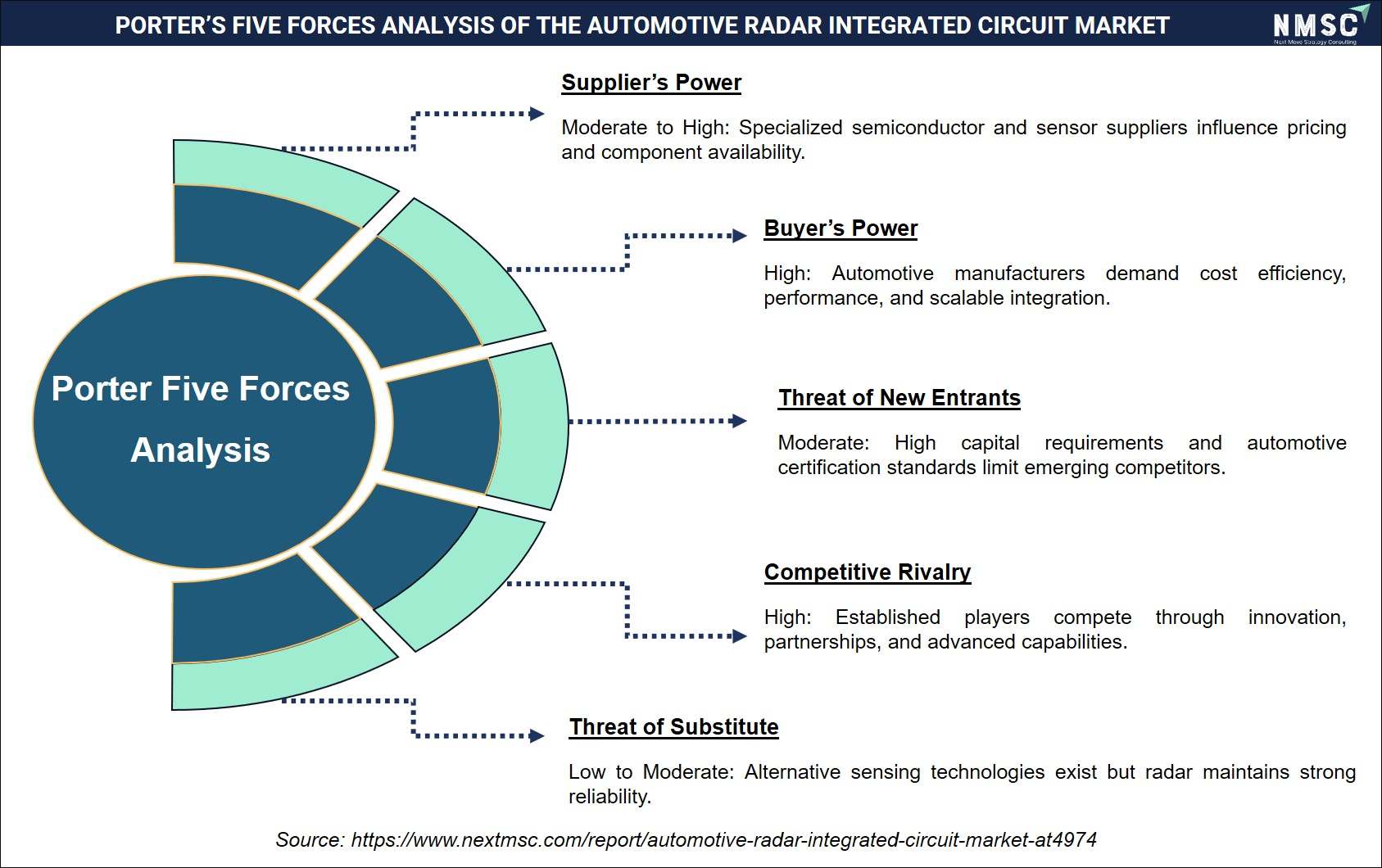
The above infographic presents a Porter's Five Forces analysis of the automotive radar integrated market. We analysed that supplier power is moderate to high due to specialized semiconductor and sensor suppliers influencing pricing, while buyer power remains high as automotive manufacturers demand cost efficiency and scalable integration. The threat of new entrants is moderate, given high capital requirements and compatibility standards, though competitive rivalry is intense among established players competing through innovation and partnerships. Looking ahead, we observed that the threat of substitutes remains low to moderate, as radar maintains strong reliability over alternative sensing technologies.
How Is the Automotive Radar Integrated Circuit Market Segmented in This Report, and What Are the Key Insights from the Segmentation Analysis?
Which Radar Integrated Circuit Category Commands the Highest Revenue Share in the Automotive Radar Integrated Circuit Market?
|
Product Type |
2025 (USD Bn) |
2035 (USD Bn) |
CAGR (%) |
|
Radar Transceiver IC |
3.10 |
11.80 |
14.1% |
|
Radar System on Chip |
1.14 |
8.85 |
23.5% |
|
Radar Processor IC |
1.30 |
5.53 |
15.5% |
|
Radar Front End IC |
1.63 |
6.64 |
14.9% |
|
Radar Companion IC |
0.98 |
4.07 |
15.2% |
Through our market assessment, we observed that the market is segmented by product type into Radar Transceiver IC, Radar System on Chip, Radar Processor IC, Radar Front End IC, and Radar Companion IC categories. Radar Transceiver IC, spanning single chip, cascadable, and multi-channel configurations, is the dominant category at USD 3.10 billion in 2025. Radar System on Chip, which integrates MCU, DSP, and increasingly AI accelerator cores, is the fastest-growing category at a CAGR of 23.5%, while Radar Front End IC components, including power amplifiers and frequency synthesizers maintain steady demand across all radar architectures.
Which Frequency Band Supports the Largest Share of Radar IC Deployment in the Automotive Radar Integrated Circuit Market?
|
Frequency Band |
2025 (USD Bn) |
2035 (USD Bn) |
CAGR (%) |
|
24 GHz |
1.47 |
2.95 |
6.2% |
|
76 GHz |
0.65 |
2.21 |
12.7% |
|
77 GHz |
4.24 |
16.60 |
14.4% |
|
79 GHz |
1.39 |
14.02 |
27.1% |
|
Other Frequency Bands |
0.40 |
1.11 |
10.1% |
NMSC's analysis indicates that the market is segmented by frequency band into 24 GHz, 76 GHz, 77 GHz, 79 GHz, and Other Frequency Bands. The 77 GHz band is the dominant frequency at USD 4.24 billion in 2025, reflecting its globally harmonised regulatory status and established role across short, medium, and long-range radar. The 79 GHz band is the fastest-growing frequency at a CAGR of 27.1%, driven by its wider bandwidth supporting 4D imaging radar resolution, while legacy 24 GHz allocation is gradually declining in relative share as regulatory transitions favour higher-frequency systems.
Which Radar Range Category Generates the Highest Demand in the Automotive Radar Integrated Circuit Market?
|
Radar Range |
2025 (USD Bn) |
2035 (USD Bn) |
CAGR (%) |
|
Short Range Radar |
2.77 |
11.80 |
15.5% |
|
Medium Range Radar |
2.28 |
9.59 |
15.3% |
|
Long Range Radar |
3.10 |
15.50 |
17.6% |
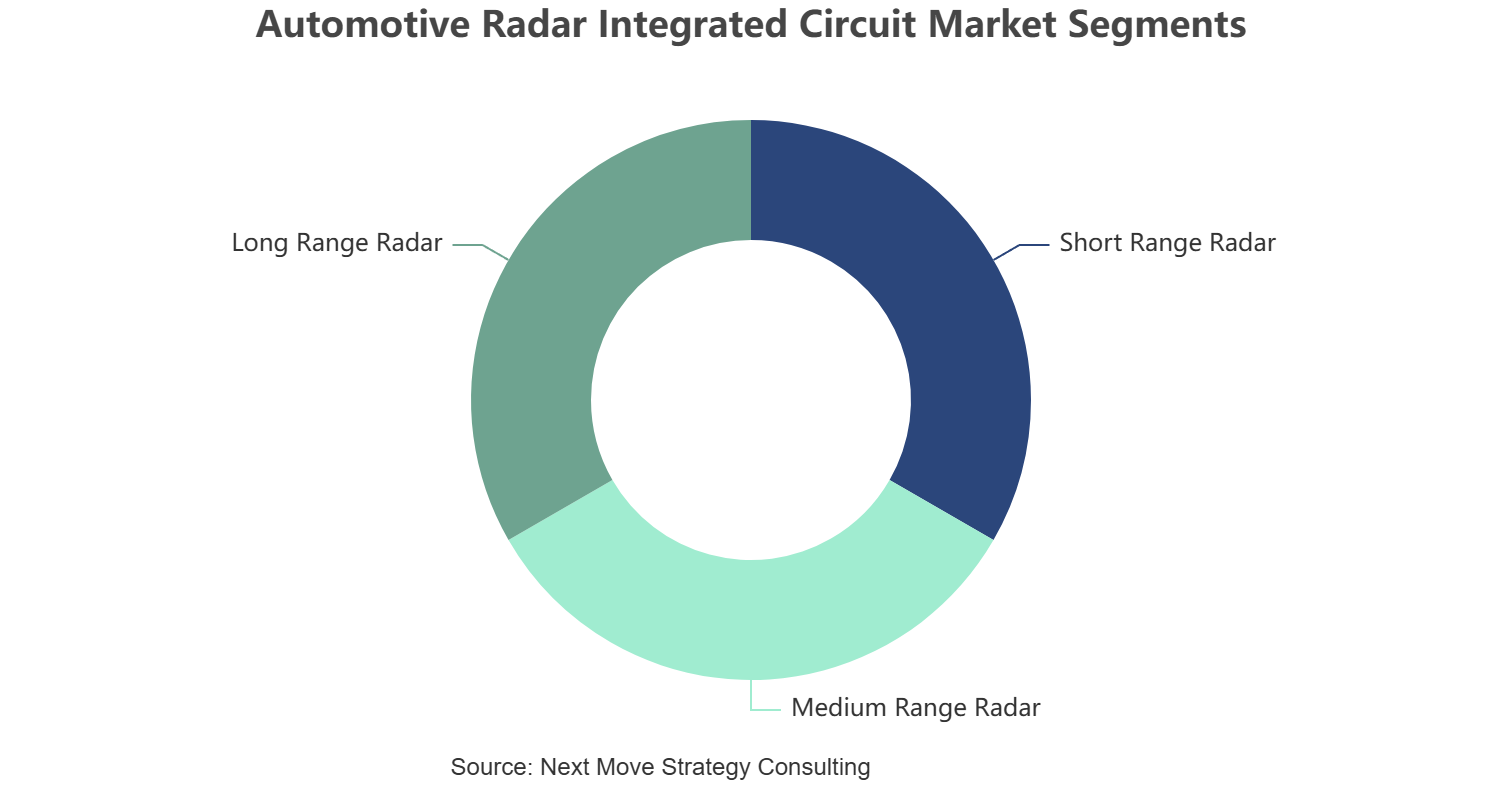
Our findings suggest that the market is segmented by radar range into Short Range Radar, Medium Range Radar, and Long Range Radar categories. Long Range Radar is both the dominant and fastest-growing category, reaching USD 3.10 billion in 2025 and advancing at a CAGR of 17.6%, supported by expanding highway-speed adaptive cruise control and forward collision mitigation deployment. Short Range Radar maintains a substantial base through corner-mounted blind spot and cross-traffic detection applications, while Medium Range Radar serves intermediate functions including lane change assistance across global vehicle platforms.
Which Vehicle Category Drives the Highest Radar IC Consumption in the Automotive Radar Integrated Circuit Market?
|
Vehicle Type |
2025 (USD Bn) |
2035 (USD Bn) |
CAGR (%) |
|
Passenger Vehicle |
5.87 |
25.09 |
15.6% |
|
Light Commercial Vehicle |
1.14 |
5.90 |
18.0% |
|
Medium Commercial Vehicle |
0.49 |
2.58 |
18.3% |
|
Heavy Commercial Vehicle |
0.49 |
2.58 |
18.3% |
|
Bus and Coach |
0.16 |
0.74 |
16.6% |
Based on our analysis of global vehicle production trends, the market is segmented by vehicle type into Passenger Vehicle, encompassing hatchback, sedan, sport utility vehicle, multi-purpose vehicle, and luxury vehicle body styles, alongside Light, Medium, and Heavy Commercial Vehicle and Bus and Coach categories. Passenger Vehicle dominates at USD 5.87 billion in 2025, led by sport utility vehicle and luxury body styles, where ADAS attach rates are highest. Heavy Commercial Vehicle is the fastest-growing category at a CAGR of 18.3%, driven by extending AEB mandates into the truck and bus segment.
How Is Vehicle Electrification Reshaping Demand Across the Automotive Radar Integrated Circuit Market?
|
Propulsion Type |
2025 (USD Bn) |
2035 (USD Bn) |
CAGR (%) |
|
Internal Combustion Engine Vehicle |
4.73 |
12.54 |
9.6% |
|
Hybrid Electric Vehicle |
1.47 |
6.64 |
16.3% |
|
Battery Electric Vehicle |
1.79 |
16.60 |
26.0% |
|
Fuel Cell Electric Vehicle |
0.16 |
1.11 |
22.0% |
From our assessment of global propulsion trends, the market is segmented by propulsion type into Internal Combustion Engine Vehicle, Hybrid Electric Vehicle, Battery Electric Vehicle, and Fuel Cell Electric Vehicle categories. Internal Combustion Engine vehicles remain the largest category in 2025 at USD 4.73 billion, reflecting their continued production majority. Battery Electric Vehicle is the fastest-growing propulsion segment at a CAGR of 26.0% and is positioned to become the largest category by 2035, as electric vehicle platforms increasingly position radar-based ADAS suites as a premium differentiator.
Which SAE Automation Level Generates the Highest Radar IC Revenue in the Automotive Radar Integrated Circuit Market?
|
Automation Level |
2025 (USD Bn) |
2035 (USD Bn) |
CAGR (%) |
|
Level 0 |
0.80 |
0.90 |
-0.4% |
|
Level 1 |
1.80 |
3.00 |
4.1% |
|
Level 2 |
3.90 |
13.50 |
12.9% |
|
Level 3 |
1.15 |
11.50 |
27.0% |
|
Level 4 |
0.40 |
5.80 |
32.4% |
|
Level 5 |
0.10 |
2.19 |
38.6% |
Through NMSC's assessment, we found that the market is segmented by SAE J3016 automation level from Level 0 through Level 5. Level 2 is the dominant tier at USD 3.90 billion in 2025, reflecting its position as the most widely commercialised ADAS configuration globally. Level 3, exemplified by conditional automation systems now factory-available on select premium platforms, and Level 4, represented by limited-access robotaxi and automated shuttle deployments, are the fastest-growing tiers, while Level 5 commercial deployment remains nascent and largely confined to controlled testing programmes rather than mass-production vehicles.
Which Semiconductor Process Technology Leads Radar IC Production in the Automotive Radar Integrated Circuit Market?
|
Semiconductor Technology |
2025 (USD Bn) |
2035 (USD Bn) |
CAGR (%) |
|
CMOS |
1.79 |
6.64 |
13.7% |
|
RFCMOS |
3.10 |
17.71 |
19.3% |
|
SiGe BiCMOS |
1.96 |
5.16 |
9.7% |
|
FD-SOI |
0.73 |
5.16 |
22.2% |
|
GaAs |
0.33 |
0.74 |
7.6% |
|
GaN |
0.16 |
1.11 |
22.0% |
|
Other Semiconductor Technologies |
0.08 |
0.37 |
16.6% |
Based on our market evaluation, we noticed that the market is segmented by semiconductor technology into CMOS, RFCMOS, SiGe BiCMOS, FD-SOI, GaAs, GaN, and Other Semiconductor Technologies. RFCMOS is the dominant process technology at USD 3.10 billion in 2025, balancing RF performance with cost-efficient high-volume manufacturing. FD-SOI is the fastest-growing technology at a CAGR of 22.2%, valued for its power efficiency and integration density, while SiGe BiCMOS retains relevance in legacy and high-linearity front-end applications across the installed radar base.
How Do Distribution Pathways Differ Across the Automotive Radar Integrated Circuit Market?
|
Sales Channel |
2025 (USD Bn) |
2035 (USD Bn) |
CAGR (%) |
|
Direct Sales to Tier 1 Suppliers |
6.36 |
27.30 |
15.6% |
|
Direct Sales to OEMs |
1.14 |
7.01 |
20.3% |
|
Authorized Distributors |
0.65 |
2.58 |
14.6% |
According to our evaluation of global automotive supply chain structures, the market is segmented by sales channel into Direct Sales to Tier 1 Suppliers, Direct Sales to OEMs, and Authorized Distributors. Direct Sales to Tier 1 Suppliers dominate at USD 6.36 billion in 2025, consistent with the module integration model in which Tier 1 companies purchase radar ICs and assemble complete sensor units. Direct Sales to OEMs is the fastest-growing channel at a CAGR of 20.3%, as vertically integrated automakers increasingly engage radar IC vendors directly for custom sensor fusion platforms.
Regional Outlook
Geographic Performance Snapshot
|
Region |
2025 (USD Bn) |
2035 (USD Bn) |
CAGR (%) |
Key Driver |
|
North America |
1.87 |
5.53 |
11.1% |
NHTSA AEB mandate, Tier 1 design wins |
|
Europe |
1.79 |
5.16 |
10.6% |
EU General Safety Regulation, OEM ADAS rollout |
|
Asia-Pacific |
3.59 |
19.56 |
18.7% |
China EV/ADAS boom, domestic radar IC scale-up |
|
Middle East & Africa |
0.41 |
2.95 |
22.4% |
Vision 2030 vehicle safety modernisation |
|
Latin America |
0.49 |
3.69 |
23.1% |
Brazil production growth, expanding safety regulation |
North America Automotive Radar IC Market
North America generated USD 1.87 billion in 2025 within the Automotive Radar Integrated Circuit Market and is forecast to reach USD 5.53 billion by 2035 at a CAGR of 11.1%. The region's growth is anchored by the NHTSA's 2024 AEB final rule, which requires pedestrian-detecting automatic emergency braking on all new light vehicles by September 2029. Established Tier 1 suppliers and semiconductor vendors, including Texas Instruments, Analog Devices, and onsemi maintain deep design-win relationships with North American OEMs, supporting sustained radar IC procurement across both passenger and commercial vehicle programmes.
United States Automotive Radar IC Market
Based on our engagements with Tier 1 suppliers and OEM programme teams, the United States represents the largest single contributor to the North American market, anchored by the NHTSA's AEB final rule and sustained ADAS feature rollout across General Motors, Ford, and Tesla platforms. Texas Instruments, Analog Devices, and onsemi maintain deep domestic radar IC design and qualification capability, while NHTSA's New Car Assessment Program continues to incentivise voluntary ADAS feature adoption ahead of the 2029 mandatory compliance deadline.
Canada Automotive Radar IC Market
Through our analysis, Canada's Automotive Radar Integrated Circuit Market is shaped by Transport Canada's Motor Vehicle Safety Standards, which are closely aligned with U.S. NHTSA requirements, supporting consistent radar-equipped ADAS feature rollout across the shared North American vehicle platform base. Canada's domestic vehicle assembly operations, concentrated in Ontario, integrate radar ICs sourced through the broader North American Tier 1 supply chain. Rising consumer demand for safety-rated vehicles continues to support steady radar IC volume growth across Canadian-assembled vehicle programmes.
Mexico Automotive Radar IC Market
From our assessment, Mexico functions primarily as a vehicle assembly and export hub within the market, hosting major OEM manufacturing plants operated by General Motors, Ford, Nissan, and Volkswagen Group brands. Radar IC content embedded in Mexican-assembled vehicles is largely determined by destination-market regulatory requirements under the USMCA trade framework, with vehicles exported to the United States incorporating NHTSA-aligned ADAS specifications. Mexico's growing assembly capacity supports rising radar IC throughput volume even though demand specification originates largely outside the country.
Europe Automotive Radar IC Market
Europe contributed USD 1.79 billion to the Automotive Radar Integrated Circuit Market in 2025 and is projected to reach USD 5.16 billion by 2035 at a CAGR of 10.6%. The European Union's General Safety Regulation mandates advanced driver assistance systems on all new vehicle registrations, anchoring sustained demand across the region's dense OEM and Tier 1 manufacturing base. NXP Semiconductors, headquartered in the Netherlands, and STMicroelectronics maintain substantial European radar IC design and production capability supporting both domestic and export-oriented vehicle programmes.
United Kingdom Automotive Radar IC Market
Based on our engagements, the United Kingdom maintains an established market position, supported by domestic OEM operations including Jaguar Land Rover, and continued regulatory alignment with UNECE vehicle safety regulations following its departure from the European Union. The UK's Driver and Vehicle Standards Agency enforces type-approval requirements consistent with international AEB performance standards. Rising consumer demand for Euro NCAP-rated safety features continues to support radar-equipped ADAS feature penetration across UK-registered new vehicles.
Germany Automotive Radar IC Market
Through our analysis, Germany is the largest European contributor to the market, anchored by its position as home to Volkswagen Group, BMW, and Mercedes-Benz, alongside Tier 1 suppliers Bosch and Continental. Germany's Federal Motor Transport Authority enforces type-approval requirements aligned with the EU General Safety Regulation. NXP Semiconductors and Infineon Technologies, both with substantial German engineering presence, maintain close design collaboration with domestic OEMs across multiple radar IC product generations.
France Automotive Radar IC Market
From our assessment, France's market is shaped by Renault and Stellantis vehicle production programmes operating under the EU General Safety Regulation's mandatory advanced driver assistance system requirements. France's national vehicle type-approval authority enforces compliance with UNECE AEB performance regulations across all new vehicle registrations. Rising domestic electric vehicle production is further extending radar-equipped ADAS feature adoption into French-assembled vehicle platforms across both passenger and light commercial vehicle segments.
Italy Automotive Radar IC Market
According to our evaluation of Italy's domestic vehicle production landscape, the Automotive Radar Integrated Circuit Market is supported primarily by Stellantis manufacturing operations and the country's compliance with EU General Safety Regulation requirements. Italy's Ministry of Infrastructure and Transport oversees vehicle type-approval enforcement consistent with broader European Union standards. Growing consumer preference for higher Euro NCAP safety ratings is gradually extending radar-based ADAS feature adoption beyond premium trims into mainstream Italian-market vehicle segments.
Spain Automotive Radar IC Market
Based on our engagements, Spain represents a significant vehicle assembly base within the market, hosting SEAT, Volkswagen Group, and Stellantis production facilities that supply both domestic and export markets. Spain's vehicle type-approval framework operates under EU General Safety Regulation requirements, mandating advanced driver assistance system fitment across all new vehicle registrations. Spain's substantial export-oriented production volume supports consistent radar IC throughput tied to broader European platform specifications.
Sweden Automotive Radar IC Market
Through our analysis, Sweden's market reflects the country's long-standing vehicle safety leadership, anchored by Volvo Cars and Volvo Trucks, both pioneers in early adoption of radar-based collision mitigation systems. Sweden's Transport Agency enforces type-approval requirements consistent with EU General Safety Regulation standards. Volvo's historical commitment to advanced safety technology continues to support above-average radar sensor count per vehicle across its passenger and commercial vehicle platforms relative to broader European averages.
Denmark Automotive Radar IC Market
From our assessment, Denmark's Automotive Radar Integrated Circuit Market is comparatively modest in absolute scale, reflecting its status as a vehicle import market rather than a domestic production base. Denmark's vehicle registration framework enforces compliance with EU General Safety Regulation requirements, ensuring imported vehicles meet mandatory AEB and advanced driver assistance system standards. Rising consumer preference for higher safety ratings continues to support gradual radar-equipped vehicle penetration across the Danish new vehicle fleet.
Finland Automotive Radar IC Market
According to our evaluation, Finland's market is shaped by its status as an import-dependent market operating under EU General Safety Regulation requirements enforced through the Finnish Transport and Communications Agency. Finland's challenging winter driving conditions have historically supported strong consumer demand for advanced safety features, including radar-based stability and collision mitigation systems. Continued alignment with European Union vehicle safety standards supports steady radar IC penetration across the Finnish new vehicle fleet.
Netherlands Automotive Radar IC Market
Based on our engagements, the Netherlands holds a distinctive position within the market as the headquarters location of NXP Semiconductors, a leading global radar IC supplier. While domestic vehicle production volume is limited, the Netherlands Vehicle Authority enforces EU General Safety Regulation compliance across all new vehicle registrations. The country's strong semiconductor research and design ecosystem continues to anchor European radar IC technology development, supporting OEM programmes across the broader region.
Rest of Europe Automotive Radar IC Market
Our analysis shows that the Rest of Europe segment within the market encompasses Poland, the Czech Republic, and other European Union member states with substantial vehicle assembly operations, including Skoda and other Volkswagen Group production sites. These markets operate under harmonised EU General Safety Regulation requirements, ensuring consistent radar-equipped ADAS feature mandates across all new vehicle registrations. Poland's growing role as a regional automotive manufacturing hub continues to expand radar IC throughput volume across the broader Central European supply base.
Asia-Pacific Automotive Radar IC Market
Asia-Pacific is both the largest and fastest-expanding major region within the Automotive Radar Integrated Circuit Market, contributing USD 3.59 billion in 2025 and forecast to reach USD 19.56 billion by 2035 at a CAGR of 18.7%. China's position as the world's largest vehicle production base, combined with rapid electric vehicle and ADAS feature adoption among domestic automakers, underpins this growth. Domestic radar IC supplier Calterah Semiconductor and established Japanese and South Korean automotive electronics manufacturers further reinforce the region's expanding radar IC supply base.
China Automotive Radar IC Market
Based on our engagements, China is the largest single-country contributor to the Asia-Pacific market, supported by its position as the world's largest vehicle production base and rapid ADAS feature adoption among domestic electric vehicle manufacturers including BYD, NIO, and Li Auto. China's Ministry of Industry and Information Technology continues to advance intelligent connected vehicle regulatory frameworks supporting radar deployment. Domestic radar IC supplier Calterah Semiconductor has scaled production to directly serve this expanding electric vehicle and ADAS feature base.
India Automotive Radar IC Market
Through our analysis, India is the fastest-growing national market within the market, driven by rising passenger vehicle production and the Bharat New Car Assessment Programme's growing influence on consumer safety expectations. India's Ministry of Road Transport and Highways continues to extend mandatory safety equipment requirements across new vehicle categories. The India Semiconductor Mission's incentive framework is gradually improving domestic radar IC design and packaging capability, supporting longer-term supply chain localisation for the country's expanding automotive sector.
Japan Automotive Radar IC Market
From our assessment, Japan maintains a technologically advanced position within the market, supported by Toyota, Honda, and Nissan vehicle production alongside domestic radar IC capability at Mitsubishi Electric and Fujitsu. Japan's Ministry of Land, Infrastructure, Transport and Tourism continues to extend mandatory AEB equipment requirements across new vehicle categories, with particular regulatory emphasis on safety features addressing the country's ageing driver population. Japan's mature automotive electronics ecosystem supports consistent radar IC design and qualification activity.
South Korea Automotive Radar IC Market
Based on our engagements, South Korea's Automotive Radar Integrated Circuit Market is anchored by Hyundai Motor Group's accelerating ADAS feature rollout across its Hyundai, Kia, and Genesis brand portfolios. South Korea's Ministry of Land, Infrastructure, and Transport enforces vehicle safety regulations that increasingly mirror UNECE AEB performance standards. The country's strong domestic semiconductor manufacturing base provides a supportive foundation for radar IC supply chain development, even as Hyundai Mobis and domestic Tier 1 suppliers continue to expand radar module production capacity.
Taiwan Automotive Radar IC Market
Through our analysis, Taiwan plays a distinctive supply-side role within the market, anchored by its globally significant semiconductor foundry capacity that supports radar IC fabrication for international chip designers. While Taiwan's domestic vehicle production volume is comparatively modest, its Bureau of Standards, Metrology and Inspection enforces vehicle safety compliance aligned with international standards. Taiwan's foundry ecosystem continues to underpin global radar IC manufacturing capacity, supporting demand well beyond its own domestic vehicle market.
Indonesia Automotive Radar IC Market
From our assessment, Indonesia represents an emerging market, supported by growing vehicle production from Toyota and Honda assembly operations and the Ministry of Transportation's gradually evolving vehicle safety standards. ASEAN NCAP's regional safety assessment programme is incentivising voluntary ADAS feature adoption ahead of formal mandatory requirements. Indonesia's expanding domestic vehicle market, among the largest in Southeast Asia, supports a growing base of radar-equipped vehicle programmes as safety feature adoption gradually extends beyond premium trims.
Vietnam Automotive Radar IC Market
According to our evaluation, Vietnam's market is shaped by the emergence of domestic electric vehicle manufacturer VinFast, which has prioritised ADAS feature integration, including radar-based collision mitigation across its vehicle lineup. Vietnam's Ministry of Transport continues to develop vehicle safety regulatory frameworks aligned with ASEAN NCAP guidance. While the broader domestic vehicle market remains in early development, VinFast's export ambitions are extending radar IC specification requirements toward international safety standard compliance.
Australia Automotive Radar IC Market
Based on our engagements, Australia's market is shaped by its position as an import-dependent vehicle market, with the Australasian New Car Assessment Program exerting substantial influence over consumer safety feature expectations. Australia's National Transport Commission continues to extend mandatory AEB equipment requirements across new vehicle categories. Strong consumer demand for five-star ANCAP safety ratings supports above-average radar-equipped ADAS feature penetration across the Australian new vehicle fleet relative to other Asia-Pacific import markets.
Philippines Automotive Radar IC Market
Through our analysis, the Philippines represents an early-stage market, with the Department of Transportation gradually extending vehicle safety equipment requirements aligned with ASEAN NCAP regional guidance. Domestic vehicle assembly remains limited, with most radar-equipped vehicles entering the market through completed import channels from regional manufacturing hubs. Rising consumer income and growing awareness of ADAS safety benefits are gradually extending radar feature adoption beyond the premium vehicle segment in the Philippine market.
Malaysia Automotive Radar IC Market
From our assessment, Malaysia's market is shaped by domestic manufacturers Proton and Perodua, which have begun integrating radar-based ADAS features into select model lines under guidance from the ASEAN NCAP safety assessment programme. Malaysia's Road Transport Department continues to develop mandatory safety equipment requirements for new vehicle registrations. Malaysia's established automotive component manufacturing base provides a supportive foundation for gradual radar IC supply chain integration into domestic vehicle production.
Rest of APAC Automotive Radar IC Market
Our analysis shows that the Rest of APAC segment within the Automotive Radar Integrated Circuit Market includes Thailand, a significant ASEAN vehicle production hub, alongside New Zealand and other regional markets. Thailand's substantial export-oriented vehicle assembly operations, hosting Toyota and Honda production facilities, increasingly incorporate radar-equipped ADAS features aligned with destination-market regulatory requirements. ASEAN NCAP's regional safety assessment framework continues to extend consistent safety feature expectations across these developing Southeast Asian and Oceania vehicle markets.
Middle East and Africa Automotive Radar IC Market
The Middle East and Africa region contributed USD 0.41 billion to the market in 2025, forecast to reach USD 2.95 billion by 2035 at a CAGR of 22.4%. Growth is led by Saudi Arabia and the UAE, where Vision 2030-aligned infrastructure investment and rising imports of ADAS-equipped vehicles are expanding radar IC consumption. Israel contributes a disproportionate share of regional radar IC innovation through pure-play chip developers, while South Africa's established vehicle assembly base supports export-oriented demand across the wider region.
Saudi Arabia Automotive Radar IC Market
Based on our engagements, Saudi Arabia is the largest Middle Eastern contributor to the market, supported by Vision 2030's broader economic diversification programme and rising imports of ADAS-equipped passenger vehicles. The Saudi Standards, Metrology and Quality Organization continues to develop vehicle safety regulatory frameworks aligned with international standards. Growing consumer preference for higher safety specification vehicles among Saudi Arabia's expanding middle class continues to support radar-equipped vehicle penetration across the kingdom's import-dependent vehicle fleet.
UAE Automotive Radar IC Market
Through our analysis, the UAE represents an affluent and import-dependent market, characterised by strong consumer demand for premium vehicles equipped with advanced radar-based safety and convenience features. The UAE's Ministry of Industry and Advanced Technology continues to align vehicle import standards with international safety regulations. The country's role as a regional vehicle distribution hub further supports radar-equipped vehicle penetration across the broader Gulf Cooperation Council import market.
Egypt Automotive Radar IC Market
From our assessment, Egypt's Automotive Radar Integrated Circuit Market remains at an early stage of development, supported by growing local vehicle assembly operations and the Ministry of Trade and Industry's gradually evolving vehicle safety standards. Most radar-equipped vehicles entering the Egyptian market currently arrive through import channels rather than domestic production. Rising consumer awareness of ADAS safety benefits and gradual regulatory development are expected to extend radar feature adoption further into the Egyptian new vehicle fleet over the forecast period.
Israel Automotive Radar IC Market
According to our evaluation, Israel occupies a distinctive innovation-driven position within the market, serving as headquarters to radar chip developers Arbe Robotics and Vayyar Imaging despite limited domestic vehicle production. Israel's Ministry of Transport and Road Safety continues to align vehicle safety regulations with international standards. Israel's concentrated radar IC research and development ecosystem continues to advance 4D imaging and in-cabin sensing technology supplied to global OEM and Tier 1 customers well beyond its own domestic market.
Turkey Automotive Radar IC Market
Based on our engagements, Turkey maintains a meaningful vehicle assembly base within the market, hosting Ford, Toyota, and Renault production facilities operating under customs union alignment with European Union vehicle safety standards. Turkey's Ministry of Transport and Infrastructure enforces type-approval requirements consistent with UNECE regulations. Turkey's substantial export-oriented production volume, directed primarily toward European markets, supports consistent radar IC specification requirements tied to EU General Safety Regulation compliance.
Nigeria Automotive Radar IC Market
Through our analysis, Nigeria's market remains nascent, characterised by limited domestic vehicle assembly and a vehicle fleet composed predominantly of imported used vehicles with limited ADAS feature penetration. Nigeria's Federal Road Safety Corps continues to develop road safety policy frameworks, though formal radar equipment mandates remain at an early stage. Gradual growth in new vehicle imports and rising consumer safety awareness are expected to incrementally extend radar feature adoption over the long-term forecast period.
South Africa Automotive Radar IC Market
From our assessment, South Africa maintains an established vehicle assembly base within the market, hosting Toyota, Volkswagen, Ford, and BMW production facilities oriented toward both domestic and export markets. South Africa's National Regulator for Compulsory Specifications enforces vehicle safety standards aligned with international regulations. South Africa's export-oriented production, particularly toward European markets, requires radar IC specification compliance consistent with destination-market regulatory frameworks, including the EU General Safety Regulation.
Rest of MEA Automotive Radar IC Market
Our analysis shows that the Rest of MEA segment within the Automotive Radar Integrated Circuit Market encompasses Gulf Cooperation Council states, including Qatar, Kuwait, and Bahrain, alongside other African nations with developing vehicle markets. These markets remain predominantly import-dependent, with radar-equipped vehicle penetration closely tied to consumer purchasing power and import vehicle specification rather than domestic regulatory mandate. Gradual economic development across these markets is expected to incrementally extend radar-based ADAS feature adoption over the forecast period.
Latin America Automotive Radar IC Market
Latin America contributed USD 0.49 billion to the Automotive Radar Integrated Circuit Market in 2025 and is forecast to reach USD 3.69 billion by 2035, the fastest regional CAGR globally at 23.1%, albeit from a comparatively smaller base. Brazil's substantial domestic vehicle assembly operations and gradually tightening regional safety regulations are the primary growth catalysts. Mercosur trade integration supports cross-border component sourcing, while rising consumer demand for safety-rated vehicles is extending radar-equipped ADAS features into mid-market vehicle segments across the region.
Brazil Automotive Radar IC Market
Based on our engagements, Brazil is the largest Latin American contributor to the market, supported by substantial domestic vehicle assembly operations from Volkswagen, General Motors, Stellantis, and Toyota. Brazil's National Traffic Department continues to extend vehicle safety equipment requirements, while Latin NCAP's regional safety assessment programme is raising consumer safety expectations. Brazil's position as the region's largest vehicle production base continues to anchor radar IC procurement across both domestic and Mercosur export-oriented vehicle programmes.
Argentina Automotive Radar IC Market
Through our analysis, Argentina maintains a meaningful vehicle production base within the market, supported by Mercosur trade integration that facilitates component and vehicle trade with Brazil. Argentina's National Highway Safety Agency continues to develop vehicle safety regulatory frameworks aligned with regional standards. Gradual extension of radar-equipped ADAS features across Argentina's domestically assembled vehicle programmes reflects broader regional safety regulation development across the Mercosur trade bloc.
Chile Automotive Radar IC Market
From our assessment, Chile's market is shaped by its position as a vehicle import market with limited domestic production, requiring imported vehicles to comply with international safety standards under the National Traffic Safety Commission oversight. Latin NCAP's regional safety assessment programme continues to influence consumer purchasing decisions toward higher-rated, radar-equipped vehicle models. Chile's comparatively stable economic environment continues to support steady growth in radar-equipped vehicle imports across the forecast period.
Colombia Automotive Radar IC Market
According to our evaluation, Colombia's market remains at an early stage of development, with the Ministry of Transport gradually extending vehicle safety equipment requirements across new vehicle registrations. Most radar-equipped vehicles in the Colombian market currently arrive through import channels rather than domestic assembly. Rising urban vehicle ownership and growing consumer awareness of ADAS safety benefits are expected to support gradual radar feature adoption across the Colombian new vehicle fleet over the coming decade.
Rest of LATAM Automotive Radar IC Market
Our analysis shows that the Rest of LATAM segment within the market encompasses Peru, Ecuador, Uruguay, and Central American and Caribbean nations, where vehicle markets remain predominantly import-dependent. Regional safety regulation development continues to be influenced by Latin NCAP's safety assessment programme, gradually raising consumer expectations for radar-equipped ADAS features. Limited domestic vehicle assembly across this segment means radar IC demand remains closely tied to import vehicle specifications rather than domestic regulatory mandates.
Supply Chain Analysis of the Automotive Radar Integrated Circuit Market
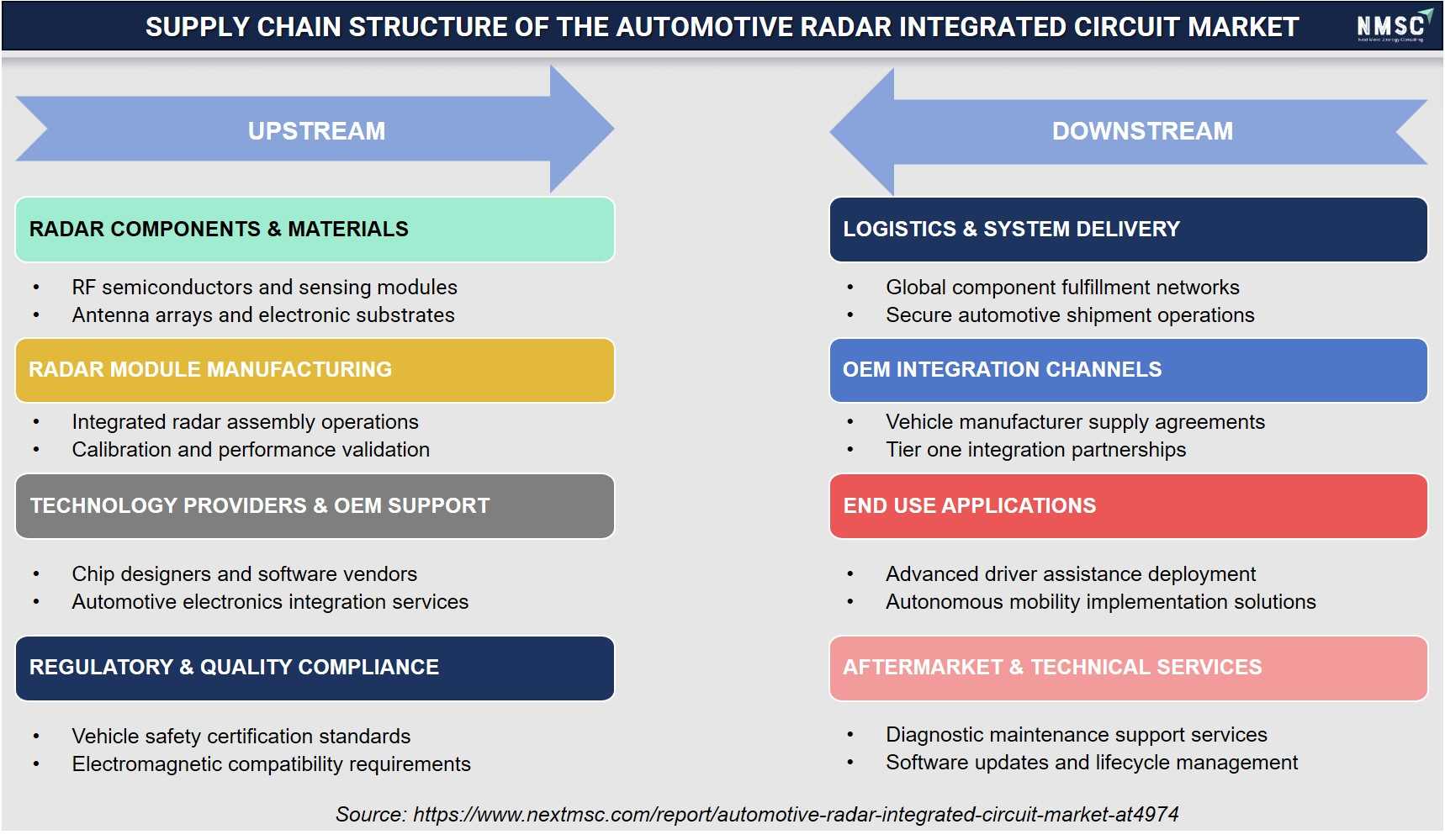
The above infographic presents the supply chain structure of the automotive radar integrated market, segmented into upstream and downstream activities. Upstream begins with RF semiconductors, sensing modules, and antenna arrays, which move into radar assembly, calibration, and validation. Technology providers supply chip designs and software, while compliance ensures safety and electromagnetic standards. Moving downstream, global logistics and OEM partnerships enable deployment across ADAS and autonomous mobility applications. Looking ahead, we observed that aftermarket diagnostics, software updates, and lifecycle management ensure long-term system reliability across the market.
Competitive Landscape
Competitive Dynamics and M&A Landscape
|
Key Takeaways |
Details |
|
Market Structure |
Moderately consolidated among diversified semiconductor majors including Infineon, NXP, Texas Instruments, STMicroelectronics, Renesas, Analog Devices, onsemi, and Microchip, which compete alongside specialised radar-native challengers such as Calterah Semiconductor, indie Semiconductor, Uhnder, Arbe Robotics, and Vayyar Imaging across distinct product-tier and architecture niches. |
|
Innovation Focus |
Single-chip CMOS and RFCMOS transceiver integration, 4D imaging radar resolution, AI accelerator-equipped radar SoC development, in-cabin sensing for occupant detection, and centralised zonal architecture compatibility for next-generation domain controller platforms. |
|
M&A Activity |
Renesas Electronics' acquisition of radar SoC specialist Steradian Semiconductors expanded its 4D imaging radar IP portfolio. indie Semiconductor has pursued multiple acquisitions, including GEO Semiconductor, to build an integrated ADAS sensor fusion platform. Continued consolidation interest is expected among pure-play radar chip developers as larger semiconductor vendors seek to acquire 4D imaging and AI-native processing intellectual property. |
How Do Companies Compete in the Automotive Radar Integrated Circuit Market?
Competitive dynamics within the Automotive Radar Integrated Circuit Market centre on long-term design-win relationships with Tier 1 suppliers and OEM platform programmes that typically span five or more years per vehicle generation. NMSC's analysis indicates that vendors compete primarily on integration density, power efficiency, and functional safety qualification under ISO 26262, while pricing strategy increasingly differentiates between premium 4D imaging radar chipsets and cost-optimised single-chip CMOS transceivers targeting mass-market vehicle programmes across diverse geographic platforms.
Which Kind of Companies Dominate the Automotive Radar Integrated Circuit Market?
The market is dominated by two distinct vendor archetypes. Diversified semiconductor majors, including Infineon Technologies, NXP Semiconductors, and Texas Instruments, leverage decades of automotive-grade qualification experience and broad Tier 1 customer relationships across multiple vehicle electronics categories. A complementary tier of radar-native specialists, including Calterah Semiconductor, Uhnder, and Arbe Robotics, compete through focused innovation in 4D imaging and digital code modulation radar architectures targeting next-generation ADAS platforms.
AI-Native Differentiation and Open Standards Drive Market Success in the Automotive Radar Integrated Circuit Market
Leading vendors within the Automotive Radar IC Market increasingly differentiate through AI-enabled on-chip processing and compliance with open automotive software standards, including AUTOSAR. Our findings suggest that radar SoC vendors integrating AI accelerator cores capable of on-chip object classification are achieving faster design-win cycles with OEMs pursuing centralised compute architectures, as this reduces the data bandwidth and central processing load required to support Level 2 and Level 3 sensor fusion.
Market Players to opt for Merger and Acquisition Strategies to Expand Their Presence in the Automotive Radar Integrated Circuit Market
Strategic M&A activity within the Automotive Radar Integrated Circuit Market is driven by the need to acquire 4D imaging radar intellectual property, AI processing capability, and direct OEM relationships. Based on our market evaluation, we noticed that Renesas Electronics' integration of Steradian Semiconductors' radar SoC technology illustrates how larger semiconductor vendors are acquiring specialised radar IP to accelerate next-generation product roadmaps, a pattern likely to continue as the market consolidates around AI-native and 4D imaging radar architectures.
Who Are the Key Market Players in the Automotive Radar Integrated Circuit Market?
-
NXP Semiconductors N.V.
-
Texas Instruments Incorporated
-
STMicroelectronics N.V.
-
Renesas Electronics Corporation
-
Analog Devices, Inc.
-
Microchip Technology Incorporated
-
Calterah Semiconductor Technology Co., Ltd.
-
Asahi Kasei Microdevices Corporation
-
indie Semiconductor, Inc.
-
Uhnder, Inc.
-
Arbe Robotics Ltd.
-
Vayyar Imaging Ltd.
-
Ambarella, Inc.
-
Elmos Semiconductor SE
-
Mitsubishi Electric Corporation
-
Fujitsu Limited
-
RFbeam Microwave GmbH
-
Arralis Holdings Limited
What Are the Latest Developments in the Automotive Radar Integrated Circuit Market Industry?
|
Date |
Event |
|
May 2025 |
NXP introduced its third-generation imaging radar processors at CES 2025, enabling higher-resolution object detection, AI-based perception, and support for Level 2+ to Level 4 autonomous driving applications. |
|
January 2025 |
Arbe Robotics demonstrated its 4D imaging radar chipset integrated with NVIDIA DRIVE at CES 2025, showcasing ultra-high-resolution environmental perception for autonomous driving. |
Expert Insights
 "HiRain's launch of the LRR615 system marks an exciting milestone for Arbe's expansion in China. Their ability to industrialize a radar system of this caliber, based on our chipset, reinforces the critical role high-resolution radar plays in the future of autonomous perception."
— Kobi Marenko, Chief Executive Officer, Arbe Robotics
Statement made during the announcement of HiRain's launch of the LRR615 production-intent imaging radar system powered by Arbe's high-resolution radar chipset.
Market Interpretation
The comment highlights the growing commercialization of high-resolution automotive radar integrated circuits (ICs) as automakers and Tier 1 suppliers accelerate the deployment of advanced driver assistance systems (ADAS) and autonomous driving technologies. It underscores the increasing importance of radar chipsets in enabling high-precision environmental perception, supporting broader adoption of imaging radar solutions across next-generation passenger and commercial vehicles.
What Are the Investment Opportunities in the Automotive Radar Integrated Circuit Market?
Capital Inflows and Strategic Semiconductor Investment
The Automotive Radar Integrated Circuit Market is attracting sustained capital allocation from both strategic semiconductor investment programmes and automotive electronics R&D budgets. Our assessment indicates that the U.S. CHIPS and Science Act, administered by the Department of Commerce, includes incentive provisions supporting domestic semiconductor manufacturing capacity relevant to automotive-grade radar chip production. This policy support is reinforcing private capital commitments toward expanding RFCMOS and CMOS fabrication capacity dedicated to automotive radar applications.
Infrastructure Investment in Domestic Semiconductor Capacity
Investment in domestic semiconductor fabrication and packaging infrastructure represents a critical priority within the Automotive Radar Integrated Circuit Market. From our research, we found that India's Semiconductor Mission, administered by the Ministry of Electronics and Information Technology, has extended financial incentives toward automotive-grade chip design and assembly capability, directly addressing the localisation gap for radar IC supply in one of the world's fastest-growing vehicle production markets.
ESG Considerations in Radar Semiconductor Manufacturing
Environmental, social, and governance considerations within the Automotive Radar Integrated Circuit Market are increasingly expressed through energy-efficient chip design and the broader road safety benefits delivered by radar-enabled ADAS features. The U.S. National Highway Traffic Safety Administration's AEB mandate is explicitly grounded in measurable fatality and injury reduction objectives, providing a clear public safety rationale that aligns commercial radar IC adoption with broader social benefit outcomes across regulated vehicle markets.
Digital Transformation and Software-Defined Radar Platforms
The integration of software-defined and AI-accelerated processing into radar system-on-chip platforms represents the digital transformation frontier of the Automotive Radar Integrated Circuit Market. NMSC's analysis indicates that radar SoC architectures supporting over-the-air firmware updates allow OEMs to extend ADAS feature capability across a vehicle's service life without hardware replacement, creating a compelling total-cost-of-ownership argument that is reshaping long-term platform investment decisions across global automotive electronics programmes.
Private Equity and Strategic M&A Activity
Strategic investment interest in the Automotive Radar Integrated Circuit Market is concentrated around 4D imaging radar intellectual property, AI processing capability, and direct OEM relationships held by emerging radar-native semiconductor companies. Through our market assessment, we observed that pure-play radar chip developers with established design-win pipelines and differentiated process technology represent attractive acquisition targets for diversified semiconductor majors seeking to accelerate next-generation radar SoC roadmaps without the multi-year timeline associated with in-house development.
Key Benefits for Stakeholders
For Tier 1 Suppliers and OEMs
Tier 1 automotive suppliers and vehicle OEMs gain access to a comprehensive assessment of the Automotive Radar Integrated Circuit Market, including quantitative market sizing and forecasts across product type, frequency band, radar range, vehicle type, propulsion, automation level, and regional segments. The report supports sourcing strategies, semiconductor supplier selection, ADAS platform planning, and long-term supply chain investment decisions by providing a vendor-neutral view of technology adoption and procurement trends through 2035.
For Investors and Financial Analysts
Investors, private equity firms, and financial analysts receive a structured evaluation of the Automotive Radar Integrated Circuit Market's growth outlook, including market size, segment-level revenue forecasts, CAGR analysis, and competitive dynamics through 2035. The report provides actionable insights into design-win momentum, semiconductor technology transitions, emerging growth segments, and competitive positioning, enabling informed valuation, portfolio construction, investment screening, and M&A opportunity assessment across the automotive semiconductor value chain.
For Radar IC and Semiconductor Vendors
Radar IC manufacturers, semiconductor companies, and technology developers gain detailed intelligence on high-growth opportunities across frequency bands, radar architectures, vehicle categories, automation levels, and regional markets. The analysis identifies emerging procurement trends, customer demand patterns, and technology adoption pathways, enabling vendors to optimize product roadmaps, prioritize R&D investments, strengthen customer engagement strategies, and expand into the most attractive growth markets through 2035.
For Government Agencies and Regulatory Bodies
Government organizations, transportation authorities, and semiconductor policy bodies gain evidence-based insights into how vehicle safety regulations, ADAS mandates, semiconductor localization initiatives, and industrial investment programs are shaping the Automotive Radar Integrated Circuit Market. Country-level analysis and regional comparisons support policy formulation, domestic semiconductor ecosystem development, automotive safety planning, and strategic investment decisions aimed at strengthening national competitiveness in advanced automotive electronics.
Key Market Segments
By Product Type
-
Radar Transceiver IC
-
Single Chip Radar Transceiver IC
-
Cascadable Radar Transceiver IC
-
Multi-Channel Radar Transceiver IC
-
-
Radar System on Chip
-
Radar SoC with MCU
-
Radar SoC with DSP
-
Radar SoC with AI Accelerator
-
-
Radar Processor IC
-
Radar Signal Processing IC
-
Radar Data Processing IC
-
Radar Accelerator IC
-
-
Radar Front End IC
-
RF Front End IC
-
Power Amplifier IC
-
Low Noise Amplifier IC
-
Frequency Synthesizer IC
-
-
Radar Companion IC
-
Power Management IC
-
Clock IC
-
Interface IC
-
By Frequency Band
-
24 GHz
-
76 GHz
-
77 GHz
-
79 GHz
-
Other Frequency Bands
By Radar Range
-
Short Range Radar
-
Medium Range Radar
-
Long Range Radar
By Vehicle Type
-
Passenger Vehicle
-
Hatchback
-
Sedan
-
Sport Utility Vehicle
-
Multi-Purpose Vehicle
-
Luxury Vehicle
-
-
Light Commercial Vehicle
-
Medium Commercial Vehicle
-
Heavy Commercial Vehicle
-
Bus and Coach
By Propulsion Type
-
Internal Combustion Engine Vehicle
-
Hybrid Electric Vehicle
-
Battery Electric Vehicle
-
Fuel Cell Electric Vehicle
By Automation Level
-
Level 0
-
Level 1
-
Level 2
-
Level 3
-
Level 4
-
Level 5
By Semiconductor Technology
-
CMOS
-
RFCMOS
-
SiGe BiCMOS
-
FD-SOI
-
GaAs
-
GaN
-
Other Semiconductor Technologies
By Sales Channel
-
Direct Sales to Tier 1 Suppliers
-
Direct Sales to OEMs
-
Authorized Distributors
By Region
-
North America: U.S., Canada, and Mexico
-
Europe: UK, Germany, France, Italy, Spain, Sweden, Denmark, Finland, the Netherlands, and the rest of Europe
-
Asia-Pacific: China, India, Japan, South Korea, Taiwan, Indonesia, Vietnam, Australia, Philippines, Malaysia, and the rest of APAC
-
Middle East & Africa (MEA): Saudi Arabia, UAE, Egypt, Israel, Turkey, Nigeria, South Africa, and the rest of MEA
-
Latin America: Brazil, Argentina, Chile, Colombia, and the rest of LATAM
Conclusion and Recommendations
Long-Term Outlook
The Automotive Radar Integrated Circuit Market is entering a decade of structurally robust expansion, advancing from USD 9.48 billion in 2026 to USD 36.89 billion by 2035 at a CAGR of 16.3%. This trajectory reflects both rising vehicle production volume and a substantial increase in average radar IC content value per vehicle, as multi-channel transceivers, AI-enabled SoCs, and 4D imaging architectures command premium value relative to legacy single-channel designs. NMSC's analysis indicates that the convergence of regulatory mandate, electrification, and automation trends provides a more durable demand structure than any single driver could sustain alone.
Strategic Positioning Recommendations
Radar IC vendors should prioritise RFCMOS and FD-SOI process investment as the primary technology pathway, given their combination of cost efficiency and the integration density required for multi-channel and 4D imaging architectures. Vendors without AI accelerator-equipped SoC roadmaps should treat this as a near-term capability gap, given the concentration of design-win momentum around Level 2 and Level 3 platforms. Alignment with ISO 26262 functional safety qualification and AUTOSAR software compatibility remains a prerequisite for sustained Tier 1 and OEM engagement globally.
Investment Attractiveness
The Automotive Radar Integrated Circuit Market represents a compelling investment environment underpinned by durable regulatory demand, multi-year platform production commitments, and a substantial semiconductor technology transition that creates design-win displacement opportunities for technology leaders. Our assessment indicates that the highest-conviction investment themes include Radar System on Chip adoption (fastest product CAGR at 23.5%), the 79 GHz frequency transition (27.1% CAGR), Battery Electric Vehicle-linked radar content growth (26.0% CAGR), and Asia-Pacific domestic supply chain localisation (18.7% regional CAGR).
Market Shifts and Key Risks
The most significant market shift underway is the transition from single-function long-range radar toward multi-function, AI-enabled, and 4D imaging radar architectures that simultaneously support multiple ADAS functions within a reduced sensor count. This shift increases average unit value per radar IC while compressing the number of discrete sensor types required per vehicle platform. Key risks for the Automotive Radar Integrated Circuit Market include automotive semiconductor supply chain volatility, frequency allocation disparities across emerging markets, and potential delays in regulatory mandate enforcement timelines that could defer near-term volume ramp.
Growth Pathways
Organisations seeking to maximise value from the Automotive Radar Integrated Circuit Market should pursue a phased strategy. In the near term through 2028, prioritise single-chip CMOS transceiver qualification for mass-market AEB compliance and Tier 1 design-win expansion across North America and Europe. In the mid-term through 2031, invest in 4D imaging radar SoC qualification and centralised zonal architecture compatibility. In the long term, through 2035, the position for AI-native radar processing and in-cabin sensing integration is the next frontier of differentiated radar IC value across global vehicle platforms.
Key Risks
The primary risks that could constrain the Automotive Radar Integrated Circuit Market growth trajectory include cyclical automotive production volume sensitivity to macroeconomic conditions, semiconductor foundry capacity constraints affecting RFCMOS and FD-SOI supply, potential softening of regulatory enforcement timelines in select jurisdictions, and intensifying price competition as CMOS integration commoditises entry-level radar transceiver chipsets. Vendors and investors should monitor NHTSA and EU regulatory enforcement milestones, global vehicle production cycles, and semiconductor foundry capacity utilisation as leading indicators of market risk through 2035.
About the Author
 Mayurima Roy
— Mayurima Roy is Research Analyst at Next Move Strategy Consulting, where she has spent 4 years working across the firm's full industry coverage rather than a single fixed vertical. Her work centers on structured research, ongoing trend tracking, competitive assessment, and insight-led content development, translating complex market data into clear, decision-ready narratives that support informed client decision-making across diverse global industries, market sectors, and world regions every day.
Mayurima Roy
— Mayurima Roy is Research Analyst at Next Move Strategy Consulting, where she has spent 4 years working across the firm's full industry coverage rather than a single fixed vertical. Her work centers on structured research, ongoing trend tracking, competitive assessment, and insight-led content development, translating complex market data into clear, decision-ready narratives that support informed client decision-making across diverse global industries, market sectors, and world regions every day.
About the Reviewer
 Supradip Baul
— Supradip Baul is an accomplished business consultant and strategist with over a decade of rich experience in market intelligence, strategy, technology, and business transformation. His work has included rigorous qualitative and quantitative analysis across multiple industries, helping clients shape investment decisions and long-term roadmaps. Earlier in his career, he was associated with Gartner, where he contributed to industry-leading reports and market share analyses. He has worked with leading global companies and holds an MBA with a dual specialization in Marketing and Finance.
Supradip Baul
— Supradip Baul is an accomplished business consultant and strategist with over a decade of rich experience in market intelligence, strategy, technology, and business transformation. His work has included rigorous qualitative and quantitative analysis across multiple industries, helping clients shape investment decisions and long-term roadmaps. Earlier in his career, he was associated with Gartner, where he contributed to industry-leading reports and market share analyses. He has worked with leading global companies and holds an MBA with a dual specialization in Marketing and Finance.
At Next Move Strategy Consulting, we understand that insightful market research is the cornerstone of successful business decisions. That's why we employ a robust and multifaceted approach, combining various methodologies to deliver the most accurate and actionable data for our clients.

Research Landscape
We navigate the world of research with two primary approaches:
Qualitative Approach
Our qualitative research methodologies involve immersive techniques such as in-depth interviews, focus groups, and observational studies. By engaging directly with individuals and stakeholders, we uncover valuable insights that quantitative data alone may overlook.

Quantitative Research
In tandem with qualitative methodologies, NMSC leverages the power of Quantitative Research to provide a robust foundation of numerical insights. Through systematic data collection and analysis, we quantify patterns, preferences, and market trends, offering a comprehensive view of the business landscape.
Our quantitative research approach employs diverse tools, including surveys, experiments, and statistical modelling. These methodologies enable us to gather data from a large and representative sample, ensuring the statistical significance of our findings. By employing structured questionnaires and standardized data collection methods, we guarantee the reliability and validity of the information we present to our clients.
Quantitative research is particularly effective in measuring the prevalence of trends, assessing market size, and gauging the impact of various factors on consumer behavior. The numerical precision attained through this approach equips our clients with actionable insights, facilitating data-driven decision-making and strategy formulation.


Our Specialized Toolbox for Industry-Specific Market Research
We deploy a specialized arsenal of techniques tailored to meet your unique requirements. Here's a glimpse into our comprehensive toolbox:

Information Procurement
The stage entails acquiring market data or relevant information through various sources and methodologies.


Market Research Approach
We utilize both top-down and bottom-up approaches in market research analysis to achieve a comprehensive understanding of the market dynamics, leveraging the broad perspective of industry trends and macroeconomic factors alongside detailed insights from specific segments and individual companies.

Porters Five Forces Analysis
We conduct Porter's Five Forces analysis to evaluate the competitive landscape of an industry, providing us with insights into factors that affect profitability and strategic positioning.

SWOT Analysis

Forecasting
We utilize a forecasting model to predict future consumption by considering parameters like population, economics, regulations, market competition, drivers, constraints, technology, and pricing. We also employ statistical techniques such as multilinear regression, exponential smoothing, moving average, ARIMA, and Monte Carlo simulations for accurate predictions. In econometric forecasting, we analyzed short-term and long-term event impacts, attributing values based on regulatory frameworks, economic factors, and market events.





 Speak to Our Analyst