The global AUTOSAR middleware market size was valued at USD 1.35 billion in 2025 and is estimated at USD 1.62 billion in 2026, forecast to reach USD 8.43 billion by 2035, expanding at a 20.1% CAGR between 2026 and 2035. Europe leads with approximately a 35% share, while the Classic Platform dominates all other platform types with approximately a 62% share.
We observed that growth is broad-based across every segmentation axis, with Adaptive Platform adoption and zonal and central vehicle computer architectures driving the dominant structural shifts through 2035.
|
Key Takeaways |
|
By Platform Type: Classic Platform held the largest share of approximately 62% (USD 0.84 billion) in 2025; Adaptive Platform is the fastest-growing sub-segment at 28.6% CAGR from 2026–2035. |
|
By Middleware Function: Communication Middleware held the largest share of approximately 30% (USD 0.41 billion) in 2025; Software Lifecycle Middleware is the fastest-growing sub-segment at 31.6% CAGR from 2026–2035. |
|
By Vehicle Domain: ADAS held the largest share of approximately 18% (USD 0.24 billion) in 2025; Autonomous Driving is the fastest-growing sub-segment at 28.2% CAGR from 2026–2035. |
|
By Vehicle Type: Passenger Vehicles held the largest share of approximately 68% (USD 0.92 billion) in 2025; Off-Highway Vehicles is the fastest-growing sub-segment at 26.3% CAGR from 2026–2035. |
|
By Software Delivery Model: Perpetual License held the largest share of approximately 34% (USD 0.46 billion) in 2025; Subscription License is the fastest-growing sub-segment at 29.5% CAGR from 2026–2035. |
|
By Deployment Model: Embedded ECU held the largest share of approximately 52% (USD 0.70 billion) in 2025; Central Vehicle Computer is the fastest-growing sub-segment at 37.2% CAGR from 2026–2035. |
|
By End User: Tier 1 Suppliers held the largest share of approximately 58% (USD 0.78 billion) in 2025; OEM is the fastest-growing sub-segment at 21.3% CAGR from 2026–2035. |
|
Dominant Region: Europe dominated with approximately 35% revenue share (USD 0.47 billion) in 2025. |
|
Fastest-Growing Region: Asia-Pacific is expected to register the highest CAGR of 23.8% during 2026–2035. |
|
Dominant Country: The U.S. led with approximately USD 295 million in 2025. |
|
Fastest-Growing Country: China is the fastest-growing country at approximately 24.5% CAGR from 2026–2035. |
Market Opportunity: The AUTOSAR middleware market is expected to create an absolute dollar opportunity of USD 6.81 billion between 2026 and 2035, presenting significant investment potential across the software-defined vehicle and centralized computing architecture value chain.
According to NMSC analysis, technology vendors are increasingly bundling Adaptive Platform licenses with long-term engineering services contracts to support OEM migration from embedded ECU to zonal and central vehicle computer architectures, a shift that favors diversified software suppliers over single-scope tool vendors as software-defined vehicle programs scale through 2035.
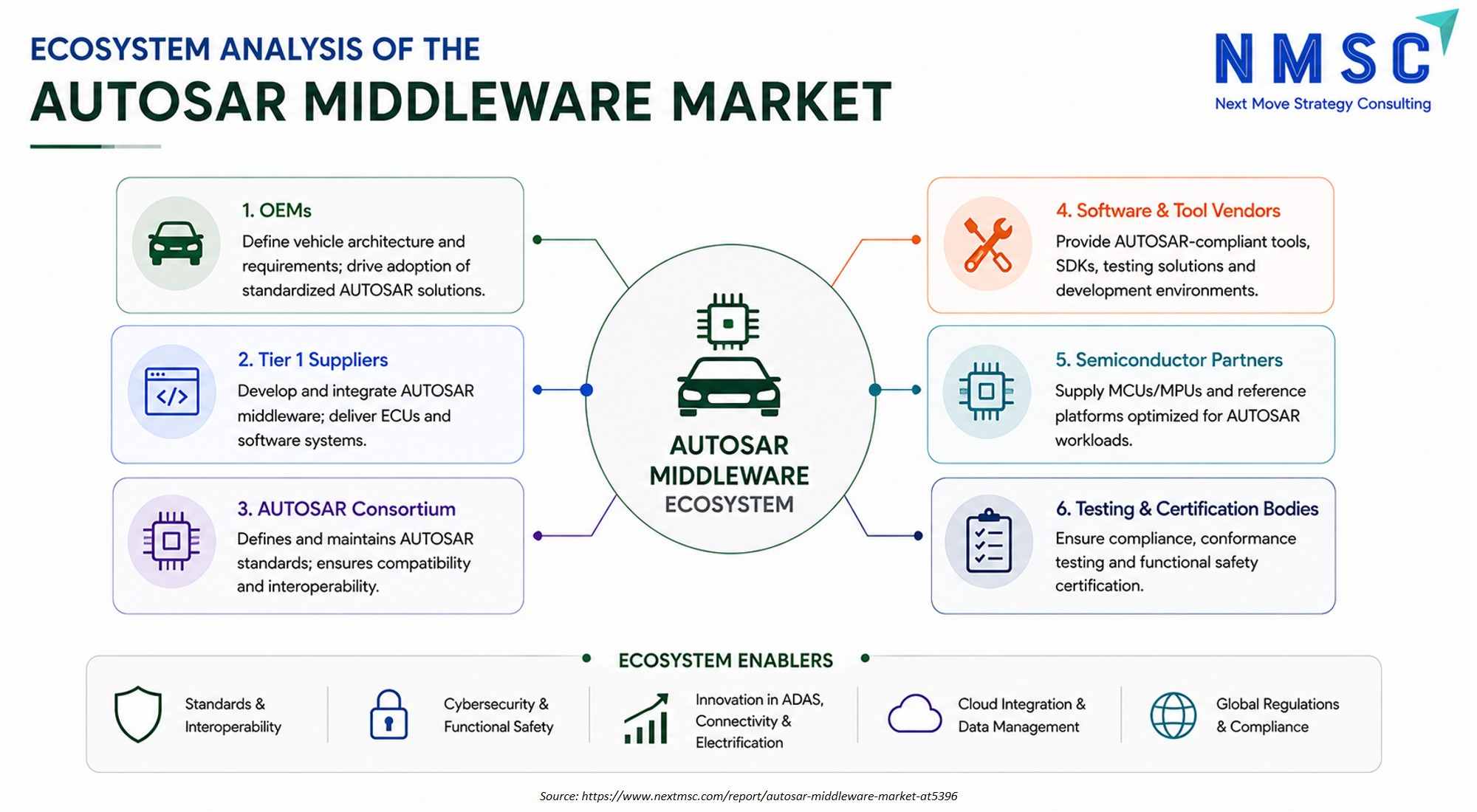
The above infographic presents an ecosystem analysis of the AUTOSAR middleware market, covering R&D, technology suppliers, software integration, deployment, OEMs, and functional safety compliance. Scalable middleware architectures and real-time communication frameworks are being developed, supported by semiconductor companies and embedded software vendors that enable automotive processing and middleware solutions. At the same time, adaptive applications are designed and validated, while software is integrated across electronic control units to enable seamless vehicle interoperability. Deployment includes over-the-air updates and lifecycle maintenance, all within a framework of ISO 26262 compliance and cybersecurity risk management. Looking ahead, we observed that these interconnected elements collectively shape the market's evolution across the automotive sector.
The AUTOSAR middleware market encompasses the basic software stacks, runtime environments, communication frameworks, diagnostic services, and lifecycle management software that implement the AUTomotive Open System ARchitecture standard across embedded ECUs, domain controllers, zonal controllers, and central vehicle computers. Our assessment indicates that the scope spans Classic Platform basic software vendors, Adaptive Platform providers, semiconductor partners delivering microcontroller abstraction layers, and system integrators serving OEMs and Tier 1 suppliers across the software-defined vehicle transition worldwide.
Regulatory frameworks such as UNECE R155 cybersecurity type approval and UNECE R156 software update management shape middleware architecture requirements, while the AUTOSAR consortium's release cadence increasingly informs OEM software roadmaps. We observed that technology adoption is shifting from embedded ECU-centric Classic Platform deployments toward Adaptive Platform and hybrid architectures supporting centralized computing. NMSC's analysis indicates that this structural shift, combined with rising over-the-air update and cybersecurity requirements, is redefining vendor selection criteria across the market.
|
Field |
Details |
|
Market Size in 2025 |
USD 1.35 Billion |
|
Market Size in 2026 |
USD 1.62 Billion |
|
Revenue Forecast in 2035 |
USD 8.43 Billion |
|
Growth Rate |
CAGR of 20.1% from 2026 to 2035 |
|
Analysis Period |
2025–2035 |
|
Base Year Considered |
2025 |
|
Forecast Period |
2026–2035 |
|
Market Size Estimation |
USD Billion |
|
Companies Profiled |
17 |
|
Countries Covered |
38 |
|
Market Share |
Available for Top 10 Companies |
Based on research conducted by NMSC, we found that four structural trends are reshaping platform selection, deployment architecture, and stakeholder engagement across the industry.
Zonal and central vehicle computer architectures are replacing distributed embedded ECU designs as OEMs consolidate electronic control units to reduce wiring complexity and cost. We observed that Vector Informatik and Microchip Technology expanded their collaboration in March 2026 to support MICROSAR IO on Microchip's dsPIC33A digital signal controllers, targeting compact edge nodes that offload complex logic to zonal and central computing layers. Middleware vendors are redesigning basic software stacks to support this functional decomposition across high-performance computing and edge control units.
Adaptive Platform adoption is accelerating as OEMs build software-defined vehicle programs requiring dynamic software updates and service-oriented communication. Our findings suggest that Elektrobit's EB corbos AdaptiveCore, supporting AUTOSAR Adaptive Platform Specifications R20-11, exemplifies this shift toward POSIX-based, over-the-air-updatable middleware. Technology vendors are expanding Adaptive Platform functional clusters for Linux and QNX, positioning these architectures as the foundation for next-generation high-performance controllers.
Digital-twin and virtual platform development environments are pushing middleware vendors toward pre-silicon validation workflows that compress integration timelines. We observed that Elektrobit demonstrated a digital-twin cockpit running EB corbos Linux for Safety Applications on Siemens' PAVE360 virtual platform, enabling OEMs to begin software-defined vehicle development before physical hardware targets are available. This trend is elevating demand for cloud-native development environments among middleware and tooling vendors.
UNECE R155 cybersecurity type approval requirements are elevating demand for safety security middleware embedding cryptographic services and secure communication into basic software stacks. NMSC's analysis indicates that Elektrobit's EB zentur embedded security portfolio and Elektrobit's EB corbos Hypervisor, which is ASIL B safety certified, illustrate how vendors integrate functional safety and cybersecurity into a unified middleware architecture. Middleware providers are embedding UNECE-aligned security services directly into Classic and Adaptive Platform basic software.
|
Factors |
Type |
(+/−) % Impact on CAGR |
Geographic Relevance |
Impact Timeline |
|
Software-defined vehicle architecture programs at OEMs |
Driver |
+4.8% |
Global |
2026-2035 |
|
Migration to zonal and central vehicle computer platforms |
Driver |
+3.9% |
Global |
2026-2035 |
|
UNECE R155 and R156 cybersecurity and OTA mandates |
Driver |
+3.1% |
Europe, Asia-Pacific |
2026-2035 |
|
Rising ADAS and autonomous driving software content |
Driver |
+2.6% |
Global |
2026-2035 |
|
Adaptive Platform ecosystem maturity and tooling growth |
Driver |
+2.0% |
Global |
2026-2032 |
|
Subscription and royalty licensing model adoption |
Driver |
+1.3% |
North America, Europe |
2026-2035 |
|
High integration complexity of Classic-Adaptive hybrid stacks |
Restraint |
-1.8% |
Global |
2026-2035 |
|
Shortage of AUTOSAR-certified embedded software engineers |
Restraint |
-1.2% |
Global |
2026-2032 |
|
Long qualification cycles for ISO 26262 safety-certified stacks |
Restraint |
-0.9% |
Global |
2026-2035 |
|
Open-source middleware alternatives pressuring license pricing |
Restraint |
-0.7% |
North America, Europe |
2028-2035 |
Software-defined vehicle architecture programs at global OEMs are the primary driver of the market. The U.S. National Highway Traffic Safety Administration has expanded software-related recall and update reporting requirements, pushing OEMs toward centralized, updatable middleware architectures rather than distributed legacy ECU designs. We observed that this structural shift, reinforced by Tier 1 suppliers scaling Adaptive Platform tooling investment, continues to anchor demand for middleware spanning embedded ECU through central vehicle computer deployments.
Regulatory mandates are accelerating market growth toward safety and security middleware and software lifecycle management. The United Nations Economic Commission for Europe's UNECE R156 regulation requires manufacturers to maintain a documented software update management system, directly driving demand for OTA update and software configuration management middleware. NMSC's analysis indicates that this regulatory pressure, combined with UNECE R155 cybersecurity type approval, is compressing adoption timelines for cryptographic and secure communication middleware across Europe and Asia-Pacific.
Integration complexity between Classic and Adaptive Platform stacks restrains deployment timelines and total cost of ownership across hybrid architectures. Engineering teams must reconcile signal-oriented Classic communication with service-oriented Adaptive communication within a single vehicle electronic architecture, extending validation cycles. We found that smaller Tier 1 suppliers face particular exposure, as limited in-house AUTOSAR expertise increases reliance on external engineering services to manage hybrid platform integration.
|
Segment |
2025 (USD) |
2035 (USD) |
CAGR% (2026–2035) |
|
Classic Platform |
USD 0.84 Billion |
USD 2.87 Billion |
12.3% |
|
Adaptive Platform |
USD 0.38 Billion |
USD 4.38 Billion |
28.6% |
|
Hybrid Platform |
USD 0.13 Billion |
USD 1.18 Billion |
25.2% |
|
Total |
USD 1.35 Billion |
USD 8.43 Billion |
20.1% |
Classic Platform, encompassing basic software modules such as the communication stack, memory stack, and ECU abstraction layers, led the market with USD 0.84 billion in 2025, reflecting decades of installed embedded ECU base. Our findings suggest that Adaptive Platform is the fastest-growing platform type, registering a 28.6% CAGR from 2026 to 2035, as OEMs adopt service-oriented, POSIX-based middleware to support software-defined vehicle programs and centralized computing architectures.
|
Segment |
2025 (USD) |
2035 (USD) |
CAGR% (2026–2035) |
|
Communication Middleware |
USD 0.41 Billion |
USD 2.02 Billion |
17.0% |
|
Diagnostic Middleware |
USD 0.19 Billion |
USD 0.93 Billion |
16.9% |
|
Memory Storage Middleware |
USD 0.16 Billion |
USD 0.76 Billion |
16.5% |
|
System Middleware |
USD 0.24 Billion |
USD 1.18 Billion |
17.0% |
|
Safety Security Middleware |
USD 0.22 Billion |
USD 1.69 Billion |
22.9% |
|
Software Lifecycle Middleware |
USD 0.13 Billion |
USD 1.85 Billion |
31.6% |
|
Total |
USD 1.35 Billion |
USD 8.43 Billion |
20.1% |
Communication Middleware remained the leading function within the market, reaching USD 0.41 billion in 2025 on sustained CAN, Ethernet, and SOME/IP protocol stack demand across automotive Ethernet and legacy network architectures. Based on research conducted by NMSC, we found that Software Lifecycle Middleware is the fastest-growing function at a 31.6% CAGR from 2026 to 2035, reflecting rising over-the-air update and software configuration management requirements tied to UNECE R156 compliance.
|
Segment |
2025 (USD) |
2035 (USD) |
CAGR% (2026–2035) |
|
Powertrain |
USD 0.22 Billion |
USD 0.84 Billion |
13.7% |
|
Chassis |
USD 0.15 Billion |
USD 0.67 Billion |
15.7% |
|
Body Electronics |
USD 0.18 Billion |
USD 0.76 Billion |
15.0% |
|
ADAS |
USD 0.24 Billion |
USD 1.69 Billion |
21.7% |
|
Autonomous Driving |
USD 0.12 Billion |
USD 1.35 Billion |
28.2% |
|
Infotainment |
USD 0.18 Billion |
USD 0.93 Billion |
17.6% |
|
Digital Cockpit |
USD 0.12 Billion |
USD 0.93 Billion |
23.0% |
|
Telematics |
USD 0.08 Billion |
USD 0.59 Billion |
22.4% |
|
Energy Management |
USD 0.06 Billion |
USD 0.67 Billion |
28.1% |
|
Total |
USD 1.35 Billion |
USD 8.43 Billion |
20.1% |
ADAS remained the leading vehicle domain within the market, valued at USD 0.24 billion in 2025 on expanding sensor fusion and advanced driver assistance software content. Our findings suggest that Autonomous Driving is the fastest-growing vehicle domain, registering a 28.2% CAGR from 2026 to 2035, as Level 3 and above driving programs require deterministic, safety-certified middleware spanning perception, planning, and actuation functions.
Our analysis shows that three forward-looking opportunities stand out for stakeholders positioning within the AUTOSAR middleware market over the 2026-2035 forecast period.
Subscription-based licensing presents a whitespace opportunity for middleware vendors seeking to shift from one-time perpetual licenses to recurring revenue. Vendors that commercialize subscription and royalty-based Adaptive Platform offerings stand to capture predictable, multi-year revenue as OEMs adopt continuous software update models across their vehicle software portfolios.
OEMs consolidating electronic architectures around central vehicle computers represent an underpenetrated opportunity for middleware providers offering hypervisor-based, multi-OS platforms. Providers that deliver validated Classic and Adaptive Platform coexistence on a single high-performance controller can secure long-term platform contracts tied to next-generation vehicle programs.
Tier 1 suppliers seeking UNECE R155 and R156 compliance create an opportunity for middleware vendors offering bundled functional safety and cybersecurity modules. Early movers that integrate cryptographic services and secure communication directly into basic software stacks can differentiate with certification-ready offerings, reducing integration risk for OEM customers pursuing centralized software architectures.
|
Region |
2025 (USD) |
2035 (USD) |
CAGR% (2026–2035) |
Key Driver |
|
North America |
USD 0.36 Billion |
USD 2.02 Billion |
18.7% |
Software-defined vehicle programs and NHTSA software update reporting |
|
Europe |
USD 0.47 Billion |
USD 2.44 Billion |
17.7% |
UNECE R155 and R156 cybersecurity and OTA mandates |
|
Asia-Pacific |
USD 0.39 Billion |
USD 3.20 Billion |
23.8% |
Expanding domestic OEM software platforms and EV architecture investment |
|
Middle East & Africa |
USD 0.07 Billion |
USD 0.42 Billion |
19.6% |
Growing vehicle assembly and connected vehicle pilot programs |
|
Latin America |
USD 0.06 Billion |
USD 0.35 Billion |
19.2% |
Rising regional vehicle production and telematics adoption |
|
Total |
USD 1.35 Billion |
USD 8.43 Billion |
20.1% |
– |
North America's market maturity reflects an accelerating software-defined vehicle transition among domestic and global OEMs operating regional engineering centers. Regulatory influence is growing as the National Highway Traffic Safety Administration expands software update and recall reporting expectations. Technology adoption favors Adaptive Platform pilots alongside established Classic Platform deployments. NMSC's analysis indicates a strategic outlook centered on zonal and central computing architecture programs advancing through 2035.
Europe's market maturity is the most advanced globally, anchored by the AUTOSAR consortium's German and French founding OEM and Tier 1 membership base. Regulatory influence is pronounced, with UNECE R155 and R156 directly shaping middleware architecture requirements. Technology adoption spans mature Classic Platform stacks and expanding Adaptive Platform deployments. Our assessment indicates a strategic outlook centered on continued leadership in safety and security middleware standardization.
Asia-Pacific's market maturity is earlier-stage but accelerating fastest globally, driven by domestic OEM software platform investment in China, Japan, and South Korea. Regulatory influence is strengthening as regional cybersecurity and software update regulations align with UNECE frameworks. Technology adoption is shifting rapidly toward Adaptive Platform and zonal architectures for electric vehicle programs. We observed that competitive intensity is rising as domestic vendors scale AUTOSAR-certified stacks, supporting the fastest regional CAGR through 2035.
The Middle East & Africa market remains early-stage, shaped by growing regional vehicle assembly operations and connected vehicle pilot programs. Regulatory influence is limited but emerging as Gulf Cooperation Council markets align with international vehicle software standards. Technology adoption centers on Classic Platform deployments supplied by global Tier 1 partners. Our findings suggest a strategic outlook of steady, assembly-linked growth through the forecast period.
Latin America's market maturity trails other regions, with demand concentrated in regional vehicle production hubs in Brazil and Argentina. Regulatory influence is nascent, with technology adoption favoring established Classic Platform basic software supplied through global Tier 1 relationships. Competitive intensity remains limited to a small number of regional integrators. NMSC's analysis indicates a strategic outlook of gradual growth tied to regional vehicle production expansion.
Based on our estimates, the U.S. AUTOSAR middleware market was valued at approximately USD 295 million in 2025, projected to reach USD 1.66 billion by 2035 at an 18.7% CAGR. Demand structure is anchored in software-defined vehicle programs among domestic and global OEM engineering centers. Adoption levels are rising, regulatory influence is growing under NHTSA software reporting expectations, technology penetration favors Adaptive Platform pilots, and competitive intensity is elevated among global middleware vendors and domestic software suppliers.
The market in Canada was valued at approximately USD 65 million in 2025, projected to reach USD 360 million by 2035 at an 18.6% CAGR. Demand structure is concentrated in Tier 1 supplier engineering operations supporting North American OEM programs. Regulatory influence is limited but aligned with U.S. software update expectations. Technology penetration favors established Classic Platform stacks, with competitive intensity moderate and strategic outlook tied to continued Tier 1 engineering investment.
As per our estimate, the UK market was valued at approximately USD 103 million in 2025, projected to reach USD 525 million by 2035 at a 17.5% CAGR. Demand structure centers on domestic OEM and specialty vehicle manufacturer software programs. Regulatory influence is substantial under UNECE-aligned cybersecurity rules, technology penetration spans Classic and emerging Adaptive Platform systems, and competitive intensity is elevated as global vendors compete for domestic engineering contracts.
According to our analysis, the German market was valued at approximately USD 160 million in 2025, projected to reach USD 840 million by 2035 at a 17.9% CAGR. Demand structure reflects Germany's position as home to the AUTOSAR consortium's founding OEMs and leading middleware vendors. Regulatory influence is strong, technology penetration is the most advanced globally across both platform types, and competitive intensity is high given Germany's concentration of software and tooling vendors.
Based on our estimates, the French market was valued at approximately USD 85 million in 2025, projected to reach USD 430 million by 2035 at a 17.4% CAGR. Demand structure is supported by domestic OEM software architecture programs and Tier 1 supplier engineering centers. Regulatory influence is significant under UNECE frameworks, technology penetration is moderate to advanced, and competitive intensity centers on established European middleware vendors serving domestic OEM platforms.
The market in China was valued at approximately USD 148 million in 2025, projected to reach USD 1.25 billion by 2035 at a 24.5% CAGR, the fastest among countries covered. Demand structure is driven by domestic OEM electric vehicle software platform investment and rapid zonal architecture adoption. Regulatory influence is strengthening under national vehicle cybersecurity standards, technology penetration favors domestically developed Adaptive Platform stacks, and competitive intensity is rising as local vendors scale AUTOSAR-certified offerings.
As per our estimate, the Indian AUTOSAR middleware market was valued at approximately USD 47 million in 2025, projected to reach USD 400 million by 2035 at a 24.1% CAGR. Demand structure centers on Tier 1 supplier engineering services exports and growing domestic OEM software investment. Regulatory influence is emerging, technology penetration is concentrated in Classic Platform engineering services, and competitive intensity is increasing as domestic engineering firms scale AUTOSAR capability for global OEM clients.
According to our analysis, the Japanese market was valued at approximately USD 78 million in 2025, projected to reach USD 620 million by 2035 at a 23.1% CAGR. Demand structure reflects domestic OEM software architecture consolidation programs. Regulatory influence is well established, technology penetration favors proven Classic Platform systems with growing Adaptive Platform pilots, and competitive intensity remains concentrated among established domestic and global middleware vendors.
Based on our estimates, the South Korean market was valued at approximately USD 58 million in 2025, projected to reach USD 470 million by 2035 at a 23.4% CAGR. Demand structure is supported by domestic OEM electric vehicle and software-defined vehicle programs. Regulatory influence is growing, technology penetration is advancing toward Adaptive Platform architectures, and competitive intensity centers on domestic conglomerates partnering with global middleware vendors.
The market in Australia was valued at approximately USD 20 million in 2025, projected to reach USD 155 million by 2035 at a 22.9% CAGR. Demand structure is concentrated in fleet telematics and imported vehicle software integration services. Regulatory influence stems from vehicle safety and cybersecurity alignment with international standards, technology penetration favors Classic Platform systems, and competitive intensity remains moderate with global vendors serving regional integrators.
As per our estimate, the UAE market was valued at approximately USD 18 million in 2025, projected to reach USD 108 million by 2035 at a 19.8% CAGR. Demand structure is anchored in regional vehicle assembly and fleet telematics integration. Regulatory influence is emerging under national vehicle technology programs, technology penetration favors Classic Platform systems supplied through global Tier 1 partners, and competitive intensity is limited to a small number of regional integrators.
According to our analysis, the Saudi Arabian market was valued at approximately USD 21 million in 2025, projected to reach USD 130 million by 2035 at a 20.0% CAGR. Demand structure reflects growing domestic vehicle assembly investment under national diversification programs. Regulatory influence is emerging, technology penetration favors Classic Platform systems, and competitive intensity is concentrated among global Tier 1 suppliers supporting new assembly operations.
Based on our estimates, the South African market was valued at approximately USD 14 million in 2025, projected to reach USD 82 million by 2035 at a 19.4% CAGR. Demand structure is supported by established regional vehicle assembly operations serving export markets. Regulatory influence remains limited, technology penetration is concentrated in Classic Platform systems, and competitive intensity is centered on global Tier 1 suppliers serving domestic assembly plants.
The market in Brazil was valued at approximately USD 33 million in 2025, projected to reach USD 190 million by 2035 at a 19.1% CAGR. Demand structure is driven by regional vehicle production and growing telematics integration requirements. Regulatory influence is limited but growing under emerging vehicle software oversight. Technology penetration favors established Classic Platform systems, and competitive intensity centers on global Tier 1 suppliers serving domestic assembly operations.
As per our estimate, Argentina's AUTOSAR middleware market was valued at approximately USD 12 million in 2025, projected to reach USD 68 million by 2035 at a 19.0% CAGR. Demand structure is supported by regional vehicle assembly operations tied to Mercosur trade integration. Regulatory influence remains limited, technology penetration is modest, and competitive intensity is centered on a small number of regional integrators serving domestic assembly plants.
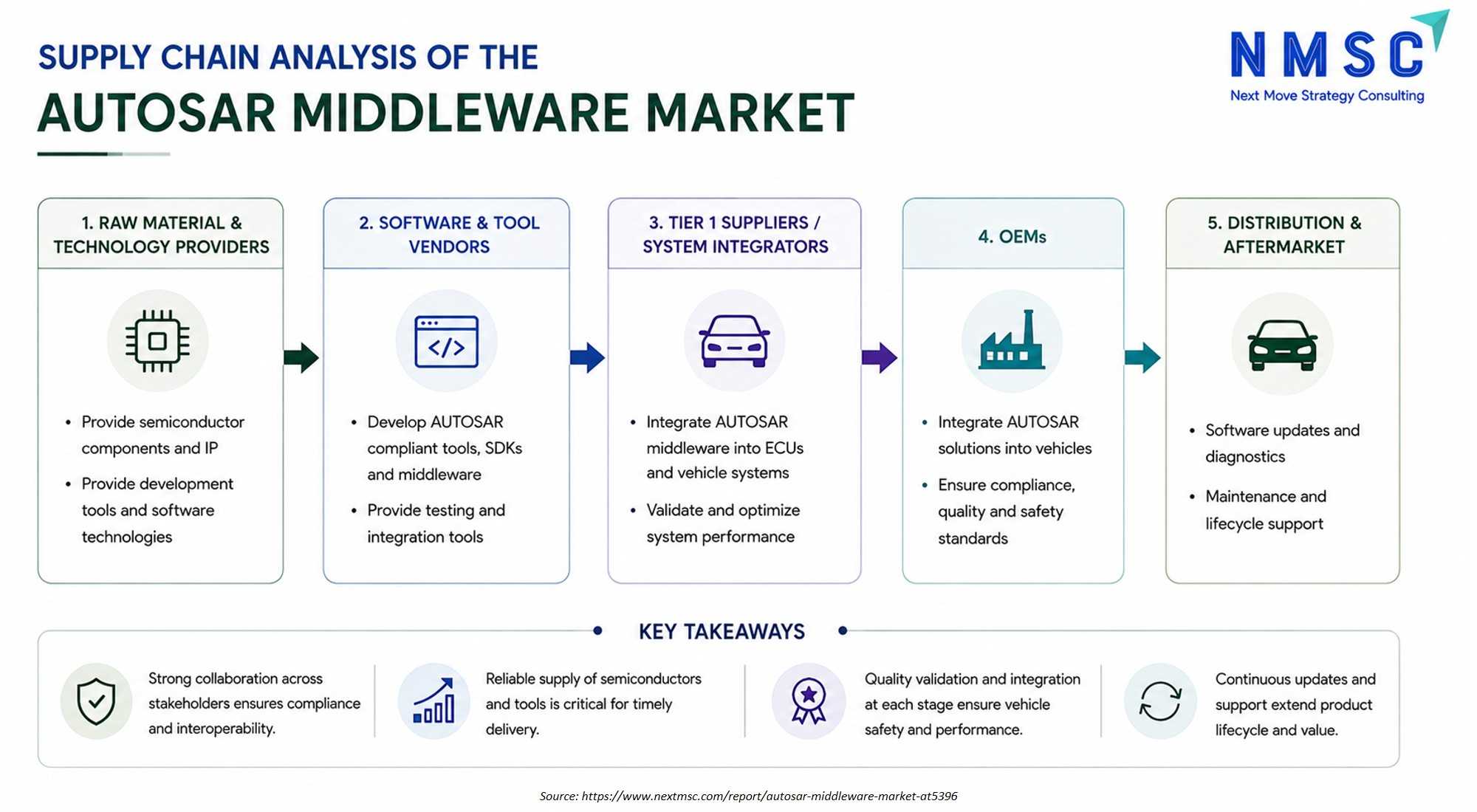
The above infographic presents the supply chain structure of the AUTOSAR middleware market, segmented into upstream and downstream activities. Upstream begins with AUTOSAR development platforms and embedded operating systems, supported by semiconductor providers supplying microcontrollers and processors. Middleware architecture design and module integration follow, while compliance with AUTOSAR specifications and ISO 26262 governs quality and safety. Moving downstream, system integration enables ECU deployment and vehicle validation, with OEMs and Tier-1 suppliers implementing solutions across passenger and commercial vehicles. Looking ahead, we observed that over-the-air updates and lifecycle maintenance ensure long-term system reliability and technical support across the market.
We observed that the AUTOSAR middleware market features a moderately consolidated competitive landscape, with established German and Japanese basic software vendors competing alongside semiconductor-affiliated and open-source-oriented entrants on certification depth, tooling maturity, and Adaptive Platform readiness.
|
Key Takeaways |
|
Market Structure: Moderately consolidated; the top five vendors, including Vector Informatik, Elektrobit, ETAS, KPIT Technologies, and TTTech Auto, collectively account for a majority of global AUTOSAR middleware market revenue, while semiconductor and regional integrators serve engineering services demand. |
|
Innovation Focus: Adaptive Platform tooling, digital-twin pre-silicon validation, and zonal and central computing-ready hypervisor architectures dominate current innovation pipelines across leading vendors. |
|
M&A Activity: Selective consolidation and strategic partnerships, exemplified by Vector Informatik's expanded collaboration with Microchip Technology to pre-integrate MICROSAR IO on dsPIC33A controllers for zonal architectures. |
Companies compete primarily on certification depth, tooling ecosystem maturity, and semiconductor platform support across the industry. Global players such as Vector Informatik and Elektrobit leverage decades of Classic Platform installed base and DaVinci or EB tresos toolchains to serve multinational OEM and Tier 1 clients, while semiconductor-affiliated vendors such as NXP Semiconductors and Renesas Electronics compete through microcontroller abstraction layer bundling and AUTOSAR certification support.
Two archetypes dominate the market: diversified basic software and toolchain vendors offering full-scope Classic and Adaptive Platform licensing, and semiconductor-affiliated providers bundling middleware with microcontroller platforms. Vector Informatik and Elektrobit exemplify the diversified toolchain archetype, while NXP Semiconductors and Infineon Technologies exemplify the semiconductor-bundled archetype serving cost-sensitive embedded ECU programs.
Innovation and differentiation strategy increasingly center on Adaptive Platform tooling and pre-silicon validation capability. Elektrobit's EB corbos AdaptiveCore and digital-twin cockpit demonstration on Siemens' PAVE360 virtual platform illustrate how vendors compress integration timelines ahead of physical hardware availability. Our analysis shows that vendors unable to demonstrate validated Adaptive Platform and hypervisor capability risk exclusion from next-generation central computing program shortlists.
Strategic partnerships and geographic expansion continue to shape competitive positioning within the industry. Vector Informatik's expanded collaboration with Microchip Technology, enabling pre-integrated MICROSAR IO support on dsPIC33A digital signal controllers, illustrates how toolchain vendors pursue semiconductor partnerships to reduce integration friction, while Elektrobit's continued IAA Mobility partnership announcements demonstrate ongoing ecosystem expansion around software-defined vehicle platforms.
Our assessment indicates that the following 17 companies are actively shaping platform licensing, tooling development, and semiconductor integration strategy within the global AUTOSAR middleware market.
Elektrobit Automotive GmbH
ETAS GmbH
KPIT Technologies Limited
Siemens Digital Industries Software Inc.
Wind River Systems, Inc.
OpenSynergy GmbH
Apex.AI, Inc.
BlackBerry Limited
Real-Time Innovations, Inc.
Neusoft Reach Automotive Technology Co., Ltd.
HIRAIN Technologies Co., Ltd.
iSOFT Infrastructure Software Co., Ltd.
Renesas Electronics Corporation
NXP Semiconductors N.V.
TTTech Auto AG
We found that recent milestones within the AUTOSAR middleware market are concentrated on zonal architecture tooling and Adaptive Platform ecosystem expansion, reflecting the industry's software-defined vehicle transition.
|
Date |
Event |
|
March 2026 |
Vector Informatik and Microchip Technology expanded their collaboration, making Vector's MICROSAR IO software layer available with pre-integrated support for Microchip's dsPIC33A digital signal controllers for zonal architectures. |
|
January 2026 |
ETAS announced that its RTA-CAR automotive runtime platform is available for NXP's S32N7 super-integration processor series. The integration combines ETAS' production-proven AUTOSAR technology with NXP's high-performance vehicle computing platform |
|
July 2025 |
Elektrobit, HighTec, and Infineon announced a collaboration to accelerate automotive software development by enabling Rust applications with AUTOSAR Classic basic software on Infineon's automotive platforms. The collaboration combines Rust development capabilities with established AUTOSAR Classic software |
Capital inflows into the AUTOSAR middleware market are increasingly directed toward Adaptive Platform tooling and semiconductor partnership development. Vector Informatik's expanded Microchip Technology collaboration and Elektrobit's continued EB corbos product investment illustrate sustained vendor-level capital commitment. We observed that investors favor vendors demonstrating validated multi-OS, multi-silicon platform support, viewing broad hardware compatibility as a proxy for long-term OEM design-win retention.
Infrastructure investment tied to cloud-native development and digital-twin validation environments is a critical enabler of AUTOSAR middleware adoption. Elektrobit's digital-twin cockpit demonstration on Siemens' PAVE360 virtual platform illustrates growing investment in pre-silicon validation infrastructure. Our assessment indicates that OEMs increasingly condition platform vendor selection on availability of cloud-based development and testing environments alongside traditional on-premise toolchains.
Environmental, social, and governance considerations increasingly influence AUTOSAR middleware investment through vehicle electrification and software longevity priorities. Middleware supporting over-the-air update management extends vehicle software lifespans, reducing electronic waste tied to premature hardware replacement. NMSC's analysis indicates that OEM sustainability commitments are beginning to factor into vendor selection criteria alongside traditional technical and cost considerations.
OEM and Tier 1 supplier leaders gain access to validated segmentation, platform benchmarking, and regional regulatory analysis that supports middleware vendor selection decisions. The report's platform type and deployment model breakdowns help engineering leaders evaluate Classic, Adaptive, and Hybrid Platform options against specific electronic architecture roadmaps, supporting more informed sourcing decisions across embedded ECU through central vehicle computer deployments.
Investors and financial analysts benefit from consolidated market sizing, regional growth forecasts, and competitive positioning data that inform capital allocation across the AUTOSAR middleware value chain. The report's country-level revenue estimates and growth catalyst matrix support due diligence on middleware vendors and semiconductor partners positioned to capture forecast demand growth through 2035.
Technology vendors and product teams gain competitive intelligence on Adaptive Platform adoption trends, zonal and central computing architecture shifts, and recent developments among the 17 companies profiled. This supports product roadmap decisions around subscription licensing models, digital-twin validation tooling, and safety security middleware bundling aligned with the fastest-growing segments identified in this report.
Classic Platform
BSW
Communication Stack
Memory Stack
System Services
ECU Abstraction
MCAL
Complex Device Drivers
Runtime Environment
Adaptive Platform
Adaptive Foundation
Communication Management
Execution Management
Persistency
Diagnostics
Time Synchronization
Update Configuration Management
Identity Access Management
Cryptography
Hybrid Platform
Communication Middleware
CAN
LIN
FlexRay
Ethernet
SOME/IP
DDS
Diagnostic Middleware
UDS
OBD
DEM
Memory Storage Middleware
NVM Management
EEPROM Abstraction
Flash Management
Persistency Services
System Middleware
OS Services
ECU State Management
Mode Management
Watchdog Management
Time Services
Resource Management
Safety Security Middleware
Functional Safety
Cybersecurity
Secure Communication
Cryptographic Services
Software Lifecycle Middleware
OTA Update
Software Configuration Management
Logging
Trace
Powertrain
Chassis
Body Electronics
ADAS
Autonomous Driving
Infotainment
Digital Cockpit
Telematics
Energy Management
Passenger Vehicles
Light Commercial Vehicles
Medium-Heavy Commercial Vehicles
Off-Highway Vehicles
Perpetual License
Subscription License
Royalty License
Engineering Services
Maintenance Support
Embedded ECU
Domain Controller
Zonal Controller
Central Vehicle Computer
OEM
Tier 1 Suppliers
North America: U.S., Canada, Mexico.
Europe: UK, Germany, France, Italy, Spain, Sweden, Denmark, Finland, Netherlands, Rest of Europe.
Asia-Pacific: China, India, Japan, South Korea, Taiwan, Indonesia, Vietnam, Australia, Philippines, Malaysia, Rest of APAC.
Middle East & Africa: Saudi Arabia, UAE, Egypt, Israel, Turkey, Nigeria, South Africa, Rest of MEA.
Latin America: Brazil, Argentina, Chile, Colombia, Rest of LATAM.
The long-term outlook for the AUTOSAR middleware market remains structurally positive, supported by a USD 6.81 billion absolute dollar opportunity between 2026 and 2035 and accelerating software-defined vehicle programs across all major automotive regions. We found that Adaptive Platform and central vehicle computer architectures will continue to gain share as OEMs consolidate electronic architectures away from distributed embedded ECU designs through the forecast period.
Stakeholders should pursue strategic positioning that combines Classic Platform installed-base expertise with Adaptive Platform and hybrid architecture capability to serve OEMs at every stage of their software-defined vehicle transition. NMSC's analysis indicates that vendors bundling platform licensing with engineering services and lifecycle support are best positioned to capture recurring, multi-year revenue across the AUTOSAR middleware market.
The AUTOSAR middleware industry presents an attractive investment case, supported by a USD 6.81 billion absolute dollar opportunity between 2026 and 2035 and above-average growth in Asia-Pacific and central vehicle computer deployment categories. We found that investment attractiveness is highest for vendors combining validated Adaptive Platform tooling with semiconductor partnership breadth, positioning them to serve both mature and emerging regional OEM programs simultaneously.
Stakeholders should monitor Classic-Adaptive integration complexity, AUTOSAR-certified engineering talent shortages, and competitive pressure from open-source middleware alternatives as key risks to the AUTOSAR middleware market. Our analysis shows that vendors unable to demonstrate credible hybrid platform integration risk losing design wins to competitors offering validated, pre-certified Adaptive Platform and central computing solutions, particularly within Europe's increasingly regulated software update environment.
Key growth pathways include scaling Adaptive Platform subscription licensing, expanding zonal and central vehicle computer tooling, and deepening penetration into autonomous driving and digital cockpit domains. NMSC's analysis indicates that vendors pursuing these pathways while maintaining cost competitiveness in Classic Platform embedded ECU categories will be best positioned to capture the AUTOSAR middleware market's projected growth through 2035.