
Autonomous Vehicles Market Size, Share, and Trends Analysis by Automation Level (Conditional Automation, High Automation, and Full Automation), Vehicle Type (Passenger Cars, Robotaxis, Commercial Trucks, Shuttles and Buses, and Delivery Vehicles), End User (Consumers, Mobility Service Providers, Logistics and Freight Companies, and Public Transit Agencies), and Region — Global Industry Report and Forecast, 2026–2035
Industry: Automotive & Transportation | Publishing Date: August 3, 2026 | Last Updated: August 3, 2026 | No of Pages: N/A | No. of Tables: N/A | No. of Figures: N/A | Format: PDF | Report Code: AT5523
What Is the Autonomous Vehicles Market Size?
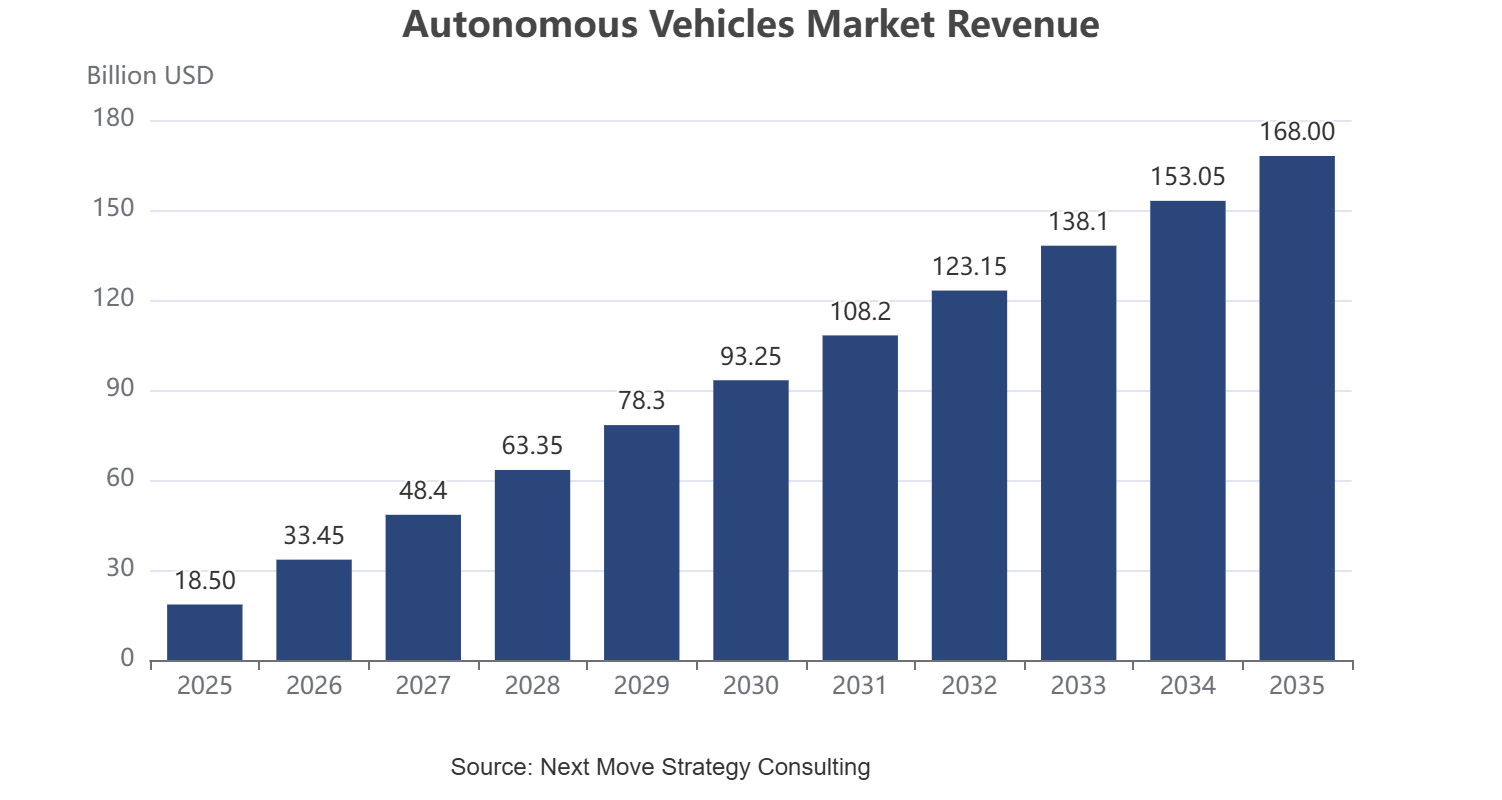
The global Autonomous Vehicles Market size reached USD 18.50 Billion in 2025 and is estimated at USD 24.20 Billion in 2026, forecast to reach USD 168.00 Billion by 2035 at a CAGR of 24.0% between 2026 and 2035. North America leads with an approximate 38% share, while Conditional Automation dominates the automation-level segment at approximately 52% share in 2025.
We observed that commercial robotaxi ridership has scaled tenfold within roughly two years in leading markets, a pace that is pulling High Automation and Full Automation revenue ahead of Conditional Automation even though the latter remains the largest installed base in 2025.
|
Key Takeaways |
|
By Automation Level: Conditional Automation held the largest share, expanding from USD 9.62 billion in 2025 to USD 50.40 billion by 2035; Full Automation is the fastest-growing sub-segment at 38.74% CAGR from 2026–2035. |
|
By Vehicle Type: Passenger Cars held the largest share, expanding from USD 8.51 billion in 2025 to USD 57.12 billion by 2035; Robotaxis is the fastest-growing sub-segment at 29.31% CAGR from 2026–2035. |
|
By End User: Consumers held the largest share, expanding from USD 7.77 billion in 2025 to USD 50.40 billion by 2035; Mobility Service Providers is the fastest-growing sub-segment at 28.29% CAGR from 2026–2035. |
|
Dominant Region: North America dominated with approximately 38% revenue share in 2025. |
|
Fastest-Growing Region: Asia-Pacific is expected to register the highest CAGR of 26.28% during 2026–2035. |
|
Dominant Country: The U.S. led the market, anchored by concentrated robotaxi commercial deployment and federal regulatory reform. |
|
Fastest-Growing Country: China is the fastest-growing country, supported by rapid robotaxi fleet expansion across multiple metropolitan pilot cities. |
Market Opportunity: The market presents an absolute investment opportunity of approximately USD 143.80 Billion between 2026 and 2035, calculated as the difference between the 2035 forecast of USD 168.00 Billion and the 2026 base of USD 24.20 Billion, positioning robotaxi platforms and Full Automation technology stacks as a high-conviction category for technology developers and mobility investors.
According to NMSC analysis, the segment's momentum stems from the shift among leading operators from geographically limited pilots toward multi-city commercial scale, which is compressing the timeline between technology validation and revenue-generating fleet deployment across major metropolitan markets.
Ecosystem Analysis of the Autonomous Vehicles Industry
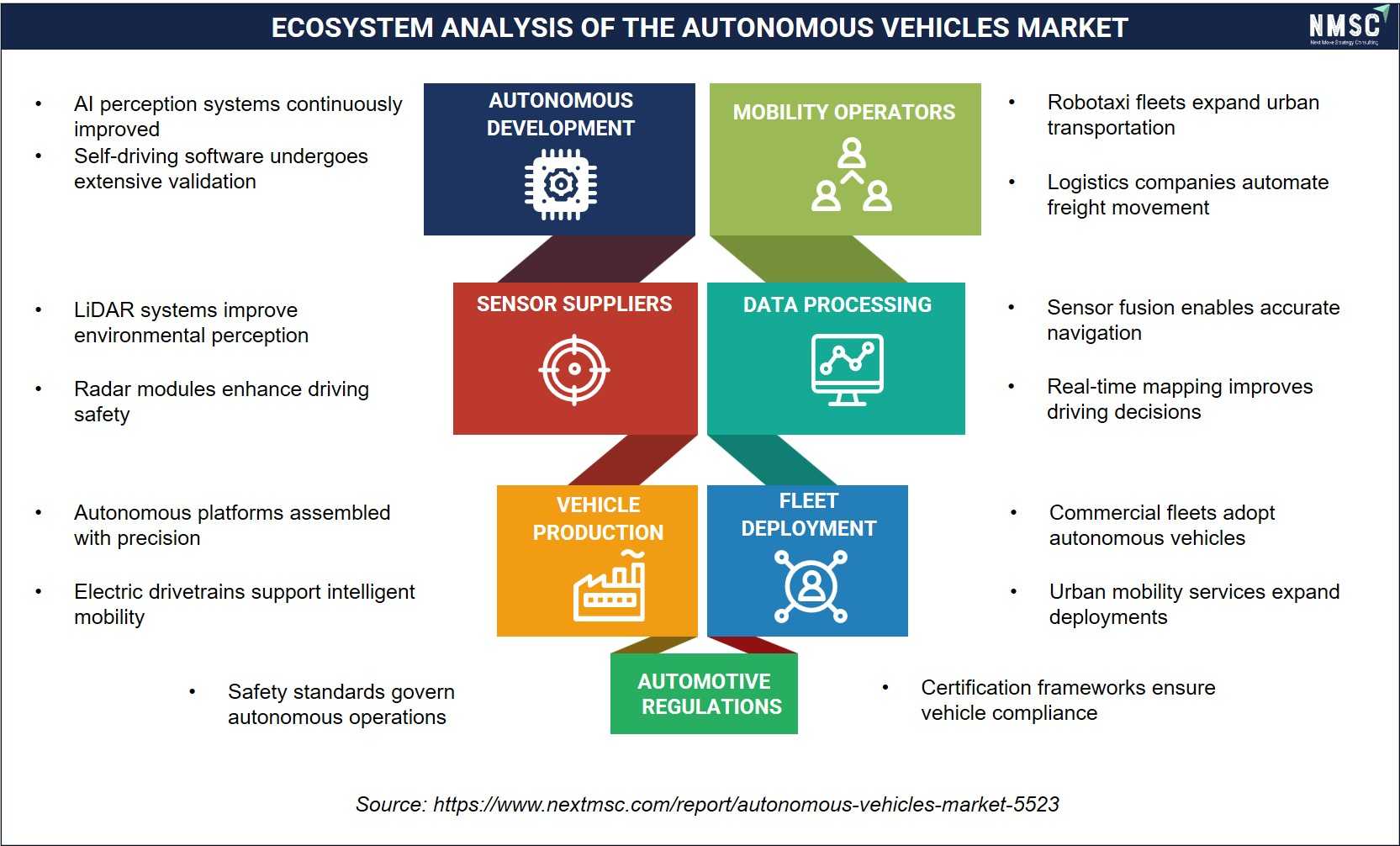
The above infographic maps the interdependent autonomous vehicle ecosystem, where advanced AI perception development and precise sensor suppliers establish foundational safety and environmental awareness. Data processing and vehicle production ensure seamless sensor fusion and precise manufacturing for intelligent mobility. Market viability hinges on fleet deployment by operators expanding urban and logistics services. Ultimately, automotive regulation serves as the critical gatekeeper, enforcing stringent safety standards and certification frameworks that govern safe, compliant commercial autonomous operations.
What does the Autonomous Vehicles Market Encompass?
The Autonomous Vehicles Market covers hardware, software, and mobility service revenue generated by SAE Level 3 conditional automation through Level 5 full automation vehicles across passenger cars, robotaxis, commercial trucks, shuttles, and delivery vehicles. We observed that the market has evolved from geographically constrained pilot programs into multi-city commercial robotaxi networks as leading operators demonstrated sustained safety performance across millions of driverless miles.
Our findings suggest that the U.S. Department of Transportation's 2025 Automated Vehicle Framework, which streamlined exemption processes and prioritized removing design barriers for vehicles lacking manual controls, is directly accelerating commercial deployment timelines. Technology adoption trends toward integrated camera, radar, and LiDAR sensor fusion combined with AI-based perception systems are further compressing the gap between conditional and full automation capability across passenger and commercial vehicle platforms.
|
Parameters |
Details |
|
Market Size in 2025 |
USD 18.50 Billion |
|
Market Size in 2026 |
USD 24.20 Billion |
|
Revenue Forecast in 2035 |
USD 168.00 Billion |
|
Growth Rate |
CAGR of 24% from 2026 to 2035 |
|
Analysis Period |
2025–2035 |
|
Base Year Considered |
2025 |
|
Forecast Period |
2026–2035 |
|
Market Size Estimation |
USD Billion |
|
Companies Profiled |
20 |
|
Countries Covered |
38 |
|
Market Share |
Available for Top 10 Companies |
Key Emerging Trends
Based on research conducted by NMSC, we found that four structural trends are redefining how autonomous vehicle developers scale, regulate, and monetize their technology through 2035.
How Is Robotaxi Ridership Scaling Transforming Commercial Viability in the Autonomous Vehicles Market?
We found that robotaxi ridership scaling is transforming the category from a demonstration technology into a commercially viable transportation mode. Waymo grew weekly paid rides from approximately 50,000 in May 2024 to 500,000 by March 2026, a tenfold increase in under two years, while expanding from three to ten U.S. cities, exemplifying how utilization and geographic scale are compounding simultaneously rather than sequentially.
What Role Does Regulatory Framework Reform Play in Commercial Deployment?
Our assessment indicates that NHTSA's 2025 Automated Vehicle Framework, which streamlined exemption processing and proposed removing manual brake control requirements for fully autonomous vehicles in 2026, is directly enabling faster commercial rollout. This regulatory reform reflects federal prioritization of reducing state-by-state patchwork requirements that previously slowed multi-state robotaxi and trucking deployment.
How Are Stakeholders Responding to Autonomous Trucking Commercialization?
We observed that logistics and freight companies are responding to autonomous trucking commercialization by piloting driver-out highway operations on defined interstate corridors ahead of broader network expansion. This stakeholder response reflects the trucking industry's structural driver shortage, which is pushing freight operators to partner directly with autonomous driving system developers rather than waiting for full nationwide regulatory clarity.
Why Is International Robotaxi Expansion Gaining Traction Beyond the U.S.?
During our market evaluation, we noticed that international robotaxi expansion is gaining traction as operators pursue partnerships that pair local ride-hailing networks with autonomous driving technology providers. Uber's partnership with Pony.ai and Verne to launch Europe's first robotaxi service in Zagreb illustrates this traction, reflecting how technology developers increasingly rely on established ride-hailing platforms to accelerate market entry outside their home markets.
Growth Drivers & Restraints
Growth Catalyst & Risk Assessment Matrix
|
Factors |
Type |
(+/−) % Impact on CAGR |
Geographic Relevance |
Impact Timeline |
|
Scaling robotaxi ridership and multi-city geographic expansion |
Driver |
+6.8% |
North America, Asia-Pacific |
2026–2035 |
|
NHTSA Automated Vehicle Framework regulatory streamlining |
Driver |
+4.2% |
North America |
2026–2030 |
|
Rising autonomous trucking pilots addressing driver shortages |
Driver |
+2.9% |
North America, Europe |
2026–2033 |
|
Expanding sensor fusion and AI perception technology maturity |
Driver |
+2.1% |
Global |
2026–2035 |
|
International robotaxi partnerships with established ride-hailing platforms |
Driver |
+1.4% |
Europe, Asia-Pacific |
2026–2032 |
|
High capital intensity of fleet deployment and sensor hardware |
Restraint |
−2.8% |
Global |
2026–2035 |
|
Fragmented state and national regulatory approval requirements |
Restraint |
−2.2% |
Global |
2026–2032 |
|
Public safety incidents affecting consumer trust and regulatory scrutiny |
Restraint |
−1.6% |
North America, Europe |
2026–2030 |
|
Data reporting and liability uncertainty for driverless operation |
Restraint |
−1.1% |
Global |
2026–2031 |
What is the Primary Growth Driver of the Autonomous Vehicles Market?
The primary growth driver is scaling robotaxi ridership combined with rapid geographic expansion among leading operators. Waymo's weekly paid rides grew from approximately 175,000 in November 2024 to more than 450,000 by December 2025, a 157% increase within roughly twelve months, while its co-CEO has publicly targeted more than 1 million weekly rides across 20 additional cities by the end of 2026.
How is Regulatory Framework Reform Driving the Autonomous Vehicles Market Growth?
Our analysis shows that NHTSA's 2025 Automated Vehicle Framework is directly driving market growth by streamlining the exemption process for commercial deployment of autonomous vehicles under a revised Part 555 process announced in June 2025. NHTSA further proposed removing manual brake control requirements for fully autonomous vehicles in June 2026, reflecting sustained federal prioritization of reducing design barriers that previously constrained Level 4 and Level 5 vehicle commercialization.
What is Restraining the Autonomous Vehicles Market?
We found that the primary restraint is the high capital intensity of fleet deployment, sensor hardware, and continuous safety validation required before commercial launch in any new market. Industry-derived estimates suggest that fragmented state-level regulatory requirements, despite recent federal streamlining efforts, continue to slow multi-state expansion relative to the pace of technology readiness among leading developers.
Segmentation Analysis
Segment Sizing: By Automation Level
|
Segment |
2025 (USD Bn) |
2035 (USD Bn) |
CAGR% (2026–2035) |
|
Conditional Automation |
9.62 |
50.40 |
16.67% |
|
High Automation |
7.40 |
80.64 |
26.56% |
|
Full Automation |
1.48 |
36.96 |
38.74% |
|
Total |
18.50 |
168.00 |
24.02% |
Which Automation Level Segment Dominates the Autonomous Vehicles Market?
Conditional Automation leads with USD 9.62 Billion in 2025, expanding to USD 50.40 Billion by 2035, reflecting its status as the most widely deployed automation tier across current passenger vehicle production. Full Automation is the fastest-growing segment at a 38.74% CAGR, directly tied to robotaxi ridership scaling and expanding driverless commercial deployment across an increasing number of cities without safety drivers on board.
Segment Sizing: By Vehicle Type
|
Segment |
2025 (USD Bn) |
2035 (USD Bn) |
CAGR% (2026–2035) |
|
Passenger Cars |
8.51 |
57.12 |
19.93% |
|
Robotaxis |
4.07 |
53.76 |
29.31% |
|
Commercial Trucks |
2.96 |
30.24 |
25.66% |
|
Shuttles and Buses |
1.48 |
11.76 |
22.17% |
|
Delivery Vehicles |
1.48 |
15.12 |
25.63% |
|
Total |
18.50 |
168.00 |
24.02% |
Which Vehicle Type Leads and Which Grows Fastest in the Autonomous Vehicles Market?
Passenger Cars dominate at USD 8.51 Billion in 2025, reflecting the largest installed base of consumer vehicles equipped with conditional and high automation features. Robotaxis are the fastest-growing vehicle type at a 29.31% CAGR, as Waymo, Pony.ai, WeRide, and Zoox expand fully driverless commercial fleets across a rapidly widening set of metropolitan markets in the United States, China, and Europe.
Segment Sizing: By End User
|
Segment |
2025 (USD Bn) |
2035 (USD Bn) |
CAGR% (2026–2035) |
|
Consumers |
7.77 |
50.40 |
19.48% |
|
Mobility Service Providers |
5.18 |
63.84 |
28.29% |
|
Logistics and Freight Companies |
3.70 |
36.96 |
25.34% |
|
Public Transit Agencies |
1.85 |
16.80 |
24.02% |
|
Total |
18.50 |
168.00 |
24.02% |
Which End User Dominates and Which is Fastest-Growing in the Autonomous Vehicles Market?
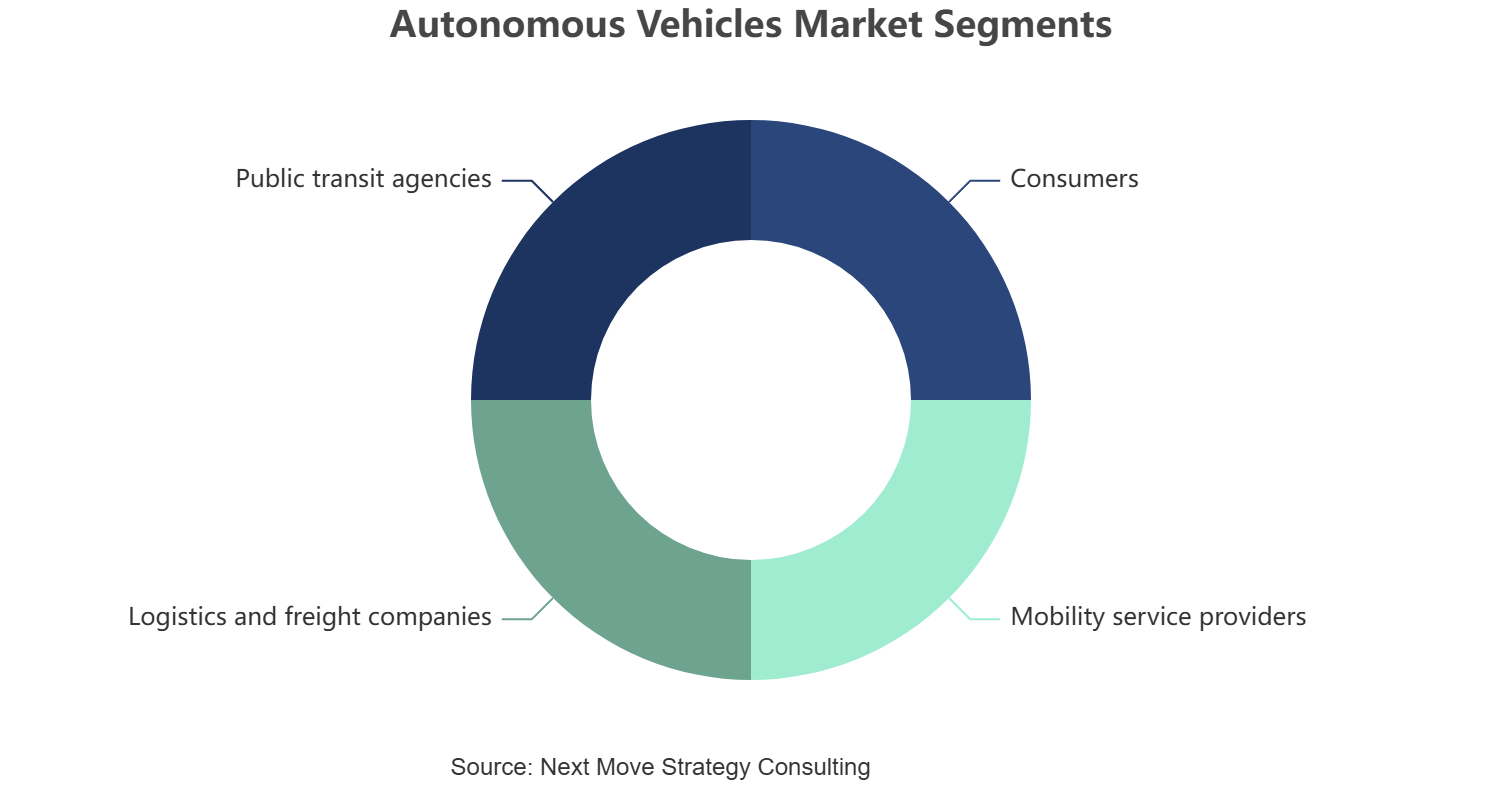
Consumers lead end-user demand at USD 7.77 Billion in 2025, reflecting the scale of privately owned vehicles equipped with conditional automation features across major automotive markets. Mobility Service Providers are the fastest-growing end user at a 28.29% CAGR, directly tied to robotaxi fleet operators scaling paid ridership volume across an expanding number of commercial markets.
Growth Opportunities
Our analysis shows that three whitespace opportunities stand out for developers positioning ahead of 2035 demand.
Can International Ride-Hailing Partnerships Unlock Faster Global Expansion?
Autonomous driving technology developers that partner with established international ride-hailing platforms can capture faster market entry outside their home markets, benefiting the Robotaxis vehicle type and Mobility Service Providers end-user segments as technology providers pair local network access with proven autonomous driving stacks.
Does Autonomous Trucking Corridor Expansion Create Value for Freight Operators?
Developers that expand driver-out highway trucking corridors along defined interstate routes can capture rising freight demand amid structural driver shortages, benefiting the Commercial Trucks vehicle type and Logistics and Freight Companies end-user segments as regulatory frameworks mature for driverless freight operation.
Can Streamlined Federal Exemption Pathways Accelerate New Market Entry?
Developers that proactively engage with NHTSA's streamlined exemption process can capture first-mover advantage in newly opened metropolitan markets, benefiting the Full Automation segment as regulatory clarity reduces the time between technology readiness and commercial launch approval.
Regional Outlook
|
Region |
2025 (USD Bn) |
2035 (USD Bn) |
CAGR% (2026–2035) |
Key Driver |
|
North America |
7.03 |
57.12 |
22.51% |
NHTSA Automated Vehicle Framework and robotaxi scale-up |
|
Asia-Pacific |
6.29 |
67.20 |
26.28% |
Rapid robotaxi fleet expansion across metropolitan pilot cities |
|
Europe |
3.70 |
28.56 |
21.80% |
International robotaxi partnerships and regulatory harmonization |
|
Latin America |
0.74 |
8.40 |
27.11% |
Emerging ride-hailing platform integration |
|
Middle East & Africa |
0.74 |
6.72 |
23.99% |
Government-backed smart mobility pilot programs |
|
Total |
18.50 |
168.00 |
24.02% |
|
North America Autonomous Vehicles Market
North America holds the largest regional share, supported by Waymo's multi-city commercial robotaxi expansion and NHTSA's 2025 Automated Vehicle Framework streamlining exemption pathways. We observed that regulatory reform and commercial scale are compounding simultaneously in this region, positioning North America as both the largest revenue base and the primary proving ground for new autonomous vehicle technology.
Asia-Pacific Autonomous Vehicles Market
Asia-Pacific is the fastest-growing region, driven by Baidu's Apollo Go, Pony.ai, and WeRide expanding robotaxi fleets across multiple Chinese metropolitan pilot cities. We found that domestic technology developers are scaling deployment fastest in this region, reflecting supportive government pilot programs and dense urban demand that favor rapid fleet expansion.
Europe Autonomous Vehicles Market
Europe's market benefits from international robotaxi partnerships, exemplified by Uber, Pony.ai, and Verne launching commercial service in Zagreb as a beachhead for further European expansion. Our findings suggest that regional regulatory harmonization efforts are gradually easing cross-border deployment even as individual national frameworks continue to vary in approval timelines.
Middle East & Africa Autonomous Vehicles Market
The Middle East & Africa region remains an early-stage market, with the UAE and Saudi Arabia leading government-backed smart mobility pilot programs tied to broader urban development initiatives. Industry-derived estimates suggest regional growth will track broader smart city investment rather than autonomous-vehicle-specific regulatory mandates, given the comparatively nascent commercial deployment environment in the region.
Latin America Autonomous Vehicles Market
Latin America is expanding at a 27.11% CAGR, led by Brazil's growing ride-hailing platform integration and urban mobility investment. We observed that Argentina's transportation sector offers latent demand for autonomous vehicle technology as regional ride-hailing platforms begin exploring partnerships with established autonomous driving developers.
U.S. Autonomous Vehicles Market
Based on our estimates, the U.S. market was valued at approximately USD 6.29 Billion in 2025 and is projected to reach USD 51.24 Billion by 2035 at a CAGR near 22.5%. Demand structure is anchored by Waymo's commercial robotaxi scale across ten cities and NHTSA's streamlined exemption framework, with high technology penetration and strong competitive intensity between Alphabet, Tesla, Amazon, and Aurora Innovation.
Canada Autonomous Vehicles Market
The market in Canada was estimated at around USD 0.74 Billion in 2025, forecast to reach USD 5.88 Billion by 2035 at roughly 22.6% CAGR. Canada's demand structure closely mirrors U.S. regulatory alignment, with growing autonomous trucking pilot interest along cross-border freight corridors supporting steady technology penetration.
UK Autonomous Vehicles Market
As per our estimate, the UK market stood near USD 0.56 Billion in 2025 and is expected to reach USD 4.20 Billion by 2035 at approximately 22.0% CAGR. Growing government interest in permitting robotaxi trials and Waymo's stated plans for international expansion support demand, with regulatory influence centered on national transport authority approval processes.
Germany Autonomous Vehicles Market
According to our analysis, Germany's market was valued at about USD 0.93 Billion in 2025, projected to reach USD 6.89 Billion by 2035 at a CAGR near 21.9%. Germany's demand structure benefits from its large domestic automotive manufacturing base and established automotive technology suppliers including Continental and Bosch, supporting high technology penetration across conditional and high automation systems.
France Autonomous Vehicles Market
Based on our estimates, France's market reached approximately USD 0.52 Billion in 2025 and is forecast to grow to USD 3.86 Billion by 2035 at around 22.0% CAGR. Demand is supported by growing interest in autonomous shuttle pilots for public transit applications, with moderate competitive intensity among regional and global technology providers.
China Autonomous Vehicles Market
The market in China was valued at nearly USD 3.02 Billion in 2025 and is projected to reach USD 34.66 Billion by 2035 at approximately 27.6% CAGR. China's dominance reflects rapid robotaxi fleet expansion by Baidu Apollo Go, Pony.ai, and WeRide across multiple metropolitan pilot cities, with domestic developers competing intensely alongside government-supported commercialization programs.
India Autonomous Vehicles Market
As per our estimate, India's market was close to USD 0.44 Billion in 2025, expected to reach USD 5.71 Billion by 2035 at roughly 29.6% CAGR, among the fastest of covered countries. Rising interest in autonomous logistics and delivery vehicle pilots is driving early demand, though technology penetration remains limited as formal regulatory frameworks for autonomous passenger vehicles continue to develop.
Japan Autonomous Vehicles Market
According to our analysis, Japan's market stood at about USD 0.63 Billion in 2025 and is forecast to reach USD 6.05 Billion by 2035 at approximately 25.3% CAGR. Japan's demand structure benefits from government support for autonomous shuttle pilots addressing rural mobility needs, alongside established automotive technology suppliers including Denso.
South Korea Autonomous Vehicles Market
Based on our estimates, South Korea's market was valued near USD 0.44 Billion in 2025, projected to reach USD 4.54 Billion by 2035 at around 26.3% CAGR. Deep integration between Hyundai Motor Company and domestic autonomous driving research supports rising technology adoption within a competitively intense domestic development environment.
Australia Autonomous Vehicles Market
As per our estimate, Australia's market reached approximately USD 0.19 Billion in 2025 and is expected to grow to USD 1.68 Billion by 2035 at roughly 24.4% CAGR. Australia's demand structure benefits from growing government interest in autonomous shuttle trials for regional and suburban transit applications.
UAE Autonomous Vehicles Market
Based on our estimates, the UAE market was valued at about USD 0.15 Billion in 2025 and is forecast to reach USD 1.51 Billion by 2035 at approximately 26.3% CAGR. Government-backed smart mobility programs and growing ride-hailing platform investment support the UAE's emerging role as a regional autonomous vehicle testing hub.
Saudi Arabia Autonomous Vehicles Market
According to our analysis, Saudi Arabia's market stood near USD 0.15 Billion in 2025, projected to reach USD 1.34 Billion by 2035 at around 24.7% CAGR. Vision 2030-linked smart city initiatives are supporting early-stage investment in autonomous mobility pilot infrastructure across the country.
South Africa Autonomous Vehicles Market
As per our estimate, South Africa's market was close to USD 0.06 Billion in 2025 and is expected to reach USD 0.47 Billion by 2035 at roughly 23.0% CAGR. A growing urban ride-hailing sector gives South Africa the strongest technology penetration in the MEA region, supporting a strategic outlook centered on future autonomous mobility pilot programs.
Brazil Autonomous Vehicles Market
Based on our estimates, Brazil's market reached approximately USD 0.44 Billion in 2025 and is projected to reach USD 5.04 Billion by 2035 at around 27.7% CAGR. Growing ride-hailing platform integration and urban mobility investment are driving demand structure, with strategic investment appeal strengthening as regional interest in autonomous technology partnerships expands.
Argentina Autonomous Vehicles Market
According to our analysis, Argentina's market was valued at about USD 0.11 Billion in 2025, forecast to reach USD 1.18 Billion by 2035 at approximately 26.9% CAGR. A growing urban transportation sector offers rising demand for autonomous vehicle technology, though competitive intensity remains moderate given the still-developing formal regulatory infrastructure relative to Brazil.
Regulatory Framework Impacting the Autonomous Vehicles Industry
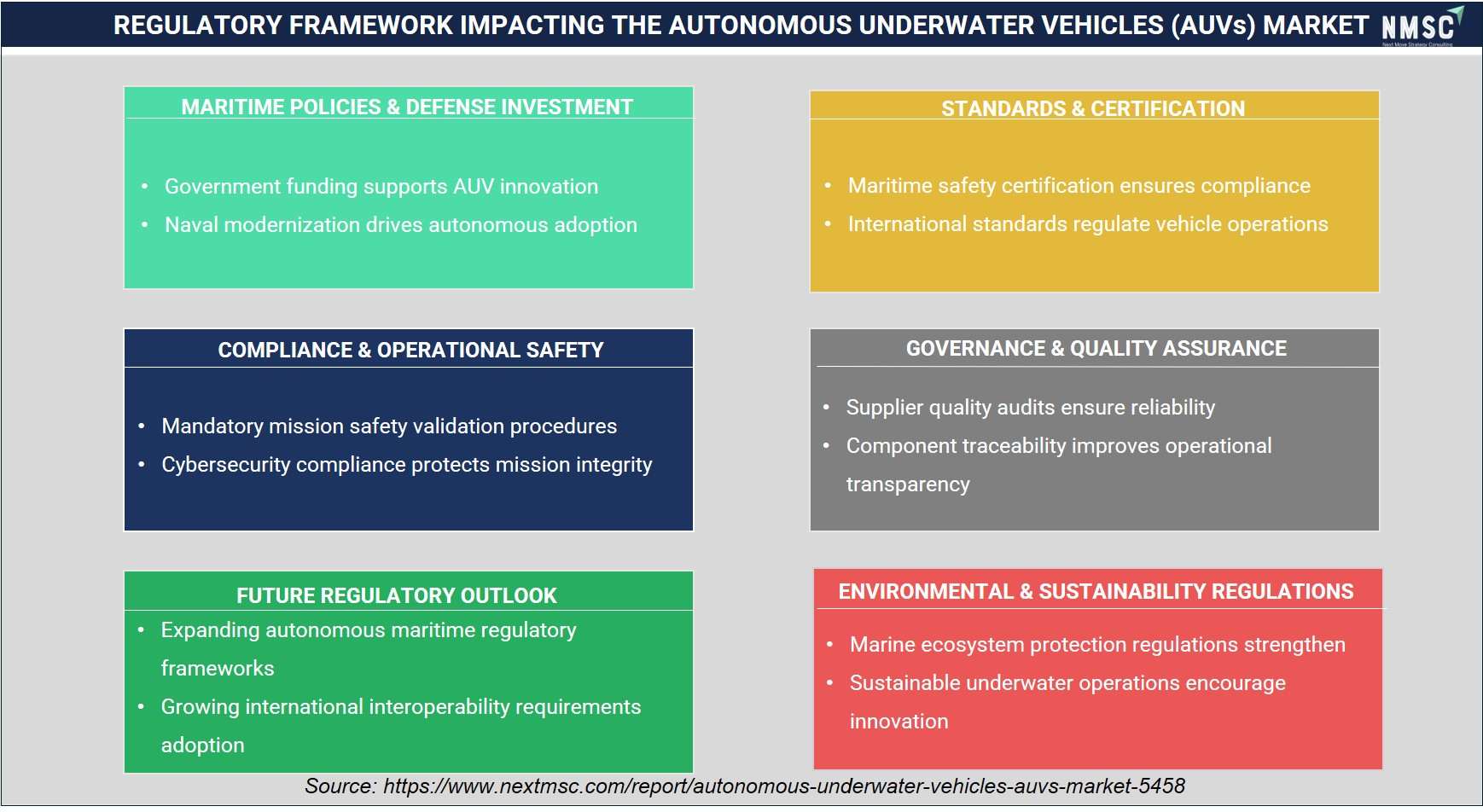
The above infographic outlines the comprehensive regulatory framework governing the autonomous vehicle market, where government incentives and standardization certifications establish foundational safety and cybersecurity benchmarks. Operational integrity depends on rigorous testing approvals, data privacy frameworks, and strict enforcement through continuous compliance audits. Market viability also hinges on navigating complex trade and tariff regulations affecting component imports. Ultimately, future regulatory outlook—governing AI and connected mobility—will serve as the critical gatekeeper for sustainable, large-scale autonomous deployment.
Competitive Landscape
Our assessment indicates that the competitive landscape spans diversified technology conglomerates, dedicated autonomous driving developers, and established automotive suppliers, each competing on driverless miles validated, geographic scale, and sensor and compute technology depth.
|
Key Takeaways |
|
Market Structure: Fragmented; top 10 companies hold a meaningful but not dominant share of Market Share, reflecting a mix of technology conglomerates, dedicated AV developers, and automotive suppliers |
|
Innovation Focus: Sensor fusion and AI perception systems, robotaxi fleet scaling, autonomous trucking corridors, and regulatory-compliant exemption pathways |
|
M&A Activity: Selective acquisitions expanding adjacent AI and robotics capability, alongside targeted wind-downs of underperforming robotaxi programs, rather than broad industry consolidation |
How Do Companies Compete in the Autonomous Vehicles Market?
Companies compete primarily on validated driverless miles, breadth of geographic deployment across metropolitan markets, and depth of sensor fusion and AI perception technology. Our findings suggest that vendors with the largest accumulated safety data hold a structural advantage over newer entrants, since regulatory exemption approval and public trust both depend heavily on demonstrated operational track record.
Which Competitive Archetypes Dominate the Autonomous Vehicles Market?
Diversified technology conglomerates such as Alphabet Inc. and Amazon.com, Inc. dominate through integrated AI research, cloud infrastructure, and dedicated robotaxi subsidiaries, while pureplay developers including Aurora Innovation, Pony.ai, and WeRide differentiate through focused autonomous trucking or robotaxi technology stacks. Established automotive suppliers such as Mobileye, Continental, and Bosch compete on embedded ADAS-to-autonomy technology integration underserved by newer software-first entrants.
What Innovation and Differentiation Strategies Are Companies Pursuing?
We observed that leading developers are investing in expanding fully driverless commercial operating domains and pursuing NHTSA's streamlined exemption pathways to accelerate new market entry. Differentiation increasingly rests on demonstrated safety performance at scale, since regulators and the public increasingly evaluate autonomous vehicle developers on accumulated operational data rather than technology demonstrations alone.
What M&A and Partnership Activity Is Shaping the Industry?
Recent activity favors targeted capability acquisitions and platform partnerships, exemplified by Mobileye's agreement to acquire Mentee Robotics to expand into humanoid robotics alongside its core autonomous driving business, and Uber's partnership with Pony.ai and Verne to launch robotaxi service in Zagreb. Our analysis shows that such structures let incumbents extend technology reach and geographic footprint without the integration risk of large-scale mergers.
Key Market Players
Based on research conducted by NMSC, the following companies represent the validated set of leading participants across autonomous driving technology development, robotaxi operation, and autonomous vehicle hardware and software supply.
-
Alphabet Inc.
-
Tesla, Inc.
-
Baidu, Inc.
-
Mobileye Global Inc.
-
NVIDIA Corporation
-
Aurora Innovation, Inc.
-
Pony.ai Inc.
-
WeRide Inc.
-
Amazon.com, Inc.
-
General Motors Company
-
Qualcomm Incorporated
-
Continental AG
-
Robert Bosch GmbH
-
Aptiv PLC
-
DENSO Corporation
-
Valeo SE
-
Hyundai Motor Company
-
Nuro, Inc.
-
DiDi Global Inc.
-
Uber Technologies, Inc.
Latest Developments
We found that recent activity reflects continued robotaxi scale-up, regulatory reform, and targeted technology acquisitions even as the overall competitive landscape remains fragmented among established and emerging developers.
|
Date |
Event |
|
June 2026 |
Uber, Nuro, and Lucid announced Houston as the second planned deployment market for their autonomous robotaxi program, with commercial service expected to launch in mid-2027. |
|
February 2026 |
Uber launched Uber Autonomous Solutions, a platform designed to help autonomous vehicle developers commercialize robotaxi and autonomous delivery services. |
Expert Insights
 “Autonomous technology has remarkable potential to make transportation safer and more affordable. Innovation in autonomy is moving quickly, but meaningful commercialization will take much longer.”
— Dara Khosrowshahi, Chief Executive Officer, Uber Technologies, Inc.
Statement made during the launch of Uber Autonomous Solutions.
Market Interpretation
The insight emphasizes that the future of the Autonomous Vehicles Market depends not only on advances in autonomous driving technology but also on the ability to commercialize safe, scalable, and reliable mobility services. As autonomous vehicle developers increasingly collaborate with mobility platforms, OEMs, and AI technology providers, the industry is shifting toward large-scale deployment of robotaxis, autonomous freight, and driverless delivery services, accelerating the commercialization of Level 4 autonomous mobility solutions.
Investment Opportunities
Where Are Capital Inflows Concentrating in the Autonomous Vehicles Market?
Capital is concentrating in robotaxi fleet expansion and sensor and compute technology, reflected in Mobileye's 8-year expected automotive revenue pipeline reaching USD 24.5 billion at year-end 2025, a 42% increase since year-end 2022. This sustained pipeline growth signals durable capital allocation toward autonomous driving technology ahead of broader commercial scale-up.
How Is Infrastructure Investment Shaping Long-Term Capacity?
Our findings suggest that infrastructure investment is shifting toward multi-city fleet operations centers and expanded sensor manufacturing capacity as operators prepare for geographic scale beyond initial pilot markets. This shift favors developers with existing fleet operations infrastructure that can be replicated across new cities without full operational redesign.
What ESG Considerations Are Influencing Investment Decisions?
Environmental, Social, and Governance considerations in this market center on road safety outcomes and equitable transportation access, given autonomous vehicle developers' public claims of safety performance relative to human drivers. We found that investors increasingly favor developers demonstrating transparent safety data disclosure and regulatory compliance as a proxy for durable, socially aligned growth.
Key Benefits for Stakeholders
How Does This Report Benefit Industry Leaders?
Industry leaders gain segment-level revenue forecasts and CAGR benchmarks across automation level, vehicle type, and end-user axes, enabling technology-roadmap decisions grounded in the same 2025–2035 figures used consistently throughout this analysis. Our findings on regional growth differentials further support market-entry and regulatory-engagement decisions.
How Does This Report Benefit Investors and Financial Analysts?
Investors and financial analysts gain a reconciled market-sizing model, competitive-landscape assessment, and named-company development tracking that supports valuation and capital-allocation decisions. The report's Growth Catalyst & Risk Assessment Matrix quantifies driver and restraint impact on CAGR, aiding scenario analysis for portfolio positioning.
How Does This Report Benefit Technology Vendors and Product Teams?
Technology vendors and product teams gain visibility into which automation-level and vehicle-type segments, such as Full Automation and Robotaxis, are growing fastest, informing where to prioritize engineering investment and regulatory strategy through 2035.
Key Market Segments
By Automation Level
-
Conditional automation
-
High automation
-
Full automation
By Vehicle Type
-
Passenger cars
-
Robotaxis
-
Commercial trucks
-
Shuttles and buses
-
Delivery vehicles
By End User
-
Consumers
-
Mobility service providers
-
Logistics and freight companies
-
Public transit agencies
By Region
-
North America: U.S., Canada, Mexico
-
Europe: UK, Germany, France, Italy, Spain, Sweden, Denmark, Finland, Netherlands, Rest of Europe
-
Asia-Pacific: China, India, Japan, South Korea, Taiwan, Indonesia, Vietnam, Australia, Philippines, Malaysia, Rest of APAC
-
Middle East & Africa: Saudi Arabia, UAE, Egypt, Israel, Turkey, Nigeria, South Africa, Rest of MEA
-
Latin America: Brazil, Argentina, Chile, Colombia, Rest of LATAM
Conclusion & Recommendations
What Is the Long-Term Outlook for the Autonomous Vehicles Market?
The long-term outlook remains strongly positive, with the market expanding from USD 24.20 Billion in 2026 to USD 168.00 Billion by 2035 at a 24.0% CAGR, driven by robotaxi ridership scaling and regulatory framework reform. We observed that this growth trajectory is underpinned by demonstrated commercial traction rather than speculative technology promise, supporting sustained capital investment across leading developers.
What Strategic Positioning Do We Recommend?
Our assessment indicates that developers should prioritize multi-city fleet expansion and regulatory engagement with NHTSA's streamlined exemption process to capture the fastest-growing Full Automation and Robotaxis segments. Companies without established driverless mile validation should pursue partnership-based market entry rather than solo commercialization given the safety-data advantage held by first-mover operators.
How Attractive Is the Market for Investment?
Investment attractiveness is high in Asia-Pacific and Latin America given superior CAGR profiles of 26.28% and 27.11% respectively, while North America offers the largest absolute revenue base with the most advanced regulatory clarity. We found that Mobility Service Providers and Full Automation revenue streams offer stronger growth profiles than mature Conditional Automation segments alone.
What Are the Key Market Shifts and Risks?
Key risks include the high capital intensity of fleet deployment and continued fragmentation of state and national regulatory requirements despite recent federal streamlining efforts. Our analysis shows that developers unable to sustain safety performance at scale risk facing renewed regulatory scrutiny and public trust setbacks that could slow commercial expansion timelines industry-wide.
What Are the Primary Growth Pathways Through 2035?
Primary growth pathways include multi-city robotaxi expansion, deeper autonomous trucking corridor commercialization, and international partnerships pairing established ride-hailing networks with proven autonomous driving technology. We observed that developers combining all three pathways are best positioned to capture disproportionate share of the USD 143.80 Billion absolute opportunity created between 2026 and 2035.
About the Author

About the Reviewer

At Next Move Strategy Consulting, we understand that insightful market research is the cornerstone of successful business decisions. That's why we employ a robust and multifaceted approach, combining various methodologies to deliver the most accurate and actionable data for our clients.

Research Landscape
We navigate the world of research with two primary approaches:
Qualitative Approach
Our qualitative research methodologies involve immersive techniques such as in-depth interviews, focus groups, and observational studies. By engaging directly with individuals and stakeholders, we uncover valuable insights that quantitative data alone may overlook.

Quantitative Research
In tandem with qualitative methodologies, NMSC leverages the power of Quantitative Research to provide a robust foundation of numerical insights. Through systematic data collection and analysis, we quantify patterns, preferences, and market trends, offering a comprehensive view of the business landscape.
Our quantitative research approach employs diverse tools, including surveys, experiments, and statistical modelling. These methodologies enable us to gather data from a large and representative sample, ensuring the statistical significance of our findings. By employing structured questionnaires and standardized data collection methods, we guarantee the reliability and validity of the information we present to our clients.
Quantitative research is particularly effective in measuring the prevalence of trends, assessing market size, and gauging the impact of various factors on consumer behavior. The numerical precision attained through this approach equips our clients with actionable insights, facilitating data-driven decision-making and strategy formulation.


Our Specialized Toolbox for Industry-Specific Market Research
We deploy a specialized arsenal of techniques tailored to meet your unique requirements. Here's a glimpse into our comprehensive toolbox:

Information Procurement
The stage entails acquiring market data or relevant information through various sources and methodologies.


Market Research Approach
We utilize both top-down and bottom-up approaches in market research analysis to achieve a comprehensive understanding of the market dynamics, leveraging the broad perspective of industry trends and macroeconomic factors alongside detailed insights from specific segments and individual companies.

Porters Five Forces Analysis
We conduct Porter's Five Forces analysis to evaluate the competitive landscape of an industry, providing us with insights into factors that affect profitability and strategic positioning.

SWOT Analysis

Forecasting
We utilize a forecasting model to predict future consumption by considering parameters like population, economics, regulations, market competition, drivers, constraints, technology, and pricing. We also employ statistical techniques such as multilinear regression, exponential smoothing, moving average, ARIMA, and Monte Carlo simulations for accurate predictions. In econometric forecasting, we analyzed short-term and long-term event impacts, attributing values based on regulatory frameworks, economic factors, and market events.





 Speak to Our Analyst