Battery Grade Nickel Market Analysis and Forecast

Nickel Market size was USD 7.40 Billion in 2025, projected to reach USD 14.40 Billion by 2035, growing at a CAGR of 6.3% from 2026 to 2035. Key drivers include rising demand for nickel-rich EV cells, low-carbon refining, and new Indonesian HPAL capacity, with Asia-Pacific leading the market.

Download Free Sample PDF
Base Year (2025)
$7.40 Billion
Forecast (2035)
$14.40 Billion
CAGR (2026-2035)
6.3%
Top Region
Asia-Pacific

What Is the Battery Grade Nickel Market Size?
The global Battery Grade Nickel Market was valued at USD 7.40 Billion in 2025 and is estimated at USD 8.30 Billion in 2026. It is forecast to reach USD 14.40 Billion by 2035, a 6.3% CAGR from 2026 to 2035. Asia-Pacific leads with about 61% share, while nickel sulfate leads with about 62%.

We observed that refiners with secured feedstock and verified impurity control are capturing the strongest pricing, which makes the following takeaways useful for sizing.

Battery Grade Nickel Market Analysis and Forecast Revenue Forecast
Values in USD Billion

2025 $7.40 Billion
2025
2026 $8.30 Billion
2026
2027 $8.82 Billion
2027
2028 $9.38 Billion
2028
2029 $9.97 Billion
2029
2030 $10.60 Billion
2030
2031 $11.27 Billion
2031
2032 $11.98 Billion
2032
2033 $12.73 Billion
2033
2034 $13.53 Billion
2034
2035 $14.40 Billion
2035

Key Takeaways

By Product Form: Nickel sulfate held the largest share, expanding from USD 4.60 Billion in 2025 to USD 9.15 Billion by 2035, and also leads growth at 6.6% CAGR from 2026–2035.

By Battery Chemistry: NMC (nickel manganese cobalt) held the largest share, increasing from USD 6.05 Billion in 2025 to USD 11.60 Billion by 2035. Other nickel-bearing chemistries are the fastest-growing category, at a 7.1% CAGR from 2026 to 2035.

By End Use: Electric vehicles held the largest share, increasing from USD 5.95 Billion in 2025 to USD 11.40 Billion by 2035. Energy storage systems are the fastest-growing end-use segment, at a 10.7% CAGR from 2026 to 2035.

Dominant Region: Asia-Pacific accounted for USD 4.58 Billion in 2025 and is projected to reach USD 8.15 Billion by 2035.

Fastest-Growing Region: Latin America is expanding at 10.7% CAGR from 2026–2035, moving from USD 0.30 Billion in 2026 to USD 0.75 Billion by 2035.

Dominant Country: China contributed USD 2.60 Billion in 2025 and is projected at USD 4.20 Billion by 2035.

Fastest-Growing Country: India is advancing at 11.4% CAGR from 2026–2035, rising from USD 0.22 Billion in 2026 to USD 0.58 Billion by 2035.

The Battery Grade Nickel Market presents an absolute opportunity of USD 6.10 Billion between 2026 and 2035, which investors should read as room for new refining capacity rather than a single product cycle.
According to NMSC analysis, the spread between nickel sulfate prices and refined nickel prices, not headline LME levels, will decide which producers capture incremental battery demand.

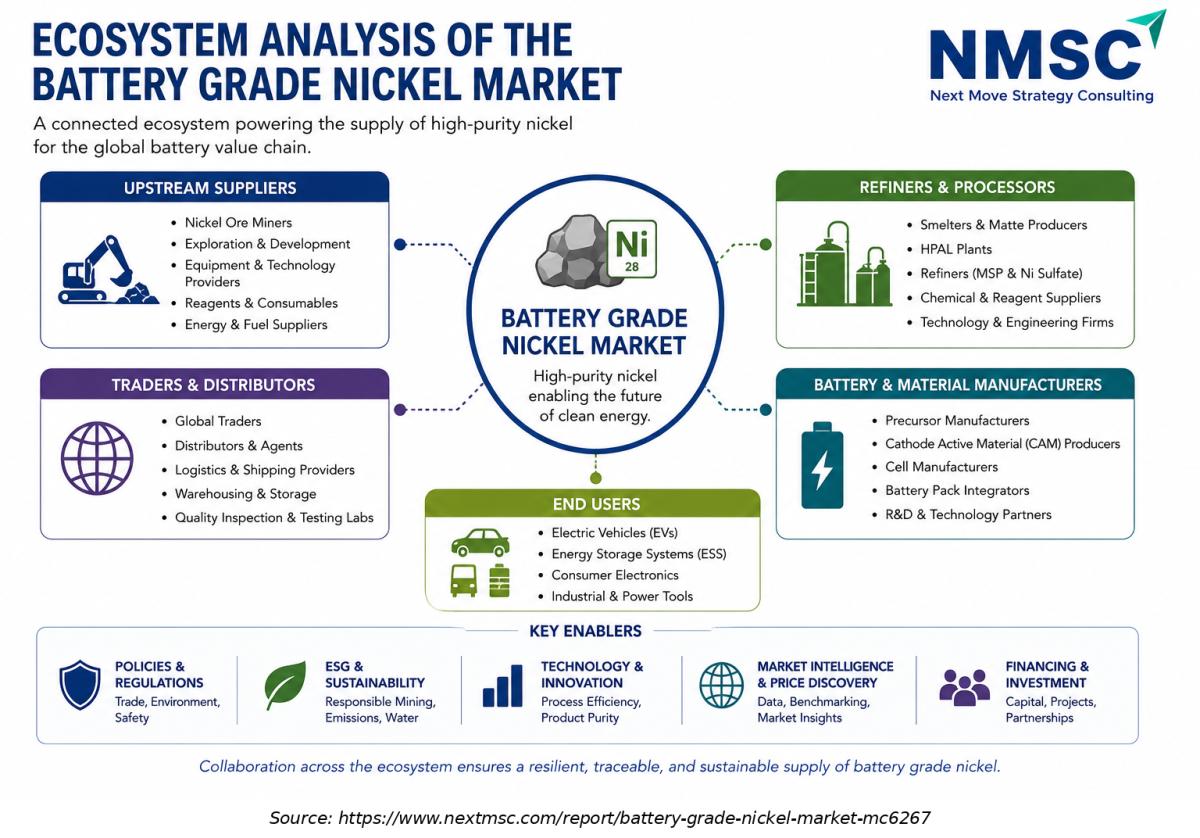
Ecosystem Analysis of the Battery Grade Nickel Market
The battery-grade nickel ecosystem brings together mining companies, refiners, traders, battery material manufacturers, and end users across electric vehicles and energy storage applications. Technological innovation, sustainability standards, regulatory policies, and investment shape the development of a reliable and traceable nickel supply chain

What Does the Battery Grade Nickel Market Encompass?
The Battery Grade Nickel Market covers refined nickel products purified to the impurity limits that lithium-ion cathode makers require. The scope includes nickel sulfate, nickel hydroxide, and Class 1 nickel metal in cathode, briquette, and powder forms when supplied for battery-material applications. Mixed hydroxide precipitate and matte count only once they are refined to battery specification. This market report values sales at the point where product leaves the refinery, so conversion margins stay inside the figures.
Regulation shapes demand and trade in this industry. Indonesia regulates nickel-ore supply through annual production quotas. Its 2026 quotas were initially reduced relative to 2025, with further adjustments remaining subject to government review during the year. Technology adoption centers on hydrometallurgical refining, scrap leaching and impurity monitoring that lets sulfate meet cathode precursor specifications.

Market Drivers & Dynamics

Interactive Dataset
Nickel rich EV cell demand driver +1.6% Global 2026–2035
Indonesian HPAL refining capacity driver +0.9% Asia-Pacific 2026–2030
Low carbon and traceable supply rules driver +0.7% Europe, North America 2026–2031
Storage projects adopting NMC cells driver +0.5% North America, Asia-Pacific 2027–2035
LFP and sodium ion substitution restraint −1.4% Asia-Pacific, Global 2026–2032
Sulfur and acid cost volatility at HPAL plants restraint −0.6% Asia-Pacific 2026–2029
Nickel and sulfate oversupply pressure on price restraint −0.5% Global 2026–2028
Source: Next Move Strategy Consulting

Growth Drivers

What Is the Primary Growth Driver in the Battery Grade Nickel Market?

Demand from nickel rich EV cells remains the primary driver. The IEA reports that global battery demand grew by more than 35% in 2025 and passed 1.5 TWh, with storage emerging as a major source of growth. The International Nickel Study Group data show batteries rising from 6% of primary nickel use in 2018 to about 17% in 2024. These data points explain why the Battery Grade Nickel Market grows faster than total nickel demand even as LFP absorbs part of each added gigawatt hour.
How Is Indonesian Refining Capacity Driving the Battery Grade Nickel Market Growth?
The IEA found that China and Indonesia accounted for most of the supply growth in nickel refining between 2020 and 2024. New high pressure acid leach plants now add capacity that can feed sulfate and cathode lines. Nickel Industries reports that its ENC project is designed for a nameplate capacity of up to 72,000 tonnes per annum of contained nickel equivalent across mixed hydroxide precipitate (MHP), nickel sulfate, and nickel cathode, providing significant long-term feedstock liquidity to downstream cathode producers. We observed that this supply response lowers feedstock risk for sulfate producers and sustains volume growth in the Battery Grade Nickel Market, although Jakarta's ore quota policy governs the pace.

Growth Inhibitors

What Is Restraining the Battery Grade Nickel Market?

Substitution is the main restraint. Chinese cell makers have shifted toward LFP, and sodium ion batteries now contest low cost segments. The International Nickel Study Group has said that nickel use in batteries expanded more slowly than predicted because of LFP and plug in hybrids. Terrafame has described oversupply in nickel and nickel sulfate markets, which caps price and limits revenue growth in the Battery Grade Nickel Market even when volumes rise.

What Are the Growth Opportunities?

How Can Refiners Capture Cathode Localization in Europe and North America?

Cathode and cell manufacturers outside China may seek regional nickel sulfate supplies to diversify sourcing and meet applicable carbon-reporting and traceability requirements. Terrafame and Nornickel Harjavalta already serve Europe from Finland with established processing infrastructure. Refiners with secured intermediate feed can sign long-term sulfate contracts at premiums, while cathode producers gain critical supply security. This is the most bankable path to share gains in the Battery Grade Nickel Market.

Where Does Recycled Nickel Create New Revenue?

Recycled content rules in Europe from 2031 create a premium for sulfate made from scrap. Sumitomo Metal Mining and Panasonic Energy already run a closed loop, which shows the route works at industrial scale. Refiners that add scrap leaching lines can serve cell makers that must document recycled nickel. Gains in the Battery Grade Nickel Market from this route start small but compound as gigafactory scrap volumes rise.

How Can Indonesian Producers Monetize Multi Product Refining?

Indonesian high pressure acid leach plants that make sulfate and cathode as well as intermediates can sell to more buyers. Nickel Industries describes ENC as the first HPAL plant globally to produce MHP, nickel and cobalt sulfate and cathode. A flexible product mix lets operators shift output toward the form with the best margin in the Battery Grade Nickel Market, which reduces exposure to a single price index.

Segmentation Analysis

2025 (USD Billion)
2035 (USD Billion)
Nickel sulfate 2025: $4.60 Billion | 2035: $9.15 Billion
Nickel sulfa
Class 1 nickel metal 2025: $2.10 Billion | 2035: $3.95 Billion
Class 1 nick
Nickel hydroxide 2025: $0.70 Billion | 2035: $1.30 Billion
Nickel hydro
Nickel sulfate $4.60 Billion $9.15 Billion 6.6%
Class 1 nickel metal $2.10 Billion $3.95 Billion 6.1%
Nickel hydroxide $0.70 Billion $1.30 Billion 5.1%

Which Product Form Dominates the Battery Grade Nickel Market?

Nickel sulfate is both the largest and fastest growing product form, rising from USD 4.60 Billion in 2025 to USD 9.15 Billion by 2035 at 6.6% CAGR from 2026 to 2035. Precursor plants dissolve nickel units into sulfate, so refiners that sell sulfate directly spare customers a conversion step. Class 1 nickel metal follows at 6.1% as dissolution capacity grows, while nickel hydroxide expands at 5.1% on specialized supply such as Nornickel's Harjavalta plant in the Battery Grade Nickel Market.

2025 (USD Billion)
2035 (USD Billion)
Category A
Category B
Category C
Category D
Segment Item 2025 (USD Billion) 2035 (USD Billion) CAGR
Category A $10.0 USD Billion $40.0 USD Billion 24.0%
Category B $17.1 USD Billion $51.1 USD Billion 26.0%
Category C $24.2 USD Billion $62.2 USD Billion 16.0%
Category D $31.3 USD Billion $73.3 USD Billion 22.0%

Segment-wise data is locked

Unlock complete segment-wise numbers for By Battery Chemistry.

Unlock Full Data
2025 (USD Billion)
2035 (USD Billion)
Category A
Category B
Category C
Category D
Segment Item 2025 (USD Billion) 2035 (USD Billion) CAGR
Category A $10.0 USD Billion $40.0 USD Billion 25.0%
Category B $17.1 USD Billion $51.1 USD Billion 27.0%
Category C $24.2 USD Billion $62.2 USD Billion 21.0%
Category D $31.3 USD Billion $73.3 USD Billion 15.0%

Segment-wise data is locked

Unlock complete segment-wise numbers for By End Use.

Unlock Full Data
2025 (USD Billion)
2035 (USD Billion)
Category A
Category B
Category C
Category D
Segment Item 2025 (USD Billion) 2035 (USD Billion) CAGR
Category A $10.0 USD Billion $40.0 USD Billion 25.0%
Category B $17.1 USD Billion $51.1 USD Billion 19.0%
Category C $24.2 USD Billion $62.2 USD Billion 17.0%
Category D $31.3 USD Billion $73.3 USD Billion 15.0%

Segment-wise data is locked

Unlock complete segment-wise numbers for By Region.

Unlock Full Data

Growth Opportunities

NMSC's analysis indicates that three opportunities offer the clearest return on capital through 2035.

How Can Refiners Capture Cathode Localization in Europe and North America?

Cathode and cell manufacturers outside China may seek regional nickel sulfate supplies to diversify sourcing and meet applicable carbon-reporting and traceability requirements. Terrafame and Nornickel Harjavalta already serve Europe from Finland with established processing infrastructure. Refiners with secured intermediate feed can sign long-term sulfate contracts at premiums, while cathode producers gain critical supply security. This is the most bankable path to share gains in the Battery Grade Nickel Market.

Where Does Recycled Nickel Create New Revenue?

Recycled content rules in Europe from 2031 create a premium for sulfate made from scrap. Sumitomo Metal Mining and Panasonic Energy already run a closed loop, which shows the route works at industrial scale. Refiners that add scrap leaching lines can serve cell makers that must document recycled nickel. Gains in the Battery Grade Nickel Market from this route start small but compound as gigafactory scrap volumes rise.

How Can Indonesian Producers Monetize Multi Product Refining?

Indonesian high pressure acid leach plants that make sulfate and cathode as well as intermediates can sell to more buyers. Nickel Industries describes ENC as the first HPAL plant globally to produce MHP, nickel and cobalt sulfate and cathode. A flexible product mix lets operators shift output toward the form with the best margin in the Battery Grade Nickel Market, which reduces exposure to a single price index.

Regional Outlook

2025 (USD Billion)
2035 (USD Billion)
North Americ
Europe
Asia-Pacific
Middle East
Latin Americ
Region 2025 (USD Billion) 2035 (USD Billion) CAGR (%)
North America $10.0 USD Billion $40.0 USD Billion 9.0%
Europe $17.1 USD Billion $51.1 USD Billion 27.0%
Asia-Pacific $24.2 USD Billion $62.2 USD Billion 25.0%
Middle East & Africa $31.3 USD Billion $73.3 USD Billion 23.0%
Latin America $38.4 USD Billion $84.4 USD Billion 12.0%

Regional data is locked

Unlock complete regional numbers for this market.

Unlock Full Data

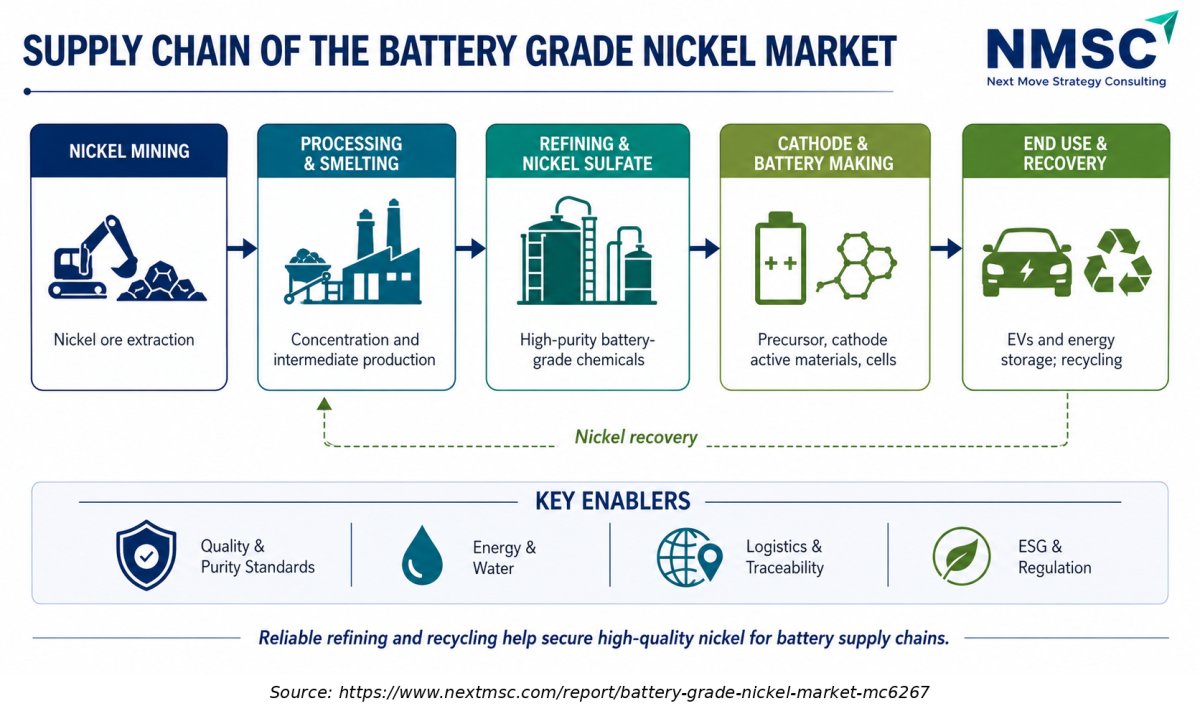
Supply Chain of the Battery Grade Nickel Market

Supply Chain of the Battery Grade Nickel Market

The battery-grade nickel supply chain begins with nickel mining and processing, followed by refining into high-purity chemicals used in cathode materials and battery manufacturing. Recycling and nickel recovery further support resource efficiency and help strengthen long-term battery material supply

Competitive Landscape

We observed that competition centers on feedstock access, product purity, carbon footprint and speed of qualification at cathode plants.

How Do Battery Grade Nickel Producers Compete?

Competition turns on feedstock security and conversion cost. Vale, Glencore and Nornickel run integrated sulfide chains that yield Class 1 nickel, while Nickel Industries builds position through laterite HPAL and Terrafame through a single site from mine to chemicals. Our assessment indicates that pricing power in the Battery Grade Nickel Market sits with suppliers who certify purity and carbon footprint together, and geographic expansion into Western hubs follows customer plants.

Which Competitor Archetypes Dominate the Battery Grade Nickel Industry?

Five archetypes stand out. Diversified miners such as Vale and Glencore compete on scale and Class 1 quality. Nornickel competes on sulfide feed and a broad product range from its Finnish refinery. Sumitomo Metal Mining integrates refining with cathode materials. Nickel Industries and Terrafame differentiate on laterite processing and single site chemistry, respectively. The differentiation themes in the Battery Grade Nickel Market are integration, purity, carbon performance and supply security.

How Are Producers Differentiating Through Innovation?

Innovation clusters around three areas. Sumitomo Metal Mining and Panasonic Energy recover nickel sulfate from cell scrap. Terrafame updated its life cycle assessment to document a footprint of 1.6 kg CO2e per kg. Nickel Industries aims to make MHP, sulfate and cathode at one HPAL site. We found that Nornickel also developed sulfate solution products for battery customers, which removes crystallization steps and strengthens its position in the market.

What Is the M&A Activity Pattern and How Do Producers Price Their Products?

Activity is selective. Nickel Industries signed agreements in 2026 to acquire interests in two Indonesian HPAL projects, and Glencore has put its Koniambo operation into care and maintenance. On pricing, Terrafame notes that the spot sulfate price in China has not been fully linked to the LME price since 2022. Our analysis shows that sulfate indexed contracts and premiums for low carbon supply now shape margins in the Battery Grade Nickel Market.

Key Market Players

Our findings suggest that six producers with verified battery relevant nickel output lead the supply base, ranked here by qualitative scale of battery relevant output.

Vale S.A. PJSC MMC Norilsk Nickel Glencore plc Sumitomo Metal Mining Co., Ltd. Nickel Industries Limited Terrafame Ltd

Latest Developments

NMSC's analysis indicates that recent announcements concentrate on Indonesian refining ramp ups and carbon performance.

Date Event
Jul 2026 Nickel Industries announced maiden MHP production at ENC, described as a landmark step into the EV battery supply chain.
Mar 2025 Panasonic Energy and Sumitomo Metal Mining launched a recycling scheme that converts cell scrap into nickel sulfate at Japanese facilities.

Expert Insights

Abu Ashar

Abu Ashar

Vice-President Director | PT Vale Indonesia

"We are optimistic that nickel-based batteries will remain in demand because of their durability and longer cycle life."

Analyst Interpretation

The statement highlights the potential for continued demand for battery-grade nickel as nickel-rich battery chemistries remain relevant in electric vehicles that prioritize higher energy density and performance. This supports opportunities for nickel refiners and battery-material producers supplying nickel-based cathode materials

Investment Opportunities

How Are Capital Inflows Shaping the Battery Grade Nickel Market?

Capital is flowing to producers with secured feed and downstream flexibility. Nickel Industries executed USD 450 million of unsecured loan facilities in the June 2026 quarter while commissioning ENC. Terrafame continues to supply customers, including Asian operators, from its Finnish plant. We observed that lenders favor projects that can switch between sulfate, cathode and intermediates, because that flexibility protects returns in the Battery Grade Nickel Market.

Where Is Infrastructure Investment Concentrated?

Infrastructure spending centers on three clusters. Indonesia hosts new HPAL lines inside industrial parks, Finland hosts the Terrafame and Nornickel refining sites, and Japan hosts Sumitomo Metal Mining's Niihama complex. Feasibility work for a refinery in the southeastern United States signals the next cluster. Our assessment indicates that proximity to cathode plants will decide where the next wave of sulfate capacity in the Battery Grade Nickel Market is built.
What ESG Considerations Matter for Investors?

Carbon footprint, tailings and acid management, and traceability determine access to Western buyers. Terrafame's footprint of 1.6 kg CO2e per kg of nickel sulfate sets a visible benchmark, while Nornickel highlights renewable power at Harjavalta. We found that Indonesian HPAL projects face scrutiny on energy sources and waste handling, so investors in the Battery Grade Nickel Market should price decarbonization capital into project returns.

Key Benefits for Stakeholders

How Does This Report Help Producers and Industry Leaders?

Producers gain a segmented view of demand by product form, chemistry and end use, which supports decisions on sulfate versus metal output. The regional forecasts show where cathode localization will lift volumes, and the competitive analysis benchmarks purity and carbon positioning. Leaders can use the Battery Grade Nickel Market outlook to time expansions around the USD 8.30 Billion 2026 base.

What Value Does It Offer Investors and Financial Analysts?

Investors receive reconciled forecasts that tie segment growth to the headline 6.3% CAGR, along with a risk matrix that quantifies substitution and oversupply effects. The country analysis separates fast growing markets such as India from scale markets such as China. This evidence helps analysts size valuation upside in the Battery Grade Nickel Market without relying on a single price scenario.

How Can Cathode Makers and Procurement Teams Use the Findings?

Cathode makers can compare supply routes by region and judge how Indonesian quotas and sulfur costs affect feed. Procurement teams can use the competitive archetypes to shortlist suppliers, and the regulatory discussion highlights which carbon and recycled content disclosures to demand. Sourcing strategies built on the Battery Grade Nickel Market findings reduce exposure to single region supply and price swings.

Key Market Segments Evaluated

By Product Form

  • Nickel sulfate
  • Class 1 nickel metal
  • Nickel hydroxide

By Battery Chemistry

  • NMC (nickel manganese cobalt)
  • NCA (nickel cobalt aluminum)
  • Other nickel bearing chemistries

By End Use

  • Electric vehicles
  • Consumer electronics
  • Energy storage systems

By Region

  • North America 
    • U.S.
    • Canada
    • Mexico
  • Europe 
    • UK
    • Germany
    • France
    • Italy
    • Spain
    • Sweden
    • Denmark
    • Finland
    • Netherlands
    • Rest of Europe
  • Asia-Pacific 
    • China
    • India
    • Japan
    • South Korea
    • Taiwan
    • Indonesia
    • Vietnam
    • Australia
    • Philippines
    • Malaysia
    • Rest of APAC
  • Middle East & Africa 
    • Saudi Arabia
    • UAE
    • Egypt
    • Israel
    • Turkey
    • Nigeria
    • South Africa
    • Rest of MEA
  • Latin America 
    • Brazil
    • Argentina
    • Chile
    • Colombia
    • Rest of LATAM

Conclusion & Recommendations

The market grows from USD 8.30 Billion in 2026 to USD 14.40 Billion by 2035, a 6.3% CAGR, which sits in the range expected for a maturing growth market. Value growth depends on nickel rich cell demand holding share against LFP, on Indonesian supply discipline and on carbon rules in Europe. Our analysis shows that the outlook is positive but paced by chemistry choices rather than by vehicle volumes alone.

What Strategic Positioning Recommendations Does NMSC Offer?

Producers should secure intermediate feed, qualify sulfate with several cathode makers and document carbon footprints early. Integrated players should keep the option to shift between sulfate, metal and cathode output. NMSC recommends that new entrants target Western hubs where regulation favors traceable supply, while established Asian producers defend cost position and scale to protect volume in the market.

How Strong Is Investment Attractiveness in the Battery Grade Nickel Market?

Attractiveness is selective. Absolute opportunity of USD 6.10 Billion between 2026 and 2035 supports capital deployment, yet price volatility and oversupply compress returns for undifferentiated capacity. Projects with feed security, low carbon credentials and flexible output offer the best risk adjusted returns, while merchant converters face the weakest economics unless spreads widen.

What Are the Market Shifts and Key Risks in the Battery Grade Nickel Market?

The main shifts are chemistry polarization, regionalization of supply and recycled content mandates. Key risks include faster LFP and sodium ion adoption, changes to Indonesian quotas and royalties, and sulfur price spikes at HPAL plants. We found that a downside case with weaker nickel rich share would trim growth in the Battery Grade Nickel Market by roughly one percentage point.

What Are the Primary Growth Pathways Through 2035?

Three pathways stand out: Western cathode localization, recycled nickel and multi product Indonesian refining. Storage and hybrid vehicles add incremental volume to the Battery Grade Nickel Market. The fastest growth appears in Latin America at 10.7% CAGR and in India at 11.4%, although Asia-Pacific keeps the largest base through 2035.

FAQs

Sources & References

1.

International Energy Agency, Global Critical Minerals Outlook 2026

iea.org
2.

International Energy Agency, Global Critical Minerals Outlook 2025, Nickel

iea.org/reports/nickel-2
3.

International Nickel Study Group

insg.org
4.

European Union, Regulation (EU) 2023/1542 on batteries and waste batteries

eur-lex.europa.eu
5.

Terrafame Ltd, Carbon footprints of nickel products, 25 March 2026

terrafame.com
6.

Terrafame Ltd, 2025 results release, 27 February 2026

terrafame.com
7.

Terrafame Ltd, January–March 2025 results release

terrafame.com
8.

Nornickel Harjavalta, Our products

nornickel.fi/en/our-products
9.

Nornickel, Annual Report 2020, Product range

ar2020.nornickel.ru
10.

Vale S.A., Form 6-K, second quarter 2026 results

sec.gov
11.

Vale S.A., Form 6-K, first quarter 2026 sales and production

sec.gov
12.

Nickel Industries Limited, ASX release, Maiden MHP production at ENC, 29 July 2026

announcements.asx.com.au
13.

Nickel Industries Limited, ASX release, Maiden nickel cathode production at ENC, 11 August 2026

announcements.asx.com.au
14.

Nickel Industries Limited, Half Year Results Presentation, 30 June 2026

announcements.asx.com.au
15.

Nickel Industries Limited, Quarterly Activities Report, June 2026

announcements.asx.com.au
16.

Glencore plc, Nickel

glencore.com
17.

Sumitomo Metal Mining Co., Ltd., Integrated Report 2025

smm.co.jp
18.

Panasonic Energy, Nickel recycling initiative with Sumitomo Metal Mining, 31 March 2025

news.panasonic.com

About the Author

Mayurima Roy

Mayurima Roy

Mayurima Roy is Research Analyst at Next Move Strategy Consulting, where she has spent 4 years working across the firm's full industry coverage rather than a single fixed vertical. Her work centers on structured research, ongoing trend tracking, competitive assessment, and insight-led content development, translating complex market data into clear, decision-ready narratives that support informed client decision-making across diverse global industries, market sectors, and world regions every day.

About the Reviewer

Supradip Baul

Supradip Baul

Supradip Baul is an accomplished business consultant and strategist with over a decade of rich experience in market intelligence, strategy, technology, and business transformation. His work has included rigorous qualitative and quantitative analysis across multiple industries, helping clients shape investment decisions and long-term roadmaps. Earlier in his career, he was associated with Gartner, where he contributed to industry-leading reports and market share analyses. He has worked with leading global companies and holds an MBA with a dual specialization in Marketing and Finance.

Download Free Sample

Diana Trejo

DIANA TREJO

Assistant Manager

Sumitomo Corporation de Mexico, S.A. de C.V.

Recently, we purchased a report on the Mexico Data Center Market from Next Move Strategy Consulting. The service has been excellent, with support that is always timely and thoroughly professional. The information provided is interesting, highly useful, and delivered with clarity. I would highly recommend NextMSC for anyone seeking insightful and dependable analysis.

Semih Kavaklioglu

SEMIH KAVAKLIOGLU

Co-Founder & Sales Manager

Decortie

I work a lot in the marketing industry and I know that research is an essential part of any campaign. I have used Market research reports for my own products and I found them to be very informative and well-researched. The team here produces insightful reports for a good price

Gustaf Hummel Burstrom

GUSTAF HUMMEL BURSTROM

Founder

Revline Tools AB

Joseph and the team at Next Move Strategy Consulting have been excellent to work with, in supplying us with relevant market data and forecasts for our specific category. We had some special requirements and they were able to do a custom package to suit our needs. We would definitely recommend them to any other company needing market data and forecasts

Robert Sean Trevino

ROBERT SEAN TREVINO

Sr. Director, Head of Strategic Insights & Analytics

Foundation Medicine

I realized that it was a reliable source of information. These days, there are many people who are looking for authentic data, and this is one of the only sources that can offer them with what they need;

Mohit Agarwal

MOHIT AGARWAL

Chief Manager

DryChem India Pvt. Ltd.

Next Move Strategy Consulting is an amazing team of consultants. We required a market study report for our investors on top priority and the team went above and beyond our expectations to deliver the same with ample supporting data within a short time span enabling us to secure the investments and keep our project timeline maintained. Their professionalism, attention to detail, and timely delivery of actionable recommendations have left a lasting impression on our organization.

Custom Market Research Services

We will customize the research for you if the listed report does not fully match your requirements.

Get 30% Free Customization

Select License

This website uses cookies to ensure you get the best experience on our website. Learn more

✖