EV Battery Swapping Market Size, Share, Growth, Trends, Analysis, and Forecast 2025–2035: By Swapping Service Revenue (Subscription Based, Pay Per Use, Hybrid Model), By Vehicle Type (Two-Wheeler, Three-Wheeler, Passenger Car, LCV, HCV, Specialty Vehicle), By Station Automation (Fully Automated, Semi-Automated, Manual), By End User (Individual Consumer, Commercial Fleet), By Battery Asset Revenue, By Infrastructure Revenue, and By Platform and Software Revenue — Global Analysis 2025–2035
Industry: Automotive & Transportation | Publishing Date: July 13, 2026 | Last Updated: September 30, 2026 | No of Pages: N/A | No. of Tables: N/A | No. of Figures: N/A | Format: PDF | Report Code: AT5096
What Is the EV Battery Swapping Market Size?
The EV Battery Swapping Market was valued at USD 4.25 billion in 2025 and is projected to grow from USD 5.48 billion in 2026 to USD 53.82 billion by 2035, registering a CAGR of 29.1% from 2026 to 2035. This market is expanding rapidly, driven by surging two-wheeler electrification across Asia Pacific, aggressive government mandates for fleet decarbonization, rapid deployment of battery-as-a-service (BaaS) models that reduce upfront EV ownership costs, and growing demand for rapid energy replenishment in last-mile delivery and ride-hailing operations.
|
Parameters |
Details |
|
Market Size in 2025 |
USD 4.25 Billion |
|
Market Size in 2026 |
USD 5.48 Billion |
|
Revenue Forecast in 2035 |
USD 53.82 Billion |
|
Growth Rate |
CAGR of 29.1% from 2026 to 2035 |
|
Analysis Period |
2025–2035 |
|
Base Year Considered |
2025 |
|
Forecast Period |
2026–2035 |
|
Market Size Estimation |
Industry-Derived Estimate |
|
Companies Profiled |
20 |
|
Countries Covered |
33 |
|
Market Share |
Top 10 |
EV Battery Swapping Market Overview
What Is the Definition and Scope of the EV Battery Swapping Market?
The EV battery swapping market encompasses the full ecosystem of services, infrastructure, hardware, software, and business models that enable the rapid exchange of depleted electric vehicle batteries for fully charged units at designated swap stations. This market covers swapping service revenue, battery asset management, station infrastructure, fleet management platforms, and ancillary revenue streams, including energy management and consulting services. The market spans commercial, public, and individual applications across two-wheelers, three-wheelers, passenger cars, and commercial vehicles globally.
How Has the EV Battery Swapping Market Structurally Evolved?
NMSC's analysis indicates that the market has evolved from isolated pilot programs in China and Taiwan to a globally recognized energy replenishment model for electric vehicles. Companies such as NIO and Gogoro pioneered commercial-scale deployment from 2018 to 2022, followed by a rapid expansion phase driven by fleet operators, logistics providers, and government-backed standardization initiatives. By 2025, the market has matured into a multi-tiered ecosystem integrating hardware OEMs, software platforms, battery leasing entities, and energy service providers across 33 countries.
What Is the Regulatory Environment Shaping the EV Battery Swapping Market?
Through our market assessment, we observed that regulatory frameworks across key markets actively support EV battery swapping deployment. China's Ministry of Industry and Information Technology has issued battery standardization guidelines that lower interoperability barriers among swap network operators. India's Bureau of Energy Efficiency under the FAME II scheme provides direct subsidies for swap infrastructure. The European Union's Alternative Fuels Infrastructure Regulation creates a favorable framework for innovative EV energy replenishment solutions. The U.S. Department of Energy's Vehicle Technologies Office has funded commercial fleet swap feasibility programs.
What Is the Technology Adoption Landscape of the EV Battery Swapping Market?
From our research, we found that battery swapping technology has advanced significantly, transitioning from manual exchange processes to semi-automated and fully automated swap stations capable of completing a battery exchange in under five minutes. AI-driven battery diagnostics, IoT-based real-time monitoring, and cloud-integrated battery management systems now underpin operational efficiency at swap stations globally. The integration of standardized battery packs, intelligent state-of-charge verification, and seamless digital payment systems has accelerated commercial adoption across fleet, logistics, and individual consumer segments of the EV battery swapping market.
Ecosystem Analysis of the EV Battery Swapping Market
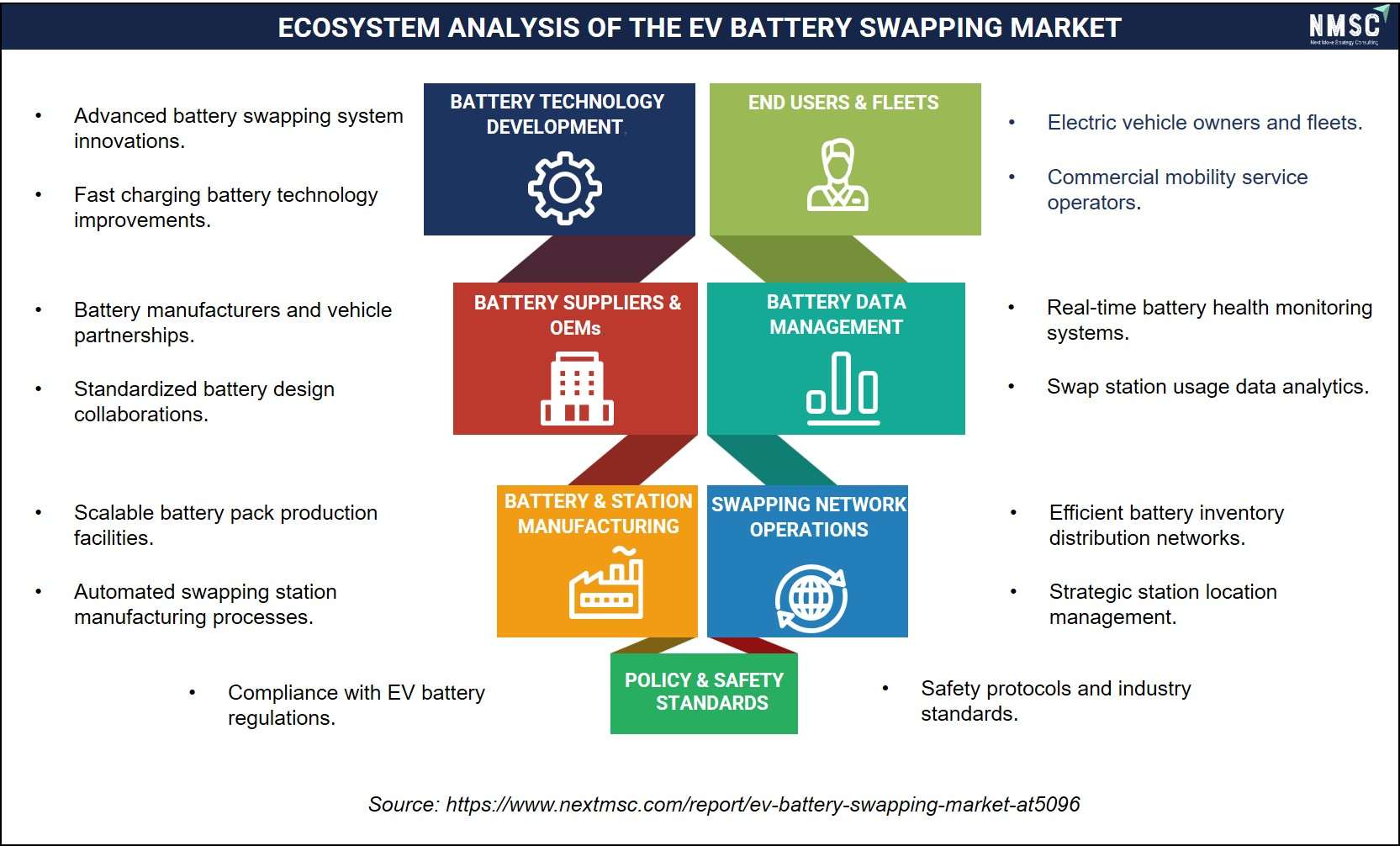
The above infographic presents an ecosystem analysis of the EV battery swapping market, covering battery technology, suppliers, manufacturing, network operations, data management, policy, and end users. Battery innovations and standardized designs are enabling scalable production, supported by OEM partnerships and automated station manufacturing. Furthermore, real-time health monitoring and usage analytics optimize swapping networks, while policy compliance ensures safety and regulatory alignment. End users include EV owners and commercial fleets. Looking ahead, we observed that these interconnected elements collectively shape the market's evolution across the sector.
|
Key Takeaways |
|
By Service Type, the Hybrid Model dominated the market with USD 1.49 billion and a 35.1% share in 2025, driven by its operational flexibility. Subscription-based services are projected to grow the fastest at a CAGR of 29.7% through 2035. |
|
By Vehicle Type, Two-Wheelers led the market with USD 1.70 billion and a 40.0% share in 2025, supported by high electric scooter adoption. Passenger Cars are expected to register the fastest growth at a CAGR of 31.1% through 2035. |
|
By Station Automation, Fully Automated Stations accounted for the largest revenue at USD 1.91 billion and a 44.9% share in 2025. The same segment is also the fastest-growing, advancing at a CAGR of 31.2% through 2035. |
|
By End User, Commercial Fleets dominated the market with USD 3.19 billion and a 75.1% share in 2025, driven by large-scale fleet electrification. The segment is also projected to grow at the fastest CAGR of 29.5% through 2035. |
|
By Revenue Model, Battery Leasing held the largest share with USD 1.70 billion and 40.0% of revenue in 2025. It is also the fastest-growing revenue model, expanding at a CAGR of 29.5% through 2035. |
|
By Lifecycle Activity, Battery Refurbishment led the market with USD 1.49 billion and a 35.1% share in 2025. Battery Repurposing is forecast to grow the fastest at a CAGR of 29.3% through 2035. |
|
By Component Type, Swapping Stations generated the highest revenue at USD 1.91 billion and a 44.9% share in 2025. Control and Monitoring Systems are projected to be the fastest-growing component segment, advancing at a CAGR of 29.1% through 2035. |
|
By Customer Type, Fleet Operators accounted for the largest revenue with USD 1.70 billion and 40.0% of the market in 2025. Fleet Operators, Original Equipment Manufacturers, Infrastructure Operators, and Government Entities are all projected to expand at a similar CAGR of 29.0% through 2035. |
|
By Platform/Software, Fleet Management Platforms led the market with USD 1.28 billion and a 30.1% share in 2025. The segment is also projected to register the fastest growth at a CAGR of 29.8% through 2035. |
|
Asia Pacific was the largest regional market with USD 3.21 billion and a 75.5% share in 2025, supported by strong EV adoption and battery swapping infrastructure. North America is projected to be the fastest-growing region at a CAGR of 30.2% through 2035. |
|
China remained the largest country market, supported by its mature battery swapping ecosystem and large EV fleet. India is projected to be the fastest-growing national market through 2035, driven by expanding electric two-wheeler adoption and supportive government initiatives. |
Key Emerging Trends in the EV Battery Swapping Market
How Is Battery Standardization Reshaping the EV Battery Swapping Market?
Battery standardization is the single most transformative structural force in the EV battery swapping market. China's MIIT-led standardization initiative for power batteries creates a technical foundation enabling multiple vehicle brands to share compatible swap infrastructure. NMSC's analysis indicates that standardized battery adoption reduces per-station capital costs by enabling higher utilization rates and multi-brand compatibility. Gogoro in Taiwan and SUN Mobility in India have demonstrated that standardized battery packs drive network effects, accelerating station deployment and lowering consumer entry barriers across two-wheeler and three-wheeler segments.
How Are AI and IoT Integrations Transforming EV Battery Swapping Station Operations?
Our findings suggest that AI-powered battery diagnostics and IoT-based real-time monitoring are rapidly becoming standard features across automated swap stations. Operators such as NIO and Aulton New Energy deploy AI models to assess battery state-of-health before each swap, reducing safety incidents and extending battery asset lifespans. IoT connectivity enables remote station management, predictive maintenance scheduling, and dynamic demand routing, which collectively improve station uptime and reduce operational expenditure in the market.
How Is Fleet Electrification Demand Driving New Revenue Models in the Market?
Through NMSC's assessment, we found that fleet operators in last-mile delivery, ride-hailing, and public transit are actively driving diversified revenue models within the market. Fleet contract arrangements offering fixed monthly fees for unlimited swaps are gaining traction in China, India, and Southeast Asia. Battery Smart and SUN Mobility in India have formalized fleet contract structures for electric two-wheeler and three-wheeler taxi operators, providing operators with predictable cash flows and eliminating range anxiety for high-utilization commercial fleets.
How Is Second Life Battery Application Revenue Emerging as a Growth Opportunity in the EV Battery Swapping Market?
Based on our market evaluation, we noticed that second-life battery applications are emerging as a strategically important revenue stream within the market. Batteries retired from active swap service retain 70-80% of original capacity and are increasingly repurposed for stationary energy storage at swap stations or in grid-connected systems. CATL's EVOGO initiative and NIO's battery management ecosystem both incorporate lifecycle planning for swap batteries, converting an operational cost center into a revenue-generating asset through circular economy frameworks.
What Are the Key Market Drivers, Breakthroughs, and Investment Opportunities that Will Shape the EV Battery Swapping Industry in the Next Decade?
|
Drivers / Trends / Restraints |
(+/-) % Impact on CAGR Forecast |
Geographic Relevance |
Impact Timeline |
|
Government EV Mandates and Subsidies |
+3.2% |
Global (China, India, EU, U.S.) |
Near-Term (2025–2027) |
|
Fleet Electrification and Last-Mile Delivery Growth |
+2.8% |
Asia Pacific, Europe, North America |
Near-to-Mid (2026–2028) |
|
Battery Standardization Initiatives |
+2.1% |
China, India, Europe |
Mid-Term (2027–2030) |
|
Battery-as-a-Service Model Adoption |
+2.3% |
Global |
Near-to-Mid (2026–2029) |
|
AI and IoT Integration at Swap Stations |
+1.8% |
Asia Pacific, North America, Europe |
Mid-to-Long (2028–2032) |
|
Second Life Battery Revenue Streams |
+1.4% |
China, India, Europe |
Mid-Term (2027–2031) |
|
Proprietary Battery Standards (Interoperability Barrier) |
-1.9% |
Global |
Near-Term (2025–2027) |
|
High Capital Investment for Station Infrastructure |
-1.4% |
Emerging Markets |
Near-to-Mid (2026–2029) |
What Are the Growth Drivers of the EV Battery Swapping Market?
How Are Government EV Policies and Subsidies Driving EV Battery Swapping Market Growth?
Government mandates and subsidy frameworks are the foremost demand catalysts in the market. India's FAME II scheme allocates direct incentives for electric two-wheelers and three-wheelers with swappable battery platforms, meaningfully lowering total ownership cost for last-mile operators. China's Ministry of Industry and Information Technology has designated battery swapping as a preferred EV energy model for commercial applications, channeling state investment into swap station deployment and battery standardization. The U.S. Department of Energy has funded commercial fleet swap feasibility programs under the Vehicle Technologies Office, establishing policy momentum across North America that supports long-term EV battery swapping market expansion.
How Is Rising Last-Mile Delivery Demand Fueling the Market?
The global expansion of e-commerce and urban logistics has generated a structural demand driver for the market. Last-mile delivery operators require vehicles capable of rapid energy replenishment to sustain multi-shift operations without lengthy charging downtime. Battery Smart, SUN Mobility, and Gogoro have specifically designed swap infrastructure serving delivery fleets across South Asia and Southeast Asia. The International Energy Agency reported that electric two- and three-wheelers accounted for over 350 million units globally by 2024, with fleet adoption accelerating the demand for scalable, fast-turnaround energy replenishment in the market.
How Are Fleet Electrification Programs Catalyzing Market Adoption?
Large-scale fleet electrification programs by ride-hailing companies, logistics operators, and public transit authorities are directly expanding the market. Fleet operators prioritize swap over charging due to predictable downtime elimination, standardized battery management, and consolidated battery ownership through leasing models. State Grid Corporation of China and China Petroleum and Chemical Corporation have both invested in swap infrastructure supporting commercial vehicle fleet transitions. Based on NMSC's research, we found that commercial fleet operators adopting battery swapping reduce per-vehicle operational costs by removing battery capital expenditure through leasing arrangements, accelerating the economic case for fleet electrification at scale.
What Are the Growth Inhibitors of the EV Battery Swapping Market?
How Do Proprietary Battery Standards Limit Market Expansion?
The prevalence of proprietary battery form factors and connector standards among major OEMs represents a meaningful structural barrier to the market. Unlike charging infrastructure, which benefits from broad standardization such as CCS, CHAdeMO, and GB/T, swap battery packs are often designed exclusively for specific vehicle models, limiting network utilization rates and increasing infrastructure investment requirements. Our assessment indicates that NIO's swap ecosystem, while commercially successful, is exclusively compatible with NIO vehicles, preventing cross-brand utilization of installed swap stations and slowing network effect realization globally.
How Does High Infrastructure Investment Cost Restrain the Market Penetration?
Establishing a commercially viable swap station network requires significant upfront capital for station construction, battery inventory, automation systems, and grid connectivity. The capital intensity of swap infrastructure creates higher barriers to entry compared to AC charging deployments, particularly in emerging markets with limited access to project financing. Industry-derived estimates suggest that a fully automated swap station capable of handling passenger cars requires capital investment in excess of USD 500,000 per unit, creating financial challenges for smaller operators entering the EV battery swapping market across developing geographies.
What Are the Growth Opportunities in the EV Battery Swapping Industry?
How Can Battery-as-a-Service Models Unlock Growth Opportunities?
Battery-as-a-Service models represent the highest-impact commercial growth opportunity in the EV battery swapping market. By decoupling battery ownership from vehicle ownership, BaaS reduces upfront EV acquisition cost by approximately 20-30%, making electrification economically accessible to a broader consumer and small fleet operator base. NIO's pioneering BaaS model in China has demonstrated the commercial viability of this approach, with subscription-linked swap services generating recurring revenue. NMSC's analysis indicates that BaaS adoption is poised to accelerate across India, Southeast Asia, and Africa as two-wheeler and three-wheeler fleet operators seek to lower the total cost of ownership.
How Can Emerging Markets in the Asia Pacific and Africa Create New EV Battery Swapping Market Opportunities?
Emerging markets in South and Southeast Asia and Sub-Saharan Africa present structural growth opportunities for the market. Two-wheeler-dominated mobility ecosystems, high fuel price sensitivity, and government-backed electrification programs create favorable conditions for swap-based energy models. Companies such as Ampersand Rwanda have deployed motorcycle taxi battery swap services in Africa, targeting commercial operators lacking access to reliable grid charging. Indonesia, Vietnam, the Philippines, and Nigeria represent markets where two-wheeler fleets number in the tens of millions and swap infrastructure can provide a commercially viable electrification pathway.
How Can Second Life Battery Applications Generate Additional Revenue?
The accumulation of retired swap battery packs creates a value chain extension opportunity in the market. Batteries exiting front-line swap service retain sufficient capacity for stationary storage applications, including grid balancing, solar energy storage at rural swap stations, and commercial building energy management. The European Union's Battery Regulation (EU 2023/1542), which mandates battery passport documentation and recycling standards, is creating a regulatory framework that supports organized second-life and recycling revenue streams for market participants operating in European markets.
How Is the EV Battery Swapping Industry Segmented in This Report, and What Are the Key Insights from the Segmentation Analysis?
Which Service Type Sub-Segments Drive EV Battery Swapping Market Revenue?
|
Service Type Segment |
2025 (USD Bn) |
2035 (USD Bn) |
CAGR (2026–2035) |
|
Subscription Based |
1.10 |
14.56 |
29.7% |
|
Pay Per Use |
0.85 |
10.51 |
28.9% |
|
Hybrid Model |
1.49 |
18.88 |
29.0% |
|
Fleet Contract |
0.81 |
9.87 |
28.6% |
The Service Type segment within the market encompasses subscription-based (unlimited and capped swap plans), pay-per-use, hybrid model, and fleet contract revenue structures. The Hybrid Model sub-segment dominated in 2025 with USD 1.49 billion in revenue, valued for its balance of flexibility and cost predictability for both individual users and commercial operators. Subscription-Based plans are the fastest growing sub-segment at a projected CAGR of 29.7%, driven by fleet operators in Asia Pacific seeking predictable swap costs. Fleet Contract arrangements are gaining strong traction among ride-hailing and logistics fleets.
Which Vehicle Type Segment Leads EV Battery Swapping Market Adoption?
|
Vehicle Type Segment |
2025 (USD Bn) |
2035 (USD Bn) |
CAGR (2026–2035) |
|
Two-Wheeler |
1.70 |
20.45 |
28.5% |
|
Three-Wheeler |
0.85 |
10.76 |
29.0% |
|
Passenger Car |
0.89 |
13.32 |
31.1% |
|
Light Commercial Vehicle |
0.42 |
5.38 |
29.0% |
|
Heavy Commercial Vehicle |
0.21 |
2.69 |
29.0% |
|
Specialty Vehicle |
0.18 |
1.22 |
23.8% |
The Vehicle Type segment of the market covers two-wheelers, three-wheelers, passenger cars, light commercial vehicles, heavy commercial vehicles, and specialty vehicles. The Two-Wheeler sub-segment dominated in 2025 at USD 1.70 billion (40.0% share), reflecting massive fleet presence across China, India, Taiwan, and Indonesia. Passenger Cars are the fastest growing vehicle type at a projected CAGR of 31.1%, led by NIO's expanding network and BaaS-linked ownership models. Three-Wheelers hold meaningful share in South Asian markets through ride-hailing and commercial freight applications.
How Does Station Automation Level Influence EV Battery Swapping Market Revenue Distribution?
|
Station Automation Segment |
2025 (USD Bn) |
2035 (USD Bn) |
CAGR (2026–2035) |
|
Fully Automated Station |
1.91 |
28.52 |
31.2% |
|
Semi-Automated Station |
1.49 |
18.34 |
28.7% |
|
Manual Station |
0.85 |
6.96 |
26.4% |
Station Automation within the market ranges from fully automated robotic systems to semi-automated and manual exchange formats. Fully Automated Stations dominated in 2025 at USD 1.91 billion and represent the fastest growing sub-segment at a projected CAGR of 31.2%, driven by fleet operators and OEMs prioritizing speed, safety, and operational scalability at high-throughput urban swap locations. Semi-Automated Stations maintain strong adoption in cost-sensitive markets. Manual Stations still serve rural and low-density emerging market deployments where capital constraints limit automation investment.
How Do End-User Segments Define EV Battery Swapping Market Revenue Patterns?
|
End User Segment |
2025 (USD Bn) |
2035 (USD Bn) |
CAGR (2026–2035) |
|
Individual Consumer |
1.06 |
12.95 |
28.5% |
|
Commercial Fleet |
3.19 |
40.87 |
29.5% |
The end-user segment of the market divides into Individual Consumers and Commercial Fleets, with Commercial Fleet operators dominating at USD 3.19 billion in 2025 and a 75.1% global revenue share. Within the Commercial Fleet sub-segment, ride-hailing and taxi operators, last-mile delivery services, logistics and freight companies, public transit authorities, and corporate fleets all represent distinct adoption channels. Based on NMSC's research, we found that Commercial Fleet is also the fastest growing sub-segment at a CAGR of 29.5%, driven by the strong operational efficiency argument for swap over charging in high-utilization fleet environments.
Which Battery Asset Revenue Model Dominates the EV Battery Swapping Market?
|
Revenue Model Segment |
2025 (USD Bn) |
2035 (USD Bn) |
CAGR (2026–2035) |
|
Battery Leasing |
1.70 |
22.60 |
29.5% |
|
Battery Rental |
1.49 |
18.88 |
29.0% |
|
Battery Subscription |
1.06 |
12.34 |
28.2% |
The Battery Asset Revenue segment within the market encompasses battery leasing, battery rental, and battery subscription models. Battery Leasing dominated in 2025 with USD 1.70 billion in revenue (40.0% share) and is also the fastest growing model at a projected CAGR of 29.5%, driven by fleet operators and OEMs seeking to transfer battery ownership and depreciation risk to specialized asset management entities. Battery Rental serves shorter-term and transactional operator needs, while Battery Subscription models are gaining traction through platforms like NIO's BaaS offering, providing users with predictable monthly costs for energy access.
How Do Lifecycle Activities Shape the Battery Asset Revenue Dimension of the EV Battery Swapping Market?
|
Lifecycle Activity Segment |
2025 (USD Bn) |
2035 (USD Bn) |
CAGR (2026–2035) |
|
Battery Refurbishment |
1.49 |
19.42 |
29.5% |
|
Battery Repurposing |
0.85 |
11.02 |
29.3% |
|
Battery Recycling |
1.06 |
13.54 |
29.0% |
|
Second Life Application Revenue |
0.85 |
9.84 |
27.8% |
The Lifecycle Activity segment of the market covers battery refurbishment, repurposing, recycling, and second-life application revenue. Battery Refurbishment dominated in 2025 at USD 1.49 billion, driven by operators extending swap battery lifecycles to reduce total fleet battery costs. Battery Repurposing is the fastest growing activity at a projected CAGR of 29.3%, with repurposed batteries increasingly deployed in stationary energy storage applications at swap stations. The EU Battery Regulation's traceability requirements are accelerating the formalization of organized lifecycle programs across European EV battery swapping market participants.
How Do Infrastructure Component Types Drive EV Battery Swapping Market Investment?
|
Component Type Segment |
2025 (USD Bn) |
2035 (USD Bn) |
CAGR (2026–2035) |
|
Swapping Station (Fixed, Modular, Containerized, Mobile) |
1.91 |
24.22 |
29.0% |
|
Swapping Robot and Mechanism |
0.85 |
10.76 |
29.0% |
|
Battery Pack (Standardized and Proprietary) |
0.85 |
10.76 |
29.0% |
|
Integrated Charging Infrastructure |
0.43 |
5.38 |
29.0% |
|
Control and Monitoring System |
0.21 |
2.70 |
29.1% |
The Infrastructure Revenue segment of the market covers swapping stations, swapping robots, battery packs, integrated charging infrastructure, and control and monitoring systems. Swapping Stations (including fixed, modular, containerized, and mobile formats) dominated in 2025 at USD 1.91 billion, serving as the physical backbone of all swap operations. Swapping Robots and Mechanisms are gaining significant investment as operators upgrade to fully automated formats. Control and Monitoring Systems, though smallest in current share, are growing steadily as operators invest in real-time remote management and predictive maintenance capabilities.
Which Customer Types Drive EV Battery Swapping Infrastructure Investment?
|
Customer Type Segment |
2025 (USD Bn) |
2035 (USD Bn) |
CAGR (2026–2035) |
|
Fleet Operator |
1.70 |
21.53 |
29.0% |
|
Original Equipment Manufacturer |
1.06 |
13.46 |
29.0% |
|
Infrastructure Operator |
0.85 |
10.76 |
29.0% |
|
Government Entity |
0.64 |
8.07 |
29.0% |
The Infrastructure Customer Type segment within the market identifies Fleet Operators, OEMs, Infrastructure Operators, and Government Entities as the primary infrastructure revenue contributors. Fleet Operators dominated in 2025 at USD 1.70 billion (40.0% share), investing in swap infrastructure to support large-scale commercial EV deployments. OEMs such as NIO, Geely, and Gogoro are the second largest customer group, building proprietary or shared swap networks linked to their vehicle ecosystems. Infrastructure Operators and Government Entities are growing contributors as public-private partnerships expand swap coverage in emerging markets.
How Does Software and Platform Revenue Contribute to the EV Battery Swapping Market?
|
Platform / Software Segment |
2025 (USD Bn) |
2035 (USD Bn) |
CAGR (2026–2035) |
|
Fleet Management Platform |
1.28 |
17.22 |
29.8% |
|
Battery Analytics and Diagnostics |
1.06 |
13.46 |
29.0% |
|
Station Management Software |
0.85 |
10.76 |
29.0% |
|
Payment and Billing System |
0.64 |
8.07 |
29.0% |
|
API and Data Service |
0.42 |
4.31 |
26.3% |
The Platform and Software Revenue segment of the market spans fleet management platforms, battery analytics and diagnostics, station management software, payment and billing systems, and API and data services. Fleet Management Platforms dominated in 2025 at USD 1.28 billion and are the fastest growing software category at a projected CAGR of 29.8%, driven by fleet operators managing large-scale electric two-wheeler and commercial vehicle deployments. Battery Analytics and Diagnostics platforms are gaining adoption for predictive maintenance, battery health monitoring, and lifecycle optimization. API and Data Services, while the smallest, enable third-party ecosystem integrations.
What Ancillary Revenue Streams Are Emerging in the EV Battery Swapping Market?
|
Other Revenue Segment |
2025 (USD Bn) |
2035 (USD Bn) |
CAGR (2026–2035) |
|
Advertising Revenue |
1.49 |
18.88 |
29.0% |
|
Consulting and Training Revenue |
1.28 |
16.15 |
29.0% |
|
Energy Management Service Revenue |
1.06 |
13.46 |
29.0% |
|
Other Ancillary Revenue |
0.42 |
5.33 |
29.0% |
The Other Revenue segment within the market includes advertising revenue generated through high-traffic swap station locations, consulting and training services, energy management service revenue, and other ancillary streams. Advertising Revenue is the largest category at USD 1.49 billion in 2025, reflecting the high dwell-time and urban location characteristics of swap stations as commercial advertising platforms. Energy Management Service Revenue is the fastest-growing ancillary stream as operators leverage distributed swap station networks to deliver grid balancing and demand response services to utility providers.
Strategic Analysis of the EV Battery Swapping Market
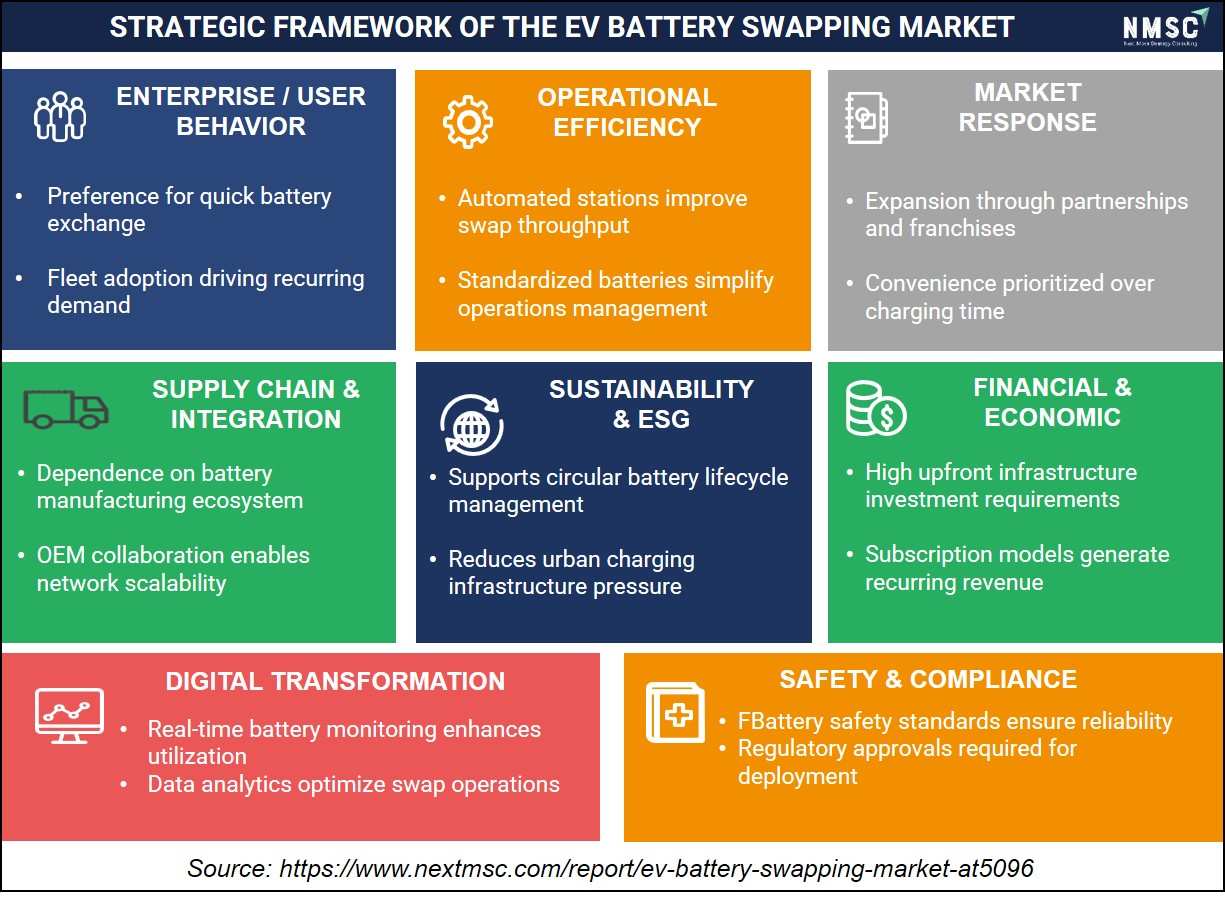
The above infographic presents a strategic framework of the EV battery swapping ecosystem. Fleet adoption is driving demand for quick battery exchange, while automated stations improve throughput, and standardized batteries simplify operations. The market is expanding through partnerships, though supply chains depend on battery manufacturing and OEM collaboration. Swapping supports circular battery management and reduces urban charging pressure, while subscription models offset high upfront costs. Looking ahead, we observed that real-time monitoring and data analytics optimize operations, backed by safety standards and regulatory approvals for reliable deployment.
Regional Outlook
EV Battery Swapping Market Analysis Snapshot
|
Region |
2025 (USD Bn) |
2035 (USD Bn) |
CAGR (2026–2035) |
Key Driver |
|
North America |
0.38 |
5.38 |
30.2% |
Fleet electrification & DOE incentives |
|
Europe |
0.32 |
4.31 |
29.5% |
AFIR regulation & urban fleet mandates |
|
Asia Pacific |
3.21 |
40.37 |
28.9% |
China's NIO/Aulton ecosystem & India FAME II |
|
Middle East & Africa |
0.18 |
2.15 |
28.3% |
Vision 2030 EV targets & two-wheeler fleets |
|
Latin America |
0.16 |
1.61 |
26.7% |
Two-wheeler swap & fleet decarbonization |
North America EV Battery Swapping Market
The North American market was valued at USD 0.38 billion in 2025 and is projected to reach USD 5.38 billion by 2035, recording the fastest regional CAGR of 30.2%. North America represents a market at an inflection point, with early commercial deployments concentrated in fleet-intensive urban corridors across the U.S. The Inflation Reduction Act and the U.S. DOE's commercial vehicle electrification programs provide policy tailwinds. Canada's provincial EV incentives and Mexico's growing maquiladora fleet electrification interest are emerging secondary demand vectors.
U.S. EV Battery Swapping Industry
Based on our engagements, the U.S. market is in an active transition from pilot programs to initial commercial deployments, driven by the fleet electrification mandate provisions of the Inflation Reduction Act and DOE Vehicle Technologies Office grants. Last-mile delivery operators, including logistics majors, are evaluating swap as a complement to fast-charging for high-utilization electric van and truck fleets. Competitive intensity is currently low but rising as infrastructure operators and technology firms position for fleet contract opportunities. Regulatory support from the EPA Clean Trucks Plan further accelerates fleet EV adoption.
Canada EV Battery Swapping Industry
Through our analysis, the Canada market is at an early commercial adoption phase, with provincial incentive programs in British Columbia, Quebec, and Ontario supporting EV fleet transitions that increasingly create demand for rapid energy replenishment solutions. Canada's Zero Emission Vehicle Infrastructure Program provides federal funding that can support swap-adjacent infrastructure development. Government procurement mandates for zero-emission public transit and public sector fleets are creating a near-term demand pipeline. Competitive intensity remains low, creating first-mover opportunities for swap operators entering commercial fleet applications.
Mexico EV Battery Swapping Industry
From our assessment, the Mexico market is in a nascent stage, with market development driven primarily by near-shoring investments that are catalyzing fleet electrification among maquiladora logistics operators and urban delivery companies. Government interest in clean air programs for Mexico City and Guadalajara represents a regulatory enabler for EV fleet adoption. Technology penetration is limited but growing, with interest from international swap operators seeking to extend Latin American coverage northward. Market maturity is expected to accelerate through 2028 as regional fleet electrification programs gain momentum.
Europe EV Battery Swapping Market
The Europe market was valued at USD 0.32 billion in 2025 and is projected to reach USD 4.31 billion by 2035, growing at a CAGR of 29.5%. Europe's market is shaped by the Alternative Fuels Infrastructure Regulation, urban clean vehicle zone mandates, and the EU Battery Regulation requiring battery traceability and lifecycle compliance. Fleet operators in Western Europe are the primary adopters, particularly in urban logistics and last-mile delivery. The regulatory-driven lifecycle compliance requirement is additionally creating demand for organized battery refurbishment and recycling programs.
UK EV Battery Swapping Industry
Based on our engagements, the UK market is driven by the Office for Zero Emission Vehicles' fleet electrification incentive programs and the Zero Emission Vehicle mandate requiring manufacturers to meet rising EV sales thresholds. Urban delivery fleets operating under London's Ultra Low Emission Zone and other city-level restrictions represent the primary commercial demand segment. Technology penetration is growing, with international swap operators entering the market alongside domestic startups. Post-Brexit regulatory alignment with global EV standards creates some complexity for battery standardization adoption.
Germany EV Battery Swapping Industry
Through our analysis, the Germany market is positioned as the largest European opportunity by mid-decade, given its automotive manufacturing dominance and active OEM investment in EV commercial vehicle platforms. The German federal government's National Hydrogen and EV Strategy supports charging and swap infrastructure deployment through federal funding. NMSC's analysis indicates that German OEMs including Volkswagen Group are evaluating battery standardization frameworks that could accelerate compatible swap infrastructure adoption. Industrial and logistics fleet operators in Rhine-Ruhr and Frankfurt corridors represent key early adopters.
France EV Battery Swapping Industry
From our assessment, the France market is advancing under the influence of Paris' urban clean vehicle zone policies and the national EV fleet procurement requirements for public sector operators. The French government's bonus-malus incentive structure and ZFE zone restrictions are accelerating electric fleet adoption in urban delivery and mobility. France has demonstrated early interest in modular swap station concepts for dense urban environments. French logistics operators and urban mobility companies represent the primary demand segment for the EV battery swapping market in France.
Italy EV Battery Swapping Industry
According to our evaluation, the Italy market is driven by urban delivery fleet electrification in Milan, Rome, and Bologna, where city-level low-emission zone restrictions incentivize rapid EV transition. Italy's PNRR (National Recovery and Resilience Plan) includes funding allocations for EV infrastructure expansion, creating a supportive investment environment. The two-wheeler and light commercial vehicle segments represent the primary swap adoption channels in Italy's urban mobility landscape. Competitive intensity is increasing as European swap operators expand southward from Western European markets.
Spain EV Battery Swapping Industry
Based on our engagements, the Spain market is developing through growing urban two-wheeler electrification in Barcelona and Madrid, supported by the Spanish government's Plan MOVES III incentive program for electric vehicles. Ride-hailing and food delivery operators are emerging as key commercial fleet demand drivers. Technology penetration in Spain is at an early growth stage, with domestic and international operators exploring urban swap station deployments. Regulatory support for urban clean mobility zones across Spain's major cities is expected to drive meaningful market expansion through 2030.
Sweden EV Battery Swapping Industry
Through our analysis, the Sweden market benefits from among the highest EV penetration rates in Europe, supported by a comprehensive national EV infrastructure grant program and ambitious carbon neutrality targets. Sweden's industrial base, including Volvo Trucks and Scania, is actively developing heavy commercial vehicle electrification solutions where swap technology represents a viable rapid energy replenishment option. High consumer awareness of EV sustainability attributes supports individual consumer interest in swap-enabled personal mobility solutions. The Sweden EV battery swapping market is positioned for steady growth driven by commercial fleet applications.
Denmark EV Battery Swapping Industry
From our assessment, the Denmark market is shaped by Denmark's aggressive EV adoption targets and its leading charging infrastructure density in Northern Europe. Denmark's national green transport strategy supports diverse energy replenishment models including battery swap for high-utilization commercial vehicles. Urban delivery and logistics operators in Copenhagen represent the primary near-term commercial demand segment. The country's small geographic market size limits absolute revenue potential but positions Denmark as a test-bed market for swap technology models intended for broader European rollout.
Finland EV Battery Swapping Industry
According to our evaluation, the Finland market is at a nascent stage, with cold climate conditions creating unique battery performance challenges that make swap a technically compelling alternative to slow-charging in winter operations. Finland's government EV grant programs and climate targets support fleet electrification. Industrial logistics and public transit represent primary EV adoption sectors. Battery swap technology that maintains pre-heated batteries for immediate use offers a specific operational advantage in Nordic conditions, representing a differentiated growth driver for the Finland EV battery swapping market.
Netherlands EV Battery Swapping Market
Based on our engagements, the Netherlands market benefits from the country's high EV adoption rate, dense urban logistics networks, and Amsterdam's commitment to zero-emission mobility by 2030. The Netherlands serves as a key European logistics hub, with major distribution center operators evaluating EV fleet transitions that create structured swap demand. Government procurement requirements for electric public transit and service vehicles further support the market in the Netherlands. Gogoro-style two-wheeler swap models are finding relevance in the country's strong cycling and urban mobility culture.
Rest of Europe EV Battery Swapping Industry
Through our analysis, the Rest of Europe EV Battery Swapping Market includes Poland, Czech Republic, Belgium, Austria, Switzerland, and other Eastern and Southern European nations at varying stages of EV fleet adoption. Poland and Czech Republic represent the largest emerging opportunities, driven by growing logistics fleet electrification linked to nearshoring investments. EU cohesion fund allocations for EV infrastructure in Eastern Europe are creating a policy foundation for eventual swap station deployment. Market maturity in these geographies is expected to accelerate through 2028 to 2030 as Western European swap operators expand coverage eastward.
Asia Pacific EV Battery Swapping Market
The Asia Pacific market was valued at USD 3.21 billion in 2025 and is projected to reach USD 40.37 billion by 2035, recording a CAGR of 28.9%. Asia Pacific accounts for 75.5% of the global market in 2025, driven by China's dominant commercial-scale swap ecosystem, India's rapidly expanding swap infrastructure backed by FAME II incentives, and two-wheeler swap markets in Taiwan, Indonesia, Vietnam, and Southeast Asia. The region's density of electric two- and three-wheeler fleets makes it the structural demand center for the global EV battery swapping market.
China EV Battery Swapping Market
Based on our engagements, the China market is the world's most mature and commercially advanced national swap ecosystem, led by NIO, Aulton New Energy, and CATL's EVOGO platform. The MIIT's inclusion of battery swapping in China's EV development guidelines and the State Grid Corporation's infrastructure investment have created a dense, government-backed swap network. NIO surpassed 40 million cumulative swaps in early 2025, representing a landmark in commercial viability. China's MIIT standardization guidelines for commercial vehicle swap batteries are reducing proprietary fragmentation and enabling multi-operator network sharing.
India EV Battery Swapping Industry
Through our analysis, the India EV market is the fastest-growing national market globally, driven by the FAME II scheme's direct subsidy for swappable battery electric two-wheelers and three-wheelers. Battery Smart and SUN Mobility have collectively deployed over 25,000 daily swaps across India's major cities by 2025. The Bureau of Energy Efficiency's EV swap station guidelines and NITI Aayog's battery swapping policy framework provide regulatory clarity. India's 200 million-plus electric two-wheeler and three-wheeler addressable fleet represents a structurally vast demand base for EV battery swapping market participants.
Japan EV Battery Swapping Market
From our assessment, the Japan market is developing through Honda Power Pack Energy India and domestic pilot programs exploring two-wheeler and light commercial vehicle swap applications. Japan's Ministry of Economy, Trade and Industry (METI) supports EV infrastructure diversification. While Japan's EV market historically favored fuel cell vehicles, growing electric kei-car adoption and delivery fleet electrification are creating structural demand for rapid energy replenishment. Technology penetration is increasing as Honda and partner entities demonstrate swap viability in urban delivery and commercial mobility applications.
South Korea EV Battery Swapping Industry
According to our evaluation, the South Korea market is at an early growth stage, supported by the Korean government's 2030 EV expansion roadmap targeting electric vehicles at 30% of new vehicle sales. LG Energy Solution and Samsung SDI's battery manufacturing expertise positions Korea as a potential hub for standardized swap battery pack development. Fleet electrification programs for taxis and urban delivery operators are the primary near-term demand drivers. Competitive intensity is growing as domestic startups and international operators assess the Korean EV battery swapping market opportunity.
Taiwan EV Battery Swapping Industry
Based on our engagements, the Taiwan market is the home market for Gogoro, the global pioneer of two-wheeler battery swap at commercial scale. Gogoro's GoStation network covers approximately 95% of Taiwan's population density, representing the world's highest swap station coverage relative to land area. Taiwan's government supports Gogoro's model through EV subsidy frameworks and public procurement. The Taiwan EV battery swapping market demonstrates the fully realized end-state of two-wheeler swap market maturity, serving as a reference model for global market entrants.
Indonesia EV Battery Swapping Market
Through our analysis, the Indonesia market is driven by the government's Presidential Regulation on the Acceleration of Electric Vehicles and the National Electric Vehicle Ecosystem Roadmap, targeting electric motorcycles as a primary electrification priority. Swap Energi Indonesia is an active domestic operator deploying two-wheeler swap infrastructure in Jakarta and other major urban centers. Indonesia's 100 million-plus motorcycle fleet and high urban mobility activity represent a structurally significant market. Honda and Yamaha's engagement in electric motorcycle development further accelerates near-term swap demand.
Vietnam EV Battery Swapping Industry
From our assessment, the Vietnam market is advancing through VinFast's electric scooter ecosystem, and the government targets mandating 100% electric public transport fleets in major cities by 2030. Vietnam's dense urban two-wheeler mobility culture and high household motorcycle ownership make it a natural fit for battery swap technology. Government support through the National Action Plan on Green Growth and urban emission control policies in Hanoi and Ho Chi Minh City is creating regulatory demand. The market in Vietnam is expected to scale rapidly through 2027 as infrastructure investment increases.
Australia EV Battery Swapping Market
According to our evaluation, the Australia market is in an early exploratory phase, with commercial interest concentrated in fleet electrification for last-mile delivery, mining support vehicles, and public transit. Australia's National Electric Vehicle Strategy and state-level EV incentive programs in New South Wales, Victoria, and Queensland create a supportive policy environment. The market's low population density outside major urban centers presents infrastructure deployment challenges, making urban fleet applications the primary near-term commercial opportunity.
Philippines EV Battery Swapping Industry
Based on our engagements, the Philippines market is gaining momentum through the government's Electric Vehicle Industry Development Act (Republic Act 11697), which mandates EV fleet targets for government agencies and incentivizes private fleet electrification. The dominance of electric tricycles and two-wheelers in Philippine urban mobility creates a direct swap demand pathway. Grid reliability challenges in secondary cities make swap-with-charged-battery models particularly attractive as they decouple vehicle operation from local grid quality. Competitive intensity is low, representing an early-mover advantage environment for swap operators.
Malaysia EV Battery Swapping Market
Through our analysis, the Malaysia market is developing under the government's National Energy Transition Roadmap and the Low Carbon Mobility Blueprint, both of which set EV adoption targets for the transport sector. Malaysia's strong two-wheeler mobility culture and growing urban delivery sector are natural demand drivers for the market. PETRONAS and Tenaga Nasional Berhad are evaluating energy service models for EV infrastructure, which may include swap station integration. Market maturity is at an early-to-growth stage, with significant commercial potential through the late 2020s.
Rest of Asia Pacific EV Battery Swapping Industry
From our assessment, the Rest of the Asia Pacific market includes Thailand, Pakistan, Bangladesh, Sri Lanka, Cambodia, Myanmar, and Pacific Island markets at varying early and nascent stages of EV adoption. Thailand's EV30@30 policy targeting 30% EV sales by 2030 is the most advanced policy framework in this group and positions Thailand for meaningful swap market development. Pakistan and Bangladesh's vast two-wheeler fleets represent structural demand, with NGO and public-private initiatives beginning to explore swap-based electrification pathways for rickshaw and motorcycle taxi operators.
Middle East and Africa EV Battery Swapping Market
The Middle East and Africa market was valued at USD 0.18 billion in 2025 and is projected to reach USD 2.15 billion by 2035, growing at a CAGR of 28.3%. Growth is driven by Vision 2030 EV targets in the Gulf, urban two-wheeler swap opportunities in Sub-Saharan Africa, and growing fleet electrification programs in South Africa and Egypt. The region's diversity in market maturity ranges from commercially active Gulf markets to nascent Sub-Saharan deployments, with the market concentrated in urban fleet and commercial mobility applications.
Saudi Arabia EV Battery Swapping Market
Based on our engagements, the Saudi Arabia market is developing within the framework of Vision 2030's commitment to EV adoption and the Public Investment Fund's investments in clean mobility infrastructure. NEOM's smart mobility projects include provisions for advanced EV energy infrastructure. Saudi Arabia's large commercial vehicle fleet and growing ride-hailing market represent primary demand segments. Temperature extremes create battery performance challenges that make swap-with-cooled-battery models technically advantageous. Competitive intensity is low, with international operators beginning to evaluate entry strategies.
UAE EV Battery Swapping Industry
Through our analysis, the UAE market is advancing through Dubai's EV Green Charger Initiative and Abu Dhabi's Clean Energy 2030 Strategy, which set targets for EV fleet adoption in taxi, ride-hailing, and government fleets. Dubai's Roads and Transport Authority mandates for electric taxis create a structured fleet swap demand pipeline. The UAE's high smartphone penetration and tech-forward consumer base support rapid adoption of app-integrated swap services. Competitive intensity in the EV battery swapping market is increasing as regional and international operators establish UAE presence as a MENA hub.
Egypt EV Battery Swapping Market
From our assessment, the Egypt market is driven by the government's National EV Transition Initiative and urban air quality programs targeting Cairo's high-density two-wheeler and three-wheeler transport fleets. Egypt's Tuk-tuk electrification programs and informal transport sector reform represent near-term swap demand opportunities. Grid reliability challenges in peri-urban areas of Egypt make swap models particularly relevant as they provide a reliable energy source for commercial operators. Market maturity is nascent, with public sector investment programs expected to catalyze early commercial deployments through 2027.
Israel EV Battery Swapping Industry
According to our evaluation, the Israel market benefits from a highly innovative technology ecosystem and government EV support through the Zero Emission Vehicle Incentive Program. Israel was an early adopter of battery swap technology through the historical Better Place venture, and the institutional knowledge from that experience is informing new-generation swap startup development. Military and security fleet electrification requirements represent a specialized near-term demand channel. Competitive intensity is growing, with domestic tech startups and international operators assessing Israel's market for regional hub potential.
Turkey EV Battery Swapping Industry
Based on our engagements, the Turkey market is developing through the government's Automotive Industry Strategy and the domestic EV manufacturer TOGG's commercial launch. Turkey's large commercial vehicle market and urban delivery sector represent primary swap demand channels. Government incentives for EV fleet procurement in taxi and municipal transport are accelerating fleet electrification. Technology penetration in the market is at an early stage, with the market expected to gain commercial scale through 2028 as fleet electrification programs mature and domestic EV adoption expands.
Nigeria EV Battery Swapping Market
Through our analysis, the Nigeria market is at a nascent stage, with commercial development driven by the widespread commercial motorcycle (Okada) and tricycle (Keke) transport sectors. Grid reliability challenges across Nigerian cities make battery swap with pre-charged units a technically viable electrification pathway for commercial two- and three-wheeler operators. NGO and impact investment programs targeting urban transport electrification are creating early demand signals. Ampersand Rwanda's adjacent market success model in East Africa provides a relevant commercial template for EV battery swapping market operators targeting Nigeria.
South Africa EV Battery Swapping Industry
From our assessment, the South Africa market is developing through government fleet electrification initiatives and the mining sector's interest in electric light utility vehicles for underground and surface operations. South Africa's National Integrated Resource Plan and Department of Transport EV policy framework provide a developing regulatory foundation. Load-shedding challenges create a unique demand for battery-stored energy solutions, which swap stations can provide as a secondary grid resilience service. Competitive intensity is low, with international operators and domestic energy companies evaluating the market entry.
Rest of Middle East and Africa EV Battery Swapping Market
According to our evaluation, the Rest of Middle East and Africa market includes Kenya, Rwanda, Morocco, Jordan, Kuwait, Qatar, and Bahrain at varying early stages of EV and swap adoption. Rwanda is notable as the location of Ampersand's pioneering commercial motorcycle swap operations, which have validated the Sub-Saharan two-wheeler swap model. Morocco's government EV targets and proximity to European markets create a favorable environment for swap market development. Gulf states, including Kuwait, Qatar, and Bahrain are exploring EV fleet programs aligned with broader GCC decarbonization commitments.
Latin America EV Battery Swapping Market
The Latin America market was valued at USD 0.16 billion in 2025 and is projected to reach USD 1.61 billion by 2035, recording a CAGR of 26.7%. Growth is anchored by Brazil's Vammo-led two-wheeler swap operations, Chile's electric bus programs, and growing urban last-mile delivery electrification across Colombia and Argentina. The market in Latin America is concentrated in two-wheeler commercial applications, with fleet contract models emerging as the dominant commercial structure for urban delivery and ride-hailing operators.
Brazil EV Battery Swapping Industry
Based on our engagements, the Brazil market is the most commercially advanced national market in Latin America, led by Vammo Tecnologia's two-wheeler swap platform targeting urban delivery riders across Sao Paulo, Rio de Janeiro, and other major cities. Brazil's PROCONVE vehicle emission standards and Rota 2030 automotive industry policy support fleet electrification. The large informal delivery sector and app-based gig economy rider base represent a structural demand channel. NMSC's analysis indicates that Vammo's fleet contract model for food delivery platform riders represents a replicable template for the Latin American market.
Argentina EV Battery Swapping Market
Through our analysis, the Argentina market is in a nascent stage, with market development constrained by macroeconomic volatility, currency controls, and limited EV import channels. However, Argentina's urban two-wheeler delivery economy and growing interest in domestic EV manufacturing represent a medium-term demand pipeline. Government electric mobility initiatives and provincial incentives in Buenos Aires Province are creating policy support for fleet electrification. Market maturity is expected to remain limited through 2027 before accelerating as macroeconomic stabilization and EV infrastructure investment improve.
Chile EV Battery Swapping Industry
From our assessment, the Chile market benefits from the most advanced EV bus fleet program in Latin America, with Santiago operating one of the world's largest electric bus fleets under the Transantiago program. The Chilean government's National Electromobility Strategy and investment in urban EV infrastructure create supportive conditions for the market. Commercial two-wheeler swap applications for delivery operators in Santiago represent the primary near-term swap demand channel. Chile's role as a lithium production leader creates an additional strategic alignment with domestic EV and battery swap ecosystem development.
Colombia EV Battery Swapping Industry
According to our evaluation, the Colombia market is developing through the government's Movilidad Sostenible framework and Bogota's electric bus and taxi fleet electrification programs. Colombia's large urban two-wheeler and moto-taxi population represents a significant addressable market for battery swap services. The National Development Plan's clean transport provisions support EV infrastructure investment. Technology penetration in the Colombia market is at an early stage, with domestic and regional startups beginning commercial deployments in Bogota and Medellin, targeting food delivery and ride-hailing platforms.
Rest of Latin America EV Battery Swapping Industry
Based on our engagements, the Rest of Latin America market includes Peru, Ecuador, Uruguay, Paraguay, Bolivia, and Central American nations at nascent stages of EV and swap adoption. Uruguay's high renewable energy grid penetration and government EV fleet mandates represent the most advanced enabling environment in this sub-group. Peru and Ecuador have active electric bus deployment programs in major cities. Central American markets are beginning to explore electric mobility as part of urban air quality and carbon emission reduction programs, creating long-term demand for the EV battery swapping market.
Competitive Landscape
Competitive Dynamics and M&A Landscape
|
Key Dimension |
Details |
|
Market Structure |
The market remains highly concentrated in Asia Pacific, led by China's NIO, Aulton, and CATL EVOGO, which operate extensive battery swapping networks and standardized battery ecosystems. At the same time, the industry is gradually fragmenting as startups, energy companies, and mobility service providers expand battery swapping infrastructure across India, Southeast Asia, and Africa. |
|
Innovation Focus |
Innovation is centered on fully automated battery swapping stations, standardized and modular battery packs, AI-enabled battery state-of-health (SoH) monitoring, Battery-as-a-Service (BaaS) subscription models, cloud-based fleet energy management, and second-life battery utilization to improve operational efficiency and battery lifecycle value. |
|
M&A Activity |
Market expansion is increasingly driven by strategic partnerships, joint ventures, and technology collaborations between EV manufacturers, battery producers, and infrastructure operators. NIO has strengthened its battery technology ecosystem through dedicated business restructuring and partnerships, while Gogoro continues to expand internationally through licensing agreements and collaborations with regional vehicle manufacturers and energy companies.\ |
How Do Companies Compete in the EV Battery Swapping Market?
Our analysis shows that the market is structured around three distinct competitive tiers: vertically integrated OEM-led ecosystems, pure-play infrastructure operators, and fleet-focused service providers. NIO, Geely, and Gogoro represent OEM-led players that control the battery standard, vehicle, and swap network simultaneously, creating strong ecosystem lock-in. Aulton New Energy and SUN Mobility operate as pure-play infrastructure operators serving multiple vehicle brands. Competition centers on network density, battery standardization compatibility, station automation capability, and the economic competitiveness of BaaS pricing relative to conventional charging.
Which Kind of Companies Dominate the EV Battery Swapping Market?
NMSC's analysis indicates that OEM-integrated operators currently dominate the market by revenue, with NIO's combined vehicle sales and swap service revenue representing the highest single-company contribution globally. Pure-play infrastructure operators such as Aulton and Battery Smart dominate the commercial two-wheeler and three-wheeler swap segments in China and India, respectively. State-owned energy companies, including State Grid Corporation of China and China Petroleum and Chemical Corporation, are leveraging their energy infrastructure networks to expand swap station coverage at scale, representing a third category of dominant competitor.
AI-Native Differentiation and Open Standards Drive Market Success in the EV Battery Swapping Market
Based on NMSC's research, we found that companies deploying AI-native battery diagnostics and supporting open battery standards are achieving superior market positioning. AI-powered battery health monitoring at swap stations differentiates operators by reducing battery degradation incidents, extending asset life, and improving safety profiles. Open standards compatibility, as demonstrated by Gogoro's open network model in Taiwan, attracts broader OEM adoption and higher station utilization rates than proprietary systems. These twin capabilities are emerging as the primary differentiators in the competitive landscape of the EV battery swapping market.
Market Players to Opt for Merger and Acquisition Strategies to Expand Their Presence
Through NMSC's assessment, we found that M&A activity in the market is accelerating as operators seek to acquire network scale, geographic coverage, and technology capabilities. Strategic partnerships between OEMs and infrastructure operators, such as Geely's engagement with swap network developers, are creating hybrid ownership structures. Battery asset management companies are acquiring swap operators to build vertically integrated lifecycle programs. In India and Southeast Asia, investor-backed startups are consolidating through Series B and C fundraising rounds, with Battery Smart's capital raise reflecting the market's growing institutional investment interest.
Who Are the Key Market Players in the EV Battery Swapping Market?
-
NIO Inc.
-
Contemporary Amperex Technology Co., Limited (CATL)
-
Gogoro Inc.
-
Aulton New Energy Automotive Technology Co., Ltd.
-
SUN Mobility Private Limited
-
Battery Smart Private Limited
-
Zhejiang Geely Holding Group Co., Ltd.
-
State Grid Corporation of China
-
China Petroleum and Chemical Corporation (Sinopec)
-
State Power Investment Corporation Limited
-
Kwang Yang Motor Co., Ltd. (KYMCO)
-
Oyika Pte. Ltd.
-
Swap Energi Indonesia
-
Honda Power Pack Energy India Private Limited
-
Exicom Tele-Systems Limited
-
Esmito Solutions Private Limited
-
VoltUp Energetech Private Limited
-
Lithion Power Private Limited
-
Ampersand Rwanda Ltd.
-
Vammo Tecnologia Ltda.
What Are the Latest Developments in the EV Battery Swapping Industry?
|
Date |
Event |
|
May 2026 |
NIO announced that its battery swap network completed more than one million battery swaps during China's May Day holiday, with a peak of over 170,000 swaps in a single day. |
|
March 2025 |
NIO and CATL signed a strategic partnership to jointly build the world's largest passenger EV battery swapping network. |
Expert Insights

“We’ve built a modular, fast, and scalable battery swapping ecosystem that adapts to real-world mobility needs. With over 1.4 million monthly swaps in India and growing global interest, we’re excited to extend our proven model to emerging markets like Africa. The region’s rapid urbanization, reliance on two and three-wheelers, and need for robust HEV solutions position it perfectly to leapfrog into clean mobility.”
- Chetan Maini, Co-Founder & Chairman, SUN Mobility
Statement made during SUN Mobility's announcement of its Africa expansion.
Market Interpretation
The statement highlights the increasing commercial viability of modular battery swapping infrastructure beyond established EV markets. It underscores the growing role of Battery-as-a-Service (BaaS) models in supporting electric two- and three-wheelers, particularly in emerging economies where urbanization, high vehicle utilization, and charging infrastructure constraints make battery swapping an attractive alternative to conventional charging. The expansion into Africa also signals rising international demand for scalable battery swapping ecosystems and reinforces the market's long-term growth potential.
What Are the Investment Opportunities in the EV Battery Swapping Market?
Capital Inflow Trends
The EV battery swapping market is attracting multi-layered capital inflows from venture capital, private equity, sovereign wealth funds, and strategic corporate investors. Battery Smart's Series C fundraising in India and Gogoro's NASDAQ listing reflect institutional confidence in the market's commercial fundamentals. NMSC's analysis indicates that total disclosed investment in EV battery swapping ventures exceeded USD 2 billion globally between 2023 and 2025, concentrated in Asia Pacific but with increasing flows into India, Southeast Asia, and Africa. The BaaS model's recurring revenue characteristics and asset-backed nature create attractive risk-adjusted return profiles for institutional investors.
Infrastructure Investment Driving EV Battery Swapping Market Expansion
Infrastructure investment represents the largest capital requirement in the market, encompassing swap station construction, battery inventory procurement, grid connectivity upgrades, and automation system deployment. State-owned energy companies in China, including State Grid Corporation and China Petroleum and Chemical Corporation, are channeling substantial infrastructure capital into commercial vehicle swap networks. In India, government-linked financing through the National Investment and Infrastructure Fund is being explored for swap station development. Our findings suggest that asset-light models, where battery inventory is financed through asset-backed securities, are reducing capital barriers for new infrastructure operators.
ESG Considerations Driving Investment
ESG alignment is a meaningful investment driver in the market, as swap operators provide measurable greenhouse gas emission reductions, battery lifecycle circularity benefits, and urban air quality improvements. Institutional investors with net-zero commitments are increasingly allocating to EV infrastructure as a defined impact investment category. The EU Taxonomy for Sustainable Activities and similar frameworks in Asia are formally recognizing EV charging and swap infrastructure as eligible green investments. Our assessment indicates that swap operators with verified carbon offset programs and EU Battery Regulation-compliant lifecycle management attract premium ESG-linked financing.
Digital Transformation
Digital transformation across the market is generating investment opportunities in fleet management SaaS platforms, battery analytics engines, AI-driven predictive maintenance tools, and open API ecosystems. Platform software companies serving swap operators are attracting dedicated software venture capital investment separate from infrastructure capital. NMSC's analysis indicates that the software layer of the EV battery swapping market represents a high-margin, capital-light investment category growing at above-average rates within the overall market. Companies building neutral, multi-brand platform software are positioned as infrastructure-agnostic beneficiaries of the overall market's expansion.
PE and VC Activity
Private equity and venture capital activity in the market is intensifying, with early-stage funding rounds giving way to growth equity investments as commercial viability is established. Battery Smart, SUN Mobility, VoltUp Energetech, and Ampersand Rwanda have all attracted notable institutional investment rounds since 2023. PE funds focused on clean infrastructure are evaluating buy-and-build strategies targeting mature swap operators in the Asia Pacific. Corporate venture capital from automotive OEMs, including Geely and KYMCO, is co-investing alongside financial investors to support strategic network development aligned with their EV product roadmaps.
Key Benefits for Stakeholders
For Investors and Financial Institutions
Investors, financial institutions, private equity firms, and venture capital funds gain access to a comprehensive assessment of the EV Battery Swapping Market, including market sizing, revenue forecasts, and CAGR analysis through 2035. The report provides detailed segment-level revenue breakdowns across battery swapping services, battery assets, infrastructure, software platforms, and ancillary services, enabling informed capital allocation, portfolio risk assessment, geographic investment prioritization, and evaluation of emerging investment opportunities aligned with ESG and sustainable mobility trends.
For Market Operators and Fleet Companies
Battery swapping network operators, mobility service providers, and commercial fleet companies benefit from detailed competitive intelligence covering vertically integrated OEMs, independent infrastructure providers, and fleet-focused service operators. The analysis evaluates Battery-as-a-Service (BaaS) business models, fleet pricing strategies, station automation trends, regulatory frameworks, and strategic partnerships, enabling organizations to optimize expansion plans, improve operational efficiency, and identify consolidation and co-investment opportunities across global markets.
For Technology Developers and OEMs
Technology developers, battery manufacturers, and automotive OEMs gain valuable insights into battery standardization initiatives, interoperability developments, and emerging software-driven revenue opportunities within the EV Battery Swapping Market. The report examines AI- and IoT-enabled battery management, fleet management platforms, station management software, battery analytics, API services, and second-life battery applications, enabling companies to refine product roadmaps, accelerate innovation, and strengthen ecosystem partnerships.
For Government and Regulatory Bodies
Government agencies, transportation authorities, and regulatory organizations gain evidence-based analysis of how incentives, subsidies, battery standardization initiatives, and EV adoption policies influence the growth of the market. Cross-country regulatory comparisons and ESG impact assessments support informed policy development, public infrastructure investment planning, regulatory benchmarking, and long-term strategies for accelerating electric mobility and sustainable transportation ecosystems.
Key Market Segments
By Swapping Service Revenue
-
Service Type
-
Subscription Based
-
Unlimited Swaps
-
Capped Swaps
-
-
Pay Per Use
-
Hybrid Model
-
Fleet Contract
-
-
Vehicle Type
-
Two-Wheeler
-
Three-Wheeler
-
Passenger Car
-
Light Commercial Vehicle
-
Heavy Commercial Vehicle
-
Specialty Vehicle
-
-
Station Automation
-
Fully Automated Station
-
Semi-Automated Station
-
Manual Station
-
-
End User
-
Individual Consumer
-
Commercial Fleet
-
Ride Hailing and Taxi
-
Last Mile Delivery
-
Logistics and Freight
-
Public Transit
-
Corporate Fleet
-
-
By Battery Asset Revenue
-
Revenue Model
-
Battery Leasing
-
Battery Rental
-
Battery Subscription
-
-
Lifecycle Activity
-
Battery Refurbishment
-
Battery Repurposing
-
Battery Recycling
-
Second Life Application Revenue
-
By Infrastructure Revenue
-
By Component Type
-
Swapping Station
-
Fixed Station
-
Modular Station
-
Containerized Station
-
Mobile Station
-
-
Swapping Robot and Mechanism
-
Battery Pack
-
Standardized Battery Pack
-
Proprietary Battery Pack
-
-
Integrated Charging Infrastructure
-
Control and Monitoring System
-
-
Customer Type
-
Fleet Operator
-
Original Equipment Manufacturer
-
Infrastructure Operator
-
Government Entity
-
By Platform and Software Revenue
-
Fleet Management Platform
-
Battery Analytics and Diagnostics
-
Station Management Software
-
Payment and Billing System
-
Application Programming Interface and Data Service
By Other Revenue
-
Advertising Revenue
-
Consulting and Training Revenue
-
Energy Management Service Revenue
-
Other Ancillary Revenue
By Region
-
North America: U.S., Canada, and Mexico.
-
Europe: UK, Germany, France, Italy, Spain, Sweden, Denmark, Finland, the Netherlands, and the rest of Europe.
-
Asia Pacific: China, India, Japan, South Korea, Taiwan, Indonesia, Vietnam, Australia, Philippines, Malaysia and the rest of APAC.
-
Middle East & Africa (MEA): Saudi Arabia, UAE, Egypt, Israel, Turkey, Nigeria, South Africa, and the rest of MEA.
-
Latin America: Brazil, Argentina, Chile, Colombia, and the rest of LATAM.
Conclusion and Strategic Recommendations
Long-Term Outlook
The EV battery swapping market is on a structurally sound growth trajectory from USD 4.25 billion in 2025 to USD 53.82 billion in 2035, representing one of the highest CAGR environments within the broader EV ecosystem. The market's expansion is underpinned by durable demand drivers including policy mandates, fleet electrification economics, and advancing technology capabilities. NMSC's long-term outlook is positive, with Asia Pacific maintaining dominant share while North America and Europe contribute an increasing proportion of incremental growth through fleet and commercial adoption programs. The two-wheeler segment will remain the volume engine while passenger cars and commercial vehicles elevate revenue per swap.
Strategic Positioning Recommendations
Our findings suggest that operators entering or expanding within the market should prioritize three strategic imperatives: network density in target markets, battery standardization alignment, and platform software capability. Network density is the primary moat, as demonstrated by Gogoro and NIO. Standardization alignment determines multi-brand adoption potential and utilization economics. Platform software capability enables fleet contract monetization and recurring revenue streams that command superior margins over transactional swap fees. Companies that integrate all three capabilities will establish the most durable competitive positions in the market through the forecast period.
Investment Attractiveness
The EV battery swapping market offers a compelling combination of high growth rate (CAGR of 29.1%), recurring revenue model characteristics through BaaS and fleet contracts, real asset backing through battery inventory, and ESG alignment that qualifies for green finance instruments. NMSC's assessment indicates that the market's risk-return profile compares favorably to conventional EV charging infrastructure investment, given the higher revenue per interaction and fleet contract predictability. Early-stage investors in India and Southeast Asia face the highest growth potential, while infrastructure-focused investors in China and Europe benefit from established commercial ecosystems.
Market Shifts
Our analysis shows that the EV battery swapping market is undergoing three simultaneous structural shifts: from manual to fully automated operations, from proprietary to standardized battery architectures, and from transactional to subscription revenue models. These shifts are reinforcing each other, as standardization enables higher automation ROI and subscription models depend on standardization for multi-brand fleet contract scalability. The acceleration of these shifts through government-mandated standardization in China and India is compressing what would otherwise be a decade-long transition into a near-term market structure evolution within the ecosystem.
Key Risks
NMSC's analysis identifies proprietary battery fragmentation, capital access constraints in emerging markets, and the potential rapid advancement of ultra-fast charging technology as the primary risks to the market's growth trajectory. If major OEMs accelerate 800V ultra-fast charging to under five minutes of meaningful range addition, the convenience premium of swap will narrow. Regulatory delays in standardization across key markets could sustain interoperability barriers that fragment network utilization economics. These risks are partially mitigated by the strong fleet economics argument for swap, which is independent of charging speed comparisons.
Growth Pathways
Based on NMSC's research, we found that the organizations most likely to capture disproportionate value in the market through 2035 will be those that aggressively expand network density ahead of demand, build open-standard battery compatibility for multi-brand fleet adoption, and develop layered software platforms that convert operational data into recurring revenue through analytics and diagnostics services. Geographic diversification into South and Southeast Asia, Africa, and Latin America will define the next phase of commercial expansion beyond China's mature market. ESG-linked financing will provide a capital advantage to operators with verified lifecycle and emission programs.
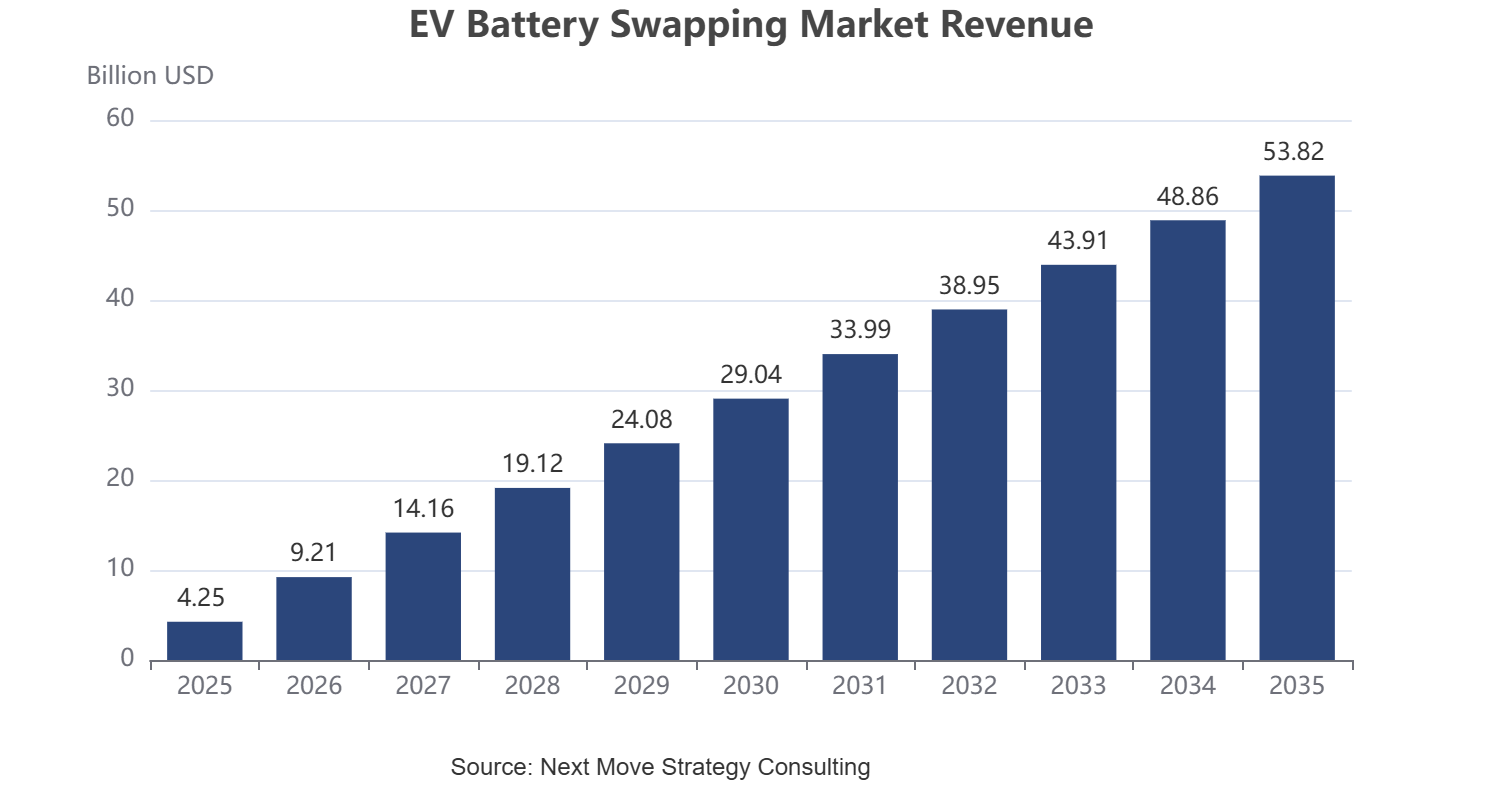
About the Author
 Mayurima Roy
— Mayurima Roy is Research Analyst at Next Move Strategy Consulting, where she has spent 4 years working across the firm's full industry coverage rather than a single fixed vertical. Her work centers on structured research, ongoing trend tracking, competitive assessment, and insight-led content development, translating complex market data into clear, decision-ready narratives that support informed client decision-making across diverse global industries, market sectors, and world regions every day.
Mayurima Roy
— Mayurima Roy is Research Analyst at Next Move Strategy Consulting, where she has spent 4 years working across the firm's full industry coverage rather than a single fixed vertical. Her work centers on structured research, ongoing trend tracking, competitive assessment, and insight-led content development, translating complex market data into clear, decision-ready narratives that support informed client decision-making across diverse global industries, market sectors, and world regions every day.
About the Reviewer
 Supradip Baul
— Supradip Baul is an accomplished business consultant and strategist with over a decade of rich experience in market intelligence, strategy, technology, and business transformation. His work has included rigorous qualitative and quantitative analysis across multiple industries, helping clients shape investment decisions and long-term roadmaps. Earlier in his career, he was associated with Gartner, where he contributed to industry-leading reports and market share analyses. He has worked with leading global companies and holds an MBA with a dual specialization in Marketing and Finance.
Supradip Baul
— Supradip Baul is an accomplished business consultant and strategist with over a decade of rich experience in market intelligence, strategy, technology, and business transformation. His work has included rigorous qualitative and quantitative analysis across multiple industries, helping clients shape investment decisions and long-term roadmaps. Earlier in his career, he was associated with Gartner, where he contributed to industry-leading reports and market share analyses. He has worked with leading global companies and holds an MBA with a dual specialization in Marketing and Finance.
At Next Move Strategy Consulting, we understand that insightful market research is the cornerstone of successful business decisions. That's why we employ a robust and multifaceted approach, combining various methodologies to deliver the most accurate and actionable data for our clients.

Research Landscape
We navigate the world of research with two primary approaches:
Qualitative Approach
Our qualitative research methodologies involve immersive techniques such as in-depth interviews, focus groups, and observational studies. By engaging directly with individuals and stakeholders, we uncover valuable insights that quantitative data alone may overlook.

Quantitative Research
In tandem with qualitative methodologies, NMSC leverages the power of Quantitative Research to provide a robust foundation of numerical insights. Through systematic data collection and analysis, we quantify patterns, preferences, and market trends, offering a comprehensive view of the business landscape.
Our quantitative research approach employs diverse tools, including surveys, experiments, and statistical modelling. These methodologies enable us to gather data from a large and representative sample, ensuring the statistical significance of our findings. By employing structured questionnaires and standardized data collection methods, we guarantee the reliability and validity of the information we present to our clients.
Quantitative research is particularly effective in measuring the prevalence of trends, assessing market size, and gauging the impact of various factors on consumer behavior. The numerical precision attained through this approach equips our clients with actionable insights, facilitating data-driven decision-making and strategy formulation.


Our Specialized Toolbox for Industry-Specific Market Research
We deploy a specialized arsenal of techniques tailored to meet your unique requirements. Here's a glimpse into our comprehensive toolbox:

Information Procurement
The stage entails acquiring market data or relevant information through various sources and methodologies.


Market Research Approach
We utilize both top-down and bottom-up approaches in market research analysis to achieve a comprehensive understanding of the market dynamics, leveraging the broad perspective of industry trends and macroeconomic factors alongside detailed insights from specific segments and individual companies.

Porters Five Forces Analysis
We conduct Porter's Five Forces analysis to evaluate the competitive landscape of an industry, providing us with insights into factors that affect profitability and strategic positioning.

SWOT Analysis

Forecasting
We utilize a forecasting model to predict future consumption by considering parameters like population, economics, regulations, market competition, drivers, constraints, technology, and pricing. We also employ statistical techniques such as multilinear regression, exponential smoothing, moving average, ARIMA, and Monte Carlo simulations for accurate predictions. In econometric forecasting, we analyzed short-term and long-term event impacts, attributing values based on regulatory frameworks, economic factors, and market events.





 Speak to Our Analyst