Bioelectric Medicine Market Analysis and Forecast (2026–2035)

The market size was USD 28.65 Billion in 2025, projected to reach USD 58.86 Billion by 2035, growing at a CAGR of 7.57% from 2026 to 2035. Key drivers include the rising chronic disease burden, new neuroimmune approvals, and increasing adoption of home-based stimulation, with North America leading the market.

Download Free Sample PDF
Base Year (2025)
$28.65 Billion
Forecast (2035)
$58.86 Billion
CAGR (2026-2035)
7.6%
Top Region
North America

What Is the Bioelectric Medicine Market Size?

The Bioelectric Medicine Market was valued at USD 28.65 Billion in 2025 and is estimated to reach USD 30.52 Billion in 2026. It is forecast to attain USD 58.86 Billion by 2035, growing at a 7.57% CAGR over 2026–2035. North America is estimated to account for 41.2% of global market revenue in 2026, with cardiac rhythm management representing the largest device type segment at an estimated share of 49.7%.

Our analysis shows that device type, application and care setting each point to a market led by cardiac rhythm devices yet pulled forward by neuromodulation and home-based therapy.

Bioelectric Medicine Market Analysis and Forecast (2026–2035) Revenue Forecast
Values in USD Billion

2025 $28.65 Billion
2025
2026 $30.52 Billion
2026
2027 $32.83 Billion
2027
2028 $35.32 Billion
2028
2029 $37.99 Billion
2029
2030 $40.86 Billion
2030
2031 $43.96 Billion
2031
2032 $47.29 Billion
2032
2033 $50.87 Billion
2033
2034 $54.72 Billion
2034
2035 $58.86 Billion
2035

Key Takeaways

By Device type: Cardiac rhythm management held the largest share, moving from USD 14.40 Billion in 2025 to USD 26.20 Billion by 2035; Noninvasive stimulation is the fastest growing at 9.76% CAGR from 2026–2035.

By Application: Cardiovascular disorders held the largest application share in 2025. Psychiatric and inflammatory disorders represent the fastest-growing application segment, expanding at an estimated CAGR of 12.67% from 2026 to 2035.

By End user: Hospitals held the largest share, moving from USD 17.20 Billion in 2025 to USD 31.00 Billion by 2035; Home care settings are the fastest growing at 9.56% CAGR from 2026–2035.

Dominant Region: North America, at USD 11.90 Billion in 2025 and USD 21.80 Billion by 2035.

Fastest-Growing Region: Asia-Pacific, at 10.38% CAGR from 2026–2035.

Dominant Country: U.S., at USD 10.60 Billion in 2025 and USD 19.40 Billion by 2035.

Fastest-Growing Country: India, at 14.44% CAGR from 2026–2035.

The market offers an absolute opportunity of USD 28.34 Billion between 2026 and 2035, a clear investment signal for device makers.

According to NMSC analysis, home-based neuromodulation represents an underappreciated growth lever, as healthcare reimbursement increasingly favors treatment outcomes over facility visits.

Ecosystem Analysis – Bioelectric Medicine Market
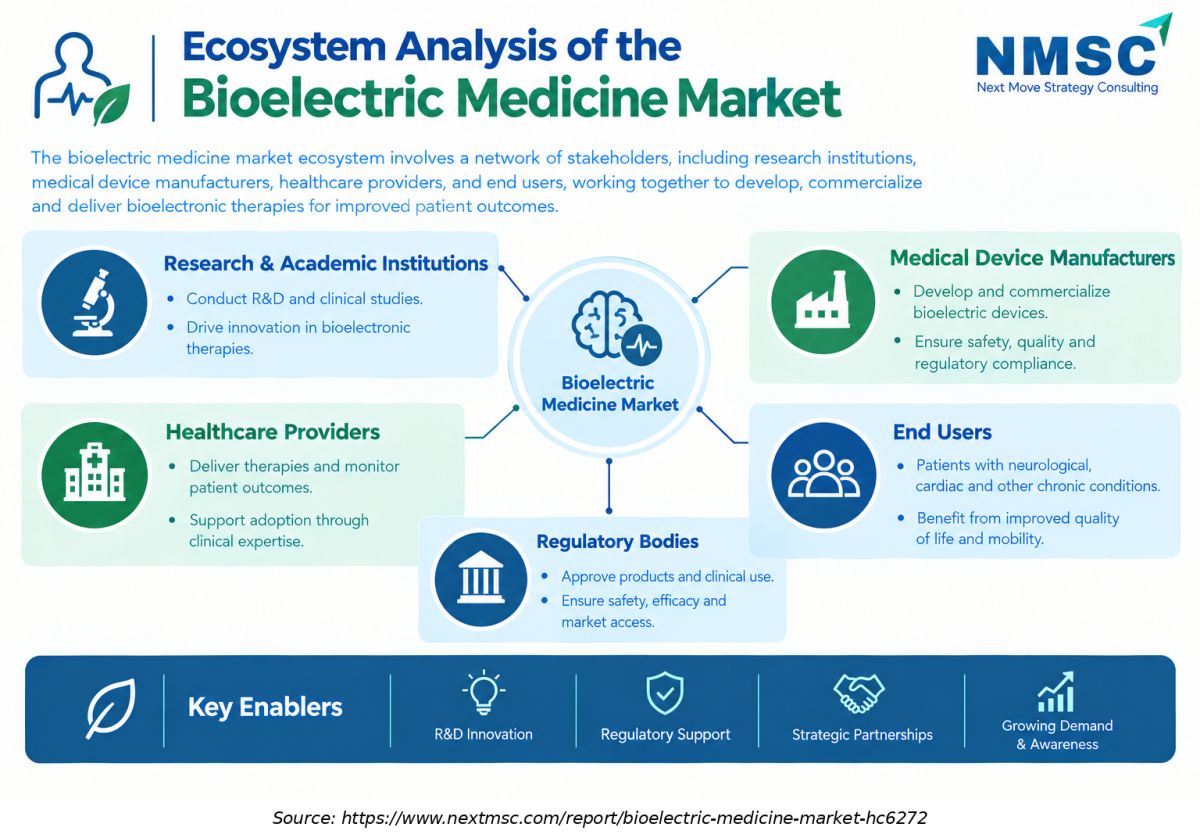
The infographic outlines the Ecosystem Analysis of the Bioelectric Medicine Market, highlighting key stakeholders such as research and academic institutions, medical device manufacturers, healthcare providers, regulatory bodies, and end users. It emphasizes how R&D innovation, regulatory support, strategic partnerships, and growing market awareness contribute to the development and commercialization of bioelectronic therapies and improved patient outcomes

What Does the Bioelectric Medicine Market Encompass?
The Bioelectric Medicine Market covers implantable and external devices that deliver controlled electrical pulses to the heart, brain, spinal cord and peripheral nerves, and that sense electrical activity to adjust therapy. Our assessment indicates that the scope spans cardiac rhythm management, implantable neuromodulation devices for pain, epilepsy, movement and pelvic disorders, and noninvasive stimulation for psychiatric and inflammatory conditions. Drug free electrical therapy is the common thread across every included product.

Market Drivers & Dynamics

Interactive Dataset
Ageing population and chronic disease burden driver +1.90% Global 2026–2035
New FDA approvals in neuroimmune and psychiatric indications driver +1.40% North America 2026–2030
Shift of therapy to outpatient and home settings driver +1.10% North America, Europe 2026–2032
Smaller, rechargeable and MRI conditional implants driver +0.90% Global 2026–2033
High device cost and uneven reimbursement restraint −1.20% Europe, Asia-Pacific, Latin America 2026–2032
Surgical risk, revision rates and implant cybersecurity restraint −0.70% Global 2026–2035
Long evidence requirements and regulatory timelines restraint −0.60% Global 2026–2030
Source: Next Move Strategy Consulting

Growth Drivers

What Is the Primary Growth Driver in the Bioelectric Medicine Market?

Chronic disease prevalence is the primary growth driver because every major indication in scope is long term and progressive. Cardiac rhythm disorders, refractory pain, epilepsy and movement disorders require lifelong management that favors durable implants over repeated drug cycles. Medtronic reported neuromodulation revenue of USD 2.07 Billion in fiscal 2026, up 7.0%, which shows steady procedure demand in a mature franchise. We observed that rising patient volumes and device longevity together sustain the forecast CAGR of 7.57%.

How Is Regulatory and Research Momentum Driving the Market Growth?

Public research funding and approvals are widening the treatable population. The National Institutes of Health supports bioelectric medicine research through its Stimulating Peripheral Activity to Relieve Conditions (SPARC) program, which investigates neural circuits and develops technologies to modulate electrical nerve activity. The FDA approval of SetPoint Medical's system under PMA P240039 provides an example of neuroimmune stimulation reaching clinical application. Our assessment indicates that clearer evidence pathways raise investor confidence and accelerate trials in inflammatory and metabolic conditions.

Growth Inhibitors

What Is Restraining the Bioelectric Medicine Market?

High procedure costs and uneven reimbursement frameworks remain the primary restraints to market expansion. An implantable system requires surgery, programming and follow up, and payers outside North America often limit coverage to patients who have failed conservative therapy, including those with neuropathic pain. Medtronic reported a 13.8% growth in international neuromodulation revenue in fiscal 2026 compared to 3.9% in the United States. This indicates that underpenetrated regional markets are expanding faster than the mature U.S. base. Cybersecurity of connected implants adds further friction.

What Are the Growth Opportunities?

Can Closed Loop Sensing Create a Premium Tier for Implantable Therapy?

Systems that sense a physiological signal and adjust stimulation automatically can command premium pricing, because they reduce clinic reprogramming and improve outcomes. Implantable neuromodulation, growing at 8.53% CAGR from 2026–2035, is the main beneficiary, particularly in chronic pain and movement disorders. Vendors with rechargeable platforms and cloud analytics can bundle software revenue with hardware.

Does Psychiatric and Inflammatory Stimulation Open Large Untapped Patient Pools?

Psychiatric and inflammatory disorders, the fastest growing application at 12.67%, address patients who have exhausted drug options. Depression and rheumatoid arthritis represent potential expansion areas for bioelectric medicine beyond traditional cardiac rhythm and chronic pain applications. The commercial opportunity in each indication depends on clinical evidence, regulatory authorization and reimbursement availability. Vagus nerve specialists and noninvasive stimulation providers benefit first, and mental health technology platforms can extend remote follow up.

Can Home Based Therapy with Digital Support Lower the Cost per Patient?

Home care settings, growing at 9.56% CAGR from 2026–2035, favor devices that patients can operate with remote clinician oversight. Pairing stimulators with digital therapeutics coaching and adherence tracking can cut clinic visits while protecting outcomes. Home-based therapy may reduce the need for selected facility visits and travel while supporting remote clinical follow-up. However, potential healthcare savings and recurring service revenue depend on clinical outcomes, patient adherence and reimbursement arrangements.

Segmentation Analysis

2025 (USD Billion)
2035 (USD Billion)
Cardiac rhyt
Implantable
Noninvasive
Segment Item 2025 (USD Billion) 2035 (USD Billion) CAGR
Cardiac rhythm management $10.0 USD Billion $40.0 USD Billion 14.0%
Implantable neuromodulation $17.1 USD Billion $51.1 USD Billion 8.0%
Noninvasive stimulation $24.2 USD Billion $62.2 USD Billion 14.0%

Segment-wise data not detailed in this view

Unlock complete segment-wise numbers for By Device Type.

Unlock Full Data
2025 (USD Billion)
2035 (USD Billion)
Cardiovascul
Chronic pain
Neurological
Pelvic and u
Psychiatric
Segment Item 2025 (USD Billion) 2035 (USD Billion) CAGR
Cardiovascular disorders $10.0 USD Billion $40.0 USD Billion 25.0%
Chronic pain $17.1 USD Billion $51.1 USD Billion 11.0%
Neurological and movement disorders $24.2 USD Billion $62.2 USD Billion 25.0%
Pelvic and urological disorders $31.3 USD Billion $73.3 USD Billion 11.0%
Psychiatric and inflammatory disorders $38.4 USD Billion $84.4 USD Billion 16.0%

Segment-wise data is locked

Unlock complete segment-wise numbers for By Application.

Unlock Full Data
2025 (USD Billion)
2035 (USD Billion)
Hospitals
Ambulatory s
Home care se
Segment Item 2025 (USD Billion) 2035 (USD Billion) CAGR
Hospitals $10.0 USD Billion $40.0 USD Billion 27.0%
Ambulatory surgical centers and clinics $17.1 USD Billion $51.1 USD Billion 9.0%
Home care settings $24.2 USD Billion $62.2 USD Billion 19.0%

Segment-wise data is locked

Unlock complete segment-wise numbers for By End User.

Unlock Full Data
2025 (USD Billion)
2035 (USD Billion)
North Americ
U.S.
Canada
Mexico
Europe
Segment Item 2025 (USD Billion) 2035 (USD Billion) CAGR
North America $10.0 USD Billion $40.0 USD Billion 14.0%
U.S. $17.1 USD Billion $51.1 USD Billion 24.0%
Canada $24.2 USD Billion $62.2 USD Billion 22.0%
Mexico $31.3 USD Billion $73.3 USD Billion 12.0%
Europe $38.4 USD Billion $84.4 USD Billion 27.0%

Segment-wise data is locked

Unlock complete segment-wise numbers for By Region.

Unlock Full Data

Regional Outlook

2025 (USD Billion)
2035 (USD Billion)
North Americ
Europe
Asia-Pacific
Middle East
Latin Americ
Region 2025 (USD Billion) 2035 (USD Billion) CAGR (%)
North America $10.0 USD Billion $40.0 USD Billion 9.0%
Europe $17.1 USD Billion $51.1 USD Billion 27.0%
Asia-Pacific $24.2 USD Billion $62.2 USD Billion 25.0%
Middle East & Africa $31.3 USD Billion $73.3 USD Billion 23.0%
Latin America $38.4 USD Billion $84.4 USD Billion 12.0%

Regional data is locked

Unlock complete regional numbers for this market.

Unlock Full Data

Strategic Framework Impacting the Bioelectric Medicine Market
Strategic Framework Impacting the Bioelectric Medicine Market
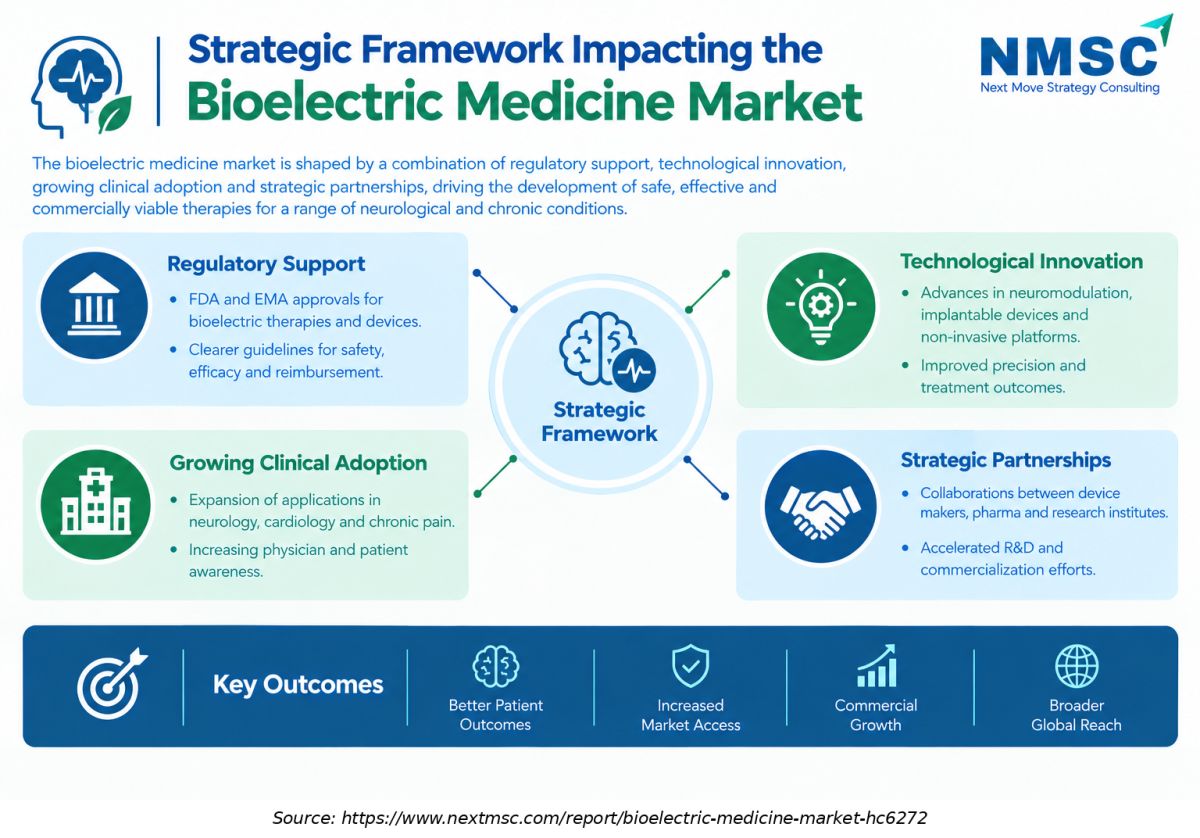
The infographic highlights the Strategic Framework Impacting the Bioelectric Medicine Market, focusing on regulatory support, technological innovation, growing clinical adoption, and strategic partnerships. It illustrates how advancements in neuromodulation, implantable and non-invasive devices, expanded clinical applications, and collaborative research initiatives support treatment innovation, broader market access, and long-term market growth

Competitive Landscape

Our findings suggest that a handful of diversified medical device groups anchor the market while specialists compete for individual indications.

How Do Companies Compete in the Bioelectric Medicine Market?

Companies compete on clinical evidence, surgeon training and the breadth of implant platforms rather than on price alone. Large groups bundle rhythm, pain and neuromodulation systems into hospital contracts and use field clinical teams to support programming. Specialists differentiate through a single indication, such as epilepsy or rheumatoid arthritis, and rely on trial data to win coverage. Geographic expansion follows regulatory approvals, and pricing power depends on reimbursement status.

Which Company Archetypes Dominate the Industry?

Three archetypes shape the industry. Diversified medical device groups such as Medtronic, Abbott and Boston Scientific differentiate through scale and portfolio breadth. Neurology focused specialists such as LivaNova and SetPoint Medical differentiate through a validated therapy in a defined disease. Spine and orthopedic groups such as Globus Medical differentiate through surgeon relationships, and BrainsWay differentiates through noninvasive psychiatric stimulation.

How Do Innovation and Differentiation Strategies Differ Among Leaders?

Leaders invest in smaller, rechargeable and MRI conditional devices, and in software that lets clinicians adjust therapy remotely. Boston Scientific refined its Intracept procedure with a new stylet, while Medtronic reports international neuromodulation growth of 13.8% in fiscal 2026. Newer entrants differentiate through indication breadth, using Internet of Medical Things connectivity to generate real world evidence that supports payer discussions.

How Active Is M&A in the Bioelectric Medicine Market?

Acquisitions are the quickest route to new indications and surgeon channels. Globus Medical entered spinal cord stimulation by completing its Nevro acquisition in April 2025, and Medtronic announced its intention to acquire SPR Therapeutics to deepen peripheral nerve stimulation. We expect further portfolio moves as large groups seek assets with reimbursed procedures and recurring consumable or service revenue.

Key Market Players

Our assessment indicates that the following seven companies, ranked qualitatively by verified neuromodulation and rhythm franchise scale, define competition in the market.

Medtronic plc Abbott Laboratories Boston Scientific Corporation LivaNova PLC Globus Medical, Inc. BrainsWay Ltd. SetPoint Medical, Inc.

Latest Developments

We observed that recent corporate and regulatory events confirm the shift toward neuroimmune therapy and consolidated stimulation portfolios.

Date Event
April 2025 Globus Medical completed its acquisition of Nevro Corp, adding spinal cord stimulation to its musculoskeletal portfolio.

Investment Opportunities

Where Is Capital Flowing in the Market?

Capital is flowing toward acquisitions and clinical programs that add reimbursed indications. Globus Medical and Medtronic have expanded their neuromodulation portfolios through acquisitions. Separately, Boston Scientific reported FY2025 Neuromodulation net sales of approximately USD 1.199 Billion, while Medtronic reported FY2026 Neuromodulation net sales of approximately USD 2.068 Billion. Investors should favor assets with approved devices, published clinical outcomes and established payer coverage, as these factors can reduce commercialization uncertainty and support recurring revenue generation.

How Does Infrastructure Investment Support Growth?

Hospital capacity, outpatient surgical centers and remote monitoring platforms determine how many patients can be treated. Asia-Pacific, growing at 10.38% CAGR from 2026–2035, offers the largest infrastructure led upside, while North America offers scale through established implant centers. Investments in training, service networks and cloud programming platforms are as important as device manufacturing capacity.

What ESG Considerations Matter to Stakeholders?

Environmental and social factors increasingly influence procurement. Rechargeable implants reduce replacement surgeries and device waste, and drug free therapy can cut long term opioid exposure in pain care. Governance matters through data privacy and cybersecurity of connected implants. Manufacturers that publish clinical outcomes and secure update processes are better positioned with hospital buyers and public payers.

Key Benefits for Stakeholders

How Does the Report Help Device Makers and Technology Vendors?

Device makers gain a segmented view of USD 30.52 Billion of 2026 revenue across device type, application and care setting, with CAGR for each. The analysis shows where noninvasive stimulation, neuroimmune therapy and home care create room for new products. Vendors can use the regional and country forecasts to prioritize approvals, distributors and clinical trial sites.

How Does the Report Help Healthcare Providers and Payers?

Providers and payers gain evidence on which indications and care settings are growing fastest and where cost per patient may fall. The report links coverage decisions to adoption, so hospital leaders can plan implant capacity and ambulatory pathways. Payers can compare drug free options against long term medication costs when setting policy for pain, epilepsy and inflammatory disease.

How Does the Report Help Investors and Financial Analysts?

Investors receive a single point forecast of USD 58.86 Billion by 2035 with reconciled segment and regional values, which supports valuation and portfolio decisions. The competitive and developments sections identify consolidation themes, while the driver and restraint matrix quantifies the factors most likely to move growth above or below the base case.

Key Market Segments Evaluated

By Device Type

  • Cardiac rhythm management
  • Implantable neuromodulation
  • Noninvasive stimulation

By Application

  • Cardiovascular disorders
  • Chronic pain
  • Neurological and movement disorders
  • Pelvic and urological disorders
  • Psychiatric and inflammatory disorders

By End User

  • Hospitals
  • Ambulatory surgical centers and clinics
  • Home care settings

By Region

  • North America 
    • U.S.
    • Canada
    • Mexico
  • Europe 
    • UK
    • Germany
    • France
    • Italy
    • Spain
    • Sweden
    • Denmark
    • Finland
    • Netherlands
    • Rest of Europe
  • Asia-Pacific 
    • China
    • India
    • Japan
    • South Korea
    • Taiwan
    • Indonesia
    • Vietnam
    • Australia
    • Philippines
    • Malaysia
    • Rest of APAC
  • Middle East & Africa 
    • Saudi Arabia
    • UAE
    • Egypt
    • Israel
    • Turkey
    • Nigeria
    • South Africa
    • Rest of MEA
  • Latin America 
    • Brazil
    • Argentina
    • Chile
    • Colombia
    • Rest of LATAM

Conclusion & Recommendations

The outlook is steady and constructive. Revenue is forecast to rise from USD 30.52 Billion in 2026 to USD 58.86 Billion in 2035, supported by chronic disease burden, new approvals and a broader care footprint. Our findings indicate balanced growth dynamics across segments, where cardiac rhythm management provides a stable revenue foundation while neuromodulation and noninvasive stimulation accelerate expansion through 2035.

What Strategic Positioning Recommendations Does NMSC Offer?

NMSC recommends that manufacturers pair implantable platforms with remote programming and consider noninvasive or home deployable products to reach new patients. Companies without a pain or neuroimmune franchise should evaluate partnerships or acquisitions, given recent portfolio transactions. Regional strategies should prioritize Asia-Pacific distribution and training, and U.S. strategies should emphasize new indications and payer evidence.

What Is the Investment Attractiveness of the Bioelectric Medicine Market?

Attractiveness is high but selective. Asia-Pacific and home care settings offer the fastest growth, at 10.38% and 9.56% CAGR respectively, while hospitals and North America provide scale and stability. Assets with approved indications, published outcomes and recurring service revenue merit premium positioning, and early-stage platforms warrant staged capital tied to regulatory milestones.

What Are the Market Shifts and Key Risks in the Bioelectric Medicine Market?

Key shifts include movement of therapy toward outpatient and home settings, growth of neuroimmune indications and consolidation of specialist assets. Key risks include reimbursement delays, surgical complications and device revision, and cybersecurity weaknesses in connected implants. Our assessment indicates that evidence quality and payer coverage will decide which new indications scale beyond early approvals.

What Are the Primary Growth Pathways Through 2035?

Three pathways stand out. Noninvasive stimulation grows at 9.76% CAGR from 2026–2035, psychiatric and inflammatory disorders grow at 12.67%, and Asia-Pacific grows at 10.38%. The global market is projected to increase by USD 28.34 Billion between 2026 and 2035. These emerging growth pathways offer manufacturers opportunities to expand beyond established cardiac rhythm management and chronic pain applications.

FAQs

Sources & References

1.

Medtronic plc, fourth quarter and full year fiscal 2026 results

news.medtronic.com
2.

Medtronic plc, Form 10-K fiscal 2026 (U.S. SEC)

sec.gov
3.

Boston Scientific Corporation, fourth quarter and full year 2025 results

news.bostonscientific.com
4.

Boston Scientific Corporation, Form 10-Q September 2025 (U.S. SEC)

sec.gov
5.

Globus Medical, Inc., Form 8-K exhibit on the Nevro transaction (U.S. SEC)

sec.gov
6.

LivaNova PLC, investor relations release details

investor.livanova.com/node/19111
7.

Abbott Laboratories, brain health and neuromodulation overview

abbott.com
8.

BrainsWay Ltd., fourth quarter and full year 2025 results

brainsway.com
9.

U.S. Food and Drug Administration, premarket approval P240039

accessdata.fda.gov
10.

National Institutes of Health Common Fund, SPARC program

commonfund.nih.gov/sparc

About the Author

Mayurima Roy

Mayurima Roy

Mayurima Roy is Research Analyst at Next Move Strategy Consulting, where she has spent 4 years working across the firm's full industry coverage rather than a single fixed vertical. Her work centers on structured research, ongoing trend tracking, competitive assessment, and insight-led content development, translating complex market data into clear, decision-ready narratives that support informed client decision-making across diverse global industries, market sectors, and world regions every day.

About the Reviewer

Supradip Baul

Supradip Baul

Supradip Baul is an accomplished business consultant and strategist with over a decade of rich experience in market intelligence, strategy, technology, and business transformation. His work has included rigorous qualitative and quantitative analysis across multiple industries, helping clients shape investment decisions and long-term roadmaps. Earlier in his career, he was associated with Gartner, where he contributed to industry-leading reports and market share analyses. He has worked with leading global companies and holds an MBA with a dual specialization in Marketing and Finance.

Download Free Sample

Kishu Kanda

KISHU KANDA

Strategy Analyst

Accenture

We purchased the AI Consumer Market Report from this company. Not only did they customize the report to meet our specific requirements, but they also showed great flexibility in accommodating our budget. The report we received fully met our expectations. Additionally, they provided prompt and thorough responses to both our pre-purchase and follow-up questions. We look forward to working with this company again in the future.

Kevin Coker

KEVIN COKER

Founder, CEO and Board Diector

Proxima Clinical Research

I have been using Next MSC reports for product positioning in a new geography for a long time. They have by far the best reports I have found and the price is reasonable too!

Robert Sean Trevino

ROBERT SEAN TREVINO

Sr. Director, Head of Strategic Insights & Analytics

Foundation Medicine

I realized that it was a reliable source of information. These days, there are many people who are looking for authentic data, and this is one of the only sources that can offer them with what they need;

Gaurav Jaiswal

GAURAV JAISWAL

Founder & CEO

Yano Charge Private Limited

The EV Charging market research report provided by the NextMSC was exceptionally detailed and insightful. It offered a comprehensive analysis that proved to be a game-changer for our strategic planning. Truly a testament to the NextMSC’s expertise and thoroughness in EV market landscape & analysis.

Melanie Samko

MELANIE SAMKO

Director of Marketing

TOSOH BIOSCIENCE, INC.

The information provided by NMSC is incredibly valuable, thank you so much for such a excellent work. I really appreciate it. I will make sure to reference all of it, in my summary document.

Custom Market Research Services

We will customize the research for you if the listed report does not fully match your requirements.

Get 30% Free Customization

Select License

This website uses cookies to ensure you get the best experience on our website. Learn more

✖