
Blockchain in Education Market Size, Share, Trends and Growth Analysis, By Component (Platform & Software, and Services), By Application (Credential & Certificate Verification, Academic Record & Transcript Management, Learning Content Management & Sharing, and Others), By Deployment Mode (Cloud, On-Premise, and Hybrid), By End User (Higher Education Institutions, K-12 Schools, and Others), and Region — Global Industry Report and Forecast, 2026–2035
Industry: ICT & Media | Publishing Date: August 1, 2026 | Last Updated: August 1, 2026 | No of Pages: N/A | No. of Tables: N/A | No. of Figures: N/A | Format: PDF | Report Code: IC5520
What Is the Blockchain in Education Market Size?
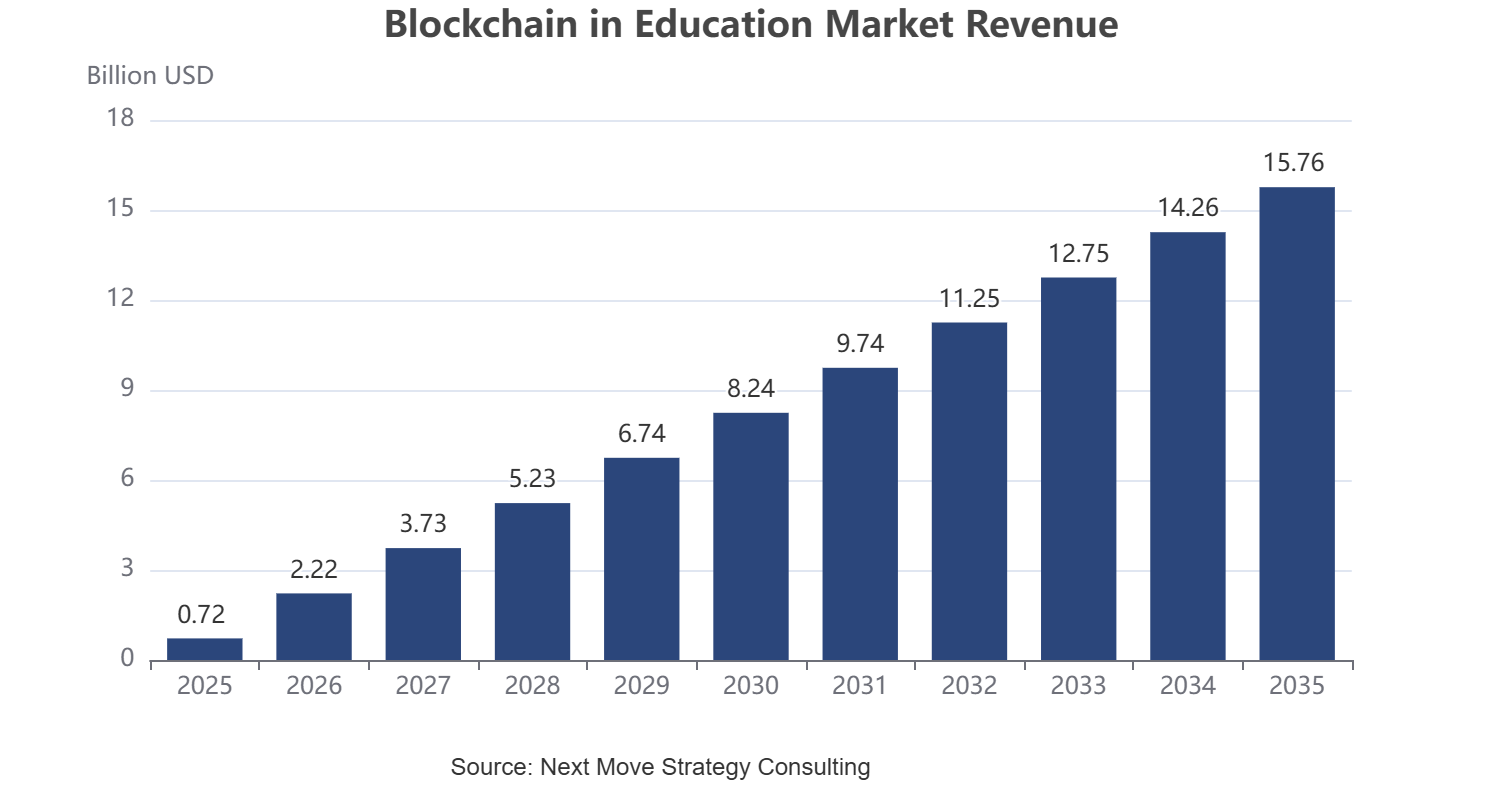
The global blockchain in education market was valued at USD 0.72 billion in 2025 and is estimated at USD 0.91 billion in 2026, forecast to reach USD 15.76 billion by 2035 at a 37.28% CAGR from 2026 to 2035. North America led with approximately 40% revenue share, while Platform & Software dominated the primary segmentation axis at approximately 61% share in 2025.
We observed that momentum is broad-based across every segmentation axis of the blockchain in education market, with credential verification platforms and cloud-hosted deployment driving the dominant structural shifts through 2035.
|
Key Takeaways |
|
By Component: Platform & Software held the largest share of approximately 61% (USD 0.44 Billion) in 2025; Services is the fastest-growing sub-segment at 38.1% CAGR from 2026–2035. |
|
By Application: Credential & Certificate Verification held the largest share of approximately 39% (USD 0.28 Billion) in 2025; Identity & Access Management is the fastest-growing sub-segment at 39.2% CAGR from 2026–2035. |
|
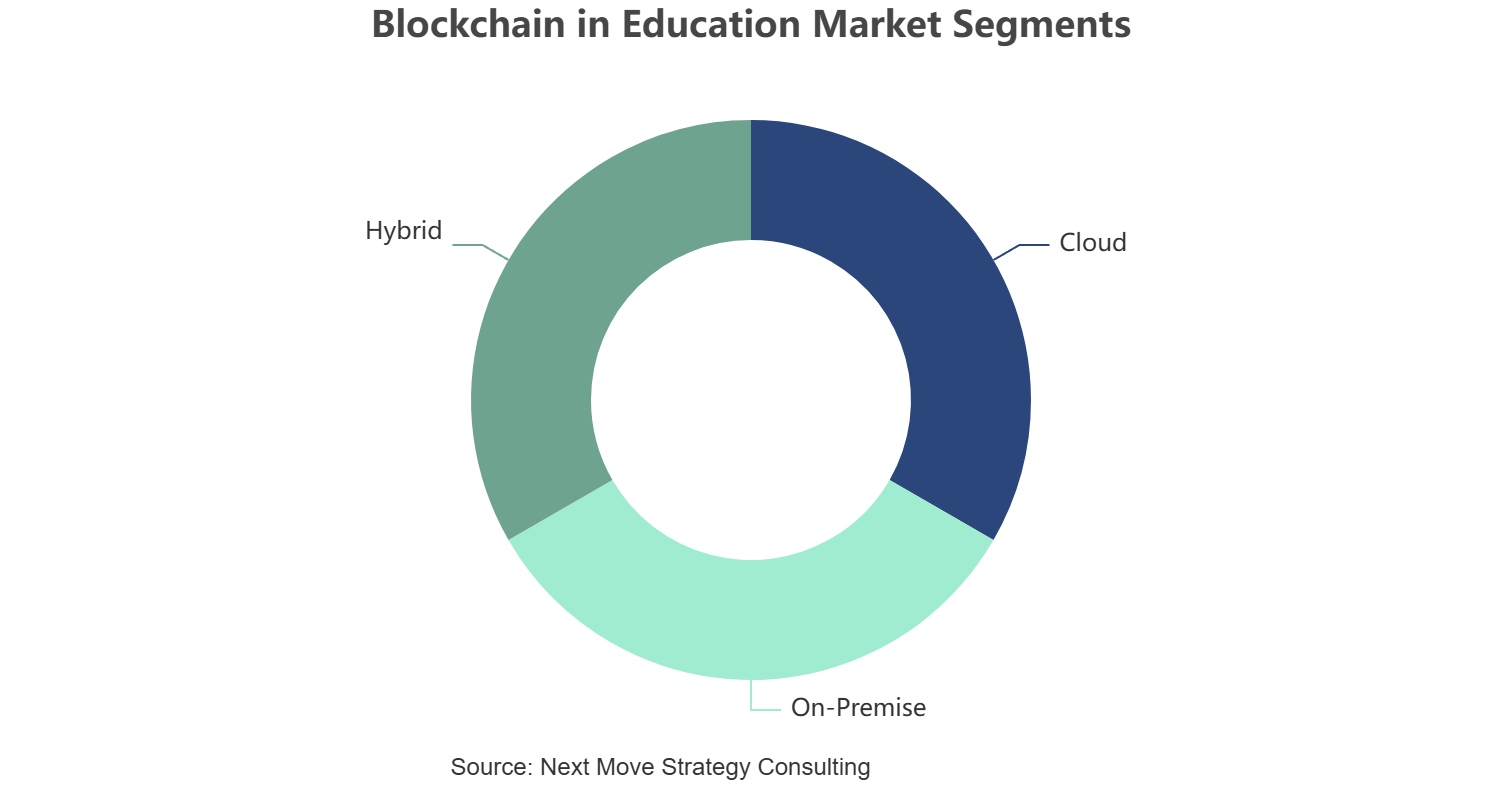
By Deployment Mode: Cloud held the largest share of approximately 64% (USD 0.46 Billion) in 2025; Cloud is the fastest-growing sub-segment at 38.8% CAGR from 2026–2035. |
|
By End User: Higher Education Institutions held the largest share of approximately 43% (USD 0.31 Billion) in 2025; Online & Distance Learning Providers is the fastest-growing sub-segment at 38.5% CAGR from 2026–2035. |
|
Dominant Region: North America dominated with approximately 40% revenue share (USD 0.29 Billion) in 2025. |
|
Fastest-Growing Region: Asia Pacific is expected to register the highest CAGR of 40.6% during 2026–2035. |
|
Dominant Country: U.S. led with approximately USD 166.3 million in 2025. |
|
Fastest-Growing Country: India is the fastest-growing country at approximately 44.2% CAGR from 2026–2035. |
Market Opportunity: The blockchain in education market is expected to create an absolute dollar opportunity of USD 14.85 billion between 2026 and 2035, presenting significant investment potential across the higher education, K-12, online learning, and corporate training credentialing value chain.
According to NMSC analysis, registrars are increasingly consolidating credentialing vendors around fewer, standards-compliant platforms to simplify cross-border recognition, a shift that is accelerating cloud-hosted deployment ahead of single-institution on-premise pilots.
|
Parameter |
Details |
|
Market Size in 2025 |
USD 0.72 Billion |
|
Market Size in 2026 |
USD 0.91 Billion |
|
Revenue Forecast in 2035 |
USD 15.76 Billion |
|
Growth Rate |
CAGR of 37.28% from 2026 to 2035 |
|
Analysis Period |
2025–2035 |
|
Base Year Considered |
2025 |
|
Forecast Period |
2026–2035 |
|
Market Size Estimation |
Revenue (USD Billion) |
|
Companies Profiled |
18 |
|
Countries Covered |
33 |
|
Market Share |
Available for Top 10 Companies |
Blockchain in Education Market Overview
The blockchain in education market encompasses distributed ledger platforms and services that let schools, universities, and training providers issue, store, and verify academic credentials, transcripts, and learning records without a central authority controlling every transaction. Our assessment indicates that scope spans platform and software licensing, consulting, integration, and support services supplied to institutions across North America, Europe, Asia Pacific, Middle East & Africa, and Latin America, with adoption accelerating as registrars replace manual verification with tamper-evident digital records.
We found that the category has evolved from experimental pilot certificates into production credentialing infrastructure, shaped heavily by data protection statutes such as the European Union's General Data Protection Regulation, which push vendors toward off-chain personal data architectures. Technology adoption is progressing fastest among higher education institutions and corporate training providers, while regulatory clarity around digital identity continues to determine the pace of institutional procurement across regions.
Key Emerging Trends
We found that four structural trends are reshaping how institutions issue, verify, and monetize academic records across the blockchain in education market.
How Is Self-Sovereign Credentialing Changing Record Ownership?
Self-sovereign identity frameworks are shifting record ownership from institutional registrars to learners themselves, who hold cryptographically verifiable diplomas in personal digital wallets. MIT Media Lab's open Blockcerts standard, now maintained through Hyland Software following its acquisition of Learning Machine, exemplifies this shift by letting graduates share tamper-evident credentials directly with employers without contacting the issuing institution.
How Are Micro-Credentials Accelerating Platform Adoption?
Employers increasingly request verifiable proof of discrete skills rather than full degrees, pushing institutions and corporate training providers to issue blockchain-anchored micro-credentials for individual courses. IBM's Emerging Technology Program, launched with Don Bosco Senior Secondary School in March 2026, illustrates how established technology vendors are embedding blockchain-based skill verification directly into secondary-level curricula.
How Is Cross-Border Recognition Reducing Verification Friction?
Universities are joining shared verification networks so that a credential issued in one country can be validated instantly by an institution or employer abroad, without contacting the issuing registrar. This reduces administrative costs tied to third-party verification services and directly supports international student mobility, a trend we found to be one of the strongest demand catalysts for the market through 2035.
How Are Smart Contracts Automating Administrative Workflows?
Institutions are layering smart contract-based automation onto enrollment, tuition disbursement, and certificate issuance, letting course completion trigger credential release without manual registrar sign-off. During our market evaluation, we noticed this reduces processing backlogs during peak graduation periods and lowers administrative headcount dedicated to manual verification requests.
Ecosystem Analysis of the Blockchain in Education Market
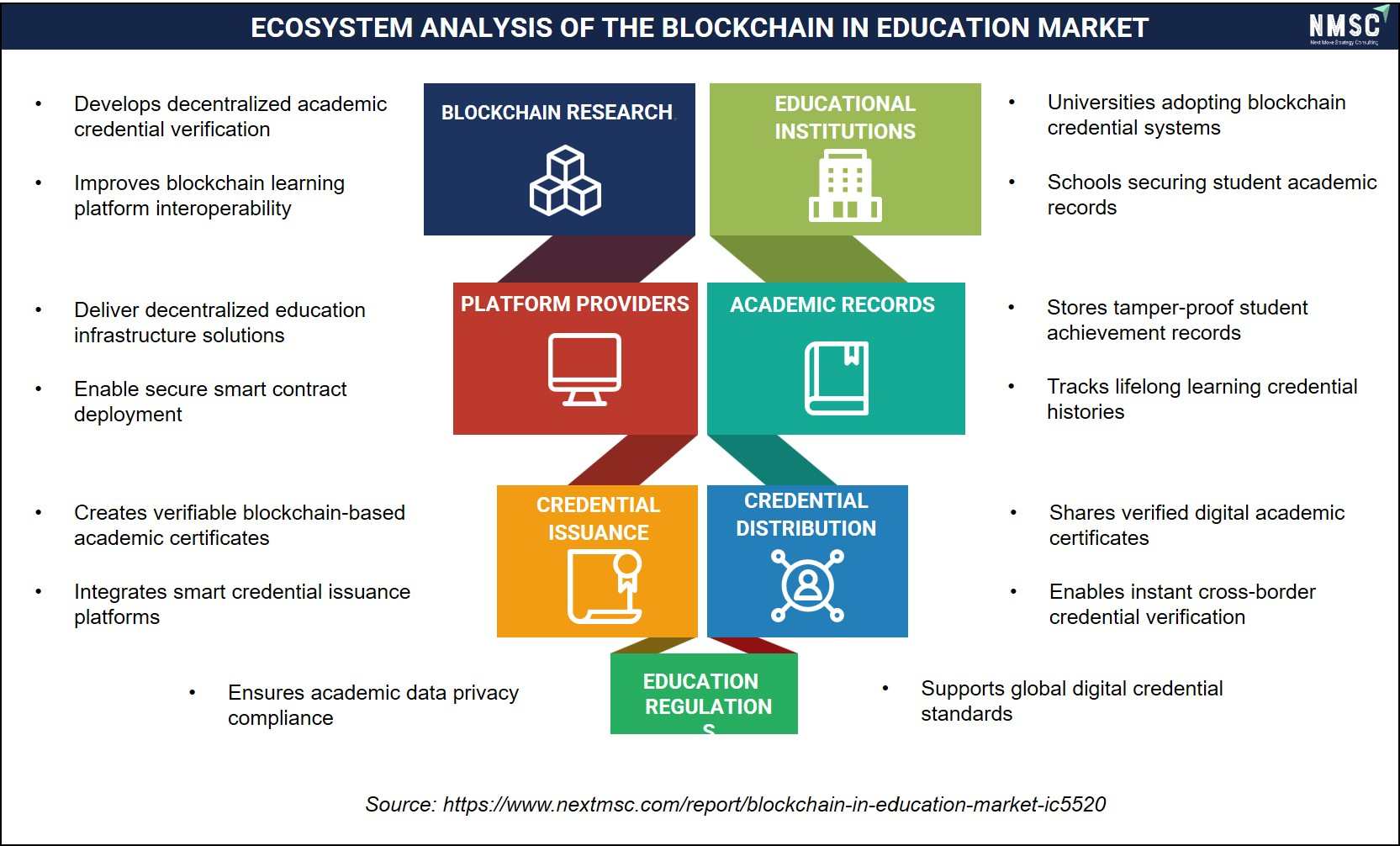
Based on our ecosystem assessment, we identified that the blockchain in education market is supported by collaboration among blockchain research organizations, educational institutions, platform providers, academic record management systems, credential issuance providers, credential distribution networks, and education regulators. Furthermore, our analysis indicates that secure credential verification, decentralized academic record management, trusted certificate issuance, and regulatory oversight strengthen ecosystem interoperability, improve data integrity, and accelerate blockchain adoption across educational institutions.
Growth Drivers & Restraints
|
Factors |
Type |
(+/-) % Impact on CAGR |
Geographic Relevance |
Impact Timeline |
|
Rising demand for fraud-resistant credentials |
Driver |
+6.4% |
Global |
2026–2030 |
|
Government-backed digital identity programs |
Driver |
+5.1% |
North America, Europe |
2026–2032 |
|
Corporate micro-credentialing expansion |
Driver |
+5.8% |
Global |
2026–2035 |
|
Cross-border credential recognition needs |
Driver |
+4.3% |
Asia Pacific, Europe |
2026–2032 |
|
Interoperability standards convergence |
Driver |
+3.7% |
Global |
2028–2035 |
|
Public-private consortium funding |
Driver |
+3.2% |
Asia Pacific, MEA |
2026–2031 |
|
Data privacy and erasure-rights conflicts |
Restraint |
−3.6% |
Europe |
2026–2029 |
|
Limited registrar technical capacity |
Restraint |
−2.8% |
MEA, LATAM |
2026–2030 |
|
Competition from centralized verification databases |
Restraint |
−2.1% |
Global |
2026–2035 |
What Is the Primary Growth Driver for the Blockchain in Education Market?
Academic credential fraud remains a documented concern for registrars and employers, and blockchain-anchored diplomas provide a tamper-evident alternative to paper transcripts. The U.S. Federal Student Aid office's public guidance on verification integrity underscores institutional pressure to modernize record-keeping, a dynamic our analysis shows is accelerating platform procurement among large public university systems.
How Is Corporate Micro-Credentialing Driving Market Growth?
Corporate learning and development teams are adopting blockchain-verified micro-credentials to document compliance training and technical certifications across regulated industries such as finance and healthcare. This extends platform demand beyond traditional registrars into human-resources and learning-and-development functions, widening the addressable buyer base for the blockchain in education market considerably through 2035.
What Is Restraining the Blockchain in Education Market?
Immutable ledgers conflict structurally with erasure rights under regulations such as the European Union's General Data Protection Regulation, forcing vendors to redesign architectures around off-chain personal data and on-chain proofs only. This redesign adds implementation complexity and cost, and our assessment indicates it remains the single largest restraint slowing procurement cycles among privacy-conscious European institutions.
Segmentation Analysis
Segment Sizing: By Component
|
Segment |
2025 (USD) |
2035 (USD) |
CAGR% (2026–2035) |
|
Platform & Software |
USD 0.44 Billion |
USD 8.79 Billion |
36.62% |
|
Services |
USD 0.28 Billion |
USD 6.97 Billion |
38.08% |
|
Total |
USD 0.72 Billion |
USD 15.76 Billion |
37.28% |
Which Component Leads the Blockchain in Education Market?
Component splits the market between platform and software licensing and professional services that support deployment. Our analysis shows that Platform & Software held the dominant share in 2025 at USD 0.44 billion, reflecting institutions' preference for licensing established verification platforms rather than building infrastructure internally. Services is projected as the fastest-growing component through 2035 at a 38.08% CAGR.
Segment Sizing: By Application
|
Segment |
2025 (USD) |
2035 (USD) |
CAGR% (2026–2035) |
|
Credential & Certificate Verification |
USD 0.28 Billion |
USD 5.32 Billion |
37.14% |
|
Academic Record & Transcript Management |
USD 0.16 Billion |
USD 3.58 Billion |
36.45% |
|
Learning Content Management & Sharing |
USD 0.12 Billion |
USD 2.94 Billion |
37.84% |
|
Identity & Access Management |
USD 0.09 Billion |
USD 2.50 Billion |
39.23% |
|
Fee & Payment Management |
USD 0.07 Billion |
USD 1.42 Billion |
35.75% |
|
Total |
USD 0.72 Billion |
USD 15.76 Billion |
37.28% |
Which Application Dominates Platform Deployment?
Application segmentation captures how institutions deploy blockchain infrastructure across the student record lifecycle. We found that Credential & Certificate Verification dominated in 2025 at USD 0.28 billion, as registrars prioritize replacing manual verification requests with instant, tamper-evident checks. Identity & Access Management is the fastest-growing application at a 39.23% CAGR from 2026 to 2035.
Segment Sizing: By End User
|
Segment |
2025 (USD) |
2035 (USD) |
CAGR% (2026–2035) |
|
Higher Education Institutions |
USD 0.31 Billion |
USD 5.81 Billion |
36.21% |
|
K-12 Schools |
USD 0.14 Billion |
USD 3.27 Billion |
37.10% |
|
Online & Distance Learning Providers |
USD 0.15 Billion |
USD 3.75 Billion |
38.49% |
|
Corporate Training & Certification Bodies |
USD 0.12 Billion |
USD 2.93 Billion |
37.80% |
|
Total |
USD 0.72 Billion |
USD 15.76 Billion |
37.28% |
Which End User Generates the Most Platform Revenue?
End-user segmentation distinguishes institutions by credentialing scale and budget authority. Our assessment indicates Higher Education Institutions generated the largest revenue share in 2025 at USD 0.31 billion, reflecting larger registrar budgets and cross-border recognition needs. Online & Distance Learning Providers is the fastest-growing end-user category at a 38.49% CAGR from 2026 to 2035.
Growth Opportunities
Beyond the core growth drivers, three whitespace opportunities stand out for vendors positioning ahead of 2035.
Consortium-Based Verification Infrastructure
Multi-institution consortiums that share a single verification ledger let mid-sized public university systems adopt blockchain credentialing without bearing full infrastructure cost individually, creating a scalable go-to-market opening for platform vendors targeting government-funded higher-education networks.
Corporate Compliance Micro-Credentialing
Regulated industries such as finance and healthcare increasingly require documented proof of employee training completion, creating an opening for vendors to extend education-oriented credentialing platforms into enterprise human-resources and compliance functions as a distinct revenue stream.
Cross-Border Identity Wallet Integration
Government digital identity wallets extending into education create an opening for credentialing vendors to integrate directly with national identity infrastructure, benefiting platforms that support interoperable standards over proprietary formats, particularly across Asia Pacific and the Middle East.
Regional Outlook
|
Region |
2025 (USD) |
2035 (USD) |
CAGR% (2026–2035) |
Key Driver |
|
North America |
USD 0.29 Billion |
USD 4.89 Billion |
34.92% |
Registrar modernization budgets |
|
Europe |
USD 0.16 Billion |
USD 3.42 Billion |
35.76% |
Cross-border recognition, GDPR-aligned design |
|
Asia Pacific |
USD 0.17 Billion |
USD 5.10 Billion |
40.65% |
Government digital identity programs |
|
Middle East & Africa |
USD 0.05 Billion |
USD 1.20 Billion |
38.55% |
Public-private consortium funding |
|
Latin America |
USD 0.05 Billion |
USD 1.15 Billion |
37.85% |
Private university platform adoption |
|
Total |
USD 0.72 Billion |
USD 15.76 Billion |
37.28% |
— |
North America Blockchain in Education Market Outlook
North America leads the blockchain in education market on the strength of well-funded public university registrar budgets and early adoption of digital identity infrastructure. Regulatory clarity from state-level education boards and established vendor relationships support steady institutional procurement. Our analysis indicates the region will retain its lead through 2035, even as faster percentage growth emerges elsewhere, given the scale of its higher education registrar base.
Europe Blockchain in Education Market Outlook
Europe's market is shaped heavily by the General Data Protection Regulation, which pushes vendors toward off-chain personal data architectures and slows initial deployment relative to less regulated regions. Cross-border credential recognition needs within the European Higher Education Area nonetheless sustain steady demand. Our assessment indicates that once compliant architectures are standardized, adoption accelerates quickly across large public university networks.
Asia Pacific Blockchain in Education Market Outlook
Asia Pacific is the fastest-growing region, propelled by government digital identity programs and large student populations that make manual verification prohibitively costly at scale. Public-private consortium funding is common across the region's digital transformation agendas. We observed that national identity infrastructure investment gives the region a distinct cost advantage in extending blockchain verification into education.
Middle East & Africa Blockchain in Education Market Outlook
The Middle East & Africa region is expanding on the back of national education modernization strategies in the Gulf states and pilot consortium funding from multilateral development bodies. Limited registrar technical capacity in parts of the region remains a near-term restraint. We found that Gulf state government funding is the primary catalyst offsetting broader capacity constraints elsewhere.
Latin America Blockchain in Education Market Outlook
Latin America's growth is concentrated among private universities piloting blockchain credentialing ahead of public systems, which face budget constraints on technology modernization. Brazil and Argentina lead regional platform adoption given larger private higher-education sectors. Our findings suggest the region will continue posting steady percentage growth as pilot programs mature into broader institutional deployment.
U.S. Blockchain in Education Market
Based on our engagements, the U.S. blockchain in education market was valued at approximately USD 166.3 million in 2025 and is projected to reach approximately USD 3222.2 million by 2035, growing at a 34.45% CAGR from 2026 to 2035. Demand structure is dominated by large public university registrar systems, with strong adoption levels supported by mature digital identity regulation; competitive intensity remains high, and strategic outlook favors continued platform consolidation.
Canada Blockchain in Education Market
Through our analysis, the Canada blockchain in education market was valued at approximately USD 48.9 million in 2025 and is projected to reach approximately USD 1000.1 million by 2035, growing at a 35.26% CAGR from 2026 to 2035. Provincial education ministries are piloting shared verification consortiums, reflecting moderate adoption levels and a regulatory environment favorable to cross-institution data sharing; strategic outlook centers on public university system-wide rollouts.
UK Blockchain in Education Market
From our assessment, the UK blockchain in education market was valued at approximately USD 32.4 million in 2025 and is projected to reach approximately USD 629.9 million by 2035, growing at a 34.41% CAGR from 2026 to 2035. Demand structure centers on research university consortiums verifying credentials for a large international student population, with regulatory influence from UK GDPR shaping architecture choices; strategic outlook favors continued consortium expansion.
Germany Blockchain in Education Market
According to evaluation, the Germany blockchain in education market was valued at approximately USD 27.5 million in 2025 and is projected to reach approximately USD 564.8 million by 2035, growing at a 35.21% CAGR from 2026 to 2035. Public university systems drive demand structure, with strict data protection enforcement shaping off-chain-first architectures; adoption levels are steady, and strategic outlook favors vendors offering demonstrably GDPR-compliant deployment models.
France Blockchain in Education Market
Based on our engagements, the France blockchain in education market was valued at approximately USD 21.1 million in 2025 and is projected to reach approximately USD 418.3 million by 2035, growing at a 34.73% CAGR from 2026 to 2035. Grandes écoles and research universities lead adoption, supported by national digital sovereignty initiatives that favor domestically hosted verification infrastructure; strategic outlook favors platforms offering local data residency.
China Blockchain in Education Market
Through our analysis, the China blockchain in education market was valued at approximately USD 36.1 million in 2025 and is projected to reach approximately USD 1013.8 million by 2035, growing at a 39.47% CAGR from 2026 to 2035. Large student population and strong government digital identity investment drive demand structure, with technology penetration accelerating through state-backed education modernization programs; strategic outlook favors continued public sector-led scaling.
India Blockchain in Education Market
From our assessment, the India blockchain in education market was valued at approximately USD 32.8 million in 2025 and is projected to reach approximately USD 1244.5 million by 2035, growing at a 44.20% CAGR from 2026 to 2035. Demand structure is shaped by an exceptionally large higher-education student population and national digital identity infrastructure extending naturally into education credentialing; strategic outlook favors platforms integrating with existing national identity systems.
Japan Blockchain in Education Market
According to evaluation, the Japan blockchain in education market was valued at approximately USD 21.3 million in 2025 and is projected to reach approximately USD 513.5 million by 2035, growing at a 37.10% CAGR from 2026 to 2035. Established public and private university systems drive steady demand structure, with regulatory influence shaped by conservative data governance norms; strategic outlook favors incremental consortium-based deployment.
South Korea Blockchain in Education Market
Based on our engagements, the South Korea blockchain in education market was valued at approximately USD 16.4 million in 2025 and is projected to reach approximately USD 460.8 million by 2035, growing at a 39.47% CAGR from 2026 to 2035. High baseline digital infrastructure penetration supports relatively fast adoption levels among research universities; strategic outlook favors partnerships between domestic technology vendors and university consortiums.
Australia Blockchain in Education Market
Through our analysis, the Australia blockchain in education market was valued at approximately USD 13.1 million in 2025 and is projected to reach approximately USD 332.8 million by 2035, growing at a 37.89% CAGR from 2026 to 2035. Established university systems drive demand structure, supported by regulatory clarity around digital identity and strong international student credential verification needs; strategic outlook favors continued consortium expansion.
UAE Blockchain in Education Market
From our assessment, the UAE blockchain in education market was valued at approximately USD 9.5 million in 2025 and is projected to reach approximately USD 288.4 million by 2035, growing at a 40.87% CAGR from 2026 to 2035. Demand structure benefits from the country's positioning as a regional digital innovation hub, with high technology penetration among private and international branch campus universities; strategic outlook favors continued platform vendor partnerships.
Saudi Arabia Blockchain in Education Market
According to evaluation, the Saudi Arabia blockchain in education market was valued at approximately USD 9.5 million in 2025 and is projected to reach approximately USD 282.6 million by 2035, growing at a 40.55% CAGR from 2026 to 2035. National education modernization strategy under broader digital transformation programs drives strong demand structure; strategic outlook favors continued large-scale public university rollouts.
South Africa Blockchain in Education Market
Based on our engagements, the South Africa blockchain in education market was valued at approximately USD 3.0 million in 2025 and is projected to reach approximately USD 73.2 million by 2035, growing at a 37.38% CAGR from 2026 to 2035. Public university systems are piloting credential verification to address regional certificate fraud concerns, supporting steady demand structure; strategic outlook favors partnerships with international platform vendors offering proven consortium models.
Brazil Blockchain in Education Market
Through our analysis, the Brazil blockchain in education market was valued at approximately USD 18.3 million in 2025 and is projected to reach approximately USD 490.4 million by 2035, growing at a 39.07% CAGR from 2026 to 2035. Large private higher-education sector drives regional demand structure, with adoption levels ahead of most Latin American peers; strategic outlook favors continued private university platform expansion.
Argentina Blockchain in Education Market
From our assessment, the Argentina blockchain in education market was valued at approximately USD 7.8 million in 2025 and is projected to reach approximately USD 199.5 million by 2035, growing at a 38.27% CAGR from 2026 to 2035. Demand structure is led by private universities pursuing internationally recognized credentials for study-abroad and employment purposes; strategic outlook favors partnerships with established global platform vendors.
Regulatory Framework Impacting the Blockchain in Education Market
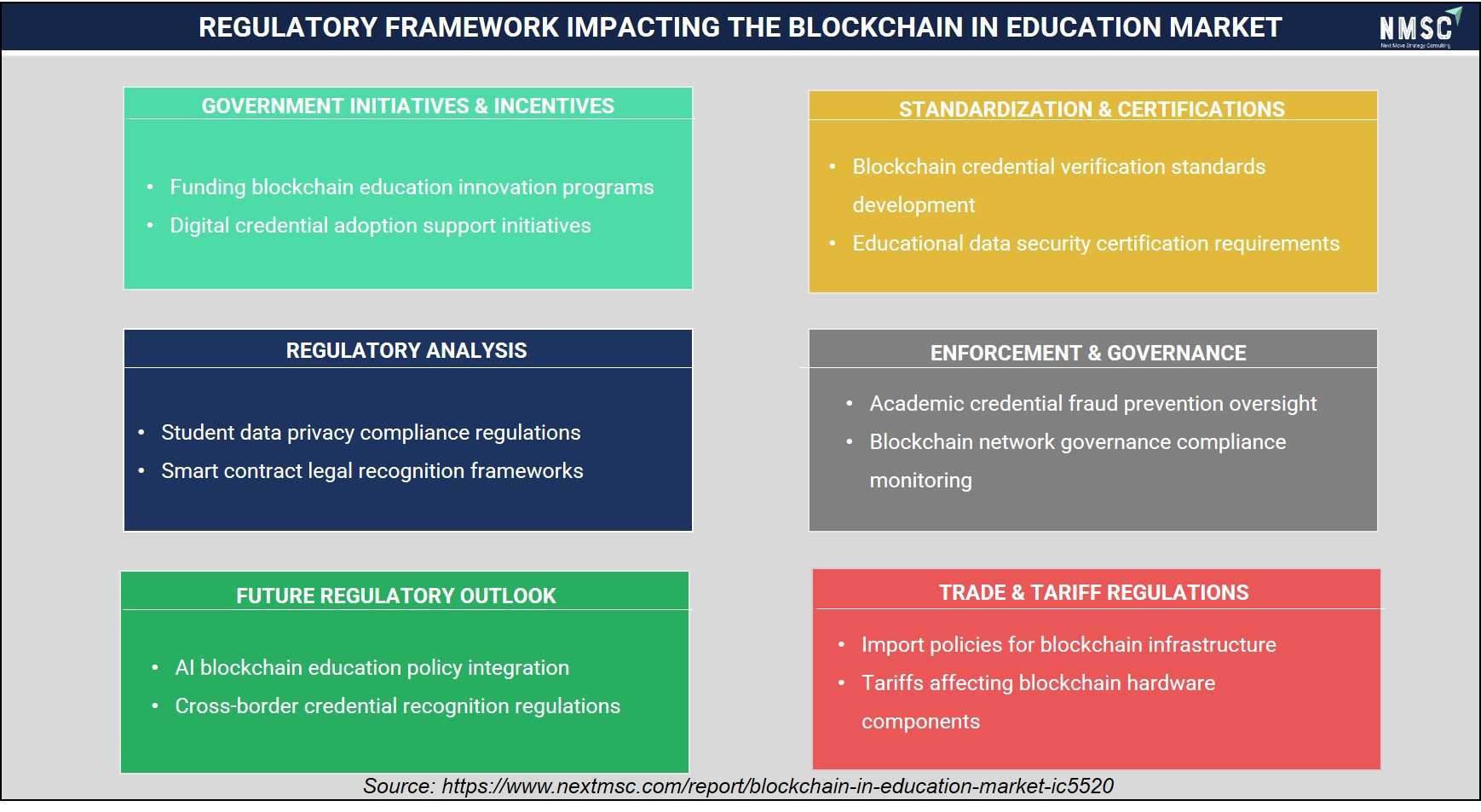
Based on our regulatory framework assessment, we identified that the blockchain in education market is shaped by government incentives, credential verification standards, student data privacy regulations, governance requirements, international trade policies, and evolving cross-border recognition frameworks. Furthermore, our analysis indicates that funding for digital credential initiatives, standardization of blockchain-based certifications, compliance with privacy regulations, and policy support for interoperable academic credentials foster market adoption while ensuring secure, transparent, and legally recognized education ecosystems.
Competitive Landscape
We found that competitive dynamics in the blockchain in education market center on interoperability and standards compliance rather than price alone.
|
Category |
Details |
|
Market Structure |
Moderately fragmented, with diversified technology conglomerates competing alongside specialized credentialing platform vendors and blockchain infrastructure providers. |
|
Innovation Focus |
Interoperable credentialing standards, self-sovereign identity wallets, and smart contract-based administrative automation. |
|
M&A Activity |
Consolidation of specialized credentialing vendors by larger enterprise software and content-services platforms. |
How Do Companies Compete in the Blockchain in Education Market?
Competition centers on interoperability, since institutions favor platforms whose credentials verify across other vendors' systems rather than proprietary, closed formats. Our analysis shows that vendors differentiate through standards compliance, integration speed with existing student information systems, and the size of their institutional customer base rather than through price competition alone.
Which Competitive Archetypes Dominate the Market?
Three archetypes define the landscape: diversified enterprise technology vendors offering blockchain as one module within broader cloud platforms, specialized credentialing platforms built specifically for education, and blockchain infrastructure providers whose ledgers underpin third-party applications. We found that diversified vendors increasingly acquire specialized credentialing platforms to shorten time-to-market.
What Innovation and Differentiation Strategies Are Companies Pursuing?
Vendors are investing in self-sovereign identity wallets that let learners control their own credential storage, and in smart contract automation that removes manual registrar steps from certificate issuance. We observed that companies offering open, auditable standards attract larger public university consortiums, while proprietary systems remain more common among smaller private deployments.
How Active Is M&A in the Competitive Landscape?
Consolidation has been most visible where enterprise content and learning-platform vendors acquire specialized credentialing companies, exemplified by Hyland Software's acquisition of Learning Machine. Our assessment indicates this pattern is likely to continue as larger vendors seek verified-credential features to differentiate broader student-records product lines.
Key Market Players
The following companies represent the verified set of active blockchain in education market participants profiled in this report, ranked by scale of operations and documented market activity.
-
International Business Machines Corporation (IBM)
-
Sony Group Corporation
-
Microsoft Corporation
-
Accenture plc
-
Deloitte Touche Tohmatsu Limited
-
Hyland Software, Inc.
-
Instructure Holdings, Inc.
-
ConsenSys Software Inc.
-
Digital Bazaar, Inc.
-
R3 LLC
-
ODEM SA
-
Woolf Development Ltd
-
Credly, LLC
-
BitDegree UAB
-
APPII Ltd
-
Factom Protocol
Latest Developments
We found that platform vendors are moving from pilot programs into institution-wide production deployments, with the following developments reflecting the most recent verifiable activity in the market.
|
Date |
Events |
|
July 2026 |
Circle Internet Group, Inc. completed the acquisition of key assets from International Business Machines Corporation (IBM)'s blockchain patent portfolio, encompassing nearly 1,000 issued patents across enterprise infrastructure, supply chain verification, and secure cloud management to strengthen its onchain financial framework. |
|
July 2026 |
SAP SE announced expanded workforce development, STEM, and digital competency initiatives designed to integrate enterprise learning with next-generation cloud and distributed ledger technologies, enhancing technological readiness across global business networks. |
|
April 2026 |
Microsoft Corporation expanded its global education and digital upskilling initiatives, including Microsoft Elevate programs integrated with cloud infrastructure investments, to equip students and academic institutions with secure, future-ready digital skills for the evolving digital economy. |
Investment Opportunities
Where Are Capital Inflows Concentrated?
Capital inflows favor vendors offering standards-compliant, interoperable credentialing platforms over single-institution bespoke deployments. Our assessment indicates that investors increasingly value recurring institutional subscription revenue over one-time integration fees, favoring platform models with strong renewal economics across multi-year registrar contracts.
What Infrastructure Investment Trends Are Emerging?
Institutions are investing in shared verification infrastructure through consortium models that spread deployment cost across multiple universities rather than each institution building independently. This consortium approach lowers per-institution capital requirements substantially, making infrastructure investment more accessible to mid-sized public university systems.
How Do ESG Considerations Factor Into Investment Decisions?
Blockchain credentialing supports environmental, social, and governance goals by reducing paper-based transcript processes and improving access to verified education records for underserved populations lacking traditional documentation. We observed that development-finance institutions increasingly cite credential access as a financial-inclusion priority when funding education technology pilots.
Key Benefits for Stakeholders
How Does This Report Benefit Enterprise Technology Leaders?
Technology leaders overseeing registrar and student information system modernization gain a segmentation view across component, application, and end user that clarifies where procurement budgets are concentrated. The regional outlook helps leaders benchmark their institution's adoption timeline against peer markets before committing to platform vendor selection.
How Does This Report Benefit Investors and Financial Analysts?
Investors evaluating exposure to education technology gain a validated market-size trajectory from 2025 through 2035, alongside a competitive landscape identifying which vendor archetypes are consolidating share through M&A. The Investment Opportunities section further clarifies where capital inflows are concentrated relative to broader digital transformation priorities.
How Does This Report Benefit Technology Vendors and Product Teams?
Product teams building credentialing platforms gain segmentation data identifying which applications and deployment modes are growing fastest, informing roadmap prioritization. The Key Emerging Trends and Growth Drivers sections identify the specific institutional pain points that currently shape purchasing decisions across target customer segments.
Key Market Segments
By Component
-
Platform & Software
-
Services
By Application
-
Credential & Certificate Verification
-
Academic Record & Transcript Management
-
Learning Content Management & Sharing
-
Identity & Access Management
-
Fee & Payment Management
By Deployment Mode
-
Cloud
-
On-Premise
-
Hybrid
By End User
-
Higher Education Institutions
-
K-12 Schools
-
Online & Distance Learning Providers
-
Corporate Training & Certification Bodies
By Region
-
North America: U.S., Canada, Mexico
-
Europe: UK, Germany, France, Italy, Spain, Sweden, Denmark, Finland, Netherlands, Rest of Europe
-
Asia-Pacific: China, India, Japan, South Korea, Taiwan, Indonesia, Vietnam, Australia, Philippines, Malaysia, Rest of APAC
-
Middle East & Africa: Saudi Arabia, UAE, Egypt, Israel, Turkey, Nigeria, South Africa, Rest of MEA
-
Latin America: Brazil, Argentina, Chile, Colombia, Rest of LATAM
Conclusion & Recommendations
What Is the Long-Term Outlook for the Blockchain in Education Market?
The blockchain in education market is set to expand from USD 0.91 billion in 2026 to USD 15.76 billion by 2035, registering a 37.28% CAGR as institutions shift from pilot credentialing programs to production-scale verification infrastructure. Long-term growth rests on continued convergence around interoperable standards, expanding government digital identity programs, and rising employer demand for instantly verifiable academic and professional credentials.
What Strategic Positioning Should Blockchain in Education Vendors Pursue?
Vendors should prioritize interoperability with existing student information systems and open credentialing standards over proprietary architectures, since institutional consortiums increasingly favor platforms that verify across providers. Positioning around compliance-ready, privacy-preserving architecture is particularly critical for vendors targeting European institutions bound by strict data protection regulation.
How Attractive Is the Blockchain in Education Market for New Investment?
Investment attractiveness is highest among platforms with proven multi-institution consortium relationships and recurring subscription revenue models, since these characteristics correlate with durable customer retention and lower acquisition-integration risk. Specialized credentialing vendors represent a particularly active segment for near-term strategic transaction activity.
What Market Shifts and Key Risks Should Stakeholders Monitor?
The most significant structural shift is the move from institution-specific pilots toward shared verification consortiums that spread infrastructure cost across multiple registrars. Key risks include continued friction between immutable ledger architecture and data-erasure regulation, and the possibility that non-blockchain centralized verification databases could satisfy institutional needs at lower implementation complexity.
What Are the Key Growth Pathways for the Blockchain in Education Market?
The clearest growth pathway runs through corporate micro-credentialing, where compliance-driven training verification extends platform demand beyond traditional registrars into human-resources functions. Secondary growth pathways include government-funded consortium infrastructure across Asia Pacific and the Middle East, and continued M&A-driven consolidation among enterprise software vendors.
About the Author
 Saista Faiyaz
— Saista Faiyaz is Research Associate at Next Move Strategy Consulting, where she has covered consumer markets and healthcare technologies for 3 years. Her work includes primary interview review, secondary-source validation, market sizing, and structured analysis of company and industry data. She supports research by comparing evidence across sources, organizing findings into market narratives, and documenting assumptions used in analysis. Her scope includes cross-market benchmarking, and reports.
Saista Faiyaz
— Saista Faiyaz is Research Associate at Next Move Strategy Consulting, where she has covered consumer markets and healthcare technologies for 3 years. Her work includes primary interview review, secondary-source validation, market sizing, and structured analysis of company and industry data. She supports research by comparing evidence across sources, organizing findings into market narratives, and documenting assumptions used in analysis. Her scope includes cross-market benchmarking, and reports.
About the Reviewer
 Supradip Baul
— Supradip Baul is an accomplished business consultant and strategist with over a decade of rich experience in market intelligence, strategy, technology, and business transformation. His work has included rigorous qualitative and quantitative analysis across multiple industries, helping clients shape investment decisions and long-term roadmaps. Earlier in his career, he was associated with Gartner, where he contributed to industry-leading reports and market share analyses. He has worked with leading global companies and holds an MBA with a dual specialization in Marketing and Finance.
Supradip Baul
— Supradip Baul is an accomplished business consultant and strategist with over a decade of rich experience in market intelligence, strategy, technology, and business transformation. His work has included rigorous qualitative and quantitative analysis across multiple industries, helping clients shape investment decisions and long-term roadmaps. Earlier in his career, he was associated with Gartner, where he contributed to industry-leading reports and market share analyses. He has worked with leading global companies and holds an MBA with a dual specialization in Marketing and Finance.
At Next Move Strategy Consulting, we understand that insightful market research is the cornerstone of successful business decisions. That's why we employ a robust and multifaceted approach, combining various methodologies to deliver the most accurate and actionable data for our clients.

Research Landscape
We navigate the world of research with two primary approaches:
Qualitative Approach
Our qualitative research methodologies involve immersive techniques such as in-depth interviews, focus groups, and observational studies. By engaging directly with individuals and stakeholders, we uncover valuable insights that quantitative data alone may overlook.

Quantitative Research
In tandem with qualitative methodologies, NMSC leverages the power of Quantitative Research to provide a robust foundation of numerical insights. Through systematic data collection and analysis, we quantify patterns, preferences, and market trends, offering a comprehensive view of the business landscape.
Our quantitative research approach employs diverse tools, including surveys, experiments, and statistical modelling. These methodologies enable us to gather data from a large and representative sample, ensuring the statistical significance of our findings. By employing structured questionnaires and standardized data collection methods, we guarantee the reliability and validity of the information we present to our clients.
Quantitative research is particularly effective in measuring the prevalence of trends, assessing market size, and gauging the impact of various factors on consumer behavior. The numerical precision attained through this approach equips our clients with actionable insights, facilitating data-driven decision-making and strategy formulation.


Our Specialized Toolbox for Industry-Specific Market Research
We deploy a specialized arsenal of techniques tailored to meet your unique requirements. Here's a glimpse into our comprehensive toolbox:

Information Procurement
The stage entails acquiring market data or relevant information through various sources and methodologies.


Market Research Approach
We utilize both top-down and bottom-up approaches in market research analysis to achieve a comprehensive understanding of the market dynamics, leveraging the broad perspective of industry trends and macroeconomic factors alongside detailed insights from specific segments and individual companies.

Porters Five Forces Analysis
We conduct Porter's Five Forces analysis to evaluate the competitive landscape of an industry, providing us with insights into factors that affect profitability and strategic positioning.

SWOT Analysis

Forecasting
We utilize a forecasting model to predict future consumption by considering parameters like population, economics, regulations, market competition, drivers, constraints, technology, and pricing. We also employ statistical techniques such as multilinear regression, exponential smoothing, moving average, ARIMA, and Monte Carlo simulations for accurate predictions. In econometric forecasting, we analyzed short-term and long-term event impacts, attributing values based on regulatory frameworks, economic factors, and market events.





 Speak to Our Analyst