Smart Contract Market by Core Offering (Platform and Protocol Revenue, Software and Tools, Token Services, Professional Services, Managed Services, and Transactional Revenue), by Blockchain Platform (EVM-Compatible Public Chains, Non-EVM Public Chains, and Enterprise Blockchain Frameworks), by Deployment & Accessibility Model (Public/Permissionless Blockchains, and Others), and Others – Global Opportunity Analysis and Industry Forecast 2024-2030
Industry: ICT & Media | Publishing Date: June 19, 2025 | Last Updated: May 19, 2026 | No of Pages: N/A | No. of Tables: N/A | No. of Figures: N/A | Format: PDF | Report Code: IC2601
Smart Contract Market Overview
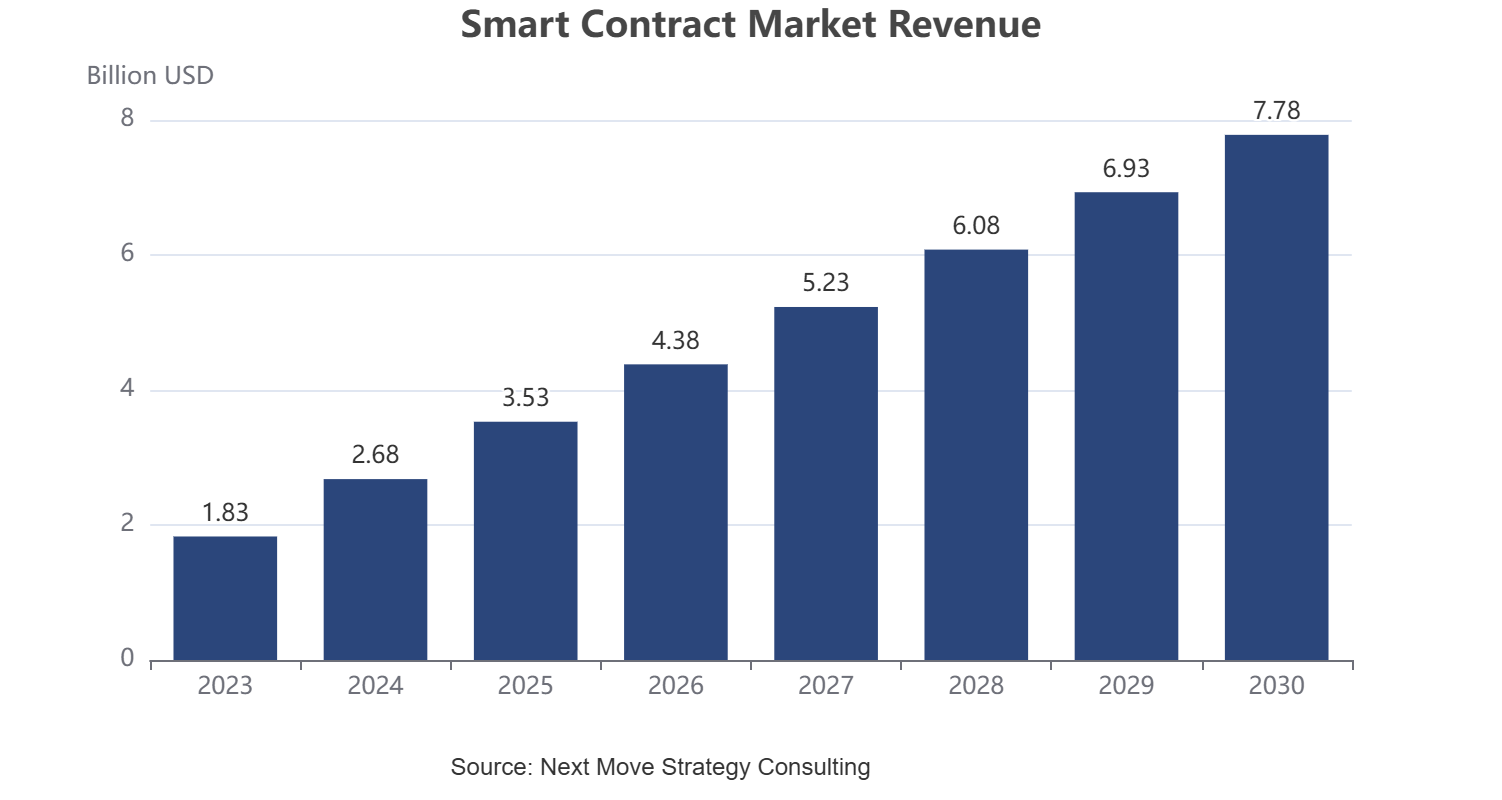
The Smart Contract Market size was valued at USD 1.83 billion in 2023 and is predicted to reach USD 7.78 billion by 2030 with a CAGR of 23.0% from 2024-2030. The smart contract market encompasses the development, deployment, and utilization of self-executing contracts where the terms are encoded directly into blockchain technology. These smart contracts automatically enforce and execute agreements when predefined conditions are met, minimizing the need for intermediaries and reducing transaction costs. The market includes technology providers, such as blockchain platforms and software developers, and spans various applications such as finance, supply chain management, real estate, and legal services. Their immutability ensures that the contract's code and execution history are recorded transparently and cannot be altered. By streamlining and automating contractual processes, decentralized contracts offer a more efficient, secure, and cost-effective alternative to traditional agreements.
Market Dynamics and Trends
The smart contract market demand is driven by the widespread implementation of blockchain technology in BFSI sector to leverage the transparency and security of blockchain. For instance, numerous banking and financial institutions are increasingly adopting blockchain technologies through collaborations with various blockchain providers.
Notable examples include HSBC Holdings plc partnering with Corda blockchain, Goldman Sachs using USDC, J.P. Morgan integrating with Liink, and the Swedish Central Bank leveraging E-Krona. These strategic partnerships between financial institutions and blockchain firms are significantly driving the growth of the market, highlighting the expanding role of decentralized contracts in enhancing financial operations and transaction efficiencies.
Moreover, the increasing cybersecurity threat worldwide is boosting the adoption of web 3.0 blockchain technology. Blockchain offers a compelling solution by providing greater transparency, reducing vulnerability to cyber-attacks, and ensuring secure data transactions. For example, in 2023, approximately 5.5 billion malware attacks and 6.3 trillion online intrusion attempts took place globally. As organizations seek more robust and secure solutions to protect their data and digital assets from cyber threats, the adoption of blockchain technology to safeguard sensitive data is poised to rise, driving the growth of the market.
However, the lack of flexibility and the high costs associated with the development and auditing of smart contracts are the major factors restraining the growth of the market. On the contrary, the integration of scalability technologies such as sharding, sidechains, or layer 2 solutions, along with the incorporation of artificial intelligence, is expected to create ample growth opportunities in the market. These advancements promise to enhance the functionality and throughput capacity of cryptographic contracts, offering more robust, efficient, and scalable solutions.
Market Segmentations and Scope of the Study
The smart contract market report is segmented on the basis of core offering, blockchain platform, deployment & accessibility model, contract type, application, enterprise size, end user industry, and region. On the basis of core offering, the market is divided into platform and protocol revenue, software and tools, token services, professional services, managed services, and transactional revenue. The platform and protocol revenue segment is further categorized into public chain fees and enterprise ledger licenses. The software and tools segment includes developer frameworks and SDKs, middleware and oracles, and security tooling and scanners. The token services segment comprises token issuance and minting, and token management platforms. The professional services segment includes consulting and architecture, implementation and integration, and audit and security testing. The managed services segment is divided into node hosting and operations, and managed platform operations. The transactional revenue segment includes marketplace and protocol fees, and transaction commission.
On the basis of blockchain platform, the market is segmented into EVM-compatible public chains, non-EVM public chains, and enterprise blockchain frameworks. The EVM-compatible public chains segment includes Ethereum Mainnet, BNB Smart Chain, Polygon, and Avalanche C-Chain. The non-EVM public chains segment comprises Solana, Cardano, Polkadot (Parachains), Tezos, Stellar, and Ripple (XRPL). The enterprise blockchain frameworks segment includes Hyperledger Fabric, R3 Corda, ConsenSys Quorum, and other permissioned/private ledgers.
On the basis of deployment & accessibility model, the market is classified into public/permissionless blockchains, private/permissioned blockchains, and consortium/hybrid blockchains.
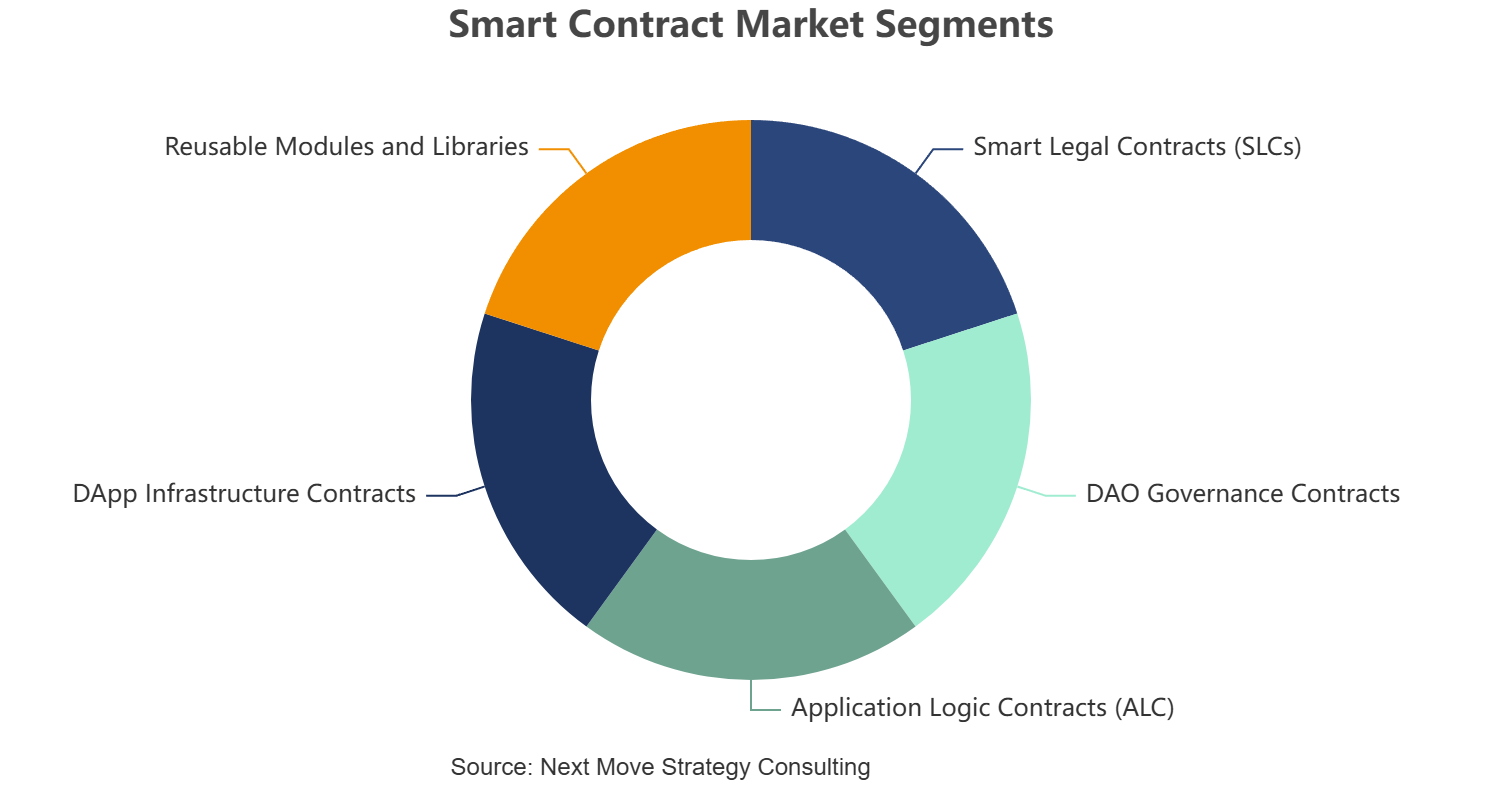
On the basis of contract type, the market is divided into smart legal contracts (SLCs), DAO governance contracts, application logic contracts (ALC), DApp infrastructure contracts, and reusable modules and libraries.
On the basis of application, the market is segmented into decentralized finance (DeFi), digital assets and collectibles, enterprise process automation, identity and governance, IoT and energy settlements, and other enterprise use cases. The decentralized finance (DeFi) segment includes trading and exchanges, lending and borrowing, payments and stable assets, and asset management and derivatives. The digital assets and collectibles segment comprises NFTs and collectibles, gaming and metaverse assets, media rights and royalties, and real world asset tokenization. The enterprise process automation segment includes supply chain (track, trace, provenance), trade finance (escrow, conditional settlements), legal & compliance automation, and loyalty and rewards programs. The identity and governance segment includes identity and credential management, and voting and organizational governance (DAOs).
On the basis of enterprise size, the market is classified into large enterprise and small and medium enterprise.
On the basis of end user industry, the market is divided into financial services, technology and IT services, government and public sector, supply chain and logistics, media and entertainment, healthcare and life sciences, real estate, retail and consumer goods, energy and utilities, manufacturing and industrial, and other industries. Regional breakdown and analysis of each of the aforesaid segments include regions comprising of North America, Europe, Asia-Pacific, and RoW.
Geographical Analysis
North America dominates the smart contract market share and is expected to continue its dominance during the forecast period. This is due to the presence of a developed healthcare sector adopting immutable contracts to improve efficiency, patient privacy, and streamlined processes for medical records & supply chain management. For instance, in 2022, U.S. based company Hedera Hashgraph LLC is collaborated with numerous healthcare companies in North America to utilize its smart contracts 2.0. Through these collaborations, the company aims to automate and enhance health data storage, patient privacy, supply chain management, and insurance settlements, resulting in improved patient outcomes and streamlined healthcare processes.
Moreover, the presence of key market players such as Coinbase and Coinbase Asset Management plays an important role in the growth of the market with their continuous advancements and innovations. For instance, in December 2023, Coinbase and Coinbase Asset Management announced to launch "Project Diamond," a new initiative aimed at enhancing the management of digital assets. This project focuses on developing a smart contract-based framework to improve asset management processes and provide users with more control over their digital assets. The goal is to streamline operations and enhance security for both individual and institutional investors.
On the other hand, the Asia-Pacific region is anticipated to demonstrate steady growth in the market, driven by the increasing adoption of blockchain technology within the Banking, Financial Services, and Insurance (BFSI) sector to enhance banking operations. For instance, in January 2022, the Asian Development Bank (ADB) launched a blockchain technology-based securities settlement, exploring its potential to improve efficiency and transparency in the financial sector. The ADB's trial of blockchain for securities settlement underscores the rising interest among financial institutions in adopting blockchain technology, highlighting its potential to revolutionize traditional settlement processes and significantly impact the market in the region.
Moreover, the growing adoption of decentralized contracts in the supply chain by e-commerce companies in the Asia-Pacific region is further driving the growth of the smart contract market expansion, enabling streamlined processes and enhanced safety & security in transactions in the e-commerce sector. For instance, in January 2023, Chinese e-commerce company Meituan launched cryptographic contract functionality on its platform. Through this launch, the company aims to allow users to leverage the digital currency for secure and automated transactions, driving the adoption of smart contracts in this region.
Competitive Landscape
Various key players operating in the smart contract industry include International Business Machines Corporation (IBM), Accenture plc, Microsoft Corporation, Amazon.com, Inc. (AWS), Tata Consultancy Services Limited (TCS), ConsenSys Software Inc., Chainlink Labs, Inc., Oracle Corporation, R3 HoldCo LLC, Polygon Labs UI, Digital Asset Holdings, LLC, Google LLC, Alchemy Insights, Inc., Offchain Labs, Inc., Ava Labs, Inc., Ripple Labs Inc., Blockdaemon Ltd., OpenZeppelin Inc., Solana Labs, Inc., and Input Output Global among others. These companies are adopting strategies such as product launches to remain dominant in the market.
For instance, in February 2025, International Business Machines Corporation (IBM) expanded its blockchain and smart contract capabilities through enhanced integration of AI-driven automation and enterprise blockchain solutions, enabling businesses to improve transaction transparency, compliance, and workflow efficiency across supply chain and financial applications.
In January 2025, Accenture plc strengthened its blockchain consulting and implementation services by partnering with enterprise clients to accelerate adoption of smart contract-based automation for digital identity, payments, and decentralized finance applications.
Moreover, in November 2024, Microsoft Corporation enhanced its Azure blockchain and AI ecosystem by supporting enterprise-grade smart contract development environments, enabling organizations to deploy scalable decentralized applications with improved security and interoperability.
Furthermore, in October 2024, Amazon.com, Inc. (AWS) expanded its managed blockchain capabilities through enhancements to Amazon Managed Blockchain, simplifying smart contract deployment and node management for enterprise customers operating across multiple blockchain networks.
Key Benefits
-
The report provides quantitative analysis and estimations of the smart contract market from 2024 to 2030, which assists in identifying the prevailing market opportunities.
-
The study comprises a deep-dive analysis of the current and future smart contract market trends to depict prevalent investment pockets in the market.
-
Information related to key drivers, restraints, and opportunities and their impact on the market is provided in the report.
-
Competitive analysis of the players, along with their market share is provided in the report.
-
SWOT analysis and Porters Five Forces model is elaborated in the study.
-
Value chain analysis in the market study provides a clear picture of roles of stakeholders.
Smart Contract Market Key Segments
By Core Offering
-
Platform and Protocol Revenue
-
Public Chain Fees
-
Enterprise Ledger Licenses
-
-
Software and Tools
-
Developer Frameworks and SDKs
-
Middleware and Oracles
-
Security Tooling and Scanners
-
-
Token Services
-
Token Issuance and Minting
-
Token Management Platforms
-
-
Professional Services
-
Consulting and Architecture
-
Implementation and Integration
-
Audit and Security Testing
-
-
Managed Services
-
Node Hosting and Operations
-
Managed Platform Operations
-
-
Transactional Revenue
-
Marketplace and Protocol Fees
-
Transaction Commission
-
By Blockchain Platform
-
EVM-Compatible Public Chains
-
Ethereum Mainnet
-
BNB Smart Chain
-
Polygon
-
Avalanche C-Chain
-
-
Non-EVM Public Chains
-
Solana
-
Cardano
-
Polkadot (Parachains)
-
Tezos
-
Stellar
-
Ripple (XRPL)
-
-
Enterprise Blockchain Frameworks
-
Hyperledger Fabric
-
R3 Corda
-
ConsenSys Quorum
-
Other Permissioned/Private Ledgers
-
By Deployment & Accessibility Model
-
Public/Permissionless Blockchains
-
Private/Permissioned Blockchains
-
Consortium/Hybrid Blockchains
By Contract Type
-
Smart Legal Contracts (SLCs)
-
DAO Governance Contracts
-
Application Logic Contracts (ALC)
-
DApp Infrastructure Contracts
-
Reusable Modules and Libraries
By Application
-
Decentralized Finance (DeFi)
-
Trading and Exchanges
-
Lending and Borrowing
-
Payments and Stable Assets
-
Asset Management and Derivatives
-
-
Digital Assets and Collectibles
-
NFTs and Collectibles
-
Gaming and Metaverse Assets
-
Media Rights and Royalties
-
Real World Asset Tokenization
-
-
Enterprise Process Automation
-
Supply Chain (Track, Trace, Provenance)
-
Trade Finance (Escrow, Conditional Settlements)
-
Legal & Compliance Automation
-
Loyalty and Rewards Programs
-
-
Identity and Governance
-
Identity and Credential Management
-
Voting and Organizational Governance (DAOs)
-
-
IoT and Energy Settlements
-
Other Enterprise Use Cases
By Enterprise Size
-
Large Enterprise
-
Small and Medium Enterprise
By End User Industry
-
Financial Services
-
Technology and IT Services
-
Government and Public Sector
-
Supply Chain and Logistics
-
Media and Entertainment
-
Healthcare and Life Sciences
-
Real Estate
-
Retail and Consumer Goods
-
Energy and Utilities
-
Manufacturing and Industrial
-
Other Industries
By Region
-
North America
-
The U.S
-
Canada
-
Mexico
-
-
Europe
-
The UK
-
Germany
-
France
-
Italy
-
Spain
-
Denmark
-
Netherlands
-
Finland
-
Sweden
-
Norway
-
Russia
-
Rest of Europe
-
-
Asia-Pacific
-
China
-
Japan
-
India
-
South Korea
-
Australia
-
Indonesia
-
Singapore
-
Taiwan
-
Thailand
-
Rest of Asia-Pacific
-
-
RoW
-
Latin America
-
Middle East
-
Africa
-
Key Players
-
International Business Machines Corporation (IBM)
-
Accenture plc
-
Microsoft Corporation
-
Amazon.com, Inc. (AWS)
-
Tata Consultancy Services Limited (TCS)
-
ConsenSys Software Inc.
-
Chainlink Labs, Inc.
-
Oracle Corporation
-
R3 HoldCo LLC
-
Polygon Labs UI
-
Digital Asset Holdings, LLC
-
Google LLC
-
Alchemy Insights, Inc.
-
Offchain Labs, Inc.
-
Ava Labs, Inc.
-
Ripple Labs Inc.
-
Blockdaemon Ltd.
-
OpenZeppelin Inc.
-
Solana Labs, Inc.
-
Input Output Global
Report Scope and Segmentation:
|
Parameters |
Details |
|
Market Size in 2023 |
USD 1.83 Billion |
|
Revenue Forecast in 2030 |
USD 7.78 Billion |
|
Growth Rate |
CAGR of 23.0% from 2024 to 2030 |
|
Analysis Period |
2023–2030 |
|
Base Year Considered |
2023 |
|
Forecast Period |
2024–2030 |
|
Market Size Estimation |
Billion (USD) |
|
Growth Factors |
|
|
Countries Covered |
28 |
|
Companies Profiled |
15 |
|
Market Share |
Available for 10 companies |
|
Customization Scope |
Free customization (equivalent up to 80 working hours of analysts) after purchase. Addition or alteration to country, regional, and segment scope. |
|
Pricing and Purchase Options |
Avail customized purchase options to meet your exact research needs. |
About the Author
 Sikha Haritwal
— Sikha Haritwal is an assistant manager with strong expertise in market research, data analysis, and cross-functional coordination. She plays a key role in leading complex research initiatives, strengthening analytical rigor, and enabling data-driven decision-making across teams. Known for her leadership mindset and structured problem-solving approach, she supports process improvement, enhances operational efficiency, and contributes to building scalable frameworks that drive long-term strategic outcomes and organizational effectiveness.
Sikha Haritwal
— Sikha Haritwal is an assistant manager with strong expertise in market research, data analysis, and cross-functional coordination. She plays a key role in leading complex research initiatives, strengthening analytical rigor, and enabling data-driven decision-making across teams. Known for her leadership mindset and structured problem-solving approach, she supports process improvement, enhances operational efficiency, and contributes to building scalable frameworks that drive long-term strategic outcomes and organizational effectiveness.
About the Reviewer
 Supradip Baul
— Supradip Baul is an accomplished business consultant and strategist with over a decade of rich experience in market intelligence, strategy, technology, and business transformation. His work has included rigorous qualitative and quantitative analysis across multiple industries, helping clients shape investment decisions and long-term roadmaps. Earlier in his career, he was associated with Gartner, where he contributed to industry-leading reports and market share analyses. He has worked with leading global companies and holds an MBA with a dual specialization in Marketing and Finance.
Supradip Baul
— Supradip Baul is an accomplished business consultant and strategist with over a decade of rich experience in market intelligence, strategy, technology, and business transformation. His work has included rigorous qualitative and quantitative analysis across multiple industries, helping clients shape investment decisions and long-term roadmaps. Earlier in his career, he was associated with Gartner, where he contributed to industry-leading reports and market share analyses. He has worked with leading global companies and holds an MBA with a dual specialization in Marketing and Finance.
At Next Move Strategy Consulting, we understand that insightful market research is the cornerstone of successful business decisions. That's why we employ a robust and multifaceted approach, combining various methodologies to deliver the most accurate and actionable data for our clients.

Research Landscape
We navigate the world of research with two primary approaches:
Qualitative Approach
Our qualitative research methodologies involve immersive techniques such as in-depth interviews, focus groups, and observational studies. By engaging directly with individuals and stakeholders, we uncover valuable insights that quantitative data alone may overlook.

Quantitative Research
In tandem with qualitative methodologies, NMSC leverages the power of Quantitative Research to provide a robust foundation of numerical insights. Through systematic data collection and analysis, we quantify patterns, preferences, and market trends, offering a comprehensive view of the business landscape.
Our quantitative research approach employs diverse tools, including surveys, experiments, and statistical modelling. These methodologies enable us to gather data from a large and representative sample, ensuring the statistical significance of our findings. By employing structured questionnaires and standardized data collection methods, we guarantee the reliability and validity of the information we present to our clients.
Quantitative research is particularly effective in measuring the prevalence of trends, assessing market size, and gauging the impact of various factors on consumer behavior. The numerical precision attained through this approach equips our clients with actionable insights, facilitating data-driven decision-making and strategy formulation.


Our Specialized Toolbox for Industry-Specific Market Research
We deploy a specialized arsenal of techniques tailored to meet your unique requirements. Here's a glimpse into our comprehensive toolbox:

Information Procurement
The stage entails acquiring market data or relevant information through various sources and methodologies.


Market Research Approach
We utilize both top-down and bottom-up approaches in market research analysis to achieve a comprehensive understanding of the market dynamics, leveraging the broad perspective of industry trends and macroeconomic factors alongside detailed insights from specific segments and individual companies.

Porters Five Forces Analysis
We conduct Porter's Five Forces analysis to evaluate the competitive landscape of an industry, providing us with insights into factors that affect profitability and strategic positioning.

SWOT Analysis

Forecasting
We utilize a forecasting model to predict future consumption by considering parameters like population, economics, regulations, market competition, drivers, constraints, technology, and pricing. We also employ statistical techniques such as multilinear regression, exponential smoothing, moving average, ARIMA, and Monte Carlo simulations for accurate predictions. In econometric forecasting, we analyzed short-term and long-term event impacts, attributing values based on regulatory frameworks, economic factors, and market events.





 Speak to Our Analyst