Blood Gas Analyzer Market Global Industry Analysis and Forecast (2026-2035)

Blood Gas Analyzer Market size was valued at USD 4.57 billion in 2025 and is estimated at USD 4.93 billion in 2026, projected to reach USD 8.20 billion by 2035, growing at a CAGR of 5.81% from 2026 to 2035. Key growth drivers include rising ICU and critical care capacity, increasing demand for arterial blood gas testing, and accelerating migration from central laboratories to point-of-care testing, with North America leading the market .

Download Free Sample PDF
Base Year (2025)
$4.57 Billion
Forecast (2035)
$8.20 Billion
CAGR (2026-2035)
5.8%
Top Country
North America

What Is the Blood Gas Analyzer Market Size?

The Blood Gas Analyzer Market size was valued at USD 4.57 Billion in 2025. It is estimated at USD 4.93 Billion in 2026. The Blood Gas Analyzer Market is forecast to reach USD 8.20 Billion by 2035, expanding at a 5.81% CAGR between 2026 and 2035. North America leads with approximately 38% share, while Benchtop Analyzers dominates all other product type categories with approximately 38% share.

We observed that growth is broad-based across every segment of the Blood Gas Analyzer Market. Point-of-care migration and rising critical care capacity are driving the dominant structural shifts through 2035.

Blood Gas Analyzer Market Global Industry Analysis and Forecast (2026-2035) Revenue Forecast

Values in USD Billion

2025 $4.57 Billion
2025
2026 $4.93 Billion
2026
2027 $5.22 Billion
2027
2028 $5.52 Billion
2028
2029 $5.84 Billion
2029
2030 $6.18 Billion
2030
2031 $6.54 Billion
2031
2032 $6.92 Billion
2032
2033 $7.32 Billion
2033
2034 $7.75 Billion
2034
2035 $8.20 Billion
2035

Key Takeaways

By Product Type: Benchtop Analyzers held the largest share of approximately 38% (USD 1.74 billion) in 2025; The Handheld Analyzers segment is the fastest-growing sub-segment at a 10.7% CAGR from 2026–2035 .

By Configuration: Multianalyte Blood Gas held the largest share of approximately 53% (USD 2.42 billion) in 2025; Multianalyte Blood Gas is also the fastest-growing sub-segment at 6.4% CAGR from 2026–2035.

By Technology: Electrochemical held the largest share of approximately 64% (USD 2.92 billion) in 2025; Optical is the fastest-growing sub-segment at approximately 7.1% CAGR from 2026–2035.

By End User: Hospitals held the largest share of approximately 44% (USD 2.01 billion) in 2025; Emergency Medical Services is the fastest-growing sub-segment at approximately 8.2% CAGR from 2026–2035.

Dominant Region: North America dominated with approximately 38% revenue share (USD 1.74 billion) in 2025.

Fastest-Growing Region: Asia-Pacific is expected to register the highest CAGR of 7.4% during 2026–2035.

Dominant Country: The U.S. led with approximately USD 1.46 billion in 2025.

Fastest-Growing Country: India is the fastest-growing country at approximately 8.9% CAGR from 2026–2035.

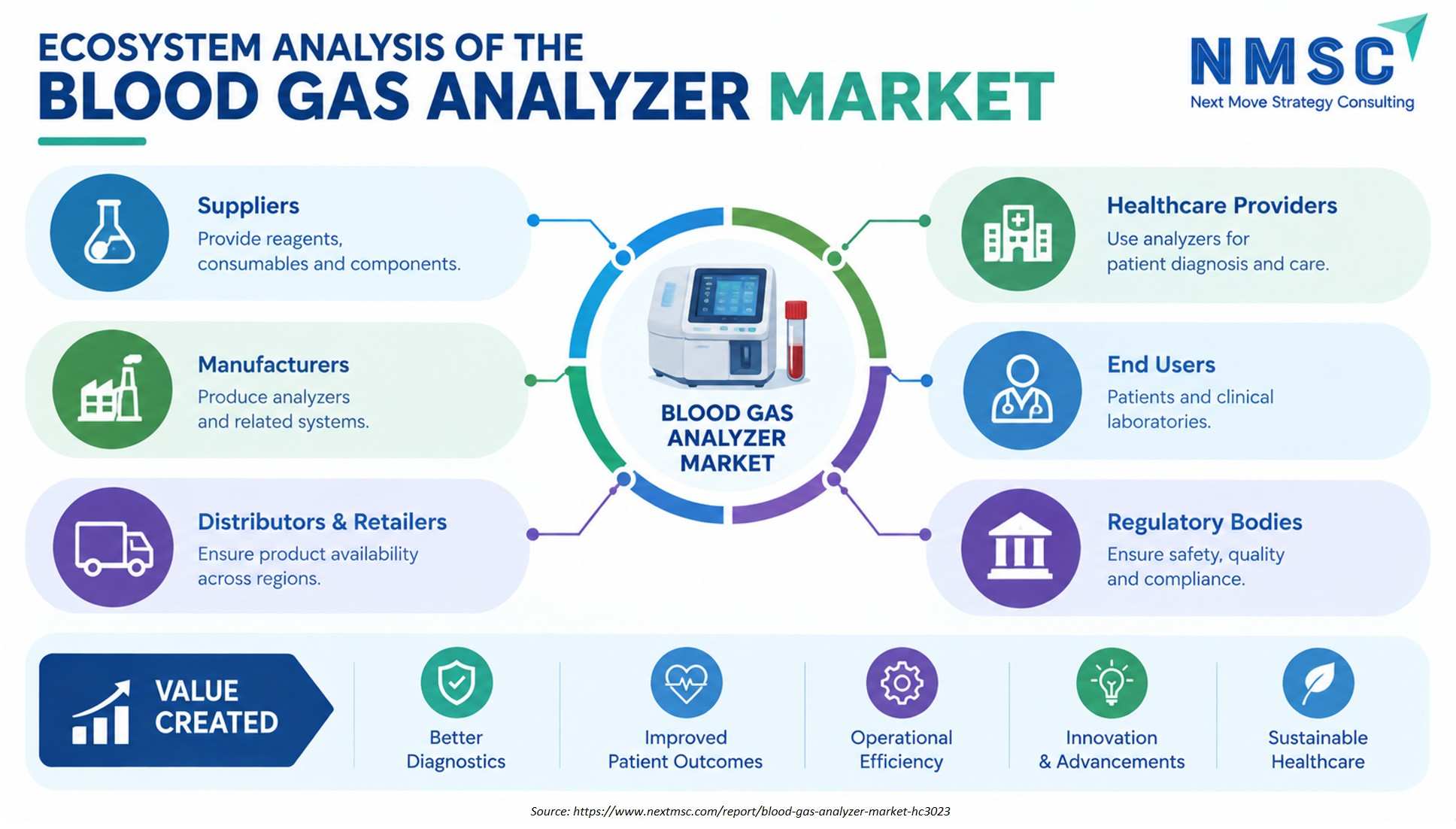
Ecosystem Analysis of the Blood Gas Analyzer Market

The above infographic provides a detailed ecosystem analysis of the blood gas analyzer market, mapping out seven key components from suppliers and manufacturers to healthcare providers and patients. It illustrates how distributors and regulatory bodies interact within a connected network to ensure product availability and compliance. The analysis further highlights the significant value created by this ecosystem, including better diagnostics, improved patient outcomes, and operational efficiency. Ultimately, it demonstrates how this interconnected chain drives innovation and supports the advancement of sustainable healthcare .
What Does the Blood Gas Analyzer Market Encompass?

The Blood Gas Analyzer Market covers instruments that measure pH, partial pressures of oxygen and carbon dioxide, electrolytes , and metabolites in whole blood. These devices range from large benchtop laboratory systems to compact handheld units used at the patient bedside. Our assessment indicates that the scope spans analyzers , consumables, and quality control materials sold to hospitals, clinical laboratories, emergency medical services, and ambulatory surgical centers worldwide.

The Blood Gas Analyzer Market has evolved from centralized laboratory testing toward decentralized, point-of-care platforms. Regulatory frameworks such as FDA 510(k) clearance requirements and CLIA waiver pathways directly shape commercialization timelines. We observed that technology adoption is shifting toward optical sensing and multianalyte configurations. NMSC's analysis indicates that this shift, combined with growing ICU and emergency capacity, is redefining competitive priorities across the point-of-care testing segment.

Market Drivers & Dynamics

Interactive Dataset
Rising ICU and critical care capacity globally driver +1.6% Global 2026-2035
Migration from central laboratories to point-of-care testing driver +1.3% North America, Europe 2026-2035
Growing prevalence of respiratory and metabolic disorders driver +1.0% Global 2026-2035
Expanding emergency medical services infrastructure driver +0.8% Asia-Pacific, Latin America 2026-2032
Multianalyte platform adoption reducing per-test cost driver +0.5% Global 2026-2032
High device and consumable cost in price-sensitive markets restraint -0.9% Latin America, Middle East & Africa 2026-2033
Stringent regulatory clearance requirements extending time to market restraint -0.7% Global 2026-2032
Reimbursement uncertainty for point-of-care blood gas testing restraint -0.5% North America, Europe 2026-2033
Interoperability challenges limiting enterprise-wide deployment restraint -0.3% Global 2026-2032
Source: Next Move Strategy Consulting

Growth Drivers

What Is the Primary Growth Driver of the Blood Gas Analyzer Market?

Rising ICU and critical care capacity is the primary driver of the Blood Gas Analyzer Market. Arterial blood gas testing is among the most frequently ordered tests in intensive care settings. CDC data reported 3.1 million U.S. emergency-department visits resulting in admission to a critical care unit in 2022, providing a relevant indicator of acute-care diagnostic demand .

How Is Point-of-Care Migration Driving Blood Gas Analyzer Market Growth?

Point-of-care migration from central laboratories is accelerating Blood Gas Analyzer Market growth. A 2025 PubMed Central study from a Canadian tertiary-care emergency department found that 90.6% of clinicians supported continued point-of-care blood gas testing after bedside adoption. Our assessment indicates that this clinical acceptance is compressing procurement decision cycles for handheld and portable blood gas analyzer investments.
Growth Inhibitors

What Is Restraining Blood Gas Analyzer Market Expansion?

High device and consumable cost restrain adoption in price-sensitive markets across Latin America and the Middle East & Africa. Integrated cartridge and cassette-based systems carry significant recurring consumable expense that challenges procurement in lower-resource healthcare settings. We found that this cost barrier is particularly pronounced for diagnostic equipment procurement in public hospital systems with limited capital budgets.

Segmentation Analysis

2025 (USD Billion)
2035 (USD Billion)
Benchtop Ana
Portable Ben
Handheld Ana
Analyzer-Spe
Integrated C
Segment Item 2025 (USD Billion) 2035 (USD Billion) CAGR
Benchtop Analyzers $10.0 USD Billion $40.0 USD Billion 14.0%
Portable Benchtop Analyzers $17.1 USD Billion $51.1 USD Billion 8.0%
Handheld Analyzers $24.2 USD Billion $62.2 USD Billion 14.0%
Analyzer-Specific Consumables $31.3 USD Billion $73.3 USD Billion 20.0%
Integrated Cartridges $38.4 USD Billion $84.4 USD Billion 27.0%

Segment-wise data is locked

Unlock complete segment-wise numbers for By Product Type.

Unlock Full Data

Which Product Type Segment Dominates the Blood Gas Analyzer Market?

Benchtop Analyzers led the Blood Gas Analyzer Market with USD 1.74 billion in 2025. These instruments remain the standard for high-throughput laboratory testing in hospitals. We observed that Handheld Analyzers is the fastest-growing product type, expanding at a 7.3% CAGR from 2026 to 2035. Rising demand for bedside testing in ICUs and emergency departments is driving rapid adoption of compact, battery-powered handheld platforms.


2025 (USD Billion)
2035 (USD Billion)
Blood Gas On
Multianalyte
Segment Item 2025 (USD Billion) 2035 (USD Billion) CAGR
Blood Gas Only $10.0 USD Billion $40.0 USD Billion 25.0%
Multianalyte Blood Gas $17.1 USD Billion $51.1 USD Billion 11.0%

Segment-wise data is locked

Unlock complete segment-wise numbers for By Configuration.

Unlock Full Data
2025 (USD Billion)
2035 (USD Billion)
Electrochemi
Optical
Hybrid
Segment Item 2025 (USD Billion) 2035 (USD Billion) CAGR
Electrochemical $10.0 USD Billion $40.0 USD Billion 27.0%
Optical $17.1 USD Billion $51.1 USD Billion 9.0%
Hybrid $24.2 USD Billion $62.2 USD Billion 19.0%

Segment-wise data is locked

Unlock complete segment-wise numbers for By Technology.

Unlock Full Data

Which Technology Leads Blood Gas Analyzer Market Demand?

Electrochemical technology remained the leading platform in the Blood Gas Analyzer Market, valued at USD 2.92 billion in 2025. It is the most commercially established sensing approach for pH, pO2, and pCO2 measurement. Our findings suggest that Optical technology is the fastest-growing category at a 7.1% CAGR from 2026 to 2035, as fluorescence-based sensors offer advantages in miniaturization and reduced calibration frequency for portable and handheld platforms.

2025 (USD Billion)
2035 (USD Billion)
Hospitals
Clinical Lab
Diagnostic C
Clinics and
Emergency Me
Segment Item 2025 (USD Billion) 2035 (USD Billion) CAGR
Hospitals $10.0 USD Billion $40.0 USD Billion 23.0%
Clinical Laboratories $17.1 USD Billion $51.1 USD Billion 9.0%
Diagnostic Centers $24.2 USD Billion $62.2 USD Billion 19.0%
Clinics and Ambulatory Surgical Centers $31.3 USD Billion $73.3 USD Billion 13.0%
Emergency Medical Services $38.4 USD Billion $84.4 USD Billion 10.0%

Segment-wise data is locked

Unlock complete segment-wise numbers for By End User.

Unlock Full Data

Which End User Segment Is Most Widely Served in the Blood Gas Analyzer Market?

Hospitals remained the dominant end user in the Blood Gas Analyzer Market, reaching USD 2.01 billion in 2025. ICUs and operating rooms require continuous blood gas monitoring for critically ill patients. Based on research conducted by NMSC, we found that Emergency Medical Services is the fastest-growing end user at an 8.2% CAGR from 2026 to 2035, reflecting rapid expansion of handheld analyzer deployment in pre-hospital and ambulance-based care settings.

2025 (USD Billion)
2035 (USD Billion)
Integrated S
Sensor Card
Modular Reag
Electrode-Ba
Other Dedica
Segment Item 2025 (USD Billion) 2035 (USD Billion) CAGR
Integrated Single-Use Format $10.0 USD Billion $40.0 USD Billion 14.0%
Sensor Card $17.1 USD Billion $51.1 USD Billion 24.0%
Modular Reagent System $24.2 USD Billion $62.2 USD Billion 22.0%
Electrode-Based System $31.3 USD Billion $73.3 USD Billion 12.0%
Other Dedicated Format $38.4 USD Billion $84.4 USD Billion 27.0%

Segment-wise data is locked

Unlock complete segment-wise numbers for By System Type.

Unlock Full Data
2025 (USD Billion)
2035 (USD Billion)
Direct Sales
Distributor
Segment Item 2025 (USD Billion) 2035 (USD Billion) CAGR
Direct Sales $10.0 USD Billion $40.0 USD Billion 24.0%
Distributor Sales $17.1 USD Billion $51.1 USD Billion 22.0%

Segment-wise data is locked

Unlock complete segment-wise numbers for By Sales Channel.

Unlock Full Data

Growth Opportunities

Our analysis shows that three forward-looking opportunities stand out for stakeholders positioning within the Blood Gas Analyzer Market over the 2026-2035 forecast period.

How Can Handheld Platform Expansion Unlock Pre-Hospital Testing Markets?

Handheld blood gas analyzers present a whitespace opportunity for manufacturers expanding into emergency medical services and pre-hospital care. Companies that engineer ruggedized, battery-efficient handheld platforms with wireless connectivity can capture recurring consumable revenue across the Emergency Medical Services segment as ambulance-based critical care capability expands globally.

Where Does Asia-Pacific Critical Care Investment Create New Demand in the Blood Gas Analyzer Market?

Asia-Pacific's rapidly expanding ICU and critical care infrastructure represents an underpenetrated opportunity for blood gas analyzer manufacturers. Companies that build regional regulatory approval and distributor networks in China, India, and Southeast Asia can secure first-mover advantage within the critical care diagnostics segment as regional hospital systems invest in point-of-care testing capability.

How Can Optical Sensing Technology Benefit Compact Analyzer Developers?

Optical sensing technology presents an innovation opportunity for developers building the next generation of miniaturized blood gas analyzers . Companies that combine fluorescence-based optical sensors with reduced calibration requirements can differentiate with the Handheld Analyzers segment by offering longer operational uptime and lower consumable burden than electrode-based competitors.

Regional Outlook

2025 (USD Billion)
2035 (USD Billion)
North Americ
Europe
Asia-Pacific
Middle East
Latin Americ
Region 2025 (USD Billion) 2035 (USD Billion) CAGR (%)
North America $10.0 USD Billion $40.0 USD Billion 9.0%
Europe $17.1 USD Billion $51.1 USD Billion 27.0%
Asia-Pacific $24.2 USD Billion $62.2 USD Billion 25.0%
Middle East & Africa $31.3 USD Billion $73.3 USD Billion 23.0%
Latin America $38.4 USD Billion $84.4 USD Billion 12.0%

Regional data is locked

Unlock complete regional numbers for this market.

Unlock Full Data

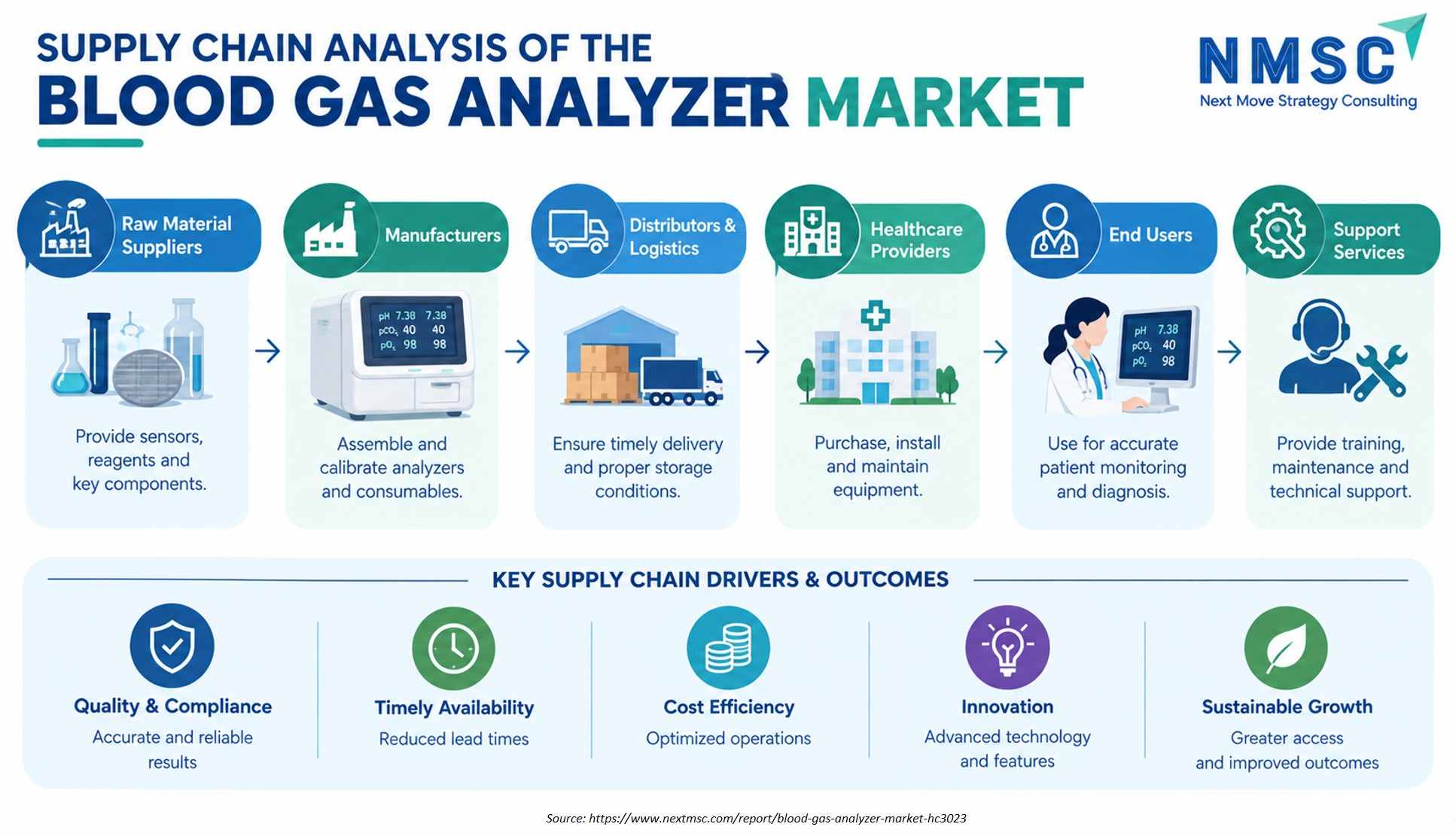
Supply Chain Analysis of the Blood Gas Analyzer Market

Supply Chain Analysis of the Blood Gas Analyzer Market
The above infographic provides a detailed supply chain analysis of the blood gas analyzer market, outlining a six-step flow from raw material suppliers to support services. It traces the process from sourcing sensors and reagents through manufacturing, distribution, and healthcare provider adoption to final use in patient monitoring. The analysis further highlights key supply chain drivers such as quality compliance, cost efficiency, and timely availability. Ultimately, it demonstrates how this interconnected chain ensures accurate diagnostics, fosters innovation, and supports sustainable growth in healthcare .

Competitive Landscape

We observed that the Blood Gas Analyzer Market features a moderately consolidated competitive landscape. A small group of established global manufacturers competes alongside regional and emerging players across theindustry.

Dimension Description
Market Structure Moderately consolidated; Radiometer Medical, Siemens Healthcare Diagnostics, Werfen , Roche, and Abbott anchor the top tier, while regional manufacturers including EDAN Instruments and Guangzhou Wondfo Biotech compete at accessible price points.
Innovation Focus Hemolysis detection, optical sensing, multianalyte expansion, and enterprise connectivity dominate current innovation pipelines across the Blood Gas Analyzer Market.
M&A Activity Strategic investment exemplified by Roche's April 2025 announcement to invest USD 50 billion in the U.S. over five years, reinforcing its diagnostics and point-of-care infrastructure footprint.

How Do Companies Compete in the Blood Gas Analyzer Market?

Companies compete primarily on parameter menu breadth, clinical accuracy, and enterprise connectivity. Radiometer Medical and Siemens Healthcare Diagnostics leverage comprehensive managed service models and connectivity platforms. Regional manufacturers in Asia-Pacific compete on price accessibility in markets where global platform costs limit penetration.

Which Competitive Archetypes Dominate the Blood Gas Analyzer Market?

Two archetypes dominate the competitive landscape. The first is the global managed-service provider offering bundled analyzers , consumables, service, and connectivity. Radiometer Medical and Werfen exemplify this archetype. The second is the affordable-platform specialist targeting price-sensitive markets, exemplified by EDAN Instruments and Guangzhou Wondfo Biotech.

How Are Companies Differentiating Through Innovation?

Innovation increasingly centers on hemolysis detection, parameter expansion, and remote connectivity. Werfen's GEM Premier 7000 with iQM3 is the first point-of-care blood gas system to offer hemolysis detection. Our analysis shows that manufacturers unable to demonstrate connectivity and AI-assisted quality management risk losing enterprise procurement contracts to connected platform competitors.

What M&A and Expansion Activity Is Shaping the Blood Gas Analyzer Market ?

Strategic investment is reshaping the Blood Gas Analyzer Market. Roche's April 2025 USD 50 billion U.S. investment commitment signals continued diagnostics infrastructure expansion. Siemens Healthineers is extending enterprise point-of-care connectivity across multi-site hospital networks, raising the capability bar for competitors.

Key Market Players

Our assessment indicates that the following 20 companies are actively shaping device innovation, consumable development, and commercial strategy within the global Blood Gas Analyzer Market.

Radiometer Medical ApS Abbott Point of Care Inc. Siemens Healthcare Diagnostics Inc. F. Hoffmann-La Roche Ltd Werfen S.A. Nova Biomedical Corporation Medica Corporation EDAN Instruments, Inc. OPTI Medical Systems, Inc. Sensa Core Medical Instrumentation i -SENS, Inc. Techno Medica Co., Ltd. ESCHWEILER GmbH & Co. KG Convergent Technologies GmbH & Co. KG Guangzhou Wondfo Biotech Co., Ltd. BIOBASE Biodustry (Shandong) Co., Ltd. Infitek Co., Ltd. Fortress Diagnostics Limited Shenzhen PioWay Medical Laboratory Equipment Co., Ltd. Henan Forever Medical Co., Ltd.

Latest Developments

We found that recent developments in the Blood Gas Analyzer Market are concentrated on new platform launches and major infrastructure investment commitments.

Date Event
December 2025 Motilal Oswal Alternates invested USD 72 million in Sensa Core , where the investment announcement states that Sensa Core had recently entered arterial blood-gas analyzers and operates a dedicated manufacturing facility in Hyderabad, with another facility being commissioned to expand capacity and capabilities .
July 2025 Werfen announced that its GEM Premier 7000 with iQM3 blood gas testing system became commercially available in Europe following adoption in North America.

Expert Insights

Francis Van Parys

Francis Van Parys

President and CEO | Radiometer

"“As we address the growing and aging population and the need for efficiency at hospitals globally, we see ourselves playing a role in a transformation towards personalized and preventive diagnostics” ."

Analyst Interpretation

We observed that this perspective directly supports the increasing demand for efficient, rapid, and clinically integrated diagnostic solutions across acute-care environments. NMSC’s analysis indicates that the growing and aging patient population, combined with pressure to improve hospital efficiency, is strengthening demand for blood gas analyzers that deliver timely physiological information at the point of care. The transition toward personalized and preventive diagnostics is also encouraging greater integration of blood gas testing with connected clinical workflows, supporting adoption across intensive care units, emergency departments, operating rooms, and other high-acuity settings .

Investment Opportunities

What Capital Inflows Are Targeting the Blood Gas Analyzer Market?

Capital inflows are increasingly directed toward point-of-care platform development and diagnostics infrastructure. Roche's April 2025 announcement to invest USD 50 billion in the U.S. over five years highlights the scale of strategic commitment among top-tier manufacturers. We observed that investors favor companies with validated clinical performance data alongside clear enterprise connectivity roadmaps.

How Significant Is Infrastructure Investment in the Blood Gas Analyzer Market ?

Infrastructure investment is expanding both manufacturing capacity and hospital-side connectivity ecosystems. Siemens Healthineers' multi-site remote management platform and Werfen's iQM3 quality system both reflect sustained investment in post-sale infrastructure. This scale of investment raises the total cost of platform switching, simultaneously a barrier for competitors and a retention tool for incumbents.

What ESG Considerations Are Shaping Blood Gas Analyzer Market Investment?

Environmental, social, and governance considerations center on single-use consumable waste reduction and broader healthcare access. Blood gas analyzer systems generate substantial cartridge, cassette, and electrode waste that hospital sustainability programs are beginning to scrutinize. We found that manufacturers demonstrating progress on sustainable medical device design are increasingly preferred by ESG-conscious health system procurement teams.

Key Benefits for Stakeholders

How Does This Report Benefit Medical Device Industry Leaders?

Medical device industry leaders gain validated segmentation, competitive benchmarking, and regional demand forecasts that support product development decisions in this space. Our analysis shows that detailed product type, technology, and end user breakdowns help portfolio teams prioritize investment in handheld platforms, optical sensing, and enterprise connectivity features.

How Does This Report Benefit Investors and Financial Analysts?

Investors and financial analysts benefit from consistent, single-point market size and CAGR estimates that support valuation decisions across this supply chain. We observed that the report's regional growth differentials help identify which manufacturers and geographies are best positioned to capture above-market growth in Asia-Pacific and Emergency Medical Services through 2035.

How Does This Report Benefit Hospital Procurement and Clinical Teams?

Hospital procurement and clinical teams gain insight into platform trends including hemolysis detection, multianalyte expansion, and enterprise connectivity that are reshaping the industry. Our findings suggest that this analysis helps procurement teams evaluate blood gas analyzer suppliers against both analytical performance and total cost of ownership criteria.

Key Market Segments Evaluated

By Product Type

  • Benchtop Analyzers
  • Portable Benchtop Analyzers
  • Handheld Analyzers
  • Analyzer-Specific Consumables 
    • Integrated Cartridges
    • Integrated Cassettes
    • Sensor Cards
    • Reagent Packs
    • Replacement Electrodes
    • Calibration Consumables
    • Quality Control Consumables
    • Proprietary Sampling Consumables

By Configuration

  • Blood Gas Only
  • Multianalyte Blood Gas

By Technology

  • Electrochemical
  • Optical
  • Hybrid

By System Type

  • Integrated Single-Use Format
  • Sensor Card
  • Modular Reagent System
  • Electrode-Based System
  • Other Dedicated Format

By Sales Channel

  • Direct Sales
  • Distributor Sales

By End User

  • Hospitals
  • Clinical Laboratories
  • Diagnostic Centers
  • Clinics and Ambulatory Surgical Centers
  • Emergency Medical Services
  • Academic and Research Institutions
  • Other Healthcare Providers

By Region

  • North America 
    • U.S.
    • Canada
    • Mexico
  • Europe 
    • UK
    • Germany
    • France
    • Italy
    • Spain
    • Sweden
    • Denmark
    • Finland
    • Netherlands
    • Rest of Europe
  • Asia-Pacific 
    • China
    • India
    • Japan
    • South Korea
    • Taiwan
    • Indonesia
    • Vietnam
    • Australia
    • Philippines
    • Malaysia
    • Rest of APAC
  • Middle East & Africa 
    • Saudi Arabia
    • UAE
    • Egypt
    • Israel
    • Turkey
    • Nigeria
    • South Africa
    • Rest of MEA
  • Latin America 
    • Brazil
    • Argentina
    • Chile
    • Colombia
    • Rest of LATAM

Conclusion & Recommendations

The long-term outlook for the Blood Gas Analyzer Market remains positive. Global revenue is projected to expand from USD 4.57 Billion in 2025 to USD 8.20 Billion by 2035 at a 5.81% CAGR. Rising critical care capacity, point-of-care migration, and Asia-Pacific hospital investment will continue underpinning growth across Handheld Analyzers and Optical technology categories.

What Strategic Positioning Should Blood Gas Analyzer Manufacturers Pursue?

Manufacturers should prioritize enterprise connectivity, hemolysis detection, and multianalyte expansion to secure long-term hospital contracts. Our assessment indicates that companies investing early in optical sensing platforms and AI-assisted quality management will be best positioned to capture premium pricing within the Blood Gas Analyzer Market.

How Attractive Is the Blood Gas Analyzer Market for New Investment?

The Blood Gas Analyzer industry presents an attractive investment case, supported by a USD 3.27 Billion absolute dollar opportunity between 2026 and 2035. We found that investment attractiveness is highest for companies combining validated clinical accuracy with enterprise connectivity credentials, particularly in the fast-growing Asia-Pacific region.

What Market Shifts and Key Risks Should Stakeholders Monitor?

Stakeholders should monitor reimbursement uncertainty for point-of-care blood gas testing, stringent regulatory clearance timelines, and high consumable costs in price-sensitive markets as key risks. Our analysis shows that manufacturers unable to demonstrate cost-effective total ownership models risk losing hospital procurement share to more competitive alternatives.

What Are the Key Growth Pathways for the Blood Gas Analyzer Market?

Key growth pathways include expanding handheld analyzer platforms into emergency medical services, scaling optical sensing technology, and deepening Asia-Pacific distribution networks. NMSC's analysis indicates that manufacturers pursuing these pathways while maintaining rigorous clinical evidence generation will be best positioned to capture the Blood Gas Analyzer Market's projected growth through 2035.

Delivered Customizations

We have successfully delivered the following deep-dive customizations:

Client Request Customization Delivered Value Adds
Historical Market Growth Analysis
  • Historical revenue and unit shipment analysis of blood gas analyzers, consumables, and accessories by product type, configuration, and system type.
  • Identifies growth patterns across instruments and recurring consumables to guide portfolio and investment priorities.
Company-Level Installed Unit and Shipment Analysis
  • Company-level analyzer unit sales and installed base estimates across benchmark manufacturers, split by configuration (portable vs. benchtop) and system type.
  • Highlights competitor scale and positioning to support share-gain and partnership decisions.
Company-Level Product Share Analysis
  • Manufacturer share by analyzer model range and product category (analyzers, cartridges, reagents, quality controls) using company filings and disclosures.
  • Reveals product-line strengths and gaps to refine portfolio and pricing strategy.
Point-of-Care vs Central Laboratory Adoption Assessment
  • Mapping of analyzer adoption across end users (hospitals, ICUs, emergency departments, central labs, ambulatory and home care) by configuration and technology.
  • Pinpoints the care settings with the highest demand to focus product development and customer targeting.
Consumables and Recurring Revenue Model Benchmarking
  • Benchmarking of razor-and-blade models, including cartridge, sensor, and reagent-based pricing and contract structures, by technology and sales channel.
  • Supports pricing, reagent-rental, and lifetime customer value optimization.
Sales Channel and Regional Distribution Strategy Assessment
  • Country-level comparison of direct sales, distributor, and tender-based procurement routes, with regional reimbursement and regulatory approval pathways such as FDA, CE-IVDR, and NMPA.
  • Guides market entry sequencing, channel partner selection, and regulatory planning.

FAQs

About the Author

Mayurima Roy

Mayurima Roy

Mayurima Roy is Research Analyst at Next Move Strategy Consulting, where she has spent 4 years working across the firm's full industry coverage rather than a single fixed vertical. Her work centers on structured research, ongoing trend tracking, competitive assessment, and insight-led content development, translating complex market data into clear, decision-ready narratives that support informed client decision-making across diverse global industries, market sectors, and world regions every day.

About the Reviewer

Supradip Baul

Supradip Baul

Supradip Baul is an accomplished business consultant and strategist with over a decade of rich experience in market intelligence, strategy, technology, and business transformation. His work has included rigorous qualitative and quantitative analysis across multiple industries, helping clients shape investment decisions and long-term roadmaps. Earlier in his career, he was associated with Gartner, where he contributed to industry-leading reports and market share analyses. He has worked with leading global companies and holds an MBA with a dual specialization in Marketing and Finance.

Download Free Sample

Rishabh Jogani

RISHABH JOGANI

Strategy Analyst

Accenture Japan

We are incredibly impressed with the market report on the real estate market in India provided by Next Move Strategy Consulting. The report was thorough, insightful, and well-structured, offering deep analysis and actionable recommendations. It not only captured the current trends and dynamics but also provided a forward-looking perspective that has been invaluable for our strategic planning. Their team demonstrated exceptional professionalism, attention to detail, and a profound understanding of the industry. The data-driven insights and clarity of presentation exceeded our expectations, making complex market trends easy to understand. We highly recommend Next Move Strategy Consulting to anyone looking for reliable and comprehensive market research services. Their expertise has given us the confidence to navigate the complexities of the Indian real estate market with clarity and foresight.

Gustaf Hummel Burstrom

GUSTAF HUMMEL BURSTROM

Founder

Revline Tools AB

Joseph and the team at Next Move Strategy Consulting have been excellent to work with, in supplying us with relevant market data and forecasts for our specific category. We had some special requirements and they were able to do a custom package to suit our needs. We would definitely recommend them to any other company needing market data and forecasts

Melanie Samko

MELANIE SAMKO

Director of Marketing

TOSOH BIOSCIENCE, INC.

The information provided by NMSC is incredibly valuable, thank you so much for such a excellent work. I really appreciate it. I will make sure to reference all of it, in my summary document.

Ross J Mckenzie

ROSS J MCKENZIE

Business Insight Manager

Staysure Group

“Next MSC have been incredibly helpful in providing detailed & robust information on our market, alongside quantifying growth by different segments. The process to procure was simple and easy, with sample reports and regular contact to ensure we had what we needed. Succinct detail on their sources & methodologies is also greatly received, allowing transparency in this respect helps build trust in the detail you pay for. Joseph in particular was fantastic, and helped ensure efficient provision of the insight pack – thank you NMSC!”.

Diana Trejo

DIANA TREJO

Assistant Manager

Sumitomo Corporation de Mexico, S.A. de C.V.

Recently, we purchased a report on the Mexico Data Center Market from Next Move Strategy Consulting. The service has been excellent, with support that is always timely and thoroughly professional. The information provided is interesting, highly useful, and delivered with clarity. I would highly recommend NextMSC for anyone seeking insightful and dependable analysis.

Custom Market Research Services

We will customize the research for you if the listed report does not fully match your requirements.

Get 30% Free Customization

Select License

This website uses cookies to ensure you get the best experience on our website. Learn more

✖