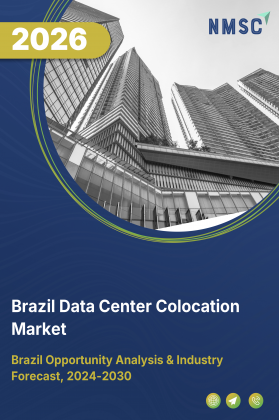
Brazil Data Center Colocation Market By Type {Retail (Single, Half & Full Cabinets, Caged Space, Custom Suites), Wholesale (Private Suites, Dedicated Space, Large-Scale)}, By Infrastructure (Hardware, Software, Services), By Data Center Rating (Tier I, Tier II, Tier III, Tier IV), By Server Rack Density (<10kW, 10–19kW, 20–29kW, 30–39kW, 40–49kW, >50kW), By End User (Cloud Service Providers, Network Providers, Managed Service Providers, Enterprises – Analysis & Forecast, 2025–2035
Industry: ICT & Media | Latest Edition: September 30, 2026 | No of Pages: 207 | No. of Tables: 87 | No. of Figures: 82 | Format: PDF | Report Code: IC4400
Industry Outlook
The Brazil Data Center Colocation Market size was valued at USD 1.93 billion in 2025 and is expected to reach USD 2.36 billion by 2026. Looking ahead, the industry is projected to expand significantly, reaching USD 6.44 billion by 2035, registering a CAGR of 11.79% from 2026 to 2035.
The Brazil data center colocation market is expanding rapidly as the country’s large digital economy drives sustained demand for scalable and secure infrastructure. Growth is supported by rising cloud adoption, strong demand from financial services, e-commerce, media, and digital platforms, and increasing data localization requirements. São Paulo dominates colocation activity, benefiting from dense enterprise presence, extensive fiber connectivity, and proximity to international network routes, while secondary cities are gradually attracting new developments.
Enterprises are increasingly outsourcing IT workloads to colocation providers to improve reliability, manage rising data volumes, and support hybrid and multi-cloud strategies. At the same time, operators are investing in higher power density capabilities, advanced cooling systems, and renewable energy sourcing to address sustainability expectations. Despite challenges related to power costs and regulatory complexity, the Brazil’s colocation market remains the most strategically important market in Latin America, with strong long-term growth potential.
São Paulo Hyperscale Concentration Drives the Brazil Data Center Colocation Market Growth
The data center colocation market in Brazil is heavily shaped by the gravitational pull of São Paulo, which functions as the country’s primary hyperscale and interconnection nucleus. The metro concentrates enterprise headquarters, financial institutions, cloud on-ramps, and the densest fiber infrastructure, making it the default landing zone for large-scale deployments. Hyperscalers favor São Paulo for its proximity to demand, network depth, and ecosystem maturity, anchoring multi-megawatt capacity growth. This concentration drives strong utilization but also creates regional imbalance, with capacity and investment clustering tightly around a single metro. As a result, São Paulo acts as both a growth engine and a structural bottleneck, defining how and where Brazil’s colocation market expands and setting technical and pricing benchmarks for the rest of the country.
Rapid OTT and Cloud Adoption Fuels Brazil Data Center Colocation Market Expansion
Brazil is experiencing rapid growth in OTT platforms, digital media, e-commerce, and enterprise cloud adoption, which is accelerating colocation capacity absorption. Streaming, gaming, fintech, and SaaS platforms are scaling to serve one of the world’s largest online populations, driving consistent demand for low-latency, in-country infrastructure. Enterprises are also migrating workloads into hybrid cloud models to improve scalability and service resilience. This demand is volume-driven and domestically anchored, rather than export-oriented, giving the market depth and continuity. Colocation facilities serve as the operational backbone for this expansion, enabling providers to scale without owning infrastructure. As digital consumption continues to rise across income segments and regions, cloud and OTT growth remains a durable driver supporting long-term expansion of Brazil data center colocation market.
Tax Complexity and Permitting Delays Acts as a Constraint for the Market
Despite strong demand, the Brazil data center colocation market faces notable restraint from high tax burdens and complex permitting frameworks. Imported equipment is subject to layered taxation, increasing capital costs for servers, power systems, and cooling infrastructure. Regulatory approvals vary by municipality and state, often involving extended timelines and administrative uncertainty. Environmental licensing and zoning requirements can further delay greenfield projects, particularly near major metros. These factors raise development risk and favor large, well-capitalized operators over new entrants. While demand remains robust, supply expansion is often slower and more expensive than fundamentals would suggest. Regulatory and tax friction therefore act as structural dampeners, shaping a market where growth is steady but operationally demanding.
Energy-Efficient Regional Campuses Unlock New Growth Opportunities for the Market
A key opportunity in the Brazil data center colocation market lies in developing energy-efficient regional campuses outside São Paulo. Secondary cities offer access to lower-cost land, available power, and improving fiber connectivity, enabling more balanced national capacity distribution. Designing campuses around efficient cooling, optimized power usage, and renewable energy sourcing helps offset Brazil’s tax and cost pressures. These regional facilities can support disaster recovery, latency optimization, and cost-sensitive workloads while reducing dependence on a single metro. As enterprises and cloud providers diversify infrastructure footprints, regional campuses become increasingly attractive. This decentralization strategy allows Brazil to scale colocation capacity more sustainably, easing pressure on São Paulo while unlocking new long-term growth corridors.
Competitive Landscape
The Brazil data center colocation industry comprises various key players, such as Ascenty, Equinix, Scala Data Centers S.A., ODATA S.A., Elea Data Centers, Cirion Technologies S.A., Tecto Data Centers, Embratel S.A., Telefônica Brasil S.A., SBA Edge Brasil Ltda., HostDime Brasil Ltda., Angola Cables S.A., UFINET, EdgeUno, IFX Networks and others.
Key Market Segments
By Type
-
Retail Colocation
-
Single Cabinets
-
Half Cabinets
-
Full Cabinets
-
Caged Space
-
Custom Suites
-
Wholesale Colocation
-
Private Data Center Suites
-
Dedicated Data Center Space
-
Large-Scale Colocation
By Infrastructure
-
Hardware
-
IT Hardware
-
Servers
-
Storage Systems
-
Networking Equipment
-
-
Power Infrastructure Hardware
-
Uninterruptible Power Supplies (UPS)
-
Generators
-
Automatic Transfer Switches
-
Power Distribution Units (PDUs)
-
-
Mechanical Infrastructure Hardware
-
Computer-Room Air Conditioners (CRAC/CRA Units)
-
Chillers
-
Racks
-
Cable Management Systems
-
-
Safety & Security Hardware
-
Fire Suppression Systems
-
Physical Security Systems (CCTV, access controls)
-
-
-
Software
-
DCIM & Monitoring
-
Automation & Orchestration
-
Backup & Disaster Recovery
-
Security Software
-
Virtualization Software
-
Analytics & Reporting Software
-
Other Software
-
-
Services
-
Planning & Professional Services
-
Site & Building Design
-
System/Infrastructure Engineering
-
Professional Advisory (compliance, energy audits)
-
-
Integration & Deployment Services
-
Electrical & Mechanical Installation
-
Commissioning & Acceptance Testing
-
-
Operation & Support Services
-
Preventive & Corrective Maintenance
-
Facilities Management / Remote Monitoring
-
Support Services (helpdesk, onsite SLA support)
-
-
Hosting & Managed Services
-
Colocation & Cloud Hosting Services
-
Virtual/Private Hosting Platforms
-
-
By Data Center Rating
-
Tier I
-
Tier II
-
Tier III
-
Tier IV
By Server Rack Density
-
<10kW
-
10–19kW
-
20–29kW
-
30–39kW
-
40–49kW
-
50kW
By End User
-
Cloud Service Provider
-
Network Provider
-
Managed Service Provider
-
Enterprises
-
IT and Telecommunication
-
Healthcare
-
BFSI
-
Retail & E-commerce
-
Media and Entertainment
-
Government
-
Energy
-
Other Enterprises
Key Players
-
Ascenty
-
ODATA
-
Elea Data Centers
-
Cirion Technologies S.A.
-
Tecto Data Centers
-
Embratel S.A.
-
Telefônica Brasil S.A.
-
SBA Edge Brasil Ltda.
-
HostDime Brasil Ltda,
-
Angola Cables S.A.
-
UFINET
-
EdgeUno
-
IFX Networks
Report Scope and Segmentation:
|
Parameters |
Details |
|
Market Size in 2026 |
USD 2.36 Billion |
|
Revenue Forecast in 2035 |
USD 6.44 Billion |
|
Growth Rate |
CAGR of 11.79% from 2026 to 2035 |
|
Analysis Period |
2025–2035 |
|
Base Year Considered |
2025 |
|
Forecast Period |
2026–2035 |
|
Market Size Estimation |
Billion (USD) |
|
Growth Factors |
|
|
Companies Profiled |
15 |
|
Market Share |
Available for 10 companies |
|
Customization Scope |
Free customization (equivalent to up to 80 analyst-working hours) after purchase. Addition or alteration to country, regional & segment scope. |
|
Pricing and Purchase Options |
Avail customized purchase options to meet your exact research needs. |
|
Approach |
In-depth primary and secondary research; proprietary databases; rigorous quality control and validation measures. |
|
Analytical Tools |
Porter's Five Forces, SWOT, value chain, and Harvey ball analysis to assess competitive intensity, stakeholder roles, and relative impact of key factors. |


About the Author
 Saista Faiyaz
— Saista Faiyaz is Research Associate at Next Move Strategy Consulting, where she has covered consumer markets and healthcare technologies for 3 years. Her work includes primary interview review, secondary-source validation, market sizing, and structured analysis of company and industry data. She supports research by comparing evidence across sources, organizing findings into market narratives, and documenting assumptions used in analysis. Her scope includes cross-market benchmarking, and reports.
Saista Faiyaz
— Saista Faiyaz is Research Associate at Next Move Strategy Consulting, where she has covered consumer markets and healthcare technologies for 3 years. Her work includes primary interview review, secondary-source validation, market sizing, and structured analysis of company and industry data. She supports research by comparing evidence across sources, organizing findings into market narratives, and documenting assumptions used in analysis. Her scope includes cross-market benchmarking, and reports.
About the Reviewer
 Supradip Baul
— Supradip Baul is an accomplished business consultant and strategist with over a decade of rich experience in market intelligence, strategy, technology, and business transformation. His work has included rigorous qualitative and quantitative analysis across multiple industries, helping clients shape investment decisions and long-term roadmaps. Earlier in his career, he was associated with Gartner, where he contributed to industry-leading reports and market share analyses. He has worked with leading global companies and holds an MBA with a dual specialization in Marketing and Finance.
Supradip Baul
— Supradip Baul is an accomplished business consultant and strategist with over a decade of rich experience in market intelligence, strategy, technology, and business transformation. His work has included rigorous qualitative and quantitative analysis across multiple industries, helping clients shape investment decisions and long-term roadmaps. Earlier in his career, he was associated with Gartner, where he contributed to industry-leading reports and market share analyses. He has worked with leading global companies and holds an MBA with a dual specialization in Marketing and Finance.
At Next Move Strategy Consulting, we understand that insightful market research is the cornerstone of successful business decisions. That's why we employ a robust and multifaceted approach, combining various methodologies to deliver the most accurate and actionable data for our clients.

Research Landscape
We navigate the world of research with two primary approaches:
Qualitative Approach
Our qualitative research methodologies involve immersive techniques such as in-depth interviews, focus groups, and observational studies. By engaging directly with individuals and stakeholders, we uncover valuable insights that quantitative data alone may overlook.

Quantitative Research
In tandem with qualitative methodologies, NMSC leverages the power of Quantitative Research to provide a robust foundation of numerical insights. Through systematic data collection and analysis, we quantify patterns, preferences, and market trends, offering a comprehensive view of the business landscape.
Our quantitative research approach employs diverse tools, including surveys, experiments, and statistical modelling. These methodologies enable us to gather data from a large and representative sample, ensuring the statistical significance of our findings. By employing structured questionnaires and standardized data collection methods, we guarantee the reliability and validity of the information we present to our clients.
Quantitative research is particularly effective in measuring the prevalence of trends, assessing market size, and gauging the impact of various factors on consumer behavior. The numerical precision attained through this approach equips our clients with actionable insights, facilitating data-driven decision-making and strategy formulation.


Our Specialized Toolbox for Industry-Specific Market Research
We deploy a specialized arsenal of techniques tailored to meet your unique requirements. Here's a glimpse into our comprehensive toolbox:

Information Procurement
The stage entails acquiring market data or relevant information through various sources and methodologies.


Market Research Approach
We utilize both top-down and bottom-up approaches in market research analysis to achieve a comprehensive understanding of the market dynamics, leveraging the broad perspective of industry trends and macroeconomic factors alongside detailed insights from specific segments and individual companies.

Porters Five Forces Analysis
We conduct Porter's Five Forces analysis to evaluate the competitive landscape of an industry, providing us with insights into factors that affect profitability and strategic positioning.

SWOT Analysis

Forecasting
We utilize a forecasting model to predict future consumption by considering parameters like population, economics, regulations, market competition, drivers, constraints, technology, and pricing. We also employ statistical techniques such as multilinear regression, exponential smoothing, moving average, ARIMA, and Monte Carlo simulations for accurate predictions. In econometric forecasting, we analyzed short-term and long-term event impacts, attributing values based on regulatory frameworks, economic factors, and market events.





 Speak to Our Analyst