Canada Room Air Conditioner Market By Product Type (Window AC, Portable AC, Single Split AC, Multi Split, & Others), By Speed Type (Fixed Speed & Inverter), By Cooling Capacity (≤ 1.0 Ton, >1.0 to ≤1.5 Ton, >1.5 to ≤2.0 Ton, & Others), By Efficiency Band (Entry, Standard, & Others), By Refrigerant (R22, R410A, R32, Hydrocarbon, & Others), By Function (Cooling Only, Heat Pump, Cooling with Electric Heat, & Others), By End-User (Residential & Commercial) – Analysis & Forecast, 2026-2035
Industry: Retail and Consumer | Latest Edition: June 24, 2026 | No of Pages: 307 | No. of Tables: 172 | No. of Figures: 156 | Format: PDF | Report Code: RC4753
Canada Room Air Conditioner Market Size & Forecast
|
Parameters |
Details |
|
Market Size in 2026 |
USD 1.18 billion |
|
Revenue Forecast in 2035 |
USD 1.58 billion |
|
Growth Rate |
CAGR of 3.35% from 2026 to 2035 |
|
Market Volume in 2026 |
1324 thousand units |
|
Volume Forecast in 2035 |
2089 thousand units |
|
Growth Rate |
CAGR of 5.20% from 2026 to 2035 |
|
Analysis Period |
2025–2035 |
|
Base Year Considered |
2025 |
|
Forecast Period |
2026–2035 |
|
Market Size Estimation |
Billion (USD) |
|
Companies Profiled |
15 |
|
Market Share |
Available for 10 companies |
Industry Outlook
The Canada Room Air Conditioner Market size was valued at USD 1.05 billion in 2025, and is expected to be valued at USD 1.18 billion by the end of 2026. The industry is projected to grow, hitting USD 1.58 billion by 2035, with a CAGR of 3.35% between 2026 and 2035. In terms of volume, the market recorded 1142 thousand units in 2025, with forecasts indicating growth to 1324 thousand units by 2026 and further to 2089 thousand units by 2035, reflecting a CAGR of 5.20% over the same period.
What are the Key Market Drivers, Breakthroughs, and Investment Opportunities that will Shape the Canada Room Air Conditioner Market in the Next Decade?
Growth Catalyst & Risk Assessment Matrix
|
Drivers / Trends / Restraints |
(+/-) % Impact on CAGR Forecast |
Geographic Relevance |
Impact Timeline |
|
Increasing summer heatwaves driving higher residential cooling demand |
+4.63% |
Southern & urban Canada (Ontario, Quebec, British Columbia) |
Short to Medium term (1–4 years) |
|
Urban housing expansion increasing RAC installation in residential projects |
+4.09% |
Major metropolitan Canada (Toronto, Vancouver, Montreal) |
Medium to Long term (3–6 years) |
|
Rising energy efficiency awareness supporting adoption of modern RAC systems |
+3.54% |
Canada (nationwide, stronger in urban households) |
Medium to Long term (3–6 years) |
|
Growing demand for compact and energy-efficient RAC systems in urban households |
+3.31% |
High-density Canadian cities (Toronto, Vancouver, Montreal) |
Medium to Long term (3–6 years) |
|
Seasonal demand variability limiting consistent year-round RAC sales |
-3.46% |
Canada (nationwide climate-driven seasonality) |
Short to Medium term (1–4 years) |
The Canada room air conditioner market is experiencing steady growth supported by rising summer temperatures, increasing urban housing development, and a gradual shift toward energy-efficient residential cooling solutions. Based on our analysis, we noticed that intensifying heatwave frequency across multiple provinces is strengthening the need for localized cooling systems in residential apartments, condominiums, and small commercial spaces. Urban expansion in cities such as Toronto, Vancouver, and Montreal is further contributing to higher RAC installations, particularly in multi-unit housing where centralized HVAC retrofits remain limited. At the same time, strong consumer awareness regarding energy consumption and environmental efficiency is shaping purchasing preferences toward compact, inverter-based, and low-energy cooling systems. While demand remains seasonally concentrated, structural shifts in climate conditions and housing patterns continue to support long-term market expansion across Canada.
Growth Drivers:
How is the increasing frequency of Summer Heatwaves Accelerating the Canada Room Air Conditioner Market?
The increasing frequency and intensity of summer heatwaves across Canada are significantly driving demand for room air conditioners. Regions that previously experienced moderate summer temperatures are now witnessing extended periods of elevated heat, directly increasing reliance on indoor cooling systems for residential comfort and safety. We observed that households in urban and semi-urban areas are increasingly adopting RAC systems as primary cooling solutions, particularly in apartments and older residential buildings lacking centralised air conditioning infrastructure. Rising awareness of heat-related health risks is also strengthening the perception of air conditioners as essential household appliances rather than optional comfort products. Also, climate variability is expanding the overall cooling requirement base across multiple provinces, reinforcing steady adoption of energy-efficient and compact RAC systems designed for residential applications.
How is Urban Housing Expansion Supporting the Canada Room Air Conditioner Industry Installations?
Based on our market assessment, we observed that ongoing urban housing expansion across Canada is significantly supporting room air conditioner installations across residential sectors. The increasing construction of condominiums, rental apartments, and high-density residential projects in major cities is directly contributing to higher demand for compact cooling systems. Furthermore, modern housing developments increasingly integrate provisions for individual room cooling solutions due to rising tenant expectations for personalised indoor comfort. Urban densification trends are also increasing reliance on standalone RAC units in buildings where centralised HVAC systems are not fully implemented or upgraded. Industry analysis indicates that rental housing growth further strengthens RAC demand, as tenants prefer flexible, easy-to-install cooling systems without long-term infrastructure commitments. This urban residential expansion continues to provide a stable foundation for long-term market growth across Canada.
How is Rising Awareness of Energy Efficiency Supporting the Canada Room Air Conditioner Market Demand?
The increasing consumer awareness regarding energy efficiency and environmental sustainability is strengthening demand for modern room air conditioners in Canada. We observed that households are increasingly prioritizing appliances that reduce electricity consumption while maintaining consistent cooling performance, particularly in response to rising utility costs and climate-conscious purchasing behaviour. This shift is encouraging adoption of inverter-based systems and ENERGY STAR-rated RAC units designed to deliver higher efficiency and lower operational costs. Industry evidence suggests that consumers are also considering lifecycle energy savings as a key purchasing factor, influencing demand for technologically advanced and environmentally responsible cooling systems. As sustainability awareness continues to grow, energy-efficient RAC models are gaining stronger acceptance across both new installations and replacement demand segments.
Growth Inhibitor:
How Does Seasonal Demand Variability Limit Consistent Room Air Conditioner Sales in Canada?
NMSC analysis indicates that seasonal demand variability remains a key structural restraint for the Canada room air conditioner market. Cooling demand is heavily concentrated during the summer months, while extended winter seasons significantly reduce usage intensity and new purchase activity. This seasonal imbalance creates irregular sales cycles for manufacturers and distributors, affecting inventory planning, revenue stability, and capacity utilization across the supply chain. Retail demand spikes during heatwave periods, followed by prolonged low-demand phases that limit consistent market performance throughout the year. Industry analysis indicates that this seasonality also affects marketing efficiency and distribution strategies, as companies must concentrate sales efforts within narrow demand windows. Despite growing climate-related demand shifts, seasonal variability continues to restrict uniform market growth across Canada.
Growth Opportunity:
How is Rising Demand for Compact and Energy-Efficient Systems Driving Growth in Urban Canadian Households?
From our research, we found that rising demand for compact and energy-efficient room air conditioning systems is creating strong growth opportunities across urban Canadian households. Space constraints in apartments and condominiums are driving preference for small-footprint RAC units that deliver effective cooling without requiring extensive installation modifications. Consumers are increasingly selecting inverter-based and smart-controlled systems that optimize energy consumption while maintaining stable indoor comfort levels. This shift is strongly supported by rising electricity costs and growing environmental awareness among urban populations. Manufacturers are responding by expanding product portfolios focused on compact design, low-noise operation, and enhanced energy efficiency. Over the long term, this trend is expected to accelerate the adoption of advanced RAC systems across high-density urban residential environments, strengthening premiumization and efficiency-driven market growth in Canada.
PESTEL Analysis of the Canada Room Air Conditioner Market:
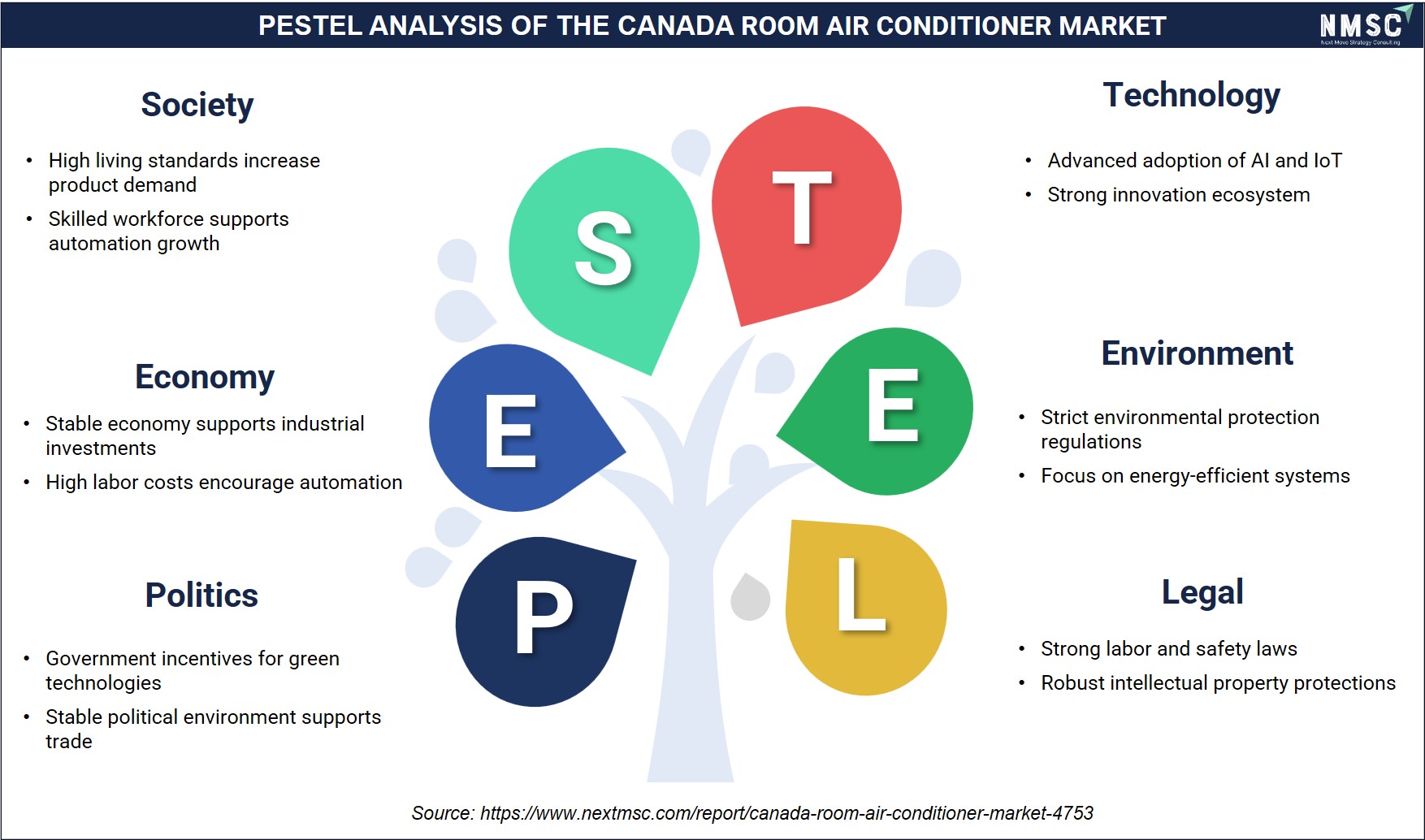
The infographic above of the Canada room air conditioner market illustrates how Canada’s distinct seasonal climate, characterised by short but intense cooling periods, directly shapes room air conditioner demand patterns. This seasonal behaviour interacts with strict environmental regulations focused on energy efficiency and refrigerant standards, influencing product design and market compliance requirements. Economic factors such as household disposable income and evolving housing trends further determine adoption levels, particularly in urban residential segments. At the same time, technological advancements in smart controls and inverter compressor systems are driving product differentiation and efficiency improvements. The structured framework strengthens trustworthiness by providing a multi-dimensional and analytical lens for evaluating market entry conditions, regulatory exposure, and consumer behaviour in the Canadian residential cooling landscape.
How is the Canada Room Air Conditioner Market segmented in this report, and what are the key insights from the segmentation analysis?
By Refrigerant Insights
How is Refrigerant Transition Shaping Sustainability and Replacement Demand in the Canada Room Air Conditioner Market?
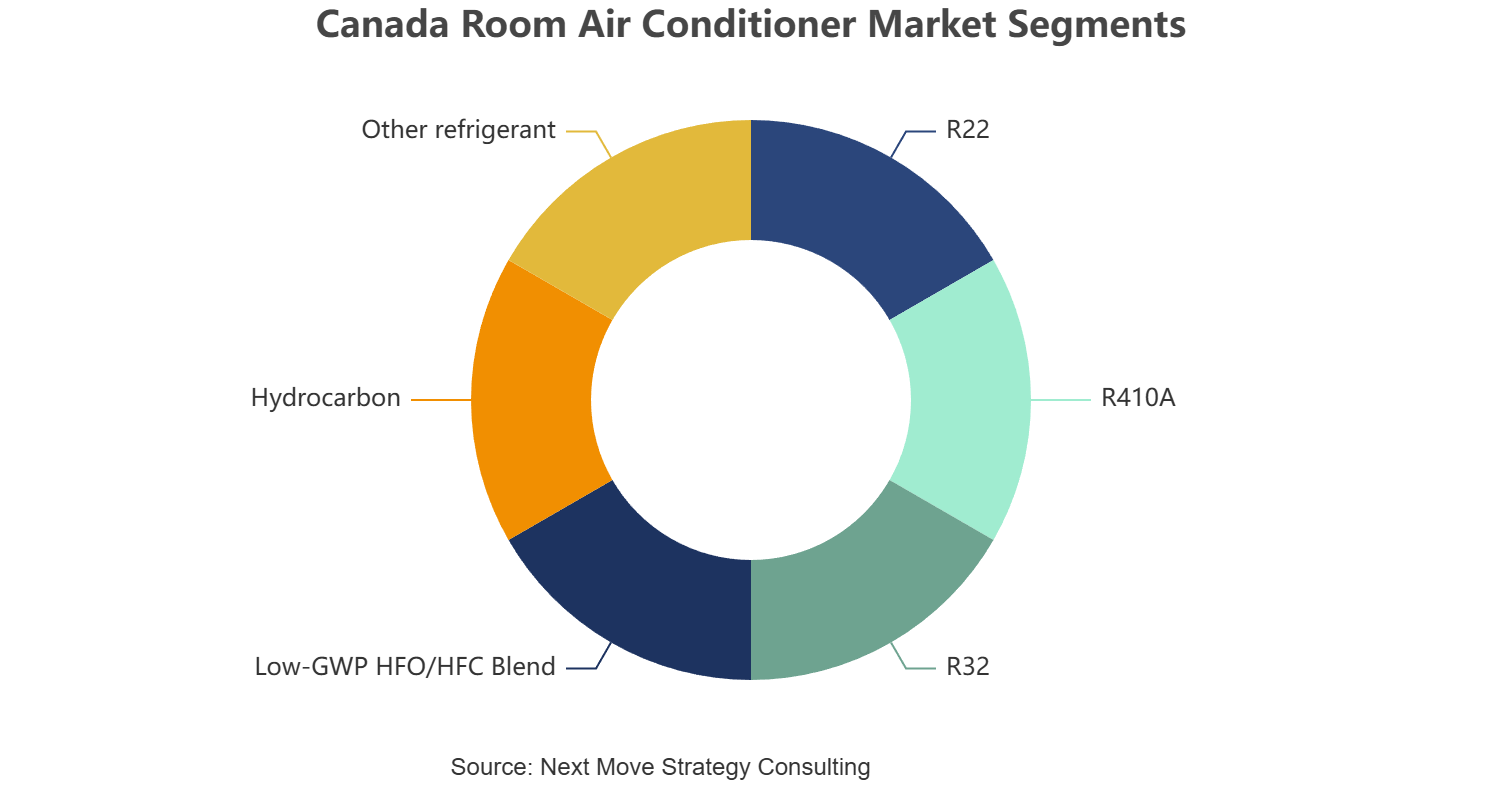
Based on refrigerant, the Canada room air conditioner market is segmented into R22, R410A, R32, Low-GWP HFO/HFC blend, hydrocarbon, and other refrigerants.
R22 refrigerant-based room air conditioners continue to exist mainly within legacy installations and replacement-driven demand, particularly in older residential properties where equipment lifecycles are still being extended through servicing and retrofit activities. However, regulatory restrictions and environmental phase-down policies are steadily reducing their long-term presence in the market. R410A systems maintain a strong installed base across residential cooling applications due to established manufacturing ecosystems and broad compatibility with existing equipment designs. At the same time, R32 refrigerants are gaining increasing adoption in new installations as manufacturers and consumers shift toward higher energy efficiency and lower global warming potential solutions. Low-GWP HFO/HFC blends are gradually expanding within premium and sustainability-focused segments, supported by tightening environmental compliance standards. Hydrocarbon refrigerants remain limited to niche applications where environmental performance and compact system design are prioritized, while other refrigerant types continue serving specialized retrofit and region-specific cooling requirements.
By Function Insights
How Do Functional Requirements Shape Demand Patterns in the Canada Room Air Conditioner Market?
Based on function, the Canada room air conditioner market is segmented into cooling only, heat pump, cooling with electric heat, and other functions.
Based on NMSC assessment, we found that cooling-only room air conditioners continue to maintain steady demand in Canada, particularly in regions and seasonal cycles where primary cooling needs dominate residential purchasing decisions during warmer months. Their relatively simple configuration and cost efficiency support adoption across apartments, rental housing, and secondary residential spaces. In contrast, heat pump-based systems are gaining stronger traction as consumers prioritize year-round climate control, combining both cooling and heating capabilities in a single energy-efficient solution aligned with Canada’s long heating season. Cooling systems integrated with electric heat remain relevant in select residential and small commercial applications where supplemental heating support is required during transitional weather conditions. Meanwhile, other functional variants serve niche use cases across specialized infrastructure and retrofit environments where tailored performance requirements and installation constraints influence equipment selection and system design.
Competitive Landscape
NMSC assessment suggests that the Canada room air conditioner industry features a moderately consolidated competitive structure, led by global HVAC and consumer appliance manufacturers operating through established Canadian subsidiaries and distribution networks. Competition is increasingly shaped by energy efficiency regulations, extreme seasonal temperature variability, and rising consumer preference for compact, inverter-based cooling systems suited to urban residential housing. Market dynamics are further reinforced by growing demand for smart-enabled climate control solutions, accelerated replacement cycles across older housing infrastructure, and the steady integration of air conditioning systems within broader home automation ecosystems. At the same time, supply chain localisation and enhanced after-sales service capabilities continue to emerge as critical differentiators across both premium and mid-tier product segments.
Strategic Developments:
-
May 2025 - Midea America Corp. opened a 20,000 sq. ft. showroom in Burnaby, British Columbia. The facility focuses on HVAC training, product demonstration, and heat pump promotion, strengthening contractor engagement and accelerating adoption of inverter-based room air conditioners in Canada.
-
March 2025 - Panasonic Canada Inc. partnered with EMCO Corporation to expand national distribution of ductless and ducted heat pump systems. The strategy improves availability of residential cooling systems and supports Canada’s shift toward electrified HVAC and energy-efficient room air conditioners.
Key Players of the Canada Room Air Conditioner Market:
-
Gree Canada Inc.
-
Midea America (Canada) Corp.
-
Panasonic Canada Inc.
-
Samsung Electronics Canada Inc.
-
Trane Canada ULC
-
Rheem Canada Ltd.
-
Whirlpool Canada LP
-
Hisense Canada Co., Ltd.
-
Mitsubishi Electric Sales Canada Inc.
-
Sharp Electronics of Canada Ltd.
-
Lennox Industries (Canada) ULC
-
Electrolux Canada Corp.
-
MC Commercial Inc.
Established participants in the Canada room air conditioner market, including Gree Canada Inc., Midea America (Canada) Corp., and Carrier Canada Limited, continue to strengthen their competitive positioning through high-efficiency inverter systems, diversified residential cooling portfolios, and robust commercial HVAC integration capabilities. In parallel, LG Electronics Canada, Inc., Samsung Electronics Canada Inc., and Panasonic Canada Inc. are reinforcing market presence through connected appliance ecosystems, IoT-enabled climate management platforms, and energy-optimised product innovation aligned with smart home adoption trends. Additionally, Trane Canada ULC, Lennox Industries (Canada) ULC, and Rheem Canada Ltd. are expanding their footprint through premium efficiency systems and integrated building solutions, while Whirlpool Canada LP, Hisense Canada Co., Ltd., Sharp Electronics of Canada Ltd., Electrolux Canada Corp., and MC Commercial Inc. are intensifying competition through diversified product offerings, pricing flexibility, and expanded retail and contractor-driven distribution networks. The future competitive differentiation will increasingly depend on low-carbon cooling technologies, intelligent energy management systems, and ecosystem-level integration across residential and light commercial environments.
SWOT Analysis of the Canada Room Air Conditioner Market:
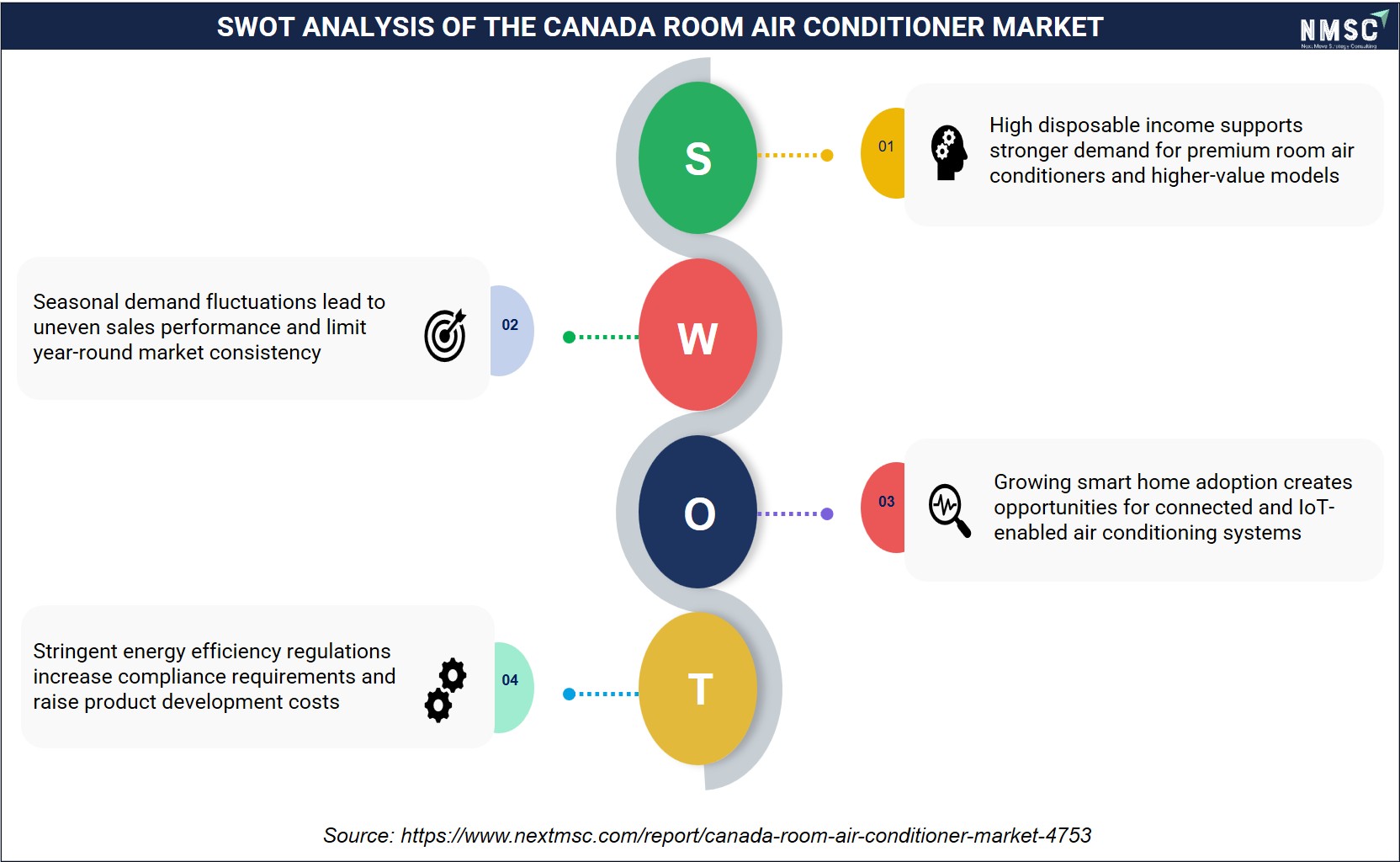
The infographic presents a structured SWOT analysis of the Canada room air conditioner market, outlining the key internal and external factors shaping industry dynamics. It highlights strong purchasing capacity driven by high disposable income as a core strength, while also emphasizing seasonal demand variability as a structural weakness that affects sales consistency. On the opportunity side, it reflects the growing adoption of smart home technologies, which is expanding demand for connected and energy-efficient cooling solutions. At the same time, the analysis identifies stringent energy efficiency regulations as a key external threat, increasing compliance pressure and influencing product design and cost structures across the market.
Canada Room Air Conditioner Market Key Segments
By Product Type
-
Window AC
-
Fixed Chassis
-
Through-the-Wall
-
-
Portable AC
-
Single Hose
-
Dual Hose
-
-
Single Split AC
-
Wall Mounted
-
Floor Standing
-
Ceiling Cassette
-
Ceiling Suspended
-
Ducted Single Zone
-
-
Multi Split AC
-
2 Indoor Units
-
3 Indoor Units
-
4+ Indoor Units
-
-
Packaged Room AC
-
Packaged Terminal AC
-
Vertical Packaged
-
Other Packaged
-
-
Other Room AC
By Speed Type
-
Fixed Speed
-
Inverter (Variable Speed)
By Cooling Capacity
-
≤ 1.0 Ton
-
>1.0 to ≤1.5 Ton
-
>1.5 to ≤2.0 Ton
-
>2.0 to ≤3.0 Ton
-
>3.0 Ton
By Efficiency Band
-
Entry
-
Standard
-
High
-
Premium
-
Unrated
By Refrigerant
-
R22
-
R410A
-
R32
-
Low-GWP HFO/HFC Blend
-
Hydrocarbon
-
Other refrigerant
By Function
-
Cooling Only
-
Heat Pump
-
Cooling with Electric Heat
-
Other Function
By Distribution Channel
-
Retail (Brick and Mortar)
-
Multi-Brand Store
-
Brand Exclusive Store
-
Hypermarkets
-
-
Dealer Network
-
HVAC Dealers
-
Distributor & Wholesaler
-
-
Online
-
Marketplace
-
Brand website
-
-
Project Sales
-
Real Estate Developer
-
Hospitality Chain
-
Institutional
-
-
OEM
By End-User
-
Residential
-
Commercial
-
Retail
-
Hospitality
-
Office
-
Healthcare
-
Education
-
Government/Public
-
Other Commercial
-
Key Benefits for Stakeholders:
Next Move Strategy Consulting (NMSC) presents a comprehensive analysis of the Canada room air conditioner market trends, covering historical trends from 2020 through 2025 and offering detailed forecasts through 2035. Our study examines the market at regional and country levels, providing quantitative projections and insights into key growth drivers, challenges, and investment opportunities across all major room air conditioner segments.
From our analysis of the Canada room air conditioner market, we found investors and customers benefit from a demand environment increasingly shaped by rising summer heat intensity, urban housing expansion, and growing awareness of indoor thermal comfort. Investors gain strategic advantages through accelerating replacement cycles, rising adoption of energy-efficient cooling systems, and steady integration of compact residential HVAC solutions suited to dense urban living. Further, the evolving energy efficiency standards and electrification-focused policies enhance long-term revenue predictability and product modernization opportunities. Customers benefit from improved access to reliable cooling systems, enhanced energy savings through advanced inverter technologies, and better adaptation to fluctuating climatic conditions. We also observed that regulatory emphasis on sustainability and safety strengthens consumer protection, product reliability, and long-term ownership value across residential applications.
|
Parameters |
Details |
|
Customization Scope |
Free customization (equivalent to up to 80 analyst-working hours) after purchase. |
|
Pricing and Purchase Options |
Avail customized purchase options to meet your exact research needs. |
|
Approach |
In-depth primary and secondary research; proprietary databases; rigorous quality control and validation measures. |
|
Analytical Tools |
Porter's Five Forces, SWOT, value chain, and Harvey ball analysis to assess competitive intensity, stakeholder roles, and relative impact of key factors. |
About the Author
 Mayurima Roy
— Mayurima Roy is Research Analyst at Next Move Strategy Consulting, where she has spent 4 years working across the firm's full industry coverage rather than a single fixed vertical. Her work centers on structured research, ongoing trend tracking, competitive assessment, and insight-led content development, translating complex market data into clear, decision-ready narratives that support informed client decision-making across diverse global industries, market sectors, and world regions every day.
Mayurima Roy
— Mayurima Roy is Research Analyst at Next Move Strategy Consulting, where she has spent 4 years working across the firm's full industry coverage rather than a single fixed vertical. Her work centers on structured research, ongoing trend tracking, competitive assessment, and insight-led content development, translating complex market data into clear, decision-ready narratives that support informed client decision-making across diverse global industries, market sectors, and world regions every day.
About the Reviewer
 Supradip Baul
— Supradip Baul is an accomplished business consultant and strategist with over a decade of rich experience in market intelligence, strategy, technology, and business transformation. His work has included rigorous qualitative and quantitative analysis across multiple industries, helping clients shape investment decisions and long-term roadmaps. Earlier in his career, he was associated with Gartner, where he contributed to industry-leading reports and market share analyses. He has worked with leading global companies and holds an MBA with a dual specialization in Marketing and Finance.
Supradip Baul
— Supradip Baul is an accomplished business consultant and strategist with over a decade of rich experience in market intelligence, strategy, technology, and business transformation. His work has included rigorous qualitative and quantitative analysis across multiple industries, helping clients shape investment decisions and long-term roadmaps. Earlier in his career, he was associated with Gartner, where he contributed to industry-leading reports and market share analyses. He has worked with leading global companies and holds an MBA with a dual specialization in Marketing and Finance.
At Next Move Strategy Consulting, we understand that insightful market research is the cornerstone of successful business decisions. That's why we employ a robust and multifaceted approach, combining various methodologies to deliver the most accurate and actionable data for our clients.

Research Landscape
We navigate the world of research with two primary approaches:
Qualitative Approach
Our qualitative research methodologies involve immersive techniques such as in-depth interviews, focus groups, and observational studies. By engaging directly with individuals and stakeholders, we uncover valuable insights that quantitative data alone may overlook.

Quantitative Research
In tandem with qualitative methodologies, NMSC leverages the power of Quantitative Research to provide a robust foundation of numerical insights. Through systematic data collection and analysis, we quantify patterns, preferences, and market trends, offering a comprehensive view of the business landscape.
Our quantitative research approach employs diverse tools, including surveys, experiments, and statistical modelling. These methodologies enable us to gather data from a large and representative sample, ensuring the statistical significance of our findings. By employing structured questionnaires and standardized data collection methods, we guarantee the reliability and validity of the information we present to our clients.
Quantitative research is particularly effective in measuring the prevalence of trends, assessing market size, and gauging the impact of various factors on consumer behavior. The numerical precision attained through this approach equips our clients with actionable insights, facilitating data-driven decision-making and strategy formulation.


Our Specialized Toolbox for Industry-Specific Market Research
We deploy a specialized arsenal of techniques tailored to meet your unique requirements. Here's a glimpse into our comprehensive toolbox:

Information Procurement
The stage entails acquiring market data or relevant information through various sources and methodologies.


Market Research Approach
We utilize both top-down and bottom-up approaches in market research analysis to achieve a comprehensive understanding of the market dynamics, leveraging the broad perspective of industry trends and macroeconomic factors alongside detailed insights from specific segments and individual companies.

Porters Five Forces Analysis
We conduct Porter's Five Forces analysis to evaluate the competitive landscape of an industry, providing us with insights into factors that affect profitability and strategic positioning.

SWOT Analysis

Forecasting
We utilize a forecasting model to predict future consumption by considering parameters like population, economics, regulations, market competition, drivers, constraints, technology, and pricing. We also employ statistical techniques such as multilinear regression, exponential smoothing, moving average, ARIMA, and Monte Carlo simulations for accurate predictions. In econometric forecasting, we analyzed short-term and long-term event impacts, attributing values based on regulatory frameworks, economic factors, and market events.





 Speak to Our Analyst