Carpet and Rug Market By Material Type {Natural Fibers (Wool, Cotton, Silk, Jute) Synthetic Fibers (Nylon, Polypropylene, Polyester, Acrylic) Blended Materials, Recycled and Bio-Based Fibers}, By Construction Method (Tufted, Woven, Knotted, Needle Felt, Hand Loomed, Flat Weave), By Distribution Channel (Online Retail, Offline Retail, Direct Manufacturer Sales, B2B Sales), By End User (Residential, Commercial) – Global Analysis & Forecast, 2026–2035
Industry: Retail and Consumer | Publishing Date: June 9, 2026 | Last Updated: October 16, 2026 | No of Pages: N/A | No. of Tables: N/A | No. of Figures: N/A | Format: PDF | Report Code: RC3864
Industry Outlook
The global Carpet and Rug Market size was valued at USD 79.49 billion in 2025 and is expected to reach USD 88.48 billion by 2026. Looking ahead, the industry is projected to expand significantly, reaching USD 231.89 billion by 2035, registering a CAGR of 11.3% from 2026 to 2035.
The carpet and rug market is experiencing strong growth, driven by rising household disposable income that enables consumers to invest more in home décor and interior enhancements. As buyers increasingly prioritize comfort, aesthetics, and overall home value, there is greater demand for premium carpets, designer rugs, and high-quality flooring. This trend encourages manufacturers to offer differentiated and higher-margin products, focusing on luxury, customization, and unique design. By positioning carpets and rugs as both functional and lifestyle-driven, companies attract consumers who value personalization and style, while also enhancing brand appeal in a competitive market.
Rapid urbanization is further fueling expansion in the market, as growing city populations create demand for well-designed, functional living and commercial spaces. Urban dwellers seek stylish and high-quality flooring solutions that complement modern apartments, condominiums, and commercial interiors. For market players, this underscores the importance of aligning product design, quality, and marketing strategies with urban lifestyles. By targeting regions with strong construction growth and emerging urban communities, carpet and rug manufacturers capture higher-volume demand and position themselves as go-to brands for consumers seeking both style and practicality in their living and working environments.
What Are the Key Trends in the Carpet and Rug Industry?
How will Regulatory Pressure from Textile Waste Laws Reshape the Industry?
The carpets and rugs industry is facing a major shift as the EU tightens rules on textile waste. From October 2025, all EU countries must collect textiles separately and enforce Extended Producer Responsibility programs, making manufacturers accountable for the disposal and recycling of their products. This change goes beyond sustainability; it will directly influence production costs and product design. Carpets and rugs that are easier to disassemble and recycle receive regulatory or financial benefits, while non-compliant products face penalties. To stay competitive, manufacturers should redesign carpets for recyclability, actively engage in EPR schemes, and consider implementing take-back programs for used products. By taking these steps proactively, companies not only meet regulations but also reduce costs, strengthen brand reputation, and appeal to the growing segment of environmentally conscious consumers.
Are Customization and Personalization Shaping Consumer Demand in the Market?
In the carpet and rug market, personalization is becoming a major trend as consumers increasingly want products that reflect their individual style. People are looking for unique patterns, colors, and sizes rather than standard designs, especially for homes and boutique commercial spaces. This shift presents a clear opportunity for manufacturers to offer modular carpets, digital printing, or fully bespoke options that let customers help design their rugs. By embracing customization, companies engage buyers more effectively, charge premium prices for tailored products, and build stronger brand loyalty in a competitive market.
How is Sustainability Influencing Material Choices in the Carpet and Rug Market?
Sustainability is increasingly shaping consumer preferences in the market. Buyers are now looking for eco-friendly options, such as carpets made from natural fibers, recycled materials, or low-impact dyes. This trend reflects a broader shift toward environmentally conscious home decorative, where customers not only care about design but also the environmental footprint of the products they buy. For manufacturers, this is an opportunity to innovate with greener materials, highlight sustainable production methods, and market products as both stylish and eco-conscious. By prioritizing sustainability, companies differentiate their offerings, appeal to environmentally aware consumers, and strengthen brand reputation in a market that is gradually placing more value on responsible production.
What Are the Key Market Drivers, Breakthroughs, and Investment Opportunities That Will Shape the Carpet and Rug Industry in the Next Decade?
The carpet and rug industry is experiencing dynamic growth, driven by rising consumer interest in stylish, high-quality, and sustainable home décor solutions. This momentum is fueled by a broader shift toward premium, functional, and aesthetically appealing interiors, where design, comfort, and eco-conscious materials are highly valued. As homeowners and commercial clients seek products that enhance living and working spaces, manufacturers are innovating with modular designs, customizable patterns, and environmentally friendly materials to meet these evolving expectations, leading to a diverse range of offerings across the market.
Despite the promising growth, challenges such as supply chain sustainability, production efficiency, and compliance with evolving environmental standards remain significant hurdles. Companies that successfully navigate these issues by emphasizing design innovation, ethical sourcing, and sustainable manufacturing practices capture growing consumer interest and strengthen brand credibility. By balancing creativity, quality, and environmental responsibility, market players are well-positioned to seize long-term opportunities and establish themselves as leaders in this evolving market.
Growth Drivers:
How does Rising Household Disposable Income Fuel Growth in the Carpet and Rug Market?
Rising household disposable income is driving growth in the market by increasing consumers’ capacity to invest in home decor and interior enhancements. According to the OECD, as disposable income rises, households are more likely to spend on premium carpets, designer rugs, and high-quality flooring that improve comfort, aesthetics, and overall home value. This trend enables manufacturers to introduce differentiated and higher-margin products targeting buyers who prioritize luxury, customization, and unique design. Companies in the market capitalize on this by focusing on regions with increasing disposable incomes, positioning their offerings as both functional and lifestyle-driven, and emphasizing design, quality, and personalization to attract consumers seeking to enhance their living spaces.
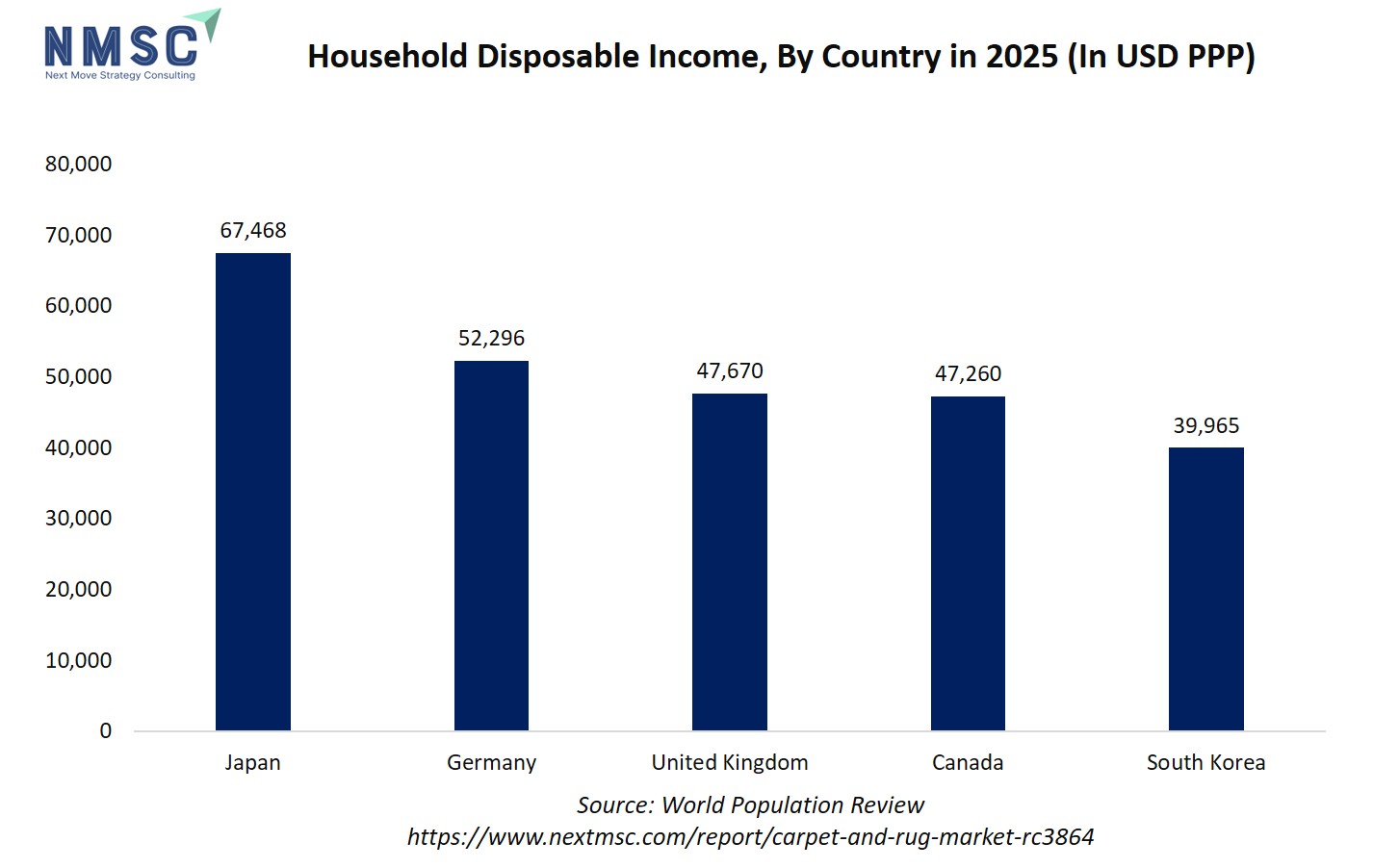
This chart shows projected household disposable income for 2025 (in USD PPP) across Japan, Germany, the United Kingdom, Canada, and South Korea, with Japan leading at USD 67,468. High disposable income increases consumer spending power, especially for discretionary items like carpets and rugs, meaning countries with higher incomes, like Japan and Germany are likely to see greater demand for premium home décor products, while lower-income markets focus on more affordable options
How is Rapid Urbanization Driving Demand in the Market?
According to the United Nations’ World Urbanization Prospects 2025, 45% of the global population now resides in cities. As urban populations grow, there is increasing demand for well-designed, functional living and commercial spaces rather than just basic housing. This trend is driving the need for interior décor solutions, including stylish and high-quality carpets and rugs that enhance comfort and aesthetics. By aligning product design and marketing strategies with urban lifestyle needs, companies capture higher-volume demand and establish themselves as preferred brands for city-dwelling consumers seeking both style and functionality in their flooring solutions.
Growth Inhibitors:
How is High Inflation Affecting Growth in the Carpet and Rug Market?
High inflation is emerging as a significant challenge for the market, as it reduces consumers’ ability to spend on non-essential home products. According to the OECD, headline inflation in member countries remained around 4.7% in December 2024 and hovered between 4.5% to 4.7% in early 2025. Elevated prices make buyers more cautious, particularly when considering premium rugs, designer carpets, or specialty flooring. For companies in the market, this presents a risk of reduced demand for higher-margin products. To address this, manufacturers focus on introducing more budget-friendly or entry-level options, offer flexible payment solutions, and highlight value in their marketing strategies. By doing so, they maintain sales and stay resilient even when consumers are more price-conscious due to inflationary pressures.
How Can the Boom in Global E-Commerce Unlock New Growth for the Carpet and Rug Market?
The rapid growth of e commerce presents a significant opportunity for the market, allowing manufacturers to reach a much wider, digitally savvy consumer base beyond traditional retail outlets. Global B2C e commerce is expected to hit USD 5.5 trillion by 2027, growing at a compound annual rate of 14.4%, according to the U.S. International Trade Administration. This surge enables companies to offer customizable rugs, modular carpet sets, and boutique designs directly to consumers, while leveraging online tools like room visualization or augmented reality to enhance the shopping experience. To capitalize on this trend, carpet and rug brands should invest in robust e commerce platforms, integrate interactive digital tools, and adopt targeted digital marketing strategies. By doing so, they efficiently scale operations, reduce distribution costs, and attract consumers who increasingly prefer purchasing home décor online.
How Is the Carpet and Rug Market Segmented in This Report, and What Are the Key Insights from the Segmentation Analysis?
By Material Type Insights
Is the Carpet and Rug Industry in 2025 Shaped by Diverse Material Type?
Based on material type, the carpet and rug market segments are divided into natural fibers, synthetic fibers, blended materials and recycled and bio-based fibers.
The natural fibers segment of the carpet and rug market encompasses materials such as wool, cotton, silk, and jute, valued for their durability, comfort, and premium feel. Carpets and rugs made from natural fibers are preferred for their aesthetic appeal, softness underfoot, and ability to regulate temperature and humidity, making them suitable for a range of residential and commercial applications. Wool offers resilience and stain resistance, cotton provides lightweight and breathable options, silk delivers a luxurious texture and sheen, and jute contributes an eco-friendly, rustic charm. This segment is increasingly favored by consumers seeking sustainable and high-quality flooring solutions, as natural fibers are renewable, biodegradable, and align with environmentally conscious design trends, positioning them as a premium choice in the broader market.
By Product Form Insights
Is the Carpet and Rug Industry in 2025 Being Shaped by Product Form?
On the basis of product form, the market is segmented into rugs, broadloom and carpet tiles.
The rugs segment represents a versatile and highly popular category within the market, prized for its design flexibility, portability, and ability to enhance the aesthetics of any space. Rugs come in various shapes, sizes, and styles, ranging from traditional handcrafted pieces to contemporary machine-made designs, allowing consumers to personalize their interiors with patterns, textures, and colors that reflect their taste. They are suitable for both residential and commercial settings, providing comfort, warmth, and noise reduction while serving as decorative focal points. This segment is particularly appealing to buyers seeking easy-to-install and movable flooring solutions, making rugs a preferred choice for those who want to combine functionality, style, and a touch of luxury in their living or working environments.
By Distribution Channel Insights
Are Distribution Channels Shaping the Carpet and rug market in 2025?
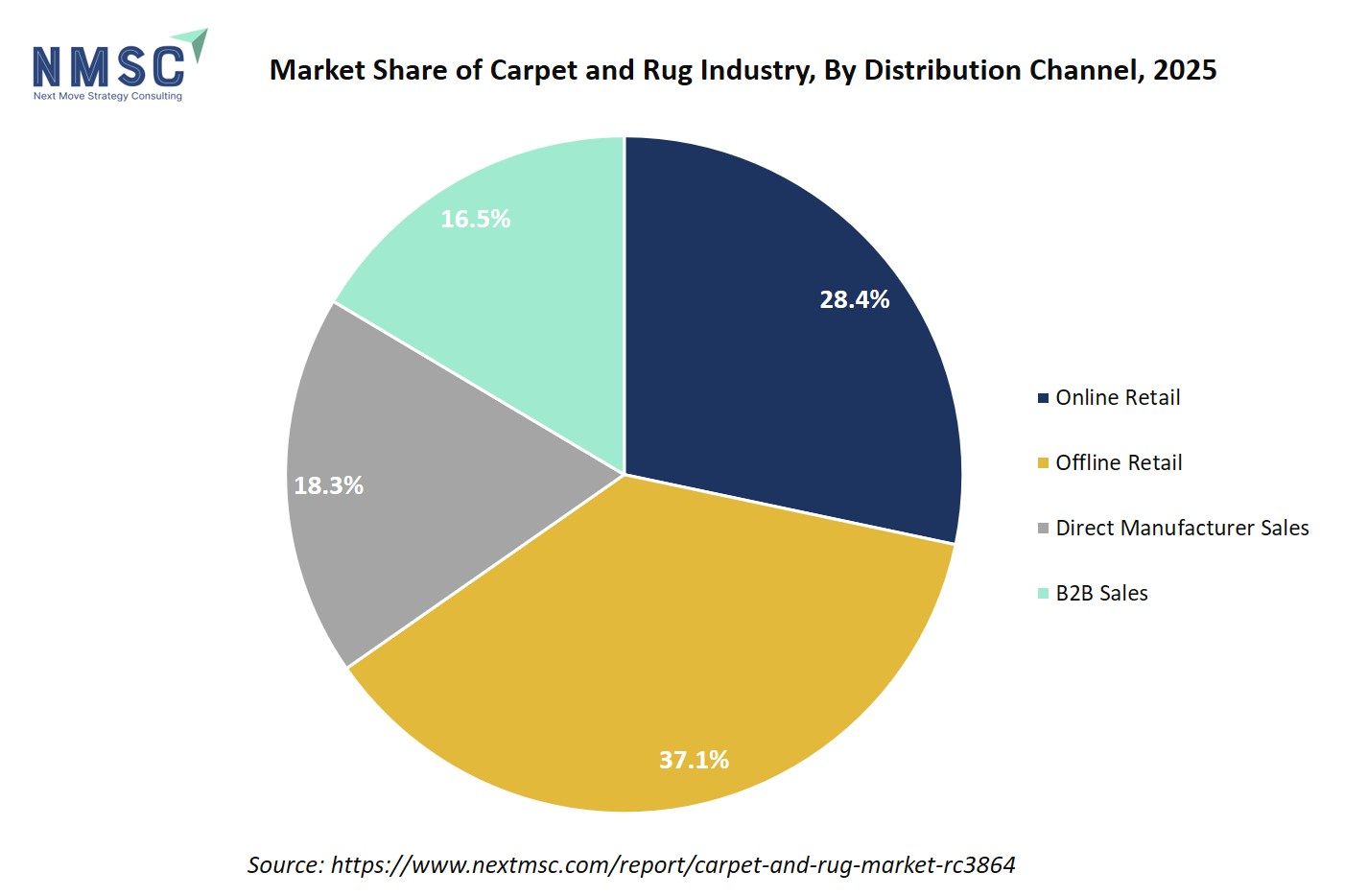
On the basis of distribution channel, the market is segmented into online retail, offline retail, direct manufacturer sales and B2B sales.
The online retail segment of the market has grown rapidly, driven by consumers’ desire for convenience, wider selection, and the ability to compare products and prices from the comfort of their homes. E-commerce platforms allow buyers to browse extensive catalogs, customize designs, view room previews with augmented reality tools, and make purchases with flexible delivery options. This channel also enables manufacturers and retailers to reach a broader, geographically diverse audience, while offering personalized marketing and promotional campaigns that enhance engagement and brand loyalty.
The offline retail segment remains a crucial distribution channel, catering to consumers who prefer tactile experience and in-person evaluation before purchase. Specialty stores, department stores, and home improvement outlets provide the advantage of hands-on interaction with carpet and rug textures, colors, and quality. In addition to offering immediate purchase options, these stores provide expert guidance, installation services, and customization support. This segment continues to appeal to buyers who prioritize experiential shopping and professional assistance when selecting products that significantly impact home aesthetics and comfort.
By End User Insights
Which End User is Driving the Carpet and rug market in 2025?
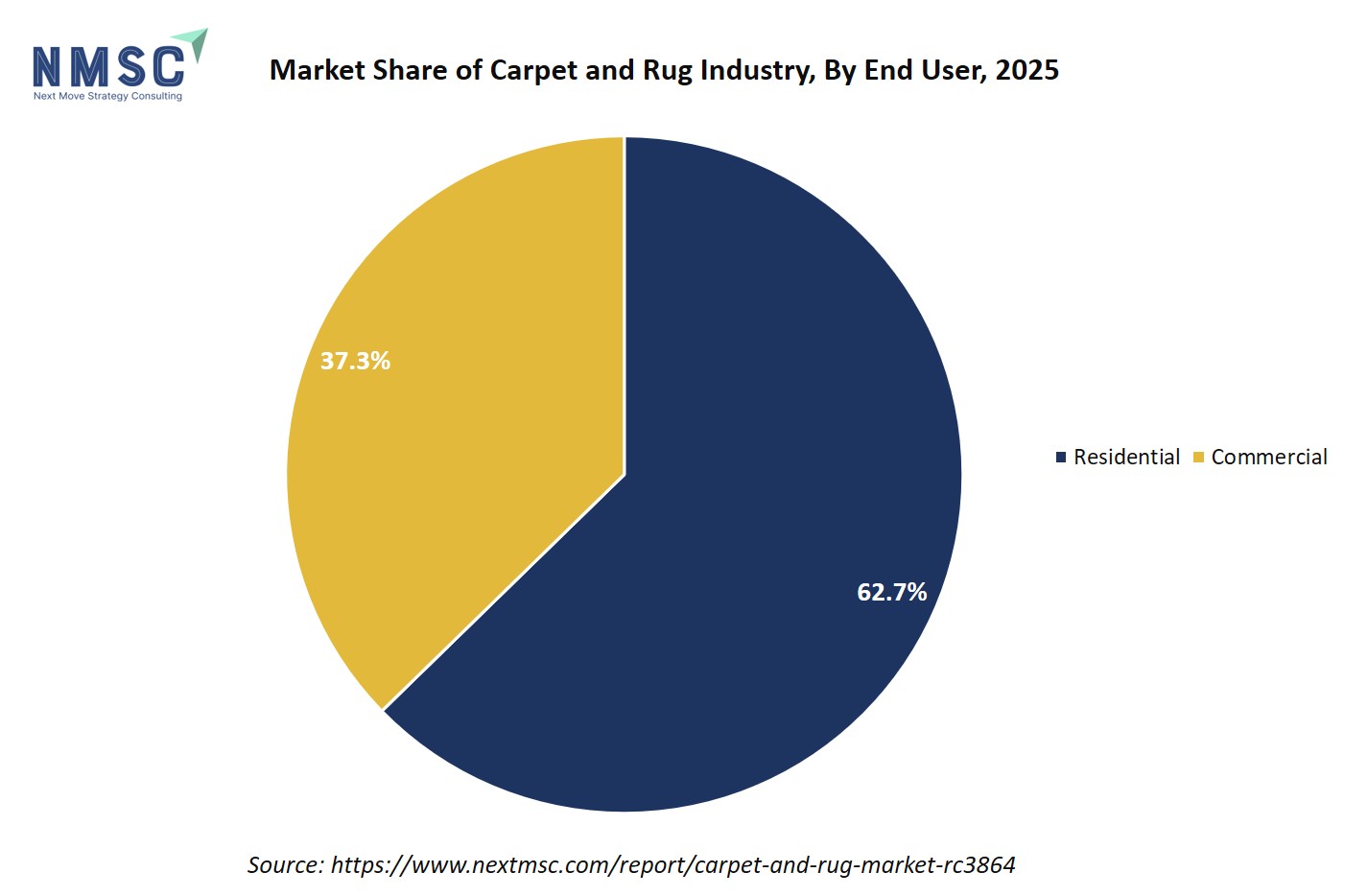
On the basis of end user, the market is segmented into residential and commercial.
The residential segment of the market caters to homeowners and apartment dwellers seeking to enhance comfort, aesthetics, and functionality within their living spaces. Residential carpets and rugs are available in a wide variety of styles, materials, and designs, from plush, luxurious rugs for bedrooms and living rooms to durable, easy-to-clean options for high-traffic areas. This segment emphasizes personalization, allowing consumers to select patterns, colors, and textures that align with their interior décor and lifestyle preferences, making carpets and rugs an integral part of home design and comfort.
The commercial segment serves offices, hotels, retail spaces, educational institutions, and other public or professional environments, where durability, safety, and low maintenance are primary considerations alongside design and aesthetics. Carpets and rugs in this segment are designed to withstand heavy foot traffic, resist stains, and meet fire and safety standards, while also contributing to the visual appeal and acoustic comfort of commercial interiors. For businesses, selecting the right carpet solution enhances brand image, creates welcoming spaces, and supports long-term functionality in high-use areas.
Regional Outlook
The carpet and rug market is geographically studied across North America, Europe, Asia Pacific, Middle East & Africa, and Latin America and each region is further studied across countries.
Carpet and rug market in North America
In North America, the market is primarily driven by strong residential and commercial construction and renovation activities, as carpets remain a preferred choice for comfort, insulation, and aesthetic appeal. Consumer demand for eco-friendly and sustainable products is also pushing manufacturers to adopt recycled and plant-based materials. At the same time, technological innovations, such as stain-resistant, durable, and customizable carpets, along with emerging smart textile applications, are enhancing product value. Changing consumer preferences toward versatile, functional, and customizable carpets further support carpet and rug market growth across both home and commercial segments.
Carpet and rug market in the United States
In the U.S., carpet and rug demand is closely linked to housing and renovation trends, with residential improvements and remodels driving the need for stylish and comfortable flooring. As a mature consumer market, the U.S. favors carpets and rugs that combine appealing design, durability, and eco-friendly attributes, enabling manufacturers to capitalize on renovation cycles and the growing preference for sustainable, high-quality products.
Carpet and rug market in Canada
In Canada, the carpet and rug market is significantly influenced by the growing demand for comfort and thermal insulation, especially given the country’s colder climate across much of its territory. Homeowners and commercial property developers increasingly seek flooring solutions that not only enhance aesthetic appeal but also provide warmth, reduce noise, and create a cozy, inviting indoor environment. Carpets and rugs are valued for their ability to improve overall living comfort while also offering functional benefits such as energy efficiency and sound absorption. As consumers continue to prioritize both comfort and practicality in interior design, these preferences are driving sustained demand and supporting steady growth in the Canadian market.
Carpet and rug market in Europe
In Europe, the carpet and rug market is largely driven by the increasing focus on interior design and aesthetic appeal. Consumers and businesses are placing greater emphasis on stylish, personalized, and premium flooring solutions that complement modern living and workspaces. This trend is encouraging manufacturers to offer a wide range of designs, textures, and patterns, catering to diverse tastes and interior themes. The growing interest in high-quality, visually appealing carpets and rugs continues to propel market growth across both residential and commercial segments.
Carpet and rug market in the United Kingdom
In United Kingdom, construction activity remains a key driver of carpet and rug demand, with both new builds and renovation projects contributing to market opportunities. Residential developments and refurbishments create strong demand for flooring solutions that balance aesthetic appeal with durability. For the market, this underscores ongoing potential in providing products that meet the needs of homeowners seeking long-lasting, visually appealing options for both new homes and renovation projects.
Carpet and rug market in Germany
In Germany, the carpet and rug market is increasingly driven by the growing emphasis on sustainability and eco-conscious living. Consumers are showing a strong preference for environmentally friendly products, including carpets made from recycled materials or natural fibers. Manufacturers that focus on sustainable production processes, low-impact materials, and durable, long-lasting designs are well-positioned to meet these evolving consumer expectations, supporting market growth in both residential and commercial sectors.
Carpet and rug market in France
In France, a significant driver for the market is the recent rise in consumer price inflation, with the Consumer Price Index increasing by 1.2% year on year as of September 2025, according to INSEE. This upward pressure on living costs is influencing consumer behavior, encouraging homeowners and property managers to seek cost-effective yet high-quality flooring solutions. Carpets and rugs, known for their durability, comfort, and long-term value, become particularly attractive in this context, as they allow consumers to enhance interior spaces without frequent replacement or high expenditure. As a result, the market benefits from a growing demand for products that combine practicality with aesthetic appeal, especially among budget-conscious buyers looking to maintain a comfortable and stylish living environment.
Carpet and rug market in Italy
In Italy, a key factor fueling the carpet and rug market is the rising demand for luxury and designer home interiors. Italian consumers highly value craftsmanship and stylish décor, making premium and visually distinctive carpets and rugs increasingly popular. This emphasis on elegance, personalization, and artistic design encourages manufacturers to develop innovative patterns, textures, and materials, driving growth across both residential and high-end commercial segments.
Carpet and rug market in Spain
In Spain, the market is being driven by the increasing focus on urban lifestyle and compact living spaces. As more consumers move into apartments and smaller homes, there is a growing demand for carpets and rugs that enhance comfort, define spaces, and add aesthetic value without overwhelming limited areas. Manufacturers are responding with versatile, space efficient, and stylish designs, which is helping to expand the market across both modern residential and urban commercial settings.
Carpet and rug market in the Nordics
In the Nordic countries, the market is increasingly driven by a strong emphasis on sustainable and natural home living. Consumers in this region prioritize eco-friendly materials, non-toxic manufacturing processes, and products that align with minimalist and nature-inspired interior designs. This growing preference for environmentally conscious and aesthetically harmonious flooring solutions encourages manufacturers to offer carpets and rugs made from natural fibers, recycled materials, and low-impact dyes, supporting steady market growth across residential and commercial spaces.
Carpet and rug market in the Asia-Pacific
In the Asia Pacific region, the carpet and rug market expansion is being driven by the rising urbanization and the hospitality sector. Rapid growth of hotels, resorts, and commercial spaces in urban centers is creating strong demand for stylish, durable, and easy-to-maintain flooring solutions. Carpets and rugs are increasingly favored for their ability to enhance interior aesthetics, provide comfort, and improve acoustic performance, making them an important element in both residential and commercial developments across the region.
Carpet and rug market in China
In China, a key factor boosting the market is the rising middle-class interest in home decor and personalized interiors. Increasing disposable incomes and evolving lifestyle preferences are prompting homeowners to invest in flooring that reflects their style and complements modern interior designs. Carpets and rugs are valued not only for comfort but also for their ability to enhance aesthetics and create distinctive, stylish living spaces, driving growth across both urban residential and premium commercial segments.
Carpet and rug market in Japan
In Japan, a key factor driving the market is the rising demand for compact and multifunctional living solutions. With urban homes and apartments limited in space, consumers are looking for flooring that enhances comfort, improves interior aesthetics, and adds versatility. Carpets and rugs that help define areas, provide warmth, and complement minimalistic and functional interiors are increasingly preferred, supporting steady growth in both residential and small-scale commercial segments.
Carpet and rug market in India
In India, a key driver for the market is the strong export demand, which reflects the country’s reputation as a leading manufacturer of high-quality, handcrafted carpets. According to IBEF, carpet exports from India reached USD 1.39 billion in FY 24, highlighting robust international interest in Indian carpets and rugs. This growing export market encourages domestic manufacturers to scale production, innovate in design, and maintain quality standards, which in turn supports overall market growth while reinforcing India’s position as a global supplier of premium carpets and rugs.
Carpet and rug market in South Korea
In South Korea, the carpet and rug market is increasingly driven by the rising interest in interior aesthetics and lifestyle customization. Consumers are placing greater emphasis on creating visually appealing and comfortable living spaces, with a focus on personalized décor that reflects individual taste. Carpets and rugs are favored for their ability to add warmth, texture, and style to homes and offices, supporting steady demand across both residential and commercial segments.
Carpet and rug market in Taiwan
In Taiwan, the market is being driven by the growing demand for modern and multifunctional interiors. As urban living spaces become more compact, consumers seek flooring solutions that enhance comfort, improve aesthetics, and offer versatility. Carpets and rugs that define areas, add warmth, and complement contemporary décor are increasingly popular, fueling growth in both residential and commercial segments.
Carpet and rug market in Indonesia
In Indonesia, a key driver for the carpet and rug market is the increasing growth of the hospitality and tourism sector. With the expansion of hotels, resorts, and serviced apartments, there is strong demand for durable, stylish, and comfortable flooring solutions. Carpets and rugs are preferred for their ability to enhance interior aesthetics, improve acoustics, and provide a luxurious feel, driving market growth in both commercial and upscale residential segments.
Carpet and rug market in Australia
In Australia, the market is increasingly driven by the growing focus on sustainable and eco-friendly home products. Consumers are showing a strong preference for carpets made from natural fibers, recycled materials, and non-toxic manufacturing processes. This emphasis on environmentally conscious living encourages manufacturers to offer sustainable, high-quality flooring solutions that combine durability with aesthetic appeal, supporting market growth across residential and commercial spaces.
Carpet and rug market in Latin America
In Latin America, the carpet and rug market is increasingly driven by the expansion of the retail and e-commerce sector. Growing online and offline retail channels are making a wider variety of carpets and rugs more accessible to consumers, allowing for greater choice in design, material, and price. This increased availability, combined with targeted marketing and home décor trends, is boosting consumer adoption and supporting overall market growth across the region.
Carpet and rug market in the Middle East & Africa
In the Middle East & Africa, the market is being driven by the rising demand for luxury and premium interior decor. High-income consumers and upscale commercial developments, such as hotels and office spaces, are increasingly investing in premium carpets and rugs that enhance elegance and sophistication. This focus on luxury, combined with a cultural appreciation for intricate designs and craftsmanship, continues to support market growth across both residential and commercial segments.
Competitive Landscape
Which Companies Dominate the Carpet and Rug Industry and How do they Compete?
Leading companies in the carpet and rug industry, such as Mohawk Industries, Milliken & Company, Tarkett USA & Canada, Engineered Floors, and ORIENTAL WEAVERS, have established themselves as key players through strategic expansions, innovation, and a focus on quality and design. Mohawk Industries, for example, emphasizes premium, durable, and sustainable flooring solutions, catering to both residential and commercial markets. Milliken & Company leverages its research and development capabilities to create innovative carpet designs and materials, while Tarkett focuses on integrating eco-friendly practices and sustainable products across its North American operations. These companies compete by differentiating their product offerings, investing in design and technology, and enhancing customer experience through customization and quality assurance.
Other prominent players, including Mannington Mills, DH Floors, Tai Ping Carpets International, Ege Carpets, Brintons Carpets, Nourison, jaipurrugs, OBEETEE, SUMINOE Interior Products, and Carpet Edition, focus on combining craftsmanship with global reach to capture market share. Many of these companies emphasize sustainable sourcing, modular and designer carpets, and innovative manufacturing processes to meet evolving consumer demands. By expanding their footprints in international markets, enhancing design portfolios, and offering eco-conscious products, these players are shaping the competitive landscape of the market while catering to both premium and mid-market segments worldwide.
Market Dominated by Carpet and Rug Giants and Specialists
The carpet and rug industry is shaped by a mix of global leaders and specialized firms, each targeting distinct regions and product categories. Companies like Mohawk Industries, Milliken & Company, Tarkett USA & Canada, and Engineered Floors lead globally with extensive portfolios, advanced manufacturing, and broad distribution networks, while specialized players such as ORIENTAL WEAVERS, Tai Ping Carpets International, Brintons Carpets, jaipurrugs, OBEETEE, and Carpet Edition focus on premium, artisanal, or region-specific designs that cater to niche consumer preferences. Regional and mid-sized companies like Mannington Mills, DH Floors, Ege Carpets, SUMINOE Interior Products, and Nourison enhance the market further by leveraging local insights, design trends, and regulatory knowledge. This competitive landscape fosters innovation and differentiation, with global players emphasizing scale, technology, and sustainability, and specialists driving craftsmanship, bespoke offerings, and luxury solutions, collectively ensuring the market evolves to meet diverse consumer needs.
Innovation and Adaptability Drive Market Success
Innovation is a key driver of success in the carpet and rug industry, with companies continually developing new products and applications to meet evolving consumer demands. In April 2024, Mohawk Group showcased the ReBloom carpet collection at HD Expo, highlighting how innovation and adaptability drive success in the market. The collection features nature-inspired patterns and incorporates Color Pulse yarn, a technology that eliminates water usage during dyeing, significantly reducing environmental impact. By combining sustainable manufacturing with creative design, Mohawk demonstrates how responding to evolving consumer preferences, such as demand for eco-friendly products and aesthetic appeal differentiate a brand in a competitive market. This approach not only reinforces Mohawk’s leadership in innovation but also illustrates that adaptability to sustainability trends and customer expectations is key to capturing market share and fostering long-term growth.
List of Key Carpet and Rug Companies
-
Milliken & Companies
-
Tarkett USA & Canada
-
Engineered floors
-
ORIENTAL WEAVERS
-
DH Floors.
-
Tai Ping Carpets International Limited
-
Ege Carpets
-
Brintons Carpets Limited.
-
Nourison
-
Jaipur rugs
-
OBEETEE
-
SUMINOE Interior Products Co, Ltd.
-
Carpet Edition
What Are The Latest Key Industry Developments?
-
July 2025 - Oriental Weavers opened the world’s first “phygital” carpet store in New Cairo, blending physical shopping with digital customization tools. This innovative approach demonstrates the company’s adaptability to evolving consumer preferences and positions it at the forefront of the market, where interactive, personalized experiences are increasingly driving customer engagement and sales.
-
January 2024 - At Domotex 2024, Oriental Weavers launched eco-friendly collections, including indoor/outdoor rugs and recycled yarn carpets. This highlights the company’s focus on sustainability and positions it to meet growing market demand for stylish, durable, and environmentally responsible flooring solutions.
What Are The Key Factors Influencing Investment Analysis & Opportunities In The Carpet And Rug Market?
Investment in the carpet and rug industry is increasingly guided by rising global demand for high-quality, aesthetically appealing, and sustainable home décor solutions. Investors are particularly interested in companies that offer differentiated products, including premium designer rugs, eco-friendly carpets, and customizable flooring solutions. Market appeal is strengthened by a focus on product innovation, durability, and adaptability to evolving consumer preferences, including modular designs and digital customization. Businesses that prioritize operational efficiency, traceability in sourcing materials, and compliance with sustainability standards are viewed as lower-risk and more attractive for long-term investment.
Valuations in the market are influenced by factors such as brand recognition, design uniqueness, and scalability of production. Investment hotspots are emerging in regions with strong construction growth, urbanization trends, and a robust consumer base for home improvement, such as North America, Europe, and Asia-Pacific. Companies that integrate sustainable materials, eco-conscious manufacturing, and innovative design elements tend to attract higher investor interest. Strategic collaborations, partnerships with real estate and interior design firms, and focus on premium and niche segments further enhance growth opportunities in this evolving market.
Key Benefits for Stakeholders:
Next Move Strategy Consulting (NMSC) presents a comprehensive analysis of the carpet and rug market, covering historical trends from 2020 through 2025 and offering detailed forecasts through 2035. Our study examines the market at regional and country levels, providing quantitative projections and insights into key growth drivers, challenges, and investment opportunities across all major carpet and rug segments.
The carpet and rug industry delivers distinct benefits to multiple stakeholders by linking economic value with evolving consumer lifestyle and home décor trends. Investors gain from strong growth potential, opportunities for diversification, and the ability to support companies offering innovative, high-margin, and sustainable flooring solutions. Consumers benefit from access to aesthetically appealing, durable, and eco-friendly carpets and rugs that enhance comfort and interior design, aligning with the demand for sustainable and high-quality home products. Suppliers and manufacturers enjoy consistent demand for raw materials and the chance to develop differentiated offerings, while designers and retailers leverage innovation and customization to create premium products. This interconnected ecosystem fosters mutual growth, where creativity, quality, and sustainability generate value for both financial stakeholders and end consumers.
Report Scope
|
Parameters |
Details |
|
Market Size in 2026 |
USD 88.48 Billion |
|
Revenue Forecast in 2035 |
USD 231.89 Billion |
|
Growth Rate |
CAGR of 11.3% from 2026 to 2035 |
|
Analysis Period |
2025–2035 |
|
Base Year Considered |
2025 |
|
Forecast Period |
2026–2035 |
|
Market Size Estimation |
Billion (USD) |
|
Growth Factors |
|
|
Companies Profiled |
15 |
|
Countries Covered |
33 |
|
Market Share |
Available for 10 companies |
|
Customization Scope |
Free customization (equivalent to up to 80 analyst-working hours) after purchase. Addition or alteration to country, regional & segment scope. |
|
Pricing and Purchase Options |
Avail customized purchase options to meet your exact research needs. |
|
Approach |
In-depth primary and secondary research; proprietary databases; rigorous quality control and validation measures. |
|
Analytical Tools |
Porter's Five Forces, SWOT, value chain, and Harvey ball analysis to assess competitive intensity, stakeholder roles, and relative impact of key factors. |
Key Market Segments
By Material Type
-
Natural Fibers
-
Wool
-
Cotton
-
Silk
-
Jute
-
-
Synthetic Fibers
-
Nylon
-
Polypropylene
-
Polyester
-
Acrylic
-
-
Blended Materials
-
Recycled and Bio-Based Fibers
By Product Form
-
Rugs
-
Broadloom
-
Carpet Tiles
By Construction Method
-
Tufted
-
Woven
-
Knotted
-
Needle Felt
-
Hand Loomed
-
Flat Weave
By Distribution Channel
-
Online Retail
-
Offline Retail
-
Specialty Stores
-
Department Stores
-
Home Improvement Stores
-
-
Direct Manufacturer Sales
-
B2B Sales
By End User
-
Residential
-
Commercial
Geographical Breakdown
-
North America: U.S., Canada, and Mexico.
-
Europe: U.K., Germany, France, Italy, Spain, Sweden, Denmark, Finland, Netherlands, and rest of Europe.
-
Asia Pacific: China, India, Japan, South Korea, Taiwan, Indonesia, Vietnam, Australia, Philippines, Malaysia and rest of APAC.
-
Middle East & Africa (MEA): Saudi Arabia, UAE, Egypt, Israel, Turkey, Nigeria, South Africa, and rest of MEA.
-
Latin America: Brazil, Argentina, Chile, Colombia, and rest of LATAM
Conclusion & Recommendations
Our report equips stakeholders, industry participants, investors, and consultants with actionable intelligence to capitalize on the transformative potential of the carpet and rug industry. By combining robust data-driven analysis with strategic frameworks, NMSC’s Carpet and Rug Market Report serves as an indispensable resource for navigating the evolving landscape. The market is poised for sustained growth, driven by increasing consumer preference for high-quality, sustainable, and aesthetically appealing home décor solutions. Strategic takeaways highlight the importance of product innovation, design differentiation, and supply chain transparency, as these factors enhance brand credibility and competitiveness. Companies that focus on premium designs, eco-friendly materials, and customizable offerings capture larger market shares while strengthening long-term growth prospects. Integrating sustainability and ethical sourcing further positions firms to meet evolving consumer expectations and stand out in a crowded marketplace.
For executives and investors, capitalizing on these trends requires identifying high-potential product segments, investing in R&D for innovative interior flooring solutions designs, and forging strategic partnerships to expand market reach. Prioritizing regions with robust urbanization, active construction markets, and favorable regulatory frameworks optimize production and distribution strategies. Additionally, emphasizing consumer education, transparent sourcing, and premium product positioning enhances brand trust and accelerates adoption, unlocking significant opportunities for value creation and sustained growth in the global carpet and rug market.


About the Author
 Mayurima Roy
— Mayurima Roy is Research Analyst at Next Move Strategy Consulting, where she has spent 4 years working across the firm's full industry coverage rather than a single fixed vertical. Her work centers on structured research, ongoing trend tracking, competitive assessment, and insight-led content development, translating complex market data into clear, decision-ready narratives that support informed client decision-making across diverse global industries, market sectors, and world regions every day.
Mayurima Roy
— Mayurima Roy is Research Analyst at Next Move Strategy Consulting, where she has spent 4 years working across the firm's full industry coverage rather than a single fixed vertical. Her work centers on structured research, ongoing trend tracking, competitive assessment, and insight-led content development, translating complex market data into clear, decision-ready narratives that support informed client decision-making across diverse global industries, market sectors, and world regions every day.
About the Reviewer
 Supradip Baul
— Supradip Baul is an accomplished business consultant and strategist with over a decade of rich experience in market intelligence, strategy, technology, and business transformation. His work has included rigorous qualitative and quantitative analysis across multiple industries, helping clients shape investment decisions and long-term roadmaps. Earlier in his career, he was associated with Gartner, where he contributed to industry-leading reports and market share analyses. He has worked with leading global companies and holds an MBA with a dual specialization in Marketing and Finance.
Supradip Baul
— Supradip Baul is an accomplished business consultant and strategist with over a decade of rich experience in market intelligence, strategy, technology, and business transformation. His work has included rigorous qualitative and quantitative analysis across multiple industries, helping clients shape investment decisions and long-term roadmaps. Earlier in his career, he was associated with Gartner, where he contributed to industry-leading reports and market share analyses. He has worked with leading global companies and holds an MBA with a dual specialization in Marketing and Finance.
At Next Move Strategy Consulting, we understand that insightful market research is the cornerstone of successful business decisions. That's why we employ a robust and multifaceted approach, combining various methodologies to deliver the most accurate and actionable data for our clients.

Research Landscape
We navigate the world of research with two primary approaches:
Qualitative Approach
Our qualitative research methodologies involve immersive techniques such as in-depth interviews, focus groups, and observational studies. By engaging directly with individuals and stakeholders, we uncover valuable insights that quantitative data alone may overlook.

Quantitative Research
In tandem with qualitative methodologies, NMSC leverages the power of Quantitative Research to provide a robust foundation of numerical insights. Through systematic data collection and analysis, we quantify patterns, preferences, and market trends, offering a comprehensive view of the business landscape.
Our quantitative research approach employs diverse tools, including surveys, experiments, and statistical modelling. These methodologies enable us to gather data from a large and representative sample, ensuring the statistical significance of our findings. By employing structured questionnaires and standardized data collection methods, we guarantee the reliability and validity of the information we present to our clients.
Quantitative research is particularly effective in measuring the prevalence of trends, assessing market size, and gauging the impact of various factors on consumer behavior. The numerical precision attained through this approach equips our clients with actionable insights, facilitating data-driven decision-making and strategy formulation.


Our Specialized Toolbox for Industry-Specific Market Research
We deploy a specialized arsenal of techniques tailored to meet your unique requirements. Here's a glimpse into our comprehensive toolbox:

Information Procurement
The stage entails acquiring market data or relevant information through various sources and methodologies.


Market Research Approach
We utilize both top-down and bottom-up approaches in market research analysis to achieve a comprehensive understanding of the market dynamics, leveraging the broad perspective of industry trends and macroeconomic factors alongside detailed insights from specific segments and individual companies.

Porters Five Forces Analysis
We conduct Porter's Five Forces analysis to evaluate the competitive landscape of an industry, providing us with insights into factors that affect profitability and strategic positioning.

SWOT Analysis

Forecasting
We utilize a forecasting model to predict future consumption by considering parameters like population, economics, regulations, market competition, drivers, constraints, technology, and pricing. We also employ statistical techniques such as multilinear regression, exponential smoothing, moving average, ARIMA, and Monte Carlo simulations for accurate predictions. In econometric forecasting, we analyzed short-term and long-term event impacts, attributing values based on regulatory frameworks, economic factors, and market events.





 Speak to Our Analyst