Cellulosic Additives Market Global Industry Analysis and Forecast (2026 to 2035)

The market size was USD 6.20 Billion in 2025, projected to reach USD 10.10 Billion by 2035, growing at a CAGR of 5.0% from 2026 to 2035. Key drivers include pharmaceutical excipient upgrades, rising demand for dry-mix construction materials, and expanding production capacity in Asia-Pacific.

Download Free Sample PDF
Base Year (2025)
$6.20 Billion
Forecast (2035)
$10.10 Billion
CAGR (2026-2035)
5.0%
Top Region
Asia-Pacific

What Is the Cellulosic Additives Market Size?

The global Cellulosic Additives Market reached USD 6.20 Billion in 2025 and is estimated at USD 6.51 Billion in 2026. It is forecast to reach USD 10.10 Billion by 2035, registering a 5.0% CAGR from 2026 to 2035. Asia-Pacific leads with approximately 45% share, while methylcellulose and hydroxypropyl methylcellulose hold approximately 42% of product revenue.

We observed that product mix, end use and regional leadership shape the snapshot below.

Cellulosic Additives Market Global Industry Analysis and Forecast (2026 to 2035) Revenue Forecast

Values in USD Billion

2025 $6.20 Billion
2025
2026 $6.51 Billion
2026
2027 $6.84 Billion
2027
2028 $7.18 Billion
2028
2029 $7.54 Billion
2029
2030 $7.91 Billion
2030
2031 $8.31 Billion
2031
2032 $8.72 Billion
2032
2033 $9.16 Billion
2033
2034 $9.62 Billion
2034
2035 $10.10 Billion
2035

Key Takeaways

By Product type: Methylcellulose and hydroxypropyl methylcellulose held the largest share, expanding from USD 2.60 Billion in 2025 to USD 4.52 Billion by 2035; Methylcellulose and hydroxypropyl methylcellulose is the fastest growing at 5.7% CAGR from 2026 to 2035.

By Application: Construction and building materials held the largest share, expanding from USD 2.15 Billion in 2025 to USD 3.40 Billion by 2035; Pharmaceuticals and nutraceuticals is the fastest growing at 7.0% CAGR from 2026 to 2035.

By Cellulose source: Wood pulp held the largest share, expanding from USD 4.10 Billion in 2025 to USD 6.85 Billion by 2035; Wood pulp is the fastest growing at 5.3% CAGR from 2026 to 2035.

Dominant Region: Asia-Pacific led with USD 2.92 Billion in 2026, equal to approximately 45% of global revenue, and is projected to reach USD 4.85 Billion by 2035.

Fastest-Growing Region: Middle East & Africa is expected to expand at 6.5% CAGR from 2026 to 2035, rising from USD 0.35 Billion in 2025 to USD 0.65 Billion by 2035.

Dominant Country: China contributed USD 1.38 Billion in 2026 and is forecast to reach USD 2.15 Billion by 2035.

Fastest-Growing Country: India is projected to grow at 8.0% CAGR from 2026 to 2035, increasing from USD 0.28 Billion in 2025 to USD 0.62 Billion by 2035.

The Cellulosic Additives Market offers an incremental revenue opportunity of approximately USD 3.59 Billion between 2026 and 2035, creating growth opportunities for producers prioritising pharmaceutical and food-grade products.

Based on our analysis, tablet coating and controlled-release excipient grades are lifting average realisations faster than overall volume. Consequently, we observed that pharmaceutical revenue growth consistently outperforms overall tonnage growth.

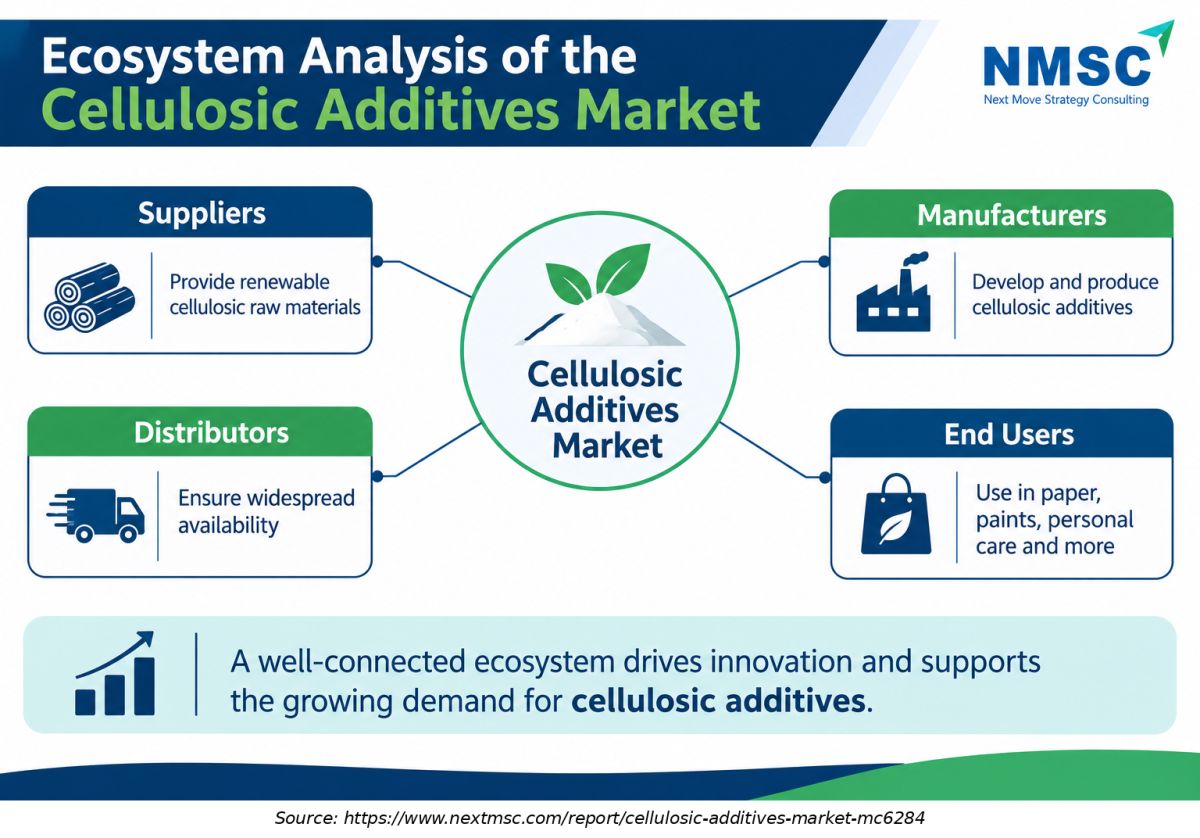
Ecosystem Analysis of the Cellulosic Additives Market

The Cellulosic Additives Market ecosystem connects raw material suppliers, manufacturers, distributors, and end users across the value chain. These stakeholders support the development, distribution and application of cellulosic additives across construction, pharmaceuticals, food and beverages, paints and coatings, personal care and industrial applications.

What Does the Cellulosic Additives Market Encompass?

The Cellulosic Additives Market covers water soluble polymers made by chemically modifying purified cellulose from wood pulp, cotton linters and other plant sources. The product family encompasses methylcellulose, HPMC, hydroxyethyl cellulose, carboxymethyl cellulose, and hydroxypropyl cellulose. Additionally, it includes water-insoluble specialized derivatives such as ethyl cellulose. These additives work as thickeners, binders, film formers, water retention agents and stabilisers across construction, pharmaceuticals, food, paints, personal care and energy. This market report excludes cellulose fibers, cellulose acetate tow and nitrocellulose.

During our market evaluation, we noticed that producers are shifting capacity from commodity industrial grades toward pharmaceutical and food grades. Ashland disclosed carboxymethyl cellulose and methylcellulose portfolio optimization actions in fiscal 2025, while Shin-Etsu announced a ¥10 billion investment in pharmaceutical cellulose. Regulatory frameworks focus heavily on pharmacopoeia monographs, food additive approvals, and nitrosamine limits in excipients. Based on market observations, these strict compliance requirements raise qualification costs, thereby favoring established suppliers with audited quality systems.

Market Drivers & Dynamics

Interactive Dataset
Pharmaceutical excipient demand driver +0.9% North America, Europe, Asia-Pacific 2026 to 2035
Dry mix mortar and tile adhesive consumption driver +0.8% Asia-Pacific, Middle East & Africa 2026–2033
Clean label food texturisers driver +0.6% North America, Europe 2026–2032
Capacity upgrades for pharma and food grades driver +0.5% Japan, Germany, South Korea 2026–2029
Wood pulp and propylene oxide cost volatility restraint −0.7% Global 2026–2030
Export price competition from Asian producers restraint −0.6% Asia-Pacific, export markets 2026–2031
Soft housing starts in mature economies restraint −0.4% Europe, North America 2026–2028
Nitrosamine and excipient compliance costs restraint −0.3% Global pharmaceutical supply chains 2026–2030
Source: Next Move Strategy Consulting

Growth Drivers

What Is the Primary Growth Driver in the Cellulosic Additives Industry?

Pharmaceutical demand is the primary driver of the Cellulosic Additives Market. According to Ashland's fiscal 2025 Form 10-K, cellulosics accounted for 43% of the company's Life Sciences sales and 39% of its total consolidated sales. These figures represent Ashland's internal sales mix rather than its share of the global Cellulosic Additives Market. We found that pharmaceutical and nutraceutical applications grow at 7.0% CAGR from 2026 to 2035 in our industry derived estimate, the fastest of any application, because excipient grades carry higher margins and longer qualification cycles.

How Is Construction Demand for Dry Mix Mortar Driving Market Growth?

Construction and building materials account for approximately 35% of 2026 revenue in our industry derived estimate. Cellulose ethers improve water retention, adhesion and workability in cement and gypsum-based mortars, and Nouryon markets Bermocoll grades for this purpose. During our market evaluation, we noticed that urban housing programmes in India, Saudi Arabia and Indonesia are adding tile adhesive and gypsum board joint compound volumes that keep this application growing at 4.7% CAGR through 2035.

Growth Inhibitors

What Is Restraining the Cellulosic Additives Market?

Competitive intensity and uneven construction demand are the main restraints on the Cellulosic Additives Market. Ashland reported Q4 FY2025 Specialty Additives sales of USD 131 million, marking a 9% decline due to softer demand in China and North America. In response to export market price competition, the company announced a hydroxyethyl cellulose network consolidation. Our assessment indicates that wood pulp and propylene oxide cost swings, an industry derived estimate, further compress margins for commodity grades.

Segmentation Analysis

2025 (USD Billion)
2035 (USD Billion)
Methylcellulose and hydroxypropyl methylcellulose 2025: $2.60 Billion | 2035: $4.52 Billion
Methylcellul
Carboxymethyl cellulose 2025: $1.80 Billion | 2035: $2.78 Billion
Carboxymethy
Hydroxyethyl cellulose and derivatives 2025: $1.20 Billion | 2035: $1.98 Billion
Hydroxyethyl
Other cellulose derivatives 2025: $0.60 Billion | 2035: $0.82 Billion
Other cellul
Methylcellulose and hydroxypropyl methylcellulose $2.60 Billion $4.52 Billion 5.7%
Carboxymethyl cellulose $1.80 Billion $2.78 Billion 4.4%
Hydroxyethyl cellulose and derivatives $1.20 Billion $1.98 Billion 5.1%
Other cellulose derivatives $0.60 Billion $0.82 Billion 3.2%

Which Product Type Leads the Cellulosic Additives Market?

J.M. Huber sold its carboxymethyl cellulose business to Nouryon in 2020, significantly expanding Nouryon's global cellulose additives portfolio. Based on our industry analysis, we concluded that extensive application breadth across tablet coatings, tile adhesives, and food texturizers solidifies segment leadership. Carboxymethyl cellulose follows at USD 1.88 Billion in 2026, supported by food, detergent and oil field demand, while the smallest group grows at 3.2%.

2025 (USD Billion)
2035 (USD Billion)
Construction
Pharmaceutic
Food and bev
Paints and c
Personal car
Segment Item 2025 (USD Billion) 2035 (USD Billion) CAGR
Construction and building materials $10.0 USD Billion $40.0 USD Billion 25.0%
Pharmaceuticals and nutraceuticals $17.1 USD Billion $51.1 USD Billion 11.0%
Food and beverages $24.2 USD Billion $62.2 USD Billion 25.0%
Paints and coatings $31.3 USD Billion $73.3 USD Billion 11.0%
Personal care and household $38.4 USD Billion $84.4 USD Billion 16.0%

Segment-wise data is locked

Unlock complete segment-wise numbers for By Application.

Unlock Full Data
2025 (USD Billion)
2035 (USD Billion)
Wood pulp
Cotton linte
Other non-wo
Segment Item 2025 (USD Billion) 2035 (USD Billion) CAGR
Wood pulp $10.0 USD Billion $40.0 USD Billion 27.0%
Cotton linters $17.1 USD Billion $51.1 USD Billion 9.0%
Other non-wood sources $24.2 USD Billion $62.2 USD Billion 19.0%

Segment-wise data is locked

Unlock complete segment-wise numbers for By Cellulose source.

Unlock Full Data

Growth Opportunities

We observed that three whitespace opportunities are positioned to add disproportionate revenue over the forecast period.

Can Specialty Pharmaceutical Excipient Grades Command Premium Pricing?

Producers qualifying low-nitrite and enteric-coating excipient grades are well-positioned to achieve strong product differentiation. This structural advantage stems from the rigorous qualification and audit requirements pharmaceutical customers demand prior to switching approved suppliers. Shin-Etsu's plan to double AQOAT capacity shows where leading suppliers are heading. The beneficiary is the pharmaceuticals and nutraceuticals segment, which we project to reach USD 2.35 Billion by 2035 from USD 1.28 Billion in 2026.

Can Emerging Construction Markets Expand Dry Mix Demand for Cellulose Ethers?

Mechanised plastering and tile fixing are replacing site mixed mortars in India, Southeast Asia and the Gulf, which lifts cellulose ether dosage per square metre. Tile adhesives, skim coats and adhesives and sealants formulations all depend on controlled water retention. The beneficiary is methylcellulose and hydroxypropyl methylcellulose, whose revenue we project at USD 4.52 Billion by 2035.

Will Regional Distribution Partnerships Unlock Underserved Latin American Demand?

Brazilian coatings and inks formulators gained access to Bermocoll cellulose ethers through Brenntag in 2026, which signals how distribution can open stranded demand. Similar agreements in Argentina, Chile and Colombia could convert import dependence into local technical support. The beneficiary is the paints and coatings segment, which grows at 3.7% CAGR from 2026 to 2035 and reaches USD 1.15 Billion in 2035.

Regional Outlook

2025 (USD Billion)
2035 (USD Billion)
North Americ
Europe
Asia-Pacific
Middle East
Latin Americ
Region 2025 (USD Billion) 2035 (USD Billion) CAGR (%)
North America $10.0 USD Billion $40.0 USD Billion 9.0%
Europe $17.1 USD Billion $51.1 USD Billion 27.0%
Asia-Pacific $24.2 USD Billion $62.2 USD Billion 25.0%
Middle East & Africa $31.3 USD Billion $73.3 USD Billion 23.0%
Latin America $38.4 USD Billion $84.4 USD Billion 12.0%

Regional data is locked

Unlock complete regional numbers for this market.

Unlock Full Data

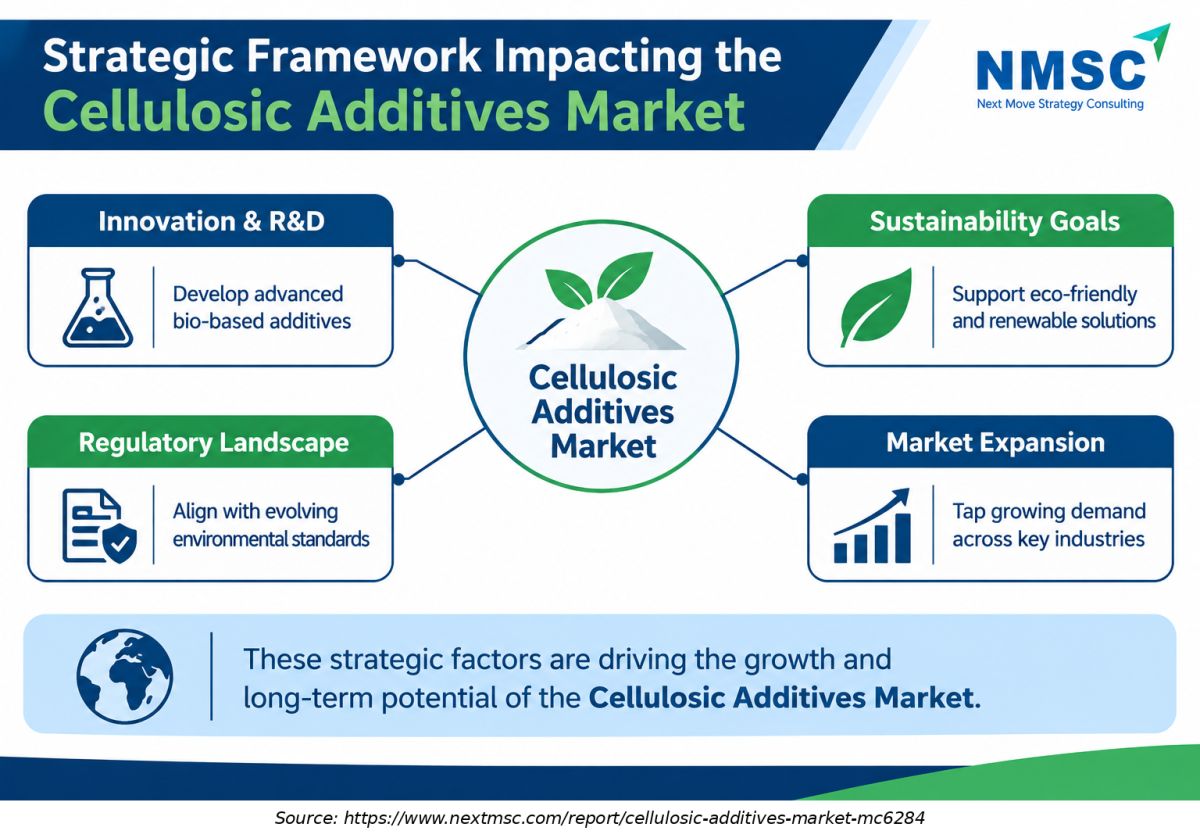
Strategic Framework Impacting the Cellulosic Additives Market

Strategic Framework Impacting the Cellulosic Additives Market

The Cellulosic Additives Market is shaped by key strategic factors, including innovation and R&D, sustainability initiatives, evolving environmental regulations, and market expansion. These factors encourage the development of advanced bio-based additives, promote environmentally friendly solutions, and support the growing adoption of cellulosic additives across diverse industries

Competitive Landscape

During our market evaluation, we noticed that supply is consolidated among a small set of integrated producers with deep cellulose chemistry expertise.

How Do Companies Compete in the Cellulosic Additives Industry?

We observed that competition rests on grade consistency, technical service and regulatory documentation rather than headline price. Shin-Etsu, through SE Tylose, advertises annual cellulose ether output of approximately 65,000 tons, giving scale in construction and pharmaceutical grades. Ashland, Nouryon and LOTTE Fine Chemical respond with application specific products and regional stock holding. Pricing power is strongest in excipient grades, while industrial grades face cost pressure and export competition.

What Innovation and Differentiation Strategies Are Companies Using?

Innovation targets niche performance gains. Nouryon introduced Bermocoll EHM MAX for architectural paints in March 2025, claiming reduced spatter, and earlier launched Bermocoll FLOW. Shin-Etsu is expanding L-HPC and AQOAT excipients, and LOTTE Fine Chemical completed a food and pharmaceutical cellulose plant expansion in 2022. Our analysis shows that geographic expansion through distributors, including Brazil and the DACH region, is the cheapest way to extend reach for specialty grades.

How Active Is M&A in the Cellulosic Additives Industry?

Portfolio reshaping matters more than large mergers. J.M. Huber announced the sale of its carboxymethyl cellulose business to Nouryon on January 30, 2020, and CP Kelco moved to Tate & Lyle in November 2024, leaving CP Kelco focused on pectin, gums and citrus fiber. Ashland pruned carboxymethyl cellulose and methylcellulose lines in fiscal 2025. We found that disposals of commodity lines and bolt on acquisitions of specialty capacity are likely to continue.

Competitive Dynamics and M&A Landscape

Recent strategic moves, partnerships, and acquisitions shaping the Cellulosic Additives Market Global Industry Analysis and Forecast (2026 to 2035).

January 30, 2020 J.M. Huber Acquisition J.M. Huber announced the sale of its carboxymethyl cellulose business to Nouryon on January 30, 2020, and CP Kelco moved to Tate & Lyle in November 2024, leaving CP Kelco focused on pectin, gums and citrus fiber.
November 2024 CP Kelco Acquisition J.M. Huber announced the sale of its carboxymethyl cellulose business to Nouryon on January 30, 2020, and CP Kelco moved to Tate & Lyle in November 2024, leaving CP Kelco focused on pectin, gums and citrus fiber.

Key Market Players

NMSC's analysis indicates that four producers with verifiable cellulosic additive operations anchor supply, listed here in ranked order based on disclosed capacity and segment scale.

Shin-Etsu Chemical Co., Ltd. Ashland Inc. Nouryon Holding B.V. LOTTE Fine Chemical Co., Ltd

Expert Insights

Guillermo Novo

Guillermo Novo

Chairman and CEO | Ashland

"“Sugarcane bagasse is a huge potential source of cellulose in the market.”"

Analyst Interpretation

The increasing focus on sustainable raw materials is encouraging manufacturers to explore alternative sources of cellulose beyond conventional wood pulp and cotton linters. Sugarcane bagasse offers an opportunity to utilize agricultural residues as feedstock for producing cellulosic materials. Such developments could support more resource-efficient manufacturing, reduce dependence on conventional raw materials and create opportunities for cost-competitive cellulose derivatives. The commercialization of waste-derived cellulose could also strengthen the sustainability positioning of cellulosic additives across industrial applications.

Investment Opportunities

Where Is Capital Flowing in the Cellulosic Additives Industry?

Capital inflows favour specialty and pharmaceutical capacity. Shin-Etsu allocated ¥10 billion to pharmaceutical cellulose and doubled AQOAT capacity plans, LOTTE Fine Chemical completed food and pharmaceutical expansions, and SE Tylose is spending approximately EUR 13 million on a distillation plant. During our market evaluation, we noticed that investors prefer assets with qualified excipient grades because they offer longer contracts and higher margins than industrial cellulose ethers.

Which Infrastructure Investments Support Market Expansion?

Infrastructure spending focuses on storage, second source production and regional logistics. Shin-Etsu doubled pharmaceutical cellulose storage at Naoetsu and is building a dual base for L-HPC in Germany, while Nouryon and distributors extend stock points in Brazil and the DACH region. We found that resilient supply chains and nearby warehouses reduce qualification risk for formulators and let suppliers win longer term agreements.

How Do ESG Considerations Influence Cellulosic Additive Investment?

Cellulose-derived additives are produced from renewable plant-based feedstocks, which may support sustainability objectives when responsible sourcing and resource-efficient manufacturing practices are implemented. Nouryon describes Bermocoll as made by a solvent free process with a low carbon footprint, and SE Tylose is investing in distillation equipment to cut carbon dioxide emissions. Our analysis shows that responsible pulp sourcing, energy efficiency and wastewater control will increasingly shape procurement scoring and access to premium customers.

Key Benefits for Stakeholders

How Do Enterprise and Industry Leaders Benefit from This Report?

Producers and formulators gain a segmented view of a USD 6.51 Billion market in 2026 and a USD 10.10 Billion outlook for 2035. Our assessment indicates that the product, application and cellulose source forecasts help leaders prioritise grade mix, capacity timing and customer qualification. Regional and country level insights highlight where distribution and technical service investments are most likely to convert into sustained share gains.

How Do Investors and Financial Analysts Benefit from This Report?

Investors receive transparent assumptions on growth rates, segment mix and margin pressure. The 5.0% CAGR, the USD 3.59 Billion absolute opportunity and the segment level CAGR spread allow analysts to compare pharmaceutical, construction and food exposure. We found that the analysis of restraints, including competitive intensity and raw material swings, supports realistic downside scenarios for valuation and capital allocation decisions.

How Do Technology Vendors and Product Teams Benefit from This Report?

Product teams can align development roadmaps with demand signals such as low nitrite excipients, hydrophobically modified rheology grades and clean label food gums. The report links these innovations to application growth rates and named supplier initiatives. During our market evaluation, we noticed that this mapping helps vendors decide which grades to qualify, where to place regional stock and how to differentiate against synthetic alternatives.

Key Market Segments Evaluated

By Product type

  • Methylcellulose and hydroxypropyl methylcellulose
  • Carboxymethyl cellulose
  • Hydroxyethyl cellulose and derivatives
  • Other cellulose derivatives

By Application

  • Construction and building materials
  • Pharmaceuticals and nutraceuticals
  • Food and beverages
  • Paints and coatings
  • Personal care and household
  • Oil, gas and industrial uses

By Cellulose source

  • Wood pulp
  • Cotton linters
  • Other non-wood sources

By Region

  • North America 
    • U.S.
    • Canada
    • Mexico
  • Europe 
    • Germany
    • UK
    • France
    • Rest of Europe
  • Asia-Pacific 
    • China
    • India
    • Japan
    • South Korea
    • Australia
    • Rest of APAC
  • Middle East & Africa 
    • UAE
    • Saudi Arabia
    • South Africa
    • Rest of MEA
  • Latin America 
    • Brazil
    • Argentina
    • Rest of LATAM

Conclusion & Recommendations

The long-term outlook is steady and quality led. The market rises from USD 6.51 Billion in 2026 to USD 10.10 Billion in 2035, and Asia-Pacific retains leadership while Middle East & Africa grows fastest at 6.5%. Our findings suggest that mature volumes in Europe and North America will be offset by value gains from specialty grades and by new construction and food demand in emerging economies.

What Strategic Positioning Recommendations Does NMSC Offer?

We recommend that suppliers prioritise pharmaceutical, food and hydrophobically modified grades, secure audited quality systems and build regional stock points. Commodity producers should differentiate through service, cost discipline and selective exports. Formulators should dual source critical grades. NMSC's analysis indicates that partnerships with distributors and co development agreements with paint, mortar and excipient customers are the most efficient route to share gains.

What Is the Investment Attractiveness of the Cellulosic Additives Market?

Investment attractiveness is moderate to high for specialty capacity in the Cellulosic Additives Market. The incremental market revenue opportunity between 2026 and 2035 is USD 3.59 Billion, while the pharmaceutical segment's projected CAGR of 7.0% exceeds the overall market CAGR of 5.0%. Our assessment indicates that returns are best where qualification barriers protect pricing, whereas undifferentiated industrial capacity faces export competition and volatile pulp and propylene oxide costs.

What Are the Market Shifts and Key Risks in the Cellulosic Additives Market?

Key shifts include pharmaceutical capacity expansion, portfolio pruning of commodity lines and distribution localisation. Main risks are weaker housing demand, feedstock cost spikes, Chinese export competition and nitrosamine related compliance costs. We found that Ashland's reported decline in Specialty Additives sales, tied to softer demand in China and North America, illustrates how quickly industrial demand can swing.

What Are the Primary Growth Pathways Through 2035?

Growth pathways include premium excipient grades, dry mix mortar adoption in India, Southeast Asia and the Gulf, clean label food gums and hydrophobically modified coatings additives. Regional distribution agreements extend reach into Latin America and Europe. Our analysis shows that suppliers combining these pathways with transparent sustainability credentials are best positioned to capture the projected USD 3.59 Billion expansion by 2035.

Delivered Customizations

We have successfully delivered the following deep-dive customizations:

Client Request Customization Delivered Value Adds
Country-Level Trade Flow Assessment
  • Country-wise import and export analysis for cellulose ethers and cellulose derivatives under HS 3912 for cellulosic additives.
  • Identifies major supplying and importing countries, supporting sourcing, localization, and trade-route decisions.
Historical Market Growth Analysis
  • Historical revenue and volume analysis of cellulosic additives across product types, applications, and cellulose sources.
  • Highlights which product and application segments have grown fastest, guiding portfolio and investment priorities.
Company-Level Product Share Analysis
  • Company-level share analysis by cellulosic additive product type, such as cellulose ethers, microcrystalline cellulose, and nanocellulose.
  • Reveals competitive positioning and share concentration, supporting partnership, M&A, and product-focus decisions.
Feedstock Sourcing and Cost Exposure Mapping
  • Mapping of cellulose source options, including wood pulp, cotton linters, and agricultural residues, against producer feedstock dependence and cost structure.
  • Assesses raw-material cost risk and identifies viable alternative cellulose sources to protect margins and secure supply.
Construction Dry-Mix Demand Linkage
  • Quantification of cellulose ether demand in dry-mix mortars and tile adhesives, linked to national construction activity and building permit statistics.
  • Enables demand forecasting by region and grade, supporting capacity planning and construction-focused go-to-market strategy.
Regulated-Grade Market Access Assessment
  • Mapping of food, pharmaceutical, and personal-care grade approval status for cellulosic additives across key regulatory jurisdictions.
  • Shows which grades can enter regulated end uses and where approval gaps create entry or certification opportunities.

FAQs

Sources & References

1.

Ashland Inc., Form 10-K for fiscal year ended September 30, 2025 (U.S. Securities and Exchange Commission)

sec.gov
2.

Ashland Inc., fourth quarter and fiscal 2025 results release, November 4, 2025

investor.ashland.com/node/36896/pdf
3.

Nouryon, Bermocoll EHM MAX at the European Coatings Show 2025

nouryon.com
4.

Nouryon, cellulose ethers portfolio (Bermocoll and Akucell)

celluloseethers.nouryon.com
5.

J.M. Huber, announcement of sale of carboxymethyl cellulose business to Nouryon (CP Kelco news archive)

cpkelco.com
6.

Tate & Lyle, completion of the combination with CP Kelco

tateandlyle.com

About the Author

Mayurima Roy

Mayurima Roy

Mayurima Roy is Research Analyst at Next Move Strategy Consulting, where she has spent 4 years working across the firm's full industry coverage rather than a single fixed vertical. Her work centers on structured research, ongoing trend tracking, competitive assessment, and insight-led content development, translating complex market data into clear, decision-ready narratives that support informed client decision-making across diverse global industries, market sectors, and world regions every day.

About the Reviewer

Supradip Baul

Supradip Baul

Supradip Baul is an accomplished business consultant and strategist with over a decade of rich experience in market intelligence, strategy, technology, and business transformation. His work has included rigorous qualitative and quantitative analysis across multiple industries, helping clients shape investment decisions and long-term roadmaps. Earlier in his career, he was associated with Gartner, where he contributed to industry-leading reports and market share analyses. He has worked with leading global companies and holds an MBA with a dual specialization in Marketing and Finance.

Download Free Sample

Nishant Awate

NISHANT AWATE

Business Development Global Sales

Zehnder Group Deutschland GmbH

Our experience working with Next Move Strategy Consulting was positive. The team was responsive, professional, and open to incorporating our specific requirements throughout the project. The India AHU market study was comprehensive and well structured, covering market value and volume forecasts, product and application segments, and key industry trends. The inclusion of both AHU and residential MVHR market insights made the study particularly relevant for our strategic market assessment. Overall, the report provides a solid foundation for evaluating market potential, identifying priority segments, and supporting business-development decisions in India.

Diana Trejo

DIANA TREJO

Assistant Manager

Sumitomo Corporation de Mexico, S.A. de C.V.

Recently, we purchased a report on the Mexico Data Center Market from Next Move Strategy Consulting. The service has been excellent, with support that is always timely and thoroughly professional. The information provided is interesting, highly useful, and delivered with clarity. I would highly recommend NextMSC for anyone seeking insightful and dependable analysis.

Mohit Agarwal

MOHIT AGARWAL

Chief Manager

DryChem India Pvt. Ltd.

Next Move Strategy Consulting is an amazing team of consultants. We required a market study report for our investors on top priority and the team went above and beyond our expectations to deliver the same with ample supporting data within a short time span enabling us to secure the investments and keep our project timeline maintained. Their professionalism, attention to detail, and timely delivery of actionable recommendations have left a lasting impression on our organization.

Robert Sean Trevino

ROBERT SEAN TREVINO

Sr. Director, Head of Strategic Insights & Analytics

Foundation Medicine

I realized that it was a reliable source of information. These days, there are many people who are looking for authentic data, and this is one of the only sources that can offer them with what they need;

Ross J Mckenzie

ROSS J MCKENZIE

Business Insight Manager

Staysure Group

“Next MSC have been incredibly helpful in providing detailed & robust information on our market, alongside quantifying growth by different segments. The process to procure was simple and easy, with sample reports and regular contact to ensure we had what we needed. Succinct detail on their sources & methodologies is also greatly received, allowing transparency in this respect helps build trust in the detail you pay for. Joseph in particular was fantastic, and helped ensure efficient provision of the insight pack – thank you NMSC!”.

Custom Market Research Services

We will customize the research for you if the listed report does not fully match your requirements.

Get 30% Free Customization

Select License

This website uses cookies to ensure you get the best experience on our website. Learn more

✖