Soil Stabilizer Additives Market Global Industry Analysis and Forecast (2026–2035)

The global Soil Stabilizer Additives Industry size was valued at USD 8.60 billion in 2025 and is estimated at USD 9.15 billion in 2026, forecast to reach USD 16.54 billion by 2035, expanding at a 6.8% CAGR from 2026 to 2035. Key drivers include increasing investment in road construction and rehabilitation and growing adoption of full-depth reclamation, with Asia-Pacific leading the global market.

Download Free Sample PDF
Base Year (2025)
$8.60 Billion
Forecast (2035)
$16.54 Billion
CAGR (2026-2035)
6.8%
Top Region
Asia-Pacific

What Is the Soil Stabilizer Additives Market Size?

The global soil stabilizer additives industry size was valued at USD 8.60 billion in 2025 and is estimated at USD 9.15 billion in 2026, forecast to reach USD 16.54 billion by 2035, expanding at a 6.8% CAGR between 2026 and 2035. Asia-Pacific leads with approximately 34% share, while Traditional Stabilizers dominate all other types with approximately 78% share.

We observed that growth is broad-based across every segmentation axis, with non-traditional polymer and enzyme stabilizers and expanding highway rehabilitation programs driving the dominant structural shifts through 2035.

Soil Stabilizer Additives Market Global Industry Analysis and Forecast (2026–2035) Revenue Forecast

Values in USD Billion

2025 $8.60 Billion
2025
2026 $9.18 Billion
2026
2027 $9.81 Billion
2027
2028 $10.48 Billion
2028
2029 $11.19 Billion
2029
2030 $11.95 Billion
2030
2031 $12.76 Billion
2031
2032 $13.63 Billion
2032
2033 $14.56 Billion
2033
2034 $15.55 Billion
2034
2035 $16.54 Billion
2035

Key Takeaways

By Type: Traditional Stabilizers held the largest share of approximately 78% (USD 6.71 billion) in 2025; Non-Traditional Stabilizers is the fastest-growing type at 10.1% CAGR from 2026–2035.

By Application: Road Construction held the largest share of approximately 46% (USD 3.96 billion) in 2025; Airport and Runway Construction is the fastest-growing application at 7.9% CAGR from 2026–2035.

By End Use: Highways and Roadways held the largest share of approximately 44% (USD 3.78 billion) in 2025; Agriculture and Land Management is the fastest-growing sub-segment at 8.4% CAGR from 2026–2035.

By Form: Powder and Granular held the largest share of approximately 63% (USD 5.42 billion) in 2025; Liquid is the fastest-growing form at 8.3% CAGR from 2026–2035.

Dominant Region: Asia-Pacific dominated with approximately 34% revenue share (USD 2.92 billion) in 2025.

Fastest-Growing Region: Latin America is expected to register the highest CAGR of 8.4% during 2026–2035.

Dominant Country: U.S. led with approximately USD 1.90 billion in 2025.

Fastest-Growing Country: India is the fastest-growing country at approximately 9.4% CAGR from 2026–2035.

Market Opportunity: The soil stabilizer additives market is expected to create an absolute dollar opportunity of USD 7.39 billion between 2026 and 2035, presenting significant investment potential across the lime, cement, and polymer stabilizer value chain.

According to NMSC analysis, highway agencies are increasingly specifying non-traditional polymer and enzyme stabilizers alongside conventional lime and cement binders to reduce hauling costs and reuse in-situ soils, a shift that favors vendors offering both traditional and non-traditional product portfolios over single-chemistry suppliers as infrastructure funding programs accelerate through 2035.

What Does the Soil Stabilizer Additives Market Encompass?

The soil stabilizer additives sector encompasses lime, cement, fly ash, slag, polymer, and enzyme-based chemical products that improve the strength, durability, and moisture resistance of weak or expansive soils for construction applications. Our assessment indicates that the scope spans traditional stabilizers used for highway subgrades and airport runways, and non-traditional stabilizers increasingly specified for mining haul roads and industrial yards, supplied to contractors, government transportation agencies, and industrial operators across road, rail, and building foundation end markets.
Regulatory frameworks such as national transportation agency pavement design guidance and government infrastructure funding programs shape specification and adoption of stabilizer chemistries, while industry associations including the National Lime Association continue to publish construction guidance that standardizes lime-based stabilization practices. We observed that technology adoption is shifting from single-chemistry treatments toward blended stabilizer systems that combine machine learning enabled mix-design optimization with traditional binders to reduce material waste. NMSC's analysis indicates that this structural shift, combined with growing government infrastructure investment, is redefining vendor selection criteria across the soil stabilizer additives market.

Market Drivers & Dynamics

Interactive Dataset
Expanding government highway and infrastructure investment programs driver +2.1% Global 2026–2035
Rising share of roads rated in poor or mediocre condition requiring rehabilitation driver +1.8% North America, Europe 2026–2035
Growing preference for full-depth reclamation over material haul-and-replace methods driver +1.4% Global 2026–2032
Expanding mining and haul road construction in resource-rich economies driver +1.2% Asia-Pacific, Latin America 2026–2035
Rising adoption of low-carbon and non-traditional stabilizer chemistries driver +1.1% Europe, North America 2027–2035
Growing airport and runway construction activity in emerging markets driver +0.9% Asia-Pacific, Middle East & Africa 2026–2035
Increasing beneficiation of fly ash and slag as supplementary stabilizer materials driver +0.7% Global 2026–2033
Rising energy and kiln fuel costs affecting lime and cement production economics restraint −1.3% Global 2026–2032
Conservative adoption practices among transportation agencies for new stabilizer chemistries restraint −0.9% Global 2026–2030
Carbon emission scrutiny affecting traditional lime and cement production restraint −0.6% Europe, North America 2026–2035
Source: Next Move Strategy Consulting

Growth Drivers

What Is the Primary Growth Driver of the Soil Stabilizer Additives industry?

Increasing investment in road construction and rehabilitation is a key growth driver for the soil stabilizer additives industry. Aging road infrastructure and the need to improve pavement performance are encouraging transportation agencies and contractors to adopt soil stabilization during new construction and rehabilitation projects. Lime, cement, and alternative stabilizers are increasingly used to improve the strength, moisture resistance, and load-bearing characteristics of weak or unsuitable soils. This growing focus on improving existing road foundations supports sustained demand for stabilization solutions across highway, municipal, and other transportation infrastructure projects.

How Is Full-Depth Reclamation Driving Soil Stabilizer Additives Industry’s Growth?

Full-depth reclamation is supporting the adoption of soil stabilizer additives by enabling contractors to rehabilitate existing pavement structures using materials already present at the project site. The process involves pulverizing existing pavement and underlying layers before mechanically and, where required, chemically treating the reclaimed material. Stabilizers such as cement, lime, and other additives can improve the engineering properties of the recycled material and support pavement reconstruction. Growing use of resource-efficient rehabilitation methods is creating additional opportunities for stabilizer suppliers across highway, road, and municipal infrastructure projects.

Growth Inhibitors

What Is Restraining Soil Stabilizer Additives Sector’s Expansion?

Volatility in energy and production costs can restrain the expansion of traditional lime- and cement-based soil stabilizer applications. Manufacturing these binders requires significant energy inputs, making producers sensitive to changes in fuel, electricity, transportation, and other operating costs. Higher production expenses can increase product prices and influence procurement decisions, particularly for projects operating under constrained construction budgets. Regional suppliers may face additional pressure when they have limited production scale or purchasing power. These cost considerations can encourage contractors and infrastructure agencies to evaluate alternative stabilization technologies and optimize material usage.

What Are the Growth Opportunities?

How Can Low-Carbon Binder Formulations Unlock Value for Highway Agencies?

Low-carbon binder formulations present a whitespace opportunity for producers serving highway agencies under growing decarbonization mandates. Vendors that commercialize reduced-emission lime and cement stabilizer blends stand to capture recurring specification wins as transportation agencies incorporate carbon intensity criteria into procurement decisions across regulated markets.

Where Do Emerging Market Highway Programs Create New Demand?

Emerging market highway and mining haul road programs represent an underpenetrated opportunity for stabilizer producers with scalable regional distribution. Producers that establish local blending and distribution capacity in Asia-Pacific and Latin America can secure long-term supply contracts tied to expanding national infrastructure investment pipelines.

How Can Full-Depth Reclamation Services Expand Producer Distribution Reach?

Full-depth reclamation service bundling creates an opportunity for stabilizer producers to extend beyond product sales into supply chain management partnerships with paving contractors and equipment providers. Early movers that combine stabilizer supply with reclamation project support can differentiate against commodity-only competitors serving transactional customers.

Segmentation Analysis

2025 (USD Billion)
2035 (USD Billion)
Traditional Stabilizers 2025: $6.71 Billion | 2035: $11.58 Billion
Traditional
Non-Traditional Stabilizers 2025: $1.89 Billion | 2035: $4.96 Billion
Non-Traditio
Traditional Stabilizers $6.71 Billion $11.58 Billion 5.6%
Non-Traditional Stabilizers $1.89 Billion $4.96 Billion 10.1%

Which Type Dominates the Soil Stabilizer Additives Market?

Traditional Stabilizers, encompassing lime, cement, fly ash, and slag, led the market with USD 6.71 billion in 2025, supported by long-established specification practices among transportation agencies. We observed that Non-Traditional Stabilizers is the fastest-growing type, expanding at a 10.1% CAGR from 2026 to 2035, as polymer and enzyme chemistries gain traction among contractors seeking lower-carbon alternatives to conventional binders.

2025 (USD Billion)
2035 (USD Billion)
Road Constru
Airport and
Railway Emba
Building Fou
Industrial Y
Segment Item 2025 (USD Billion) 2035 (USD Billion) CAGR
Road Construction $10.0 USD Billion $40.0 USD Billion 25.0%
Airport and Runway Construction $17.1 USD Billion $51.1 USD Billion 11.0%
Railway Embankments $24.2 USD Billion $62.2 USD Billion 25.0%
Building Foundations $31.3 USD Billion $73.3 USD Billion 11.0%
Industrial Yards and Parking Areas $38.4 USD Billion $84.4 USD Billion 16.0%

Segment-wise data is locked

Unlock complete segment-wise numbers for By Application.

Unlock Full Data

Which Application Leads Soil Stabilizer Additives Market Demand?

Road Construction remained the dominant application, reaching USD 3.96 billion in 2025 due to sustained highway rehabilitation and new road-building activity worldwide. Our findings suggest that Airport and Runway Construction is the fastest-growing application, registering an 7.9% CAGR from 2026 to 2035, as emerging market aviation infrastructure programs specify subgrade stabilization to support heavier aircraft loading requirements.
2025 (USD Billion)
2035 (USD Billion)
Highways and
Construction
Mining
Oil and Gas
Agriculture
Segment Item 2025 (USD Billion) 2035 (USD Billion) CAGR
Highways and Roadways $10.0 USD Billion $40.0 USD Billion 27.0%
Construction (Non-Road) $17.1 USD Billion $51.1 USD Billion 9.0%
Mining $24.2 USD Billion $62.2 USD Billion 19.0%
Oil and Gas $31.3 USD Billion $73.3 USD Billion 17.0%
Agriculture and Land Management $38.4 USD Billion $84.4 USD Billion 18.0%

Segment-wise data is locked

Unlock complete segment-wise numbers for By End Use.

Unlock Full Data

Which End Use Leads Soil Stabilizer Additives Market Adoption?

Highways and Roadways remained the leading end use, valued at USD 3.78 billion in 2025 on sustained rehabilitation spending across aging national road networks. We found that Agriculture and Land Management is the fastest-growing end use, registering an 8.4% CAGR from 2026 to 2035, as land management programs increasingly apply lime-based soil treatment to improve acidic and marginal farmland across expanding agricultural economies.

2025 (USD Billion)
2035 (USD Billion)
Powder and G
Liquid
Segment Item 2025 (USD Billion) 2035 (USD Billion) CAGR
Powder and Granular $10.0 USD Billion $40.0 USD Billion 14.0%
Liquid $17.1 USD Billion $51.1 USD Billion 24.0%

Segment-wise data is locked

Unlock complete segment-wise numbers for By Form.

Unlock Full Data

Which Form Leads Soil Stabilizer Additives Market Demand?

Powder and Granular remained the dominant form, reaching USD 5.42 billion in 2025 due to established handling, storage, and field-application practices among contractors and transportation agencies. We found that Liquid is the fastest-growing form, registering an 8.3% CAGR from 2026 to 2035, as liquid polymer and enzyme formulations gain preference for ease of application and reduced dust generation during in-situ soil treatment.

Growth Opportunities

Our analysis shows that three forward-looking opportunities stand out for stakeholders positioning within the soil stabilizer additives market over the 2026-2035 forecast period.

How Can Low-Carbon Binder Formulations Unlock Value for Highway Agencies?

Low-carbon binder formulations present a whitespace opportunity for producers serving highway agencies under growing decarbonization mandates. Vendors that commercialize reduced-emission lime and cement stabilizer blends stand to capture recurring specification wins as transportation agencies incorporate carbon intensity criteria into procurement decisions across regulated markets.

Where Do Emerging Market Highway Programs Create New Demand?

Emerging market highway and mining haul road programs represent an underpenetrated opportunity for stabilizer producers with scalable regional distribution. Producers that establish local blending and distribution capacity in Asia-Pacific and Latin America can secure long-term supply contracts tied to expanding national infrastructure investment pipelines.

How Can Full-Depth Reclamation Services Expand Producer Distribution Reach?

Full-depth reclamation service bundling creates an opportunity for stabilizer producers to extend beyond product sales into supply chain management partnerships with paving contractors and equipment providers. Early movers that combine stabilizer supply with reclamation project support can differentiate against commodity-only competitors serving transactional customers.

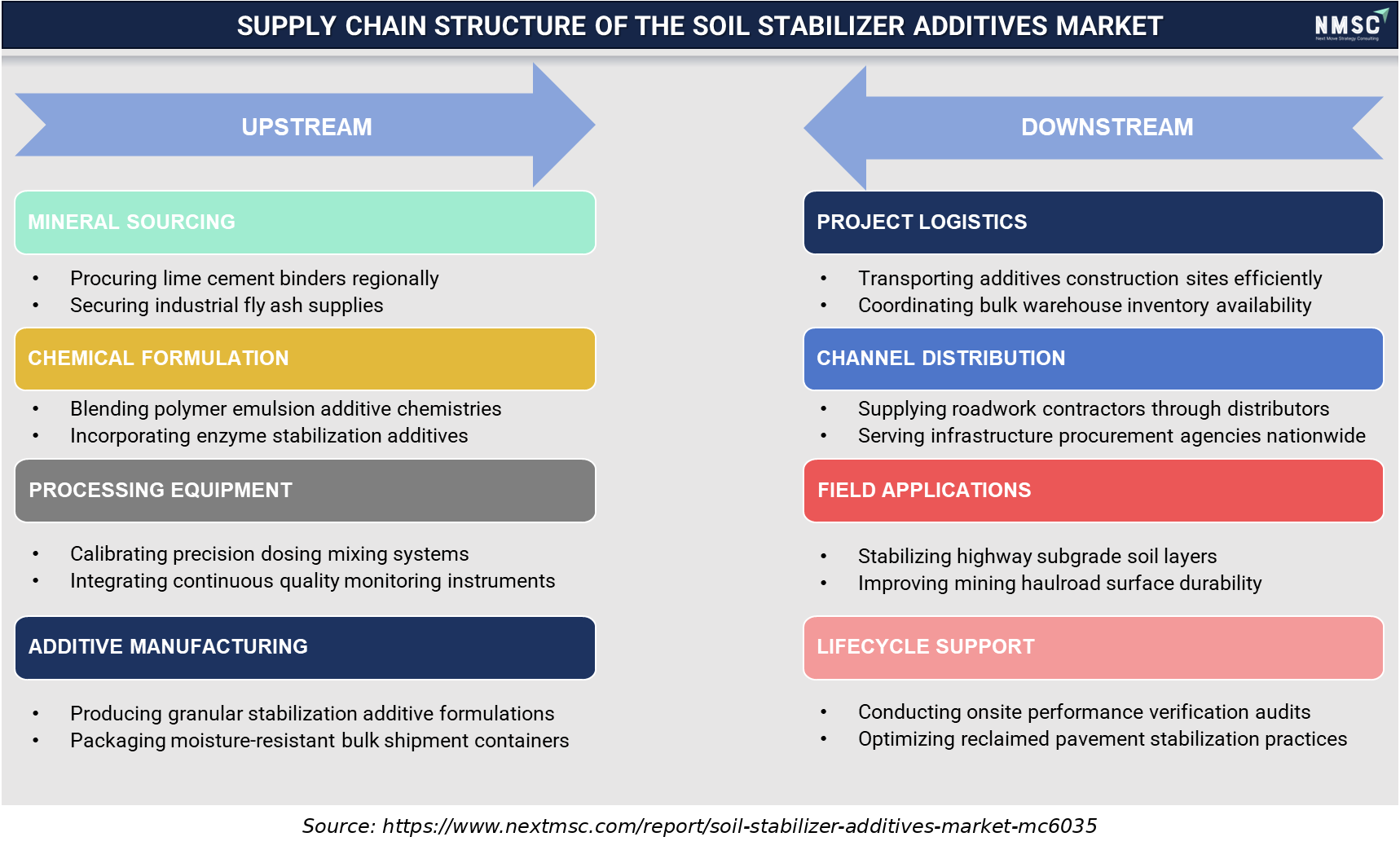
Supply Chain Structure of the Soil Stabilizer Additives Market

Supply Chain Structure of the Soil Stabilizer Additives Market
The soil stabilizer additives market supply chain spans mineral sourcing, chemical formulation, precision processing, additive manufacturing, logistics, distribution, field application, and lifecycle support. Regional sourcing of binders and industrial materials supports supply continuity, while advanced dosing, quality monitoring, and packaging improve consistency. Strong distributor networks and onsite performance verification further enhance project execution and product reliability.

Regional Outlook

2025 (USD Billion)
2035 (USD Billion)
Asia-Pacific
North Americ
Europe
Middle East
Latin Americ
Region 2025 (USD Billion) 2035 (USD Billion) CAGR (%)
Asia-Pacific $10.0 USD Billion $40.0 USD Billion 9.0%
North America $17.1 USD Billion $51.1 USD Billion 27.0%
Europe $24.2 USD Billion $62.2 USD Billion 25.0%
Middle East & Africa $31.3 USD Billion $73.3 USD Billion 23.0%
Latin America $38.4 USD Billion $84.4 USD Billion 12.0%

Regional data is locked

Unlock complete regional numbers for this market.

Unlock Full Data

Competitive Landscape

We observed that the soil stabilizer additives market features a moderately fragmented competitive landscape, with multinational lime and cement conglomerates competing alongside specialized polymer and enzyme stabilizer producers on chemistry performance, distribution reach, and project engineering support.

Dimension Description
Market Structure Moderately fragmented; multinational lime and cement producers account for a significant share of global revenue, while numerous regional and specialty chemical producers serve targeted chemistries and applications.
Innovation Focus Low-carbon binder formulations, polymer and enzyme chemistries, and fly ash beneficiation technology dominate current innovation pipelines across leading producers.
M&A Activity Selective consolidation through capacity expansion and distribution partnerships, exemplified by Graymont's continued kiln capacity investments to serve rising construction demand.

How Do Companies Compete in the Soil Stabilizer Additives Market?

Companies compete primarily on chemistry performance, distribution reach, and technical support across the industry. Multinational lime producers such as Lhoist and Carmeuse leverage extensive quarry networks and long-standing agency relationships to serve national highway programs, while specialized chemical producers such as Zydex Industries and Soilworks compete on formulation performance and rapid field-support for polymer and enzyme stabilizer applications.

Which Competitive Archetypes Dominate the Soil Stabilizer Additives Market?

Two archetypes dominate the market: multinational lime and cement conglomerates offering large-scale traditional stabilizer supply, and specialized chemical producers offering differentiated polymer and enzyme formulations. Holcim and CEMEX exemplify the conglomerate archetype through integrated cement and hydraulic binder production, while Midwest Industrial Supply and Zydex Industries exemplify the specialty archetype through proprietary chemistry and application engineering support.

How Are Companies Differentiating Through Innovation in Soil Stabilizer Additives?

Innovation and differentiation strategy increasingly center on low-carbon binder formulations and beneficiated supplementary materials. Carmeuse's low-carbon quicklime range and Charah Solutions' EnviroSource fly ash beneficiation technology both address growing decarbonization and material-availability requirements. Our analysis shows that producers unable to demonstrate reduced-emission or supply-chain resilience credentials risk exclusion from agency procurement shortlists in carbon-conscious markets.
What M&A and Capacity Activity Is Shaping the Soil Stabilizer Additives Market?

Capacity expansion and distribution investment continue to shape competitive positioning within the industry. Graymont's ongoing kiln upgrades across North American and Asia-Pacific facilities illustrate how established lime producers are investing to meet rising construction demand, while specialty chemical producers continue to expand international distribution networks to serve growing polymer and enzyme stabilizer adoption in emerging infrastructure markets.

Key Market Players

Our assessment indicates that the following 20 companies are actively shaping product innovation, capacity expansion, and go-to-market strategy within the global soil stabilizer additives market.

Lhoist S.A. Carmeuse Coordination Center S.A. Graymont Limited Mississippi Lime Company United States Lime & Minerals, Inc. Grupo Calidra, S.A.B. de C.V. Minerals Technologies Inc. Nordkalk Oy Ab Holcim Ltd. CEMEX, S.A.B. de C.V. Sika AG BASF SE SNF SAS Midwest Industrial Supply, Inc. Soilworks, LLC Environmental Products & Applications, Inc. Zydex Industries Private Limited Charah Solutions, LLC GeoCHEM, Inc. Soil Stabilization Products Company, Inc.

Latest Developments

We found that recent product launches, capacity investments, and regulatory developments within the soil stabilizer additives market are concentrated on low-carbon formulations and expanding infrastructure demand, reflecting the industry's steady capitalization cycle.

Date Event
July 2026 Graymont announced investment in a new hydrated lime production facility at its Traralgon plant, alongside plans to more than double quicklime production capability and establish a Melbourne logistics terminal. The expansion strengthens localized availability of calcium-based materials used in construction and soil-stabilization applications across Victoria.
November 2025 Sika’s November 2025 product documentation introduced Sika® Stabilizer-3121 TBM PH, an acrylic-based polymer designed to improve soil conditions during EPB tunnel excavation. The additive reduces problems associated with high water content, improves spoil compactness and supports more efficient excavation and material handling.
December 2025 Midwest Industrial Supply reported deployment of its Soil-Sement® polymer stabilization approach on a solar construction project covering more than 1,000 acres in southern New Mexico. The project faced inconsistent cement-stabilization results, leading to evaluation of polymer stabilization as an alternative for strengthening challenging native soils.
August 2025 Grupo UNACEM and Grupo Calidra began construction of CALCEM, a new lime-production company in Peru. The project involves a modern plant with initial capacity of 200,000 tonnes annually and a stated US$70 million investment, expanding regional lime availability for construction and other infrastructure-related applications.

Expert Insights

Steve Vitale

Steve Vitale

President | Midwest Industrial Supply

"Our eco-friendly, innovative dust control solutions and soil stabilization methods are promoting safer, healthier, and more efficient communities around the world."

Analyst Interpretation

The statement highlights the increasing emphasis on environmental performance within the soil stabilizer additives market. Demand is shifting toward solutions that combine effective soil stabilization and dust suppression with improved environmental and community outcomes. This trend is supporting the development and adoption of lower-impact additives and stabilization technologies across infrastructure, mining, construction, and other applications where soil performance and environmental management are both important considerations.

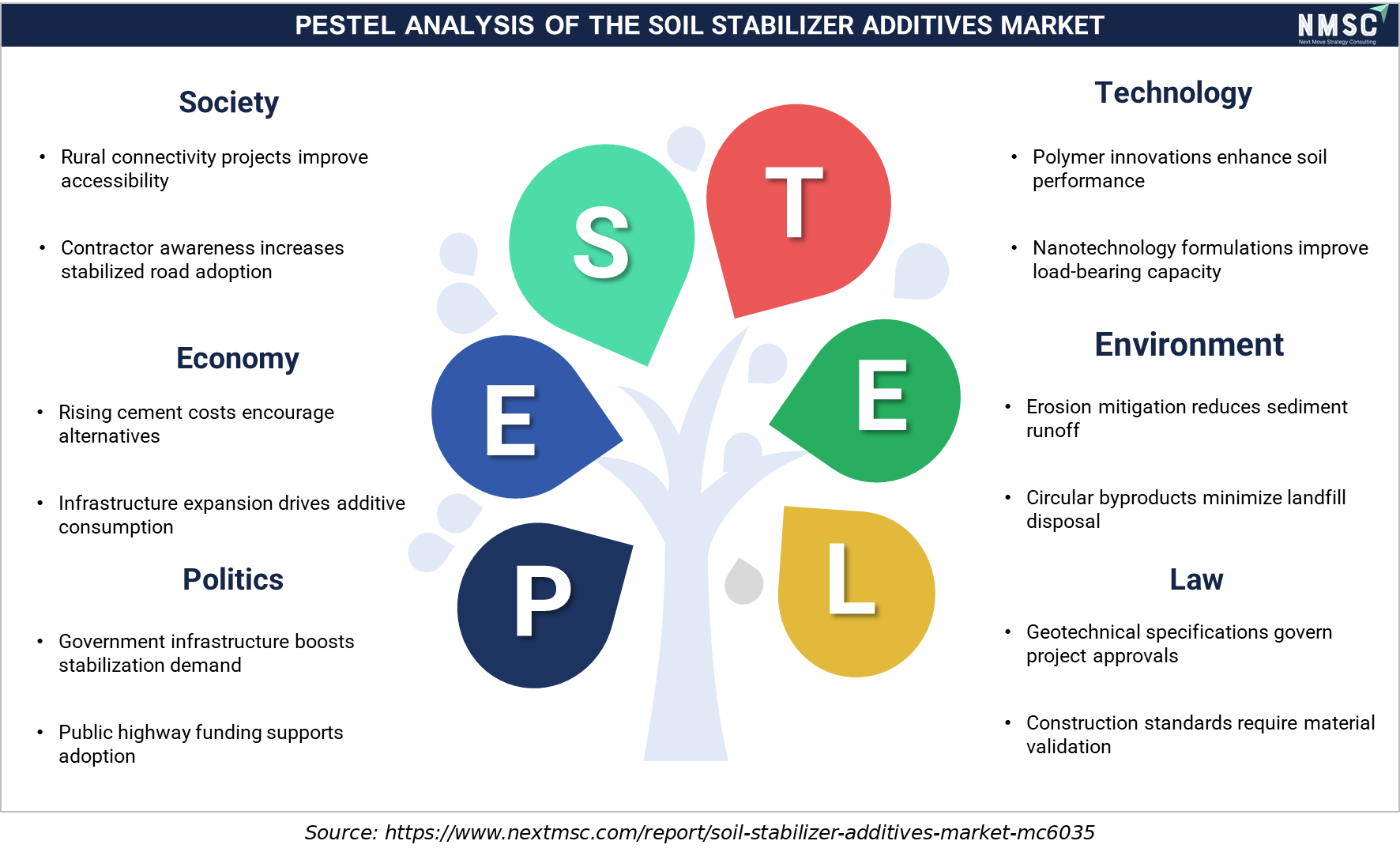
PESTEL Analysis of the Soil Stabilizer Additives Market

PESTEL Analysis of the Soil Stabilizer Additives Market
The PESTEL analysis highlights key external factors influencing the soil stabilizer additives market. Infrastructure investment and construction activity support demand, while formulation technologies and precision processing improve product performance. Environmental priorities encourage sustainable stabilization solutions and material efficiency. Regulatory requirements, quality standards, and evolving sustainability policies remain important considerations for manufacturers, contractors, and infrastructure stakeholders.

Investment Opportunities

What Capital Inflows Are Targeting the Soil Stabilizer Additives Market?

Capital inflows into the soil stabilizer additives market are increasingly directed toward kiln capacity expansion and low-carbon production technology. Established lime producers continue to fund modernization, as seen in Graymont's ongoing kiln upgrades across North American facilities. We observed that investors favor producers demonstrating both traditional-chemistry scale and non-traditional product diversification, viewing portfolio breadth as a proxy for long-term contract retention with transportation agencies.

How Is Infrastructure Investment Supporting Soil Stabilizer Additives Deployment?

Government infrastructure investment programs are directly expanding demand for stabilizer deployment across highway and airport rehabilitation projects. Our findings suggest that sustained federal and national funding commitments, addressing the multi-billion-dollar roadway funding gap identified in recent infrastructure assessments, are supporting multi-year procurement visibility for lime, cement, and polymer stabilizer suppliers.

What ESG Considerations Are Shaping Soil Stabilizer Additives Investment Decisions?

Environmental, social, and governance considerations are increasingly central to investment decisions across the industry, with carbon intensity and energy efficiency as key criteria. Producer sustainability commitments, including low-carbon quicklime product lines, continue to inform procurement evaluations. We found that investors increasingly favor producers with credible decarbonization roadmaps, treating emission-reduction progress as a governance indicator alongside production scale.

Key Benefits for Stakeholders

How Does This Report Benefit Enterprise and Industry Leaders?

Enterprise and industry leaders gain access to validated segmentation, competitive benchmarking, and regional demand forecasts that support vendor-selection and capacity-investment decisions across the soil stabilizer additives industry. Our analysis shows that detailed type, application, and end-use breakdowns help procurement teams align specifications with regulatory and sustainability requirements while identifying underserved industry segments for expansion.

How Does This Report Benefit Investors and Financial Analysts?

Investors and financial analysts benefit from consistent, single-point market size and CAGR estimates that support valuation and capital-allocation decisions across the soil stabilizer additives supply chain. We observed that the report's regional and segment-level growth differentials help identify which producers are best positioned to capture above-market growth in non-traditional stabilizer and Asia-Pacific categories through 2035.

How Does This Report Benefit Technology Vendors and Product Teams?

Technology vendors and product teams gain insight into emerging design requirements, including low-carbon binder formulations, polymer and enzyme chemistries, and fly ash beneficiation, that are reshaping the industry. Our findings suggest that this analysis helps R&D teams prioritize development roadmaps around blended stabilizer systems increasingly required by transportation agency specifications.

Key Market Segments Evaluated

By Type

  • Traditional Stabilizers
  • Non-Traditional Stabilizers

By Application

  • Road Construction
  • Building Foundations
  • Mining and Haul Roads
  • Industrial Yards and Parking Areas
  • Airport and Runway Construction
  • Railway Embankments
  • Other Applications

By End Use

  • Highways and Roadways
  • Construction (Non-Road)
  • Mining
  • Oil and Gas
  • Agriculture and Land Management
  • Other End Uses

By Form

  • Powder and Granular
  • Liquid

Conclusion & Recommendations

The long-term outlook for the market remains steadily positive, with global revenue projected to nearly double from USD 8.60 billion in 2025 to USD 16.54 billion by 2035 at a 6.8% CAGR. We observed that sustained infrastructure funding, rising highway rehabilitation backlogs, and growing non-traditional stabilizer adoption will continue underpinning demand across road, mining, and agricultural applications through the forecast period.

What Strategic Positioning Should Soil Stabilizer Additives Vendors Pursue?

Vendors should prioritize low-carbon binder formulations while pursuing broader distribution and technical support capabilities to secure long-term agency and contractor relationships. Our assessment indicates that vendors investing early in polymer and enzyme chemistry development will be best positioned to capture premium pricing within the soil stabilizer additives market.

How Attractive Is the Soil Stabilizer Additives Market for New Investment?

The soil stabilizer additives industry presents a steady investment case, supported by a USD 7.39 billion absolute dollar opportunity between 2026 and 2035 and above-average growth in Asia-Pacific and non-traditional stabilizer categories. We found that investment attractiveness is highest for producers combining traditional-chemistry scale with differentiated non-traditional product lines, positioning them to serve both established and emerging infrastructure markets simultaneously.

What Market Shifts and Key Risks Should Stakeholders Monitor?

Stakeholders should monitor energy cost volatility, carbon emission scrutiny, and conservative agency adoption practices as key risks to the soil stabilizer additives market. Our analysis shows that producers unable to demonstrate credible decarbonization progress risk losing specification wins to competitors with established low-carbon product lines, particularly within increasingly regulated European and North American markets.

What Are the Key Growth Pathways for the Soil Stabilizer Additives Market?

Key growth pathways include expanding low-carbon binder capability, scaling polymer and enzyme chemistry adoption for remote infrastructure projects, and deepening penetration into mining and agricultural land management channels. NMSC's analysis indicates that vendors pursuing these pathways while maintaining broad distribution networks will be best positioned to capture the soil stabilizer additives market's projected growth through 2035.

FAQs

About the Author

Mihul Sharma

Mihul Sharma

Mihul Sharma is Research Associate at Next Move Strategy Consulting, where he has covered technology, industrial, and healthcare markets for 3 years. His work applies structured business research, market analysis, and secondary-source review to assess market trends, competitive developments, and growth opportunities. He supports report development by fully synthesizing industry data, company information, and market signals into concise findings for strategy and investment-focused research teams.

About the Reviewer

Supradip Baul

Supradip Baul

Supradip Baul is an accomplished business consultant and strategist with over a decade of rich experience in market intelligence, strategy, technology, and business transformation. His work has included rigorous qualitative and quantitative analysis across multiple industries, helping clients shape investment decisions and long-term roadmaps. Earlier in his career, he was associated with Gartner, where he contributed to industry-leading reports and market share analyses. He has worked with leading global companies and holds an MBA with a dual specialization in Marketing and Finance.

Download Free Sample

Diana Trejo

DIANA TREJO

Assistant Manager

Sumitomo Corporation de Mexico, S.A. de C.V.

Recently, we purchased a report on the Mexico Data Center Market from Next Move Strategy Consulting. The service has been excellent, with support that is always timely and thoroughly professional. The information provided is interesting, highly useful, and delivered with clarity. I would highly recommend NextMSC for anyone seeking insightful and dependable analysis.

Melanie Samko

MELANIE SAMKO

Director of Marketing

TOSOH BIOSCIENCE, INC.

The information provided by NMSC is incredibly valuable, thank you so much for such a excellent work. I really appreciate it. I will make sure to reference all of it, in my summary document.

Gaurav Jaiswal

GAURAV JAISWAL

Founder & CEO

Yano Charge Private Limited

The EV Charging market research report provided by the NextMSC was exceptionally detailed and insightful. It offered a comprehensive analysis that proved to be a game-changer for our strategic planning. Truly a testament to the NextMSC’s expertise and thoroughness in EV market landscape & analysis.

Semih Kavaklioglu

SEMIH KAVAKLIOGLU

Co-Founder & Sales Manager

Decortie

I work a lot in the marketing industry and I know that research is an essential part of any campaign. I have used Market research reports for my own products and I found them to be very informative and well-researched. The team here produces insightful reports for a good price

Gustaf Hummel Burstrom

GUSTAF HUMMEL BURSTROM

Founder

Revline Tools AB

Joseph and the team at Next Move Strategy Consulting have been excellent to work with, in supplying us with relevant market data and forecasts for our specific category. We had some special requirements and they were able to do a custom package to suit our needs. We would definitely recommend them to any other company needing market data and forecasts

Custom Market Research Services

We will customize the research for you if the listed report does not fully match your requirements.

Get 30% Free Customization

Select License

This website uses cookies to ensure you get the best experience on our website. Learn more

✖