
Chile Fabric Care Market, By Product Type {Fabric Detergents (General Purpose, Baby Laundry Detergent, and Delicate Laundry Detergent), Fabric Softeners/Conditioners, and Others}, By Form (Liquid, Powder, Unit-Dose, Sheet & Wipe, and Spray), By Nature (Conventional and Eco-friendly / Organic), By Price Tier (Value, Mid-range, and Premium), By Distribution Channel (Online and Offline), and By End-User (Residential, Commercial, and Others) – Analysis & Forecast, 2025–2035
Industry: Retail and Consumer | Latest Edition: September 30, 2026 | No of Pages: 154 | No. of Tables: 49 | No. of Figures: 43 | Format: PDF | Report Code: RC5760
Chile Fabric Care Market Size & Forecast
|
Parameters |
Details |
|
Market Size in 2025 |
USD 1.66 Billion |
|
Market Size in 2026 |
USD 1.95 Billion |
|
Revenue Forecast in 2035 |
USD 3.95 Billion |
|
Growth Rate |
CAGR of 8.17% from 2026 to 2035 |
|
Analysis Period |
2025–2035 |
|
Base Year Considered |
2025 |
|
Forecast Period |
2026–2035 |
|
Market Size Estimation |
Billion (USD) |
|
Companies Profiled |
15 |
|
Market Share |
Available for 10 companies |
Industry Outlook
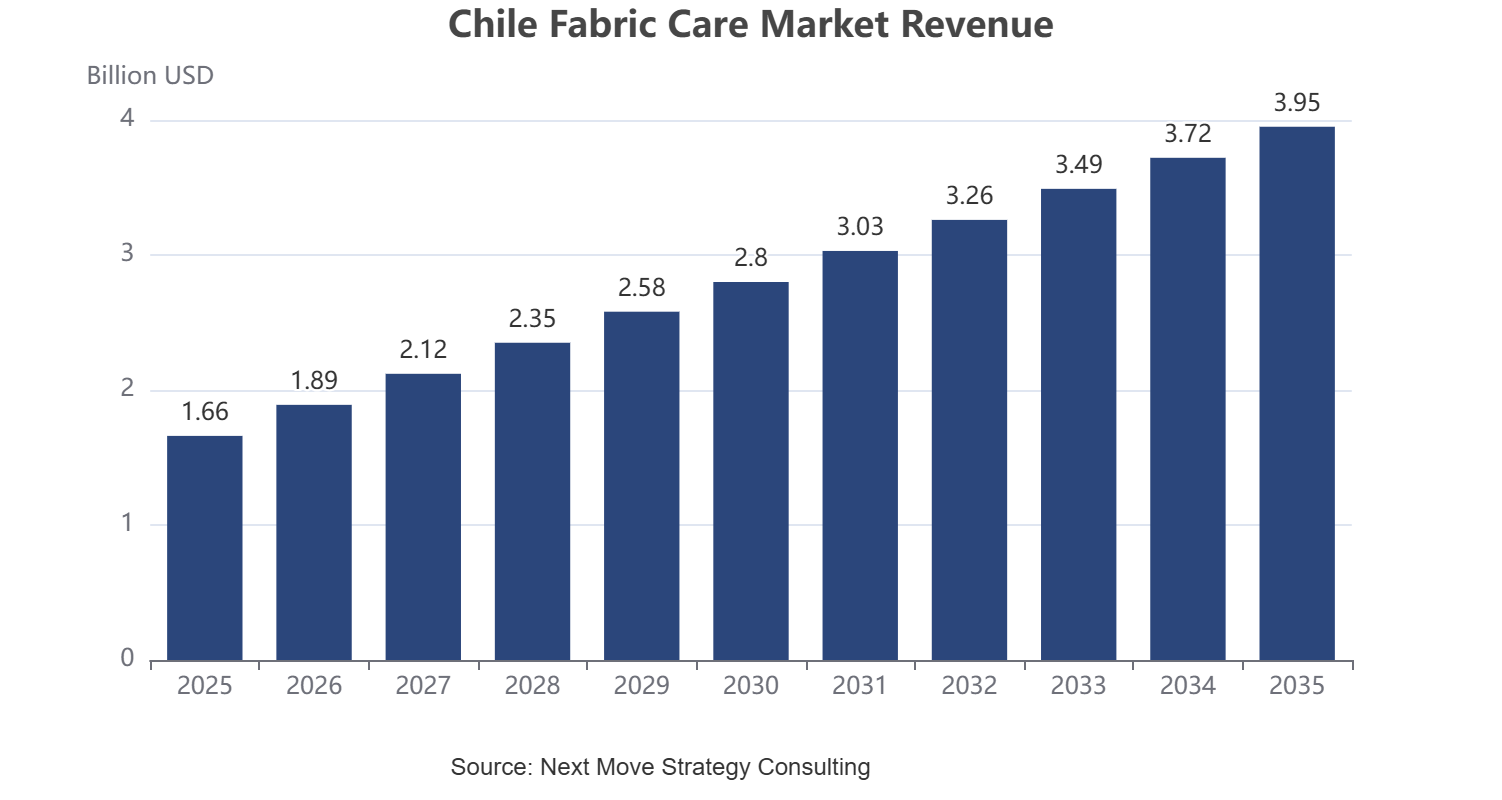
The Chile Fabric Care Market was valued at USD 1.66 billion in 2025 and is estimated at USD 1.95 billion in 2026, reflecting steady household consumption of detergents, softeners, and stain-care formats across urban and regional retail networks. The market is forecast to reach USD 3.95 billion by 2035, expanding at a CAGR of 8.17% between 2026 and 2035. Growth is underpinned by rising disposable income, premiumization toward eco-friendly and unit-dose formats, and the continued formalization of Chile's retail and e-commerce distribution infrastructure for household essentials.
Ecosystem Analysis of the Chile Fabric Care Market
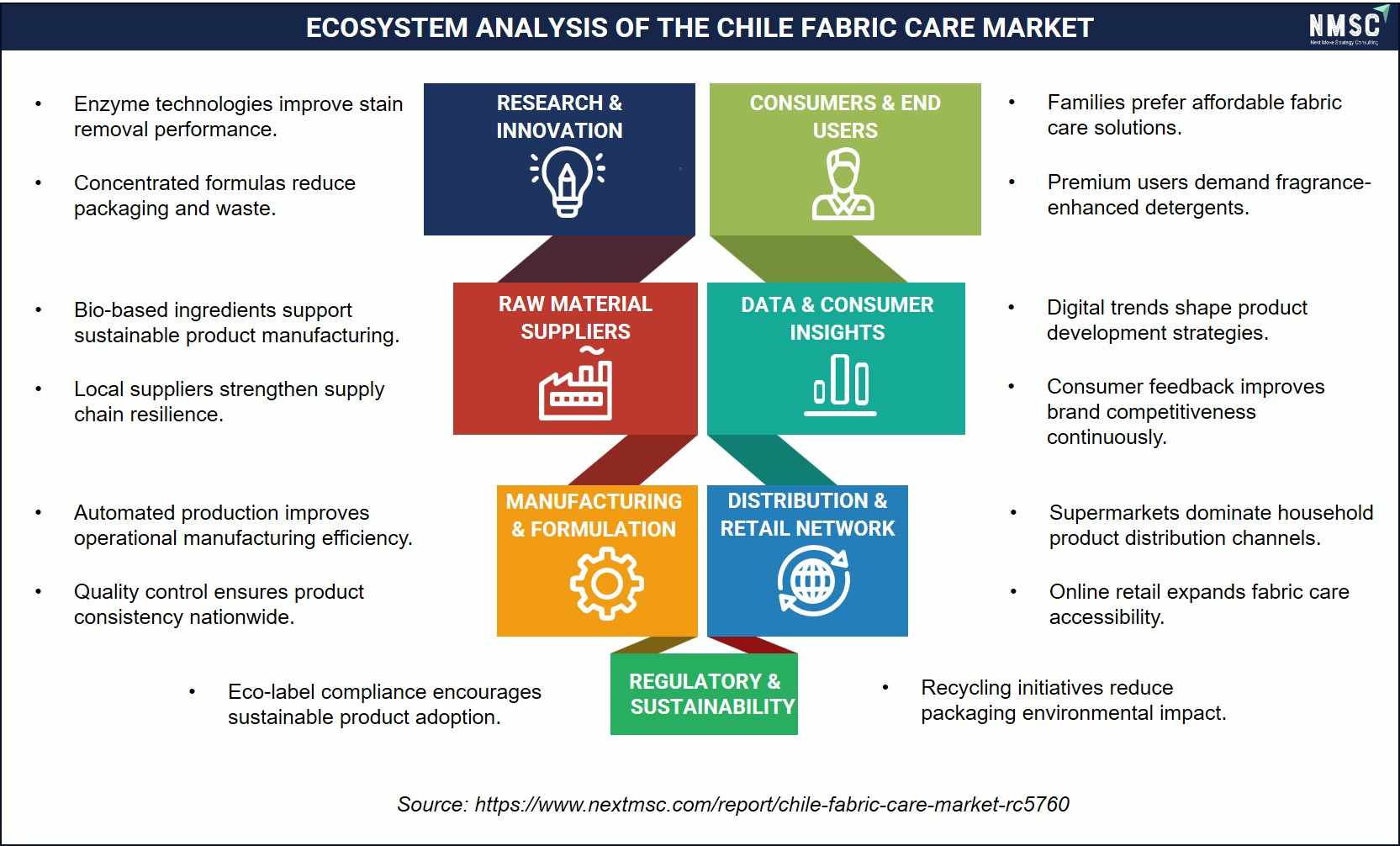
The above ecosystem analysis maps the key operational pillars, such as research and innovation, raw material suppliers, manufacturing and formulation, regulatory and sustainability, distribution and retail network, data and consumer insights, and consumers and end users, shaping the Chile fabric care market. From our analysis, we observed that research drives innovation in fabric care, while raw material suppliers ensure quality inputs. Manufacturing focuses on efficient formulation, whereas regulatory frameworks enforce sustainability standards. Distribution through retail networks expands market reach, while data insights guide strategic decisions. Finally, consumers comprise families preferring affordable solutions and premium users demanding fragrance-enhanced detergents.
What Are the Key Market Drivers, Restraints, and Opportunities Shaping the Chile Fabric Care Industry Through 2035?
Growth Catalyst & Risk Assessment Matrix
|
Drivers / Trends / Restraints |
(+/-) % Impact on CAGR Forecast |
Geographic Relevance |
Impact Timeline |
|
Expanding modern retail and quick-commerce penetration accelerating detergent and softener replenishment purchases nationwide |
+2.1% |
Santiago Metropolitan Region and major regional capitals |
Long term (4–7 years) |
|
Rising consumer shift toward liquid and unit-dose formats improving convenience and dosing accuracy |
+1.8% |
Nationwide, concentrated in urban households |
Medium to Long term (3–6 years) |
|
Growing demand for eco-friendly and hypoallergenic fabric care formulations among health-conscious households |
+1.6% |
Chile nationwide, led by higher-income urban segments |
Medium term (2–5 years) |
|
Private-label and value-tier detergent expansion by domestic manufacturers strengthening price competitiveness |
+1.2% |
Value-sensitive regional and semi-urban markets |
Short to Medium term (1–4 years) |
|
Raw material and packaging cost volatility compressing margins for mid-tier and premium brands |
–1.4% |
Nationwide, most pronounced among mid-sized local producers |
Short term (1–3 years) |
The Chile fabric care market is shaped by a combination of retail modernization, shifting consumer preferences, and cost-side pressures that together determine the pace of category growth through 2035. Expanding organized retail and e-commerce infrastructure is widening product access, while household demand is steadily migrating toward liquid, unit-dose, and eco-friendly formats. At the same time, raw material cost volatility and competitive pricing pressure from value-tier entrants continue to test manufacturer margins. Understanding these growth catalysts and risk factors together provides a clearer view of where near-term investment and innovation are most likely to concentrate.
Growth Drivers
How Is Modern Retail Expansion Driving Fabric Care Purchases in Chile?
Through our assessment, we found that Chile's expanding footprint of supermarkets, hypermarkets, and quick-commerce platforms is significantly widening consumer access to fabric care products across both metropolitan and regional markets. Retailers are dedicating greater shelf space to detergents, softeners, and stain-removal formats, while quick-commerce operators are shortening replenishment cycles for time-constrained urban households. This distribution expansion is lowering the barrier to trial for newer formats such as pods and eco-friendly variants, reinforcing category volume growth and giving established and emerging brands a broader route to reach price-sensitive and premium consumers alike.
How Is the Shift toward Liquid and Unit-Dose Formats Reshaping Demand?
We observed that Chilean households are increasingly favoring liquid detergents and unit-dose pods over traditional powder formats, driven by convenience, precise dosing, and reduced spillage during use. This shift is particularly visible among younger, urban consumers who prioritize time-saving laundry routines and are willing to pay a modest premium for ease of use. Manufacturers are responding by expanding liquid and pod production lines and increasing marketing investment behind these formats, which is gradually altering category economics and encouraging further premiumization across mid-tier and value price segments.
How Is Rising Demand for Eco-Friendly Formulations Supporting Category Growth?
Our assessment indicates that growing environmental awareness and sensitivity to skin allergies are pushing a meaningful share of Chilean consumers toward eco-friendly, biodegradable, and hypoallergenic fabric care products. Brands are responding with plant-based surfactants, reduced-plastic packaging, and dermatologically tested formulations aimed at health-conscious households and families with young children. While eco-friendly products currently command a smaller share of overall volume, their higher price realization and strong repeat-purchase behavior make this segment an increasingly important contributor to category revenue growth across premium retail and specialty channels.
Growth Inhibitor
How Are Raw Material Cost Pressures Limiting Margin Expansion?
In our assessment, sustained volatility in surfactant, packaging resin, and fragrance input costs is compressing margins for mid-sized and regional fabric care manufacturers that lack the purchasing scale of multinational players. Currency fluctuation further complicates cost planning for imported raw materials and specialty chemicals used in premium formulations. This pressure is prompting some manufacturers to delay reformulation and packaging upgrades or to pass costs onto consumers through smaller pack sizes, a trend that risks slowing category premiumization and constraining the pace at which eco-friendly and unit-dose innovations can scale profitably across price-sensitive market segments.
Growth Opportunity
How Does E-Commerce Expansion Create New Growth Avenues for Brands?
Chile's expanding online grocery and quick-commerce ecosystem presents a substantial opportunity for fabric care brands to reach consumers directly through subscription models, bundled promotions, and targeted digital marketing. Brand-owned e-commerce storefronts and marketplace partnerships allow manufacturers to introduce premium and eco-friendly variants without the shelf-space constraints of traditional retail, while capturing richer consumer data to refine product development. As digital penetration deepens across metropolitan and secondary cities, brands that invest early in direct-to-consumer capabilities are well positioned to capture a disproportionate share of incremental category growth through the remainder of the forecast period.
How Is the Chile Fabric Care Industry Segmented in This Report, and What Are the Key Insights from the Segmentation Analysis?
By Nature Insights
How Is Nature-Based Segmentation Shaping Consumer Preferences Across the Chile Fabric Care Market?
Based on nature, the Chile market is segmented into conventional and eco-friendly/organic products.
The market is evolving as consumers increasingly balance cleaning performance with growing environmental awareness in their fabric care purchasing decisions. In our observation, conventional products continue to serve a broad range of everyday laundry requirements due to their familiarity and widespread availability, while eco-friendly and organic alternatives are witnessing increasing interest among sustainability-conscious consumers seeking biodegradable ingredients, reduced chemical formulations, and environmentally responsible packaging, encouraging continued innovation across the fabric care landscape.
By End-User Insights
How Does End-User Segmentation Reflect Consumption Patterns Across the Chile Fabric Care Market?
Based on end-user, the Chile market is segmented into residential, commercial, and other end-users.
The market exhibits a diverse consumption structure, with demand patterns varying according to household and institutional laundry requirements. According to our analysis, we found that residential end-users drive consistent demand through routine home laundering and regular product replenishment, while commercial end-users, including hospitality, healthcare, and institutional facilities, require high-performance and bulk fabric care solutions for large-scale operations. Meanwhile, the other end-user segment caters to niche and specialized applications, further broadening the market's demand profile.
Key Segments
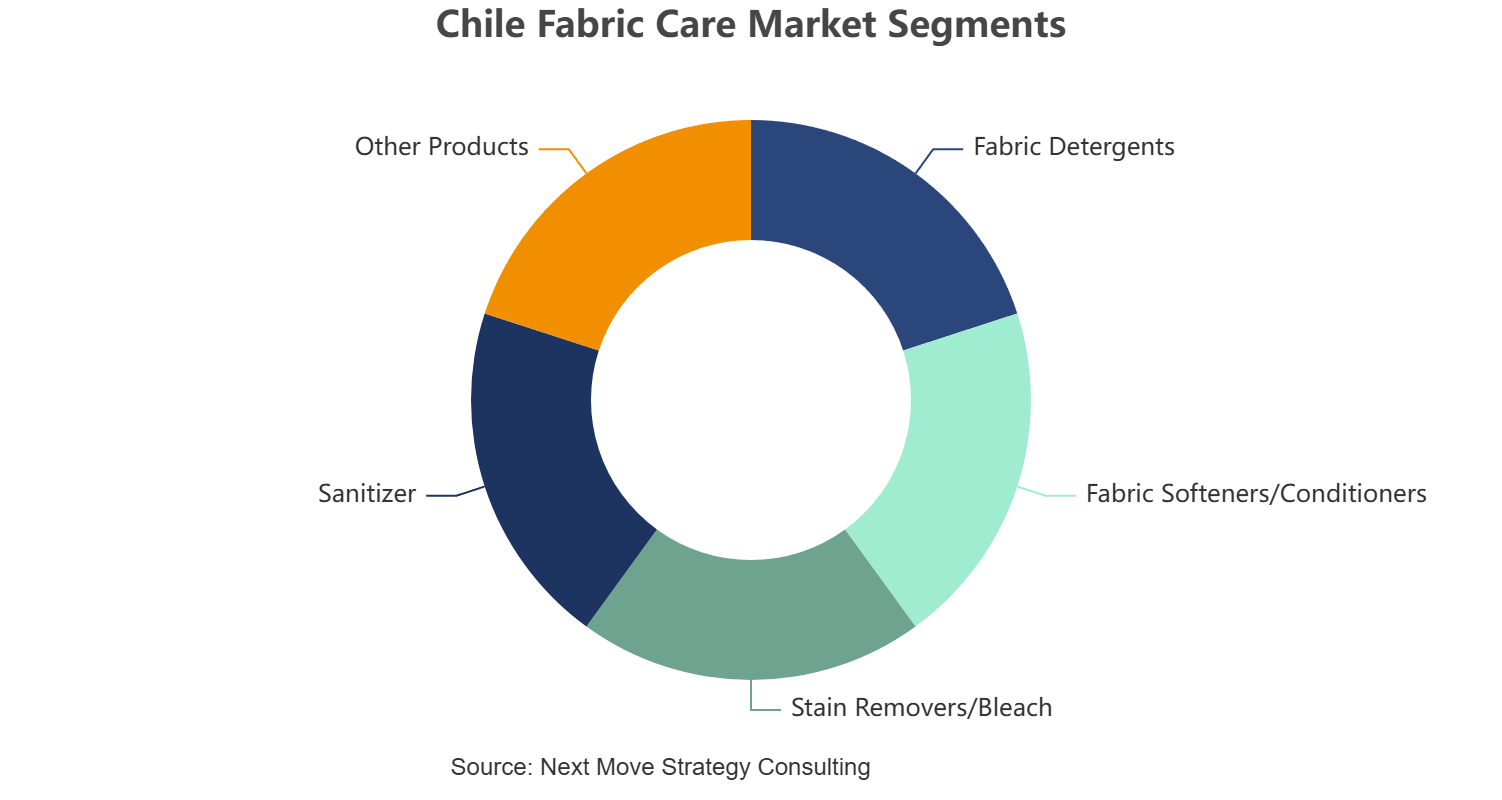
By Product Type
-
Fabric Detergents
-
General Purpose
-
Baby Laundry Detergent
-
Delicate Laundry Detergent
-
-
Fabric Softeners/Conditioners
-
Stain Removers/Bleach
-
Sanitizer
-
Other Products
By Form
-
Liquid
-
Powder
-
Unit-Dose
-
Pods
-
Sachets
-
-
Sheet & Wipe
-
Spray
By Nature
-
Conventional
-
Eco-friendly / Organic
By Price Tier
-
Value
-
Mid-range
-
Premium
By Distribution Channel
-
Online
-
Marketplaces
-
Brand E-com
-
Quick Commerce
-
-
Offline
-
Supermarkets
-
Hypermarkets
-
Department Stores
-
By End-User
-
Residential
-
Commercial
-
Others
Competitive Landscape
The competitive landscape of the Chile fabric care market is characterized by a mix of multinational consumer goods majors and established domestic manufacturers competing across value, mid-range, and premium price tiers. Multinational players leverage strong brand equity, extensive distribution networks, and continuous innovation in eco-friendly and unit-dose formats, while domestic manufacturers compete on price, regional distribution relationships, and localized formulations tailored to local water hardness and washing habits. Competitive intensity remains high in the mainstream detergent segment, prompting frequent promotional activity and pack-size innovation aimed at defending shelf space across retail channels.
Key Players of the Chile Fabric Care Market
-
Procter & Gamble Chile Ltda.
-
Biofrescura SpA
-
Laboratorio Ballerina Ltda.
-
Colgate-Palmolive Chile S.A.
-
Clorox Chile S.A.
-
Reckitt Benckiser Chile S.A.
-
Miguel Maritano Industria de Jabones S.A.
-
Spartan Chemical de Chile Ltda.
-
JJ Detergentes S.A.
-
Nobel SpA
-
Rinde Mas SpA
-
Henkel Chile Ltda.
-
Duoquimica SpA
-
KINCELL SpA
-
Indusmel Industrial Ltda.
Leading multinational participants, including Procter & Gamble Chile Ltda., Colgate-Palmolive Chile S.A., Clorox Chile S.A., Reckitt Benckiser Chile S.A., and Henkel Chile Ltda., continue to anchor category innovation and premium-format launches. Domestic and regional manufacturers such as Biofrescura SpA, Laboratorio Ballerina Ltda., Miguel Maritano Industria de Jabones S.A., Spartan Chemical de Chile Ltda., JJ Detergentes S.A., Nobel SpA, Rinde Mas SpA, Duoquimica SpA, KINCELL SpA, and Indusmel Industrial Ltda. compete strongly in value and mid-tier segments through localized production and distribution reach, sustaining a dynamic, moderately fragmented environment across Chile's fabric care retail landscape.
Price Point Analysis of the Chile Fabric Care Market
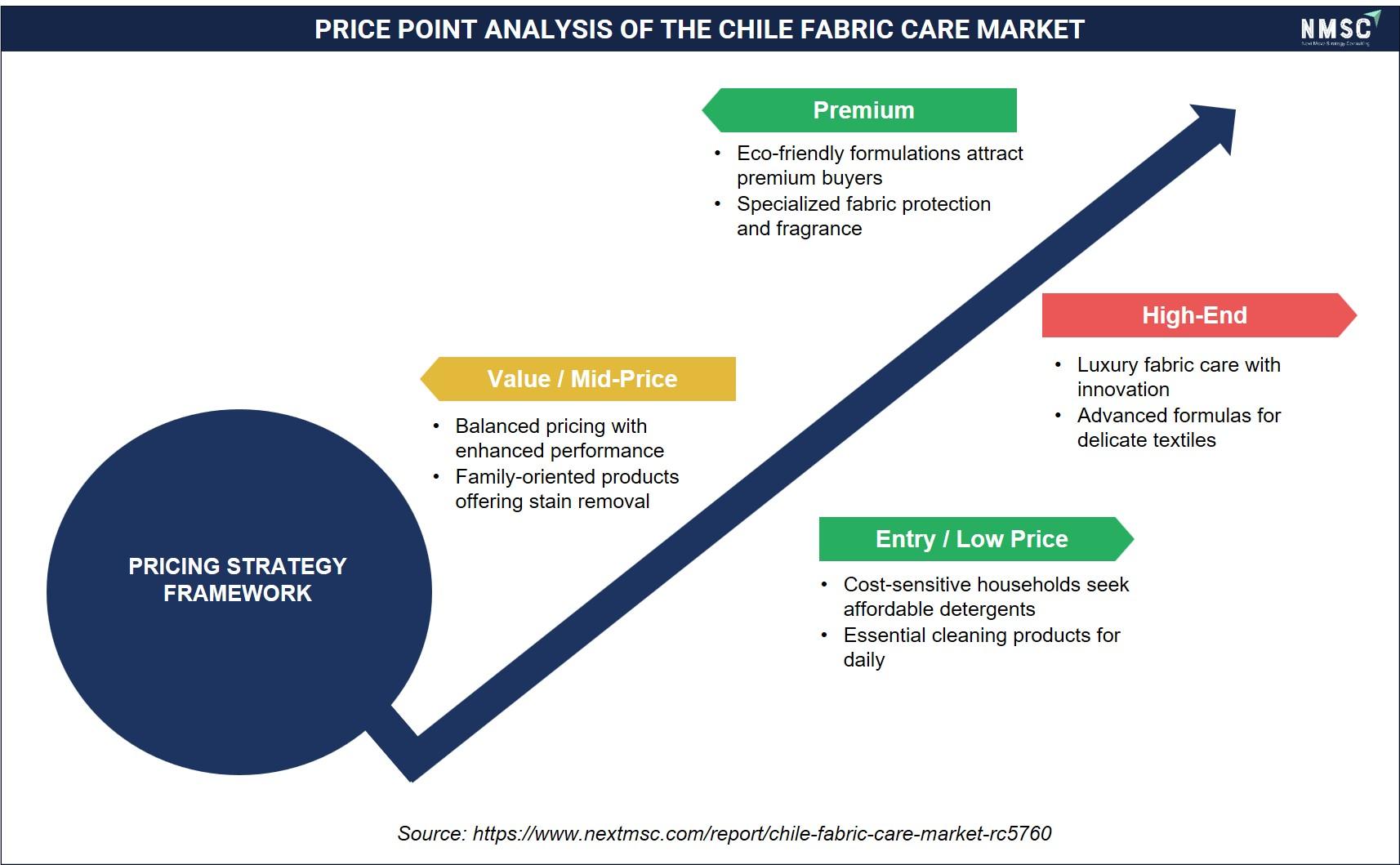
The above price point analysis maps the key pricing tiers, such as entry or low price, value or mid-price, premium, and high-end, shaping the Chile fabric care market. From our analysis, we observed that the value or mid-price segment captures the largest consumer base, as balanced pricing with enhanced performance and family-oriented stain removal remain top priorities for most households, while premium and high-end segments are steadily gaining traction among consumers seeking eco-friendly formulations, specialized fabric protection, fragrance, and advanced formulas for delicate textiles.
Key Benefits for Stakeholders
This report offers stakeholders a comprehensive, data-driven view of the Chile fabric care market, enabling manufacturers, investors, and retailers to identify high-growth product types, formats, and distribution channels ahead of competitors. Detailed segmentation across product type, form, nature, price tier, distribution channel, and end-user allows stakeholders to pinpoint underserved niches, such as eco-friendly and unit-dose formats, and to align product development, pricing, and marketing strategies with evolving consumer preferences across urban and regional Chilean markets through the 2026–2035 forecast period.
Competitive benchmarking against 15 profiled companies equips stakeholders with a clear understanding of prevailing pricing strategies, distribution partnerships, and innovation trends shaping category dynamics. Strategic insights into growth drivers, restraints, and emerging opportunities support informed decisions around capacity investment, channel prioritization, and new product introductions. Investors and industry participants can use these findings to evaluate market entry timing and partnership opportunities, while retailers gain guidance on category management tailored to shifting Chilean household consumption patterns.
|
Parameters |
Details |
|
Customization Scope |
Free customization (equivalent to up to 80 analyst-working hours) after purchase. |
|
Pricing and Purchase Options |
Avail customized purchase options to meet your exact research needs. |
|
Approach |
In-depth primary and secondary research; proprietary databases; rigorous quality control and validation measures. |
|
Analytical Tools |
Porter's Five Forces, SWOT, value chain, and Harvey ball analysis to assess competitive intensity, stakeholder roles, and relative impact of key factors. |
Conclusion
The Chile fabric care market is set for steady expansion through 2035, growing from USD 1.95 billion in 2026 to USD 3.95 billion at a CAGR of 8.17%, propelled by retail modernization, rising demand for liquid and unit-dose formats, and growing consumer preference for eco-friendly formulations. While raw material cost volatility remains a persistent constraint on margins, expanding e-commerce infrastructure offers a significant avenue for direct consumer engagement and premiumization. With a moderately fragmented competitive base spanning multinational and domestic manufacturers, sustained innovation and distribution reach will remain the defining factors separating market leaders from followers.
About the Author
 Mayurima Roy
— Mayurima Roy is Research Analyst at Next Move Strategy Consulting, where she has spent 4 years working across the firm's full industry coverage rather than a single fixed vertical. Her work centers on structured research, ongoing trend tracking, competitive assessment, and insight-led content development, translating complex market data into clear, decision-ready narratives that support informed client decision-making across diverse global industries, market sectors, and world regions every day.
Mayurima Roy
— Mayurima Roy is Research Analyst at Next Move Strategy Consulting, where she has spent 4 years working across the firm's full industry coverage rather than a single fixed vertical. Her work centers on structured research, ongoing trend tracking, competitive assessment, and insight-led content development, translating complex market data into clear, decision-ready narratives that support informed client decision-making across diverse global industries, market sectors, and world regions every day.
About the Reviewer
 Supradip Baul
— Supradip Baul is an accomplished business consultant and strategist with over a decade of rich experience in market intelligence, strategy, technology, and business transformation. His work has included rigorous qualitative and quantitative analysis across multiple industries, helping clients shape investment decisions and long-term roadmaps. Earlier in his career, he was associated with Gartner, where he contributed to industry-leading reports and market share analyses. He has worked with leading global companies and holds an MBA with a dual specialization in Marketing and Finance.
Supradip Baul
— Supradip Baul is an accomplished business consultant and strategist with over a decade of rich experience in market intelligence, strategy, technology, and business transformation. His work has included rigorous qualitative and quantitative analysis across multiple industries, helping clients shape investment decisions and long-term roadmaps. Earlier in his career, he was associated with Gartner, where he contributed to industry-leading reports and market share analyses. He has worked with leading global companies and holds an MBA with a dual specialization in Marketing and Finance.
At Next Move Strategy Consulting, we understand that insightful market research is the cornerstone of successful business decisions. That's why we employ a robust and multifaceted approach, combining various methodologies to deliver the most accurate and actionable data for our clients.

Research Landscape
We navigate the world of research with two primary approaches:
Qualitative Approach
Our qualitative research methodologies involve immersive techniques such as in-depth interviews, focus groups, and observational studies. By engaging directly with individuals and stakeholders, we uncover valuable insights that quantitative data alone may overlook.

Quantitative Research
In tandem with qualitative methodologies, NMSC leverages the power of Quantitative Research to provide a robust foundation of numerical insights. Through systematic data collection and analysis, we quantify patterns, preferences, and market trends, offering a comprehensive view of the business landscape.
Our quantitative research approach employs diverse tools, including surveys, experiments, and statistical modelling. These methodologies enable us to gather data from a large and representative sample, ensuring the statistical significance of our findings. By employing structured questionnaires and standardized data collection methods, we guarantee the reliability and validity of the information we present to our clients.
Quantitative research is particularly effective in measuring the prevalence of trends, assessing market size, and gauging the impact of various factors on consumer behavior. The numerical precision attained through this approach equips our clients with actionable insights, facilitating data-driven decision-making and strategy formulation.


Our Specialized Toolbox for Industry-Specific Market Research
We deploy a specialized arsenal of techniques tailored to meet your unique requirements. Here's a glimpse into our comprehensive toolbox:

Information Procurement
The stage entails acquiring market data or relevant information through various sources and methodologies.


Market Research Approach
We utilize both top-down and bottom-up approaches in market research analysis to achieve a comprehensive understanding of the market dynamics, leveraging the broad perspective of industry trends and macroeconomic factors alongside detailed insights from specific segments and individual companies.

Porters Five Forces Analysis
We conduct Porter's Five Forces analysis to evaluate the competitive landscape of an industry, providing us with insights into factors that affect profitability and strategic positioning.

SWOT Analysis

Forecasting
We utilize a forecasting model to predict future consumption by considering parameters like population, economics, regulations, market competition, drivers, constraints, technology, and pricing. We also employ statistical techniques such as multilinear regression, exponential smoothing, moving average, ARIMA, and Monte Carlo simulations for accurate predictions. In econometric forecasting, we analyzed short-term and long-term event impacts, attributing values based on regulatory frameworks, economic factors, and market events.





 Speak to Our Analyst