Men's Fragrances Market Global Industry Analysis and Forecast (2026–2035)

Men's fragrances market size was USD 27.00 billion in 2025, projected to reach USD 53.30 billion by 2035, and is growing at a 7.0% CAGR from 2026 to 2035

Download Free Sample PDF
Base Year (2025)
$27.00 Billion
Forecast (2035)
$53.30 Billion
CAGR (2026-2035)
7.0%
Top Region
North America

What Is the Men's Fragrances Market Size?

The global men's fragrances market size was valued at USD 27.00 billion in 2025 and is estimated at USD 29.00 billion in 2026, forecast to reach USD 53.30 billion by 2035, expanding at a 7.0% CAGR between 2026 and 2035. North America leads with approximately 34% share, while fine fragrance dominates all other product categories with approximately 55% share.

We observed that the growth is broad-based across every segmentation axis, with niche price-tier adoption and gift and discovery format demand driving the dominant structural shifts through 2035.

Men's Fragrances Market Global Industry Analysis and Forecast (2026–2035) Revenue Forecast

Values in USD Billion

2025 $27.00 Billion
2025
2026 $29.00 Billion
2026
2027 $31.03 Billion
2027
2028 $33.20 Billion
2028
2029 $35.53 Billion
2029
2030 $38.01 Billion
2030
2031 $40.67 Billion
2031
2032 $43.52 Billion
2032
2033 $46.57 Billion
2033
2034 $49.83 Billion
2034
2035 $53.30 Billion
2035

Key Takeaways

By Product Category: Fine Fragrance held the largest share of approximately 55% (USD 14.85 billion) in 2025; Gift and Discovery is the fastest-growing sub-segment at 13.5% CAGR from 2026–2035.

By Price Tier: Prestige held the largest share of approximately 38% (USD 10.26 billion) in 2025; Niche is the fastest-growing sub-segment at 14.5% CAGR from 2026–2035.

By Pack Size: 51 ml to 100 ml held the largest share of approximately 38% (USD 10.26 billion) in 2025; Up to 15 ml is the fastest-growing sub-segment at 11.4% CAGR from 2026–2035.

By Distribution Channel: Retail held the largest share of approximately 78% (USD 21.06 billion) in 2025; E-commerce is the fastest-growing sub-segment at 9.6% CAGR from 2026–2035.

By End User: Adult Men held the largest share of approximately 82% (USD 22.14 billion) in 2025; Teen Boys is the fastest-growing sub-segment at 8.3% CAGR from 2026–2035.

Dominant Region: North America dominated with approximately 34% revenue share (USD 9.18 billion) in 2025.

Fastest-Growing Region: Asia-Pacific is expected to register the highest CAGR of 8.9% during 2026–2035.

Dominant Country: U.S. led with approximately USD 7.20 billion in 2025.

Fastest-Growing Country: India is the fastest-growing country at approximately 11.3% CAGR from 2026–2035.

Market Opportunity: The men's fragrances market is expected to create an absolute dollar opportunity of USD 24.30 billion between 2026 and 2035, presenting significant investment potential across the prestige and niche fragrance value chain.

According to NMSC analysis, leading fragrance houses are increasingly extending licensed and heritage brands into accessible mist and travel-size formats to capture discovery-driven purchasing, a shift that broadens category entry points without diluting prestige brand equity as digital-first male consumers reshape purchase journeys through 2035.

What Does the Men's Fragrances Market Encompass?

The men's fragrances industry encompasses scented products formulated and marketed for male grooming, spanning fine fragrance concentrations from eau fraîche through extrait de parfum, fragrance body sprays, fragrance deodorants, aftershaves, and gift and discovery formats. Our assessment indicates that the scope covers products sold across mass, premium, prestige, luxury, and niche price tiers through retail and e-commerce channels to both teen boys and adult men worldwide. The category has evolved from single-brand department store counters into a multi-channel ecosystem spanning brand-owned stores, travel retail, and digital marketplaces.
Legal labeling obligations, including the U.S. Food and Drug Administration's cosmetic labeling rules under the Modernization of Cosmetics Regulation Act and the European Union's Cosmetic Regulation allergen disclosure requirements, mandate ingredient disclosure for fragrance products sold across major markets. Separately, the International Fragrance Association's voluntary formulation standards guide industry self-regulation of allergen and restricted-substance limits without carrying the force of law. During our market evaluation, we noticed that technology adoption is shifting toward AI-assisted scent discovery and personalized sampling programs. NMSC's analysis indicates that this structural shift, combined with rising demand for prestige and niche formulations, is redefining competitive positioning across the men's fragrances ecosystem.

Competitive Landscape

We observed that the men's fragrances market features a moderately consolidated competitive landscape, with a small group of diversified beauty conglomerates and licensed-brand specialists accounting for a majority of prestige distribution alongside heritage luxury houses.

Dimension Description
Market Structure Moderately consolidated; L'Oréal, Coty, LVMH, Puig, and Estée Lauder collectively represent a majority of global prestige fragrance distribution, while licensing specialists and heritage houses serve differentiated brand portfolios.
Innovation Focus Fragrance mist formats, niche and artisanal scent development, and digital sampling technology dominate current innovation pipelines across leading suppliers.
M&A Activity Selective brand licensing and portfolio expansion, exemplified by Interparfums' 2025 additions of Off-White and Goutal alongside new long-term licenses with David Beckham and Nautica.

How Do Companies Compete in the Men's Fragrances Market?

Companies compete primarily on brand storytelling, licensing portfolio breadth, and distribution reach across the industry. Global conglomerates such as L'Oréal and LVMH leverage extensive counter and travel retail networks to serve prestige and luxury consumers, while licensing specialists including Interparfums and Coty compete on breadth of designer and celebrity brand agreements spanning multiple price tiers.

Which Competitive Archetypes Dominate the Men's Fragrances Market?

Two archetypes dominate the market: heritage luxury houses with owned-brand equity, and licensing-driven specialists managing multi-brand designer portfolios. Chanel and Hermès exemplify the heritage owned-brand archetype through decades of fragrance heritage, while Interparfums and Coty exemplify the licensing-driven archetype, managing diverse designer and celebrity brand agreements across price tiers.

How Are Companies Differentiating Through Innovation in Men's Fragrances?

Innovation and differentiation strategy increasingly center on accessible mist formats and niche scent development that extend brand reach without diluting prestige equity. Coty's planned expansion of fragrance mist launches across more than a dozen brands and Interparfums' creation of the Solférino luxury house both illustrate this dual approach. Our analysis shows that suppliers unable to balance accessible and prestige innovation risk losing share to more diversified competitors.

What M&A and Expansion Activity Is Shaping the Men's Fragrances Market?

Brand licensing and portfolio expansion continue to reshape supplier strategy within the industry. Interparfums' 2025 brand additions, including Off-White, Goutal, and a 15-year extension of its Guess license, illustrate how licensing specialists sustain growth through portfolio diversification, while Coty's strategic review of its Consumer Beauty business illustrates how diversified conglomerates are reassessing structural focus around core fragrance strength.

Key Market Players

Our assessment indicates that the following 20 companies are actively shaping product innovation, brand licensing, and distribution strategy within the global men's fragrances market.

L'Oréal S.A. Coty Inc. LVMH Moët Hennessy Louis Vuitton SE Puig Brands, S.A. The Estée Lauder Companies Inc. Chanel Limited Hermès International S.A. Interparfums, Inc. Shiseido Company, Limited Unilever PLC The Procter & Gamble Company Natura &Co Holding S.A. Bath & Body Works, Inc. Oriflame Holding AG L'Occitane Groupe S.A. Euroitalia S.r.l. Lalique Group SA Amouage SAOC Jacques Bogart S.A. Ralph Lauren Corporation

Market Drivers & Dynamics

Interactive Dataset
Rising male grooming awareness and daily fragrance use driver +1.8% Global 2026-2035
Premiumization toward prestige and luxury concentrations driver +1.6% North America, Europe 2026-2035
Growth of niche and artisanal fragrance houses driver +1.3% North America, Europe 2026-2035
Expansion of e-commerce and social commerce discovery driver +1.2% Global 2026-2035
Rising disposable income across Asia-Pacific and MEA driver +1.0% Asia-Pacific, Middle East & Africa 2026-2035
Celebrity and licensed-brand collaboration launches driver +0.7% Global 2026-2032
Price sensitivity and cart abandonment above key thresholds restraint -1.1% North America, Latin America 2026-2035
Tariff-driven cost pressure on cross-border fragrance trade restraint -0.9% North America 2026-2030
Retailer destocking and inventory rightsizing cycles restraint -0.6% North America, Europe 2026-2028
Source: Next Move Strategy Consulting

Growth Drivers

What Is the Primary Growth Driver of the Men's Fragrances Market?

Rising male grooming awareness and the normalization of daily fragrance use is the primary driver of the market. Coty's own fiscal 2025 disclosures state that fragrances account for over 60 percent of the company's revenues and an even larger share of its profits, underscoring category resilience within broader beauty spending. Our assessment indicates that this grooming-driven demand, reinforced by rising urban disposable income, continues to anchor baseline demand for fine fragrance and fragrance deodorant products across developed and emerging economies alike.

How Is Prestige and Niche Premiumization Driving Men's Fragrances Market Growth?

Premiumization toward prestige and luxury concentrations is accelerating market growth as male consumers trade up from mass-market colognes to higher-concentration formulations. Interparfums reported record annual sales of $1.49 billion in 2025, with its top seven brands, representing 77 percent of sales, growing 5 percent across the year. Our assessment indicates that this premiumization, combined with expanding niche fragrance house portfolios, is compressing adoption timelines for prestige and luxury price tiers across commercial and digital-native consumer segments.

Growth Inhibitors

What Is Restraining Men's Fragrances Market Expansion?

Price sensitivity above key spending thresholds restrains conversion for premium and luxury fragrance purchases, particularly in price-conscious markets. Coty's fiscal third-quarter 2025 results showed a 6 percent decline in net revenue, partly attributed to market slowdown and retailer inventory destocking in the United States. We found that this restraint disproportionately affects brands reliant on department store and travel retail channels, as cart abandonment rises sharply once online prices cross widely cited consumer price-resistance thresholds.

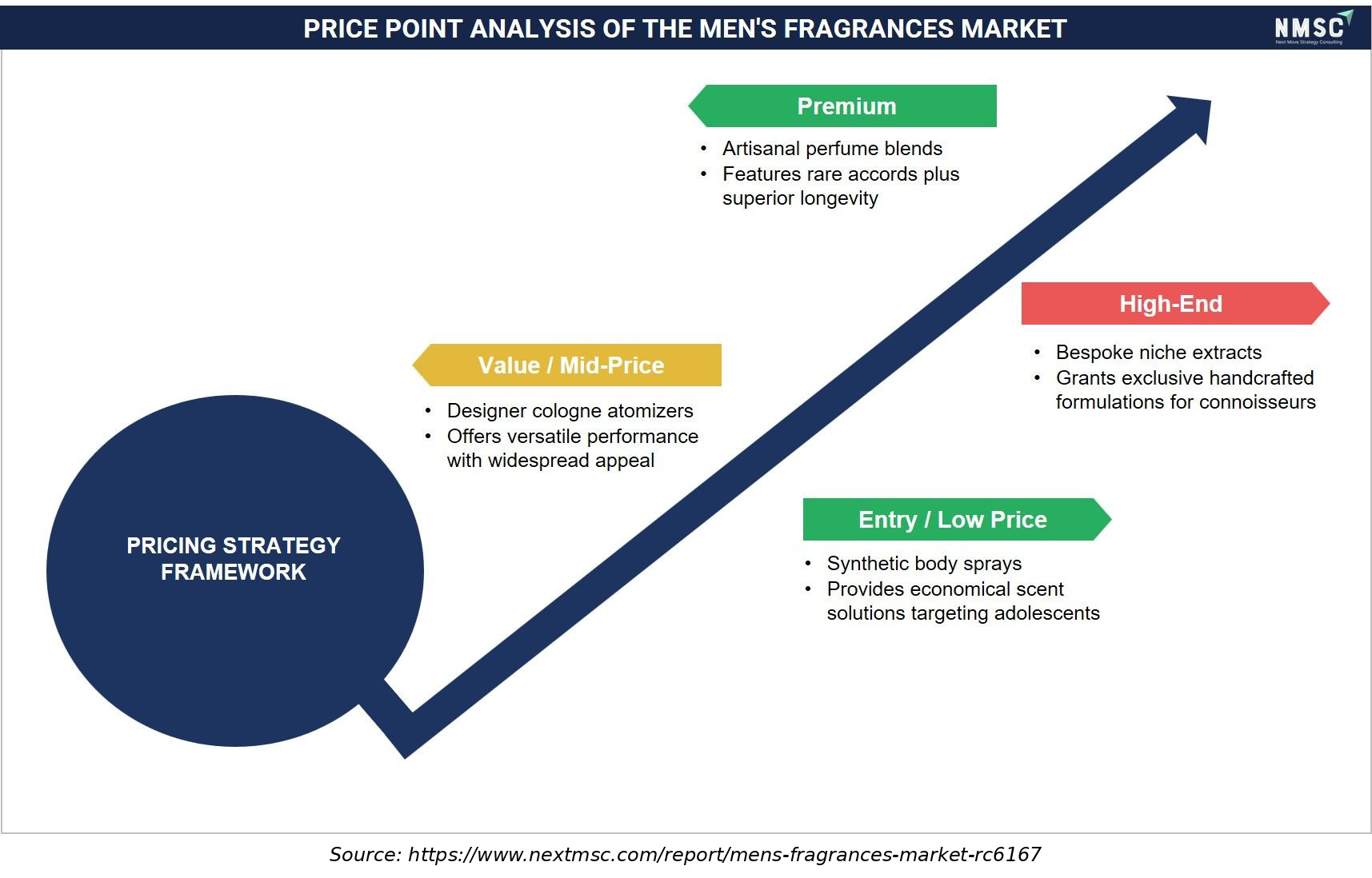
Price Point Analysis of the Men's Fragrances Market

Price Point Analysis of the Men's Fragrances Market
The infographic illustrates the pricing strategy framework for the men's fragrances market, highlighting four key price segments: entry/low-price, value/mid-price, high-end, and premium. The upward-sloping arrow represents the progression toward higher price positioning. These segments reflect diverse consumer preferences, purchasing power, and perceived fragrance value, helping brands develop targeted pricing strategies and strengthen their market positioning.

Segmentation Analysis

2025 (USD Billion)
2035 (USD Billion)
Fine Fragrance 2025: $14.85 Billion | 2035: $28.25 Billion
Fine Fragran
Fragrance Body Spray 2025: $3.78 Billion | 2035: $7.20 Billion
Fragrance Bo
Fragrance Deodorant 2025: $4.32 Billion | 2035: $7.73 Billion
Fragrance De
Aftershave 2025: $2.16 Billion | 2035: $4.00 Billion
Aftershave
Gift and Discovery 2025: $1.35 Billion | 2035: $4.80 Billion
Gift and Dis
Specialty Formats 2025: $0.54 Billion | 2035: $1.32 Billion
Specialty Fo
Fine Fragrance $14.85 Billion $28.25 Billion 6.6%
Fragrance Body Spray $3.78 Billion $7.20 Billion 6.6%
Fragrance Deodorant $4.32 Billion $7.73 Billion 6.0%
Aftershave $2.16 Billion $4.00 Billion 6.4%
Gift and Discovery $1.35 Billion $4.80 Billion 13.5%
Specialty Formats $0.54 Billion $1.32 Billion 9.3%

Which Product Category Dominates the Men's Fragrances Market?

Fine Fragrance, spanning eau de toilette through extrait de parfum concentrations, led the market with USD 14.85 billion in 2025, supported by sustained demand for signature scent formats across prestige and luxury price tiers. We observed that Gift and Discovery is the fastest-growing product category, expanding at a 13.5% CAGR from 2026 to 2035, as digital-first male consumers increasingly rely on trial-size and sampling formats before committing to full-size fine fragrance purchases.

2025 (USD Billion)
2035 (USD Billion)
Mass
Premium
Prestige
Luxury
Niche
Segment Item 2025 (USD Billion) 2035 (USD Billion) CAGR
Mass $10.0 USD Billion $40.0 USD Billion 25.0%
Premium $17.1 USD Billion $51.1 USD Billion 11.0%
Prestige $24.2 USD Billion $62.2 USD Billion 25.0%
Luxury $31.3 USD Billion $73.3 USD Billion 11.0%
Niche $38.4 USD Billion $84.4 USD Billion 16.0%

Segment-wise data is locked

Unlock complete segment-wise numbers for By Price Tier.

Unlock Full Data

Which Price Tier Is Growing Fastest in the Men's Fragrances Market?

Prestige remained the dominant price tier, valued at USD 10.26 billion in 2025 on sustained demand for branded, mid-to-high concentration fragrances positioned between mass and luxury pricing. Our findings suggest that Niche is the fastest-growing price tier, registering a 14.5% CAGR from 2026 to 2035, as artisanal fragrance houses such as Interparfums' newly launched Solférino brand attract male consumers seeking olfactory distinction beyond widely available designer scents.

2025 (USD Billion)
2035 (USD Billion)
Up to 15 ml
15 ml to 30
31 ml to 50
51 ml to 100
>100 ml
Segment Item 2025 (USD Billion) 2035 (USD Billion) CAGR
Up to 15 ml $10.0 USD Billion $40.0 USD Billion 27.0%
15 ml to 30 ml $17.1 USD Billion $51.1 USD Billion 9.0%
31 ml to 50 ml $24.2 USD Billion $62.2 USD Billion 19.0%
51 ml to 100 ml $31.3 USD Billion $73.3 USD Billion 17.0%
>100 ml $38.4 USD Billion $84.4 USD Billion 18.0%

Segment-wise data is locked

Unlock complete segment-wise numbers for By Pack Size.

Unlock Full Data
2025 (USD Billion)
2035 (USD Billion)
Retail
Hypermarket
Drugstore an
Department S
Specialty Be
Segment Item 2025 (USD Billion) 2035 (USD Billion) CAGR
Retail $10.0 USD Billion $40.0 USD Billion 14.0%
Hypermarket and Supermarket $17.1 USD Billion $51.1 USD Billion 24.0%
Drugstore and Pharmacy $24.2 USD Billion $62.2 USD Billion 22.0%
Department Store $31.3 USD Billion $73.3 USD Billion 12.0%
Specialty Beauty Retailer $38.4 USD Billion $84.4 USD Billion 27.0%

Segment-wise data is locked

Unlock complete segment-wise numbers for By Distribution Channel.

Unlock Full Data

Which Distribution Channel Leads Men's Fragrances Market Demand?

Retail, encompassing department stores, specialty beauty retailers, and brand-owned stores, remained the leading distribution channel, valued at USD 21.06 billion in 2025 on established counter-based sampling and personalized fragrance consultation. Based on research conducted by NMSC, we found that E-commerce is the fastest-growing distribution channel, at a 9.6% CAGR from 2026 to 2035, as brand-owned e-commerce platforms and online marketplaces expand digital sampling and subscription-based discovery programs.

2025 (USD Billion)
2035 (USD Billion)
Teen Boys
Adult Men
Segment Item 2025 (USD Billion) 2035 (USD Billion) CAGR
Teen Boys $10.0 USD Billion $40.0 USD Billion 24.0%
Adult Men $17.1 USD Billion $51.1 USD Billion 22.0%

Segment-wise data is locked

Unlock complete segment-wise numbers for By End User.

Unlock Full Data

Growth Opportunities

Our analysis shows that three forward-looking opportunities stand out for stakeholders positioning within the men's fragrances ecosystem over the 2026-2035 forecast period.

How Can Fragrance Mist Formats Unlock Value for Mass-Tier Brands?

Affordable fragrance mist formats present a whitespace opportunity for mass and premium-tier brands seeking to broaden category entry points. Coty's plan to expand its fragrance mist category across more than a dozen brands in the coming year illustrates how manufacturers can capture accessible, complementary revenue from cost-conscious male consumers without diluting prestige brand equity.

Where Does Teen Boy Adoption Create New Demand?

Teen boys represent an underpenetrated end user opportunity as grooming awareness normalizes at younger ages. Manufacturers that develop accessible, entry-price gift and discovery sets tailored to teen boys can secure early brand loyalty, benefiting from the fastest-growing end user segment as this cohort transitions into adult prestige and niche fragrance spending.

How Can Licensed Brand Extensions Benefit Prestige Fragrance Houses?

Prestige fragrance houses seeking sustained brand-portfolio growth create an opportunity through long-term licensing agreements with recognized consumer and lifestyle brands. Interparfums' recently announced longer-term licenses with David Beckham and Nautica illustrate how manufacturers can expand addressable demand by pairing established licensor recognition with fragrance house formulation and distribution expertise.

Regional Outlook

2025 (USD Billion)
2035 (USD Billion)
North Americ
Europe
Asia-Pacific
Middle East
Latin Americ
Region 2025 (USD Billion) 2035 (USD Billion) CAGR (%)
North America $10.0 USD Billion $40.0 USD Billion 9.0%
Europe $17.1 USD Billion $51.1 USD Billion 27.0%
Asia-Pacific $24.2 USD Billion $62.2 USD Billion 25.0%
Middle East & Africa $31.3 USD Billion $73.3 USD Billion 23.0%
Latin America $38.4 USD Billion $84.4 USD Billion 12.0%

Regional data is locked

Unlock complete regional numbers for this market.

Unlock Full Data

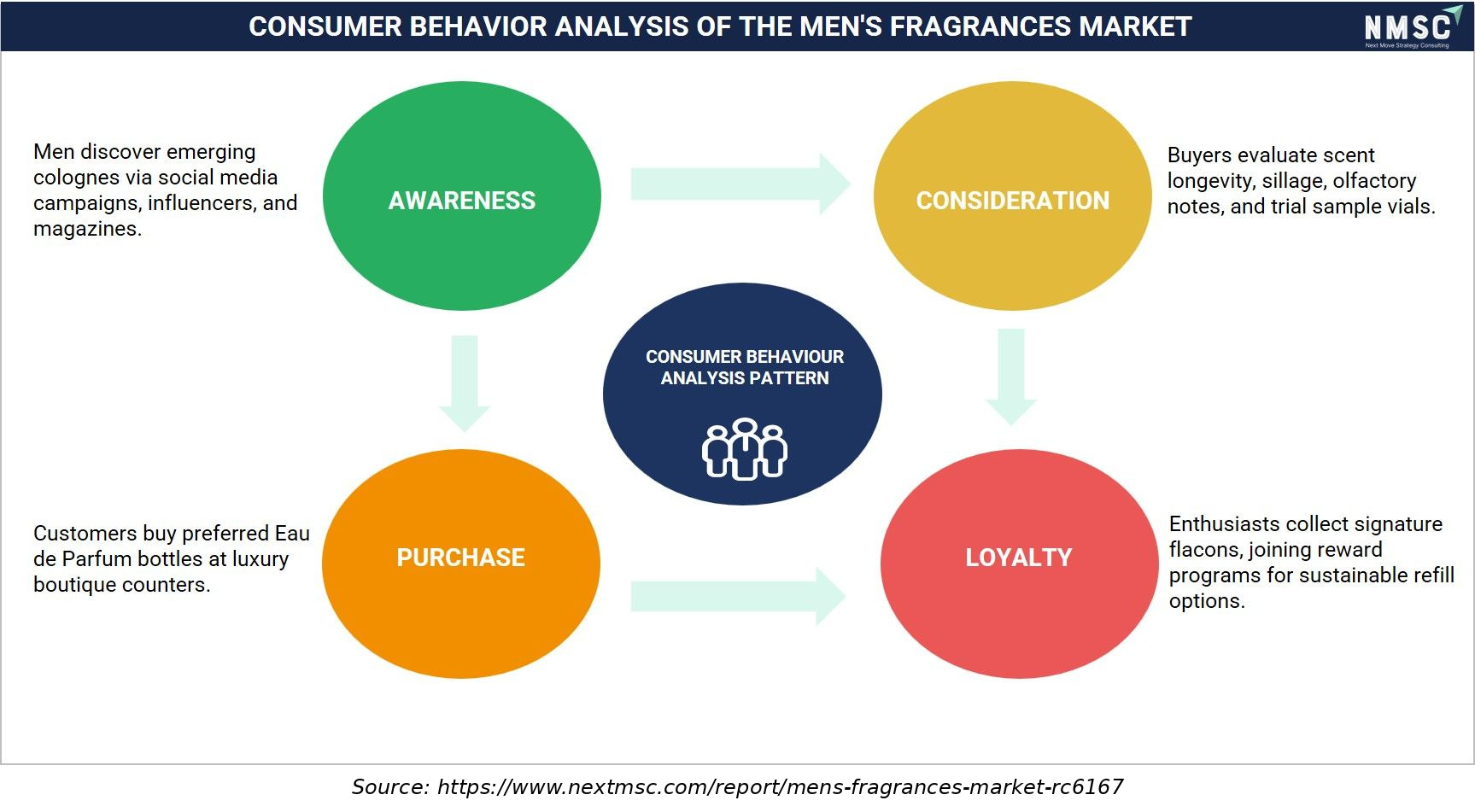
Consumer Behavior Analysis of the Men's Fragrances Market

Consumer Behavior Analysis of the Men's Fragrances Market

The infographic presents the consumer purchasing journey in the men's fragrances market through four stages: awareness, consideration, purchase, and loyalty. Social media, influencer campaigns, and magazines drive awareness, while fragrance longevity, sillage, and scent notes influence consideration. Luxury boutique purchases and loyalty programs encourage repeat buying, while signature flacons and sustainable refill options strengthen customer engagement and long-term brand loyalty.

Latest Developments

We found that recent activity within the men's fragrances market is concentrated on brand licensing expansion and format innovation, reflecting the industry's broader shift toward diversified, discovery-driven portfolios.

Date Event
Mar 2026 L'Oréal S.A. completed the acquisition of Kering Beauté, including the House of Creed, one of the world's leading luxury fragrance houses. The company also signed 50-year exclusive licenses to create, develop, and distribute fragrance and beauty products for the Bottega Veneta and Balenciaga brands. The 50-year exclusive Gucci beauty license will commence after the expiration of the existing Coty licensing agreement.
Dec 2025 Rabanne introduced Phantom in Red, a new masculine amber aromatic woody fragrance, as a limited-edition addition to its Phantom fragrance line. The launch was announced alongside the new women's fragrance, Fame in Love, expanding Rabanne's fragrance portfolio.

Investment Opportunities

What Capital Inflows Are Targeting the Men's Fragrances Market?

Capital inflows into the men's fragrances market are increasingly directed toward brand licensing agreements and niche fragrance house development. Interparfums continues to fund long-term licensing agreements, including its recently announced David Beckham and Nautica partnerships. Based on research conducted by NMSC, we found that investors favor manufacturers demonstrating diversified owned and licensed brand portfolios, viewing this balance as a proxy for long-term resilience against category volatility.

How Is Infrastructure Investment Supporting Men's Fragrances Manufacturing?

Infrastructure investment is expanding domestic manufacturing capacity in North America as tariff policy reshapes cross-border fragrance trade. Our findings suggest that Coty is transferring production of mass fragrances, entry prestige fragrances, and other adjacencies sold in the United States to its domestic manufacturing plant, supporting supply chain resilience amid the shifting global tariff landscape.

What ESG Considerations Are Shaping Men's Fragrances Investment Decisions?

Environmental, social, and governance considerations are increasingly relevant to investment decisions, with ingredient transparency and allergen disclosure cited as key criteria. The European Union's IFRA-aligned fragrance allergen labeling requirements continue to inform formulation and disclosure practices across the industry. We found that investors increasingly favor manufacturers with credible ingredient transparency programs, treating this data as a governance indicator alongside supply chain and labor practices.

Key Benefits for Stakeholders

How Does This Report Benefit Enterprise and Industry Leaders?

Enterprise and industry leaders gain access to validated segmentation, competitive benchmarking, and regional demand forecasts that support brand-portfolio and distribution-channel decisions across the men's fragrances industry. Our analysis shows that detailed product-category, price-tier, and distribution-channel breakdowns help brand and merchandising teams align investment with premiumization and digital discovery trends while identifying underserved segments for portfolio expansion.

How Does This Report Benefit Investors and Financial Analysts?

Investors and financial analysts benefit from consistent, single-point market size and CAGR estimates that support valuation and capital-allocation decisions across the men's fragrances supply chain. Our findings suggest that the report's regional and segment-level growth differentials help identify which manufacturers and licensing specialists are best positioned to capture above-market growth in niche and gift and discovery categories through 2035.

How Does This Report Benefit Technology Vendors and Product Teams?

Technology vendors and product teams gain insight into emerging digital sampling, e-commerce, and personalization requirements that are reshaping the industry. Our findings suggest that this analysis helps brand and R&D teams prioritize development roadmaps around discovery-driven formats and direct-to-consumer digital platforms increasingly required to engage digital-first male consumers.

Key Market Segments Evaluated

By Product Category

  • Fine Fragrance 
    • Eau Fraîche
    • Eau de Cologne
    • Eau de Toilette
    • Eau de Parfum
    • Parfum
    • Extrait de Parfum
  • Fragrance Body Spray 
    • Aerosol Body Spray
    • Pump Body Spray
    • Body Mist
  • Fragrance Deodorant 
    • Aerosol Deodorant
    • Roll-On Deodorant
    • Stick Deodorant
    • Gel Deodorant
    • Cream Deodorant
  • Aftershave 
    • Aftershave Splash
    • Aftershave Balm
    • Aftershave Lotion
    • Aftershave Gel
  • Gift and Discovery 
    • Gift Set
    • Discovery Set
    • Mini Set
    • Travel Set
  • Specialty Formats 
    • Solid Fragrance
    • Fragrance Oil
    • Refill

By Price Tier

  • Mass
  • Premium
  • Prestige
  • Luxury
  • Niche

By Pack Size

  • Up to 15 ml
  • 15 ml to 30 ml
  • 31 ml to 50 ml
  • 51 ml to 100 ml
  • >100 ml

By Distribution Channel

  • Retail 
    • Hypermarket and Supermarket
    • Drugstore and Pharmacy
    • Department Store
    • Specialty Beauty Retailer
    • Brand-Owned Store
    • Travel Retail
  • E-commerce 
    • Brand-Owned E-commerce
    • Online Marketplace

By End User

  • Teen Boys
  • Adult Men

By Region

  • North America 
    • U.S.
    • Canada
    • Mexico
  • Europe 
    • UK
    • Germany
    • France
    • Italy
    • Spain
    • Sweden
    • Denmark
    • Finland
    • Netherlands
    • Rest of Europe
  • Asia-Pacific 
    • China
    • India
    • Japan
    • South Korea
    • Taiwan
    • Indonesia
    • Vietnam
    • Australia
    • Philippines
    • Malaysia
    • Rest of APAC
  • Middle East & Africa 
    • Saudi Arabia
    • UAE
    • Egypt
    • Israel
    • Turkey
    • Nigeria
    • South Africa
    • Rest of MEA
  • Latin America 
    • Brazil
    • Argentina
    • Chile
    • Colombia
    • Rest of LATAM

Conclusion & Recommendations

The long-term outlook for the market remains positive, with global revenue projected to grow from USD 27.00 billion in 2025 to USD 53.30 billion by 2035 at a 7.0% CAGR. We found that sustained male grooming awareness, prestige and niche premiumization, and expanding digital discovery channels will continue underpinning demand across fine fragrance and gift and discovery categories through the forecast period.

What Strategic Positioning Should Men's Fragrances Suppliers Pursue?

Suppliers should prioritize niche and licensed brand portfolio diversification while pursuing accessible mist and discovery formats to secure long-term consumer engagement. Our assessment indicates that manufacturers investing early in diversified price-tier portfolios will be best positioned to capture premium pricing within the men's fragrances market.

How Attractive Is the Men's Fragrances Market for New Investment?

The men's fragrances industry presents an attractive investment case, supported by a USD 24.30 billion absolute dollar opportunity between 2026 and 2035 and above-average growth in Asia-Pacific and niche price-tier categories. We found that investment attractiveness is highest for manufacturers combining licensing agility with scaled prestige distribution, positioning them to serve both discovery-driven and premium-loyal consumer segments simultaneously.

What Market Shifts and Key Risks Should Stakeholders Monitor?

Stakeholders should monitor price sensitivity above key spending thresholds, tariff-driven cost pressure, and retailer destocking cycles as key risks to the men's fragrances market. Our analysis shows that suppliers unable to adapt distribution and manufacturing footprints to shifting tariff policy risk margin compression, particularly within North America's increasingly tariff-sensitive trade environment.

What Are the Key Growth Pathways for the Men's Fragrances Market?

Key growth pathways include expanding niche and licensed brand portfolios, scaling accessible mist and discovery formats, and deepening penetration into e-commerce and social commerce discovery channels. NMSC's analysis indicates that suppliers pursuing these pathways while maintaining prestige brand equity will be best positioned to capture the men's fragrances market's projected growth through 2035.

FAQs

About the Author

Mihul Sharma

Mihul Sharma

Mihul Sharma is Research Associate at Next Move Strategy Consulting, where he has covered technology, industrial, and healthcare markets for 3 years. His work applies structured business research, market analysis, and secondary-source review to assess market trends, competitive developments, and growth opportunities. He supports report development by fully synthesizing industry data, company information, and market signals into concise findings for strategy and investment-focused research teams.

About the Reviewer

Supradip Baul

Supradip Baul

Supradip Baul is an accomplished business consultant and strategist with over a decade of rich experience in market intelligence, strategy, technology, and business transformation. His work has included rigorous qualitative and quantitative analysis across multiple industries, helping clients shape investment decisions and long-term roadmaps. Earlier in his career, he was associated with Gartner, where he contributed to industry-leading reports and market share analyses. He has worked with leading global companies and holds an MBA with a dual specialization in Marketing and Finance.

Download Free Sample

Henri Knyphausen

HENRI KNYPHAUSEN

Partner at Singulier [Ex-BCG]
Singulier

I recently engaged NEXTMSC.com for a commercial due diligence project within the intralogistics sector, and I am pleased to provide a reference based on my experience. In utilizing NEXTMSC.com's services, I found their report to offer valuable insights into market dynamics and key industry players. The initial report provided a solid foundation for our analysis. However, as we were investigating a smaller target in the market, and I had specific customization requests requiring additional research. These requests included detailed information on product portfolios of various players and sub-market sizes, both inclusive and exclusive of certain product categories. NEXTMSC.com demonstrated commendable responsiveness and agility in accommodating these customization requests. Within a timeframe of 1-2 weeks, they delivered a revised report that met our specific needs. Furthermore, they were receptive to my follow-up inquiries, ensuring clarity and understanding of the data provided. The final deliverable significantly contributed to our due diligence efforts. One of NEXTMSC.com's notable strengths lies in their qualitative research capabilities. However, for future engagements, I would recommend the inclusion of a quantified market model in Excel format. Such a model would offer the ability to conduct in-depth analyses and explore various market segments, including country-specific data and subcomponent breakdowns. Based on my positive experience, I would not hesitate to work with NEXTMSC.com again. Their responsiveness, willingness to accommodate customization requests, and commitment to delivering actionable insights make them a reliable partner for commercial research projects.


Gaurav Jaiswal

GAURAV JAISWAL

Founder & CEO

Yano Charge Private Limited

The EV Charging market research report provided by the NextMSC was exceptionally detailed and insightful. It offered a comprehensive analysis that proved to be a game-changer for our strategic planning. Truly a testament to the NextMSC’s expertise and thoroughness in EV market landscape & analysis.

Melanie Samko

MELANIE SAMKO

Director of Marketing

TOSOH BIOSCIENCE, INC.

The information provided by NMSC is incredibly valuable, thank you so much for such a excellent work. I really appreciate it. I will make sure to reference all of it, in my summary document.

Amos Chang

AMOS CHANG

Strategy Consultant

Kardex Group

I have bought the intralogistics market reports from NMSC two times so far. Joseph and his team are always very helpful and flexible in responding to any customization requirements on the report. Their expertise in market reports really helps us steer the day-to-day business. I will definitely recommend and come back myself whenever there is a need.

Mohit Agarwal

MOHIT AGARWAL

Chief Manager

DryChem India Pvt. Ltd.

Next Move Strategy Consulting is an amazing team of consultants. We required a market study report for our investors on top priority and the team went above and beyond our expectations to deliver the same with ample supporting data within a short time span enabling us to secure the investments and keep our project timeline maintained. Their professionalism, attention to detail, and timely delivery of actionable recommendations have left a lasting impression on our organization.

Custom Market Research Services

We will customize the research for you if the listed report does not fully match your requirements.

Get 30% Free Customization

Select License

This website uses cookies to ensure you get the best experience on our website. Learn more

✖