China Mobile Payment Market By Payment Channel (Contactless Card-based, QR Code-based, Account-to-Account Transfers, and Carrier Billing), By Platform Type (Web-Embedded and Native App), By Transaction Use Case (Peer-to-Peer, Point-of-Sale, Bill and Recurring Payments, and Others), By Payment Location (Remote Payment and Proximity Payment), and By Customer Type (Retail Consumers, Small and Medium Enterprises, and Others) – Opportunity Analysis and Industry Forecast, 2025–2035
Industry: ICT & Media | Latest Edition: September 30, 2026 | No of Pages: 133 | No. of Tables: 33 | No. of Figures: 28 | Format: PDF | Report Code: IC2490
What Is the China Mobile Payment Market Size?
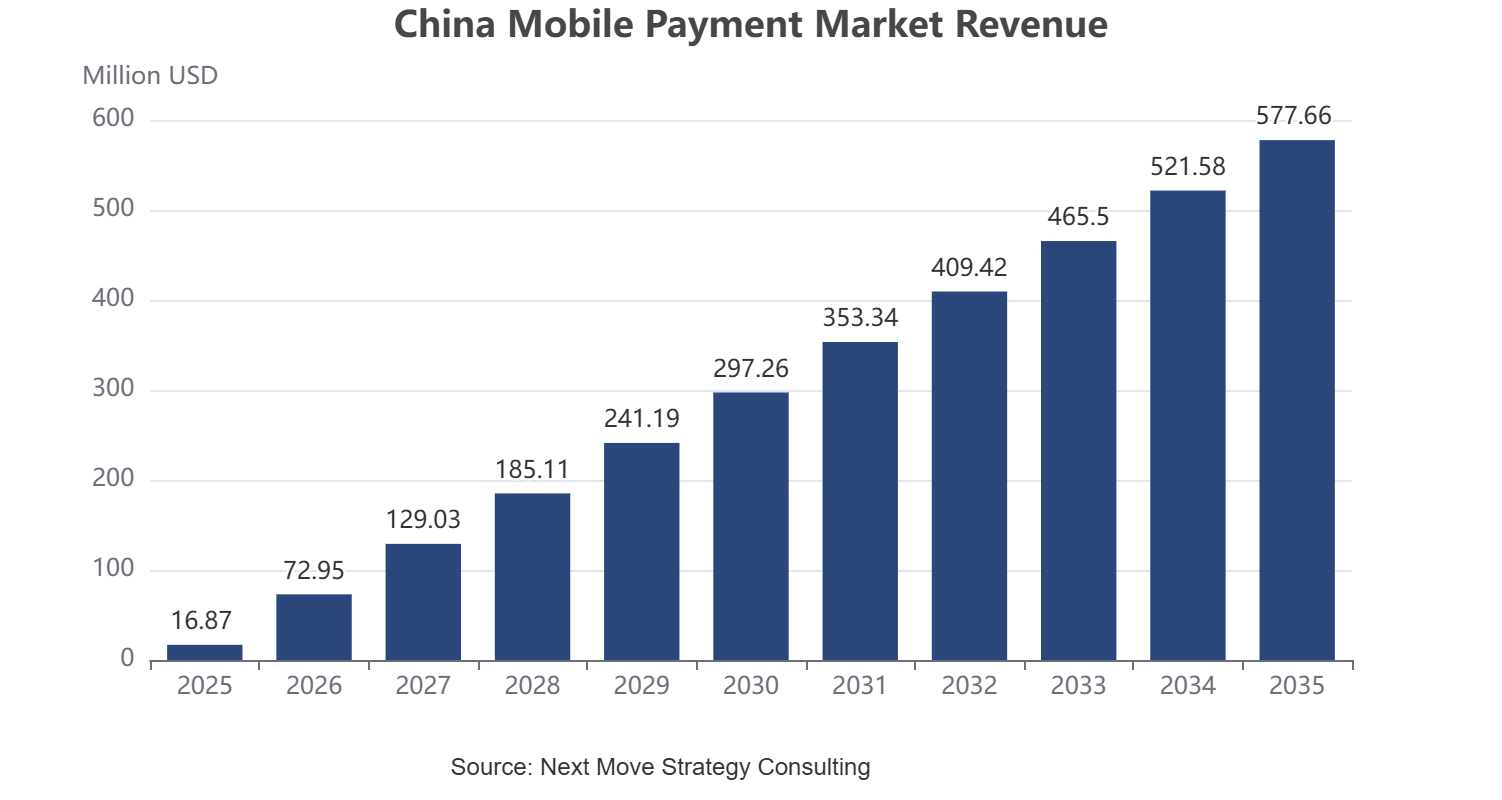
The China Mobile Payment Market was valued at USD 16.87 billion in 2025 and is estimated at USD 29.36 billion in 2026, forecast to reach USD 577.66 billion by 2035, expanding at a 39.24% CAGR between 2026 and 2035. QR Code-based payment dominates the market by payment channel, driven by widespread merchant acceptance across retail and service outlets nationwide.
Key Takeaways
|
By Payment Channel: QR Code-based is the dominant segment, while Account-to-Account Transfers (A2A) is the fastest-growing segment. |
|
By Platform Type: Native App is the dominant segment, while Web-Embedded is the fastest-growing segment. |
|
By Transaction Use-Case: Point-of-Sale (P2M) is the dominant segment, while Business-to-Business is the fastest-growing segment. |
|
By Payment Location: Proximity Payment is the dominant segment, while Remote Payment is the fastest-growing segment. |
|
By Customer Type: Retail Consumers is the dominant segment, while Small and Medium Enterprises (SMEs) is the fastest-growing segment. |
Market Opportunity:The China Mobile Payment Market is expected to create an absolute dollar opportunity of USD 548.30 billion between 2026 and 2035, presenting significant investment potential across QR-based acceptance networks, account-to-account rails, and embedded finance platforms.
According to NMSC’s analysis, continued integration of mobile payment credentials into transport, government, and business-to-business settlement systems is broadening the addressable use cases for mobile payment platforms across China through 2035.
What does the China Mobile Payment Market Encompass?
The China Mobile Payment Market encompasses smartphone-based transaction systems including QR code scanning, near-field communication, account-to-account transfers, and carrier billing that enable consumers, enterprises, and government bodies to settle payments without physical cash or cards. Our assessment indicates that the market has evolved from a peer-to-peer convenience tool into core national payment infrastructure spanning retail, mobile commerce, transit, taxation, and business settlement. The People’s Bank of China regulates payment institutions, interoperability standards, and digital currency pilots that shape platform design and merchant acceptance nationwide.
We found that rising smartphone penetration, super-app ecosystems, and biometric authentication are accelerating adoption across urban and rural customer segments alike. NMSC’s analysis indicates that regulatory emphasis on interoperability between competing wallet ecosystems, alongside expanding acceptance among small and medium enterprises, continues to reshape competitive dynamics, merchant economics, and consumer trust across the China Mobile Payment Market.
|
Parameter |
Details |
|
Market Size in 2025 |
USD 16.87 Billion |
|
Market Size in 2026 |
USD 29.36 Billion |
|
Revenue Forecast in 2035 |
USD 577.66 Billion |
|
Growth Rate |
CAGR of 39.24% from 2026 to 2035 |
|
Analysis Period |
2025–2035 |
|
Base Year Considered |
2025 |
|
Forecast Period |
2026–2035 |
|
Market Size Estimation |
USD Billion |
|
Companies Profiled |
15 |
|
Market Share |
Available for Top 10 Companies |
Key Emerging Trends
Based on research conducted by NMSC, we found that four structural trends are reshaping platform design, adoption patterns, and competitive dynamics across the China Mobile Payment Market.
How Is Biometric Authentication Transforming Checkout Experiences?
Facial recognition and fingerprint-based verification are replacing password and PIN entry at point-of-sale terminals across supermarkets and convenience stores. We observed that this transformation reduces checkout friction while strengthening fraud prevention for high-volume merchants. Alipay’s facial recognition terminals illustrate how biometric adoption is reshaping stakeholder expectations for speed and security in everyday retail transactions nationwide.
How Are Super-App Ecosystems Expanding Mobile Payment Utility?
Integrated super-apps combining messaging, ride-hailing, and mini-programs are embedding payment functionality into daily digital life. During our market evaluation, we noticed that this integration deepens user engagement and transaction frequency for platform operators. WeChat Pay’s mini-program ecosystem demonstrates how bundled services drive stakeholder stickiness and expand merchant acceptance across diverse service categories.
What Role Is Blockchain-Based Settlement Playing in Market Evolution?
Distributed ledger pilots are being tested for cross-border settlement and business-to-business reconciliation alongside conventional rails. Our findings suggest that this shift toward programmable, traceable settlement complements broader Web3 payment innovation, giving enterprise stakeholders new tools for transparent multi-party transaction verification and dispute resolution across supply chains.
How Is the Digital Yuan Influencing Mobile Payment Infrastructure?
The People’s Bank of China’s e-CNY pilot programs are being integrated into existing wallet applications, giving consumers a state-backed settlement option alongside commercial platforms. We observed that transit systems and government service points are early adopters, extending digital currency acceptance to public-sector use cases and reinforcing infrastructure-level stakeholder impact nationwide.
Ecosystem Analysis of the China Mobile Payment Market:
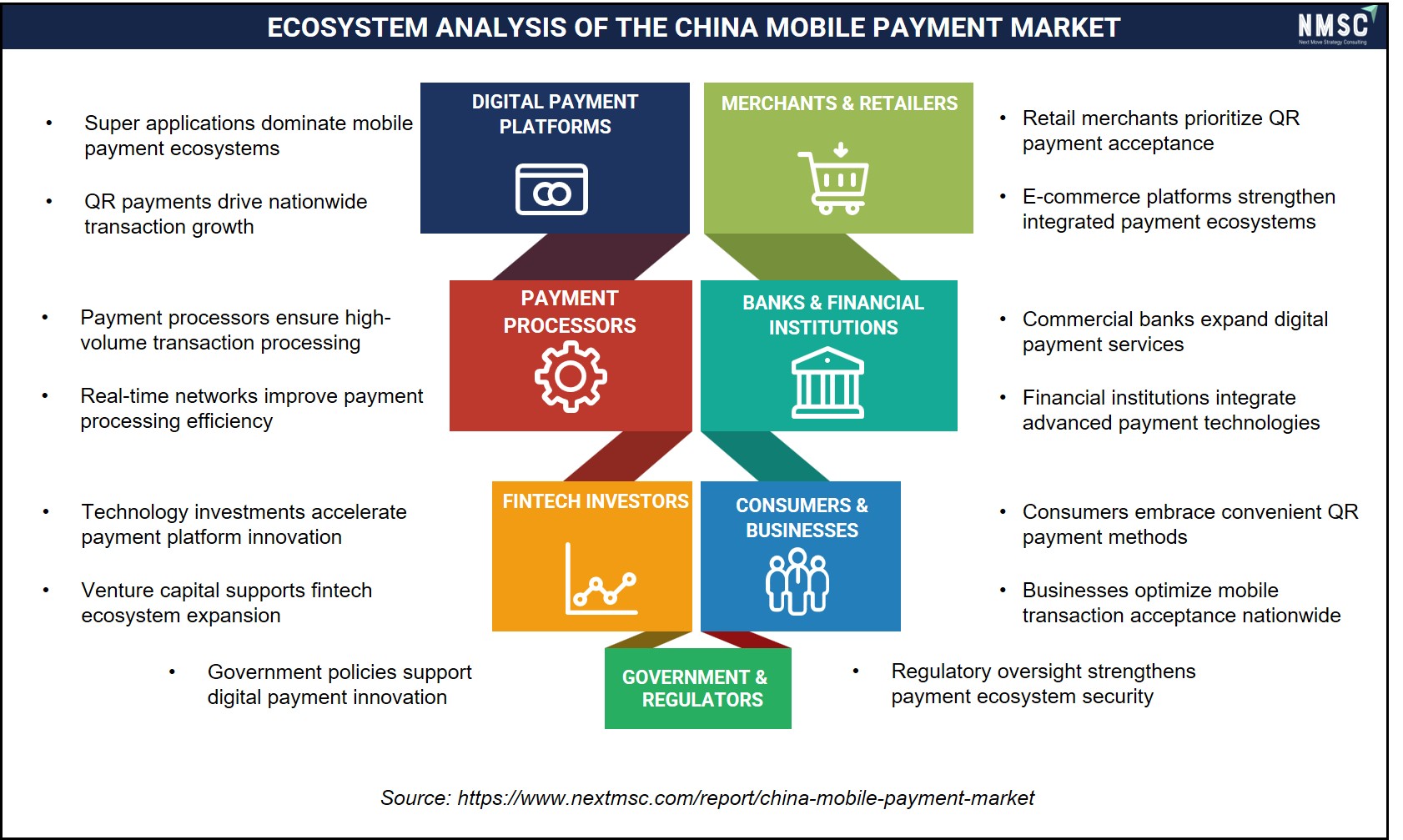
Our assessment indicates that China's mobile payment ecosystem is driven by strong collaboration among digital payment platforms, fintech investors, commercial banks, merchants, businesses, and government regulators. In addition, super applications, QR payment adoption, real-time payment processing, and technology investments accelerate innovation and market expansion. Therefore, this interconnected ecosystem enhances transaction efficiency, supports continuous digital transformation, and reinforces China's leadership in the global mobile payment landscape.
Growth Drivers & Restraints
Growth Catalyst & Risk Assessment Matrix
|
Factors |
Type |
(+/−) % Impact on CAGR |
Geographic Relevance |
Impact Timeline |
|
Merchant QR acceptance expansion |
Driver |
+8.2% |
National |
2026–2030 |
|
Super-app ecosystem integration |
Driver |
+6.7% |
Urban & Tier-1 Cities |
2026–2032 |
|
e-CNY government adoption |
Driver |
+5.4% |
National |
2026–2035 |
|
Biometric authentication rollout |
Driver |
+4.1% |
National |
2027–2033 |
|
Cross-border interoperability programs |
Driver |
+3.6% |
Coastal & Trade Hubs |
2027–2034 |
|
SME onboarding incentives |
Driver |
+3.0% |
National |
2026–2031 |
|
Data privacy compliance costs |
Restraint |
−2.8% |
National |
2026–2030 |
|
Interbank interoperability friction |
Restraint |
−2.1% |
National |
2026–2029 |
|
Rural connectivity gaps |
Restraint |
−1.5% |
Rural Regions |
2026–2032 |
What Is the Primary Growth Driver?
Merchant QR acceptance is the primary growth driver, as small retailers and service providers increasingly adopt low-cost QR terminals over traditional card infrastructure. We found that the People’s Bank of China reports steadily rising non-cash transaction volumes processed through licensed payment institutions, reflecting sustained merchant-side migration toward mobile-first settlement across urban and township commercial districts nationwide.
How Is Super-App Integration Driving Market Growth?
Deep integration of payment functionality within messaging and lifestyle super-apps is driving transaction frequency and platform stickiness. Our analysis shows that bundling ride-hailing, food delivery, and utility bill payment within a single wallet interface increases average transactions per active user, reinforcing platform-level network effects across both established and emerging service categories.
What Is Restraining the China Mobile Payment Market?
Data privacy compliance under China’s Personal Information Protection Law raises operating costs for payment institutions handling sensitive transaction data. We observed that interbank interoperability friction between competing wallet ecosystems continues to fragment merchant acceptance in select regions, moderating near-term platform consolidation despite an otherwise industry-derived estimate of strong overall channel expansion.
Segmentation Analysis
By Payment Channel Insights
Which Payment Channel Leads the China Mobile Payment Market?
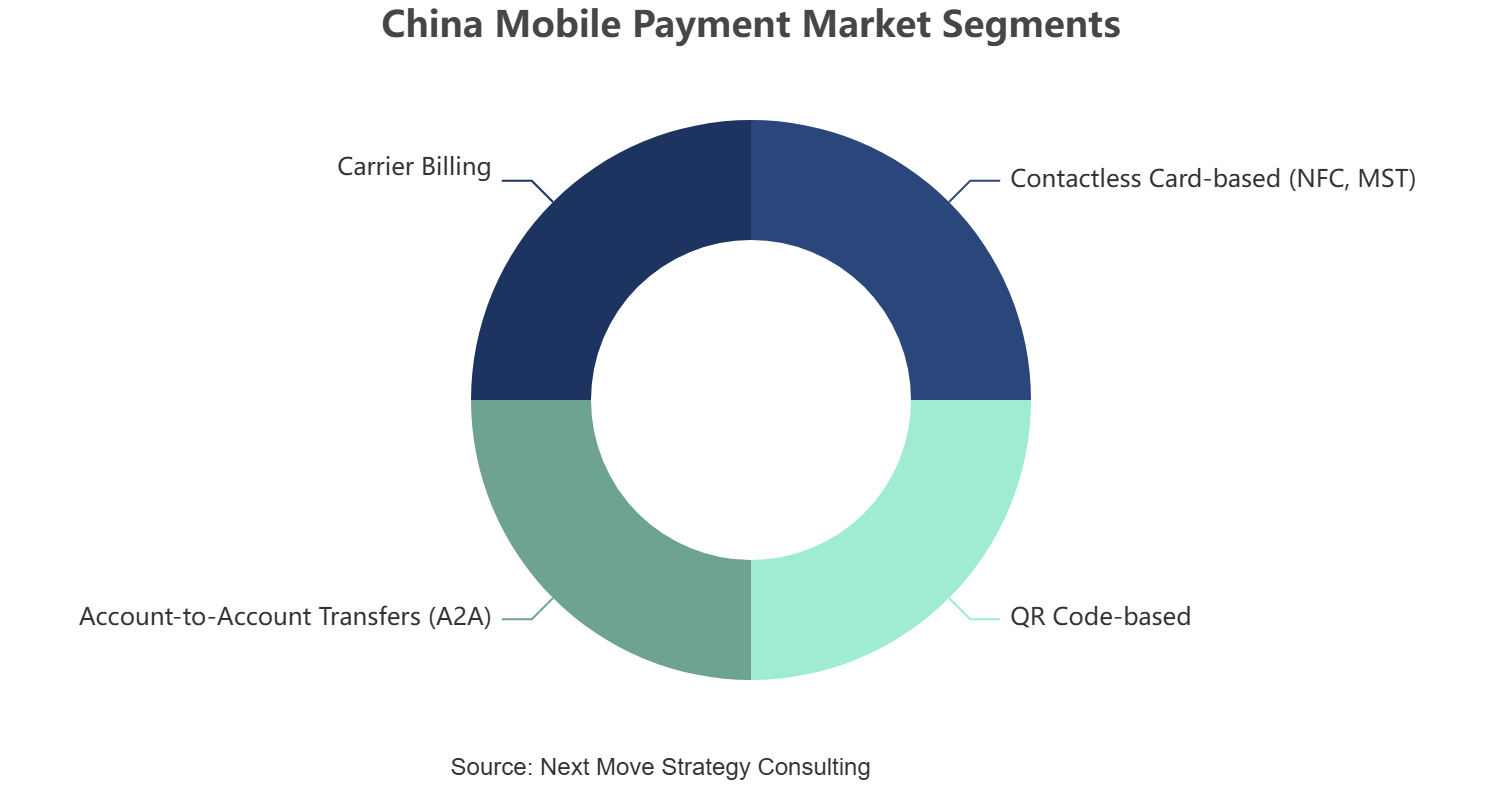
Based on Payment Channel, the market is segmented into contactless card-based, QR code-based, account-to-account transfers, and carrier billing. We found that this segmentation reflects how consumers and merchants authorize and settle transactions across retail, transit, and digital service environments throughout the country.
QR code-based payment remains dominant given its low merchant onboarding cost and universal smartphone camera compatibility across small and large retailers alike. Account-to-account transfers are the fastest-growing channel as banks and platforms expand real-time interbank settlement rails, supported by regulatory encouragement of open, interoperable payment infrastructure that reduces dependence on any single closed-loop wallet ecosystem.
By Customer Type Insights
Which Customer Type Drives the China Mobile Payment Market?
Based on Customer Type, the market is segmented into retail consumers, small and medium enterprises, large enterprises, and government and public sector. We observed that this segmentation captures the distinct adoption drivers, transaction volumes, and platform requirements across individual and institutional users nationwide.
Retail consumers dominate given near-universal daily use of mobile wallets for everyday purchases and bill payments. Small and medium enterprises are the fastest-growing customer type as simplified onboarding, lower transaction fees, and integrated point-of-sale tools encourage neighborhood merchants and independent service providers to shift away from cash-based transaction models.
Growth Opportunities
We observed three forward-looking opportunities positioned to shape whitespace expansion across the China Mobile Payment Market through 2035.
How Can Cross-Border Interoperability Unlock New Revenue Streams?
Linking domestic QR standards with regional wallet networks creates a mechanism for outbound tourism and trade-linked settlement. This benefits payment institutions and cross-border e-commerce merchants seeking simplified multi-currency acceptance for international customers.
What Opportunity Does Embedded Government Payment Present?
Integrating tax remittance and public-service fee collection directly into wallet applications creates a recurring, high-volume transaction mechanism. This benefits government and public-sector agencies and payment platform operators through reduced collection costs and improved compliance tracking.
How Can SME-Focused Lending Bundles Expand Platform Value?
Combining transaction-data-based credit scoring with payment acceptance tools creates a mechanism for working-capital lending at the point of sale. This benefits small and medium enterprises seeking accessible financing and payment platforms seeking diversified, fee-generating revenue streams beyond transaction processing alone.
Supply Chain Structure of the China Mobile Payment Market:
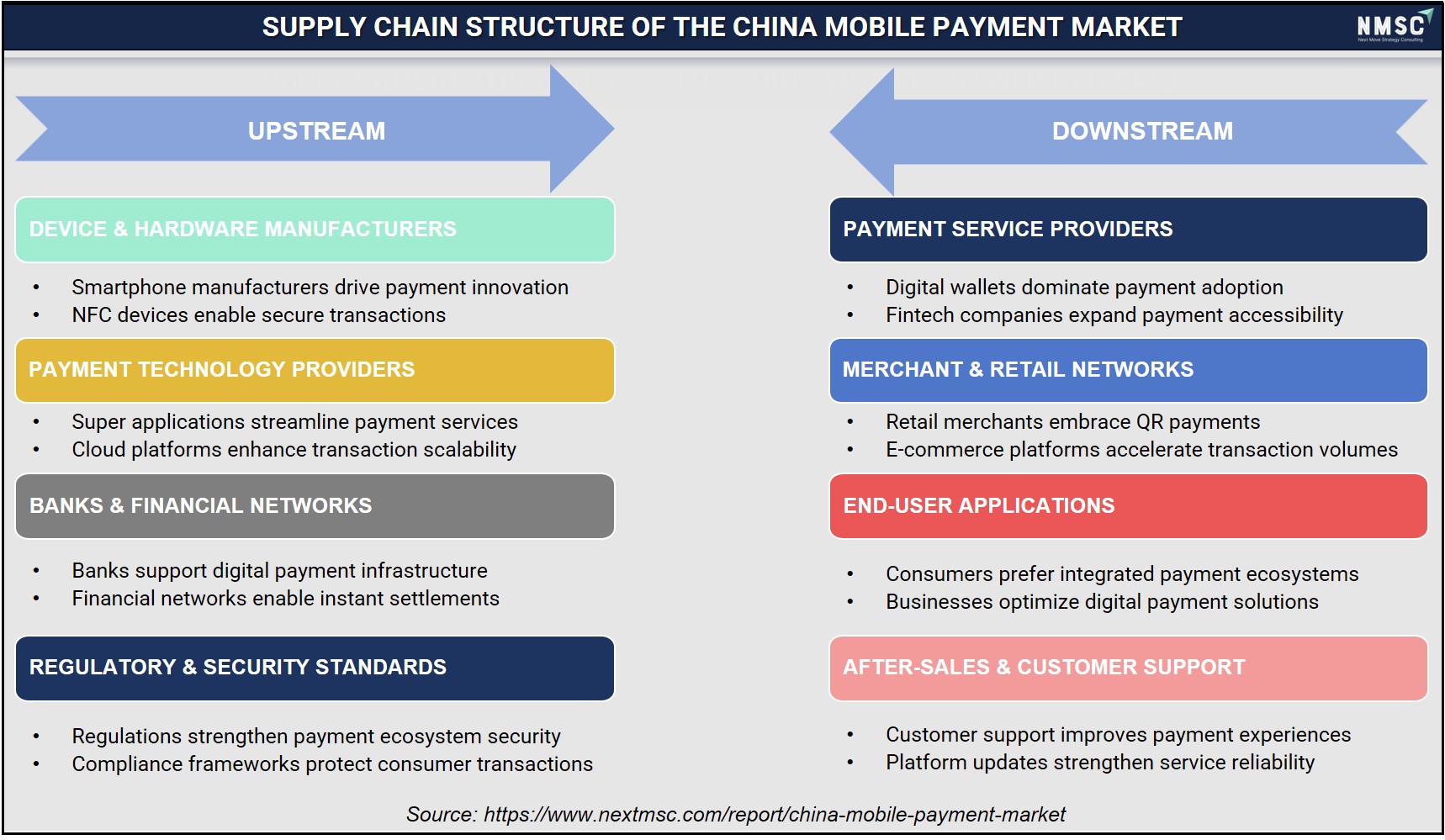
Based on our market evaluation, we noticed that the China Mobile Payment Market benefits from a well-connected supply chain linking device manufacturers, payment technology providers, financial institutions, merchants, and service providers. Furthermore, cloud platforms, NFC-enabled devices, digital wallets, and strong regulatory compliance improve payment security and operational efficiency. Consequently, coordinated collaboration across upstream and downstream participants supports scalable innovation, strengthens consumer trust, and ensures seamless digital payment experiences nationwide.
Competitive Landscape
Our analysis shows that the China Mobile Payment Market is shaped by a mix of licensed payment institutions, device manufacturers, and financial technology platforms competing on acceptance network breadth and transaction reliability.
Key Takeaways
|
Category |
Details |
|
Market Structure |
Moderately consolidated among leading licensed payment institutions alongside device-based wallet providers |
|
Innovation Focus |
Biometric authentication, embedded lending, and interoperable QR standards |
|
M&A Activity |
Selective acquisitions of regional acquiring networks and fintech infrastructure providers |
How Do Companies Compete in the China Mobile Payment Market?
Companies compete primarily on merchant acceptance breadth, transaction speed, and integrated value-added services such as lending and loyalty programs. We found that platforms with the largest installed base of linked bank accounts and merchant terminals sustain the strongest transaction volume advantages across urban commercial districts nationwide.
Which Competitive Archetypes Dominate the Market?
Two archetypes dominate: closed-loop super-app wallets that bundle lifestyle services, and open acquiring networks that serve as neutral processing infrastructure for banks and merchants. Our assessment indicates that this dual structure explains why both consumer-facing platforms and business-to-business processors maintain durable competitive positioning simultaneously.
What Innovation and Differentiation Strategies Are Companies Pursuing?
Leading players are differentiating through biometric checkout, programmable settlement pilots, and merchant financing tools layered onto core payment rails. We observed that device manufacturers are embedding secure elements directly into smartphones, positioning hardware-level security as a differentiator against purely software-based wallet competitors.
How Active Is M&A Activity Across the Market?
M&A activity remains selective, concentrated on acquiring regional acquiring licenses and specialized fintech infrastructure rather than large horizontal consolidation. NMSC’s analysis indicates that this measured approach reflects regulatory scrutiny of payment-sector concentration alongside continued organic geographic expansion into underserved township and rural commercial segments.
Key Market Players
We identified the following companies as key participants shaping competitive dynamics across the China Mobile Payment Market.
-
Allinpay Network Services Co., Ltd.
-
Huifu Payment Limited
-
YeePay Co., Ltd.
-
Shanghai Fuiou Payment Service Corp., Ltd.
-
99Bill Corporation
-
LianLian DigiTech Co., Ltd.
-
Tianyi Payment Technology Co., Ltd.
-
Du Xiaoman Financial
-
Ping An E-wallet Electronic Commerce Co., Ltd.
-
Apple Inc.
-
Xiaomi Inc.
-
Samsung Electronics Nordic AB (device-based wallet integration in the China market)
-
Suning.com Co., Ltd.
Latest Developments
We compiled the following publicly verified developments relevant to the China Mobile Payment Market.
|
Date |
Event |
|
May 2026 |
China UnionPay Co., Ltd. & Huawei Technologies Co., Ltd. signed a renewed strategic cooperation agreement in Shenzhen, China, and jointly launched Innovation and Artificial Intelligence Action Plans. The partnership expands collaboration on ICT infrastructure, Huawei Pay terminal payments, HarmonyOS ecosystem development, and intelligent financial services across China's payment ecosystem |
|
January 2026 |
Apple Inc. expanded Apple Pay cross-border payment support for users in mainland China, enabling eligible Visa cards issued by participating Chinese banks to be used internationally. The initiative was launched with support from China UnionPay and multiple domestic banking partners serving Chinese consumers |
Investment Opportunities
Where Is Capital Inflow Concentrated?
Capital inflow is concentrated in acquiring infrastructure, biometric authentication technology, and embedded lending platforms layered onto existing payment rails. Our findings suggest that institutional investors favor platforms demonstrating durable merchant retention and diversified fee-generating services beyond core transaction processing revenue alone.
How Is Infrastructure Investment Shaping the Market?
Infrastructure investment is directed toward interbank settlement modernization and expanded point-of-sale terminal deployment in lower-tier cities and rural townships. We observed that continued rollout of low-cost acceptance hardware is essential to sustaining transaction volume growth among small and medium enterprise merchants nationwide.
What ESG Considerations Are Relevant to Investors?
ESG considerations center on financial inclusion for underbanked rural populations, data privacy governance, and energy-efficient data center operations supporting transaction processing. NMSC’s analysis indicates that platforms demonstrating measurable financial inclusion outcomes are increasingly favored by institutional and government-linked investment programs.
Key Benefits for Stakeholders
How Does This Report Benefit Industry Leaders?
Industry leaders gain access to detailed segmentation, competitive benchmarking, and demand forecasts that inform product roadmap and merchant acquisition strategy. Our analysis shows that this report enables executives to prioritize investment across payment channels and customer segments with the strongest projected growth trajectories through 2035.
How Does This Report Benefit Investors and Financial Analysts?
Investors and financial analysts gain quantified market size, CAGR, and opportunity estimates that support valuation and capital allocation decisions. We found that the report’s growth catalyst and risk assessment matrix provides a structured framework for evaluating comparative exposure across drivers and restraints shaping platform economics.
How Does This Report Benefit Technology Vendors and Product Teams?
Technology vendors and product teams gain insight into emerging trends such as biometric authentication and blockchain-based settlement that inform feature prioritization. Our assessment indicates that this report clarifies which segmentation categories present the strongest near-term product-market fit for new payment technology deployment.
Key Market Segments
By Payment Channel
-
Contactless Card-based (NFC, MST)
-
QR Code-based
-
Account-to-Account Transfers (A2A)
-
Carrier Billing
By Platform Types
-
Web-Embedded
-
Native App
By Transaction Use-Case
-
Peer-to-Peer (P2P)
-
Point-of-Sale (P2M)
-
Bill & Recurring Payments
-
Business-to-Business
-
Government/tax remittance
By Payment Location
-
Remote Payment
-
Proximity Payment
By Customer Type
-
Retail Consumers
-
Small and Medium Enterprises (SMEs)
-
Large Enterprises
-
Government & Public Sector
Conclusion & Recommendations
What Is the Long-Term Outlook?
The long-term outlook remains strongly positive, with the market projected to expand from USD 29.36 billion in 2026 to USD 577.66 billion by 2035 at a 39.24% CAGR. We found that sustained smartphone penetration and merchant acceptance expansion underpin this trajectory across both consumer and institutional customer segments nationwide.
What Strategic Positioning Do We Recommend?
We recommend that platform operators prioritize interoperable acceptance infrastructure and embedded financial services to differentiate beyond core transaction processing. Our analysis shows that companies balancing consumer wallet engagement with business-to-business settlement capability are best positioned to capture cross-segment revenue opportunities through 2035.
How Attractive Is the Market for Investment?
Investment attractiveness is high given the market’s 39.24% projected CAGR and USD 548.30 billion absolute dollar opportunity between 2026 and 2035. We observed that diversified revenue streams spanning transaction fees, lending, and merchant services strengthen the sector’s appeal to growth-oriented institutional capital.
What Market Shifts and Key Risks Should Stakeholders Monitor?
Stakeholders should monitor evolving data privacy regulation and interbank interoperability requirements that could reshape platform economics. We observed that regulatory shifts toward open, interoperable acceptance standards present both a risk to closed-loop wallet incumbents and an opportunity for new entrants offering compliant, interoperable settlement infrastructure.
What Are the Key Growth Pathways?
Key growth pathways include rural merchant onboarding, government payment integration, and cross-border interoperability with neighboring markets. Comparative expansion patterns observed in the U.S. mobile payment market suggest that continued biometric and embedded-finance innovation will remain central to sustained growth through 2035.
About the Author
 Saista Faiyaz
— Saista Faiyaz is Research Associate at Next Move Strategy Consulting, where she has covered consumer markets and healthcare technologies for 3 years. Her work includes primary interview review, secondary-source validation, market sizing, and structured analysis of company and industry data. She supports research by comparing evidence across sources, organizing findings into market narratives, and documenting assumptions used in analysis. Her scope includes cross-market benchmarking, and reports.
Saista Faiyaz
— Saista Faiyaz is Research Associate at Next Move Strategy Consulting, where she has covered consumer markets and healthcare technologies for 3 years. Her work includes primary interview review, secondary-source validation, market sizing, and structured analysis of company and industry data. She supports research by comparing evidence across sources, organizing findings into market narratives, and documenting assumptions used in analysis. Her scope includes cross-market benchmarking, and reports.
About the Reviewer
 Supradip Baul
— Supradip Baul is an accomplished business consultant and strategist with over a decade of rich experience in market intelligence, strategy, technology, and business transformation. His work has included rigorous qualitative and quantitative analysis across multiple industries, helping clients shape investment decisions and long-term roadmaps. Earlier in his career, he was associated with Gartner, where he contributed to industry-leading reports and market share analyses. He has worked with leading global companies and holds an MBA with a dual specialization in Marketing and Finance.
Supradip Baul
— Supradip Baul is an accomplished business consultant and strategist with over a decade of rich experience in market intelligence, strategy, technology, and business transformation. His work has included rigorous qualitative and quantitative analysis across multiple industries, helping clients shape investment decisions and long-term roadmaps. Earlier in his career, he was associated with Gartner, where he contributed to industry-leading reports and market share analyses. He has worked with leading global companies and holds an MBA with a dual specialization in Marketing and Finance.
At Next Move Strategy Consulting, we understand that insightful market research is the cornerstone of successful business decisions. That's why we employ a robust and multifaceted approach, combining various methodologies to deliver the most accurate and actionable data for our clients.

Research Landscape
We navigate the world of research with two primary approaches:
Qualitative Approach
Our qualitative research methodologies involve immersive techniques such as in-depth interviews, focus groups, and observational studies. By engaging directly with individuals and stakeholders, we uncover valuable insights that quantitative data alone may overlook.

Quantitative Research
In tandem with qualitative methodologies, NMSC leverages the power of Quantitative Research to provide a robust foundation of numerical insights. Through systematic data collection and analysis, we quantify patterns, preferences, and market trends, offering a comprehensive view of the business landscape.
Our quantitative research approach employs diverse tools, including surveys, experiments, and statistical modelling. These methodologies enable us to gather data from a large and representative sample, ensuring the statistical significance of our findings. By employing structured questionnaires and standardized data collection methods, we guarantee the reliability and validity of the information we present to our clients.
Quantitative research is particularly effective in measuring the prevalence of trends, assessing market size, and gauging the impact of various factors on consumer behavior. The numerical precision attained through this approach equips our clients with actionable insights, facilitating data-driven decision-making and strategy formulation.


Our Specialized Toolbox for Industry-Specific Market Research
We deploy a specialized arsenal of techniques tailored to meet your unique requirements. Here's a glimpse into our comprehensive toolbox:

Information Procurement
The stage entails acquiring market data or relevant information through various sources and methodologies.


Market Research Approach
We utilize both top-down and bottom-up approaches in market research analysis to achieve a comprehensive understanding of the market dynamics, leveraging the broad perspective of industry trends and macroeconomic factors alongside detailed insights from specific segments and individual companies.

Porters Five Forces Analysis
We conduct Porter's Five Forces analysis to evaluate the competitive landscape of an industry, providing us with insights into factors that affect profitability and strategic positioning.

SWOT Analysis

Forecasting
We utilize a forecasting model to predict future consumption by considering parameters like population, economics, regulations, market competition, drivers, constraints, technology, and pricing. We also employ statistical techniques such as multilinear regression, exponential smoothing, moving average, ARIMA, and Monte Carlo simulations for accurate predictions. In econometric forecasting, we analyzed short-term and long-term event impacts, attributing values based on regulatory frameworks, economic factors, and market events.





 Speak to Our Analyst