Employee Advocacy Software Market Size Forecast

Employee Advocacy Software Market size was USD 1.32 Billion in 2025, projected to reach USD 5.04 Billion by 2035, growing at a CAGR of 13.1% from 2026 to 2035. Key drivers include rising enterprise investment in organic social reach, growing employer branding demand, social selling adoption, and expanding digital transformation, with Asia-Pacific expected to be the fastest-growing region.
Download Free Sample PDF
Base Year (2025)
$1.32 Billion
Forecast (2035)
$5.04 Billion
CAGR (2026-2035)
13.1%
Top Region
North America

What Is the Employee Advocacy Software Market Size?

The global employee advocacy software market size was valued at USD 1.32 billion in 2025 and is estimated at USD 1.65 billion in 2026, forecast to reach USD 5.04 billion by 2035, expanding at a 13.13% CAGR between 2026 and 2035. North America leads with approximately 42% share, while public cloud deployment dominates all other models with approximately 62% share.

We observed that growth is broad-based across every segmentation axis, with executive advocacy use cases and hybrid deployment models driving the dominant structural shifts through 2035.

Employee Advocacy Software Market Size Forecast Revenue Forecast

Values in USD Billion

2025 $1.32 Billion
2025
2026 $1.49 Billion
2026
2027 $1.69 Billion
2027
2028 $1.91 Billion
2028
2029 $2.16 Billion
2029
2030 $2.45 Billion
2030
2031 $2.77 Billion
2031
2032 $3.13 Billion
2032
2033 $3.54 Billion
2033
2034 $4.01 Billion
2034
2035 $5.04 Billion
2035

Key Takeaways

By Deployment Model: Public Cloud held the largest share of approximately 62% (USD 0.82 Billion) in 2025; Hybrid Deployment is the fastest-growing sub-segment at 15.1% CAGR from 2026–2035.

By Organization Size: Large Enterprise held the largest share of approximately 63% (USD 0.83 Billion) in 2025; SME is the fastest-growing sub-segment at 16.1% CAGR from 2026–2035.

By Use Case: Brand Advocacy held the largest share of approximately 27% (USD 0.36 Billion) in 2025; Executive Advocacy is the fastest-growing sub-segment at 16.1% CAGR from 2026–2035.

By Buyer Function: Marketing held the largest share of approximately 34% (USD 0.45 Billion) in 2025; Executive Leadership is the fastest-growing sub-segment at 17.1% CAGR from 2026–2035.

By Pricing Model: Per Advocate held the largest share of approximately 36% (USD 0.47 Billion) in 2025; Subscription is the fastest-growing sub-segment at 16.1% CAGR from 2026–2035.

By End User: Technology held the largest share of approximately 19% (USD 0.25 Billion) in 2025; Life Sciences is the fastest-growing sub-segment at 19.1% CAGR from 2026–2035.

Dominant Region: North America dominated with approximately 42% revenue share (USD 0.55 billion) in 2025.

Fastest-Growing Region: Asia-Pacific is expected to register the highest CAGR of 16.1% during 2026–2035.

Dominant Country: U.S. led with approximately USD 0.46 billion in 2025.

Fastest-Growing Country: India is the fastest-growing country at approximately 19.8% CAGR from 2026–2035.

Market Opportunity: The employee advocacy software market is expected to create an absolute dollar opportunity of USD 3.39 billion between 2026 and 2035, presenting significant investment potential across the employee-driven brand amplification and social selling value chain.

According to NMSC analysis, marketing and human resources buyers are increasingly consolidating brand advocacy, employer branding, and executive thought leadership programmes onto a single platform to simplify content governance, a shift that favors vendors with cross-functional use case coverage over point solutions as organizations formalize advocacy as a core communications discipline through 2035.

What Does the Employee Advocacy Software Market Encompass?
The employee advocacy software market encompasses cloud and on-premises platforms that enable organizations to curate, distribute, and measure branded content shared by employees across personal and professional social networks. Our assessment indicates that the scope spans brand advocacy, social selling, executive advocacy, employer advocacy, recruitment advocacy, and corporate advocacy use cases, supplied to marketing, sales, communications, human resources, and executive leadership buyers across small and medium enterprises and large enterprises worldwide.
Regulatory frameworks such as data privacy rules governing employee social media data and platform-specific content policies increasingly shape how vendors design content approval and compliance workflows. We observed that technology adoption is shifting toward AI-assisted content recommendation and gamified participation features that improve employee engagement rates. NMSC's analysis indicates that this structural shift, combined with employer branding pressure amid competitive talent markets, is redefining procurement criteria across the market.

Ecosystem Analysis of the Employee Software Market

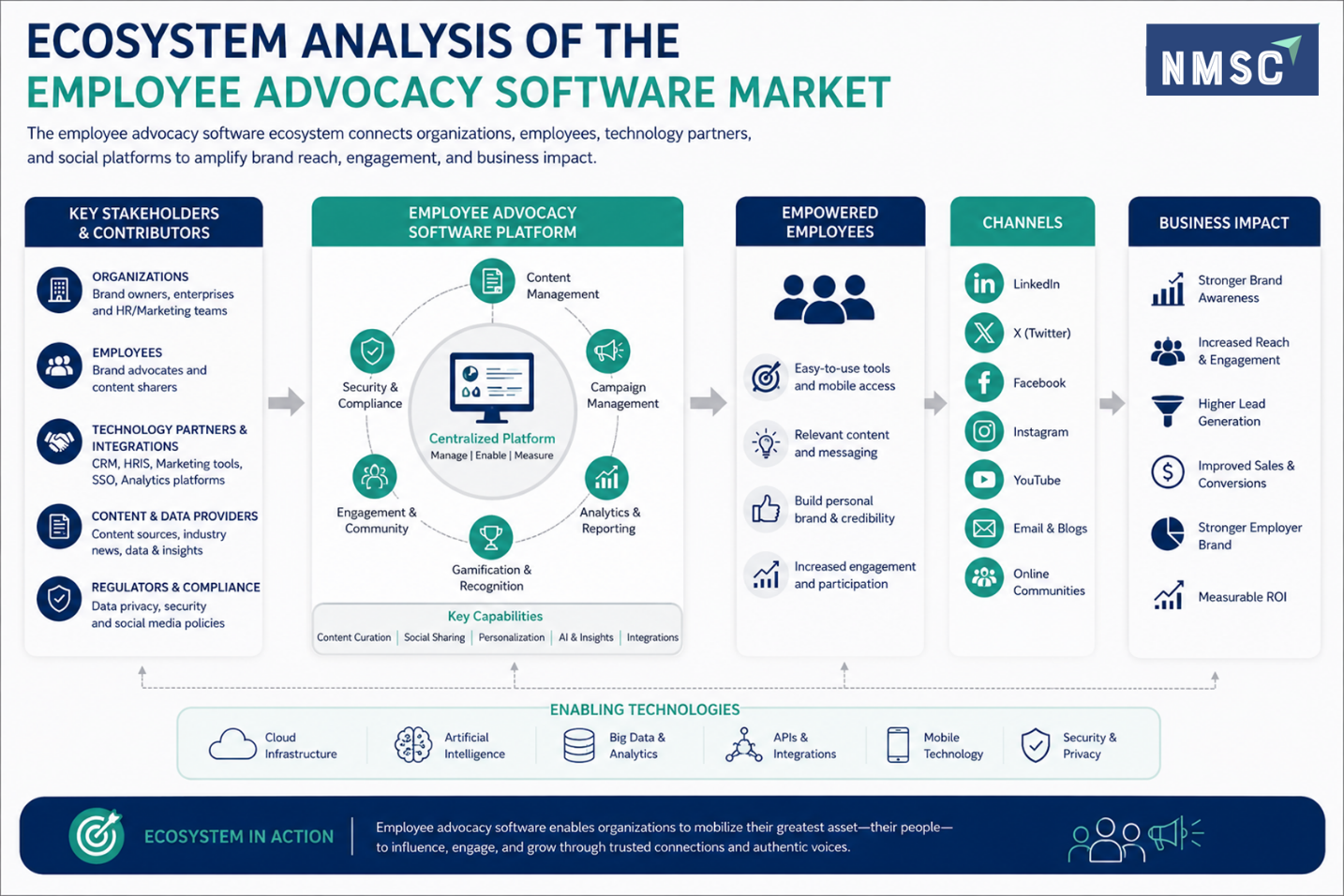
The infographic presents the Ecosystem Analysis of the Employee Advocacy Software Market, illustrating how organizations, employees, technology partners, content providers, and compliance stakeholders interact through centralized advocacy platforms. It highlights core capabilities such as content management, campaign management, analytics, gamification, engagement, and integrations, while connecting employees with key communication channels. The ecosystem ultimately drives brand awareness, engagement, lead generation, sales conversions, employer branding, and measurable ROI.

Market Drivers & Dynamics

Interactive Dataset
Rising enterprise investment in organic social reach amid paid media cost inflation driver +2.4% Global 2026–2035
Growing employer branding pressure amid competitive talent markets driver +2.1% North America, Europe 2026–2035
Expanding B2B social selling adoption among sales organizations driver +1.6% Global 2026–2035
Rising executive thought leadership investment on professional networks driver +1.3% North America, Europe 2026–2032
Growing small and medium enterprise access to cloud-based advocacy tools driver +1.1% Asia-Pacific, Latin America 2026–2035
Increasing AI-assisted content personalization capability driver +0.9% Global 2026–2035
Employee data privacy and social media usage policy constraints restraint −1.2% Europe, North America 2026–2032
Inconsistent employee participation rates limiting programme ROI restraint −0.8% Global 2026–2035
Budget competition with adjacent social media management tools restraint −0.6% Global 2028–2035
Source: Next Move Strategy Consulting

Growth Drivers

What Is the Primary Growth Driver of the Employee Advocacy Software Market?

Rising enterprise investment in organic social reach amid paid media cost inflation is the primary driver of the market. Industry commentary from platform vendors continues to describe employee advocacy as a cost-efficient complement to paid social advertising, leveraging employees' combined social networks to extend organic reach. We observed that this cost-efficiency positioning, reinforced by expanding vendor customer bases spanning thousands of enterprise accounts, continues to anchor baseline demand for brand advocacy and social selling software.

How Is Employer Branding Demand Driving Employee Advocacy Software Market Growth?

Growing employer branding pressure amid competitive talent markets is accelerating market growth toward human resources-oriented use cases. U.S. Bureau of Labor Statistics labor market data continues to document persistent skilled-role hiring competition across multiple sectors. Our assessment indicates that this talent competition, combined with vendors including Staffbase expanding AI-native employee experience capability, is compressing adoption timelines for employer advocacy and recruitment advocacy software across North America and Europe.

Growth Inhibitors

What Is Restraining Employee Advocacy Software Market Expansion?
Employee data privacy and social media usage policy constraints restrain adoption among organizations navigating complex data protection compliance requirements. European Union data protection guidance continues to require careful handling of employee personal data connected to social media accounts. We found that vendors offering granular consent management and privacy-compliant data handling are beginning to offset this restraint, though full adoption across highly regulated sectors remains gradual.

Segmentation Analysis

2025 (USD Billion)
2035 (USD Billion)
Public Cloud
Multi-Tenant
Single-Tenan
Private Clou
Hosted Priva
Segment Item 2025 (USD Billion) 2035 (USD Billion) CAGR
Public Cloud $10.0 USD Billion $40.0 USD Billion 18.0%
Multi-Tenant SaaS $17.1 USD Billion $51.1 USD Billion 24.0%
Single-Tenant SaaS $24.2 USD Billion $62.2 USD Billion 26.0%
Private Cloud $31.3 USD Billion $73.3 USD Billion 8.0%
Hosted Private Cloud $38.4 USD Billion $84.4 USD Billion 27.0%

Segment-wise data not detailed in this view

Unlock complete segment-wise numbers for By Deployment Model.

Unlock Full Data
2025 (USD Billion)
2035 (USD Billion)
SME
Micro Enterp
Small Enterp
Medium Enter
Large Enterp
Segment Item 2025 (USD Billion) 2035 (USD Billion) CAGR
SME $10.0 USD Billion $40.0 USD Billion 10.0%
Micro Enterprise $17.1 USD Billion $51.1 USD Billion 24.0%
Small Enterprise $24.2 USD Billion $62.2 USD Billion 14.0%
Medium Enterprise $31.3 USD Billion $73.3 USD Billion 20.0%
Large Enterprise $38.4 USD Billion $84.4 USD Billion 11.0%

Segment-wise data not detailed in this view

Unlock complete segment-wise numbers for By Organization Size.

Unlock Full Data
2025 (USD Billion)
2035 (USD Billion)
Brand Advocacy 2025: $0.36 Billion | 2035: $1.13 Billion
Brand Advoca
Social Selling 2025: $0.28 Billion | 2035: $1.28 Billion
Social Selli
Executive Advocacy 2025: $0.18 Billion | 2035: $0.89 Billion
Executive Ad
Employer Advocacy 2025: $0.21 Billion | 2035: $0.80 Billion
Employer Adv
Recruitment Advocacy 2025: $0.17 Billion | 2035: $0.60 Billion
Recruitment
Corporate Advocacy 2025: $0.12 Billion | 2035: $0.34 Billion
Corporate Ad
Brand Advocacy $0.36 Billion $1.13 Billion 10.9%
Social Selling $0.28 Billion $1.28 Billion 15.6%
Executive Advocacy $0.18 Billion $0.89 Billion 16.1%
Employer Advocacy $0.21 Billion $0.80 Billion 13.1%
Recruitment Advocacy $0.17 Billion $0.60 Billion 12.1%
Corporate Advocacy $0.12 Billion $0.34 Billion 9.8%

Which Use Case Segment Dominates the Employee Advocacy Software Market?

Brand Advocacy led the market with USD 0.36 billion in 2025, supported by its role as the foundational use case through which most organizations first adopt advocacy software before expanding into specialized applications. We observed that Executive Advocacy is the fastest-growing use case, expanding at a 16.1% CAGR from 2026 to 2035, as organizations increasingly invest in personal branding and thought leadership programmes for senior leaders on professional social networks.

2025 (USD Billion)
2035 (USD Billion)
Marketing 2025: $0.45 Billion | 2035: $1.52 Billion
Marketing
Sales 2025: $0.29 Billion | 2035: $1.10 Billion
Sales
Communications 2025: $0.25 Billion | 2035: $0.88 Billion
Communicatio
Human Resources 2025: $0.22 Billion | 2035: $0.99 Billion
Human Resour
Executive Leadership 2025: $0.11 Billion | 2035: $0.55 Billion
Executive Le
Marketing $0.45 Billion $1.52 Billion 11.7%
Sales $0.29 Billion $1.10 Billion 13.1%
Communications $0.25 Billion $0.88 Billion 12.1%
Human Resources $0.22 Billion $0.99 Billion 15.1%
Executive Leadership $0.11 Billion $0.55 Billion 17.1%

Which Buyer Function Leads Employee Advocacy Software Market Demand?

Marketing remained the leading buyer function, valued at USD 0.45 billion in 2025 as the traditional owner of brand advocacy and content distribution programmes within most organizations. Based on research conducted by NMSC, we found that Executive Leadership is the fastest-growing buyer function at a 17.1% CAGR from 2026 to 2035, reflecting rising direct investment by C-suite offices in personal thought leadership and corporate reputation management programmes.

2025 (USD Billion)
2035 (USD Billion)
Per Advocate
Active Advoc
Registered A
Per Employee
Active Emplo
Segment Item 2025 (USD Billion) 2035 (USD Billion) CAGR
Per Advocate $10.0 USD Billion $40.0 USD Billion 15.0%
Active Advocate $17.1 USD Billion $51.1 USD Billion 17.0%
Registered Advocate $24.2 USD Billion $62.2 USD Billion 19.0%
Per Employee $31.3 USD Billion $73.3 USD Billion 17.0%
Active Employee $38.4 USD Billion $84.4 USD Billion 10.0%

Segment-wise data not detailed in this view

Unlock complete segment-wise numbers for By Pricing Model.

Unlock Full Data
2025 (USD Billion)
2035 (USD Billion)
Technology 2025: $0.25 Billion | 2035: $1.30 Billion
Technology
BFSI 2025: $0.17 Billion | 2035: $0.65 Billion
BFSI
Retail 2025: $0.12 Billion | 2035: $0.38 Billion
Retail
Consumer Goods 2025: $0.09 Billion | 2035: $0.27 Billion
Consumer Goo
Telecom 2025: $0.08 Billion | 2035: $0.22 Billion
Telecom
Media 2025: $0.07 Billion | 2035: $0.20 Billion
Media
Healthcare 2025: $0.11 Billion | 2035: $0.47 Billion
Healthcare
Life Sciences 2025: $0.07 Billion | 2035: $0.40 Billion
Life Science
Manufacturing 2025: $0.11 Billion | 2035: $0.28 Billion
Manufacturin
Professional Services 2025: $0.09 Billion | 2035: $0.38 Billion
Professional
Education 2025: $0.05 Billion | 2035: $0.17 Billion
Education
Government 2025: $0.04 Billion | 2035: $0.10 Billion
Government
Travel 2025: $0.03 Billion | 2035: $0.09 Billion
Travel
Hospitality 2025: $0.03 Billion | 2035: $0.08 Billion
Hospitality
Energy 2025: $0.01 Billion | 2035: $0.03 Billion
Energy
Utilities 2025: $0.01 Billion | 2035: $0.02 Billion
Utilities
Real Estate 2025: $0.01 Billion | 2035: $0.02 Billion
Real Estate
Technology $0.25 Billion $1.30 Billion 17.1%
BFSI $0.17 Billion $0.65 Billion 13.1%
Retail $0.12 Billion $0.38 Billion 10.9%
Consumer Goods $0.09 Billion $0.27 Billion 9.8%
Telecom $0.08 Billion $0.22 Billion 9.1%
Media $0.07 Billion $0.20 Billion 10.1%
Healthcare $0.11 Billion $0.47 Billion 15.1%
Life Sciences $0.07 Billion $0.40 Billion 19.1%
Manufacturing $0.11 Billion $0.28 Billion 8.9%
Professional Services $0.09 Billion $0.38 Billion 14.1%
Education $0.05 Billion $0.17 Billion 11.1%
Government $0.04 Billion $0.10 Billion 7.9%
Travel $0.03 Billion $0.09 Billion 12.1%
Hospitality $0.03 Billion $0.08 Billion 9.8%
Energy $0.01 Billion $0.03 Billion 6.9%
Utilities $0.01 Billion $0.02 Billion 8.1%
Real Estate $0.01 Billion $0.02 Billion 12.9%

Which End User Segment Leads Employee Advocacy Software Adoption?

Technology remained the dominant end user, reaching USD 0.25 billion in 2025 due to the sector's early adoption of social-first marketing and talent branding practices. Our findings suggest that Life Sciences is the fastest-growing end user at a 19.1% CAGR from 2026 to 2035, reflecting rising adoption of employer advocacy and thought leadership programmes among biotechnology and clinical research organizations competing for specialized scientific talent.

Growth Opportunities

Our analysis shows that three forward-looking opportunities stand out for stakeholders positioning within the employee advocacy software market over the 2026–2035 forecast period.

How Can AI-Driven Personalization Unlock Value for Enterprise Buyers?

AI-driven content personalization presents a whitespace opportunity for vendors targeting large enterprises seeking to scale advocacy participation without expanding content operations headcount. Suppliers that embed generative AI -based message suggestions directly into advocacy workflows stand to capture premium pricing as marketing and communications teams pursue higher employee participation rates without proportional content curation investment.

Where Does Frontline Workforce Advocacy Create New Demand?

Deskless and frontline employee populations represent an underpenetrated opportunity for vendors extending advocacy tools beyond traditional desk-based, social-media-native knowledge workers. Suppliers that design mobile-first, low-friction advocacy experiences can secure new enterprise segments in retail, hospitality, and manufacturing seeking to extend brand and employer advocacy participation to frontline workforce populations previously excluded from advocacy programmes.

How Can Executive Advocacy Suites Benefit Corporate Reputation Teams?

Corporate reputation and executive communications teams seeking structured thought leadership programmes create an opportunity for vendors offering dedicated executive advocacy suites. Early movers that combine personal branding coaching with content governance and analytics can differentiate with executive leadership buyers pursuing measurable, systematic approaches to senior leader social media presence beyond ad hoc personal posting.

Supply Chain Structure of the Employee Advocacy Software Market

Supply Chain Structure of the Employee Advocacy Software Market

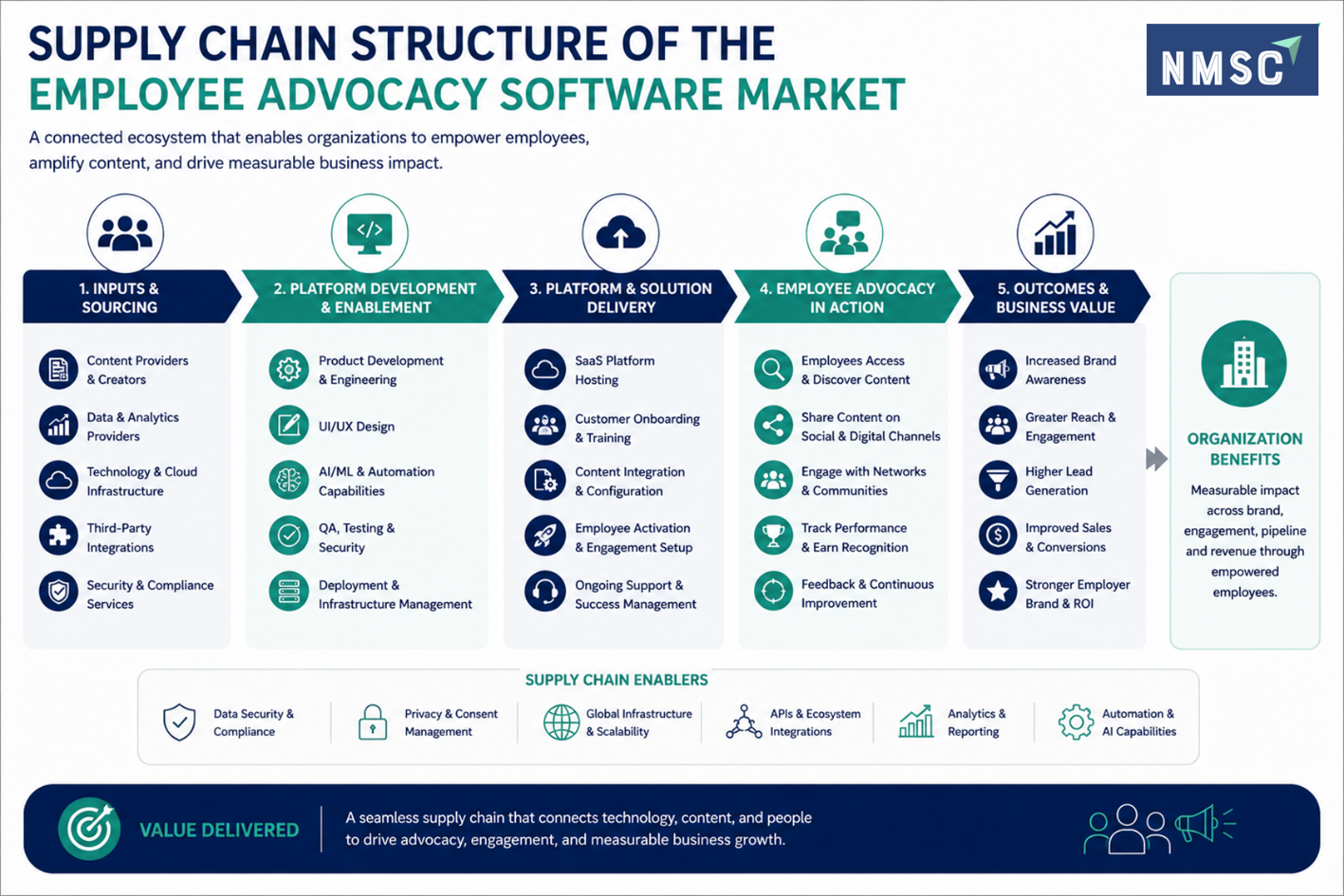
The infographic illustrates the Supply Chain Structure of the Employee Advocacy Software Market, covering the flow from content, data, technology, integrations, and security providers through platform development and SaaS delivery to employee advocacy activities. It highlights key outcomes such as increased brand awareness, engagement, lead generation, sales conversions, employer branding, and ROI, while emphasizing security, privacy, scalability, analytics, integrations, and AI as critical supply-chain enablers.

Regional Outlook

North America $0.55 Billion $1.95 Billion 12.2%
Europe $0.36 Billion $1.22 Billion 11.8%
Asia-Pacific $0.28 Billion $1.33 Billion 16.1%
Middle East & Africa $0.08 Billion $0.35 Billion 15.1%
Latin America $0.05 Billion $0.20 Billion 13.1%

Competitive Landscape

We observed that the employee advocacy software market remains moderately fragmented among diversified social media management platforms and specialized advocacy-focused vendors competing for marketing, communications, and human resources budget. Field | Details Market Structure | Moderately fragmented, led by diversified social media management platforms and specialized advocacy vendors Innovation Focus | AI-assisted content curation, employee experience platform convergence, and integrated analytics M&A Activity | Moderate, concentrated in employee communications platform consolidation and geographic expansion Source: www.nextmsc.com

How Do Companies Compete in the Employee Advocacy Software Market?

Companies compete primarily on content curation depth, employee participation rate optimization, and integration breadth with existing social and communications stacks across the industry. Diversified vendors such as Sprout Social, Inc. and Hootsuite Inc. leverage broad social media management platforms to cross-sell advocacy modules, while specialized vendors such as DSMN8 Ltd and GaggleAMP , Inc. compete on dedicated advocacy feature depth and gamification capability.

Which Competitive Archetypes Dominate the Employee Advocacy Software Market?

Two archetypes dominate the market: diversified social media and employee communications platforms offering advocacy as an integrated module, and specialized advocacy-first vendors focused on dedicated program management. Sprout Social, Inc. and Staffbase SE exemplify the diversified archetype through advocacy capability embedded in broader social and communications suites, while DSMN8 Ltd and Oktopost Technologies Ltd. exemplify the specialized archetype through purpose-built advocacy and social selling platforms.

How Are Companies Differentiating Through Innovation in Employee Advocacy?

Innovation and differentiation strategy increasingly center on AI-assisted content personalization and unified reporting. Sprout Social's AI-driven message idea suggestions and integration of Advocacy data into its Post Performance Report exemplify how vendors are reducing content preparation friction while consolidating measurement. Our analysis shows that vendors unable to demonstrate AI-assisted workflow efficiency risk losing enterprise accounts to competitors with more automated content curation capability.

What M&A and Expansion Activity Is Shaping the Employee Advocacy Software Market?

Geographic expansion and platform convergence continue to shape competitive positioning within the industry. Staffbase's establishment of a Mexico City hub for Latin American enterprises and a Middle East and Africa office, alongside its earlier French market entry, illustrates how leading vendors are scaling regional sales infrastructure to serve multinational enterprise accounts. This expansion pattern, combined with continued convergence of advocacy and broader employee experience platforms, is reshaping competitive boundaries across the industry.

Key Market Players

Our assessment indicates that the following 19 companies are actively shaping platform innovation, geographic expansion, and commercial strategy within the global employee advocacy software market.

Hootsuite Inc. Sprout Social, Inc. Staffbase SE Firstup , Inc. Haiilo GmbH Gravit, Inc. LumApps SAS Oktopost Technologies Ltd. DSMN8 Ltd Influitive Corporation GaggleAMP , Inc. Poppulo Limited Ambassify NV ClearView Social, Inc. MarketBeam , Inc. Socxo Pte. Limited STORY CHIEF NV Heyoo HR B.V. Skail AI

Latest Developments

We found that recent activity within the employee advocacy software market is concentrated on AI feature expansion and geographic growth, reflecting the industry's push toward broader enterprise and international adoption.

Date Event
June 2026 Hootsuite launched Wisdom, a social-first AI agent, alongside Social OS, reorganizing its portfolio around AI. Its employee advocacy product, Amplify, was renamed Parliament, bringing advocacy into Hootsuite’s broader AI-powered social operating environment .
June 2026 Oktopost launched Advocacy Agent, an AI capability that drafts and formats starter posts from approved content while allowing employees to edit and retain ownership of their voice. The feature uses personal style guides and is available to Oktopost Enterprise customers .
December 2025 Ambassify highlighted a broad 2025 product expansion including built-in AI for captions and content generation, a Content Catalog , 31-day share scheduling, Personal Posts, and social engagement metrics covering reach, impressions, comments, reactions, and reposts .

Investment Opportunities

What Capital Inflows Are Targeting the Employee Advocacy Software Market?

Capital inflows into the employee advocacy software market are increasingly directed toward vendors combining advocacy capability with broader employee experience platforms. Staffbase's total funding exceeding USD 280 million across multiple rounds illustrates continued investor confidence in integrated employee communications and advocacy platforms. We observed that investors favor vendors demonstrating strong enterprise customer retention, viewing multinational account expansion as a proxy for long-term platform stickiness.

How Is Infrastructure Investment Supporting Employee Advocacy Software Market Growth?

Infrastructure investment is expanding regional sales, support, and AI capability to serve growing multinational enterprise demand. Our findings suggest that Staffbase's sequential establishment of regional hubs across France, Latin America, and the Middle East and Africa illustrates how vendors are prioritizing localized infrastructure investment to support distributed enterprise customer bases managing complex, multi-region advocacy programmes.

What ESG Considerations Are Shaping Employee Advocacy Software Investment Decisions?

Environmental, social, and governance considerations are increasingly relevant to investment decisions across the industry, with employee data privacy safeguards and inclusive workforce participation as key criteria. European Union data protection guidance continues to inform governance disclosures for platforms handling employee social media data. We found that investors increasingly favor vendors with transparent consent management practices, treating employee data governance as a governance indicator alongside platform accessibility for frontline workforce populations.

Key Benefits for Stakeholders

How Does This Report Benefit Enterprise and Industry Leaders?

Enterprise and industry leaders gain access to validated segmentation, competitive benchmarking, and regional demand forecasts that support sourcing and platform investment decisions across the employee advocacy software industry. Our analysis shows that detailed use case, buyer function, and end user breakdowns help procurement teams align platform investment with organizational priorities while identifying underserved segments for expansion.

How Does This Report Benefit Investors and Financial Analysts?

Investors and financial analysts benefit from consistent, single-point market size and CAGR estimates that support valuation and capital-allocation decisions across the employee advocacy software market supply chain. We observed that the report's regional and segment-level growth differentials help identify which vendors are best positioned to capture above-market growth in executive advocacy and Asia-Pacific categories through 2035.

How Does This Report Benefit Technology Vendors and Product Teams?

Technology vendors and product teams gain insight into emerging design requirements, including AI-assisted content personalization, unified analytics, and frontline workforce accessibility, that are reshaping the industry. Our findings suggest that this analysis helps R&D teams prioritize development roadmaps around employer branding capability and consolidated reporting that are increasingly required by large enterprise and global enterprise procurement processes.

Key Market Segments Evaluated

By Deployment Model

  • Public Cloud
  • Multi-Tenant SaaS
  • Single-Tenant SaaS
  • Private Cloud
  • Hosted Private Cloud
  • Customer-Managed Private Cloud
  • On-Premises
  • Hybrid Deployment
  • Cloud Integration
  • Cloud Coexistence

By Organization Size

  • SME
  • Micro Enterprise
  • Small Enterprise
  • Medium Enterprise
  • Large Enterprise
  • Mid-Market
  • Enterprise
  • Global Enterprise

By Use Case

  • Brand Advocacy
  • Social Selling
  • Executive Advocacy
  • Employer Advocacy
  • Recruitment Advocacy
  • Corporate Advocacy

By Buyer Function

  • Marketing
  • Sales
  • Communications
  • Human Resources
  • Executive Leadership

By Pricing Model

  • Per Advocate
  • Active Advocate
  • Registered Advocate
  • Per Employee
  • Active Employee
  • Total Employee
  • Subscription
  • Tiered Subscription
  • Enterprise Subscription
  • Others

By End User

  • Technology
  • BFSI
  • Retail
  • Consumer Goods
  • Telecom
  • Media
  • Healthcare
  • Life Sciences
  • Manufacturing
  • Professional Services
  • Education
  • Government
  • Travel
  • Hospitality
  • Energy
  • Utilities
  • Real Estate

Conclusion & Recommendations

The long-term outlook for the market remains strongly positive, with global revenue projected to nearly quadruple from USD 1.32 billion in 2025 to USD 5.04 billion by 2035 at a 13.13% CAGR. We observed that sustained employer branding pressure, expanding executive thought leadership investment, and rising AI-assisted content personalization will continue underpinning demand across marketing, sales, and human resources functions through the forecast period.

What Strategic Positioning Should Employee Advocacy Software Suppliers Pursue?

Suppliers should prioritize AI-assisted content curation and unified analytics while pursuing cross-functional use case coverage to secure long-term enterprise contracts. Our assessment indicates that vendors investing early in frontline workforce accessibility and executive advocacy suites will be best positioned to capture premium pricing within the employee advocacy software market.

How Attractive Is the Employee Advocacy Software Market for New Investment?

The employee advocacy software industry presents an attractive investment case, supported by a USD 3.39 billion absolute dollar opportunity between 2026 and 2035 and above-average growth in Asia-Pacific and executive advocacy categories. We found that investment attractiveness is highest for vendors combining broad use case coverage with strong regional expansion infrastructure, positioning them to serve both mid-market and global enterprise customer segments simultaneously.

What Market Shifts and Key Risks Should Stakeholders Monitor?

Stakeholders should monitor employee data privacy regulation, inconsistent participation rates, and budget competition with adjacent social media management tools as key risks to the employee advocacy software market. Our analysis shows that vendors unable to demonstrate measurable participation and ROI improvement risk losing enterprise contracts to competitors with validated engagement outcomes, particularly within Europe's increasingly privacy-conscious procurement environment.

What Are the Key Growth Pathways for the Employee Advocacy Software Market?

Key growth pathways include expanding AI-assisted personalization capability, scaling frontline workforce accessibility, and deepening penetration into life sciences and healthcare end-use industries. NMSC's analysis indicates that suppliers pursuing these pathways while maintaining strong data governance practices will be best positioned to capture the employee advocacy software market's projected growth through 2035.

FAQs

About the Author

Reshma Dey

Reshma Dey

Reshma Dey is an experienced HR & Operations professional with over seven years of expertise in people management, organizational planning, and internal operations. In her role at Next Move Strategy Consulting, she supports business growth through effective HR leadership and streamlined operational processes. With a Master’s degree in Human Resource Management, her interests include leadership development, workplace culture, and evolving HR practices that enable long-term organizational success.

About the Reviewer

Supradip Baul

Supradip Baul

Supradip Baul is an accomplished business consultant and strategist with over a decade of rich experience in market intelligence, strategy, technology, and business transformation. His work has included rigorous qualitative and quantitative analysis across multiple industries, helping clients shape investment decisions and long-term roadmaps. Earlier in his career, he was associated with Gartner, where he contributed to industry-leading reports and market share analyses. He has worked with leading global companies and holds an MBA with a dual specialization in Marketing and Finance.

Download Free Sample

Rishabh Jogani

RISHABH JOGANI

Strategy Analyst

Accenture Japan

We are incredibly impressed with the market report on the real estate market in India provided by Next Move Strategy Consulting. The report was thorough, insightful, and well-structured, offering deep analysis and actionable recommendations. It not only captured the current trends and dynamics but also provided a forward-looking perspective that has been invaluable for our strategic planning. Their team demonstrated exceptional professionalism, attention to detail, and a profound understanding of the industry. The data-driven insights and clarity of presentation exceeded our expectations, making complex market trends easy to understand. We highly recommend Next Move Strategy Consulting to anyone looking for reliable and comprehensive market research services. Their expertise has given us the confidence to navigate the complexities of the Indian real estate market with clarity and foresight.

Pratyush Kumar Das

PRATYUSH KUMAR DAS

Assistant Manager

Polycab India Limited

We would like to express our appreciation for the data and insights provided by nextmsc. We are very pleased with the quality and depth of the information, which has proven to be highly valuable and beneficial for our business decision-making.

Kishu Kanda

KISHU KANDA

Strategy Analyst

Accenture

We purchased the AI Consumer Market Report from this company. Not only did they customize the report to meet our specific requirements, but they also showed great flexibility in accommodating our budget. The report we received fully met our expectations. Additionally, they provided prompt and thorough responses to both our pre-purchase and follow-up questions. We look forward to working with this company again in the future.

Diana Trejo

DIANA TREJO

Assistant Manager

Sumitomo Corporation de Mexico, S.A. de C.V.

Recently, we purchased a report on the Mexico Data Center Market from Next Move Strategy Consulting. The service has been excellent, with support that is always timely and thoroughly professional. The information provided is interesting, highly useful, and delivered with clarity. I would highly recommend NextMSC for anyone seeking insightful and dependable analysis.

Amos Chang

AMOS CHANG

Strategy Consultant

Kardex Group

I have bought the intralogistics market reports from NMSC two times so far. Joseph and his team are always very helpful and flexible in responding to any customization requirements on the report. Their expertise in market reports really helps us steer the day-to-day business. I will definitely recommend and come back myself whenever there is a need.

Custom Market Research Services

We will customize the research for you if the listed report does not fully match your requirements.

Get 30% Free Customization

Select License

This website uses cookies to ensure you get the best experience on our website. Learn more