Claims Processing Software Market Global Industry Analysis and Forecast (2026-2035)

Claims processing software market size is estimated at USD 60.42 billion in 2026, projected to reach USD 124.97 billion by 2035, growing at a CAGR of 8.41% from 2026 to 2035. Key drivers include AI-enabled claims adjudication, cloud migration, and automated fraud detection, with North America leading the market and Asia-Pacific registering the fastest growth.

Download Free Sample PDF
Base Year (2025)
$53.24 Billion
Forecast (2035)
$124.97 Billion
CAGR (2026-2035)
8.4%
Top Region
North America

What Is the Claims Processing Software Market Size?

The global claims processing software market size was valued at USD 53.24 Billion in 2025 and is estimated to grow from USD 60.42 Billion in 2026 to USD 124.97 Billion by 2035, expanding at a CAGR of 8.41% between 2026 and 2035. North America led the claims processing software market with an approximate 40% revenue share in 2025, while Software remained the dominant component with an approximate 68% share of global revenue.

We observed that the claims processing software market's momentum is best captured through a concise set of indicators before deeper analysis follows.

Claims Processing Software Market Global Industry Analysis and Forecast (2026-2035) Revenue Forecast

Values in USD Billion

2025 $53.24 Billion
2025
2026 $57.72 Billion
2026
2027 $62.57 Billion
2027
2028 $67.83 Billion
2028
2029 $73.54 Billion
2029
2030 $79.72 Billion
2030
2031 $86.43 Billion
2031
2032 $93.70 Billion
2032
2033 $101.58 Billion
2033
2034 $110.12 Billion
2034
2035 $124.97 Billion
2035

Key Takeaways

By Component: Software held the largest share of approximately USD 36.34 billion in 2025 and is projected to reach USD 87.02 billion by 2035; Software is also the fastest-growing sub-segment at 9.13% CAGR from 2026–2035 By Deployment Mode: Cloud held the largest share of approximately USD 31.94 billion in 2025 and is projected to reach USD 81.23 billion by 2035, and is the fastest-growing sub-segment at 9.78% CAGR from 2026–2035 By Insurance Type: Property & Casualty Insurance held the largest share of approximately USD 19.72 billion in 2025 and is projected to reach USD 44.24 billion by 2035; Workers’ Compensation & Other is the fastest-growing sub-segment at 10.04% CAGR from 2026–2035 Dominant Region: North America dominated with approximately USD 21.30 billion in 2025 and is projected to reach USD 45.74 billion by 2035 Fastest-Growing Region: Asia-Pacific is expected to register the highest CAGR of 11.25% during 2026–2035 Dominant Country: U.S. was the largest single national contributor within North America in 2025 Fastest-Growing Country: India is the fastest-growing country, with its CAGR outpacing the regional Asia-Pacific average

Market Opportunity: The claims processing software market is projected to generate an incremental revenue opportunity of approximately USD 64.55 Billion between 2026 and 2035, reflecting the absolute dollar gap between the 2035 forecast and the 2026 base value — a signal of sustained investment in cloud-native claims platforms and AI-enabled adjudication tools

According to NMSC analysis, insurers are progressively shifting claims-technology spend toward AI-enabled fraud detection and straight-through adjudication capabilities, a dynamic not fully captured in aggregate revenue figures but material to future component-mix and vendor selection.

What does the Claims Processing Software Market Encompass?

The claims processing software market encompasses software platforms and associated implementation, consulting, and support services used by insurers, third-party administrators, and brokers to manage the end-to-end claims lifecycle, from first notice of loss through adjudication, investigation, settlement, and payment. Our assessment indicates that the market spans claims management, claims adjudication, fraud detection and analytics, and document management functionality, delivered through cloud and on-premise deployment models to property and casualty, health, auto, life, and workers’ compensation insurance lines.
Structurally, the market has evolved from rules-based claims workflow engines toward AI-augmented, straight-through processing platforms that triage, route, and adjudicate low-complexity claims with minimal human intervention. We found that regulatory environments administered by state insurance departments in the U.S. and the European Insurance and Occupational Pensions Authority continue to shape claims-handling timeliness and fair-claims-practice requirements, while technology adoption trends in generative AI and computer-vision damage assessment are shortening cycle times and influencing platform selection across insurer and TPA operations.

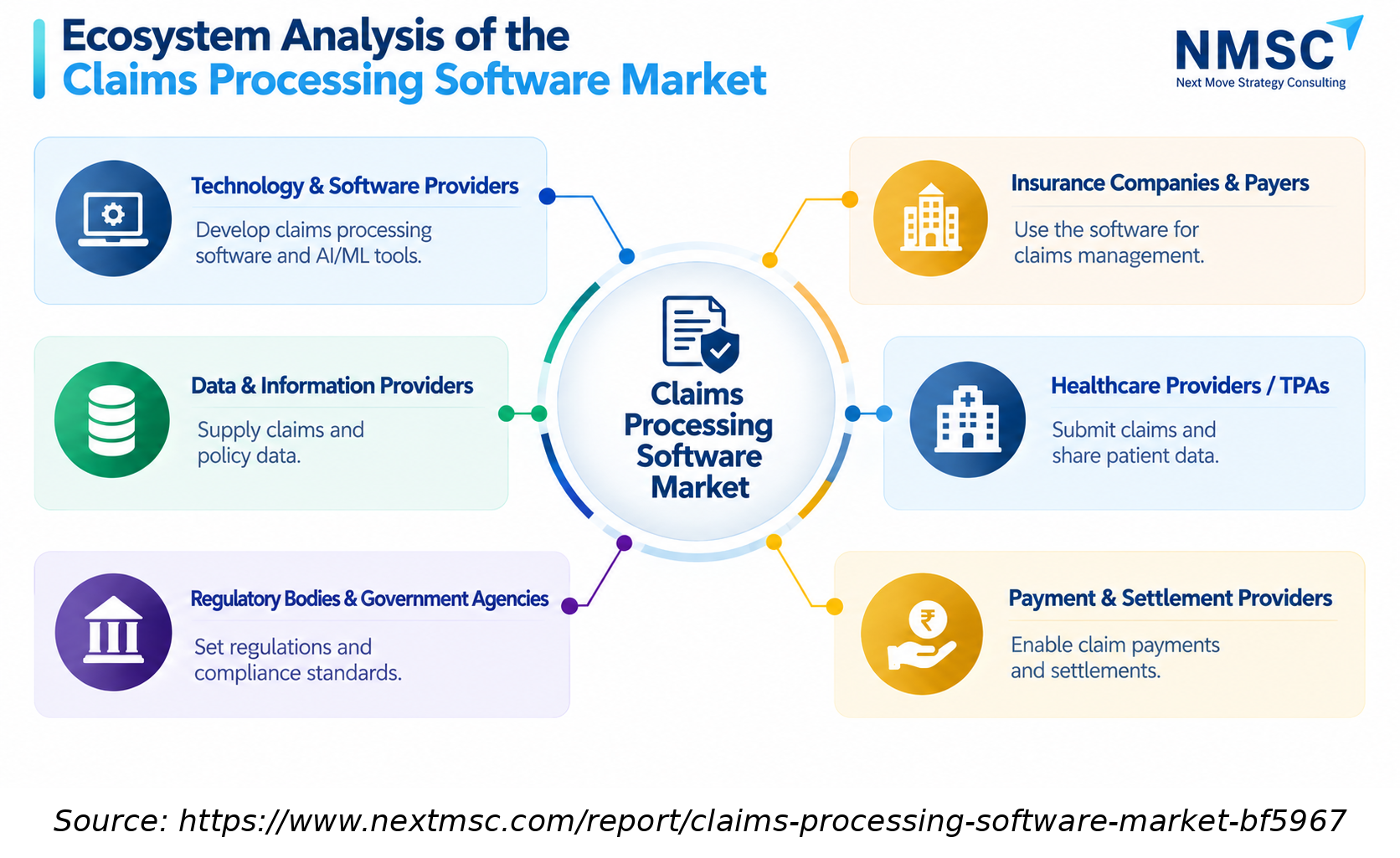
Ecosystem Analysis

Market Drivers & Dynamics

Interactive Dataset
Rising adoption of AI-enabled claims adjudication driver +1.7% Global 2026–2035
Growth in cloud migration of legacy core claims systems driver +1.3% North America, Europe 2026–2035
Expansion of usage-based and telematics-linked auto claims driver +0.9% North America, Europe, APAC 2026–2032
Rising claims volume from climate-linked property losses driver +0.8% North America, Asia-Pacific 2026–2035
Expansion of insurtech and digital-first claims platforms driver +0.6% Asia-Pacific, Latin America 2026–2035
High integration cost with legacy policy and billing systems restraint −0.6% Global 2026–2032
Data privacy and claims-data localization requirements restraint −0.5% Europe, Asia-Pacific 2026–2033
Budget constraints among small and mid-size insurers restraint −0.4% Middle East & Africa, Latin America 2026–2033
Source: Next Move Strategy Consulting

Growth Drivers

What Is the Primary Growth Driver for the Claims Processing Software Market?

Rising adoption of AI-enabled claims adjudication is the primary growth driver, sustaining consistent platform demand across personal and commercial insurance lines. State insurance regulators in the U.S. have increasingly issued guidance on AI use in claims decisioning, underscoring the scale of carrier investment required to deploy AI-based adjudication in a compliant, auditable manner through the forecast period.

How Is Cloud Migration Driving the Market Growth?

Cloud migration is driving growth by shifting carrier spend from on-premise licensing toward recurring SaaS subscriptions with continuous feature delivery. Company analysis indicates that large carriers are expanding cloud claims deployments to reduce release cycles and support faster AI-feature adoption. Based on research conducted by NMSC, we found that this shift is most pronounced among top-50 U.S. and European property and casualty carriers.

Growth Inhibitors

What Is Restraining the Claims Processing Software Market?

High integration cost with legacy policy administration and billing systems is restraining overall revenue growth, as carriers weigh multi-year modernization budgets against near-term implementation risk. We observed that this restraint is most pronounced among mid-size and regional carriers operating decades-old core systems, compressing near-term deal velocity even as long-term platform-replacement demand continues to rise.

What Are the Growth Opportunities?

Can Embedded Fraud-Analytics APIs Expand Mid-Market Carrier Adoption?

Embedding fraud-detection and anomaly-scoring capabilities as lightweight APIs within existing claims workflows can expand adoption among mid-market carriers unable to justify full platform replacement. This mechanism primarily benefits specialist fraud-analytics vendors positioned to supply modular, usage-priced detection services alongside incumbent core systems.

Will Agentic AI Adjudication Address Adjuster Capacity Constraints?

Agentic AI tools that autonomously triage, investigate, and recommend settlement on low-complexity claims offer a mechanism to address adjuster staffing shortages without proportional headcount growth. Cloud-native claims platform vendors with generative-AI partnerships stand to benefit most from this high-value automation niche.

Can Telematics-Linked Claims Prefill Unlock Faster Auto Settlement Cycles?

Integrating telematics and connected-vehicle data directly into first notice of loss can prefill claims details and unlock faster auto settlement cycles. Auto-claims specialists with existing repair-network and estimating integrations are best positioned to capture this opportunity as insurers expand usage-based claims programs.

Segmentation Analysis

2025 (USD Billion)
2035 (USD Billion)
Software 2025: $36.34 Billion | 2035: $87.02 Billion
Software
Services 2025: $16.90 Billion | 2035: $37.95 Billion
Services
Software $36.34 Billion $87.02 Billion 9.13%
Services $16.90 Billion $37.95 Billion 8.44%

Which Component Dominates the Claims Processing Software Market?

Software dominates component segmentation with an estimated USD 36.34 Billion in 2025, rising to USD 87.02 Billion by 2035, reflecting sustained carrier investment in claims management, adjudication, and fraud-analytics applications. Software is also the fastest-growing segment at a 9.13% CAGR, reflecting expanding AI-feature attach rates and rising subscription pricing as carriers add generative-AI and computer-vision modules to core claims platforms.

2025 (USD Billion)
2035 (USD Billion)
Cloud
Public Cloud
Private Clou
Hybrid Cloud
On-Premise
Segment Item 2025 (USD Billion) 2035 (USD Billion) CAGR
Cloud $10.0 USD Billion $40.0 USD Billion 25.0%
Public Cloud $17.1 USD Billion $51.1 USD Billion 11.0%
Private Cloud $24.2 USD Billion $62.2 USD Billion 25.0%
Hybrid Cloud $31.3 USD Billion $73.3 USD Billion 11.0%
On-Premise $38.4 USD Billion $84.4 USD Billion 16.0%

Segment-wise data is locked

Unlock complete segment-wise numbers for By Deployment Mode.

Unlock Full Data

Which Deployment Mode Leads and Which Is Growing Fastest?

Cloud leads deployment-mode segmentation with USD 31.94 Billion in 2025 revenue, reflecting carrier preference for subscription pricing, faster release cycles, and reduced infrastructure ownership. Cloud is also the fastest-growing mode at a 9.78% CAGR, driven by large-carrier migration programs and insurtech entrants building claims operations natively on cloud infrastructure from inception.

2025 (USD Billion)
2035 (USD Billion)
Property & C
Personal Lin
Commercial L
Health Insur
Auto/Motor I
Segment Item 2025 (USD Billion) 2035 (USD Billion) CAGR
Property & Casualty Insurance $10.0 USD Billion $40.0 USD Billion 27.0%
Personal Lines $17.1 USD Billion $51.1 USD Billion 9.0%
Commercial Lines $24.2 USD Billion $62.2 USD Billion 19.0%
Health Insurance $31.3 USD Billion $73.3 USD Billion 17.0%
Auto/Motor Insurance $38.4 USD Billion $84.4 USD Billion 18.0%

Segment-wise data is locked

Unlock complete segment-wise numbers for By Insurance Type.

Unlock Full Data

Which Insurance Type Segment Is Gaining the Most Ground?

Property & Casualty Insurance remains the largest insurance-type segment with USD 19.72 Billion in 2025 revenue, reflecting its high claims frequency and long-standing core-system modernization spend. Workers’ Compensation & Other is growing fastest at a 10.04% CAGR as employers and carriers expand automated medical-bill review and return-to-work case-management tools within claims platforms.

2025 (USD Billion)
2035 (USD Billion)
Large Enterp
Small and Me
Segment Item 2025 (USD Billion) 2035 (USD Billion) CAGR
Large Enterprises $10.0 USD Billion $40.0 USD Billion 14.0%
Small and Medium Enterprises $17.1 USD Billion $51.1 USD Billion 24.0%

Segment-wise data is locked

Unlock complete segment-wise numbers for By Organization Size.

Unlock Full Data
2025 (USD Billion)
2035 (USD Billion)
Insurance Co
Third-Party
Insurance Br
Other End Us
Segment Item 2025 (USD Billion) 2035 (USD Billion) CAGR
Insurance Companies $10.0 USD Billion $40.0 USD Billion 24.0%
Third-Party Administrators $17.1 USD Billion $51.1 USD Billion 22.0%
Insurance Brokers & Agents $24.2 USD Billion $62.2 USD Billion 20.0%
Other End Users $31.3 USD Billion $73.3 USD Billion 22.0%

Segment-wise data is locked

Unlock complete segment-wise numbers for By End User.

Unlock Full Data

Growth Opportunities

Beyond current demand drivers, three whitespace opportunities stand out as forward-looking mechanisms for revenue expansion through 2035.

Can Embedded Fraud-Analytics APIs Expand Mid-Market Carrier Adoption?

Embedding fraud-detection and anomaly-scoring capabilities as lightweight APIs within existing claims workflows can expand adoption among mid-market carriers unable to justify full platform replacement. This mechanism primarily benefits specialist fraud-analytics vendors positioned to supply modular, usage-priced detection services alongside incumbent core systems.

Will Agentic AI Adjudication Address Adjuster Capacity Constraints?

Agentic AI tools that autonomously triage, investigate, and recommend settlement on low-complexity claims offer a mechanism to address adjuster staffing shortages without proportional headcount growth. Cloud-native claims platform vendors with generative-AI partnerships stand to benefit most from this high-value automation niche.

Can Telematics-Linked Claims Prefill Unlock Faster Auto Settlement Cycles?

Integrating telematics and connected-vehicle data directly into first notice of loss can prefill claims details and unlock faster auto settlement cycles. Auto-claims specialists with existing repair-network and estimating integrations are best positioned to capture this opportunity as insurers expand usage-based claims programs.

Regulatory Framework for the Claims Processing Software Market

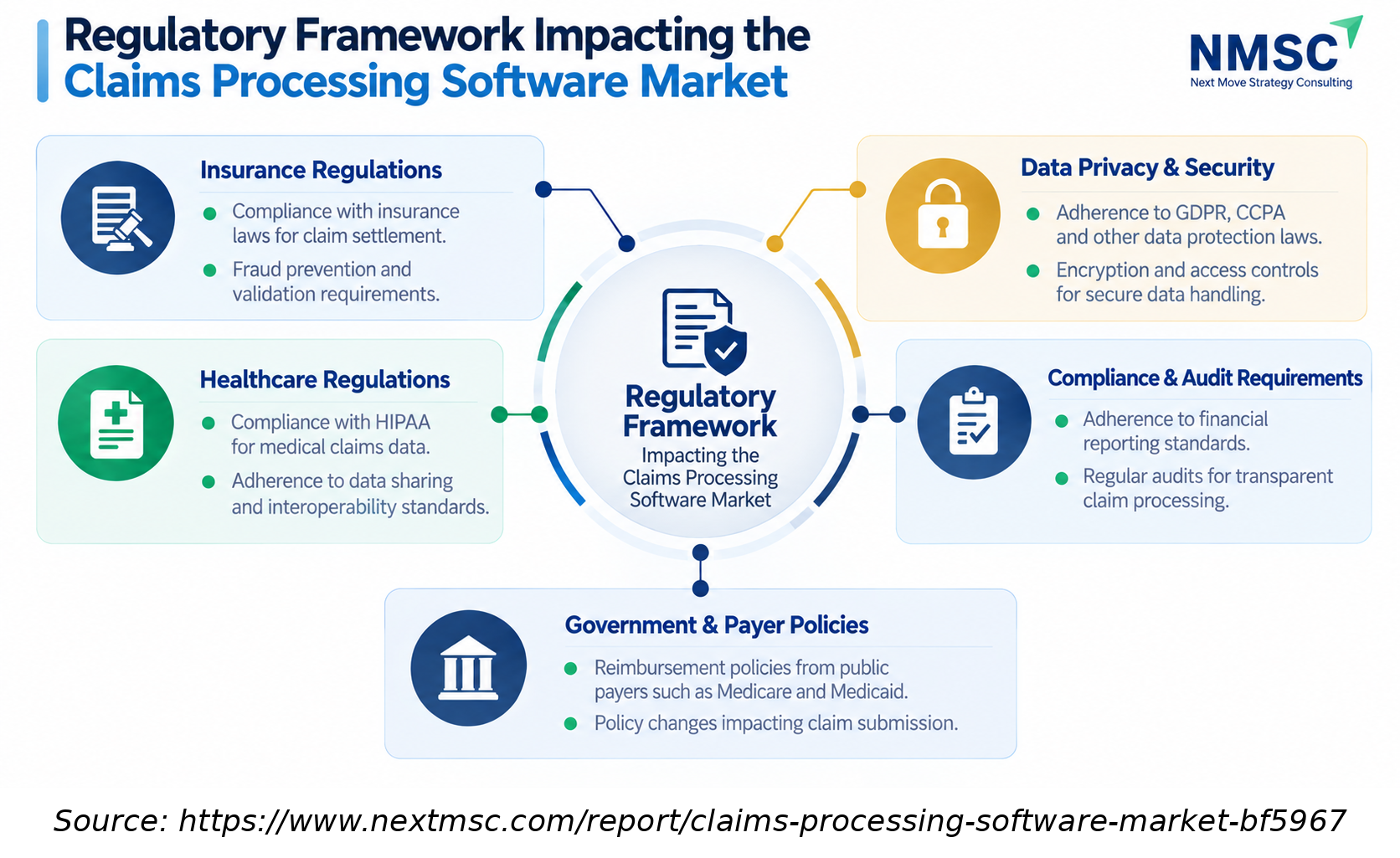
This infographic presents the Regulatory Framework for the Claims Processing Software Market, covering insurance regulations, data privacy and security, healthcare regulations, compliance and audit requirements, government and payer policies, and technology and AI governance. It highlights key requirements related to claims transparency, sensitive data protection, accurate records, reimbursement rules, auditability, fraud prevention, and responsible AI use, demonstrating how regulatory compliance influences the development and deployment of claims processing software.

Regional Outlook

2025 (USD Billion)
2035 (USD Billion)
North Americ
Europe
Asia-Pacific
Middle East
Latin Americ
Region 2025 (USD Billion) 2035 (USD Billion) CAGR (%)
North America $10.0 USD Billion $40.0 USD Billion 9.0%
Europe $17.1 USD Billion $51.1 USD Billion 27.0%
Asia-Pacific $24.2 USD Billion $62.2 USD Billion 25.0%
Middle East & Africa $31.3 USD Billion $73.3 USD Billion 23.0%
Latin America $38.4 USD Billion $84.4 USD Billion 12.0%

Regional data is locked

Unlock complete regional numbers for this market.

Unlock Full Data

Competitive Landscape

Our findings suggest that the competitive landscape spans diversified enterprise-software majors and specialized insurance-technology vendors, each pursuing distinct differentiation strategies across the claims value chain.

Dimension Description
Dimension Assessment
Market Structure Moderately consolidated; core-system majors hold large-carrier share while specialist vendors compete on AI-feature depth and speed of deployment
Innovation Focus Generative-AI claims triage, computer-vision damage assessment, agentic adjudication automation
M&A Activity Moderate; core-system vendors acquire fraud-analytics and AI specialists while private-equity sponsors consolidate mid-market platforms

How Do Companies Compete in the Claims Processing Software Market?

Companies compete primarily on breadth of claims-lifecycle functionality, depth of AI and analytics capability, and scale of insurer implementation experience. Our analysis shows that core-system majors with large installed bases sustain premium pricing on multi-year platform contracts, while specialist vendors compete on faster time-to-value and narrower, high-precision use cases such as fraud detection and damage estimating.

Which Competitive Archetypes Dominate the Industry?

Two archetypes dominate: diversified core-system vendors offering integrated policy, billing, and claims suites, and specialist claims-technology providers concentrated on adjudication, fraud, or estimating functionality. We observed that the differentiation between these archetypes is narrowing as core-system vendors expand AI-native claims modules previously reserved for specialists.

What Innovation and Differentiation Strategies Are Companies Pursuing?

Company analysis indicates that leading firms are differentiating through generative-AI claims-intake development, alongside computer-vision damage-assessment investment for auto and property lines. Investment in agentic adjudication automation continues, alongside expanded cloud-native architecture to support faster carrier onboarding across large and mid-market segments.

How Active Is M&A in the Claims Processing Software Industry?

M&A activity remains moderate as core-system vendors pursue capability-expanding acquisitions of fraud-analytics and AI specialists while private-equity sponsors consolidate mid-market claims platforms. Based on research conducted by NMSC, we found that acquisition targets increasingly cluster around generative-AI and computer-vision assets, reflecting strategic pivots toward the fastest-growing capability areas.

Key Market Players

Our assessment indicates that the following companies represent the validated set of key players shaping competitive dynamics across claims management, adjudication, fraud-analytics, and document-management software within the claims processing software market.

Guidewire Software, Inc. Duck Creek Technologies, LLC Sapiens International Corporation N.V. EIS Group, Inc. Insurity, LLC Majesco CCC Intelligent Solutions Holdings Inc. Mitchell International, Inc. (Enlyte) Solera Holdings, LLC Verisk Analytics, Inc. LexisNexis Risk Solutions (RELX Group) Shift Technology SAS Snapsheet Inc. Five Sigma, Inc. Origami Risk LLC Applied Systems, Inc. International Business Machines Corporation Oracle Corporation Salesforce, Inc. Pegasystems Inc.

Latest Developments

We observed that recent developments across the industry reflect continued investment in AI-driven claims capability and cloud platform expansion.

Date Event
August 2026 Salesforce announced that IndiaFirst Life selected Agentforce for enterprise AI transformation, including claims processing. AI agents will verify documents, identify missing information, and route exceptions for review for micro-insurance and PMJJBY claims, extending automation into life-insurance claims handling and demonstrating agentic AI adoption in production customer workflows.
August 2026 Solera launched Qapter Estimating ADAS Integration with Azimuth Claims Solutions, adding a dedicated breakdown of ADAS calibration procedures, operational requirements, and labor times to collision estimates. The capability gives insurers and repair stakeholders greater visibility during claims estimation, supporting more transparent, data-driven repair planning and settlement decisions.
April 2026 Duck Creek launched its insurance-native Agentic AI Platform and introduced Agentic FNOL, enabling insurers to deploy governed AI agents within core P&C workflows. The platform combines insurance domain models, carrier data, orchestration, and audit controls, pushing claims intake and downstream handling toward automated, human-in-the-loop processing.

Investment Opportunities

Where Is Capital Flowing Within the Claims Processing Software Market?

Capital inflows are concentrated in generative-AI claims-automation development and cloud-migration tooling for large-carrier core-system replacement. We found that private-equity-backed consolidation continues to support mid-market claims-platform capacity expansion, signaling sustained institutional interest in recurring-revenue insurance-technology assets.

How Significant Is Infrastructure Investment in This Market?

Infrastructure investment is substantial, with vendors expanding cloud-hosting capacity and AI-model infrastructure to meet rising carrier demand for real-time claims decisioning. Our assessment indicates that continued investment in API-based integration infrastructure is becoming a prerequisite for claims platforms to interoperate with policy, billing, and third-party data sources at scale.

What ESG Considerations Are Relevant to This Market?

ESG considerations center on fair and unbiased AI-driven claims decisioning, equitable claims-service access across underserved policyholder segments, and data-privacy governance for sensitive claims information. We observed that vendors increasingly disclose AI-governance and responsible-automation commitments in customer-facing trust documentation.

Key Benefits for Stakeholders

How Does This Report Benefit Industry Leaders?

Industry and enterprise leaders gain a structured view of component, deployment, and regional revenue distribution, supporting prioritization decisions across platform investment and modernization-program planning. Our analysis shows that this structured segmentation clarifies where competitive intensity is rising fastest ahead of vendor-selection decisions.

How Does This Report Benefit Investors and Financial Analysts?

Investors and financial analysts gain reconciled market-size, CAGR, and regional-growth data supporting valuation and portfolio-allocation decisions. Company analysis indicates that segment-level growth differentials, particularly around cloud and AI-enabled software, are material inputs for evaluating vendor growth durability.

How Does This Report Benefit Technology Vendors and Product Teams?

Technology vendors and product teams gain visibility into deployment-mode and insurance-type trends shaping cloud migration and AI-feature demand. We found that this analysis supports prioritization of engineering investment toward the fastest-growing claims-automation capabilities identified across the forecast period.

Key Market Segments Evaluated

By Component

  • Software 
    • Claims Management Software
    • Claims Adjudication Software
    • Fraud Detection & Analytics Software
    • Document Management Software
    • Other Software
  • Services 
    • Implementation & Integration Services
    • Consulting Services
    • Support & Maintenance Services
    • Training Services

By Deployment Mode

  • Cloud 
    • Public Cloud
    • Private Cloud
    • Hybrid Cloud
  • On-Premise

By Insurance Type

  • Property & Casualty Insurance 
    • Personal Lines
    • Commercial Lines
  • Health Insurance
  • Auto/Motor Insurance
  • Life Insurance
  • Workers’ Compensation & Other

By Organization Size

  • Large Enterprises
  • Small and Medium Enterprises

By End User

  • Insurance Companies
  • Third-Party Administrators
  • Insurance Brokers & Agents
  • Other End Users

By Region

  • North America 
    • U.S.
    • Canada
    • Mexico
  • Europe 
    • UK
    • Germany
    • France
    • Italy
    • Spain
    • Sweden
    • Denmark
    • Finland
    • Netherlands
    • Rest of Europe
  • Asia-Pacific 
    • China
    • India
    • Japan
    • South Korea
    • Taiwan
    • Indonesia
    • Vietnam
    • Australia
    • Philippines
    • Malaysia
    • Rest of APAC
  • Middle East & Africa 
    • Saudi Arabia
    • UAE
    • Egypt
    • Israel
    • Turkey
    • Nigeria
    • South Africa
    • Rest of MEA
  • Latin America 
    • Brazil
    • Argentina
    • Chile
    • Colombia
    • Rest of LATAM

Conclusion & Recommendations

The long-term outlook remains steadily expansionary, with revenue projected to grow from USD 60.42 Billion in 2026 to USD 124.97 Billion by 2035 at an 8.41% CAGR. Our analysis shows that this trajectory is underpinned by sustained core-system modernization and rising AI-feature adoption rather than cyclical claims-volume fluctuation alone.

What Strategic Positioning Should Companies Pursue?

Companies should prioritize AI-adjudication capability investment alongside continued cloud-native platform expansion. We found that firms combining deep insurer implementation experience with modern AI roadmaps sustain more resilient revenue than those reliant on legacy on-premise licensing alone.

How Attractive Is the Market for Investment?

Investment attractiveness is moderate to high given steady double-digit country-level growth in emerging markets alongside a large, stable base of demand in mature markets. Our assessment indicates that capital allocators should weight exposure toward vendors with proven AI-adjudication roadmaps over legacy-only competitors facing modernization-driven displacement risk.

What Market Shifts and Key Risks Should Stakeholders Monitor?

Key risks include high integration cost with legacy policy and billing systems, data-privacy and claims-data localization requirements, and budget constraints among small and mid-size insurers. We observed that integration cost poses the most immediate risk to near-term deal velocity among regional carriers.

What Are the Primary Growth Pathways Through 2035?

Primary growth pathways include embedded fraud-analytics APIs for mid-market adoption, agentic AI adjudication for adjuster-capacity relief, and telematics-linked claims prefill for faster auto settlement. Our findings suggest that companies combining all three pathways will outpace single-lever competitors through the forecast period.

FAQs

About the Author

Liza Phukan

Liza Phukan

Liza Phukan is Research Associate at Next Move Strategy Consulting, where she has covered emerging industries and market research across sectors for 3.5 years. Her work includes analyzing industry developments, validating market data, and developing structured business content from research findings. She uses secondary research and data-validation practices to turn complex market information into clear decision-useful market analysis for business audiences and support report development and B2B.

About the Reviewer

Supradip Baul

Supradip Baul

Supradip Baul is an accomplished business consultant and strategist with over a decade of rich experience in market intelligence, strategy, technology, and business transformation. His work has included rigorous qualitative and quantitative analysis across multiple industries, helping clients shape investment decisions and long-term roadmaps. Earlier in his career, he was associated with Gartner, where he contributed to industry-leading reports and market share analyses. He has worked with leading global companies and holds an MBA with a dual specialization in Marketing and Finance.

Download Free Sample

Henri Knyphausen

HENRI KNYPHAUSEN

Partner at Singulier [Ex-BCG]

Singulier

I recently engaged NEXTMSC.com for a commercial due diligence project within the intralogistics sector, and I am pleased to provide a reference based on my experience. In utilizing NEXTMSC.com's services, I found their report to offer valuable insights into market dynamics and key industry players. The initial report provided a solid foundation for our analysis. However, as we were investigating a smaller target in the market, and I had specific customization requests requiring additional research. These requests included detailed information on product portfolios of various players and sub-market sizes, both inclusive and exclusive of certain product categories. NEXTMSC.com demonstrated commendable responsiveness and agility in accommodating these customization requests. Within a timeframe of 1-2 weeks, they delivered a revised report that met our specific needs. Furthermore, they were receptive to my follow-up inquiries, ensuring clarity and understanding of the data provided. The final deliverable significantly contributed to our due diligence efforts. One of NEXTMSC.com's notable strengths lies in their qualitative research capabilities. However, for future engagements, I would recommend the inclusion of a quantified market model in Excel format. Such a model would offer the ability to conduct in-depth analyses and explore various market segments, including country-specific data and subcomponent breakdowns. Based on my positive experience, I would not hesitate to work with NEXTMSC.com again. Their responsiveness, willingness to accommodate customization requests, and commitment to delivering actionable insights make them a reliable partner for commercial research projects.


Pratyush Kumar Das

PRATYUSH KUMAR DAS

Assistant Manager

Polycab India Limited

We would like to express our appreciation for the data and insights provided by nextmsc. We are very pleased with the quality and depth of the information, which has proven to be highly valuable and beneficial for our business decision-making.

Semih Kavaklioglu

SEMIH KAVAKLIOGLU

Co-Founder & Sales Manager

Decortie

I work a lot in the marketing industry and I know that research is an essential part of any campaign. I have used Market research reports for my own products and I found them to be very informative and well-researched. The team here produces insightful reports for a good price

Gaurav Jaiswal

GAURAV JAISWAL

Founder & CEO

Yano Charge Private Limited

The EV Charging market research report provided by the NextMSC was exceptionally detailed and insightful. It offered a comprehensive analysis that proved to be a game-changer for our strategic planning. Truly a testament to the NextMSC’s expertise and thoroughness in EV market landscape & analysis.

Diana Trejo

DIANA TREJO

Assistant Manager

Sumitomo Corporation de Mexico, S.A. de C.V.

Recently, we purchased a report on the Mexico Data Center Market from Next Move Strategy Consulting. The service has been excellent, with support that is always timely and thoroughly professional. The information provided is interesting, highly useful, and delivered with clarity. I would highly recommend NextMSC for anyone seeking insightful and dependable analysis.

Custom Market Research Services

We will customize the research for you if the listed report does not fully match your requirements.

Get 30% Free Customization

Select License

This website uses cookies to ensure you get the best experience on our website. Learn more

✖