AI Claims Processing Market By Monetization Model (Software Subscription Revenue, Transaction Based Revenue, Managed Service Revenue, Professional Service Revenue), By Deployment Model (Cloud Native SaaS, Private Cloud, On-Premise, Hybrid), By Insurance Line of Business (Property and Casualty, Health Insurance, Multi-Line Insurance), By Buyer Type (Tier 1 Global Insurance Carriers, Tier 2 Regional Carriers, Tier 3 Small and Specialty Insurers, Self-Insured Corporates) — Global Analysis 2025–2035
Industry: BFSI | Publishing Date: July 6, 2026 | Last Updated: September 30, 2026 | No of Pages: N/A | No. of Tables: N/A | No. of Figures: N/A | Format: PDF | Report Code: BF4971
What Is the AI Claims Processing Market Size?
The global AI Claims Processing Market size was valued at USD 2.38 billion in 2025 and is expected to reach USD 3.01 billion by 2026. The market is projected to grow significantly, reaching USD 24.84 billion by 2035, with a CAGR of 26.4% between 2026 and 2035. This rapid expansion is driven by accelerating digital transformation within the insurance sector, rising adoption of artificial intelligence across end-to-end claims workflows, growing insurer focus on operational efficiency and fraud mitigation, and increasing demand for real-time claims decisioning capabilities across Property and Casualty, Health, and Life insurance verticals.
AI Claims Processing Market Size and Forecast
|
Parameters |
Details |
|
Market Size in 2025 |
USD 2.38 Billion |
|
Market Size in 2026 |
USD 3.01 Billion |
|
Revenue Forecast in 2035 |
USD 24.84 Billion |
|
Growth Rate |
CAGR of 26.4% from 2026 to 2035 |
|
Analysis Period |
2025–2035 |
|
Base Year Considered |
2025 |
|
Forecast Period |
2026–2035 |
|
Market Size Estimation |
USD Billion |
|
Companies Profiled |
20 |
|
Countries Covered |
33 |
|
Market Share |
Top 10 |
AI Claims Processing Market Overview
What Is the AI Claims Processing Market?
The AI Claims Processing Market encompasses software platforms, AI modules, and managed services that automate the intake, adjudication, investigation, and settlement of insurance claims across multiple lines of business. These solutions leverage artificial intelligence to improve claims accuracy, reduce processing time, and enhance customer experience. NMSC's analysis indicates that the market spans document intelligence platforms, fraud detection engines, claims decision-support tools, and fully integrated end-to-end claims automation systems connected to insurers' core policy administration platforms. The market includes both standalone AI offerings and AI capabilities embedded within broader claims management suites.
How Has the AI Claims Processing Market Evolved?
The AI Claims Processing Market has undergone a significant transformation from rule-based claims automation systems prevalent in the early 2010s to intelligent, machine learning-driven claims workflows. Early deployments focused on predefined rules and isolated automation functions, while subsequent advancements in machine learning and computer vision enabled more sophisticated claims assessment and fraud detection capabilities. Based on research conducted by NMSC, we found that the current phase is characterised by enterprise-wide AI orchestration frameworks that manage claims routing, fraud prioritization, payment authorization, and customer interactions, accelerating the modernization of legacy claims administration infrastructure.
How Do Regulations Influence the AI Claims Processing Market?
Regulatory and governance frameworks are increasingly influencing the AI Claims Processing Market. In the United States, the National Association of Insurance Commissioners (NAIC) has issued guidance requiring insurers to ensure fairness, transparency, accuracy, and accountability in AI-enabled decision-making processes. Similarly, the European Insurance and Occupational Pensions Authority (EIOPA) has introduced AI governance principles that emphasize explainability, risk management, and regulatory compliance. Our assessment indicates that these evolving requirements are driving vendors to incorporate auditability and responsible AI capabilities into product architectures while simultaneously increasing barriers to entry for new market participants.
How Is Technology Adoption Expanding Across the AI Claims Processing Market?
Technology adoption across the AI Claims Processing Market is accelerating as insurers seek to improve operational efficiency and enhance policyholder experiences. Large global carriers are increasingly investing in enterprise AI orchestration platforms and proprietary model development to support complex claims environments. Our findings suggest that mid-sized and smaller insurers are relying more heavily on cloud-native SaaS solutions and managed AI services to access advanced automation capabilities without extensive internal development resources. This divergence in deployment strategies is shaping vendor monetization models and intensifying competition across the market.
|
Key Takeaways |
|
By Monetization Model, Software Subscription Revenue dominates the AI Claims Processing Market, accounting for USD 0.91 billion in 2025, driven by widespread adoption of cloud-based claims platforms. Transaction-Based Revenue is the fastest-growing model, projected to expand at a CAGR of 29.1% from 2026 to 2035 and reach USD 9.42 billion by 2035, supported by growing preference for usage-based pricing. |
|
By Deployment Model, Cloud Native SaaS leads the market with USD 1.07 billion in 2025, benefiting from scalability and lower ownership costs. Hybrid Deployment is the fastest-growing model, advancing at a CAGR of 28.3% through 2035 as insurers integrate AI capabilities with legacy systems. |
|
By Solution Type, End-to-End Claims Platforms generated the highest revenue at USD 0.74 billion in 2025, driven by demand for comprehensive workflow automation. Fraud Detection and Risk Scoring Solutions are the fastest-growing segment, registering a CAGR of 30.5% through 2035 amid rising concerns over insurance fraud. |
|
By Insurance Line of Business, Property and Casualty Insurance held the largest share at USD 0.98 billion in 2025, supported by the high volume of auto claims. Health Insurance Claims is the fastest-growing segment, projected to grow at a CAGR of 28.7% through 2035 due to increasing use of AI in medical coding and prior authorization. |
|
By Buyer Type, Tier 1 Global Insurance Carriers represented the largest segment, contributing USD 0.95 billion in 2025. Third-Party Administrators are the fastest-growing buyers, expanding at a CAGR of 29.4% through 2035 as they invest in AI to improve operational efficiency. |
|
By Distribution Channel, Direct Enterprise Sales remained the leading channel at USD 1.04 billion in 2025, reflecting the consultative nature of AI platform procurement. Insurance Technology Partnerships are the fastest-growing channel, driven by expanding insurtech ecosystems and pre-integrated AI solutions. |
|
By Region, North America dominated the market with USD 1.07 billion in 2025, supported by strong insurer digitization and a mature insurtech ecosystem. Asia Pacific is the fastest-growing region, projected to register a CAGR of 29.8% through 2035, driven by insurance market expansion and digital transformation initiatives. |
|
By Country, the United States is the largest market at USD 0.93 billion in 2025, supported by high claims volumes and advanced AI adoption. India is among the fastest-growing country markets, driven by rising insurance penetration and a rapidly expanding domestic insurtech ecosystem. |
Key Emerging Trends in AI Claims Processing Market
How Is Generative AI Transforming Claims Documentation and Adjudication Workflows?
Generative AI is fundamentally reshaping claims documentation, customer communication, and adjudication narrative generation within the AI claims processing market. NMSC's analysis indicates that insurers are deploying large language models to automate the creation of claims summaries, coverage determination letters, and denial communications, significantly reducing adjuster workload. For example, Guidewire Software's 2024 Copilot initiative integrates generative AI directly into its ClaimCenter platform, enabling adjusters to generate structured claim narratives from unstructured conversation transcripts. This adoption is reducing average handling time and improving consistency across claims outcomes, with material implications for staffing models and adjuster productivity benchmarks.
How Is Computer Vision Reshaping Vehicle and Property Damage Assessment?
Computer vision-based damage estimation is evolving from a supplementary tool into a primary assessment channel for auto and property claims within the AI claims processing market. Our research found that platforms such as Tractable and Mitchell International now process millions of damage images annually, enabling near-instantaneous repair cost estimation that rivals traditional in-person appraisals in accuracy. The integration of drone-captured imagery for property damage assessment following catastrophe events is further extending the use case. Insurers adopting AI-powered visual assessment report 40-60% reductions in appraisal cycle times, a key competitive and cost differentiator (industry-derived estimate; no publicly verifiable dataset available).
How Are Real-Time Fraud Orchestration Platforms Changing the Economics of Claims Investigation?
Real-time fraud orchestration platforms that combine network analytics, behavioural AI, and claims history scoring are progressively replacing static rules-based fraud detection systems. Based on our market evaluation, we noticed that vendors such as FRISS and Shift Technology have developed AI models that assess fraud risk at the point of First Notice of Loss (FNOL), enabling insurers to route suspicious claims to specialized investigation units before adjudication commences. This proactive intervention model is reducing claims leakage and shortening investigation cycles. The Insurance Information Institute reported that insurance fraud costs the U.S. property-casualty industry more than USD 34 billion annually, underscoring the financial imperative driving AI fraud technology investment.
How Is the Emergence of API-Native Claims AI Architectures Enabling Modular Deployment?
API-native architectures are enabling insurers to deploy AI capabilities modularly, integrating specific AI functions such as document classification, fraud scoring, or medical coding into existing claims administration systems without requiring full platform replacement. NMSC's findings suggest that this architectural approach is particularly attractive for Tier 2 and Tier 3 insurers with substantial legacy system investment. Vendors including Cytora, Omni:us, and Sprout.ai have built cloud-native, API-first platforms that deliver discrete AI capabilities as microservices, enabling rapid value realization with controlled implementation risk. This trend is expanding the addressable market for AI claims solutions beyond large carriers to mid-market insurers.
What Are the Key Market Drivers, Breakthroughs, and Investment Opportunities that will Shape the AI Claims Processing Industry in the Next Decade?
Growth Catalyst & Risk Assessment Matrix
|
Drivers/Trends/Restraints |
(+/-) % Impact on CAGR Forecast |
Geographic Relevance |
Impact Timeline |
|
Escalating insurance claims volume and rising operational cost pressure driving AI automation adoption |
+5.8% |
North America, Europe, Asia Pacific |
Short to Medium Term (1–4 years) |
|
Rapid advancement in machine learning, computer vision, and NLP enabling higher claims AI accuracy |
+4.2% |
Global – technology-forward markets |
Medium Term (2–5 years) |
|
Expansion of cloud-native SaaS delivery models reducing AI adoption barriers for mid-tier carriers |
+3.7% |
North America, Asia Pacific, Latin America |
Short to Medium Term (1–4 years) |
|
Growing regulatory scrutiny of AI decision-making requiring explainability investments |
-2.1% |
North America, Europe |
Medium to Long Term (3–7 years) |
|
Data privacy regulations constraining AI model training data access |
-1.8% |
Europe, Asia Pacific |
Medium Term (2–5 years) |
|
Expanding insurtech partnership ecosystems accelerating distribution and integration velocity |
+3.4% |
North America, Europe |
Short Term (1–3 years) |
What Are the Drivers of AI Claims Processing Market Growth?
How Is Rising Claims Volume and Operational Cost Pressure Accelerating AI Adoption in Insurance?
Escalating insurance claims volumes, driven by climate-related catastrophe events, population ageing, and rising healthcare utilization, are compelling insurers to invest in AI-powered automation to sustain operational efficiency without proportional headcount expansion. Our analysis shows that the reinsurance community has documented unprecedented natural catastrophe loss accumulation in recent years, with global insured losses from natural disasters reaching record levels that strain manual claims handling capacity. The U.S. Department of Labor's Bureau of Labor Statistics confirms that insurance claims adjuster employment growth has not kept pace with claims volume expansion, creating a structural automation imperative. AI claims processing platforms directly address this gap by automating routine claims decisions, routing complex cases to human adjusters, and compressing cycle times.
How Are Advances in Machine Learning and Computer Vision Creating More Accurate Claims AI Models?
Rapid capability improvements in machine learning model architectures, including transformer-based NLP and convolutional neural network advances for image analysis, are enabling AI claims processing systems to achieve accuracy levels that meet or exceed human adjudication benchmarks on structured claim types. From our research, we found that computer vision models for vehicle damage assessment have achieved damage severity classification accuracy rates that have made them commercially viable for straight-through processing of lower-severity auto claims. NIST's ongoing AI evaluation programs provide independent benchmarking frameworks that insurers are increasingly using to evaluate vendor AI model performance claims, with verified AI accuracy supporting broader enterprise deployment approvals.
How Is Cloud-Native SaaS Delivery Lowering the AI Adoption Barrier for Regional and Mid-Tier Carriers?
The widespread availability of cloud-native, subscription-based AI claims platforms has fundamentally changed the economics of AI adoption for Tier 2 and Tier 3 insurance carriers that historically lacked the capital budget and technical talent to build and maintain proprietary AI systems. Our assessment indicates that SaaS delivery models from vendors including Duck Creek Technologies, Five Sigma, and ClaimCentral Consolidated allow regional carriers to deploy enterprise-grade AI claims automation with predictable subscription costs, rapid implementation timelines measured in weeks rather than years, and built-in model maintenance responsibilities that sit with the vendor. This structural shift is expanding the AI claims processing market's addressable base beyond large global carriers.
What Are the Growth Inhibitors of AI Claims Processing Market?
How Is Regulatory Scrutiny of AI Decision-Making Creating Compliance Complexity for Insurers?
Increasing regulatory attention to AI fairness, transparency, and accountability in insurance is creating meaningful compliance complexity for insurers deploying AI claims platforms. NMSC's analysis indicates that the NAIC's model bulletin on AI governance, adopted by multiple U.S. states as of 2024, requires insurers to maintain oversight of AI systems used in claims and underwriting, document algorithmic decision rationale, and demonstrate non-discriminatory outcomes. The European Union's Artificial Intelligence Act, which classifies certain insurance AI applications as high-risk, imposes conformity assessment, data governance, and transparency requirements on insurers and their AI vendors operating in EU markets. These regulatory frameworks are increasing both the cost of compliance and the implementation timelines for AI claims deployments.
How Do Data Privacy Regulations Constrain AI Model Training and Performance in Claims Processing?
Data privacy regulations, including GDPR in Europe, CCPA in California, and emerging state-level equivalents in the United States, are creating constraints on the volume and type of claims data that insurers can use for AI model training and continuous learning. Through our market assessment, we observed that these constraints are particularly impactful for health insurance claims AI, where the use of Protected Health Information in model training is subject to HIPAA requirements in the United States, adding compliance overhead to model development pipelines. Limited training data access can reduce AI model accuracy, particularly for niche claim types or emerging risk categories where historical claims data is sparse. Vendors are responding by developing federated learning architectures and synthetic data generation capabilities to mitigate this constraint.
What Are the Growth Opportunities in the AI Claims Processing Market?
How Is the Expansion of Embedded Insurance Creating New Claims AI Deployment Contexts?
The rapid growth of embedded insurance, where insurance coverage is integrated directly into product purchases, financial transactions, and digital platforms, is creating new high-volume, automated claims contexts that are ideally suited to AI-native processing architectures. Our findings suggest that embedded insurance programs, which are proliferating across e-commerce, travel, mobility, and consumer electronics sectors, generate high claims frequencies with standardized, low-complexity claim types that are highly amenable to straight-through AI processing. Vendors that develop pre-integrated claims AI solutions capable of operating within embedded insurance platforms are well-positioned to capture this emerging opportunity as embedded insurance premium volumes expand globally.
How Are Small and Mid-Tier Insurers Creating Incremental Demand for Managed AI Claims Services?
The large universe of Tier 3 small insurers, captives, and specialty risk carriers that lack the resources for enterprise AI platform deployments represents a significant incremental opportunity for managed AI claims service providers. NMSC's analysis indicates that this segment, which collectively processes a substantial share of total U.S. and European claims volume across specialty lines, niche coverages, and captive programs, is increasingly accessible through outcome-based managed service contracts that charge per claim processed. Vendors including Snapsheet and ClaimCentral Consolidated have established managed claims operations that deploy AI across carrier clients without requiring carrier-side technology infrastructure investment, unlocking demand from the long tail of smaller insurance entities.
How Is the Rise of Parametric Insurance Creating New Real-Time AI Claims Decisioning Opportunities?
Parametric insurance products, which pay predetermined claim amounts upon the occurrence of defined trigger events rather than requiring damage assessment and adjudication, represent a high-growth opportunity for real-time AI claims decisioning platforms. Based on our market evaluation, we noticed that parametric insurance is expanding across agriculture, catastrophe, business interruption, and travel sectors, with trigger validation relying on external data sources including weather stations, satellite imagery, and IoT sensor networks. AI platforms capable of ingesting and analyzing these data streams to validate parametric triggers in near real-time, initiate automated payments, and generate regulatory documentation are positioned to capture a rapidly growing segment of claims AI demand that does not yet have an established vendor landscape.
How Is the AI Claims Processing Market Segmented in this Report, and What Are the Key Insights from the Segmentation Analysis?
Which Monetization Model Is Driving the Most Revenue in the AI Claims Processing Market?
|
Segments |
2025 (USD Billion) |
2035 (USD Billion) |
CAGR (%) |
|
Software Subscription Revenue |
0.91 |
8.68 |
25.4% |
|
Transaction Based Revenue |
0.62 |
9.42 |
29.1% |
|
Managed Service Revenue |
0.54 |
4.22 |
22.9% |
|
Professional Service Revenue |
0.31 |
2.52 |
23.3% |
The monetization model segmentation of the AI claims processing market reflects the diverse commercial architectures through which vendors capture value from insurance enterprise deployments. Software Subscription Revenue, anchored by Core Claims Platform Subscription contracts and increasingly by AI Module Subscription Add-Ons, is the leading segment at USD 0.91 Billion in 2025, underpinned by multi-year SaaS agreements with large carriers. API-Based AI Licensing is an emerging and fast-growing sub-component, as modular AI vendors monetize discrete capabilities. Transaction-based Revenue, comprising Per Claim Processing Fees, Per Document Processing Fees, and Per Decision Event Fees, is the fastest-growing model, as usage-aligned pricing gains preference among carriers managing variable claims volumes. Managed Service Revenue supports end-to-end and AI-assisted claims operations outsourcing, while Professional Service Revenue reflects implementation, integration, and model training engagements.
Which Deployment Architecture Is Gaining the Fastest Adoption Among Insurers?
|
Segments |
2025 (USD Billion) |
2035 (USD Billion) |
CAGR (%) |
|
Cloud Native SaaS Deployment |
1.07 |
10.89 |
25.9% |
|
Private Cloud Deployment |
0.52 |
5.24 |
25.9% |
|
On-Premise Deployment |
0.42 |
2.85 |
21.0% |
|
Hybrid Deployment |
0.37 |
5.86 |
28.3% |
Deployment model selection within the AI claims processing market is shaped by carrier size, core system architecture legacy, data sovereignty requirements, and risk tolerance for cloud-hosted sensitive claims data. Cloud Native SaaS Deployment dominates at USD 1.07 Billion in 2025 and is the preferred model for regional carriers, TPAs, and MGA buyers, offering rapid provisioning, automatic model updates, and subscription economics. Private Cloud Deployment is favoured by large global carriers with stringent data residency and security mandates. On-Premise Deployment is declining in share but persists among carriers with significant legacy core system dependencies. Hybrid Deployment is the fastest-growing model, as large carriers bridge cloud AI capabilities with existing on-premise infrastructure using API integration layers. Our findings suggest that Hybrid architectures are emerging as the de facto standard for Tier 1 carriers undertaking multi-year digital transformation programs.
Which AI Solution Category Is Generating the Highest Enterprise Investment?
|
Segments |
2025 (USD Billion) |
2035 (USD Billion) |
CAGR (%) |
|
End-To-End Claims Platforms |
0.74 |
7.71 |
26.4% |
|
Modular Claims AI Solutions |
0.38 |
4.27 |
27.4% |
|
Fraud Detection and Risk Scoring |
0.41 |
5.92 |
30.5% |
|
Damage Assessment and Estimation |
0.35 |
3.99 |
27.5% |
|
Document Intelligence Solutions |
0.28 |
1.91 |
21.2% |
|
Claims Analytics Solutions |
0.22 |
1.04 |
16.8% |
Solution type segmentation reveals significant variation in growth trajectories and adoption dynamics across the AI claims processing market. End-To-End Claims Platforms command the largest share at USD 0.74 Billion in 2025, driven by their comprehensive workflow automation coverage and strong renewal economics among large carrier deployments. Modular Claims AI Solutions are growing rapidly as mid-market carriers adopt point solutions before committing to full-platform replacements. Fraud Detection and Risk Scoring Solutions are the fastest-growing category at 30.5% CAGR, reflecting escalating global insurance fraud losses and insurer urgency to deploy real-time AI investigation tools. Damage Assessment and Estimation Solutions leverage computer vision and AI-driven repair cost modelling. Document Intelligence Solutions automate claims intake and medical record review. Claims Analytics Solutions provide retrospective performance insights, though their growth is more moderate relative to operational AI categories.
How Does AI Claims Processing Adoption Vary Across Insurance Lines?
|
Segments |
2025 (USD Billion) |
2035 (USD Billion) |
CAGR (%) |
|
Property and Casualty Insurance |
0.98 |
9.43 |
25.4% |
|
Health Insurance Claims |
0.54 |
6.76 |
28.7% |
|
Life Insurance and Annuities Claims |
0.28 |
2.89 |
26.2% |
|
Specialty Insurance Claims |
0.33 |
3.47 |
26.5% |
|
Multi-Line Insurance Claims |
0.25 |
2.29 |
24.8% |
Insurance line of business segmentation illustrates the varying levels of AI claims processing maturity and investment priority across coverage categories. Property and Casualty Insurance, specifically Auto Claims and Property Claims sub-segments, dominates at USD 0.98 Billion in 2025, benefiting from high claims frequency, standardized claim types amenable to AI automation, and a mature vendor ecosystem. Commercial Claims within P&C represent a growing premium segment as AI is applied to complex commercial loss assessment. Health Insurance Claims is the fastest-growing line at 28.7% CAGR, driven by the high administrative burden of medical coding, prior authorization, and clinical documentation review. Life Insurance and Annuities Claims is experiencing AI adoption for death benefit verification and accelerated underwriting integration. Specialty Insurance Claims including cyber, marine, and aviation are emerging AI adoption areas.
Which Insurance Buyer Segments Are Most Actively Investing in AI Claims Processing?
|
Segments |
2025 (USD Billion) |
2035 (USD Billion) |
CAGR (%) |
|
Tier 1 Global Insurance Carriers |
0.95 |
9.28 |
25.6% |
|
Tier 2 Regional Insurance Carriers |
0.58 |
5.96 |
26.2% |
|
Tier 3 Small and Specialty Insurers |
0.21 |
2.47 |
27.8% |
|
MGAs and Underwriters |
0.19 |
2.11 |
27.3% |
|
Third Party Administrators |
0.28 |
3.49 |
29.4% |
|
Self-Insured Corporates |
0.17 |
1.53 |
24.6% |
Buyer type segmentation reveals the expanding democratisation of AI claims processing across the insurance value chain. Tier 1 Global Insurance Carriers remain the dominant buyer at USD 0.95 Billion in 2025, as their high claims volumes and IT investment budgets support comprehensive AI platform deployments and custom model training. Tier 2 Regional Insurance Carriers represent a substantial and growing buyer segment, increasingly adopting mid-market SaaS platforms. Tier 3 Small and Specialty Insurers and MGAs are the fastest-growing buyer categories as affordable managed AI claims services and modular SaaS tools extend AI accessibility. TPAs represent a critical and rapidly growing buyer type, as they manage claims on behalf of multiple carrier clients and benefit disproportionately from AI automation throughput gains. Self-Insured Corporates are emerging as a distinct buyer segment, particularly in healthcare and workers' compensation claims.
How Are AI Claims Processing Solutions Reaching Insurance Buyers Across Different Market Segments?
|
Segments |
2025 (USD Billion) |
2035 (USD Billion) |
CAGR (%) |
|
Direct Enterprise Sales |
1.04 |
9.94 |
25.3% |
|
System Integrator Led Sales |
0.47 |
4.36 |
24.8% |
|
Insurance Technology Partnerships |
0.52 |
6.40 |
28.6% |
|
Cloud Marketplace Distribution |
0.19 |
2.47 |
29.3% |
|
Embedded OEM Distribution |
0.16 |
1.67 |
26.5% |
Distribution channel dynamics in the AI claims processing market reflect the complex procurement pathways through which insurance carriers evaluate, purchase, and implement AI solutions. Direct Enterprise Sales leads at USD 1.04 Billion in 2025, as the high-value, multi-year nature of enterprise AI claims platform contracts requires direct vendor engagement, executive sponsorship, and customized implementation roadmaps. System Integrator-led sales, through global partners such as Accenture, Deloitte, and Capgemini, facilitate large-scale transformation programs. Insurance Technology Partnerships through Guidewire Marketplace, Duck Creek Exchange, and similar ecosystems are the fastest-growing channel alongside Cloud Marketplace Distribution, as pre-integrated, low-friction deployment options gain preference. Embedded OEM Distribution is an emerging channel as AI capabilities are embedded natively within core insurance administration platforms.
Supply Chain Analysis of the AI Claims Processing Market
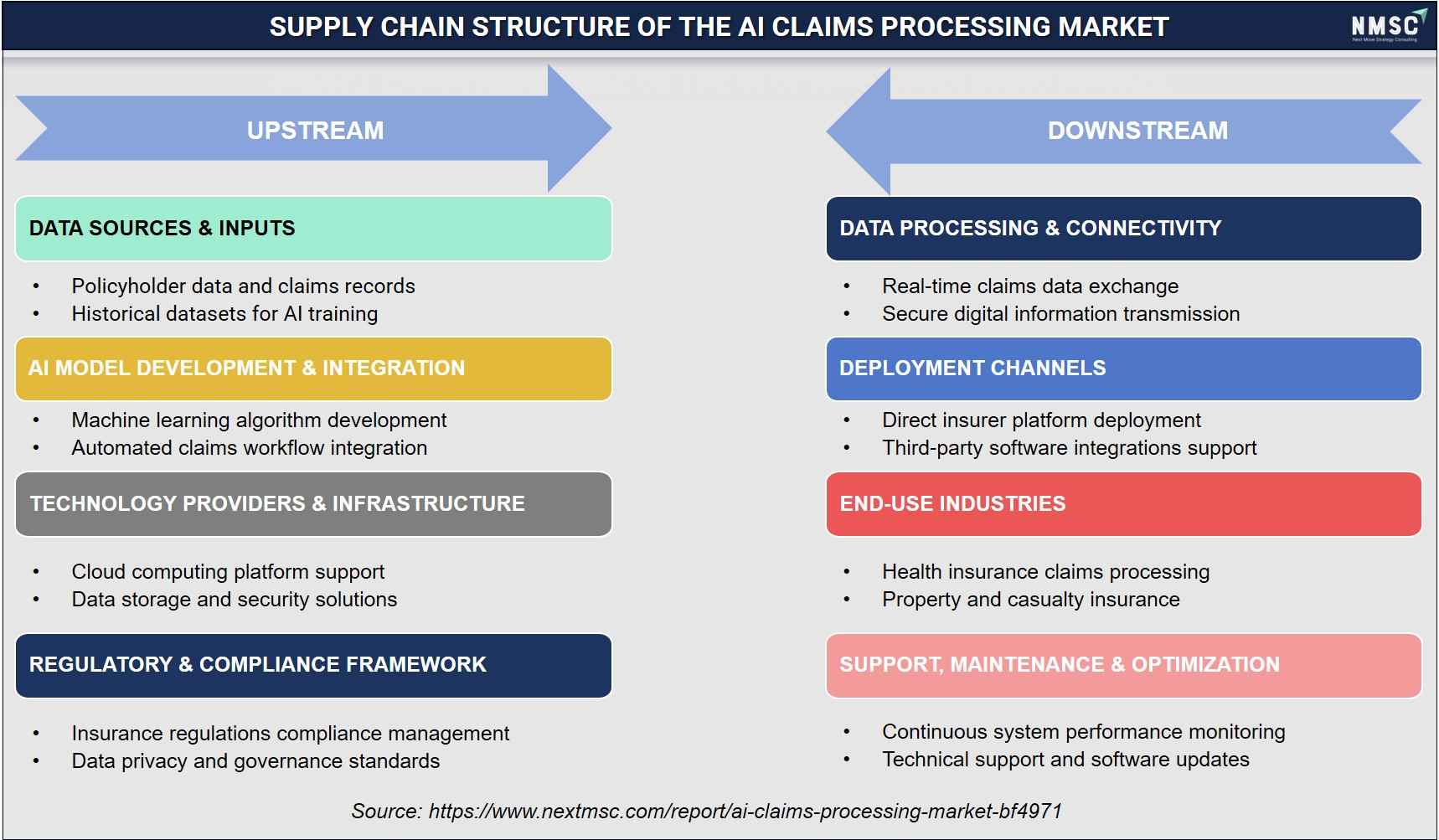
The above framework maps the supply chain structure of the AI Claim Processing Market across upstream data sourcing, model development, and downstream deployment. We observed that policyholder data, claims records, and historical datasets form the core input base, while machine learning algorithm development and workflow integration define AI model development, supported by cloud platforms and security solutions. Regulatory compliance with insurance standards and data privacy governs upstream operations, whereas downstream activities encompass real-time data exchange, deployment through insurer platforms and third-party integrations, serving health and property insurance sectors, with continuous monitoring, technical support, and updates reinforcing system reliability and performance.
Regional Outlook
Geographic Performance Snapshot
|
Region |
2025 (USD Billion) |
2035 (USD Billion) |
CAGR (%) |
Primary Drivers |
|
North America |
1.07 |
11.02 |
26.2% |
Advanced adoption of AI-powered claims automation, fraud analytics, and straight-through processing |
|
Europe |
0.64 |
6.11 |
25.3% |
Modernization of insurance operations through intelligent claims adjudication and workflow optimization |
|
Asia Pacific |
0.42 |
5.11 |
29.8% |
Accelerating digital insurance transformation and growing demand for scalable AI claims platforms |
|
Middle East and Africa |
0.14 |
1.34 |
25.4% |
Rising insurer investments in automated claims processing and customer service enhancement |
|
Latin America |
0.11 |
1.26 |
27.6% |
Increasing deployment of AI solutions to improve claims accuracy, efficiency, and fraud prevention |
North America AI Claims Processing Market
North America represents the most mature and largest regional market for AI claims processing, generating USD 1.07 Billion in 2025. The region is characterized by a high density of technology-forward P&C and health insurance carriers, a robust insurtech vendor ecosystem, and a well-established enterprise AI investment culture. NMSC's analysis indicates that U.S. carriers are leading global adoption of end-to-end AI claims platforms, real-time fraud detection systems, and computer vision-based damage assessment tools. The region's regulatory framework, while evolving, supports structured AI adoption through NAIC guidance that insurers are actively incorporating into their AI governance programs.
United States AI Claims Processing Market
Based on our engagements with market participants, the United States is the world's largest single-country market for AI claims processing, valued at USD 0.93 Billion in 2025. The U.S. insurance market's exceptional claims volume across auto, property, health, and workers compensation lines creates a structural demand base for AI automation. Market demand is driven by insurer operational efficiency imperatives, rising combined ratios in P&C lines, and health insurer focus on administrative cost reduction. Government influence includes state insurance department AI governance mandates and federal healthcare claims regulations under CMS that are accelerating AI adoption in health claims processing. Technology penetration is high among Tier 1 carriers, with leading insurers including progressive auto insurers, large regional P&C carriers, and national health plans deploying AI across the full claims lifecycle.
Canada AI Claims Processing Market
Through our analysis, Canada's AI claims processing market benefits from proximity to the U.S. insurtech ecosystem and a concentrated insurance industry structure in which a small number of large national carriers drive the majority of technology investment. The Financial Services Regulatory Authority of Ontario and similar provincial regulators are developing AI governance frameworks that are shaping vendor product requirements for the Canadian market. Technology adoption is accelerating, particularly in auto claims processing where Canada's no-fault insurance systems in certain provinces create high-volume standardized claims suitable for AI automation. French-English bilingual claims processing requirements create incremental complexity that AI document intelligence vendors are addressing through multilingual model capabilities.
Mexico AI Claims Processing Market
According to evaluation of the Mexico insurance market, AI claims processing adoption remains in early stages but is accelerating, supported by regulatory modernization under Mexico's National Insurance and Surety Commission (CNSF) and rising insurance penetration among Mexico's growing middle class. The Mexican P&C insurance market is dominated by a small number of large domestic and multinational carriers that are beginning to invest in cloud-native AI claims platforms. Auto insurance claims represent the primary AI adoption use case given high vehicle theft and accident rates. System integrator led distribution channels are important in Mexico as carriers rely on local implementation partners with regulatory expertise to deploy international AI platform vendors.
Europe AI Claims Processing Market
Europe is the second-largest regional market for AI claims processing at USD 0.64 Billion in 2025, characterized by diverse regulatory environments across member states, strong data privacy obligations under GDPR, and a maturing insurtech ecosystem centred on the UK, Germany, and France. From our assessment, European insurers are investing in AI claims platforms that demonstrate GDPR compliance, explainable AI capabilities, and integration with national insurance regulatory reporting requirements. The European Insurance and Occupational Pensions Authority's AI governance guidelines are influencing platform architecture investments across the region, with a particular emphasis on algorithmic fairness and auditability.
United Kingdom AI Claims Processing Market
Based on our engagements with UK insurance market participants, the United Kingdom represents the most advanced AI claims processing market in Europe, benefiting from a sophisticated Lloyd's and London Market specialty insurance ecosystem, strong Financial Conduct Authority (FCA) support for insurtech innovation, and a concentration of AI-native insurtech vendors. The UK's high-frequency motor insurance claims environment has driven early adoption of computer vision damage assessment and AI fraud detection tools. Post-Brexit regulatory divergence from EU frameworks is creating both opportunities for UK-specific AI innovation and complexity for vendors operating simultaneously in UK and EU insurance markets.
Germany AI Claims Processing Market
Through our analysis, Germany's AI claims processing market is driven by the country's large P&C insurance market, high industry concentration among major carriers including Allianz, Munich Re, and Talanx, and strong enterprise technology investment capacity. The Federal Financial Supervisory Authority (BaFin) has issued guidance on AI use in insurance that aligns with broader EU regulatory frameworks. German insurers place high emphasis on data sovereignty and system reliability, supporting demand for private cloud and hybrid deployment models. The automotive insurance segment is a primary AI adoption driver given Germany's large vehicle fleet and high repair cost environment.
France AI Claims Processing Market
From our assessment, France's AI claims processing market benefits from a highly concentrated insurance industry structure and strong government digital transformation support under France's national digital economy strategy. The Autorité de Contrôle Prudentiel et de Résolution (ACPR) actively engages with insurtech innovation through its regulatory sandbox program, which has facilitated AI claims pilot programs. French mutual insurer structures and the prevalence of bancassurance distribution create distinct operational claims environments that AI vendors must adapt to. Health insurance claims processing represents a major opportunity given France's complementary health insurance market's high administrative complexity.
Italy AI Claims Processing Market
According to evaluation of Italy's insurance sector, AI claims processing adoption is accelerating particularly in the motor insurance segment, which remains Italy's largest P&C line and has been subject to regulatory reform under IVASS (Institute for Insurance Supervision) aimed at reducing claims fraud and improving settlement transparency. Italian insurers have historically faced elevated motor claims fraud rates, creating strong demand for AI fraud detection capabilities. Cloud adoption in Italian insurance is advancing, supported by Italian government digital economy initiatives, though data residency preferences continue to support private and hybrid cloud deployment models among larger carriers.
Spain AI Claims Processing Market
Based on our engagements, Spain's AI claims processing market is developing steadily, anchored by a mature and concentrated insurance sector overseen by the Directorate-General for Insurance and Pension Funds (DGSFP). Spanish insurers are increasingly investing in AI platforms following regulatory encouragement for digital innovation in financial services. The auto and home insurance claims segments represent primary AI adoption use cases. Spanish language NLP capabilities in document intelligence and claims communication tools are an important vendor product requirement distinguishing the Spanish market from broader European deployments.
Sweden AI Claims Processing Market
Through our analysis, Sweden's AI claims processing market benefits from Scandinavia's advanced digital infrastructure, high insurance technology investment maturity, and a progressive regulatory environment under Finansinspektionen that actively supports insurtech development. Swedish insurers lead Nordic adoption of claims AI, particularly in health and disability insurance claims processing. The high penetration of digital customer interfaces among Swedish consumers supports AI-powered self-service claims submission and automated status communication capabilities.
Denmark AI Claims Processing Market
From our assessment, Denmark's AI claims processing market is compact but highly digitized, reflecting Denmark's broader status as one of Europe's most advanced digital economies. The Danish Financial Supervisory Authority's risk-based regulatory approach creates an enabling environment for insurer AI investment. Danish insurers are notable for their advanced customer data utilization in claims risk assessment, creating demand for AI analytics platforms that integrate behavioral and IoT data streams with traditional claims information.
Finland AI Claims Processing Market
Based on our engagements, Finland's AI claims processing market operates within a concentrated insurance sector where a small number of major carriers including If P&C Insurance and OP Financial Group drive the majority of technology investment. Finnish insurers are early adopters of AI-driven claims automation in health and disability lines, sectors where Finland's robust social insurance infrastructure interfaces with private insurance complementary coverage. Government support for AI innovation under Finland's national AI strategy is supporting insurer experimentation with claims automation tools.
Netherlands AI Claims Processing Market
Through our analysis, the Netherlands AI claims processing market benefits from the country's advanced financial services infrastructure and the Dutch Central Bank's (DNB) progressive approach to insurtech innovation. Dutch insurers operate in a highly competitive market that incentivizes operational efficiency investment. AI claims processing adoption is particularly advanced in the Dutch health insurance market, where mandatory basic health insurance coverage creates extremely high claims volumes that are well-suited to AI automation. The Netherlands' multilingual business environment (Dutch, English, German) creates document intelligence requirements that AI vendors address through multilingual processing capabilities.
Rest of Europe AI Claims Processing Market
According to our evaluation of remaining European markets including Poland, Switzerland, Austria, Belgium, Portugal, and the broader CEE region, AI claims processing adoption varies significantly by market size, insurance sector maturity, and digital infrastructure development. Switzerland's international reinsurance hub status creates demand for sophisticated claims analytics and AI catastrophe modelling tools. Eastern European markets are in earlier stages of AI claims adoption but are experiencing accelerated investment driven by the expansion of digital insurance platforms and pan-European carrier subsidiaries that are rolling out corporate AI claims programs to local markets.
Asia Pacific AI Claims Processing Market
Asia Pacific is the fastest-growing regional market for AI claims processing, projected to expand from USD 0.42 Billion in 2025 to USD 5.11 Billion by 2035 at a CAGR of 29.8%. NMSC's analysis indicates that the region's growth is driven by rapid insurance market expansion in China and India, digital-native insurer ecosystems in Southeast Asia, and increasing government initiatives promoting digital financial services infrastructure. Regulatory frameworks across Asia Pacific vary significantly, with more advanced AI governance frameworks in Singapore, Australia, and Japan contrasting with still-developing frameworks in emerging markets.
China AI Claims Processing Market
Based on our engagements, China represents the largest AI claims processing market in Asia Pacific, driven by the world's second-largest insurance market, strong government support for AI development through national AI strategy frameworks, and the rapid digitization of the Chinese insurance industry. The China Banking and Insurance Regulatory Commission (CBIRC) has issued guidance on technology application in insurance that is actively shaping AI claims platform requirements. Domestic AI vendors including technology subsidiaries of Alibaba, Tencent, and Ping An, are significant market participants alongside international players, creating a competitive dynamic distinct from Western markets.
India AI Claims Processing Market
Through our analysis, India's AI claims processing market is experiencing acceleration driven by government initiatives including the Insurance Regulatory and Development Authority of India (IRDAI)'s technology-forward regulatory reforms, rising insurance penetration supported by PM Jan Arogya Yojana health coverage expansion, and a vibrant domestic insurtech ecosystem. Cloud-native SaaS platforms are the dominant deployment model given India's cost-sensitive insurance carrier landscape. Health insurance claims represent the primary AI adoption use case, with motor insurance claims AI adoption growing rapidly following IRDAI's digital claims processing mandate.
Japan AI Claims Processing Market
From our assessment, Japan's AI claims processing market is characterised by the country's large, mature insurance sector, strong enterprise technology investment culture, and a regulatory environment under the Financial Services Agency (FSA) that is progressively incorporating AI governance expectations. Japanese insurers are investing in AI claims automation, particularly to address workforce demographics challenges, as a declining working-age population increases the operational pressure to automate labour-intensive claims adjudication processes. Disaster insurance claims management represents a distinctive use case given Japan's high natural catastrophe exposure.
South Korea AI Claims Processing Market
According to our evaluation of South Korea's insurance sector, AI claims processing adoption is advancing rapidly, supported by the Financial Supervisory Service (FSS)'s insurtech-friendly regulatory approach and South Korea's world-leading digital infrastructure. Korean insurers are notable early adopters of AI medical claims review systems, driven by the country's high healthcare utilization rates and complex national health insurance interface requirements. Domestic technology companies and insurtechs are developing Korea-specific AI claims solutions that address the unique requirements of Korea's insurance regulatory and health system environment.
Taiwan AI Claims Processing Market
Based on our engagements, Taiwan's AI claims processing market benefits from the country's advanced semiconductor and technology manufacturing ecosystem, which supports a sophisticated enterprise technology adoption culture among Taiwanese insurers. The Financial Supervisory Commission's sandbox program has facilitated AI claims experiments, and several major life insurers have deployed AI document processing tools for policy servicing and claims automation. Taiwan's ageing population is increasing demand for health and long-term care insurance claims automation capabilities.
Indonesia AI Claims Processing Market
Through our analysis, Indonesia's AI claims processing market is in an early but rapidly developing stage, supported by the Otoritas Jasa Keuangan (OJK)'s digital financial services roadmap and rising insurance penetration in Southeast Asia's largest economy. Mobile-first AI claims submission and automated document verification are the primary AI adoption use cases given Indonesia's high smartphone penetration and predominantly digital-native insurance customer base. International AI claims vendors are entering Indonesia through local system integrator partnerships with carriers.
Vietnam AI Claims Processing Market
From our assessment, Vietnam's AI claims processing market is emerging as a regional growth hotspot, driven by rapid insurance market expansion, a young and digitally engaged consumer population, and strong government commitment to financial technology development under Vietnam's national digital transformation program. The Ministry of Finance and the Insurance Supervisory Authority are supporting digital claims infrastructure development. Motor insurance claims represent the initial AI adoption focus given rapid vehicle ownership growth.
Australia AI Claims Processing Market
Based on our engagements, Australia's AI claims processing market is the most mature in the Oceania region, characterised by a concentrated insurance sector, an advanced regulatory framework under the Australian Prudential Regulation Authority (APRA), and strong enterprise AI investment among major carriers. APRA's Prudential Practice Guide CPG 234 on information security and technology risk management is influencing AI claims deployment governance requirements. Home and contents insurance claims AI adoption is driven by Australia's high natural catastrophe exposure, with computer vision-based building damage assessment tools gaining significant traction following major weather events.
Philippines AI Claims Processing Market
Through our analysis, the Philippines AI claims processing market is developing, supported by the Insurance Commission's digital transformation initiatives and increasing international and domestic insurer investment in cloud-based claims automation platforms. The country's high remittance-driven insurance demand and rapidly growing middle class are expanding the insurance customer base. Microinsurance and mobile-first claims processing platforms are creating distinctive AI deployment contexts suited to the Philippines' predominantly mobile digital ecosystem.
Malaysia AI Claims Processing Market
According to our evaluation of Malaysia's insurance market, AI claims processing adoption is progressing, supported by Bank Negara Malaysia's Financial Sector Blueprint that explicitly encourages digital innovation in insurance operations. The Malaysian Takaful sector, one of the world's largest Islamic insurance markets, creates specific claims processing requirements that AI vendors are addressing through Shariah-compliant workflow configurations. Motor and medical claims represent the primary AI adoption use cases, with major Malaysian carriers deploying AI fraud detection to address motor insurance fraud challenges.
Rest of APAC AI Claims Processing Market
From our assessment, remaining Asia Pacific markets including Thailand, Singapore, New Zealand, and Pacific Island nations represent collectively growing AI claims processing demand. Singapore, as the region's premier financial services hub, has a disproportionate concentration of international insurance carrier regional headquarters deploying AI claims platforms that extend to APAC subsidiaries. Thailand's large motor insurance market and growing health insurance sector are attracting AI claims vendor investment, while New Zealand's market structure parallels Australia's in technology maturity and regulatory framework.
Middle East and Africa AI Claims Processing Market
The Middle East and Africa region represents an emerging market for AI claims processing, valued at USD 0.14 Billion in 2025 and projected to reach USD 1.34 Billion by 2035. NMSC's analysis indicates that Gulf Cooperation Council countries, led by Saudi Arabia and the UAE, are the primary drivers of regional AI claims investment, supported by national Vision programs mandating digital economy transformation and large-scale healthcare insurance expansion. Sub-Saharan Africa is an earlier-stage market where mobile-first insurance distribution models are creating demand for lightweight, API-native AI claims processing tools.
Saudi Arabia AI Claims Processing Market
Based on our engagements, Saudi Arabia's AI claims processing market is advancing rapidly, driven by Saudi Vision 2030's digital transformation mandate, mandatory health insurance for expatriate workers expanding the health claims base, and the Central Bank of Saudi Arabia (SAMA)'s insurtech regulatory framework. Motor insurance reform and the expansion of mandatory coverage lines are increasing AI claims automation investment among Saudi carriers. International AI claims vendors are entering the Saudi market through local partnerships and are adapting platforms for Arabic language claims documentation processing.
UAE AI Claims Processing Market
Through our analysis, the UAE's AI claims processing market benefits from the country's advanced digital infrastructure, high insurance penetration relative to the GCC, and the Dubai International Financial Centre (DIFC)'s Insurance Regulatory Authority's progressive framework for technology adoption in insurance. UAE carriers are among the most technologically advanced in the MEA region, with several leading carriers deploying AI claims platforms across health, motor, and property lines. The UAE's position as a regional hub for international reinsurers and specialty carriers creates demand for sophisticated claims analytics and catastrophe modelling AI tools.
Egypt AI Claims Processing Market
From our assessment, Egypt's AI claims processing market is in early development, supported by the Financial Regulatory Authority's ongoing digital transformation initiatives for the insurance sector. Egypt's large population and growing insurance awareness among the urban middle class are expanding the insurance market base. Mobile-first claims submission tools and automated document verification are the primary AI adoption entry points for Egyptian carriers managing cost constraints. The Egyptian Takaful insurance sector is a growing component of the market.
Israel AI Claims Processing Market
According to evaluation of Israel's insurance market, the country's world-leading technology and cybersecurity sector translates into an advanced enterprise AI adoption environment for insurance carriers. The Israel Insurance Association and the Capital Markets, Insurance and Savings Authority are supportive of technology innovation. Israeli insurers are notable adopters of AI-driven health claims analytics, building on the country's advanced health informatics infrastructure. Israel's high-tech workforce also supports domestic AI vendor development serving regional and global insurance clients.
Turkey AI Claims Processing Market
Based on our engagements, Turkey's AI claims processing market is developing within a large and growing insurance sector overseen by the Insurance and Private Pension Regulation and Supervision Agency (SEDDK). Motor insurance claims represent the primary AI adoption use case given Turkey's large vehicle fleet and active traffic claims environment. Turkish insurers are investing in cloud-based AI fraud detection tools as part of broader operational efficiency programs. The market's cost sensitivity favours SaaS delivery models with flexible subscription pricing.
Nigeria AI Claims Processing Market
Through our analysis, Nigeria's AI claims processing market is at an early stage but holds significant long-term potential as Africa's most populous country and largest economy. The National Insurance Commission (NAICOM)'s digital insurance policy is encouraging insurer technology investment. Mobile insurance platforms serving Nigeria's large unbanked and underbanked population are creating demand for simplified AI claims processing tools compatible with feature phone and basic smartphone interfaces. Key challenges include limited internet infrastructure coverage in rural areas and the need for AI models trained on locally relevant claims data.
South Africa AI Claims Processing Market
From our assessment, South Africa represents the most mature AI claims processing market in Sub-Saharan Africa, with a sophisticated insurance sector regulated by the Prudential Authority and the Financial Sector Conduct Authority (FSCA). South African insurers are adopting AI claims platforms across short-term insurance, life insurance, and healthcare lines. The market is characterised by established enterprise technology vendors and growing domestic insurtech activity. Motor vehicle theft and fraud are persistent challenges driving demand for AI-powered claims investigation tools across the South African P&C market.
Rest of MEA AI Claims Processing Market
According to evaluation of remaining MEA markets including Kuwait, Qatar, Bahrain, Oman, Morocco, Kenya, Ghana, and other African insurance markets, AI claims processing adoption reflects the full spectrum of market maturity from near-developed Gulf markets to early-stage Sub-Saharan adoption. Gulf markets benefit from government-led digital transformation programs and high healthcare insurance claim volumes. East African markets, including Kenya, are notable for mobile-first insurance innovation that is creating distinctive AI claims deployment architectures compatible with emerging market digital infrastructure constraints.
Latin America AI Claims Processing Market
Latin America's AI claims processing market is valued at USD 0.11 Billion in 2025 and is projected to expand at a CAGR of 27.6% through 2035. NMSC's analysis indicates that Brazil, as the region's largest insurance market, drives the majority of regional AI claims investment, followed by Colombia and Chile's growing technology-forward carrier sectors. Cloud-native SaaS platforms dominate deployment preferences given the cost structures and IT infrastructure characteristics of Latin American insurance carriers. Regulatory evolution, including SUSEP's open insurance framework in Brazil, is creating structural opportunities for AI claims interoperability.
Brazil AI Claims Processing Market
Based on our engagements, Brazil is Latin America's largest and most advanced AI claims processing market, supported by the Superintendency of Private Insurance (SUSEP)'s Open Insurance initiative that is creating standardized digital claims data flows, a large auto and health insurance market, and a growing domestic insurtech ecosystem. Major Brazilian carriers are deploying AI claims platforms across auto, health, and property lines, with a particular focus on fraud detection given Brazil's high insurance fraud incidence. Portuguese language NLP capabilities are a key vendor requirement for the Brazilian market.
Argentina AI Claims Processing Market
Through our analysis, Argentina's AI claims processing market operates within a challenging macroeconomic environment characterised by high inflation and currency volatility that constrains USD-denominated technology investment. However, Argentina's large pool of technology talent, including a significant software development workforce, supports domestic AI solutions development for insurance applications. The Superintendencia de Seguros de la Nación is working toward digital insurance modernisation. Motor insurance claims and life insurance analytics represent the primary AI adoption use cases among Argentine carriers.
Chile AI Claims Processing Market
From our assessment, Chile represents one of Latin America's most financially mature insurance markets, with strong regulatory oversight from the Financial Market Commission (CMF) and a high-income consumer base supporting premium insurance product demand. Chilean insurers are increasingly adopting cloud-based AI claims platforms, particularly for health insurance claims processing following major healthcare system reforms. The country's stable economic environment and advanced digital infrastructure support higher technology investment rates among Chilean insurance carriers relative to regional peers.
Colombia AI Claims Processing Market
According to evaluation of Colombia's insurance sector, AI claims processing adoption is advancing under the oversight of the Superintendency of Finance of Colombia, with increasing investment in digital claims infrastructure among leading carriers. Colombia's SOAT mandatory motor insurance scheme generates high-volume standardized claims suitable for AI automation. Health insurance claims are a growing AI investment priority given Colombia's complex multi-payer health system and high administrative processing costs. The Colombian government's digital economy agenda is supporting broader fintech and insurtech innovation.
Rest of LATAM AI Claims Processing Market
From our assessment, remaining Latin American markets including Peru, Ecuador, Uruguay, Bolivia, Paraguay, and Central American insurance markets represent earlier-stage AI claims processing adoption environments. Peru and Ecuador are experiencing growing insurance market development supported by regulatory modernisation. Central American carriers, often subsidiaries of multinational insurance groups, are beginning to extend corporate AI claims programs to regional operations. Cloud-native SaaS models dominate due to cost constraints, with local system integrators playing important roles in implementation.
Competitive Landscape
Competitive Dynamics and M&A Landscape
|
Key Takeaways |
Details |
|
Market Structure |
Moderately fragmented; dominated by established claims management platform vendors (CCC Intelligent Solutions, Guidewire, Solera) alongside a growing tier of AI-native insurtech challengers (Shift Technology, Tractable, FRISS). |
|
Innovation Focus |
Generative AI integration for claims narrative automation, computer vision for damage assessment, real-time fraud scoring at FNOL, API-native modular architectures, and LLM-powered document intelligence are the primary innovation vectors across leading vendors. |
|
M&A Activity |
Active consolidation underway: established platform vendors are acquiring AI-native point solution providers to augment core platforms; PE and growth equity investors are funding AI-native challengers targeting specific insurance lines and geographies. |
How Do Companies Compete in AI Claims Processing Market?
The competitive landscape of the AI claims processing market is defined by a multi-tier structure in which established claims management platform vendors compete with AI-native insurtech challengers across distinct market segments. Market structure analysis conducted by NMSC indicates that incumbents including CCC Intelligent Solutions and Solera Holdings derive competitive advantage from extensive auto claims data assets, deep OEM and repair network integrations, and multi-decade carrier relationships. Platform vendors including Guidewire Software and Duck Creek Technologies compete on core system ecosystem lock-in, pre-integration advantages, and broad functional coverage across the policy-claims continuum. AI-native challengers including Shift Technology, Tractable, FRISS, and CLARA Analytics differentiate through superior model accuracy, rapid implementation, and outcome-based commercial models.
Which Kind of Companies Dominate the AI Claims Processing Market?
The AI claims processing market is primarily driven by established claims platform vendors that have incorporated AI into end-to-end claims management systems and leverage decades of proprietary claims data to strengthen automation and decision-making capabilities. Alongside them, AI-native insurtech companies are gaining traction through advanced machine learning models, faster implementation, and flexible commercial structures. In addition, a growing segment of providers is combining AI technology with operational expertise to deliver claims processing as a service, while specialized firms are emerging to support governance, risk management, and regulatory compliance across the broader ecosystem.
AI-Native Differentiation and Open Standards Drive Market Success in the AI Claims Processing Market
NMSC's analysis indicates that AI-native differentiation is increasingly the primary competitive currency in the AI claims processing industry, as carrier procurement teams evaluate vendors on demonstrated model accuracy, transparent AI decision auditability, and integration flexibility over traditional considerations of vendor size and platform breadth. Vendors that publish benchmark results, provide explainability dashboards, and support open API integration standards are gaining preference in competitive evaluations. The emergence of open insurance data standards, including those promoted by the IAIS and regional equivalents, is further incentivizing vendors to build platform-agnostic AI capabilities accessible through standardized data interfaces.
Market Players to opt for Merger and Acquisition Strategies to Expand Their Presence in the AI Claims Processing Market
M&A activity in the AI claims processing market is accelerating, driven by established platform vendors seeking to acquire AI-native capabilities, and by private equity investors building consolidated AI claims technology stacks. Our findings suggest that acquisition targets typically include AI-native vendors with demonstrated model accuracy in specific claims categories, proprietary training datasets, and customer bases that provide cross-sell opportunities for acquiring parties. Geographic expansion through acquisition of regional claims AI vendors is an emerging strategy particularly relevant for North American and European platform vendors seeking to extend into Asia Pacific, Gulf, and Latin American markets with culturally and linguistically specific AI requirements.
Who Are the Key Market Players in the AI Claims Processing Market?
-
CCC Intelligent Solutions
-
Solera Holdings
-
Guidewire Software
-
Duck Creek Technologies
-
Shift Technology
-
Tractable
-
Snapsheet
-
Mitchell International
-
FRISS
-
CLARA Analytics
-
Sapiens International
-
EIS Group
-
Five Sigma
-
Cytora
-
ClaimCentral Consolidated
-
Omni:us
-
Sprout.ai
-
SWORD GRC
-
Bdeo
What Are the Latest Developments in the AI Claims Processing Industry?
|
Date |
Event |
|
September 2025 |
Shift Technology introduced Shift Claims, an agentic AI platform designed to assess, prioritise, guide, and automate tasks across the entire claims lifecycle. The launch represents a major shift from rules-based claims handling toward autonomous AI-assisted claims processing that improves speed, accuracy, and operational efficiency |
|
January 2025 |
CCC Intelligent Solutions completed its acquisition of EvolutionIQ, an AI-powered claims guidance platform specializing in disability and injury claims. The combination expands CCC’s capabilities in AI-assisted claims resolution and reflects growing insurer demand for intelligent decision-support systems across complex claims workflows. |
|
April 2025 |
CCC Intelligent Solutions announced the integration of EvolutionIQ’s AI synthesis and claims guidance capabilities into its third-party auto casualty offering. The move strengthens AI-driven decision-making and faster claim resolution, highlighting the industry's transition toward intelligent claims orchestration and automated guidance. |
Expert Insights

"It is not surprising that the results promised by claims transformation projects over the years have failed to materialize, because most technology-based approaches were simply not up to the task of addressing claim complexity. Agentic AI provides insurers with a powerful transformation tool that increases automation when appropriate and also provides the right kind of advice, guidance, and recommendations when a human claim handler needs to be in the loop."
- Eric Sibony, Chief Scientist and Chief Product Officer of Shift Technology
Statement made at Shift Technology, during the launch of Shift Claims, discussing the limitations of traditional claims transformation approaches.
Market Interpretation:
The statement highlights a fundamental shift in the AI Claims Processing market from conventional rules-based automation toward agentic AI systems capable of handling the inherent complexity of claims management. As insurers seek to improve efficiency, reduce claims leakage, and accelerate settlement cycles, demand is increasing for intelligent platforms that combine automation with contextual guidance and human oversight. Consequently, the market is evolving toward human-in-the-loop claims ecosystems, where AI augments adjusters with recommendations and decision support rather than replacing them entirely.
SWOT Analysis of the AI Claims Processing Market
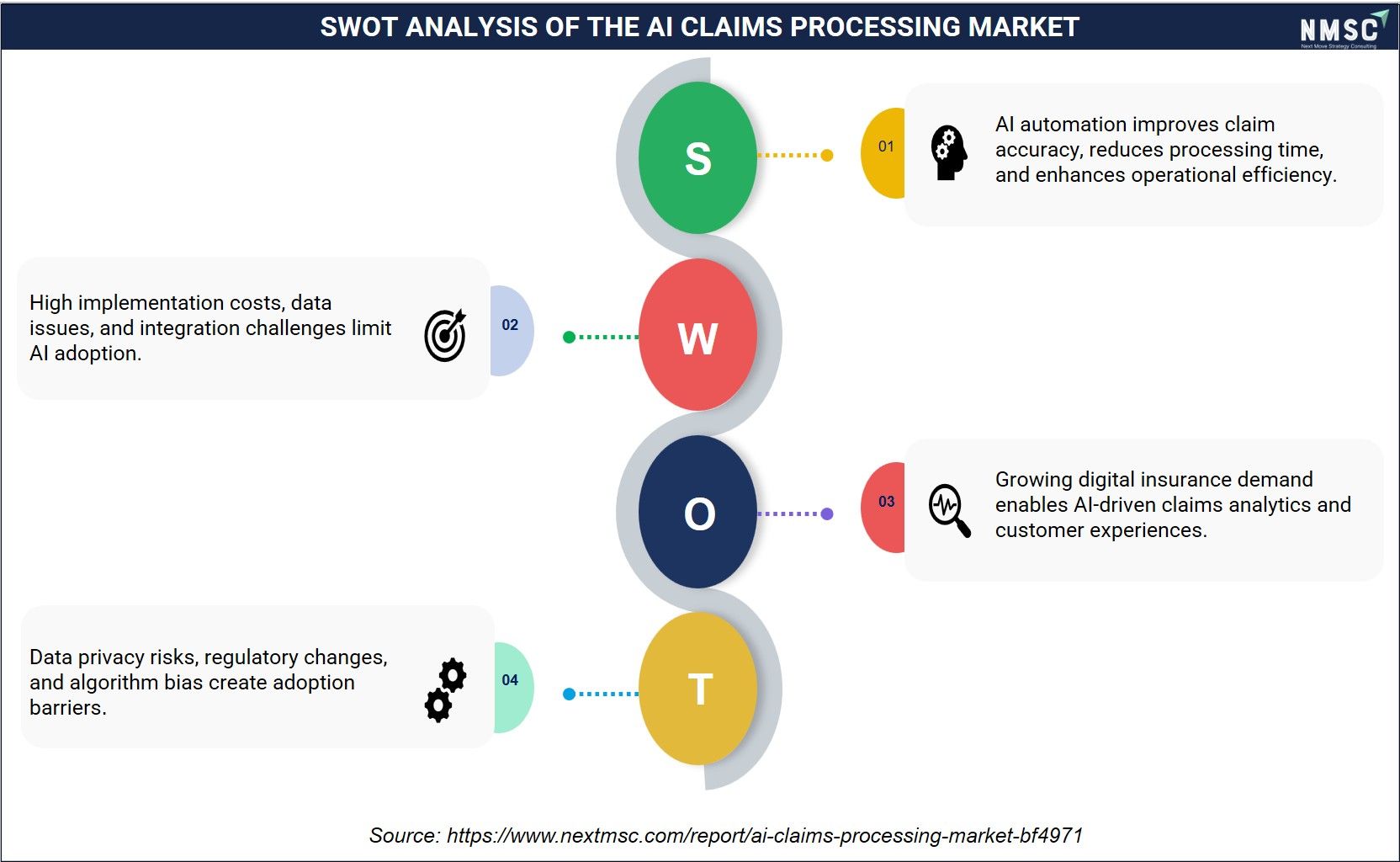
The above SWOT framework identifies key strategic factors shaping the AI Claim Processing Market across strengths, weaknesses, opportunities, and threats. We observed that AI automation improves claim accuracy, reduces processing time, and enhances operational efficiency as core strengths, while high implementation costs, data issues, and integration challenges emerge as key weaknesses limiting adoption. Growing digital insurance demand enabling AI-driven claims analytics and customer experiences presents significant growth opportunities, yet data privacy risks, regulatory changes, and algorithm bias continue to threaten deployment strategies and long-term profitability.
What Are the Investment Opportunities in AI Claims Processing Market?
Capital Inflows and Venture Capital Activity
The AI Claims Processing Market is attracting substantial capital from venture capital firms, growth equity investors, and strategic corporate participants, supported by the large addressable opportunity and favourable economics of AI-enabled claims automation. Our analysis indicates that AI-native insurtech companies focused on high-volume claims segments such as auto damage assessment, health claims adjudication, and property and casualty fraud detection have secured premium valuations, reflecting investor confidence in the scalability and defensibility of proprietary claims AI models trained on extensive historical datasets. Strong investor interest is also being supported by the recurring revenue characteristics and high customer retention associated with enterprise claims platforms.
AI Infrastructure and Data Investment
Investment in the AI Claims Processing Market is increasingly directed toward cloud computing resources, GPU-accelerated model training environments, and data annotation capabilities that support the development of claims-specific AI models. Insurance carriers are making direct investments in AI infrastructure to reduce reliance on external model training pipelines for sensitive claims data and to maintain greater control over model governance. Through our market assessment, we observed that industry technology consortia are exploring shared AI infrastructure frameworks that could enable smaller insurers to access enterprise-grade capabilities through collaborative arrangements. These developments are creating opportunities across AI compute, data engineering, and model operations ecosystems.
Responsible AI, Governance and ESG Considerations
Environmental, social, and governance factors are gaining importance within the AI Claims Processing Market, primarily through the lens of responsible AI adoption and claims fairness. NMSC's findings suggest that AI claims platforms capable of reducing fraudulent payouts, improving claims cycle efficiency, and supporting equitable outcomes across policyholder groups are receiving favourable ESG consideration. Regulatory scrutiny surrounding algorithmic transparency is creating additional investment requirements in explainability tools, bias detection systems, and AI governance platforms. These capabilities are becoming increasingly important as insurers seek to strengthen compliance and demonstrate responsible use of AI technologies.
Digital Transformation of Insurance Operations
Digital transformation initiatives among insurance carriers represent the principal demand driver for the AI Claims Processing Market. Our assessment indicates that insurers worldwide are allocating increasing portions of their technology budgets to AI and automation, with claims processing consistently emerging as one of the highest-priority modernization areas due to its direct impact on operating efficiency and combined ratios. Multi-year transformation programs are creating sustained revenue opportunities for AI claims platform vendors and providing long-term demand visibility. As carriers seek to improve customer experience and accelerate settlement cycles, investment in intelligent claims automation is expected to remain a strategic priority.
Private Equity Consolidation and Strategic M&A Activity
Private equity and strategic acquisition activity within the AI Claims Processing Market remains robust, supported by continued growth investments in AI-native insurtech companies and platform expansion initiatives by established claims software vendors. NMSC's analysis indicates that consolidation is accelerating across the managed AI claims services segment, as investors seek to build diversified technology stacks capable of serving carriers across multiple insurance lines and geographies. The strong recurring revenue profile, mission-critical nature of claims systems, and high switching costs associated with SaaS-based platforms create predictable cash flows that are particularly attractive to private equity investors and strategic acquirers.
Key Benefits for Stakeholders
For Insurance Carriers
Insurance carriers gain access to a comprehensive assessment of the AI Claims Processing Market trends and its impact on operational performance across the claims value chain. The analysis highlights how AI-enabled automation, intelligent triage, and fraud detection technologies contribute to lower claims processing costs, improved combined ratios, faster settlement cycles, and enhanced customer experience. These insights support strategic technology investments aimed at strengthening underwriting profitability and claims efficiency.
For Insurtech Vendors
Insurtech vendors benefit from detailed market sizing, competitive landscape analysis, and segmentation intelligence across deployment models, applications, and end-user categories. The report provides actionable insights that support product roadmap development, partnership strategies, and go-to-market prioritization. Competitive benchmarking also enables vendors to identify white-space opportunities and strengthen differentiation in an increasingly crowded AI claims ecosystem.
For Investors and Private Equity Firms
Investors and private equity firms gain access to validated market forecasts, competitive positioning assessments, and analysis of merger and acquisition activity across the AI Claims Processing Market. Segment-level growth projections and regional opportunity mapping provide a robust framework for investment thesis development, portfolio construction, and evaluation of expansion opportunities within the broader insurance technology sector.
For System Integrators
System integrators receive insights into carrier adoption trends, deployment preferences, and integration requirements associated with AI-enabled claims platforms. The analysis provides visibility into implementation complexity, ecosystem partnerships, and evolving carrier priorities, enabling service providers to develop specialized practices and align strategic alliances with high-growth opportunities across the insurance technology landscape.
For Regulators and Industry Bodies
Regulators and industry organizations gain evidence-based intelligence on AI adoption rates, regulatory developments, and emerging governance considerations within claims operations. The report provides perspectives on transparency, compliance, and systemic risk issues relevant to the design of AI governance frameworks and industry standards, supporting responsible adoption of AI technologies across the insurance sector.
For Reinsurers
Reinsurers obtain a structured understanding of how primary insurers are deploying AI across claims management functions and the resulting impact on claims quality, fraud mitigation, and operational efficiency. These insights support more informed pricing decisions, risk assessment methodologies, and capital allocation strategies, enabling reinsurers to better adapt to evolving claims dynamics and technological advancements within the insurance industry.
AI Claims Processing Market Key Segments
By Monetization Model
-
Software Subscription Revenue
-
Core Claims Platform Subscription
-
AI Module Subscription Add-Ons
-
API Based AI Licensing
-
-
Transaction Based Revenue
-
Per Claim Processing Fees
-
Per Document Processing Fees
-
Per Decision Event Fees
-
-
Managed Service Revenue
-
End-To-End Claims Operations Services
-
AI Assisted Claims Processing Services
-
-
Professional Service Revenue
-
Implementation Services
-
Integration Services
-
Model Training Services
-
By Deployment Model
-
Cloud Native SaaS Deployment
-
Private Cloud Deployment
-
On-Premise Deployment
-
Hybrid Deployment
By Solution Type
-
End-To-End Claims Platforms
-
Modular Claims AI Solutions
-
Fraud Detection and Risk Scoring Solutions
-
Damage Assessment and Estimation Solutions
-
Document Intelligence Solutions
-
Claims Analytics Solutions
By Insurance Line of Business
-
Property and Casualty Insurance
-
Auto Claims
-
Property Claims
-
Commercial Claims
-
-
Health Insurance Claims
-
Life Insurance and Annuities Claims
-
Specialty Insurance Claims
-
Multi-Line Insurance Claims
By Buyer Type
-
Tier 1 Global Insurance Carriers
-
Tier 2 Regional Insurance Carriers
-
Tier 3 Small and Specialty Insurers
-
Managing General Agents and Underwriters
-
Third Party Administrators
-
Self-Insured Corporates
By Distribution Channel
-
Direct Enterprise Sales
-
System Integrator Led Sales
-
Insurance Technology Partnerships
-
Cloud Marketplace Distribution
-
Embedded OEM Distribution
By Regions
-
North America: U.S., Canada, Mexico
-
Europe: UK, Germany, France, Italy, Spain, Sweden, Denmark, Finland, Netherlands, Rest of Europe
-
Asia Pacific: China, India, Japan, South Korea, Taiwan, Indonesia, Vietnam, Australia, Philippines, Malaysia, Rest of APAC
-
Middle East & Africa: Saudi Arabia, UAE, Egypt, Israel, Turkey, Nigeria, South Africa, Rest of MEA
-
Latin America: Brazil, Argentina, Chile, Colombia, Rest of LATAM
Conclusion and Recommendations
Long-Term Outlook
The AI claims processing market is entering a decade of transformative expansion, with the market projected to grow from USD 2.38 Billion in 2025 to USD 24.84 Billion by 2035 at a CAGR of 26.4%. NMSC's analysis indicates that this growth reflects a fundamental restructuring of insurance operations, driven by the convergence of machine learning maturity, cloud infrastructure availability, and rising operational efficiency imperatives that collectively make AI-powered claims automation both technologically viable and economically attractive at enterprise scale. The long-term outlook remains highly favourable, supported by growing claims volumes, accelerating digital transformation initiatives across insurers, and evolving regulatory frameworks that are providing greater governance clarity for enterprise AI adoption. The ongoing transition from isolated AI tools toward integrated orchestration platforms managing the entire claims lifecycle represents the defining architectural shift shaping the market.
Strategic Positioning Recommendations
Insurance carriers should prioritize AI deployment in high-volume, standardized claims categories where automation delivers the fastest return on investment, while simultaneously establishing governance frameworks that proactively address regulatory accountability requirements. Vendor selection strategies should extend beyond functional capabilities to evaluate API openness, explainability features, interoperability, and data privacy compliance. Providers capable of delivering end-to-end workflow integration and continuous performance monitoring are likely to secure stronger competitive positions as insurers increasingly seek scalable and auditable AI infrastructures.
Investment Attractiveness
The AI claims processing market represents an attractive investment environment supported by durable secular drivers, including rising claims complexity, labour shortages within claims operations, and increasing pressure on insurers to improve customer experience and cost efficiency. Our assessment indicates that the highest-conviction opportunities lie with AI-native vendors demonstrating superior model accuracy, scalable SaaS architectures, and outcome-based pricing models that align vendor incentives with carrier performance objectives. AI-enabled managed claims services also represent an emerging investment theme, particularly among smaller and mid-sized insurers seeking outsourced automation capabilities.
Market Shifts and Key Risks
The most significant market shift underway is the evolution from point solutions toward integrated AI orchestration platforms capable of governing the entire claims process. Key risks include intensifying regulatory scrutiny of AI-driven insurance decisions that could increase compliance burdens and implementation timelines, cybersecurity threats affecting model integrity and claims data protection, growing commoditization as AI capabilities become more widespread, and the potential legal and reputational consequences arising from model errors in claims adjudication. Although these risks are manageable through strong governance frameworks, vendor due diligence, and continuous model monitoring, they require proactive oversight at both the enterprise and industry levels.
Growth Pathways
Organizations seeking to maximize value from the AI claims processing market should adopt a three-horizon strategy. In the near term from 2025 to 2027, focus on automating high-frequency claims categories and strengthening AI governance capabilities. In the mid-term from 2027 to 2031, expand AI deployment into more complex claims workflows and accelerate penetration across under-served insurance lines, including specialty insurance, life and annuities, and parametric products. In the long term from 2031 to 2035, pursue geographic expansion across Asia Pacific, the Middle East, and Latin America, while developing AI-enabled managed claims services that broaden access to advanced claims automation among smaller carriers and specialty insurers.
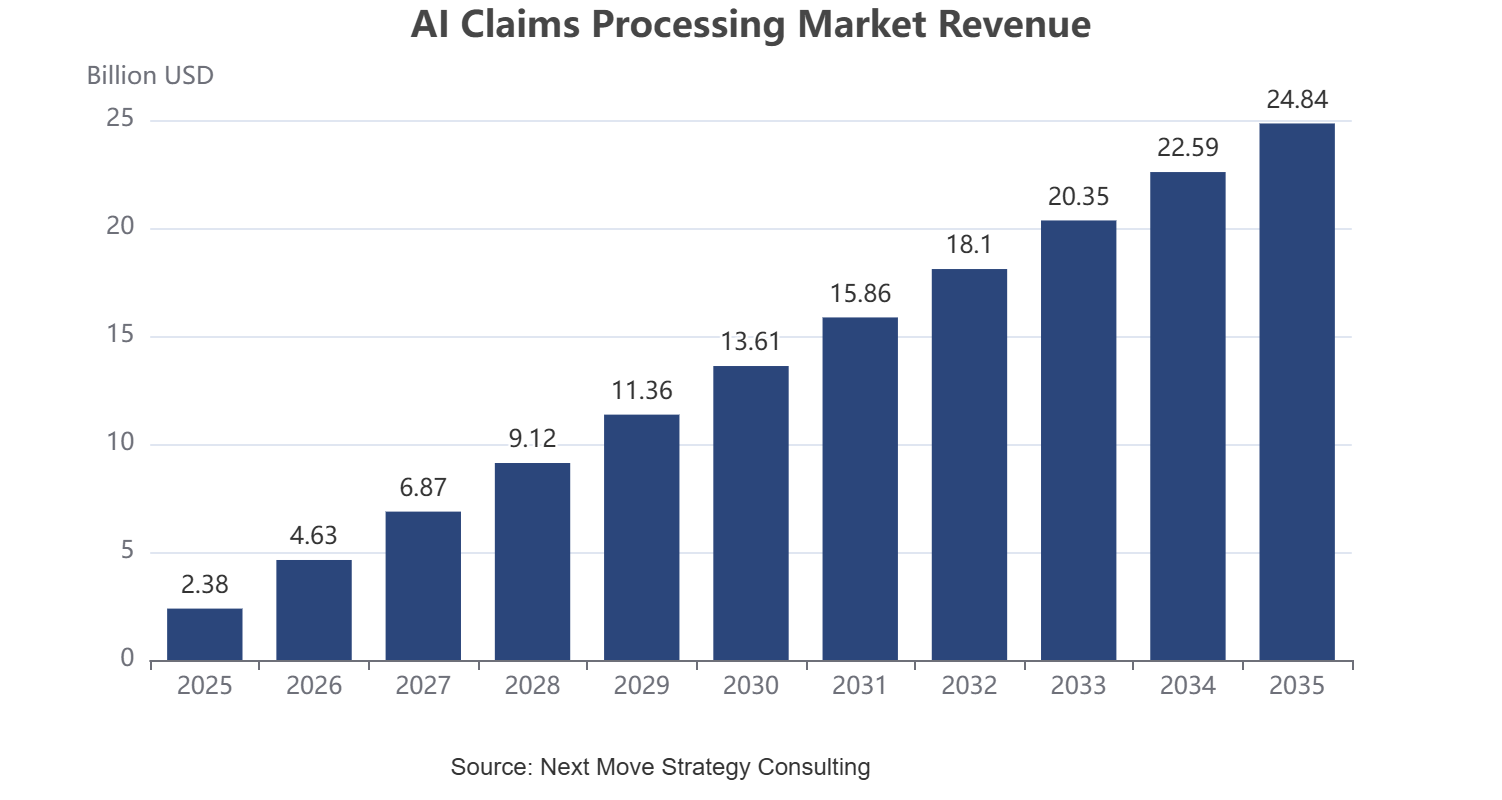
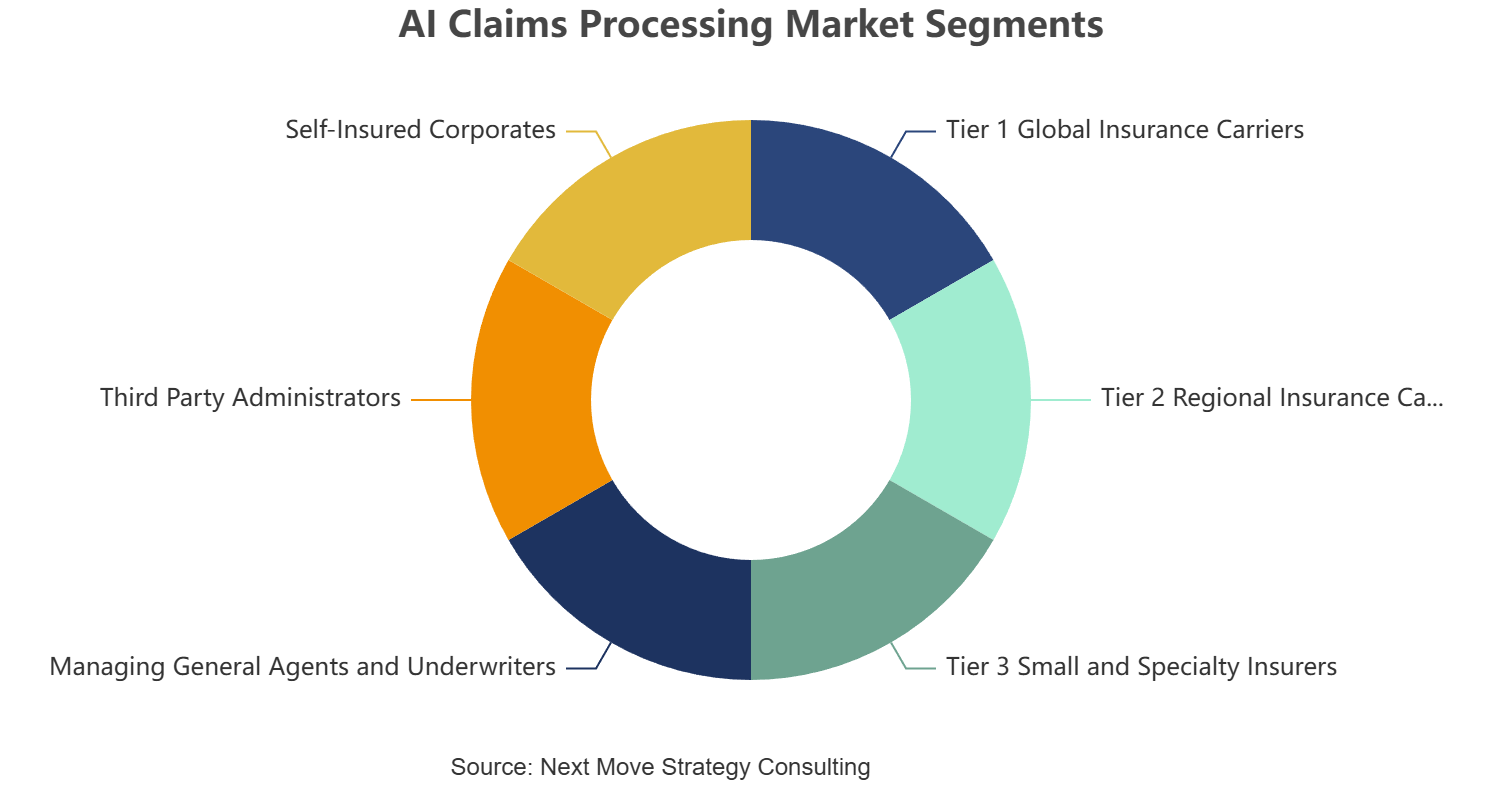
About the Author
 Mayurima Roy
— Mayurima Roy is Research Analyst at Next Move Strategy Consulting, where she has spent 4 years working across the firm's full industry coverage rather than a single fixed vertical. Her work centers on structured research, ongoing trend tracking, competitive assessment, and insight-led content development, translating complex market data into clear, decision-ready narratives that support informed client decision-making across diverse global industries, market sectors, and world regions every day.
Mayurima Roy
— Mayurima Roy is Research Analyst at Next Move Strategy Consulting, where she has spent 4 years working across the firm's full industry coverage rather than a single fixed vertical. Her work centers on structured research, ongoing trend tracking, competitive assessment, and insight-led content development, translating complex market data into clear, decision-ready narratives that support informed client decision-making across diverse global industries, market sectors, and world regions every day.
About the Reviewer
 Supradip Baul
— Supradip Baul is an accomplished business consultant and strategist with over a decade of rich experience in market intelligence, strategy, technology, and business transformation. His work has included rigorous qualitative and quantitative analysis across multiple industries, helping clients shape investment decisions and long-term roadmaps. Earlier in his career, he was associated with Gartner, where he contributed to industry-leading reports and market share analyses. He has worked with leading global companies and holds an MBA with a dual specialization in Marketing and Finance.
Supradip Baul
— Supradip Baul is an accomplished business consultant and strategist with over a decade of rich experience in market intelligence, strategy, technology, and business transformation. His work has included rigorous qualitative and quantitative analysis across multiple industries, helping clients shape investment decisions and long-term roadmaps. Earlier in his career, he was associated with Gartner, where he contributed to industry-leading reports and market share analyses. He has worked with leading global companies and holds an MBA with a dual specialization in Marketing and Finance.
At Next Move Strategy Consulting, we understand that insightful market research is the cornerstone of successful business decisions. That's why we employ a robust and multifaceted approach, combining various methodologies to deliver the most accurate and actionable data for our clients.

Research Landscape
We navigate the world of research with two primary approaches:
Qualitative Approach
Our qualitative research methodologies involve immersive techniques such as in-depth interviews, focus groups, and observational studies. By engaging directly with individuals and stakeholders, we uncover valuable insights that quantitative data alone may overlook.

Quantitative Research
In tandem with qualitative methodologies, NMSC leverages the power of Quantitative Research to provide a robust foundation of numerical insights. Through systematic data collection and analysis, we quantify patterns, preferences, and market trends, offering a comprehensive view of the business landscape.
Our quantitative research approach employs diverse tools, including surveys, experiments, and statistical modelling. These methodologies enable us to gather data from a large and representative sample, ensuring the statistical significance of our findings. By employing structured questionnaires and standardized data collection methods, we guarantee the reliability and validity of the information we present to our clients.
Quantitative research is particularly effective in measuring the prevalence of trends, assessing market size, and gauging the impact of various factors on consumer behavior. The numerical precision attained through this approach equips our clients with actionable insights, facilitating data-driven decision-making and strategy formulation.


Our Specialized Toolbox for Industry-Specific Market Research
We deploy a specialized arsenal of techniques tailored to meet your unique requirements. Here's a glimpse into our comprehensive toolbox:

Information Procurement
The stage entails acquiring market data or relevant information through various sources and methodologies.


Market Research Approach
We utilize both top-down and bottom-up approaches in market research analysis to achieve a comprehensive understanding of the market dynamics, leveraging the broad perspective of industry trends and macroeconomic factors alongside detailed insights from specific segments and individual companies.

Porters Five Forces Analysis
We conduct Porter's Five Forces analysis to evaluate the competitive landscape of an industry, providing us with insights into factors that affect profitability and strategic positioning.

SWOT Analysis

Forecasting
We utilize a forecasting model to predict future consumption by considering parameters like population, economics, regulations, market competition, drivers, constraints, technology, and pricing. We also employ statistical techniques such as multilinear regression, exponential smoothing, moving average, ARIMA, and Monte Carlo simulations for accurate predictions. In econometric forecasting, we analyzed short-term and long-term event impacts, attributing values based on regulatory frameworks, economic factors, and market events.





 Speak to Our Analyst