Colombia Autonomous Mobile Robot (AMR) Market By Product Type (Autonomous Transport Robots, Autonomous Picking Robots, & Others), By Navigation Technology (LiDAR, Vision Navigation, & Others), By Payload Capacity (<100 KG, 100–1000 KG, & Others), By Deployment Environment (Indoor & Outdoor), By Commercial Model (Direct Sales, System Integrator Sales, & Others), By End-User Industry (Warehousing and Distribution, Manufacturing, & Others) – Opportunity Analysis & Forecast, 2025–2035
Industry: Semiconductor & Electronics | Latest Edition: September 30, 2026 | No of Pages: 335 | No. of Tables: 194 | No. of Figures: 180 | Format: PDF | Report Code: SE5813
What Is the Colombia Autonomous Mobile Robot (AMR) Market Size?
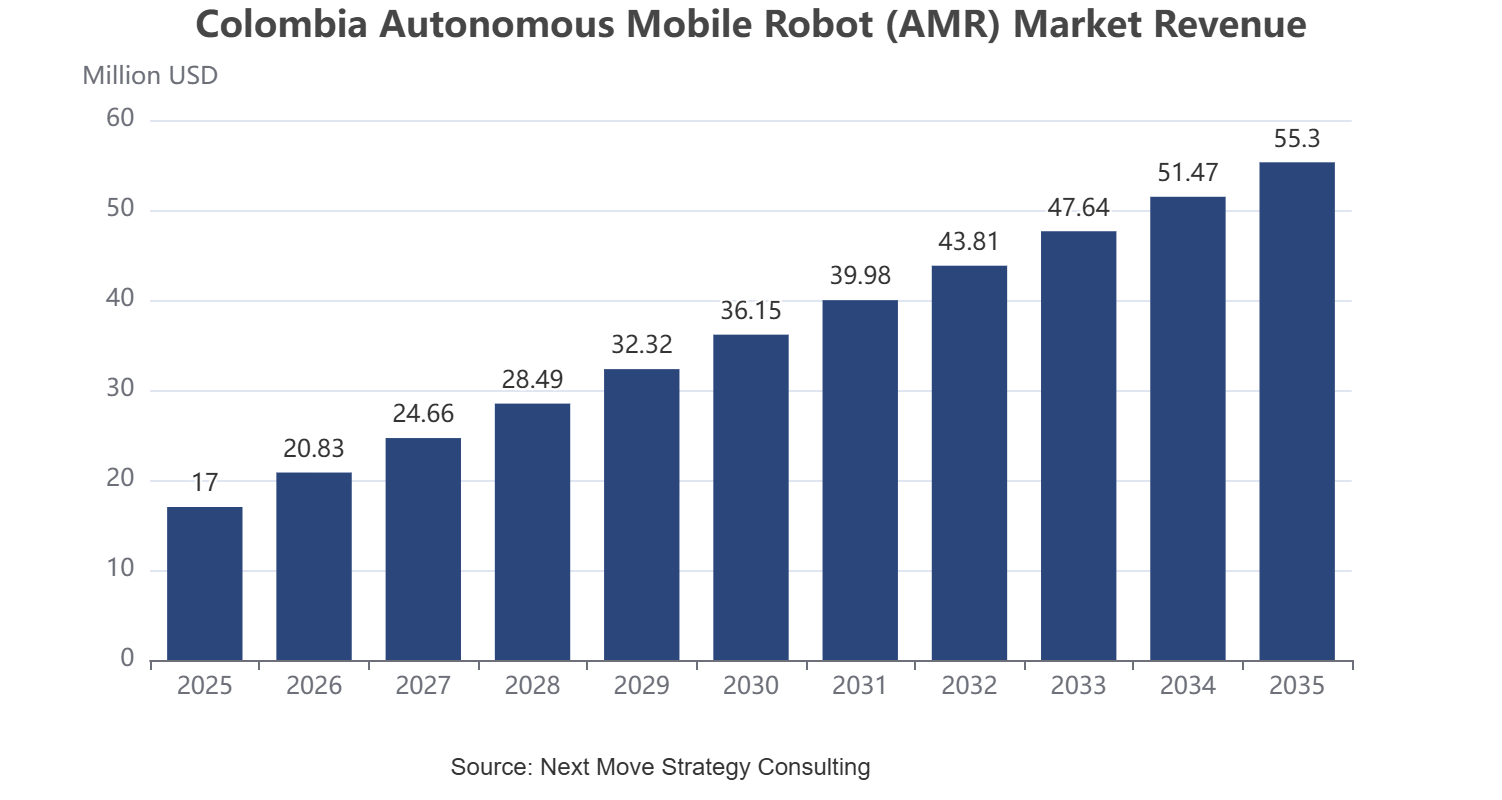
The Colombia Autonomous Mobile Robot (AMR) Market size was valued at USD 17 million in 2025 and is estimated at USD 20.2 million in 2026, forecast to reach USD 55.3 million by 2035, expanding at an 11.84% CAGR between 2026 and 2035. Autonomous Transport Robots dominate the market by product type, supported by growing deployment across warehousing and logistics facilities in Bogotá and Medellín. In terms of volume, the Colombia AMR market recorded 659 units in 2025, with forecasts indicating growth to 818 units by 2026 and further to 3,034 units by 2035, reflecting a CAGR of 15.67% over the forecast period.
We observed that market growth is reinforced by Colombia's positioning as a Latin American logistics gateway, rising nearshoring-linked manufacturing investment, and persistently high logistics costs that incentivize automation, alongside continuous innovation in navigation technology and commercial financing models through 2035.
|
Key Takeaways |
|
By Product Type: Autonomous Transport Robots is the dominant segment, while Autonomous Mobile Manipulators is the fastest-growing segment. |
|
By Navigation Technology: LiDAR is the dominant segment, while Sensor Fusion Navigation is the fastest-growing segment. |
|
By Payload Capacity: 100 Kgs to 1000 Kgs is the dominant segment, while 1001 Kgs to 5000 Kgs is the fastest-growing segment. |
|
By Deployment Environment: Indoor Autonomous Mobile Robots is the dominant segment, while Outdoor Autonomous Mobile Robots is the fastest-growing segment. |
|
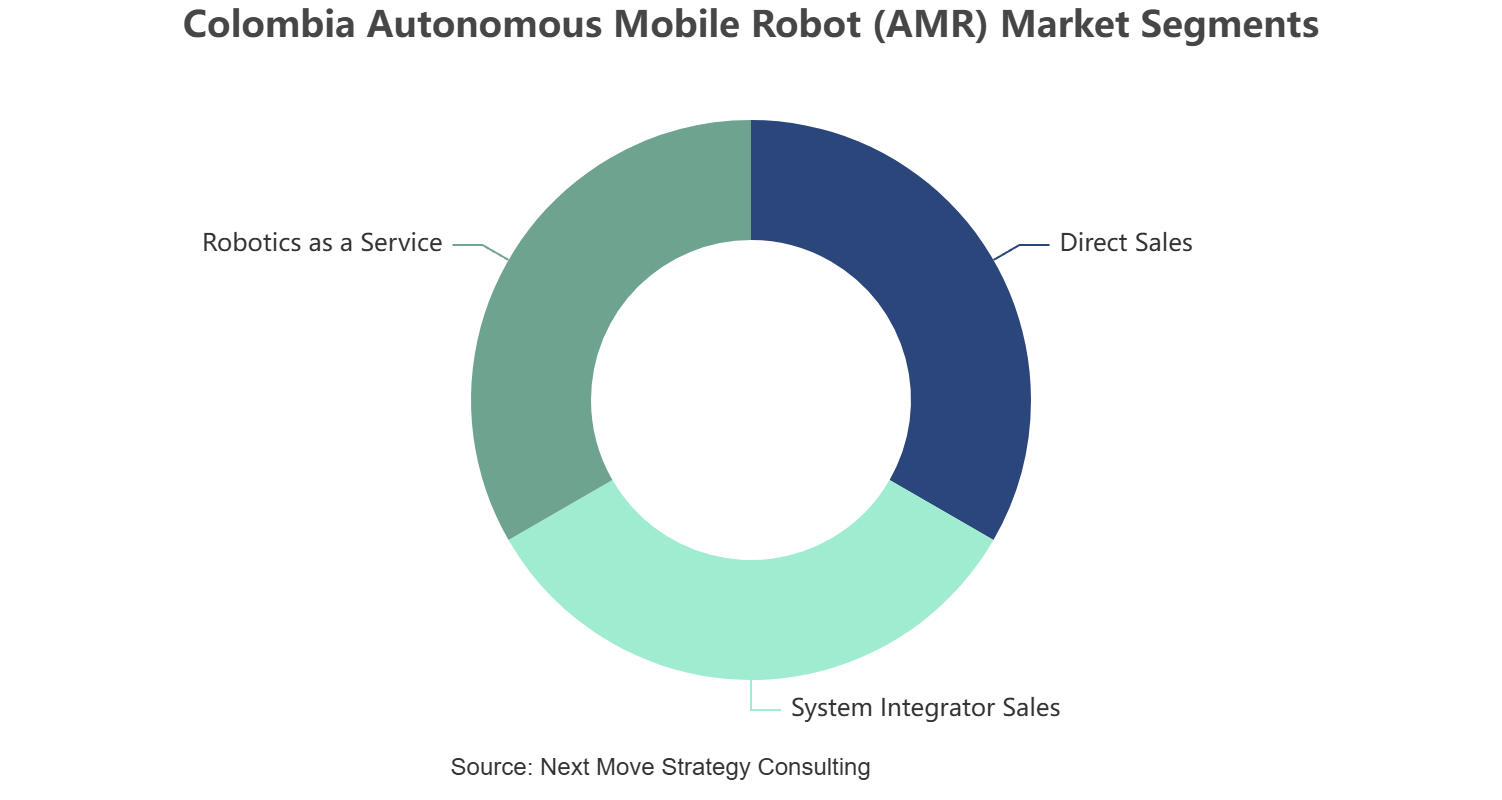
By Commercial Model: Direct Sales is the dominant segment, while Robotics as a Service is the fastest-growing segment. |
|
By Revenue Stream: Robot Hardware is the dominant segment, while Software is the fastest-growing segment. |
|
By End User Industry: Warehousing and Distribution is the dominant segment, while Healthcare is the fastest-growing segment. |
Market Opportunity: The Colombia Autonomous Mobile Robot (AMR) market is expected to create an absolute dollar opportunity of USD 35.1 million between 2026 and 2035, presenting significant investment potential across warehousing automation, nearshoring-linked manufacturing, and system integrator service expansion.
According to NMSC's analysis, system integrator sales are gaining traction as a deployment channel, reflecting Colombia's nascent domestic robotics ecosystem and the resulting reliance on specialized partners to configure and support AMR fleets for logistics and manufacturing customers.
What does the Colombia Autonomous Mobile Robot (AMR) Market Encompass?
The Colombia Autonomous Mobile Robot (AMR) market encompasses autonomous transport, picking, mobile manipulation, forklift, and specialized robot platforms deployed across warehousing, manufacturing, healthcare, and retail environments. Our assessment indicates that the market spans navigation technologies including LiDAR, vision, and magnetic and marker systems, supporting payload classes from under 100 Kgs to over 5,000 Kgs across indoor and outdoor deployment environments throughout Colombia's expanding logistics and manufacturing base.
Colombia's regulatory environment is shaped by the Ministry of Commerce, Industry and Tourism's Single Investment Window and ProColombia's investment facilitation programs, which support foreign capital entry into manufacturing and logistics sectors. We observed that operators are increasingly investing in system integrator partnerships and direct hardware procurement to accelerate deployment amid persistently high logistics costs. NMSC's analysis indicates that Colombia's position as a Latin American logistics gateway continues to anchor long-term AMR demand across warehousing, e-commerce fulfillment, and manufacturing sectors.
|
Parameters |
Details |
|
Market Size in 2025 |
USD 17 Million |
|
Market Size in 2026 |
USD 20.2 Million |
|
Revenue Forecast in 2035 |
USD 55.3 Million |
|
Market Size Growth Rate |
CAGR of 11.84% from 2026 to 2035 |
|
Market Volume in 2025 |
659 Units |
|
Market Volume in 2026 |
818 Units |
|
Volume Forecast in 2035 |
3,034 Units |
|
Market Volume Growth Rate |
CAGR of 15.67% from 2026 to 2035 |
|
Analysis Period |
2025–2035 |
|
Base Year Considered |
2025 |
|
Forecast Period |
2026–2035 |
|
Market Size Estimation |
Million (USD) |
|
Companies Profiled |
10 |
|
Market Share |
Available for 10 companies |
Key Emerging Trends
Based on research conducted by NMSC, we found that four structural trends are reshaping deployment models, technology architecture, and competitive dynamics across the Colombia Autonomous Mobile Robot (AMR) market.
How Is Nearshoring Accelerating Manufacturing Automation Investment?
Nearshoring-linked manufacturing investment is accelerating structured automation adoption as companies relocate production capacity closer to North American markets. We observed that Colombia's electronics and automotive-adjacent manufacturing sectors are attracting new foreign capital, prompting operators in Bogotá and Medellín industrial zones to specify AMR-based material handling for new and expanding facilities, reflecting a broader regional shift toward nearshoring-driven automation investment.
How Is Colombia's Logistics Gateway Position Driving Warehouse Automation?
Colombia's position as a logistics gateway linking Pacific and Caribbean trade routes is driving warehouse automation adoption across Cartagena and Bogotá distribution hubs. Our findings suggest that logistics operators are deploying autonomous transport and picking robots to manage rising e-commerce volumes, reflecting a structural shift toward automated fulfillment infrastructure as Colombia strengthens its role in regional trade.
Why Are High Logistics Costs Accelerating Automation Adoption?
Persistently high logistics costs, which represent a substantial share of product value in Colombia, are accelerating automation adoption as operators seek efficiency gains. We observed that companies including Mecalux Colombia are expanding warehouse execution software offerings to help logistics providers offset elevated transportation and handling costs through improved throughput and reduced labor dependency.
How Are System Integrator Partnerships Shaping Deployment Patterns?
System integrator partnerships are shaping AMR deployment patterns as Colombia's nascent domestic robotics ecosystem drives reliance on specialized configuration and support services. Our analysis indicates that international vendors are strengthening local integrator relationships to support multi-robot facility deployments, helping address the technical complexity manufacturers and logistics operators face when coordinating automated material handling systems.
Strategic Framework of the Colombia Autonomous Mobile Robot (AMR) Market
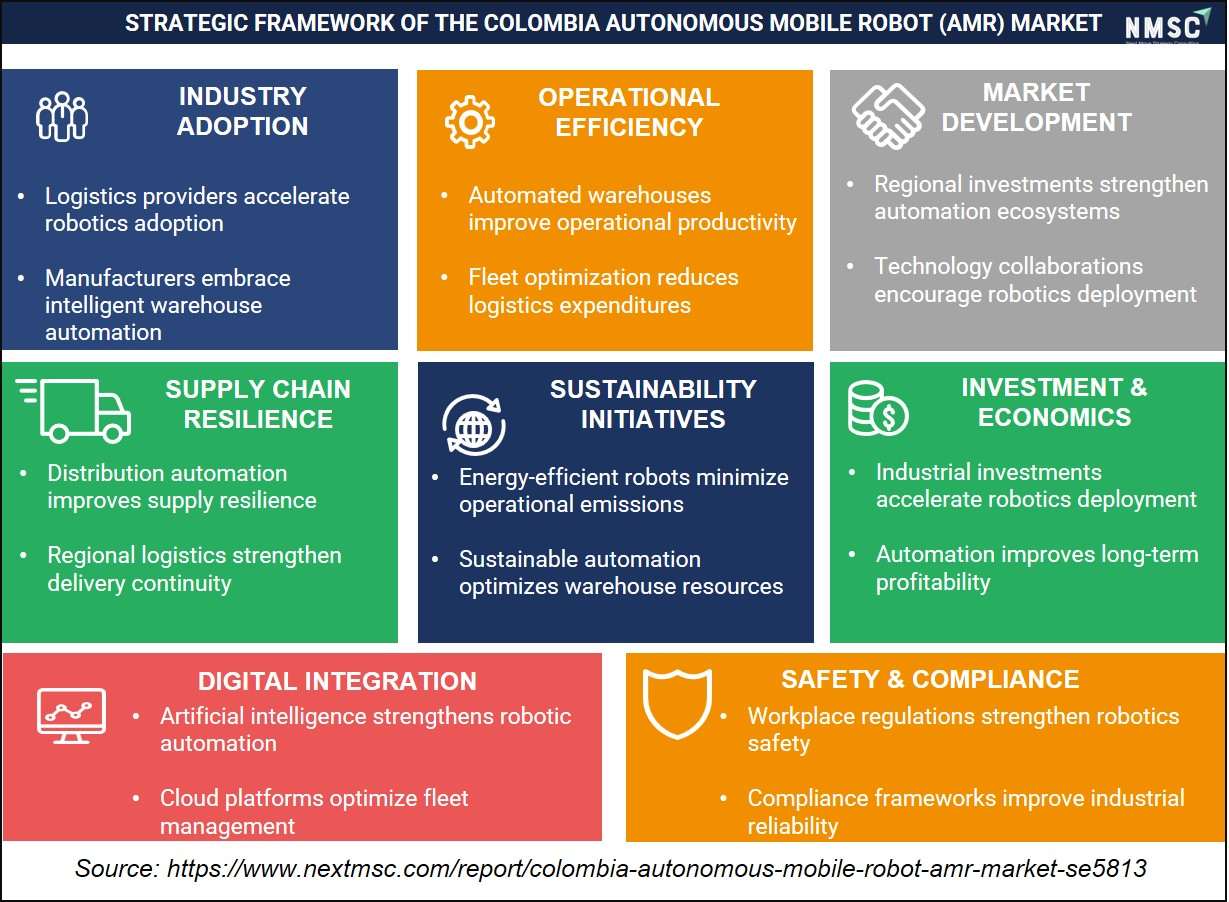
The above strategic framework analysis maps the key strategic components, such as industry adoption, supply chain resilience, operational efficiency, sustainability initiatives, market development, investment and economics, digital integration, and safety and compliance, shaping the Colombia AMR market. From our analysis, we observed that logistics providers and manufacturers accelerate robotics adoption, while automated warehouses improve productivity and fleet optimization reduces expenditures. Regional investments strengthen automation ecosystems, and artificial intelligence enhances robotic automation, whereas workplace regulations strengthen robotics safety and compliance frameworks improve industrial reliability.
Growth Drivers and Restraints
Growth Catalyst and Risk Assessment Matrix
|
FACTORS |
TYPE |
(+/–) % Impact on CAGR |
GEOGRAPHIC RELEVANCE |
IMPACT TIMELINE |
|
Nearshoring-driven manufacturing and logistics investment despite overall FDI volatility |
Driver |
+2.70% |
Colombia (Bogotá, Medellín, Cartagena) |
Medium term (2–5 years) |
|
Rapid e-commerce growth and logistics gateway positioning within Latin America |
Driver |
+2.35% |
Colombia (Bogotá, Cartagena port corridor) |
Medium term (2–4 years) |
|
High logistics costs incentivizing warehouse automation investment |
Driver |
+1.90% |
Colombia (nationwide) |
Medium term (2–4 years) |
|
Free trade zone incentives and ProColombia investment facilitation programs |
Driver |
+1.35% |
Colombia (nationwide free trade zones) |
Medium to Long term (2–6 years) |
|
Overall foreign direct investment volatility amid domestic policy uncertainty |
Restraint |
−1.60% |
Colombia (nationwide) |
Short term (1–2 years) |
|
Currency depreciation and import cost volatility affecting AMR hardware procurement |
Restraint |
−1.30% |
Colombia (nationwide) |
Short to Medium term (1–3 years) |
|
Nascent domestic robotics integration ecosystem outside major cities |
Restraint |
−1.10% |
Colombia (nationwide; outside Bogotá, Medellín) |
Short term (1–2 years) |
What Is the Primary Growth Driver of the Colombia Autonomous Mobile Robot (AMR) Market?
Nearshoring-driven manufacturing and logistics investment is the primary growth driver of the Colombia Autonomous Mobile Robot (AMR) market. According to the U.S. Department of State, foreign direct investment in non-extractive sectors grew 3.4% in 2024 and represented 75% of Colombia's total investment inflows, even as overall FDI declined amid mining-sector contraction. We observed that this non-extractive investment concentration is directly supporting manufacturing and logistics automation across Bogotá and Medellín industrial zones.
How Is Colombia's Logistics Gateway Role Driving Market Growth?
Colombia's logistics gateway role continues to drive AMR market growth as e-commerce and trade volumes expand across Pacific and Caribbean corridors. According to DANE, Colombia's economy grew 2.4% cumulatively through the first half of 2025, with trade and transport sectors among the strongest contributors. Our assessment indicates that this sustained trade and commerce activity is directly translating into expanded warehouse automation investment across major distribution hubs.
What Is Restraining Colombia Autonomous Mobile Robot (AMR) Market Expansion?
Overall foreign direct investment volatility is restraining broader capital availability for automation projects, with the U.S. Department of State reporting a 15.2% decline in total FDI between 2023 and 2024 amid domestic policy uncertainty. We found that currency depreciation further raises the effective cost of imported AMR hardware, requiring vendors to expand local financing partnerships to support sustained fleet growth despite macroeconomic headwinds.
Segmentation Analysis
By Revenue Stream Insights
How Is the Colombia Autonomous Mobile Robot (AMR) Market Segmented by Revenue Stream?
Based on revenue stream, the Colombia Autonomous Mobile Robot (AMR) market is segmented into robot hardware, software, and services.
Robot hardware continues to anchor spending as operators prioritize initial fleet acquisition across warehousing and manufacturing facilities in Bogotá and Medellín. Our analysis indicates that software, spanning fleet management, navigation, and analytics applications, is expanding rapidly as logistics operators seek to optimize throughput amid persistently high transportation costs, reflecting growing recognition that software-driven efficiency gains can meaningfully offset Colombia's elevated logistics cost structure.
By End User Industry Insights
How Is the Colombia Autonomous Mobile Robot (AMR) Market Segmented by End User Industry?
Based on end user industry, the Colombia Autonomous Mobile Robot (AMR) market is segmented into warehousing and distribution, manufacturing, healthcare, retail, and other industries.
Warehousing and distribution continues to represent a substantial share of deployed fleets, reflecting Colombia's strengthening position as a regional logistics gateway serving Pacific and Caribbean trade routes. We observed that manufacturing is expanding adoption quickly as nearshoring-linked investment flows into electronics and automotive-adjacent production facilities, positioning the segment among the fastest-growing end-user categories as foreign capital increasingly targets non-extractive manufacturing capacity.
Growth Opportunities
We observed three forward-looking opportunities positioned to shape investment and product strategy across the Colombia Autonomous Mobile Robot (AMR) market through 2035.
How Can System Integrator Networks Expand Deployment Beyond Major Cities?
Building local system integrator networks creates opportunity for vendors targeting manufacturers and logistics operators outside Bogotá and Medellín. This mechanism benefits system integrators and service providers capable of extending configuration and maintenance support to secondary industrial cities, addressing the nascent state of Colombia's domestic robotics integration ecosystem.
How Can Warehouse Automation Offset Colombia's High Logistics Costs?
Deploying throughput-optimized warehouse automation creates opportunity for vendors targeting logistics operators facing elevated transportation and handling costs. This mechanism benefits software and transport robot vendors capable of demonstrating measurable efficiency gains, enabling distribution centers in Cartagena and Bogotá to offset Colombia's above-average logistics cost structure.
How Can Flexible Financing Models Support Nearshoring-Linked Manufacturers?
Expanding flexible commercial financing models creates opportunity for vendors targeting nearshoring-linked manufacturers navigating currency volatility and import cost pressures. This mechanism benefits robotics vendors and financing partners offering direct sales alternatives, lowering adoption barriers as new manufacturing capacity comes online across Colombia's industrial zones.
Competitive Landscape
We observed that the Colombia Autonomous Mobile Robot (AMR) market features a competitive landscape combining international industrial robotics manufacturers and material-handling specialists operating through Colombian subsidiaries and regional distribution partners.
|
Key Takeaways |
Description |
|
Market Structure |
Consolidated among international robotics and material-handling manufacturers operating through local subsidiaries, with limited domestic pure-play AMR competition at this stage of market development. |
|
Innovation Focus |
System integrator enablement, throughput-optimized software, and flexible financing models suited to Colombia's cost-sensitive logistics sector dominate current strategies. |
|
M&A Activity |
Local subsidiary establishment and distribution partnerships continue to shape competitive positioning as vendors build service capacity across Bogotá and Medellín. |
How Do Companies Compete in the Colombia Autonomous Mobile Robot (AMR) Market?
Companies compete primarily through hardware reliability, local service availability, system integrator support, and established relationships with logistics and manufacturing customers. Leading vendors such as Dematic Colombia and Mecalux Colombia leverage extensive warehousing and distribution customer relationships, while diversified automation providers including ABB Colombia and OMRON Colombia differentiate through broader industrial robotics portfolios spanning manufacturing applications.
Which Competitive Archetypes Dominate the Colombia Autonomous Mobile Robot (AMR) Market?
Two primary competitive archetypes characterize the market. The first comprises diversified international industrial automation manufacturers operating through Colombian subsidiaries, represented by companies such as ABB Colombia, KUKA Robotics Colombia, and OMRON Colombia. The second includes intralogistics and material-handling specialists such as Dematic Colombia, Mecalux Colombia, and SSI SCHAEFER Sucursal Colombia, which focus on warehouse-oriented transport and picking robot platforms for logistics customers.
How Are Companies Differentiating Through Innovation in the Colombia Autonomous Mobile Robot (AMR) Market?
Innovation strategies increasingly center on warehouse execution software and system integrator enablement suited to Colombia's cost-sensitive logistics sector. Companies including KNAPP Colombia and Jungheinrich Colombia are investing in throughput-optimized fleet coordination, while Honeywell Colombia continues to expand its material-handling technology portfolio to support growing e-commerce fulfillment demand.
What Expansion Activity Is Shaping the Colombia Autonomous Mobile Robot (AMR) Market?
Local subsidiary establishment and distribution partnerships continue to shape competition across the market. International vendors are strengthening Colombia-based service and integration capacity to support ProColombia-facilitated manufacturing and logistics investment, enabling faster deployment timelines across warehousing and manufacturing facilities as nearshoring-linked capital inflows continue to expand.
Key Players
Our assessment indicates that the following 10 companies are actively shaping technology innovation, service expansion, and competitive dynamics within the Colombia Autonomous Mobile Robot (AMR) market.
-
Dematic Colombia S.A.S.
-
Jungheinrich Colombia S.A.S.
-
Mecalux Colombia S.A.S.
-
SSI SCHAEFER Sucursal Colombia
-
Honeywell Colombia S.A.S.
-
ABB Colombia Ltda.
-
KNAPP Colombia S.A.S.
-
Zebra Technologies Colombia S.A.S.
Investment Opportunities
What Capital Inflows Are Targeting the Colombia Autonomous Mobile Robot (AMR) Industry?
Capital inflows into the Colombia Autonomous Mobile Robot (AMR) Industry are increasingly concentrated in non-extractive sectors, which the U.S. Department of State reports grew 3.4% in 2024 and represented 75% of Colombia's total foreign direct investment. We observed that investors favor vendors demonstrating strong local service capacity and established logistics or manufacturing customer relationships as indicators of durable growth amid broader FDI volatility.
How Is Infrastructure Investment Supporting the Colombia Autonomous Mobile Robot (AMR) Market?
Infrastructure investment is expanding logistics and manufacturing automation capacity across Colombia's major trade corridors, supported by government programs including MinCIT's Single Investment Window, which enabled foreign investors to complete 36 procedures online as of May 2025. Our findings suggest that companies are investing in expanded distribution centers and system integrator training programs to support faster AMR deployment across Bogotá, Medellín, and Cartagena.
What ESG Considerations Are Shaping Investment Decisions in the Colombia Autonomous Mobile Robot (AMR) Market?
Environmental, social, and governance considerations are increasingly integral to investment decisions, with energy-efficient drive systems and workplace safety emerging as priorities alongside ProColombia's stated focus on sustainable development and reindustrialization. We found that investors increasingly favor vendors demonstrating measurable improvements in energy efficiency and alignment with Colombia's broader social and environmental investment priorities, reinforcing long-term value creation across the country's automation sector.
Key Benefits for Stakeholders
How Does This Report Benefit Enterprise and Industry Leaders?
Enterprise and industry leaders gain access to validated market segmentation, competitive benchmarking, and regional demand forecasts that support strategic planning, capital allocation, and fleet-deployment decisions across the Colombia Autonomous Mobile Robot (AMR) market. Our analysis shows that detailed assessments of product type, navigation technology, payload, and end-user industry trends help operators identify high-growth opportunities and strengthen long-term automation strategies.
How Does This Report Benefit Investors and Financial Analysts?
Investors and financial analysts benefit from consistent market size estimates, growth forecasts, and competitive assessments supporting investment evaluation across the Colombia AMR market. We observed that detailed analysis of commercial model, revenue stream, and end-user industry trends enables stakeholders to identify companies and market categories with the strongest long-term growth potential through 2035.
How Does This Report Benefit Technology Vendors and Product Teams?
Technology vendors and product development teams gain insights into emerging innovation trends, including throughput-optimized software, system integrator enablement, and flexible financing models transforming the Colombian AMR industry. Our findings suggest that this analysis helps research and development teams prioritize future product pipelines and align offerings with evolving customer and regulatory requirements.
PESTEL Analysis of the Colombia Autonomous Mobile Robot (AMR) Market
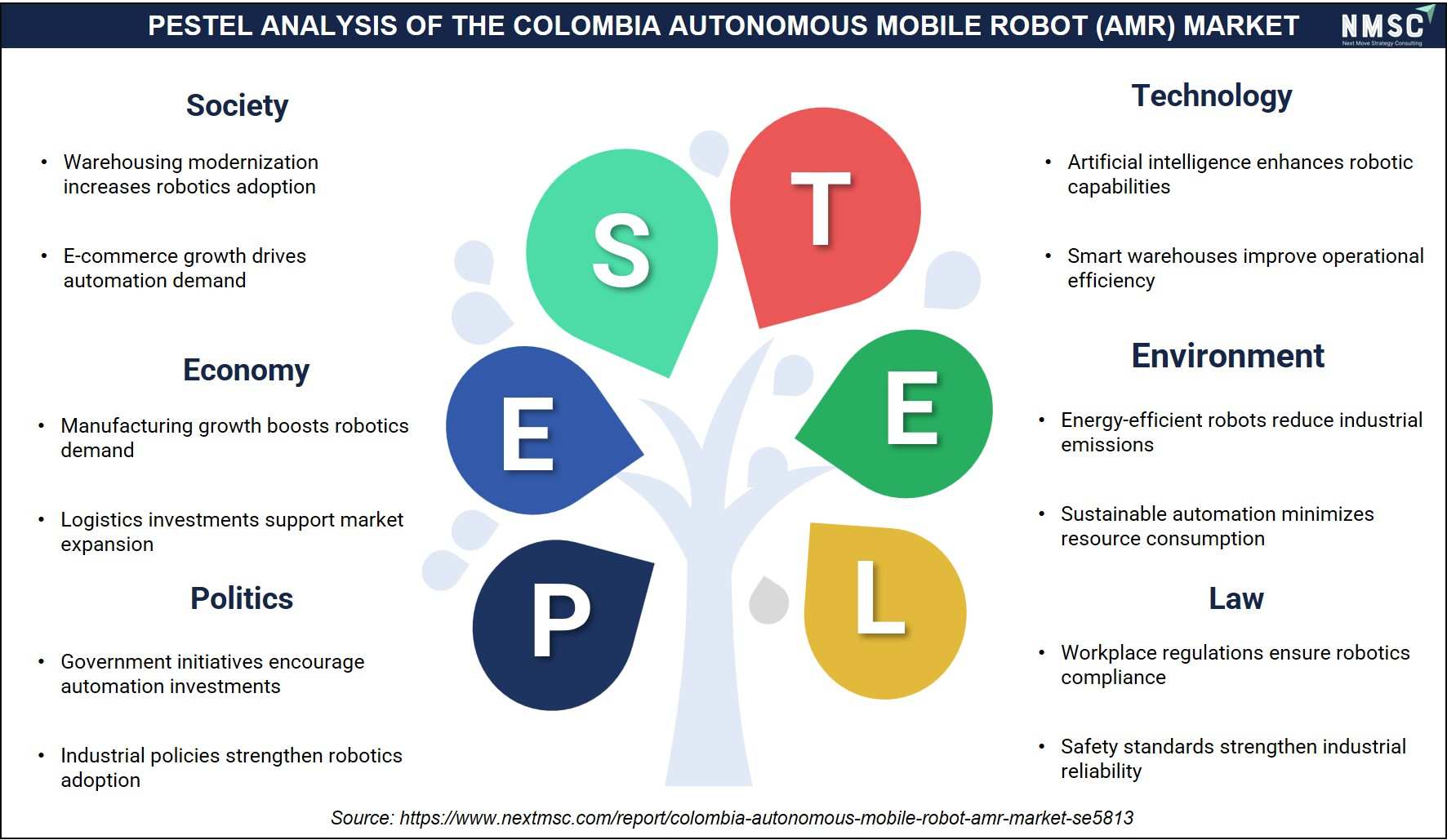
The above PESTEL analysis maps the key macro-environmental factors, such as political, economic, social, technological, environmental, and legal, shaping the Colombia AMR market. From our analysis, we observed that political stability and government initiatives support automation adoption, while economic factors influence investment and operational costs. Social acceptance and technological advancements drive innovation, whereas environmental regulations promote sustainable practices. Legal frameworks, including robotics standards and compliance requirements, ensure safety and reliability, reflecting a comprehensive PESTEL landscape across the Colombia AMR market.
Key Market Segments
By Product Type
-
Autonomous Transport Robots
-
Tugger
-
Cart
-
Pallet
-
Shelf and Rack
-
Conveyor
-
Other Transport Robots
-
-
Autonomous Picking Robots
-
Goods to Person
-
Person to Goods
-
Piece Picking
-
Case Picking
-
Other Picking Robots
-
-
Autonomous Mobile Manipulators
-
Robotic Arm
-
Inspection Manipulators
-
Maintenance Manipulators
-
Other Mobile Manipulators
-
-
Autonomous Forklift Robots
-
Counterbalance Forklift
-
Reach Forklift
-
Stacker Forklift
-
Pallet Truck
-
Other Forklift Robots
-
-
Specialized AMRs
-
Healthcare Robots
-
Laboratory Robots
-
Retail Robots
-
Security Robots
-
Other Specialized Robots
-
By Navigation Technology
-
LiDAR
-
Vision Navigation
-
Sensor Fusion Navigation
-
Magnetic and Marker Navigation
-
Other Navigation Technology
By Payload Capacity
-
< 100 Kgs
-
100 Kgs to 1000 Kgs
-
1001 Kgs to 5000 Kgs
-
> 5000 Kgs
By Deployment Environment
-
Indoor Autonomous Mobile Robots
-
Warehouse Environment
-
Manufacturing Environment
-
Healthcare Environment
-
Retail Environment
-
Laboratory Environment
-
-
Outdoor Autonomous Mobile Robots
-
Industrial Yard Environment
-
Logistics Terminal Environment
-
Other Outdoor Environment
-
By Commercial Model
-
Direct Sales
-
System Integrator Sales
-
Robotics as a Service
By Revenue Stream
-
Robot Hardware
-
Software
-
Fleet Management Software
-
Navigation Software
-
Robot Operating Software
-
Analytics Software
-
AI Software
-
-
Services
-
Installation and Deployment
-
Integration Services
-
Maintenance Services
-
Robotics as a Service
-
By End User Industry
-
Warehousing and Distribution
-
E-commerce Fulfillment
-
Third Party Logistics
-
Retail Distribution
-
-
Manufacturing
-
Automotive
-
Electronics and Semiconductors
-
Machinery and Equipment
-
Food and Beverage Manufacturing
-
Other Manufacturing
-
-
Healthcare
-
Hospitals
-
Laboratories
-
Pharmaceutical Facilities
-
-
Retail
-
Other Industries
Conclusion and Recommendations
What Is the Long-Term Outlook for the Colombia Autonomous Mobile Robot (AMR) Market?
The long-term outlook for the Colombia AMR market remains positive, supported by Colombia's strengthening logistics gateway position, nearshoring-linked manufacturing investment concentrated in non-extractive sectors, and persistently high logistics costs that continue to incentivize automation. We observed that growing adoption across warehousing and manufacturing will continue to drive expansion throughout the forecast period.
What Strategic Positioning Should AMR Companies Pursue?
Vendors should prioritize investment in local system integrator partnerships, throughput-optimized software, and flexible financing models while strengthening logistics and manufacturing customer relationships. Our assessment indicates that companies combining hardware reliability with strong local service capacity and financing flexibility will be best positioned to capture demand across the Colombia Autonomous Mobile Robot (AMR) market amid broader FDI volatility.
How Attractive Is the Colombia Autonomous Mobile Robot (AMR) Market for New Investment?
The Colombia AMR market presents an emerging investment opportunity, supported by Colombia's logistics gateway positioning and concentrated non-extractive sector investment growth. We found that investment potential is particularly strong for companies focused on system integrator enablement, throughput software, and flexible commercial models, enabling them to capitalize on nearshoring-linked demand despite near-term macroeconomic uncertainty.
What Market Shifts and Key Risks Should Stakeholders Monitor?
Stakeholders should closely monitor overall foreign direct investment volatility, currency depreciation affecting hardware import costs, and the nascent state of Colombia's domestic robotics integration ecosystem outside major cities. Our analysis shows that companies unable to expand local service capacity or offer flexible financing may face increasing competitive pressure as customers seek more affordable deployment across the Colombia Autonomous Mobile Robot (AMR) market.
What Are the Key Growth Pathways for the Colombia Autonomous Mobile Robot (AMR) Market?
Key growth pathways include expanding system integrator networks beyond Bogotá and Medellín, advancing throughput-optimized warehouse software, and strengthening flexible financing models for nearshoring-linked manufacturers. NMSC's analysis indicates that companies successfully combining hardware reliability, local service depth, and financing flexibility will be best positioned to capture the Colombia AMR market's projected growth through 2035.
About the Author
 Mayurima Roy
— Mayurima Roy is Research Analyst at Next Move Strategy Consulting, where she has spent 4 years working across the firm's full industry coverage rather than a single fixed vertical. Her work centers on structured research, ongoing trend tracking, competitive assessment, and insight-led content development, translating complex market data into clear, decision-ready narratives that support informed client decision-making across diverse global industries, market sectors, and world regions every day.
Mayurima Roy
— Mayurima Roy is Research Analyst at Next Move Strategy Consulting, where she has spent 4 years working across the firm's full industry coverage rather than a single fixed vertical. Her work centers on structured research, ongoing trend tracking, competitive assessment, and insight-led content development, translating complex market data into clear, decision-ready narratives that support informed client decision-making across diverse global industries, market sectors, and world regions every day.
About the Reviewer
 Supradip Baul
— Supradip Baul is an accomplished business consultant and strategist with over a decade of rich experience in market intelligence, strategy, technology, and business transformation. His work has included rigorous qualitative and quantitative analysis across multiple industries, helping clients shape investment decisions and long-term roadmaps. Earlier in his career, he was associated with Gartner, where he contributed to industry-leading reports and market share analyses. He has worked with leading global companies and holds an MBA with a dual specialization in Marketing and Finance.
Supradip Baul
— Supradip Baul is an accomplished business consultant and strategist with over a decade of rich experience in market intelligence, strategy, technology, and business transformation. His work has included rigorous qualitative and quantitative analysis across multiple industries, helping clients shape investment decisions and long-term roadmaps. Earlier in his career, he was associated with Gartner, where he contributed to industry-leading reports and market share analyses. He has worked with leading global companies and holds an MBA with a dual specialization in Marketing and Finance.
At Next Move Strategy Consulting, we understand that insightful market research is the cornerstone of successful business decisions. That's why we employ a robust and multifaceted approach, combining various methodologies to deliver the most accurate and actionable data for our clients.

Research Landscape
We navigate the world of research with two primary approaches:
Qualitative Approach
Our qualitative research methodologies involve immersive techniques such as in-depth interviews, focus groups, and observational studies. By engaging directly with individuals and stakeholders, we uncover valuable insights that quantitative data alone may overlook.

Quantitative Research
In tandem with qualitative methodologies, NMSC leverages the power of Quantitative Research to provide a robust foundation of numerical insights. Through systematic data collection and analysis, we quantify patterns, preferences, and market trends, offering a comprehensive view of the business landscape.
Our quantitative research approach employs diverse tools, including surveys, experiments, and statistical modelling. These methodologies enable us to gather data from a large and representative sample, ensuring the statistical significance of our findings. By employing structured questionnaires and standardized data collection methods, we guarantee the reliability and validity of the information we present to our clients.
Quantitative research is particularly effective in measuring the prevalence of trends, assessing market size, and gauging the impact of various factors on consumer behavior. The numerical precision attained through this approach equips our clients with actionable insights, facilitating data-driven decision-making and strategy formulation.


Our Specialized Toolbox for Industry-Specific Market Research
We deploy a specialized arsenal of techniques tailored to meet your unique requirements. Here's a glimpse into our comprehensive toolbox:

Information Procurement
The stage entails acquiring market data or relevant information through various sources and methodologies.


Market Research Approach
We utilize both top-down and bottom-up approaches in market research analysis to achieve a comprehensive understanding of the market dynamics, leveraging the broad perspective of industry trends and macroeconomic factors alongside detailed insights from specific segments and individual companies.

Porters Five Forces Analysis
We conduct Porter's Five Forces analysis to evaluate the competitive landscape of an industry, providing us with insights into factors that affect profitability and strategic positioning.

SWOT Analysis

Forecasting
We utilize a forecasting model to predict future consumption by considering parameters like population, economics, regulations, market competition, drivers, constraints, technology, and pricing. We also employ statistical techniques such as multilinear regression, exponential smoothing, moving average, ARIMA, and Monte Carlo simulations for accurate predictions. In econometric forecasting, we analyzed short-term and long-term event impacts, attributing values based on regulatory frameworks, economic factors, and market events.





 Speak to Our Analyst