Contact Lenses Market Size, Share, and Trends Analysis by Base Material (Hydrogel, Silicone Hydrogel, Rigid gas permeable, & Others), Intended Use (Routine correction, Myopia management, Cosmetic enhancement, Therapeutic, & Others), Wear Schedule (Daily Disposable, Biweekly, Monthly, & Others), Distribution Channel (Eye Care Professionals and Clinics, Optical Retail, E-commerce, & Others), and Region — Global Industry Report and Forecast, 2026–2035
Industry: Retail and Consumer | Publishing Date: August 5, 2026 | Last Updated: August 5, 2026 | No of Pages: N/A | No. of Tables: N/A | No. of Figures: N/A | Format: PDF | Report Code: RC3881
What Is the Contact Lenses Market Size?
The global Contact Lenses Market size reached USD 14.82 Billion in 2025 and is estimated at USD 15.61 Billion in 2026, forecast to reach USD 24.89 Billion by 2035 at a CAGR of 5.32% between 2026 and 2035. North America leads with an approximate 34% share, while Silicone Hydrogel dominates the base material segment at approximately 58% share in 2025.
We observed that pediatric myopia management is shifting from an emerging clinical niche into a core growth category, a transition reinforced by regulatory clearance precedent that is pulling premium-priced daily disposable lens demand ahead of the broader routine correction segment.
|
Key Takeaways |
|
By Base Material: Silicone Hydrogel held the largest share, expanding from USD 8.60 billion in 2025 to USD 15.93 billion by 2035; Hybrid is the fastest-growing sub-segment at 8.75% CAGR from 2026–2035. |
|
By Intended Use: Routine Correction held the largest share, expanding from USD 11.55 billion in 2025 to USD 16.93 billion by 2035; Myopia Management is the fastest-growing sub-segment at 13.73% CAGR from 2026–2035. |
|
By Wear Schedule: Daily Disposable held the largest share, reflecting rising preference for single-use hygiene and convenience; Daily Disposable is also the fastest-growing sub-segment, driven by myopia management and premium routine correction adoption. |
|
By Distribution Channel: Eye Care Professionals and Clinics held the largest share, expanding from USD 6.22 billion in 2025 to USD 8.96 billion by 2035; E-Commerce is the fastest-growing sub-segment at 9.03% CAGR from 2026–2035. |
|
Dominant Region: North America dominated with approximately 34% revenue share in 2025. |
|
Fastest-Growing Region: Asia-Pacific is expected to register the highest CAGR of 7.01% during 2026–2035. |
|
Dominant Country: The U.S. led the market, anchored by concentrated eye care professional infrastructure and premium lens adoption. |
|
Fastest-Growing Country: India is the fastest-growing country, supported by rising myopia prevalence and expanding eye care access. |
The market presents an absolute investment opportunity of approximately USD 9.28 Billion between 2026 and 2035, calculated as the difference between the 2035 forecast of USD 24.89 Billion and the 2026 base of USD 15.61 Billion, positioning silicone hydrogel and myopia management lens platforms as a high-conviction category for ophthalmic device manufacturers and eye care investors.
According to NMSC analysis, the segment's resilience stems from the convergence of daily disposable convenience with clinically validated myopia control, which is expanding total addressable spend per pediatric patient well beyond traditional routine correction pricing.
What does the Contact Lenses Market Encompass?
The Contact Lenses Market covers hydrogel, silicone hydrogel, rigid gas permeable, and hybrid lenses used for routine vision correction, myopia management, cosmetic enhancement, therapeutic, prosthetic, and smart diagnostic applications across daily disposable through yearly wear schedules. We observed that the market has evolved from primarily reusable hydrogel lenses into a silicone hydrogel and daily disposable dominated category as oxygen permeability and single-use hygiene became standard clinical expectations.
Our findings suggest that FDA clearance precedent for myopia control lenses is structurally reshaping product development priorities, as manufacturers race to bring competing myopia management options to market following the regulatory pathway established for the category. Technology adoption trends toward smart and diagnostic lenses embedding sensing capability are further extending contact lens value beyond optical correction into continuous ocular health monitoring.
|
Parameters |
Details |
|
Market Size in 2025 |
USD 14.82 Billion |
|
Market Size in 2026 |
USD 15.61 Billion |
|
Revenue Forecast in 2035 |
USD 24.89 Billion |
|
Growth Rate |
CAGR of 5.32% from 2026 to 2035 |
|
Analysis Period |
2025–2035 |
|
Base Year Considered |
2025 |
|
Forecast Period |
2026–2035 |
|
Market Size Estimation |
USD Billion |
|
Companies Profiled |
20 |
|
Countries Covered |
38 |
|
Market Share |
Available for Top 10 Companies |
Key Emerging Trends
Based on research conducted by NMSC, we found that four structural trends are redefining how contact lens manufacturers formulate, price, and expand their addressable population through 2035.
How Is FDA-Cleared Myopia Management Transforming Pediatric Eye Care?
We found that FDA clearance precedent for myopia control is transforming pediatric eye care from correction-only toward disease-modifying treatment. CooperVision's MiSight 1 day, cleared by the FDA in November 2019 as the first and only approved soft contact lens proven to slow myopia progression in children aged 8 to 12, exemplifies this transformation, with published trial data showing progression slowed by 59% on one clinical measure over the study period.
What Role Does Silicone Hydrogel Adoption Play in Reusable Lens Preference?
Our assessment indicates that silicone hydrogel materials are gaining adoption in Alcon's reusable lens portfolio, with the company reporting that reusable contact lenses and new product launches, including its first multifocal toric lens, delivered share gains within the fastest-growing multifocal category in 2025. This adoption reflects rising demand among presbyopic patients with astigmatism who previously had limited reusable lens options.
How Are Stakeholders Responding to E-Commerce Distribution Growth in the Contact Lenses Market?
We observed that eye care professionals and manufacturers are responding to growing e-commerce contact lens purchasing by strengthening direct-to-consumer subscription and reorder programs that maintain prescription compliance oversight. This stakeholder response reflects manufacturers' need to preserve clinical relationship value even as an increasing share of routine reorder volume shifts toward online channels.
Why Is Daily Disposable Adoption Gaining Traction Across Multiple Indications?
During our market evaluation, we noticed that daily disposable wear schedules are gaining traction not only in routine correction but across myopia management and therapeutic indications, since single-use lenses eliminate lens-care compliance risk in pediatric and clinically sensitive populations. This traction reflects growing clinical consensus that daily disposable formats represent the healthiest soft contact lens wear modality across nearly all patient categories.
Growth Drivers & Restraints
Growth Catalyst & Risk Assessment Matrix
|
Factors |
Type |
(+/−) % Impact on CAGR |
Geographic Relevance |
Impact Timeline |
|
Rising pediatric myopia prevalence and clinical management adoption |
Driver |
+2.1% |
Asia-Pacific, North America |
2026–2035 |
|
FDA-cleared myopia control lens regulatory precedent |
Driver |
+1.6% |
North America, Global |
2026–2032 |
|
Growth of premium silicone hydrogel and multifocal reusable lenses |
Driver |
+1.3% |
North America, Europe |
2026–2033 |
|
Expanding e-commerce and direct-to-consumer distribution |
Driver |
+0.9% |
Global |
2026–2031 |
|
Rising presbyopic population driving multifocal and toric demand |
Driver |
+0.7% |
Europe, North America, Asia-Pacific |
2026–2035 |
|
Price competition from regional Asia-Pacific manufacturers |
Restraint |
−0.8% |
Asia-Pacific |
2026–2035 |
|
Reimbursement limitations for premium myopia management lenses |
Restraint |
−0.6% |
Latin America, MEA, Asia-Pacific |
2026–2033 |
|
Contact lens-related eye infection safety concerns |
Restraint |
−0.4% |
Global |
2026–2030 |
|
Long regulatory approval cycles for new therapeutic lens indications |
Restraint |
−0.3% |
North America, Europe |
2026–2032 |
What is the Primary Growth Driver of the Contact Lenses Market?
The primary growth driver is rising pediatric myopia prevalence combined with the availability of clinically validated management options, following the FDA's November 2019 approval of CooperVision's MiSight 1 day as the first product proven to slow myopia progression in children aged 8 to 12. This regulatory precedent has established a clear commercialization pathway that competing manufacturers are now pursuing across the myopia management category.
How is Premium Reusable Lens Innovation Driving the Contact Lenses Market Growth?
Our analysis shows that premium reusable lens innovation is directly driving market growth, with Alcon reporting full-year 2025 contact lens net sales of USD 2.8 billion, an increase of 6%, led by its first multifocal toric lens launch addressing presbyopic patients with astigmatism. This sustained innovation-led growth evidences durable enterprise demand for differentiated reusable lens categories beyond standard spherical corrections.
What is Restraining the Contact Lenses Market?
We found that the primary restraint is price competition from regional Asia-Pacific manufacturers offering lower-cost hydrogel and silicone hydrogel alternatives, which pressures premium-brand pricing power in price-sensitive markets. Industry-derived estimates suggest that limited reimbursement coverage for premium myopia management lenses in several Asia-Pacific and Latin American markets is also slowing broader clinical adoption relative to North America and Europe.
Segmentation Analysis
Segment Sizing: By Base Material
|
Segment |
2025 (USD Bn) |
2035 (USD Bn) |
CAGR% (2026–2035) |
|
Silicone Hydrogel |
8.60 |
15.93 |
6.48% |
|
Hydrogel |
4.45 |
5.72 |
2.25% |
|
Rigid Gas Permeable |
0.89 |
1.24 |
3.13% |
|
Hybrid |
0.44 |
1.00 |
8.75% |
|
Other Materials |
0.44 |
1.00 |
8.75% |
|
Total |
14.82 |
24.89 |
5.32% |
Which Base Material Segment Dominates the Contact Lenses Market?
Silicone Hydrogel leads with USD 8.60 Billion in 2025, expanding to USD 15.93 Billion by 2035, reflecting its established position as the standard material for both daily disposable and reusable lenses due to superior oxygen permeability. Hybrid is the fastest-growing base material segment at an 8.75% CAGR, as manufacturers combine rigid gas permeable optical centers with soft peripheral skirts to serve keratoconus and irregular cornea patients underserved by standard soft lens geometry.
Segment Sizing: By Intended Use
|
Segment |
2025 (USD Bn) |
2035 (USD Bn) |
CAGR% (2026–2035) |
|
Routine Correction |
11.55 |
16.93 |
3.74% |
|
Myopia Management |
1.19 |
3.98 |
13.73% |
|
Cosmetic Enhancement |
0.89 |
1.49 |
5.25% |
|
Therapeutic |
0.74 |
1.49 |
7.46% |
|
Prosthetic |
0.15 |
0.25 |
5.08% |
|
Smart and Diagnostic |
0.30 |
0.75 |
10.31% |
|
Total |
14.82 |
24.89 |
5.32% |
Which Intended Use Leads and Which Grows Fastest in the Contact Lenses Market?
Routine Correction dominates at USD 11.55 Billion in 2025, reflecting its role as the foundational use case across the vast majority of prescribed lenses within the broader eyewear and vision correction landscape. Myopia Management is the fastest-growing intended use at a 13.73% CAGR, directly tied to rising pediatric myopia prevalence and the commercial pathway established by FDA-cleared products proven to slow disease progression rather than only correct refractive error.
Segment Sizing: By Distribution Channel
|
Segment |
2025 (USD Bn) |
2035 (USD Bn) |
CAGR% (2026–2035) |
|
Eye Care Professionals and Clinics |
6.22 |
8.96 |
3.54% |
|
Optical Retail |
3.56 |
5.23 |
3.77% |
|
E-Commerce |
3.26 |
7.47 |
9.03% |
|
Hospitals and Medical Centers |
0.89 |
1.49 |
5.25% |
|
OEM and Private Label |
0.89 |
1.74 |
7.08% |
|
Total |
14.82 |
24.89 |
5.32% |
Which Distribution Channel Dominates and Which is Fastest-Growing in the Contact Lenses Market?
Eye Care Professionals and Clinics lead distribution at USD 6.22 Billion in 2025, reflecting the clinical fitting and prescription requirements that anchor initial lens purchases to professional relationships. E-Commerce is the fastest-growing distribution channel at a 9.03% CAGR, as an increasing share of routine reorder volume shifts online once initial fittings and prescriptions are established through in-person eye care visits.
Porter's Five Forces Analysis of the Contact Lenses Industry
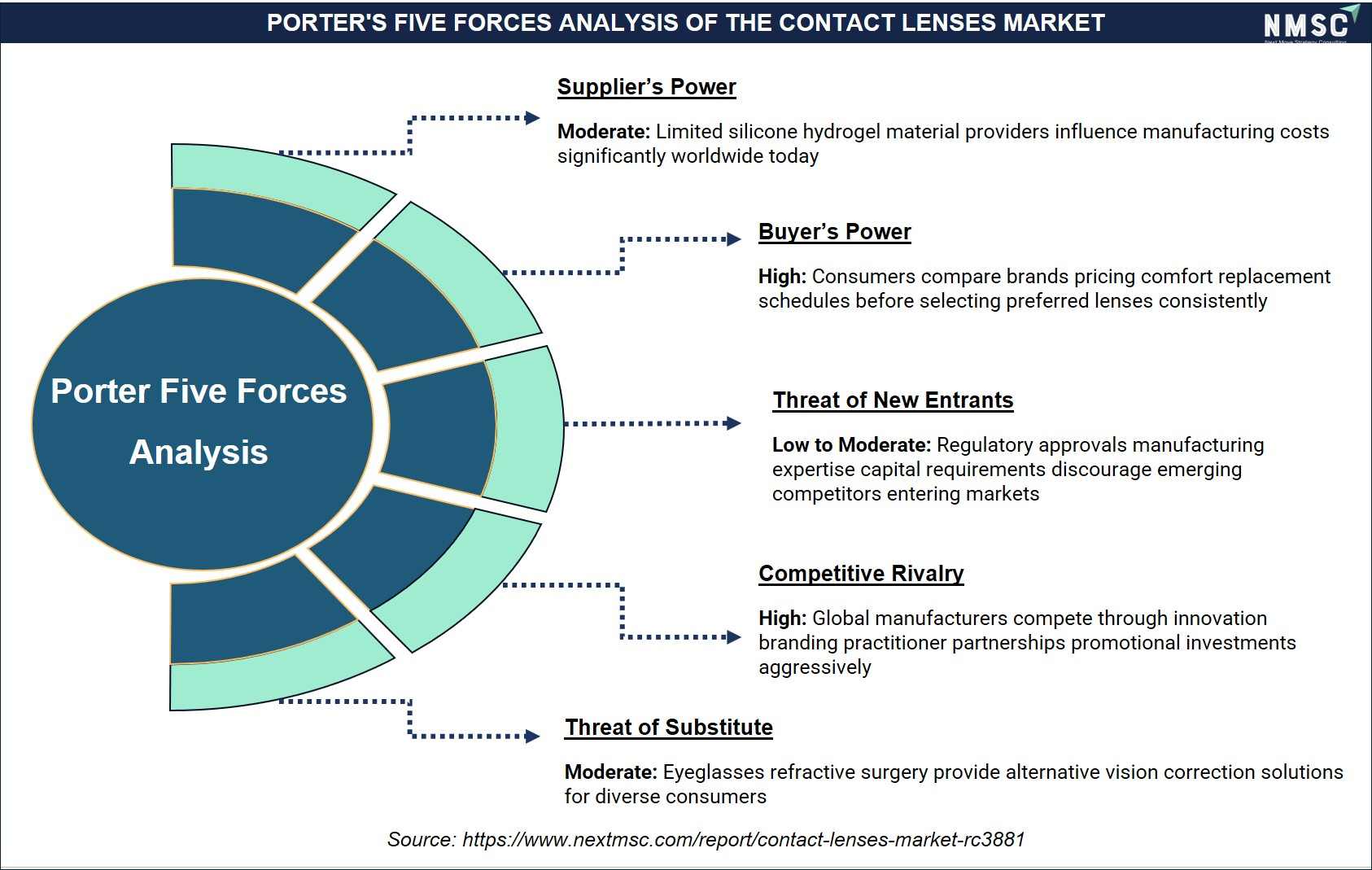
The above infographic presents a Porter's Five Forces analysis of the contact lenses market, wherein supplier power remains moderate due to reliance on limited silicone hydrogel material providers that influence manufacturing costs. Buyer power is high as consumers compare pricing, comfort, and brand reputation before purchasing. The threat of new entrants is low to moderate, constrained by regulatory approvals, manufacturing expertise, and capital requirements. Further, competitive rivalry is intense among global manufacturers competing through innovation and branding, while the threat of substitutes remains moderate, as eyeglasses and refractive surgery provide viable alternatives. Looking ahead, we observed that continued innovation and shifting consumer preferences will remain key competitive drivers across the market.
Growth Opportunities
Our analysis shows that three whitespace opportunities stand out for manufacturers positioning ahead of 2035 demand.
Can Expanded Myopia Management Age Ranges Unlock New Pediatric Demand?
Manufacturers that secure regulatory clearance for myopia management lenses beyond the current 8 to 12 age range can capture additional pediatric and adolescent patients currently outside approved indications, benefiting the Myopia Management segment as clinical evidence supporting earlier and later intervention continues to accumulate.
Does Smart Lens Sensing Technology Create Value for Chronic Disease Monitoring?
Manufacturers developing smart and diagnostic lenses capable of continuous intraocular pressure or glucose monitoring can capture demand from glaucoma and diabetes patient populations, benefiting the Smart and Diagnostic segment as embedded sensing technology matures toward commercial viability.
Can Subscription-Based E-Commerce Models Expand Daily Disposable Adoption in the Contact Lenses Market?
Manufacturers offering subscription-based e-commerce reorder programs tied to eye care professional oversight can capture rising online distribution demand while preserving prescription compliance, benefiting the E-Commerce channel and Daily Disposable wear schedule as convenience-focused purchasing continues to grow.
Regional Outlook
|
Region |
2025 (USD Bn) |
2035 (USD Bn) |
CAGR% (2026–2035) |
Key Driver |
|
North America |
5.04 |
7.47 |
3.89% |
Premium silicone hydrogel and myopia management adoption |
|
Asia-Pacific |
4.74 |
9.20 |
7.01% |
Rising myopia prevalence and expanding eye care access |
|
Europe |
3.56 |
5.48 |
4.31% |
Established reimbursement and presbyopic multifocal demand |
|
Latin America |
0.89 |
1.74 |
7.08% |
Growing eye care infrastructure investment |
|
Middle East & Africa |
0.59 |
1.00 |
5.46% |
Expanding optical retail and clinic infrastructure |
|
Total |
14.82 |
24.89 |
5.32% |
|
North America Contact Lenses Market
North America holds the largest regional share, supported by concentrated eye care professional infrastructure and the presence of leading manufacturers including Johnson & Johnson Vision Care, Alcon, and CooperVision. We observed that premium silicone hydrogel and myopia management adoption are most advanced in this region, positioning North America as both the largest revenue base and the primary launch market for new lens technology.
Asia-Pacific Contact Lenses Market
Asia-Pacific is the fastest-growing region, driven by rising myopia prevalence across China, India, and Southeast Asia combined with expanding eye care access. We found that regional manufacturers are scaling hydrogel and silicone hydrogel production fastest in this region, reflecting price-sensitive demand alongside growing adoption of myopia management lenses in markets with the highest pediatric myopia rates globally.
Europe Contact Lenses Market
Europe's market benefits from established reimbursement frameworks and a growing presbyopic population driving multifocal and toric lens demand. Our findings suggest that regional adoption of premium daily disposable formats continues to rise steadily as clinical guidance increasingly favors single-use wear schedules over reusable alternatives for eye health reasons.
Middle East & Africa Contact Lenses Market
The Middle East & Africa region is expanding steadily, with the UAE and Saudi Arabia leading optical retail and clinic infrastructure investment tied to broader healthcare modernization. Industry-derived estimates suggest regional growth will track broader eye care access expansion rather than myopia-specific regulatory mandates, given the comparatively nascent clinical infrastructure environment in the region.
Latin America Contact Lenses Market
Latin America is expanding at a 7.08% CAGR, led by Brazil's growing eye care infrastructure investment and rising optical retail penetration. We observed that Argentina's eye care sector offers latent demand for silicone hydrogel and daily disposable lenses as private insurers begin extending coverage previously limited to basic hydrogel options.
U.S. Contact Lenses Market
Based on our estimates, the U.S. market was valued at approximately USD 4.15 Billion in 2025 and is projected to reach USD 6.13 Billion by 2035 at a CAGR near 4.0%. Demand structure is anchored by concentrated eye care professional infrastructure and high technology penetration among premium silicone hydrogel and myopia management lenses, with strong competitive intensity between Johnson & Johnson Vision Care, Alcon, CooperVision, and Bausch + Lomb.
Canada Contact Lenses Market
The market in Canada was estimated at around USD 0.62 Billion in 2025, forecast to reach USD 0.92 Billion by 2035 at roughly 4.0% CAGR. Canada's demand structure closely mirrors U.S. adoption patterns, with growing myopia management uptake among pediatric patients supporting steady technology penetration and moderate competitive intensity.
UK Contact Lenses Market
As per our estimate, the UK market stood near USD 0.71 Billion in 2025 and is expected to reach USD 1.07 Billion by 2035 at approximately 4.2% CAGR. Established National Health Service and private optical retail infrastructure support demand, with regulatory influence centered on medical device conformity standards rather than binding reimbursement mandates.
Germany Contact Lenses Market
According to our analysis, Germany's market was valued at about USD 0.83 Billion in 2025, projected to reach USD 1.28 Billion by 2035 at a CAGR near 4.4%. Germany's demand structure benefits from strong presbyopic multifocal adoption and the presence of established regional optical retail chains, supporting high technology penetration across premium lens categories.
France Contact Lenses Market
Based on our estimates, France's market reached approximately USD 0.44 Billion in 2025 and is forecast to grow to USD 0.68 Billion by 2035 at around 4.5% CAGR. Demand is supported by growing myopia management awareness among French ophthalmologists, with moderate competitive intensity among global and regional lens manufacturers.
China Contact Lenses Market
The market in China was valued at nearly USD 1.66 Billion in 2025 and is projected to reach USD 3.68 Billion by 2035 at approximately 8.3% CAGR. China's growth reflects its exceptionally high pediatric myopia prevalence and rapidly expanding eye care access, with domestic manufacturers competing intensely alongside global vendors for myopia management market share.
India Contact Lenses Market
As per our estimate, India's market was close to USD 0.71 Billion in 2025, expected to reach USD 1.75 Billion by 2035 at roughly 9.5% CAGR, the fastest among covered countries. Rising myopia prevalence and expanding urban eye care infrastructure are driving demand, though technology penetration remains moderate as formal eye care access continues to scale relative to established Asia-Pacific markets.
Japan Contact Lenses Market
According to our analysis, Japan's market stood at about USD 0.74 Billion in 2025 and is forecast to reach USD 1.34 Billion by 2035 at approximately 6.1% CAGR. Japan's demand structure benefits from an established base of manufacturers including Menicon and SEED, supporting high technology penetration in precision silicone hydrogel and rigid gas permeable applications.
South Korea Contact Lenses Market
Based on our estimates, South Korea's market was valued at around USD 0.44 Billion in 2025, projected to reach USD 0.89 Billion by 2035 at around 7.5% CAGR. Strong domestic cosmetic and colored lens demand, alongside Interojo'sregional presence, supports rising technology adoption within a competitively intense domestic manufacturing base.
Australia Contact Lenses Market
As per our estimate, Australia's market reached approximately USD 0.28 Billion in 2025 and is expected to grow to USD 0.47 Billion by 2035 at roughly 5.4% CAGR. Australia's demand structure benefits from strong optical retail penetration and rising myopia management awareness, positioning the country as a steady adopter of premium lens technology.
UAE Contact Lenses Market
Based on our estimates, the UAE market was valued at about USD 0.10 Billion in 2025 and is forecast to reach USD 0.18 Billion by 2035 at approximately 6.0% CAGR. Growing optical retail investment and expanding private healthcare support the UAE's emerging role as a regional eye care hub.
Saudi Arabia Contact Lenses Market
According to our analysis, Saudi Arabia's market stood at around USD 0.13 Billion in 2025, projected to reach USD 0.22 Billion by 2035 at around 5.4% CAGR. Vision 2030-linked healthcare investment is supporting steady growth in optical retail and eye care clinic infrastructure across the country.
South Africa Contact Lenses Market
As per our estimate, South Africa's market was close to USD 0.07 Billion in 2025 and is expected to reach USD 0.11 Billion by 2035 at roughly 4.9% CAGR. A growing private optical retail sector gives South Africa the strongest technology penetration in the MEA region, supporting a strategic outlook centered on silicone hydrogel adoption.
Brazil Contact Lenses Market
Based on our estimates, Brazil's market reached approximately USD 0.42 Billion in 2025 and is projected to reach USD 0.82 Billion by 2035 at around 6.9% CAGR. Growing eye care infrastructure and rising optical retail penetration are driving demand structure, with strategic investment appeal strengthening as Solotica's domestic manufacturing presence supports market development.
Argentina Contact Lenses Market
According to our analysis, Argentina's market was valued at about USD 0.13 Billion in 2025, forecast to reach USD 0.25 Billion by 2035 at approximately 7.4% CAGR. A growing eye care sector offers rising demand for silicone hydrogel and daily disposable lenses, though competitive intensity remains moderate given the still-developing formal distribution infrastructure relative to Brazil.
Competitive Landscape
Our assessment indicates that the competitive landscape spans diversified ophthalmic device conglomerates, specialized lens manufacturers, and regional cosmetic and rigid lens producers, each competing on material innovation, clinical validation depth, and distribution reach.
|
Key Takeaways |
Details |
|
Dimension |
Assessment |
|
Market Structure |
Moderately consolidated; top 10 companies hold the majority of Market Share, led by four global manufacturers with integrated material science and clinical research capability |
|
Innovation Focus |
FDA-cleared myopia management lenses, premium multifocal toric formulations, smart sensing lenses, and daily disposable material advances |
|
M&A Activity |
Selective bolt-on acquisitions and portfolio expansion rather than large-scale consolidation among top-tier lens manufacturers |
How Do Companies Compete in the Contact Lenses Market?
Companies compete primarily on material innovation breadth across silicone hydrogel and specialty geometries, depth of clinical validation for myopia management and therapeutic indications, and reach across eye care professional and e-commerce distribution channels. Our findings suggest that vendors with established regulatory clearance precedent hold a structural advantage over newer entrants, since myopia management approval pathways require extensive multi-year clinical trial data.
Which Competitive Archetypes Dominate the Contact Lenses Industry?
Diversified ophthalmic device conglomerates such as Johnson & Johnson Vision Care, Alcon, and CooperVision dominate through integrated material science, clinical research, and global distribution platforms spanning multiple intended-use categories. Regional specialists including Menicon and SEED differentiate through precision rigid gas permeable and specialty lens expertise, while cosmetic-focused producers such as Solotica compete on colored and circle lens design underserved by global platform vendors.
What Innovation and Differentiation Strategies Are Companies Pursuing?
We observed that leading manufacturers are investing in myopia management clinical trials and premium multifocal toric formulations to capture the fastest-growing intended-use categories. Differentiation increasingly rests on documented clinical outcomes data, since eye care professionals and regulators increasingly favor products with peer-reviewed, multi-year efficacy evidence over marketing claims alone.
What M&A and Partnership Activity Is Shaping the Contact Lenses Market?
Recent activity favors continued organic innovation investment over large-scale acquisitions, exemplified by Alcon's ongoing multifocal toric and weekly disposable product launches within its existing Precision and Total30 lens families. Our analysis shows that established manufacturers are prioritizing internal R&D and regulatory clearance pursuit over acquisitions, reflecting the clinical validation intensity required for new therapeutic and myopia management indications.
Key Market Players
Based on research conducted by NMSC, the following companies represent the validated set of leading participants across contact lens material development, manufacturing, and clinical innovation.
-
Johnson & Johnson Vision Care, Inc.
-
Alcon Inc.
-
CooperVision, Inc.
-
Bausch + Lomb Corporation
-
Menicon Co., Ltd.
-
SEED Co., Ltd.
-
St.Shine Optical Co., Ltd.
-
Pegavision Corporation
-
Interojo Co., Ltd.
-
Visco Vision Inc.
-
BenQ Materials Corporation
-
Maxvue Vision Sdn. Bhd.
-
Solotica Indústria e Comércio Ltda.
-
Clearlab SG Pte. Ltd.
-
Euclid Vision Corporation
-
SynergEyes, Inc.
-
Oculus Private Limited
-
Visioneering Technologies, Inc.
-
Art Optical Contact Lens, Inc.
-
Polytouch Co., Ltd.
Latest Developments
We found that recent corporate activity reflects continued premium reusable lens innovation and sustained contact lens revenue growth even as the overall competitive landscape remains concentrated among established manufacturers.
|
Date |
Event |
|
February 2026 |
Alcon introduced TOTAL30 Multifocal Toric, a monthly replacement contact lens designed for people with both astigmatism and presbyopia. |
|
June 2025 |
Johnson & Johnson announced that the U.S. Food and Drug Administration (FDA) approved ACUVUE OASYS MAX 1-Day MULTIFOCAL for ASTIGMATISM, the first and only daily disposable contact lens designed to address both astigmatism and presbyopia. |
Expert Insights
 “The lens provides excellent stability on the eye, which makes the fitting process straightforward. It has been especially rewarding to see patients who were considering dropping out of contact lenses feel confident wearing them again.”
— April L. Jasper OD, FAAO, Advance Eyecare Specialists
Statement made during Alcon's launch of TOTAL30 Multifocal for Astigmatism.
Market Interpretation
The insight reflects the growing emphasis on innovation within the contact lenses market, where manufacturers are developing advanced lens materials and optical designs to improve comfort, stability, and vision quality for patients with complex refractive needs. Enhanced fitting success and better wearer experience are expected to reduce contact lens dropout rates, supporting broader adoption of premium contact lenses and driving growth in the global contact lenses market.
Consumer Behavior Analysis of the Contact Lenses Industry
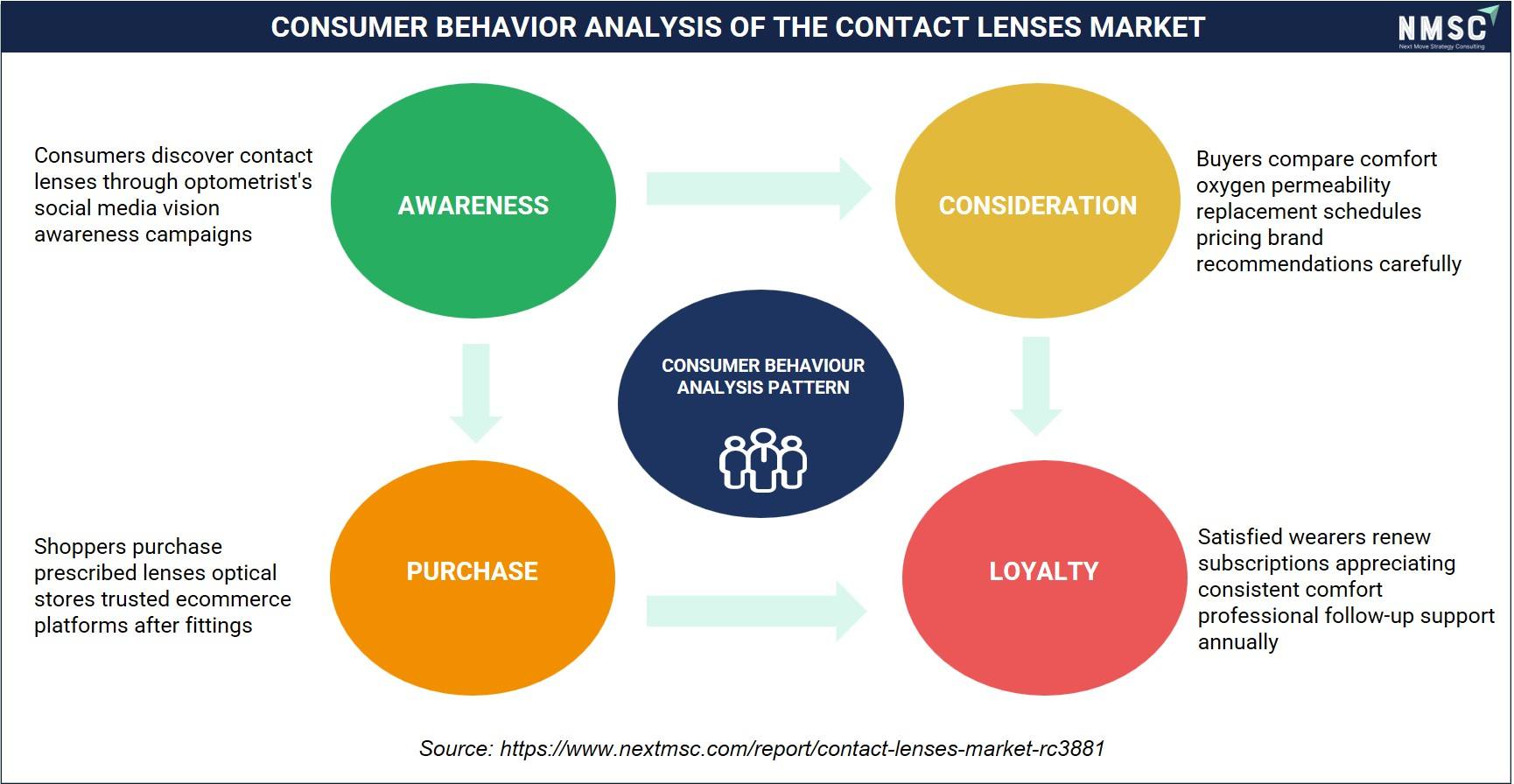
The above infographic presents a consumer behavior analysis of the contact lenses market, mapping the journey from awareness to loyalty. Awareness is driven through optometrists, social media, and vision campaigns, leading consumers to evaluate comfort, oxygen permeability, replacement schedules, and pricing before purchasing. Once satisfied, wearers renew subscriptions, appreciating consistent comfort and professional follow-up support. Looking ahead, we observed that brand trust and ongoing professional care remain essential for customer retention and long-term market engagement.
Investment Opportunities
Where Are Capital Inflows Concentrating in the Contact Lenses Market?
Capital is concentrating in myopia management clinical trial programs and premium multifocal toric lens development, the two areas generating the strongest recent regulatory and revenue momentum. Alcon's continued double-digit growth in its multifocal category following its first multifocal toric lens launch signals sustained capital allocation toward differentiated reusable lens innovation.
How Is Infrastructure Investment Shaping Long-Term Capacity?
Our findings suggest that infrastructure investment is shifting toward automated daily disposable manufacturing capacity capable of supporting both standard routine correction and clinically differentiated myopia management production lines. This shift favors manufacturers with existing high-volume daily disposable infrastructure that can be adapted to new indication-specific product lines without full facility replacement.
What ESG Considerations Are Influencing Investment Decisions?
Environmental, Social, and Governance considerations in this market center on pediatric eye health access equity and contact lens packaging waste reduction, given the single-use nature of daily disposable formats that dominate category growth. We found that investors increasingly favor manufacturers demonstrating expanded access to myopia management therapy alongside sustainable packaging initiatives as a proxy for durable, socially aligned growth.
Key Benefits for Stakeholders
How Does This Report Benefit Industry Leaders?
Industry leaders gain segment-level revenue forecasts and CAGR benchmarks across base material, intended use, and distribution channel axes, enabling product-roadmap decisions grounded in the same 2025–2035 figures used consistently throughout this analysis. Our findings on regional growth differentials further support market-entry and clinical trial investment decisions.
How Does This Report Benefit Investors and Financial Analysts?
Investors and financial analysts gain a reconciled market-sizing model, competitive-landscape assessment, and named-company development tracking that supports valuation and capital-allocation decisions. The report's Growth Catalyst & Risk Assessment Matrix quantifies driver and restraint impact on CAGR, aiding scenario analysis for portfolio positioning.
How Does This Report Benefit Technology Vendors and Product Teams?
Technology vendors and product teams gain visibility into which intended-use and distribution segments, such as Myopia Management and E-Commerce, are growing fastest, informing where to prioritize clinical trial investment and go-to-market focus through 2035.
Key Market Segments
By Base Material
-
Hydrogel
-
Silicone hydrogel
-
Rigid gas permeable
-
Hybrid
-
Other materials
By Intended Use
-
Routine correction
-
Single vision
-
Toric
-
Multifocal
-
Toric multifocal
-
Custom
-
-
Myopia management
-
Soft dual focus
-
Peripheral defocus
-
Orthokeratology
-
Other myopia management
-
-
Cosmetic enhancement
-
Colored
-
Circle lenses
-
Costume and special effects
-
Other cosmetic
-
-
Therapeutic
-
Bandage
-
Dry eye management
-
Keratoconus management
-
Post-operative
-
Other therapeutic
-
-
Prosthetic
-
Iris occlusion
-
Aniseikonia management
-
Other prosthetic
-
-
Smart and diagnostic
-
Monitoring
-
Display
-
Other smart
-
By Wear Schedule
-
Daily disposable
-
Biweekly
-
Monthly
-
Quarterly
-
Yearly
-
Other wear schedules
By Distribution Channel
-
Eye care professionals and clinics
-
Optical retail
-
E-commerce
-
Hospitals and medical centers
-
OEM and private label
By Region
-
North America: U.S., Canada, Mexico
-
Europe: UK, Germany, France, Italy, Spain, Sweden, Denmark, Finland, Netherlands, Rest of Europe
-
Asia-Pacific: China, India, Japan, South Korea, Taiwan, Indonesia, Vietnam, Australia,Philippines, Malaysia, Rest of APAC
-
Middle East & Africa: Saudi Arabia, UAE, Egypt, Israel, Turkey, Nigeria, South Africa, Rest of MEA
-
Latin America: Brazil, Argentina, Chile, Colombia, Rest of LATAM
Conclusion & Recommendations
What Is the Long-Term Outlook for the Contact Lenses Market?
The long-term outlook remains steadily positive, with the market expanding from USD 15.61 Billion in 2026 to USD 24.89 Billion by 2035 at a 5.32% CAGR, driven by rising myopia prevalence and premium silicone hydrogel adoption. We observed that this growth trajectory is underpinned by durable clinical and demographic tailwinds rather than speculative demand, supporting sustained manufacturer investment in material science and clinical trials.
What Strategic Positioning Do We Recommend?
Our assessment indicates that manufacturers should prioritize myopia management clinical trial investment and premium multifocal toric development to capture the fastest-growing Myopia Management and Smart and Diagnostic segments. Companies without established regulatory clearance precedent should pursue accelerated clinical trial programs rather than incremental line extensions given the market's clear shift toward clinically validated, disease-modifying lens categories.
How Attractive Is the Market for Investment?
Investment attractiveness is high in Asia-Pacific and Latin America given superior CAGR profiles of 7.01% and 7.08%, respectively, while North America offers the largest absolute revenue base with durable premium lens demand. We found that myopia management and smart and diagnostic revenue streams offer stronger margin and growth profiles than mature routine correction segments alone.
What Are the Key Market Shifts and Risks?
Key risks include intensifying price competition from regional Asia-Pacific manufacturers in standard hydrogel and silicone hydrogel categories, alongside limited reimbursement coverage constraining premium myopia management adoption in several emerging markets. Our analysis shows that manufacturers unable to secure regulatory clearance for differentiated therapeutic indications risk ceding share of the fastest-growing segments to earlier-mover competitors.
What Are the Primary Growth Pathways Through 2035?
Primary growth pathways include expanded myopia management age-range clearances, deeper premium multifocal toric product development, and smart sensing lens commercialization for chronic disease monitoring. We observed that manufacturers combining all three pathways are best positioned to capture disproportionate share of the USD 9.28 Billion absolute opportunity created between 2026 and 2035.
About the Author
 Mayurima Roy
— Mayurima Roy is Research Analyst at Next Move Strategy Consulting, where she has spent 4 years working across the firm's full industry coverage rather than a single fixed vertical. Her work centers on structured research, ongoing trend tracking, competitive assessment, and insight-led content development, translating complex market data into clear, decision-ready narratives that support informed client decision-making across diverse global industries, market sectors, and world regions every day.
Mayurima Roy
— Mayurima Roy is Research Analyst at Next Move Strategy Consulting, where she has spent 4 years working across the firm's full industry coverage rather than a single fixed vertical. Her work centers on structured research, ongoing trend tracking, competitive assessment, and insight-led content development, translating complex market data into clear, decision-ready narratives that support informed client decision-making across diverse global industries, market sectors, and world regions every day.
About the Reviewer
 Supradip Baul
— Supradip Baul is an accomplished business consultant and strategist with over a decade of rich experience in market intelligence, strategy, technology, and business transformation. His work has included rigorous qualitative and quantitative analysis across multiple industries, helping clients shape investment decisions and long-term roadmaps. Earlier in his career, he was associated with Gartner, where he contributed to industry-leading reports and market share analyses. He has worked with leading global companies and holds an MBA with a dual specialization in Marketing and Finance.
Supradip Baul
— Supradip Baul is an accomplished business consultant and strategist with over a decade of rich experience in market intelligence, strategy, technology, and business transformation. His work has included rigorous qualitative and quantitative analysis across multiple industries, helping clients shape investment decisions and long-term roadmaps. Earlier in his career, he was associated with Gartner, where he contributed to industry-leading reports and market share analyses. He has worked with leading global companies and holds an MBA with a dual specialization in Marketing and Finance.
At Next Move Strategy Consulting, we understand that insightful market research is the cornerstone of successful business decisions. That's why we employ a robust and multifaceted approach, combining various methodologies to deliver the most accurate and actionable data for our clients.

Research Landscape
We navigate the world of research with two primary approaches:
Qualitative Approach
Our qualitative research methodologies involve immersive techniques such as in-depth interviews, focus groups, and observational studies. By engaging directly with individuals and stakeholders, we uncover valuable insights that quantitative data alone may overlook.

Quantitative Research
In tandem with qualitative methodologies, NMSC leverages the power of Quantitative Research to provide a robust foundation of numerical insights. Through systematic data collection and analysis, we quantify patterns, preferences, and market trends, offering a comprehensive view of the business landscape.
Our quantitative research approach employs diverse tools, including surveys, experiments, and statistical modelling. These methodologies enable us to gather data from a large and representative sample, ensuring the statistical significance of our findings. By employing structured questionnaires and standardized data collection methods, we guarantee the reliability and validity of the information we present to our clients.
Quantitative research is particularly effective in measuring the prevalence of trends, assessing market size, and gauging the impact of various factors on consumer behavior. The numerical precision attained through this approach equips our clients with actionable insights, facilitating data-driven decision-making and strategy formulation.


Our Specialized Toolbox for Industry-Specific Market Research
We deploy a specialized arsenal of techniques tailored to meet your unique requirements. Here's a glimpse into our comprehensive toolbox:

Information Procurement
The stage entails acquiring market data or relevant information through various sources and methodologies.


Market Research Approach
We utilize both top-down and bottom-up approaches in market research analysis to achieve a comprehensive understanding of the market dynamics, leveraging the broad perspective of industry trends and macroeconomic factors alongside detailed insights from specific segments and individual companies.

Porters Five Forces Analysis
We conduct Porter's Five Forces analysis to evaluate the competitive landscape of an industry, providing us with insights into factors that affect profitability and strategic positioning.

SWOT Analysis

Forecasting
We utilize a forecasting model to predict future consumption by considering parameters like population, economics, regulations, market competition, drivers, constraints, technology, and pricing. We also employ statistical techniques such as multilinear regression, exponential smoothing, moving average, ARIMA, and Monte Carlo simulations for accurate predictions. In econometric forecasting, we analyzed short-term and long-term event impacts, attributing values based on regulatory frameworks, economic factors, and market events.





 Speak to Our Analyst