Cryogenic Freezers for Food Market Global Industry Analysis and Forecast (2026–2035)

Cryogenic Freezers for Food Market size was USD 930 million in 2025, projected to reach USD 1,745.74 million by 2035, growing at a CAGR of 6.5% from 2026 to 2035. Key drivers include rising demand for rapid freezing of premium frozen foods, expansion of cold chain infrastructure in food processing, and advances in cryogen dosing and insulation engineering, with North America leading the global market.

Download Free Sample PDF
Base Year (2025)
$930.0 Million
Forecast (2035)
$1,745.7 Million
CAGR (2026-2035)
6.5%
Top Region
North America

What Are the Cryogenic Freezers for Food Market Size?

The global cryogenic freezers for food market was valued at USD 930 million in 2025 and is estimated to reach USD 990.45 million in 2026. The market is projected to reach USD 1,745.74 million by 2035, registering a CAGR of 6.5% during 2026–2035. According to the report’s estimates, North America accounted for approximately 34% of global market revenue in 2025, while IQF Freezers represented the largest reported freezer-type category, with approximately 34% share.

Developments in vessel insulation, stainless-steel construction and cryogen injection controls are influencing the design and operational performance of cryogenic food-freezing equipment. Modular tunnel and immersion systems offer processors flexible freezing configurations and the capacity to handle different food products and production requirements. These engineering refinements can help bakeries, seafood processors and prepared-meal manufacturers improve production capacity within existing facility footprints. Their impact on overall energy and cryogen consumption depends on equipment configuration and operating conditions.

Cryogenic Freezers for Food Market Global Industry Analysis and Forecast (2026–2035) Revenue Forecast

Values in USD Million

2025 $930.0 Million
2025
2026 $990.5 Million
2026
2027 $1,054.8 Million
2027
2028 $1,123.4 Million
2028
2029 $1,196.4 Million
2029
2030 $1,274.2 Million
2030
2031 $1,357.0 Million
2031
2032 $1,445.2 Million
2032
2033 $1,539.1 Million
2033
2034 $1,639.2 Million
2034
2035 $1,745.7 Million
2035

Key Takeaways

By Freezer Type: IQF Freezers held the largest share, expanding from USD 315.49 Million in 2025 to USD 554.82 Million by 2035; the Specialized Pellet Freezers segment is the fastest-growing at 8.7% CAGR from 2025–2035.

By Application: Meat, Poultry & Seafood represented the largest reported application category, increasing from USD 342.91 million in 2025 to USD 586.88 million by 2035. Other Food Applications is projected to register the highest growth among the listed application categories, at 8.7%.

By End User: Large Food Processors represented the largest reported end-user category, increasing from USD 440.30 million in 2025 to USD 724.31 million by 2035. Foodservice and Catering is projected to register the highest growth among the listed categories, at 9.3%, subject to validation of direct equipment purchases by these operators.

By Distribution Channel: Direct Sales to Processors represented the largest reported distribution category, increasing from USD 432.21 million in 2025 to USD 733.12 million by 2035. Online and Digital Procurement is projected to register the highest growth among the listed channels, at 8.8%, subject to consistent and mutually exclusive channel classification.

Dominant Region: North America dominated the market with approximately 34% revenue share (USD 316.2 Million) in 2025, anchored by large bakery, meat, and seafood processors, mature food processing corridors, and extensive cryogen distribution networks.

Fastest-Growing Region: Asia-Pacific is expected to register the highest CAGR of 9.3% during 2025–2035, driven by expanding seafood export processing, new food parks in India and Vietnam, and growing cold chain capacity across high-density markets.

Dominant Country: The U.S. led the market with an estimated USD 240.31 Million in 2025 (~76% of North America), supported by large bakery, meat, and seafood processors and an extensive cold chain network.

Fastest-Growing Country: India is among the fastest-growing major countries, projected to expand from USD 50.22 Million in 2025 at a CAGR of approximately 11.1%, driven by expanding seafood export and frozen poultry processing and growing organized retail cold chains.

Next Move Strategy Consulting's analysis indicates that the cryogenic freezers for food market presents an absolute opportunity of USD 755.29 million between 2026 and 2035. This expansion reflects growing adoption among frozen confectionery, seafood, and prepared meal manufacturers that require fast freezing to maintain product integrity. Moreover, expanding [cold storage](https: //www.nextmsc.com/report/cold-storage-market-cm3208) infrastructure in emerging food processing hubs creates sustained demand for dependable freezing equipment, supporting long-term revenue expansion for both established gas suppliers and specialized equipment manufacturers.

Competition in the cryogenic freezers for food market involves industrial gas suppliers offering integrated freezing solutions and specialized equipment manufacturers developing application-specific freezing systems. Some market participants offer integrated equipment, cryogen supply and technical services, providing food processors with coordinated freezing solutions and ongoing operational support. Supply chain scale also matters, since established players can secure stable cryogen logistics across multiple regions. Specialized equipment manufacturers can differentiate through customized tunnel, immersion and other cryogenic configurations designed for specific food products and production requirements.

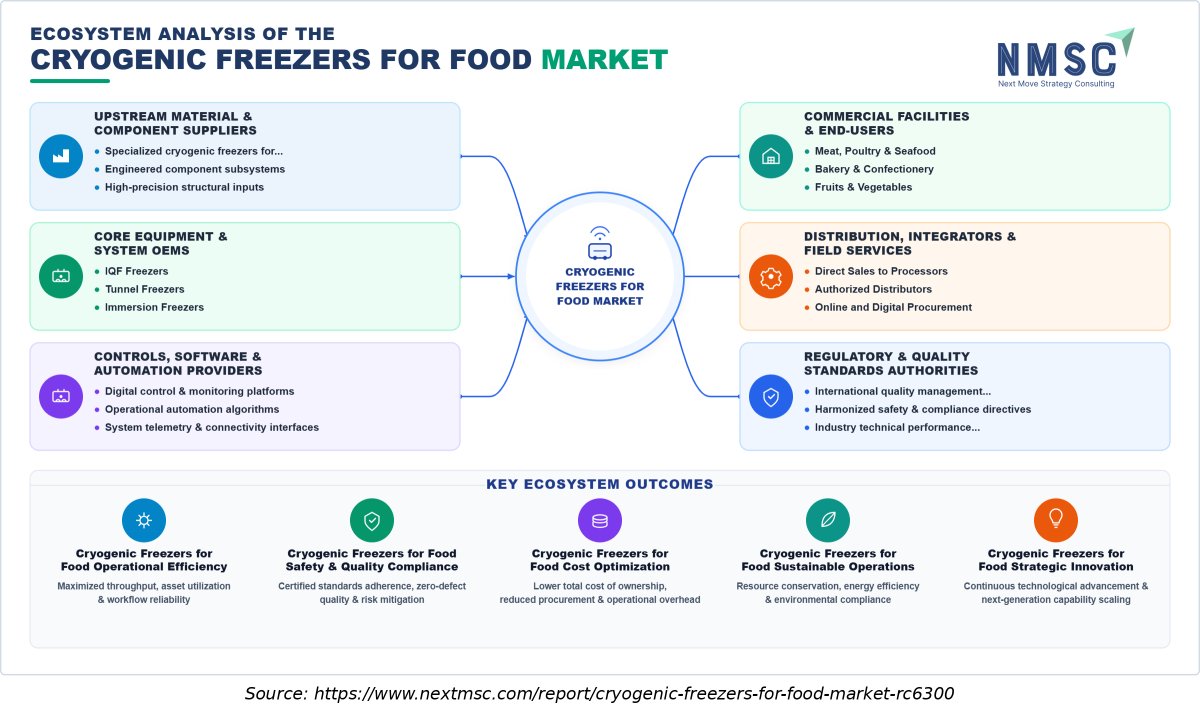
Ecosystem Analysis of the Cryogenic Freezers for Food Market

The above infographic presents the Cryogenic Freezers for Food market ecosystem in a structured format, focusing on six core stakeholder groups: upstream material & component suppliers, core equipment & system OEMs, and controls, software & automation providers. On the downstream and governance side, it encompasses commercial facilities & end-users, distribution, integrators & field services, and regulatory & quality standards authorities. It shows how these participants support operations while contributing to operational efficiency, safety, cost optimization, sustainability, and technological innovation across diverse operating environments.

What Does the Cryogenic Freezers for Food Market Encompass?

The global cryogenic freezers for food market encompasses equipment that uses liquid nitrogen, carbon dioxide, or other cryogenic media to freeze food products rapidly and uniformly. Core equipment configurations include cryogenic tunnel, immersion, spiral and batch or cabinet freezers designed for commercial food-processing applications. Dedicated individually quick freezing (IQF) systems are modeled separately from standard multi-purpose tunnel and spiral freezers to prevent overlap across equipment categories. Key equipment technologies include cryogen injection systems, thermal insulation, controlled airflow, conveyor management and temperature monitoring, which support controlled freezing across different food products.

Equipment specifications emphasize food-grade stainless-steel contact surfaces, hygienic construction and thermal insulation designed to support cleaning requirements and minimize heat ingress during freezing operations. Equipment design may incorporate corrosion-resistant materials and insulation systems engineered to withstand repeated thermal cycling and demanding food-processing environments. Cryogenic food-freezing equipment must comply with applicable food-contact, food-hygiene, machinery-safety and pressure-equipment requirements in the markets where it is installed. These requirements influence equipment material selection, hygienic design, safety documentation and conformity assessment.

Market Drivers & Dynamics

Interactive Dataset
Rising Demand for Rapid Freezing of Premium Frozen Foods driver High Immediate
Expansion of Cold Chain Infrastructure in Food Processing driver High Immediate
Advances in Cryogen Dosing and Insulation Engineering driver Medium Medium-term
High Operating Cost of Liquid Nitrogen Supply restraint High Immediate
Limited Cryogen Logistics in Remote Food Hubs restraint Medium Medium-term
Competition From Mechanical Freezing Technologies restraint Low Long-term
Source: Next Move Strategy Consulting

Growth Drivers

Rising Demand for Rapid Freezing of Premium Frozen Foods

Faster freezing preserves texture and moisture in bakery, seafood, and prepared meal products processed through cryogenic freezers for food

Expansion of Cold Chain Infrastructure in Food Processing

New processing plants require cryogenic freezers for food to meet throughput and product quality targets

Advances in Cryogen Dosing and Insulation Engineering

Improved nozzle designs and insulation reduce cryogen consumption in cryogenic freezers for food

Growth Inhibitors

High Operating Cost of Liquid Nitrogen Supply

Cryogen consumption represents a significant operating expense for users of cryogenic freezers for food

Limited Cryogen Logistics in Remote Food Hubs

Distribution gaps restrict deployment of cryogenic freezers for food in regions with thin gas supply networks

Competition From Mechanical Freezing Technologies

Mechanical freezers compete with cryogenic freezers for food in cost-sensitive applications.

What Are the Growth Opportunities?

Can High-Density Tunnel Deployments Capture Larger Production Volumes?

High-density tunnel configurations offer a clear pathway for cryogenic freezers for food to capture larger production volumes in meat, bakery, and seafood plants. These systems maximize product throughput within constrained floor space, which appeals to facilities seeking capacity expansion without new buildings. Multi-tier conveyor configurations may allow processors to increase throughput within existing production footprints, depending on equipment design and facility requirements. Equipment makers that deliver validated tunnel layouts stand to benefit from this sustained demand for scalable freezing capacity.

How Is Mid-Tier and Regional Facility Adoption Unlocking New Cryogenic Freezers for Food Market Volume?
Mid-tier processors and regional production facilities represent an expanding customer base for cryogenic freezers for food. Smaller plants are increasingly adopting compact batch cabinets and modular tunnels that fit limited budgets and footprints. Expansion of food-processing capacity in emerging economies may create opportunities for cryogenic freezer suppliers, particularly where processors invest in dedicated freezing equipment and reliable cryogen supply infrastructure. Suppliers offering flexible financing, local service support, and reliable cryogen supply arrangements can convert these facilities into long-term accounts.

Can Specialized Vertical Implementations Become Distinct Premium Markets?

Specialized vertical applications may develop into premium niches within the cryogenic freezers for food landscape. Delicate products such as premium ice cream, specialty seafood, and artisan bakery goods require precisely tuned freezing profiles that standard systems cannot always deliver. Application-specific freezing systems may provide manufacturers with opportunities to differentiate their equipment offerings through customized configurations and performance specifications. Manufacturers developing application-specific nozzle arrangements and airflow patterns may capture differentiated demand in quality-sensitive segments.

Segmentation Analysis

2025 (USD Million)
2035 (USD Million)
IQF Freezers 2025: $315.5 Million | 2035: $0.0 Million
IQF Freezers
Tunnel Freezers 2025: $237.0 Million | 2035: $0.0 Million
Tunnel Freez
Immersion Freezers 2025: $152.0 Million | 2035: $0.0 Million
Immersion Fr
Spiral Freezers 2025: $93.6 Million | 2035: $0.0 Million
Spiral Freez
Cryogenic Impingement Freezers 2025: $65.6 Million | 2035: $0.0 Million
Cryogenic Im
Cryo-Mechanical Freezing 2025: $39.1 Million | 2035: $0.0 Million
Cryo-Mechani
Specialized Pellet Freezers 2025: $27.2 Million | 2035: $0.0 Million
Specialized
IQF Freezers $315.5 Million $0.0 Million 5.8%
Tunnel Freezers $237.0 Million $0.0 Million 5.8%
Immersion Freezers $152.0 Million $0.0 Million 7.1%
Spiral Freezers $93.6 Million $0.0 Million 7.6%
Cryogenic Impingement Freezers $65.6 Million $0.0 Million 7.1%
Cryo-Mechanical Freezing $39.1 Million $0.0 Million 7.9%
Specialized Pellet Freezers $27.2 Million $0.0 Million 8.7%

Segment Sizing: By Freezer Type

2025 (USD Million)
2035 (USD Million)
Meat
Poultry & Se
Fresh Protei
Marinated Pr
Bakery & Con
Segment Item 2025 (USD Million) 2035 (USD Million) CAGR
Meat $10.0 USD Million $40.0 USD Million 25.0%
Poultry & Seafood $17.1 USD Million $51.1 USD Million 11.0%
Fresh Protein Freezing $24.2 USD Million $62.2 USD Million 25.0%
Marinated Product Freezing $31.3 USD Million $73.3 USD Million 11.0%
Bakery & Confectionery $38.4 USD Million $84.4 USD Million 16.0%

Segment-wise data is locked

Unlock complete segment-wise numbers for By Application.

Unlock Full Data
2025 (USD Million)
2035 (USD Million)
Large Food P
Industrial P
Small and Me
Regional Pro
Cold Chain a
Segment Item 2025 (USD Million) 2035 (USD Million) CAGR
Large Food Processors $10.0 USD Million $40.0 USD Million 27.0%
Industrial Processing Plants $17.1 USD Million $51.1 USD Million 9.0%
Small and Medium Food Producers $24.2 USD Million $62.2 USD Million 19.0%
Regional Processors $31.3 USD Million $73.3 USD Million 17.0%
Cold Chain and Logistics Operators $38.4 USD Million $84.4 USD Million 18.0%

Segment-wise data is locked

Unlock complete segment-wise numbers for By End User.

Unlock Full Data
2025 (USD Million)
2035 (USD Million)
Direct Sales
Engineering
Authorized D
Regional Equ
Online and D
Segment Item 2025 (USD Million) 2035 (USD Million) CAGR
Direct Sales to Processors $10.0 USD Million $40.0 USD Million 14.0%
Engineering and Turnkey Contracts $17.1 USD Million $51.1 USD Million 24.0%
Authorized Distributors $24.2 USD Million $62.2 USD Million 22.0%
Regional Equipment Dealers $31.3 USD Million $73.3 USD Million 12.0%
Online and Digital Procurement $38.4 USD Million $84.4 USD Million 27.0%

Segment-wise data is locked

Unlock complete segment-wise numbers for By Distribution Channel.

Unlock Full Data
2025 (USD Million)
2035 (USD Million)
North Americ
Canada
Mexico.
Europe: UK
Germany
Segment Item 2025 (USD Million) 2035 (USD Million) CAGR
North America: U.S. $10.0 USD Million $40.0 USD Million 24.0%
Canada $17.1 USD Million $51.1 USD Million 22.0%
Mexico. $24.2 USD Million $62.2 USD Million 20.0%
Europe: UK $31.3 USD Million $73.3 USD Million 22.0%
Germany $38.4 USD Million $84.4 USD Million 13.0%

Segment-wise data is locked

Unlock complete segment-wise numbers for By Region.

Unlock Full Data

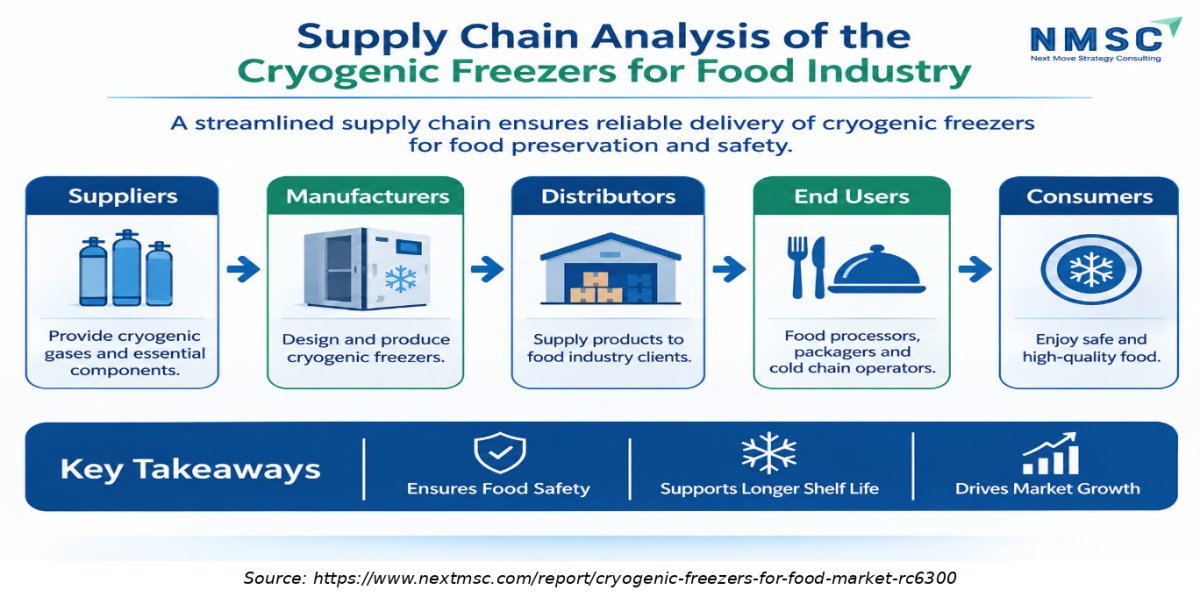
Supply Chain Analysis of the Cryogenic Freezers for Food Industry

Supply Chain Analysis of the Cryogenic Freezers for Food Industry
The above infographic maps the Cryogenic Freezers for Food market supply chain across five sequential stages: Stage 1: Suppliers, Stage 2: Manufacturers, Stage 3: Distributors, Stage 4: End Users, and Stage 5: Consumers. It illustrates how these stages connect to ensure component reliability, manufacturing precision, supply stability, cost control, and rapid technological deployment across end-user environments.

Regional Outlook

2025 (USD Million)
2035 (USD Million)
North Americ
Europe
Asia-Pacific
Latin Americ
Middle East
Region 2025 (USD Million) 2035 (USD Million) CAGR (%)
North America $10.0 USD Million $40.0 USD Million 9.0%
Europe $17.1 USD Million $51.1 USD Million 27.0%
Asia-Pacific $24.2 USD Million $62.2 USD Million 25.0%
Latin America $31.3 USD Million $73.3 USD Million 23.0%
Middle East & Africa $38.4 USD Million $84.4 USD Million 12.0%

Regional data is locked

Unlock complete regional numbers for this market.

Unlock Full Data

Competitive Landscape

The competitive structure of the cryogenic freezers for food market features a concentrated group of established industrial gas and cryogenic equipment manufacturers alongside specialized freezing system producers. Nippon Sanso Holdings Corporation, Linde PLC, Air Liquide S.A., and Messer Group GmbH leverage broad cryogenic supply networks, while Chart Industries, Inc., DSI Dantech A/S, and JBT Marel (Frigoscandia) compete on dedicated freezing system engineering. Market leadership therefore depends on combining equipment design depth with reliable service coverage across processing facilities.

How Do Companies Compete in the Cryogenic Freezers for Food Market?

Competition in the cryogenic freezers for food market centers on throughput performance, energy consumption per kilogram processed, and the ability to integrate with existing production lines. Vendors differentiate through customized tunnel, spiral, and IQF configurations tailored to specific protein, bakery, or produce applications. Pricing reflects capital equipment scale and long-term service contracts rather than short transactional cycles. Direct sales engagement with large processors remains the primary commercial route, supplemented by growing digital procurement capabilities for standardized equipment and spare components.

Which Competitive Archetypes Dominate the Cryogenic Freezers for Food Market?

Market participants in the cryogenic freezers for food market fall into distinct archetypes. Industrial gas majors such as Linde PLC, Air Liquide S.A., and Nippon Sanso Holdings Corporation supply cryogenic fluids and integrated freezing systems to food processors. Specialized freezing equipment manufacturers including DSI Dantech A/S, JBT Marel (Frigoscandia), and Chart Industries, Inc. focus on dedicated freezer engineering. Specialized cryogenic equipment providers, including RS Cryo Equipment Inc., serve food processors through application-specific freezing systems and customized equipment configurations.

What Innovation and Differentiation Strategies Are Companies Pursuing?

Sustainable advantages in the cryogenic freezers for food market arise from proprietary freezing architectures, long-standing processor relationships, and integrated gas supply capabilities. Suppliers that coordinate equipment engineering, cryogen availability and technical support may strengthen customer relationships after their systems are integrated into validated production lines. Installed base service revenue further reinforces competitive position over the forecast horizon. Companies that sustain performance benchmarks across varied applications will likely preserve pricing discipline through 2035.

What M&A and Partnership Activity Is Shaping the Cryogenic Freezers for Food Market?

Corporate transactions involving industrial gas and cryogenic equipment companies may influence the competitive environment; however, market-specific consolidation should be discussed only where documented transactions directly relate to food-freezing equipment. Acquisitions and strategic investments may expand equipment portfolios, geographic coverage and application expertise, but each claimed development should be supported by a named transaction and an official announcement. Where acquisitions combine relevant cryogen supply and food-freezing equipment capabilities, they may enable suppliers to offer more integrated solutions to food processors. Ongoing portfolio realignment is expected to continue as participants seek scale in higher-growth applications.

Competitive Dynamics and M&A Landscape

Recent strategic moves, partnerships, and acquisitions shaping the Cryogenic Freezers for Food Market Global Industry Analysis and Forecast (2026–2035).

March 2026 Nippon Sanso Performance Certification In March 2026, Nippon Sanso helped launch the world’s first food-freezing equipment performance certification system (Source: [Insert Official Press Release Link]).
June [Insert Year] Linde LienHwa Product Showcase Linde LienHwa showcased cryogenic solutions for food processing in June [Insert Year] (Source: [Insert Link]).
September [Insert Year] JBT Marel Product Upgrade JBT Marel introduced an upgraded Frigoscandia spiral-freezer belt in September [Insert Year] (Source: [Insert Link]).
[Insert Month/Year] DSI Dantech Service Expansion Additionally, in [Insert Month/Year], DSI Dantech expanded North American freezer-service coverage through GEA’s service-business transfer.

Key Market Players

Based on research conducted by Next Move Strategy Consulting (NMSC), the following 17 companies represent the validated leadership set across Cryogenic Freezers for Food Market developers, manufacturers, and solution providers:

Nippon Sanso Holdings Corporation Linde PLC Air Liquide S.A. Messer Group GmbH Cryogenic Industries, Inc. DSI Dantech A/S RS Cryo Equipment Inc. Chart Industries, Inc. JBT Marel (Frigoscandia) Cryotec Anlagenbau GmbH Gulf Cryo LLC Air Products and Chemicals, Inc. (Freshline) Iceland Cryogenics Ltd Hangzhou Hangyang Cryogenic Equipment Co., Ltd. Shanghai Huiyang Cryogenic Equipment Co., Ltd. Air Water Inc. Cryogenic Systems Equipment Corp.

Investment Opportunities

Where Are Capital Inflows Concentrating in the Cryogenic Freezers for Food Market?

Capital allocation in the cryogenic freezers for food market is concentrating on freezing technologies that serve high-growth freezer types such as specialized pellet freezers. Investment opportunities may include engineering capabilities and freezer configurations designed to accommodate different food products, production volumes and processing requirements. Technology investments also target control systems that improve energy efficiency and throughput consistency. Such allocation reflects the need to address evolving processor requirements across the forecast period.

How Is Infrastructure Investment Shaping Cryogenic Freezers for Food Market Capacity?
Infrastructure investment is expanding the operational capacity available to processors of cryogenic freezers for food. Investments in production facilities and equipment assembly capabilities may support manufacturing capacity, provided that the anticipated demand from food processors and other qualified buyers is independently established. Distribution hubs and service centers are also growing to support faster commissioning and spare parts delivery. Consequently, these investments strengthen the supply base needed to sustain market expansion through 2035.

What ESG Considerations Are Influencing Market Investment?

Environmental and safety considerations increasingly shape investment decisions across the cryogenic freezers for food ecosystem. Energy efficiency improvements reduce cryogen consumption per unit processed, lowering operating costs and emissions for processors. Circular material choices and safety compliance standards for cryogenic handling further influence equipment specification. Manufacturers that incorporate appropriate energy-efficiency, material-selection and cryogenic-handling safety measures may be better positioned to meet the procurement requirements of large food processors.

Key Benefits for Stakeholders

How Does This Report Benefit Industry Leaders and Enterprise Operators?

Operational executives, procurement directors, and commercial operators in the cryogenic freezers for food market gain empirical benchmarks for capacity planning and equipment selection. The report quantifies segment performance across freezer types, applications, and end users, enabling more precise investment timing. Forecasts through 2035 support long-term procurement strategy and facility expansion decisions. Such insight helps enterprise operators align freezing capacity with projected demand.

How Does This Report Benefit Investors and Financial Analysts?

Investors and financial analysts evaluating the cryogenic freezers for food market can benchmark revenue trajectories from USD 930 million in 2025 to USD 1,745.74 million by 2035. The report details margin-relevant dynamics such as installed base service revenue and channel mix shifts. Valuation comparisons across key participants become more grounded when supported by segment-level demand data. These benchmarks inform portfolio allocation and acquisition assessments.

How Does This Report Benefit Technology Vendors and Solution Platform Teams?

Technology vendors and solution platform teams can use this analysis to plan product roadmaps for cryogenic freezers for food. Identifying high-growth segments such as specialized pellet freezers and foodservice applications clarifies where engineering resources should concentrate. Competitive differentiation insights help teams refine configurations that address specific processor requirements. Such alignment supports stronger positioning as the market evolves.

Key Market Segments Evaluated

By Application

  • Meat, Poultry & Seafood 
    • Fresh Protein Freezing
    • Marinated Product Freezing
  • Bakery & Confectionery 
    • Dough and Bakery Freezing
    • Frozen Dessert Freezing
  • Fruits & Vegetables 
    • Individually Quick-Frozen Produce
    • Berries and Soft Fruit
  • Dairy & Ready Meals 
    • Cheese and Dairy Freezing
    • Prepared Meal Freezing
  • Other Food Applications 
    • Sauces and Pellet Freezing
    • Specialty Ingredient Freezing

By End User

  • Large Food Processors 
    • Industrial Processing Plants
  • Small and Medium Food Producers 
    • Regional Processors
  • Cold Chain and Logistics Operators 
    • Third-Party Cold Storage
  • Foodservice and Catering 
    • Restaurant Chains
    • Institutional Kitchens

By Distribution Channel

  • Direct Sales to Processors 
    • Engineering and Turnkey Contracts
  • Authorized Distributors 
    • Regional Equipment Dealers
  • Online and Digital Procurement 
    • E-Commerce Equipment Platforms

By Region

  • North America 
    • U.S.
    • Canada
    • Mexico.
  • Europe 
    • UK
    • Germany
    • France
    • Italy
    • Rest of Europe.
  • Asia-Pacific 
    • China
    • India
    • Japan
    • South Korea
    • Australia
    • Rest of APAC.
  • Latin America 
    • Brazil
    • Argentina
    • Colombia
    • Rest of Latin America.
  • Middle East & Africa 
    • UAE
    • Saudi Arabia
    • South Africa
    • Rest of MEA.

Conclusion & Recommendations

What Is the Long-Term Outlook for the Cryogenic Freezers for Food Market?

The cryogenic freezers for food market is projected to expand from USD 990.45 million in 2026 to USD 1,745.74 million by 2035, representing a CAGR of 6.5% during the forecast period. Growth is underpinned by durable commercial demand expansion, the structural shift toward high-performance specialized solutions, and continuous technological innovation across core operational workflows. Rising demand for rapid, quality-preserving freezing and cold chain expansion support this growth, while liquid nitrogen cost volatility remains the principal moderating factor.

What Strategic Positioning Recommendations Does NMSC Offer?

Market participants should evaluate opportunities in specialized pellet-freezing systems, particularly for sauce and liquid-food applications, while ensuring that investment decisions are supported by validated market demand. Dedicated IQF and tunnel-based freezing systems represent core equipment configurations, accounting for a combined revenue share of approximately 59.4% in 2025 within the report's mutually exclusive segmentation model. OEMs should develop scalable configurations that serve both large processors and expanding foodservice operators. Distributors should build digital procurement channels alongside direct engineering relationships to capture channel growth. Such positioning helps sustain competitive advantage through 2035.

How Attractive Is the Cryogenic Freezers for Food Market for Investment?
Investment attractiveness is high, supported by the USD 755.29 million absolute growth opportunity between 2026 and 2035 in the cryogenic freezers for food market. Demand drivers include steady processing volume from large food producers and rising adoption among foodservice operators. Installed base service revenue provides recurring income that supports margin stability. Together these factors make the sector appealing to long-horizon capital.

What Are the Key Market Shifts and Risks in the Cryogenic Freezers for Food Market?

The cryogenic freezers for food market is shifting toward flexible freezing architectures that accommodate diverse product formats. Primary risks include cryogen supply price volatility, which affects operating costs for processors, and concentration of demand among large buyers. Equipment lead times and skilled engineering availability also constrain capacity expansion. Vendors that manage these exposures will be better placed to sustain performance.

What Are the Primary Growth Pathways Through 2035?

Primary growth pathways in the cryogenic freezers for food market lie in specialized pellet freezing, other food applications, and foodservice and catering deployments. Capturing a larger share of the USD 755.29 million absolute growth opportunity requires targeted engineering investment in these segments. Expanding digital procurement and service coverage will also strengthen reach. Participants that focus on these pathways are positioned to outperform the broader market.

FAQs

About the Author

Mayurima Roy

Mayurima Roy

Mayurima Roy is Research Analyst at Next Move Strategy Consulting, where she has spent 4 years working across the firm's full industry coverage rather than a single fixed vertical. Her work centers on structured research, ongoing trend tracking, competitive assessment, and insight-led content development, translating complex market data into clear, decision-ready narratives that support informed client decision-making across diverse global industries, market sectors, and world regions every day.

About the Reviewer

Supradip Baul

Supradip Baul

Supradip Baul is an accomplished business consultant and strategist with over a decade of rich experience in market intelligence, strategy, technology, and business transformation. His work has included rigorous qualitative and quantitative analysis across multiple industries, helping clients shape investment decisions and long-term roadmaps. Earlier in his career, he was associated with Gartner, where he contributed to industry-leading reports and market share analyses. He has worked with leading global companies and holds an MBA with a dual specialization in Marketing and Finance.

Download Free Sample

Pratyush Kumar Das

PRATYUSH KUMAR DAS

Assistant Manager

Polycab India Limited

We would like to express our appreciation for the data and insights provided by nextmsc. We are very pleased with the quality and depth of the information, which has proven to be highly valuable and beneficial for our business decision-making.

Melanie Samko

MELANIE SAMKO

Director of Marketing

TOSOH BIOSCIENCE, INC.

The information provided by NMSC is incredibly valuable, thank you so much for such a excellent work. I really appreciate it. I will make sure to reference all of it, in my summary document.

Ross J Mckenzie

ROSS J MCKENZIE

Business Insight Manager

Staysure Group

“Next MSC have been incredibly helpful in providing detailed & robust information on our market, alongside quantifying growth by different segments. The process to procure was simple and easy, with sample reports and regular contact to ensure we had what we needed. Succinct detail on their sources & methodologies is also greatly received, allowing transparency in this respect helps build trust in the detail you pay for. Joseph in particular was fantastic, and helped ensure efficient provision of the insight pack – thank you NMSC!”.

Mohit Agarwal

MOHIT AGARWAL

Chief Manager

DryChem India Pvt. Ltd.

Next Move Strategy Consulting is an amazing team of consultants. We required a market study report for our investors on top priority and the team went above and beyond our expectations to deliver the same with ample supporting data within a short time span enabling us to secure the investments and keep our project timeline maintained. Their professionalism, attention to detail, and timely delivery of actionable recommendations have left a lasting impression on our organization.

Semih Kavaklioglu

SEMIH KAVAKLIOGLU

Co-Founder & Sales Manager

Decortie

I work a lot in the marketing industry and I know that research is an essential part of any campaign. I have used Market research reports for my own products and I found them to be very informative and well-researched. The team here produces insightful reports for a good price

Custom Market Research Services

We will customize the research for you if the listed report does not fully match your requirements.

Get 30% Free Customization

Select License

This website uses cookies to ensure you get the best experience on our website. Learn more

✖