High Pressure Processing (HPP) Food Market Size, Share, Growth & Forecast by Product Type (Fruits & Vegetables, Meat & Poultry, Seafood, Dairy & Alternatives, Beverages, RTE Meals, Baby Food, Pet Food), Packaging Type (Pouches, Bottles & Jars, Trays & Tubs), Distribution Channel (Supermarkets, Convenience Stores, Specialty Stores, Online Retail, Institutional Sales), and End User (Residential, Commercial) — Global Analysis 2025–2035
Industry: Retail and Consumer | Publishing Date: July 11, 2026 | Last Updated: September 30, 2026 | No of Pages: N/A | No. of Tables: N/A | No. of Figures: N/A | Format: PDF | Report Code: RC5094
What Is the High Pressure Processing (HPP) Food Market Size?
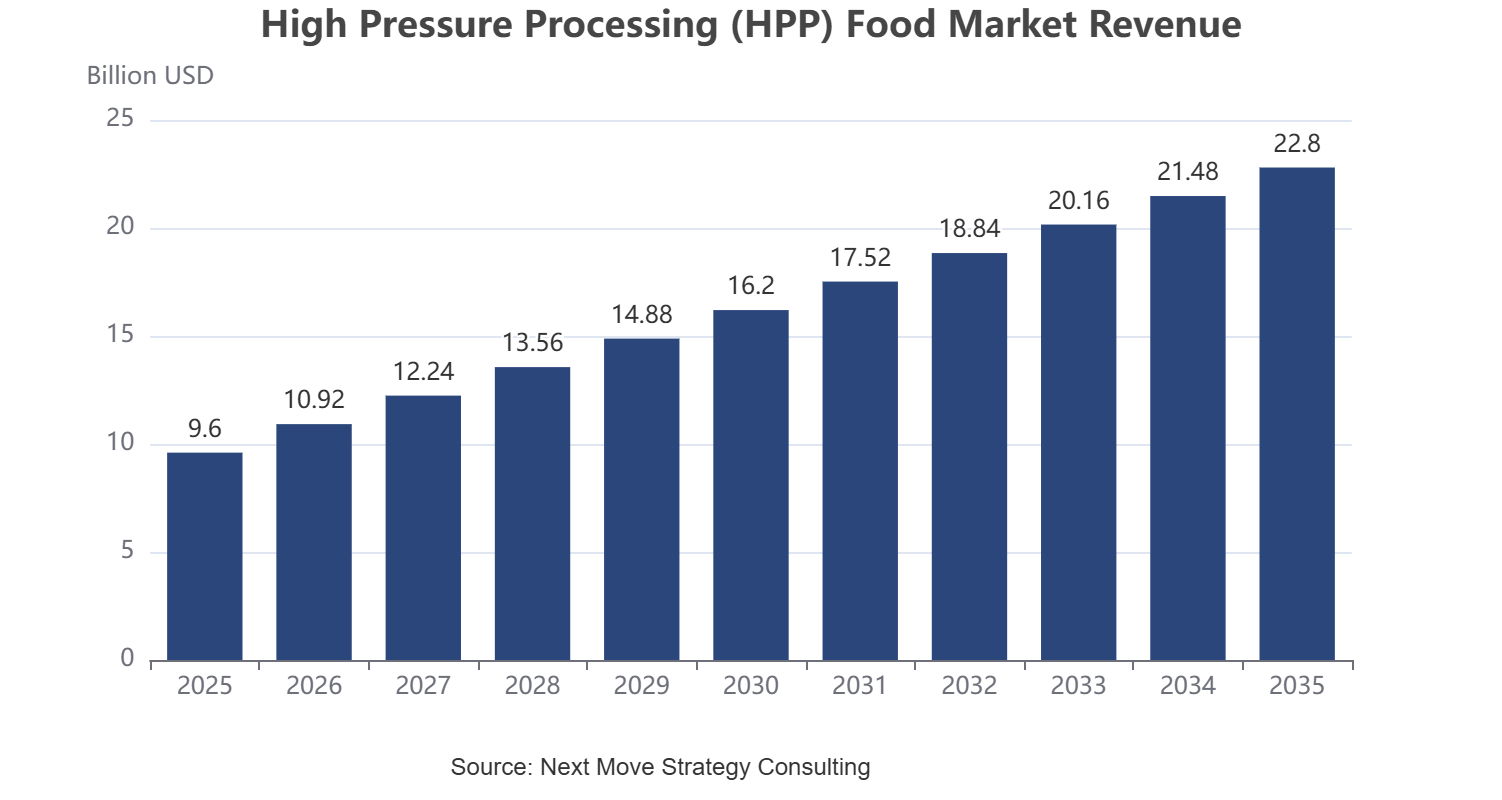
The global High Pressure Processing (HPP) Food Market was valued at USD 9.6 billion in 2025 and is estimated to reach USD 10.5 billion in 2026. Sustained consumer demand for clean-label, minimally processed, and shelf-stable food products is projected to propel the market to USD 22.8 billion by 2035, advancing at a CAGR of 9.0% from 2026 to 2035. Key growth drivers include rising health consciousness among global consumers, increasing demand for extended shelf-life solutions without chemical preservatives, accelerating adoption of HPP technology by food and beverage manufacturers, and expanding regulatory support for non-thermal processing innovations.
|
Parameters |
Details |
|
Market Size in 2025 |
USD 9.6 Billion |
|
Market Size in 2026 |
USD 10.5 Billion |
|
Revenue Forecast in 2035 |
USD 22.8 Billion |
|
Growth Rate |
CAGR of 9.0% from 2026 to 2035 |
|
Analysis Period |
2025–2035 |
|
Base Year Considered |
2025 |
|
Forecast Period |
2026–2035 |
|
Market Size Estimation |
Billion USD |
|
Companies Profiled |
14 |
|
Countries Covered |
33 |
|
Market Share |
Top 10 |
High Pressure Processing (HPP) Food Market Overview
What Is the High Pressure Processing (HPP) Food Market?
High Pressure Processing (HPP) is a cold pasteurization technology that subjects packaged food and beverage products to extremely high hydrostatic pressure, typically between 100 and 600 megapascals, to inactivate harmful pathogens and spoilage microorganisms without the use of heat or chemical additives. Based on our research, we found that the HPP Food Market spans a broad range of product categories including fresh meats, ready-to-eat meals, juices, dairy products, seafood, baby food, and pet food. The technology preserves the nutritional value, color, taste, and texture of food products while significantly extending their shelf life.
How Has the High Pressure Processing (HPP) Food Market Evolved?
The High Pressure Processing (HPP) Food Market has evolved from a niche food safety technology to a mainstream commercial processing solution over the past three decades. NMSC's analysis indicates that the first commercial HPP food products emerged in Japan in the early 1990s, with avocado-based products and seafood leading adoption. Subsequent innovations in equipment engineering, vessel design, and processing throughput have reduced per-unit processing costs, enabling widespread commercial deployment across North America, Europe, and increasingly in Asia-Pacific. Today, the market supports a diverse ecosystem of toll processors, equipment manufacturers, and brand owners.
How Do Regulations Influence the High Pressure Processing (HPP) Food Market?
Regulatory frameworks play a pivotal role in shaping the High Pressure Processing (HPP) Food Market. The U.S. Food and Drug Administration (FDA) and the U.S. Department of Agriculture (USDA) have established validated HPP protocols for pathogen reduction in ready-to-eat meats and juice products. The European Food Safety Authority (EFSA) has similarly recognized HPP as a safe and effective non-thermal processing method. Through our market assessment, we observed that compliance with food safety regulations such as the FDA Food Safety Modernization Act (FSMA) is a significant driver for the adoption of HPP technology among food processors seeking to meet Hazard Analysis Critical Control Point (HACCP) requirements.
How Is Technology Adoption Expanding Across the High Pressure Processing (HPP) Food Market?
Technology adoption across the High Pressure Processing (HPP) Food Market is accelerating as equipment costs decline and processing throughput improves. Our findings suggest that next-generation HPP systems now offer higher vessel volumes, faster cycle times, and improved automation, making the technology economically viable for mid-sized food manufacturers. Toll processing services continue to serve as an important entry point for smaller brands seeking HPP capabilities without capital investment. Integration of HPP with cold chain logistics and modified atmosphere packaging is further expanding application scope across the High Pressure Processing (HPP) Food Market.
|
Key Takeaways |
|
By product type, Meat and Poultry Products held the largest share of the High Pressure Processing (HPP) Food Market at USD 3.1 billion in 2025. The segment benefits from stringent food safety requirements and the FDA's validated Listeria monocytogenes reduction protocols for ready-to-eat deli meats and charcuterie. Beverages, led by Fruit & Vegetable Juices, represent the fastest-growing product segment, projected to advance from USD 1.8 billion in 2025 to USD 5.2 billion by 2035 at a CAGR of 11.2%, driven by the clean-label juice movement and consumer demand for raw, cold-pressed products. |
|
By packaging type, Pouches dominate the High Pressure Processing (HPP) Food Market, accounting for approximately 52% of total market revenue in 2025, owing to their flexibility, compatibility with HPP pressure vessels, and suitability for a wide range of food product formats. Bottles & Jars represent the fastest-growing packaging segment at a CAGR of 10.1% from 2026 to 2035, driven by the expanding HPP juice and beverage category and consumer preference for transparent, premium packaging formats. |
|
By distribution channel, Supermarkets and Hypermarkets generated the highest revenue in the High Pressure Processing (HPP) Food Market at USD 4.1 billion in 2025, driven by the broad availability of HPP-processed packaged foods and beverages in major retail chains across North America and Europe. Online Retail and E-commerce Platforms represent the fastest-growing channel at a CAGR of 13.5% from 2026 to 2035, fueled by direct-to-consumer HPP brands and expanding cold-chain delivery infrastructure. |
|
By end user, Commercial Users accounted for the dominant revenue share at USD 6.2 billion in 2025, led by Food & Beverage Manufacturers who deploy HPP systems as an in-line or toll processing solution for large-scale production. Residential Consumers represent the fastest-growing end-user segment as premium HPP-labeled products gain traction in retail and subscription-based meal delivery services. |
|
North America holds the largest regional position in the High Pressure Processing (HPP) Food Market, supported by early technology adoption, a well-established food safety regulatory framework, and the strong presence of HPP equipment manufacturers and toll processing service providers. |
|
Asia-Pacific is the fastest-growing region in the High Pressure Processing (HPP) Food Market, driven by increasing demand for premium and minimally processed foods, rapid expansion of organized retail, and rising investments in food safety technologies across major economies. |
|
The United States remains the single largest country market, benefiting from advanced food processing infrastructure, high consumer preference for clean-label products, and widespread commercial adoption of HPP technology. |
|
China is the fastest-growing national market in the Asia-Pacific region, propelled by expanding middle-class consumption, modernization of the food processing sector, and increasing focus on food quality and safety standards. |
Key Emerging Trends in the High Pressure Processing (HPP) Food Market
How Is the Clean-Label Movement Reshaping Product Innovation in the High Pressure Processing (HPP) Food Market?
The clean-label movement is one of the most influential trends shaping the High Pressure Processing (HPP) Food Market. NMSC's analysis indicates that consumers are increasingly rejecting artificial preservatives, colors, and additives, creating strong commercial demand for HPP-processed products that achieve extended shelf life through pressure rather than chemistry. Companies such as Suja Life and Evolution Fresh have built brand platforms entirely around cold-pressure processing, marketing HPP as a guarantee of freshness and nutritional integrity. This trend is accelerating premiumization across juice, guacamole, hummus, and RTE meal categories globally.
How Is Toll Processing Expanding Access to HPP Technology Across the High Pressure Processing (HPP) Food Market?
Toll processing services are a strategically important trend enabling smaller and mid-sized food brands to access High Pressure Processing (HPP) technology without the capital burden of in-house equipment investment. Through our analysis, we found that dedicated HPP toll processors operate large-scale pressure vessels and offer contract processing services on a per-unit or per-pallet basis, significantly reducing the barrier to market entry for emerging food brands. Companies such as Good Foods Group and Urban Remedy have leveraged toll processing networks to scale HPP-branded product lines rapidly across North American retail channels.
What Role Is Pet Food Playing in Expanding the High Pressure Processing (HPP) Food Market Opportunity?
Pet food represents an emerging and high-growth application segment within the High Pressure Processing (HPP) Food Market. Our market assessment indicates that pet owners are increasingly demanding raw, minimally processed, and pathogen-free pet food products that mirror human food safety standards. HPP enables raw meat-based pet food manufacturers to eliminate harmful pathogens such as Salmonella and E. coli without cooking, preserving the nutritional profile of raw ingredients. This trend is supported by the growing humanization of pets and the premiumization of the pet food category across North America and Europe.
How Are Advances in HPP Equipment Design Influencing the High Pressure Processing (HPP) Food Market?
Equipment engineering advances are a critical enabling trend for the High Pressure Processing (HPP) Food Market. Based on our market evaluation, we noticed that next-generation HPP systems feature larger vessel volumes, automated product handling, reduced cycle times, and improved energy efficiency, directly lowering per-unit processing costs. Manufacturers of HPP equipment are developing continuous-flow systems designed specifically for liquid beverages, expanding HPP applicability beyond flexible packaging. These technological improvements are making HPP increasingly competitive with conventional thermal processing for a broader range of food product categories and production volumes.
What Are the Key Market Drivers, Breakthroughs, and Investment Opportunities that Will Shape the High Pressure Processing (HPP) Food Market in the Next Decade?
|
Drivers / Trends / Restraints |
(+/-) % Impact on CAGR Forecast |
Geographic Relevance |
Impact Timeline |
|
Rising Consumer Demand for Clean-Label Products |
+1.8% |
Global (led by North America, Europe) |
2025–2032 |
|
Expansion of HPP Beverage Category |
+1.4% |
North America, Europe, APAC |
2025–2030 |
|
HPP Pet Food Market Growth |
+1.0% |
North America, Europe |
2026–2035 |
|
Toll Processing Infrastructure Expansion |
+0.9% |
Global (SMB food brands) |
2025–2030 |
|
Food Safety Regulatory Compliance Mandates |
+1.2% |
North America, Europe, APAC |
Ongoing |
|
High Capital Cost of HPP Equipment |
-1.1% |
Emerging markets, SMBs globally |
2025–2028 |
|
Cold Chain Logistics Dependency |
-0.8% |
Middle East, Africa, Latin America |
Ongoing |
|
Limited Consumer Awareness in Emerging Markets |
-0.6% |
APAC, MEA, LATAM |
2025–2028 |
|
HPP Baby Food and Infant Nutrition Expansion |
+1.3% |
Asia-Pacific, North America, Europe |
2026–2035 |
|
E-commerce Cold-Chain Distribution Growth |
+1.1% |
North America, Europe, APAC |
2025–2035 |
What Are the Growth Drivers of the High Pressure Processing (HPP) Food Market?
How Is Growing Consumer Demand for Minimally Processed and Safe Food Products Driving the High Pressure Processing (HPP) Food Market?
Consumer preference for minimally processed foods is a primary structural driver of the High Pressure Processing (HPP) Food Market. The U.S. Centers for Disease Control and Prevention (CDC) estimates that approximately 48 million Americans suffer from foodborne illnesses annually, creating urgent consumer and regulatory demand for safer food processing technologies. HPP effectively eliminates major foodborne pathogens including Listeria monocytogenes, Salmonella, and E. coli without heat, preserving nutritional content and sensory qualities that thermal processing degrades. Our analysis shows that food manufacturers increasingly position HPP certification as a premium quality and safety differentiator in retail environments.
How Are Regulatory Frameworks Mandating HPP Adoption and Accelerating High Pressure Processing (HPP) Food Market Growth?
Regulatory compliance requirements are a significant structural driver for the High Pressure Processing (HPP) Food Market. The USDA Food Safety and Inspection Service (FSIS) has validated HPP as an effective intervention for Listeria control in ready-to-eat meat products, and the FDA's FSMA regulations mandate science-based preventive controls for human food manufacturers. Based on NMSC's research, we found that food companies processing high-risk categories such as deli meats, cold-pressed juices, and seafood are increasingly adopting HPP technology to comply with HACCP plan requirements and reduce product liability exposure. The EFSA has similarly issued positive opinions on HPP safety efficacy.
How Is the Expansion of Ready-to-Eat and Convenience Food Categories Fueling the High Pressure Processing (HPP) Food Market?
The global expansion of ready-to-eat (RTE) meals, deli products, and convenience food categories is a fundamental demand driver for the High Pressure Processing (HPP) Food Market growth. The U.S. Bureau of Labor Statistics consumer expenditure data indicates that out-of-home and convenience food spending has grown consistently as dual-income households seek time-saving meal solutions. HPP enables RTE food manufacturers to extend refrigerated shelf life from days to several weeks without compromising taste, texture, or nutritional value. Our assessment indicates that this capability is commercially critical for food manufacturers managing complex retail distribution networks with extended lead times.
Supply Chain Structure of the HPP Food Market
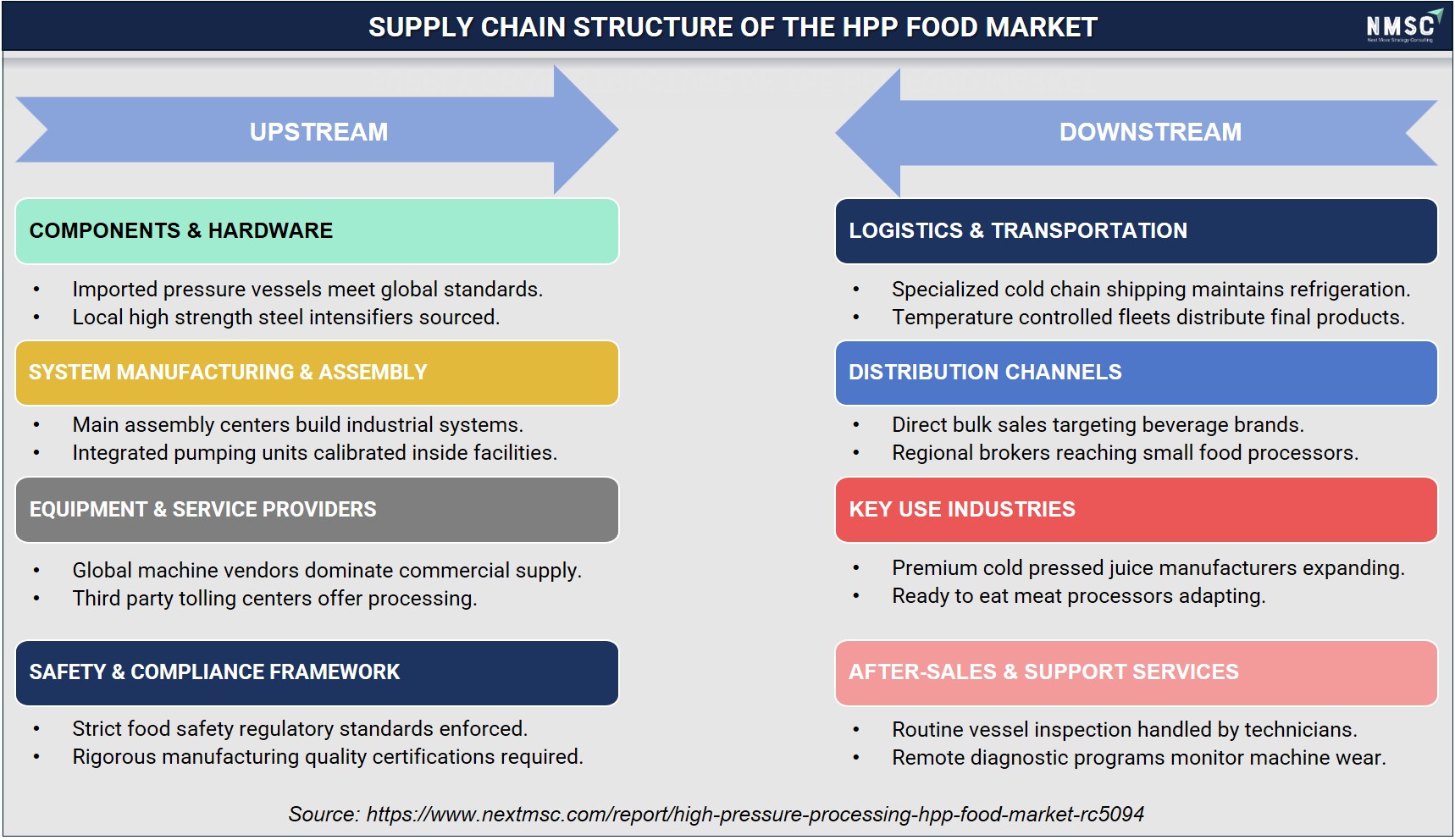
The infographic illustrates the supply chain structure of the High Pressure Processing (HPP) Food Market, highlighting both upstream and downstream activities. Upstream operations include component sourcing, pressure vessel manufacturing, system assembly, equipment providers, and compliance frameworks that ensure food safety and quality standards. Downstream activities focus on cold-chain logistics, distribution networks, end-use industries such as cold-pressed juices and ready-to-eat foods, and after-sales support services. The supply chain emphasizes food safety, shelf-life extension, and efficient refrigerated distribution, which are critical to HPP food commercialization and market growth.
What Are the Growth Inhibitors of the High Pressure Processing (HPP) Food Market?
How Does the High Capital Investment Required for HPP Equipment Constrain High Pressure Processing (HPP) Food Market Growth?
The high capital cost of HPP processing equipment represents one of the most significant barriers to market expansion, particularly for small and medium-sized food manufacturers. Industrial HPP systems capable of commercial-scale throughput require initial capital investments that can range into the millions of dollars per unit, excluding installation, facility modification, and maintenance costs. The U.S. Small Business Administration (SBA) acknowledges that capital access constraints are a persistent challenge for food manufacturing SMBs. Our findings suggest that this barrier concentrates HPP adoption among large food and beverage manufacturers and dedicated toll processors, limiting broader market democratization in the near term.
How Does Cold Chain Dependency Limit the Geographic Expansion of the High Pressure Processing (HPP) Food Market?
HPP-processed products require uninterrupted refrigerated storage and distribution throughout the supply chain, creating a structural dependency on cold chain infrastructure that constrains market expansion in regions with underdeveloped logistics networks. Our assessment indicates that across significant portions of Sub-Saharan Africa, South and Southeast Asia, and Latin America, cold chain coverage remains insufficient for reliable HPP product distribution. The Food and Agriculture Organization (FAO) of the United Nations has documented substantial post-harvest food losses in developing regions linked directly to inadequate refrigeration infrastructure, limiting the commercial viability of HPP products in these geographies.
What Are the Growth Opportunities in the High Pressure Processing (HPP) Food Market?
How Does the Rapid Growth of the HPP Beverage Category Create a Substantial Market Opportunity?
The cold-pressed juice and functional beverage category represents one of the most commercially significant growth opportunities in the High Pressure Processing (HPP) Food Market. Based on our market evaluation, we noticed that consumer willingness to pay a premium for HPP-labeled juice products is well established across North American and European retail markets. The U.S. Department of Agriculture (USDA) reports consistent growth in organic and natural beverage consumption, categories in which HPP products have high penetration. Emerging opportunities in functional and nutritional drink formulations, including plant-based protein drinks, probiotic beverages, and immunity-boosting juices, are expanding the HPP beverage addressable market further.
How Is the Growing HPP Baby Food and Infant Nutrition Segment Generating Long-Term Opportunity in the High Pressure Processing (HPP) Food Market?
Baby food and infant nutrition represent a structurally attractive and high-growth opportunity within the High Pressure Processing (HPP) Food Market. Parents globally are increasingly seeking organic, preservative-free, and pathogen-safe options for infant feeding, creating ideal conditions for HPP product expansion. The World Health Organization (WHO) guidelines on complementary feeding emphasize the importance of safe, nutritious, and minimally processed foods for infants and young children. NMSC's analysis indicates that HPP baby food brands are gaining shelf space in premium grocery retailers and online channels across North America, Europe, and increasingly in Asia-Pacific markets including China, South Korea, and Australia.
How Does the Expansion of E-Commerce and Direct-to-Consumer Channels Open New Distribution Pathways for the High Pressure Processing (HPP) Food Market?
The rapid growth of e-commerce and direct-to-consumer food delivery represents a significant distribution opportunity for the High Pressure Processing (HPP) Food Market. Our analysis shows that online retail channels enable HPP brands to reach health-conscious consumers beyond the geographic limitations of specialty retail store networks. The U.S. Postal Service (USPS) and private logistics operators have expanded temperature-controlled last-mile delivery infrastructure, making direct-to-consumer distribution of perishable HPP products increasingly feasible. Companies leveraging subscription models for HPP meal kits, cold-pressed juices, and raw pet food are generating recurring revenue streams with higher margins than traditional retail channels.
Pain Point Analysis of the HPP Food Market
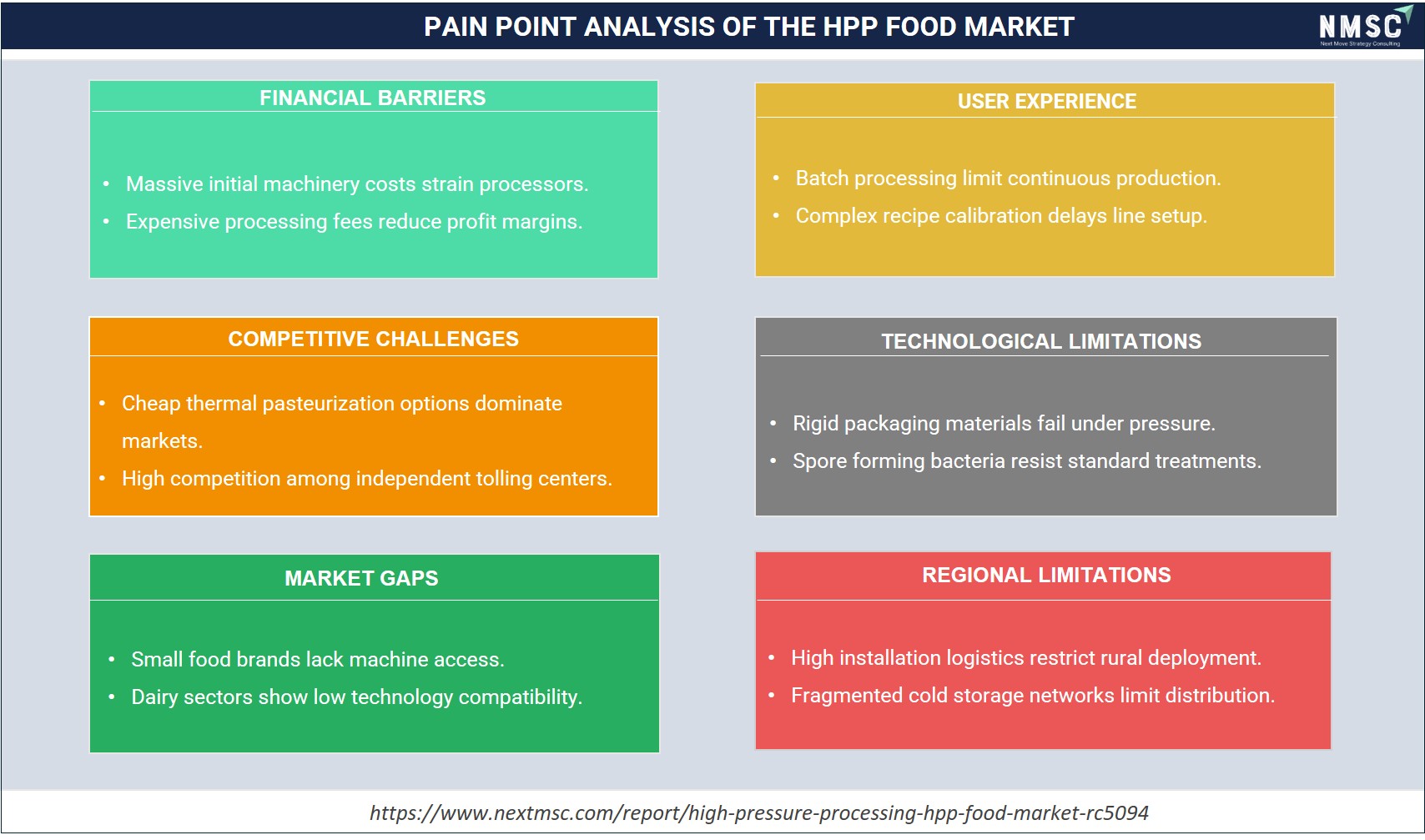
The High Pressure Processing (HPP) Food Market expansion faces several operational and commercial challenges that influence market growth. High equipment investment and processing costs create financial barriers, while batch-based operations and complex recipe calibration affect production efficiency. Competition from conventional thermal pasteurization methods, packaging limitations under extreme pressure, and resistance of certain microorganisms add technological hurdles. Additionally, limited access for small food manufacturers and underdeveloped cold chain infrastructure in some regions constrain broader market adoption.
How Is the High Pressure Processing (HPP) Food Market Segmented in This Report, and What Are the Key Insights from the Segmentation Analysis?
How Do Different Product Categories Shape Revenue Distribution Across the High Pressure Processing (HPP) Food Market?
|
Product Type Segment |
2025 (USD Bn) |
2035 (USD Bn) |
CAGR (%) |
|
Fruits and Vegetables |
1.2 |
3 |
9.6% |
|
Meat and Poultry Products |
3.1 |
6.8 |
8.2% |
|
Seafood Products |
0.9 |
2.2 |
9.4% |
|
Dairy and Dairy Alternatives |
0.7 |
1.7 |
9.3% |
|
Beverages |
1.8 |
5.2 |
11.2% |
|
Ready-to-Eat (RTE) Meals and Packaged Foods |
1.2 |
2.8 |
8.8% |
|
Baby Food and Infant Nutrition |
0.4 |
1.2 |
11.6% |
|
Pet Food |
0.3 |
0.9 |
11.6% |
Through NMSC's assessment, we found that the High Pressure Processing (HPP) Food Market share is segmented into Fruits and Vegetables, Meat and Poultry Products, Seafood Products, Dairy and Dairy Alternatives, Beverages, Ready-to-Eat Meals, Baby Food and Infant Nutrition, and Pet Food. The Meat and Poultry Products segment holds the largest market share, driven by stringent regulatory requirements for pathogen reduction in deli meats and charcuterie. Beverages, encompassing Fruit & Vegetable Juices and Functional & Nutritional Drinks, represent the fastest-growing segment as cold-pressed juice brands and functional beverage innovators expand their HPP-labeled product portfolios globally.
Which Packaging Formats Are Driving Adoption and Revenue Growth Across the High Pressure Processing (HPP) Food Market?
|
Packaging Type Segment |
2025 (USD Bn) |
2035 (USD Bn) |
CAGR (%) |
|
Pouches |
5 |
11.5 |
8.7% |
|
Bottles & Jars |
3.1 |
8.1 |
10.1% |
|
Trays & Tubs |
1.5 |
3.2 |
7.8% |
Based on our analysis of packaging technology trends and HPP compatibility requirements, we observed that the High Pressure Processing (HPP) Food Market is segmented by Pouches, Bottles & Jars, and Trays & Tubs. The Pouches segment dominates due to its pressure-transmission properties, flexible form factor, and compatibility with a wide range of HPP-processed food products including meats, guacamole, and prepared meals. Bottles & Jars represent the fastest-growing packaging format, driven by the expanding HPP juice and beverage category where consumer preference for transparent, resealable packaging is strong. Trays & Tubs serve the RTE meal and seafood segments.
How Do Distribution Channels Shape Market Accessibility and Growth Potential in the High Pressure Processing (HPP) Food Market?
|
Distribution Channel Segment |
2025 (USD Bn) |
2035 (USD Bn) |
CAGR (%) |
|
Supermarkets and Hypermarkets |
4.1 |
9 |
8.2% |
|
Convenience Stores |
1.2 |
2.6 |
8.0% |
|
Specialty and Gourmet Food Stores |
1.8 |
3.8 |
7.8% |
|
Online Retail / E-commerce Platforms |
1.4 |
5 |
13.5% |
|
Institutional Sales |
1.1 |
2.4 |
8.1% |
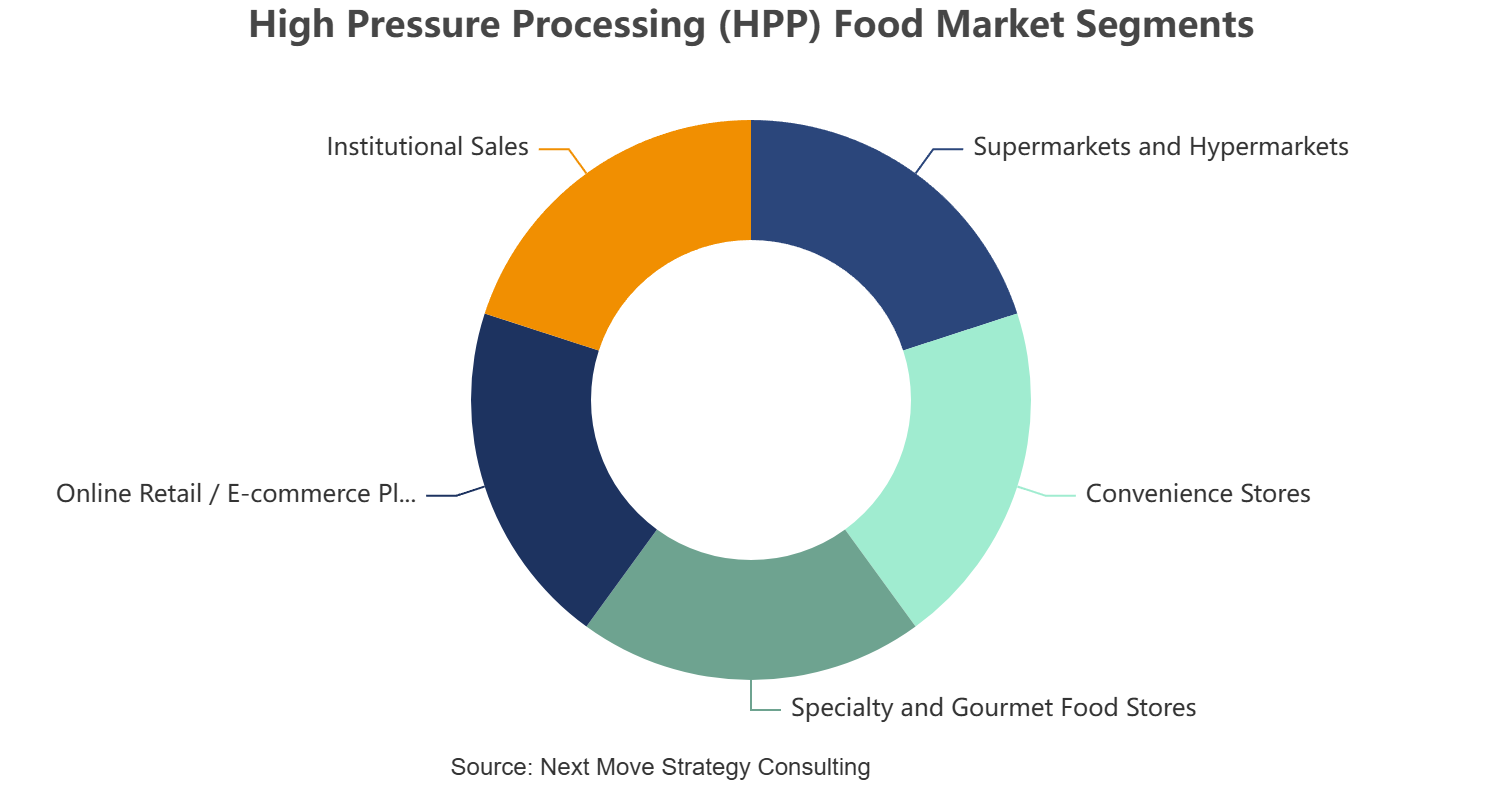
Our assessment indicates that the High Pressure Processing (HPP) Food Market is segmented across Supermarkets and Hypermarkets, Convenience Stores, Specialty and Gourmet Food Stores, Online Retail and E-commerce Platforms, and Institutional Sales. Supermarkets and Hypermarkets hold the dominant share, providing the broadest consumer reach for HPP-processed packaged foods and beverages. Specialty and Gourmet Food Stores serve premium and health-conscious consumer segments with curated HPP product selections. Online Retail is the fastest-growing channel, enabled by expanding cold-chain last-mile delivery and the direct-to-consumer strategies of HPP-focused food brands.
How Do Residential and Commercial End Users Differ in Their Demand Patterns Within the High Pressure Processing (HPP) Food Market?
|
End User Segment |
2025 (USD Bn) |
2035 (USD Bn) |
CAGR (%) |
|
Residential Consumers |
3.4 |
8.6 |
9.7% |
|
Commercial Users |
6.2 |
14.2 |
8.6% |
Based on our market evaluation, we observed that the High Pressure Processing (HPP) Food Market is segmented into Residential Consumers and Commercial Users, with Commercial Users subdivided into Restaurants & Catering Services, Food & Beverage Manufacturers, and Institutional Buyers. The Commercial Users segment dominates, driven by large-scale food and beverage manufacturers who integrate HPP processing into production lines for deli meats, juices, and seafood. Food & Beverage Manufacturers represent the largest sub-segment within commercial users. Residential Consumers are the fastest-growing end-user category as premium HPP products achieve broader retail distribution and subscription-based meal delivery services expand.
Regional Outlook
Geographic Performance Snapshot
|
Region |
2025 (USD Bn) |
2035 (USD Bn) |
CAGR (%) |
Key Driver |
|
North America |
4.2 |
9.3 |
8.4% |
Early HPP adoption, FDA/USDA compliance mandates |
|
Europe |
2.8 |
6.4 |
8.6% |
Clean-label consumer trends, EFSA validation |
|
Asia-Pacific |
1.6 |
5 |
12.0% |
Premium food growth, rising food safety investment |
|
Middle East & Africa |
0.6 |
1.5 |
9.6% |
Modern retail expansion, food safety awareness |
|
Latin America |
0.4 |
0.6 |
4.1% |
Growing organized retail, HPP awareness increase |
North America High Pressure Processing (HPP) Food Market
North America is the global leader and most mature market in the High Pressure Processing (HPP) Food Market, accounting for USD 4.2 billion in 2025 and forecast to reach USD 9.3 billion by 2035 at a CAGR of 8.4%. The region benefits from strong regulatory frameworks including FDA FSMA and USDA FSIS guidelines that have institutionalized HPP as a preferred food safety intervention. Based on our market assessment, we observed that the presence of leading HPP equipment manufacturers, a well-developed toll processing industry, and high consumer awareness of clean-label food products collectively underpin North America's sustained market leadership. The United States and Canada are the primary revenue contributors.
United States High Pressure Processing (HPP) Food Market
Based on our engagements across the U.S. food processing industry, we found that the United States represents approximately 85% of North American HPP Food Market revenue, driven by regulatory compliance requirements, strong clean-label consumer demand, and the presence of major HPP brands including Evolution Fresh, Suja Life, and Good Foods. The FDA's FSMA and USDA FSIS Listeria Alternative 2 controls have made HPP standard practice for deli meat and RTE manufacturers. Technology penetration is high, with established toll processors operating across the country. Competitive intensity is strong, with both national brands and private-label HPP products competing for retail shelf space.
Canada High Pressure Processing (HPP) Food Market
Through our analysis, we noticed that Canada is the second-largest market in North America for HPP Food products, supported by a health-conscious consumer base and regulatory alignment with international food safety standards under the Canadian Food Inspection Agency (CFIA). Canadian food manufacturers are adopting HPP technology for deli meats, seafood, and fresh juice products. Government investment in food safety infrastructure under Agriculture and Agri-Food Canada's programs is supporting industry modernization. E-commerce and specialty retail channels are growing in importance for HPP product distribution across major Canadian urban centers.
Mexico High Pressure Processing (HPP) Food Market
From our assessment, the Mexican High Pressure Processing (HPP) Food Market is at an early but expanding stage, benefiting from a growing modern retail sector, rising middle-class food safety awareness, and increasing exports of HPP-processed avocado and guacamole products to the United States. Mexico's Federal Commission for the Protection Against Sanitary Risks (COFEPRIS) provides the regulatory framework for non-thermal food processing approvals. Technology adoption remains concentrated among large food exporters, with toll processing partnerships enabling smaller producers to access HPP capabilities for export-oriented product lines targeting North American and European retail buyers.
Europe High Pressure Processing (HPP) Food Market
Europe is the second-largest region in the High Pressure Processing (HPP) Food Market, contributing USD 2.8 billion in 2025 and forecast to reach USD 6.4 billion by 2035 at a CAGR of 8.6%. The region's strong clean-label consumer culture, supportive EFSA scientific opinions on HPP, and strict EU food safety regulations under Regulation (EC) No 852/2004 are key demand drivers. Our analysis shows that European food manufacturers are investing in HPP as a competitive differentiation strategy for premium and organic product lines across meats, beverages, and ready-to-eat categories, with Spain and the UK among the most active HPP-adopting markets.
UK High Pressure Processing (HPP) Food Market
Based on our engagements with the UK food and beverage sector, we found that the United Kingdom represents one of Europe's most developed High Pressure Processing (HPP) Food markets, driven by a sophisticated health food retail ecosystem, strong consumer demand for clean-label products, and robust food safety oversight by the Food Standards Agency (FSA). UK food manufacturers in the deli meat, cold-pressed juice, and premium RTE categories are significant HPP technology adopters. Government policies supporting food innovation through Innovate UK and the British Meat Processors Association's safety standards have provided structural encouragement for HPP investment across the UK food industry.
Germany High Pressure Processing (HPP) Food Market
According to evaluation, Germany's High Pressure Processing (HPP) Food Market is characterized by strong consumer preference for natural and minimally processed foods, supported by the country's robust organic food retail sector. The German Federal Institute for Risk Assessment (BfR) and the Federal Office of Consumer Protection and Food Safety (BVL) provide the regulatory framework for HPP product approvals. German food manufacturers in the meat and charcuterie sector are adopting HPP to meet both domestic food safety standards and export requirements for European and global markets. Technology penetration is growing across premium and organic product segments.
France High Pressure Processing (HPP) Food Market
Through our analysis, we noticed that France presents growing opportunities in the High Pressure Processing (HPP) Food Market, particularly within the country's strong charcuterie and ready-to-eat food manufacturing sector. The French Agency for Food, Environmental and Occupational Health & Safety (ANSES) oversees food safety standards for novel processing technologies. French consumers show strong affinity for natural and artisanal food products, creating demand for HPP-processed premium foods that preserve traditional flavors and nutritional qualities. Government support for food innovation through BPI France and the Plan France 2030 initiative encourages adoption of advanced processing technologies across the food industry.
Italy High Pressure Processing (HPP) Food Market
From our assessment, Italy's High Pressure Processing (HPP) Food Market is developing steadily, supported by the country's strong food culture, premium cured meat tradition, and growing consumer interest in clean-label food products. The Italian Ministry of Health oversees food safety regulations in compliance with EU directives. HPP technology is gaining traction among producers of premium deli meats, seafood, and fresh pasta products seeking to extend refrigerated shelf life while preserving artisanal quality attributes. Government modernization initiatives under the National Recovery and Resilience Plan (PNRR) are supporting food industry technology investment.
Spain High Pressure Processing (HPP) Food Market
Based on our engagements across the Spanish food processing industry, Spain represents one of the most advanced High Pressure Processing (HPP) Food markets in Europe, with a well-established HPP processing infrastructure. Spain hosts a significant concentration of HPP toll processors and equipment installations, serving both domestic food manufacturers and European exports. The Spanish Agency for Food Safety and Nutrition (AESAN) provides regulatory oversight consistent with EU food safety legislation. Spanish food companies including Campofrío and Embutidos Espuña are globally recognized HPP adopters in the processed meat category.
Sweden High Pressure Processing (HPP) Food Market
Through our analysis, the Swedish High Pressure Processing (HPP) Food Market reflects the country's high standards for food safety, sustainability, and innovation. The Swedish Food Agency (Livsmedelsverket) provides regulatory guidance consistent with EU frameworks for novel food processing technologies. Swedish consumers show strong preference for organic, natural, and minimally processed foods, creating favorable conditions for HPP product adoption. Growing interest in cold-pressed beverages, plant-based foods, and clean-label convenience products supports expanding HPP market opportunities. Technology adoption remains concentrated among premium food brands.
Denmark High Pressure Processing (HPP) Food Market
From our assessment, Denmark's High Pressure Processing (HPP) Food Market benefits from a progressive food safety culture, high consumer health awareness, and strong seafood and dairy processing sectors where HPP offers significant quality and safety advantages. The Danish Veterinary and Food Administration oversees compliance with EU food safety regulations. Danish food manufacturers in the smoked salmon, ready-to-eat seafood, and premium dairy categories are exploring HPP adoption. Government innovation support through the Danish Food and Agricultural Policy Framework encourages technological modernization across the food processing industry.
Finland High Pressure Processing (HPP) Food Market
Based on our market evaluation, the Finnish High Pressure Processing (HPP) Food Market is at an early adoption stage, with growing interest driven by the country's strong food safety tradition and expanding organic food sector. The Finnish Food Authority (Ruokavirasto) oversees food safety standards in compliance with EU legislation. Finnish food manufacturers in meat processing, dairy, and seafood categories present the primary near-term opportunity for HPP technology adoption. Government investment in food sector modernization through Business Finland programs supports technological innovation across the Finnish food and beverage industry.
Netherlands High Pressure Processing (HPP) Food Market
According to evaluation, the Netherlands High Pressure Processing (HPP) Food Market benefits from its position as a major European food and agricultural hub, with sophisticated food processing infrastructure and one of the world's most advanced logistics networks. The Netherlands Food and Consumer Product Safety Authority (NVWA) provides regulatory oversight for novel food processing technologies. Dutch food manufacturers in the premium dairy, vegetable protein, and RTE meal categories are exploring HPP adoption. The Netherlands' role as a gateway for European food exports creates commercial incentives for HPP technology investment that supports extended shelf life and food safety certification.
Asia-Pacific High Pressure Processing (HPP) Food Market
Asia-Pacific is the fastest-growing region in the High Pressure Processing (HPP) Food Market at a CAGR of 12.0% from 2026 to 2035, advancing from USD 1.6 billion in 2025 to USD 5.0 billion by 2035. Rising middle-class consumer spending on premium and safe food products, expanding organized retail infrastructure, and increasing government investment in food safety technology are the primary growth drivers. Our analysis shows that Japan pioneered commercial HPP food production globally, while China, South Korea, and Australia represent the current frontiers of rapid market expansion across the region.
China High Pressure Processing (HPP) Food Market
Based on our engagements with the Chinese food safety and processing sector, China represents the largest and fastest-growing High Pressure Processing (HPP) Food Market demand in Asia-Pacific, driven by rapidly rising consumer demand for premium, safe, and minimally processed foods following high-profile food safety incidents. The National Medical Products Administration (NMPA) and the General Administration of Customs regulate food safety and import standards. Growing demand for HPP-processed juices, infant formula alternatives, and premium meats is driving domestic investment in HPP equipment and processing infrastructure across major Chinese food manufacturing hubs.
India High Pressure Processing (HPP) Food Market
Through our analysis, India's High Pressure Processing (HPP) Food Market is at a nascent but high-potential stage, supported by a rapidly growing organized food retail sector, increasing consumer awareness of food safety, and government-led initiatives including the Food Safety and Standards Authority of India (FSSAI) modernization programs. Rising demand for fresh, clean-label juice and RTE food products in urban centers is creating early commercial demand for HPP processing. Toll processing services and imported HPP equipment are the current primary access points for Indian food manufacturers exploring non-thermal processing technology adoption.
Japan High Pressure Processing (HPP) Food Market
From our assessment, Japan holds a historically significant position in the High Pressure Processing (HPP) Food Market as the country where commercial HPP food production originated in the early 1990s. The Japanese Ministry of Health, Labour and Welfare provides oversight for food safety and processing technology standards. Japanese consumers demonstrate sophisticated preferences for premium, fresh, and minimally processed foods that align well with HPP product attributes. HPP is well established in Japan's seafood, rice cake, and juice categories. Competitive intensity is high, with both domestic innovators and international brands competing for market share.
South Korea High Pressure Processing (HPP) Food Market
Based on our market evaluation, the South Korean High Pressure Processing (HPP) Food Market is growing steadily, supported by high consumer health consciousness, a vibrant premium food retail sector, and strong domestic demand for fresh and safe food products. The Ministry of Food and Drug Safety (MFDS) provides regulatory oversight for non-thermal food processing approvals. South Korean food manufacturers in the kimchi, seafood, and premium juice categories are exploring HPP adoption. Companies such as Pulmuone Co., Ltd. have established significant HPP processing capabilities, positioning South Korea as a technically advanced HPP market in Asia-Pacific.
Taiwan High Pressure Processing (HPP) Food Market
According to evaluation, Taiwan's High Pressure Processing (HPP) Food Market benefits from the island's sophisticated food processing industry, strong consumer health awareness, and proximity to major HPP equipment manufacturers in the Asia-Pacific region. The Taiwan Food and Drug Administration (TFDA) governs food safety standards and processing technology approvals. Taiwanese food manufacturers in seafood, tropical fruit processing, and premium beverage categories present commercial opportunities for HPP technology adoption. Growing export demand for premium Taiwanese food products in Japanese and Southeast Asian markets provides additional commercial incentives for HPP investment.
Indonesia High Pressure Processing (HPP) Food Market
Based on our engagements, Indonesia represents an early-stage but high-potential High Pressure Processing (HPP) Food Market, driven by a large and rapidly growing consumer base, rising food safety awareness, and government modernization programs including the National Food Agency (Badan Pangan Nasional) initiatives. The country's expanding modern retail sector and growing middle-class demand for premium and safe packaged foods create favorable conditions for HPP market development. Cold chain infrastructure limitations remain a constraint, but government investment in logistics modernization is progressively addressing this challenge.
Vietnam High Pressure Processing (HPP) Food Market
Through our analysis, Vietnam's High Pressure Processing (HPP) Food Market is in an early development stage, with market growth driven by rising consumer health awareness, rapid expansion of organized food retail channels, and increasing demand for premium and safe food products among urban middle-class consumers. The Ministry of Health's Food Safety Department provides regulatory oversight. Vietnam's growing seafood and tropical fruit export industries present compelling applications for HPP technology as a food safety and shelf life extension solution for international trade. Government investment in food processing modernization supports long-term market development.
Australia High Pressure Processing (HPP) Food Market
From our assessment, Australia is among the most advanced High Pressure Processing (HPP) Food Markets in the Asia-Pacific region, characterized by sophisticated consumer demand for clean-label and health-oriented food products, strong food safety regulatory frameworks under Food Standards Australia New Zealand (FSANZ), and a vibrant premium food manufacturing sector. Australian food companies in the cold-pressed juice, premium meat, and organic RTE categories have adopted HPP technology for both domestic and export markets. The Australian Government's food industry innovation programs support technology adoption and export market development for premium HPP-processed food products.
Philippines High Pressure Processing (HPP) Food Market
Based on our market evaluation, the Philippines High Pressure Processing (HPP) Food Market is at an emerging stage, with commercial opportunities primarily in seafood processing, tropical fruit products, and premium beverages targeting urban middle-class consumers and export markets. The Food and Drug Administration (FDA Philippines) provides regulatory oversight for novel food processing technologies. Government investment in food industry modernization through the Department of Agriculture and Department of Trade and Industry creates structural support for HPP technology adoption among Philippine food exporters seeking to meet international food safety standards for premium export product categories.
Malaysia High Pressure Processing (HPP) Food Market
According to evaluation, Malaysia's High Pressure Processing (HPP) Food Market is gradually developing, driven by rising consumer health consciousness, an expanding premium food retail sector, and Malaysia's position as a significant food export hub in Southeast Asia. The Ministry of Health Malaysia and the Malaysian Food Regulations provide the framework for food processing technology approvals. Malaysia's halal food export industry, one of the world's largest, presents a strategic application for HPP technology as a non-thermal processing alternative that preserves food integrity while meeting halal certification requirements for international Muslim-majority markets.
Middle East & Africa (MEA) High Pressure Processing (HPP) Food Market
The Middle East & Africa High Pressure Processing (HPP) Food Market contributed USD 0.6 billion in 2025 and is forecast to reach USD 1.5 billion by 2035 at a CAGR of 9.6%. The region's market is characterized by a bifurcated structure, with GCC nations leading adoption driven by premium food imports and modern retail expansion, while most African markets remain at early awareness stages. Our analysis shows that food safety concerns, rising consumer health awareness in urban centers, and growing demand for extended shelf-life products in high-temperature environments are the primary drivers of HPP market development across the MEA region.
Saudi Arabia High Pressure Processing (HPP) Food Market
Based on our engagements, Saudi Arabia is the leading High Pressure Processing (HPP) Food Market in the Middle East, driven by high consumer purchasing power, a sophisticated modern retail sector, and Vision 2030 investments in food security and manufacturing diversification. The Saudi Food and Drug Authority (SFDA) provides regulatory oversight for imported and domestically produced HPP food products. Rising demand for premium, safe, and minimally processed food products among health-conscious Saudi consumers is creating commercial demand for HPP-labeled imports and, increasingly, domestic processing investments across juice, meat, and RTE food categories.
UAE High Pressure Processing (HPP) Food Market
Through our analysis, the UAE High Pressure Processing (HPP) Food Market benefits from Dubai and Abu Dhabi's positions as major international food trade and distribution hubs, strong consumer demand for premium and health-oriented food products, and well-developed cold chain logistics infrastructure. The UAE Food Safety Authority and local authorities in Dubai (Dubai Municipality) and Abu Dhabi (ADAFSA) provide regulatory frameworks for food safety standards. The UAE's significant expatriate consumer population with diverse food preferences and high health awareness creates strong demand for HPP-processed premium products across meat, juice, and dairy categories.
Egypt High Pressure Processing (HPP) Food Market
From our assessment, Egypt's High Pressure Processing (HPP) Food Market is at an early development stage, with market opportunities primarily concentrated in premium food categories serving Egypt's growing middle class and export markets. The Egyptian Food Safety Authority provides regulatory oversight for food processing technologies. Egypt's large food manufacturing base and strategic position as an African and Middle Eastern food export hub create long-term structural opportunities for HPP technology adoption. Government food industry modernization programs and international food safety certification requirements for export markets are gradually encouraging technology investment among Egyptian food manufacturers.
Israel High Pressure Processing (HPP) Food Market
Based on our market evaluation, Israel represents one of the more technically advanced High Pressure Processing (HPP) Food Markets in the MEA region, driven by a sophisticated food technology ecosystem, strong consumer health orientation, and regulatory alignment with international food safety standards under the Israeli Standards Institute and the Ministry of Health. Israeli food companies in the fresh produce, premium dairy, and RTE food categories present commercial opportunities for HPP adoption. Israel's strong food technology innovation culture and export-oriented food manufacturing sector provide structural support for HPP technology investment and commercialization.
Turkey High Pressure Processing (HPP) Food Market
According to evaluation, Turkey's High Pressure Processing (HPP) Food Market is developing steadily, supported by a large and sophisticated food processing industry, growing consumer health awareness, and Turkey's strategic position as a food export hub serving European, Middle Eastern, and Central Asian markets. The Turkish Food Codex and the Ministry of Agriculture and Forestry provide regulatory oversight for food processing technologies. Turkish food manufacturers in the processed meat, fresh produce, and dairy categories present growing opportunities for HPP technology adoption, particularly as export customers increasingly require international food safety certifications.
Nigeria High Pressure Processing (HPP) Food Market
Based on our engagements, Nigeria's High Pressure Processing (HPP) Food Market is at a very early stage, with commercial opportunities primarily in premium imported products and nascent domestic food safety technology investment. The National Agency for Food and Drug Administration and Control (NAFDAC) regulates food safety standards. Nigeria's large urban consumer base and growing modern retail sector present long-term market development potential. Cold chain infrastructure limitations and high equipment costs represent the primary near-term barriers to domestic HPP technology adoption. Market development is expected to accelerate as food safety awareness increases and cold chain infrastructure improves.
South Africa High Pressure Processing (HPP) Food Market
Through our analysis, South Africa is the most developed High Pressure Processing (HPP) Food Market in Sub-Saharan Africa, supported by a sophisticated food manufacturing sector, strong modern retail infrastructure, and regulatory oversight by the Department of Health and the South African Bureau of Standards (SABS). South African food manufacturers in the premium meat, fresh produce, and juice categories present the most developed near-term opportunities for HPP technology adoption. Growing consumer demand for clean-label and safe food products among South Africa's health-conscious urban consumers is creating commercial incentives for HPP product innovation and investment.
Latin America High Pressure Processing (HPP) Food Market
Latin America's High Pressure Processing (HPP) Food Market contributed USD 0.4 billion in 2025 and is forecast to reach USD 0.6 billion by 2035 at a CAGR of 4.1%. The region's market is at an early commercial stage, with Brazil and Argentina representing the primary adoption markets. Our analysis shows that Latin America's large avocado and fresh produce export industries present strategically important applications for HPP technology as a food safety and shelf-life extension solution for North American and European export markets. Growing modern retail sector development and rising urban consumer health awareness are the primary long-term demand drivers.
Brazil High Pressure Processing (HPP) Food Market
Based on our engagements, Brazil is the largest High Pressure Processing (HPP) Food Market in Latin America, driven by a large food manufacturing base, growing modern retail sector, and Brazil's significant fresh produce and juice export industries. The National Health Surveillance Agency (ANVISA) provides regulatory oversight for food safety and processing technology approvals. Brazilian food companies in the juice, tropical fruit, and premium meat categories present the most developed HPP opportunities. Government food industry modernization programs and increasing export certification requirements from North American and European buyers are gradually encouraging HPP technology investment.
Argentina High Pressure Processing (HPP) Food Market
Through our analysis, Argentina's High Pressure Processing (HPP) Food Market is developing in the context of the country's large beef and agricultural export industries, where HPP offers food safety and shelf-life advantages for international trade. The National Food Institute (INAL) and the National Service for Agri-Food Health and Quality (SENASA) regulate food processing safety standards. Economic volatility presents a significant constraint on capital investment in HPP equipment. Nonetheless, export-oriented food manufacturers with international food safety certification requirements represent a viable near-term market segment for HPP technology adoption in Argentina.
Chile High Pressure Processing (HPP) Food Market
From our assessment, Chile's High Pressure Processing (HPP) Food Market is primarily driven by the country's large seafood and fresh produce export industries, where HPP offers compelling food safety and shelf-life advantages for international markets. The Chilean Agency for Food and Drug Quality and Safety (ACHIPIA) and the Ministry of Health provide regulatory oversight. Chilean seafood exporters, particularly salmon processors, represent strategically important HPP adoption opportunities as international buyers increasingly require advanced food safety processing certification. Government investment in seafood industry modernization creates structural support for HPP technology adoption.
Colombia High Pressure Processing (HPP) Food Market
Based on our market evaluation, Colombia's High Pressure Processing (HPP) Food Market is at a nascent stage, with commercial development primarily driven by the country's growing fresh fruit and juice export industries and rising urban consumer demand for premium, safe food products. The Colombian National Food and Drug Surveillance Institute (INVIMA) regulates food safety and processing technology standards. Colombia's strategic position as a major tropical fruit producer and exporter creates long-term application opportunities for HPP as a food safety solution for export-oriented fresh produce and juice products targeting North American and European retail markets.
Competitive Landscape
Competitive Dynamics & M&A Landscape
|
Key Takeaways |
Details |
|
Market Structure |
The High Pressure Processing (HPP) Food Market is moderately concentrated, with a mix of global food conglomerates, regional processors, and dedicated HPP-native brands competing across product categories and geographies. Large players such as Cargill and Hormel Foods leverage HPP as a food safety tool within diversified portfolios, while specialized brands like Suja Life and Evolution Fresh have built HPP as a core marketing differentiator. |
|
Innovation Focus |
Innovation is concentrated in beverage HPP applications, pet food HPP expansion, and next-generation infant nutrition products. Companies are investing in proprietary cold-pressure formulations, clean-label brand positioning, and sustainable packaging compatibility. Equipment and process optimization to reduce per-unit costs is a parallel innovation priority for large-scale producers. |
|
M&A Activity |
M&A activity in the High Pressure Processing (HPP) Food Market has been driven by large food and beverage companies acquiring HPP-native brands to access clean-label product portfolios and established consumer relationships. Notable consolidation activity has occurred in the cold-pressed juice and premium deli meat categories as strategic buyers recognize the commercial value of HPP brand equity and technology expertise. |
How Do Companies Compete in the High Pressure Processing (HPP) Food Market?
NMSC's analysis indicates that competition in the High Pressure Processing (HPP) Food Market operates across several strategic dimensions including food safety credentials, product innovation, brand positioning, distribution scale, and pricing strategy. Large food conglomerates such as Cargill and Hormel Foods compete on scale, food safety expertise, and retailer relationships. Mid-tier regional players including Campofrío and Creta Farms compete on product quality, provenance storytelling, and premium market positioning. HPP-native brands like Suja Life, Urban Remedy, and Evolution Fresh compete primarily on brand authenticity, clean-label transparency, and direct-to-consumer digital engagement. Geographic expansion into Asia-Pacific and the Middle East represents a key competitive frontier.
Which Kind of Companies Dominate the High Pressure Processing (HPP) Food Market?
The High Pressure Processing (HPP) Food Market is dominated by a dual structure of large established food processors that have adopted HPP as a food safety and quality tool within diversified portfolios, and specialized HPP-native brands that have built their entire commercial identity around cold-pressure processing. Our assessment indicates that the former category, represented by companies such as Cargill, Hormel Foods, and Pulmuone, benefits from scale economies, retailer access, and global distribution infrastructure. The latter category, including Suja Life, Urban Remedy, Hope Foods, and Evolution Fresh, commands premium pricing and strong direct consumer loyalty.
Market Players to Opt for Merger and Acquisition Strategies to Expand Their Presence in the High Pressure Processing (HPP) Food Market
Strategic M&A activity in the High Pressure Processing (HPP) Food Market is expected to accelerate as large food and beverage companies seek to expand their clean-label product portfolios and HPP technology capabilities. Our findings suggest that the most attractive acquisition targets include established HPP beverage brands with proven retail distribution, innovative baby food and infant nutrition companies, and pet food brands building HPP-native product lines. Toll processing companies with high-capacity HPP infrastructure also represent strategically valuable acquisition assets for companies seeking to internalize processing capabilities and reduce dependence on contract processing services.
Who Are the Key Market Players in the High Pressure Processing (HPP) Food Market?
-
Cargill, Incorporated
-
Hormel Foods, LLC
-
Archer Daniels Midland Company (ADM)
-
Campofrio Food Group
-
Applegate Farms, LLC
-
Hain Celestial Group, Inc.
-
Suja Life, LLC
-
Urban Remedy
-
GoodFoods Group
-
Grupo Jumex
-
Creta Farms
-
Pulmuone Co., Ltd.
-
Hope Foods
-
Espuna
-
Echigo Seika
-
Motivatit Seafoods
-
Danone
-
Nestle
-
Evolution Fresh
-
Lakewood Organic Juice Co.
What Are the Latest Developments in the High Pressure Processing (HPP) Food Market Industry?
|
Date |
Event |
|
June 2024 |
Good Foods launched its 2024 “Dip into Summer” experiential campaign. The company continues to position its fresh dips and spreads around HPP-enabled clean-label production and freshness preservation. |
|
April 2024 |
Hormel reintroduced its Natural Choice Deli Roast Beef and Rotisserie Seasoned Chicken products. The company stated that all products in the range are packed, sealed, and HPP-treated to maintain natural flavor without preservatives. |
|
March 2024 |
Hormel Foods introduced a redesigned packaging format for its HORMEL NATURAL CHOICE deli range. The company highlighted that products are packed, sealed, and processed using High Pressure Processing (HPP) to preserve flavor without preservatives. |
Expert Insights
 “We continue to see increasing demand from our customers as more brands recognize the value HPP brings to food safety and shelf-life extension.”
- Frank Jimenez, Chief Executive Officer of Universal Pure.
The statement was made in November 2025 during Universal Pure’s announcement of the installation of an additional Hiperbaric 525i High Pressure Processing (HPP) system at its Malvern, Pennsylvania facility.
Market Interpretation
The quote highlights a major growth driver in the High Pressure Processing (HPP) Food Market: increasing adoption of non-thermal food preservation technologies that enhance food safety while extending shelf life without preservatives. As consumers increasingly demand fresh, minimally processed, and clean-label products, food manufacturers are turning to HPP to maintain product quality, freshness, and nutritional value. The statement also indicates rising commercialization of HPP across multiple food categories, encouraging processors and service providers to expand capacity and invest in advanced HPP infrastructure to meet accelerating market demand.
What Are the Investment Opportunities in the High Pressure Processing (HPP) Food Market?
Capital Inflows and Venture Activity
The High Pressure Processing (HPP) Food Market continues to attract significant private capital investment, particularly in HPP-native consumer food and beverage brands. Venture capital and growth equity investors have funded the expansion of companies such as Suja Life, Urban Remedy, and Hope Foods, recognizing the premium brand value and recurring revenue potential of HPP-labeled product portfolios. Based on NMSC's research, we found that strategic investors from large food conglomerates are increasingly acquiring HPP-focused brands to rapidly access clean-label product lines and established consumer relationships, rather than investing in organic brand development.
Infrastructure Investments
Infrastructure investment in HPP processing capacity represents a structurally important opportunity within the High Pressure Processing (HPP) Food Market. Toll processing facilities with large-format HPP vessels and high throughput capacity serve as critical infrastructure for the broader HPP food ecosystem. Our assessment indicates that investment in next-generation HPP equipment with larger vessel volumes, improved automation, and reduced energy consumption is creating meaningful cost reduction opportunities for existing operators. Cold chain logistics infrastructure investment, including refrigerated warehousing and last-mile delivery capacity, is equally critical to enabling market expansion into new geographies and product categories.
ESG Considerations
Environmental sustainability is an increasingly relevant consideration for investors evaluating the High Pressure Processing (HPP) Food Market. HPP technology offers meaningful ESG advantages compared to conventional thermal processing, including significant reductions in food waste through extended shelf life, elimination of chemical preservatives, and lower energy consumption per unit compared to retort sterilization. The U.S. Environmental Protection Agency (EPA) has consistently highlighted food waste reduction as a priority sustainability objective. Our findings suggest that HPP's alignment with food waste reduction and clean-label consumer values positions it favorably within ESG-screened investment frameworks and responsible sourcing programs of major food retailers.
Digital Transformation
Digital transformation is creating investment opportunities at the intersection of HPP technology and food supply chain intelligence. Our analysis shows that advanced HPP processing operations are increasingly integrating IoT sensors, real-time monitoring systems, and predictive maintenance algorithms to optimize processing cycle parameters, improve throughput, and reduce equipment downtime. Data analytics platforms for HPP process validation and compliance documentation are creating new software investment opportunities within the broader HPP ecosystem. These digital capabilities are becoming competitive prerequisites for large-scale HPP operators serving major food and beverage manufacturers with rigorous food safety validation requirements.
Private Equity and Strategic M&A Activity
Private equity activity in the High Pressure Processing (HPP) Food Market is focused on consolidation of fragmented toll processing capacity, brand portfolio acquisitions in the premium beverage and RTE meal categories, and investment in HPP equipment manufacturing businesses. Our assessment indicates that the most strategically attractive M&A targets include established HPP toll processors with multi-vessel capacity and broad geographic coverage, HPP-native brands with proven retail distribution in North America and Europe, and emerging HPP pet food companies with strong direct-to-consumer channels. Strategic acquirers from the global food and beverage industry are expected to remain active buyers through the 2025–2030 period.
Key Benefits for Stakeholders
For Food and Beverage Manufacturers
Food and beverage manufacturers gain comprehensive, vendor-neutral intelligence on the High Pressure Processing (HPP) Food Market, including quantitative sizing across all product categories, packaging formats, distribution channels, and end-user segments. This intelligence enables technology investment planning, competitive benchmarking, and strategic portfolio development decisions. Our competitive landscape analysis helps manufacturers evaluate HPP adoption strategies, identify toll processing partnerships, and assess the commercial potential of HPP-labeled product lines across target market segments.
For Investors and Financial Analysts
Investors and financial analysts gain structured access to a data-rich assessment of the High Pressure Processing (HPP) Food Market's growth trajectory, competitive dynamics, and segment-level revenue forecasts through 2035. The CAGR analysis by product type, packaging, distribution channel, end user, and region enables precise portfolio construction and valuation modeling. Detailed tracking of key market players combined with M&A landscape analysis provides an early-signal framework for identifying acquisition targets, emerging leaders, and investment opportunities across the global HPP Food Market.
For HPP Equipment Manufacturers and Technology Providers
HPP equipment manufacturers and technology providers gain actionable intelligence on demand drivers, application expansion opportunities, and fastest-growing market segments within the High Pressure Processing (HPP) Food Market. Segmentation analysis reveals high-growth application areas including baby food, pet food, and functional beverages. Regional outlook sections identify geographic expansion priorities with regulatory and market maturity context. The analysis enables equipment vendors to align product development and commercial strategies with the most commercially attractive HPP application markets.
For Government and Regulatory Bodies
Government agencies and regulatory bodies gain a structured analysis of how food safety regulatory frameworks, including FDA FSMA, USDA FSIS guidelines, EFSA scientific opinions, and equivalent national regulations, are influencing the High Pressure Processing (HPP) Food Market structure and competitive dynamics. Country-level insights provide policymakers with evidence-based perspectives on how regulatory design choices affect food safety technology adoption, food industry competitiveness, and consumer access to safer, minimally processed food products across national markets.
Key Market Segments
By Product Type
-
Fruits and Vegetables
-
Meat and Poultry Products
-
Seafood Products
-
Dairy and Dairy Alternatives
-
Beverages
-
Fruit & Vegetable Juices
-
Functional & Nutritional Drinks
-
-
Ready-to-Eat (RTE) Meals and Packaged Foods
-
Baby Food and Infant Nutrition
-
Pet Food
By Packaging Type
-
Pouches
-
Bottles & Jars
-
Trays & Tubs
By Distribution Channel
-
Supermarkets and Hypermarkets
-
Convenience Stores
-
Specialty and Gourmet Food Stores
-
Online Retail / E-commerce Platforms
-
Institutional Sales
By End User
-
Residential Consumers
-
Commercial Users
-
Restaurants & Catering Services
-
Food & Beverage Manufacturers
-
Institutional Buyers
-
By Region
-
North America: U.S., Canada, and Mexico.
-
Europe: UK, Germany, France, Italy, Spain, Sweden, Denmark, Finland, the Netherlands, and the rest of Europe.
-
Asia Pacific: China, India, Japan, South Korea, Taiwan, Indonesia, Vietnam, Australia, Philippines, Malaysia and the rest of APAC.
-
Middle East & Africa (MEA): Saudi Arabia, UAE, Egypt, Israel, Turkey, Nigeria, South Africa, and the rest of MEA.
-
Latin America: Brazil, Argentina, Chile, Colombia, and the rest of LATAM.
Conclusion and Recommendations
Long-Term Outlook
The High Pressure Processing (HPP) Food Market is positioned for sustained structural growth through 2035, driven by converging forces of consumer health consciousness, food safety regulatory stringency, and clean-label product innovation. The market is forecast to grow from USD 10.5 billion in 2026 to USD 22.8 billion by 2035, at a CAGR of 9.0%. Our analysis indicates that this growth reflects both the expanding base of HPP-adopting food manufacturers and the broadening application scope of the technology across new product categories including baby food, pet food, and functional beverages.
Strategic Positioning Recommendations
Food manufacturers should prioritize HPP adoption in highest-risk food safety categories including RTE meats, cold-pressed beverages, and seafood products where regulatory compliance requirements and consumer safety expectations create the strongest commercial justification. Brand owners should leverage HPP labeling as an explicit clean-label differentiator in premium retail channels. Equipment investors should focus capital on high-throughput, automated HPP systems that reduce per-unit processing costs and expand economic viability to mid-market food manufacturers. Toll processors should expand geographic coverage and product-specific processing capabilities to serve emerging HPP brand growth.
Investment Attractiveness
The High Pressure Processing (HPP) Food Market presents attractive investment characteristics including durable consumer demand drivers, recurring commercial processing revenue models, and a clear technology upgrade cycle as next-generation HPP equipment replaces older installations. Our assessment indicates that the highest-conviction investment themes include HPP beverage brands with premium retail positioning, HPP baby food and infant nutrition innovators, HPP pet food companies with direct-to-consumer channels, and toll processing infrastructure with capacity to serve multiple food categories. Asia-Pacific market development, particularly in China, South Korea, and Australia, represents the highest-growth geographic investment opportunity.
Market Shifts and Key Risks
The most significant market shift in the High Pressure Processing (HPP) Food Market is the transition of HPP from a niche premium technology to a mainstream food safety standard for specific high-risk product categories. This shift is creating both commercial opportunities for technology providers and competitive pressure on brands relying solely on HPP labeling as a differentiator. Key risks include high capital cost barriers limiting adoption among smaller food manufacturers, cold chain infrastructure constraints in developing markets, potential disruption from alternative non-thermal technologies including pulsed electric field processing and ultraviolet light treatment, and economic pressure on premium food pricing in cost-sensitive consumer environments.
Growth Pathways
Organizations seeking to maximize value from the High Pressure Processing (HPP) Food Market should pursue a multi-horizon strategy aligned with technology maturity and market development stages. In the near term through 2027, prioritize HPP adoption in FDA and USDA-regulated food safety categories and establish cold-chain distribution partnerships for retail expansion. In the mid-term from 2027 to 2031, invest in HPP application expansion across baby food, pet food, and functional beverage categories while building e-commerce and direct-to-consumer distribution capabilities. In the long term through 2035, focus on Asia-Pacific market development and equipment technology innovation to reduce processing costs and expand the addressable market.
About the Author
 Liza Phukan
— Liza Phukan is Research Associate at Next Move Strategy Consulting, where she has covered emerging industries and market research across sectors for 3.5 years. Her work includes analyzing industry developments, validating market data, and developing structured business content from research findings. She uses secondary research and data-validation practices to turn complex market information into clear decision-useful market analysis for business audiences and support report development and B2B.
Liza Phukan
— Liza Phukan is Research Associate at Next Move Strategy Consulting, where she has covered emerging industries and market research across sectors for 3.5 years. Her work includes analyzing industry developments, validating market data, and developing structured business content from research findings. She uses secondary research and data-validation practices to turn complex market information into clear decision-useful market analysis for business audiences and support report development and B2B.
About the Reviewer
 Supradip Baul
— Supradip Baul is an accomplished business consultant and strategist with over a decade of rich experience in market intelligence, strategy, technology, and business transformation. His work has included rigorous qualitative and quantitative analysis across multiple industries, helping clients shape investment decisions and long-term roadmaps. Earlier in his career, he was associated with Gartner, where he contributed to industry-leading reports and market share analyses. He has worked with leading global companies and holds an MBA with a dual specialization in Marketing and Finance.
Supradip Baul
— Supradip Baul is an accomplished business consultant and strategist with over a decade of rich experience in market intelligence, strategy, technology, and business transformation. His work has included rigorous qualitative and quantitative analysis across multiple industries, helping clients shape investment decisions and long-term roadmaps. Earlier in his career, he was associated with Gartner, where he contributed to industry-leading reports and market share analyses. He has worked with leading global companies and holds an MBA with a dual specialization in Marketing and Finance.
At Next Move Strategy Consulting, we understand that insightful market research is the cornerstone of successful business decisions. That's why we employ a robust and multifaceted approach, combining various methodologies to deliver the most accurate and actionable data for our clients.

Research Landscape
We navigate the world of research with two primary approaches:
Qualitative Approach
Our qualitative research methodologies involve immersive techniques such as in-depth interviews, focus groups, and observational studies. By engaging directly with individuals and stakeholders, we uncover valuable insights that quantitative data alone may overlook.

Quantitative Research
In tandem with qualitative methodologies, NMSC leverages the power of Quantitative Research to provide a robust foundation of numerical insights. Through systematic data collection and analysis, we quantify patterns, preferences, and market trends, offering a comprehensive view of the business landscape.
Our quantitative research approach employs diverse tools, including surveys, experiments, and statistical modelling. These methodologies enable us to gather data from a large and representative sample, ensuring the statistical significance of our findings. By employing structured questionnaires and standardized data collection methods, we guarantee the reliability and validity of the information we present to our clients.
Quantitative research is particularly effective in measuring the prevalence of trends, assessing market size, and gauging the impact of various factors on consumer behavior. The numerical precision attained through this approach equips our clients with actionable insights, facilitating data-driven decision-making and strategy formulation.


Our Specialized Toolbox for Industry-Specific Market Research
We deploy a specialized arsenal of techniques tailored to meet your unique requirements. Here's a glimpse into our comprehensive toolbox:

Information Procurement
The stage entails acquiring market data or relevant information through various sources and methodologies.


Market Research Approach
We utilize both top-down and bottom-up approaches in market research analysis to achieve a comprehensive understanding of the market dynamics, leveraging the broad perspective of industry trends and macroeconomic factors alongside detailed insights from specific segments and individual companies.

Porters Five Forces Analysis
We conduct Porter's Five Forces analysis to evaluate the competitive landscape of an industry, providing us with insights into factors that affect profitability and strategic positioning.

SWOT Analysis

Forecasting
We utilize a forecasting model to predict future consumption by considering parameters like population, economics, regulations, market competition, drivers, constraints, technology, and pricing. We also employ statistical techniques such as multilinear regression, exponential smoothing, moving average, ARIMA, and Monte Carlo simulations for accurate predictions. In econometric forecasting, we analyzed short-term and long-term event impacts, attributing values based on regulatory frameworks, economic factors, and market events.





 Speak to Our Analyst