Data Centre Chillers Market Global Industry Analysis and Forecast (2026–2035)

Data Centre Chillers Market size was USD 3.76 billion in 2026, projected to reach USD 12.13 billion by 2035, growing at a CAGR of 13.91% from 2026 to 2035. Key drivers include AI-driven cooling demand, hybrid and free cooling adoption, and energy efficiency regulations, with North America leading the market.

Download Free Sample PDF
Base Year (2025)
$2.83 Billion
Forecast (2035)
$12.13 Billion
CAGR (2026-2035)
13.9%
Top Region
North America

What Is the Data Centre Chillers Market Size?

The global Data Centre Chillers Market reached USD 2.83 Billion in 2025 and is estimated at USD 3.76 Billion in 2026, forecast to reach USD 12.13 Billion by 2035 at a CAGR of 13.91% from 2026 to 2035. North America holds approximately 38% share in 2025, while Screw Compressors account for roughly 39% of revenue.
During our market evaluation, we noticed that AI training clusters and inference campuses are lifting chilled water demand faster than electricity grids can expand. Operators now size cooling plants around warm water liquid loops and free cooling hours, which favours magnetic bearing compressors, hybrid configurations and modular delivery. The summary below captures the dominant and fastest growing segments on every axis of the segmentation.

Data Centre Chillers Market Global Industry Analysis and Forecast (2026–2035) Revenue Forecast
Values in USD Billion

2025 $2.83 Billion
2025
2026 $3.76 Billion
2026
2027 $4.28 Billion
2027
2028 $4.88 Billion
2028
2029 $5.56 Billion
2029
2030 $6.33 Billion
2030
2031 $7.21 Billion
2031
2032 $8.21 Billion
2032
2033 $9.36 Billion
2033
2034 $10.66 Billion
2034
2035 $12.13 Billion
2035

Key Takeaways

By Heat-Rejection Technology: Air-Cooled Chillers held the largest share, expanding from USD 1.64 Billion in 2025 to USD 7.42 Billion by 2035, and is also the fastest growing at 14.46% CAGR from 2026–2035.

By Compressor Technology: Screw Compressors held the largest share, expanding from USD 1.10 Billion in 2025 to USD 4.13 Billion by 2035; Non-Compressor Chillers is the fastest growing at 17.23% CAGR from 2026–2035.

By Cooling Configuration: Hybrid Cooling held the largest share, expanding from USD 1.05 Billion in 2025 to USD 5.46 Billion by 2035, and is also the fastest growing at 16.05% CAGR from 2026–2035.

By Cooling Capacity: 1,000 kW to Below 1,500 kW held the largest share, expanding from USD 0.54 Billion in 2025 to USD 2.12 Billion by 2035; 5,000 kW and Above is the fastest growing at 18.63% CAGR from 2026–2035.

By Installation Configuration: Outdoor Installation held the largest share, expanding from USD 1.47 Billion in 2025 to USD 6.19 Billion by 2035; Modular Systems is the fastest growing at 17.77% CAGR from 2026–2035.

By Buyer Channel: Direct Sale to Data Centre Operator held the largest share, expanding from USD 0.85 Billion in 2025 to USD 3.21 Billion by 2035; Cooling System Integrators is the fastest growing at 15.39% CAGR from 2026–2035.

By Deployment: New Installation held the largest share, expanding from USD 2.32 Billion in 2025 to USD 9.46 Billion by 2035; Replacement is the fastest growing at 16.41% CAGR from 2026–2035.

By End-User Facility: Hyperscale Data Centres held the largest share, expanding from USD 1.25 Billion in 2025 to USD 6.06 Billion by 2035; Edge Data Centres is the fastest growing at 17.92% CAGR from 2026–2035.

Dominant Region: North America, at USD 1.07 Billion in 2025 (approximately 38% share), growing to USD 4.37 Billion by 2035.

Fastest-Growing Region: Middle East & Africa, expanding at 17.26% CAGR from 2026–2035, from USD 0.20 Billion in 2025 to USD 1.09 Billion by 2035.

Dominant Country: The U.S., valued at USD 0.90 Billion in 2025 and projected at USD 3.58 Billion by 2035.

Fastest-Growing Country: India, at 19.52% CAGR from 2026–2035, rising from USD 0.10 Billion in 2025 to USD 0.76 Billion by 2035.

The Data Centre Chillers Market presents an absolute investment opportunity of approximately USD 8.37 Billion between 2026 and 2035, rewarding early capacity commitments.
According to NMSC analysis, Hybrid Cooling configurations will reach 45% of 2035 revenue as operators pair free cooling hours with mechanical peak capacity.

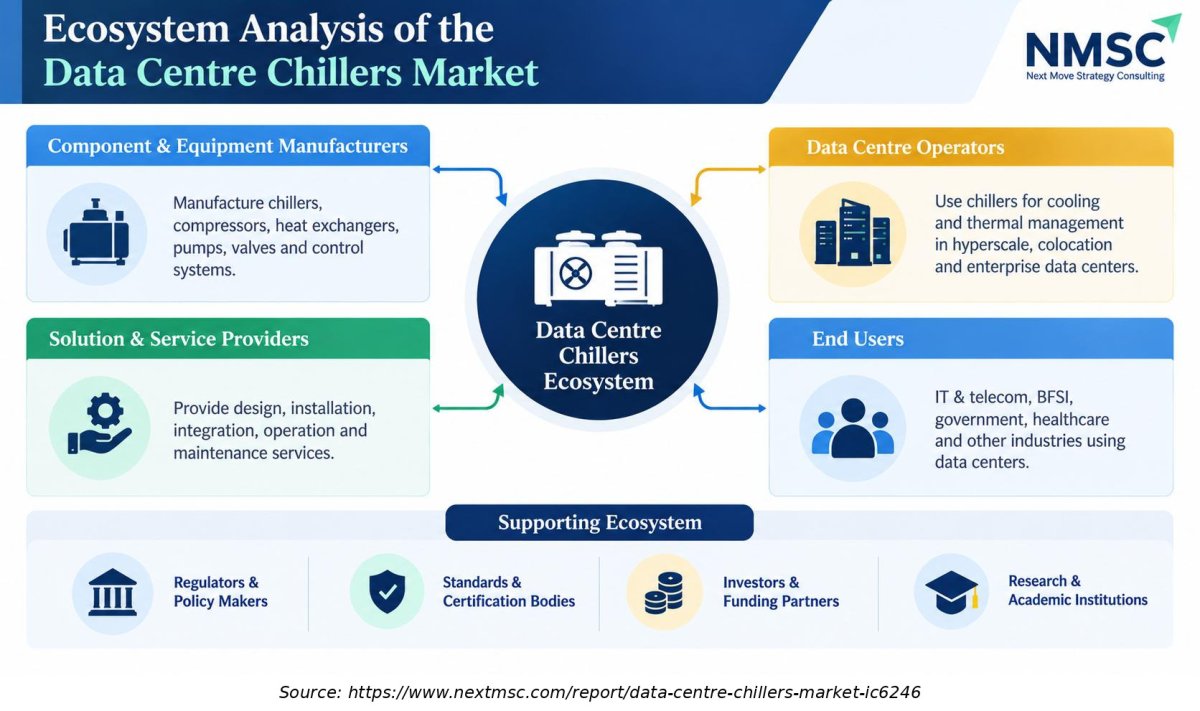
Ecosystem Analysis of the Data Centre Chillers Market
The data centre chillers market ecosystem includes chiller and component manufacturers, solution and service providers, data centre operators, and end users. Manufacturers supply chillers, compressors, heat exchangers, pumps, and control systems, while service providers support installation, integration, and maintenance. Regulators, standards bodies, investors, and research institutions contribute to energy efficiency, operational reliability, and cooling technology development.

What does the Data Centre Chillers Market Encompass?
The Data Centre Chillers Market covers factory built chilled water plants that remove heat from data halls, liquid cooling loops and supporting infrastructure through compressor based or absorption cycles. Scope spans air cooled and water cooled units, compressor technologies from centrifugal to scroll, free cooling and hybrid configurations, and capacities from below 250 kW to 5,000 kW and above. Air handlers, coolant distribution units, cooling towers and immersion systems sit outside the scope.
Market Drivers & Dynamics

Interactive Dataset
AI and high density compute capacity additions raising heat rejection demand driver +3.2% Global; U.S., China, Gulf states 2026–2032
Hyperscale and colocation campus construction driver +2.6% North America, Asia-Pacific, Middle East 2026–2033
PUE and energy efficiency regulation driver +1.8% Europe, Germany, China 2026–2030
Warm water liquid cooling raising chiller setpoints driver +1.4% Global hyperscale sites 2026–2031
Replacement of ageing plants and refrigerant transition driver +1.1% North America, Europe 2026–2034
Free cooling and hybrid adoption in water scarce regions driver +0.9% Middle East, India, U.S. Southwest 2026–2035
Direct liquid cooling reducing mechanical load per rack restraint −1.6% Hyperscale North America and Asia-Pacific 2027–2035
Grid interconnection delays and long lead times on large units restraint −1.3% North America, Europe 2026–2029
Capital cost and refrigerant rule uncertainty restraint −0.8% U.S., European Union 2026–2028
Source: Next Move Strategy Consulting

Growth Drivers

What Is the Primary Growth Driver in the Data Centre Chillers Market?

AI driven capacity additions are the primary driver. The International Energy Agency reports that data centres consumed 415 TWh of electricity in 2024, equal to 1.5% of global demand, and projects about 945 TWh by 2030. Nearly every added megawatt of IT load becomes a megawatt of heat that chillers must reject. The Lawrence Berkeley National Laboratory recorded 176 TWh of U.S. data centre electricity use in 2023, which anchors North American chiller demand.

How Is Energy Efficiency Regulation Driving the Data Centre Chillers Market Growth?

Efficiency rules turn cooling choices into compliance decisions. Germany's Energy Efficiency Act requires a PUE of 1.2 for data centres starting operations from July 2026, with energy reuse minimums rising from 10% to 20% by July 2028. China's National Development and Reform Commission targets a PUE no higher than 1.25 for new large facilities, and the EU Energy Efficiency Directive obliges larger operators to report energy performance. These requirements favour efficient compressors, free cooling and heat recovery ready designs.

Growth Inhibitors

What Is Restraining the Data Centre Chillers Market?

Direct liquid cooling and higher chip tolerance for warm water reduce the mechanical cooling load per rack, which shifts some demand toward dry coolers. Grid interconnection delays and long lead times on large capacity units also postpone chiller purchases. Based on our estimates, these two factors trim roughly 2.9 percentage points from the CAGR that unconstrained demand would deliver, an industry derived estimate, while refrigerant rule changes add uncertainty in the United States and Europe.

What Are the Growth Opportunities?

Can Very Large Capacity Plants Capture Gigawatt Scale AI Campuses?

Plants of 5,000 kW and above grow at 18.63% CAGR from 2026 to 2035, the fastest among capacity bands, reaching USD 1.21 Billion by 2035. Multistory and gigawatt campuses need fewer, larger chillers to cut rigging and labour, and MHI's 10MW class centrifugal unit shipped to the United States in July 2026 illustrates the direction. Hyperscale operators and engineering contractors benefit most.

Does Modular Delivery Offer a Faster Route to Capacity?

Modular Systems, covering skid mounted chillers and containerised chiller plants, grow at 17.77% CAGR from 2026 to 2035 to USD 2.79 Billion. Factory assembled plants shorten site schedules when skilled labour and grid timing are the binding constraints. Wholesale colocation developers and cooling system integrators gain most, since repeatable blocks let them phase capacity against tenant demand.

Will Replacement and Retrofit Cycles Create a Recurring Revenue Pool?

Replacement demand grows at 16.41% CAGR from 2026 to 2035, rising from USD 0.51 Billion in 2025 to USD 2.67 Billion by 2035. Ageing enterprise plants and refrigerant transition rules push owners toward higher efficiency units with low GWP refrigerants. Mechanical contractors, authorised distributors and service led OEMs capture this opportunity through lifecycle contracts.

Segmentation Analysis

2025 (USD Billion)
2035 (USD Billion)
Air-Cooled Chillers 2025: $1.64 Billion | 2035: $7.42 Billion
Air-Cooled C
Water-Cooled Chillers 2025: $1.13 Billion | 2035: $4.48 Billion
Water-Cooled
Other Verified Chillers 2025: $0.06 Billion | 2035: $0.23 Billion
Other Verifi
Air-Cooled Chillers $1.64 Billion $7.42 Billion 14.46%
Water-Cooled Chillers $1.13 Billion $4.48 Billion 13.01%
Other Verified Chillers $0.06 Billion $0.23 Billion 14.13%

Which Heat Rejection Technology Dominates the Market?

Air-Cooled Chillers are both the dominant and the fastest growing heat rejection technology, rising from USD 1.64 Billion in 2025 to USD 7.42 Billion by 2035 at 14.46% CAGR from 2026 to 2035. Water scarcity rules, zero on site water designs such as the YORK YDAM and widening free cooling hours lift adoption. Water-Cooled Chillers still serve campuses with cooling tower access and very large plants, growing at 13.01% CAGR.

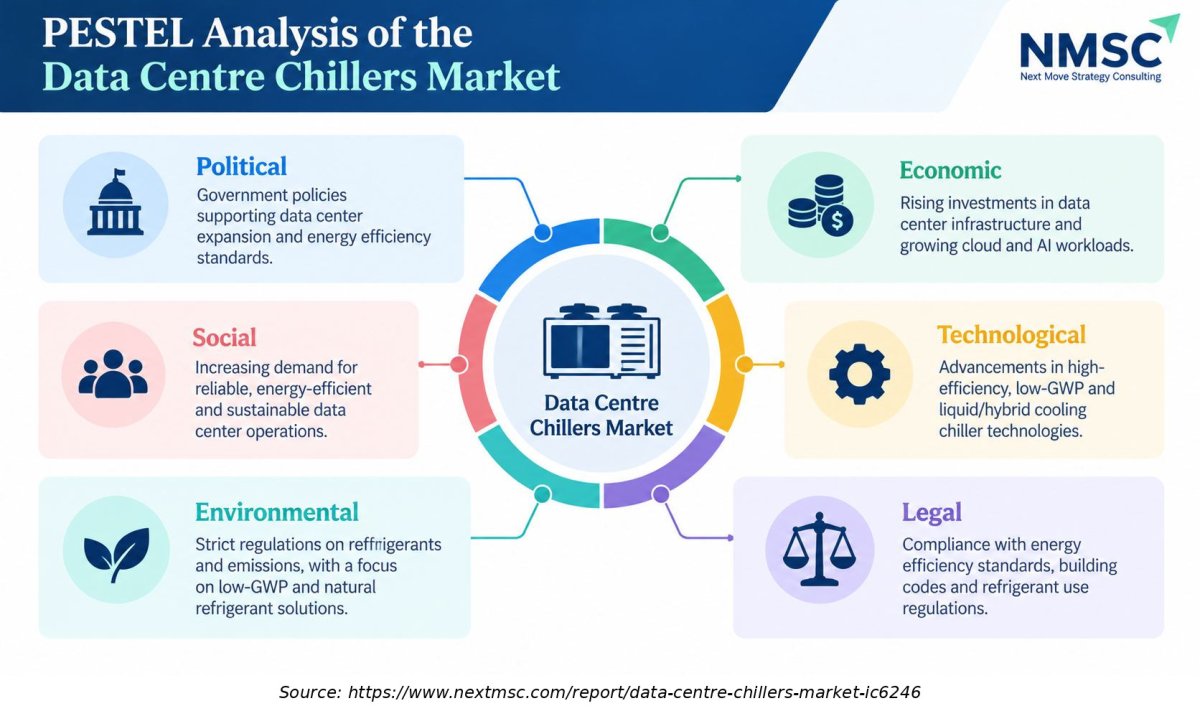
PESTEL Analysis of the Data Centre Chillers Market

PESTEL Analysis of the Data Centre Chillers Market

The data centre chillers market is influenced by political support for digital infrastructure, economic investment in data centres, and rising demand for reliable and sustainable cooling. Technological advancements in high-efficiency, low-global-warming-potential (GWP), and liquid cooling solutions shape market development. Environmental regulations on refrigerants, energy consumption, and emissions, alongside legal requirements for building safety and efficiency, influence product design and adoption.

Growth Opportunities

Our analysis shows that three whitespace opportunities can generate above average revenue gains through 2035.

Can Very Large Capacity Plants Capture Gigawatt Scale AI Campuses?

Plants of 5,000 kW and above grow at 18.63% CAGR from 2026 to 2035, the fastest among capacity bands, reaching USD 1.21 Billion by 2035. Multistory and gigawatt campuses need fewer, larger chillers to cut rigging and labour, and MHI's 10MW class centrifugal unit shipped to the United States in July 2026 illustrates the direction. Hyperscale operators and engineering contractors benefit most.

Does Modular Delivery Offer a Faster Route to Capacity?

Modular Systems, covering skid mounted chillers and containerised chiller plants, grow at 17.77% CAGR from 2026 to 2035 to USD 2.79 Billion. Factory assembled plants shorten site schedules when skilled labour and grid timing are the binding constraints. Wholesale colocation developers and cooling system integrators gain most, since repeatable blocks let them phase capacity against tenant demand.

Will Replacement and Retrofit Cycles Create a Recurring Revenue Pool?

Replacement demand grows at 16.41% CAGR from 2026 to 2035, rising from USD 0.51 Billion in 2025 to USD 2.67 Billion by 2035. Ageing enterprise plants and refrigerant transition rules push owners toward higher efficiency units with low GWP refrigerants. Mechanical contractors, authorised distributors and service led OEMs capture this opportunity through lifecycle contracts.

Regional Outlook

2025 (USD Billion)
2035 (USD Billion)
North Americ
Asia-Pacific
Europe
Middle East
Latin Americ
Region 2025 (USD Billion) 2035 (USD Billion) CAGR (%)
North America $10.0 USD Billion $40.0 USD Billion 9.0%
Asia-Pacific $17.1 USD Billion $51.1 USD Billion 27.0%
Europe $24.2 USD Billion $62.2 USD Billion 25.0%
Middle East & Africa $31.3 USD Billion $73.3 USD Billion 23.0%
Latin America $38.4 USD Billion $84.4 USD Billion 12.0%

Regional data is locked

Unlock complete regional numbers for this market.

Unlock Full Data

Competitive Landscape

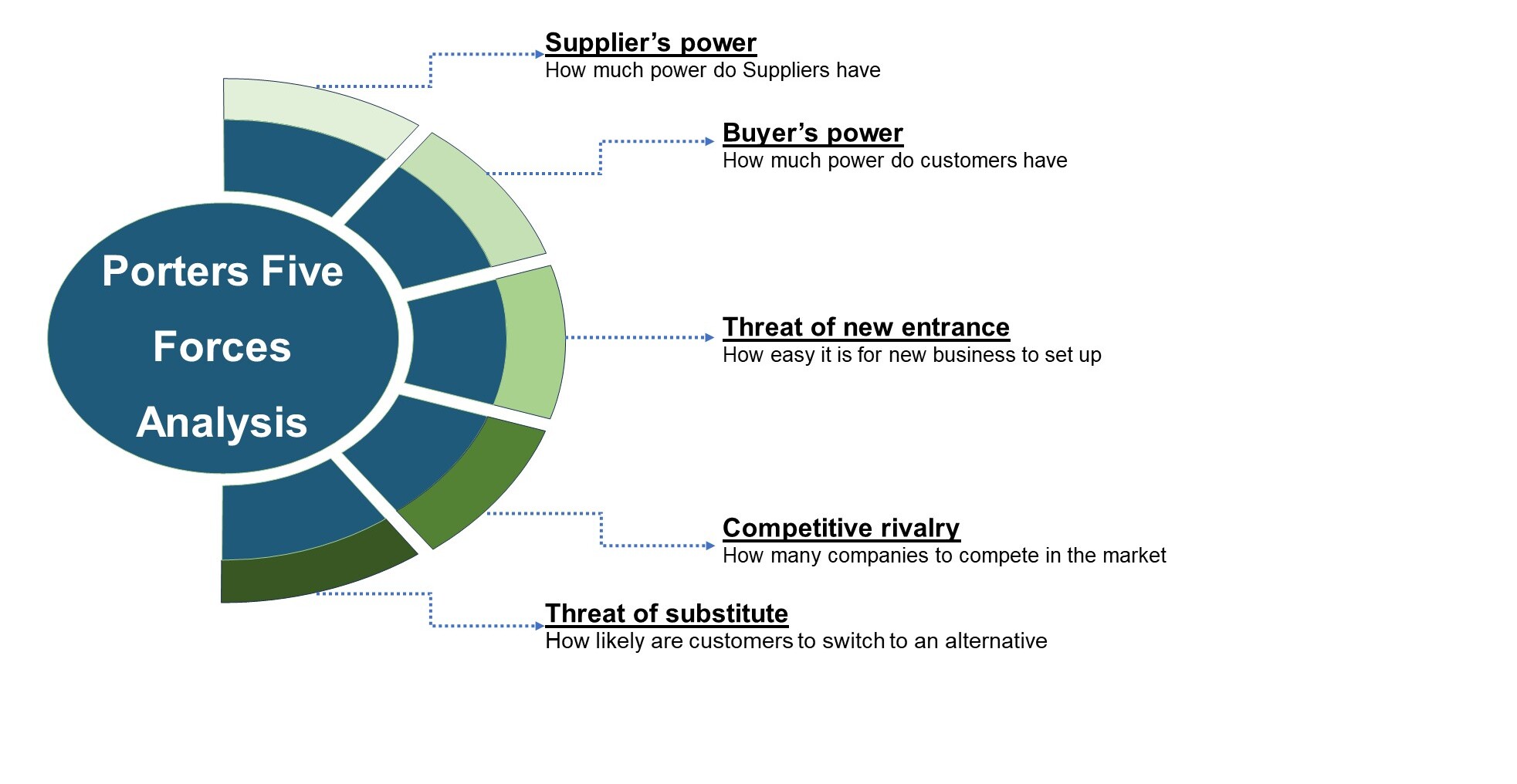
Our assessment indicates that the Data Centre Chillers Market encompasses three distinct competitive groups serving different capacity bands.

Dimension Description
Market Structure Moderately concentrated at large capacities, where global HVAC majors and critical infrastructure specialists supply most plants above 1,000 kW; regional OEMs compete below that band.
Innovation Focus Warm water capable chillers, oil free magnetic bearing compressors, low GWP refrigerants, hybrid free cooling and software defined controls.
M&A Activity Acquisitions target liquid cooling, modular systems and controls, as Trane's agreement to acquire LiquidStack in February 2026 shows.

How Do Companies Compete in the Data Centre Chillers Market?

Companies compete on delivered efficiency at high ambient temperatures, single frame capacity, restart time after power loss, refrigerant compliance and lead time. Our findings suggest that large operators buy against total cost of ownership and uptime evidence, so service coverage and factory testing credentials matter as much as unit price. Pricing pressure is strongest in units below 1,000 kW, where regional manufacturers and distributors narrow margins.

Which Competitive Archetypes Dominate the Data Centre Chillers Market?

Global HVAC majors such as Johnson Controls International plc, Trane Technologies plc, Carrier Global Corporation and Daikin Industries, Ltd. differentiate through broad chiller ranges and service networks. Critical infrastructure specialists including Vertiv Group Corp., Schneider Electric SE, STULZ GmbH and Modine Manufacturing Company differentiate through integrated cooling systems. Regional OEMs and component specialists, including Mitsubishi Heavy Industries, Ltd., Blue Star Limited, Danfoss A/S and Smardt Chiller Group, compete through compressor technology and local presence.

What Innovation and Differentiation Strategies Are Companies Pursuing?

We observed that leading suppliers are raising single unit capacity, with the YORK YDAM at 3.5 MW and the MHI test unit at 10MW class, while extending operating maps for warm water duty. Oil free magnetic bearing designs, as in Schneider's Uniflair XCA and Daikin's AWM, cut maintenance. Software features such as variable speed pump algorithms and real time energy metering turn chillers into controllable assets, and absorption designs target power constrained sites.

What M&A and Partnership Activity Is Shaping the Data Centre Chillers Market?

Consolidation targets the interface between chillers and liquid cooling. Trane announced an agreement to acquire LiquidStack in February 2026, building on its 2023 minority investment, and Daikin Applied has made acquisitions in liquid cooling and custom air handling. During our Data Centre Chillers market evaluation, we noticed that partnerships with AI infrastructure platforms, such as MHI's alignment with NVIDIA DSX reference architectures, increasingly shape product roadmaps and early orders.

Key Market Players

Based on research conducted by NMSC, the following 20 companies represent the validated leadership set across the Data Centre Chillers Market.

Johnson Controls International plc Trane Technologies plc Carrier Global Corporation Daikin Industries, Ltd. Vertiv Group Corp. Schneider Electric SE Mitsubishi Electric Corporation STULZ GmbH Modine Manufacturing Company LG Electronics Inc. Munters Group AB Danfoss A/S Smardt Chiller Group Mitsubishi Heavy Industries, Ltd. Thermax Limited Blue Star Limited GEA Group AG Dunham-Bush Lennox International Inc. Kirloskar Group

Latest Developments

During our Data Centre Chillers market evaluation, we noticed that 2025–2026 announcements concentrate on higher capacity, warm water capable and modular chillers.

Date Event
September 2026 LG launched an air-cooled centrifugal chiller designed for AI data centres, with unit capacities of 480–600 refrigeration tons. The system combines an oil-free magnetic-bearing compressor with refrigerant free cooling and rapid cooling recovery after power restoration, addressing high-density computing and continuous-operation requirements.
July 2026 Vertiv announced investments at its Tognana campus near Padua, Italy, targeting a doubling of regional chiller production capacity by the end of 2026. It also plans a large-scale testing laboratory for early 2027 to validate chillers integrated with liquid-cooling systems under demanding operating conditions

Expert Insights

Austin Domenici

Austin Domenici

Vice President and General Manager | Johnson Controls Global Data Center Solutions

"“AI and high-performance computing are pushing data centers beyond traditional limits.”"

Analyst Interpretation

The statement highlights the growing importance of cooling capacity density, warm-water cooling compatibility and space constraints in high-density data centre design. Our assessment indicates that compact, high-capacity chillers supporting 45°C warm-water cooling could become increasingly relevant to multistorey data centres and AI infrastructure projects. The YORK YDAM's capacity of 3,500 kW illustrates demand for larger individual chiller units, supporting the 3,000–4,999 kW capacity band, subject to the report's segmentation definitions. Its compact, transport-oriented design also highlights the potential value of space-efficient equipment in constrained installations.

Market Interpretation

The statement highlights the growing importance of cooling capacity density, warm-water cooling compatibility and space constraints in high-density data centre design. Our assessment indicates that compact, high-capacity chillers supporting 45°C warm-water cooling could become increasingly relevant to multistorey data centres and AI infrastructure projects. The YORK YDAM's capacity of 3,500 kW illustrates demand for larger individual chiller units, supporting the 3,000–4,999 kW capacity band, subject to the report's segmentation definitions. Its compact, transport-oriented design also highlights the potential value of space-efficient equipment in constrained installations.

Investment Opportunities

Where Are Capital Inflows Concentrating in the Data Centre Chillers Market?

Capital concentrates in large capacity plants, modular manufacturing and portfolio acquisitions that join chillers with liquid cooling, as Trane's LiquidStack agreement illustrates. Hyperscale Data Centres account for USD 6.06 Billion of 2035 revenue, and Edge Data Centres grow at 17.92% CAGR. Based on our estimates, investors earn the strongest returns where suppliers combine single frame capacity, service networks and factory capacity close to campus clusters.

How Is Infrastructure Investment Shaping Data Centre Chillers Market Capacity?

Infrastructure spending now includes on site generation, grid upgrades and heat recovery, which alter chiller duty. Johnson Controls estimates that 57% of on site generation energy is lost as waste heat, and absorption plants can turn it into cooling. MHI's Modular Chiller Plant uses a closed loop design that limits water use. We found that supplier capacity and commissioning crews, not demand, are the tighter constraint on delivery.

What ESG Considerations Are Influencing Data Centre Chillers Market Investment?

Environmental, Social, and Governance criteria centre on refrigerant GWP, onsite water use and energy intensity. Schneider Electric aligns its Uniflair XCA with the EU F-Gas Regulation 2024/573, and Johnson Controls states that its YDAM design consumes no water on site. The Johnson Controls absorption reference design targets up to 43% lower cooling system CO2 emissions. Investors increasingly screen suppliers against these disclosures.

Key Benefits for Stakeholders

How Does This Report Benefit Data Centre Operators and Industry Leaders?

Operators, engineering contractors and facility planners gain segment level revenue pathways for all eight segmentation axes, from USD 2.83 Billion in 2025 to USD 12.13 Billion by 2035. The analysis of heat rejection, compressor type, free cooling and capacity bands supports plant selection against PUE and water targets. Regional and country outlooks help teams time procurement against regulation and lead times in the Data Centre Chillers markets where they build.

How Does This Report Benefit Investors and Financial Analysts?

Investors and financial analysts gain a reconciled sizing model in which segments, regions and countries sum to the global figures, growing at 13.91% from 2026 to 2035. The USD 8.37 Billion absolute opportunity, the growth matrix and the competitive and M&A review help screen listed suppliers and private targets. Restraint estimates show where liquid cooling and grid delays could slow orders.

How Does This Report Benefit Technology Vendors and Product Teams?

Chiller manufacturers and component suppliers gain visibility into the fastest growing niches, including Absorption at 18.90% and Magnetic-Bearing centrifugal units at 17.36%. The assessment of warm water duty, refrigerant rules and modular delivery guides roadmap decisions. Country level insights identify where local assembly, service coverage or channel partners would lift Data Centre Chillers market share.

Key Market Segments Evaluated

By Heat-Rejection Technology

  • Air-Cooled Chillers
  • Water-Cooled Chillers
  • Other Verified Chillers

By Compressor Technology

  • Centrifugal Compressors 
    • Magnetic-Bearing
    • Conventional
  • Screw Compressors 
    • Oil-Injected
    • Oil-Free
  • Scroll Compressors 
    • Fixed-Speed
    • Variable-Speed
  • Other Compressor Technologies 
    • Reciprocating
    • Other Verified Types
  • Non-Compressor Chillers 
    • Absorption
    • Other Verified Types

By Cooling Configuration

  • Mechanical Cooling Without Free Cooling
  • Integrated Free Cooling 
    • Air-Side Economiser
    • Water-Side Economiser
  • Hybrid Cooling 
    • Mechanical Cooling With Free Cooling
    • Mechanical Cooling With Evaporative Assistance
  • Other Verified Configurations

By Cooling Capacity

  • Below 250 kW
  • 250 kW to Below 500 kW
  • 500 kW to Below 1,000 kW
  • 1,000 kW to Below 1,500 kW
  • 1,500 kW to Below 2,000 kW
  • 2,000 kW to Below 3,000 kW
  • 3,000 kW to Below 5,000 kW
  • 5,000 kW and Above

By Installation Configuration

  • Indoor Installation 
    • Plant-Room Chillers
    • Indoor Packaged Chillers
  • Outdoor Installation 
    • Outdoor Packaged Chillers
    • Rooftop Chillers
  • Modular Systems 
    • Skid-Mounted Chillers
    • Containerised Chiller Plants
  • Other Verified Configurations

By Buyer Channel

  • Direct Sale to Data Centre Operator
  • Cooling System Integrators 
    • Specialist Integrators
    • Engineering Contractors
  • Mechanical Contractors and Distributors 
    • HVAC Contractors
    • Authorised Distributors
  • OEM and Packaged-System Partners 
    • OEM Purchasers
    • Packaged-System Partners
  • Other Verified Channels

By Deployment

  • New Installation 
    • Greenfield Facilities
    • Additional Capacity
  • Replacement 
    • Chiller Replacement
    • Replacement-Based Retrofits

By End-User Facility

  • Hyperscale Data Centres 
    • Cloud Service Providers
    • Other Hyperscale Operators
  • Colocation Data Centres 
    • Retail Colocation
    • Wholesale Colocation
  • Enterprise Data Centres 
    • Corporate-Owned Facilities
    • Other Private Facilities
  • Edge Data Centres 
    • Edge Computing Sites
    • Micro Data Centres
  • Other Data Centre Facilities 
    • Government Facilities
    • Research and Institutional Facilities

By Region

  • North America 
    • U.S.
    • Canada
    • Mexico
  • Europe 
    • UK
    • Germany
    • France
    • Italy
    • Spain
    • Sweden
    • Denmark
    • Finland
    • Netherlands
    • Rest of Europe
  • Asia-Pacific 
    • China
    • India
    • Japan
    • South Korea
    • Taiwan
    • Indonesia
    • Vietnam
    • Australia
    • Philippines
    • Malaysia
    • Rest of APAC
  • Middle East & Africa 
    • Saudi Arabia
    • UAE
    • Egypt
    • Israel
    • Turkey
    • Nigeria
    • South Africa
    • Rest of MEA
  • Latin America 
    • Brazil
    • Argentina
    • Chile
    • Colombia
    • Rest of LATAM

Conclusion & Recommendations

The long-term outlook is strongly positive, with revenue expanding from USD 2.83 Billion in 2025 to USD 12.13 Billion by 2035. Growth stays above 13% a year as AI campuses, hybrid cooling and efficiency regulation add capacity, and the Asia-Pacific and Middle East regions gain share from North America. Our analysis shows that the mix shifts toward oil free, hybrid and modular plants rather than simple volume growth.

What Strategic Positioning Recommendations Does NMSC Offer?

Suppliers should prioritise warm water capable magnetic bearing and hybrid ranges, extend single frame capacity beyond 3 MW, and certify low GWP refrigerant options. Building modular factories and integrator partnerships shortens delivery for hyperscale and wholesale colocation customers. Service contracts and retrofit programmes protect margins as installed bases age, and absorption and heat recovery offers address power constrained sites.

What Is the Investment Attractiveness of the Data Centre Chillers Market?

Investment attractiveness is high, supported by the USD 8.37 Billion absolute growth opportunity between 2026 and 2035 and a revenue base that nearly quadruples. Capital earns the best returns in suppliers with large capacity portfolios, modular production and strong service revenue. Valuation risk centres on order timing, which depends on grid access and campus approvals.

What Are the Data Centre Chillers Market Shifts and Key Risks?

Key shifts include the move from fixed speed to inverter and magnetic bearing compressors, from mechanical only to hybrid plants, and from small units to multi megawatt frames. Principal risks are direct liquid cooling that lowers mechanical load, grid and permitting delays, refrigerant rule changes in the United States and Europe, and supply chain lead times. Suppliers with flexible product maps and local assembly manage these risks best.

What Are the Primary Growth Pathways Through 2035?

Primary pathways include Hybrid Cooling reaching USD 5.46 Billion, Hyperscale Data Centres reaching USD 6.06 Billion, and capacity bands of 5,000 kW and above at 18.63% CAGR. Regional pathways run through India at 19.52% CAGR and Middle East & Africa at 17.26%. Replacement and absorption cooling add resilient revenue streams beside greenfield demand.

FAQs

Sources & References

1.

International Energy Agency, Energy and AI

iea.org
2.

Lawrence Berkeley National Laboratory, 2024 United States Data Center Energy Usage Report

eta.lbl.gov
3.

European Union, Regulation (EU) 2024/573 on fluorinated greenhouse gases

eur-lex.europa.eu/eli/reg/2024/573/oj
4.

European Union, Directive (EU) 2023/1791 on energy efficiency

eur-lex.europa.eu
5.

U.S. Environmental Protection Agency, AIM Act Technology Transitions

epa.gov
6.

German Federal Government, Energy Efficiency Act (EnEfG)

gesetze-im-internet.de/enefg
7.

National Development and Reform Commission of China

ndrc.gov.cn
8.

Johnson Controls, YORK YDAM launch release (3 February 2026)

prnewswire.com
9.

Johnson Controls, Absorption Chiller Reference Design Guide release (28 July 2026)

prnewswire.com
10.

Trane Technologies, LiquidStack acquisition release (9 February 2026)

businesswire.com
11.

Schneider Electric, Newsroom (Uniflair XCA launch, June 2026)

se.com
12.

Mitsubishi Heavy Industries, 10MW class chiller press release (16 July 2026)

mhi.com/news/260716.html
13.

Daikin Applied, 2026 AHR Expo announcement (28 January 2026)

daikinapplied.com
14.

Modine, Airedale TurboChill 3+MW release (22 January 2026)

prnewswire.com
15.

Carrier, AquaForce 30XF with FreeBoost announcement (November 2025)

carrier.com
16.

Blue Star Limited, Investors’ Presentation for quarter ended 30 June 2026 (7 August 2026)

nsearchives.nseindia.com

About the Author

Liza Phukan

Liza Phukan

Liza Phukan is Research Associate at Next Move Strategy Consulting, where she has covered emerging industries and market research across sectors for 3.5 years. Her work includes analyzing industry developments, validating market data, and developing structured business content from research findings. She uses secondary research and data-validation practices to turn complex market information into clear decision-useful market analysis for business audiences and support report development and B2B.

About the Reviewer

Supradip Baul

Supradip Baul

Supradip Baul is an accomplished business consultant and strategist with over a decade of rich experience in market intelligence, strategy, technology, and business transformation. His work has included rigorous qualitative and quantitative analysis across multiple industries, helping clients shape investment decisions and long-term roadmaps. Earlier in his career, he was associated with Gartner, where he contributed to industry-leading reports and market share analyses. He has worked with leading global companies and holds an MBA with a dual specialization in Marketing and Finance.

Download Free Sample

Pratyush Kumar Das

PRATYUSH KUMAR DAS

Assistant Manager

Polycab India Limited

We would like to express our appreciation for the data and insights provided by nextmsc. We are very pleased with the quality and depth of the information, which has proven to be highly valuable and beneficial for our business decision-making.

Amos Chang

AMOS CHANG

Strategy Consultant

Kardex Group

I have bought the intralogistics market reports from NMSC two times so far. Joseph and his team are always very helpful and flexible in responding to any customization requirements on the report. Their expertise in market reports really helps us steer the day-to-day business. I will definitely recommend and come back myself whenever there is a need.

Semih Kavaklioglu

SEMIH KAVAKLIOGLU

Co-Founder & Sales Manager

Decortie

I work a lot in the marketing industry and I know that research is an essential part of any campaign. I have used Market research reports for my own products and I found them to be very informative and well-researched. The team here produces insightful reports for a good price

Mohit Agarwal

MOHIT AGARWAL

Chief Manager

DryChem India Pvt. Ltd.

Next Move Strategy Consulting is an amazing team of consultants. We required a market study report for our investors on top priority and the team went above and beyond our expectations to deliver the same with ample supporting data within a short time span enabling us to secure the investments and keep our project timeline maintained. Their professionalism, attention to detail, and timely delivery of actionable recommendations have left a lasting impression on our organization.

Robert Sean Trevino

ROBERT SEAN TREVINO

Sr. Director, Head of Strategic Insights & Analytics

Foundation Medicine

I realized that it was a reliable source of information. These days, there are many people who are looking for authentic data, and this is one of the only sources that can offer them with what they need;

Custom Market Research Services

We will customize the research for you if the listed report does not fully match your requirements.

Get 30% Free Customization

Select License

This website uses cookies to ensure you get the best experience on our website. Learn more

✖