Data Centre HVAC Market Global Industry Analysis and Forecast (2026–2035)

Data Centre HVAC Market size was USD 26.00 billion in 2026, projected to reach USD 68.00 billion by 2035, growing at a CAGR of 11.3% from 2026 to 2035. Key drivers include rising AI rack densities, hyperscale and colocation capacity expansion, and increasing demand for energy-efficient cooling, with North America leading the market.
Download Free Sample PDF
Base Year (2025)
$20.00 Billion
Forecast (2035)
$68.00 Billion
CAGR (2026-2035)
11.3%
Top Region
North America

What Is the Data Centre HVAC Market Size?
The global Data Centre HVAC Market was valued at USD 20.00 Billion in 2025, is estimated at USD 26.00 Billion in 2026 and is forecast to reach USD 68.00 Billion by 2035, growing at a CAGR of 11.3% from 2026 to 2035. North America leads with approximately 46% share, while air cooling holds approximately 88% of revenue.
We observed that AI training clusters now push rack power far beyond what room level air handling was designed to remove, so operators are layering direct to chip liquid loops, coolant distribution units and larger chiller plants onto existing air cooled halls. This hybrid build pattern raises cooling spend per megawatt of IT load and keeps air cooling relevant while liquid cooling captures most incremental growth.

The following Key Takeaways table summarises dominant and fastest growing segments, regions and countries across the forecast period.

Data Centre HVAC Market Global Industry Analysis and Forecast (2026–2035) Revenue Forecast
Values in USD Billion

2025 $20.00 Billion
2025
2026 $26.00 Billion
2026
2027 $28.94 Billion
2027
2028 $32.21 Billion
2028
2029 $35.85 Billion
2029
2030 $39.90 Billion
2030
2031 $44.41 Billion
2031
2032 $49.42 Billion
2032
2033 $55.01 Billion
2033
2034 $61.23 Billion
2034
2035 $68.00 Billion
2035

Key Takeaways

By Cooling Technology: Air cooling held the largest share, expanding from USD 17.50 Billion in 2025 to USD 37.00 Billion by 2035; Immersion and rear door cooling is the fastest growing at 27.3% CAGR from 2026–2035.

By Equipment and Services: Chillers and heat rejection held the largest share, expanding from USD 7.00 Billion in 2025 to USD 22.00 Billion by 2035; Coolant distribution and liquid cooling units is the fastest growing at 19.9% CAGR from 2026–2035.

By Data Centre Type: Hyperscale and cloud held the largest share, expanding from USD 11.00 Billion in 2025 to USD 41.00 Billion by 2035; it is also the fastest growing at 11.8% CAGR from 2026–2035.

Dominant Region: North America dominated with approximately 46% revenue share in 2025, anchored by hyperscale campuses and AI cluster construction in the United States.

Fastest-Growing Region: Asia-Pacific is expected to register the highest CAGR of 12.7% during 2026–2035, driven by capacity additions in China, India and South Korea.

Dominant Country: The U.S. led the market with an estimated USD 8.30 Billion in 2025, supported by the largest installed base of AI ready data centre capacity.

Fastest-Growing Country: India is among the fastest growing major countries, projected to expand from USD 0.55 Billion in 2025 at a CAGR of 16.0%, driven by new hyperscale and colocation campuses.

The Data Centre HVAC Market presents an absolute investment opportunity of approximately USD 42.00 Billion between 2026 and 2035, calculated as the difference between the 2035 forecast of USD 68.00 Billion and the 2026 estimate of USD 26.00 Billion. This makes coolant distribution units, modular chiller plants and lifecycle services the most capital efficient categories for equipment makers and infrastructure investors.

According to NMSC analysis, the decisive shift is the move from component sales to engineered thermal systems, because hyperscale buyers increasingly award chillers, coolant distribution units, controls and commissioning as one package. Vendors that can guarantee delivery capacity and commissioning speed are winning multi year framework agreements that separate them from component suppliers.

What Does the Data Centre HVAC Market Encompass?

The Data Centre HVAC Market covers the design, manufacture, installation and servicing of heating, ventilation and air conditioning systems that remove heat from data centre halls, racks and chips. Scope includes chillers and heat rejection, computer room air handlers, in row and rack units, coolant distribution units, direct to chip and immersion systems, and lifecycle services. Comfort cooling for office space and power equipment are excluded.

Our analysis shows that the structure of demand changed after 2024, when AI accelerators lifted rack densities and operators began specifying liquid ready facilities from day one. Regulatory attention to energy and water use is rising alongside, and the International Energy Agency expects data centre electricity use to reach about 945 TWh by 2030, which keeps efficiency central to every cooling specification.

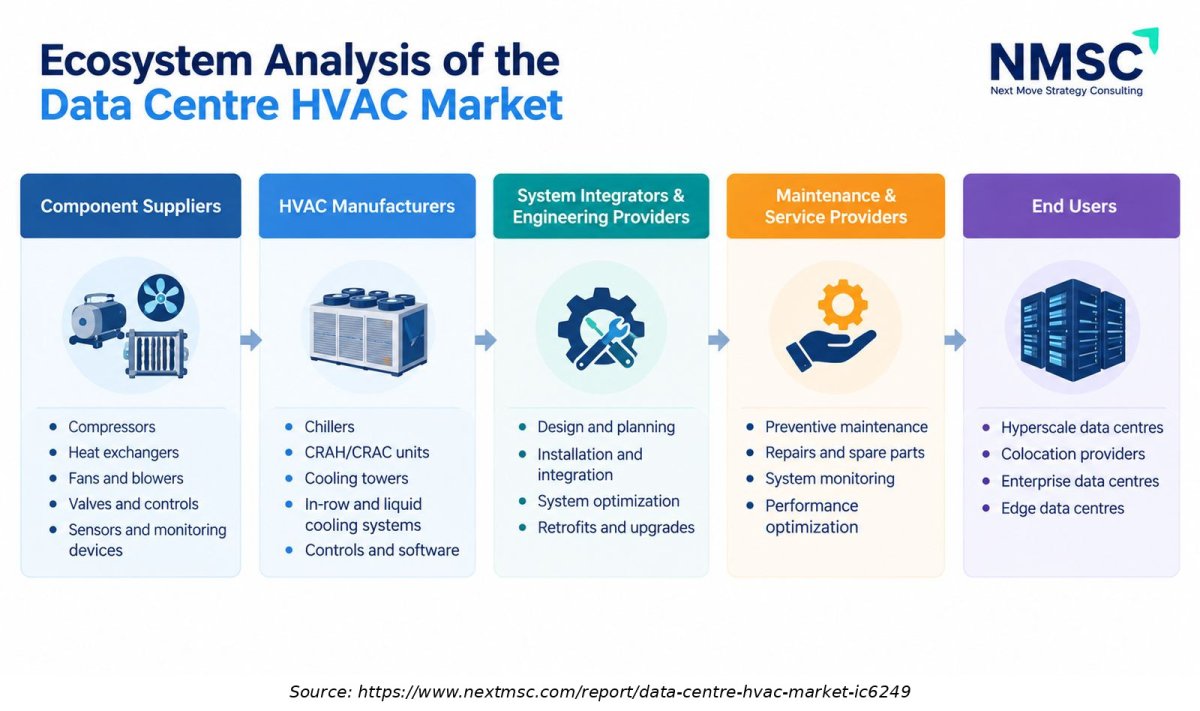
Ecosystem Analysis of the Data Centre HVAC Market

The data centre HVAC market ecosystem comprises component suppliers, HVAC manufacturers, engineering and system integrators, maintenance providers, and data centre operators. Suppliers provide compressors, heat exchangers, fans, and controls, while manufacturers develop chillers, CRAH/CRAC units, and liquid cooling systems. Integrators manage installation and optimisation, while service providers support maintenance, repairs, upgrades, and long-term cooling performance.

Market Drivers & Dynamics

Interactive Dataset
AI rack densities exceeding air cooling limits driver +2.6% Global, led by North America 2026–2032
Hyperscale and colocation capacity additions driver +2.2% North America, Asia-Pacific 2026–2030
Retrofit of legacy halls to hybrid liquid cooling driver +1.1% North America, Europe 2027–2033
Energy, water and efficiency regulation driver +0.9% Europe, Asia-Pacific 2026–2035
Grid interconnection and power availability delays restraint −1.4% North America, Europe 2026–2029
Equipment lead times, tariffs and component constraints restraint −0.9% Global 2026–2028
Water scarcity limits on evaporative cooling restraint −0.6% Middle East & Africa, Asia-Pacific 2026–2035
Source: Next Move Strategy Consulting

Growth Drivers

Growth Inhibitors

Segmentation Analysis

2025 (USD Billion)
2035 (USD Billion)
Air cooling 2025: $17.50 Billion | 2035: $37.00 Billion
Air cooling
Direct to chip liquid cooling 2025: $2.10 Billion | 2035: $24.00 Billion
Direct to ch
Immersion and rear door cooling 2025: $0.40 Billion | 2035: $7.00 Billion
Immersion an
Air cooling $17.50 Billion $37.00 Billion 6.1%
Direct to chip liquid cooling $2.10 Billion $24.00 Billion 24.3%
Immersion and rear door cooling $0.40 Billion $7.00 Billion 27.3%
2025 (USD Billion)
2035 (USD Billion)
Air cooling
Direct to ch
Immersion an
Chillers and
Room and row
Segment Item 2025 (USD Billion) 2035 (USD Billion) CAGR
Air cooling $10.0 USD Billion $40.0 USD Billion 25.0%
Direct to chip liquid cooling $17.1 USD Billion $51.1 USD Billion 11.0%
Immersion and rear door cooling $24.2 USD Billion $62.2 USD Billion 25.0%
Chillers and heat rejection $31.3 USD Billion $73.3 USD Billion 11.0%
Room and row cooling units $38.4 USD Billion $84.4 USD Billion 16.0%

Segment-wise data is locked

Unlock complete segment-wise numbers for By Equipment and Services.

Unlock Full Data
2025 (USD Billion)
2035 (USD Billion)
Air cooling
Direct to ch
Immersion an
Chillers and
Room and row
Segment Item 2025 (USD Billion) 2035 (USD Billion) CAGR
Air cooling $10.0 USD Billion $40.0 USD Billion 27.0%
Direct to chip liquid cooling $17.1 USD Billion $51.1 USD Billion 9.0%
Immersion and rear door cooling $24.2 USD Billion $62.2 USD Billion 19.0%
Chillers and heat rejection $31.3 USD Billion $73.3 USD Billion 17.0%
Room and row cooling units $38.4 USD Billion $84.4 USD Billion 18.0%

Segment-wise data is locked

Unlock complete segment-wise numbers for By Data Centre Type.

Unlock Full Data
2025 (USD Billion)
2035 (USD Billion)
Air cooling
Direct to ch
Immersion an
Chillers and
Room and row
Segment Item 2025 (USD Billion) 2035 (USD Billion) CAGR
Air cooling $10.0 USD Billion $40.0 USD Billion 14.0%
Direct to chip liquid cooling $17.1 USD Billion $51.1 USD Billion 24.0%
Immersion and rear door cooling $24.2 USD Billion $62.2 USD Billion 22.0%
Chillers and heat rejection $31.3 USD Billion $73.3 USD Billion 12.0%
Room and row cooling units $38.4 USD Billion $84.4 USD Billion 27.0%

Segment-wise data is locked

Unlock complete segment-wise numbers for By Region.

Unlock Full Data

Growth Opportunities

Our assessment indicates that three opportunity pools offer the clearest revenue visibility through 2035.

Where Does Liquid Cooling Retrofit Create the Largest Revenue Pool?

Installed air cooled halls need coolant distribution units, rear door exchangers and fluid management to host AI racks. This retrofit demand benefits the coolant distribution and liquid cooling units segment, which grows from USD 3.90 Billion in 2026 to USD 20.00 Billion by 2035. Colocation and enterprise operators gain most because they avoid full rebuilds.

How Can Services and Fluid Management Build Recurring Revenue?

A growing installed base of liquid loops creates demand for commissioning, flushing, filtration and maintenance contracts. The services segment expands from USD 5.70 Billion in 2026 to USD 12.50 Billion by 2035. Vendors with field service networks, including Trane and Vertiv, benefit most, because recurring contracts smooth the cyclical timing of large equipment projects.

Which Emerging Regions Offer the Fastest Capacity Additions?

Asia-Pacific grows at 12.7% and India reaches 16.0%, as new hyperscale and colocation campuses are commissioned. Middle East and African projects add demand for chillers designed for hot climates and low water use. These regions favour chillers and heat rejection suppliers with local manufacturing or service partners, and they diversify revenue away from North America.

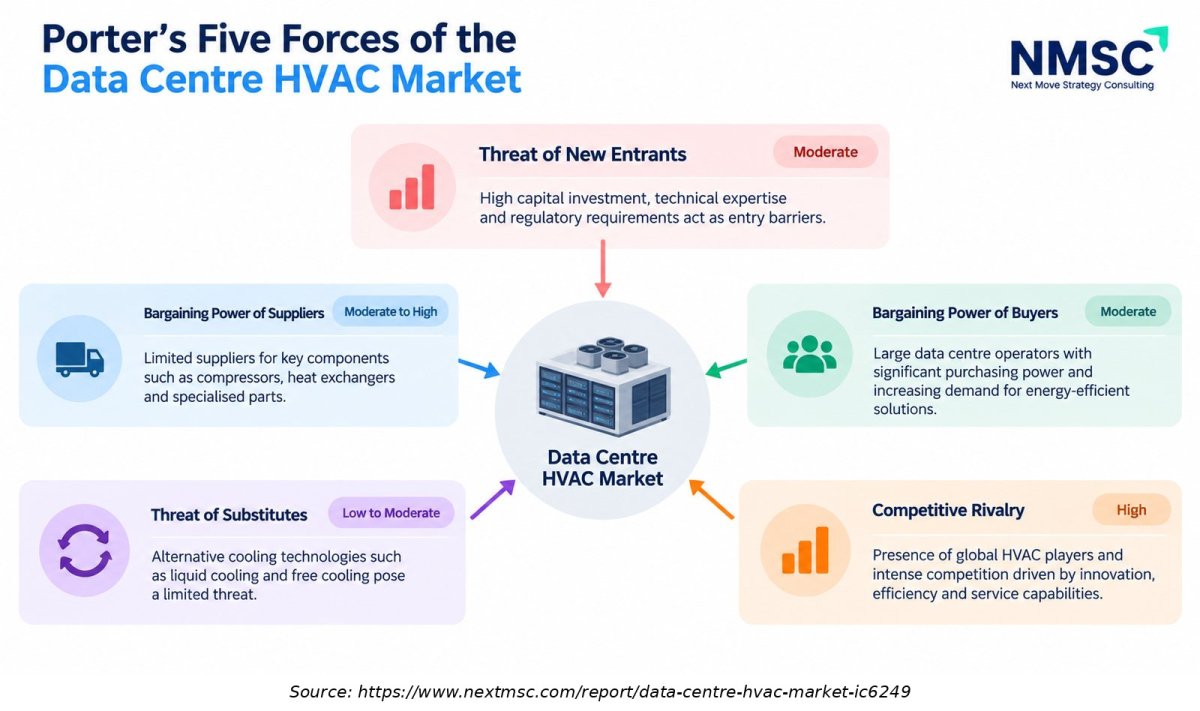
Porter’s Five Forces Analysis of the Data Centre HVAC Market

The data centre HVAC market experiences high competitive rivalry due to established HVAC manufacturers and specialised cooling providers. Supplier power ranges from moderate to high because of specialised components, while large data centre operators influence pricing and service contracts. High capital and technical requirements create moderate entry barriers. Alternative cooling technologies pose a low-to-moderate substitution threat, as reliable thermal management remains essential for data centre operations.

Regional Outlook

2025 (USD Billion)
2035 (USD Billion)
North Americ
Europe
Asia-Pacific
Middle East
Latin Americ
Region 2025 (USD Billion) 2035 (USD Billion) CAGR (%)
North America $10.0 USD Billion $40.0 USD Billion 9.0%
Europe $17.1 USD Billion $51.1 USD Billion 27.0%
Asia-Pacific $24.2 USD Billion $62.2 USD Billion 25.0%
Middle East & Africa $31.3 USD Billion $73.3 USD Billion 23.0%
Latin America $38.4 USD Billion $84.4 USD Billion 12.0%

Regional data is locked

Unlock complete regional numbers for this market.

Unlock Full Data

Competitive Landscape

Our analysis shows that competition is moderately concentrated, with global HVAC, power infrastructure and thermal specialists converging on integrated offers.

Dimension Description
Market Structure Moderately concentrated; global HVAC majors, power infrastructure suppliers and thermal specialists compete for the same hyperscale framework agreements.
Innovation Focus Direct to chip liquid cooling, coolant distribution units, modular chiller plants and integrated controls for AI racks.
M&A Activity Active; Eaton–Boyd Thermal, Schneider Electric–Motivair and Daikin Applied–Chilldyne add liquid cooling capability.

Key Market Players

Our assessment indicates that the following verified companies, ranked qualitatively on data centre cooling scale and breadth, shape the competitive landscape.

Vertiv Holdings Co Schneider Electric SE Johnson Controls International plc Trane Technologies plc Carrier Global Corporation Daikin Industries, Ltd. Eaton Corporation plc Modine Manufacturing Company nVent Electric plc Munters Group AB (publ) STULZ GmbH

Latest Developments

Based on research conducted by NMSC, the following verified developments from 2025 and 2026 show where capacity and capability are being added.

Date Event
September 2026 Schneider Electric introduced the Motivair WCDU, a coolant distribution unit designed to integrate with fan-wall air cooling and support hybrid liquid/air architectures in high-density AI data centers. Each unit provides up to 3.5 MW capacity, can be grouped in sets of 20, and is optimized for technical-corridor installation.
September 2026 Vertiv announced that its 2.3 MW CoolChip coolant distribution unit became the first CDU to qualify specifically as NVIDIA DSX Ready. The liquid-to-liquid system supports direct-to-chip and rear-door heat exchanger applications, allowing AI factory developers to evaluate a high-capacity cooling component against defined platform requirements.
July 2026 nVent announced an additional 160,000-square-foot manufacturing site in Blaine, Minnesota, dedicated to data-centre liquid-cooling production. The facility is expected to begin production in the first half of 2027 and marks the company’s third cooling-capacity expansion in three years, adding more than 400,000 square feet overall.

Expert Insights

Jensen Huang

Jensen Huang

Founder and Chief Executive Officer | NVIDIA

"New data centers are built for accelerated computing and generative AI with architectures that are significantly more complex than those for general-purpose computing."

Analyst Interpretation

The statement highlights how accelerated computing and generative AI are increasing the complexity of data centre infrastructure. As AI workloads drive higher rack power densities and greater thermal loads, data centre operators require more advanced and integrated cooling solutions. This creates opportunities for HVAC suppliers offering liquid cooling systems, high-efficiency chillers, precision air cooling, and integrated thermal management technologies. The trend also reinforces the importance of coordinating cooling infrastructure with server architecture and power distribution to support operational efficiency, reliability, and future scalability.

Market Interpretation

The statement highlights how accelerated computing and generative AI are increasing the complexity of data centre infrastructure. As AI workloads drive higher rack power densities and greater thermal loads, data centre operators require more advanced and integrated cooling solutions. This creates opportunities for HVAC suppliers offering liquid cooling systems, high-efficiency chillers, precision air cooling, and integrated thermal management technologies. The trend also reinforces the importance of coordinating cooling infrastructure with server architecture and power distribution to support operational efficiency, reliability, and future scalability.

Investment Opportunities

How Are Capital Inflows Shaping Investment in Data Centre Cooling?

Capital is flowing into capacity, acquisitions and technology. Eaton's Boyd Thermal purchase, Daikin Applied's two 2025 acquisitions and Schneider Electric's Motivair deal show strategic buyers paying for liquid cooling capability. Manufacturers are also investing in plants, including Modine's capacity expansion, nVent's third Minnesota facility and Carrier's planned new U.S. factory, which gives investors visibility on supply growth through 2027.

Where Is Infrastructure Investment Concentrated?

Infrastructure spending concentrates on hyperscale campuses in North America, which account for USD 9.20 Billion of 2025 revenue, and on fast growing Asia-Pacific hubs. Investors should watch factory built chiller plants, coolant distribution capacity and field service networks, because these assets convert backlog into revenue. Power availability remains the gating factor for site timing, so grid ready locations command premium attention.

How Do ESG Considerations Influence Cooling Investment?

Energy and water use are central to permitting and customer procurement. The International Institute of Refrigeration notes that cooling can take a large share of data centre energy, so efficient chillers, free cooling, closed loop liquid systems and heat reuse reduce both cost and environmental exposure. Investors increasingly favour suppliers that document efficiency gains and low water designs, which strengthens the case for liquid ready portfolios.

Key Benefits for Stakeholders

How Does This Report Benefit Data Centre Operators and Enterprise Leaders?

Operators gain segment level forecasts for cooling technology, equipment categories and data centre types, which supports capacity planning and vendor selection. The analysis shows when hybrid air and liquid architectures become cost effective, how services contracts affect lifecycle cost, and which regions face the tightest equipment lead times, helping leaders sequence retrofit and new build programmes.

How Does This Report Benefit Investors and Financial Analysts?

Investors receive reconciled 2025, 2026 and 2035 values, segment growth rates and an absolute opportunity of USD 42.00 Billion between 2026 and 2035. The report separates fast growing liquid categories from mature air cooling revenue, links growth to named company capacity additions and acquisitions, and flags restraints such as power availability, which supports risk adjusted valuation and portfolio positioning.

How Does This Report Benefit Technology Vendors and Product Teams?

Vendors can benchmark product roadmaps against segment growth, regional demand and competitor moves. The analysis highlights where coolant distribution units, modular plants and controls are gaining traction, which buyer groups award multi year frameworks, and how services build recurring revenue, helping product teams prioritise capacity, partnerships and acquisitions with the strongest return.

Data Centre HVAC Market Key Segments

By Cooling Technology

Air cooling
Direct to chip liquid cooling
Immersion and rear door cooling

By Equipment and Services

Chillers and heat rejection
Room and row cooling units
Coolant distribution and liquid cooling units
Services

By Data Centre Type

Hyperscale and cloud
Colocation
Enterprise and edge

By Region

North America: U.S., Canada, Mexico
Europe: UK, Germany, France, Italy, Spain, Sweden, Denmark, Finland, Netherlands, Rest of Europe
Asia-Pacific: China, India, Japan, South Korea, Taiwan, Indonesia, Vietnam, Australia, Philippines, Malaysia, Rest of APAC
Middle East & Africa: Saudi Arabia, UAE, Egypt, Israel, Turkey, Nigeria, South Africa, Rest of MEA
Latin America: Brazil, Argentina, Chile, Colombia, Rest of LATAM

Conclusion & Recommendations

The outlook is strongly positive. Revenue is forecast to rise from USD 26.00 Billion in 2026 to USD 68.00 Billion by 2035, with liquid technologies taking an increasing share as AI rack densities climb. Near term growth of about 30% in 2026 reflects backlog conversion, then moderates toward the long run rate as capacity additions normalise and cooling efficiency improves. Operators should plan for hybrid architectures as the default design.

What Strategic Positioning Recommendations Does NMSC Offer?

We recommend that vendors secure factory capacity, expand liquid cooling portfolios and bundle controls and services into one accountable offer. Suppliers lacking coolant distribution or heat rejection depth should partner or acquire. Operators should lock multi year supply agreements early, specify liquid ready designs, and diversify sourcing across regions to reduce tariff and lead time exposure.

What Is the Investment Attractiveness of the Data Centre HVAC Market?

Attractiveness is high but selective. Coolant distribution and liquid cooling units grow at 19.9%, and immersion and rear door cooling at 27.3%, while air cooling grows at 6.1% from a larger base. Backlog visibility at listed suppliers supports earnings, yet valuation depends on execution, capacity delivery and the pace of AI capital spending.

What Are the Data Centre HVAC Market Shifts and Key Risks Through 2035?

Key shifts include the rise of liquid cooling, modular delivery and integrated power and thermal offers. Key risks include grid connection delays, tariff driven cost inflation, component shortages, water scarcity and the possibility that AI investment slows. Trane and Munters have both noted supply chain or project timing pressures, so forecasts assume gradual rather than uninterrupted capacity conversion.

What Are the Primary Growth Pathways Through 2035?

Growth pathways include liquid cooling retrofits of installed halls, hyperscale and colocation capacity in North America and Asia-Pacific, and recurring services that reach USD 12.50 Billion by 2035. Asia-Pacific grows at 12.7%, and India at 16.0%. Vendors that combine regional manufacturing with global service coverage are best placed to capture these pathways.

FAQs

Sources & References

1.

International Energy Agency, Energy and AI (Executive Summary)

iea.org
2.

International Institute of Refrigeration, AI set to drive doubling of electricity demand from data centres

iifiir.org
3.

Vertiv Holdings Co, Form 10-K for fiscal year 2025 (SEC)

sec.gov
4.

Vertiv Holdings Co, 2025 Annual Report

s205.q4cdn.com
5.

Carrier Global Corporation, Second Quarter 2026 results (Form 8-K, Exhibit 99)

sec.gov
6.

Trane Technologies plc, Second Quarter 2026 earnings release

s2.q4cdn.com
7.

Johnson Controls International plc, Third Quarter 2026 press release

s21.q4cdn.com
8.

Modine Manufacturing Company, Fourth Quarter Fiscal 2026 earnings presentation

s205.q4cdn.com
9.

Modine Manufacturing Company, First Quarter Fiscal 2026 results (SEC Exhibit 99.1)

sec.gov
10.

Munters Group AB, Second Quarter 2026 regulatory press release

mfn.se
11.

Munters Group AB, First Quarter 2026 regulatory press release

mfn.se
12.

nVent Electric plc, Second Quarter 2026 earnings presentation

s22.q4cdn.com
13.

Eaton Corporation plc, press release on completion of the Boyd Thermal acquisition

businesswire.com
14.

Daikin Applied, news release on the acquisition of Chilldyne

daikinapplied.com
15.

Schneider Electric, liquid cooling portfolio with Motivair press release

se.com
16.

STULZ GmbH, company website

stulz.com/en-it/regions

Key Market Segments Evaluated

By Cooling Technology

  • Air cooling
  • Direct to chip liquid cooling
  • Immersion and rear door cooling

By Equipment and Services

  • Air cooling
  • Direct to chip liquid cooling
  • Immersion and rear door cooling
  • Chillers and heat rejection
  • Room and row cooling units
  • Coolant distribution and liquid cooling units
  • Services
  • Hyperscale and cloud
  • Colocation
  • Enterprise and edge
  • North America: U.S.
  • Canada
  • Mexico
  • Europe: UK
  • Germany
  • France
  • Italy
  • Spain
  • Sweden
  • Denmark
  • Finland
  • Netherlands
  • Rest of Europe
  • Asia-Pacific: China
  • India
  • Japan
  • South Korea
  • Taiwan
  • Indonesia
  • Vietnam
  • Australia
  • Philippines
  • Malaysia
  • Rest of APAC
  • Middle East & Africa: Saudi Arabia
  • UAE
  • Egypt
  • Israel
  • Turkey
  • Nigeria
  • South Africa
  • Rest of MEA
  • Latin America: Brazil
  • Argentina
  • Chile
  • Colombia
  • Rest of LATAM

By Data Centre Type

  • Air cooling
  • Direct to chip liquid cooling
  • Immersion and rear door cooling
  • Chillers and heat rejection
  • Room and row cooling units
  • Coolant distribution and liquid cooling units
  • Services
  • Hyperscale and cloud
  • Colocation
  • Enterprise and edge
  • North America: U.S.
  • Canada
  • Mexico
  • Europe: UK
  • Germany
  • France
  • Italy
  • Spain
  • Sweden
  • Denmark
  • Finland
  • Netherlands
  • Rest of Europe
  • Asia-Pacific: China
  • India
  • Japan
  • South Korea
  • Taiwan
  • Indonesia
  • Vietnam
  • Australia
  • Philippines
  • Malaysia
  • Rest of APAC
  • Middle East & Africa: Saudi Arabia
  • UAE
  • Egypt
  • Israel
  • Turkey
  • Nigeria
  • South Africa
  • Rest of MEA
  • Latin America: Brazil
  • Argentina
  • Chile
  • Colombia
  • Rest of LATAM

By Region

  • Air cooling
  • Direct to chip liquid cooling
  • Immersion and rear door cooling
  • Chillers and heat rejection
  • Room and row cooling units
  • Coolant distribution and liquid cooling units
  • Services
  • Hyperscale and cloud
  • Colocation
  • Enterprise and edge
  • North America: U.S.
  • Canada
  • Mexico
  • Europe: UK
  • Germany
  • France
  • Italy
  • Spain
  • Sweden
  • Denmark
  • Finland
  • Netherlands
  • Rest of Europe
  • Asia-Pacific: China
  • India
  • Japan
  • South Korea
  • Taiwan
  • Indonesia
  • Vietnam
  • Australia
  • Philippines
  • Malaysia
  • Rest of APAC
  • Middle East & Africa: Saudi Arabia
  • UAE
  • Egypt
  • Israel
  • Turkey
  • Nigeria
  • South Africa
  • Rest of MEA
  • Latin America: Brazil
  • Argentina
  • Chile
  • Colombia
  • Rest of LATAM

About the Author

Liza Phukan

Liza Phukan

Liza Phukan is Research Associate at Next Move Strategy Consulting, where she has covered emerging industries and market research across sectors for 3.5 years. Her work includes analyzing industry developments, validating market data, and developing structured business content from research findings. She uses secondary research and data-validation practices to turn complex market information into clear decision-useful market analysis for business audiences and support report development and B2B.

About the Reviewer

Supradip Baul

Supradip Baul

Supradip Baul is an accomplished business consultant and strategist with over a decade of rich experience in market intelligence, strategy, technology, and business transformation. His work has included rigorous qualitative and quantitative analysis across multiple industries, helping clients shape investment decisions and long-term roadmaps. Earlier in his career, he was associated with Gartner, where he contributed to industry-leading reports and market share analyses. He has worked with leading global companies and holds an MBA with a dual specialization in Marketing and Finance.

Download Free Sample

Gaurav Jaiswal

GAURAV JAISWAL

Founder & CEO

Yano Charge Private Limited

The EV Charging market research report provided by the NextMSC was exceptionally detailed and insightful. It offered a comprehensive analysis that proved to be a game-changer for our strategic planning. Truly a testament to the NextMSC’s expertise and thoroughness in EV market landscape & analysis.

Diana Trejo

DIANA TREJO

Assistant Manager

Sumitomo Corporation de Mexico, S.A. de C.V.

Recently, we purchased a report on the Mexico Data Center Market from Next Move Strategy Consulting. The service has been excellent, with support that is always timely and thoroughly professional. The information provided is interesting, highly useful, and delivered with clarity. I would highly recommend NextMSC for anyone seeking insightful and dependable analysis.

Pratyush Kumar Das

PRATYUSH KUMAR DAS

Assistant Manager

Polycab India Limited

We would like to express our appreciation for the data and insights provided by nextmsc. We are very pleased with the quality and depth of the information, which has proven to be highly valuable and beneficial for our business decision-making.

Nishant Awate

NISHANT AWATE

Business Development Global Sales

Zehnder Group Deutschland GmbH

Our experience working with Next Move Strategy Consulting was positive. The team was responsive, professional, and open to incorporating our specific requirements throughout the project. The India AHU market study was comprehensive and well structured, covering market value and volume forecasts, product and application segments, and key industry trends. The inclusion of both AHU and residential MVHR market insights made the study particularly relevant for our strategic market assessment. Overall, the report provides a solid foundation for evaluating market potential, identifying priority segments, and supporting business-development decisions in India.

Kevin Coker

KEVIN COKER

Founder, CEO and Board Diector

Proxima Clinical Research

I have been using Next MSC reports for product positioning in a new geography for a long time. They have by far the best reports I have found and the price is reasonable too!

Custom Market Research Services

We will customize the research for you if the listed report does not fully match your requirements.

Get 30% Free Customization

Select License

This website uses cookies to ensure you get the best experience on our website. Learn more

✖