
Digital Nomad Market Size, Share, Trends and Growth Analysis, By Offering (Co-working Spaces, Co-living and Accommodation Services, Travel, Visa and Relocation Services, Digital Platforms and Community Networks, and Financial, Insurance and Payment Services), By Traveler Type (Freelance Professionals, Salaried Remote Employees, Entrepreneurs and Business Owners, and Others), By Duration of Stay, By Booking Channel, and Region — Global Industry Report and Forecast, 2026–2035
Industry: Retail and Consumer | Publishing Date: August 3, 2026 | Last Updated: August 3, 2026 | No of Pages: N/A | No. of Tables: N/A | No. of Figures: N/A | Format: PDF | Report Code: RC5526
What Is the Digital Nomad Market Size?
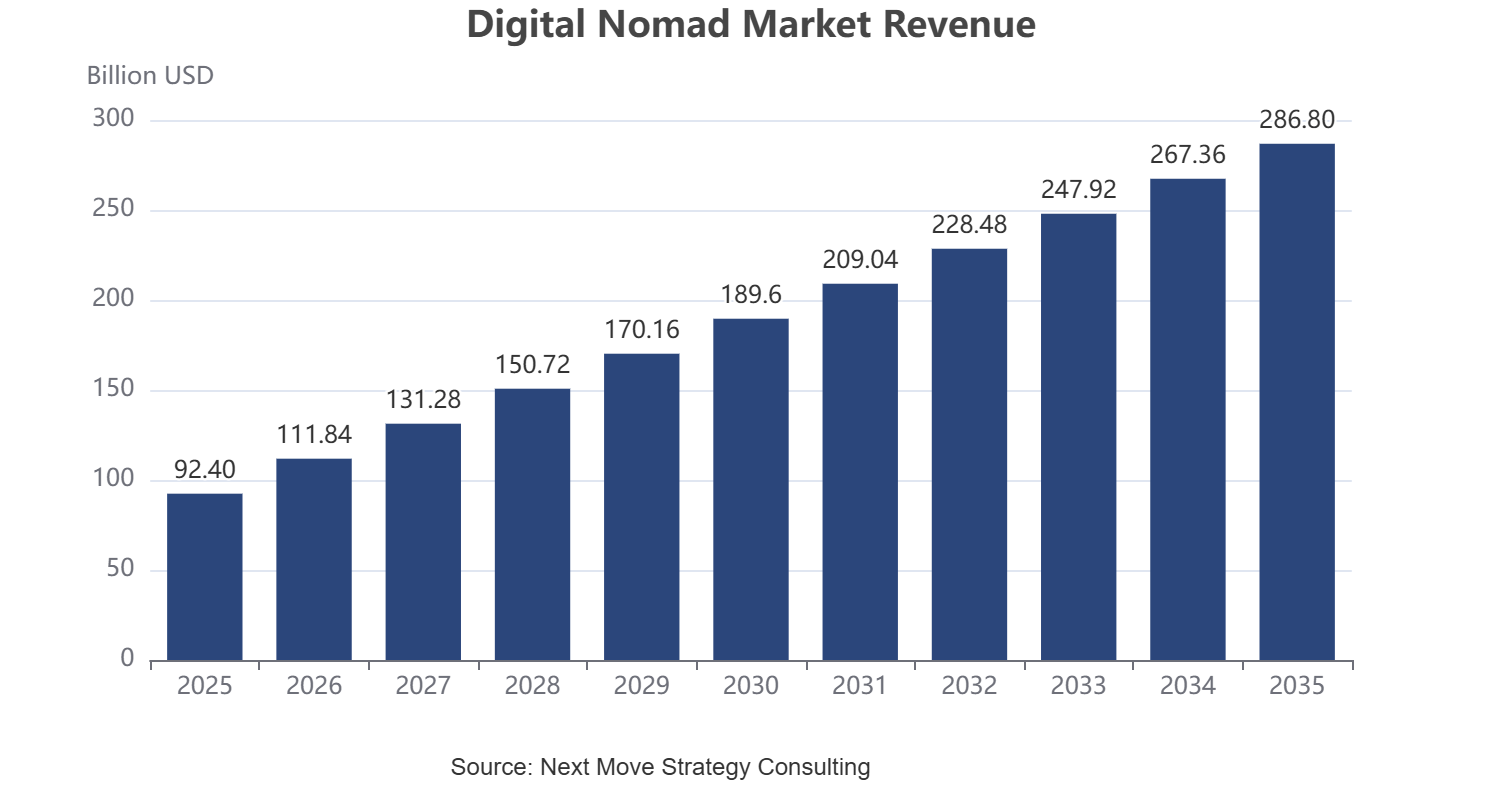
The global digital nomad market size was valued at USD 92.40 billion in 2025 and is estimated at USD 103.10 billion in 2026, forecast to reach USD 286.80 billion by 2035, expanding at a 12.00% CAGR between 2026 and 2035. North America leads with approximately 29% share, while coworking spaces dominate all other offerings with approximately 34% share.
We observed that the growth is broad-based across every segmentation axis, with coliving accommodation and travel, visa and relocation services driving the dominant structural shifts through 2035.
|
Key Takeaways |
|
By Offering: Coworking Spaces held the largest share of approximately 34% (USD 31.42 Billion) in 2025; Travel, Visa and Relocation Services is the fastest-growing sub-segment at 14.3% CAGR from 2026–2035. |
|
By Traveler Type: Freelance Professionals held the largest share of approximately 42% (USD 38.81 Billion) in 2025; Entrepreneurs and Business Owners is the fastest-growing sub-segment at 13.6% CAGR from 2026–2035. |
|
By Duration of Stay: Short Term Stay Up To 30 Days held the largest share of approximately 46% (USD 42.50 Billion) in 2025; Long Term Stay Above 6 Months is the fastest-growing sub-segment at 13.2% CAGR from 2026–2035. |
|
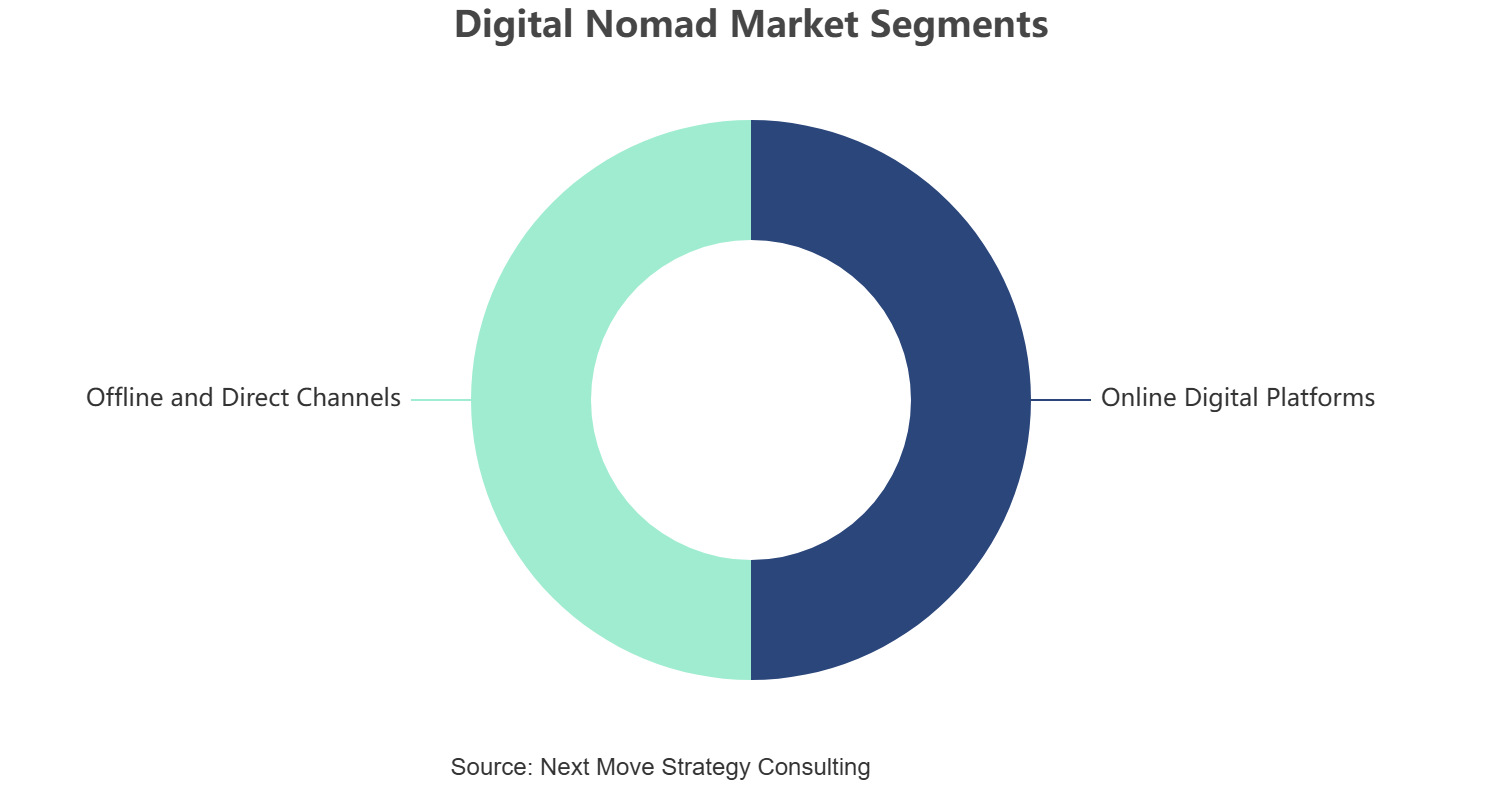
By Booking Channel: Online Digital Platforms held the largest share of approximately 63% (USD 58.21 Billion) in 2025; Online Digital Platforms is also the fastest-growing channel at 13.0% CAGR from 2026–2035. |
|
Dominant Region: North America dominated with approximately 29% revenue share (USD 26.80 Billion) in 2025. |
|
Fastest-Growing Region: Asia-Pacific is expected to register the highest CAGR of 13.9% during 2026–2035. |
|
Dominant Country: The U.S. led with approximately USD 19.60 billion in 2025. |
|
Fastest-Growing Country: India is the fastest-growing country at approximately 15.8% CAGR from 2026–2035. |
Market Opportunity: The digital nomad market is expected to create an absolute dollar opportunity of USD 183.70 billion between 2026 and 2035, presenting significant investment potential across the coworking, coliving, travel-technology, and remote-work financial services value chain.
According to Next Move Strategy Consulting analysis, service providers are increasingly bundling accommodation, workspace access, and mobility compliance into single subscription platforms, a shift that favors diversified, multi-country operators over single-city or single-service specialists as competitive intensity increases through 2035.
Digital Nomad Market Overview
The digital nomad market encompasses coworking spaces, coliving accommodation, travel and visa facilitation services, digital community platforms, and financial and insurance products purpose-built for location-independent professionals. Our assessment indicates that the scope spans freelance professionals, salaried remote employees, entrepreneurs, and content creators who combine income-generating work with sustained international mobility, supported by an ecosystem of coworking operators, accommodation platforms, and remote-employment infrastructure providers.
We observed that the market has evolved from informal backpacker-era coworking cafes into a structured industry anchored by dedicated digital nomad visa programs, with regulatory frameworks such as national remote-work residency schemes and the European Union's Schengen entry-exit rules shaping stay duration and compliance requirements. Technology adoption is shifting toward integrated booking, payment, and community platforms, and Next Move Strategy Consulting's analysis indicates that this convergence of mobility policy and digital infrastructure is redefining how the digital nomad market is served worldwide.
|
Parameters |
Details |
|
Market Size in 2025 |
USD 92.40 Billion |
|
Market Size in 2026 |
USD 103.10 Billion |
|
Revenue Forecast in 2035 |
USD 286.80 Billion |
|
Growth Rate |
CAGR of 12.00% from 2026 to 2035 |
|
Analysis Period |
2025–2035 |
|
Base Year Considered |
2025 |
|
Forecast Period |
2026–2035 |
|
Market Size Estimation |
Revenue (USD Billion) |
|
Companies Profiled |
20 |
|
Countries Covered |
38 |
|
Market Share |
Available for Top 10 Companies |
Key Emerging Trends
Based on research conducted by Next Move Strategy Consulting, we found that four structural trends are reshaping service delivery, platform design, and stakeholder engagement across the digital nomad market.
How Is Visa Liberalization Transforming Digital Nomad Mobility?
National governments are expanding dedicated remote-work residency schemes to attract location-independent spenders. We observed that the United Arab Emirates launched its twelve-month renewable Remote Working Visa in January 2026, removing the local sponsor requirement for foreign-employer remote workers. Coworking operators and relocation platforms are adapting onboarding workflows to these new eligibility rules, while destination governments increasingly compete on visa duration, tax treatment, and processing speed to capture longer-staying nomad populations.
Why Are Integrated Coliving-Coworking Platforms Gaining Adoption?
Single-membership platforms bundling accommodation, desk access, and community events are displacing standalone coworking cafes. Our findings suggest that operators such as Selina and Outsite are expanding multi-country property networks so members can transfer bookings across cities on one subscription. This convergence reduces coordination friction for medium-term stays and is positioning integrated coliving-coworking brands as a premium, higher-retention category within the broader digital nomad services landscape.
How Is AI Adoption Reshaping Digital Nomad Work Patterns?
Artificial intelligence tools are becoming embedded in the daily workflow of location-independent professionals, changing the skills and connectivity they demand from service providers. We observed that a large majority of surveyed digital nomads reported using AI tools in their work in 2025, per MBO Partners research, intensifying demand for high-bandwidth, low-latency connectivity at coworking and coliving sites. Providers are responding by upgrading network infrastructure and adding AI-enabled productivity amenities to differentiate their offerings.
What Role Does Entry-Exit Tracking Play in Reshaping Stay Patterns?
Automated border-control systems are compressing the informal tourist-visa workarounds nomads previously relied on for extended stays. We observed that the European Union's Entry/Exit System became operational in April 2026, recording exact entry and exit dates and tightening enforcement against undocumented remote work on tourist visas across the Schengen area. This shift is accelerating demand for formal digital nomad visas and compliance-advisory services as travelers seek legally documented alternatives to short-stay tourism rules.
Consumer Behavior Analysis of the Digital Nomad Industry
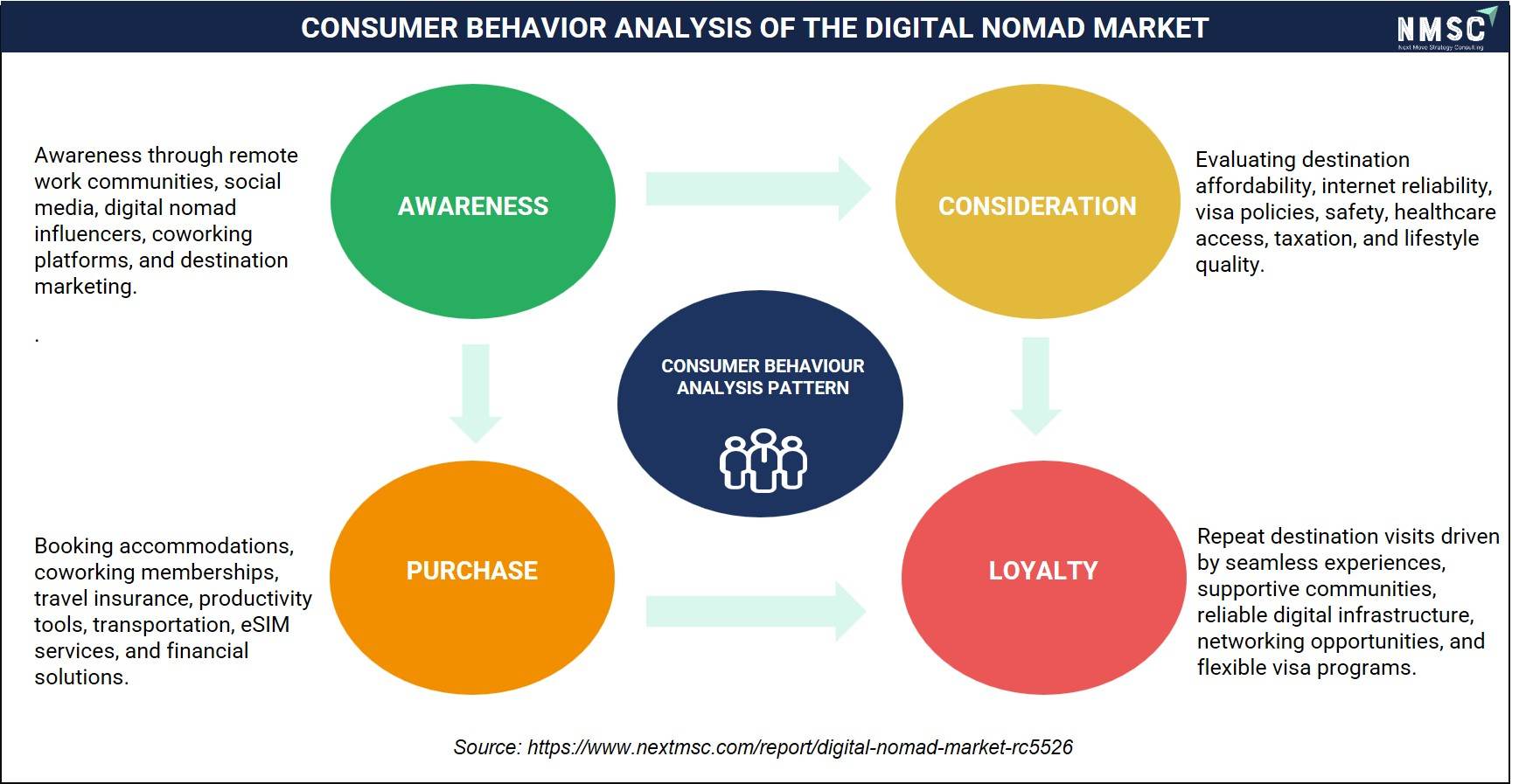
Based on our consumer behavior assessment, we identified that digital nomads evaluate destinations based on affordability, internet reliability, visa policies, safety, healthcare access, taxation, and overall lifestyle quality. Furthermore, our analysis indicates that purchasing decisions increasingly include accommodations, coworking memberships, travel insurance, productivity tools, transportation, eSIM services, and digital financial solutions, while customer loyalty is strengthened through seamless living experiences, reliable digital infrastructure, supportive communities, networking opportunities, and flexible digital nomad visa programs.
Growth Drivers and Restraints
Growth Catalyst and Risk Assessment Matrix
|
Factors |
Type |
(+/−) % Impact on CAGR |
Geographic Relevance |
Impact Timeline |
|
Expansion of dedicated digital nomad visa programs |
Driver |
+2.4% |
Global |
2026-2035 |
|
Rising remote and hybrid employment adoption |
Driver |
+2.0% |
Global |
2026-2035 |
|
Growth of integrated coliving-coworking platforms |
Driver |
+1.6% |
Europe, Latin America, Asia-Pacific |
2026-2035 |
|
Expansion of nomad-specific insurance and banking products |
Driver |
+1.1% |
Global |
2026-2032 |
|
Government tax incentives in emerging nomad hubs |
Driver |
+0.9% |
Middle East, Latin America |
2026-2035 |
|
AI-enabled productivity and connectivity upgrades |
Driver |
+0.8% |
Global |
2026-2033 |
|
Tightening entry-exit enforcement on tourist-visa work |
Restraint |
-1.3% |
Europe |
2026-2035 |
|
Currency volatility affecting cross-border spending |
Restraint |
-0.9% |
Latin America, Africa |
2026-2032 |
|
Rising cost of living in top-tier nomad destinations |
Restraint |
-0.7% |
Europe, North America |
2028-2035 |
What Is the Primary Growth Driver of the Digital Nomad Market?
The expansion of dedicated digital nomad visa programs is the primary driver of the market. Government sources indicate that around 60 countries now offer digital nomad visas or remote-worker residency programs as of 2026, up from a handful in 2020. We observed that this proliferation of legal residency pathways is converting previously informal, tourist-visa-based travel into documented, longer-duration stays, directly expanding the addressable customer base for coworking, coliving, and relocation-support providers.
How Is Remote Work Adoption Driving Digital Nomad Market Growth?
Sustained employer acceptance of remote and hybrid work arrangements continues to expand the pool of location-independent professionals. U.S. Bureau of Labor Statistics data confirms that a substantial share of the American workforce continues to work remotely at least part of the week, sustaining the labor-market base from which digital nomads are drawn. Our assessment indicates that this structural shift in employment policy, combined with employer-agnostic freelance platforms, is compressing the transition timeline from remote employee to full-time nomad.
What Is Restraining Digital Nomad Market Expansion?
Tightening entry-exit enforcement against undocumented tourist-visa remote work restrains informal market participation and elevates compliance costs. The European Union's Entry/Exit System, operational since April 2026, automatically logs border crossings and flags overstays across the Schengen area. We found that this enforcement infrastructure is compelling nomads and employers to shift toward formal visa channels, raising administrative costs and slowing spontaneous, short-notice mobility that previously characterized much of the nomad lifestyle.
Segmentation Analysis
Segment Sizing: By Offering
|
Segment |
2025 (USD) |
2035 (USD) |
CAGR% (2026–2035) |
|
Coworking Spaces |
USD 31.42 Billion |
USD 83.17 Billion |
10.2% |
|
Coliving and Accommodation Services |
USD 24.95 Billion |
USD 86.04 Billion |
13.2% |
|
Travel, Visa and Relocation Services |
USD 16.63 Billion |
USD 63.10 Billion |
14.3% |
|
Digital Platforms and Community Networks |
USD 12.01 Billion |
USD 31.55 Billion |
10.1% |
|
Financial, Insurance and Payment Services |
USD 7.39 Billion |
USD 22.94 Billion |
12.0% |
|
Total |
USD 92.40 Billion |
USD 286.80 Billion |
12.00% |
What Is Driving Segment Sizing By Offering in the Digital Nomad Market?
This axis captures the distinct service categories nomads purchase, from physical workspace access to mobility compliance support. Coworking spaces dominate with an established base of urban and destination-city desk operators. Travel, visa and relocation services register the fastest growth as government visa proliferation and compliance complexity drive demand for structured onboarding support, while coliving and accommodation services benefit from rising preference for bundled work-live formats among medium-term stayers.
Segment Sizing: By Traveler Type
|
Segment |
2025 (USD) |
2035 (USD) |
CAGR% (2026–2035) |
|
Freelance Professionals |
USD 38.81 Billion |
USD 114.72 Billion |
11.4% |
|
Salaried Remote Employees |
USD 28.64 Billion |
USD 83.17 Billion |
11.2% |
|
Entrepreneurs and Business Owners |
USD 17.56 Billion |
USD 63.10 Billion |
13.6% |
|
Content Creators and Influencers |
USD 7.39 Billion |
USD 25.81 Billion |
13.3% |
|
Total |
USD 92.40 Billion |
USD 286.80 Billion |
12.00% |
Which Traveler Type Leads the Digital Nomad Market?
Freelance professionals remain the largest traveler cohort, reflecting the long-standing base of independent contractors who pioneered the nomad lifestyle. Entrepreneurs and business owners are growing fastest as company formation tools and remote-banking access lower the barrier to running a business while traveling. Salaried remote employees form a stable secondary base as employer remote-work policies mature, while content creators and influencers expand steadily on the back of platform monetization growth.
Segment Sizing: By Duration of Stay
|
Segment |
2025 (USD) |
2035 (USD) |
CAGR% (2026–2035) |
|
Short Term Stay Up To 30 Days |
USD 42.50 Billion |
USD 117.59 Billion |
10.7% |
|
Medium Term Stay 1 To 6 Months |
USD 34.19 Billion |
USD 114.72 Billion |
12.9% |
|
Long Term Stay Above 6 Months |
USD 15.71 Billion |
USD 54.49 Billion |
13.2% |
|
Total |
USD 92.40 Billion |
USD 286.80 Billion |
12.00% |
Why Is Long Term Stay the Fastest-Growing Duration Segment?
Short-term stays under thirty days retain the largest share, driven by tourist-visa-compatible trips and destination-hopping behavior. Long-term stays above six months are growing fastest as dedicated digital nomad visas, several offering renewable multi-year residency, make extended settlement legally viable. Medium-term stays of one to six months continue to anchor the coliving and coworking membership model, balancing flexibility with community-building duration.
Growth Opportunities
Beyond the core growth drivers, three forward-looking whitespace opportunities stand out for stakeholders positioning ahead of 2035 demand.
Bundled Visa-Compliance-as-a-Service Platforms
Relocation and travel-technology providers can capture value by bundling visa eligibility screening, tax-residency guidance, and renewal management into a single subscription, benefiting entrepreneurs and salaried remote employees who currently manage compliance manually across multiple jurisdictions.
Emerging-Market Coliving Expansion
Coliving and accommodation operators can extend property networks into emerging Asia-Pacific and Latin American cities where cost-of-living arbitrage attracts long-term stayers, benefiting freelance professionals and content creators seeking affordable, community-anchored medium-term housing.
Nomad-Specific Financial Infrastructure
Financial and insurance providers can expand multi-currency banking, cross-border health coverage, and portable retirement products tailored to intermittent, multi-jurisdiction income patterns, benefiting entrepreneurs and salaried remote employees who currently rely on fragmented, single-country financial services.
Regional Outlook
|
Region |
2025 (USD) |
2035 (USD) |
CAGR% (2026–2035) |
Key Driver |
|
North America |
USD 26.80 Billion |
USD 74.57 Billion |
10.8% |
Established remote-work culture and mature coworking networks |
|
Europe |
USD 22.18 Billion |
USD 60.23 Billion |
10.5% |
Dense digital nomad visa coverage across Schengen states |
|
Asia-Pacific |
USD 24.95 Billion |
USD 91.78 Billion |
13.9% |
Low cost of living and expanding visa access in Southeast Asia |
|
Middle East and Africa |
USD 11.09 Billion |
USD 37.28 Billion |
12.9% |
Tax-free residency programs in Gulf states |
|
Latin America |
USD 7.38 Billion |
USD 22.94 Billion |
12.0% |
Long-stay visas and favorable time-zone alignment with North America |
|
Total |
USD 92.40 Billion |
USD 286.80 Billion |
12.00% |
|
North America Digital Nomad Market Outlook
North America represents the most mature digital nomad industry, anchored by an established base of over 18 million U.S. remote workers and dense coworking infrastructure. We observed that employer remote-work policy stability and high broadband penetration support consistent workspace and coliving demand. Regulatory influence remains limited to state-level tax rules rather than dedicated federal visas, and strategic outlook favors continued premium coworking and financial-services expansion through 2035.
Europe Digital Nomad Market Outlook
Europe benefits from the highest concentration of dedicated digital nomad visa programs among developed economies, led by destinations such as Portugal and Spain. Technology adoption is advancing through integrated coliving-coworking platforms, though the European Union's Entry/Exit System is tightening compliance requirements. Our assessment indicates that regulatory formalization, while adding administrative steps, is reinforcing Europe's position as the most visa-accessible region for long-term nomad settlement.
Asia-Pacific Digital Nomad Market Outlook
Asia-Pacific combines low-cost living hubs with rapidly expanding visa access, positioning it as the fastest-growing region through 2035. We found that Southeast Asian destinations continue to attract cost-conscious freelancers and entrepreneurs, while technology penetration in coworking connectivity is rising across major metro areas. Strategic outlook favors continued coliving network expansion as regional governments compete for long-stay remote-worker spending.
Middle East and Africa Digital Nomad Market Outlook
The Middle East and Africa region is expanding on the strength of tax-advantaged residency programs, including the United Arab Emirates' Remote Working Visa. We observed that Gulf states are positioning themselves as zero-income-tax alternatives for higher-earning nomads, while African hubs gain traction through affordable living costs. Strategic outlook favors continued premium coworking and coliving investment concentrated in Gulf metro markets.
Latin America Digital Nomad Market Outlook
Latin America benefits from favorable time-zone alignment with North American employers and comparatively accessible long-stay visa rules. Our findings suggest that countries in the region introduced fewer pandemic-era mobility restrictions, accelerating early nomad adoption that has since matured into structured coliving and coworking demand. Strategic outlook favors continued growth in cost-arbitrage-driven long-term stays across major regional capitals.
U.S. Digital Nomad Market
Based on our engagements, the U.S. digital nomad industry was valued at approximately USD 19.60 billion in 2025 and is projected to reach USD 51.20 billion by 2035, expanding at a 10.1% CAGR. Demand structure centers on high-income freelance professionals and salaried remote employees, supported by mature coworking chains and high broadband penetration. Regulatory influence remains limited to state tax policy, and strategic outlook favors continued premium workspace and financial-services expansion.
Canada Digital Nomad Market
Through our analysis, the Canada digital nomad industry was valued at approximately USD 5.60 billion in 2025 and is projected to reach USD 15.10 billion by 2035, expanding at a 10.4% CAGR. Adoption levels are supported by strong urban coworking density in Toronto and Vancouver, while technology penetration benefits from robust digital infrastructure. Competitive intensity is moderate, and strategic outlook favors steady coliving expansion in major metro corridors.
UK Digital Nomad Market
From our assessment, the UK digital nomad industry was valued at approximately USD 6.80 billion in 2025 and is projected to reach USD 17.90 billion by 2035, expanding at a 10.2% CAGR. Demand structure reflects a dense concentration of freelance professionals in London and secondary tech hubs, with regulatory influence from post-Brexit visa rules shaping cross-border mobility. Strategic outlook favors continued coworking consolidation among established operators.
Germany Digital Nomad Market
According to evaluation, the Germany digital nomad industry was valued at approximately USD 6.10 billion in 2025 and is projected to reach USD 16.30 billion by 2035, expanding at a 10.3% CAGR. Adoption levels benefit from strong freelance-visa infrastructure and high technology penetration across Berlin's startup ecosystem. Competitive intensity is rising as coworking operators expand beyond major cities, and strategic outlook favors continued growth in mid-tier urban markets.
France Digital Nomad Market
Based on our engagements, the France digital nomad industry was valued at approximately USD 4.90 billion in 2025 and is projected to reach USD 12.80 billion by 2035, expanding at a 10.1% CAGR. Demand structure centers on Paris-based freelance professionals and a growing coliving segment in southern coastal cities. Regulatory influence from France's talent-passport visa framework supports longer-term stays, and strategic outlook favors coworking expansion beyond the capital.
China Digital Nomad Market
Through our analysis, the China digital nomad market was valued at approximately USD 4.70 billion in 2025 and is projected to reach USD 16.90 billion by 2035, expanding at a 13.7% CAGR. Adoption levels are rising among urban freelance and content-creator populations, supported by extensive digital-payment infrastructure. Regulatory influence remains more restrictive than Southeast Asian peers, and strategic outlook favors gradual growth concentrated in major coastal cities.
India Digital Nomad Market
From our assessment, the India digital nomad market was valued at approximately USD 3.20 billion in 2025 and is projected to reach USD 13.88 billion by 2035, expanding at a 15.8% CAGR, the fastest among covered countries. Demand structure is driven by a large freelance and IT-services workforce and rapidly expanding coworking networks in Bengaluru and Hyderabad. Strategic outlook favors accelerated coworking and coliving investment through the forecast period.
Japan Digital Nomad Market
According to evaluation, the Japan digital nomad market was valued at approximately USD 3.90 billion in 2025 and is projected to reach USD 12.60 billion by 2035, expanding at a 12.5% CAGR. Adoption levels benefit from Japan's 2024-introduced digital nomad visa and high technology penetration, though competitive intensity remains modest. Strategic outlook favors gradual coworking expansion concentrated in Tokyo and Osaka.
South Korea Digital Nomad Market
Based on our engagements, the South Korea digital nomad market was valued at approximately USD 2.60 billion in 2025 and is projected to reach USD 9.30 billion by 2035, expanding at a 13.6% CAGR. Demand structure reflects growing interest from content creators leveraging Korea's media industry, supported by high urban connectivity. Strategic outlook favors coworking growth concentrated in Seoul's innovation districts.
Australia Digital Nomad Market
Through our analysis, the Australia digital nomad market was valued at approximately USD 3.50 billion in 2025 and is projected to reach USD 9.70 billion by 2035, expanding at a 10.7% CAGR. Adoption levels are supported by a dedicated Digital Nomad visa pathway and established coworking density in Sydney and Melbourne. Strategic outlook favors continued steady growth aligned with regional tourism recovery.
UAE Digital Nomad Market
From our assessment, the UAE digital nomad market was valued at approximately USD 3.80 billion in 2025 and is projected to reach USD 13.40 billion by 2035, expanding at a 13.4% CAGR. Demand structure is anchored by the zero-income-tax Remote Working Visa launched in January 2026, attracting higher-income entrepreneurs and salaried employees. Strategic outlook favors continued premium coworking and coliving investment across Dubai and Abu Dhabi.
Saudi Arabia Digital Nomad Market
According to evaluation, the Saudi Arabia digital nomad market was valued at approximately USD 2.10 billion in 2025 and is projected to reach USD 7.60 billion by 2035, expanding at a 13.7% CAGR. Adoption levels are rising as Vision 2030 diversification initiatives expand remote-work-friendly infrastructure. Regulatory influence remains developing relative to the UAE, and strategic outlook favors gradual coworking network expansion in Riyadh.
South Africa Digital Nomad Market
Based on our engagements, the South Africa digital nomad market was valued at approximately USD 1.30 billion in 2025 and is projected to reach USD 4.60 billion by 2035, expanding at a 13.5% CAGR. Demand structure centers on Cape Town's established nomad community and comparatively low cost of living. Strategic outlook favors continued coliving investment supported by a formal remote-work visa introduced in recent years.
Brazil Digital Nomad Market
Through our analysis, the Brazil digital nomad market was valued at approximately USD 2.60 billion in 2025 and is projected to reach USD 8.10 billion by 2035, expanding at a 12.1% CAGR. Adoption levels benefit from favorable time-zone alignment with North American and European employers and an accessible long-stay visa. Strategic outlook favors continued coworking growth across Sao Paulo and Florianopolis.
Argentina Digital Nomad Market
From our assessment, the Argentina digital nomad market was valued at approximately USD 1.40 billion in 2025 and is projected to reach USD 4.30 billion by 2035, expanding at a 11.9% CAGR. Demand structure reflects strong cost-of-living arbitrage for dollar and euro earners, supported by an established digital nomad visa. Strategic outlook favors steady coliving expansion concentrated in Buenos Aires.
PESTEL Analysis of the Digital Nomad Market
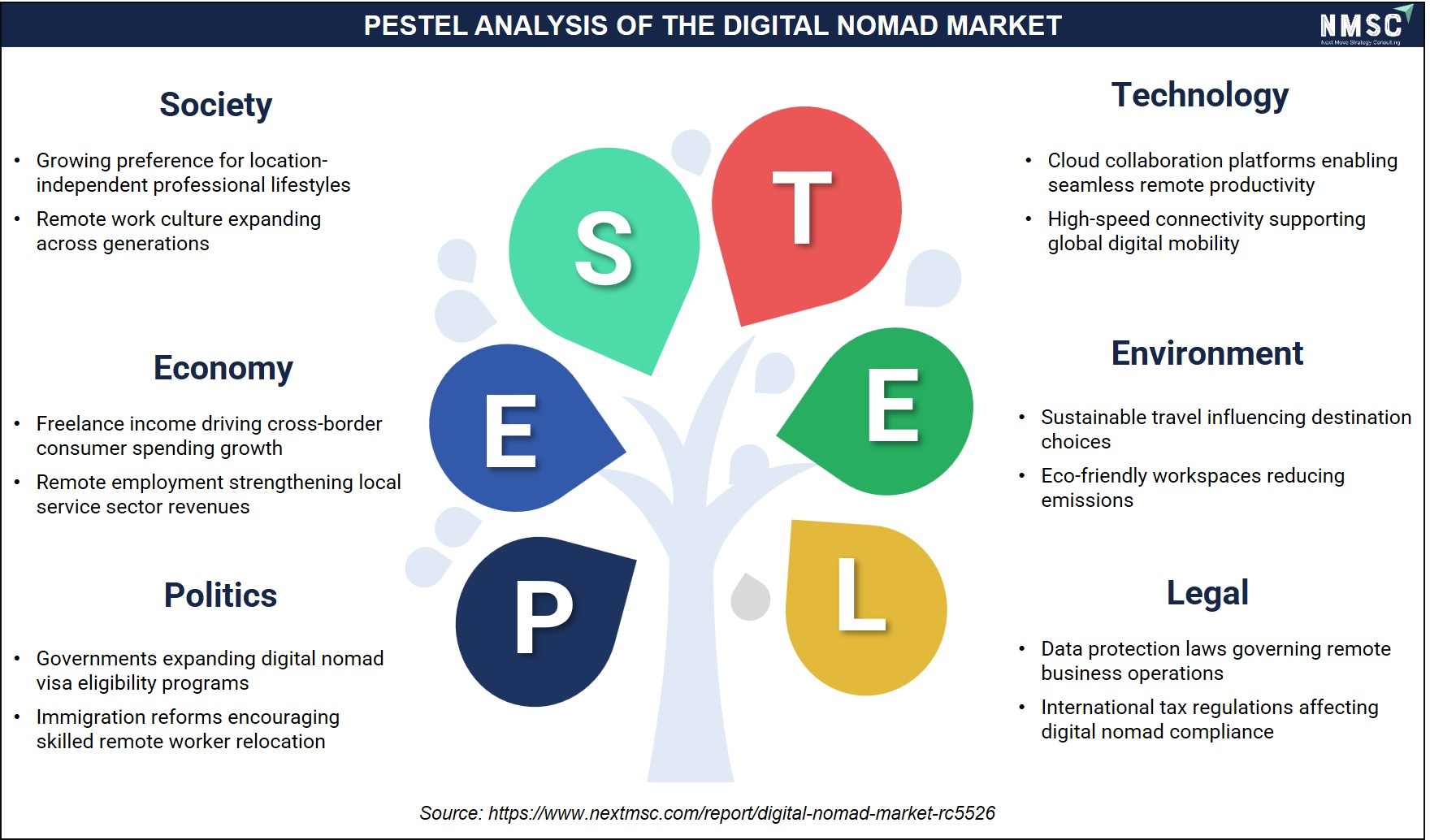
Based on our PESTEL assessment, we identified that the digital nomad market is influenced by government visa policies, global economic conditions, evolving remote work culture, digital infrastructure advancements, environmental sustainability initiatives, and international legal frameworks. Furthermore, our analysis indicates that remote work legislation, affordable living costs, high-speed internet availability, smart city development, sustainable tourism practices, cross-border taxation policies, and data privacy regulations collectively shape destination attractiveness and long-term market growth.
Competitive Landscape
We observed that the digital nomad market remains moderately fragmented, with competitive intensity concentrated among diversified coworking-coliving operators and specialized travel-technology and financial-services providers.
|
Aspect |
Details |
|
Market Structure |
Moderately fragmented, with the Top 10 companies holding an available market share while a long tail of city-specific coworking and coliving operators serves regional demand. |
|
Innovation Focus |
Integrated booking platforms, AI-enabled workspace amenities, and bundled visa-compliance and financial-services offerings. |
|
M&A Activity |
Selective acquisitions of regional coliving networks and travel-technology platforms to expand multi-country coverage. |
How Do Companies Compete in the Digital Nomad Market?
Companies compete primarily on the breadth of their multi-country property or platform network, since nomads value the ability to transfer memberships across cities without renegotiating terms. Our analysis shows that operators with standardized amenities, verified connectivity speeds, and transparent pricing across locations command stronger retention than single-city providers, while pricing strategies increasingly favor flexible, month-to-month subscription models over fixed-term leases.
Which Competitive Archetypes Dominate the Digital Nomad Market?
Three archetypes dominate: large-scale coworking and coliving networks with global footprints, specialized travel and community platforms curating group experiences, and financial or insurance providers building nomad-specific product lines. We found that scale-driven networks compete on geographic breadth, while community-focused platforms differentiate through curated events and destination expertise, and financial providers compete on cross-border product flexibility.
What Innovation and Differentiation Strategies Are Companies Pursuing?
Providers are investing in unified mobile applications that combine booking, community messaging, and payment functions to reduce platform-switching friction. Our findings suggest that verified connectivity testing and published speed benchmarks have become a differentiation tool for premium operators, while some platforms are piloting AI-based itinerary and visa-eligibility matching tools to streamline multi-country trip planning for members.
What M&A Activity Is Shaping the Digital Nomad Market?
Mergers and acquisitions activity centers on regional network consolidation, as larger coliving and coworking operators acquire smaller city-specific properties to expand geographic coverage without ground-up development. We observed that travel-technology and insurance platforms are also pursuing selective partnerships with visa-processing services to offer bundled compliance support, reflecting a broader industry shift toward vertically integrated service delivery.
Key Market Players
We found that the following companies represent the leading providers of coworking, coliving, travel, community, and financial services purpose-built for the digital nomad population, ranked by market-specific scale of operations.
-
WeWork Inc.
-
IWG plc
-
Airbnb, Inc.
-
Selina Hospitality PLC
-
SafetyWing
-
Outsite Inc.
-
Deel, Inc.
-
Blueground Inc.
-
Worldpackers
-
Coworker.com
-
Croissant
-
NomadX
-
Anyplace
-
Flatio
-
Hacker Paradise
-
Remote Year
-
Second Home
-
Roam Coliving
Latest Developments
We observed several verifiable developments across visa policy and provider expansion that are shaping near-term market direction.
|
Date |
Event |
|
May 2026 |
Deel, Inc. expanded its Deel Mobility platform to provide comprehensive digital nomad and global visa application support directly to individual remote workers and businesses without requiring a standard Deel employment contract, streamlining documentation across more than 40 countries. |
|
March 2026 |
International Workplace Group (IWG plc) reported a record expansion, signing 1,132 new hybrid workspace and flexible office locations globally over the previous year through its asset-light managed partnership model to support the growing demand from location-independent professionals and remote workers. |
|
June 2025 |
Airbnb, Inc. launched its major summer platform update, transforming its core rental platform into an integrated travel and remote-living ecosystem with localized services across hundreds of cities, enhancing long-term digital nomad stay planning and host management capabilities. |
Investment Opportunities
Where Is Capital Flowing Within the Digital Nomad Market?
Capital continues to concentrate in coliving network operators and remote-work financial infrastructure platforms. We observed that Outsite has raised substantial venture funding to expand its coliving property portfolio, while Deel has attained significant private valuation on the strength of its global payroll and compliance platform, signaling investor confidence in infrastructure serving distributed workforces.
How Is Infrastructure Investment Shaping the Market?
Infrastructure investment is concentrated in high-bandwidth connectivity upgrades at coworking and coliving properties, alongside city-level digital-infrastructure programs in destinations competing for nomad visa applicants. Our findings suggest that governments in Southeast Asia and the Gulf are directing public investment toward broadband and business-registration systems specifically to attract remote-worker residency applicants.
What ESG Considerations Are Relevant to Digital Nomad Market Investment?
Environmental, social, and governance considerations center on the housing-affordability impact of coliving expansion in popular destinations, where rising long-stay demand has drawn scrutiny in cities such as Lisbon and Mexico City. Social considerations include community-integration practices between nomads and host populations, while governance considerations relate to tax-compliance transparency across multi-jurisdiction income reporting.
Key Benefits for Stakeholders
How Does This Report Benefit Coworking and Coliving Industry Leaders?
Industry leaders gain a validated market-sizing and segmentation framework to prioritize expansion across offering types, traveler segments, and regions. The report's country-level revenue and CAGR data support site-selection and capital-allocation decisions for operators evaluating new market entry through 2035.
How Does This Report Benefit Investors and Financial Analysts?
Investors and financial analysts gain a fundamentals-based CAGR methodology, competitive landscape mapping, and a Top 20 company benchmark set, supporting valuation and portfolio-allocation decisions across coworking, coliving, and remote-work financial-services providers.
How Does This Report Benefit Technology Vendors and Product Teams?
Technology vendors and product teams gain segment-level demand signals, including the fastest-growing travel, visa and relocation services category, to prioritize product roadmaps around compliance automation, connectivity verification, and integrated booking functionality.
Key Market Segments
By Offering
-
Co-working Spaces
-
Co-living and Accommodation Services
-
Travel, Visa and Relocation Services
-
Digital Platforms and Community Networks
-
Financial, Insurance and Payment Services
By Traveler Type
-
Freelance Professionals
-
Salaried Remote Employees
-
Entrepreneurs and Business Owners
-
Content Creators and Influencers
By Duration of Stay
-
Short Term Stay Up To 30 Days
-
Medium Term Stay 1 To 6 Months
-
Long Term Stay Above 6 Months
By Booking Channel
-
Online Digital Platforms
-
Offline and Direct Channels
By Region
-
North America: U.S., Canada, Mexico
-
Europe: UK, Germany, France, Italy, Spain, Sweden, Denmark, Finland, Netherlands, Rest of Europe
-
Asia-Pacific: China, India, Japan, South Korea, Taiwan, Indonesia, Vietnam, Australia, Philippines, Malaysia, Rest of APAC
-
Middle East & Africa: Saudi Arabia, UAE, Egypt, Israel, Turkey, Nigeria, South Africa, Rest of MEA
-
Latin America: Brazil, Argentina, Chile, Colombia, Rest of LATAM
Conclusion and Recommendations
What Is the Long-Term Outlook for the Digital Nomad Market?
The long-term outlook remains firmly positive, with the market projected to expand from USD 92.40 billion in 2025 to USD 286.80 billion by 2035 at a 12.00% CAGR. We observed that structural drivers, including visa-program proliferation and sustained remote-work adoption, are durable rather than cyclical, supporting continued double-digit growth across most segments through the forecast period.
What Strategic Positioning Should Providers Pursue?
Providers should prioritize multi-country network breadth over single-city depth, since retention correlates strongly with the ability to transfer memberships across destinations. Our assessment indicates that bundling workspace, accommodation, and compliance services into unified subscriptions will differentiate providers as competitive intensity increases through 2035.
How Attractive Is the Market for New Investment?
Investment attractiveness is high across coliving network operators and remote-work financial infrastructure platforms, given a USD 183.70 billion absolute dollar opportunity between 2026 and 2035. We found that travel, visa and relocation services offer the strongest risk-adjusted entry point given their 14.3% segment CAGR and comparatively low existing competitive density.
What Market Shifts and Key Risks Should Stakeholders Monitor?
Stakeholders should monitor tightening entry-exit enforcement, such as the European Union's Entry/Exit System, which could compress informal short-stay volumes, alongside currency volatility affecting cross-border spending power. Our analysis shows that providers with formalized visa-compliance offerings are better positioned to absorb these regulatory shifts than those relying on informal tourist-visa travel patterns.
What Are the Primary Growth Pathways Through 2035?
Primary growth pathways include expansion into fast-growing Asia-Pacific and Latin American destinations, deeper integration of visa-compliance services into coworking and coliving subscriptions, and development of nomad-specific financial products. We observed that providers combining at least two of these pathways are best positioned to capture disproportionate share of the USD 194.40 billion in incremental revenue generated between 2025 and 2035.
About the Author

About the Reviewer

At Next Move Strategy Consulting, we understand that insightful market research is the cornerstone of successful business decisions. That's why we employ a robust and multifaceted approach, combining various methodologies to deliver the most accurate and actionable data for our clients.

Research Landscape
We navigate the world of research with two primary approaches:
Qualitative Approach
Our qualitative research methodologies involve immersive techniques such as in-depth interviews, focus groups, and observational studies. By engaging directly with individuals and stakeholders, we uncover valuable insights that quantitative data alone may overlook.

Quantitative Research
In tandem with qualitative methodologies, NMSC leverages the power of Quantitative Research to provide a robust foundation of numerical insights. Through systematic data collection and analysis, we quantify patterns, preferences, and market trends, offering a comprehensive view of the business landscape.
Our quantitative research approach employs diverse tools, including surveys, experiments, and statistical modelling. These methodologies enable us to gather data from a large and representative sample, ensuring the statistical significance of our findings. By employing structured questionnaires and standardized data collection methods, we guarantee the reliability and validity of the information we present to our clients.
Quantitative research is particularly effective in measuring the prevalence of trends, assessing market size, and gauging the impact of various factors on consumer behavior. The numerical precision attained through this approach equips our clients with actionable insights, facilitating data-driven decision-making and strategy formulation.


Our Specialized Toolbox for Industry-Specific Market Research
We deploy a specialized arsenal of techniques tailored to meet your unique requirements. Here's a glimpse into our comprehensive toolbox:

Information Procurement
The stage entails acquiring market data or relevant information through various sources and methodologies.


Market Research Approach
We utilize both top-down and bottom-up approaches in market research analysis to achieve a comprehensive understanding of the market dynamics, leveraging the broad perspective of industry trends and macroeconomic factors alongside detailed insights from specific segments and individual companies.

Porters Five Forces Analysis
We conduct Porter's Five Forces analysis to evaluate the competitive landscape of an industry, providing us with insights into factors that affect profitability and strategic positioning.

SWOT Analysis

Forecasting
We utilize a forecasting model to predict future consumption by considering parameters like population, economics, regulations, market competition, drivers, constraints, technology, and pricing. We also employ statistical techniques such as multilinear regression, exponential smoothing, moving average, ARIMA, and Monte Carlo simulations for accurate predictions. In econometric forecasting, we analyzed short-term and long-term event impacts, attributing values based on regulatory frameworks, economic factors, and market events.





 Speak to Our Analyst