Smart Hotels and AI in Hospitality Market Size, Share, Trends and Growth Analysis, By Offering (Software, Hardware, and Services), By Technology (AI and Machine Learning, IoT and Connected Devices, Robotics and Automation, Biometric and Facial Recognition, and Cloud Computing and Big Data Analytics), By Application (Guest Experience and Personalization, Security and Access Control, and Others), By Deployment Mode, By Hotel Type, and Region — Global Industry Report and Forecast, 2026–2035
Industry: Retail and Consumer | Publishing Date: August 1, 2026 | Last Updated: August 1, 2026 | No of Pages: N/A | No. of Tables: N/A | No. of Figures: N/A | Format: PDF | Report Code: RC5508
What Is the Smart Hotels and AI in Hospitality Market Size?
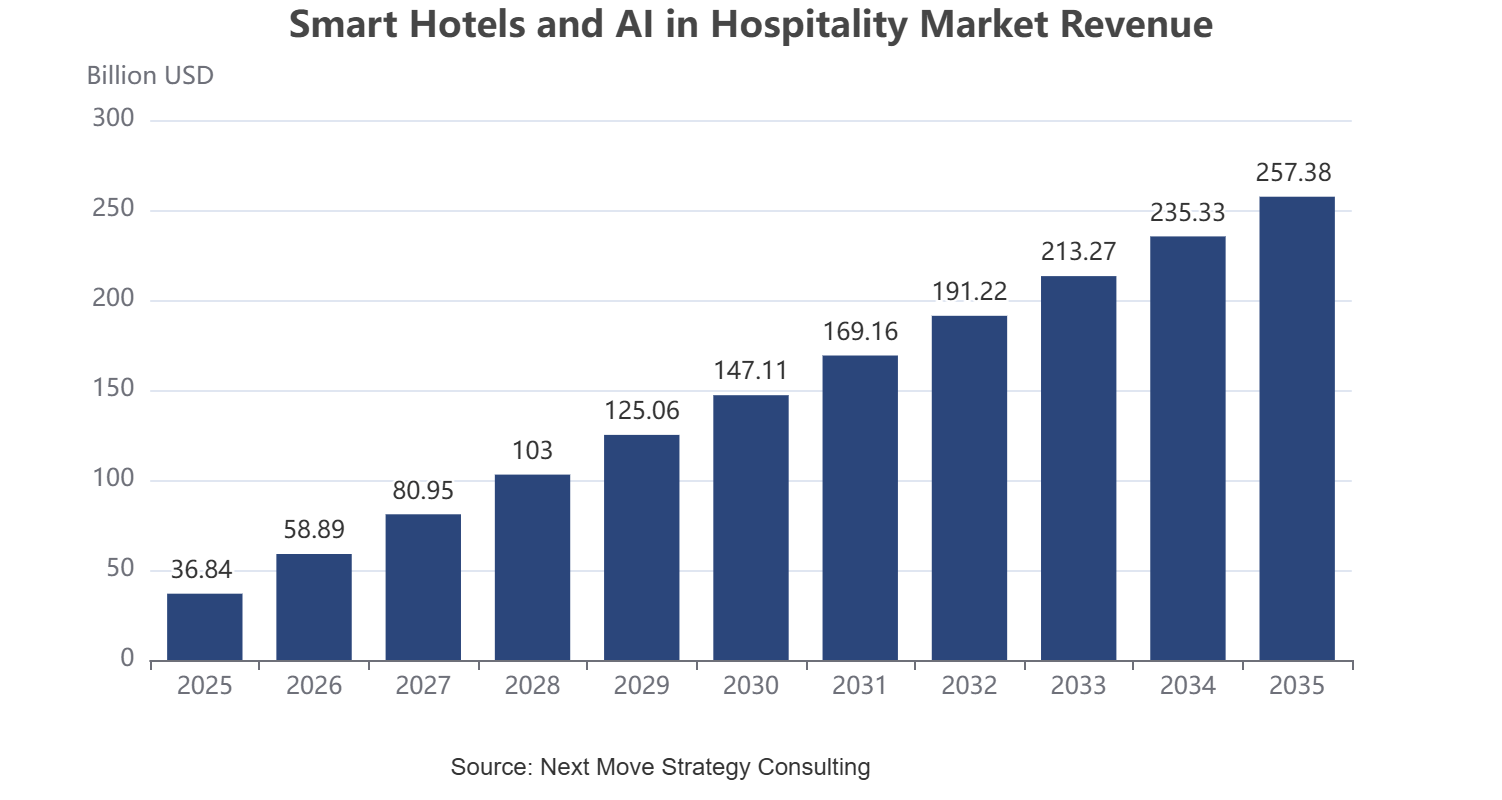
The global smart hotels and AI in hospitality market size was valued at USD 36.84 Billion in 2025 and is estimated at USD 46.52 Billion in 2026, forecast to reach USD 257.38 Billion by 2035, expanding at a 20.94% CAGR between 2026 and 2035. North America leads with approximately 34% share, while software solutions dominate all other offering types with approximately 46% share.
We observed that growth is broad-based across every segmentation axis, with AI-driven personalization and robotics-enabled automation driving the dominant structural shifts through 2035.
|
Key Takeaways |
|
By Offering: Software held the largest share of approximately 46% (USD 16.95 Billion) in 2025; Services is the fastest-growing sub-segment at 25.8% CAGR from 2026–2035. |
|
By Technology: AI and Machine Learning held the largest share of approximately 29% (USD 10.68 Billion) in 2025; Robotics and Automation is the fastest-growing sub-segment at 25.1% CAGR from 2026–2035. |
|
By Application: Guest Experience and Personalization held the largest share of approximately 24% (USD 8.84 Billion) in 2025; Energy Management and Sustainability is the fastest-growing sub-segment at 24.4% CAGR from 2026–2035. |
|
By Deployment Mode: Cloud held the largest share of approximately 58% (USD 21.37 Billion) in 2025; Hybrid is the fastest-growing sub-segment at 23.9% CAGR from 2026–2035. |
|
By Hotel Type: Upscale and Upper-Upscale Hotels held the largest share of approximately 38% (USD 14.00 Billion) in 2025; Budget and Economy Hotels is the fastest-growing sub-segment at 23.6% CAGR from 2026–2035. |
|
Dominant Region: North America dominated with approximately 34% revenue share (USD 12.53 Billion) in 2025. |
|
Fastest-Growing Region: Asia-Pacific is expected to register the highest CAGR of 24.1% during 2026–2035. |
|
Dominant Country: U.S. led with approximately USD 10.78 Billion in 2025. |
|
Fastest-Growing Country: India is the fastest-growing country at approximately 28.0% CAGR from 2026–2035. |
Market Opportunity: The smart hotels and AI in hospitality market is expected to create an absolute dollar opportunity of USD 210.86 Billion between 2026 and 2035, presenting significant investment potential across the guest technology, hotel security, and operations-automation value chain.
According to Next Move Strategy Consulting analysis, hotel groups are increasingly consolidating technology sourcing with unified AI platform vendors rather than point solutions, a shift that favors diversified providers over single-function specialists as integration complexity rises across multi-property portfolios through 2035.
Smart Hotels and AI in Hospitality Market Overview
The smart hotels and AI in hospitality market encompasses software, hardware, and services that embed artificial intelligence, Internet of Things connectivity, robotics, and biometric technology into hotel operations and guest-facing touchpoints. Our assessment indicates that the scope spans property management systems, revenue management engines, in-room voice assistants, keyless access platforms, and service robots deployed across luxury, upscale, midscale, and budget properties worldwide. The category has evolved from isolated point solutions into unified, cloud-native technology stacks, driven by rising guest expectations for personalization, labor cost pressure, and hotel groups' pursuit of operational efficiency at scale.
Regulatory frameworks such as the European Union's General Data Protection Regulation and the U.S. Federal Trade Commission's guidance on biometric data shape consent and data-retention requirements for guest-facing AI systems, while national tourism and building-energy codes increasingly influence smart infrastructure adoption. We observed that technology adoption is shifting toward agentic, multilingual guest assistants and predictive maintenance platforms that reduce dependence on manual staff intervention. Next Move Strategy Consulting's analysis indicates that this structural shift, combined with post-pandemic labor shortages, is redefining technology sourcing criteria across the smart hotels and AI in hospitality market.
|
Parameters |
Details |
|
Market Size in 2025 |
USD 36.84 Billion |
|
Market Size in 2026 |
USD 46.52 Billion |
|
Revenue Forecast in 2035 |
USD 257.38 Billion |
|
Growth Rate |
CAGR of 20.94% from 2026 to 2035 |
|
Analysis Period |
2025–2035 |
|
Base Year Considered |
2025 |
|
Forecast Period |
2026–2035 |
|
Market Size Estimation |
Revenue (USD Billion) |
|
Companies Profiled |
20 |
|
Countries Covered |
38 |
|
Market Share |
Available for Top 10 Companies |
Key Emerging Trends
Based on research conducted by Next Move Strategy Consulting, we found that four structural trends are reshaping product development, sourcing, and stakeholder engagement across the industry.
How Is AI-Powered Personalization Redefining the Guest Experience?
Hotels are deploying AI-driven guest profiles that tailor room settings, dining recommendations, and loyalty offers based on prior stay data. We observed that Canary Technologies launched its Hospitality AI Agent Studio in March 2026, allowing hoteliers to configure front desk, concierge, and reservations agents without custom development. Brand owners are adopting these platforms to differentiate loyalty programs, while independent properties license similar capability through cloud subscriptions, narrowing the personalization gap between large chains and independent operators across the smart hotels and AI in hospitality market.
How Are Robotics and Automation Transforming Hotel Operations?
Service and delivery robots are being deployed for luggage handling, in-room delivery, and back-of-house logistics to offset staffing shortages. Our findings suggest that adoption is concentrated among large-format upscale and resort properties, where labor cost savings justify capital outlay, while cloud robotics platforms increasingly allow smaller properties to deploy shared robotic fleets across multi-property clusters, lowering the total cost of automation for mid-tier hotel groups.
Why Is Biometric and Facial Recognition Technology Gaining Adoption at Check-In?
Contactless check-in using facial recognition and biometric identification is expanding across airports, resorts, and business hotels seeking to reduce front-desk wait times. We found that Assa Abloy's SmartSecure Hotel platform, launched in 2024, integrates biometric identification with AI-driven security analytics to deliver real-time access insights alongside seamless guest entry, reflecting a broader industry shift toward unified biometric security ecosystems.
How Is Predictive Analytics Reshaping Revenue and Demand Management?
Predictive analytics engines are enabling dynamic pricing that adjusts room rates in near real time based on demand signals, competitor pricing, and local events. Our analysis shows that Oracle's OPERA Cloud Assistant, announced in June 2026, embeds AI-generated rate descriptions and automated room assignment directly within existing revenue workflows, illustrating how predictive tools are moving from standalone systems into core property management infrastructure across the hospitality sector.
Ecosystem Analysis of the Smart Hotels & AI in Hospitality Market
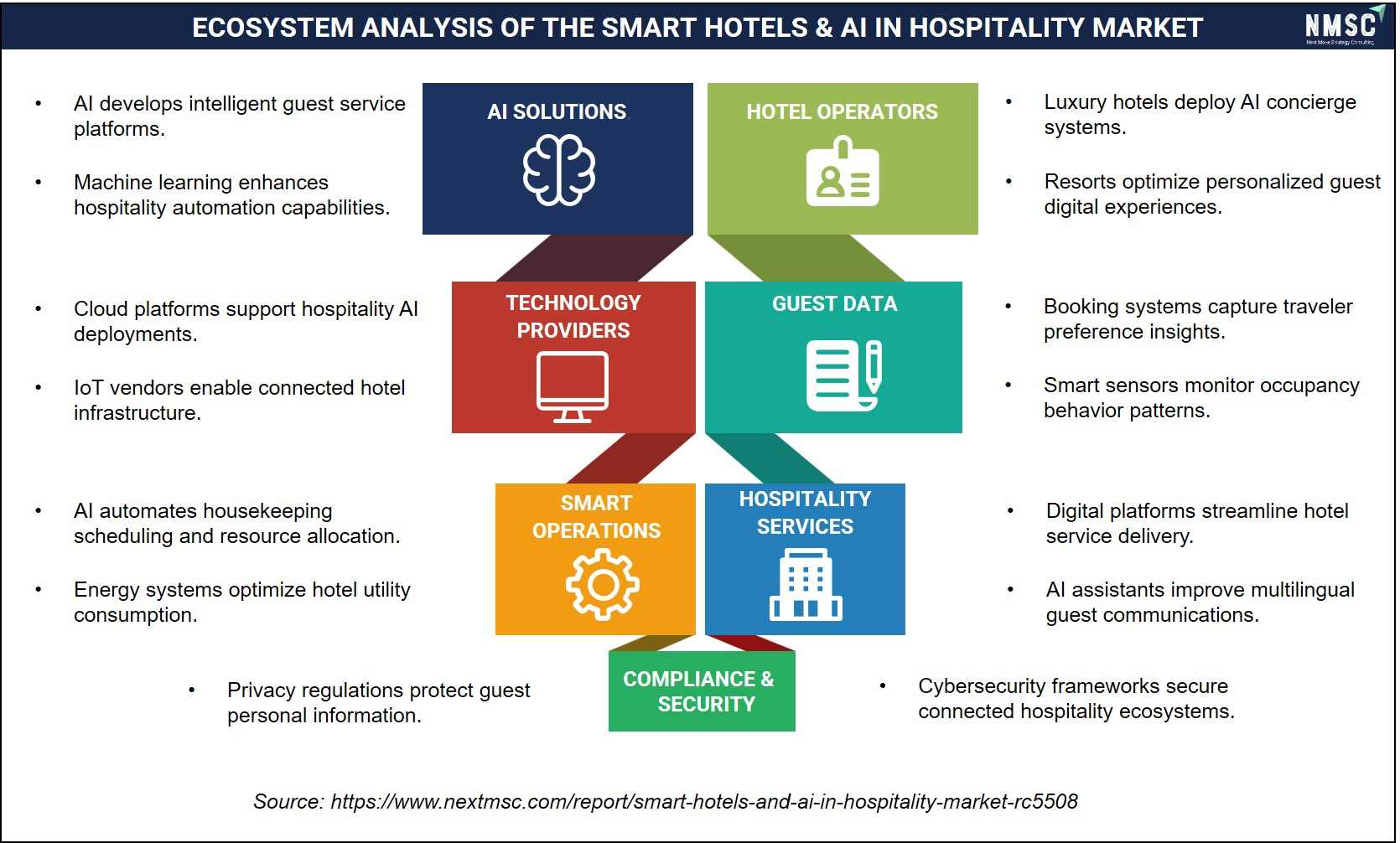
Based on our ecosystem assessment, we identified that the smart hotels and AI in hospitality market consists of AI solution providers, hotel operators, technology providers, guest data management platforms, smart operations systems, hospitality service providers, and compliance and security authorities. Furthermore, our analysis indicates that AI-enabled automation, connected hotel technologies, intelligent guest data management, digital hospitality services, and cybersecurity compliance improve operational efficiency, personalize guest experiences, and strengthen hotel competitiveness.
Growth Drivers & Restraints
Growth Catalyst and Risk Assessment Matrix
|
Factors |
Type |
(+/−) % Impact on CAGR |
Geographic Relevance |
Impact Timeline |
|
Rising adoption of AI-powered guest personalization platforms |
Driver |
+3.8% |
Global |
2026–2035 |
|
Expansion of contactless check-in and biometric access solutions |
Driver |
+3.1% |
North America, Europe |
2026–2032 |
|
Growing integration of IoT-enabled energy management systems |
Driver |
+2.6% |
Global |
2026–2035 |
|
Increasing deployment of AI chatbots and voice assistants for guest service |
Driver |
+2.9% |
Global |
2026–2033 |
|
Rising investment in predictive revenue management software |
Driver |
+2.2% |
North America, Asia-Pacific |
2026–2035 |
|
Expansion of smart hotel infrastructure in emerging APAC markets |
Driver |
+2.4% |
Asia-Pacific |
2026–2035 |
|
High upfront capital cost of retrofitting legacy hotel infrastructure |
Restraint |
−1.8% |
Global |
2026–2030 |
|
Data privacy and cybersecurity concerns over guest information |
Restraint |
−1.5% |
Europe, North America |
2026–2032 |
|
Shortage of skilled technical staff for AI system integration |
Restraint |
−1.1% |
Middle East and Africa, Latin America |
2026–2031 |
What Is the Primary Growth Driver for the Smart Hotels and AI in Hospitality Market?
AI-powered guest personalization is the primary growth driver, as hotel groups pursue differentiated loyalty experiences to protect rate premiums. According to the U.S. Bureau of Labor Statistics, accommodation-sector job openings remained elevated through early 2026, reinforcing hotel operators' incentive to deploy automation and personalization software that reduces dependence on front-line staffing while improving guest satisfaction scores.
How Is IoT-Enabled Energy Management Driving Market Growth?
IoT-connected thermostats, lighting, and occupancy sensors are enabling hotels to cut energy consumption while meeting building-efficiency codes. We observed that the U.S. Department of Energy's commercial building initiatives cite hospitality as a priority sector for smart-metering deployment, supporting adoption of connected energy management systems that lower operating costs and align with sustainability commitments made by major hotel brands.
What Is Restraining Smart Hotels and AI in Hospitality Market Growth?
High upfront capital costs for retrofitting legacy hotel infrastructure restrain adoption, particularly among independent and budget-tier properties with limited capital expenditure budgets. Our assessment indicates that integration complexity across disparate legacy systems adds further cost, with independent hotels frequently deferring full-scale AI deployment until property management system replacement cycles create a natural upgrade window.
Segmentation Analysis
Segment Sizing: By Offering
|
Segment |
2025 (USD) |
2035 (USD) |
CAGR% (2026–2035) |
|
Software |
USD 16.95 Billion |
USD 113.25 Billion |
20.3% |
|
Hardware |
USD 12.16 Billion |
USD 66.92 Billion |
17.8% |
|
Services |
USD 7.73 Billion |
USD 77.21 Billion |
25.8% |
|
Total |
USD 36.84 Billion |
USD 257.38 Billion |
— |
Which Offering Type Dominates the Smart Hotels and AI in Hospitality Market?
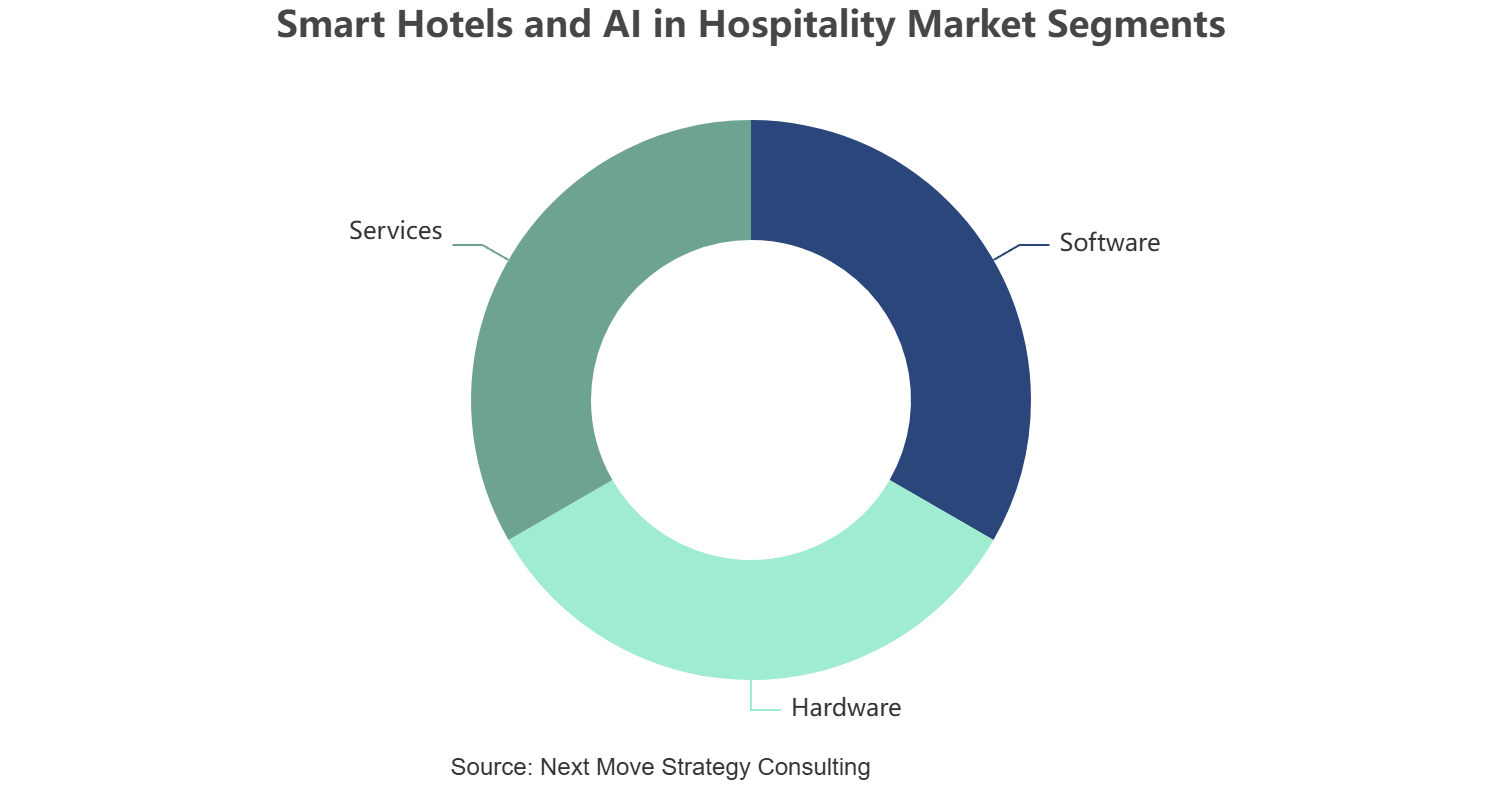
Offering is segmented into software, hardware, and services, spanning property management platforms, sensors and access devices, and integration or support services. We found that software dominates at approximately 46% share in 2025 given hotels' preference for cloud-subscription platforms over capital-intensive hardware, while services is the fastest-growing category at 25.8% CAGR as multi-property groups increasingly outsource AI system integration and ongoing optimization work.
Segment Sizing: By Technology
|
Segment |
2025 (USD) |
2035 (USD) |
CAGR% (2026–2035) |
|
AI and Machine Learning |
USD 10.68 Billion |
USD 84.94 Billion |
22.7% |
|
IoT and Connected Devices |
USD 8.84 Billion |
USD 54.05 Billion |
19.2% |
|
Robotics and Automation |
USD 5.16 Billion |
USD 48.90 Billion |
25.1% |
|
Biometric and Facial Recognition |
USD 4.79 Billion |
USD 30.89 Billion |
19.9% |
|
Cloud Computing and Big Data Analytics |
USD 7.37 Billion |
USD 38.60 Billion |
17.1% |
|
Total |
USD 36.84 Billion |
USD 257.38 Billion |
— |
Which Technology Leads the Smart Hotels and AI in Hospitality Market?
Technology is segmented into AI and machine learning, IoT and connected devices, robotics and automation, biometric and facial recognition, and cloud computing and big data analytics. AI and machine learning leads with approximately 29% share in 2025, underpinning personalization and predictive pricing engines, while physical AI applications embedded in service robots make robotics and automation the fastest-growing category at 25.1% CAGR as labor-constrained properties scale automated operations.
Segment Sizing: By Application
|
Segment |
2025 (USD) |
2035 (USD) |
CAGR% (2026–2035) |
|
Guest Experience and Personalization |
USD 8.84 Billion |
USD 66.92 Billion |
22.0% |
|
Security and Access Control |
USD 7.00 Billion |
USD 41.18 Billion |
18.6% |
|
Revenue and Pricing Management |
USD 6.26 Billion |
USD 38.61 Billion |
19.3% |
|
Energy Management and Sustainability |
USD 5.16 Billion |
USD 46.33 Billion |
24.4% |
|
Housekeeping and Facility Automation |
USD 5.53 Billion |
USD 36.03 Billion |
20.0% |
|
Back-Office and Administrative Operations |
USD 4.05 Billion
|
USD 28.31 Billion |
20.9% |
|
Total |
USD 36.84 Billion |
USD 257.38 Billion |
— |
Which Application Generates the Largest Revenue in the Smart Hotels and AI in Hospitality Market?
Application segmentation spans guest experience and personalization, security and access control, revenue and pricing management, energy management and sustainability, housekeeping and facility automation, and back-office operations. Guest experience and personalization, which increasingly incorporates emotion AI to gauge satisfaction in real time, leads with approximately 24% share, while energy management and sustainability is the fastest-growing application at 24.4% CAGR as hotels pursue carbon-reduction commitments.
Growth Opportunities
Three forward-looking whitespace opportunities stand out for stakeholders positioning ahead of the smart hotels and AI in hospitality market's 2026–2035 growth curve.
Expansion of AI-Driven Energy Management in Sustainability-Focused Hotels
Hotel groups pursuing carbon-reduction targets present a scalable opportunity for vendors offering IoT-enabled energy management platforms that pair occupancy sensing with predictive HVAC control, benefiting energy management solution providers and sustainability-focused upscale hotel chains seeking measurable efficiency gains.
Growth of Voice-Activated In-Room Assistants Across Upscale Properties
Voice-activated in-room assistants that control lighting, climate, and concierge requests are gaining traction among upscale and luxury properties seeking differentiated guest experiences, creating opportunity for voice technology vendors and hotel groups willing to bundle smart-room packages into premium rate tiers.
Scaling Predictive Maintenance Platforms Across Multi-Property Hotel Groups
Predictive maintenance platforms that flag equipment failures before guest-facing disruption occur present a strong opportunity for multi-property hotel groups seeking to reduce downtime costs, benefiting both facilities-technology vendors and asset owners managing large room-count portfolios across diverse geographies.
Regional Outlook
Geographic Performance Snapshot
|
Region |
2025 (USD) |
2035 (USD) |
CAGR% (2026–2035) |
Key Driver |
|
North America |
USD 12.53 Billion |
USD 79.79 Billion |
19.7% |
Rapid adoption of AI-driven revenue management and guest personalization platforms |
|
Europe |
USD 9.58 Billion |
USD 56.62 Billion |
18.7% |
Regulatory-driven investment in energy management and data-secure guest systems |
|
Asia-Pacific |
USD 9.95 Billion |
USD 87.51 Billion |
24.1% |
Large-scale smart hotel construction and government-backed digital tourism initiatives |
|
Middle East and Africa |
USD 2.58 Billion |
USD 18.02 Billion |
20.9% |
Mega-project hospitality development and luxury smart hotel investment |
|
Latin America |
USD 2.20 Billion |
USD 15.44 Billion |
21.0% |
Growing international tourism inflows and hotel chain digitalization programs |
|
Total |
USD 36.84 Billion |
USD 257.38 Billion |
— |
— |
North America Smart Hotels and AI in Hospitality Market Outlook
North America's smart hotels and AI in hospitality market benefits from mature technology infrastructure and early enterprise adoption among major hotel brands. We observed that regulatory clarity from state-level data privacy laws is accelerating standardized biometric consent frameworks, while high labor costs continue to justify automation investment. The region's technology penetration remains the deepest globally, and its strategic outlook favors continued platform consolidation among large hotel operators through 2035.
Europe Smart Hotels and AI in Hospitality Market Outlook
Europe's market is shaped by the General Data Protection Regulation, which imposes strict consent requirements on biometric and guest-data processing. Through our analysis, adoption is concentrated among upscale urban hotels pursuing energy-efficiency mandates under national building codes, while regulatory complexity moderates deployment pace relative to North America. Technology vendors with strong compliance credentials hold a structural advantage across the region's fragmented, multi-country hotel ownership landscape.
Asia-Pacific Smart Hotels and AI in Hospitality Market Outlook
Asia-Pacific combines rapid new hotel construction with government-backed digital tourism programs, positioning the region as the fastest-growing globally. From our assessment, China and India are driving disproportionate share gains as domestic technology vendors scale AI-enabled property management platforms at competitive price points. Regulatory environments vary widely across the region, but rising smartphone-based guest engagement is accelerating technology penetration even among midscale properties.
Middle East and Africa Smart Hotels and AI in Hospitality Market Outlook
The Middle East and Africa region is anchored by large-scale luxury hospitality development tied to national tourism diversification strategies. According to evaluation, Gulf Cooperation Council countries are driving most regional investment, with government-backed megaprojects embedding AI and biometric systems from the ground up. Technology adoption in Africa remains nascent outside flagship urban and resort properties, but strategic outlook favors accelerating investment as tourism infrastructure expands.
Latin America Smart Hotels and AI in Hospitality Market Outlook
Latin America's market is supported by growing international tourism inflows and hotel chain digitalization programs across Brazil and Mexico. Based on our engagements, regional operators are prioritizing cloud-based property management systems that require minimal on-premise infrastructure investment. Regulatory frameworks remain less standardized than in North America or Europe, but competitive intensity among regional hotel groups is accelerating technology adoption across upper-midscale segments.
U.S. Smart Hotels and AI in Hospitality Market
Based on our engagements, the U.S. smart hotels and AI in hospitality market was valued at approximately USD 10.78 Billion in 2025 and is projected to reach USD 60.35 Billion by 2035, expanding at a 18.0% CAGR from 2026 to 2035. In U.S., demand is led by enterprise hotel chains deploying AI revenue management and guest personalization at scale, with high technology penetration, moderate regulatory complexity from state privacy laws, intense vendor competition, and a strategic outlook centered on platform consolidation.
Canada Smart Hotels and AI in Hospitality Market
Through our analysis, the Canada smart hotels and AI in hospitality market was valued at approximately USD 1.35 Billion in 2025 and is projected to reach USD 7.84 Billion by 2035, expanding at a 18.5% CAGR from 2026 to 2035. In Canada, adoption follows U.S. trends with a lag, supported by moderate technology penetration among urban business hotels, manageable regulatory influence from federal privacy law, and a strategic outlook favoring gradual cloud migration across mid-sized hotel groups.
UK Smart Hotels and AI in Hospitality Market
From our assessment, the UK smart hotels and AI in hospitality market was valued at approximately USD 2.30 Billion in 2025 and is projected to reach USD 12.39 Billion by 2035, expanding at a 17.5% CAGR from 2026 to 2035. In UK, demand centers on data-compliant guest personalization platforms, with strong technology penetration in London's hotel market, significant regulatory influence from UK GDPR, moderate competitive intensity, and a strategic outlook favoring compliance-certified vendors.
Germany Smart Hotels and AI in Hospitality Market
According to evaluation, the Germany smart hotels and AI in hospitality market was valued at approximately USD 2.10 Billion in 2025 and is projected to reach USD 11.58 Billion by 2035, expanding at a 17.8% CAGR from 2026 to 2035. In Germany, adoption is shaped by strict data protection enforcement and strong sustainability mandates, with high technology penetration among energy-conscious upscale hotels, considerable regulatory influence, and a strategic outlook favoring integrated energy management platforms.
France Smart Hotels and AI in Hospitality Market
Based on our engagements, the France smart hotels and AI in hospitality market was valued at approximately USD 1.55 Billion in 2025 and is projected to reach USD 8.18 Billion by 2035, expanding at a 17.2% CAGR from 2026 to 2035. In France, demand reflects a mature hospitality sector balancing luxury guest experience investment with GDPR compliance, moderate technology penetration outside major cities, notable regulatory influence, and a strategic outlook favoring premium personalization technology.
China Smart Hotels and AI in Hospitality Market
Through our analysis, the China smart hotels and AI in hospitality market was valued at approximately USD 3.60 Billion in 2025 and is projected to reach USD 36.40 Billion by 2035, expanding at a 26.0% CAGR from 2026 to 2035. In China, demand is driven by domestic technology giants scaling AI-enabled hotel platforms at competitive cost, very high technology penetration in tier-one cities, moderate regulatory influence, intense competitive intensity, and a strategic outlook favoring rapid nationwide rollout.
India Smart Hotels and AI in Hospitality Market
From our assessment, the India smart hotels and AI in hospitality market was valued at approximately USD 1.55 Billion in 2025 and is projected to reach USD 18.10 Billion by 2035, expanding at a 28.0% CAGR from 2026 to 2035. In India, adoption is accelerating fastest globally as domestic hotel chains digitize legacy operations, moderate but rapidly rising technology penetration, developing regulatory frameworks, growing competitive intensity, and a strategic outlook favoring cloud-first budget and midscale deployment.
Japan Smart Hotels and AI in Hospitality Market
According to evaluation, the Japan smart hotels and AI in hospitality market was valued at approximately USD 1.45 Billion in 2025 and is projected to reach USD 6.69 Billion by 2035, expanding at a 15.5% CAGR from 2026 to 2035. In Japan, demand reflects mature hospitality infrastructure prioritizing robotics and automation to offset labor shortages, high technology penetration, stable regulatory environment, moderate competitive intensity, and a strategic outlook favoring service robot deployment.
South Korea Smart Hotels and AI in Hospitality Market
Based on our engagements, the South Korea smart hotels and AI in hospitality market was valued at approximately USD 0.95 Billion in 2025 and is projected to reach USD 5.75 Billion by 2035, expanding at a 19.0% CAGR from 2026 to 2035. In South Korea, adoption is led by technology-forward urban hotel chains integrating AI concierge and biometric check-in, high technology penetration, stable regulatory influence, and a strategic outlook favoring smart-room bundling in upscale properties.
Australia Smart Hotels and AI in Hospitality Market
Through our analysis, the Australia smart hotels and AI in hospitality market was valued at approximately USD 0.65 Billion in 2025 and is projected to reach USD 4.08 Billion by 2035, expanding at a 19.5% CAGR from 2026 to 2035. In Australia, demand centers on resort and business hotel segments adopting cloud property management systems, moderate technology penetration, stable regulatory influence from national privacy law, and a strategic outlook favoring gradual multi-property platform standardization.
UAE Smart Hotels and AI in Hospitality Market
From our assessment, the UAE smart hotels and AI in hospitality market was valued at approximately USD 0.78 Billion in 2025 and is projected to reach USD 5.93 Billion by 2035, expanding at a 22.0% CAGR from 2026 to 2035. In UAE, adoption is driven by luxury and megaproject hospitality development embedding AI and biometric systems from construction, very high technology penetration among flagship properties, government-supportive regulatory environment, and a strategic outlook favoring premium smart hotel positioning.
Saudi Arabia Smart Hotels and AI in Hospitality Market
According to evaluation, the Saudi Arabia smart hotels and AI in hospitality market was valued at approximately USD 0.68 Billion in 2025 and is projected to reach USD 5.34 Billion by 2035, expanding at a 22.5% CAGR from 2026 to 2035. In Saudi Arabia, demand is tied to national tourism diversification megaprojects integrating AI-enabled hospitality infrastructure at scale, rapidly rising technology penetration, supportive regulatory environment, and a strategic outlook favoring large-scale greenfield smart hotel development.
South Africa Smart Hotels and AI in Hospitality Market
Based on our engagements, the South Africa smart hotels and AI in hospitality market was valued at approximately USD 0.32 Billion in 2025 and is projected to reach USD 1.92 Billion by 2035, expanding at a 19.0% CAGR from 2026 to 2035. In South Africa, adoption remains concentrated in flagship urban and safari-tourism properties, moderate technology penetration, developing regulatory framework, and a strategic outlook favoring selective investment in guest-facing personalization technology.
Brazil Smart Hotels and AI in Hospitality Market
Through our analysis, the Brazil smart hotels and AI in hospitality market was valued at approximately USD 1.05 Billion in 2025 and is projected to reach USD 7.40 Billion by 2035, expanding at a 21.0% CAGR from 2026 to 2035. In Brazil, demand is supported by growing domestic and international tourism, moderate technology penetration concentrated in major cities, developing regulatory framework under national data protection law, and a strategic outlook favoring cloud-based property management adoption.
Argentina Smart Hotels and AI in Hospitality Market
From our assessment, the Argentina smart hotels and AI in hospitality market was valued at approximately USD 0.38 Billion in 2025 and is projected to reach USD 2.48 Billion by 2035, expanding at a 20.0% CAGR from 2026 to 2035. In Argentina, adoption is emerging among upper-midscale hotels in major tourism centers, moderate technology penetration, developing regulatory environment, and a strategic outlook favoring incremental digitalization as international arrivals recover.
Strategic Framework of the Smart Hotels & AI in Hospitality Market
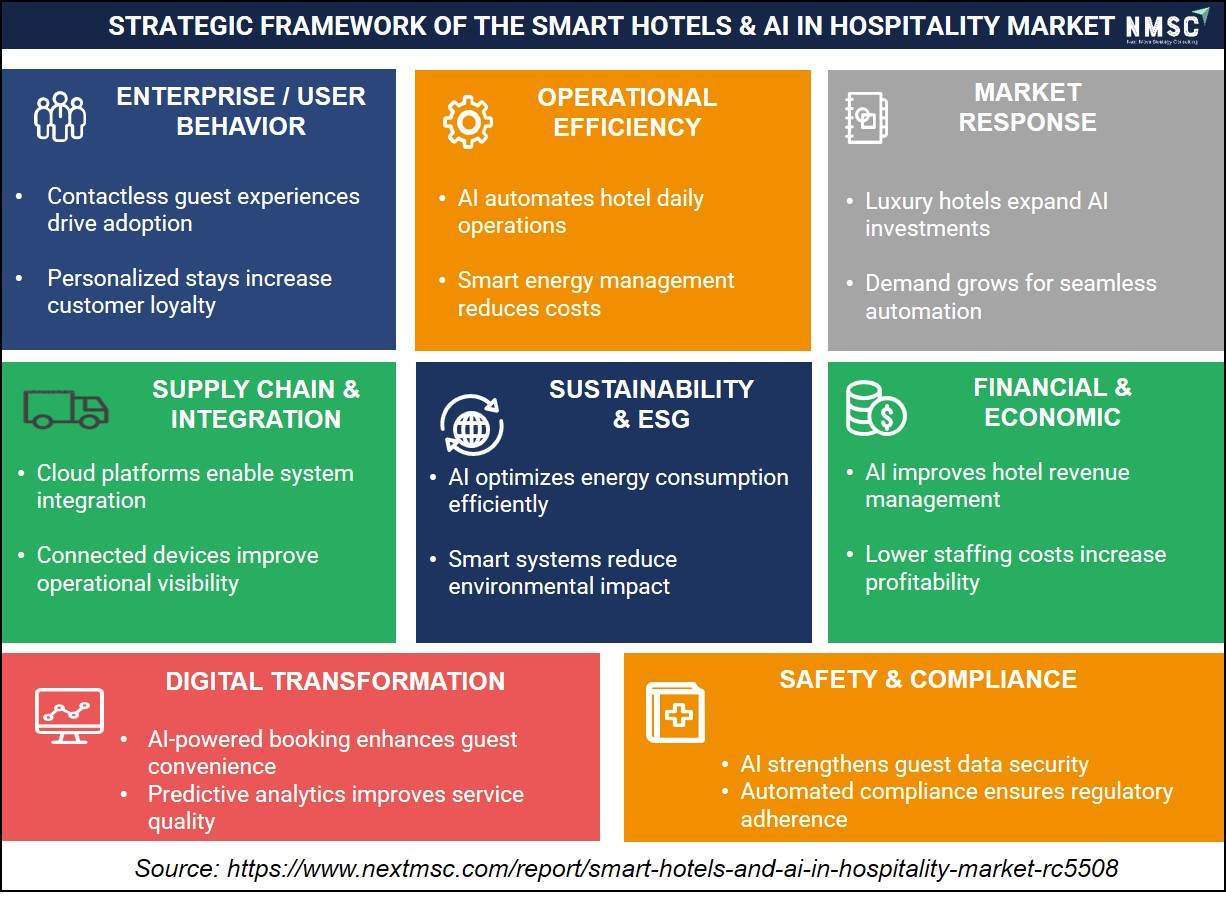
Based on our strategic framework assessment, we identified that the smart hotels and AI in hospitality market is driven by digital guest engagement, operational efficiency, integrated technology infrastructure, sustainability initiatives, financial optimization, market responsiveness, and regulatory compliance. Furthermore, our analysis indicates that AI-powered hotel operations, predictive analytics, smart energy management, connected hospitality platforms, automated compliance systems, and personalized digital services improve guest satisfaction, reduce operating costs, and support long-term market growth.
Competitive Landscape
We found that the competitive landscape spans diversified technology conglomerates, hospitality-specific software vendors, and physical security specialists, each competing on integration depth and platform breadth.
|
Key Takeaways |
|
Market Structure: Moderately fragmented; diversified technology conglomerates compete alongside hospitality-specific point-solution vendors, with the top companies profiled in this report collectively accounting for a significant share of global revenue. |
|
Innovation Focus: Agentic AI concierge and sales platforms, predictive revenue management engines, and biometric access integration dominate current innovation pipelines across leading vendors. |
|
M&A Activity: Selective consolidation through software-platform acquisitions, exemplified by Assa Abloy's integration of SiteOwl into its access-control portfolio to broaden cloud lifecycle-management capability. |
How Do Companies Compete in the Smart Hotels and AI in Hospitality Market?
Companies compete primarily on platform integration depth, breadth of AI capability, and ability to serve multi-property hotel groups across geographies. Our analysis shows that vendors bundling property management, revenue management, and guest engagement into a single AI-enabled platform are winning larger enterprise contracts against point-solution specialists, while pricing strategies increasingly favor subscription-based models over upfront licensing.
Which Competitive Archetypes Dominate the Market?
Two archetypes dominate: diversified technology conglomerates such as Oracle and IBM that extend enterprise cloud platforms into hospitality, and hospitality-native specialists such as Canary Technologies and Shiji Group that build agentic AI purpose-built for hotel workflows. The former wins on scale and existing enterprise relationships, while the latter wins on hospitality-specific product depth and faster feature iteration.
What Innovation and Differentiation Strategies Are Companies Pursuing?
Vendors are differentiating through agentic AI systems capable of autonomously managing tasks such as group sales coordination and guest messaging without constant human oversight. We observed that Canary Technologies' Agentic Sales Coordinator, launched in June 2026, exemplifies this shift toward autonomous workflow management, a differentiation strategy that agentic AI vendors are increasingly replicating across reservations and concierge functions.
What M&A Activity Is Shaping the Competitive Landscape?
Security and access-control vendors are acquiring adjacent software platforms to expand recurring-revenue capability. Our findings suggest that Assa Abloy's August 2025 acquisition of SiteOwl, a cloud platform for physical security lifecycle management, reflects a broader trend of hardware-centric vendors acquiring software assets to compete against cloud-native hospitality technology specialists on geographic expansion and platform stickiness.
Key Market Players
Our assessment identifies the following 20 companies as the leading providers of smart hotel and AI hospitality technology, ranked by market-specific revenue and scale of operations as of 2026.
-
Oracle Corporation
-
Amazon.com, Inc.
-
International Business Machines Corporation (IBM)
-
Honeywell International Inc.
-
Cisco Systems, Inc.
-
Samsung Electronics Co., Ltd.
-
LG Electronics Inc.
-
Assa Abloy AB
-
dormakaba Holding AG
-
Infor, Inc.
-
Agilysys, Inc.
-
Shiji Group
-
Volara, Inc.
-
INTELITY, Inc.
-
Zaplox AB
-
Canary Technologies Corp.
-
Alibaba Group Holding Limited
-
Suprema Inc.
-
NEC Corporation
-
Sabre Corporation
Latest Developments
We found that recent product launches and acquisitions reflect accelerating investment in agentic AI, revenue automation, and integrated security across the industry.
|
Date |
Event |
|
June 2026 |
Samsung Electronics Co., Ltd. announced the global launch of The Frame (HL03H model) hospitality display at HITEC 2026 in San Antonio, Texas. The display introduces AI-powered Generative Wallpaper and Live Translate features tailored for premium smart hotel environments. |
|
March 2026 |
Canary Technologies launched the Hospitality AI Agent Studio, the hospitality industry's first AI-specific agent builder, enabling hotels to configure, customize, and deploy intelligent AI agents for front desk, concierge, and central reservation operations. |
|
February 2025 |
LG Electronics Inc. showcased its advanced webOS-powered hotel TVs with secure, network-isolated Google Cast and Apple AirPlay connectivity at Integrated Systems Europe (ISE) 2025 in Barcelona, enhancing seamless in-room streaming experiences for hospitality guests. |
Expert Insights
 “AI is the new standard for service, efficiency, and discovery. Guests now expect seamless, hyper-personalized interactions… AI provides the essential leverage: empowering hotels to free up time for deeper guest engagement and personalization, while simultaneously enabling teams to excel under pressure.”
— Jean-François Guilmard, Chief Data & AI Officer, Accor
Statement made during an interview discussing Accor's vision for the future of AI in hospitality and how artificial intelligence is reshaping guest experiences and hotel operations.
Market Interpretation
The statement highlights the growing role of artificial intelligence in transforming the hospitality industry by enabling hyper-personalized guest experiences while improving operational efficiency. As hotels increasingly adopt AI-powered concierge services, intelligent booking systems, predictive analytics, smart room technologies, and automated guest support, demand for smart hospitality solutions is expected to accelerate. This convergence of AI, data analytics, and connected hotel technologies is anticipated to drive sustained growth in the global Smart Hotels & AI in Hospitality Market.
Investment Opportunities
Where Are Capital Inflows Concentrated in the Smart Hotels and AI in Hospitality Market?
Capital inflows are concentrated in hospitality-native AI agent platforms and biometric security software, where recurring subscription revenue models attract growth-equity investment. We observed that venture and private equity funding continues to favor vendors demonstrating measurable guest-satisfaction and labor-cost improvements, with agentic AI platforms and AI agents architectures increasingly cited by investors as durable differentiation.
How Significant Is Infrastructure Investment in the Smart Hotels and AI in Hospitality Market?
Infrastructure investment spans IoT sensor networks, edge computing gateways, and connectivity upgrades required to support real-time guest personalization. Our findings suggest that hotel groups in Asia-Pacific and the Middle East are making the largest proportional infrastructure commitments, reflecting extensive greenfield hotel construction that embeds smart infrastructure from initial design rather than retrofit.
What ESG Considerations Influence Investment in the Smart Hotels and AI in Hospitality Market?
Environmental, social, and governance considerations increasingly shape investment decisions, with energy management platforms directly supporting hotel groups' carbon-reduction commitments. We observed that responsible AI governance frameworks are gaining investor attention as biometric data usage expands, with vendors demonstrating transparent data-handling practices increasingly favored in institutional capital allocation decisions.
Key Benefits for Stakeholders
How Does This Report Benefit Enterprise and Hotel Industry Leaders?
Hotel industry leaders gain access to segmented revenue forecasts and competitive benchmarking that support technology procurement and capital allocation decisions. The report's regional and country-level analysis helps operators prioritize markets for expansion, while segmentation data by application supports targeted investment in the highest-return automation categories across diverse property portfolios.
How Does This Report Benefit Investors and Financial Analysts?
Investors and financial analysts gain quantified market sizing, growth trajectories, and competitive landscape analysis that support valuation and due diligence for hospitality technology investments. The report's forecast methodology and company-level competitive positioning provide a structured basis for evaluating growth-stage vendors against established diversified technology providers.
How Does This Report Benefit Technology Vendors and Product Teams?
Technology vendors and product teams gain insight into fastest-growing application and technology segments, informing roadmap prioritization across AI, robotics, and biometric capability. Emerging categories such as wearable AI for staff coordination and energy management platforms are highlighted as high-growth areas where product teams can differentiate ahead of broader market maturation.
Key Market Segments
By Offering
-
Software
-
Hardware
-
Services
By Technology
-
AI and Machine Learning
-
IoT and Connected Devices
-
Robotics and Automation
-
Biometric and Facial Recognition
-
Cloud Computing and Big Data Analytics
By Application
-
Guest Experience and Personalization
-
Security and Access Control
-
Revenue and Pricing Management
-
Energy Management and Sustainability
-
Housekeeping and Facility Automation
-
Back-Office and Administrative Operations
By Deployment Mode
-
Cloud
-
On-Premise
-
Hybrid
By Hotel Type
-
Luxury and Resort Hotels
-
Upscale and Upper-Upscale Hotels
-
Midscale Hotels
-
Budget and Economy Hotels
By Region
-
North America: U.S., Canada, Mexico.
-
Europe: UK, Germany, France, Italy, Spain, Sweden, Denmark, Finland, Netherlands, Rest of Europe.
-
Asia-Pacific: China, India, Japan, South Korea, Taiwan, Indonesia, Vietnam, Australia, Philippines, Malaysia, Rest of APAC.
-
Middle East & Africa: Saudi Arabia, UAE, Egypt, Israel, Turkey, Nigeria, South Africa, Rest of MEA.
-
Latin America: Brazil, Argentina, Chile, Colombia, Rest of LATAM.
Conclusion & Recommendations
What Is the Long-Term Outlook for the Smart Hotels and AI in Hospitality Market?
The long-term outlook remains strongly positive, with the market projected to expand from USD 46.52 Billion in 2026 to USD 257.38 Billion by 2035 at a 20.94% CAGR. Our analysis shows that sustained growth will be driven by continued labor cost pressure, rising guest expectations for personalization, and expanding smart hotel construction across Asia-Pacific and the Middle East through the forecast period.
What Strategic Positioning Do We Recommend?
We recommend vendors prioritize unified, cloud-native platforms that integrate property management, revenue management, and guest engagement rather than pursuing point-solution strategies. Our assessment indicates that companies combining hospitality-specific product depth with enterprise-grade scalability will be best positioned to win multi-property contracts as hotel groups consolidate technology vendors.
How Attractive Is the Market for New Investment?
The market presents an attractive investment case, supported by a USD 210.86 Billion absolute dollar opportunity between 2026 and 2035 and above-average growth in Asia-Pacific and robotics-enabled categories. We found that investment attractiveness is highest for vendors combining recurring subscription revenue with measurable guest-satisfaction and cost-efficiency outcomes.
What Market Shifts and Key Risks Should Stakeholders Monitor?
Stakeholders should monitor tightening data privacy regulation, cybersecurity risk associated with biometric guest data, and competitive pressure from diversified technology conglomerates entering hospitality-specific AI. Our analysis shows that vendors unable to demonstrate robust data governance risk losing enterprise contracts as hotel groups formalize AI procurement standards.
What Are the Key Growth Pathways for the Smart Hotels and AI in Hospitality Market?
Key growth pathways include expanding agentic AI capability across reservations and guest service, scaling energy management platforms to meet sustainability mandates, and deepening penetration into budget and midscale hotel segments. Next Move Strategy Consulting's analysis indicates that vendors pursuing these pathways while maintaining pricing accessibility will be best positioned to capture the market's projected growth through 2035.
About the Author
 Saista Faiyaz
— Saista Faiyaz is Research Associate at Next Move Strategy Consulting, where she has covered consumer markets and healthcare technologies for 3 years. Her work includes primary interview review, secondary-source validation, market sizing, and structured analysis of company and industry data. She supports research by comparing evidence across sources, organizing findings into market narratives, and documenting assumptions used in analysis. Her scope includes cross-market benchmarking, and reports.
Saista Faiyaz
— Saista Faiyaz is Research Associate at Next Move Strategy Consulting, where she has covered consumer markets and healthcare technologies for 3 years. Her work includes primary interview review, secondary-source validation, market sizing, and structured analysis of company and industry data. She supports research by comparing evidence across sources, organizing findings into market narratives, and documenting assumptions used in analysis. Her scope includes cross-market benchmarking, and reports.
About the Reviewer
 Supradip Baul
— Supradip Baul is an accomplished business consultant and strategist with over a decade of rich experience in market intelligence, strategy, technology, and business transformation. His work has included rigorous qualitative and quantitative analysis across multiple industries, helping clients shape investment decisions and long-term roadmaps. Earlier in his career, he was associated with Gartner, where he contributed to industry-leading reports and market share analyses. He has worked with leading global companies and holds an MBA with a dual specialization in Marketing and Finance.
Supradip Baul
— Supradip Baul is an accomplished business consultant and strategist with over a decade of rich experience in market intelligence, strategy, technology, and business transformation. His work has included rigorous qualitative and quantitative analysis across multiple industries, helping clients shape investment decisions and long-term roadmaps. Earlier in his career, he was associated with Gartner, where he contributed to industry-leading reports and market share analyses. He has worked with leading global companies and holds an MBA with a dual specialization in Marketing and Finance.
At Next Move Strategy Consulting, we understand that insightful market research is the cornerstone of successful business decisions. That's why we employ a robust and multifaceted approach, combining various methodologies to deliver the most accurate and actionable data for our clients.

Research Landscape
We navigate the world of research with two primary approaches:
Qualitative Approach
Our qualitative research methodologies involve immersive techniques such as in-depth interviews, focus groups, and observational studies. By engaging directly with individuals and stakeholders, we uncover valuable insights that quantitative data alone may overlook.

Quantitative Research
In tandem with qualitative methodologies, NMSC leverages the power of Quantitative Research to provide a robust foundation of numerical insights. Through systematic data collection and analysis, we quantify patterns, preferences, and market trends, offering a comprehensive view of the business landscape.
Our quantitative research approach employs diverse tools, including surveys, experiments, and statistical modelling. These methodologies enable us to gather data from a large and representative sample, ensuring the statistical significance of our findings. By employing structured questionnaires and standardized data collection methods, we guarantee the reliability and validity of the information we present to our clients.
Quantitative research is particularly effective in measuring the prevalence of trends, assessing market size, and gauging the impact of various factors on consumer behavior. The numerical precision attained through this approach equips our clients with actionable insights, facilitating data-driven decision-making and strategy formulation.


Our Specialized Toolbox for Industry-Specific Market Research
We deploy a specialized arsenal of techniques tailored to meet your unique requirements. Here's a glimpse into our comprehensive toolbox:

Information Procurement
The stage entails acquiring market data or relevant information through various sources and methodologies.


Market Research Approach
We utilize both top-down and bottom-up approaches in market research analysis to achieve a comprehensive understanding of the market dynamics, leveraging the broad perspective of industry trends and macroeconomic factors alongside detailed insights from specific segments and individual companies.

Porters Five Forces Analysis
We conduct Porter's Five Forces analysis to evaluate the competitive landscape of an industry, providing us with insights into factors that affect profitability and strategic positioning.

SWOT Analysis

Forecasting
We utilize a forecasting model to predict future consumption by considering parameters like population, economics, regulations, market competition, drivers, constraints, technology, and pricing. We also employ statistical techniques such as multilinear regression, exponential smoothing, moving average, ARIMA, and Monte Carlo simulations for accurate predictions. In econometric forecasting, we analyzed short-term and long-term event impacts, attributing values based on regulatory frameworks, economic factors, and market events.





 Speak to Our Analyst