Digital Transformation in Healthcare Market

The Digital transformation in healthcare market size was valued at USD 252.40 billion in 2025, projected to reach USD 980.60 billion by 2035 at a 14.5% CAGR

Download Free Sample PDF
Base Year (2025)
$252.40 Billion
Forecast (2035)
$980.60 Billion
CAGR (2026-2035)
14.5%
Top Region
North America

What Is the Digital Transformation in Healthcare Market Size?

The global digital transformation in healthcare market size was valued at USD 252.40 billion in 2025 and is estimated at USD 289.60 billion in 2026, forecast to reach USD 980.60 billion by 2035, expanding at a 14.5% CAGR between 2026 and 2035. North America leads with approximately 38% share, while software platforms dominate all other offering categories with approximately 34% share.

We observed that growth is broad-based across every segmentation axis, with cloud-native architectures and generative healthcare AI driving the dominant structural shifts through 2035.

Key Takeaways By Offering: Software Platforms held the largest share of approximately 34% (USD 85.82 Billion) in 2025; Healthcare Data and Analytics Platforms is the fastest-growing category at 16.8% CAGR from 2026–2035. By Deployment Model: Cloud held the largest share of approximately 60% (USD 151.44 Billion) in 2025; Edge is the fastest-growing deployment mode at 16.9% CAGR from 2026–2035. By Technology: Artificial Intelligence held the largest share of approximately 27% (USD 68.15 Billion) in 2025 and also registers the fastest CAGR of 16.3% from 2026–2035, closely followed by the Internet of Medical Things. By Buyer Type: Healthcare Providers held the largest share of approximately 45% (USD 113.58 Billion) in 2025; Government and Public Health Organizations is the fastest-growing buyer category at 16.5% CAGR from 2026–2035. By Revenue Stream: Software Subscription held the largest share of approximately 32% (USD 80.77 Billion) in 2025; Cloud Consumption is the fastest-growing revenue stream at 16.9% CAGR from 2026–2035. Dominant Region: North America dominated with approximately 38% revenue share (USD 95.91 Billion) in 2025. Fastest-Growing Region: Asia-Pacific is expected to register the highest CAGR of 17.4% during 2026–2035. Dominant Country: The U.S. led with approximately USD 58.00 billion in 2025. Fastest-Growing Country: India is the fastest-growing country at approximately 20.2% CAGR from 2026–2035.

Market Opportunity: The digital transformation in healthcare market is expected to create an absolute dollar opportunity of USD 691.00 billion between 2026 and 2035, presenting significant investment potential across the provider, payer, life sciences, and medical technology value chain.

According to Next Move Strategy Consulting analysis, health systems are increasingly consolidating point solutions onto unified cloud data platforms to reduce integration overhead, a shift that favors vendors with native interoperability capabilities over single-function software providers as value-based care models expand through 2035.

Digital Transformation in Healthcare Market Revenue Forecast

Values in USD Billion

2025 $252.40 Billion
2025
2026 $289.00 Billion
2026
2027 $330.90 Billion
2027
2028 $378.88 Billion
2028
2029 $433.82 Billion
2029
2030 $496.73 Billion
2030
2031 $568.75 Billion
2031
2032 $651.22 Billion
2032
2033 $745.65 Billion
2033
2034 $853.77 Billion
2034
2035 $980.60 Billion
2035

Key Takeaways

By Offering: Software Platforms held the largest share of approximately 34% (USD 85.82 Billion) in 2025; Healthcare Data and Analytics Platforms is the fastest-growing category at 16.8% CAGR from 2026–2035.

By Deployment Model: Cloud held the largest share of approximately 60% (USD 151.44 Billion) in 2025; Edge is the fastest-growing deployment mode at 16.9% CAGR from 2026–2035.

By Technology: Artificial Intelligence held the largest share of approximately 27% (USD 68.15 Billion) in 2025 and also registers the fastest CAGR of 16.3% from 2026–2035, closely followed by the Internet of Medical Things.

By Buyer Type: Healthcare Providers held the largest share of approximately 45% (USD 113.58 Billion) in 2025; Government and Public Health Organizations is the fastest-growing buyer category at 16.5% CAGR from 2026–2035.

By Revenue Stream: Software Subscription held the largest share of approximately 32% (USD 80.77 Billion) in 2025; Cloud Consumption is the fastest-growing revenue stream at 16.9% CAGR from 2026–2035.

Dominant Region: North America dominated with approximately 38% revenue share (USD 95.91 Billion) in 2025.

Fastest-Growing Region: Asia-Pacific is expected to register the highest CAGR of 17.4% during 2026–2035.

Dominant Country: The U.S. led with approximately USD 58.00 billion in 2025.

Fastest-Growing Country: India is the fastest-growing country at approximately 20.2% CAGR from 2026–2035.

What Does the Digital Transformation in Healthcare Market Encompass?

The digital transformation in healthcare market encompasses the software platforms, data and analytics systems, cloud infrastructure, connected devices, and advisory services that healthcare organizations deploy to modernize clinical, administrative, and patient-facing operations. Our assessment indicates that the scope spans clinical information systems, revenue cycle platforms, virtual care tools, and healthcare AI applications supplied to providers, payers, life sciences companies, and medical technology firms across hospitals, ambulatory networks, and public health agencies worldwide. The category has evolved from isolated departmental software into integrated, cloud-native ecosystems that connect clinical, financial, and operational data across the care continuum.
Regulatory frameworks such as the U.S. Health Insurance Portability and Accountability Act and the 21st Century Cures Act interoperability provisions, alongside the European Union's Regulation (EU) 2024/1689 on artificial intelligence and the European Health Data Space, shape data governance and system-certification requirements, while national digital health strategies increasingly influence cloud adoption. We observed that technology adoption is shifting toward ambient clinical intelligence and generative AI documentation tools that reduce administrative burden. Next Move Strategy Consulting's analysis indicates that this structural shift, combined with rising cybersecurity mandates, is redefining procurement criteria across the population health management and digital health value chain.

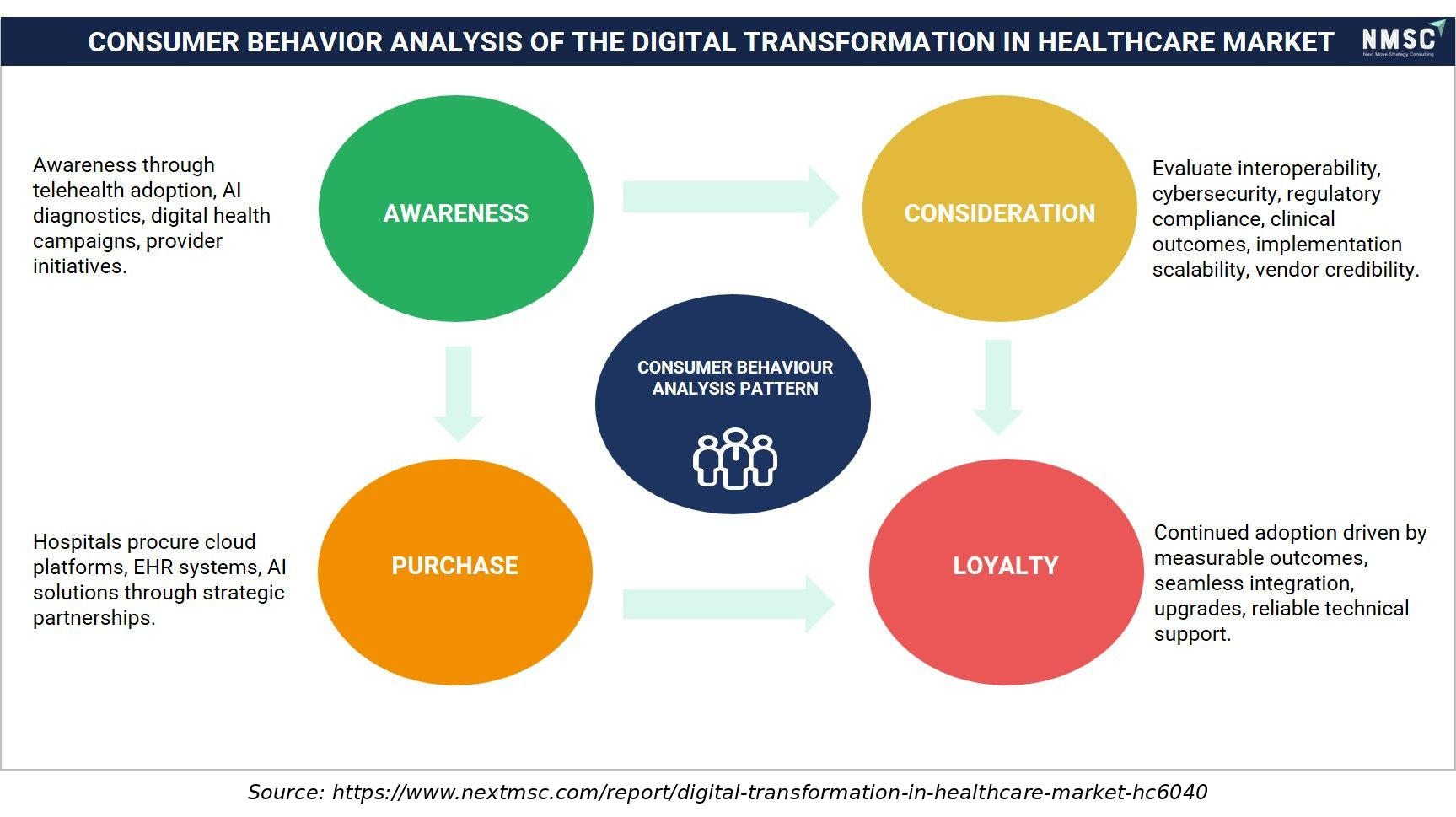
Consumer Behavior Analysis of the Digital Transformation in Healthcare Market

Consumer Behavior Analysis of the Digital Transformation in Healthcare Market

Based on our consumer behavior assessment, we identified that adoption of digital healthcare solutions follows a progression from awareness and evaluation to procurement and long-term engagement. Furthermore, our industry evaluation indicates that healthcare providers prioritize interoperability, cybersecurity, regulatory compliance, clinical outcomes, implementation scalability, and reliable technical support, while continued satisfaction is driven by measurable operational improvements, seamless system integration, and continuous platform enhancements.

Market Drivers & Dynamics

Interactive Dataset
Rising adoption of cloud-native clinical platforms driver +3.2% Global 2026–2035
Expansion of generative AI in clinical documentation driver +2.8% North America, Europe 2026–2032
Government digital health investment programs driver +2.1% Asia-Pacific, MEA 2026–2035
Growth in value-based care and interoperability mandates driver +1.9% North America, Europe 2026–2035
Rising cybersecurity threats to healthcare data driver +1.4% Global 2026–2033
High implementation and integration costs restraint −1.8% Global 2026–2030
Shortage of skilled healthcare IT and data talent restraint −1.3% North America, Europe 2026–2031
Data privacy and cross-border compliance complexity restraint −1.1% Europe, Asia-Pacific 2026–2035
Legacy system interoperability constraints restraint −0.9% Global 2026–2029
Source: Next Move Strategy Consulting

Growth Drivers

What Is the Primary Growth Driver?

The primary growth driver is the accelerating shift toward cloud-native clinical and administrative platforms that replace on-premise legacy systems. Our assessment indicates that this migration lowers total cost of ownership while enabling faster deployment of analytics and AI capabilities. The U.S. Department of Health and Human Services reported continued growth in certified health IT adoption among hospitals through 2025, supporting sustained platform modernization investment across provider networks.

How Is Generative AI Driving the Market Growth?

Generative AI adoption is directly driving market growth by automating documentation, coding, and patient communication tasks that previously required significant staff time. We observed that health systems piloting ambient AI tools report measurable reductions in clinician administrative burden, reinforcing return-on-investment cases for broader rollout. The U.S. Food and Drug Administration's authorization of an expanding number of AI-enabled medical devices through 2025 signals accelerating regulatory acceptance of clinical AI applications.

Growth Inhibitors

What Is Restraining the Digital Transformation in Healthcare Market?

High implementation and integration costs remain the primary restraint, particularly for mid-sized and rural healthcare providers with constrained capital budgets. Next Move Strategy Consulting's analysis indicates that multi-year system migrations, alongside the added expense of cloud workload protection and healthcare data security controls, often exceed initial budget estimates, delaying return on investment among smaller provider organizations.

What Are the Growth Opportunities?

How Can Ambient AI Documentation Create New Revenue for Vendors?

Software vendors that bundle ambient clinical documentation with existing electronic health record platforms can capture incremental subscription revenue from health systems seeking to offset clinician burnout. This mechanism benefits established clinical information platform vendors with existing hospital footprints and integration rights.

What Opportunity Exists in Mid-Market Cloud Migration Services?

Mid-sized hospitals and ambulatory networks that have delayed cloud migration represent a significant services opportunity for systems integrators offering fixed-fee modernization packages. This mechanism benefits healthcare digital transformation services providers and regional systems integrators serving cost-constrained provider segments.

How Does Remote Patient Monitoring Expand Payer-Funded Digital Health?

Payers reimbursing remote patient monitoring and connected chronic-disease management programs create recurring revenue opportunities for Internet of Medical Things device makers and virtual care platform vendors expanding telemedicine capabilities. This mechanism benefits medical technology companies and virtual care platform providers targeting chronic-condition populations.

Segmentation Analysis

2025 (USD Billion)
2035 (USD Billion)
Software Platforms 2025: $85.82 Billion | 2035: $294.18 Billion
Software Pla
Healthcare Data and Analytics Platforms 2025: $53.00 Billion | 2035: $245.15 Billion
Healthcare D
Digital Solutions 2025: $30.29 Billion | 2035: $107.87 Billion
Digital Solu
Healthcare Cloud Solutions 2025: $35.34 Billion | 2035: $137.28 Billion
Healthcare C
Healthcare Connected Digital 2025: $20.19 Billion | 2035: $88.25 Billion
Healthcare C
Healthcare Cybersecurity Solutions 2025: $15.14 Billion | 2035: $58.84 Billion
Healthcare C
Healthcare Digital Transformation Services 2025: $12.62 Billion | 2035: $49.03 Billion
Healthcare D
Software Platforms $85.82 Billion $294.18 Billion 12.9%
Healthcare Data and Analytics Platforms $53.00 Billion $245.15 Billion 16.8%
Digital Solutions $30.29 Billion $107.87 Billion 13.4%
Healthcare Cloud Solutions $35.34 Billion $137.28 Billion 14.5%
Healthcare Connected Digital $20.19 Billion $88.25 Billion 16.0%
Healthcare Cybersecurity Solutions $15.14 Billion $58.84 Billion 14.5%
Healthcare Digital Transformation Services $12.62 Billion $49.03 Billion 14.5%

Which Offering Segment Dominates the Market?

Software Platforms dominated the offering segment with approximately 34% share in 2025, supported by widespread clinical information and administrative platform renewal cycles across large hospital networks. Our analysis shows that Healthcare Data and Analytics Platforms is the fastest-growing category at a 16.8% CAGR through 2035, driven by demand for predictive and generative healthcare AI applications, complementing adjacent categories such as digital therapeutics solutions within the broader digital health ecosystem.

2025 (USD Billion)
2035 (USD Billion)
Cloud
On-Premise
Edge
Segment Item 2025 (USD Billion) 2035 (USD Billion) CAGR
Cloud $10.0 USD Billion $40.0 USD Billion 18.0%
On-Premise $17.1 USD Billion $51.1 USD Billion 24.0%
Edge $24.2 USD Billion $62.2 USD Billion 26.0%

Segment-wise data is locked

Unlock complete segment-wise numbers for By Deployment Model.

Unlock Full Data

Which Deployment Model Leads Adoption?

Cloud deployment led the market with approximately 60% share in 2025, reflecting healthcare organizations' preference for scalable, subscription-based infrastructure built on modern cloud computing architectures over capital-intensive on-premise systems. We found that Edge deployment is the fastest-growing model at a 16.9% CAGR, driven by real-time processing needs for remote patient monitoring and connected medical devices at the point of care.

2025 (USD Billion)
2035 (USD Billion)
Artificial I
Machine Lear
Generative A
Natural Lang
Computer Vis
Segment Item 2025 (USD Billion) 2035 (USD Billion) CAGR
Artificial Intelligence $10.0 USD Billion $40.0 USD Billion 16.0%
Machine Learning $17.1 USD Billion $51.1 USD Billion 22.0%
Generative AI $24.2 USD Billion $62.2 USD Billion 16.0%
Natural Language Processing $31.3 USD Billion $73.3 USD Billion 26.0%
Computer Vision $38.4 USD Billion $84.4 USD Billion 25.0%

Segment-wise data is locked

Unlock complete segment-wise numbers for By Technology.

Unlock Full Data

Which Technology Segment Is Growing Fastest?

Artificial Intelligence led the technology segment with approximately 27% share in 2025 and also posted the fastest CAGR of 16.3% through 2035, reflecting simultaneous scale and momentum. Our assessment indicates that machine learning and generative AI sub-technologies are being embedded across clinical, administrative, and imaging workflows simultaneously, while the Internet of Medical Things follows closely as connected monitoring devices proliferate across remote and in-hospital care settings.

2025 (USD Billion)
2035 (USD Billion)
Healthcare P
Healthcare P
Life Science
Medical Tech
Government a
Segment Item 2025 (USD Billion) 2035 (USD Billion) CAGR
Healthcare Providers $10.0 USD Billion $40.0 USD Billion 22.0%
Healthcare Payers $17.1 USD Billion $51.1 USD Billion 12.0%
Life Sciences Companies $24.2 USD Billion $62.2 USD Billion 14.0%
Medical Technology Companies $31.3 USD Billion $73.3 USD Billion 12.0%
Government and Public Health Organizations $38.4 USD Billion $84.4 USD Billion 15.0%

Segment-wise data is locked

Unlock complete segment-wise numbers for By Buyer Type.

Unlock Full Data
2025 (USD Billion)
2035 (USD Billion)
Software Sub
Software Lic
Cloud Consum
Professional
Managed Serv
Segment Item 2025 (USD Billion) 2035 (USD Billion) CAGR
Software Subscription $10.0 USD Billion $40.0 USD Billion 15.0%
Software License $17.1 USD Billion $51.1 USD Billion 21.0%
Cloud Consumption $24.2 USD Billion $62.2 USD Billion 23.0%
Professional Services $31.3 USD Billion $73.3 USD Billion 21.0%
Managed Services $38.4 USD Billion $84.4 USD Billion 22.0%

Segment-wise data is locked

Unlock complete segment-wise numbers for By Revenue Stream.

Unlock Full Data

Growth Opportunities

Our findings suggest that three forward-looking whitespace opportunities stand out for stakeholders positioning ahead of 2035 demand curves.

How Can Ambient AI Documentation Create New Revenue for Vendors?

Software vendors that bundle ambient clinical documentation with existing electronic health record platforms can capture incremental subscription revenue from health systems seeking to offset clinician burnout. This mechanism benefits established clinical information platform vendors with existing hospital footprints and integration rights.

What Opportunity Exists in Mid-Market Cloud Migration Services?

Mid-sized hospitals and ambulatory networks that have delayed cloud migration represent a significant services opportunity for systems integrators offering fixed-fee modernization packages. This mechanism benefits healthcare digital transformation services providers and regional systems integrators serving cost-constrained provider segments.

How Does Remote Patient Monitoring Expand Payer-Funded Digital Health?

Payers reimbursing remote patient monitoring and connected chronic-disease management programs create recurring revenue opportunities for Internet of Medical Things device makers and virtual care platform vendors expanding telemedicine capabilities. This mechanism benefits medical technology companies and virtual care platform providers targeting chronic-condition populations.

Regional Outlook

2025 (USD Billion)
2035 (USD Billion)
North Americ
Europe
Asia-Pacific
Middle East
Latin Americ
Region 2025 (USD Billion) 2035 (USD Billion) CAGR (%)
North America $10.0 USD Billion $40.0 USD Billion 9.0%
Europe $17.1 USD Billion $51.1 USD Billion 27.0%
Asia-Pacific $24.2 USD Billion $62.2 USD Billion 25.0%
Middle East & Africa $31.3 USD Billion $73.3 USD Billion 23.0%
Latin America $38.4 USD Billion $84.4 USD Billion 12.0%

Regional data is locked

Unlock complete regional numbers for this market.

Unlock Full Data

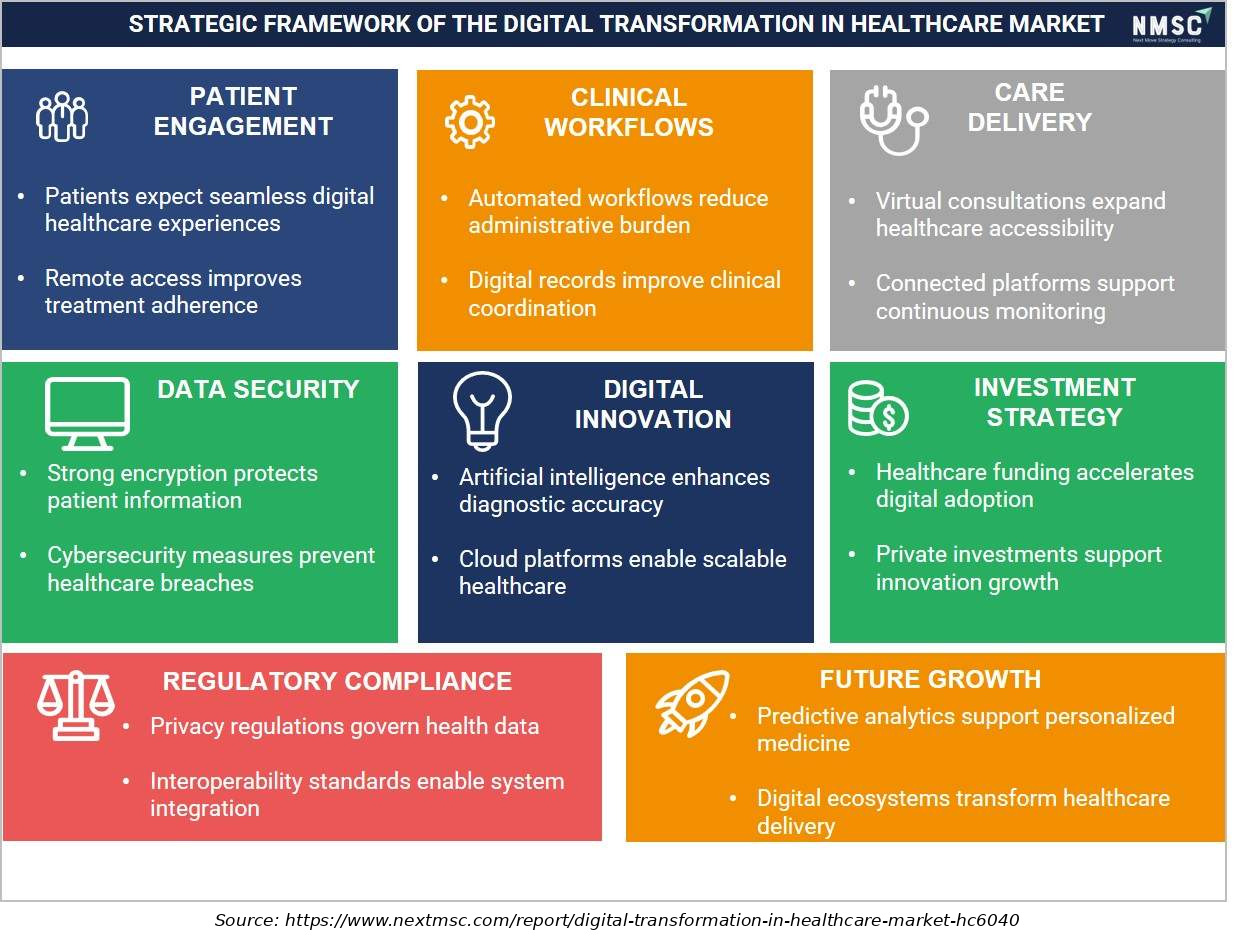
Strategic Framework of the Digital Transformation in Healthcare Market

Strategic Framework of the Digital Transformation in Healthcare Market
Based on our strategic assessment, we identified that the digital transformation in healthcare market is shaped by patient engagement, clinical workflow optimization, digital care delivery, data security, digital innovation, investment strategies, regulatory compliance, and future growth initiatives. Furthermore, our industry evaluation indicates that secure digital platforms, artificial intelligence, cloud-based healthcare solutions, supportive investments, and robust regulatory frameworks improve care delivery, enhance operational efficiency, strengthen patient outcomes, and accelerate the modernization of healthcare systems.

Competitive Landscape

We observed that the competitive landscape spans global technology conglomerates, specialized health IT vendors, and systems integrators, each pursuing distinct differentiation strategies to capture share across the digital transformation in healthcare value chain.

Dimension Description
Market Structure Moderately fragmented, with global technology conglomerates competing alongside specialized clinical software vendors
Innovation Focus Generative AI clinical documentation, ambient intelligence, and interoperable cloud data platforms
M&A Activity Active consolidation as large vendors acquire specialized AI and analytics firms to expand platform capabilities

How Do Companies Compete in the Digital Transformation in Healthcare Market?

Companies compete primarily on platform breadth, interoperability certification, and depth of clinical AI capability rather than price alone. Our analysis shows that vendors bundling clinical, administrative, and analytics modules into unified suites are winning larger enterprise contracts against point-solution providers, particularly among health systems seeking to consolidate vendor relationships and reduce integration overhead across departments.

Which Competitive Archetypes Dominate the Industry?

Three archetypes dominate: global cloud and technology conglomerates offering horizontal AI and infrastructure capabilities, specialized clinical software vendors with deep electronic health record expertise, and consulting-led systems integrators managing large-scale implementation programs. This differentiation explains why enterprise deals increasingly involve multi-vendor partnerships rather than single-supplier procurement across the industry.

What Innovation and Differentiation Strategies Are Companies Pursuing?

Leading vendors are differentiating through proprietary generative AI models trained on clinical data, expanded interoperability partnerships, and vertical-specific compliance certifications. Our findings suggest that companies investing early in ambient documentation and predictive analytics are capturing disproportionate enterprise mindshare, positioning them favorably as health systems evaluate long-term platform partners through 2035.

Key Market Players

Our assessment indicates that the following companies represent the leading validated participants shaping the competitive structure of the digital transformation in healthcare market.

Microsoft Corporation Oracle Corporation Amazon Web Services, Inc. Alphabet Inc. International Business Machines Corporation Accenture plc Cognizant Technology Solutions Corporation Tata Consultancy Services Limited Siemens Healthineers AG Koninklijke Philips N.V. GE HealthCare Technologies Inc. Epic Systems Corporation SAP SE Salesforce, Inc. Optum, Inc. Veeva Systems Inc. IQVIA Holdings Inc. Dassault Systèmes SE Infosys Limited Wipro Limited

Latest Developments

We observed that vendor activity through 2025 and into 2026 has concentrated on generative AI product launches, cloud platform expansions, and strategic partnerships across the digital transformation in healthcare value chain, including advances in connected clinical alarm management and patient safety systems.

Date Event
April 2026 Alphabet Inc. (via Google) announced an initiative with the Centers for Medicare & Medicaid Services (CMS) to expand consumer access to medical records through the Fitbit app. The initiative enables users in the U.S. Public Preview to securely link medical records, including lab results, medications, and visit history, supported by identity verification and participating healthcare connections.
April 2026 Siemens Healthineers AG expanded its manufacturing footprint in India by beginning local production of the Artis One Edition X angiography system at its Bengaluru facility. The system provides advanced imaging capabilities and workflow efficiency and is part of Siemens Healthineers’ broader portfolio of locally manufactured imaging and medical technology solutions.
April 2025 Health Catalyst, Inc. announced a strategic partnership with Microsoft Corporation to accelerate AI adoption and digital transformation across healthcare organizations. The collaboration combines Microsoft Azure and Azure AI Foundry with Health Catalyst’s data and analytics solutions, which are also available through the Azure Marketplace, to support data-driven operational, clinical, and financial improvements.

Investment Opportunities

How Are Capital Inflows Shaping the Market?

Venture and private equity capital continues flowing into generative healthcare AI and cloud interoperability startups, reflecting investor confidence in recurring subscription revenue models. Our analysis shows that later-stage funding rounds increasingly target companies with proven enterprise health system deployments rather than early-stage pilots, signaling a maturing investment landscape through 2035.

What Infrastructure Investment Trends Are Emerging?

Health systems and technology vendors are investing heavily in cloud data infrastructure and secure interoperability networks to support AI workloads at scale, including early-stage pilots of blockchain-enabled healthcare data exchange for tamper-evident records. We observed that infrastructure spending is increasingly directed toward hybrid cloud architectures balancing data residency with computational flexibility.

What ESG Considerations Influence Investment Decisions?

Environmental, social, and governance considerations increasingly factor into digital health investment decisions, particularly around data privacy, algorithmic bias mitigation, and equitable access to virtual care technologies. Our assessment indicates that investors are prioritizing vendors with transparent AI governance frameworks, aligning with tightening regulatory disclosure expectations across major markets through 2035.

Key Benefits for Stakeholders

How Does This Report Benefit Healthcare Industry Leaders?

Healthcare industry leaders gain granular segmentation, regional, and competitive benchmarking data to prioritize technology investment decisions. Our analysis shows that this report's forecasts and driver analysis support strategic roadmap development for cloud migration, AI adoption, and interoperability initiatives across provider and payer organizations through 2035.

How Does This Report Benefit Investors and Financial Analysts?

Investors and financial analysts benefit from validated market sizing, growth driver analysis, and competitive landscape insights that support capital allocation decisions across the digital transformation in healthcare value chain. We found that the report's regional and segmental forecasts help identify high-growth investment pockets ahead of broader market recognition.

How Does This Report Benefit Technology Vendors and Product Teams?

Technology vendors and product teams gain insight into buyer priorities, competitive differentiation strategies, and emerging whitespace opportunities across offering, deployment, and technology segments. Our findings suggest that this analysis supports product roadmap prioritization and go-to-market strategy refinement across provider, payer, and life sciences customer segments through 2035.

Key Market Segments Evaluated

By Offering

  • Software Platforms
  • Healthcare Data and Analytics Platforms
  • Digital Solutions
  • Healthcare Cloud Solutions
  • Healthcare Connected Digital
  • Healthcare Cybersecurity Solutions
  • Healthcare Digital Transformation Services

By Deployment Model

  • Cloud
  • On-Premise
  • Edge

By Technology

  • Artificial Intelligence
  • Cloud Computing
  • Big Data and Analytics
  • Internet of Medical Things
  • Cybersecurity Technologies
  • Interoperability Technologies
  • Automation Technologies

By Buyer Type

  • Healthcare Providers
  • Healthcare Payers
  • Life Sciences Companies
  • Medical Technology Companies
  • Government and Public Health Organizations

By Revenue Stream

  • Software Subscription
  • Software License
  • Cloud Consumption
  • Professional Services
  • Managed Services
  • Transaction-Based

Conclusion & Recommendations

The long-term outlook remains strongly positive, with the market projected to expand from USD 252.40 billion in 2025 to USD 980.60 billion by 2035 at a 14.5% CAGR. Our analysis shows that cloud-native platforms and generative AI applications will anchor sustained double-digit growth as health systems complete multi-year modernization programs through the forecast period.

What Are the Strategic Positioning Recommendations?

Vendors should prioritize unified platform strategies that bundle clinical, administrative, and analytics capabilities rather than competing as point solutions. We observed that companies investing in interoperability certification and proven enterprise deployments are best positioned to capture large health system contracts through 2035.

How Attractive Is the Market for Investment?

Investment attractiveness remains high given the market's scale, sustained double-digit growth, and recurring subscription revenue models across cloud and AI platforms. Our findings suggest that companies with proven generative AI deployments and strong interoperability credentials represent the most attractive investment targets through the forecast period.

What Market Shifts and Key Risks Should Stakeholders Monitor?

Stakeholders should monitor tightening AI governance regulation, rising cybersecurity threats, and potential integration cost overruns as key risks. Next Move Strategy Consulting's analysis indicates that vendors unable to demonstrate clear compliance and security credentials may face slower enterprise procurement cycles through 2035.

What Are the Primary Growth Pathways?

Primary growth pathways include expanding generative AI documentation tools, deepening interoperability partnerships, and extending cloud platform adoption into mid-sized and emerging-market health systems. Our assessment indicates that vendors executing across all three pathways simultaneously will capture disproportionate share of the USD 691.00 billion incremental opportunity through 2035.

FAQs

About the Author

Saista Faiyaz

Saista Faiyaz

Saista Faiyaz is Research Associate at Next Move Strategy Consulting, where she has covered consumer markets and healthcare technologies for 3 years. Her work includes primary interview review, secondary-source validation, market sizing, and structured analysis of company and industry data. She supports research by comparing evidence across sources, organizing findings into market narratives, and documenting assumptions used in analysis. Her scope includes cross-market benchmarking, and reports.

About the Reviewer

Supradip Baul

Supradip Baul

Supradip Baul is an accomplished business consultant and strategist with over a decade of rich experience in market intelligence, strategy, technology, and business transformation. His work has included rigorous qualitative and quantitative analysis across multiple industries, helping clients shape investment decisions and long-term roadmaps. Earlier in his career, he was associated with Gartner, where he contributed to industry-leading reports and market share analyses. He has worked with leading global companies and holds an MBA with a dual specialization in Marketing and Finance.

Download Free Sample

Ross J Mckenzie

ROSS J MCKENZIE

Business Insight Manager

Staysure Group

“Next MSC have been incredibly helpful in providing detailed & robust information on our market, alongside quantifying growth by different segments. The process to procure was simple and easy, with sample reports and regular contact to ensure we had what we needed. Succinct detail on their sources & methodologies is also greatly received, allowing transparency in this respect helps build trust in the detail you pay for. Joseph in particular was fantastic, and helped ensure efficient provision of the insight pack – thank you NMSC!”.

Gustaf Hummel Burstrom

GUSTAF HUMMEL BURSTROM

Founder

Revline Tools AB

Joseph and the team at Next Move Strategy Consulting have been excellent to work with, in supplying us with relevant market data and forecasts for our specific category. We had some special requirements and they were able to do a custom package to suit our needs. We would definitely recommend them to any other company needing market data and forecasts

Gaurav Jaiswal

GAURAV JAISWAL

Founder & CEO

Yano Charge Private Limited

The EV Charging market research report provided by the NextMSC was exceptionally detailed and insightful. It offered a comprehensive analysis that proved to be a game-changer for our strategic planning. Truly a testament to the NextMSC’s expertise and thoroughness in EV market landscape & analysis.

Semih Kavaklioglu

SEMIH KAVAKLIOGLU

Co-Founder & Sales Manager

Decortie

I work a lot in the marketing industry and I know that research is an essential part of any campaign. I have used Market research reports for my own products and I found them to be very informative and well-researched. The team here produces insightful reports for a good price

Mohit Agarwal

MOHIT AGARWAL

Chief Manager

DryChem India Pvt. Ltd.

Next Move Strategy Consulting is an amazing team of consultants. We required a market study report for our investors on top priority and the team went above and beyond our expectations to deliver the same with ample supporting data within a short time span enabling us to secure the investments and keep our project timeline maintained. Their professionalism, attention to detail, and timely delivery of actionable recommendations have left a lasting impression on our organization.

Custom Market Research Services

We will customize the research for you if the listed report does not fully match your requirements.

Get 30% Free Customization

Select License

This website uses cookies to ensure you get the best experience on our website. Learn more

✖