Direct Battery Recycling Market Size, Share, Trends and Growth Analysis, By Revenue Type (Material Sales, Service Fees, and Technology Revenue), By Technology Type (Direct Cathode Regeneration, Direct Hydrometallurgical CAM Synthesis, Anode Regeneration, & Others), By Feedstock Chemistry, By Scrap Origin, By Commercial Model, By Buyer Type (Automotive OEMs, Battery Cell Makers, Cathode Active Material Makers, & Others), and Region — Global Industry Report and Forecast, 2026–2035
Industry: Energy & Power | Publishing Date: July 27, 2026 | Last Updated: September 30, 2026 | No of Pages: N/A | No. of Tables: N/A | No. of Figures: N/A | Format: PDF | Report Code: EP5414
What Is the Direct Battery Recycling Market Size?
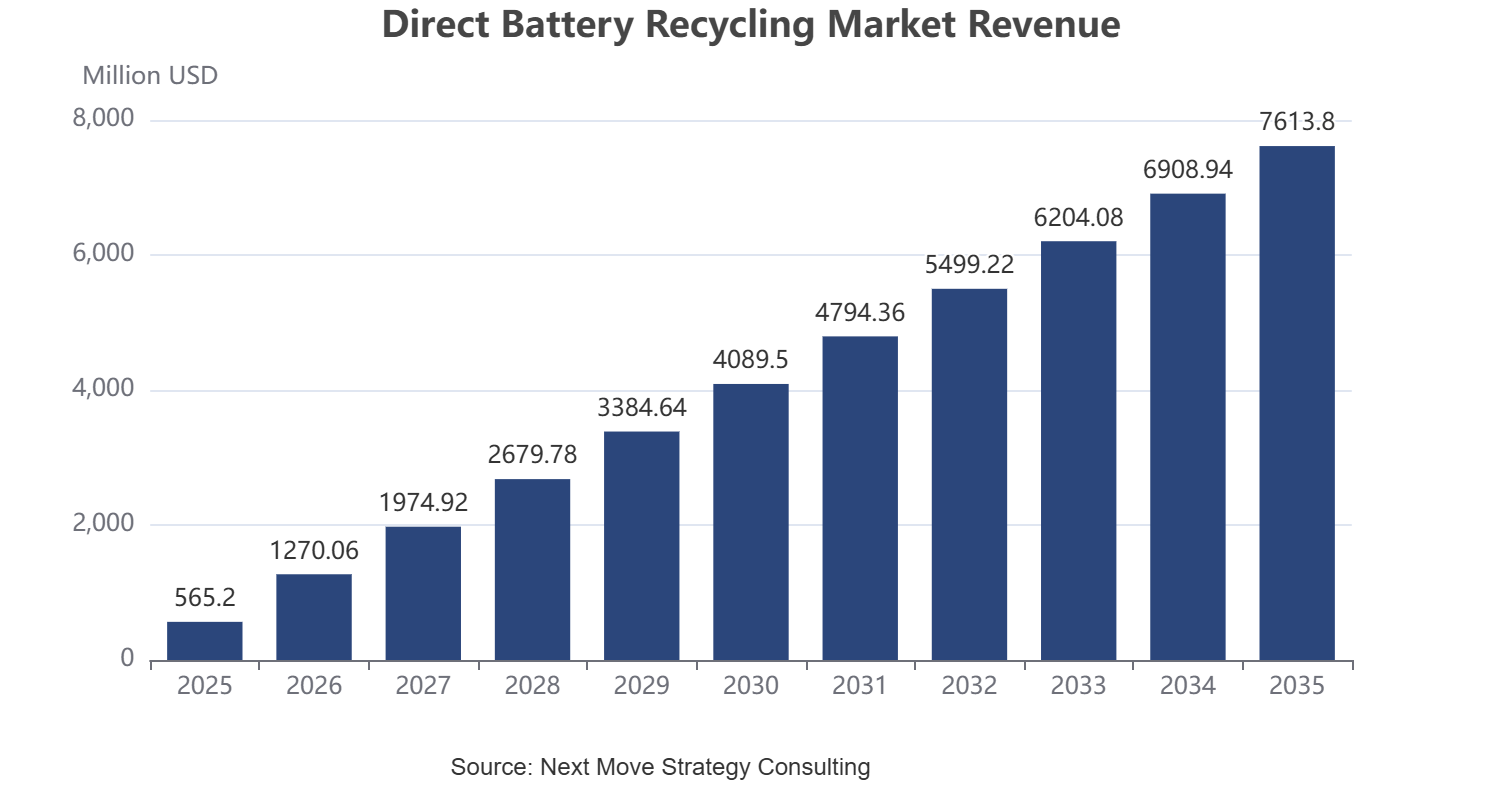
The global direct battery recycling market size was valued at USD 565.2 Million in 2025 and is estimated at USD 733.1 Million in 2026, forecast to reach USD 7613.8 Million by 2035, expanding at a 29.7% CAGR between 2026 and 2035. Asia-Pacific leads with approximately a 46% share, while Material Sales dominates all other revenue categories with approximately a 58% share.
We observed that growth is broad-based across every segmentation axis, with production scrap volumes and direct cathode regeneration technology driving the dominant structural shifts through 2035, even as early movers in the sector navigate near-term financial consolidation.
|
Key Takeaways |
|
By Revenue Type: Material Sales held the largest share of approximately 58% (USD 0.33 billion) in 2025; Technology Revenue is the fastest-growing sub-segment at 34.3% CAGR from 2026–2035. |
|
By Technology Type: Direct Cathode Regeneration held the largest share of approximately 40% (USD 0.23 billion) in 2025; Anode Regeneration is the fastest-growing sub-segment at 34.3% CAGR from 2026–2035. |
|
By Feedstock Chemistry: Nickel Manganese Cobalt held the largest share of approximately 38% (USD 0.21 billion) in 2025; Lithium Iron Phosphate is the fastest-growing sub-segment at 33.7% CAGR from 2026–2035. |
|
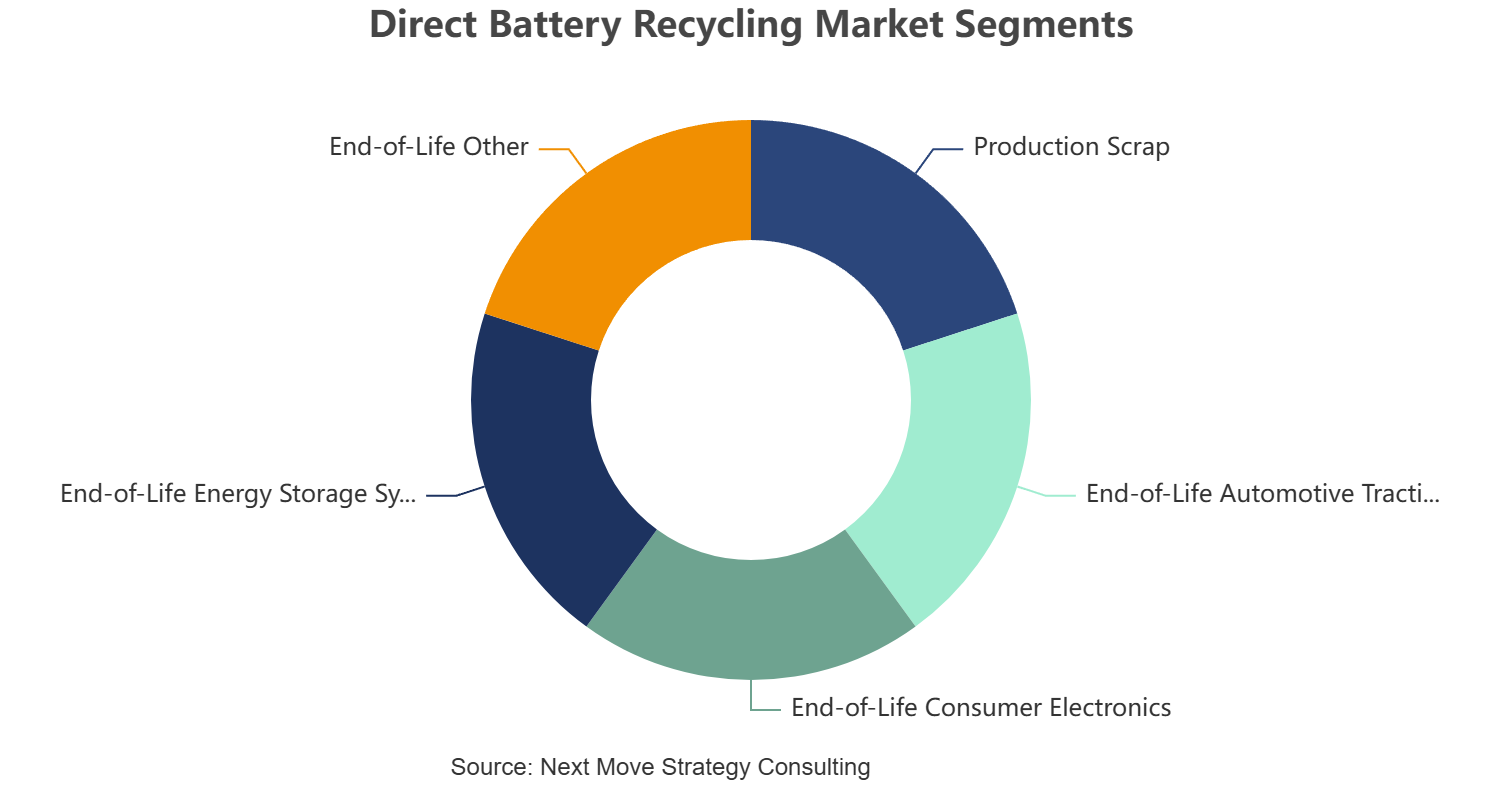
By Scrap Origin: Production Scrap held the largest share of approximately 44% (USD 0.25 billion) in 2025; End-of-Life Automotive Traction Batteries is the fastest-growing sub-segment at approximately 33.0% CAGR from 2026–2035. |
|
By Commercial Model: Toll Processing Agreement held the largest share of approximately 36% (USD 0.20 billion) in 2025; Joint Venture Tolling is the fastest-growing sub-segment at approximately 33.0% CAGR from 2026–2035. |
|
By Buyer Type: Battery Cell Makers held the largest share of approximately 32% (USD 0.18 billion) in 2025; Energy Storage Developers is the fastest-growing sub-segment at approximately 34.0% CAGR from 2026–2035. |
|
Dominant Region: Asia-Pacific dominated with approximately 46% revenue share (USD 0.26 billion) in 2025. |
|
Fastest-Growing Region: North America is expected to register the highest CAGR of 33.6% during 2026–2035. |
|
Dominant Country: China led with approximately USD 0.13 billion in 2025. |
|
Fastest-Growing Country: India is the fastest-growing country at approximately 36.0% CAGR from 2026–2035. |
Market Opportunity: The direct battery recycling market is expected to create an absolute dollar opportunity of USD 6.88 Billion between 2026 and 2035, presenting significant investment potential across cathode regeneration technology, black mass processing infrastructure, and toll recycling capacity.
According to NMSC analysis, buyers are increasingly favouring producers with diversified feedstock contracts spanning both production scrap and end-of-life sources over single-source suppliers, a shift that rewards vertically integrated operators as financial distress among early single-technology entrants reshapes competitive positioning through 2035.
What Does the Direct Battery Recycling Market Encompass?
The direct battery recycling industry encompasses technologies and services that regenerate cathode and anode active materials from lithium-ion battery scrap without fully breaking down compounds into constituent metals, preserving crystal structure to reduce cost and environmental impact relative to conventional hydrometallurgical or pyrometallurgical recycling. Our assessment indicates that the scope spans direct cathode regeneration, direct hydrometallurgical CAM synthesis, anode regeneration, and pre-processing technologies serving automotive OEMs, battery cell makers, cathode active material makers, and energy storage developers seeking domestically sourced, lower-carbon battery materials.
Regulatory frameworks such as the European Union's Battery Regulation, which mandates minimum recycled lithium, cobalt, and nickel content in industrial and electric vehicle batteries starting in 2030, and the U.S. Department of Energy's critical minerals supply chain programs are reshaping sourcing requirements. We observed that technology adoption is shifting toward direct regeneration routes validated to recover lithium-ion battery cathode performance comparable to virgin material. NMSC's analysis indicates that this structural shift, combined with feedstock timing constraints as end-of-life volumes remain limited before 2030, is redefining commercial strategy across the direct battery recycling market.
|
Parameters |
Details |
|
Market Size in 2025 |
USD 565.2 Million |
|
Market Size in 2026 |
USD 733.1 Million |
|
Revenue Forecast in 2035 |
USD 7613.8 Million |
|
Growth Rate |
CAGR of 29.7% from 2026 to 2035 |
|
Analysis Period |
2025–2035 |
|
Base Year Considered |
2025 |
|
Forecast Period |
2026–2035 |
|
Market Size Estimation |
USD Million |
|
Companies Profiled |
20 |
|
Countries Covered |
38 |
|
Market Share |
Available for Top 10 Companies |
Key Emerging Trends
Based on research conducted by NMSC, we found that four structural trends are reshaping technology adoption, business models, and stakeholder engagement across the industry.
How Is Direct Cathode Regeneration Reaching Commercial Scale?
Direct cathode regeneration is transitioning from pilot to commercial scale as validated processes demonstrate cost and yield advantages over conventional recycling. We observed that Princeton NuEnergy's Chester, South Carolina facility became the United States' first commercial-scale direct recycling site in August 2025, delivering a recycling yield exceeding 97% while achieving a 38% cost reduction relative to conventional processes. Manufacturers are positioning direct regeneration as the standard response to rising cathode material costs.
Why Is Second-Life Integration Blurring Recycling and Energy Storage?
Recyclers are increasingly integrating second-life battery repurposing alongside direct material recovery to capture additional value from retired packs before final recycling. Our findings suggest that Redwood Materials launched its Redwood Energy division in June 2025, repurposing retired electric vehicle packs into second-life EV battery storage systems for data centers and grid applications. This trend reflects growing recognition that recycling economics improve when combined with staged value extraction across a battery's remaining useful life.
How Is Feedstock Timing Reshaping Direct Recycling Business Models?
Feedstock availability timing is reshaping business models as recyclers confront the reality that end-of-life volumes remain limited relative to manufacturing scrap. We observed that the International Energy Agency reports scrap accounting for roughly two-thirds of available recycling feedstock through 2030, while electric vehicle batteries typically last 12 to 15 years, meaning retired packs will not become a dominant waste stream until after 2040. Companies are adapting by prioritizing production scrap partnerships with cell and cathode active material makers.
What Role Does Financial Consolidation Play in Market Structure?
Financial consolidation among early movers is reshaping competitive structure as commodity price declines and policy uncertainty pressure single-technology operators. Our analysis shows that Ascend Elements filed for Chapter 11 bankruptcy protection in April 2026 after forgoing federal grants tied to its cathode active material plans, while Li-Cycle entered creditor protection in May 2025 despite an unclaimed USD 475 million Department of Energy loan commitment. This trend favors diversified, better-capitalized operators such as Redwood Materials.
Growth Drivers and Restraints
Growth Catalyst and Risk Assessment Matrix
|
Factors |
Type |
(+/−) % Impact on CAGR |
Geographic Relevance |
Impact Timeline |
|
EU Battery Regulation recycled content mandates |
Driver |
+5.8% |
Europe |
2026–2035 |
|
Domestic critical minerals supply chain policy |
Driver |
+4.6% |
North America, Europe |
2026–2035 |
|
Cost and yield advantages of direct regeneration processes |
Driver |
+3.9% |
Global |
2026–2032 |
|
Rising production scrap volumes from cell manufacturing expansion |
Driver |
+3.2% |
Asia-Pacific, North America |
2026–2032 |
|
Second-life and stationary storage value chain integration |
Driver |
+2.1% |
North America, Europe |
2026–2035 |
|
Automaker demand for lower-carbon battery materials |
Driver |
+1.8% |
Europe, North America |
2026–2035 |
|
Limited end-of-life battery volumes before 2030s |
Restraint |
-3.4% |
Global |
2026–2032 |
|
Financial distress and consolidation among early operators |
Restraint |
-2.6% |
North America |
2026–2030 |
|
Commodity price volatility for cathode and anode materials |
Restraint |
-1.9% |
Global |
2026–2035 |
|
Federal grant cancellations and policy uncertainty |
Restraint |
-1.2% |
North America |
2026–2030 |
What Is the Primary Growth Driver of the Direct Battery Recycling Market?
The European Union's Battery Regulation recycled content mandates are the primary driver of the market. The regulation requires industrial and electric vehicle batteries to contain a minimum recovered share of cobalt, lithium, and nickel starting January 1, 2030, rising further by January 1, 2035, according to the European Commission. We observed that this compliance-driven demand is compelling automakers and cell makers to secure long-term direct recycling offtake agreements well ahead of the mandate's effective date.
How Is Domestic Critical Minerals Policy Driving Market Growth?
Domestic critical minerals supply chain policy is accelerating market growth as governments seek to reduce reliance on imported battery materials. The U.S. Department of Energy has supported direct recycling infrastructure through loan and grant programs, while Princeton NuEnergy's Chester, South Carolina facility demonstrates domestic production of battery-grade cathode material at commercial scale. Our assessment indicates that this policy-driven investment is expanding domestic direct recycling capacity even as some individual grant commitments face cancellation.
What Is Restraining Direct Battery Recycling Market Expansion?
Limited end-of-life battery volumes before the 2030s restrain the pace of feedstock-dependent capacity expansion. The International Energy Agency reports that manufacturing scrap will continue to account for roughly two-thirds of available recycling feedstock through 2030, delaying the point at which retired electric vehicle battery packs become a dominant waste stream. We found that this feedstock timing gap has contributed to financial distress among operators that built capacity ahead of end-of-life volume growth, including Ascend Elements and Li-Cycle.
Segmentation Analysis
Segment Sizing: By Revenue Type
|
Segment |
2025 (USD Million) |
2035 (USD Million) |
CAGR% (2026–2035) |
|
Material Sales |
327.8 |
3,942.0 |
28.2% |
|
Service Fees |
169.6 |
2,382.0 |
30.3% |
|
Technology Revenue |
67.8 |
1,290.0 |
34.3% |
|
Total |
565.2 |
7,613.8 |
29.7% |
Which Revenue Type Segment Dominates the Direct Battery Recycling Market?
Material Sales, comprising cathode active materials, anode active materials, electrolyte components, and metal foils and casings, led the market with USD 327.8 million in 2025, reflecting recyclers' primary revenue stream from selling regenerated battery materials back into the supply chain. We observed that Technology Revenue is the fastest-growing revenue type, expanding at a 34.3% CAGR from 2026 to 2035, as licensing and engineering support agreements scale alongside broader industry adoption of direct regeneration processes.
Segment Sizing: By Technology Type
|
Segment |
2025 (USD Million) |
2035 (USD Million) |
CAGR% (2026–2035) |
|
Direct Cathode Regeneration |
226.1 |
2,727.0 |
28.3% |
|
Pre-processing for Direct Routes |
158.3 |
2,064.0 |
29.3% |
|
Direct Hydrometallurgical CAM Synthesis |
124.3 |
1,748.0 |
30.3% |
|
Anode Regeneration |
56.5 |
1,074.0 |
34.3% |
|
Total |
565.2 |
7,613.8 |
29.7% |
Which Technology Type Leads Direct Battery Recycling Market Demand?
Direct Cathode Regeneration remained the leading technology within the market, valued at USD 226.1 Million in 2025 as commercial facilities including Princeton NuEnergy's Chester site validate relithiation and recoating processes at scale. Our findings suggest that Anode Regeneration is the fastest-growing technology, registering a 34.3% CAGR from 2026 to 2035, as graphite healing and purification processes mature from a smaller commercial base to meet rising demand for recovered anode material.
Segment Sizing: By Feedstock Chemistry
|
Segment |
2025 (USD Million) |
2035 (USD Million) |
CAGR% (2026–2035) |
|
Nickel Manganese Cobalt |
214.8 |
2,484.0 |
27.7% |
|
Lithium Iron Phosphate |
169.6 |
3,103.0 |
33.7% |
|
Nickel Cobalt Aluminum |
79.1 |
988.0 |
28.7% |
|
Lithium Cobalt Oxide |
56.5 |
604.0 |
26.7% |
|
Lithium Manganese Oxide |
28.3 |
280.0 |
25.8% |
|
Other Lithium-Ion Cathode Chemistries |
16.9 |
154.0 |
24.7% |
|
Total |
565.2 |
<7,613.8 |
29.7% |
Which Feedstock Chemistry Is Most Widely Processed in Direct Recycling?
Nickel Manganese Cobalt chemistry remained the dominant feedstock across the market, reaching USD 214.8 million in 2025 due to its historical prevalence in electric vehicle traction batteries reaching end-of-production scrap streams. Based on research conducted by NMSC, we found that Lithium Iron Phosphate is the fastest-growing feedstock chemistry at a 33.7% CAGR from 2026 to 2035, reflecting surging graphite-anode LFP battery production volumes in China and rising LFP scrap availability as early LFP-equipped vehicles begin retiring.
Growth Opportunities
Our analysis shows that three forward-looking opportunities stand out for stakeholders positioning within the direct battery recycling market over the 2026-2035 forecast period.
How Can Production Scrap Partnerships Unlock Value for Cell Makers?
Long-term production scrap offtake partnerships present a whitespace opportunity given that manufacturing scrap will remain the dominant feedstock through 2030. Recyclers that secure dedicated scrap supply agreements directly with battery cell makers and cathode active material makers stand to capture stable, high-purity feedstock volumes ahead of competitors still dependent on inconsistent end-of-life collection streams.
Where Do EU Recycled Content Mandates Create New Compliance Demand?
Automotive OEMs and cathode active material makers face a compliance-driven opportunity as the EU Battery Regulation's recycled content minimums for cobalt, lithium, and nickel take effect from January 2030. Vendors that secure validated, audit-ready recycled content documentation ahead of the deadline can capture long-term supply contracts with European battery and vehicle manufacturers preparing compliance strategies well in advance.
How Can Second-Life Integration Benefit Energy Storage Developers?
Energy storage developers represent an emerging opportunity for recyclers that integrate staged value extraction, repurposing retired packs for stationary storage before final material recovery. Redwood Materials' expansion into battery energy storage system applications illustrates how combining second-life deployment with eventual direct recycling can improve overall economics for both recyclers and grid-scale storage buyers.
PESTEL Analysis of the Direct Battery Recycling Industry
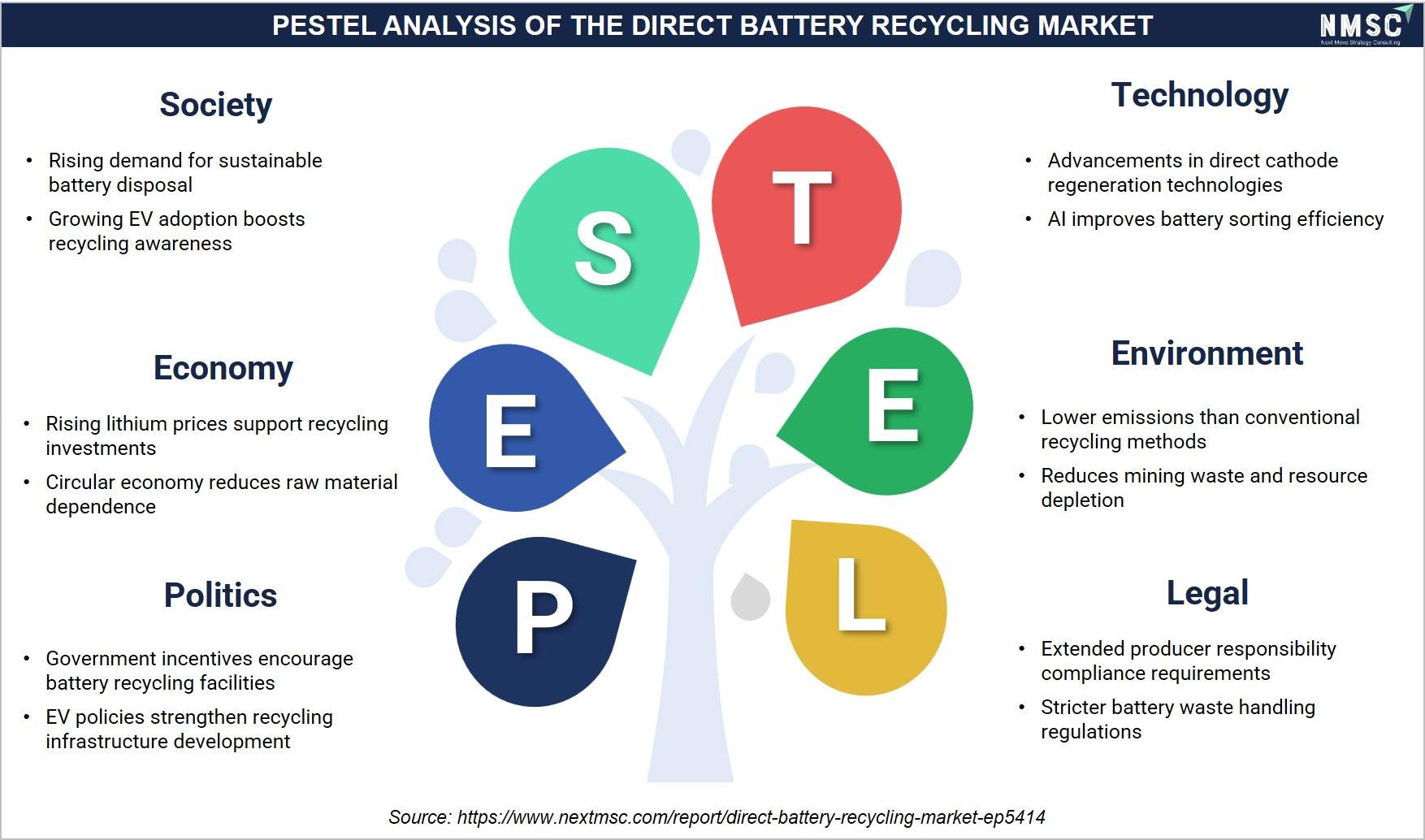
The above infographic presents a PESTEL analysis of the direct battery recycling market, where government incentives and EV policies are encouraging infrastructure development and facility investments. At the same time, rising lithium prices and circular economy goals are driving economic viability and reducing raw material dependence. Growing EV adoption and demand for sustainable technologies are shaping social acceptance, supported by advancements in direct cathode recycling and AI-driven sorting that improve efficiency. Environmental benefits such as lower emissions and reduced mining waste are further driving adoption, within a legal framework of extended producer responsibility and stricter battery waste regulations. Looking ahead, we observed that these interconnected factors collectively shape the market's evolution across the sector.
Regional Outlook
Geographic Performance Snapshot
|
Region |
2025 (USD Million) |
2035 (USD Million) |
CAGR% (2026–2035) |
Key Driver |
|
Asia-Pacific |
260.0 |
2,985.0 |
27.6% |
Battery manufacturing scale and production scrap volumes |
|
North America |
158.3 |
2,876.0 |
33.6% |
Critical minerals policy and domestic capacity build-out |
|
Europe |
113.0 |
1,402.0 |
28.6% |
EU Battery Regulation recycled content mandates |
|
Middle East & Africa |
22.6 |
240.0 |
26.7% |
Emerging critical minerals diversification strategy |
|
Latin America |
11.3 |
111.0 |
25.7% |
Growing lithium and battery supply chain investment |
|
Total |
565.2 |
7,613.8 |
29.7% |
— |
Asia-Pacific
Asia-Pacific leads the direct battery recycling market, anchored by China's dominant battery cell manufacturing base and correspondingly large production scrap volumes. We observed that regional producers including GEM and Guangdong Brunp Recycling Technology operate at substantial scale to serve domestic cathode active material demand. Technology adoption remains advanced for hydrometallurgical and pre-processing routes, while regulatory influence is increasing gradually as China tightens battery material traceability requirements.
North America
North America's market reflects an emerging, policy-driven landscape shaped by U.S. critical minerals supply chain priorities. Our findings suggest that Princeton NuEnergy's commercial-scale Chester, South Carolina facility and Redwood Materials' expanding Nevada and South Carolina operations demonstrate technology validation despite financial distress among some early entrants. Regulatory influence from Department of Energy programs remains significant, and technology adoption favors direct cathode regeneration among domestically focused operators.
Europe
Europe's direct battery recycling market is shaped decisively by the EU Battery Regulation's recycled content mandates taking effect from 2030. We observed that Germany's Duesenfeld and Belgium-headquartered Umicore are positioning direct and hydrometallurgical recovery capacity ahead of compliance deadlines. Regulatory influence is the strongest globally, technology adoption favors validated, audit-ready recycled content documentation, and strategic outlook remains positive as automakers secure long-term supply commitments.
Middle East & Africa
The direct battery recycling market in the Middle East & Africa is in an early stage, supported by Gulf Cooperation Council economies pursuing a critical minerals diversification strategy. Our analysis shows that regional investment remains limited relative to other regions, with technology adoption gradually emerging through partnerships with established international recyclers. Regulatory influence remains developing, while strategic outlook improves as regional sovereign wealth funds explore battery materials supply chain investment.
Latin America
Latin America's market is supported by the region's position within the global lithium supply chain and growing battery manufacturing investment in Brazil and Argentina. We observed that regulatory frameworks remain less developed than in Europe or North America, though multinational recyclers are beginning to evaluate regional processing capacity. Technology adoption remains nascent, with competitive intensity low given the early stage of regional direct recycling infrastructure.
China
Based on our estimates, China's market was valued at approximately USD 0.13 billion in 2025 and is projected to reach USD 1.419 billion by 2035, growing at a 27.0% CAGR. Demand is anchored by the country's dominant battery cell manufacturing base and abundant production scrap volumes. Technology penetration favors hydrometallurgical and pre-processing routes, and competitive intensity remains high among established domestic recyclers including GEM and Guangdong Brunp Recycling Technology.
India
The market in India reached roughly USD 0.026 billion in 2025 and is forecast to hit USD 0.563 billion by 2035 at a 36.0% CAGR, the fastest among covered countries. Demand structure is emerging alongside India's expanding electric vehicle manufacturing base and LOHUM Cleantech's domestic direct recycling operations. Technology penetration is rising quickly as the country seeks reduced dependence on imported battery materials, with regulatory influence remaining developmental.
Japan
As per our estimate, Japan's market stood at about USD 0.034 billion in 2025, advancing toward USD 0.290 billion by 2035 at a 24.0% CAGR. Demand is supported by Japan's established battery cell manufacturing heritage and precision materials engineering expertise. Regulatory influence is well established, technology penetration favors advanced hydrometallurgical processes, and competitive intensity remains steady among domestic materials specialists.
South Korea
According to our analysis, South Korea's market reached close to USD 0.036 billion in 2025 and is expected to hit USD 0.367 billion by 2035, growing at a 26.0% CAGR. Demand structure benefits from South Korea's globally significant battery cell manufacturing industry and EcoPro CnG's domestic direct recycling capabilities. Technology penetration is high, and competitive intensity remains pronounced amid rapid cathode material innovation cycles.
Australia
Based on our estimates, Australia's market stood at approximately USD 0.010 billion in 2025, forecast to reach USD 0.097 billion by 2035 at a 25.0% CAGR. Demand structure reflects Australia's position as a major lithium and nickel raw material supplier seeking to expand into downstream recycling value chains. Regulatory influence remains moderate, and technology penetration is gradually improving through partnerships with international recyclers.
UK
The market in the UK reached approximately USD 0.029 billion in 2025 and is projected to reach USD 0.361 billion by 2035, registering a 28.5% CAGR. Demand is underpinned by the UK's post-Brexit battery supply chain strategy and growing domestic electric vehicle manufacturing. Regulatory influence stems from evolving UK-specific battery material rules, and technology penetration favors direct cathode regeneration among emerging domestic operators.
Germany
As per our estimate, Germany's market stood at about USD 0.034 billion in 2025, advancing toward USD 0.417 billion by 2035 at a 28.5% CAGR. Demand is driven by Germany's position as Europe's largest automotive manufacturing base and home to established recycler Duesenfeld. Regulatory influence from the EU Battery Regulation is significant, and technology penetration favors validated direct recycling processes among premium automakers.
France
According to our analysis, France's market reached roughly USD 0.023 billion in 2025 and is expected to hit USD 0.278 billion by 2035, growing at a 28.5% CAGR. Demand is supported by France's expanding domestic battery gigafactory investments and national critical minerals strategy. Regulatory influence from EU-level mandates remains strong, and competitive intensity is increasing as recyclers position for compliance-driven automaker contracts.
UAE
Based on our estimates, the UAE market was valued near USD 0.008 billion in 2025, projected to reach USD 0.086 billion by 2035 at a 27.0% CAGR. Demand structure is shaped by the UAE's sovereign wealth-backed critical minerals diversification strategy. Regulatory influence remains developing, and technology penetration is improving gradually through partnerships with established international recycling technology providers.
Saudi Arabia
The market in Saudi Arabia reached approximately USD 0.009 billion in 2025 and is projected to reach USD 0.098 billion by 2035, registering a 27.0% CAGR. Demand is underpinned by Vision 2030-linked investment in battery materials supply chain diversification. Regulatory influence stems from national industrial policy, and technology penetration remains in early stages among regional operators.
South Africa
As per our estimate, South Africa's market stood at about USD 0.002 billion in 2025, advancing toward USD 0.020 billion by 2035 at a 24.0% CAGR. Demand structure reflects a nascent battery recycling base serving regional Southern African markets. Regulatory influence remains limited, and technology penetration is modest given reliance on imported recycling technology from Europe and Asia.
Brazil
According to our analysis, Brazil's market reached close to USD 0.006 billion in 2025 and is expected to hit USD 0.063 billion by 2035, growing at a 26.0% CAGR. Demand is supported by Brazil's position within the global lithium supply chain and growing domestic battery assembly investment. Regulatory influence remains developing, and competitive intensity is centered on early-stage partnerships with multinational recyclers.
Argentina
Based on our estimates, Argentina's market was valued near USD 0.002 billion in 2025, projected to reach USD 0.017 billion by 2035 at a 24.0% CAGR. Demand structure is supported by Argentina's significant lithium reserves and emerging battery materials investment despite macroeconomic volatility. Regulatory influence remains limited, and technology penetration is centered on a small number of pilot-stage recycling initiatives.
Supply Chain Analysis of the Direct Battery Recycling Industry
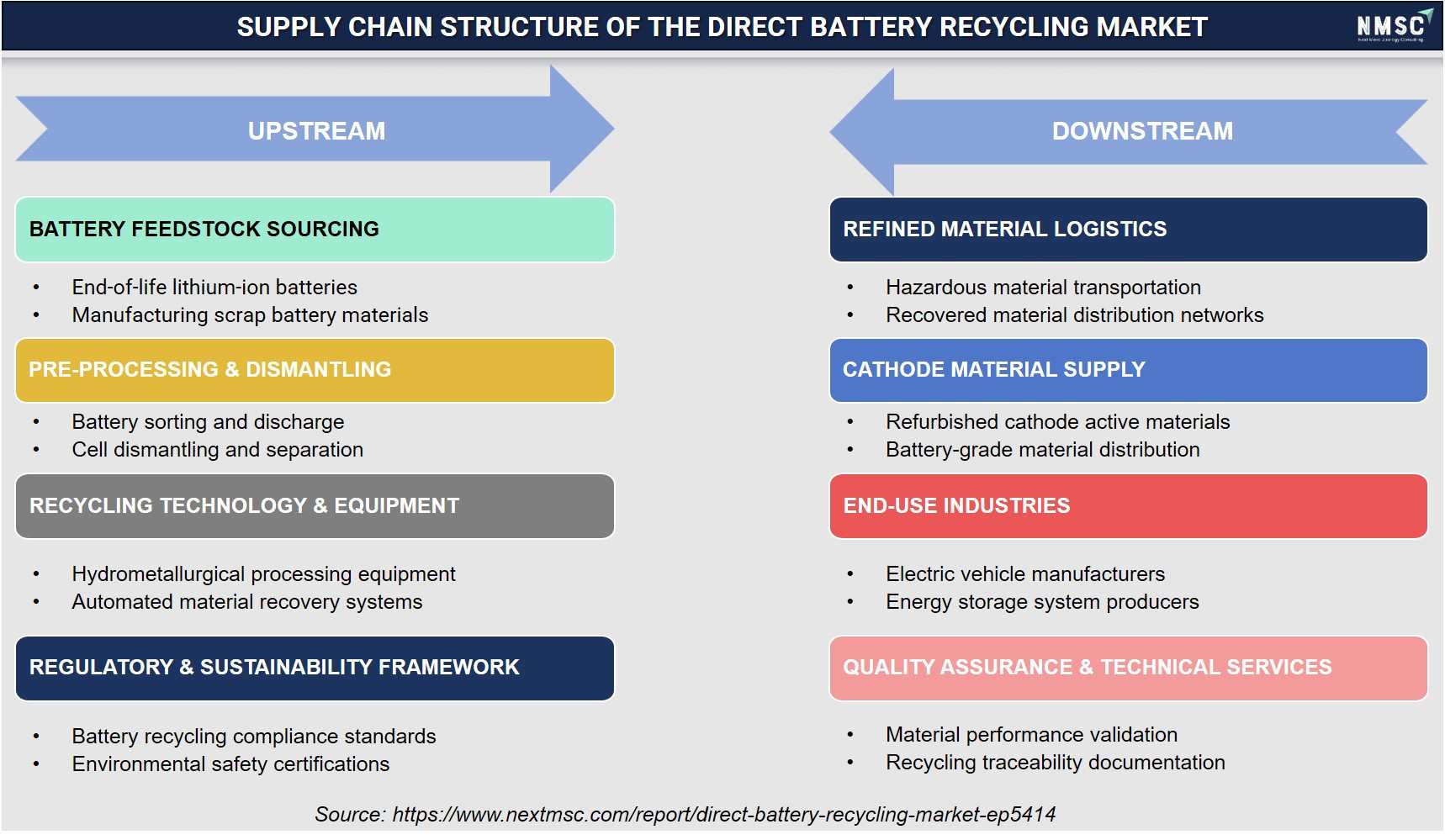
The above infographic presents the supply chain structure of the direct battery recycling market. Upstream begins with sourcing end-of-life batteries and scrap, moving into sorting, dismantling, and material recovery. Automated equipment supports recycling, while compliance with safety standards ensures regulatory adherence. Moving downstream, recovered materials supply cathode manufacturers for electric vehicle and energy storage production. Looking ahead, we observed that quality assurance and traceability ensure material reliability and sustainability across the market.
Competitive Landscape
We observed that the direct battery recycling market features a fragmented, technology-differentiated competitive landscape, with established materials companies competing alongside specialized direct recycling startups navigating significant financial and feedstock timing pressures.
|
Key Takeaways |
|
Market Structure Fragmented; large diversified materials companies such as BASF and Umicore compete alongside specialized direct recycling pioneers including Princeton NuEnergy and Redwood Materials, while several early single-technology entrants face financial distress. |
|
Innovation Focus Direct cathode regeneration yield improvement, second-life integration, and production scrap partnership models dominate current innovation pipelines across leading operators. |
|
M&A Activity Selective and increasingly distressed-asset-driven, exemplified by Ascend Elements' Chapter 11 filing in April 2026 and Li-Cycle's creditor protection proceedings in May 2025 following cost overruns. |
How Do Companies Compete in the Direct Battery Recycling Market?
Companies compete primarily on validated recycling yield, feedstock diversification, and capital resilience across the industry. Diversified materials companies such as BASF and Umicore leverage broad chemical processing expertise to serve multiple buyer types, while specialized operators including Princeton NuEnergy and Redwood Materials compete on proprietary direct regeneration technology and secured feedstock supply contracts with cell makers and automakers.
Which Competitive Archetypes Dominate the Direct Battery Recycling Market?
Two archetypes dominate the market: diversified chemical and materials companies offering direct recycling as one of several processing routes, and specialized direct recycling pioneers built exclusively around regeneration technology. BASF and Umicore exemplify the diversified archetype through integrated hydrometallurgical and direct recovery capabilities, while Princeton NuEnergy and Redwood Materials exemplify the specialized archetype through dedicated commercial-scale direct recycling facilities.
How Are Companies Differentiating Through Innovation in Direct Recycling?
Innovation and differentiation strategy increasingly center on validated yield performance and cost reduction relative to conventional recycling. Princeton NuEnergy's low-temperature plasma-assisted separation process achieves a recycling yield exceeding 97% alongside a 38% cost reduction, while Redwood Materials integrates second-life repurposing to improve overall unit economics. Our analysis shows that operators unable to demonstrate validated, commercially proven yield and cost advantages risk exclusion from long-term automaker supply agreements.
What M&A and Expansion Activity Is Shaping the Direct Battery Recycling Market?
Consolidation activity is increasingly distressed-asset driven as early movers confront feedstock timing and capital constraints. Ascend Elements' Chapter 11 filing in April 2026 and Li-Cycle's creditor protection proceedings in May 2025 illustrate the risks facing capacity built ahead of circular economy feedstock availability, while better-capitalized operators such as Redwood Materials continue expanding through equity financing, including a USD 425 million Series E round closed in January 2026.
Key Market Players
Our assessment indicates that the following 20 companies are actively shaping technology validation, capacity expansion, and commercial strategy within the global direct battery recycling market.
-
Guangdong Brunp Recycling Technology Co., Ltd.
-
Redwood Materials, Inc.
-
Ascend Elements, Inc.
-
GEM Co., Ltd.
-
Encory GmbH
-
SungEel HiTech Co., Ltd.
-
Princeton NuEnergy Inc.
-
RecycLiCo Battery Materials Inc.
-
Fortum Oyj
-
Umicore SA
-
Duesenfeld GmbH
-
Green Li-ion Pte. Ltd.
-
Northvolt AB
-
EcoPro CnG
-
Aqua Metals, Inc.
-
GRST Limited
-
OnTo Technology LLC
-
Redivivus, Inc.
-
LOHUM Cleantech Private Limited
Latest Developments
We found that recent facility commissionings and financial developments within the direct battery recycling market are concentrated on commercial-scale technology validation and sector consolidation, reflecting the industry's transitional phase.
|
Date |
Event |
|
January 2026 |
Honda and Princeton NuEnergy sign MOU on next-generation battery recycling announced an MOU to advance collaboration on next-generation lithium-ion battery recycling technologies. Importantly, the companies have been conducting technical validation of Princeton NuEnergy's plasma-based Direct Recycling and Upcycling technologies for battery manufacturing scrap and end-of-life materials |
|
August 2025 |
Princeton NuEnergy commissioned its Chester, South Carolina Advanced Black Mass facility, the first U.S. commercial-scale direct recycling site producing battery-grade cathode material at 5,000 tonnes per annum. |
Expert Insights
 “Princeton NuEnergy has an innovative concept and technologies for lithium-ion battery recycling, and Honda has high expectations for their future potential. The plasma-based direct recycling technology will enable the sustainability of the EV battery supply chain and, as Honda strives to achieve 100% use of sustainable materials by 2050.”
— Manabu Ozawa, Managing Executive Officer of Honda Motor Co.
Statement made in connection with Honda's investment in Princeton NuEnergy and its plasma-based direct recycling technology for lithium-ion batteries.
Market Interpretation
The statement highlights the growing importance of direct recycling as a pathway toward a more sustainable and circular EV battery supply chain. Unlike conventional recycling routes that break battery materials down into individual chemical components, direct recycling aims to preserve and rejuvenate valuable active materials, potentially improving resource efficiency and reducing processing requirements. NMSC's analysis indicates that growing EV adoption, increasing demand for critical battery materials, and sustainability targets are encouraging automakers and recycling technology developers to advance direct recycling technologies from technical validation toward commercial-scale deployment.
Investment Opportunities
What Capital Inflows Are Targeting the Direct Battery Recycling Market?
Capital inflows into the direct battery recycling market are increasingly selective, favoring operators with validated technology and diversified feedstock contracts over single-technology early movers. We observed that Redwood Materials closed a USD 425 million Series E financing round in January 2026 with Google participating as an investor, while distressed peers including Ascend Elements and Li-Cycle have entered bankruptcy or creditor protection proceedings. Investors increasingly favor operators demonstrating commercial-scale yield validation.
How Is Infrastructure Investment Supporting Direct Battery Recycling Capacity?
Infrastructure investment is expanding commercial-scale direct recycling capacity in the United States and China. Our findings suggest that Princeton NuEnergy's Chester facility is scaling from 5,000 to 15,000 tonnes per annum capacity in 2026, with potential expansion to 50,000 tonnes per annum as demand grows, while Redwood Materials' South Carolina site added an initial 20,000 metric tons of annual processing capacity in its first construction phase during late 2025.
What ESG Considerations Are Shaping Direct Battery Recycling Investment Decisions?
Environmental, social, and governance considerations are central to investment decisions across the industry, given direct recycling's substantially lower environmental footprint relative to conventional processes. Princeton NuEnergy's process delivers a 69% lower environmental impact than conventional recycling, supporting lithium-ion battery supply chains aligned with automaker decarbonization commitments. We found that investors increasingly favor operators with transparent recycling efficiency documentation, particularly as EU Battery Regulation reporting requirements take effect.
Key Benefits for Stakeholders
How Does This Report Benefit Battery Industry Leaders?
Battery industry leaders gain access to validated segmentation, competitive benchmarking, and regional demand forecasts that support sourcing and technology-adoption decisions across the direct battery recycling industry. Our analysis shows that detailed revenue type, technology type, and feedstock chemistry breakdowns help procurement teams align material sourcing strategy with EU Battery Regulation compliance timelines and domestic supply chain policy requirements.
How Does This Report Benefit Investors and Financial Analysts?
Investors and financial analysts benefit from consistent, single-point market size and CAGR estimates that support valuation and capital-allocation decisions across the direct battery recycling supply chain. We observed that the report's regional and segment-level growth differentials help identify which technology categories and geographies are best positioned to capture above-market growth, while also flagging financial distress risk factors relevant to early-stage operator valuations.
How Does This Report Benefit Technology Vendors and Product Teams?
Technology vendors and product teams gain insight into emerging design requirements, including relithiation, graphite healing, and pre-processing separation techniques, that are reshaping the industry. Our findings suggest that this analysis helps R&D teams prioritize development roadmaps around validated yield and cost performance increasingly required by automotive OEM and battery cell maker procurement processes.
Key Market Segments
By Revenue Type
-
Material Sales
-
Cathode Active Materials
-
Anode Active Materials
-
Electrolyte Components
-
Metal Foils and Casings
-
Other Battery Materials
-
-
Service Fees
-
Full-Service Toll Recycling
-
Dismantling and Sorting
-
Safe Discharge
-
-
Technology Revenue
-
Licensing
-
Engineering and Plant Supply
-
Operating Support
-
By Technology Type
-
Direct Cathode Regeneration
-
Relithiation
-
Recoating
-
Cathode Re-synthesis
-
-
Direct Hydrometallurgical CAM Synthesis
-
Impurity-Tolerant Leaching and Precipitation
-
Electrochemical Deposition
-
-
Anode Regeneration
-
Graphite Healing
-
Graphite Doping
-
Graphite Purification
-
-
Pre-processing for Direct Routes
-
Cell Disassembly
-
Electrode Separation
-
Foil and Substrate Separation
-
By Feedstock Chemistry
-
Lithium Iron Phosphate
-
Nickel Manganese Cobalt
-
Nickel Cobalt Aluminum
-
Lithium Cobalt Oxide
-
Lithium Manganese Oxide
-
Other Lithium-Ion Cathode Chemistries
By Scrap Origin
-
Production Scrap
-
End-of-Life Automotive Traction Batteries
-
End-of-Life Consumer Electronics
-
End-of-Life Energy Storage Systems
-
End-of-Life Other
By Commercial Model
-
Direct Offtake Contract
-
Toll Processing Agreement
-
Joint Venture Tolling
-
Technology Licensing
-
Equipment Sales
By Buyer Type
-
Automotive OEMs
-
Battery Cell Makers
-
Cathode Active Material Makers
-
Energy Storage Developers
-
Electronics OEMs
-
Recycling Operators
By Region
-
North America: U.S., Canada, Mexico
-
Europe: UK, Germany, France, Italy, Spain, Sweden, Denmark, Finland, Netherlands, Rest of Europe
-
Asia-Pacific: China, India, Japan, South Korea, Taiwan, Indonesia, Vietnam, Australia, Philippines, Malaysia, Rest of APAC
-
Middle East & Africa: Saudi Arabia, UAE, Egypt, Israel, Turkey, Nigeria, South Africa, Rest of MEA
-
Latin America: Brazil, Argentina, Chile, Colombia, Rest of LATAM
Conclusion and Recommendations
What Is the Long-Term Outlook for the Direct Battery Recycling Market?
The long-term outlook for the market remains strongly positive, with global revenue projected to expand more than thirteenfold from USD 565.2 Million in 2025 to USD 7613.8 Million by 2035 at a 29.7% CAGR. We observed that EU recycled content mandates, domestic critical minerals policy, and rising production scrap volumes will continue underpinning demand across direct cathode regeneration and hydrometallurgical CAM synthesis categories through the forecast period, even as near-term financial consolidation reshapes the competitive field.
What Strategic Positioning Should Direct Battery Recycling Vendors Pursue?
Vendors should prioritize diversified feedstock contracts spanning both production scrap and end-of-life sources while pursuing validated, commercially proven yield performance to secure long-term automaker and cell maker agreements. Our assessment indicates that operators investing early in second-life integration and audit-ready recycled content documentation will be best positioned to capture premium pricing within the direct battery recycling market.
How Attractive Is the Direct Battery Recycling Market for New Investment?
The direct battery recycling industry presents an attractive but selective investment case, supported by a USD 6.88 Billion absolute dollar opportunity between 2026 and 2035 and above-average growth in North America and Anode Regeneration categories. We found that investment attractiveness is highest for operators combining validated technology performance with diversified, capital-resilient balance sheets, positioning them to withstand feedstock timing pressures that have destabilized less diversified early movers.
What Market Shifts and Key Risks Should Stakeholders Monitor?
Stakeholders should monitor limited end-of-life feedstock volumes before the 2030s, commodity price volatility, and financial distress among early single-technology operators as key risks to the direct battery recycling market. Our analysis shows that operators unable to secure diversified production scrap partnerships risk following Ascend Elements and Li-Cycle into financial restructuring, particularly as federal grant support faces continued policy uncertainty.
What Are the Key Growth Pathways for the Direct Battery Recycling Market?
Key growth pathways include expanding production scrap partnership networks, scaling validated direct cathode regeneration capacity, and deepening integration with second-life energy storage applications. NMSC's analysis indicates that vendors pursuing these pathways while maintaining capital discipline through the feedstock timing gap will be best positioned to capture the direct battery recycling market's projected growth through 2035.
About the Author
 Mayurima Roy
— Mayurima Roy is Research Analyst at Next Move Strategy Consulting, where she has spent 4 years working across the firm's full industry coverage rather than a single fixed vertical. Her work centers on structured research, ongoing trend tracking, competitive assessment, and insight-led content development, translating complex market data into clear, decision-ready narratives that support informed client decision-making across diverse global industries, market sectors, and world regions every day.
Mayurima Roy
— Mayurima Roy is Research Analyst at Next Move Strategy Consulting, where she has spent 4 years working across the firm's full industry coverage rather than a single fixed vertical. Her work centers on structured research, ongoing trend tracking, competitive assessment, and insight-led content development, translating complex market data into clear, decision-ready narratives that support informed client decision-making across diverse global industries, market sectors, and world regions every day.
About the Reviewer
 Supradip Baul
— Supradip Baul is an accomplished business consultant and strategist with over a decade of rich experience in market intelligence, strategy, technology, and business transformation. His work has included rigorous qualitative and quantitative analysis across multiple industries, helping clients shape investment decisions and long-term roadmaps. Earlier in his career, he was associated with Gartner, where he contributed to industry-leading reports and market share analyses. He has worked with leading global companies and holds an MBA with a dual specialization in Marketing and Finance.
Supradip Baul
— Supradip Baul is an accomplished business consultant and strategist with over a decade of rich experience in market intelligence, strategy, technology, and business transformation. His work has included rigorous qualitative and quantitative analysis across multiple industries, helping clients shape investment decisions and long-term roadmaps. Earlier in his career, he was associated with Gartner, where he contributed to industry-leading reports and market share analyses. He has worked with leading global companies and holds an MBA with a dual specialization in Marketing and Finance.
At Next Move Strategy Consulting, we understand that insightful market research is the cornerstone of successful business decisions. That's why we employ a robust and multifaceted approach, combining various methodologies to deliver the most accurate and actionable data for our clients.

Research Landscape
We navigate the world of research with two primary approaches:
Qualitative Approach
Our qualitative research methodologies involve immersive techniques such as in-depth interviews, focus groups, and observational studies. By engaging directly with individuals and stakeholders, we uncover valuable insights that quantitative data alone may overlook.

Quantitative Research
In tandem with qualitative methodologies, NMSC leverages the power of Quantitative Research to provide a robust foundation of numerical insights. Through systematic data collection and analysis, we quantify patterns, preferences, and market trends, offering a comprehensive view of the business landscape.
Our quantitative research approach employs diverse tools, including surveys, experiments, and statistical modelling. These methodologies enable us to gather data from a large and representative sample, ensuring the statistical significance of our findings. By employing structured questionnaires and standardized data collection methods, we guarantee the reliability and validity of the information we present to our clients.
Quantitative research is particularly effective in measuring the prevalence of trends, assessing market size, and gauging the impact of various factors on consumer behavior. The numerical precision attained through this approach equips our clients with actionable insights, facilitating data-driven decision-making and strategy formulation.


Our Specialized Toolbox for Industry-Specific Market Research
We deploy a specialized arsenal of techniques tailored to meet your unique requirements. Here's a glimpse into our comprehensive toolbox:

Information Procurement
The stage entails acquiring market data or relevant information through various sources and methodologies.


Market Research Approach
We utilize both top-down and bottom-up approaches in market research analysis to achieve a comprehensive understanding of the market dynamics, leveraging the broad perspective of industry trends and macroeconomic factors alongside detailed insights from specific segments and individual companies.

Porters Five Forces Analysis
We conduct Porter's Five Forces analysis to evaluate the competitive landscape of an industry, providing us with insights into factors that affect profitability and strategic positioning.

SWOT Analysis

Forecasting
We utilize a forecasting model to predict future consumption by considering parameters like population, economics, regulations, market competition, drivers, constraints, technology, and pricing. We also employ statistical techniques such as multilinear regression, exponential smoothing, moving average, ARIMA, and Monte Carlo simulations for accurate predictions. In econometric forecasting, we analyzed short-term and long-term event impacts, attributing values based on regulatory frameworks, economic factors, and market events.





 Speak to Our Analyst