Drone Fleet Management Software Market

Drone fleet management software market size was USD 1.86 billion in 2025, projected to reach USD 15.42 billion by 2035 at a 23.3% CAGR from 2026 to 2035

Download Free Sample PDF
Base Year (2025)
$1.86 Billion
Forecast (2035)
$15.42 Billion
CAGR (2026-2035)
23.3%
Top Region
North America

What Is the Drone Fleet Management Software Market Size?

The global drone fleet management software market size was valued at USD 1.86 billion in 2025 and is estimated at USD 2.34 billion in 2026, forecast to reach USD 15.42 billion by 2035, expanding at a 23.3% CAGR between 2026 and 2035. North America leads with approximately 38% share, while Software dominates the component landscape with approximately 72% share.

We observed that cloud-based deployment and fully autonomous operations are reshaping purchasing criteria across every buyer segment, as enterprises transition from pilot-in-command programs toward dock-based, remotely supervised fleets.

Drone Fleet Management Software Market Revenue Forecast

Values in USD Billion

2025 $1.86 Billion
2025
2026 $2.29 Billion
2026
2027 $2.83 Billion
2027
2028 $3.49 Billion
2028
2029 $4.30 Billion
2029
2030 $5.30 Billion
2030
2031 $6.54 Billion
2031
2032 $8.06 Billion
2032
2033 $9.94 Billion
2033
2034 $12.25 Billion
2034
2035 $15.42 Billion
2035

Key Takeaways

By Component: Software held the largest share of approximately 72% (USD 1.34 billion) in 2025; Services is the fastest-growing sub-segment at 29.3% CAGR from 2026–2035.

By Deployment Mode: Cloud-Based held the largest share of approximately 64% (USD 1.19 billion) in 2025; Cloud-Based is also the fastest-growing sub-segment at 29.5% CAGR from 2026–2035.

By Drone Type Supported: Multi-Rotor Drones held the largest share of approximately 61% (USD 1.14 billion) in 2025; Hybrid VTOL Drones is the fastest-growing sub-segment at 35.3% CAGR from 2026–2035.

By Fleet Size: Small Fleets (Up to 10 Drones) held the largest share of approximately 46% (USD 0.86 billion) in 2025; Large Fleets (Above 50 Drones) is the fastest-growing sub-segment at 35.8% CAGR from 2026–2035.

By Autonomy Level: Manually Piloted Operations held the largest share of approximately 42% (USD 0.78 billion) in 2025; Fully Autonomous Operations is the fastest-growing sub-segment at 39.7% CAGR from 2026–2035.

By Operation Type: Visual Line of Sight Operations held the largest share of approximately 68% (USD 1.27 billion) in 2025; Beyond Visual Line of Sight Operations is the fastest-growing sub-segment at 34.6% CAGR from 2026–2035.

By Organization Size: Large Enterprises held the largest share of approximately 63% (USD 1.17 billion) in 2025; Small and Medium Enterprises is the fastest-growing sub-segment at 28.3% CAGR from 2026–2035.

By End User: Energy and Utilities held the largest share of approximately 19% (USD 0.35 billion) in 2025; Logistics and Delivery is the fastest-growing sub-segment at 35.8% CAGR from 2026–2035.

Dominant Region: North America dominated with approximately 38% revenue share (USD 0.71 billion) in 2025.

Fastest-Growing Region: Asia-Pacific is expected to register the highest CAGR of 32.4% during 2026–2035.

Dominant Country: U.S. led with approximately USD 0.57 billion in 2025.

Fastest-Growing Country: India is the fastest-growing country at approximately 36.0% CAGR from 2026–2035.

Market Opportunity: The drone fleet management software market is expected to create an absolute dollar opportunity of USD 13.08 billion between 2026 and 2035, presenting significant investment potential across the enterprise autonomy and BVLOS-ready fleet operations value chain.

According to NMSC analysis, hardware-agnostic fleet platforms are gaining share over single-vendor ecosystems as enterprises increasingly operate mixed fleets, a shift reinforced by the U.S. National Defense Authorization Act restrictions affecting non-compliant Chinese-made drones and reshaping vendor selection across the [drone software](https: //www.nextmsc.com/report/drone-software-market-ic4300) landscape.

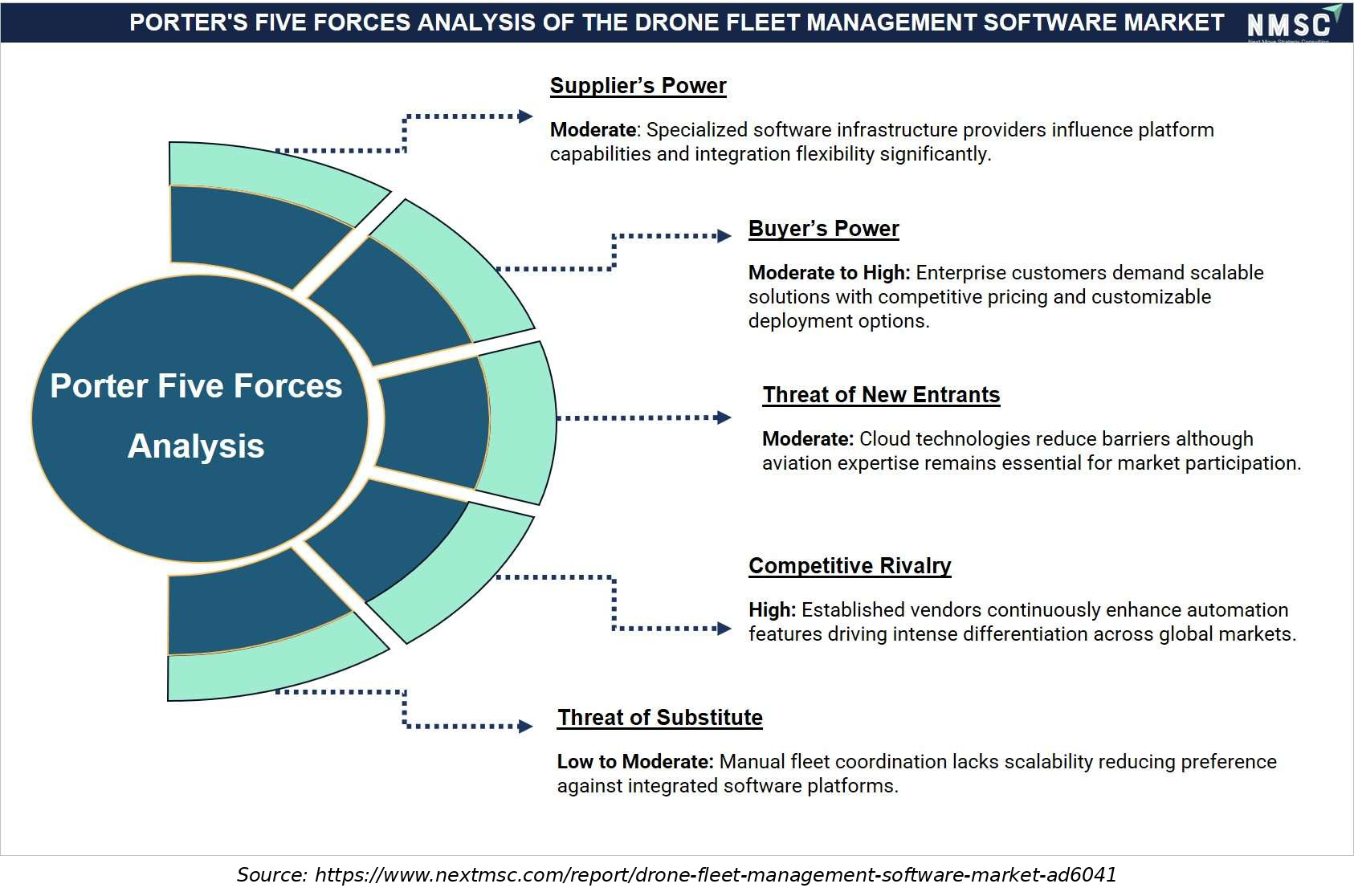
Porter’s Five Forces Analysis of the Drone Fleet Management Software Market

Porter’s Five Forces analysis highlights the competitive dynamics shaping the Drone Fleet Management Software market by assessing supplier influence, buyer bargaining power, competitive rivalry, substitution risk, and barriers to new entrants. Based on NMSC’s assessment, growing software innovation, regulatory requirements, and enterprise demand continue to influence market competition, pricing strategies, and long-term profitability.

What Does the Drone Fleet Management Software Market Encompass?

The drone fleet management software market encompasses cloud and on-premise platforms that centralize flight planning, mission scheduling, maintenance tracking, airspace compliance, and data management across multiple aircraft and pilots. Our assessment indicates that the scope spans hardware-agnostic and manufacturer-specific software serving large enterprises and small and medium enterprises across energy, construction, public safety, agriculture, mining, and logistics end markets, supported by implementation, training, and managed services delivered by the vendors profiled in this report.

The category has evolved from basic flight-logging tools into mission-critical operations platforms as enterprises shift toward dock-based, remotely supervised fleets. Regulatory frameworks are actively reshaping software requirements, including the U.S. Federal Aviation Administration's Part 108 proposed rule, published as a Notice of Proposed Rulemaking on August 6, 2025, which would replace individual beyond visual line of sight waivers with a standardized operational certificate framework. We observed that technology adoption is shifting toward fully autonomous, detect-and-avoid-equipped fleets as vendors race to align software architectures with the pending Part 108 technical requirements.

Market Drivers & Dynamics

Interactive Dataset
Shift toward fully autonomous, dock-based fleet operations driver +3.4% Global 2026-2035
FAA Part 108 standardized BVLOS operational framework driver +2.6% North America 2026-2032
NDAA-driven diversification away from restricted drone hardware driver +1.8% North America 2026-2030
Public safety drone-as-first-responder program expansion driver +1.5% North America, Europe 2026-2035
Hyperscale cloud infrastructure investment enabling SaaS delivery driver +1.2% Global 2026-2035
Asia-Pacific enterprise drone adoption in agriculture and logistics driver +1.9% Asia-Pacific 2026-2035
Fragmented regional airspace and licensing requirements restraint -1.3% Europe, Middle East & Africa 2026-2035
Cybersecurity and data-sovereignty concerns over cloud fleet data restraint -0.9% Global 2026-2032
High switching costs for enterprises on manufacturer-specific platforms restraint -0.6% Global 2028-2035
Source: Next Move Strategy Consulting

Growth Drivers

What Is the Primary Growth Driver of the Drone Fleet Management Software Market?

The shift toward fully autonomous, dock-based fleet operations is the primary driver of the market. We observed that enterprises are increasingly deploying remotely supervised drone docks rather than pilot-attended missions, a transition reinforced by Skydio, Inc.'s USD 3.5 billion U.S. manufacturing commitment announced in April 2026 to scale dock-compatible production. This behavioral shift continues to anchor baseline demand for fleet software capable of remote dispatch, scheduling, and exception-based monitoring.

How Is FAA Part 108 Driving Drone Fleet Management Software Market Growth?

The FAA's Part 108 Notice of Proposed Rulemaking, published August 6, 2025, is accelerating market growth by defining a standardized path to beyond visual line of sight operations that requires detect-and-avoid and continuous tracking capability. Our assessment indicates that fleet software vendors building compliance-ready modules ahead of the rule's expected mid-2026 finalization are positioned to capture early enterprise contracts across linear infrastructure and public safety applications.

Growth Inhibitors

What Is Restraining Drone Fleet Management Software Market Expansion?

Fragmented regional airspace regulations and licensing requirements restrain broader market expansion, particularly across Europe and Middle East & Africa where national aviation authorities maintain distinct approval processes. We found that operators managing cross-border fleets face added software configuration complexity to maintain compliance across multiple jurisdictions, slowing platform standardization compared with the more unified U.S. regulatory trajectory under Part 108.

Segmentation Analysis

2025 (USD Billion)
2035 (USD Billion)
Software 2025: $1.34 Billion | 2035: $10.18 Billion
Software
Services 2025: $0.52 Billion | 2035: $5.24 Billion
Services
Software $1.34 Billion $10.18 Billion 25.3%
Services $0.52 Billion $5.24 Billion 29.3%

Which Component Segment Dominates the Drone Fleet Management Software Market?

Software led the market with USD 1.34 billion in 2025, encompassing fleet operations, flight planning, maintenance, data analytics, and airspace compliance modules purchased as core platform licenses. We observed that Services is the fastest-growing component, expanding at a 29.3% CAGR from 2026 to 2035, as implementation, training, and managed service contracts scale alongside enterprises transitioning from pilot programs to fleet-wide deployments.

2025 (USD Billion)
2035 (USD Billion)
Cloud-Based
On-Premise
Segment Item 2025 (USD Billion) 2035 (USD Billion) CAGR
Cloud-Based $10.0 USD Billion $40.0 USD Billion 9.0%
On-Premise $17.1 USD Billion $51.1 USD Billion 23.0%

Segment-wise data is locked

Unlock complete segment-wise numbers for By Deployment Mode.

Unlock Full Data
2025 (USD Billion)
2035 (USD Billion)
Multi-Rotor
Fixed-Wing D
Hybrid VTOL
Segment Item 2025 (USD Billion) 2035 (USD Billion) CAGR
Multi-Rotor Drones $10.0 USD Billion $40.0 USD Billion 16.0%
Fixed-Wing Drones $17.1 USD Billion $51.1 USD Billion 14.0%
Hybrid VTOL Drones $24.2 USD Billion $62.2 USD Billion 12.0%

Segment-wise data is locked

Unlock complete segment-wise numbers for By Drone Type Supported.

Unlock Full Data
2025 (USD Billion)
2035 (USD Billion)
Small Fleets
Medium Fleet
Large Fleets
Segment Item 2025 (USD Billion) 2035 (USD Billion) CAGR
Small Fleets (Up to 10 Drones) $10.0 USD Billion $40.0 USD Billion 10.0%
Medium Fleets (11 to 50 Drones) $17.1 USD Billion $51.1 USD Billion 16.0%
Large Fleets (Above 50 Drones) $24.2 USD Billion $62.2 USD Billion 14.0%

Segment-wise data is locked

Unlock complete segment-wise numbers for By Fleet Size.

Unlock Full Data
2025 (USD Billion)
2035 (USD Billion)
Manually Pil
Semi-Autonom
Fully Autono
Segment Item 2025 (USD Billion) 2035 (USD Billion) CAGR
Manually Piloted Operations $10.0 USD Billion $40.0 USD Billion 26.0%
Semi-Autonomous Operations $17.1 USD Billion $51.1 USD Billion 8.0%
Fully Autonomous Operations $24.2 USD Billion $62.2 USD Billion 14.0%

Segment-wise data is locked

Unlock complete segment-wise numbers for By Autonomy Level.

Unlock Full Data

Which Autonomy Level Segment Is Growing Fastest in the Drone Fleet Management Software Market?

Manually Piloted Operations remained the largest autonomy level segment in 2025, reflecting the continued prevalence of pilot-attended commercial drone programs. Our findings suggest that Fully Autonomous Operations is the fastest-growing segment, registering a 39.7% CAGR from 2026 to 2035, as dock-based systems and detect-and-avoid technology mature ahead of the FAA's anticipated Part 108 finalization, enabling routine unsupervised missions across enterprise fleets.

2025 (USD Billion)
2035 (USD Billion)
Visual Line
Beyond Visua
Segment Item 2025 (USD Billion) 2035 (USD Billion) CAGR
Visual Line of Sight Operations $10.0 USD Billion $40.0 USD Billion 18.0%
Beyond Visual Line of Sight Operations $17.1 USD Billion $51.1 USD Billion 12.0%

Segment-wise data is locked

Unlock complete segment-wise numbers for By Operation Type.

Unlock Full Data
2025 (USD Billion)
2035 (USD Billion)
Large Enterp
Small and Me
Segment Item 2025 (USD Billion) 2035 (USD Billion) CAGR
Large Enterprises $10.0 USD Billion $40.0 USD Billion 10.0%
Small and Medium Enterprises $17.1 USD Billion $51.1 USD Billion 24.0%

Segment-wise data is locked

Unlock complete segment-wise numbers for By Organization Size.

Unlock Full Data
2025 (USD Billion)
2035 (USD Billion)
Energy and U
Construction
Public Safet
Agriculture
Logistics an
Segment Item 2025 (USD Billion) 2035 (USD Billion) CAGR
Energy and Utilities $10.0 USD Billion $40.0 USD Billion 26.0%
Construction and Infrastructure $17.1 USD Billion $51.1 USD Billion 16.0%
Public Safety and Government $24.2 USD Billion $62.2 USD Billion 18.0%
Agriculture $31.3 USD Billion $73.3 USD Billion 8.0%
Logistics and Delivery $38.4 USD Billion $84.4 USD Billion 23.0%

Segment-wise data is locked

Unlock complete segment-wise numbers for By End User.

Unlock Full Data

Which End User Segment Is Growing Fastest in the Drone Fleet Management Software Market?

Energy and Utilities remained the leading end user segment, reaching USD 0.35 billion in 2025 as transmission and distribution operators scale recurring linear-asset inspection programs. We found that Logistics and Delivery is the fastest-growing end user category, registering a 35.8% CAGR from 2026 to 2035, as beyond visual line of sight delivery pilots expand ahead of the FAA's anticipated Part 108 rule finalization.

Growth Opportunities

Our analysis shows that three forward-looking opportunities stand out for stakeholders positioning within the drone fleet management software market over the 2026-2035 forecast period.

How Can Part 108-Ready Compliance Modules Unlock Value for Enterprise Fleet Operators?

Fleet software vendors that pre-build detect-and-avoid integration and automated operational certificate reporting ahead of the FAA's Part 108 finalization can capture early adopter contracts among linear infrastructure and public safety operators. This positions compliance-ready platforms to secure long-term contracts as beyond visual line of sight operations scale industry-wide.

Where Does Hardware-Agnostic Fleet Software Create Opportunity Amid Supply-Chain Diversification?

Hardware-agnostic platforms present a whitespace opportunity as federal and public safety buyers diversify away from restricted drone hardware under U.S. National Defense Authorization Act provisions. Vendors supporting multiple domestically compliant drone brands on a single dashboard stand to capture share from single-vendor ecosystems facing procurement restrictions.

How Can Simplified Fleet Platforms Expand Adoption Among Small and Medium Enterprises?

Simplified, subscription-priced fleet management platforms create an opportunity to convert small and medium enterprises currently relying on manual spreadsheets and single-drone tools. Vendors offering entry-level cloud-based tiers can capture recurring revenue from smaller inspection, agriculture, and real estate operators scaling beyond single-aircraft programs.

Regional Outlook

2025 (USD Billion)
2035 (USD Billion)
North Americ
Europe
Asia-Pacific
Middle East
Latin Americ
Region 2025 (USD Billion) 2035 (USD Billion) CAGR (%)
North America $10.0 USD Billion $40.0 USD Billion 9.0%
Europe $17.1 USD Billion $51.1 USD Billion 27.0%
Asia-Pacific $24.2 USD Billion $62.2 USD Billion 25.0%
Middle East & Africa $31.3 USD Billion $73.3 USD Billion 23.0%
Latin America $38.4 USD Billion $84.4 USD Billion 12.0%

Regional data is locked

Unlock complete regional numbers for this market.

Unlock Full Data

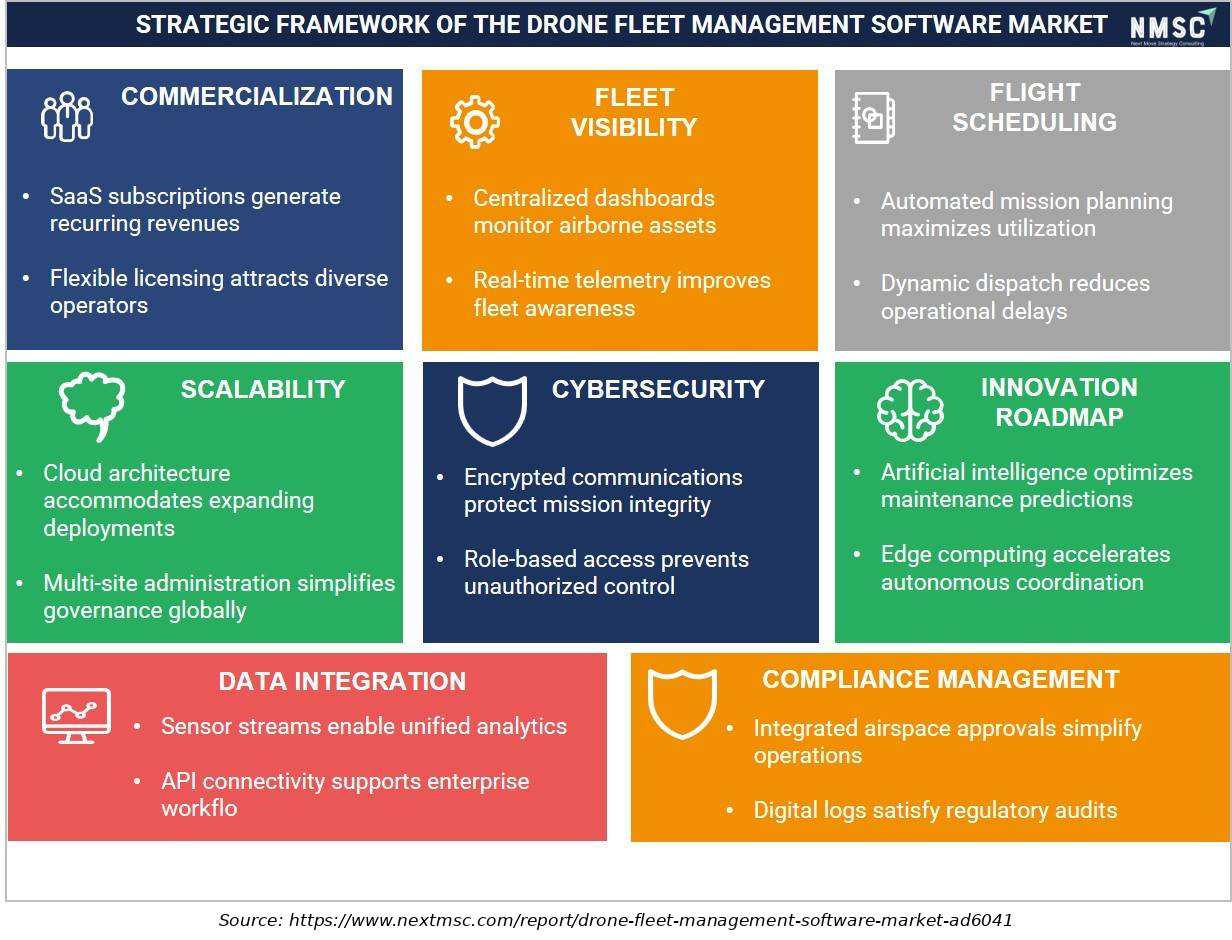
Strategic Framework of the Drone Fleet Management Software Market

Strategic Framework of the Drone Fleet Management Software Market
The strategic framework of the Drone Fleet Management Software market focuses on cloud scalability, intelligent fleet orchestration, cybersecurity, AI-driven analytics, and regulatory compliance. Based on NMSC’s assessment, integrated data management, automated mission planning, and secure software architectures enable operational efficiency, support large-scale drone deployments, and strengthen competitive differentiation across commercial and industrial applications.

Competitive Landscape

We observed that the drone fleet management software market features a fragmented competitive landscape, with hardware-agnostic software specialists competing alongside drone manufacturers offering proprietary fleet platforms and defense-oriented operating system providers across the industry.

Dimension Description
Market Structure Fragmented; the top companies profiled in this report compete across hardware-agnostic software, manufacturer-specific platforms, and defense-oriented operating systems, with no single vendor commanding a majority share.
Innovation Focus Fully autonomous dock-based operation, detect-and-avoid integration ahead of FAA Part 108, hardware-agnostic multi-brand support, and AI-powered exception-based inspection analytics dominate current innovation pipelines.
M&A Activity Selective consolidation through platform acquisitions and strategic capital raises, exemplified by Skydio, Inc.'s USD 110 million Series F round and USD 3.5 billion U.S. manufacturing commitment announced in April 2026.

How Do Companies Compete in the Drone Fleet Management Software Market?

Companies compete primarily on autonomy capability, hardware compatibility breadth, and compliance-readiness across the Industry. Manufacturer-aligned vendors such as SZ DJI Technology Co., Ltd. and Skydio, Inc. leverage proprietary hardware-software integration to serve single-brand fleets, while hardware-agnostic vendors such as FlytBase, Inc. and Auterion AG compete on cross-manufacturer support for enterprises operating mixed fleets.

Which Competitive Archetypes Dominate the Drone Fleet Management Software Market?

Three archetypes dominate the market: drone manufacturers bundling proprietary fleet software with hardware sales, hardware-agnostic software specialists serving mixed fleets, and defense-oriented operating system providers. SZ DJI Technology Co., Ltd. and Skydio, Inc. exemplify the manufacturer-bundled archetype, FlytBase, Inc. and Airdata LLC exemplify the hardware-agnostic archetype, and Auterion AG exemplifies the defense-oriented operating system archetype serving government and enterprise customers.

How Are Companies Differentiating Through Innovation in Fleet Management Software?

Innovation and differentiation strategy increasingly center on fully autonomous dock-based operation and detect-and-avoid integration ahead of anticipated FAA Part 108 requirements. Percepto Robotics Ltd. and Skydio, Inc. exemplify this direction through field-proven autonomous dock deployments. Based on our assessment, vendors unable to demonstrate multi-manufacturer compatibility risk exclusion from enterprise procurement shortlists as mixed-fleet operations become more common.

What M&A and Capital Activity Is Shaping the Drone Fleet Management Software Market?

Capital raises and strategic expansion continue to reshape competitive positioning within the Industry. Skydio, Inc.'s USD 110 million Series F round, completed in April 2026 at a USD 4.4 billion valuation, funded a subsequent USD 3.5 billion domestic manufacturing commitment illustrating how vendors are pursuing scale to meet demand from public safety, defense, and critical infrastructure customers.

Key Market Players

Our assessment indicates that the following 20 companies are actively shaping product innovation, platform interoperability, and compliance-readiness strategy within the global drone fleet management software market.

SZ DJI Technology Co., Ltd. Skydio, Inc. DroneDeploy, Inc. FlytBase, Inc. Auterion AG Percepto Ltd. Airdata UAV, Inc. Aloft Technologies, Inc. Terra Drone Corporation Ondas Holdings Inc. ANRA Technologies, Inc. Dronedesk Ltd. SIA SPH Engineering Measure Global Inc. Identified Technologies Corporation Easy Aerial, Inc. High Lander Aviation Ltd. Drone Harmony AG FlyFreely Pty Ltd Unifly NV

Latest Developments

We found that recent activity within the drone fleet management software market is concentrated on autonomous manufacturing scale-up and BVLOS compliance readiness, reflecting the industry's broader shift toward remotely supervised fleet operations.

Date Event
Feb 2026 FlytBase introduced FlytBase One, an enterprise platform that unifies autonomous drone fleet operations, dock management, mission planning, and AI-powered workflows. The platform enables centralized management of large drone fleets, making it directly relevant to the Drone Fleet Management Software Market.
Jan 2026 High Lander partnered with TII and VentureOne to advance Zero-Trust UTM and secure drone ecosystem management during UMEX 2026.
Apr 2025 Skydio updated Cloud, DFR Command and Remote Ops, adding fleet health visibility, live coordination, and remote operational improvements.

Investment Opportunities

What Capital Inflows Are Targeting the Drone Fleet Management Software Market?

Capital inflows into the market are increasingly directed toward autonomous fleet manufacturing and compliance-ready software platforms. We observed that Skydio, Inc.'s USD 110 million Series F round, completed in April 2026, funded a subsequent USD 3.5 billion domestic manufacturing expansion, reflecting investor confidence in autonomous, NDAA-compliant fleet infrastructure. Investors favor vendors demonstrating detect-and-avoid readiness ahead of the FAA's anticipated Part 108 finalization.

How Is Infrastructure Investment Supporting Fleet Management Software Adoption?

Infrastructure investment is expanding enterprise adoption of fleet management platforms across energy, utilities, and telecommunications sectors requiring recurring linear-asset inspection. Our findings suggest that growing enterprise reliance on cloud computing infrastructure is enabling fleet software vendors to scale software-as-a-service delivery models, reducing upfront capital requirements for enterprises adopting multi-site drone programs.

What ESG Considerations Are Shaping Drone Fleet Management Software Investment Decisions?

Environmental, social, and governance considerations increasingly influence investment decisions, with drone-based inspection replacing higher-emission manual inspection methods such as helicopter flyovers and vehicle patrols across linear infrastructure. We found that investors increasingly favor fleet software vendors demonstrating measurable emissions-reduction outcomes for utility and energy customers, treating it as a governance and sustainability indicator alongside safety compliance.

Key Benefits for Stakeholders

How Does This Report Benefit Enterprise and Industry Leaders?

Enterprise and industry leaders gain access to validated segmentation, competitive benchmarking, and regional demand forecasts that support sourcing and platform-selection decisions across the drone fleet management software industry. Our analysis shows that detailed autonomy level, deployment mode, and end user breakdowns help operations teams align platform specifications with rising fleet scale requirements while identifying underserved end user segments for expansion.

How Does This Report Benefit Investors and Financial Analysts?

Investors and financial analysts benefit from consistent, single-point market size and CAGR estimates that support valuation and capital-allocation decisions across the drone fleet management software supply chain. We observed that the report's regional and segment-level growth differentials help identify which vendors are best positioned to capture above-market growth in fully autonomous and Asia-Pacific categories through 2035.

How Does This Report Benefit Technology Vendors and Product Teams?

Technology vendors and product teams gain insight into emerging design requirements, including detect-and-avoid integration, hardware-agnostic compatibility, and compliance reporting, that are reshaping the industry. Our findings suggest that this analysis helps R&D teams prioritize development roadmaps around fully autonomous fleet architectures increasingly required by enterprise procurement processes ahead of the FAA's Part 108 finalization.

Key Market Segments Evaluated

By Component

  • Software
  • Services

By Deployment Mode

  • Cloud-Based
  • On-Premise

By Drone Type Supported

  • Multi-Rotor Drones
  • Fixed-Wing Drones
  • Hybrid VTOL Drones

By Fleet Size

  • Small Fleets (Up to 10 Drones)
  • Medium Fleets (11 to 50 Drones)
  • Large Fleets (Above 50 Drones)

By Autonomy Level

  • Manually Piloted Operations
  • Semi-Autonomous Operations
  • Fully Autonomous Operations

By Operation Type

  • Visual Line of Sight Operations
  • Beyond Visual Line of Sight Operations

By Organization Size

  • Large Enterprises
  • Small and Medium Enterprises

By End User

  • Energy and Utilities
  • Construction and Infrastructure
  • Public Safety and Government
  • Agriculture
  • Logistics and Delivery
  • Mining
  • Oil and Gas
  • Telecommunications
  • Media and Entertainment
  • Insurance
  • Other End Users

Conclusion & Recommendations

The long-term outlook for the market remains strongly positive, with global revenue projected to expand more than eightfold from USD 1.86 billion in 2025 to USD 15.42 billion by 2035 at a 23.3% CAGR. We observed that the shift toward fully autonomous fleets, pending FAA Part 108 finalization, and rising Asia-Pacific enterprise adoption will continue underpinning demand across energy, public safety, logistics, and agriculture applications through the forecast period.

What Strategic Positioning Should Drone Fleet Management Software Vendors Pursue?

Vendors should prioritize detect-and-avoid integration and hardware-agnostic multi-manufacturer support to secure long-term enterprise and public safety contracts. Our assessment indicates that vendors investing early in compliance-ready reporting modules and cloud-based SaaS delivery will be best positioned to capture premium pricing within the drone fleet management software market.

How Attractive Is the Drone Fleet Management Software Market for New Investment?

The industry presents a highly attractive investment case, supported by a USD 13.08 billion absolute dollar opportunity between 2026 and 2035 and above-average growth in Asia-Pacific and Fully Autonomous Operations categories. We found that investment attractiveness is highest for vendors combining compliance credentials with scaled cloud infrastructure, positioning them to serve both large enterprise and small and medium enterprise buyer segments simultaneously.

What Market Shifts and Key Risks Should Stakeholders Monitor?

Stakeholders should monitor fragmented regional airspace regulation, cybersecurity concerns over cloud fleet data, and high switching costs from manufacturer-specific platforms as key risks to the market. Our analysis shows that vendors unable to adapt to FAA Part 108 technical requirements risk losing enterprise contracts to competitors with certified detect-and-avoid platforms, particularly within North America's increasingly standardized regulatory environment.

What Are the Key Growth Pathways for the Drone Fleet Management Software Market?

Key growth pathways include expanding fully autonomous dock-based fleet portfolios, scaling hardware-agnostic platforms for mixed-fleet enterprises, and deepening penetration into dedicated logistics and delivery applications ahead of anticipated BVLOS rule finalization. NMSC's analysis indicates that vendors pursuing these pathways while maintaining cost competitiveness for small and medium enterprises will be best positioned to capture the market's projected growth through 2035.

FAQs

About the Author

Mihul Sharma

Mihul Sharma

Mihul Sharma is Research Associate at Next Move Strategy Consulting, where he has covered technology, industrial, and healthcare markets for 3 years. His work applies structured business research, market analysis, and secondary-source review to assess market trends, competitive developments, and growth opportunities. He supports report development by fully synthesizing industry data, company information, and market signals into concise findings for strategy and investment-focused research teams.

About the Reviewer

Supradip Baul

Supradip Baul

Supradip Baul is an accomplished business consultant and strategist with over a decade of rich experience in market intelligence, strategy, technology, and business transformation. His work has included rigorous qualitative and quantitative analysis across multiple industries, helping clients shape investment decisions and long-term roadmaps. Earlier in his career, he was associated with Gartner, where he contributed to industry-leading reports and market share analyses. He has worked with leading global companies and holds an MBA with a dual specialization in Marketing and Finance.

Download Free Sample

Semih Kavaklioglu

SEMIH KAVAKLIOGLU

Co-Founder & Sales Manager

Decortie

I work a lot in the marketing industry and I know that research is an essential part of any campaign. I have used Market research reports for my own products and I found them to be very informative and well-researched. The team here produces insightful reports for a good price

Mohit Agarwal

MOHIT AGARWAL

Chief Manager

DryChem India Pvt. Ltd.

Next Move Strategy Consulting is an amazing team of consultants. We required a market study report for our investors on top priority and the team went above and beyond our expectations to deliver the same with ample supporting data within a short time span enabling us to secure the investments and keep our project timeline maintained. Their professionalism, attention to detail, and timely delivery of actionable recommendations have left a lasting impression on our organization.

Gustaf Hummel Burstrom

GUSTAF HUMMEL BURSTROM

Founder

Revline Tools AB

Joseph and the team at Next Move Strategy Consulting have been excellent to work with, in supplying us with relevant market data and forecasts for our specific category. We had some special requirements and they were able to do a custom package to suit our needs. We would definitely recommend them to any other company needing market data and forecasts

Diana Trejo

DIANA TREJO

Assistant Manager

Sumitomo Corporation de Mexico, S.A. de C.V.

Recently, we purchased a report on the Mexico Data Center Market from Next Move Strategy Consulting. The service has been excellent, with support that is always timely and thoroughly professional. The information provided is interesting, highly useful, and delivered with clarity. I would highly recommend NextMSC for anyone seeking insightful and dependable analysis.

Pratyush Kumar Das

PRATYUSH KUMAR DAS

Assistant Manager

Polycab India Limited

We would like to express our appreciation for the data and insights provided by nextmsc. We are very pleased with the quality and depth of the information, which has proven to be highly valuable and beneficial for our business decision-making.

Custom Market Research Services

We will customize the research for you if the listed report does not fully match your requirements.

Get 30% Free Customization

Select License

This website uses cookies to ensure you get the best experience on our website. Learn more

✖