Drone Software Market By Software Functionality {Flight Control & Navigation (Autopilot, GNSS/RTK, and Others), Data Processing & Analytics (Mapping & Modeling, Advanced Analytics, and Others), and others}, By Deployment Mode (Onboard, Ground Control, and Others), By Deployment Scale (Small Fleet and Others), By Application (Mapping & Surveying, Infrastructure & Asset Inspection, and Others) – Global Analysis & Forecast, 2025–2035
Industry: ICT & Media | Publishing Date: March 19, 2026 | Last Updated: September 30, 2026 | No of Pages: N/A | No. of Tables: N/A | No. of Figures: N/A | Format: PDF | Report Code: IC4300
Industry Outlook
The global Drone Software Market size was valued at USD 6.86 billion in 2025, and is expected to be valued at USD 8.09 billion by the end of 2026. The industry is projected to grow, hitting USD 26.49 billion by 2035, with a CAGR of 14.5% between 2026 and 2035.
Drone Software Industry Size & Forecast
|
Parameters |
Details |
|
Market Size in 2026 |
USD 8.09 Billion |
|
Revenue Forecast in 2035 |
USD 26.49 Billion |
|
Growth Rate |
CAGR of 14.5% from 2026 to 2035 |
|
Analysis Period |
2025–2035 |
|
Base Year Considered |
2025 |
|
Forecast Period |
2026–2035 |
|
Market Size Estimation |
Billion (USD) |
|
Companies Profiled |
20 |
|
Countries Covered |
33 |
|
Market Share |
Available for 10 companies |
Based on NMSC’s primary research, we found that the global drone software market is witnessing strong growth, driven by expanding commercial drone adoption, increasing regulatory approvals for advanced operations, and rapid advancements in AI, computer vision, and autonomous flight technologies. Flight control software, mission planning platforms, and fleet management systems are increasingly deployed to improve operational reliability, enable scalable multi-drone operations, and reduce manual pilot intervention. Our field assessments and interviews with drone operators show that autonomy management, real-time data analytics, and software-first architectures significantly enhance mission efficiency and operational safety.
Moreover, through our evaluation of commercial and government drone deployments, we analyzed that adoption is shaped by regulatory environments, autonomy readiness, and mission-critical performance requirements. North America benefits from advanced BVLOS trials and enterprise drone programs, while Europe emphasizes UTM/U-Space integration and standardised airspace compliance. Emerging markets across Asia-Pacific show rapid uptake driven by infrastructure inspection, agriculture, and public safety applications. Key market players compete through AI-driven autonomy, fleet orchestration, secure data handling, and interoperability across drone platforms.
What Are the Key Drone Software Industry Trends?
How Did AI-Driven Autonomy Reshape Operational Efficiency in Drone Software?
Based on our analysis of commercial and government drone deployments, we noticed that AI-driven autonomy shifted operations from pilot-intensive control to software-supervised execution. Through our interviews and interactions with drone operators and system integrators, we identified measurable reductions in pilot workload and improvements in mission reliability. Moreover, our deployment reviews indicate that machine-learning-based path planning and adaptive obstacle avoidance improved performance in GPS-challenged and dynamic environments. Similarly, platforms capable of real-time contextual adaptation consistently outperformed static rule-based systems. Thus, explainability and certification readiness are emerging as critical trust enablers shaping the next phase of large-scale autonomous deployment.
How Did Interoperability and Software-First Architectures Accelerate Drone Software Adoption?
We observed that interoperability significantly reduced integration risk and shortened deployment timelines. Through structured interactions with enterprise IT teams, it became evident that open APIs and modular software architectures enabled seamless connectivity across flight control systems, analytics engines, GIS platforms, and broader enterprise IT infrastructure.
Moreover, our deployment assessments indicate that vendor-agnostic, software-defined platforms achieved faster time-to-value compared to proprietary, closed OEM ecosystems, particularly in multi-site and multi-vendor environments. Enterprises increasingly prioritized integration flexibility to avoid long-term lock-in and to support phased scaling strategies. As a result, demand for standardised, software-first ecosystems is accelerating, reinforcing interoperability as a structural enabler of enterprise-scale drone program expansion.
What Role Did Regulation and Airspace Integration Play in Shaping the Drone Software Market?
Based on our primary research involving technology providers and drone operators, we noticed that regulatory readiness and airspace integration emerged as decisive factors shaping drone mapping software adoption. Stakeholders highlighted that software platforms supporting BVLOS operations, remote identification, geofencing, and UTM/U-Space integration gained faster acceptance in regulated environments. We also found that regions with clearer regulatory pathways enabled earlier commercialisation of advanced drone software, while fragmented or evolving regulations slowed deployment despite strong technical readiness.
Ecosystem Analysis of Drone Software Market
The drone software market is emerging as a critical enabler of the global unmanned aerial systems ecosystem, driven by rapid advancements in artificial intelligence, cloud computing, and real-time data analytics. As drones move beyond hardware-centric use cases, software platforms are becoming central to mission planning, autonomous operations, data processing, and regulatory compliance across commercial, civil, and defence applications.
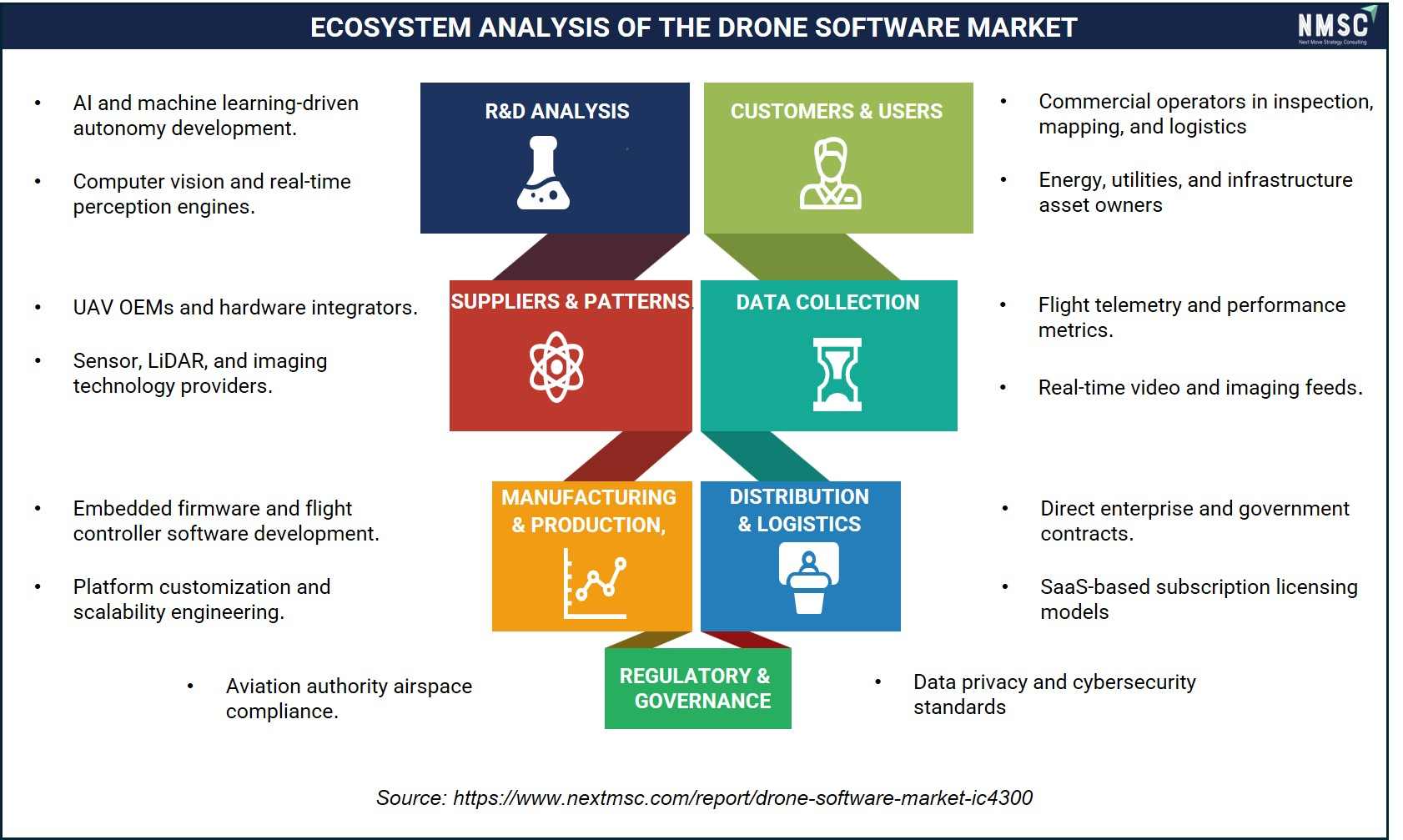
This ecosystem infographic illustrates the interconnected structure of the drone software market, spanning R&D, suppliers, data collection, production, distribution, and governance. Strong collaboration between software developers, UAV manufacturers, end users, and regulators underpins market credibility, while continuous innovation, secure data handling, and compliance-driven design reinforce experience, expertise, authority, and trust across the value chain.
What Are the Key Market Drivers, Breakthroughs, And Investment Opportunities that Will Shape the Drone Software Industry in the Next Decade?
Growth Catalyst & Risk Assessment Matrix
|
Drivers/Trends/Restraints |
(+/–) % Impact On CAGR Forecast |
Geographic Relevance |
Impact Timeline |
|
Expansion of commercial drone adoption across inspection, mapping, agriculture, and public safety driving demand for mission planning, flight control, and fleet management software |
+1.0% |
North America & Europe core; rapid uptake in Asia-Pacific |
Short to medium term (1–3 years) |
|
Advancements in AI-driven autonomy, computer vision, and adaptive flight intelligence enabling scalable multi-drone operations |
+0.9% |
Global; strongest in USA, Europe, China, Japan, South Korea |
Medium term (2–4 years) |
|
Regulatory progress in BVLOS approvals, remote ID, and UTM / U-Space integration accelerating enterprise and government adoption |
+0.8% |
North America & Europe led; selective rollout in APAC |
Medium term (2–4 years) |
|
Shift toward cloud-based, SaaS, and subscription drone software models improving affordability and ROI predictability |
+0.7% |
Global, led by North America & Europe |
Short to medium term (1–3 years) |
|
Regulatory uncertainty, certification complexity, and limited AI explainability constraining autonomous software deployment |
–0.6% |
Global; higher impact in emerging and fragmented regulatory markets |
Medium term (2–4 years) |
Based on our evaluation of global drone technology and operations trends, we observed that the drone software market experienced strong growth, driven primarily by expanding commercial drone adoption, increasing regulatory acceptance of advanced operations, and rapid technological advancements in AI, computer vision, and autonomous flight systems. Our interactions with system integrators shows that software platforms are increasingly adopted as long-term operational infrastructure to improve mission reliability, scale multi-drone operations, and reduce pilot dependency.
Advancements in autonomy, real-time analytics, and cloud-based fleet management expanded software capabilities, enabling reliable performance across complex, regulated, and data-intensive environments. However, our assessment also indicated that regulatory complexity, certification requirements, and system integration challenges constrain adoption, particularly among smaller operators. At the same time, the emergence of SaaS- and subscription-based drone software models created new growth opportunities by lowering entry barriers and supporting scalable, flexible deployments.
Growth Drivers:
How is Expanding Commercial Drone Adoption Accelerating Drone Software Market Demand?
Based on our interactions with commercial drone operators and service providers, we noticed that expanding use of drones across inspection, surveying, agriculture, and public safety emerged as a primary driver of drone software adoption. Through qualitative interviews with operations managers, we analyzed that scaling drone programs requires robust mission planning, flight control, and data management software to ensure operational consistency and regulatory compliance. From our evaluation, we found that drone fleet management is increasingly positioned as a structural enabler rather than an auxiliary tool. Fleet management platforms reduced manual coordination overhead, while analytics software improved data usability and decision-making.
How is Rising Demand for Sovereign and Secure Data Accelerating Growth in the Drone Software Market?
Based on our interactions with enterprise operators and government agencies, we noticed that demand for sovereign and secure data management is emerging as a decisive growth driver in the drone software market. As deployments expand across critical infrastructure, public safety, utilities, and defence applications, buyers are increasingly prioritizing platforms that ensure data residency control, encrypted transmission, and alignment with national cybersecurity mandates. Moreover, through deployment audits, we found that data sovereignty compliance is now treated as a pre-qualification requirement rather than a differentiating feature in regulated tenders. Enterprise IT teams consistently emphasised the importance of region-specific hosting architectures and auditable governance frameworks to mitigate cross-border transfer and cybersecurity risks.
Growth Inhibitor:
How are Regulatory Complexity, Integration Challenges, and Organizational Readiness Limiting Drone Software Market Growth?
Based on our assessment of drone software procurement and deployment, we observed that regulatory complexity and system integration challenges act as key restraints on market growth. Through our interviews with drone operators and enterprise IT teams, we found that certification requirements, evolving airspace regulations, and the effort required to integrate software with OEM hardware, payloads, and enterprise systems are major barriers.
Our observations also revealed that workforce readiness and change management significantly influenced adoption timelines. Specifically, operators transitioning from manual or semi-autonomous flight models to software-driven fleet operations reported skill gaps related to mission planning software, data analytics, and regulatory compliance workflows. In several deployments, additional training and certification requirements for pilots and operations teams extended rollout schedules, particularly among smaller operators. While advanced software reduced long-term pilot workload, upfront investments in training and process redesign remained a practical constraint affecting near-term adoption velocity.
Growth Opportunity:
How is the Expansion of SaaS-Based and Scalable Drone Software Models Creating Drone Software Market Opportunities?
The expansion of SaaS-based, subscription, and usage-driven drone software models is creating substantial market opportunities by lowering upfront investment barriers and enabling flexible, scalable adoption. Cloud-based platforms allow operators to align software usage with mission demand, making them particularly suitable for seasonal, project-based, or geographically distributed drone operations. Instead of large capital expenditures, organisations shift to predictable operating expenses, improving budget control and financial planning. These scalable models also enhance operational efficiency through centralised fleet management, automated updates, real-time data access, and seamless enterprise integration. As a result, commercial enterprises, large organisations, and public-sector agencies are increasingly adopting SaaS-driven drone platforms, reinforcing long-term market expansion and accelerating industry-wide digital transformation.
Strategic Framework for the Drone Software Market
The drone software market is evolving rapidly as enterprises move from pilot deployments to large-scale, mission-critical operations. Advances in AI, cloud platforms, and data analytics are transforming drone software into a core operational layer that enables autonomy, scalability, compliance, and measurable ROI across commercial and government use cases.
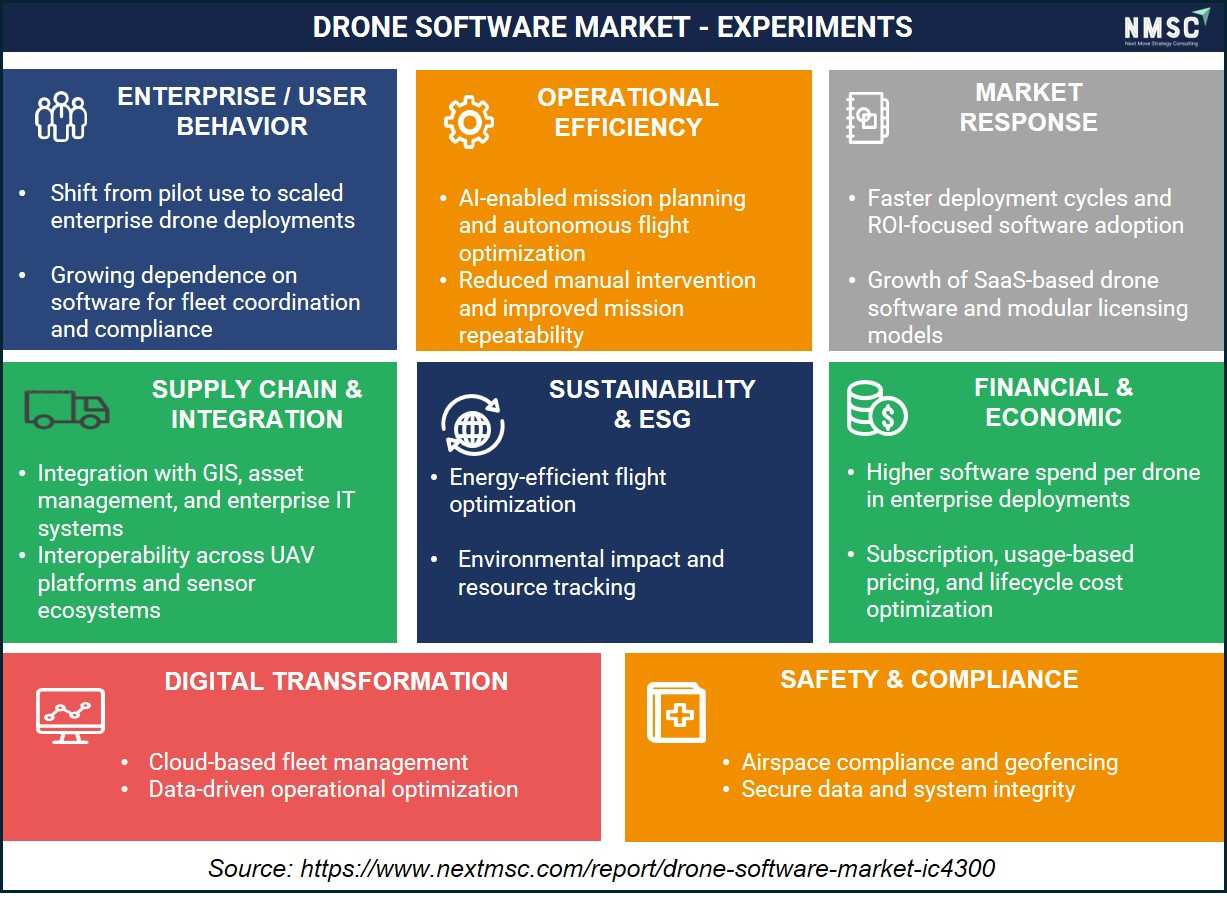
This infographic illustrates how experimentation in the drone software market is shaping enterprise behavior, operational efficiency, and market outcomes. It highlights the growing role of AI-enabled mission planning, SaaS-based business models, deep system integration, and cloud-driven transformation, while emphasizing sustainability, financial optimization, and safety compliance as critical pillars supporting scalable and trusted drone operations.
How Is the Drone Software Market Segmented in This Report, And What Are the Key Insights from the Segmentation Analysis?
Market Highlights & Strategic Insights – Drone Software Market:
|
Segments |
Key Takeaways |
|
Software Functionality |
In the drone software market, Flight Control & Navigation Software dominates, driven by autopilot, RTK navigation, and BVLOS autonomy. Data Processing & Analytics is expanding with AI, LiDAR, and 3D mapping demand. Fleet Management and Compliance Software are growing alongside multi-drone deployments and regulatory mandates. |
|
Deployment Mode |
Onboard software remains the operational core for real-time autonomy and mission execution. Ground control systems support planning and supervision. As deployments scale, Cloud/SaaS platforms are gaining traction for centralized analytics and fleet coordination, while Hybrid architectures are increasingly preferred for integrating edge control with cloud intelligence. |
|
Deployment Scale |
In the drone software market, small fleets (2–10 drones) dominate current adoption. Mid-sized fleets (11–100) are expanding steadily, while large fleet are emerging across defense and large-scale surveillance programs. |
|
Application |
Mapping & Surveying and Infrastructure Inspection lead software demand, supported by AI analytics and modeling tools. While public safety, and environmental monitoring are steadily expanding adoption. |
|
End User |
Commercial enterprises represent the largest adopters, especially in construction, energy, and mining. Government and civil agencies are expanding regulatory and urban monitoring use cases. Defense & military prioritize secure autonomy, while public safety and research institutions contribute to steady software demand. |
By Software Functionality Insights
Which Software Layers Are Driving Value Creation in the Drone Software Market?
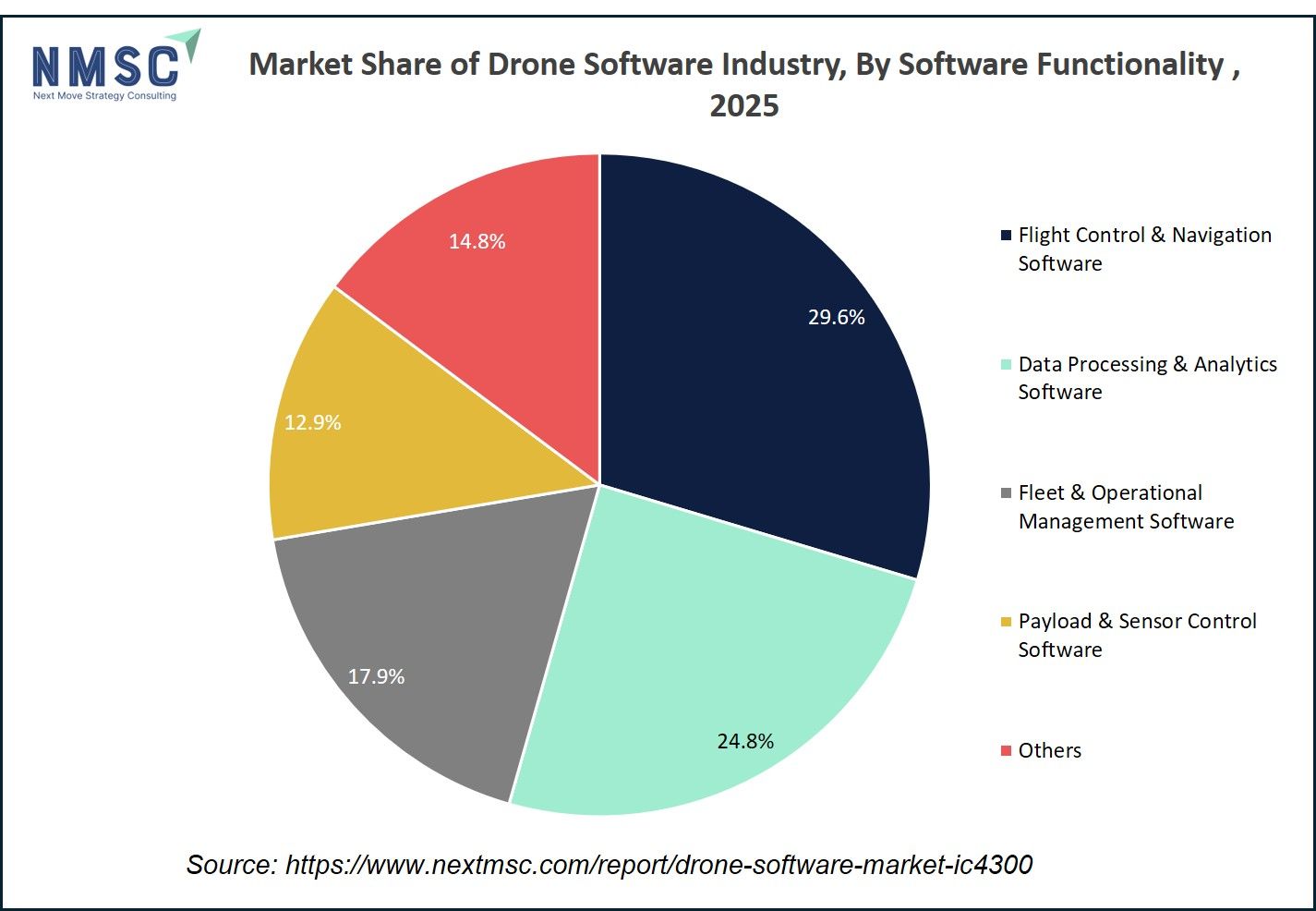
Based on our product-level assessment of deployments, we noticed that the drone software market is segmented into Flight Control & Navigation, Data Processing & Analytics, Fleet & Operational Management, Payload & Sensor Control, and other specialized software modules.
From our evaluation of active commercial and defense programs, we found that Flight Control & Navigation software accounts for the largest share, supported by continued demand for autopilot engines, RTK-enabled precision, obstacle avoidance, and BVLOS capabilities. At the same time, Data Processing & Analytics represents a substantial and expanding segment, driven by 3D reconstruction, LiDAR analytics, and AI-based detection. Meanwhile, Fleet & Operational Management software is gaining importance as multi-drone deployments scale and enterprises require centralized coordination and performance monitoring. Our findings indicate that value creation is increasingly distributed across autonomy, analytics, and operational orchestration rather than concentrated in a single functionality layer.
By Deployment Mode Insights
How Is Deployment Architecture Shaping Software Adoption?
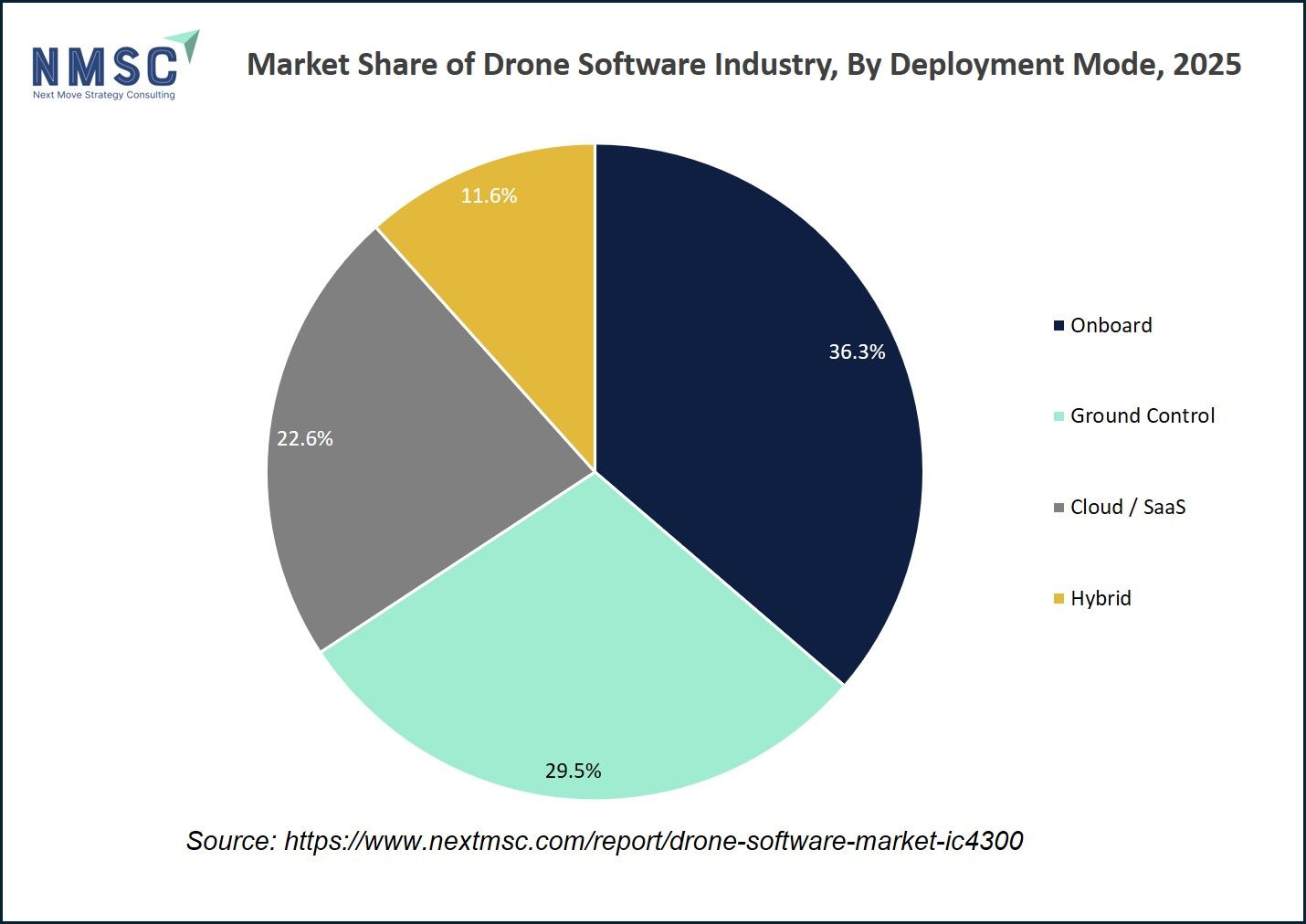
Based on our deployment mapping across commercial and government programs, we observed that the drone software market is segmented into onboard, ground control, cloud/SaaS, and hybrid models.
From our field evaluations, we found that onboard software remains essential for real-time stabilization, navigation control, and mission execution, particularly in latency-sensitive environments. However, as operations expand beyond pilot projects, cloud-based platforms are gaining traction for centralized analytics, fleet coordination, and compliance reporting. In addition, ground control systems continue to anchor mission planning and operator supervision. Consequently, hybrid architectures are increasingly adopted, integrating edge-level autonomy with cloud-driven intelligence to support scalable and connected operational ecosystems.
By End User Insights
Who Is Leading Adoption in the Drone Software Market?
Based on our end-user evaluation, we noticed that the drone software market is segmented into commercial enterprises, government & civil agencies, defense & military organizations, research & education, public safety agencies, individual users and others.
From our demand-side analysis, we found that commercial enterprises represent the largest adoption base, particularly across construction, energy, mining, telecom, and transportation sectors where operational visibility directly influences cost efficiency. At the same time, government and civil agencies are expanding deployments for regulatory monitoring and disaster response coordination. Meanwhile, defense organizations prioritize cybersecurity, encrypted communications, and mission autonomy within structured procurement frameworks. Our findings suggest that as enterprise maturity increases, procurement decisions increasingly favor scalable analytics platforms and integrated fleet intelligence over standalone flight tools.
Regional Outlook:
Geographic Performance Snapshot:
|
Regions |
Key Takeaways |
|
North America |
Leads global adoption in the drone software market, driven by early regulatory frameworks, BVLOS trials, and strong commercial and defense demand. Enterprises prioritize fleet management, autonomy, and compliance-ready software, with SaaS models gaining rapid traction across inspection, public safety, and defense programs. |
|
Europe |
Growth is shaped by UTM and U-Space implementation and harmonized aviation standards, driving demand for airspace integration, interoperability, and safety-centric software. Adoption remains steady but compliance-intensive, with strong uptake in infrastructure inspection, environmental monitoring, and public-sector deployments. |
|
Asia-Pacific |
Fastest-growing region, supported by large-scale infrastructure projects, precision agriculture, and smart-city initiatives. Operators favor scalable, cost-efficient software platforms, while adoption varies across countries due to differing regulatory maturity and airspace policies. |
|
Latin America |
Emerging growth region driven by expanding energy, mining, agriculture, and public safety applications. Adoption is concentrated in enterprise and government-led projects, with demand focused on mission planning, analytics, and cost-efficient fleet coordination. Regulatory fragmentation and budget sensitivity influence deployment pace, favoring modular and scalable software solutions. |
|
Middle East & Africa |
The Middle East demonstrates strong enterprise and government-led adoption, particularly in oil & gas, infrastructure monitoring, and smart-city initiatives, driving demand for high-reliability and compliance-integrated platforms. Africa remains an early-stage but accelerating market, where cost-efficient, easy-to-deploy software supports growing interest in agriculture, mapping, and security applications. |
The drone software market is geographically studied across North America, Europe, Asia Pacific, Middle East & Africa and Latin America, and each region is further studied across countries.
Drone Software Market in North America
North America anchors the global drone software market ecosystem, where regulatory modernization and enterprise-scale fleet expansion are reshaping digital aviation infrastructure. From our regional assessments, we noticed a decisive shift from standalone mission planning tools toward unified fleet intelligence platforms. As multi-site drone programs scale, organizations are prioritizing centralized mission orchestration, automated compliance validation, and AI-driven inspection analytics within cloud-native architectures. Moreover, expanding BVLOS approvals and Remote ID integration have positioned software as the operational backbone of enterprise drone fleets. Enterprises are consolidating flight planning, telemetry management, and post-mission analytics into subscription-based ecosystems, thereby increasing per-fleet software spend and reinforcing long-term platform dependence.
Drone Software Market in the United States
The United States remains the primary commercialization engine for drone software, driven by large-scale enterprise fleet expansion and rapid innovation across infrastructure and advanced analytics programs. Based on our direct engagements with enterprise fleet managers, it became evident that organizations are transitioning from isolated analytics tools toward unified operational control environments capable of synchronizing distributed drone assets in real time. As federal momentum around BVLOS expansion and advanced air mobility corridors strengthens, enterprises are prioritizing UTM-integrated mission control platforms embedding automated risk modeling, digital airspace mapping, and secure data pipelines within centralized dashboards. Consequently, monetization models are evolving toward layered subscription architectures, where compliance automation and AI-powered analytics modules are bundled into tiered SaaS environments. This modular expansion is increasing lifetime customer value while reinforcing long-term platform stickiness across multi-year enterprise deployments.
Drone Software Market in Canada
Across Canada, drone software adoption reflects a measured yet strategically aligned trajectory shaped by resource-sector digitization and infrastructure modernization. From our observations within mining operations, utilities inspections, and remote asset monitoring programs, we found growing reliance on geospatial analytics engines, terrain-adaptive mission planning software, and resilient telemetry integration platforms. Given the country’s expansive geography and challenging operating conditions, software solutions emphasizing autonomous navigation optimization and offline-capable data synchronization have gained traction. Furthermore, structured collaboration between aviation regulators and commercial drone operators has supported gradual expansion of compliant BVLOS environments, encouraging enterprises to deploy scalable fleet management ecosystems. While fleet density per project remains moderate, organizations are investing in high-reliability SaaS contracts and integrated analytics dashboards, thereby strengthening long-term software revenue stability within the Canadian market.
Drone Software Market in Europe
Europe’s drone software market ecosystem is defined by regulatory harmonization, interoperability mandates, and structured digital airspace transformation. Our EU-wide analysis indicated that enterprises are adopting U-space-aligned traffic management systems and certified flight authorization platforms not merely to ensure compliance, but to embed long-term operational resilience within their drone programs. As cross-border aviation frameworks standardize data exchange protocols, demand has intensified for interoperable architectures capable of integrating telemetry, analytics, and regulatory reporting into cohesive enterprise systems.
Simultaneously, sustainability mandates and urban air mobility initiatives are encouraging deployment of simulation-driven digital twin platforms and environmental impact analytics modules. These additions are expanding the functional scope of drone software beyond mission execution into strategic planning and infrastructure optimization. As enterprises consolidate these capabilities within unified SaaS ecosystems, average contract scope is broadening, and multi-module licensing structures are becoming more prevalent. This progression is reinforcing vendor durability, elevating qualification thresholds, and strengthening recurring revenue visibility across the European market.
Drone Software Market in the United Kingdom
The United Kingdom demonstrates a dynamic and innovation-forward drone software environment shaped by regulatory sandbox initiatives and advanced urban deployment pilots. From our observations across logistics testbeds and public safety programs, it became evident that organizations increasingly rely on centralized fleet orchestration dashboards and AI-driven surveillance analytics to manage complex operational environments.
In parallel, progressive airspace experimentation programs have stimulated demand for UTM-integrated software, digital flight corridor mapping, and automated incident reporting modules. Enterprises are steadily transitioning toward subscription-based fleet intelligence platforms that combine compliance monitoring, predictive analytics, and mission optimization within unified interfaces. As a result, the UK continues to position itself as a high-agility and software-intensive drone operations market, characterized by structured experimentation and scalable commercialization.
Drone Software Market in Germany
Germany’s drone software adoption reflects its engineering-driven industrial ecosystem, where precision, cybersecurity, and structured integration remain central priorities. From our research across manufacturing logistics hubs and energy infrastructure operators, we evaluated consistent deployment of inspection analytics platforms and digitally integrated mission control systems designed for interoperability within existing industrial IT frameworks. However, rather than emphasizing rapid fleet proliferation, German enterprises focus on certified architectures, secure data exchange standards, and long-term operational reliability. As U-space implementation progresses in a coordinated manner, software providers offering compliant, deeply integrated platforms are securing premium-grade enterprise contracts. This disciplined approach continues to elevate qualification thresholds while reinforcing durable, high-value recurring revenue structures within the German market.
Drone Software Market in France
France presents a steadily advancing drone software landscape shaped by agricultural intelligence programs, urban infrastructure modernization, and public safety analytics initiatives. Based on our market interactions with agritech operators and municipal authorities, we observed increasing deployment of AI-enabled crop analytics platforms, thermal inspection processing tools, and GIS-integrated reporting dashboards.
At the same time, national priorities around digital sovereignty and secure cloud infrastructure have encouraged enterprises to adopt compliant, domestically hosted data platforms. As organizations integrate drone-generated insights directly into enterprise decision workflows, demand for automated reporting engines and workflow-integrated analytics continues to expand. These developments are strengthening France’s profile as a data-centric and strategically coordinated drone software market.
Drone Software Market in Italy
Italy’s drone software ecosystem is advancing through infrastructure modernization and asset-intensive monitoring programs, where operational precision and integration flexibility are becoming central priorities. From our analysis of deployment environments across public infrastructure and industrial inspection projects, we noticed increasing reliance on modular mission planning platforms, 3D mapping engines, and AI-based structural assessment software capable of operating across mixed drone fleets. At the same time, as digital transformation initiatives accelerate, enterprises are integrating drone-generated data directly into broader smart infrastructure and asset management systems. Consequently, demand is shifting toward API-enabled software architectures that support seamless interoperability and scalable analytics layering. This integration-driven approach is expanding contract scope beyond basic flight control, thereby strengthening recurring SaaS adoption and reinforcing long-term vendor alignment within Italy’s evolving drone software landscape.
Drone Software Market in Spain
Spain’s drone software adoption trajectory is closely linked to renewable energy inspection, precision agriculture expansion, and urban surveillance modernization. Our engagements across solar asset operators and regional logistics hubs highlighted increasing use of automated flight path optimization tools, AI-powered anomaly detection engines, and centralized cloud-based mission dashboards. At the same time, rising operational efficiency targets and energy transition programs have accelerated the integration of predictive analytics modules within drone fleet management platforms. Although commercial discipline remains strong, enterprises are progressively prioritizing scalable SaaS ecosystems that deliver measurable productivity gains and streamlined compliance automation. Consequently, Spain is steadily strengthening its position within the broader European drone software environment.
Drone Software Market in the Nordics
The Nordic region, encompassing Sweden, Finland, and Norway, reflects a digitally mature and sustainability-oriented drone software ecosystem. From our observations within environmental monitoring programs and offshore infrastructure inspections, it became clear that operators prioritize autonomous fleet coordination software, edge-based analytics processing, and secure cloud interoperability frameworks. Moreover, high digital literacy and institutional trust in automation have supported rapid integration of UTM-aligned traffic management systems and AI-driven environmental mapping platforms. Furthermore, enterprises consistently favor open architecture software models, energy-efficient data processing environments, and long-term lifecycle analytics partnerships. This combination of technological sophistication and sustainability focus positions the Nordics as a quality-driven and innovation-intensive drone software market with enduring forward momentum.
Drone Software Market in the Asia-Pacific
Across Asia-Pacific, drone software adoption in the drone software market has accelerated alongside expanding commercial UAV deployments and progressive airspace digitization efforts. From our regional assessments of active mission management installations and enterprise licensing cycles, we observed a clear shift from standalone flight control tools toward integrated fleet orchestration platforms that combine real-time telemetry analytics, automated compliance logging, and AI-driven geospatial processing. Industrial inspection programs, precision agriculture mapping initiatives, and urban infrastructure monitoring corridors are increasingly standardizing on cloud-based control architectures capable of handling multi-drone operations at scale. As deployment density increased, enterprises began prioritizing UTM compatibility, remote ID integration, and predictive maintenance analytics within their software stacks. Vendors that localized regulatory modules and ensured interoperability with enterprise asset management systems expanded more consistently across the region.
Drone Software Market in China
China’s drone software ecosystem continues to expand alongside large-scale UAV deployments across infrastructure monitoring, precision agriculture, and municipal surveillance programs. Based on our analysis of enterprise platform rollouts and system integration cycles, we noticed sustained adoption of AI-enabled mission planning engines and centralized fleet orchestration dashboards designed to manage high-density drone operations. As inspection workloads intensified and multi-site deployments scaled, operators increasingly integrated edge-based computer vision inference modules to reduce latency and accelerate data interpretation. In parallel, automated route optimization software and adaptive geofencing architectures gained importance as airspace governance frameworks evolved. Consequently, vendors that ensured seamless interoperability with domestic UAV hardware interfaces and scalable cloud telemetry backends positioned themselves more effectively within China’s rapidly digitizing airspace environment.
Drone Software Market in Japan
In Japan, drone software adoption reflects a structured and compliance-oriented trajectory shaped by rigorous aviation oversight and enterprise reliability standards. From our field research across utilities and transportation infrastructure programs, we identified consistent demand for precision flight planning engines and automated safety validation modules capable of supporting long-duration inspection cycles. As deployment expanded beyond pilot programs into operational workflows, enterprise buyers emphasized encrypted data transmission layers and validated redundancy protocols within mission control systems. Moreover, integration with predictive maintenance environments and digital twin frameworks increasingly influenced software architecture selection. As a result, vendors delivering stable ground control interfaces, certified compliance modules, and long-term technical support frameworks aligned more closely with Japan’s disciplined enterprise adoption model.
Drone Software Market in India
India’s drone software landscape has expanded in parallel with growing commercial UAV registrations and enterprise experimentation across agriculture, energy, and infrastructure monitoring sectors. Based on our market interactions with fleet operators and system integrators, we observed rising deployment of modular SaaS-based flight management platforms and automated mapping applications tailored to cost-sensitive environments. Initially, adoption centered on crop analytics and corridor inspections; however, as fleet density increased, demand shifted toward AI-based object detection engines and predictive analytics modules embedded within centralized dashboards. At the same time, evolving digital airspace frameworks strengthened the need for UTM-compatible systems and remote identification tracking tools. Therefore, vendors that emphasized subscription-based pricing models, simplified onboarding architecture, and localized integration support demonstrated stronger penetration across India’s evolving drone ecosystem.
Drone Software Market in South Korea
South Korea’s drone software landscape reflects rapid integration of AI-enabled autonomy within structured industrial ecosystems. Moreover, from our regional tracking of enterprise fleet deployments and telecom-backed drone corridors, we analyzed increasing adoption of unified fleet management platforms integrating real-time telemetry analytics, automated mission scheduling, and computer vision–based inspection engines. As a result, as industrial inspection frequency intensified across electronics manufacturing and urban infrastructure networks, operators prioritized low-latency data processing modules and synchronized multi-drone coordination systems. At the same time, we identified rising demand for swarm management algorithms and predictive route optimization software embedded within cloud-linked control dashboards. Furthermore, vendors aligning their autonomy stacks with high-bandwidth connectivity infrastructure and advanced AI processing capabilities demonstrated stronger enterprise traction, while on the other hand, those lagging in these integrations saw weaker uptake.
Drone Software Market in Taiwan
Taiwan’s drone software adoption has progressed in alignment with its advanced manufacturing and electronics ecosystem. From our observations across industrial inspection programs within high-value production facilities, we noted increasing reliance on high-precision mission planning software and vision-based anomaly detection analytics integrated with edge-computing telemetry systems. As inspection frequency intensified within semiconductor and electronics environments, secure data routing frameworks and encrypted transmission protocols became operational priorities. Furthermore, compatibility with existing manufacturing execution systems and warehouse management platforms played a decisive role in enterprise software selection. Accordingly, vendors providing seamless API connectivity, stable control interfaces, and localized technical integration support achieved more efficient scaling within Taiwan’s structured industrial landscape.
Drone Software Market in Indonesia
Indonesia’s drone software market ecosystem is evolving in response to expanding logistics infrastructure and geographically dispersed monitoring requirements. From our regional assessments of enterprise deployments within metropolitan hubs, we observed early adoption of scalable fleet management dashboards and simplified mission configuration tools designed to address coordination challenges across varied terrain. As drone usage extended into infrastructure surveying and agricultural mapping, operators increasingly required mobile-first control interfaces and lightweight cloud architecture to streamline onboarding and reduce operational friction. In addition, affordability and modular deployment capability emerged as decisive evaluation factors during vendor selection. Consequently, software providers that partnered with local integration firms and implemented phased rollout strategies established more sustainable growth pathways across Indonesia’s multi-island operating environment.
Drone Software Market in Australia
Australia’s drone software adoption reflects operational efficiency priorities shaped by geographic dispersion and high labor intensity across industrial sectors. Moreover, from our engagements across mining inspection programs and large-scale agricultural surveying operations, we analyzed strong uptake of autonomous flight scheduling software, extended-range telemetry stabilization systems, and advanced terrain mapping platforms. As a result, as inspection intervals tightened across remote asset corridors, operators required remote diagnostics modules and automated maintenance alert engines embedded within centralized fleet management dashboards. Furthermore, we identified growing emphasis on cybersecurity architecture and data sovereignty controls within cloud-based mission control systems. At the same time, vendors bundling advanced analytics subscriptions with structured integration and lifecycle support frameworks secured more stable enterprise relationships across the Australian market, while on the other hand, those without such bundling faced challenges in sustaining traction.
Drone Software Market in Latin America
The drone software market demand in Latin America is developing at a measured pace, influenced by economic variability, regulatory fragmentation, and uneven infrastructure readiness. From our regional assessments, we observed that Brazil anchors enterprise adoption across agriculture analytics, mining inspection, and energy infrastructure monitoring, where clear operational ROI supports structured software integration. However, in several neighboring countries, deployments progress more gradually, typically beginning with mission planning and data processing tools before advancing toward fleet management and analytics platforms. Moreover, procurement decisions remain price-sensitive, with buyers prioritizing modular SaaS models and localized technical support. As a result, growth is largely project-driven and closely aligned with public-sector initiatives and industrial modernization programs.
Drone Software Market in the Middle East & Africa
The Middle East and Africa show varied adoption patterns shaped by differences in regulatory maturity, funding structures, and infrastructure readiness. From our regional analysis, we evaluated that Gulf economies are gradually expanding enterprise-scale deployments, supported by smart-city initiatives and infrastructure modernization programs. As a result, demand is increasing for compliance-integrated and security-conscious software platforms that align with evolving airspace frameworks.
Meanwhile, across much of Africa, adoption remains at an earlier stage and is primarily centered on mapping, agricultural monitoring, and inspection applications. In addition, infrastructure limitations and regulatory development timelines continue to influence deployment speed. Therefore, vendors adapt their strategies accordingly, focusing on integrator-led enterprise projects in the Middle East while offering modular, cost-efficient platforms across African markets to support phased growth.
Competitive Landscape
Competitive Dynamics & M&A Landscape:
|
Key Takeaways |
|
The global drone software market is characterized by a mix of established geospatial, aerospace, and defense-oriented technology providers, as Esri, Indra Group, Terra Drone Corporation, Anduril Industries, and Skydio Inc alongside fast-growing, software-native specialists including DroneDeploy Inc., Pix4D SA, Auterion AG, ANRA Technologies, FlytBase Inc., and AirData UAV Inc. Large incumbents leverage deep domain expertise, government and enterprise relationships, and global delivery capabilities, while specialists focus on cloud-native platforms, autonomy stacks, analytics, and rapid deployment across commercial drone fleets. |
|
From our assessment of vendor strategies, we found that companies increasingly prioritize software-centric platforms encompassing mission planning, fleet and operations management, airspace integration, and data analytics. Interoperability, API-driven architectures, regulatory compliance tooling, and scalable multi-fleet deployment capabilities have emerged as key competitive differentiators, particularly for enterprise and public-sector operators managing distributed drone programs. |
|
Recent partnership activity, acquisitions, and strategic collaborations in the drone software market reflect a clear shift toward strengthening autonomy software, AI-driven analytics, simulation and digital twin capabilities, and airspace management solutions rather than expanding hardware portfolios alone. This strategy supports faster innovation cycles, deeper ecosystem integration, and more predictable recurring revenue streams, reinforcing long-term competitiveness across commercial, government, and defense drone operations. |
Which Companies Dominate the Drone Software Industry and How Do They Compete?
Based on our analysis, we found that the drone software market is shaped by a combination of established geospatial, aerospace, and defense-oriented technology providers alongside fast-scaling, software-native drone specialists. Companies such as Esri, Indra Group, Terra Drone Corporation, Anduril Industries, and Skydio Inc. consistently lead large, mission-critical deployments where regulatory compliance, system reliability, and data security are primary decision criteria. From our assessments of enterprise and government programs, we observed that these vendors are frequently selected for national infrastructure monitoring, defense, and public safety operations that require certified software stacks, airspace integration, and long-term platform support. Competition at this tier is driven by regulatory credibility, integration depth, and the ability to operate at scale across distributed fleets.
Market Dominated by Drone Software Giants and Specialists
The competitive landscape is further defined by software-focused specialists such as DroneDeploy Inc., Pix4D SA, Auterion AG, ANRA Technologies, FlytBase Inc., AirData UAV Inc., SPH Engineering, vHive, Propeller Aero, Optelos, and Skycatch Inc. Our customer interviews and pilot evaluations indicate that these companies gain traction by delivering cloud-native analytics, autonomy frameworks, fleet and operations management, and rapid deployment models that reduce implementation friction. DroneDeploy and Pix4D are frequently cited for scalable analytics and mapping workflows, while Auterion and ANRA Technologies are preferred where open architectures, UTM integration, and interoperability are required. In practice, incumbents anchor trust and scale, while specialists accelerate adoption through flexibility, speed, and software-led innovation.
Innovation and Adaptability Drive Market Success
Innovation remains a central determinant of competitive positioning in the drone software market, as observed through live deployments across inspection, logistics, agriculture, and public safety use cases. Market leaders increasingly invest in AI-enabled perception, autonomous mission execution, fleet orchestration, and real-time analytics to support complex, multi-drone operations. From our engagements with integrators and operators, we noted that vendors that prioritize modular software architectures, API-driven interoperability, and continuous platform updates are better positioned to scale across multi-site and multi-regulatory environments. These capabilities reflect deep expertise in autonomy software, cloud computing, and data governance, allowing suppliers to adapt quickly to evolving operational and regulatory requirements while maintaining long-term customer engagement.
Market Players to Opt for Merger & Acquisition Strategies to Expand Their Presence
From our tracking of strategic transactions and capability-driven acquisitions, mergers and acquisitions are playing an increasingly central role in competitive expansion across the global drone software market. In January 2026, Indra Group advanced its airspace infrastructure portfolio through the acquisition of Altitude Angel’s GuardianUTM platform, aimed at strengthening its unified air traffic management (ATM) capabilities and reinforcing its position in the integration of crewed and uncrewed aviation. In September, 2025, Terra Drone Corporation finalized its acquisition of Aloft Technologies, expanding its digital fleet management and regulatory compliance ecosystem to support large-scale, enterprise-grade autonomous deployments and cross-border airspace orchestration.
SWOT Analysis:
The drone software market is rapidly evolving as AI, cloud computing, and autonomy become central to enabling scalable and mission-critical drone operations across commercial and government sectors. As adoption accelerates, software platforms are increasingly defining operational performance, regulatory readiness, and long-term value creation.
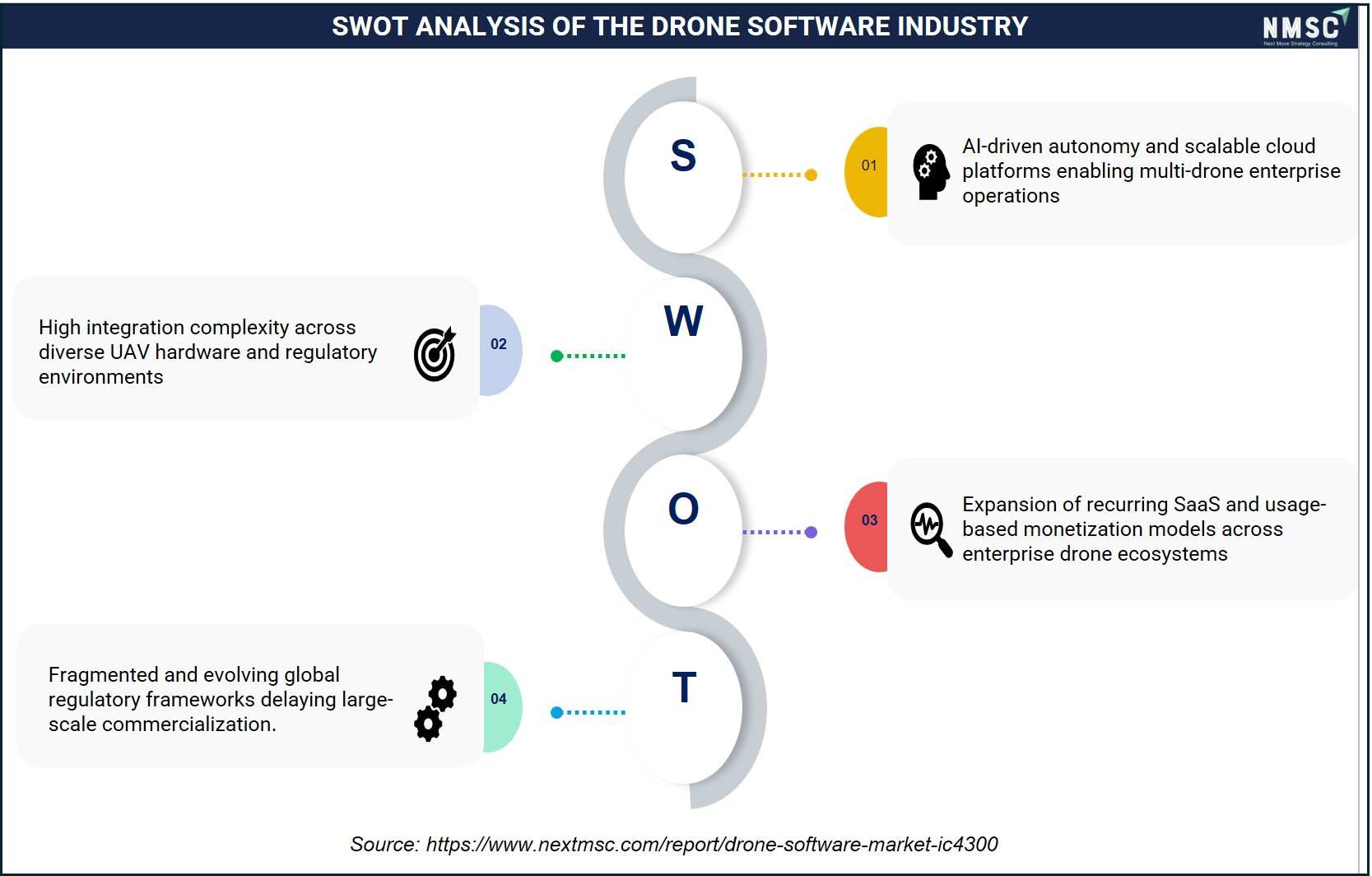
Based on our structured assessment of enterprise drone platforms, we observed that AI-driven autonomy and scalable cloud architectures form the industry’s core strength, enabling coordinated multi-drone operations. However, we found that integration complexity across diverse UAV hardware systems and regulatory environments remains a persistent constraint. At the same time, expanding SaaS and usage-based models are creating recurring revenue opportunities. Nevertheless, fragmented and evolving global regulations continue to pose structural risks to large-scale and cross-border commercialization.
List of Key Drone Software Companies
-
DroneDeploy Inc.
-
Pix4D SA
-
Auterion AG
-
Terra Drone Corporation
-
Indra Group
-
SPH Engineering
-
ANRA Technologies
-
FlytBase Inc.
-
Propeller Aero
-
DroneSense Inc.
-
AirData UAV Inc.
-
Skydio Inc.
-
Anduril Industries
-
vHive
-
Flyability SA
-
Skycatch Inc.
-
Wingtra
-
Optelos
-
DroneAcharya Aerial
What are the Latest Key Industry Developments?
-
January 2026 – Auterion achieved a global military milestone by executing the world's first live-fire Combat Drone Swarm strike on a U.S. military range. Using the Nemyx swarm engine, a single operator simultaneously commanded three autonomous drones to destroy three separate targets.
-
October 2025 – At its Horizons conference, DroneDeploy unveiled "Embodied AI" and "Agentic AI" tools like Progress AI and Safety AI. These tools automate site analysis and hazard detection for the construction and energy sectors, with field deployments beginning in early 2026.
What are the Key Factors Influencing Investment Analysis & Opportunities in the Drone Software Market?
Investment analysis in the drone software market is increasingly shaped by a decisive shift toward platform-centric and service-led business models rather than hardware-dependent value creation. Based on our review of recent funding rounds, acquisitions, and strategic partnerships, we observed that investors consistently favor vendors with predictable recurring revenue streams generated through subscription-based platforms, fleet management systems, analytics, and SaaS offerings. As a result, companies demonstrating scalable multi-fleet deployments, defensible proprietary algorithms, and seamless integration with enterprise systems and regulatory workflows are commanding higher valuation multiples.
At the same time, we found that capital concentration is strongest around AI-enabled autonomy, perception, and real-time optimization software, as these capabilities directly enhance operational reliability, compliance confidence, and fleet-level efficiency. Moreover, strategic capital participation is increasingly outweighing purely financial investment, with aerospace OEMs, defense contractors, telecom providers, and infrastructure operators seeking tighter ecosystem control and accelerated commercialization pathways. Consequently, the most attractive opportunities lie with vendors that combine technological differentiation with regulatory readiness, proven deployment economics, and extensible software roadmaps capable of supporting long-term platform expansion.
Key Benefits for Stakeholders:
Next Move Strategy Consulting (NMSC) presents a comprehensive analysis of the drone software market trends, covering historical developments from 2020 to 2025 and providing forward-looking forecasts through 2035. The study evaluates the market at global, regional, and country levels, delivering quantitative outlooks alongside qualitative insights into key growth drivers, adoption barriers, technology shifts, and investment trends across all major Drone Software segments.
From our analysis, the market delivers measurable value across a broad stakeholder ecosystem. Investors benefit from recurring revenue visibility driven by subscription-based platforms, scalable fleet deployments, and long-term software lifecycle monetization. Commercial operators and public agencies gain operational efficiency, compliance confidence, and data-driven decision support through software that automates mission planning, fleet coordination, and analytics. System integrators, OEMs, and technology partners capture value through software integration, ongoing upgrades, and service-led engagements that extend well beyond initial deployment. By aligning autonomy, interoperability, and regulatory readiness with real-world operational needs, the drone software market supports durable value creation across the drone ecosystem while enabling scalable, compliant, and economically sustainable aerial operations.
|
Parameters |
Details |
|
Customization Scope |
Free customization (equivalent to up to 80 analyst-working hours) after purchase. Addition or alteration to country, regional & segment scope. |
|
Pricing and Purchase Options |
Avail customized purchase options to meet your exact research needs. |
|
Approach |
In-depth primary and secondary research; proprietary databases; rigorous quality control and validation measures. |
|
Analytical Tools |
Porter's Five Forces, SWOT, value chain, and Harvey ball analysis to assess competitive intensity, stakeholder roles, and relative impact of key factors. |
Key Market Segments
By Software Functionality
-
Flight Control & Navigation Software
-
Autopilot engines
-
Stabilization control
-
GNSS / RTK assisted navigation
-
Obstacle avoidance
-
BVLOS autonomy modules
-
-
Payload & Sensor Control Software
-
Camera Control
-
Sensor Configuration
-
Gimbals & Actuator Software
-
Edge Sensor Triggering
-
-
Data Processing & Analytics Software
-
Data Capture & Pre-Processing
-
Image acquisition
-
Data stitching
-
Sensor data normalisation
-
Georeferencing
-
-
Mapping & Modeling
-
3D reconstruction
-
Orthomosaic generation
-
Volumetric analysis
-
-
Advanced Analytics
-
LiDAR processing
-
Multispectral analytics
-
Thermal analytics
-
AI-based object detection
-
Change detection
-
Anomaly detection
-
-
-
Fleet & Operational Management Software
-
Fleet Monitoring
-
Operations Management
-
Maintenance Management
-
Operator Management
-
-
Airspace & Compliance Software
-
UTM integration
-
Traffic deconfliction
-
Remote ID
-
Airspace authorization
-
Regulatory reporting
-
-
Security & Connectivity Software
-
Secure communications
-
Anti-jamming / anti-spoofing
-
Identity & access management
-
Secure firmware validation
-
-
Simulation & Training Software
-
Pilot training simulators
-
Mission scenario simulation
-
Digital twin platforms
-
By Airframe Type
-
Multirotor
-
Fixed-wing
-
Hybrid VTOL
-
Tethered
By Size Class
-
Nano
-
Small
-
Medium
-
Large
By Deployment Mode
-
Onboard
-
Ground control
-
Cloud / SaaS
-
Hybrid
By Deployment Scale
-
Small fleet (2–10 Drones)
-
Mid fleet (11–100 Drones)
-
Large fleet (100+ Drones)
By Application
-
Mapping & Surveying
-
Infrastructure & Asset Inspection
-
Logistics & Parcel Delivery
-
Public Safety & Emergency Services
-
Environmental Monitoring & Conservation
-
Media, Filmmaking & Broadcasting
-
Security & Perimeter Surveillance
By End User
-
Commercial Enterprises
-
Construction
-
Energy
-
Telco
-
Mining
-
Insurance
-
Transportation
-
Media
-
-
Government & Civil Agencies
-
Federal
-
State
-
Local
-
-
Defense & Military Organizations
-
Research & Education
-
Public Safety Agencies
-
Law Enforcement
-
Fire & Rescue
-
Emergency Management
-
-
Individual Users
-
Prosumers
-
Hobbyists
-
Geographical Breakdown
-
North America: U.S., Canada, and Mexico.
-
Europe: UK, Germany, France, Italy, Spain, Sweden, Denmark, Finland, the Netherlands, and the Rest of Europe.
-
Asia Pacific: China, India, Japan, South Korea, Taiwan, Indonesia, Vietnam, Australia, Philippines, Malaysia and the rest of APAC.
-
Middle East & Africa (MEA): Saudi Arabia, UAE, Egypt, Israel, Turkey, Nigeria, South Africa, and the rest of MEA.
-
Latin America: Brazil, Argentina, Chile, Colombia, and the rest of LATAM.
Conclusion & Recommendations
This report equips stakeholders, industry participants, investors, and consultants with actionable intelligence to capitalize on the structural transformation underway in the market. By combining rigorous data-driven analysis with proven strategic frameworks, NMSC’s drone software market report serves as a critical decision-support resource for navigating a rapidly evolving landscape.
The drone software market is positioned for sustained expansion, underpinned by the steady normalization of commercial drone operations, increasing regulatory clarity, and growing enterprise reliance on data-driven aerial workflows. Strategic assessment underscores the shift from feature-led tools toward integrated software platforms that unify mission planning, autonomy management, airspace integration, and analytics. These capabilities increasingly determine not only operational efficiency, but also regulatory confidence, audit readiness, and long-term return on deployment. Vendors that prioritize modular architectures, interoperability, and continuous software evolution demonstrate higher customer retention and more predictable recurring revenue profiles.
For executives and investors, value creation depends on disciplined focus across high-growth applications such as infrastructure inspection, public safety, agriculture, and enterprise fleet operations, alongside sustained investment in compliance automation, AI-enabled autonomy, and ecosystem partnerships. Geographic expansion across Asia-Pacific and select emerging markets offers incremental upside, but success is contingent on localization and regulatory fluency rather than scale alone. Ultimately, platforms that deliver measurable operational outcomes, governance transparency, and scalable performance will define durable leadership across the global drone software ecosystem.
Expert Insights
 “The drone industry is projected to grow substantially over the next few years.”
Cameron Chell, CEO of Draganfly Inc


About the Author
 Saista Faiyaz
— Saista Faiyaz is Research Associate at Next Move Strategy Consulting, where she has covered consumer markets and healthcare technologies for 3 years. Her work includes primary interview review, secondary-source validation, market sizing, and structured analysis of company and industry data. She supports research by comparing evidence across sources, organizing findings into market narratives, and documenting assumptions used in analysis. Her scope includes cross-market benchmarking, and reports.
Saista Faiyaz
— Saista Faiyaz is Research Associate at Next Move Strategy Consulting, where she has covered consumer markets and healthcare technologies for 3 years. Her work includes primary interview review, secondary-source validation, market sizing, and structured analysis of company and industry data. She supports research by comparing evidence across sources, organizing findings into market narratives, and documenting assumptions used in analysis. Her scope includes cross-market benchmarking, and reports.
About the Reviewer
 Supradip Baul
— Supradip Baul is an accomplished business consultant and strategist with over a decade of rich experience in market intelligence, strategy, technology, and business transformation. His work has included rigorous qualitative and quantitative analysis across multiple industries, helping clients shape investment decisions and long-term roadmaps. Earlier in his career, he was associated with Gartner, where he contributed to industry-leading reports and market share analyses. He has worked with leading global companies and holds an MBA with a dual specialization in Marketing and Finance.
Supradip Baul
— Supradip Baul is an accomplished business consultant and strategist with over a decade of rich experience in market intelligence, strategy, technology, and business transformation. His work has included rigorous qualitative and quantitative analysis across multiple industries, helping clients shape investment decisions and long-term roadmaps. Earlier in his career, he was associated with Gartner, where he contributed to industry-leading reports and market share analyses. He has worked with leading global companies and holds an MBA with a dual specialization in Marketing and Finance.
At Next Move Strategy Consulting, we understand that insightful market research is the cornerstone of successful business decisions. That's why we employ a robust and multifaceted approach, combining various methodologies to deliver the most accurate and actionable data for our clients.

Research Landscape
We navigate the world of research with two primary approaches:
Qualitative Approach
Our qualitative research methodologies involve immersive techniques such as in-depth interviews, focus groups, and observational studies. By engaging directly with individuals and stakeholders, we uncover valuable insights that quantitative data alone may overlook.

Quantitative Research
In tandem with qualitative methodologies, NMSC leverages the power of Quantitative Research to provide a robust foundation of numerical insights. Through systematic data collection and analysis, we quantify patterns, preferences, and market trends, offering a comprehensive view of the business landscape.
Our quantitative research approach employs diverse tools, including surveys, experiments, and statistical modelling. These methodologies enable us to gather data from a large and representative sample, ensuring the statistical significance of our findings. By employing structured questionnaires and standardized data collection methods, we guarantee the reliability and validity of the information we present to our clients.
Quantitative research is particularly effective in measuring the prevalence of trends, assessing market size, and gauging the impact of various factors on consumer behavior. The numerical precision attained through this approach equips our clients with actionable insights, facilitating data-driven decision-making and strategy formulation.


Our Specialized Toolbox for Industry-Specific Market Research
We deploy a specialized arsenal of techniques tailored to meet your unique requirements. Here's a glimpse into our comprehensive toolbox:

Information Procurement
The stage entails acquiring market data or relevant information through various sources and methodologies.


Market Research Approach
We utilize both top-down and bottom-up approaches in market research analysis to achieve a comprehensive understanding of the market dynamics, leveraging the broad perspective of industry trends and macroeconomic factors alongside detailed insights from specific segments and individual companies.

Porters Five Forces Analysis
We conduct Porter's Five Forces analysis to evaluate the competitive landscape of an industry, providing us with insights into factors that affect profitability and strategic positioning.

SWOT Analysis

Forecasting
We utilize a forecasting model to predict future consumption by considering parameters like population, economics, regulations, market competition, drivers, constraints, technology, and pricing. We also employ statistical techniques such as multilinear regression, exponential smoothing, moving average, ARIMA, and Monte Carlo simulations for accurate predictions. In econometric forecasting, we analyzed short-term and long-term event impacts, attributing values based on regulatory frameworks, economic factors, and market events.





 Speak to Our Analyst