U.S. Drone Market By Component (Hardware, Software, and Services), By Platform Type (Multi-Rotor, Fixed-Wing, Hybrid VTOL, and Others), By Autonomy Level (Remotely Piloted, Assisted, Advanced, and Fully Autonomous), By Maximum Take-off Weight {Nano (<250 g), Micro (250 g–2 kg), Small (>2 kg–25 kg), and Others}, By End-User (Consumer Drone, Commercial & Industrial Drone, Government & Public Safety Drone, and Military Drone) – Analysis & Forecast, 2025–2035
Industry: Aerospace & Defense | Latest Edition: September 30, 2026 | No of Pages: 264 | No. of Tables: 140 | No. of Figures: 128 | Format: PDF | Report Code: AD3979
U.S. Drone Market Size & Forecast
|
Parameters |
Details |
|
Market Size in 2025 |
USD 9.52 billion |
|
Market Size in 2026 |
USD 11.32 billion |
|
Revenue Forecast in 2035 |
USD 31.40 billion |
|
Market Size Growth Rate |
CAGR of 12.00% from 2026 to 2035 |
|
Market Volume in 2025 |
287 thousand units |
|
Market Volume in 2026 |
356 thousand units |
|
Volume Forecast in 2035 |
1,338 thousand units |
|
Market Volume Growth Rate |
CAGR of 15.84% from 2026 to 2035 |
|
Analysis Period |
2025–2035 |
|
Base Year Considered |
2025 |
|
Forecast Period |
2026–2035 |
|
Market Size Estimation |
Billion (USD) |
|
Companies Profiled |
15 |
|
Market Share |
Available for 10 companies |
Industry Outlook
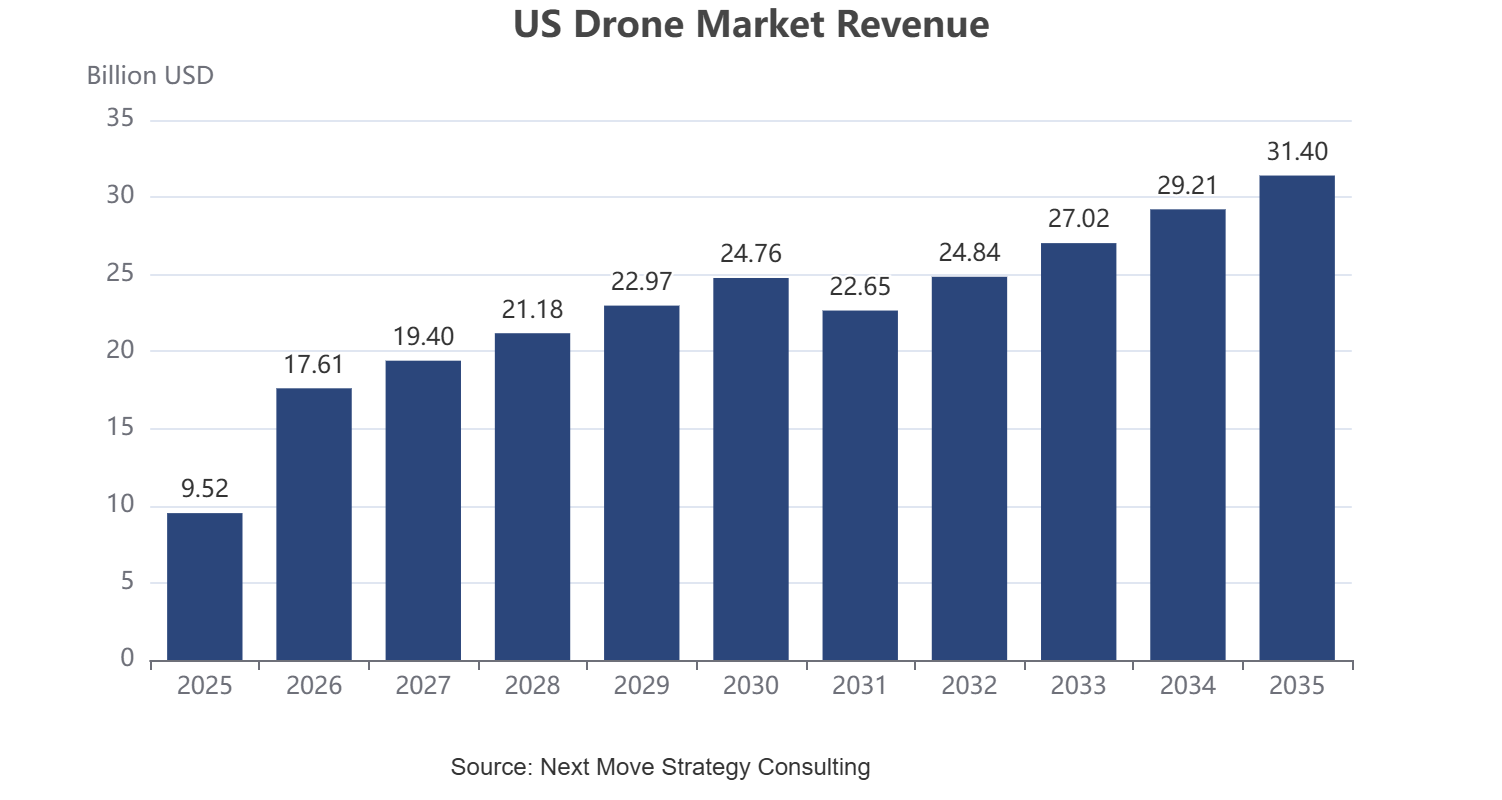
The U.S. Drone Market was valued at USD 9.52 billion in 2025 and is estimated to reach USD 11.32 billion in 2026, advancing to USD 31.40 billion by 2035 at a revenue CAGR of 12.00% during 2026–2035. In volume terms, the market stood at approximately 287 thousand units in 2025, with the 2026 estimate placed at 356 thousand units and volume projected to reach 1,338 thousand units by 2035 at a unit CAGR of 15.84%, reflecting rapid adoption across defense, commercial, and public safety applications nationwide.
What Are the Key Growth Drivers, Restraints, and Opportunities Shaping the U.S. Drone Market Through 2035?
Growth Catalyst & Risk Assessment Matrix
|
DRIVERS / TRENDS / RESTRAINTS |
(+/–) % IMPACT ON CAGR FORECAST |
GEOGRAPHIC RELEVANCE |
IMPACT TIMELINE |
|
Sustained DoD procurement of tactical ISR drones, loitering munitions, and UCAV systems driving large-scale defense-grade UAV demand across all service branches |
+2.5% |
Nationwide; defense installations and contracted OEM facilities |
Short to Medium term (1–4 years) |
|
FAA BVLOS regulatory expansion enabling enterprise commercial adoption across utilities, agriculture, infrastructure inspection, and logistics operators |
+2.0% |
Nationwide; accelerating in rural and suburban operational corridors |
Medium term (2–5 years) |
|
AI-driven onboard autonomy advancements extending drone capability into swarm operations, autonomous ISR, and unassisted commercial missions |
+1.8% |
Nationwide; led by U.S.-based autonomy software developers |
Medium to Long term (3–6 years) |
|
Federal procurement restrictions on foreign-manufactured drones creating domestic supply gaps and near-term platform availability constraints |
–1.2% |
Federal agency and DoD procurement segments |
Short term (1–3 years) |
|
Drone delivery commercialization and AI-enabled precision agriculture creating significant long-term revenue opportunities across logistics and farming sectors |
+1.7% |
Nationwide; strongest in urban delivery corridors and major agricultural states |
Long term (4–8 years) |
The U.S. Drone Market is one of the most structurally dynamic unmanned systems ecosystems globally, shaped by the simultaneous convergence of large-scale Department of Defense modernization programs, a rapidly maturing commercial enterprise sector, and a FAA regulatory environment that is progressively enabling beyond-visual-line-of-sight operations. From our analysis, we observed that the market's growth trajectory is unusually broad-based: no single end-user category accounts for a dominant share of incremental demand, and the pace of autonomy technology adoption is accelerating across defense, public safety, and commercial segments concurrently.
Growth Drivers:
How Is U.S. Department of Defense Procurement Driving Structural Demand for Defense-Grade Drone Platforms?
The U.S. Department of Defense remains one of the world's largest institutional consumers of unmanned aerial systems, with active procurement programs spanning small tactical drones under the SUAS program, MALE-class ISR platforms, and long-range UCAV systems for contested-environment operations. Congressional budget allocations for drone-enabled ISR, electronic warfare, and autonomous logistics are growing consistently across service branches, driven by the operational lessons of recent conflicts and the Pentagon's explicit shift toward attritable, networked unmanned platforms as a cost-effective complement to manned airpower.
How Is FAA Regulatory Progress Enabling the Commercialization of BVLOS Drone Operations in the U.S.?
The FAA's ongoing implementation of Remote ID requirements, the expansion of the BEYOND program for BVLOS operational approvals, and the establishment of the UAS Integration Pilot Program have collectively reduced regulatory uncertainty for commercial operators and accelerated enterprise drone adoption across infrastructure inspection, precision agriculture, public safety, and last-mile delivery verticals. Operators including energy utilities, railroad inspection firms, and telecommunications companies are institutionalizing drone programs following successful BVLOS waiver approvals, creating recurring demand for enterprise-grade platforms and associated data analytics software.
How Are AI-Powered Autonomy Advances Expanding the Commercial and Defense Operational Envelope of U.S. Drone Platforms?
Rapid advances in onboard AI-powered autonomy, including object avoidance, terrain following, target tracking, and swarm coordination, are extending the operational envelope of commercial and defense drone platforms well beyond what remote-piloted architectures could achieve. U.S.-based companies including Skydio and Anduril have demonstrated commercially deployable autonomous navigation capabilities that are being adopted by law enforcement, first responders, and defense contractors at scale. This technology-led demand expansion is attracting continued venture and government investment, sustaining a rapid R&D cycle that further accelerates capability and adoption timelines.
Growth Inhibitor:
How Are Federal Procurement Restrictions on Foreign Drone Hardware Creating Supply Constraints in the U.S. Market?
The U.S. drone market faces a significant structural headwind from the prohibition of federal agencies and defense contractors from procuring drones manufactured by certain foreign entities, particularly following legislative restrictions targeting Chinese-origin hardware. While this creates a domestic manufacturing opportunity, supply chain constraints and limited production capacity among U.S.-based airframe manufacturers are creating near-term fulfillment gaps, particularly in the consumer and prosumer segments where domestic alternatives to restricted platforms are still maturing in cost competitiveness and feature parity.
Growth Opportunity:
What Opportunity Do Drone Delivery and Precision Agriculture Represent for Long-Term Revenue Expansion in the U.S. Market?
The drone delivery and urban air mobility adjacency represents the most transformational long-term revenue opportunity in the U.S. market, as FAA frameworks for package delivery operations progressively formalize and operators such as Wing, Zipline, and Amazon Prime Air accumulate operational approvals across multiple cities. Beyond pure logistics, drone-enabled precision agriculture at scale — combining autonomous spraying, hyperspectral imaging, and AI-driven crop analytics — presents a multi-billion-dollar addressable market that remains underpenetrated relative to its agronomic and economic potential across U.S. row crop and specialty agriculture regions.
How Is the U.S. Drone Market Segmented in This Report, and What Are the Key Insights from the Segmentation Analysis?
By Component Insights
How Does Component Segmentation Reflect Technology Value Distribution Across the U.S. Drone Market?
Based on component, the U.S. Drone Market is segmented into hardware, software and services.
The market comprises a mature drone ecosystem supported by advanced hardware, intelligent software platforms, and specialized service offerings across commercial, government, and defense applications. According to our analysis, we found that hardware components provide the foundation for platform performance through advanced airframes, sensor payloads, avionics, and secure communication systems. Software solutions are gaining strategic importance through autonomous flight control, AI-enabled analytics, and fleet management capabilities, while services such as DaaS, training, maintenance, and data processing are enabling wider adoption, operational scalability, and lifecycle support across diverse drone deployments.
By Autonomy Level Insights
How Does Autonomy Level Segmentation Reflect Technology Advancement Across the U.S. Drone Market?
Based on autonomy level, the U.S. Drone Market is segmented into remotely piloted, assisted autonomy, advanced autonomy, and fully autonomous platforms.
The market reflects a progressive shift toward higher levels of automation as commercial, government, and defense users increasingly adopt intelligent unmanned systems to enhance operational efficiency, safety, and mission effectiveness. According to our analysis, we found that remotely piloted platforms continue to support established applications such as aerial imaging, infrastructure inspection, public safety, and defense operations requiring direct human oversight. Assisted autonomy solutions are expanding through automated navigation, obstacle avoidance, and precision flight capabilities, while advanced and fully autonomous platforms are gaining momentum across logistics, defense, surveillance, and industrial applications driven by AI, sensor fusion, and autonomous mission-management technologies.
Supply Chain Structure of the U.S. Drone Market:
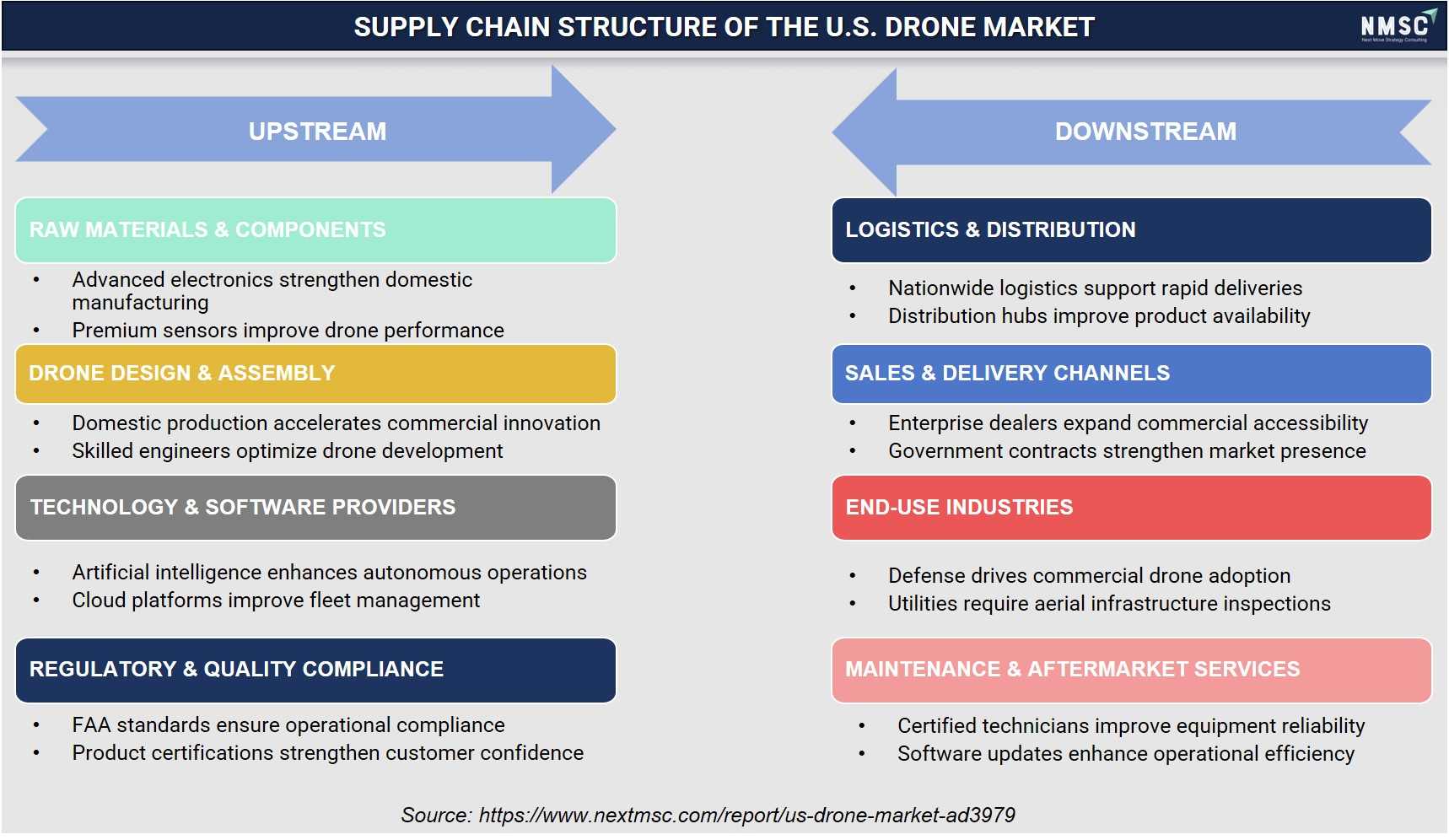
The above supply chain analysis maps the key operational stages, such as upstream and downstream, shaping the U.S. drone market. From our analysis, we observed that upstream activities include advanced electronics, premium sensors, domestic production, skilled engineers, artificial intelligence, cloud platforms, and FAA standards, while downstream activities encompass nationwide logistics, enterprise dealers, government contracts, defense and utilities end-users, and certified technicians, reflecting a well-integrated supply chain across the market.
Key Segments
By Component
-
Hardware
-
Airframe
-
Avionics & Core Systems
-
Payloads & Sensors (Cameras, LiDAR, Multispectral, etc.)
-
Communication Systems (C2 Links)
-
-
Software
-
Flight Control & Autonomy
-
Data Processing & Analytics
-
Fleet Management
-
-
Services
-
Drone-as-a-Service (DaaS)
-
Training & Certification
-
Maintenance, Repair & Overhaul (MRO)
-
Data Processing Services
-
By Platform Type
-
Multi-Rotor
-
Fixed-Wing
-
Hybrid VTOL (Vertical Take-Off and Landing)
-
Single-Rotor (Helicopter)
-
Tethered UAV
-
Loitering Munition
-
MALE/HALE/UCAV
By Autonomy Level
-
Remotely Piloted
-
Assisted Autonomy
-
Advanced Autonomy
-
Fully Autonomous
By Maximum Takeoff Weight (MTOW)
-
Nano: < 250 g
-
Micro: 250 g – 2 kg
-
Small: > 2 kg – 25 kg
-
Medium: > 25 kg – 150 kg
-
Large: > 150 kg – 600 kg
-
Very Large/Tactical: > 600 kg
By Price/Performance Grade
-
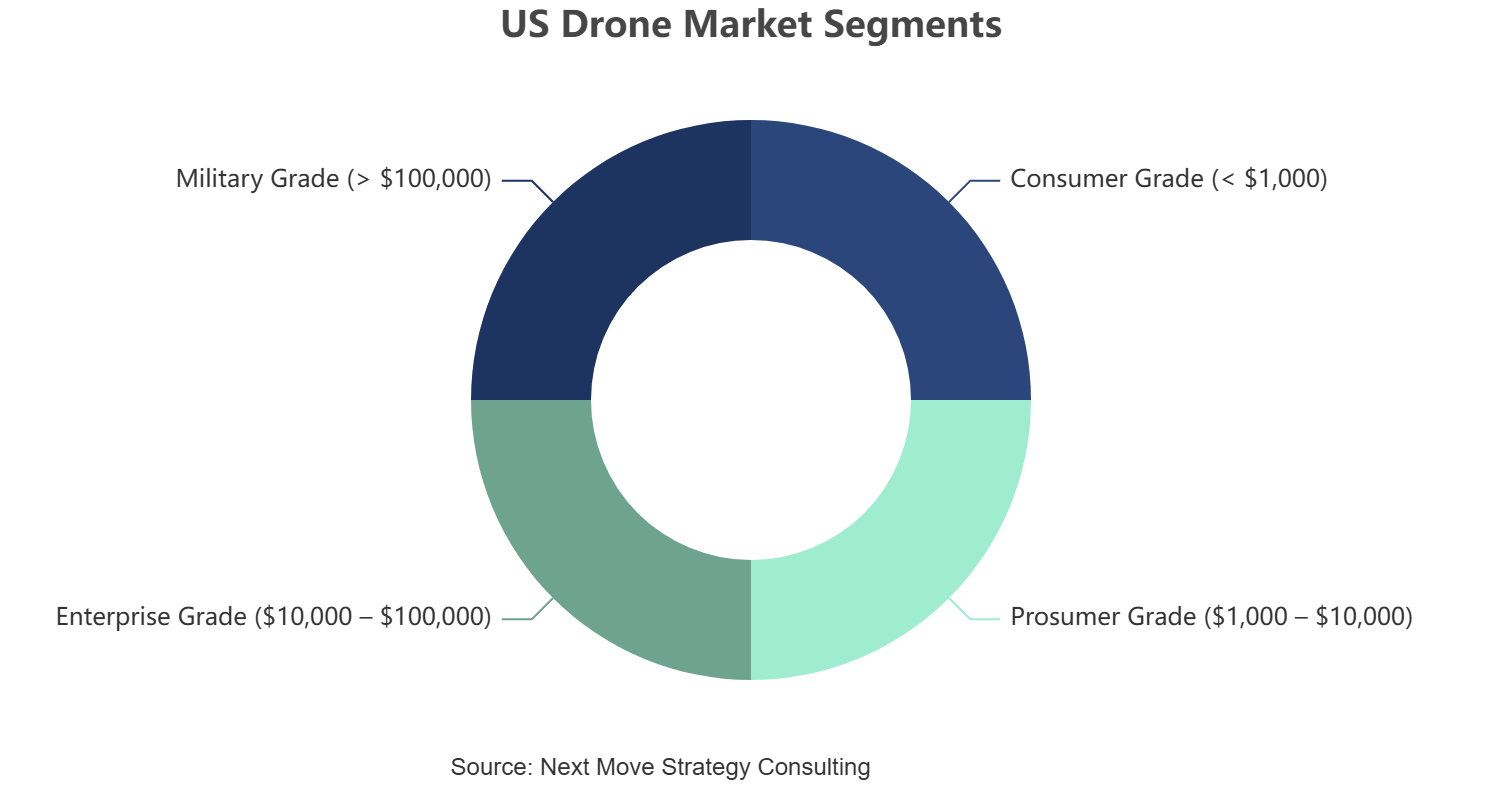
Consumer Grade (< $1,000)
-
Prosumer Grade ($1,000 – $10,000)
-
Enterprise Grade ($10,000 – $100,000)
-
Military Grade (> $100,000)
By End-User
-
Consumer Drone
-
Commercial & Industrial Drone
-
Aerial Imaging & Cinematography
-
Surveying & Mapping (Geomatics)
-
Agricultural Applications (spraying, crop monitoring)
-
Infrastructure Inspection (energy, utilities, transport)
-
Logistics & Delivery (package transport)
-
Environmental & Scientific Monitoring
-
-
Government & Public Safety Drone
-
Emergency Response & Disaster Management
-
Law Enforcement & Security
-
Firefighting & Public Safety
-
Smart City Management
-
-
Military Drone
-
Intelligence, Surveillance & Reconnaissance (ISR)
-
Combat Operations
-
Electronic Warfare (EW)
-
Target Acquisition & Designation
-
Logistics & Resupply
-
Decoy & Countermeasure Systems
-
Competitive Landscape
The U.S. Drone Market's competitive landscape is distinguished by the parallel presence of globally dominant consumer and commercial hardware manufacturers, specialized defense prime contractors and emerging autonomous systems developers, and a growing ecosystem of software and services companies addressing fleet management, data analytics, and drone-as-a-service delivery models. Our analysis indicates that competitive intensity is escalating across all segments as domestic manufacturers accelerate product development in response to federal procurement preferences and commercial enterprise demand for domestically sourced, cybersecure drone platforms capable of BVLOS operations.
Strategic Developments:
February 2025 – AeroVironment, Inc. secured a USD 288 million delivery order from the U.S. Army for its Switchblade loitering munition systems under a USD 990 million multi-year contract. The award strengthens the company’s manufacturing capabilities, supports large-scale production, and reinforces its leadership in the U.S. defense drone market.
Key Players
-
DJI Technology, Inc.
-
AeroVironment, Inc.
-
Parrot, Inc.
-
Yuneec USA, Inc.
-
Skydio, Inc.
-
Autel Robotics USA LLC
-
Wingtra AG
-
Lockheed Martin Corporation
-
Percepto Robotics Ltd.
-
Skyfront Corp.
-
Anduril Industries, Inc.
-
Kratos Defense & Security Solutions, Inc.
-
Draganfly Innovations USA, Inc.
-
Quantum-Systems Inc.
-
Tekever, S.A.
Global hardware leader DJI Technology competes alongside domestic challengers Skydio and Autel Robotics in the commercial and prosumer segments, while AeroVironment and Kratos Defense & Security Solutions anchor the tactical and defense-grade UAV market alongside Lockheed Martin and Anduril Industries for advanced autonomous systems. Parrot and Yuneec USA address commercial and public safety niches, while Wingtra and Quantum-Systems serve professional fixed-wing survey applications. Percepto Robotics, Skyfront, Draganfly Innovations, and Tekever round out a competitive field spanning autonomous inspection, long-endurance operations, and ISR solutions.
Porter's Five Forces Analysis of the U.S. Drone Market:
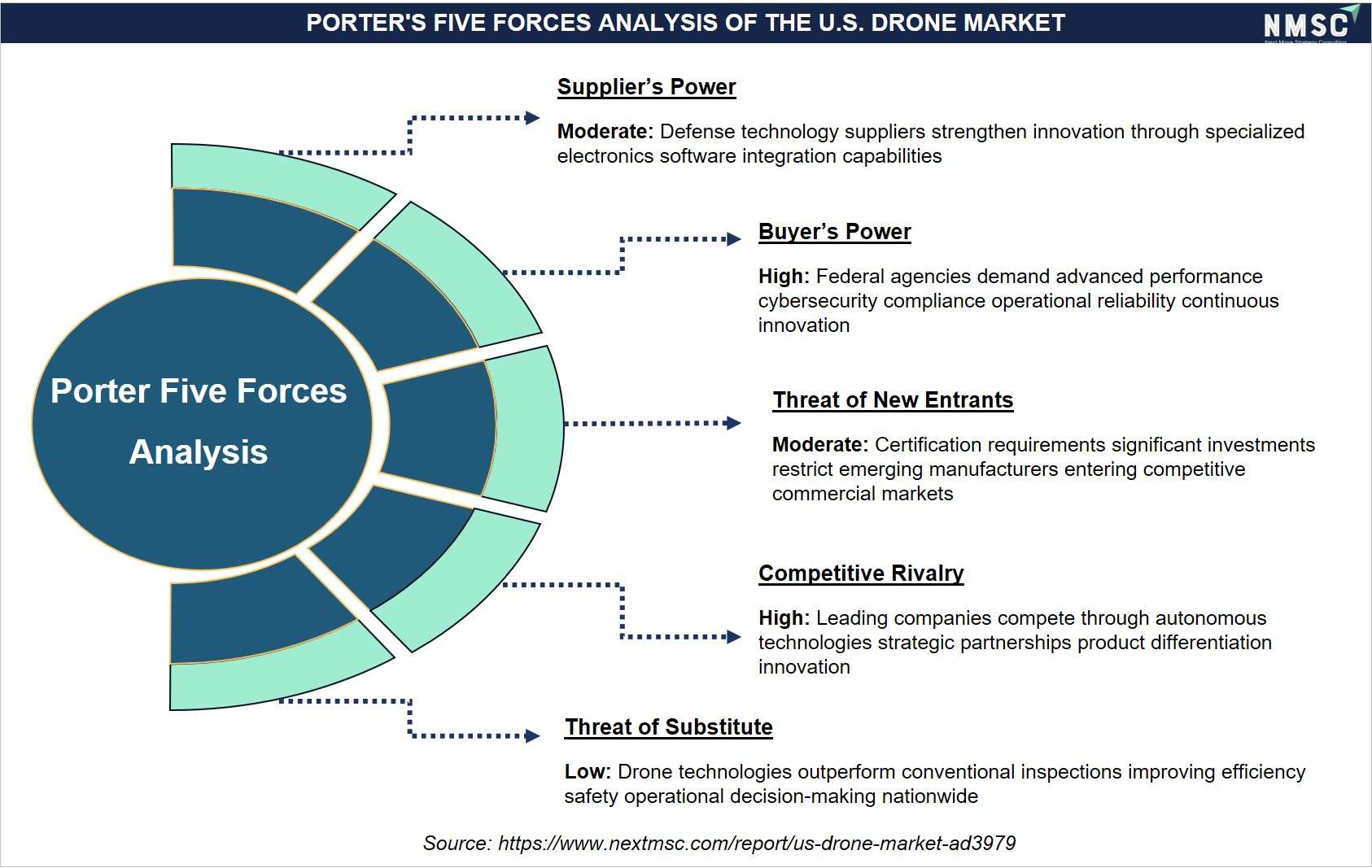
The above Porter's Five Forces analysis maps the key competitive forces, such as supplier power, buyer power, threat of new entrants, competitive rivalry, and threat of substitutes, shaping the U.S. drone market. From our analysis, we observed that supplier power remains moderate with defense technology suppliers driving innovation, while buyer power is high as federal agencies demand advanced performance and cybersecurity compliance. The threat of new entrants is moderate due to certification requirements and significant investments, whereas competitive rivalry remains high with leading companies competing through autonomous technologies and strategic partnerships. The threat of substitutes is low, as drone technologies outperform conventional inspections across the market.
Key Benefits for Stakeholders
Next Move Strategy Consulting's study of the U.S. Drone Market provides a comprehensive, data-driven view of revenue and volume trends from 2025 through 2035, segmented across component, platform type, autonomy level, MTOW, price grade, and end-user. Investors, manufacturers, and service operators gain quantified market sizing, segment-level growth trajectories, and an evidence-based view of the forces shaping the United States' commercial, defense, and public safety drone ecosystem.
Defense contractors, commercial operators, and technology developers gain operational and regulatory intelligence calibrated to the U.S. market's unique federal procurement dynamics, FAA regulatory environment, and domestic-sourcing policy landscape. Detailed competitive profiling supports partnership evaluation and market entry strategy, while transparent revenue and volume projections grounded in U.S.-specific demand drivers provide financial stakeholders with a reliable analytical foundation.
|
Parameters |
Details |
|
Customization Scope |
Free customization (equivalent to up to 80 analyst-working hours) after purchase. |
|
Pricing and Purchase Options |
Avail customized purchase options to meet your exact research needs. |
|
Approach |
In-depth primary and secondary research; proprietary databases; rigorous quality control and validation measures. |
|
Analytical Tools |
Porter’s Five Forces, SWOT, value chain, and Harvey ball analysis to assess competitive intensity, stakeholder roles, and relative impact of key factors. |
Conclusion
The U.S. Drone Market is on a high-growth trajectory, advancing from USD 9.52 billion in 2025 to USD 31.40 billion by 2035 at a revenue CAGR of 12.00%, while unit volumes expand from 287 thousand to 1,338 thousand units at 15.84% CAGR. Defense modernization programs, FAA-enabled BVLOS expansion, and rapid AI-driven autonomy advancement are the primary structural growth catalysts, while federal procurement restrictions on foreign hardware are reshaping competitive dynamics in favor of domestic manufacturers. Drone delivery and precision agriculture represent the most transformational long-term revenue opportunities.
About the Author
 Mayurima Roy
— Mayurima Roy is Research Analyst at Next Move Strategy Consulting, where she has spent 4 years working across the firm's full industry coverage rather than a single fixed vertical. Her work centers on structured research, ongoing trend tracking, competitive assessment, and insight-led content development, translating complex market data into clear, decision-ready narratives that support informed client decision-making across diverse global industries, market sectors, and world regions every day.
Mayurima Roy
— Mayurima Roy is Research Analyst at Next Move Strategy Consulting, where she has spent 4 years working across the firm's full industry coverage rather than a single fixed vertical. Her work centers on structured research, ongoing trend tracking, competitive assessment, and insight-led content development, translating complex market data into clear, decision-ready narratives that support informed client decision-making across diverse global industries, market sectors, and world regions every day.
About the Reviewer
 Supradip Baul
— Supradip Baul is an accomplished business consultant and strategist with over a decade of rich experience in market intelligence, strategy, technology, and business transformation. His work has included rigorous qualitative and quantitative analysis across multiple industries, helping clients shape investment decisions and long-term roadmaps. Earlier in his career, he was associated with Gartner, where he contributed to industry-leading reports and market share analyses. He has worked with leading global companies and holds an MBA with a dual specialization in Marketing and Finance.
Supradip Baul
— Supradip Baul is an accomplished business consultant and strategist with over a decade of rich experience in market intelligence, strategy, technology, and business transformation. His work has included rigorous qualitative and quantitative analysis across multiple industries, helping clients shape investment decisions and long-term roadmaps. Earlier in his career, he was associated with Gartner, where he contributed to industry-leading reports and market share analyses. He has worked with leading global companies and holds an MBA with a dual specialization in Marketing and Finance.
At Next Move Strategy Consulting, we understand that insightful market research is the cornerstone of successful business decisions. That's why we employ a robust and multifaceted approach, combining various methodologies to deliver the most accurate and actionable data for our clients.

Research Landscape
We navigate the world of research with two primary approaches:
Qualitative Approach
Our qualitative research methodologies involve immersive techniques such as in-depth interviews, focus groups, and observational studies. By engaging directly with individuals and stakeholders, we uncover valuable insights that quantitative data alone may overlook.

Quantitative Research
In tandem with qualitative methodologies, NMSC leverages the power of Quantitative Research to provide a robust foundation of numerical insights. Through systematic data collection and analysis, we quantify patterns, preferences, and market trends, offering a comprehensive view of the business landscape.
Our quantitative research approach employs diverse tools, including surveys, experiments, and statistical modelling. These methodologies enable us to gather data from a large and representative sample, ensuring the statistical significance of our findings. By employing structured questionnaires and standardized data collection methods, we guarantee the reliability and validity of the information we present to our clients.
Quantitative research is particularly effective in measuring the prevalence of trends, assessing market size, and gauging the impact of various factors on consumer behavior. The numerical precision attained through this approach equips our clients with actionable insights, facilitating data-driven decision-making and strategy formulation.


Our Specialized Toolbox for Industry-Specific Market Research
We deploy a specialized arsenal of techniques tailored to meet your unique requirements. Here's a glimpse into our comprehensive toolbox:

Information Procurement
The stage entails acquiring market data or relevant information through various sources and methodologies.


Market Research Approach
We utilize both top-down and bottom-up approaches in market research analysis to achieve a comprehensive understanding of the market dynamics, leveraging the broad perspective of industry trends and macroeconomic factors alongside detailed insights from specific segments and individual companies.

Porters Five Forces Analysis
We conduct Porter's Five Forces analysis to evaluate the competitive landscape of an industry, providing us with insights into factors that affect profitability and strategic positioning.

SWOT Analysis

Forecasting
We utilize a forecasting model to predict future consumption by considering parameters like population, economics, regulations, market competition, drivers, constraints, technology, and pricing. We also employ statistical techniques such as multilinear regression, exponential smoothing, moving average, ARIMA, and Monte Carlo simulations for accurate predictions. In econometric forecasting, we analyzed short-term and long-term event impacts, attributing values based on regulatory frameworks, economic factors, and market events.





 Speak to Our Analyst