Edge Containerization Market

Edge containerization market size was USD 4.3 billion in 2025, projected to reach USD 34.9 billion by 2035 at a 23.3% CAGR from 2026 to 2035, per this report.

Download Free Sample PDF
Base Year (2025)
$4.30 Billion
Forecast (2035)
$34.90 Billion
CAGR (2026-2035)
23.3%
Top Region
North America

What Is the Edge Containerization Market Size?

The global edge containerization market size was valued at USD 4.3 billion in 2025 and is estimated at USD 5.3 billion in 2026, forecast to reach USD 34.9 billion by 2035, expanding at a 23.3% CAGR between 2026 and 2035. North America leads with approximately 43% share, while platform software dominates with approximately 44% share of components.

We observed that growth is broad-based across every segmentation axis, with cloud-managed edge deployment and healthcare adoption driving the dominant structural shifts through 2035.

Edge Containerization Market Revenue Forecast

Values in USD Billion

2025 $4.30 Billion
2025
2026 $5.30 Billion
2026
2027 $6.54 Billion
2027
2028 $8.06 Billion
2028
2029 $9.94 Billion
2029
2030 $12.25 Billion
2030
2031 $15.11 Billion
2031
2032 $18.63 Billion
2032
2033 $22.97 Billion
2033
2034 $28.32 Billion
2034
2035 $34.90 Billion
2035

Key Takeaways

By Component: Platform Software held the largest share of approximately 44% (USD 1.89 billion) in 2025; Professional and Managed Services is the fastest-growing sub-segment at approximately 25.1% CAGR from 2026–2035.

By Deployment Mode: On-Premises Edge held the largest share of approximately 50% (USD 2.15 billion) in 2025; Cloud-Managed Edge is the fastest-growing sub-segment at approximately 27.2% CAGR from 2026–2035.

By Organization Size: Large Enterprise held the largest share of approximately 65% (USD 2.79 billion) in 2025; Small and Medium Business is the fastest-growing sub-segment at approximately 24.5% CAGR from 2026–2035.

By End User Industry: Manufacturing held the largest share of approximately 30% (USD 1.29 billion) in 2025; Healthcare is the fastest-growing sub-segment at approximately 28.7% CAGR from 2026–2035.

By Application: Industrial Automation held the largest share of approximately 36% (USD 1.55 billion) in 2025; Autonomous Systems is the fastest-growing sub-segment at approximately 31.4% CAGR from 2026–2035.

Dominant Region: North America dominated with approximately 43% revenue share (USD 1.85 billion) in 2025.

Fastest-Growing Region: Asia-Pacific is expected to register the highest CAGR of approximately 27.0% during 2026–2035.

Dominant Country: U.S. led with approximately USD 1.55 billion in 2025.

Fastest-Growing Country: India is the fastest-growing country at approximately 32.6% CAGR from 2026–2035.

Market Opportunity: The edge containerization market is expected to create an absolute dollar opportunity of USD 29.6 billion between 2026 and 2035, presenting significant investment potential across the cloud-managed edge and healthcare adoption value chain.

According to Next Move Strategy Consulting analysis, industrial and telecommunications operators are increasingly consolidating fragmented device management tools into unified, Kubernetes-native control planes that span thousands of distributed edge nodes, a shift that favors vendors with proven large-scale orchestration reliability over single-device management specialists as real-time AI inference workloads move closer to the network edge through 2035.

What Does the Edge Containerization Market Encompass?
The edge containerization market encompasses platform software, orchestration tools, runtime engines, and services that package and manage containerized applications across distributed edge computing nodes rather than centralized data centers. Our assessment indicates that the scope spans on-premises, cloud-managed, and hybrid deployment models supplied to large enterprises and small and medium businesses across manufacturing, telecommunications, retail, and a broad range of other industries, reflecting the sector's evolution from data-center-centric Cloud Computing toward distributed, latency-sensitive workload deployment at the network edge.
Regulatory developments, including expanding data sovereignty requirements across major economies, continue to influence where and how edge workloads process sensitive data locally rather than in centralized clouds. We observed that technology adoption is shifting toward lightweight, Kubernetes-native distributions purpose-built for resource-constrained edge hardware rather than adapted data-center orchestration platforms. Next Move Strategy Consulting's analysis indicates that this structural shift, combined with expanding real-time AI inference deployment at the edge, is redefining competitive dynamics across the edge containerization market.

SUPPLY CHAIN STRUCTURE OF THE EDGE CONTAINERIZATION MARKET

SUPPLY CHAIN STRUCTURE OF THE EDGE CONTAINERIZATION MARKET
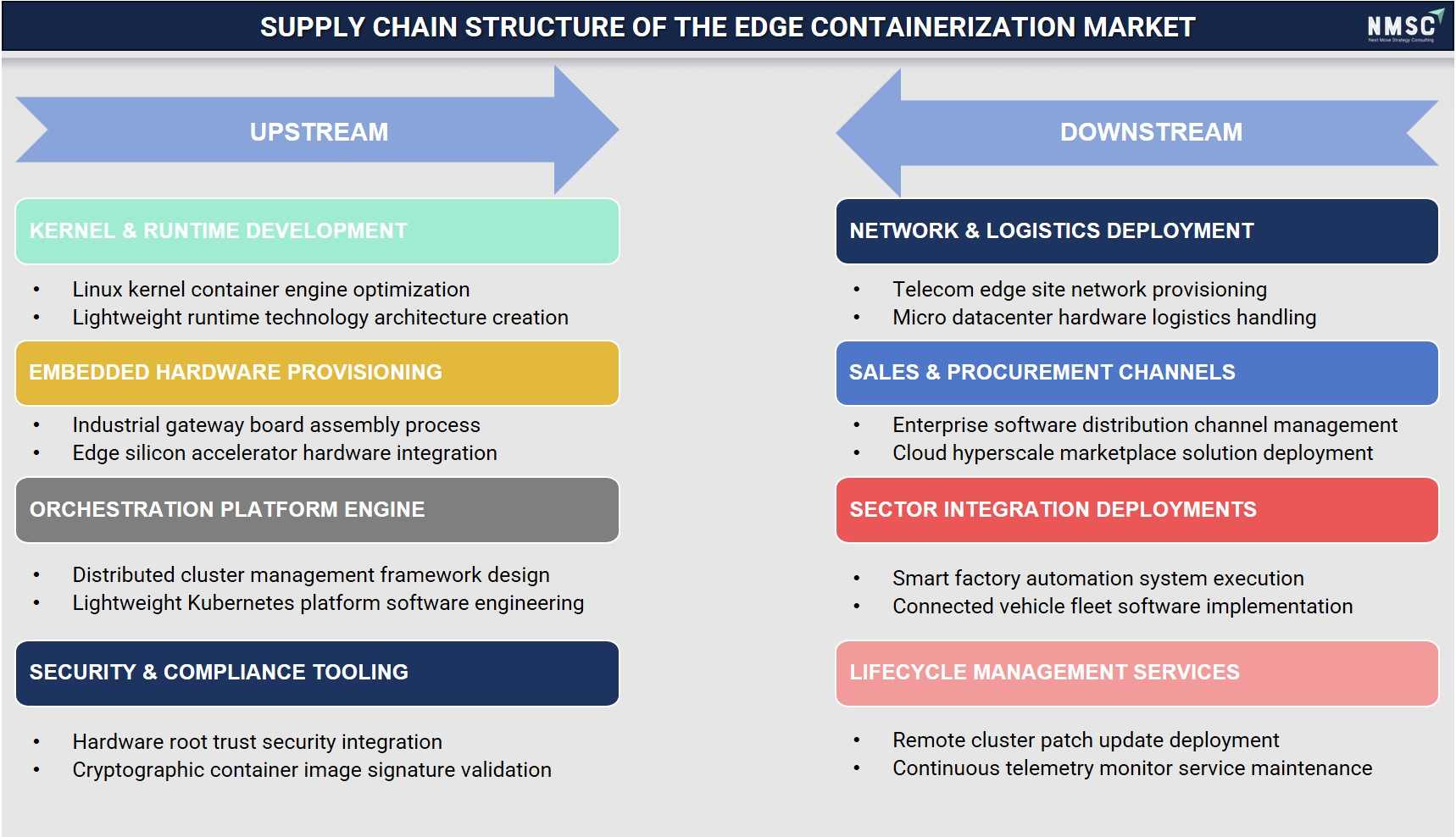
The supply chain of the market spans software development, hardware integration, orchestration platforms, security solutions, deployment infrastructure, and lifecycle services. Upstream activities focus on container runtimes, Kubernetes orchestration, embedded hardware, and security tooling, while downstream operations include network deployment, enterprise distribution, industry-specific implementation, and continuous monitoring to ensure scalable, secure, and efficient edge application management.

Market Drivers & Dynamics

Interactive Dataset
Rising demand for real-time AI inference processing at the network edge driver +3.8% North America, Asia-Pacific 2026–2035
Expanding industrial IoT and manufacturing automation deployment driver +3.1% Asia-Pacific, Europe 2026–2035
Growing data sovereignty requirements favoring local edge processing driver +2.4% Europe, Asia-Pacific 2026–2035
Expanding hyperscaler edge-native platform investment driver +1.8% North America 2026–2032
Rising healthcare adoption of real-time clinical edge diagnostics driver +1.3% North America, Europe 2026–2035
Growing 5G and telecommunications edge infrastructure investment driver +1.0% Asia-Pacific, North America 2026–2035
Fragmented hardware ecosystems complicating cross-platform orchestration restraint −1.6% Global 2026–2035
Limited skilled workforce for edge-native Kubernetes deployment restraint −1.1% Global 2026–2032
Connectivity and bandwidth constraints in remote edge locations restraint −0.7% Asia-Pacific, Latin America, Middle East & Africa 2028–2035
Source: Next Move Strategy Consulting

Growth Drivers

What Is the Primary Growth Driver of the Edge Containerization Market?

Rising demand for real-time AI inference processing at the network edge is the primary driver of the market. Industry estimates cited by edge computing infrastructure providers project that a majority of enterprise-generated data will be processed at the edge rather than centralized data centers, reflecting a fundamental shift in where compute occurs. We observed that this data-processing shift, reinforced by expanding industrial IoT deployment across manufacturing and utilities, continues to anchor baseline demand for containerized orchestration platforms capable of managing distributed edge workloads.

How Is Hyperscaler Investment Driving Edge Containerization Market Growth?
Expanding hyperscaler investment in edge-native platforms and developer toolkits is accelerating market growth beyond traditional on-premises deployment models. Our assessment indicates that Microsoft Corporation's continued expansion of edge-native platform integrations and Hewlett Packard Enterprise Company's enhanced edge software portfolio reflect sustained investment in simplifying containerized application deployment at scale. This investment momentum, combined with expanding managed service offerings, is compressing adoption timelines for edge orchestration platforms across enterprise and industrial buyers.

Growth Inhibitors

What Is Restraining Edge Containerization Market Expansion?
Fragmented hardware ecosystems restrain broader platform standardization, as edge deployments span highly heterogeneous device types, connectivity conditions, and compute capabilities. Limited availability of skilled workforce experienced in edge-native Kubernetes deployment continues to constrain implementation speed for many organizations. We found that operators in remote or bandwidth-constrained locations face particular exposure, as connectivity limitations restrict their ability to fully realize centralized orchestration and monitoring capability across distributed edge nodes.

What Are the Growth Opportunities?

How Can Lightweight, Purpose-Built Distributions Unlock Value for Resource-Constrained Deployments?

Lightweight Kubernetes distributions engineered specifically for resource-constrained edge hardware present a whitespace opportunity for vendors serving manufacturers and telecommunications operators managing thousands of distributed nodes. Suppliers that commercialize minimal-footprint orchestration platforms stand to capture recurring platform revenue as enterprises scale beyond pilot deployments across the Orchestration Tools segment.

Where Does Healthcare Edge Deployment Create New Demand?

Healthcare providers deploying real-time clinical diagnostics and remote patient monitoring represent an underpenetrated opportunity for vendors offering compliance-ready edge orchestration platforms. Vendors that build healthcare-specific security and regulatory compliance capability can capture recurring platform revenue as clinical edge deployment accelerates across the Healthcare end user industry segment.

How Can Managed Services Benefit Enterprises Facing Skilled Workforce Shortages?

Managed edge orchestration services create an opportunity for vendors serving enterprises that lack in-house Kubernetes expertise to operate distributed edge deployments effectively. Early movers that scale consumption-based managed service offerings can differentiate with mid-market and enterprise buyers facing workforce shortages across the Professional and Managed Services segment.

Segmentation Analysis

2025 (USD Billion)
2035 (USD Billion)
Platform Software 2025: $1.89 Billion | 2035: $14.50 Billion
Platform Sof
Orchestration Tools 2025: $1.03 Billion | 2035: $8.50 Billion
Orchestratio
Runtime Engines 2025: $0.73 Billion | 2035: $5.90 Billion
Runtime Engi
Professional and Managed Services 2025: $0.65 Billion | 2035: $6.00 Billion
Professional
Platform Software $1.89 Billion $14.50 Billion 23.3%
Orchestration Tools $1.03 Billion $8.50 Billion 23.9%
Runtime Engines $0.73 Billion $5.90 Billion 23.5%
Professional and Managed Services $0.65 Billion $6.00 Billion 25.1%

Which Component Dominates the Edge Containerization Market?

Platform Software led the market with USD 1.89 billion in 2025, supported by its role as the foundational orchestration layer underpinning nearly all edge containerization deployments. We observed that Professional and Managed Services is the fastest-growing component, expanding at a 25.1% CAGR from 2026 to 2035, as enterprises increasingly favor subscription-based managed offerings over capital-intensive self-managed deployments to reduce operational complexity.

2025 (USD Billion)
2035 (USD Billion)
On-Premises
Cloud-Manage
Hybrid Edge
Segment Item 2025 (USD Billion) 2035 (USD Billion) CAGR
On-Premises Edge $10.0 USD Billion $40.0 USD Billion 9.0%
Cloud-Managed Edge $17.1 USD Billion $51.1 USD Billion 23.0%
Hybrid Edge $24.2 USD Billion $62.2 USD Billion 9.0%

Segment-wise data is locked

Unlock complete segment-wise numbers for By Deployment Mode.

Unlock Full Data
2025 (USD Billion)
2035 (USD Billion)
Large Enterp
Small and Me
Segment Item 2025 (USD Billion) 2035 (USD Billion) CAGR
Large Enterprise $10.0 USD Billion $40.0 USD Billion 10.0%
Small and Medium Business $17.1 USD Billion $51.1 USD Billion 24.0%

Segment-wise data is locked

Unlock complete segment-wise numbers for By Organization Size.

Unlock Full Data
2025 (USD Billion)
2035 (USD Billion)
Manufacturin
Telecommunic
Retail
Healthcare
Energy and U
Segment Item 2025 (USD Billion) 2035 (USD Billion) CAGR
Manufacturing $10.0 USD Billion $40.0 USD Billion 20.0%
Telecommunications $17.1 USD Billion $51.1 USD Billion 26.0%
Retail $24.2 USD Billion $62.2 USD Billion 24.0%
Healthcare $31.3 USD Billion $73.3 USD Billion 26.0%
Energy and Utilities $38.4 USD Billion $84.4 USD Billion 9.0%

Segment-wise data is locked

Unlock complete segment-wise numbers for By End User Industry.

Unlock Full Data

Which End User Industry Leads the Edge Containerization Market?

Manufacturing remained the dominant end user industry, reaching USD 1.29 billion in 2025 given the scale of industrial automation and factory-floor edge deployments already underway across global production facilities. Our findings suggest that Healthcare is the fastest-growing industry at a 28.7% CAGR from 2026 to 2035, as real-time clinical diagnostics and remote patient monitoring applications increasingly require low-latency edge processing capability.

2025 (USD Billion)
2035 (USD Billion)
Industrial A
Real-Time An
Autonomous S
Content Deli
Security and
Segment Item 2025 (USD Billion) 2035 (USD Billion) CAGR
Industrial Automation $10.0 USD Billion $40.0 USD Billion 18.0%
Real-Time Analytics $17.1 USD Billion $51.1 USD Billion 16.0%
Autonomous Systems $24.2 USD Billion $62.2 USD Billion 22.0%
Content Delivery and Caching $31.3 USD Billion $73.3 USD Billion 12.0%
Security and Compliance $38.4 USD Billion $84.4 USD Billion 19.0%

Segment-wise data is locked

Unlock complete segment-wise numbers for By Application.

Unlock Full Data

Which Application Leads Edge Containerization Market Demand?
Industrial Automation remained the leading application, valued at USD 1.55 billion in 2025 as factory automation and production control systems continue to represent the most mature use case for containerized edge deployment. Based on research conducted by Next Move Strategy Consulting, we found that Autonomous Systems is the fastest-growing application, registering a 31.4% CAGR from 2026 to 2035, as robotics and autonomous vehicle platforms scale rapidly from a comparatively small base.

Growth Opportunities

Our analysis shows that three forward-looking opportunities stand out for stakeholders positioning within the edge containerization market over the 2026–2035 forecast period.

How Can Lightweight, Purpose-Built Distributions Unlock Value for Resource-Constrained Deployments?

Lightweight Kubernetes distributions engineered specifically for resource-constrained edge hardware present a whitespace opportunity for vendors serving manufacturers and telecommunications operators managing thousands of distributed nodes. Suppliers that commercialize minimal-footprint orchestration platforms stand to capture recurring platform revenue as enterprises scale beyond pilot deployments across the Orchestration Tools segment.

Where Does Healthcare Edge Deployment Create New Demand?

Healthcare providers deploying real-time clinical diagnostics and remote patient monitoring represent an underpenetrated opportunity for vendors offering compliance-ready edge orchestration platforms. Vendors that build healthcare-specific security and regulatory compliance capability can capture recurring platform revenue as clinical edge deployment accelerates across the Healthcare end user industry segment.

How Can Managed Services Benefit Enterprises Facing Skilled Workforce Shortages?

Managed edge orchestration services create an opportunity for vendors serving enterprises that lack in-house Kubernetes expertise to operate distributed edge deployments effectively. Early movers that scale consumption-based managed service offerings can differentiate with mid-market and enterprise buyers facing workforce shortages across the Professional and Managed Services segment.

STRATEGIC FRAMEWORK OF THE EDGE CONTAINERIZATION MARKET

STRATEGIC FRAMEWORK OF THE EDGE CONTAINERIZATION MARKET
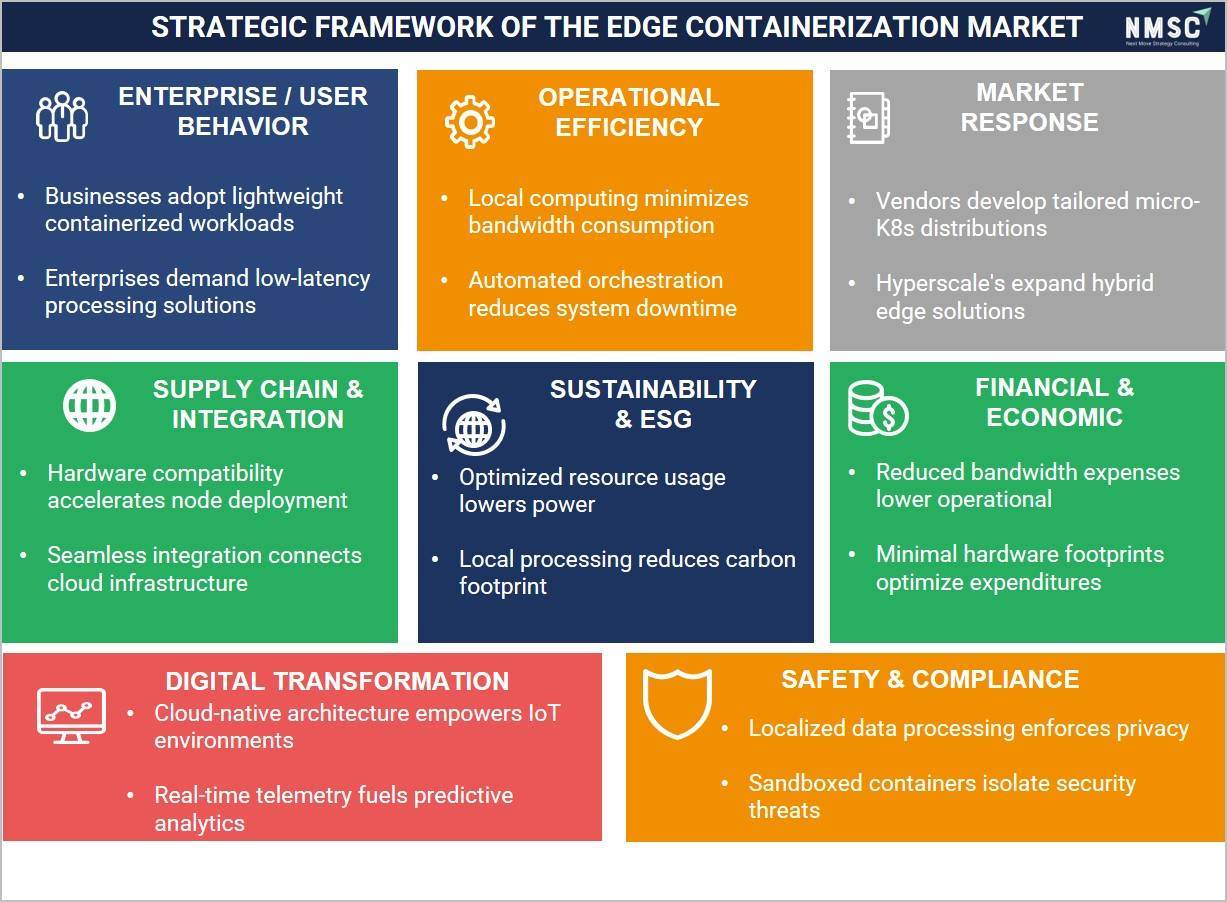
The strategic framework of the market highlights how enterprise demand for low-latency computing, cloud-native architectures, and automated orchestration drives market growth. It emphasizes operational efficiency, secure localized data processing, supply chain integration, sustainability, and cost optimization. Together, these factors enable scalable deployment of containerized applications across distributed edge environments, supporting digital transformation in industries such as manufacturing, telecom, healthcare, and transportation.

Regional Outlook

2025 (USD Billion)
2035 (USD Billion)
North Americ
Europe
Asia-Pacific
Middle East
Latin Americ
Region 2025 (USD Billion) 2035 (USD Billion) CAGR (%)
North America $10.0 USD Billion $40.0 USD Billion 9.0%
Europe $17.1 USD Billion $51.1 USD Billion 27.0%
Asia-Pacific $24.2 USD Billion $62.2 USD Billion 25.0%
Middle East & Africa $31.3 USD Billion $73.3 USD Billion 23.0%
Latin America $38.4 USD Billion $84.4 USD Billion 12.0%

Regional data is locked

Unlock complete regional numbers for this market.

Unlock Full Data

Competitive Landscape

We observed that the edge containerization market features a moderately consolidated competitive landscape, with hyperscale cloud providers and enterprise infrastructure vendors competing alongside specialized edge-native orchestration platforms on deployment scale, hardware compatibility, and management simplicity.

Dimension Description
Market Structure Moderately consolidated; the top companies profiled in this report collectively account for a majority of global edge containerization market revenue, while numerous specialized point-tool vendors serve niche industrial deployment demand.
Innovation Focus Lightweight orchestration distributions, vendor-agnostic hardware architectures, and industrial-grade security dominate current innovation pipelines across leading vendors.
M&A Activity Selective platform and capability acquisitions continue as hyperscale and enterprise infrastructure vendors expand edge-native orchestration portfolios to compete with specialized edge-native platform providers.

How Do Companies Compete in the Edge Containerization Market?

Companies compete primarily on deployment scale, hardware compatibility, and management simplicity across the industry. Hyperscale cloud providers such as Microsoft Corporation and Amazon.com, Inc. leverage broad cloud-to-edge platform integration to serve large enterprises, while specialized innovators such as ZEDEDA, Inc. and SUSE S.A. compete on vendor-agnostic, hardware-independent orchestration depth.

Which Competitive Archetypes Dominate the Edge Containerization Market?

Two archetypes dominate the market: hyperscale cloud and enterprise infrastructure providers offering integrated cloud-to-edge platform ecosystems, and specialized edge-native orchestration vendors concentrated in lightweight, hardware-agnostic deployment. Broadcom Inc. and Hewlett Packard Enterprise Company exemplify the diversified archetype through integrated edge software portfolios, while ZEDEDA, Inc. and Rafay Systems, Inc. exemplify the specialized archetype built around purpose-built edge orchestration.

How Are Companies Differentiating Through Innovation in Edge Containerization?

Innovation and differentiation strategy increasingly center on lightweight orchestration distributions and vendor-agnostic hardware architectures. SUSE S.A.'s K3s distribution and ZEDEDA, Inc.'s EVE-OS-based architecture illustrate how vendors are positioning minimal-footprint, hardware-independent orchestration as a competitive differentiator for resource-constrained edge deployments. Our analysis shows that vendors unable to demonstrate credible lightweight orchestration capability risk losing specification share to platform-diversified competitors.

What M&A and Expansion Activity Is Shaping the Edge Containerization Market?

Platform expansion and managed services investment continue to shape capability access within the industry. Hewlett Packard Enterprise Company's expanding GreenLake managed edge offerings and Microsoft Corporation's continued edge-native platform integration illustrate how established infrastructure vendors are broadening edge orchestration capability to compete with specialized providers across the growing managed services segment.

Key Market Players

Our assessment indicates that the following 20 companies are actively shaping product innovation, platform architecture, and managed services expansion within the global edge containerization market.

Docker, Inc. Red Hat, Inc. Broadcom Inc. SUSE S.A. Canonical Ltd. Microsoft Corporation Amazon.com, Inc. Alphabet Inc. ZEDEDA, Inc. Wind River Systems, Inc. Hewlett Packard Enterprise Company Dell Technologies Inc. Cisco Systems, Inc. Nutanix, Inc. Rafay Systems, Inc. D2iQ, Inc. Portainer.io Balena Ltd. Avassa AB EMQ Technologies Co., Ltd.

Latest Developments

We found that recent developments within the edge containerization market are concentrated on edge-native platform expansion and industrial orchestration innovation, reflecting the industry's broader innovation trajectory.

Date Event
May 20 Dell announced major enhancements to Dell NativeEdge, enabling organizations to run and centrally manage containers, virtual machines, and AI workloads across distributed edge infrastructure with improved orchestration, scalability, and automation.
May 20 Docker launched Docker Hardened Images (DHI), a catalog of enterprise-grade, security-hardened container images designed to improve software supply chain security. The solution enables secure deployment of containerized applications across Kubernetes, hybrid cloud, and edge computing environments.

Investment Opportunities

What Capital Inflows Are Targeting the Edge Containerization Market?

Capital inflows into the market are increasingly directed toward lightweight orchestration platforms and managed services capability. Continued hyperscaler investment from Microsoft Corporation and Hewlett Packard Enterprise Company alongside specialized platform expansion from vendors such as ZEDEDA, Inc. illustrate sustained investor interest in edge-native architecture. We observed that investors favor platforms demonstrating validated large-scale deployment reliability, viewing proven node-count scalability as a proxy for long-term enterprise contract relevance.

How Is Infrastructure Investment Supporting Edge Containerization Platform Scaling?

Infrastructure investment is expanding edge compute and orchestration control-plane capacity to support growing volumes of distributed containerized workloads. Our findings suggest that Hewlett Packard Enterprise Company's Edgeline converged edge systems exemplify continued investment in AI-ready edge infrastructure. Vendors are increasingly investing in scalable control-plane architectures capable of managing thousands of geographically dispersed edge nodes simultaneously.

What ESG Considerations Are Shaping Edge Containerization Investment Decisions?

Environmental, social, and governance considerations are increasingly relevant to investment decisions across the industry, as distributed edge computing can reduce data-transport energy consumption compared with centralized cloud processing for latency-sensitive workloads. Expanding data sovereignty regulations across Europe and Asia-Pacific continue to shape vendor architecture decisions. We found that investors increasingly favor vendors demonstrating measurable energy-efficiency gains from localized edge processing, treating this as a differentiator alongside data governance compliance.

Key Benefits for Stakeholders

How Does This Report Benefit Enterprise and Industry Leaders?

Enterprise and industry leaders gain access to validated segmentation, competitive benchmarking, and regional demand forecasts that support platform selection and deployment strategy across the edge containerization industry. Our analysis shows that detailed component, deployment mode, and end user industry breakdowns help technology leaders align investment with organizational edge computing maturity while identifying underserved industry segments for platform expansion.

How Does This Report Benefit Investors and Financial Analysts?

Investors and financial analysts benefit from consistent, single-point market size and CAGR estimates that support valuation and capital-allocation decisions across the edge containerization market supply chain. We observed that the report's regional and segment-level growth differentials help identify which vendors are best positioned to capture above-market growth in healthcare and Asia-Pacific categories through 2035.

How Does This Report Benefit Technology Vendors and Product Teams?

Technology vendors and product teams gain insight into emerging platform requirements, including lightweight orchestration distributions, vendor-agnostic hardware architectures, and managed service delivery models, that are reshaping the industry. Our findings suggest that this analysis helps R&D teams prioritize development roadmaps around minimal-footprint deployment and industrial-grade security capability that are increasingly required by enterprise buyer evaluation processes.

Key Market Segments Evaluated

By Component

  • Platform Software
  • Orchestration Tools
  • Runtime Engines
  • Professional and Managed Services

By Deployment Mode

  • On-Premises Edge
  • Cloud-Managed Edge
  • Hybrid Edge

By Organization Size

  • Large Enterprise
  • Small and Medium Business

By End User Industry

  • Manufacturing
  • Telecommunications
  • Retail
  • Healthcare
  • Energy and Utilities
  • Transportation and Logistics
  • Other Industries

By Application

  • Industrial Automation
  • Real-Time Analytics
  • Autonomous Systems
  • Content Delivery and Caching
  • Security and Compliance
  • Other Applications

By Region

  • North America 
    • U.S.
    • Canada
    • Mexico.
  • Europe 
    • UK
    • Germany
    • France
    • Italy
    • Spain
    • Sweden
    • Denmark
    • Finland
    • Netherlands
    • Rest of Europe.
  • Asia-Pacific 
    • China
    • India
    • Japan
    • South Korea
    • Taiwan
    • Indonesia
    • Vietnam
    • Australia
    • Philippines
    • Malaysia
    • Rest of APAC.
  • Middle East & Africa 
    • Saudi Arabia
    • UAE
    • Egypt
    • Israel
    • Turkey
    • Nigeria
    • South Africa
    • Rest of MEA.
  • Latin America 
    • Brazil
    • Argentina
    • Chile
    • Colombia
    • Rest of LATAM.

Conclusion & Recommendations

The long-term outlook for the market remains strongly positive, with global revenue projected to grow more than eightfold from USD 4.3 billion in 2025 to USD 34.9 billion by 2035 at a 23.3% CAGR. We observed that sustained real-time AI inference demand, expanding industrial IoT deployment, and growing healthcare edge adoption will continue underpinning demand across manufacturing, telecommunications, and healthcare segments through the forecast period.

What Strategic Positioning Should Edge Containerization Suppliers Pursue?

Suppliers should prioritize lightweight, vendor-agnostic orchestration platforms while pursuing managed services capacity to address persistent skilled workforce shortages. Our assessment indicates that vendors investing early in hardware-independent architecture and industrial-grade security capability will be best positioned to capture premium specification within the edge containerization market.

How Attractive Is the Edge Containerization Market for New Investment?
The edge containerization industry presents a highly attractive investment case, supported by a USD 29.6 billion absolute dollar opportunity between 2026 and 2035 and above-average growth in Asia-Pacific and healthcare categories. We found that investment attractiveness is highest for vendors combining validated large-scale deployment reliability with vendor-agnostic architecture, positioning them to serve both hyperscaler-aligned and independent enterprise segments simultaneously.

What Market Shifts and Key Risks Should Stakeholders Monitor?

Stakeholders should monitor fragmented hardware ecosystems, limited skilled workforce availability, and connectivity constraints in remote deployment locations as key risks to the edge containerization market. Our analysis shows that vendors unable to demonstrate credible lightweight, hardware-agnostic orchestration capability risk losing specification share to platform-diversified competitors as enterprises scale beyond pilot deployments industry-wide.

What Are the Key Growth Pathways for the Edge Containerization Market?

Key growth pathways include expanding healthcare and autonomous systems application capability, scaling managed services offerings, and deepening penetration into Asia-Pacific's rapidly expanding industrial IoT base. Next Move Strategy Consulting's analysis indicates that suppliers pursuing these pathways while maintaining strength in core industrial automation deployment will be best positioned to capture the edge containerization market's projected growth through 2035.

FAQs

About the Author

Liza Phukan

Liza Phukan

Liza Phukan is Research Associate at Next Move Strategy Consulting, where she has covered emerging industries and market research across sectors for 3.5 years. Her work includes analyzing industry developments, validating market data, and developing structured business content from research findings. She uses secondary research and data-validation practices to turn complex market information into clear decision-useful market analysis for business audiences and support report development and B2B.

About the Reviewer

Supradip Baul

Supradip Baul

Supradip Baul is an accomplished business consultant and strategist with over a decade of rich experience in market intelligence, strategy, technology, and business transformation. His work has included rigorous qualitative and quantitative analysis across multiple industries, helping clients shape investment decisions and long-term roadmaps. Earlier in his career, he was associated with Gartner, where he contributed to industry-leading reports and market share analyses. He has worked with leading global companies and holds an MBA with a dual specialization in Marketing and Finance.

Download Free Sample

Robert Sean Trevino

ROBERT SEAN TREVINO

Sr. Director, Head of Strategic Insights & Analytics

Foundation Medicine

I realized that it was a reliable source of information. These days, there are many people who are looking for authentic data, and this is one of the only sources that can offer them with what they need;

Gaurav Jaiswal

GAURAV JAISWAL

Founder & CEO

Yano Charge Private Limited

The EV Charging market research report provided by the NextMSC was exceptionally detailed and insightful. It offered a comprehensive analysis that proved to be a game-changer for our strategic planning. Truly a testament to the NextMSC’s expertise and thoroughness in EV market landscape & analysis.

Henri Knyphausen

HENRI KNYPHAUSEN

Partner at Singulier [Ex-BCG]

Singulier

I recently engaged NEXTMSC.com for a commercial due diligence project within the intralogistics sector, and I am pleased to provide a reference based on my experience. In utilizing NEXTMSC.com's services, I found their report to offer valuable insights into market dynamics and key industry players. The initial report provided a solid foundation for our analysis. However, as we were investigating a smaller target in the market, and I had specific customization requests requiring additional research. These requests included detailed information on product portfolios of various players and sub-market sizes, both inclusive and exclusive of certain product categories. NEXTMSC.com demonstrated commendable responsiveness and agility in accommodating these customization requests. Within a timeframe of 1-2 weeks, they delivered a revised report that met our specific needs. Furthermore, they were receptive to my follow-up inquiries, ensuring clarity and understanding of the data provided. The final deliverable significantly contributed to our due diligence efforts. One of NEXTMSC.com's notable strengths lies in their qualitative research capabilities. However, for future engagements, I would recommend the inclusion of a quantified market model in Excel format. Such a model would offer the ability to conduct in-depth analyses and explore various market segments, including country-specific data and subcomponent breakdowns. Based on my positive experience, I would not hesitate to work with NEXTMSC.com again. Their responsiveness, willingness to accommodate customization requests, and commitment to delivering actionable insights make them a reliable partner for commercial research projects.

Ross J Mckenzie

ROSS J MCKENZIE

Business Insight Manager

Staysure Group

“Next MSC have been incredibly helpful in providing detailed & robust information on our market, alongside quantifying growth by different segments. The process to procure was simple and easy, with sample reports and regular contact to ensure we had what we needed. Succinct detail on their sources & methodologies is also greatly received, allowing transparency in this respect helps build trust in the detail you pay for. Joseph in particular was fantastic, and helped ensure efficient provision of the insight pack – thank you NMSC!”.

Melanie Samko

MELANIE SAMKO

Director of Marketing

TOSOH BIOSCIENCE, INC.

The information provided by NMSC is incredibly valuable, thank you so much for such a excellent work. I really appreciate it. I will make sure to reference all of it, in my summary document.

Custom Market Research Services

We will customize the research for you if the listed report does not fully match your requirements.

Get 30% Free Customization

Select License

This website uses cookies to ensure you get the best experience on our website. Learn more

✖