The global Sovereign Cloud Infrastructure Market size was valued at USD 137.42 billion in 2025 and is expected to be valued at USD 170.65 billion by the end of 2026. The industry is projected to grow, hitting USD 1,187.93 billion by 2035, with a CAGR of 24.18% between 2026 and 2035.
|
Parameters |
Details |
|
Market Size in 2026 |
USD 170.65 Billion |
|
Revenue Forecast in 2035 |
USD 1,187.93 Billion |
|
Growth Rate |
CAGR of 24.18% from 2026 to 2035 |
|
Analysis Period |
2025–2035 |
|
Base Year Considered |
2025 |
|
Forecast Period |
2026–2035 |
|
Market Size Estimation |
Billion (USD) |
|
Companies Profiled |
20 |
|
Countries Covered |
33 |
|
Market Share |
Available for 10 companies |
Based on NMSC’s primary research, we observed that the global sovereign cloud infrastructure market is witnessing steady growth, primarily driven by increasing concerns around data sovereignty, regulatory compliance, and national security. As a result, governments and enterprises prioritize localized cloud environments to ensure that sensitive data remains within jurisdictional boundaries and complies with domestic legal frameworks. In this context, sovereign cloud models including fully national deployments, hybrid structures, and partnership-based frameworks gain strong traction as organizations strengthen control over data, reduce dependency on foreign hyperscalers, and enhance digital resilience. Furthermore, our expert interviews with public sector agencies and enterprise IT leaders indicate that secure-by-design architectures, data residency assurance, and policy-driven access controls emerge as critical decision factors. At the same time, infrastructure, particularly data centers and hardware, accounts for the largest share of market value, while platform and security layers evolve as key areas of differentiation. Notably, Europe demonstrates strong adoption, supported by stringent data protection regulations and initiatives such as GAIA-X.
Moreover, through in-depth assessment of sovereign cloud deployments across Europe, Asia-Pacific, and the Middle East, we identified that adoption is strongly shaped by regulatory intensity, geopolitical priorities, and national digital transformation agendas. Consequently, Europe emphasizes compliance-driven cloud ecosystems and interoperability standards, while Asia-Pacific markets, including India and Southeast Asia, accelerate investments to support digital public infrastructure and enforce data localization mandates. In parallel, the Middle East advances sovereign cloud strategies as part of national digital economy programs. In terms of competition, key market participants such as Amazon Web Services, Microsoft Azure, Google Cloud, along with regional providers, compete through sovereign cloud offerings, localized partnerships, and advanced security frameworks. Additionally, recent developments including sovereign cloud regions, dedicated government cloud environments, and collaborations with domestic operators demonstrate continuous innovation, while controlled access models and compliance certifications strengthen trustworthiness and support long-term adoption.
The chart illustrates a steady rise in global infrastructure investment from USD 2.7 trillion in 2020 to USD 3 trillion in 2025, reflecting consistent capital expansion. In the context of the sovereign cloud infrastructure market, this upward trend signals increasing government and regional investments in secure, localized data ecosystems. As nations prioritize data sovereignty, regulatory compliance, and digital independence, funding is being directed toward domestic data centers, secure cloud architectures, and resilient network systems. This growth trajectory aligns with the accelerating demand for sovereign cloud solutions, particularly across Europe and Asia-Pacific, where policy-driven infrastructure development is shaping next-generation cloud deployments.
NMSC’s analysis indicates that the expansion of sovereign AI ecosystems is fundamentally reshaping how organizations manage sensitive data while generating high-value intelligence. In our evaluation of enterprise and public-sector deployments, we identified a clear shift toward training AI models within jurisdiction-controlled environments rather than relying on globally distributed infrastructure. This transition is being driven by stricter data protection mandates and the increasing need to prevent sensitive information from leaving national boundaries. Furthermore, organizations are increasingly implementing geo-fenced AI frameworks that allow localized data processing while still enabling advanced analytics. As a result, AI strategies are now being designed with compliance built in from the outset, rather than being adjusted later. In addition, this approach enhances trust in AI-driven outputs, particularly in regulated industries.
Consequently, sovereign AI infrastructure is evolving into a core architectural layer supporting secure, compliant, and scalable digital intelligence systems within the sovereign cloud infrastructure market.
Through our market evaluation, we found that cloud-in-a-box and edge sovereignty models are significantly redefining how sovereign infrastructure is deployed and utilized across distributed environments. In particular, there is a growing demand for compact, self-contained cloud systems capable of operating independently from centralized networks. This is especially relevant in scenarios requiring uninterrupted operations, such as defense applications, remote industrial sites, and critical infrastructure environments. Moreover, these deployments enable real-time data processing at the edge, thereby reducing latency and improving responsiveness for AI-driven workloads. At the same time, they ensure that sensitive data remains within controlled environments, aligning with strict sovereignty requirements. In addition, organizations are leveraging these solutions to extend cloud capabilities into previously underserved or connectivity-constrained regions. As adoption increases, edge sovereignty models are becoming essential for building resilient, distributed, and compliance-aligned infrastructure ecosystems.
Sovereign systems integrators are playing an increasingly important role in enabling compliance-driven cloud adoption. As organizations navigate complex regulatory environments, there is a rising need for solutions that combine advanced cloud capabilities with strict jurisdictional controls. In this context, integrators are providing structured frameworks that adapt global cloud technologies to meet local legal and operational requirements. Additionally, these providers incorporate region-specific encryption, governance mechanisms, and operational oversight, thereby simplifying the transition to sovereign environments. As a result, organizations achieve compliance more efficiently without compromising on performance or scalability. Furthermore, this approach reduces deployment complexity by offering pre-integrated solutions tailored to regulatory conditions. Consequently, we noticed that as compliance requirements continue to evolve, sovereign systems integrators are becoming central to the design and expansion of secure, locally governed cloud ecosystems.
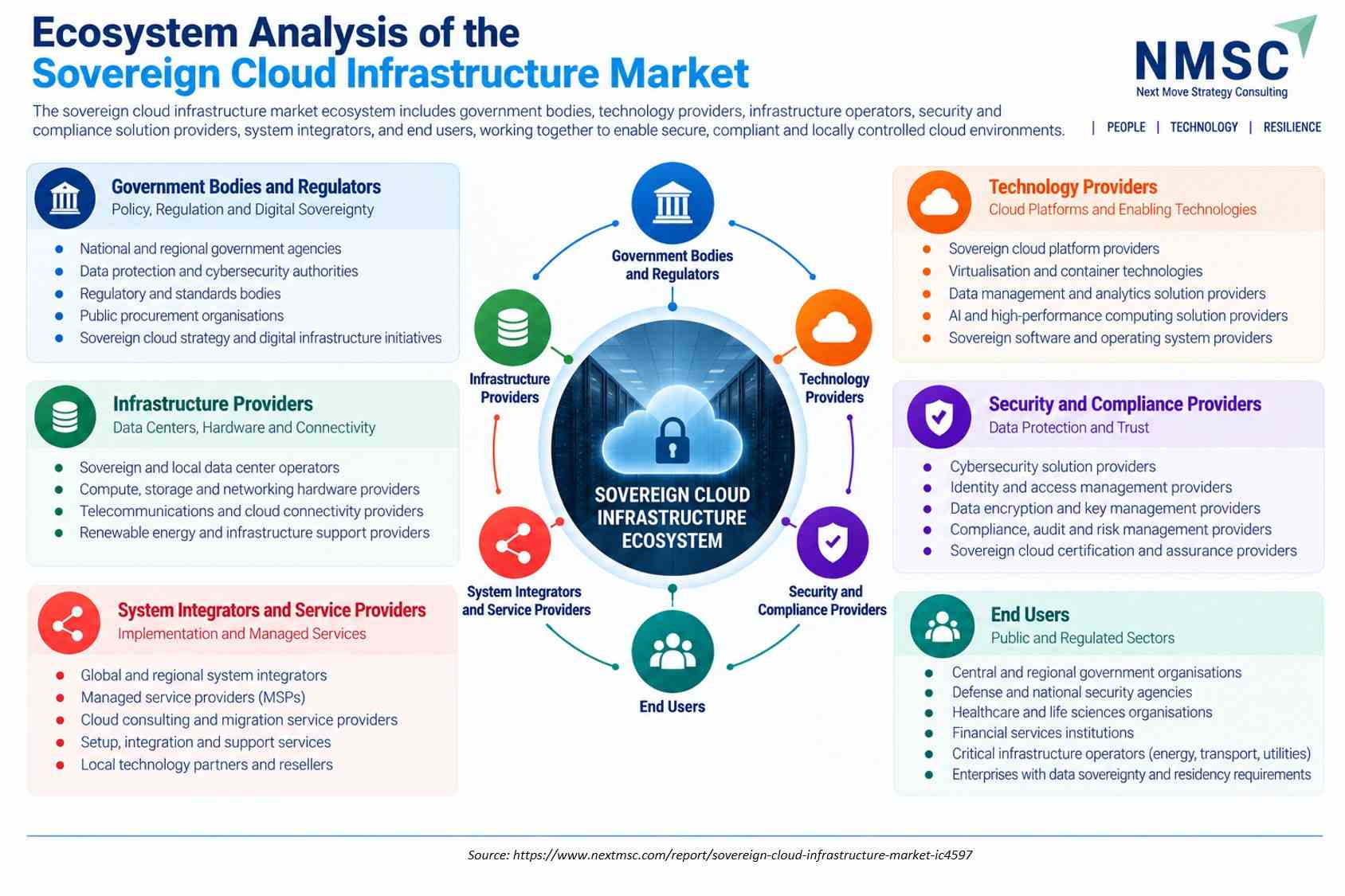
Our analysis indicates that the sovereign cloud infrastructure market ecosystem is evolving through close collaboration between infrastructure providers, technology partners, and regulatory bodies. Innovation in sovereign AI, including the Sovereign AI Stack, encryption, and zero-trust frameworks is strengthening secure cloud architectures, while data governance and compliance systems ensure operational control. Furthermore, investments in AI, secure platforms, and localized infrastructure, such as AI Data Centers, are accelerating ecosystem maturity. As a result, integrated platforms combining hardware, software, and governance capabilities are becoming essential for enabling scalable and compliant sovereign cloud deployments.
Growth Catalyst & Risk Assessment Matrix
|
DRIVERS / TRENDS / RESTRAINTS |
(+/–) % IMPACT ON CAGR FORECAST |
GEOGRAPHIC RELEVANCE |
IMPACT TIMELINE |
|
Strengthening data localization laws and sovereignty mandates |
+1.5% |
Europe (Germany, France), Asia-Pacific (India, China), Middle East |
Medium to long term (3–7 years) |
|
Rising geopolitical tensions and need for digital independence |
+1.3% |
North America, Europe, Asia-Pacific |
Medium term (2–5 years) |
|
Increasing adoption of sovereign AI and secure cloud architectures |
+1.2% |
North America, Europe, Asia-Pacific (India, Japan) |
Medium to long term (3–6 years) |
|
Expansion of government-backed national cloud and digital infrastructure programs |
+1.1% |
Asia-Pacific, Europe, Middle East |
Medium term (2–5 years) |
|
High infrastructure costs and complex compliance requirements |
–1.2% |
North America, Europe, Asia-Pacific |
Short to medium term (1–4 years) |
Based on our evaluation of global digital infrastructure trends, we identified that the sovereign cloud infrastructure market is experiencing strong growth, driven by rising data volumes, increasing demand for secure data control, and rapid advancements in cloud computing, artificial intelligence, and data governance frameworks. Sovereign cloud solutions are increasingly adopted as a strategic investment to enhance operational resilience, ensure regulatory compliance, and reduce dependency on external infrastructure. Furthermore, advancements in AI-driven analytics and real-time data processing are expanding enterprise capabilities across regulated industries. However, our assessment indicates that high implementation costs and integration complexity continue to constrain adoption. At the same time, the emergence of platform-based models and managed services is lowering entry barriers and enabling scalable, compliant digital transformation.
Based on our market analysis, we observed that rising geopolitical tensions are fundamentally reshaping how nations and enterprises approach digital infrastructure. As global dependencies on foreign-controlled cloud ecosystems become increasingly scrutinized, there is a clear shift toward building nationally governed and legally controlled digital environments. In our evaluation of policy directions and infrastructure strategies, we identified that governments are actively prioritizing digital independence to reduce exposure to sanctions, cross-border data risks, and external technological dependencies. Furthermore, this transition is being reinforced by large-scale public investments aimed at strengthening domestic compute and data capabilities. For instance, in February 2026, the Indian government reaffirmed its approx. USD 1.2 billion IndiaAI Mission, which explicitly targets "National Sovereignty" as one of its five pillars by strengthening indigenous compute and data infrastructure. As a result, organizations are increasingly aligning their cloud strategies with jurisdictional control requirements. Consequently, sovereign cloud adoption is accelerating as digital infrastructure becomes closely tied to national security and economic resilience.
From our evaluation, we found that strengthening data protection regulations and sovereignty mandates are significantly influencing how enterprises design and deploy their cloud infrastructure. As regulatory frameworks evolve, organizations are no longer treating compliance as a secondary requirement but as a foundational element of their digital strategy. In particular, stricter enforcement mechanisms are compelling enterprises to adopt infrastructure that ensures data residency, auditability, and controlled access across jurisdictions. Moreover, this shift is being reinforced by continuous regulatory advancements across major economies. For example, according to the European Commission, 2025, the EU reached a political agreement on additional procedural rules to strengthen enforcement of the General Data Protection Regulation (GDPR), reinforcing compliance obligations across member states and increasing regulatory oversight on data processing activities. Thus, enterprises are prioritizing sovereign cloud environments that inherently align with these requirements. In addition, compliance-driven decision-making is influencing vendor selection and architecture design. Consequently, regulatory pressure is not only shaping adoption but also redefining the structure of modern cloud ecosystems.
In our analysis, we observed that the cost burden associated with sovereign cloud computing remains a significant constraint on broader market adoption. Unlike traditional cloud models that benefit from global scale efficiencies, sovereign environments require localized infrastructure, dedicated operational controls, and continuous compliance investments. In our evaluation of deployment models, we identified that these additional requirements substantially increase both capital expenditure and ongoing operational costs. Furthermore, regulatory frameworks themselves contribute to this financial pressure by imposing strict compliance obligations. For instance, the Australian Digital Transformation Agency (DTA) announced that its new Whole-of-Government Cloud Policy, effective July, 2026, will mandate stricter cost transparency and skill-building, as agencies struggle to manage the high cost of moving off legacy ICT systems.
As a result, providers are compelled to invest heavily in compliance systems and auditing mechanisms. In addition, enterprises must allocate resources for integration and governance layers. Consequently, while demand remains strong, cost considerations continue to moderate the pace of adoption.
From our market evaluation, we determined that federated learning architectures are emerging as a critical solution for enabling cross-border innovation without compromising data sovereignty. As regulatory restrictions limit the movement of sensitive data across jurisdictions, organizations are increasingly adopting decentralized AI models that allow data to remain locally stored while enabling collaborative learning. In our analysis of enterprise and government initiatives, we found that this approach effectively balances compliance requirements with the need for scalable intelligence. Moreover, according to the U.S. Office of Management and Budget (reported 2026), federal agencies documented 3,611 AI use cases in 2025, more than doubling from the previous year, indicating rapid scaling of AI systems across distributed government environments where privacy-preserving approaches such as federated AI are increasingly relevant. Therefore, there is increasing demand for architectures that support secure and compliant data utilization. Consequently, federated AI is positioning itself as a key enabler of scalable, privacy-preserving, and globally collaborative AI ecosystems.
Regulatory Framework Impacting the Sovereign Cloud Infrastructure Market
NMSC’s evaluation indicates the regulatory frameworks are playing a central role in shaping sovereign cloud infrastructure market adoption across global markets. Governments are increasingly introducing funding programs and policy incentives to support national cloud and AI infrastructure. In addition, standardization, certification, and compliance benchmarks are ensuring data residency and operational control. Moreover, continuous monitoring and governance mechanisms are strengthening enforcement. Consequently, evolving data localization policies and trade regulations are expected to further reinforce secure, compliant, and sovereignty-driven cloud ecosystems.
Market Highlights & Strategic Insights – Sovereign Cloud Infrastructure Market:
|
Segments |
Key Takeaways |
|
Infrastructure Type |
Compute forms the core of sovereign cloud deployments, with virtual machines enabling scalable workloads and bare metal supporting high-security use cases. Storage is driven by object and block storage for compliant data residency and scalability. Network capabilities, particularly virtual private cloud and dedicated connectivity, are critical for secure and controlled data movement. |
|
Deployment Model |
Single-tenant deployments dominate due to strict data sovereignty and compliance requirements. Air-gapped environments are increasingly adopted in defense and intelligence use cases requiring full isolation. Multi-tenant models remain relevant for less sensitive workloads where scalability and cost efficiency are prioritized. |
|
Sales Channel |
Indirect channels lead the market, driven by system integrators, telecom partners, and managed service providers enabling compliant and localized deployments. Direct sales remain important for large government and strategic enterprise contracts. |
|
End User Industry |
Government and defense sectors are the primary demand drivers due to national security and data sovereignty mandates. BFSI and healthcare are expanding with rising regulatory compliance needs, while telecom and technology sectors are adopting sovereign cloud for localized infrastructure control and service delivery. |
How Does Infrastructure Type Shape Sovereign Cloud Deployments?
Based on our analysis of sovereign cloud architectures, we observed that the market is segmented into compute, storage, and network, where compute includes virtual machines and bare metal, storage includes block, file, and object storage, and network includes virtual private cloud, load balancing, dedicated connectivity, and data transfer.From our evaluation of deployment patterns, we found that compute forms the foundation of sovereign cloud environments, with virtual machines widely adopted for workload flexibility. At the same time, bare metal is gaining importance in high-security and performance-sensitive applications requiring strict isolation. In parallel, storage demand is driven by object and block storage as organizations prioritize scalable and compliant data residency. Furthermore, network capabilities such as virtual private cloud and dedicated connectivity are increasingly critical to ensure secure and policy-compliant data movement. Overall, infrastructure design is increasingly centered on balancing security, control, and performance within sovereign environments.
How Do Deployment Models Influence Sovereign Cloud Adoption?
Based on our assessment of deployment strategies, we observed that the market is segmented into multi-tenant, single-tenant, and air-gapped models.
From our analysis of enterprise and government requirements, we found that single-tenant deployments are widely preferred due to strict data sovereignty, compliance, and security needs, as they enable full control over infrastructure, access, and data governance. Meanwhile, air-gapped environments are gaining traction in defense and intelligence applications where complete physical and logical isolation is critical to eliminate external vulnerabilities. On the other hand, multi-tenant models continue to support fewer sensitive workloads by offering scalability, faster deployment, and cost efficiency without compromising baseline compliance requirements. In addition, organizations are increasingly adopting hybrid deployment approaches, combining isolated environments for sensitive workloads with shared infrastructure for non-critical operations. Therefore, deployment preferences are increasingly shaped by data sensitivity, regulatory pressure, and risk management strategies, leading to a clear shift toward more controlled and segmented cloud environments.
Which Industries Are Driving for Sovereign Cloud Infrastructure Market Demand?
Based on our analysis of end-user adoption, we observed that the market is segmented into government civilian, defense and intelligence, BFSI, healthcare, telecom, energy and utilities, industrial, technology and IT services, and others.
From our evaluation of demand patterns, we found that government and defense sectors remain the primary drivers, supported by stringent data sovereignty regulations, national security priorities, and increasing investments in domestic cloud infrastructure. In addition, BFSI and healthcare sectors are accelerating adoption as they face rising regulatory scrutiny around data protection, privacy, and localization requirements. Furthermore, telecom and technology sectors are leveraging sovereign cloud to enable localized service delivery, improve latency, and maintain greater control over infrastructure ecosystems. At the same time, industrial and energy sectors are gradually adopting sovereign cloud to support critical infrastructure monitoring and operational resilience. Thus, demand is expanding from public sector-led adoption toward a broader base of regulated industries requiring secure, compliant, and locally controlled cloud environments.
Geographic Performance Snapshot:
|
Regions |
Key Takeaways |
|
North America |
North America represents a leading sovereign cloud infrastructure market, share supported by advanced digital infrastructure, strong hyperscaler presence, and early adoption of secure and compliant cloud architectures. The region benefits from high enterprise cloud maturity, increasing focus on data governance, and rising investments in AI-driven and defense-related sovereign cloud initiatives, which continue to drive sustained market expansion. |
|
Europe |
Europe represents a highly structured sovereign cloud infrastructure market, driven by stringent data protection regulations, strong policy emphasis on digital sovereignty, and active government involvement. The region is characterized by initiatives promoting data localization, cross-border data governance frameworks, and sovereign cloud certifications, enabling consistent demand across public sector and regulated industries. |
|
Asia-Pacific |
Asia-Pacific represents the fastest-growing sovereign cloud infrastructure market, supported by rapid digital transformation, expanding cloud infrastructure, and strong government-backed sovereignty initiatives across countries such as China, India, Japan, and South Korea. Increasing demand for localized data control, combined with large-scale digital economy growth, continues to accelerate regional market expansion. |
|
Latin America |
Latin America represents a developing sovereign cloud infrastructure market, supported by gradual improvements in digital infrastructure and increasing awareness around data governance and regulatory compliance. Governments and enterprises are progressively adopting localized cloud solutions to enhance data control and operational resilience, contributing to steady market development. |
|
Middle East & Africa |
The Middle East & Africa represents an emerging sovereign cloud infrastructure market, supported by rising government investments in digital infrastructure, national cloud strategies, and smart city initiatives. Countries in the Middle East are actively advancing sovereign cloud capabilities, while parts of Africa are gradually strengthening digital ecosystems, driving consistent long-term growth. |
The sovereign cloud infrastructure market is geographically studied across North America, Europe, Asia Pacific, Latin America and Middle East & Africa and each region is further studied across countries.
North America represents a security-driven and hyperscaler-dominated sovereign cloud market, supported by advanced digital infrastructure and strong enterprise cloud maturity. In particular, the United States leads adoption through defense, intelligence, and federal cloud programs that prioritize high-assurance environments, zero-trust architectures, and classified workload handling. Moreover, large technology providers such as Amazon Web Services, Microsoft Azure, and Google Cloud continue to expand sovereign capabilities through government cloud offerings and compliance-certified platforms. In addition, enterprise demand across BFSI, telecom, and critical infrastructure sectors is accelerating adoption of jurisdiction-controlled cloud environments. Consequently, the market is shaped by security prioritization, hyperscaler leadership, and large-scale federal and enterprise deployments, establishing North America as a high-assurance and execution-driven sovereign cloud ecosystem.
From our direct engagements with federal agencies and system integrators, we observed that the United States represents a defense-driven and high-assurance sovereign cloud infrastructure market, driven by stringent national security requirements, classified workload handling, and established federal cloud governance frameworks. Adoption is led by defense, intelligence, and federal civilian agencies that mandate isolated environments, strict identity controls, and verified operational boundaries. Our evaluation indicates that sovereign cloud deployments evolve through government-certified platforms, air-gapped architectures, and zero-trust security models, ensuring full control over data access and processing. Cloud providers such as Amazon Web Services, Microsoft Azure, and Google Cloud strengthen their positioning through dedicated government cloud offerings and long-term federal contracts. In parallel, enterprise adoption expands across regulated sectors, reinforcing a security-first ecosystem where defense priorities, certification depth, and operational control define market structure.
In Canada, the sovereign cloud infrastructure market demonstrates a policy-aligned and governance-driven adoption profile, supported by public sector digitization and national data residency requirements. Based on our regional assessment, we observed that government institutions and regulated industries prioritize domestically hosted cloud environments and compliance-aligned infrastructure to ensure adherence to federal and provincial data governance frameworks. From our interactions with public sector authorities and cloud service providers, we identified that hybrid sovereign models and locally controlled data environments dominate deployments, particularly across public services, financial institutions, and healthcare systems. In addition, collaboration between global cloud providers and domestic partners supports the development of sovereign-ready cloud regions aligned with national compliance expectations. Procurement frameworks emphasize data residency assurance, service transparency, and operational control, establishing a trust-oriented and regulation-anchored market structure.
The sovereign cloud infrastructure market trends in Europe represents a regulation-driven and sovereignty-focused ecosystem, where strict data protection frameworks and regional digital autonomy initiatives shape adoption. Our regional evaluation indicates that demand is driven by enforcement of data residency mandates and jurisdiction-controlled cloud environments across public and regulated sectors. Building on this, deployment trends demonstrate that federated architectures, interoperability standards, and transparent governance frameworks define market evolution. In this context, initiatives such as GAIA-X establish a structured foundation for compliant and interoperable cloud ecosystems. In parallel, engagements with regulatory authorities and cloud providers confirm that procurement decisions center on auditability, data control, and adherence to regional compliance mandates. These dynamics raise qualification thresholds for providers while reinforcing ecosystem-level trust and long-term regulatory alignment.
NMSC’s research indicates that the United Kingdom reflects a governance-led and compliance-integrated sovereign cloud infrastructure market, supported by strong data governance policies and structured public sector cloud frameworks. We observed that government departments and regulated enterprises prioritize controlled data environments with clearly defined residency requirements and governed access frameworks, ensuring alignment with national data protection regulations. Moreover, interactions with public sector authorities and system integrators show that sovereign cloud adoption is structured around hybrid deployments, certified cloud platforms, and policy-enforced access management systems. In addition, cloud providers such as Microsoft Azure and Amazon Web Services strengthen their presence through UK-aligned sovereign offerings and compliance certifications. Consequently, procurement frameworks emphasize operational transparency, service accountability, and lifecycle assurance, reinforcing a governance-driven ecosystem where regulatory clarity and institutional control guide long-term adoption.
Germany represents a precision-driven and compliance-intensive sovereign cloud Infrastructure market, where stringent data protection laws and strong industrial digitalization initiatives shape adoption. Assessment of enterprise deployment patterns shows that organizations prioritize high-integrity data environments with strict localization requirements and certified operational frameworks. Aligned with this, implementation strategies confirm that private sovereign architectures, hybrid configurations, and regulation-compliant platforms anchor market development across manufacturing, BFSI, and public sectors. Concurrently, engagements with enterprise IT teams and cloud providers reveal that system reliability, data integrity, and certification depth remain central to procurement decisions. This establishes a high-assurance ecosystem, where technical precision and compliance depth directly influence vendor selection and long-term contract structures
France demonstrates a policy-structured and security-focused sovereign cloud Infrastructure market, where national data protection priorities and digital sovereignty initiatives guide adoption. Government agencies and regulated enterprises emphasize domestically controlled cloud environments and strict data governance frameworks to ensure compliance with national and regional regulations. Moreover, from our interactions with public sector authorities and cloud providers, we identified that trusted cloud certifications, localized data hosting, and secure access controls define deployment models. In addition, national initiatives supporting sovereign cloud development reinforce market structure, encouraging collaboration between domestic providers and global technology partners. Consequently, procurement decisions prioritize compliance assurance, operational transparency, and long-term service reliability, resulting in a controlled and certification-driven cloud ecosystem.
The sovereign cloud infrastructure market in Italy exhibits a modernization-driven and policy-supported adoption landscape, where public sector digitization and regulatory alignment drive demand. Based on our regional assessment, we found that organizations prioritize secure cloud environments with defined data residency and compliance-aligned infrastructure to support national digital transformation objectives. Furthermore, from our engagements with government agencies and system integrators, we identified that hybrid sovereign models, localized data centers, and structured cloud migration programs shape market development. In addition, government-backed initiatives and funding programs support cloud adoption across public administration and regulated sectors. As a result, these dynamics create a structured and implementation-focused market environment, where deployment scalability, compliance adherence, and integration capabilities influence vendor selection.
From our regional assessment, we observed that Spain represents a growth-oriented and EU-funded sovereign cloud market, where digital transformation is increasingly supported by European Union recovery and digitalization funds. In particular, small and medium-sized enterprises (SMEs) are accelerating cloud adoption through government-backed incentives and funding programs. Moreover, organizations prioritize scalable and compliant cloud environments to align with evolving EU data protection requirements. Consequently, sovereign cloud deployment in Spain is shaped by funding-driven adoption, SME participation, and regulatory alignment, establishing a cost-sensitive yet rapidly expanding market ecosystem.
The Nordics represent a trust-led and digitally mature sovereign cloud Infrastructure market, where strong governance frameworks, high digital readiness, and public sector leadership shape adoption. Based on our regional assessment, we identified that countries such as Sweden, Finland, and Norway prioritize secure, transparent, and domestically governed cloud environments aligned with national and regional data protection standards. In practice, our engagements with public sector authorities and cloud providers reveal that federated cloud structures, energy-efficient data infrastructure, and policy-enforced access controls underpin deployment strategies. At the same time, sustainability requirements and data transparency expectations directly influence infrastructure investments and vendor qualification. Consequently, procurement processes center on accountability, environmental compliance, and service continuity, ultimately establishing a high-trust and sustainability-integrated cloud ecosystem.
From our regional analysis and engagements with government agencies and cloud service providers, we observed that Asia-Pacific reflects a policy-anchored and expansion-driven sovereign cloud Infrastructure market, supported by large-scale digital infrastructure programs and enforced data localization frameworks. Governments across the region prioritize national data control, secure cloud environments, and sovereign digital platforms to support public systems and critical industries. Building on this, our evaluation highlights that localized cloud regions, compliance-aligned architectures, and structured public-private collaborations drive market expansion. Alongside this, rising enterprise cloud adoption across finance, telecom, and public services strengthens demand for sovereign infrastructure. Therefore, the region develops into a scale-intensive and execution-led market, where regulatory alignment, infrastructure depth, and ecosystem coordination define growth trajectories.
The sovereign cloud infrastructure market in China demonstrates a state-controlled and domestically anchored ecosystem, where national data governance laws and digital sovereignty policies determine market structure. Our regional assessment indicates that organizations operate within fully localized environments featuring enforced data residency, restricted access frameworks, and domestically governed infrastructure. In alignment with this structure, engagements with government authorities and cloud providers confirm that domestic cloud platforms, vertically integrated systems, and policy-defined deployment standards dominate implementation. Additionally, regulatory enforcement over data storage, processing, and cross-border transfer strengthens centralized control. Consequently, the market evolves as a self-reliant and policy-enforced ecosystem, where scale execution, regulatory alignment, and domestic capability define long-term development.
Japan represents a precision-oriented and reliability-driven sovereign cloud market, where advanced enterprise standards, strict compliance requirements, and operational excellence guide adoption. Based on our regional assessment, we observed that organizations prioritize high-integrity cloud environments with strong data protection, uptime assurance, and certified infrastructure frameworks. Reflecting this, our interactions with enterprise IT teams and system integrators show that hybrid sovereign configurations, secure data governance models, and compliance-certified platforms anchor deployment decisions. At the same time, demand remains concentrated in sectors such as manufacturing, finance, and public services, where operational continuity is critical. Accordingly, procurement behavior emphasizes technical robustness, lifecycle reliability, and consistent service performance, shaping a stability-focused and performance-assured cloud ecosystem.
India represents a DPI-driven and policy-accelerated sovereign cloud Infrastructure market, where national digital public infrastructure programs, data localization mandates, and public sector cloud adoption drive demand. Market-level analysis highlights that organizations prioritize jurisdiction-bound data environments supported by structured governance frameworks to enable large-scale digital platforms. Extending this, deployment patterns indicate that domestic data center expansion, hybrid sovereign architectures, and governed access frameworks shape implementation strategies. Alongside this, digital public infrastructure initiatives, including identity and financial platforms, reinforce demand for secure and scalable cloud systems. As a result, procurement behavior focuses on compliance alignment, infrastructure scalability, and integration depth, strengthening execution capabilities and long-term ecosystem development.
South Korea demonstrates a technology-intensive and security-focused sovereign cloud market, where advanced digital infrastructure, strong cybersecurity frameworks, and enterprise cloud maturity shape adoption. Based on our regional assessment, we identified that organizations prioritize high-performance cloud environments with strict access controls and compliance-certified systems to support data-sensitive operations. Aligned with this, our interactions with enterprise IT teams and cloud providers show that integrated sovereign cloud platforms, secure data management systems, and real-time monitoring frameworks define deployment strategies. At the same time, demand remains concentrated across sectors such as telecommunications, finance, and public administration, where operational precision is essential. Consequently, vendor selection centers on technical capability, security architecture, and service reliability, establishing a high-performance and innovation-driven cloud market structure.
Taiwan reflects a technology-aligned and reliability-driven sovereign cloud market, where strong industrial ecosystems, advanced IT capabilities, and regulatory compliance requirements influence adoption. Based on our regional assessment, we observed that organizations prioritize secure and interoperable cloud environments with localized data control and certified infrastructure standards. From our engagements with enterprise IT teams and cloud service providers, we identified that modular sovereign cloud deployments, integration-ready platforms, and policy-aligned data governance frameworks shape implementation. In parallel, demand remains closely linked to high-value industries such as electronics and advanced manufacturing, where data integrity and system continuity are critical. As such, procurement decisions focus on interoperability, system stability, and long-term operational assurance, reinforcing a precision-oriented and integration-led cloud ecosystem.
Indonesia represents an emerging and capacity-building sovereign cloud Infrastructure market, where expanding digital ecosystems, evolving regulatory structures, and enterprise cloud adoption support gradual uptake. From our field-level interactions with government authorities and cloud providers, we observed that organizations prioritize cost-efficient, jurisdiction-bound data environments to support growing digital services and regulatory alignment. In this environment, our evaluation of deployment patterns indicates that localized data hosting, modular cloud architectures, and simplified deployment frameworks drive early adoption.
Notably, the sovereign cloud infrastructure market is strongly influenced by a mobile-first digital economy, where large-scale consumer platforms and digital services demand scalable, low-latency infrastructure aligned with local data control requirements. At the same time, rapid growth in e-commerce, fintech, and digital platforms strengthens the need for flexible and distributed cloud capabilities. As a result, market development progresses through accessibility, deployment flexibility, and regulatory alignment, positioning Indonesia as a mobile-driven sovereign infrastructure landscape with increasing demand for scalable, locally governed cloud systems
From our direct engagements with public sector authorities and cloud service providers, we found that Australia reflects a governance-driven and resilience-focused sovereign cloud market, supported by strong regulatory frameworks and national data protection priorities. Organizations prioritize secure, locally governed cloud environments with clear data residency and compliance-aligned architectures to support public services and regulated industries. Building on this, our evaluation shows that sovereign cloud deployments center on certified cloud regions, hybrid architectures, and policy-enforced access controls. At the same time, national cybersecurity frameworks and digital transformation programs reinforce demand for high-assurance infrastructure. As a result, procurement behaviour emphasizes security validation, operational transparency, and long-term service continuity, establishing a compliance-assured and reliability-oriented cloud ecosystem.
From our regional analysis, we found that Latin America represents a fragmented and regulation-diverse sovereign cloud market, where varying data protection laws and inconsistent policy enforcement create complexity in adoption. Organizations increasingly prioritize country-specific cloud strategies to address regulatory differences across markets such as Brazil, Mexico, and Chile. Moreover, localized data hosting and modular cloud deployments are gaining traction to ensure compliance while maintaining flexibility. Consequently, sovereign cloud adoption in the region is shaped by regulatory fragmentation, cost sensitivity, and gradual digital infrastructure development, creating a diverse yet opportunity-rich market landscape.
From our regional analysis and engagements with government authorities and cloud providers, we identified that the Middle East & Africa demonstrates a state-led and investment-driven sovereign cloud infrastructure market, where national digital strategies and data sovereignty priorities accelerate adoption. Governments across the region prioritize domestically governed cloud environments and controlled data infrastructure to support public sector modernization and critical services. Building on this, evaluation of deployment frameworks shows that sovereign cloud development is anchored in national data strategies, localized cloud regions, and structured public-private partnerships. In parallel, sovereign infrastructure investments align closely with digital identity systems and national data exchange platforms, strengthening adoption across key sectors. Accordingly, procurement decisions emphasize infrastructure control, regulatory compliance, and scalability, reinforcing long-term strategic positioning and ecosystem expansion.
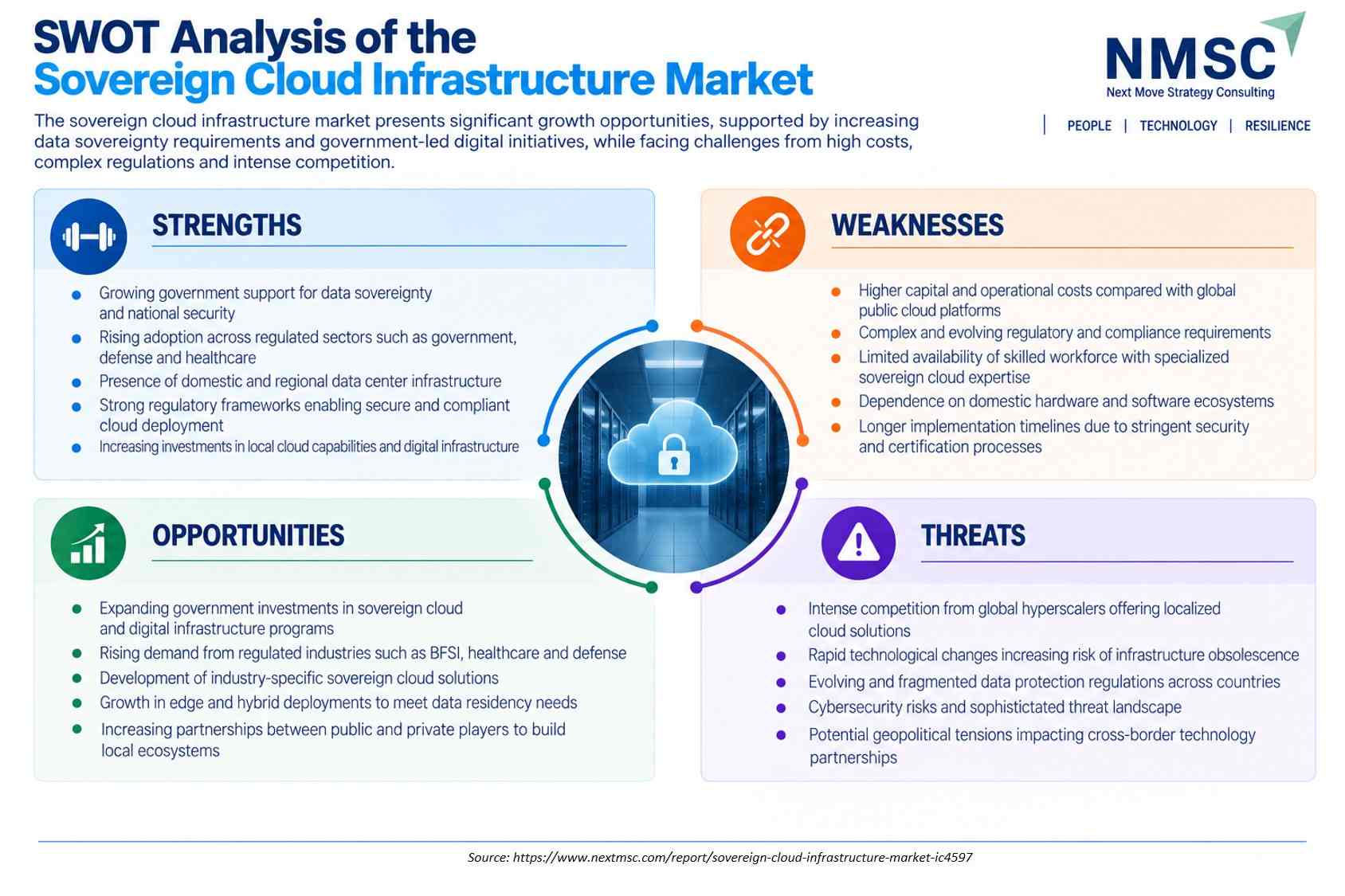
SWOT Analysis of Sovereign Cloud Infrastructure Market
Our assessment indicates the sovereign cloud infrastructure market is supported by strong data control, regulatory compliance, and enhanced security capabilities, which collectively strengthen trust in critical digital systems. However, high infrastructure costs and complex compliance requirements continue to limit scalability and broader adoption. At the same time, rising demand for sovereign AI and localized cloud solutions is creating meaningful growth opportunities. Nevertheless, geopolitical risks and reliance on foreign hardware supply chains remain key challenges influencing long-term stability.
Competitive Dynamics & M&A Landscape:
|
Key Takeaways |
|
The global sovereign cloud infrastructure industry is led by major technology providers such as Oracle Corporation, Microsoft Corporation, Amazon Web Services, Inc., Google LLC, along with regional players including OVHcloud SA, T-Systems International GmbH, and Orange Business Services S.A. These companies leverage sovereign cloud platforms, localised infrastructure, and strong enterprise networks to maintain leadership across regulated and public sector environments. |
|
Companies are increasingly focusing on cloud-native architectures, data sovereignty frameworks, and AI-enabled services to enhance security, compliance, and operational efficiency. In addition, IT service providers such as Cognizant, Wipro, and Tata Consultancy Services support large-scale cloud migration, system integration, and managed services across enterprise and government deployments. |
|
Recent developments highlight platform consolidation and ecosystem expansion, with providers strengthening capabilities in sovereign AI, encryption, and compliance-driven cloud solutions to support scalable, secure, and jurisdiction-controlled digital infrastructure. |
Based on our market analysis, we observed that the sovereign cloud infrastructure market is dominated by large global hyperscale technology providers alongside regionally anchored sovereign cloud operators. Industry leaders such as Oracle Corporation, Microsoft Corporation, Amazon Web Services, Google LLC, and IBM consistently lead large-scale digital transformation initiatives where data sovereignty, compliance, and security remain critical decision factors. These providers are frequently selected for enterprise-wide and government deployments requiring jurisdiction-controlled infrastructure, localized data processing, and compliance-certified cloud environments. In parallel, regional players such as OVHcloud, T-Systems, Orange Business Services, Alibaba Cloud, and Huawei Cloud strengthen competition by offering locally governed infrastructure aligned with national regulatory frameworks. As a result, global players establish platform standards, while regional providers enhance trust through sovereignty-focused delivery models.
From our evaluation, we found that the competitive landscape is further shaped by IT service providers and system integrators that enable large-scale sovereign cloud adoption. Companies such as Cognizant, Wipro, Tata Consultancy Services, and Accenture play a critical role in cloud migration, system integration, and managed services across complex enterprise and public sector environments. These firms bridge the gap between hyperscaler capabilities and local compliance requirements, ensuring seamless deployment of sovereign architectures. Consequently, competition at this level is driven by integration expertise, execution capability, and the ability to deliver scalable, compliance-aligned cloud ecosystems.
Innovation remains a key determinant of competitive advantage in the sovereign cloud infrastructure market, particularly in areas such as sovereign AI, confidential computing, and compliance-driven cloud architectures. Leading providers including Microsoft Corporation, Oracle Corporation, IBM, and Amazon Web Services are continuously enhancing capabilities in secure data processing, customer-controlled encryption, and policy-driven governance frameworks. Moreover, vendors investing in modular architectures, API-driven ecosystems, and interoperable multi-cloud platforms are better positioned to scale across regulated industries and public sector deployments. These advancements enable secure integration across distributed systems, thereby strengthening long-term customer trust, operational resilience, and ecosystem scalability.
Based on our analysis, we noticed that mergers and acquisitions are increasingly being used to strengthen sovereign capabilities and expand market presence. As demand shifts toward compliance-driven cloud environments, companies are focusing on acquiring technologies related to encryption, AI, and data governance to build integrated, sovereignty-ready platforms. A notable example is OVHcloud, which in January 2026 acquired Seald, an end-to-end encryption specialist, and Dragon LLM, an AI platform for regulated industries. This reflects a strategic shift toward combining infrastructure with secure AI and software layers. Consequently, M&A activity is accelerating platform consolidation, enhancing service depth, and enabling providers to deliver more comprehensive, compliant, and scalable sovereign cloud solutions.
Amazon Web Services, Inc.
Microsoft Corporation
Google LLC
International Business Machines Corporation
Huawei Cloud Computing Technologies Co., Ltd.
Tencent Cloud Computing (Beijing) Co., Ltd.
OVHcloud SA
T-Systems International GmbH
Orange Business Services S.A.
Atos SE
SAP SE
Fujitsu Limited
Rackspace Technology, Inc.
Scaleway SAS
VMware, Inc.
Infomaniak Network SA
E2E Networks Limited
Sovereign Cloud Holdings Limited
January 2026 – AWS announced the general availability of the AWS European Sovereign Cloud. This is a physically and logically separate cloud entirely located within the EU, operated exclusively by EU residents, and featuring a dedicated governance structure with local German subsidiaries.
January 2026 – IBM introduced IBM Sovereign Core, a software-defined sovereignty foundation built on Red Hat OpenShift. It enables organizations to run AI and data workloads in a "customer-operated" control plane that is air-gapped from the provider's global network.
November 2025 – T-Systems (Deutsche Telekom) opened its AI Factory in Munich in partnership with NVIDIA and SAP. The "Industrial AI Cloud" platform provides sovereign AI compute power operated exclusively under European standards for SMEs and the public sector.
“AI sovereignty isn't where it runs, it's who controls it. In the AI era, the topic that's least talked about, but I feel will be most talked about in this calendar year, will be the sovereignty of a firm.”
-Satya Nadella, CEO, Microsoft
Statement made following remarks on AI sovereignty and enterprise control in the AI era, as discussed at the World Economic Forum.
The statement highlights a shift from infrastructure ownership to control over data, models, and decision-making systems. It underscores the growing importance of enterprise-level control, governance, and strategic autonomy in AI adoption. As a result, organizations are prioritizing sovereign cloud, data localization, and controlled AI deployment models, positioning sovereignty as a key factor shaping future technology investments and competitive differentiation.
Investment activity in the sovereign cloud infrastructure market is increasingly shifting toward platform-centric and service-led models rather than standalone infrastructure offerings. Based on our evaluation of funding trends, M&A activity, and strategic partnerships, we found that investors are prioritizing companies with recurring revenue streams derived from cloud platforms, AI-enabled services, and integrated data management solutions. Providers demonstrating scalable deployments, strong interoperability, and seamless integration across multi-cloud and regulated environments continue to attract premium valuations.
Furthermore, investment focus is concentrating on areas such as AI-driven analytics, cybersecurity, data sovereignty frameworks, and confidential computing, particularly solutions that enhance compliance, operational resilience, and secure data utilization. In addition, strategic investments are gaining prominence over purely financial funding, as governments, enterprises, and technology providers seek greater control over digital infrastructure and faster transformation outcomes. Consequently, the most attractive opportunities lie in companies that combine technological differentiation with proven deployment capabilities, scalable architectures, and long-term ecosystem expansion within the sovereign cloud value chain.
Next Move Strategy Consulting (NMSC) presents a comprehensive analysis of the sovereign cloud infrastructure market, covering historical developments from 2020 to 2025 and providing forward-looking forecasts through 2035.
Our study evaluates the sovereign cloud infrastructure market at global, regional, and country levels, delivering quantitative outlooks alongside qualitative insights into key growth drivers, adoption barriers, technology advancements, and investment trends across major market segments.
From our market observation, the Sovereign Cloud Infrastructure industry delivers measurable value across a diverse ecosystem of participants. Investors benefit from recurring revenue models driven by cloud platforms, subscription-based services, and scalable infrastructure offerings aligned with long-term digital transformation needs. Government agencies and regulated enterprises achieve enhanced data control, improved operational resilience, and stronger compliance through the adoption of jurisdiction-controlled cloud environments and secure data management frameworks. At the same time, cloud providers, system integrators, and technology partners benefit from long-term contracts, infrastructure deployment programs, and continuous upgrades across sovereign ecosystems. By aligning digital infrastructure with regulatory compliance, security requirements, and operational efficiency, the sovereign cloud Infrastructure market creates sustained value while supporting resilient, scalable, and future-ready digital systems.
|
Parameters |
Details |
|
Customization Scope |
Free customization (equivalent to up to 80 analyst-working hours) after purchase. Addition or alteration to country, regional & segment scope. |
|
Pricing and Purchase Options |
Avail customized purchase options to meet your exact research needs. |
|
Approach |
In-depth primary and secondary research; proprietary databases; rigorous quality control and validation measures. |
|
Analytical Tools |
Porter's Five Forces, SWOT, value chain, and Harvey ball analysis to assess competitive intensity, stakeholder roles, and relative impact of key factors. |
By Infrastructure Type
Compute
Virtual Machines
Bare Metal
Storage
Block Storage
File Storage
Object Storage
Network
Virtual Private Cloud
Load Balancing
Dedicated Connectivity
Data Transfer
By Deployment Model
Multi-Tenant
Single Tenant
Air Gapped
By Sales Channel
Direct
Indirect
System Integrator
Telecom Partner
Managed Service Provider
Reseller
By End User Industry
Government Civilian
Defense and Intelligence
BFSI
Healthcare
Telecom
Energy and Utilities
Industrial
Technology and IT Services
Others
North America: U.S., Canada, and Mexico.
Europe: UK, Germany, France, Italy, Spain, Sweden, Denmark, Finland, the Netherlands, and the Rest of Europe.
Asia Pacific: China, India, Japan, South Korea, Taiwan, Indonesia, Vietnam, Australia, Philippines, Malaysia and the rest of APAC.
Middle East & Africa (MEA): Saudi Arabia, UAE, Egypt, Israel, Turkey, Nigeria, South Africa, and the rest of MEA.
Latin America: Brazil, Argentina, Chile, Colombia, and the rest of LATAM.
This report provides stakeholders, service providers, investors, and consultants with actionable insights to capitalise on the structural transformation underway in the sovereign cloud infrastructure market.
By combining rigorous data-driven analysis with proven strategic frameworks, NMSC’s Sovereign Cloud Infrastructure Market Report serves as a critical decision-support resource for navigating an increasingly complex and data-driven digital economy.
The sovereign cloud infrastructure market is positioned for sustained expansion, supported by rising data volumes, stricter regulatory requirements, and the growing need for secure, compliant, and locally governed digital environments.
Key strategic insights highlight the increasing importance of platform-centric architectures, real-time data processing, and seamless integration across multi-cloud and regulated systems, as these capabilities enhance operational resilience and long-term value creation. Providers prioritizing modular platforms, AI-enabled services, and scalable deployment models consistently achieve stronger customer retention and recurring revenue growth.
For executives and investors, capturing value requires focusing on high-growth areas such as sovereign AI, confidential computing, and compliance-driven cloud services, while continuing investments in interoperability, cybersecurity, and advanced data governance frameworks. Expanding presence across high-growth regions, particularly Asia-Pacific and emerging digital economies, unlocks new demand opportunities. At the same time, scalability, regulatory alignment, and secure data control strengthen vendor credibility and accelerate adoption, thereby creating durable value across the global sovereign cloud infrastructure ecosystem.