Containerization Market Size, Share, Growth & Forecast By Offering (Platform and Orchestration, Developer Tools, Registry and Artifacts, Security, Storage and Data, Networking, Observability and Operations, Services and Support, Other Container Software), By Deployment Model (Public Cloud, Hybrid Cloud, On-Premises, Edge, Air-Gapped), By Consumption Model (Subscription and License, Usage-Based, Perpetual With Support, Professional Services), By Sales Channel — Global Analysis 2026–2035
Industry: ICT & Media | Publishing Date: July 8, 2026 | Last Updated: September 30, 2026 | No of Pages: N/A | No. of Tables: N/A | No. of Figures: N/A | Format: PDF | Report Code: IC5038
What Is the Containerization Market Size?
The global Containerization Market was valued at USD 7.4 billion in 2025 and is expected to reach USD 8.9 billion in 2026. Accelerating enterprise cloud-native adoption, the mainstreaming of Kubernetes as the de facto container orchestration standard, and intensifying demand for DevOps automation are projected to propel the Containerization Market to USD 46.8 billion by 2035, advancing at a CAGR of 20.3% from 2026 to 2035. Key growth drivers include the proliferation of microservices architectures across large enterprises, rising AI and machine learning workload containerization, expanding edge computing deployments, and the widespread integration of security and compliance tooling within container pipelines.
|
Parameters |
Details |
|
Market Size in 2025 |
USD 7.4 Billion |
|
Market Size in 2026 |
USD 8.9 Billion |
|
Revenue Forecast in 2035 |
USD 46.8 Billion |
|
Growth Rate |
CAGR of 20.3% from 2026 to 2035 |
|
Analysis Period |
2025–2035 |
|
Base Year Considered |
2025 |
|
Forecast Period |
2026–2035 |
|
Market Size Estimation |
Billion USD |
|
Companies Profiled |
20 |
|
Countries Covered |
33 |
|
Market Share |
Top 10 |
Containerization Market Overview
What Is the Containerization Market?
The Containerization Market encompasses the full ecosystem of software, platforms, tools, and managed services that enable organizations to package, deploy, orchestrate, secure, and observe containerized applications. Containerization abstracts application code and its dependencies into portable, lightweight container images that run consistently across development, testing, and production environments. From our research, we found that Kubernetes has become the dominant orchestration layer, supported by a broad ecosystem of cloud-managed services, enterprise distributions, developer tooling, security products, observability platforms, and professional services offered by both hyperscalers and independent software vendors globally.
How Has the Containerization Market Evolved?
The Containerization Market has progressed through three distinct technology generations. The first generation centered on Docker's introduction of standardized container packaging in 2013, which democratized application portability. The second generation saw Kubernetes emerge as the orchestration standard, with cloud providers offering managed Kubernetes services that abstracted operational complexity. NMSC's analysis indicates that the current third generation is defined by platform engineering, GitOps automation, AI-native workload orchestration, and the convergence of container security with software supply chain integrity frameworks, including Software Bill of Materials adoption and runtime security automation.
How Do Regulations Influence the Containerization Market?
Regulatory developments are increasingly shaping procurement and product strategies within the Containerization Market. The U.S. Cybersecurity and Infrastructure Security Agency has issued mandatory Kubernetes hardening guides for federal agencies, compelling public sector buyers toward security-first container architectures. The European Union's NIS2 Directive introduces binding cybersecurity requirements for critical infrastructure operators that directly affect containerized application security postures. Based on our market evaluation, we noticed that NIST's SP 800-190 Application Container Security Guide has become the de facto compliance baseline for enterprise container security programs in regulated industries including healthcare, financial services, and defense contracting.
How Is Technology Adoption Expanding Across the Containerization Market?
Technology adoption across the Containerization Market is accelerating as platform engineering teams standardize on Kubernetes-based internal developer platforms. CNCF's annual surveys consistently show Kubernetes production usage rates exceeding 80% among surveyed enterprises. Consumption-based pricing for managed Kubernetes services, serverless container execution environments such as AWS Fargate and Google Cloud Run, and cloud marketplace distribution models are lowering adoption barriers for mid-market organizations. Our assessment indicates that enterprises are simultaneously consolidating tool sprawl through integrated container platforms that combine orchestration, security, observability, and GitOps capabilities within a unified operational framework.
|
Key Takeaways |
|
By offering, Platform and Orchestration dominated the Containerization Market at USD 2.9 billion in 2025, with Managed Kubernetes on Public Cloud commanding the largest sub-segment share. The Security offering segment is the fastest-growing sub-category, advancing at a CAGR of 23.1% from 2026 to 2035, driven by enterprise demand for Image Scanning, Runtime Security, and SBOM tooling as organizations address software supply chain vulnerabilities at scale. |
|
By deployment model, Public Cloud accounted for the largest share of the Containerization Market at USD 4.1 billion in 2025, representing approximately 55% of total revenue. Edge deployment is the fastest-growing deployment model at a CAGR of 25.8% from 2026 to 2035, fueled by telecommunications 5G rollouts, industrial IoT containerization, and distributed AI inference requirements. |
|
By consumption model, Subscription and License led the Containerization Market at USD 3.2 billion in 2025, reflecting enterprise preference for predictable expenditure across multi-year platform commitments. Usage-Based consumption is the fastest-growing model at a CAGR of 22.6% from 2026 to 2035, as serverless containers and managed Kubernetes services align cost directly with workload execution. |
|
By sales channel, Direct Sales held USD 3.1 billion in 2025, the largest share in the Containerization Market, reflecting complex enterprise procurement cycles for platform and security solutions. Cloud Marketplace is the fastest-growing channel at a CAGR of 24.0% from 2026 to 2035, as hyperscaler committed spend programs accelerate enterprise adoption. |
|
By buyer persona, Platform Engineers represented the largest individual buyer segment in the Containerization Market, driving platform standardization and internal developer platform investments. Developer adoption is the fastest-growing buyer category as self-service container tooling, desktop runtimes, and local development clusters lower individual adoption friction. |
|
By organization size, Large Enterprise dominated the Containerization Market at USD 3.8 billion in 2025, representing approximately 51% of total revenue. Mid-Market organizations are the fastest-growing size segment at a CAGR of 21.5% as managed Kubernetes services eliminate the need for dedicated site reliability engineering teams. |
|
By end user industry, Technology and Software held the largest revenue share at USD 1.8 billion in 2025. Banking, Financial Services, and Insurance is the second-largest vertical and among the fastest-growing at a CAGR of 21.8% from 2026 to 2035, driven by microservices modernization of core banking and payment infrastructure. |
|
North America held the largest regional share of the Containerization Market at USD 3.2 billion in 2025, projected to reach USD 19.8 billion by 2035 at a CAGR of 20.0%, anchored by hyperscaler headquarters, the highest enterprise Kubernetes adoption rates, and a mature DevOps toolchain ecosystem. |
|
Asia-Pacific is the fastest-growing major region in the Containerization Market at a CAGR of 21.4% from 2026 to 2035. Latin America records the highest regional CAGR at 21.6%, driven by fintech digitization in Brazil, e-commerce expansion, and cloud-first infrastructure investment across the region. |
|
The United States is the single largest country market in the Containerization Market, representing over 75% of North American revenue in 2025, underpinned by the world's highest concentration of container platform vendors and enterprise DevOps investment budgets. |
|
India is the fastest-growing national market in Asia-Pacific within the Containerization Market at a CAGR of 24.2%, propelled by rapid cloud-native startup formation, the digitization of IT services delivery, and government digital public infrastructure initiatives driving container-based application modernization. |
Key Emerging Trends in the Containerization Market
How Is Platform Engineering Redefining the Containerization Market Landscape?
Platform engineering has emerged as the dominant organizational model for managing containerized environments, transforming how enterprises consume the Containerization Market. Rather than individual development teams managing their own Kubernetes infrastructure, platform engineering teams now build and operate internal developer platforms that abstract Kubernetes complexity through golden paths, self-service portals, and automated guardrails. Our analysis shows that organizations such as Spotify, with its Backstage open-source internal developer portal adopted by hundreds of enterprises, exemplify this shift. Platform engineering directly expands demand for Kubernetes management tooling, GitOps platforms, and multi-cluster fleet management products across large enterprise buyers.
How Is the Software Supply Chain Security Imperative Transforming Container Security Demand?
Following multiple high-profile supply chain attacks targeting container image registries and base images, software supply chain security has become a board-level imperative within the Containerization Market. The U.S. Executive Order on Improving the Nation's Cybersecurity mandated SBOM adoption for software sold to federal agencies, creating a compliance-driven demand surge for container image scanning, SBOM generation, and artifact signing tools. From our assessment, we observed that vendors including Sysdig, Aqua Security, and Snyk have repositioned their product portfolios to center on supply chain integrity, runtime policy enforcement, and continuous compliance monitoring as primary value propositions for enterprise security buyers.
How Is AI and Machine Learning Workload Containerization Reshaping Demand in the Containerization Market?
The containerization of AI and machine learning workloads is creating new architectural requirements and demand vectors within the Containerization Market. Training and inference workloads require GPU-aware Kubernetes scheduling, high-performance persistent storage, and specialized networking configurations for distributed training frameworks such as PyTorch's DistributedDataParallel. NMSC's analysis indicates that NVIDIA's GPU Operator for Kubernetes, now widely adopted across major cloud providers and on-premises GPU clusters, has standardized containerized GPU workload deployment. This trend is driving premium demand for Kubernetes operators, specialized runtimes, and observability tooling optimized for AI infrastructure cost visibility and utilization management.
How Is WebAssembly Emerging as a Complementary Runtime in the Containerization Market?
WebAssembly beyond the browser is emerging as a complementary container runtime within the Containerization Market, particularly for edge, serverless, and security-isolated workloads. The CNCF's WasmEdge project and Fermyon's Spin framework are positioning WebAssembly containers as a lightweight alternative for functions-as-a-service and edge inference deployments. Through NMSC's assessment, we found that Microsoft Azure has experimentally integrated WebAssembly System Interface support within AKS, enabling mixed container and Wasm workload scheduling within the same Kubernetes cluster. While still early-stage, WebAssembly adoption is influencing container runtime strategy among hyperscalers and edge infrastructure vendors.
How Is GitOps Becoming the Standard Operational Model Across the Containerization Market?
GitOps, the operational model treating Git as the single source of truth for declarative Kubernetes configuration, has transitioned from early-adopter practice to mainstream enterprise standard within the Containerization Market. The CNCF's Flux and Argo CD projects, both graduated CNCF projects, have been adopted by thousands of organizations globally for automated continuous deployment in Kubernetes environments. Our findings suggest that GitOps directly increases demand for container registry services, policy and compliance tooling, and multi-cluster fleet management products, as enterprises require consistent configuration enforcement across dozens or hundreds of Kubernetes clusters spanning on-premises, public cloud, and edge deployments.
Porter's Five Forces Analysis of the Containerization Market
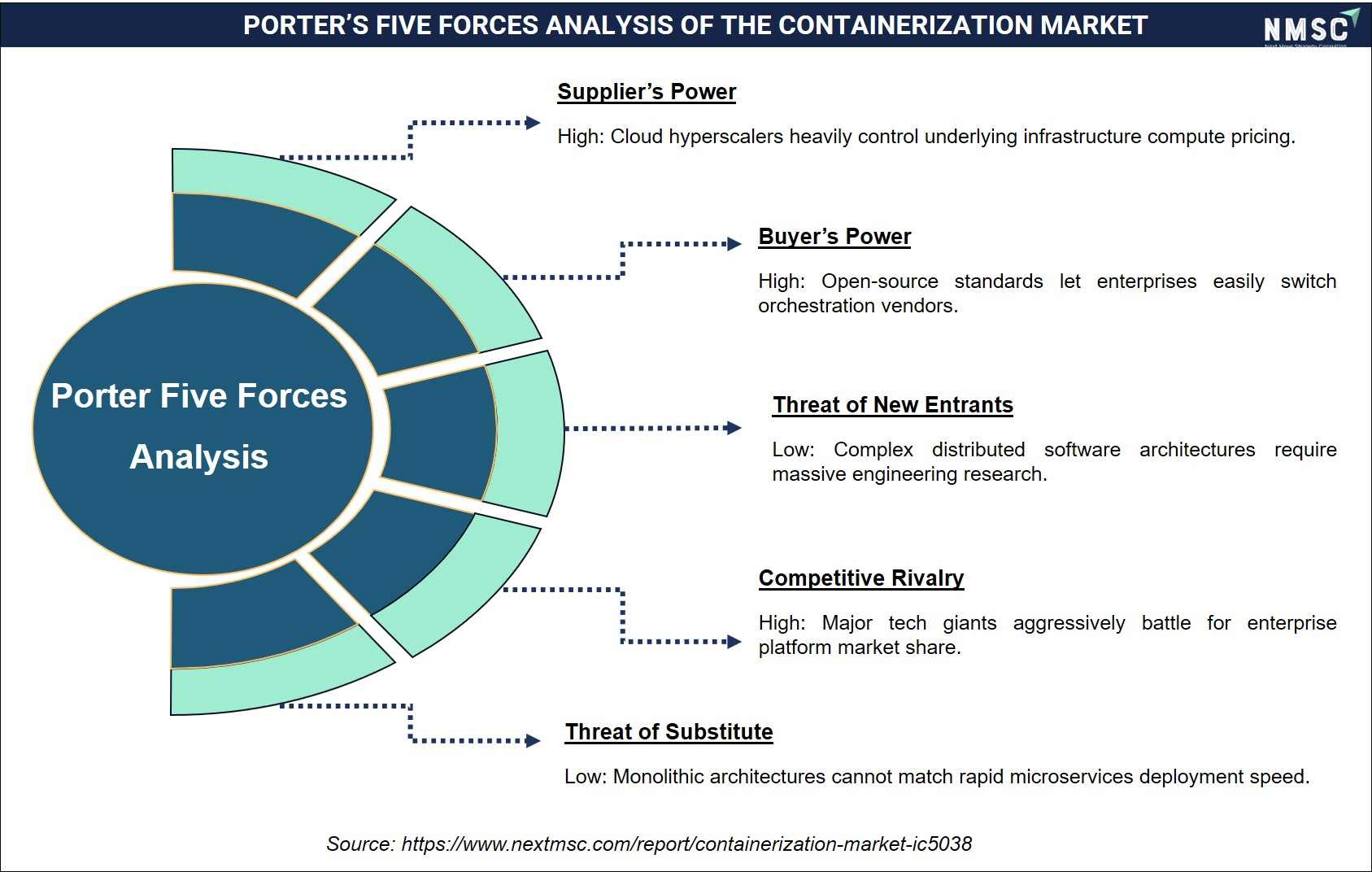
The Containerization Market is characterized by moderate-to-high competitive rivalry due to the presence of major cloud providers, Kubernetes platform vendors, and container management solution providers. The threat of new entrants is moderate, as significant technical expertise and ecosystem support are required. Supplier bargaining power remains moderate, driven by cloud infrastructure and software platform providers. Buyer bargaining power is relatively high because enterprises can choose from multiple open-source and commercial container solutions. The threat of substitutes is moderate, as traditional virtualization and serverless computing alternatives continue to evolve. Overall, innovation, cloud adoption, and Kubernetes standardization shape competitive dynamics across the market.
What Are the Key Market Drivers, Breakthroughs, and Investment Opportunities that Will Shape the Containerization Market Industry in the Next Decade?
|
Drivers / Trends / Restraints |
(+/-) % Impact on CAGR Forecast |
Geographic Relevance |
Impact Timeline |
|
Enterprise Cloud-Native Architecture Adoption |
+2.5% |
Global (led by North America, Europe) |
2025–2030 |
|
Rising Demand for DevOps and CI/CD Automation |
+2.1% |
North America, Europe, APAC |
2025–2032 |
|
AI and ML Workload Containerization |
+1.9% |
Global |
2026–2035 |
|
Edge Computing and IoT Expansion |
+1.4% |
APAC, North America, Europe |
2026–2035 |
|
Kubernetes Ecosystem Maturation |
+1.2% |
Global |
2025–2030 |
|
Container Security and Compliance Requirements |
+0.9% |
North America, Europe, MEA |
2025–2035 |
|
Vendor Lock-In and Interoperability Complexity |
-1.0% |
Global (especially SMB) |
Ongoing |
|
Kubernetes Operational Complexity for Enterprises |
-0.8% |
Mid-market, Emerging Markets |
2025–2028 |
|
Open-Source Competition Pressuring Margins |
-0.5% |
All regions |
Ongoing |
|
Serverless and PaaS Substitution Risk |
-0.4% |
North America, Europe |
2027–2035 |
|
Hybrid Cloud and Multi-Cloud Orchestration |
+1.6% |
North America, Europe, APAC |
2025–2033 |
|
Green IT and Sustainable Infrastructure Demand |
+0.7% |
Europe, North America |
2027–2035 |
What Are the Growth Drivers of the Containerization Market?
How Is the Global Adoption of Cloud-Native Architecture Driving the Containerization Market?
Enterprise migration to cloud-native architectures is the foundational demand driver for the Containerization Market. Cloud-native design principles require application decomposition into containerized microservices that scale independently, deploy continuously, and recover automatically. The Cloud Native Computing Foundation reports that Kubernetes usage has consistently exceeded 80% in enterprise production environments across its annual surveys, reflecting deep structural penetration. From our research, we found that the CNCF Landscape now catalogs over 1,000 cloud-native projects and products, the majority of which directly depend on container runtime environments, creating a compounding ecosystem effect that sustains long-term demand growth across all Containerization Market segments.
How Is DevOps and CI/CD Automation Accelerating Containerization Market Expansion?
The widespread enterprise adoption of DevOps practices and continuous integration and continuous delivery pipelines is a structural driver of the Containerization Market. Containers provide the consistency, portability, and immutability that CI/CD automation requires to deliver reliable application deployment from development to production. Based on our analysis, every major CI/CD platform, including GitHub Actions, GitLab CI/CD, and Jenkins, has standardized container-based build and test execution as the default pipeline architecture. This integration creates durable demand for container image build tools, local development clusters, artifact registries, and automated security scanning solutions within the developer tooling and registry sub-segments of the Containerization Market.
How Does the Expansion of Edge Computing Create Incremental Demand in the Containerization Market?
Edge computing is creating a structurally new deployment frontier for the Containerization Market, extending container workloads beyond centralized data centers to thousands of distributed edge nodes including telecommunications base stations, retail locations, manufacturing floors, and transportation hubs. Lightweight Kubernetes distributions including SUSE's K3s, specifically designed for resource-constrained edge environments, and MicroK8s from Canonical are enabling consistent container orchestration at the edge. Through our market assessment, we observed that telecommunications operators deploying 5G Multi-Access Edge Computing infrastructure are among the largest new adopters of edge container orchestration, driving incremental demand for CNI plugins, service mesh, and specialized edge container storage solutions within the Containerization Market ecosystem.
What Are the Growth Inhibitors of the Containerization Market?
How Does Kubernetes Operational Complexity Constrain Containerization Market Adoption?
Despite managed Kubernetes services lowering the barrier significantly, Kubernetes operational complexity remains a material adoption inhibitor within the Containerization Market, particularly for mid-market and public sector organizations. Configuring networking, persistent storage, multi-tenancy, and security policies in Kubernetes environments requires specialized skills that remain in short supply globally. The U.S. Bureau of Labor Statistics data on software and DevOps engineering roles indicates a persistent skills gap in cloud infrastructure disciplines. Our assessment indicates that organizations without dedicated platform engineering or site reliability engineering teams frequently delay or scale back containerization ambitions, constraining near-term revenue growth in the Services and Support and platform orchestration segments.
How Does Vendor Lock-In and Ecosystem Fragmentation Limit Containerization Market Growth?
Fragmentation across Kubernetes distributions, container networking interfaces, storage drivers, and service mesh implementations creates integration complexity that constrains technology consolidation and slows enterprise procurement decisions. While the Open Container Initiative and CNCF standards provide interoperability baselines, proprietary extensions from hyperscalers and enterprise vendors create practical lock-in concerns. NMSC's analysis indicates that this fragmentation disproportionately affects organizations operating in multi-cloud or hybrid cloud environments, where consistent security policy, observability, and networking behavior across multiple Kubernetes distributions is technically difficult to achieve. Vendor lock-in anxiety directly extends sales cycles for platform consolidation decisions in the Containerization Market.
Ecosystem Analysis of the Containerization Market
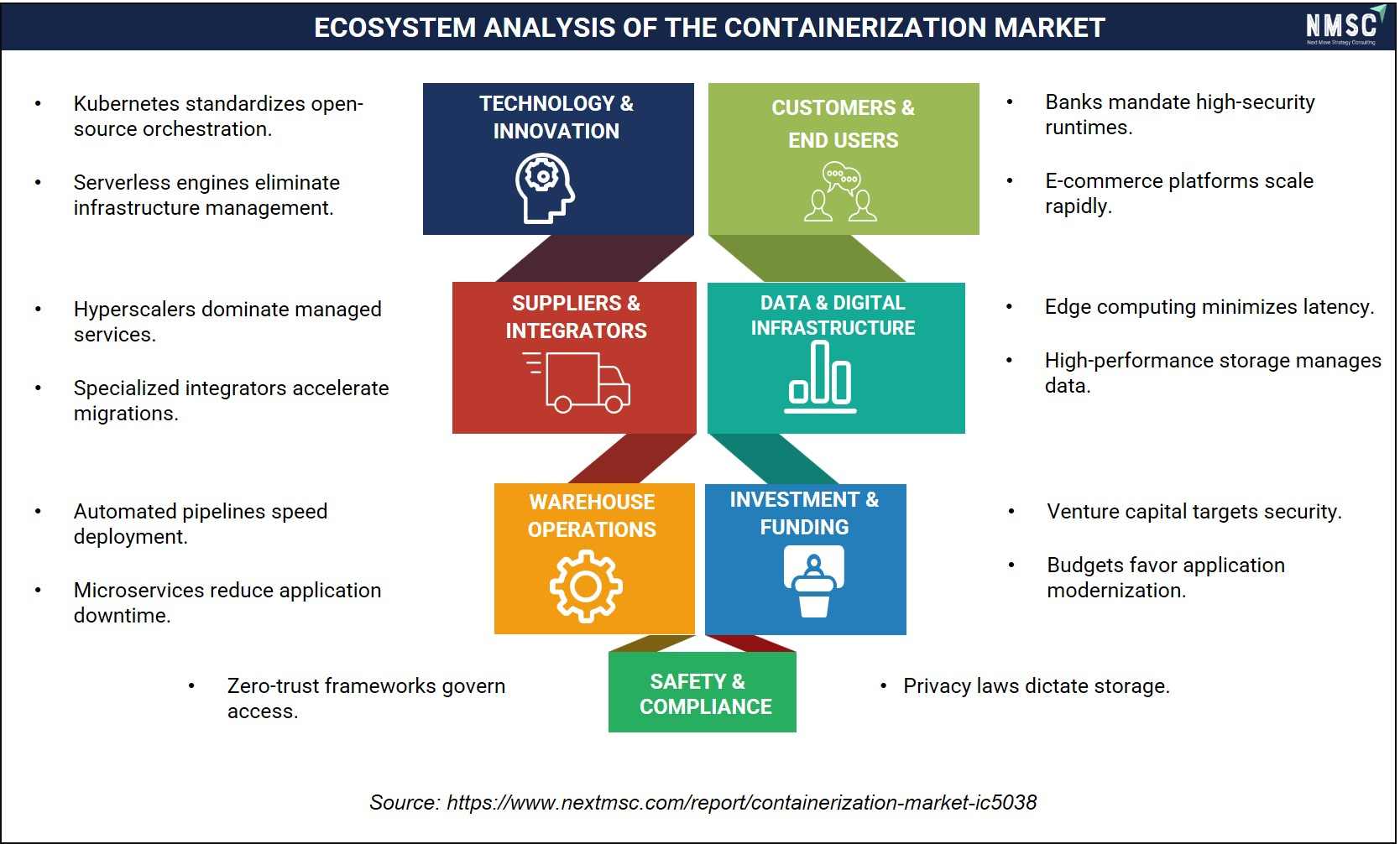
The Containerization Market ecosystem is driven by continuous advancements in technology and innovation, including Kubernetes, cloud-native platforms, and AI-enabled orchestration tools. Suppliers and integrators provide container platforms, management solutions, and deployment services, while data and digital infrastructure providers deliver cloud, networking, and storage capabilities. Investment and funding support innovation and market expansion, whereas safety and compliance frameworks ensure secure and regulatory-compliant deployments. IT operations and application management represent key operational functions in supporting enterprise container deployment. End users across industries such as BFSI, healthcare, retail, telecom, and manufacturing drive demand for scalable, portable, and efficient containerized applications.
What Are the Growth Opportunities in the Containerization Market?
How Does Federal Government Containerization Modernization Create a Multi-Billion Dollar Opportunity in the Containerization Market?
The U.S. federal government's mandatory cloud and DevSecOps modernization programs represent a structurally significant and durable revenue opportunity within the Containerization Market. The U.S. Department of Defense's DevSecOps Reference Design mandates container-based application delivery for new military software programs, creating procurement requirements for FedRAMP-authorized container platforms, Kubernetes security tooling, and air-gapped registry solutions. The General Services Administration's cloud procurement frameworks create structured pathways for container platform vendors to access the federal IT budget. Based on NMSC's research, we found that the DoD Unified Platform program and the Army Software Factory have standardized Kubernetes as the deployment environment for mission-critical defense applications, establishing a durable public-sector demand base.
How Does the Convergence of FinOps and Containerization Create a High-Growth Opportunity in the Containerization Market?
The convergence of financial operations practices with containerized infrastructure management is creating a high-growth product category within the Containerization Market. As enterprises scale to hundreds of Kubernetes clusters with thousands of workloads, container cost optimization has become a board-level concern. Our findings suggest that Kubernetes workload rightsizing, namespace-level cost attribution, and automated scaling optimization represent a rapidly expanding software category. The FinOps Foundation, a Linux Foundation project, reports growing enterprise membership and standardized frameworks specifically addressing Kubernetes cost management, creating organizational demand for observability and cost management products from vendors including Datadog, Kubecost, and hyperscaler-native tools within the Containerization Market.
How Does the Growth of AI Infrastructure Drive Platform and Tooling Opportunities in the Containerization Market?
Enterprises building and operating AI infrastructure at scale require sophisticated container platforms that support GPU scheduling, high-throughput storage, and distributed training network topologies. This requirement creates premium product and services opportunities within the Containerization Market for vendors offering AI-optimized Kubernetes operators, specialized runtimes, and infrastructure management tooling. Through NMSC's assessment, we found that the U.S. Department of Energy's national laboratories and major hyperscalers have deployed Kubernetes-orchestrated GPU clusters with thousands of nodes for frontier AI model training, establishing architectural patterns that enterprise AI teams are rapidly adopting. AI infrastructure containerization directly drives incremental demand for storage, networking, observability, and security segments within the Containerization Market.
How Is the Containerization Market Segmented in This Report, and What Are the Key Insights from the Segmentation Analysis?
How Do the Diverse Offering Categories Define the Competitive Structure of the Containerization Market?
|
Offering Segment |
2025 (USD Bn) |
2035 (USD Bn) |
CAGR (%) |
|
Platform and Orchestration |
2.90 |
17.60 |
19.7% |
|
Developer Tools |
0.90 |
5.80 |
20.5% |
|
Registry and Artifacts |
0.55 |
3.40 |
20.0% |
|
Security |
0.70 |
5.20 |
22.3% |
|
Storage and Data |
0.50 |
3.10 |
20.0% |
|
Networking |
0.45 |
2.80 |
20.1% |
|
Observability and Operations |
0.65 |
4.10 |
20.2% |
|
Services and Support |
0.60 |
3.50 |
19.3% |
|
Other Container Software |
0.15 |
1.30 |
24.3% |
Based on NMSC's research, we found that the Containerization Market offering landscape spans Platform and Orchestration, Developer Tools, Registry and Artifacts, Security, Storage and Data, Networking, Observability and Operations, Services and Support, and Other Container Software. Platform and Orchestration dominates the offering mix, accounting for USD 2.9 billion in 2025, driven by enterprise adoption of Managed Kubernetes services across public and hybrid cloud environments. The Security offering is the fastest-growing segment, reflecting intensifying regulatory and compliance pressure on container pipelines, while Developer Tools and Observability segments are expanding rapidly as organizations invest in productivity and operational efficiency across their container estates.
How Do the Sub-Segments of Platform and Orchestration Reflect Enterprise Kubernetes Adoption Patterns?
|
Sub-Segment |
2025 (USD Bn) |
2035 (USD Bn) |
CAGR (%) |
|
Managed Kubernetes – Public Cloud |
1.20 |
7.40 |
19.8% |
|
Managed Kubernetes – Hybrid Cloud |
0.50 |
3.20 |
20.3% |
|
Managed Kubernetes – Edge |
0.18 |
1.60 |
24.6% |
|
Self-Managed – Enterprise Distribution |
0.42 |
2.30 |
18.6% |
|
Self-Managed – Lightweight Distribution |
0.22 |
1.50 |
21.0% |
|
Multi-Cluster Management |
0.18 |
1.30 |
21.8% |
|
Serverless Containers |
0.20 |
1.50 |
22.3% |
From our research, we found that the Platform and Orchestration segment is defined by Managed Kubernetes offerings spanning Public Cloud, Hybrid Cloud, and Edge deployment modes, alongside Self-Managed Enterprise and Lightweight Distributions, Multi-Cluster Management, and Serverless Containers. Managed Kubernetes on Public Cloud leads the segment, representing the largest revenue contributor as enterprises prioritize operational simplicity and hyperscaler integration. Serverless Containers and Edge Managed Kubernetes are the fastest-growing sub-segments, driven by demand for zero-infrastructure-management execution environments and distributed edge workload orchestration. Multi-Cluster Management is gaining traction as large enterprises operate fleets of clusters across geographies and cloud providers.
Which Developer Tool Sub-Segments Are Generating the Strongest Demand in the Containerization Market?
|
Sub-Segment |
2025 (USD Bn) |
2035 (USD Bn) |
CAGR (%) |
|
Desktop Runtime |
0.25 |
1.55 |
19.9% |
|
Image Build and Packaging |
0.22 |
1.40 |
20.4% |
|
Local Development Cluster |
0.21 |
1.38 |
20.6% |
|
CI and CD Integration |
0.22 |
1.47 |
20.8% |
Our assessment indicates that the Developer Tools segment within the Containerization Market is structured around Desktop Runtimes, Image Build and Packaging, Local Development Cluster environments, and CI and CD Integration tooling. Docker Desktop retains dominance as the leading desktop runtime for developer workstations, while alternatives including Podman Desktop and Rancher Desktop are gaining traction in enterprise environments with licensing constraints. CI/CD Integration tools represent the fastest-growing sub-segment as DevOps platform standardization accelerates adoption of container-native build pipelines across engineering organizations of all sizes, reducing time-to-deployment and improving consistency across development and production environments.
How Does the Registry and Artifacts Segment Support Container Image Lifecycle Management in the Containerization Market?
|
Sub-Segment |
2025 (USD Mn) |
2035 (USD Mn) |
CAGR (%) |
|
Public Registry |
120 |
690 |
19.2% |
|
Private Registry |
280 |
1,800 |
20.5% |
|
Artifact Repository |
150 |
910 |
19.6% |
Based on our market evaluation, we noticed that the Registry and Artifacts segment encompasses Public Registries, Private Registries, and Artifact Repositories, forming the foundational image supply chain layer of the Containerization Market. Private Registries dominate due to enterprise requirements for access control, vulnerability scanning integration, and geo-replicated image distribution across multi-cloud and on-premises environments. Public Registries such as Docker Hub remain widely used by developers and open-source communities, while Artifact Repositories are gaining importance as organizations extend beyond container images to manage Helm charts, OPA policies, and WebAssembly modules within unified artifact management platforms aligned with supply chain security requirements.
How Is the Container Security Sub-Segment Landscape Evolving to Address Enterprise Risk in the Containerization Market?
|
Sub-Segment |
2025 (USD Mn) |
2035 (USD Mn) |
CAGR (%) |
|
Image Scanning |
185 |
1,340 |
21.9% |
|
Runtime Security |
195 |
1,490 |
22.6% |
|
Policy and Compliance |
160 |
1,190 |
22.2% |
|
SBOM |
160 |
1,180 |
22.2% |
Our findings suggest that the Security offering segment in the Containerization Market is composed of Image Scanning, Runtime Security, Policy and Compliance, and Software Bill of Materials tools. Runtime Security is the fastest-growing sub-segment, driven by the U.S. CISA mandate for runtime threat detection in federal Kubernetes deployments and increasing enterprise demand for eBPF-based behavioral monitoring solutions such as Falco. SBOM tooling is experiencing strong adoption acceleration following U.S. Executive Order 14028, which mandated SBOM provision for software sold to federal agencies. Policy and Compliance platforms using Open Policy Agent and Kubernetes Admission Controllers are becoming standard enterprise procurement requirements across regulated industries.
How Are Storage and Data Sub-Segments Addressing Persistent Workload Requirements in the Containerization Market?
|
Sub-Segment |
2025 (USD Mn) |
2035 (USD Mn) |
CAGR (%) |
|
Persistent Storage |
255 |
1,600 |
20.1% |
|
Backup and Disaster Recovery |
145 |
890 |
19.8% |
|
Data Services |
100 |
610 |
19.9% |
In our observation, the Storage and Data segment within the Containerization Market addresses Persistent Storage, Backup and Disaster Recovery, and Data Services requirements for stateful containerized workloads. Persistent Storage leads the segment as enterprises increasingly run stateful applications including databases, message queues, and machine learning feature stores within Kubernetes environments requiring durable, high-performance storage backends. Backup and Disaster Recovery tools such as Kasten K10 by Veeam and Velero are gaining enterprise traction as data protection requirements extend to containerized database and application state. Container-native Data Services represent an emerging category combining storage with data management intelligence for AI and analytics workloads.
How Do Container Networking Sub-Segments Shape Workload Connectivity in the Containerization Market?
|
Sub-Segment |
2025 (USD Mn) |
2035 (USD Mn) |
CAGR (%) |
|
CNI Plugins |
130 |
790 |
19.7% |
|
Service Mesh |
145 |
960 |
21.0% |
|
Ingress and Gateway |
105 |
640 |
19.8% |
|
Network Policy |
70 |
420 |
19.6% |
Through our analysis, we assessed that the Networking segment of the Containerization Market spans Container Network Interface plugins, Service Mesh frameworks, Ingress and Gateway controllers, and Network Policy enforcement tools. Service Mesh is the fastest-growing sub-segment, with Istio, Cilium, and Linkerd enabling zero-trust east-west traffic security, observability, and resilience features across microservices architectures. Cilium's eBPF-based CNI plugin is displacing traditional overlay-based solutions in high-performance environments due to superior throughput and lower latency characteristics. Gateway API, the next-generation Kubernetes ingress standard promoted by the CNCF, is standardizing Ingress and Gateway product architectures across the ecosystem.
How Are Observability and Operations Sub-Segments Enabling Containerization Market Maturity?
|
Sub-Segment |
2025 (USD Mn) |
2035 (USD Mn) |
CAGR (%) |
|
Monitoring |
220 |
1,360 |
19.9% |
|
Logging and Tracing |
170 |
1,050 |
19.8% |
|
Cost Management |
110 |
820 |
22.2% |
|
Fleet Management |
150 |
870 |
19.3% |
Based on NMSC's research, we found that the Observability and Operations segment encompasses Monitoring, Logging and Tracing, Cost Management, and Fleet Management capabilities. Monitoring leads the segment as Prometheus and Grafana-based observability stacks have become the standard telemetry architecture for containerized applications. Cost Management is the fastest-growing sub-segment, reflecting enterprise prioritization of Kubernetes infrastructure optimization amid cloud cost pressures. Logging and Tracing platforms supporting the OpenTelemetry standard, now a CNCF graduated project, are standardizing distributed observability signal collection across container environments. Fleet Management products are gaining strategic importance as enterprises scale to multi-cluster environments requiring centralized configuration, upgrade, and policy management.
How Do Services and Support Sub-Segments Drive Containerization Market Revenue in Enterprise Deployments?
|
Sub-Segment |
2025 (USD Mn) |
2035 (USD Mn) |
CAGR (%) |
|
Consulting |
160 |
930 |
19.3% |
|
Implementation |
175 |
1,050 |
19.6% |
|
Training |
90 |
530 |
19.4% |
|
Managed Operations |
175 |
990 |
18.9% |
Our assessment indicates that the Services and Support segment of the Containerization Market is structured across Consulting, Implementation, Training, and Managed Operations offerings. Implementation services lead as enterprises require architectural guidance and hands-on deployment assistance for Kubernetes platform buildouts. Consulting engagements are expanding as organizations seek cloud-native transformation roadmaps, FinOps optimization strategies, and DevSecOps framework design. Training has become a structured revenue stream as Kubernetes certification programs through the Linux Foundation and CNCF drive organizational upskilling demand. Managed Operations services are growing steadily among mid-market and public sector buyers that lack internal site reliability engineering teams to operate production Kubernetes environments independently.
How Do Specialized Runtimes and Workflow Automation Tools Complement the Containerization Market Ecosystem?
|
Sub-Segment |
2025 (USD Mn) |
2035 (USD Mn) |
CAGR (%) |
|
Specialized Runtimes |
80 |
650 |
23.4% |
|
Workflow Automation |
70 |
650 |
25.0% |
In our observation, the Other Container Software segment includes Specialized Runtimes and Workflow Automation tools that serve adjacent and emerging use cases within the Containerization Market. Specialized Runtimes including gVisor and Kata Containers provide hardware-level isolation for security-sensitive workloads and are gaining adoption in multi-tenant public cloud environments. Workflow Automation tools such as Argo Workflows and Tekton have emerged as container-native pipeline orchestration platforms for batch data processing and AI model training pipelines. Both sub-segments are growing rapidly, with Workflow Automation recording the highest CAGR in the offering category as organizations increasingly automate complex multi-step containerized processes in production environments.
How Does Deployment Model Segmentation Reflect Enterprise Infrastructure Strategy in the Containerization Market?
|
Deployment Model |
2025 (USD Bn) |
2035 (USD Bn) |
CAGR (%) |
|
Public Cloud |
4.07 |
24.80 |
19.8% |
|
Hybrid Cloud |
1.48 |
9.20 |
20.1% |
|
On-Premises |
0.92 |
5.10 |
18.7% |
|
Edge |
0.55 |
5.50 |
25.8% |
|
Air-Gapped |
0.38 |
2.20 |
19.3% |
Our analysis shows that the Containerization Market is segmented by deployment model across Public Cloud, Hybrid Cloud, On-Premises, Edge, and Air-Gapped environments. Public Cloud dominates at USD 4.07 billion in 2025 as enterprises leverage Managed Kubernetes services from AWS, Azure, and Google Cloud for operational simplicity and rapid scalability. Hybrid Cloud is the second-largest deployment mode as organizations maintain on-premises Kubernetes clusters for sensitive workloads while consuming public cloud capacity for variable demand. Edge is the fastest-growing deployment model at a CAGR of 25.8%, underpinned by telecommunications 5G infrastructure and industrial IoT workloads. Air-Gapped deployments sustain steady demand from defense, intelligence, and critical infrastructure operators requiring fully isolated container environments.
How Do Consumption Models Shape Revenue Structuring Across the Containerization Market?
|
Consumption Model |
2025 (USD Bn) |
2035 (USD Bn) |
CAGR (%) |
|
Subscription and License |
3.19 |
19.00 |
19.5% |
|
Usage-Based |
2.00 |
14.90 |
22.6% |
|
Perpetual With Support |
1.11 |
5.80 |
18.0% |
|
Professional Services |
1.10 |
7.10 |
20.5% |
Based on our market evaluation, we noticed that the Containerization Market consumption model landscape is segmented into Subscription and License, Usage-Based, Perpetual With Support, and Professional Services models. Subscription and License leads as enterprises commit to multi-year platform agreements with Red Hat, SUSE, VMware, and hyperscaler-managed Kubernetes services. Usage-Based consumption is the fastest-growing model at a CAGR of 22.6%, driven by the per-compute-unit pricing of serverless containers and the growing enterprise preference for aligning container infrastructure costs with workload execution rather than fixed capacity. Professional Services maintain strong growth as containerization complexity sustains demand for implementation, advisory, and managed operations engagements.
How Do Sales Channel Dynamics Reflect Go-to-Market Evolution in the Containerization Market?
|
Sales Channel |
2025 (USD Bn) |
2035 (USD Bn) |
CAGR (%) |
|
Direct Sales |
3.11 |
18.60 |
19.6% |
|
Partner and Reseller |
1.55 |
9.40 |
19.7% |
|
Cloud Marketplace |
1.33 |
10.50 |
23.0% |
|
OEM and Embedded |
0.92 |
5.20 |
18.9% |
|
Service-Led |
0.49 |
3.10 |
20.3% |
Through our analysis, we assessed that the Containerization Market sales channel structure spans Direct Sales, Partner and Reseller, Cloud Marketplace, OEM and Embedded, and Service-Led channels. Direct Sales leads due to the enterprise-grade nature of platform and security buying decisions, which require deep technical evaluation and customized commercial structures. Cloud Marketplace is the fastest-growing channel at a CAGR of 23.0%, as hyperscaler committed spend programs enable procurement of container security, observability, and orchestration software within existing cloud enterprise discount agreements. Partner and Reseller channels remain important for geographic market coverage, while OEM and Embedded channels drive revenue through hyperscaler-integrated native Kubernetes services.
How Do Distinct Buyer Personas Shape Product Development and Sales Strategies in the Containerization Market?
|
Buyer Persona |
2025 (USD Bn) |
2035 (USD Bn) |
CAGR (%) |
|
Developer |
1.63 |
10.80 |
21.0% |
|
Platform Engineer |
2.00 |
12.20 |
19.7% |
|
SRE and Operations |
1.48 |
8.90 |
19.6% |
|
Security Engineer |
1.11 |
7.40 |
21.1% |
|
Procurement and IT Leadership |
1.18 |
7.50 |
20.3% |
NMSC's analysis indicates that the Containerization Market buyer persona segmentation includes Developer, Platform Engineer, SRE and Operations, Security Engineer, and Procurement and IT Leadership stakeholders. Platform Engineers represent the largest buying authority for orchestration and multi-cluster management platforms, driving standardized internal developer platform investments. Security Engineers are the fastest-growing buyer persona alongside Developers, reflecting the convergence of DevSecOps and the rising enterprise investment in container security tooling. Procurement and IT Leadership control the highest-value contract decisions for enterprise platform agreements, while Developers and SRE teams drive bottom-up adoption of developer tools and observability products through self-service and freemium models.
How Does Organization Size Influence Containerization Market Purchasing Behavior and Technology Adoption?
|
Organization Size |
2025 (USD Bn) |
2035 (USD Bn) |
CAGR (%) |
|
Small Business |
0.74 |
4.90 |
21.0% |
|
Mid-Market |
1.85 |
12.30 |
21.5% |
|
Large Enterprise |
3.81 |
22.40 |
19.4% |
|
Public Sector |
1.00 |
7.20 |
21.8% |
Our findings suggest that the Containerization Market organization size segmentation reflects fundamentally different adoption patterns across Small Business, Mid-Market, Large Enterprise, and Public Sector buyers. Large Enterprise dominates at USD 3.81 billion in 2025 due to large-scale Kubernetes platform investments, comprehensive security tool procurement, and multi-year managed services agreements. Mid-Market is the fastest-growing commercial size segment at a CAGR of 21.5% as managed Kubernetes services eliminate the need for large in-house infrastructure teams. Public Sector is the fastest-growing size category overall at a CAGR of 21.8%, driven by U.S. DoD DevSecOps mandates, European digital government programs, and government cloud transformation initiatives across Asia-Pacific.
Which End User Industries Are Generating the Greatest Revenue in the Containerization Market?
|
End User Industry |
2025 (USD Bn) |
2035 (USD Bn) |
CAGR (%) |
|
Technology and Software |
1.85 |
10.80 |
19.3% |
|
Banking, Financial Services and Insurance |
1.11 |
7.60 |
21.3% |
|
Telecommunications |
0.74 |
4.70 |
20.3% |
|
Retail and E-Commerce |
0.74 |
4.60 |
19.9% |
|
Healthcare and Life Sciences |
0.55 |
3.90 |
21.5% |
|
Manufacturing and Industrial |
0.55 |
3.40 |
19.9% |
|
Government, Defense and Education |
0.74 |
5.30 |
21.7% |
|
Energy and Utilities |
0.37 |
2.30 |
19.9% |
|
Media and Entertainment |
0.37 |
2.30 |
20.0% |
|
Other |
0.38 |
2.70 |
21.6% |
Based on our analysis of enterprise technology adoption patterns, we observed that the Containerization Market end user industry segmentation spans Technology and Software, Banking, Financial Services and Insurance, Telecommunications, Retail and E-Commerce, Healthcare and Life Sciences, Manufacturing and Industrial, Government, Defense and Education, Energy and Utilities, Media and Entertainment, and Other industries. Technology and Software leads at USD 1.85 billion in 2025, as software companies are inherent early adopters and often the vendors building container tooling themselves. BFSI is the fastest-growing major vertical at a CAGR of 21.3%, driven by core banking microservices modernization. Healthcare and Life Sciences demonstrates strong growth as organizations containerize genomics pipelines, clinical data platforms, and telehealth infrastructure. Government, Defense and Education is the second-fastest-growing segment reflecting mandatory DevSecOps adoption across public sector digital transformation programs.
Regional Outlook
Geographic Performance Snapshot
|
Region |
2025 (USD Bn) |
2035 (USD Bn) |
CAGR (%) |
Key Driver |
|
North America |
USD 3.2 Bn |
USD 19.8 Bn |
20.0% |
Hyperscaler dominance, enterprise DevOps maturity, federal cloud adoption |
|
Europe |
USD 1.8 Bn |
USD 10.5 Bn |
19.3% |
GDPR compliance, sovereign cloud mandates, industrial containerization |
|
Asia-Pacific |
USD 1.6 Bn |
USD 11.2 Bn |
21.4% |
Cloud-native startups, China digital economy, India IT services growth |
|
Middle East & Africa |
USD 0.5 Bn |
USD 3.2 Bn |
20.5% |
Vision 2030, smart city infrastructure, fintech containerization |
|
Latin America |
USD 0.3 Bn |
USD 2.1 Bn |
21.6% |
Fintech digitization, cloud-first SMB adoption, e-commerce scale-up |
North America Containerization Market
North America is the global epicenter of the Containerization Market, accounting for USD 3.2 billion in 2025 and forecast to reach USD 19.8 billion by 2035 at a CAGR of 20.0%. The region benefits from the headquarters of all major container platform vendors and hyperscalers. Strong enterprise technology budgets, the highest global Kubernetes production adoption rates, and the deepest DevOps talent pool underpin sustained market leadership. Regulatory requirements from CISA and NIST for container security in federal procurement further institutionalize containerization spending across both commercial and public sector organizations throughout the region.
U.S. Containerization Market
Based on our analysis, we found that the United States represents over 75% of the North America Containerization Market and is the world's single largest national market. The U.S. benefits from the highest concentration of cloud-native software vendors, the headquarters of AWS, Azure, Google Cloud, Red Hat, and Docker, and a mature enterprise DevOps investment culture. The DoD Software Modernization Strategy and the U.S. Digital Service standards mandate container-based application delivery for federal digital transformation programs. The CISA Kubernetes Hardening Guide and NIST SP 800-190 provide compliance frameworks that drive enterprise and public sector security tooling procurement across the Containerization Market.
Canada Containerization Market
Through our analysis, we noticed that Canada represents approximately 15% of North American Containerization Market revenue, with strong demand concentrated in financial services, telecommunications, and public sector organizations. Canadian banks including RBC, TD, and Scotiabank have invested heavily in Kubernetes-based microservices modernization for digital banking platforms. The Government of Canada's Digital Ambition strategy and Treasury Board cloud adoption policies are driving public sector containerization. Data sovereignty concerns around cross-border cloud workloads are sustaining demand for on-premises and hybrid Kubernetes deployments with in-country data residency capabilities for regulated financial and healthcare applications.
Mexico Containerization Market
From our assessment, Mexico is the fastest-growing market within North America in the Containerization Market, advancing at a CAGR of 22.5%. Mexico's expanding fintech sector, manufacturing industry digital transformation, and nearshoring activity from Asia are generating demand for containerized application delivery platforms. The government's Agenda Digital Nacional is driving public sector cloud adoption. Growing AWS and Azure data center footprints in Mexico City are enabling local cloud-native Kubernetes deployments that reduce latency for Mexican enterprise workloads. Security tooling demand is increasing as Mexican organizations align with U.S. parent company DevSecOps standards across multinational supply chains and financial services operations.
Europe Containerization Market
Europe is the second-largest region in the Containerization Market, contributing USD 1.8 billion in 2025 and forecast to reach USD 10.5 billion by 2035 at a CAGR of 19.3%. Europe's regulatory environment, including NIS2, GDPR, the EU Cybersecurity Act, and the EU AI Act, simultaneously creates compliance-driven demand for container security tooling and introduces procurement complexity that extends sales cycles. Sovereign cloud investment, led by national cloud programs and the EU's Gaia-X initiative, creates differentiated demand for on-premises Kubernetes distributions and hybrid cloud orchestration platforms across European enterprise and public sector buyers.
UK Containerization Market
Based on our engagements, the United Kingdom represents approximately 22% of European Containerization Market revenue in 2025. Post-Brexit, the UK maintains GDPR-equivalent standards through UK GDPR, while digital financial services investment has made London a leading containerization adopter. The NCSC's cloud security guidance and Government Digital Service standards shape public sector container platform requirements. Major UK financial institutions have containerized core banking microservices on Kubernetes, and UK telecommunications operators are deploying edge Kubernetes for 5G network functions. The UK's deep pool of DevOps engineering talent supports strong enterprise containerization market demand.
Germany Containerization Market
According to our evaluation, Germany is the second-largest European market in the Containerization Market, driven by its world-class manufacturing sector's adoption of containerized industrial IoT platforms and supply chain intelligence applications. German enterprises are among the most stringent in data privacy and operational security requirements globally, creating strong demand for on-premises and hybrid Kubernetes solutions. The BSI's cloud security guidelines shape enterprise procurement requirements for container platform certification. SAP's Kubernetes-based BTP platform, headquartered in Walldorf, enjoys strong home market adoption. Manufacturing and automotive sector containerization is advancing as Industry 4.0 initiatives drive factory edge deployments.
France Containerization Market
Through our analysis, we noticed that France is the third-largest European Containerization Market, distinguished by strong public sector digital transformation investments under France 2030 and a national cloud sovereignty strategy. The CNIL enforces GDPR rigorously, creating compliance-driven demand for container policy and security tools. OVHcloud's Managed Kubernetes offering benefits from enterprises seeking EU-controlled infrastructure alternatives. France's strong defense and aerospace sector drives demand for secure on-premises and air-gapped Kubernetes environments. Telecoms operators Orange and SFR are containerizing 5G network functions on lightweight Kubernetes distributions at the network edge.
Italy Containerization Market
In our assessment, Italy is a mid-tier European market in the Containerization Market, with growing adoption in banking, manufacturing, and public administration. The PNRR recovery plan has directed substantial investment toward cloud migration for Italian public sector entities, including containerized application platforms. The Polo Strategico Nazionale supports sovereign cloud containerization for government workloads. Italian financial institutions are modernizing payment and core banking systems on Kubernetes. The Garante data protection authority's active GDPR enforcement is compelling enterprise investment in container security and data governance tooling aligned with EU standards.
Spain Containerization Market
Based on our evaluation, we noticed that Spain demonstrates growing momentum in the Containerization Market under the Agenda España Digital 2026 digital transformation strategy. Spanish banks, insurers, and retail organizati
organizations are investing in microservices-based platform modernization on Kubernetes. AWS, Azure, and Google Cloud operate local Spanish regions supporting enterprise data residency requirements. Telefónica is a leading edge Kubernetes adopter, containerizing network functions across its European and Latin American telecommunications operations. The AEPD actively enforces GDPR, driving enterprise demand for container security, access governance, and data protection tooling aligned with EU regulatory standards.
Sweden Containerization Market
Through our market assessment, we observed that Sweden maintains a strong Containerization Market position driven by its globally competitive technology sector, including music streaming, gaming, and fintech companies with advanced container and Kubernetes adoption. Spotify's open-source Backstage internal developer portal has become a globally adopted platform engineering standard, demonstrating Swedish enterprise technical leadership. The Swedish Authority for Privacy Protection enforces GDPR, influencing container security procurement. Swedish government digital services agencies are increasingly adopting cloud-native containerized platforms aligned with EU sovereign cloud standards and NIS2 compliance requirements.
Denmark Containerization Market
From our assessment, Denmark exhibits solid Containerization Market growth anchored in its pharmaceutical, shipping, and financial services sectors. Novo Nordisk and A.P. Moller-Maersk represent large enterprise adopters of containerized platforms for drug discovery data pipelines and global logistics software respectively. The Danish Digitisation Agency's public cloud strategy is driving government containerization of citizen-facing digital services. Denmark's high cloud adoption rate and progressive technology regulatory environment, including alignment with NIS2 and EU cybersecurity standards, support stable enterprise demand for container security and orchestration solutions.
Finland Containerization Market
According to evaluation, Finland demonstrates consistent Containerization Market growth driven by its telecommunications and technology sectors. Nokia, a global telecommunications infrastructure leader, is a significant user of containerized network functions and cloud-native 5G core architecture. The Finnish government's digital public services strategy promotes cloud-native application development. Finland's strong open-source culture supports Kubernetes adoption in both enterprise and academic research environments. Finnish technology companies participate actively in CNCF and Linux Foundation open-source container projects, contributing to ecosystem development that benefits the national Containerization Market.
Netherlands Containerization Market
Based on our market evaluation, we noticed that the Netherlands is a strategically important Containerization Market within Europe, benefiting from its role as a major European cloud hub hosting hyperscaler data centers and internet exchange points. Dutch financial services firms, logistics companies, and e-commerce platforms are advanced containerization adopters. The Autoriteit Persoonsgegevens is a proactive GDPR enforcer, creating enterprise demand for container data protection tooling. The Netherlands' strong API economy and fintech ecosystem create natural demand for containerized microservices architectures. Government cloud programs through ICTU are expanding public sector Kubernetes adoption aligned with EU digital infrastructure standards.
Rest of Europe Containerization Market
Through our analysis, we assessed that the Rest of Europe within the Containerization Market includes Switzerland, Austria, Belgium, Poland, Czech Republic, Romania, and other European nations with growing containerization investment. Switzerland's financial services sector and pharmaceutical industry are significant adopters. Central and Eastern European nations including Poland and Czech Republic are experiencing accelerating cloud-native adoption driven by IT services offshoring, regional technology startup formation, and EU-funded digital transformation programs. NIS2 compliance requirements across EU member states are creating baseline demand for container security tooling among previously under-invested enterprise segments.
Asia-Pacific Containerization Market
Asia-Pacific is the fastest-growing major region in the Containerization Market, contributing USD 1.6 billion in 2025 and forecast to reach USD 11.2 billion by 2035 at a CAGR of 21.4%. The region's growth is propelled by China's large-scale internet economy and industrial containerization, India's cloud-native startup formation and IT services digital transformation, Japan's enterprise modernization wave, and Southeast Asia's rapidly digitalizing fintech and e-commerce sectors. Diverse regulatory environments across the region create both demand for localized compliance-ready container platforms and operational complexity for multinational vendors.
China Containerization Market
Based on our engagements, China represents the largest national Containerization Market within Asia-Pacific, driven by its vast internet economy, industrial digitization programs, and government cloud-first mandates. Alibaba Cloud ACK and Tencent Cloud TKE are the dominant managed Kubernetes platforms in the domestic market, with strong adoption across retail, fintech, gaming, and manufacturing sectors. Huawei's Cloud Container Engine serves public sector and enterprise customers aligned with state cloud infrastructure preferences. Data localization requirements under China's Personal Information Protection Law and Data Security Law sustain demand for domestically hosted container platforms, benefiting Chinese hyperscalers over foreign providers.
India Containerization Market
Through our analysis, we noticed that India is the fastest-growing national Containerization Market within Asia-Pacific at a CAGR of 24.2%, propelled by rapid cloud-native startup formation, the digital transformation of IT services delivery, and government digital public infrastructure programs. India's large developer community with over five million software developers is highly Kubernetes-literate, supporting strong bottom-up container adoption. The Digital India stack and MEITY cloud policy are accelerating government containerization. Indian IT services companies including TCS, Infosys, and Wipro are standardizing Kubernetes-based delivery platforms for multinational client engagements, creating structural demand for container tooling and managed services.
Japan Containerization Market
From our assessment, Japan is the second-largest Containerization Market in Asia-Pacific, driven by its enterprise modernization imperative and government DX (Digital Transformation) strategy. Japan's historically conservative enterprise IT culture is transitioning toward cloud-native containerized architectures as legacy mainframe retirement accelerates. The Ministry of Internal Affairs and Communications cloud security policy framework shapes public sector container platform requirements. Japanese telecommunications operators NTT and KDDI are containerizing 5G network functions. Financial institutions including Mizuho, SMBC, and MUFG are investing in Kubernetes-based core system modernization aligned with the Financial Services Agency digital transformation guidelines.
South Korea Containerization Market
According to evaluation, South Korea demonstrates strong Containerization Market growth anchored in its technology sector, financial services industry, and 5G telecommunications infrastructure. Samsung Electronics, LG, and Kakao are advanced container adopters operating large-scale Kubernetes deployments. Korean telecommunications leaders SK Telecom and KT are among the most advanced 5G edge Kubernetes adopters globally. KISA's cloud security standards shape enterprise container security procurement. Korea's government Digital New Deal policy funds cloud-native transformation of public services. Financial services regulators are increasingly providing guidance for containerized application security aligned with international standards.
Taiwan Containerization Market
Based on our market evaluation, we noticed that Taiwan's Containerization Market is shaped by its semiconductor and electronics manufacturing industries, where containerized DevOps platforms enable rapid software iteration for hardware-software integration. TSMC and other semiconductor manufacturers use containerized simulation and design tooling environments. Taiwan's cloud-native startup ecosystem is growing, and financial services sector containerization is advancing under guidance from the Financial Supervisory Commission. Geopolitical considerations are driving enterprise demand for resilient, potentially air-gapped or hybrid Kubernetes deployments that minimize dependence on single cloud providers or regions.
Indonesia Containerization Market
Through our analysis, we assessed that Indonesia is the fastest-growing Southeast Asian Containerization Market, driven by its large and rapidly digitalizing e-commerce and fintech sectors. Companies such as GoTo, Tokopedia, and Traveloka have built cloud-native microservices architectures on Kubernetes at scale, creating domestic demand for container tooling and talent. Bank Indonesia's technology governance framework increasingly reflects international container security standards. Indonesia's Kominfo data localization requirements under the PDP Law are creating demand for Indonesian-hosted managed Kubernetes services. Cloud providers including AWS, Azure, and Google Cloud are expanding Indonesian data center presence to support this growing market.
Vietnam Containerization Market
From our assessment, Vietnam demonstrates emerging but accelerating Containerization Market growth driven by its expanding technology services export industry and rapidly growing domestic digital economy. Vietnamese IT services companies increasingly deliver containerized application development for global clients. The government's National Digital Transformation Program promotes cloud-native adoption for public services. Vietnam's young, technology-literate workforce and rapidly improving cloud infrastructure are creating conditions for sustained containerization growth. Fintech and e-commerce sectors are the primary enterprise adopters of Kubernetes-based platforms in the domestic market.
Australia Containerization Market
Based on our engagements, Australia is a mature Containerization Market within Asia-Pacific, characterized by high enterprise cloud adoption, strong DevOps culture, and sophisticated public sector digitization. The Australian Government's Whole-of-Government Cloud Policy and ASD Essential Eight cybersecurity controls framework influence enterprise container security procurement. The ACSC provides container-specific cloud security guidance for critical infrastructure operators. Australian financial services firms, major banks, and telecommunications operators including Telstra are advanced Kubernetes adopters. Australia's geographic proximity to Southeast Asian markets makes it a regional hub for container platform vendor operations serving the broader Asia-Pacific region.
Philippines Containerization Market
Through our analysis, we noticed that the Philippines is an emerging Containerization Market within Asia-Pacific, driven by its large IT-BPM sector and growing fintech industry. Business process outsourcing companies are containerizing client-facing application platforms for improved scalability and cost efficiency. Philippine fintech firms and digital banks are adopting Kubernetes-based microservices architectures aligned with BSP digital banking framework requirements. The government's e-Government Masterplan is driving public sector cloud adoption. Container orchestration demand is increasing as local technology companies build cloud-native products for both domestic and international markets.
Malaysia Containerization Market
According to our evaluation, Malaysia demonstrates solid Containerization Market growth driven by government-led digital economy initiatives including MyDigital and smart city programs. Malaysian financial institutions are containerizing core banking and digital payment platforms under Bank Negara Malaysia's technology risk management guidelines. The Multimedia Super Corridor ecosystem and Cyberjaya technology hub host growing cloud-native technology companies. Malaysia's national cloud policy, including domestic data center requirements for government workloads, is sustaining demand for on-premises and hybrid Kubernetes platforms from both global and regional container software vendors.
Rest of APAC Containerization Market
From our assessment, the Rest of APAC within the Containerization Market encompasses Singapore, Thailand, New Zealand, Pakistan, and other markets with growing containerization investment. Singapore functions as a regional headquarters hub for container platform vendors, with MAS technology risk management standards shaping financial services adoption. Thailand's Eastern Economic Corridor digital infrastructure program and Thailand 4.0 strategy are driving manufacturing containerization. New Zealand's government digital services agency DIA is adopting containerized platforms for citizen digital service delivery. These markets collectively represent meaningful incremental demand as cloud infrastructure investment expands across the region.
Middle East and Africa Containerization Market
The Middle East and Africa Containerization Market is valued at USD 0.5 billion in 2025 and forecast to reach USD 3.2 billion by 2035 at a CAGR of 20.5%. The region's growth is driven by Vision 2030 initiatives in Saudi Arabia and the UAE, smart city infrastructure programs, fintech sector expansion, and increasing hyperscaler data center investment across the Gulf Cooperation Council. Africa's growing technology startup ecosystem in Nigeria, South Africa, and Kenya is creating additional demand for cloud-native containerized platforms as digital financial services and e-commerce scale rapidly.
Saudi Arabia Containerization Market
Based on our analysis, we found that Saudi Arabia is the largest Containerization Market within the Middle East, driven by Vision 2030 digital transformation ambitions and substantial government cloud infrastructure investment. SDAIA's National Data Management Office requirements are shaping container platform data governance and security standards for public sector deployments. Hyperscalers including AWS, Microsoft Azure, and Google Cloud have established Saudi Arabian regions supporting enterprise data residency. Saudi Aramco and SABIC are investing in containerized industrial IoT and operations technology platforms. The digital government transformation program is driving public sector containerization of citizen services and government digital infrastructure.
UAE Containerization Market
Through our analysis, we noticed that the UAE is the fastest-growing Containerization Market in the Middle East at a CAGR of 22.1%, driven by smart city programs in Dubai and Abu Dhabi, the DIFC and ADGM fintech ecosystems, and Expo-legacy digital infrastructure investment. UAE Central Bank digital banking guidelines are influencing financial services container security standards. The Mohammed bin Rashid Smart Learning Platform and national e-government initiatives are containerizing public digital services. The UAE's strategic position as a regional technology hub attracts container platform vendor regional headquarters and creates enterprise demand for Kubernetes-based solutions across financial services, telecommunications, and logistics sectors.
Egypt Containerization Market
From our assessment, Egypt represents a growing Containerization Market in North Africa, driven by its large and expanding technology workforce, fintech sector development, and government digital transformation under Egypt Vision 2030. The Central Bank of Egypt's financial technology strategy and digital payment infrastructure modernization are driving Kubernetes adoption among Egyptian banks and payment processors. The government's Smart Village technology hub and Egypt's ICT ministry cloud adoption policies are accelerating public sector containerization. Egypt's position as a regional IT services hub for the Arab world creates growing enterprise demand for cloud-native container training and implementation services.
Israel Containerization Market
According to our evaluation, Israel punches significantly above its size in the global Containerization Market as a leading developer and exporter of container security technology. Israeli cybersecurity companies including Aqua Security and Snyk have contributed foundational container security innovations adopted globally. Israel's national cybersecurity agency directives influence enterprise container security procurement standards. The Israeli Defense Forces' Unit 8200 alumni have founded multiple container security and cloud-native companies operating globally. Israel's deep security engineering talent pool and entrepreneurial ecosystem position it as a net technology exporter rather than a primary consumption market within the regional context.
Turkey Containerization Market
Based on our market evaluation, we noticed that Turkey demonstrates growing Containerization Market demand anchored in its e-commerce, financial services, and telecommunications sectors. Trendyol, Turkey's largest e-commerce platform, operates large-scale Kubernetes deployments supporting millions of daily transactions. Turkish banks and insurers are containerizing digital banking platforms under BDDK (Banking Regulation and Supervision Agency) technology governance requirements. Turkey's growing technology startup ecosystem is generating organic cloud-native developer demand for container tooling. Data localization requirements under Turkish Personal Data Protection Law are sustaining demand for Turkish-hosted or hybrid cloud Kubernetes deployments.
Nigeria Containerization Market
Through our analysis, we assessed that Nigeria is the largest Containerization Market in Sub-Saharan Africa, driven by its vibrant fintech ecosystem that includes globally recognized companies such as Flutterwave, Paystack, and Interswitch. Nigerian fintech companies are advanced cloud-native adopters, operating Kubernetes-based payment processing platforms at significant scale. The Nigeria Data Protection Commission framework under the NDPA creates compliance requirements influencing container security tool procurement. As cloud infrastructure improves in Nigeria through local AWS and Azure deployments, containerization adoption is expanding from fintech into telecommunications, media, and growing enterprise sectors.
South Africa Containerization Market
From our assessment, South Africa is the second-largest Containerization Market in Africa, with established enterprise adoption in financial services, retail, and telecommunications. Major South African banks including Standard Bank, Absa, and FNB are investing in Kubernetes-based core banking modernization. MTN and Vodacom are adopting edge Kubernetes for 5G network function deployment. The Information Regulator enforces POPIA, South Africa's comprehensive data protection law, creating demand for container security and governance tooling. South Africa's well-developed IT services sector and strong DevOps talent pool support both domestic containerization adoption and regional service delivery capability.
Rest of MEA Containerization Market
According to our evaluation, the Rest of MEA within the Containerization Market encompasses Kuwait, Qatar, Bahrain, Oman, Morocco, Kenya, and other markets with growing containerization investment. Gulf Cooperation Council nations are advancing cloud-native government digital transformation programs aligned with national Vision strategies. Kenya is emerging as an East African technology hub with growing fintech and startup containerization activity. Morocco's technology sector, particularly focused on nearshore IT services for European clients, is adopting containerized delivery platforms aligned with EU DevOps standards. These markets represent meaningful early-stage demand that will expand materially as cloud infrastructure investment increases.
Latin America Containerization Market
Latin America is valued at USD 0.3 billion in 2025 and forecast to reach USD 2.1 billion by 2035 at a CAGR of 21.6%, the highest regional CAGR within the Containerization Market. Growth is driven by Brazil's large and dynamic fintech ecosystem, Argentina's strong software development talent pool, Chile and Colombia's growing technology sectors, and accelerating cloud infrastructure investment by all major hyperscalers across the region. LATAM fintech companies have been among the earliest and most aggressive cloud-native adopters, building Kubernetes-based payment, lending, and banking-as-a-service platforms that have achieved continental scale.
Brazil Containerization Market
Based on our analysis, we found that Brazil represents the largest national Containerization Market within Latin America, accounting for approximately 55% of the regional total. Brazilian fintech companies including Nubank, PicPay, and Mercado Pago operate globally significant Kubernetes deployments serving hundreds of millions of customers. The Brazilian Central Bank's Open Finance regulations and PIX instant payment infrastructure are driving containerized microservices adoption across the entire financial system. Brazil's ANPD enforces LGPD data protection requirements that influence container security and data governance tool procurement. AWS, Azure, and Google Cloud operate Brazilian regions supporting enterprise data residency and sovereign cloud requirements.
Argentina Containerization Market
Through our analysis, we noticed that Argentina is a significant contributor to Latin American Containerization Market growth, particularly distinguished by its large and highly skilled software development community. Argentine software companies develop containerized applications for both domestic and export markets. Local fintech companies are Kubernetes adopters, and traditional banks are containerizing digital banking platforms. The technology sector's resilience during economic volatility reflects the strategic nature of digital infrastructure investment. Argentina's nearshore software services sector is adopting containerized development platforms aligned with U.S. and European client DevOps standards, creating demand for developer tools and registry solutions.
Chile Containerization Market
From our assessment, Chile is the most technologically advanced Containerization Market per capita in South America, driven by its relatively mature financial services sector, strong digital infrastructure, and government digitalization programs. Chilean banks and insurance companies are containerizing core systems under CMF financial technology guidance. Chile's startup ecosystem and technology export ambitions are supporting cloud-native containerization adoption. AWS, Azure, and Google Cloud operate Chilean data center regions supporting enterprise and government cloud adoption. Chile's Personal Data Protection Law reform creating a GDPR-aligned framework is expected to drive compliance-related container security tool demand in the coming years.
Colombia Containerization Market
According to our evaluation, Colombia demonstrates strong Containerization Market growth anchored in its growing fintech sector, telecommunications industry, and digital government transformation programs. The Colombian financial services regulator's technology risk guidelines and fintech sandbox program are facilitating Kubernetes adoption among digital banks and payment companies. Rappi, Colombia's large tech company operating across Latin America, represents a major cloud-native Kubernetes adopter. The Colombian government's Digital Economy Ministry is promoting cloud-native application development for public sector digital services. Colombia's growing technology talent pipeline is supporting both domestic containerization adoption and regional IT services delivery.
Rest of LATAM Containerization Market
Through our analysis, we assessed that the Rest of LATAM within the Containerization Market includes Mexico (covered separately under North America) and markets including Peru, Ecuador, Venezuela, and Central American nations with growing containerization investment. Peru's growing fintech sector and banking system modernization are driving early Kubernetes adoption. Central American nations are benefiting from nearshore IT services growth, with containerized development platforms becoming standard among technology companies serving North American clients. Regional cloud infrastructure expansion by hyperscalers is progressively enabling Containerization Market growth across smaller Latin American nations as internet connectivity and cloud availability improve.
Competitive Landscape
Competitive Dynamics and M&A Landscape
|
Key Takeaways |
Details |
|
Market Structure |
The Containerization Market is highly competitive, with major cloud providers and container platform vendors competing to support enterprise application deployment and management. Key players focus on container orchestration, hybrid and multi-cloud environments, security, monitoring, and DevOps integration. Kubernetes has become the industry standard for container orchestration, encouraging vendors to differentiate through automation, scalability, and cloud-native platform capabilities. |
|
Innovation Focus |
Innovation within the Containerization Market is increasingly focused on Kubernetes automation, AI-enabled infrastructure management, cloud-native application modernization, platform engineering, service mesh architectures, container security, and multi-cloud orchestration. Vendors are investing in developer productivity tools, GitOps workflows, edge container deployment, and AI workload orchestration platforms to support enterprise digital transformation initiatives. The growing adoption of microservices architectures and cloud-native applications continues to accelerate platform innovation across the ecosystem. |
|
M&A Activity |
Mergers and acquisitions remain a major competitive strategy in the Containerization Market. Notable transactions include IBM's acquisition of Red Hat to strengthen its hybrid cloud and Kubernetes capabilities, Broadcom's acquisition of VMware to expand enterprise cloud infrastructure offerings, and Mirantis' acquisition of Docker Enterprise to enhance its Kubernetes-based cloud-native platform portfolio. Strategic acquisitions continue to focus on container security, multi-cloud management, platform engineering, and AI-driven infrastructure automation capabilities. |
How Do Companies Compete in the Containerization Market?
Competition in the Containerization Market operates across multiple strategic dimensions including platform integration breadth, security capability depth, developer experience quality, and pricing flexibility. Hyperscalers compete primarily on integration with their broader cloud services ecosystem and consumption-based pricing aligned with existing cloud spend commitments. Enterprise platform vendors including Red Hat, SUSE, and VMware/Broadcom compete on operational security, multi-cloud portability, and long-term enterprise support SLAs. Developer-focused vendors prioritize local development experience, CI/CD integration, and community ecosystem strength. Observability and security vendors differentiate through AI-driven anomaly detection, automated compliance reporting, and zero-configuration deployment experiences that reduce operational complexity for platform engineering teams.
Which Kind of Companies Dominate the Containerization Market?
The Containerization Market is dominated by three major categories of companies. First, global cloud providers such as Microsoft Corporation, Amazon.com Inc., Alphabet Inc., Alibaba Group Holding Limited, Tencent Holdings Limited, Huawei Technologies Co., Ltd., and Oracle Corporation deliver container orchestration, cloud-native infrastructure, and managed Kubernetes services at scale. Second, enterprise platform providers including Red Hat Inc., VMware LLC, SUSE S.A., Canonical Group Limited, Nutanix Inc., Hewlett Packard Enterprise Company, and Mirantis Inc. offer container management platforms that support hybrid and multi-cloud deployments. Finally, container-focused software and observability vendors such as Docker Inc., Datadog Inc., Dynatrace Inc., Sysdig Inc., Aqua Security Software Ltd., and DigitalOcean Holdings Inc. provide development, monitoring, and security solutions that enable efficient containerized application deployment and lifecycle management.
Cloud-Native Innovation and Security-Centric Architectures Drive Success in the Containerization Market
Innovation across the Containerization Market is increasingly focused on Kubernetes ecosystem enhancements, AI-enabled infrastructure automation, platform engineering, cloud-native application development, and container security. Companies including Red Hat Inc., VMware LLC, Docker Inc., SUSE S.A., Canonical Group Limited, and Mirantis Inc. are investing heavily in simplified orchestration, developer productivity, and multi-cloud portability. Simultaneously, Datadog Inc., Dynatrace Inc., Sysdig Inc., and Aqua Security Software Ltd. are advancing observability, runtime protection, and compliance capabilities to address growing enterprise security requirements. Organizations that successfully integrate automation, security, and operational visibility within container environments are gaining a competitive advantage as enterprises accelerate cloud-native transformation initiatives.
Strategic Partnerships and Acquisitions Strengthen Competitive Positioning in the Containerization Market
Strategic acquisitions, ecosystem partnerships, and platform expansion initiatives continue to reshape the competitive landscape of the Containerization Market. Leading technology providers such as Microsoft Corporation, Amazon.com Inc., Alphabet Inc., Oracle Corporation, and Alibaba Group Holding Limited are expanding their container service portfolios through investments in cloud-native technologies and Kubernetes-based infrastructure. Enterprise software vendors including Red Hat Inc., VMware LLC, Nutanix Inc., Hewlett Packard Enterprise Company, and Mirantis Inc. are strengthening hybrid cloud capabilities through strategic collaborations and product integrations. Meanwhile, security and observability specialists such as Aqua Security Software Ltd., Sysdig Inc., Datadog Inc., and Dynatrace Inc. continue to expand their capabilities through targeted acquisitions and innovation-driven partnerships, supporting the growing demand for secure and scalable containerized environments.
Who Are the Key Market Players in the Containerization Market?
-
Microsoft Corporation
-
Amazon.com Inc.
-
Alphabet Inc.
-
Oracle Corporation
-
Red Hat Inc.
-
VMware LLC
-
Alibaba Group Holding Limited
-
Tencent Holdings Limited
-
Huawei Technologies Co.Ltd
-
Docker Inc.
-
SUSE S.A.
-
Canonical Group Limited
-
Nutanix Inc.
-
Hewlett Packard Enterprise Company
-
DigitalOcean Holdings Inc.
-
Datadog Inc.
-
Dynatrace Inc.
-
Sysdig Inc.
-
Aqua Security Software Ltd.
-
Mirantis Inc.
What Are the Latest Developments in the Containerization Market Industry?
|
Date |
Event |
|
November 2025 |
Google announced new Google Kubernetes Engine (GKE) and Kubernetes advancements at KubeCon North America 2025, including AI workload orchestration capabilities, Kubernetes scalability improvements, Agent Sandbox technology, and enhanced cloud-native infrastructure features for enterprise containerized applications. |
|
May 2025 |
Google announced advancements in Kubernetes and Google Kubernetes Engine (GKE) aimed at transforming Kubernetes into a leading platform for AI and machine learning workloads. |
|
April 2025 |
Microsoft announced new Azure Kubernetes Service (AKS) enhancements and Kubernetes ecosystem innovations at KubeCon + CloudNativeCon Europe 2025, including Kubernetes security improvements, GitOps capabilities, container management enhancements, and cloud-native platform advancements. |
Expert Insights
 “Over the past decade, Kubernetes has become the foundation of modern infrastructure. Now, as AI and cloud native converge, we're entering a new chapter. Kubernetes isn't just scaling applications; it's becoming the platform for intelligent systems. This community has the expertise to shape how AI runs at scale, and we have a massive opportunity to build something open, powerful, and impactful for the next ten years.”
— Jonathan Bryce, Executive Director, Cloud Native Computing Foundation (CNCF)
Made during the release of the CNCF Annual Cloud Native Survey 2026, which reported that 82% of container users run Kubernetes in production environments.
Market Interpretation
This insight reflects the maturation of the containerization market from application deployment infrastructure to a strategic platform supporting AI, machine learning, and cloud-native workloads. Kubernetes has become the dominant orchestration layer for containerized environments, driving demand for container security, observability, automation, and platform engineering solutions. The statement indicates that future growth in the containerization market will increasingly be tied to enterprise AI adoption and cloud-native modernization initiatives.
What Are the Investment Opportunities in the Containerization Market?
Capital Inflows and Venture Investment
The Containerization Market continues to attract significant private equity and venture capital investment, particularly in the container security, developer productivity, and FinOps sub-segments. The National Venture Capital Association reports sustained AI infrastructure and cloud-native tooling investment as top technology investment themes, with container security companies benefiting from enterprise security budget expansion following U.S. government supply chain security mandates. CNCF ecosystem companies that have achieved CNCF graduation status demonstrate lower technical risk profiles that attract growth capital investors. Series B through pre-IPO investment rounds in container security, observability, and multi-cluster management companies continue to be active, reflecting investor confidence in sustained enterprise demand expansion.
Infrastructure and Hyperscaler Investment
Hyperscaler capital expenditure directed at data center expansion, GPU infrastructure build-out, and managed Kubernetes service enhancement represents the largest single investment category within the Containerization Market. Microsoft, Amazon, and Google collectively announced over USD 200 billion in combined capital expenditure plans through 2026, substantial portions of which are directed at cloud services infrastructure including managed Kubernetes environments. Based on our analysis, this infrastructure investment creates both supply-side capacity for managed Kubernetes services and demand-side pull through cloud credit programs and marketplace incentives that accelerate enterprise containerization adoption. Edge infrastructure investment by telecommunications operators deploying 5G MEC creates additional investment-driven demand for lightweight Kubernetes orchestration platforms.
ESG and Green Infrastructure Considerations
ESG investors are increasingly scrutinizing the environmental footprint of cloud and container infrastructure, creating investment pressure and market opportunity within the Containerization Market. Container workload consolidation enables significantly higher server utilization rates compared to virtual machine or bare-metal architectures, contributing to measurable reductions in data center power consumption per application transaction. The U.S. Department of Energy's data center efficiency programs and the European Commission's Energy Efficiency Directive both reference cloud-native architectures as enabling technologies for reducing enterprise IT carbon intensity. Our assessment indicates that green IT positioning is becoming a meaningful commercial differentiator in public sector and European enterprise procurement of container platforms, where sustainability reporting requirements under EU CSRD create procurement incentives for energy-efficient infrastructure solutions.
Digital Transformation and Enterprise Modernization
The global enterprise application modernization wave represents the most durable investment opportunity in the Containerization Market. Organizations across every industry vertical are systematically replacing legacy monolithic applications with containerized microservices architectures to enable continuous delivery, elastic scaling, and reduced operational cost. The U.S. federal government's IT modernization fund and the EU's digital transition investment programs provide structured public capital flows into containerization-dependent digital transformation. From our research, we found that digital banking, healthcare platform modernization, and government digital service transformation represent the three highest-volume enterprise application modernization themes globally, each requiring Kubernetes as the deployment foundation, creating sustained platform and services revenue opportunities for the Containerization Market throughout the forecast period.
PE and VC Activity
Private equity activity in the Containerization Market is focused on platform consolidation, with buyout firms evaluating enterprise Kubernetes distribution and container management software companies as candidates for portfolio building strategies. The software-as-a-service revenue model of leading container security and observability vendors creates predictable recurring revenue profiles attractive to growth equity investors. Our analysis indicates that container security companies with strong compliance automation and SBOM capabilities are particularly attractive targets as regulatory tailwinds from U.S. executive orders and EU NIS2 create durable demand expansion. CNCF open-source project governance creates a natural funnel from open-source community adoption to commercial enterprise software investment, providing investor diligence comfort around technology market fit and enterprise adoption velocity.
Key Benefits for Stakeholders
For Enterprise Buyers
Enterprise buyers gain comprehensive insights into the Containerization Market, including market sizing across container platforms, orchestration tools, security solutions, monitoring technologies, and deployment environments. This intelligence supports cloud-native transformation initiatives, application modernization strategies, and long-term infrastructure planning. Competitive benchmarking of leading providers such as Microsoft Corporation, Amazon.com Inc., Red Hat Inc., VMware LLC, Docker Inc., and Oracle Corporation enables organizations to evaluate platform capabilities, optimize IT spending, and make informed decisions regarding hybrid cloud, multi-cloud, and Kubernetes adoption strategies.
For Investors and Financial Analysts
Investors and financial analysts gain access to a detailed assessment of the Containerization Market's growth trajectory, competitive landscape, technology evolution, and revenue opportunities through 2035. Segment-level analysis across container orchestration, security, observability, and managed services supports accurate market forecasting and valuation modeling. Detailed profiles of key vendors including Alphabet Inc., Alibaba Group Holding Limited, Tencent Holdings Limited, Huawei Technologies Co., Ltd., Datadog Inc., Dynatrace Inc., and Aqua Security Software Ltd. help identify emerging growth leaders, strategic acquisition targets, and companies best positioned to benefit from accelerating enterprise adoption of cloud-native technologies.
For Container Platform Providers and Technology Vendors
Container platform providers and technology vendors benefit from actionable intelligence regarding emerging customer requirements, competitive positioning, and high-growth opportunities within the Containerization Market. Analysis of enterprise adoption patterns highlights increasing demand for Kubernetes management, container security, observability, AI-driven operations, and hybrid cloud deployment capabilities. Companies such as SUSE S.A., Canonical Group Limited, Nutanix Inc., Hewlett Packard Enterprise Company, Mirantis Inc., Sysdig Inc., and DigitalOcean Holdings Inc. can leverage these insights to refine product development strategies, expand market presence, strengthen partner ecosystems, and optimize go-to-market initiatives across diverse customer segments.
For Government and Regulatory Bodies
Government agencies and regulatory organizations gain valuable insights into how containerization technologies are supporting national digital transformation programs, cloud infrastructure modernization, cybersecurity resilience, and sovereign cloud initiatives. Regional and country-level analysis provides policymakers with a clearer understanding of enterprise cloud-native adoption trends, technology ecosystem development, and critical infrastructure modernization efforts. The report also highlights the growing importance of container security, compliance frameworks, workload portability, and secure software supply chains in supporting innovation, economic competitiveness, and national cybersecurity objectives.
Containerization Market Key Segments
By Offering
-
Platform and Orchestration
-
Managed Kubernetes
-
Public Cloud
-
Hybrid Cloud
-
Edge
-
-
Self-Managed Kubernetes
-
Enterprise Distribution
-
Lightweight Distribution
-
-
Multi-Cluster Management
-
Serverless Containers
-
-
Developer Tools
-
Desktop Runtime
-
Image Build and Packaging
-
Local Development Cluster
-
CI and CD Integration
-
-
Registry and Artifacts
-
Public Registry
-
Private Registry
-
Artifact Repository
-
-
Security
-
Image Scanning
-
Runtime Security
-
Policy and Compliance
-
SBOM
-
-
Storage and Data
-
Persistent Storage
-
Backup and Disaster Recovery
-
Data Services
-
-
Networking
-
CNI Plugins
-
Service Mesh
-
Ingress and Gateway
-
Network Policy
-
-
Observability and Operations
-
Monitoring
-
Logging and Tracing
-
Cost Management
-
Fleet Management
-
-
Services and Support
-
Consulting
-
Implementation
-
Training
-
Managed Operations
-
-
Other Container Software
-
Specialized Runtimes
-
Workflow Automation
-
By Deployment Model
-
Public Cloud
-
Hybrid Cloud
-
On-Premises
-
Edge
-
Air-Gapped
By Consumption Model
-
Subscription and License
-
Usage-Based
-
Perpetual With Support
-
Professional Services
By Sales Channel
-
Direct Sales
-
Partner and Reseller
-
Cloud Marketplace
-
OEM and Embedded
-
Service-Led
By Buyer Persona
-
Developer
-
Platform Engineer
-
SRE and Operations
-
Security Engineer
-
Procurement and IT Leadership
By Organization Size
-
Small Business
-
Mid-Market
-
Large Enterprise
-
Public Sector
By End User Industry
-
Technology and Software
-
Banking, Financial Services and Insurance
-
Telecommunications
-
Retail and E-Commerce
-
Healthcare and Life Sciences
-
Manufacturing and Industrial
-
Government, Defense and Education
-
Energy and Utilities
-
Media and Entertainment
-
Other
By Region
-
North America: U.S., Canada, and Mexico.
-
Europe: UK, Germany, France, Italy, Spain, Sweden, Denmark, Finland, the Netherlands, and the rest of Europe.
-
Asia Pacific: China, India, Japan, South Korea, Taiwan, Indonesia, Vietnam, Australia, Philippines, Malaysia and the rest of APAC
-
Middle East & Africa (MEA): Saudi Arabia, UAE, Egypt, Israel, Turkey, Nigeria, South Africa, and the rest of MEA.
-
Latin America: Brazil, Argentina, Chile, Colombia, and the rest of LATAM.
Conclusion and Recommendations
Long-Term Outlook
The Containerization Market is entering its highest-growth decade, transitioning from a developer-centric tooling category to a foundational enterprise infrastructure layer spanning public cloud, hybrid, edge, and air-gapped environments. The market is forecast to grow from USD 8.9 billion in 2026 to USD 46.8 billion by 2035 at a CAGR of 20.3%. NMSC's analysis indicates that this growth reflects both the structural expansion of Kubernetes adoption across new industry verticals and geographies, and the maturation of adjacent software categories including container security, observability, and FinOps tooling that are becoming standard enterprise procurement components alongside core orchestration platforms.
Strategic Positioning Recommendations
Platform vendors should prioritize AI workload optimization as a primary product differentiator, embedding GPU scheduling, distributed training support, and inference cost optimization natively within Kubernetes management platforms. Organizations that integrate AI infrastructure management within governed container platforms will capture premium enterprise pricing and superior renewal economics. Edge and air-gapped deployment capabilities are non-negotiable for vendors targeting telecommunications, defense, manufacturing, and energy sector buyers. Vendors without credible lightweight Kubernetes distributions and edge lifecycle management capabilities will face structural disadvantage in public sector and industrial enterprise procurement processes across the Containerization Market forecast period.
Investment Attractiveness
The Containerization Market represents an exceptionally attractive investment environment given durable secular demand drivers, high enterprise switching costs for established platform relationships, and multiple sub-segment categories growing at above-market CAGR rates. Our assessment indicates that the highest-conviction investment themes include Container Security at a CAGR of 22.3%, Edge deployment at a CAGR of 25.8%, Serverless Containers at a CAGR of 22.3%, Cloud Marketplace distribution at a CAGR of 23.0%, and Cost Management tooling at a CAGR of 22.2%. Public sector containerization driven by mandatory DevSecOps adoption represents a structurally growing procurement base with multi-year budget visibility and high renewal rates.
Market Shifts and Key Risks
The most significant market shift underway is the consolidation of container tooling procurement from best-of-breed point solutions toward integrated container platforms that address orchestration, security, observability, and GitOps within unified commercial agreements. This shift benefits hyperscalers and full-stack platform vendors at the expense of narrow point-solution providers. Key risks for the Containerization Market include WebAssembly and serverless architectures potentially displacing traditional container orchestration for specific workload types, open-source competition from CNCF projects pressuring commercial software margins, and macroeconomic pressures leading enterprises to defer platform consolidation investments in favor of maintaining existing Kubernetes architectures without upgrading to premium commercial platform capabilities.
Growth Pathways
Organizations seeking to maximize value from the Containerization Market should pursue a three-horizon strategy. In the near term spanning 2025 to 2027, prioritize Kubernetes security hardening, SBOM implementation, and GitOps automation to establish the compliant and automated container foundation required for AI workload adoption. In the mid-term spanning 2027 to 2031, invest in platform engineering capability building, FinOps cost optimization programs, and edge Kubernetes deployments to capture the next wave of containerization expansion beyond traditional cloud environments. In the long term spanning 2031 to 2035, position for WebAssembly integration, AI-native infrastructure management, and quantum-safe container security as technology evolution creates new capability requirements across the Containerization Market ecosystem.
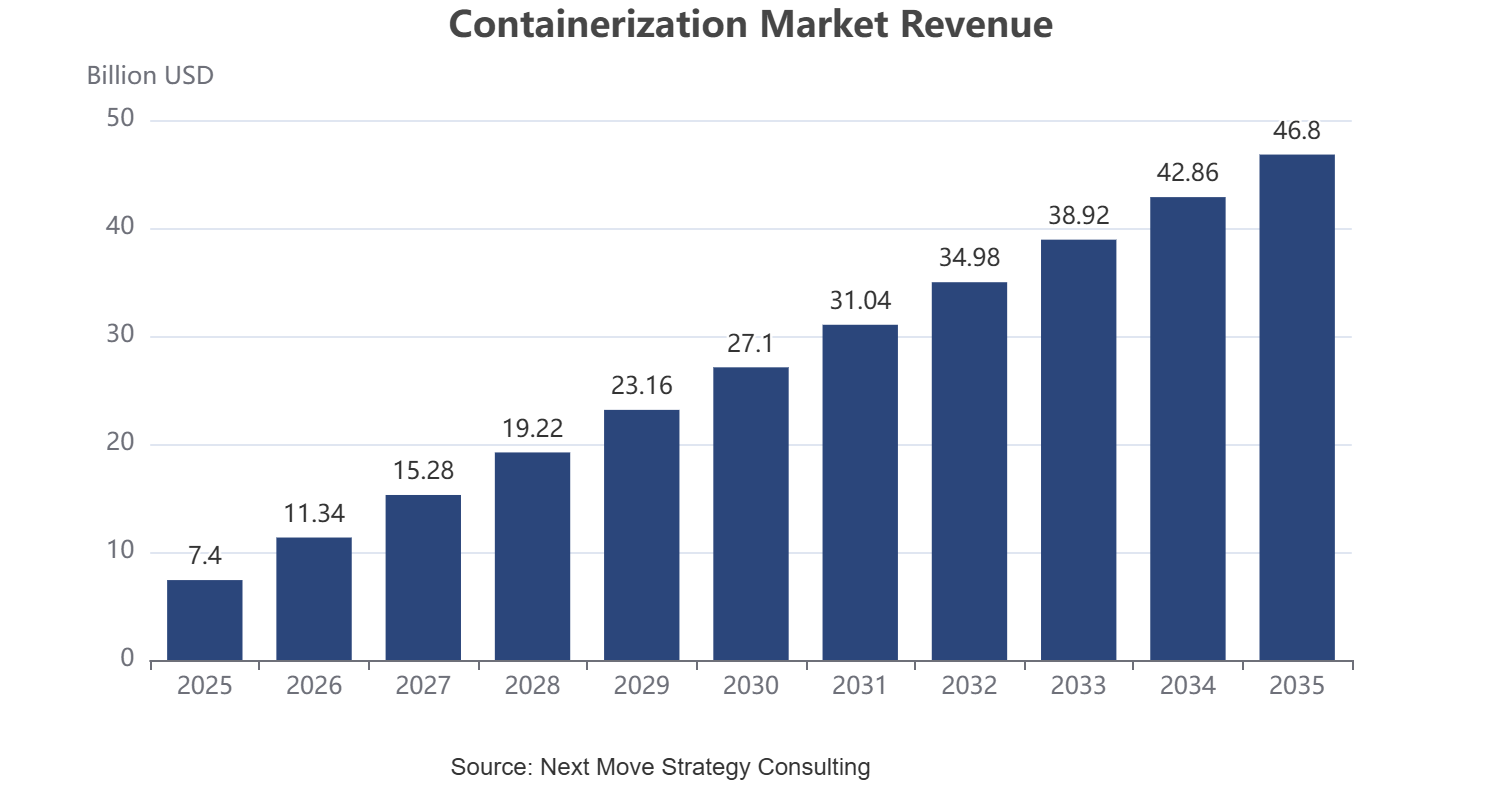
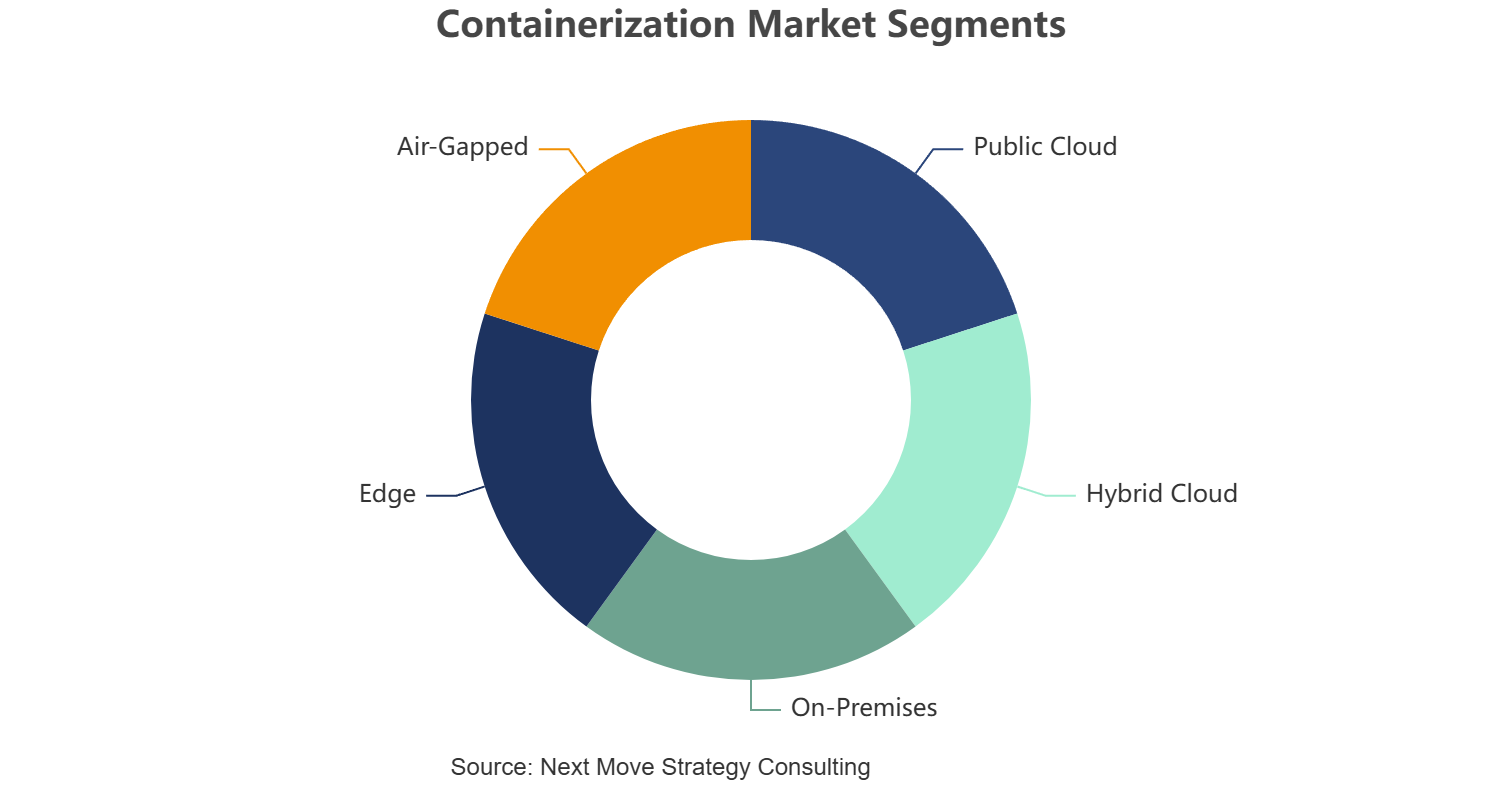
About the Author
 Liza Phukan
— Liza Phukan is Research Associate at Next Move Strategy Consulting, where she has covered emerging industries and market research across sectors for 3.5 years. Her work includes analyzing industry developments, validating market data, and developing structured business content from research findings. She uses secondary research and data-validation practices to turn complex market information into clear decision-useful market analysis for business audiences and support report development and B2B.
Liza Phukan
— Liza Phukan is Research Associate at Next Move Strategy Consulting, where she has covered emerging industries and market research across sectors for 3.5 years. Her work includes analyzing industry developments, validating market data, and developing structured business content from research findings. She uses secondary research and data-validation practices to turn complex market information into clear decision-useful market analysis for business audiences and support report development and B2B.
About the Reviewer
 Supradip Baul
— Supradip Baul is an accomplished business consultant and strategist with over a decade of rich experience in market intelligence, strategy, technology, and business transformation. His work has included rigorous qualitative and quantitative analysis across multiple industries, helping clients shape investment decisions and long-term roadmaps. Earlier in his career, he was associated with Gartner, where he contributed to industry-leading reports and market share analyses. He has worked with leading global companies and holds an MBA with a dual specialization in Marketing and Finance.
Supradip Baul
— Supradip Baul is an accomplished business consultant and strategist with over a decade of rich experience in market intelligence, strategy, technology, and business transformation. His work has included rigorous qualitative and quantitative analysis across multiple industries, helping clients shape investment decisions and long-term roadmaps. Earlier in his career, he was associated with Gartner, where he contributed to industry-leading reports and market share analyses. He has worked with leading global companies and holds an MBA with a dual specialization in Marketing and Finance.
At Next Move Strategy Consulting, we understand that insightful market research is the cornerstone of successful business decisions. That's why we employ a robust and multifaceted approach, combining various methodologies to deliver the most accurate and actionable data for our clients.

Research Landscape
We navigate the world of research with two primary approaches:
Qualitative Approach
Our qualitative research methodologies involve immersive techniques such as in-depth interviews, focus groups, and observational studies. By engaging directly with individuals and stakeholders, we uncover valuable insights that quantitative data alone may overlook.

Quantitative Research
In tandem with qualitative methodologies, NMSC leverages the power of Quantitative Research to provide a robust foundation of numerical insights. Through systematic data collection and analysis, we quantify patterns, preferences, and market trends, offering a comprehensive view of the business landscape.
Our quantitative research approach employs diverse tools, including surveys, experiments, and statistical modelling. These methodologies enable us to gather data from a large and representative sample, ensuring the statistical significance of our findings. By employing structured questionnaires and standardized data collection methods, we guarantee the reliability and validity of the information we present to our clients.
Quantitative research is particularly effective in measuring the prevalence of trends, assessing market size, and gauging the impact of various factors on consumer behavior. The numerical precision attained through this approach equips our clients with actionable insights, facilitating data-driven decision-making and strategy formulation.


Our Specialized Toolbox for Industry-Specific Market Research
We deploy a specialized arsenal of techniques tailored to meet your unique requirements. Here's a glimpse into our comprehensive toolbox:

Information Procurement
The stage entails acquiring market data or relevant information through various sources and methodologies.


Market Research Approach
We utilize both top-down and bottom-up approaches in market research analysis to achieve a comprehensive understanding of the market dynamics, leveraging the broad perspective of industry trends and macroeconomic factors alongside detailed insights from specific segments and individual companies.

Porters Five Forces Analysis
We conduct Porter's Five Forces analysis to evaluate the competitive landscape of an industry, providing us with insights into factors that affect profitability and strategic positioning.

SWOT Analysis

Forecasting
We utilize a forecasting model to predict future consumption by considering parameters like population, economics, regulations, market competition, drivers, constraints, technology, and pricing. We also employ statistical techniques such as multilinear regression, exponential smoothing, moving average, ARIMA, and Monte Carlo simulations for accurate predictions. In econometric forecasting, we analyzed short-term and long-term event impacts, attributing values based on regulatory frameworks, economic factors, and market events.





 Speak to Our Analyst