Electric Service Companies (ESCOs) Market Size, Share, Growth & Forecast by Service Delivery Model (Energy Performance Contracting, Energy as a Service, Design Build, and Others), End User Vertical (Public Sector, Commercial Buildings, and others), Technology Domain (HVAC and Controls, Lighting, Power and Electrical, Renewable Energy, Energy Storage, EV Charging,and Others), and Buyer Type (Government, Enterprise, Utility, Residential) — Global Analysis 2025–2035
Industry: Energy & Power | Publishing Date: July 6, 2026 | Last Updated: September 30, 2026 | No of Pages: N/A | No. of Tables: N/A | No. of Figures: N/A | Format: PDF | Report Code: EP4978
What Is the Electric Service Companies (ESCOs) Market Size?
The global Electric Service Companies (ESCOs) Market was valued at USD 29.8 billion in 2025 and is expected to reach USD 32.7 billion in 2026. Accelerating decarbonization mandates, aggressive net-zero commitments across public and private sectors, and escalating energy costs are projected to propel the Electric Service Companies (ESCOs) Market to USD 74.6 billion by 2035, advancing at a CAGR of 9.6% from 2026 to 2035. Key growth drivers include the rapid expansion of performance-based energy contracting across government facilities, the commercial adoption of Energy as a Service financing models that eliminate upfront capital barriers, growing deployment of distributed renewable and storage technologies by ESCOs, and the digitalization of building energy management through advanced analytics and demand response platforms.
|
Parameters |
Details |
|
Market Size in 2025 |
USD 29.8 Billion |
|
Market Size in 2026 |
USD 32.7 Billion |
|
Revenue Forecast in 2035 |
USD 74.6 Billion |
|
Growth Rate |
CAGR of 9.6% from 2026 to 2035 |
|
Analysis Period |
2025–2035 |
|
Base Year Considered |
2025 |
|
Forecast Period |
2026–2035 |
|
Market Size Estimation |
Billion USD |
|
Companies Profiled |
20 |
|
Countries Covered |
35 |
|
Market Share |
Top 10 |
Electric Service Companies (ESCOs) Market Overview
What Is the Electric Service Companies (ESCOs) Market?
Electric Service Companies (ESCOs) are specialized energy service providers that design, implement, finance, and operate energy efficiency and clean energy projects for commercial, industrial, government, and residential clients. ESCOs assume technical and financial risk on behalf of their clients through performance-based contracts, delivering guaranteed energy cost savings that are used to repay project financing. The Electric Service Companies (ESCOs) Market encompasses a broad suite of services including Energy Performance Contracting, Energy as a Service delivery, design-build retrofit execution, facility operations and maintenance, advisory and audit services, and digital energy management platforms.
How Has the Electric Service Companies (ESCOs) Market Evolved?
The Electric Service Companies (ESCOs) Market has evolved significantly across four decades of development. Early-stage growth focused on industrial boiler replacements and lighting retrofits financed through Guaranteed Savings Energy Performance Contracts. The second phase introduced comprehensive facility upgrades incorporating controls, HVAC optimization, and renewable integration. Through our market assessment, we observed that the current phase is characterized by digital-first service delivery, AI-enabled energy management, outcome-based Energy as a Service models, and microgrid development that positions ESCOs as energy infrastructure developers rather than simple retrofit contractors.
How Do Regulations Influence the Electric Service Companies (ESCOs) Market?
Regulatory frameworks have become central structural drivers for the Electric Service Companies (ESCOs) Market. In the United States, the Federal Energy Management Program (FEMP) and the enabling legislation under the Energy Policy Act of 2005 have institutionalized ESCO procurement pathways for federal agencies. The European Union's Energy Efficiency Directive mandates member states to achieve cumulative final energy savings targets, creating procurement obligations that favor ESCO-delivered solutions. Building performance standards enacted in cities including New York, Boston, and Washington D.C. are compelling commercial property owners to engage ESCOs for compliance-driven retrofits under legally binding emissions reduction schedules.
How Is Technology Adoption Expanding Across the Electric Service Companies (ESCOs) Market?
Technology adoption across the Electric Service Companies (ESCOs) Market is accelerating as ESCOs integrate advanced digital capabilities into their core service delivery architecture. Internet of Things sensor networks, fault detection and diagnostics platforms, and AI-driven energy optimization algorithms are being embedded into long-term operations and maintenance contracts, transforming ESCOs from project-based contractors into continuous energy performance managers. NMSC's analysis indicates that the convergence of smart building controls, demand response automation, virtual power plant aggregation, and distributed energy resource management is expanding the total addressable market for digitally enabled ESCO services well beyond traditional lighting and HVAC applications.
|
Key Takeaways |
|
By service delivery model, Energy Performance Contracting held the largest share of the Electric Service Companies (ESCOs) Market at USD 11.9 billion in 2025. The Energy as a Service segment is the fastest-growing sub-segment, projected to expand from USD 6.2 billion in 2025 to USD 19.8 billion by 2035 at a CAGR of 12.3%, fueled by enterprise and government demand for outcome-based models that eliminate upfront capital expenditure requirements. |
|
By end user vertical, the Public Sector was the largest vertical at USD 10.1 billion in 2025, accounting for approximately 34% of total market revenue. Industrial Sites represent the fastest-growing vertical at a CAGR of 11.2% from 2026 to 2035, driven by manufacturing decarbonization mandates and process electrification investment across energy-intensive sectors globally. |
|
By technology domain, HVAC and Controls dominated the Electric Service Companies (ESCOs) Market at USD 6.8 billion in 2025. Renewable Energy integration is the fastest-growing technology domain at a CAGR of 13.8% from 2026 to 2035, as ESCOs increasingly bundle on-site solar, wind, and storage into comprehensive clean energy service packages. |
|
By buyer type, Government buyers accounted for USD 10.9 billion in 2025, representing the largest share. Enterprise buyers are the fastest-growing segment at a CAGR of 11.1% from 2026 to 2035, as large corporations implement portfolio-level decarbonization strategies requiring comprehensive energy services delivery partners. |
|
North America held the largest regional share in the Electric Service Companies (ESCOs) Market at USD 12.4 billion in 2025, projected to reach USD 29.6 billion by 2035 at a CAGR of 9.1%, supported by the U.S. Federal Energy Management Program, stringent building performance standards, strong project financing infrastructure, and increasing adoption of energy performance contracting across public and commercial facilities. |
|
Asia-Pacific is the fastest-growing region in the Electric Service Companies (ESCOs) Market at a CAGR of 12.4% from 2026 to 2035, driven by industrial energy-efficiency mandates, rapid urbanization, government-backed decarbonization initiatives, expanding commercial building construction, and growing deployment of Energy as a Service solution. |
|
The United States is the single largest country market in the Electric Service Companies (ESCOs) Market, underpinned by a mature ESCO ecosystem, extensive federal and state energy-efficiency programs, strong private-sector investment, and widespread implementation of performance-based energy contracts. |
|
China is the fastest-growing national market within Asia-Pacific in the Electric Service Companies (ESCOs) Market at a CAGR of 13.6%, propelled by the Contract Energy Management policy framework, mandatory industrial energy audits, dual-carbon objectives, and rising investments in industrial decarbonization and smart energy management solutions. |
Key Emerging Trends in the Electric Service Companies (ESCOs) Market
How Is the Energy as a Service Model Transforming the Electric Service Companies (ESCOs) Market?
Energy as a Service (EaaS) is fundamentally reshaping the Electric Service Companies (ESCOs) Market by shifting project delivery from capital project contracting toward ongoing subscription-based energy outcome agreements. Our findings suggest that major ESCOs including Schneider Electric and Enel X are restructuring their business models around multi-year EaaS agreements that bundle solar, storage, controls, and demand response into a single monthly payment. This model eliminates the capital barrier that historically limited ESCO penetration in commercial and mid-market segments, accelerating adoption among retail, hospitality, and healthcare property owners seeking predictable energy cost structures.
How Are Digital Energy Services Redefining Value Creation in the Electric Service Companies (ESCOs) Market?
Digital energy services are emerging as a core revenue and differentiation layer within the Electric Service Companies (ESCOs) Market. From our research, we found that ESCOs are deploying AI-powered fault detection and diagnostics platforms, virtual power plant aggregation software, and energy management systems that generate recurring software revenue independent of physical project execution. Honeywell's Forge Energy Optimization platform and Siemens Building X represent the integration of SaaS models into traditional ESCO service delivery. These digital capabilities extend ESCO contract durations, improve realized energy savings verification, and create defensible competitive barriers through proprietary data assets accumulated across managed building portfolios.
How Is the Expansion of Building Performance Standards Driving ESCO Market Demand?
Based on our market evaluation, we noticed that the rapid proliferation of building performance standards at city, state, and national levels is creating a structural compliance-driven demand wave for Electric Service Companies (ESCOs) Market participants. New York City's Local Law 97, Boston's Building Emissions Reduction and Disclosure Ordinance, and the EU's Energy Performance of Buildings Directive recast are imposing legally binding carbon and energy intensity thresholds on existing building stock. Property owners lacking internal technical expertise are increasingly engaging ESCOs as compliance execution partners, creating a new regulatory-anchored demand channel that supplements traditional government procurement pathways.
How Are Microgrids and Distributed Energy Resources Expanding the ESCO Value Proposition?
Through NMSC's assessment, we found that microgrid development and distributed energy resource (DER) integration are expanding the Electric Service Companies (ESCOs) Market total addressable market beyond traditional efficiency retrofits. ESCOs such as Ameresco and McKinstry are increasingly developing campus microgrids that combine solar, battery storage, fuel cells, and demand response to deliver energy resilience alongside efficiency savings. The U.S. Department of Energy's Loan Programs Office has facilitated financing for several multi-million-dollar ESCO-developed microgrid projects at federal installations. This expansion positions leading ESCOs as energy infrastructure developers operating at the intersection of efficiency, resilience, and clean energy transition.
Ecosystem Analysis of the Electric Service Companies (ESCOs) Market
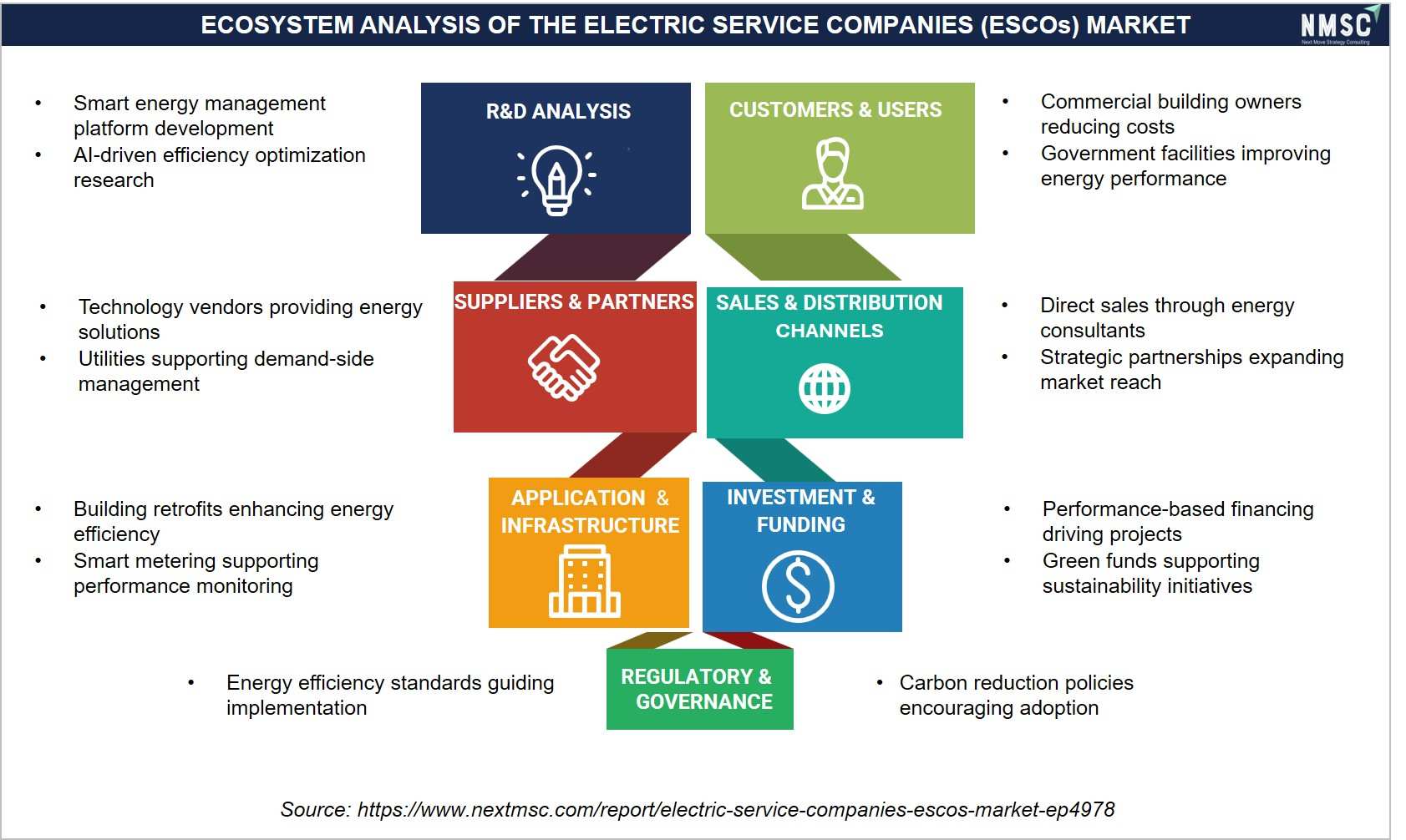
NMSC’s analysis indicates that the Electric Service Companies (ESCOs) market is supported by a collaborative ecosystem involving technology providers, utilities, building owners, financing institutions, and regulatory bodies. Our assessment finds that increasing demand for energy efficiency, smart building solutions, and performance-based contracting is accelerating market adoption. Furthermore, sustainability initiatives, supportive policies, and digital energy management platforms continue to strengthen market expansion.
What Are the Key Market Drivers, Breakthroughs, and Investment Opportunities that Will Shape the Electric Service Companies (ESCOs) Market Industry in the Next Decade?
|
Drivers / Trends / Restraints |
(+/-) % Impact on CAGR |
Geographic Relevance |
Impact Timeline |
|
Federal and State Building Performance Mandates |
+1.4% |
North America, Europe |
2025–2035 |
|
Energy as a Service Model Adoption |
+1.2% |
Global (led by North America, Europe) |
2025–2032 |
|
Industrial Decarbonization Obligations |
+1.1% |
APAC, Europe, North America |
2026–2035 |
|
Digital Energy Services and SaaS Integration |
+0.9% |
North America, Europe, APAC |
2025–2030 |
|
Microgrid and DER Project Development |
+0.8% |
North America, APAC, MEA |
2026–2035 |
|
Renewable Energy Integration by ESCOs |
+0.7% |
Global |
2025–2035 |
|
Long Contract Financing and Capital Constraints |
-1.0% |
SMB, Mid-market globally |
Ongoing |
|
Measurement and Verification Complexity |
-0.6% |
All regions |
Ongoing |
|
Supply Chain Constraints for Equipment |
-0.5% |
Global |
2025–2028 |
|
Demand Response and VPP Aggregation |
+0.6% |
North America, Europe, Australia |
2026–2035 |
What Are the Growth Drivers of the Electric Service Companies (ESCOs) Market?
How Are Federal and Municipal Building Performance Standards Driving Demand in the Electric Service Companies (ESCOs) Market?
Building performance standards enacted at federal and municipal levels represent the most powerful structural growth driver for the Electric Service Companies (ESCOs) Market. The U.S. Federal Energy Management Program has facilitated over USD 10 billion in ESCO project investment across federal facilities since the Energy Policy Act of 2005. The U.S. Department of Energy's Federal Energy Management Program reports that federal agencies have executed over 4,500 energy savings performance contracts across government installations nationwide. The EU Energy Efficiency Directive obliges member states to achieve energy savings of 1.5% per year from final energy consumption, creating enforceable renovation obligations that channel investment into ESCO-delivered efficiency programs across commercial and public building stock.
How Does Rising Commercial and Industrial Energy Cost Pressure Accelerate ESCO Market Growth?
Persistent energy price volatility and structural increases in commercial and industrial electricity costs are compelling facility owners to engage Electric Service Companies (ESCOs) as long-term energy cost management partners. The U.S. Energy Information Administration reports that commercial electricity prices have risen by more than 18% over the past five years, intensifying the economic case for performance-based ESCO contracts that lock in guaranteed savings. NMSC's analysis indicates that manufacturing enterprises operating energy-intensive processes are increasingly prioritizing ESCO-delivered electrification and process optimization projects to reduce exposure to fossil fuel price fluctuations and meet scope 1 emissions reduction commitments.
How Is the Global Push for Net-Zero Emissions Creating Multi-Decade Demand for ESCOs?
National net-zero emission commitments made under the Paris Agreement and subsequent NDC revisions are creating sustained multi-decade demand for the Electric Service Companies (ESCOs) Market. The International Energy Agency reports that energy efficiency must deliver approximately 40% of the emissions reductions required to achieve net-zero by 2050, establishing ESCOs as indispensable delivery vehicles for decarbonization. Through our market assessment, we observed that sovereign wealth funds, infrastructure investors, and green bond markets are channeling capital into ESCO-structured projects at scale, extending the financing runway for public and private sector clients that previously lacked access to long-term project finance for energy upgrades.
What Are the Growth Inhibitors of the Electric Service Companies (ESCOs) Market?
How Do Long Contract Tenors and Complex Financing Structures Constrain ESCO Market Expansion?
The structural reliance of Electric Service Companies (ESCOs) on long-duration performance contracts, typically spanning 10 to 25 years, creates financing complexity and procurement cycle length that limits market penetration among smaller commercial buyers. The U.S. Government Accountability Office has documented that small and mid-size federal agencies frequently lack the procurement expertise and legal capacity to navigate Energy Savings Performance Contract structures, resulting in underutilization of available ESCO programs. From our assessment, we further noticed that private sector SMBs face similar barriers as lenders and guarantee providers require credit quality and collateral structures that exclude a substantial proportion of the commercial building market from accessing performance-based ESCO financing.
How Does Measurement and Verification Complexity Limit ESCO Market Scalability?
Measurement and verification of energy savings against independently established baselines remains one of the most operationally complex and cost-intensive aspects of ESCO project delivery, creating a structural constraint on market scalability. The International Performance Measurement and Verification Protocol, maintained by the Efficiency Valuation Organization, defines rigorous metering and analysis requirements that add cost and technical overhead to every ESCO project. Our findings suggest that discrepancies between projected and realized savings, often arising from changes in building occupancy, weather normalization methodology, and equipment degradation, generate contractual disputes that extend project timelines and increase transaction costs across the Electric Service Companies (ESCOs) Market.
What Are the Growth Opportunities in the Electric Service Companies (ESCOs) Market?
How Does the Industrial Decarbonization Wave Create a Multi-Billion Dollar ESCO Market Opportunity?
Industrial decarbonization represents the highest-potential untapped growth opportunity for the Electric Service Companies (ESCOs) Market, as manufacturing, process, and logistics operators face regulatory and market pressure to reduce Scope 1 and Scope 2 emissions at the facility level. The U.S. Department of Energy's Industrial Decarbonization Roadmap identifies energy efficiency, electrification, and on-site renewable deployment as the three primary industrial decarbonization pathways, all of which align directly with ESCO core competencies. Our analysis shows that the total addressable industrial ESCO market in North America alone exceeds USD 50 billion in identified project opportunity, with process electrification, compressed air optimization, and smart motor control representing the most capital-efficient near-term deployment categories.
How Are Data Centers and Digital Infrastructure Creating a New High-Growth ESCO Vertical?
Data center energy intensity has elevated the sector to one of the fastest-growing ESCO client verticals within the Electric Service Companies (ESCOs) Market. The U.S. Department of Energy reports that data centers consume approximately 2% of total U.S. electricity and face mounting regulatory and ESG pressure to improve power usage effectiveness and transition to renewable energy sources. Based on NMSC's research, we found that ESCOs are increasingly offering integrated data center energy services combining cooling system optimization, on-site renewable installation, battery storage for demand charge management, and carbon reporting analytics. Hyperscaler sustainability commitments and EU data center energy efficiency mandates under the European Green Deal are generating procurement pipelines that favor ESCO-structured outcome-based contracts.
How Does the Digitalization of ESCO Services Create a Sustainable Competitive Moat and Recurring Revenue Opportunity?
The transition of Electric Service Companies (ESCOs) from project-based contractors to digital energy platform operators creates a structural opportunity to generate scalable recurring software and services revenue alongside traditional project execution. NMSC's analysis indicates that ESCOs managing large portfolios of monitored buildings accumulate proprietary operational data assets that feed AI optimization algorithms, creating compounding competitive advantages. The U.S. Environmental Protection Agency's ENERGY STAR Portfolio Manager platform provides a widely adopted baseline benchmarking framework that ESCOs leverage to demonstrate and report verified performance improvement, supporting client retention and contract renewal across long-duration managed services agreements.
How Is the Electric Service Companies (ESCOs) Market Segmented in This Report, and What Are the Key Insights from the Segmentation Analysis?
By Service Delivery Model
How Does Service Delivery Model Segmentation Reveal the Commercial Architecture of the Electric Service Companies (ESCOs) Market?
|
Segments |
2025 (USD Bn) |
2035 (USD Bn) |
CAGR (%) |
|
Energy Performance Contracting |
11.9 |
26.8 |
8.5% |
|
Energy as a Service |
6.2 |
19.8 |
12.3% |
|
Design Build |
4.8 |
11.4 |
9.0% |
|
Operations and Maintenance |
4.1 |
9.6 |
8.9% |
|
Advisory Services |
1.7 |
3.8 |
8.4% |
|
Digital Energy Services |
1.1 |
3.2 |
11.3% |
Based on our research, we found that the Electric Service Companies (ESCOs) Market is segmented by service delivery model into Energy Performance Contracting (EPC), Energy as a Service (EaaS), Design Build, Operations and Maintenance, Advisory Services, and Digital Energy Services. Energy Performance Contracting retains the largest revenue share, encompassing Guaranteed Savings EPC, Shared Savings EPC, and Fixed Fee EPC structures that have served as the commercial backbone of the ESCO industry since its inception. Through our market assessment, we observed that Energy as a Service is rapidly emerging as the fastest-growing model, with Lighting as a Service, Solar as a Service, Storage as a Service, Microgrid as a Service, and EV Charging as a Service sub-models expanding the client base beyond traditional public sector procurement. Digital Energy Services, encompassing energy management software, analytics, demand response, virtual power plant aggregation, and fault detection and diagnostics, is scaling rapidly as ESCOs commercialize technology-enabled performance monitoring capabilities alongside physical project execution.
By End User Vertical
Which End User Verticals Are Generating the Greatest Revenue Concentration in the Electric Service Companies (ESCOs) Market?
|
Segments |
2025 (USD Bn) |
2035 (USD Bn) |
CAGR (%) |
|
Public Sector |
10.1 |
22.9 |
8.5% |
|
Commercial Buildings |
7.4 |
17.6 |
9.1% |
|
Industrial Sites |
5.6 |
15.8 |
11.2% |
|
Infrastructure |
4.2 |
11.3 |
10.4% |
|
Residential and Multifamily |
2.5 |
7.0 |
10.8% |
Through NMSC's assessment, we found that the Electric Service Companies (ESCOs) Market is segmented by end user vertical into Public Sector, Commercial Buildings, Industrial Sites, Infrastructure, and Residential and Multifamily. The Public Sector vertical, encompassing Federal, State and Local government facilities, has historically dominated ESCO revenue due to legislatively enabled performance contracting mechanisms and long-term institutional credit quality. Commercial Buildings, including Office, Retail, Hospitality, and Real Estate sub-segments, represent the second-largest vertical and are being accelerated by building performance standards and corporate net-zero commitments. Industrial Sites covering Manufacturing, Process, Logistics, and Data Centers are the fastest-growing vertical as decarbonization obligations extend into supply chains, while the Infrastructure vertical encompassing Utilities, Transportation, and Water and Wastewater is expanding as asset operators adopt performance-based energy management contracts.
By Technology Domain
How Do Technology Domain Preferences Shape ESCO Project Composition and Revenue Distribution?
|
Segments |
2025 (USD Bn) |
2035 (USD Bn) |
CAGR (%) |
|
HVAC and Controls |
6.8 |
14.9 |
8.2% |
|
Lighting |
4.9 |
9.8 |
7.2% |
|
Renewable Energy |
3.8 |
13.8 |
13.8% |
|
Power and Electrical |
3.4 |
8.4 |
9.5% |
|
Energy Storage |
2.6 |
9.2 |
13.5% |
|
EV Charging |
1.8 |
6.8 |
14.2% |
|
Water Efficiency |
1.4 |
3.2 |
8.6% |
|
Building Envelope |
1.3 |
2.9 |
8.4% |
|
Process Optimization |
1.9 |
4.8 |
9.7% |
|
Digital and Analytics |
2.1 |
5.8 |
10.7% |
Based on our market evaluation, we noticed that the Electric Service Companies (ESCOs) Market is segmented across technology domains including HVAC and Controls, Lighting, Renewable Energy, Power and Electrical, Energy Storage, EV Charging, Water Efficiency, Building Envelope, Process Optimization, and Digital and Analytics. HVAC and Controls retains the largest revenue share as the most capital-intensive and performance-impactful technology category in the ESCO project landscape, encompassing chiller replacements, variable speed drives, building automation systems, and advanced controls integration. Lighting remains a significant segment, though its revenue share is declining as LED retrofit penetration matures. Renewable Energy, Energy Storage, and EV Charging are the three fastest-growing technology domains, reflecting the strategic evolution of ESCOs from efficiency specialists toward comprehensive clean energy infrastructure service providers addressing the full spectrum of client decarbonization requirements.
By Buyer Type
How Do Buyer Type Differences Influence ESCO Contract Structure and Revenue Dynamics?
|
Segments |
2025 (USD Bn) |
2035 (USD Bn) |
CAGR (%) |
|
Government |
10.9 |
24.4 |
8.4% |
|
Enterprise |
9.6 |
25.8 |
11.1% |
|
Utility |
5.2 |
12.8 |
9.5% |
|
Residential |
2.5 |
7.0 |
10.8% |
|
Other Buyer Types |
1.6 |
4.6 |
11.2% |
Our assessment indicates that the Electric Service Companies (ESCOs) Market is segmented by buyer type into Government, Enterprise, Utility, Residential, and Other buyer categories. Government buyers remain the largest revenue source due to structured procurement frameworks, long-term institutional credit, and legislatively mandated energy reduction targets that create recurring ESCO procurement pipelines at federal, state, and municipal levels. Enterprise buyers are the fastest-growing category as large corporations implement portfolio-level Scope 1 and Scope 2 emissions reduction strategies requiring comprehensive ESCO partnerships across global real estate and manufacturing footprints. Utility buyers are expanding ESCO engagement through demand-side management program delivery and virtual power plant development, while the Residential and Multifamily segment is emerging as a new growth frontier through Lighting as a Service and Solar as a Service subscription models.
Regional Outlook
Geographic Performance Snapshot
|
Region |
2025 (USD Bn) |
2035 (USD Bn) |
CAGR (%) |
Key Driver |
|
North America |
12.4 |
29.6 |
9.1% |
U.S. federal ESCO program, building performance standards |
|
Europe |
9.8 |
23.4 |
9.2% |
EU Energy Efficiency Directive, Renovation Wave |
|
Asia-Pacific |
5.4 |
17.2 |
12.4% |
China CEM policy, India NMEE, APAC building growth |
|
Middle East & Africa |
1.3 |
3.6 |
10.8% |
Vision 2030, UAE Net Zero 2050 |
|
Latin America |
0.9 |
2.4 |
10.2% |
Brazil PROCEL, Chile Energy Efficiency Law |
North America Electric Service Companies (ESCOs) Market
North America is the global leader in the Electric Service Companies (ESCOs) Market, contributing USD 12.4 billion in 2025 and forecast to reach USD 29.6 billion by 2035 at a CAGR of 9.1%. The region benefits from the world's most developed ESCO legislative and financing infrastructure, anchored by the U.S. Federal Energy Management Program and state-level building performance standards. Strong private capital markets, established guaranteed savings contracting protocols, and a deep pool of accredited ESCO providers underpin sustained market leadership. The Inflation Reduction Act's energy efficiency incentives and the Bipartisan Infrastructure Law's federal building renovation funding are creating additional near-term demand catalysts across the region.
U.S. Electric Service Companies (ESCOs) Market
Based on our engagements with federal procurement stakeholders and commercial building operators, the United States is the world's single largest Electric Service Companies (ESCOs) Market, representing approximately 80% of North American revenue at USD 9.9 billion in 2025. The U.S. Federal Energy Management Program administers over USD 1.5 billion annually in Energy Savings Performance Contracts across federal agencies. New York City's Local Law 97, Massachusetts' Building Energy Codes, and California's Title 24 standards are generating compliance-driven demand for ESCO-delivered retrofits at scale. The Inflation Reduction Act's 179D commercial building deduction enhancement materially improves ESCO project economics, accelerating investment returns for qualified energy efficiency measures.
Canada Electric Service Companies (ESCOs) Market
Through our analysis, Canada represents a mature and growing market within North America's Electric Service Companies (ESCOs) landscape, supported by Natural Resources Canada's Energy Efficiency Programs and provincial green building initiatives. Federal government building retrofit commitments under Canada's Greening Government Strategy are generating structured ESCO procurement through the Public Services and Procurement Canada framework. Ontario's Green Energy Act legacy investments and British Columbia's CleanBC program are driving commercial ESCO activity at the provincial level. Canadian institutional investors have demonstrated strong appetite for energy-efficiency-backed infrastructure assets, supporting long-tenor ESCO project finance.
Mexico Electric Service Companies (ESCOs) Market
From our assessment, Mexico represents the fastest-growing North American market for Electric Service Companies (ESCOs), driven by rising electricity tariffs, industrial nearshoring investment, and government commitments under the National Energy Efficiency Program. CONUEE, Mexico's National Commission for the Efficient Use of Energy, has developed ESCO-enabling frameworks for public buildings, while the manufacturing sector's energy intensity creates strong private sector demand. International ESCOs are establishing local presence to capture manufacturing facility efficiency contracts generated by the nearshoring wave, while Mexico's growing commercial real estate sector presents emerging demand for EaaS delivery models.
Europe Electric Service Companies (ESCOs) Market
Europe is the second-largest region in the Electric Service Companies (ESCOs) Market, valued at USD 9.8 billion in 2025 and projected to reach USD 23.4 billion by 2035 at a CAGR of 9.2%. The European Union's Energy Efficiency Directive, Energy Performance of Buildings Directive, and Renovation Wave strategy collectively mandate and incentivize deep building retrofits that channel investment into ESCO-delivered solutions. The EU Taxonomy for Sustainable Finance and the European Green Deal create strong investment-grade demand for verified energy performance improvements. Germany, France, and the UK represent the three largest individual country markets within the European ESCO landscape.
UK Electric Service Companies (ESCOs) Market
Based on our engagements with UK energy service providers and public sector procurement teams, the United Kingdom represents one of Europe's most developed Electric Service Companies (ESCOs) Markets. The UK's Salix Finance scheme enables public sector organizations to access interest-free loans for energy efficiency projects, channeling investment into ESCO-delivered upgrades. The Energy Company Obligation (ECO) scheme drives residential and low-income building retrofit activity. The UK's legally binding net-zero by 2050 target and the Future Homes Standard are generating long-duration ESCO project pipelines across commercial and public buildings, reinforced by the Climate Change Committee's advisory framework.
Germany Electric Service Companies (ESCOs) Market
Through our analysis, Germany is the largest individual country market for Electric Service Companies (ESCOs) in continental Europe, driven by industrial energy efficiency obligations and federal building renovation commitments. The German government's Building Energy Act and Federal Funding for Efficient Buildings (BEG) program have directed substantial capital toward deep renovation projects that align with ESCO delivery models. German industrial enterprises, particularly in automotive, chemical, and mechanical engineering sectors, represent high-value ESCO clients for process optimization, compressed air efficiency, and on-site renewable integration projects, while municipalities are increasingly adopting energy contracting for public building portfolios.
France Electric Service Companies (ESCOs) Market
From our assessment, France represents a strategically important market for Electric Service Companies (ESCOs), supported by the Tertiary Decree which mandates energy consumption reductions of 40% to 60% in commercial buildings above 1,000 m² by 2030 and 2050 respectively. This creates one of Europe's most clearly defined compliance-driven ESCO procurement requirements. Dalkia, a subsidiary of EDF, is headquartered in France and holds a dominant position in the domestic ESCO market. The France Relance recovery plan has directed EUR 7 billion toward public building renovation, creating a substantial public sector ESCO project pipeline managed through ADEME-coordinated procurement frameworks.
Italy Electric Service Companies (ESCOs) Market
Based on our engagements with Italian energy services providers, Italy demonstrates growing momentum in the Electric Service Companies (ESCOs) Market, supported by the Superbonus and Bonus Casa energy renovation incentive schemes that have stimulated deep retrofit activity across residential and commercial building stock. Italy's National Integrated Energy and Climate Plan sets binding energy efficiency targets requiring sustained annual investment in building and industrial efficiency improvements. The Gestore dei Servizi Energetici (GSE) administers Italy's white certificate system, which provides financial incentives for verified energy savings delivered through ESCO projects, strengthening the business case for performance contracting across multiple sectors.
Spain Electric Service Companies (ESCOs) Market
Through our analysis, Spain is an emerging growth market for Electric Service Companies (ESCOs), underpinned by the National Energy and Climate Plan's commitment to reducing energy consumption by 39.5% by 2030 compared to 2007 levels. The Spanish government's PERTE program and Recovery, Transformation and Resilience Plan are directing substantial EU NextGenerationEU funds toward building renovation and industrial decarbonization, creating structured procurement pathways for ESCO-delivered solutions. Spain's Hotel and Tourism sector represents a distinctive high-value ESCO client segment, as operators seek to reduce energy costs and demonstrate environmental credentials to increasingly sustainability-conscious international travelers.
Sweden Electric Service Companies (ESCOs) Market
Based on our engagements with Nordic energy service operators, Sweden maintains a technologically advanced Electric Service Companies (ESCOs) Market, characterized by district energy integration, deep geothermal heat pump deployment, and comprehensive building automation systems. Sweden's Energy Markets Inspectorate and the Swedish Energy Agency support ESCO market development through technical guidance and standardized measurement frameworks. Sweden's ambitious climate target of net-zero greenhouse gas emissions by 2045, among the most aggressive in the EU, is generating continuous demand for ESCO-facilitated building renovation and industrial process decarbonization across the public and private sectors.
Denmark Electric Service Companies (ESCOs) Market
Through our analysis, Denmark represents a mature and innovative market within Europe's Electric Service Companies (ESCOs) landscape, notable for its advanced district heating system integration and municipal energy services delivery models. The Danish Energy Agency's Building Renovation Fund and Energistyrelsen's program support have established structured ESCO procurement frameworks for public buildings and social housing. Denmark's Energy Efficiency Obligation on energy companies creates demand-side management activities that ESCO providers increasingly fulfill through energy performance contracting. Municipalities across Denmark have been early adopters of comprehensive facility management ESCO contracts encompassing heating, cooling, and lighting systems.
Finland Electric Service Companies (ESCOs) Market
From our assessment, Finland is a developed Nordic market for Electric Service Companies (ESCOs), supported by Motiva, the Finnish Government's sustainable development company, which has actively promoted energy service contracting since the early 2000s. Finland's National Climate and Energy Strategy mandates continuous energy efficiency improvements across the building sector, creating a structured demand pipeline for ESCO services. Helsinki's carbon neutrality by 2030 commitment is generating municipal ESCO procurement for district heating optimization, LED street lighting, and building automation integration. Finnish ESCOs are particularly active in the industrial sector, delivering energy and water efficiency projects for forest industry clients.
Netherlands Electric Service Companies (ESCOs) Market
Based on our engagements with Dutch energy service providers, the Netherlands represents a technically sophisticated Electric Service Companies (ESCOs) Market, characterized by advanced building management systems integration, delta-climate-adapted HVAC technologies, and robust green building certification frameworks. The Dutch government's RVO (Netherlands Enterprise Agency) supports ESCO adoption through the Stimulation of Sustainable Energy Production (SDE++) scheme and energy savings obligation on large enterprises. The Netherlands' requirement for nearly zero-energy new buildings and the Multi-Year Agreements on Energy Efficiency (MJA3) for industrial enterprises create structured ESCO engagement pathways across both commercial building and industrial verticals.
Rest of Europe Electric Service Companies (ESCOs) Market
Through our analysis, the rest of Europe encompasses an array of developing Electric Service Companies (ESCOs) Markets including Poland, Belgium, Austria, and Central and Eastern European economies. The EU Energy Efficiency Directive's binding savings obligations apply uniformly across all member states, creating structured ESCO demand in markets that are at earlier stages of market development. EU Cohesion Funds and the European Structural and Investment Funds are channeling capital toward public building renovation projects in Eastern European member states, creating government-backed ESCO project pipelines with multilateral credit support.
Asia-Pacific Electric Service Companies (ESCOs) Market
Asia-Pacific is the fastest-growing major region in the Electric Service Companies (ESCOs) Market, valued at USD 5.4 billion in 2025 and projected to advance at a CAGR of 12.4% to reach USD 17.2 billion by 2035. China's Contract Energy Management policy, India's National Mission for Enhanced Energy Efficiency, Japan's Top Runner energy efficiency standards, and South Korea's green new deal infrastructure investment are all generating structured government-backed demand for ESCO services. Rapid commercial building construction and industrialization across Southeast Asia are creating greenfield ESCO project development opportunities across the region.
China Electric Service Companies (ESCOs) Market
Based on our engagements with Chinese energy service providers and policy analysts, China is the largest and fastest-growing individual country market in Asia-Pacific for Electric Service Companies (ESCOs). China's Contract Energy Management system, formalized through State Council regulations, has institutionalized ESCO project delivery across industrial enterprises, public buildings, and utilities. The National Development and Reform Commission mandates energy audits for large industrial consumers, generating substantial project identification pipelines for ESCOs. China's Dual Carbon Goals, targeting carbon peak by 2030 and neutrality by 2060, are compelling energy-intensive industries to accelerate ESCO-delivered efficiency investments at unprecedented scale.
India Electric Service Companies (ESCOs) Market
Through our analysis, India represents one of Asia-Pacific's fastest-growing Electric Service Companies (ESCOs) Markets, driven by the Bureau of Energy Efficiency's Perform Achieve Trade scheme and National Mission for Enhanced Energy Efficiency. The Energy Conservation Act mandates energy audits for designated consumers across eleven energy-intensive sectors, creating structured project identification activity for ESCO providers. India's Smart Cities Mission and the AMRUT program are funding urban infrastructure energy efficiency projects through public ESCO procurement frameworks. EESL (Energy Efficiency Services Limited), a government enterprise, has become one of the world's largest deployed demand aggregators for street lighting and appliance efficiency programs.
Japan Electric Service Companies (ESCOs) Market
From our assessment, Japan is a technologically advanced market for Electric Service Companies (ESCOs), characterized by high energy efficiency standards under the Top Runner program and Energy Conservation Law obligations on large business operators. The Agency for Natural Resources and Energy coordinates ESCO market development through technical certification and performance contracting frameworks. Japan's net-zero by 2050 carbon neutrality declaration and Green Growth Strategy have prioritized building renovation and industrial process electrification as key ESCO demand vectors. Japanese ESCOs are notable for integrating advanced AI-based energy management systems and factory automation analytics into their service delivery frameworks.
South Korea Electric Service Companies (ESCOs) Market
Based on our engagements with Korean energy service companies, South Korea has a structured Electric Service Companies (ESCOs) Market underpinned by the Korea Energy Agency's ESCO registration and certification system. The Korean government's Green New Deal includes KRW 24.3 trillion (approximately USD 18 billion) of investments in smart green infrastructure, driving demand for energy performance contracting in public buildings and industrial facilities. South Korea's Emissions Trading Scheme creates additional financial incentives for verified energy savings delivered through ESCO projects. The country's semiconductor and display panel manufacturing sectors represent high-value industrial ESCO clients with significant compressed air and cleanroom cooling optimization opportunities.
Taiwan Electric Service Companies (ESCOs) Market
Through our analysis, Taiwan is an emerging market for Electric Service Companies (ESCOs), driven by the Ministry of Economic Affairs' Energy Conservation Programs and the government's commitment to achieving 20% renewable energy share by 2025. Taiwan's high-technology manufacturing sector, encompassing semiconductor fabs and electronics assembly operations, represents a significant ESCO market segment given its extreme energy intensity. The Bureau of Energy's ESCO promotion program has established technical and financial frameworks for energy performance contracting in industrial and commercial facilities. Taiwan's Electricity Act revisions allowing direct renewable power purchase agreements are expanding ESCO service offerings to include solar procurement and on-site generation management.
Indonesia Electric Service Companies (ESCOs) Market
From our assessment, Indonesia represents an early-stage but high-potential market for Electric Service Companies (ESCOs), supported by the Ministry of Energy and Mineral Resources' National Energy Efficiency Action Plan targeting 17% energy intensity reduction by 2025. The Indonesian government's mandatory energy audit requirements for large industrial and commercial buildings are creating project identification pipelines. International development finance institutions including the Asian Development Bank and World Bank Group are providing concessional funding to support ESCO market development in Indonesia. The country's rapidly expanding manufacturing and commercial building sectors, combined with high electricity tariff growth, are strengthening the economic case for ESCO-delivered energy services.
Vietnam Electric Service Companies (ESCOs) Market
Based on our engagements, Vietnam is developing its Electric Service Companies (ESCOs) Market through the Law on Economical and Efficient Use of Energy, which mandates energy audits for facilities consuming above defined thresholds. The Ministry of Industry and Trade's energy efficiency programs provide technical and financial support for industrial ESCO projects. Vietnam's rapid manufacturing sector growth, particularly in electronics, textiles, and food processing, creates strong private sector demand for industrial energy efficiency services. USAID's Vietnam Low Emission Energy Program and the World Bank's Vietnam Energy Efficiency for Industrial Enterprises project have helped establish ESCO-enabling frameworks and project finance mechanisms in the market.
Australia Electric Service Companies (ESCOs) Market
Through our analysis, Australia represents a commercially mature market for Electric Service Companies (ESCOs), anchored by the Clean Energy Finance Corporation's project finance activities and state-level energy efficiency programs. The National Australian Built Environment Rating System (NABERS) provides the performance benchmarking framework that underpins most commercial building ESCO contracting activity. Energy Performance Contracts are common in the federal government's Australian Public Service, facilitated by the Department of Climate Change, Energy, the Environment and Water. Australia's state-level energy efficiency schemes in Victoria, New South Wales, and South Australia create white certificate incentives that improve ESCO project economics across building and industrial sectors.
Philippines Electric Service Companies (ESCOs) Market
From our assessment, the Philippines represents an emerging Electric Service Companies (ESCOs) Market, supported by Republic Act 11285 (Energy Efficiency and Conservation Act), which establishes mandatory energy management systems for large industrial and commercial consumers. The Department of Energy's Implementing Rules provide the regulatory basis for ESCO service delivery and energy audit requirements. The Philippines' rapid commercial building sector growth in Metro Manila and provincial growth centers is creating demand for building energy management and lighting retrofit services. The Asian Development Bank and International Finance Corporation have provided technical assistance to support ESCO market development and project finance frameworks in the country.
Malaysia Electric Service Companies (ESCOs) Market
Based on our engagements with Malaysian energy stakeholders, Malaysia has a developing Electric Service Companies (ESCOs) Market underpinned by the Energy Efficiency and Conservation Act and Sustainable Energy Development Authority (SEDA) programs. The government's National Energy Transition Roadmap includes building efficiency as a priority decarbonization pathway, creating ESCO project development opportunities in the commercial and public building sectors. Malaysia's Petrochemical and manufacturing sectors represent high-value industrial ESCO client segments given their significant process energy consumption. Ongoing efforts to develop a domestic ESCO registry and standardized energy performance contracting framework by the Energy Commission are expected to accelerate market formalization.
Rest of APAC Electric Service Companies (ESCOs) Market
From our assessment, the rest of Asia-Pacific encompasses emerging Electric Service Companies (ESCOs) Markets in Thailand, Bangladesh, New Zealand, and Pacific island nations at various stages of ESCO market development. Thailand's Energy Efficiency Revolving Fund and New Zealand's EECA-administered energy efficiency programs provide institutional frameworks for ESCO service delivery. Regional development bank financing from the Asian Development Bank supports ESCO project development across early-stage Southeast Asian markets where domestic capital markets for long-tenor project finance remain limited.
Middle East and Africa Electric Service Companies (ESCOs) Market
The Middle East and Africa region represents USD 1.3 billion in the Electric Service Companies (ESCOs) Market in 2025, growing at a CAGR of 10.8% to reach USD 3.6 billion by 2035. Saudi Arabia's Vision 2030 energy efficiency program, the UAE's National Energy Strategy 2050, and Egypt's Sustainable Energy Strategy are driving government-backed ESCO project pipelines across public buildings and industrial facilities. Africa's growing commercial real estate sector and donor-funded public building energy efficiency programs are creating early-stage demand for ESCO services, particularly in South Africa, Nigeria, and Egypt.
Saudi Arabia Electric Service Companies (ESCOs) Market
Based on our engagements with Saudi energy stakeholders, Saudi Arabia is one of the most active Electric Service Companies (ESCOs) Markets in the Middle East, driven by the National Energy Services Company (TARSHID) program and Saudi Vision 2030's energy efficiency targets. Saudi Arabia's energy intensity reduction goal of 24% by 2030 creates a legally anchored ESCO demand pathway across government buildings, hospitals, and district cooling systems. TARSHID manages the government's Energy Performance Contracting program for public buildings, while ARAMCO's industrial energy efficiency projects create high-value private sector ESCO opportunities. The Saudi Energy Efficiency Center coordinates regulatory frameworks supporting ESCO market development.
UAE Electric Service Companies (ESCOs) Market
Through our analysis, the UAE demonstrates strong Electric Service Companies (ESCOs) Market activity, particularly in Dubai and Abu Dhabi, where government-mandated green building regulations and net-zero 2050 commitments drive retrofit demand. Dubai Supreme Council of Energy's Demand Side Management Strategy targets 30% energy and water demand reduction by 2030, creating structured ESCO procurement through Etihad ESCO, the Dubai government's dedicated energy service company. Abu Dhabi's Estidama Pearl Building Rating System and the UAE National Energy Plan provide additional regulatory underpinnings for ESCO service adoption across commercial, hotel, and healthcare building portfolios.
Egypt Electric Service Companies (ESCOs) Market
From our assessment, Egypt is an emerging Electric Service Companies (ESCOs) Market, supported by the New and Renewable Energy Authority and the Egyptian Energy Efficiency Fund, which channels concessional financing toward industrial and commercial energy efficiency projects. Egypt's Sustainable Energy Strategy targets 42% renewable energy share by 2035 and significant energy intensity reductions across industrial sectors. The Egyptian Electricity Holding Company's distribution network modernization program creates ESCO engagement opportunities in smart metering and demand response aggregation. International development finance from the EBRD and AFD has supported early ESCO market development, particularly in industrial and public building applications.
Israel Electric Service Companies (ESCOs) Market
Based on our engagements, Israel has a developed and technology-forward Electric Service Companies (ESCOs) Market, shaped by the Public Utilities Authority's energy efficiency programs and mandatory energy audit requirements. Israel's National Energy Efficiency Plan targets a 17% reduction in energy consumption by 2030, creating structured demand for ESCO-delivered upgrades across public buildings, industrial facilities, and municipal infrastructure. Israel's strong technology innovation ecosystem has fostered a number of digitally native energy service companies integrating IoT analytics and AI optimization platforms into ESCO service delivery. Cyber and data security considerations are particularly prominent in Israeli building energy management deployments.
Turkey Electric Service Companies (ESCOs) Market
Through our analysis, Turkey is a growing Electric Service Companies (ESCOs) Market, supported by the Energy Efficiency Law (Law No. 5627) and the mandatory energy management requirements established by the Ministry of Energy and Natural Resources. Turkey's energy intensity reduction target of 20% by 2023, extended under the updated National Energy Efficiency Action Plan, creates structured industrial and commercial ESCO demand. The country's large and energy-intensive manufacturing sector, particularly in textiles, cement, and steel, represents a significant ESCO market segment. Turkey's natural gas import dependency creates strong economic motivation for industrial energy efficiency, making ESCO-financed projects attractive for operators seeking to reduce fuel cost exposure.
Nigeria Electric Service Companies (ESCOs) Market
From our assessment, Nigeria represents an early-stage Electric Service Companies (ESCOs) Market with significant long-term potential, driven by unreliable grid supply, high diesel backup costs, and government energy efficiency mandates. The Energy Commission of Nigeria and the Rural Electrification Agency are developing frameworks for solar-as-a-service and microgrid ESCO models that address Nigeria's unique distributed energy access challenges. Large commercial facilities, hotels, and industrial operators in Lagos and Abuja represent the immediate ESCO client base. International climate finance from the Climate Investment Funds and Green Climate Fund is supporting the development of bankable ESCO project pipelines in Nigeria's commercial and public building sectors.
South Africa Electric Service Companies (ESCOs) Market
Based on our engagements with South African energy services providers, South Africa has the most developed Electric Service Companies (ESCOs) Market on the African continent, driven by Eskom's Integrated Demand Management program and the Sustainable Energy Society of Southern Africa's advocacy framework. The Department of Mineral Resources and Energy's National Energy Efficiency Strategy targets a 12% reduction in final energy demand. South Africa's mining and minerals processing sector represents the highest-value ESCO client segment, given its extreme electricity consumption and Eskom tariff escalation exposure. The Renewable Energy Independent Power Producer Programme indirectly supports ESCO activity by demonstrating bankable project structures for on-site energy generation investments.
Rest of MEA Electric Service Companies (ESCOs) Market
Based on our engagements, the rest of the Middle East and Africa encompasses Electric Service Companies (ESCOs) Markets in Jordan, Morocco, Kenya, Ghana, and other economies where government energy efficiency programs and international climate finance are creating early-stage ESCO project pipelines. The African Development Bank's energy efficiency facility and UNDP's energy services programs are supporting ESCO market development in sub-Saharan Africa. GCC countries beyond Saudi Arabia and the UAE are implementing national energy efficiency strategies that increasingly reference ESCO-delivered performance contracting as a preferred implementation mechanism.
Latin America Electric Service Companies (ESCOs) Market
Latin America is an emerging region in the Electric Service Companies (ESCOs) Market, contributing USD 0.9 billion in 2025 and projected to grow at a CAGR of 10.2% to reach USD 2.4 billion by 2035. Brazil's National Energy Efficiency Plan, Chile's Energy Efficiency Law, and Colombia's energy efficiency programs are creating regulatory-driven demand for ESCO services. The region's growing commercial real estate sector, energy cost pressures, and availability of multilateral development bank financing for energy efficiency projects are attracting leading international ESCOs to establish dedicated Latin American operations and partnership networks.
Brazil Electric Service Companies (ESCOs) Market
Based on our engagements with Brazilian energy service stakeholders, Brazil has the most developed Electric Service Companies (ESCOs) Market in Latin America, underpinned by PROCEL's energy efficiency programs, ANEEL's regulatory framework, and the Brazilian Association of Energy Services Companies (ABESCO). Brazil's National Energy Efficiency Plan and the Electricity Conservation Program create structured demand for ESCO services in industrial, commercial, and residential sectors. Brazilian electricity distribution companies are required to invest a percentage of net revenue in energy efficiency programs, channeling project finance capital into ESCO-delivered installations. The country's industrial sector, particularly in pulp and paper, food and beverage, and chemicals, represents the highest-value ESCO market segment.
Argentina Electric Service Companies (ESCOs) Market
Through our analysis, Argentina represents a developing Electric Service Companies (ESCOs) Market, shaped by Argentina's National Energy Efficiency Program and the Secretariat of Energy's efficiency promotion activities. High commercial electricity tariffs and periodic energy supply constraints create strong economic motivation for building and industrial energy efficiency investment. Argentina's recent economic stabilization efforts have improved the investment climate for long-duration ESCO performance contracts, which previously faced currency risk challenges. International development finance from the Inter-American Development Bank has supported the structuring of ESCO-enabling financing mechanisms for public buildings and municipal infrastructure across Argentine provinces.
Chile Electric Service Companies (ESCOs) Market
From our assessment, Chile has enacted one of Latin America's most comprehensive regulatory frameworks for Electric Service Companies (ESCOs) through the Energy Efficiency Law (Law 21.305), which mandates energy management systems for large consumers and establishes the National Energy Efficiency Agency as the regulatory authority. Chile's net-zero by 2050 commitment and carbon neutrality strategies are driving demand for ESCO-delivered building renovation and industrial energy optimization projects. The mining sector, Chile's most energy-intensive industry, represents a significant ESCO target market for electrification, compressed air, and process heat optimization. Chile's carbon tax mechanism creates additional financial incentives for verified energy savings delivered through ESCO performance contracts.
Colombia Electric Service Companies (ESCOs) Market
Based on our engagements, Colombia is developing its Electric Service Companies (ESCOs) Market through Law 1715 on Renewable Energy and the National Energy Efficiency Program coordinated by the Ministry of Mines and Energy. Colombia's commitment to reducing greenhouse gas emissions by 51% by 2030 under its updated NDC is driving investment in building and industrial energy efficiency. The commercial building sector in Bogotá, Medellín, and other major cities represents the primary near-term ESCO target market. UPME (Colombian Mining and Energy Planning Unit) coordinates energy efficiency investment assessments that identify ESCO-viable projects across industrial and public facility portfolios. International finance from IDB Invest is supporting ESCO project development in Colombia.
Rest of LATAM Electric Service Companies (ESCOs) Market
Through our analysis, the rest of Latin America encompasses developing Electric Service Companies (ESCOs) Markets in Peru, Ecuador, Uruguay, and Central American countries where energy efficiency programs and IDB-supported project finance are creating initial ESCO market structures. Peru's Ministry of Energy and Mines administers efficiency promotion programs targeting industrial consumers. Uruguay's MIEM coordinates building energy efficiency standards that are generating commercial building ESCO engagement. IDB Invest's green finance facility provides project finance support for ESCO-delivered energy efficiency investments across the region.
Strategic Framework Impacting the Electric Service Companies (ESCOs) Market
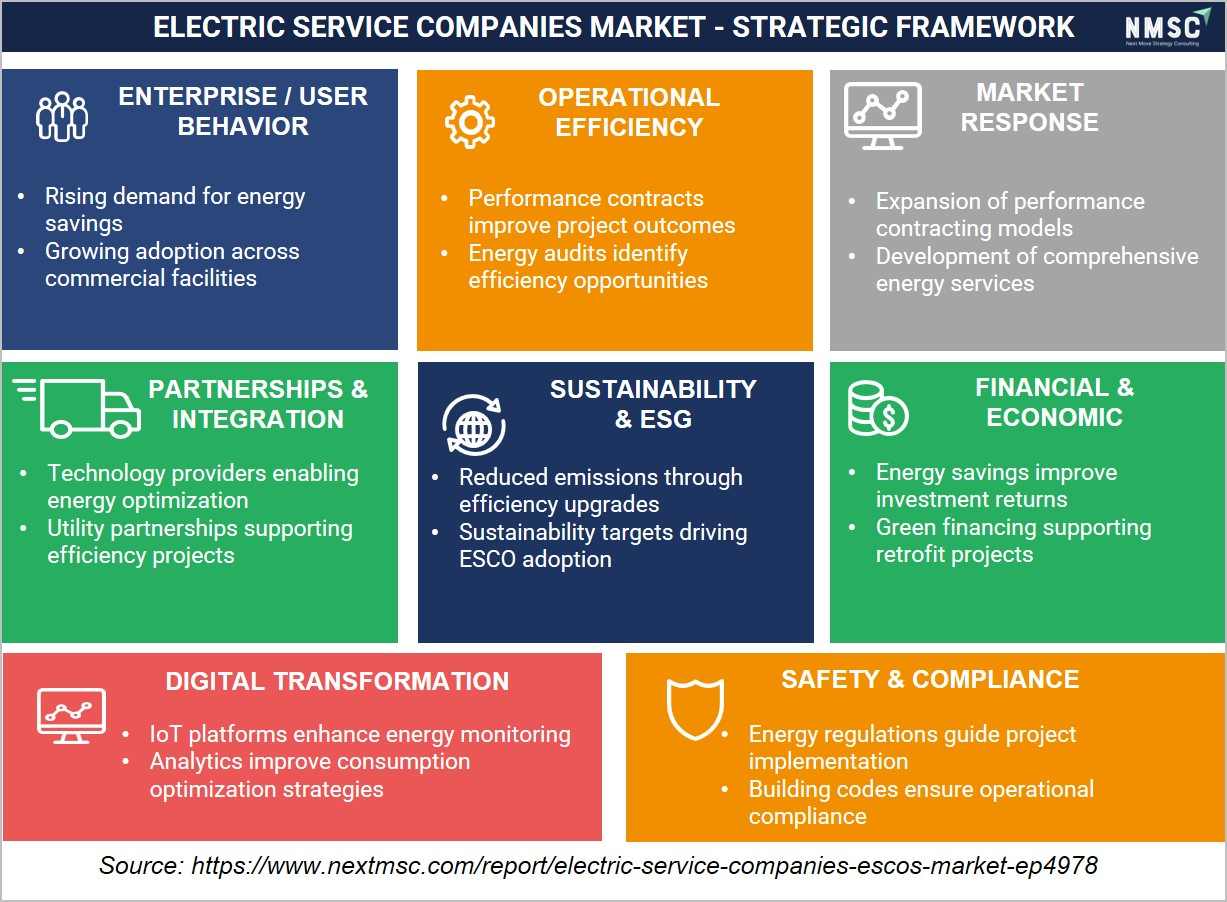
Based on NMSC’s evaluation, we found that the Electric Service Companies (ESCOs) market is evolving through growing energy optimization requirements, digital transformation, and sustainability-driven investments. Our assessment identifies that performance contracts, advanced analytics, and strategic partnerships are improving project outcomes and operational efficiency. Moreover, green financing mechanisms, regulatory compliance requirements, and expanding energy management services are enhancing market competitiveness and long-term growth opportunities.
Competitive Landscape
Competitive Dynamics and M&A Landscape
|
Key Takeaways |
Details |
|
Market Structure |
Moderately concentrated; top five players hold approximately 35% share; long tail of regional specialists |
|
Innovation Focus |
AI-driven energy management platforms, EaaS subscription models, VPP aggregation, microgrid-as-a-service, digital twin integration |
|
M&A Activity |
Active consolidation; large industrials acquiring digital energy startups; utility-affiliated ESCOs expanding through regional ESCO acquisitions |
How Do Companies Compete in the Electric Service Companies (ESCOs) Market?
The Electric Service Companies (ESCOs) Market operates within a moderately concentrated competitive structure where global diversified energy and industrial companies compete alongside specialized regional ESCO providers and emerging digitally native energy service platforms. NMSC's analysis indicates that the top five market participants, including Schneider Electric, Johnson Controls, Siemens, Honeywell, and Trane Technologies, collectively account for approximately 35% of global market revenue, reflecting meaningful scale advantages in project finance access, technology breadth, and geographic reach. The remaining market share is distributed across a fragmented long tail of regional ESCOs, facility management companies, and specialty providers that compete on local relationships, technical expertise, and contract flexibility.
Which Kind of Companies Dominate the Electric Service Companies (ESCOs) Market?
Global diversified industrials with integrated energy technology portfolios dominate the Electric Service Companies (ESCOs) Market at the enterprise and government tiers. Companies such as Schneider Electric, Johnson Controls, Siemens, and Honeywell leverage their proprietary building automation, HVAC, and electrical systems hardware to extend total-cost-of-ownership arguments that smaller competitors cannot match. These incumbents benefit from long-standing government procurement relationships and the ability to self-finance large performance contracts from their balance sheets. Regional specialists including Ameresco, NORESCO, and McKinstry compete effectively in the North American public sector through deep program management expertise and established state and municipal procurement track records.
AI-Native Differentiation and Open Standards Drive Market Success in the Electric Service Companies (ESCOs) Market
AI-native differentiation is becoming a critical competitive battleground in the Electric Service Companies (ESCOs) Market as digital energy platform capabilities increasingly determine contract award outcomes in technology-sophisticated client verticals. ESCOs that operate proprietary fault detection and diagnostics platforms, energy management software suites, and demand response aggregation capabilities generate measurable competitive advantages through superior measurement and verification outcomes, reduced operations and maintenance costs, and enhanced client retention. Our findings suggest that companies investing in digital twin technology for building energy modeling and AI-driven optimization are achieving realized energy savings performance that exceeds contractual guarantees, creating reference cases that accelerate new contract acquisition.
Market Players to Opt for Merger and Acquisition Strategies to Expand Their Presence in the Electric Service Companies (ESCOs) Market
Merger and acquisition activity is reshaping the competitive structure of the Electric Service Companies (ESCOs) Market as established industrial players acquire digital energy startups and utility-affiliated ESCOs pursue regional expansion strategies. Based on NMSC's research, we found that Schneider Electric's acquisition of AutoGrid has strengthened its demand response and virtual power plant capabilities, while Honeywell's Forge platform investments reflect organic development of SaaS revenue alongside traditional ESCO contracting. Trane Technologies and Johnson Controls have both made strategic acquisitions of building automation software companies to enhance their digital energy services portfolios. These consolidation dynamics are elevating the technology capabilities of top-tier ESCO providers while compressing the competitive space for non-digitally differentiated regional players.
Who Are the Key Market Players in the Electric Service Companies (ESCOs) Market?
-
Schneider Electric SE
-
Johnson Controls International plc
-
Siemens AG
-
Honeywell International Inc.
-
ENGIE SA
-
Veolia Environnement SA
-
Trane Technologies plc
-
E.ON SE
-
Centrica plc
-
Enel X S.r.l.
-
Ameresco, Inc.
-
NORESCO, LLC
-
Dalkia SA
-
ABM Industries Incorporated
-
Constellation NewEnergy, Inc.
-
ENFRA, LLC
-
CLEAResult, Inc.
-
Willdan Group, Inc.
-
Energy Systems Group, LLC
-
McKinstry Co., LLC
What Are the Latest Developments in the Electric Service Companies (ESCOs) Industry?
|
Date |
Event |
|
May 2026 |
Johnson Controls International plc finalized its strategic acquisition of Boston-based thermal management platform Alloy Enterprises, originally signed in February 2026. The acquisition incorporates advanced multi-physics fluid technology and custom direct liquid-cooling components into Johnson Controls' energy efficiency and commercial infrastructure building portfolios. |
|
March 2026 |
Global climate innovator Trane Technologies plc completed the acquisition of LiquidStack, a provider of advanced high-density liquid, immersion, and direct-to-chip cooling architectures. This expansion followed the company's February 2026 closing of Stellar Energy Americas, Inc., allowing Trane to scale modular energy efficiency and turnkey thermal services for high-demand, high-density infrastructure operators. |
|
April 2026 |
Schneider Electric SE launched its TeSys Tera motor and resource management platform during Texas Water 2026. Designed for heavy municipal and industrial utility sites, the system incorporates predictive load shedding, automated restart functions, and motor-level electricity monitoring to optimize structural process costs by up to 30%. |
What Are the Investment Opportunities in the Electric Service Companies (ESCOs) Market?
Capital Inflows
The Electric Service Companies (ESCOs) Market is attracting growing capital inflows from infrastructure funds, green bond markets, and impact investment platforms that recognize the durable, contracted cash flow characteristics of ESCO project portfolios. The U.S. Department of Energy's Loan Programs Office has committed billions of dollars in loan guarantees to support ESCO project finance for federal and commercial clients. From our research, we found that green bond issuances specifically designated for energy performance contracting projects have grown substantially, with ESCOs including Ameresco and ENGIE accessing green bond markets to finance large-scale public sector contract portfolios.
Infrastructure Investments
Infrastructure investment in the Electric Service Companies (ESCOs) Market is increasingly oriented toward distributed energy resource integration, including on-site solar, battery storage, EV charging infrastructure, and microgrid development that complements traditional efficiency retrofit activity. The U.S. Bipartisan Infrastructure Law allocated USD 3.5 billion for energy efficiency upgrades to federal buildings, channeling capital directly into ESCO-structured procurement. Based on NMSC's research, we found that multilateral development banks including the World Bank Group, Asian Development Bank, and European Bank for Reconstruction and Development are collectively deploying multi-billion-dollar facility lines to support ESCO project finance in emerging and developing economy markets.
ESG Considerations
ESG considerations are emerging as a central investment driver for the Electric Service Companies (ESCOs) Market, as institutional investors seek verified, measurable impact investments aligned with climate transition commitments. ESCO performance contracts generate independently verified energy savings metrics that directly align with Scope 1 and Scope 2 emissions reduction targets required under Science Based Targets initiative frameworks. Our assessment indicates that real estate investment trusts, institutional property owners, and corporate occupiers are increasingly viewing ESCO engagement as a strategic ESG risk management tool that improves asset sustainability ratings, reduces carbon liability exposure, and enhances property valuations in sustainability-sensitive markets.
Digital Transformation
Digital transformation investment within the Electric Service Companies (ESCOs) Market is accelerating as providers build proprietary software platforms, AI analytics engines, and IoT sensor networks that generate recurring technology revenue alongside physical project execution. Venture capital and private equity firms are directing investment into digitally native energy service startups that leverage cloud-native energy management platforms, demand response aggregation technology, and AI-driven optimization algorithms. NMSC's analysis indicates that strategic acquisitions of energy software companies by established ESCO providers are increasingly common, reflecting the recognition that digital capabilities have become a non-negotiable competitive requirement in technology-sophisticated client procurement processes.
PE and VC Activity
Private equity and venture capital activity in the Electric Service Companies (ESCOs) Market is robust, with fund managers attracted by the inflation-hedged, long-duration contracted revenue profiles of ESCO project portfolios. The National Venture Capital Association reports growing PE/VC investment in climate technology and energy efficiency companies, with ESCO-adjacent categories including demand response, building analytics, and energy management software receiving significant funding. Through our market assessment, we observed that PE-backed ESCO roll-up strategies are active in North America, with private equity platforms acquiring regional ESCO providers to build nationally scaled service delivery capabilities for the commercial and public sector markets.
Key Benefits for Stakeholders
For Investors and Financial Institutions
Investors and financial institutions gain access to comprehensive intelligence on the Electric Service Companies (ESCOs) Market, including detailed market sizing, long-term forecasts, segment-level CAGR analysis, and regional growth opportunities. The report provides investment-grade insights across service delivery models, technology domains, and geographic markets, supporting infrastructure fund strategy development, green bond structuring, and sustainable investment planning. Competitive landscape analysis and market outlook assessments further enable investors to identify high-growth opportunities, evaluate risk-adjusted returns, and optimize capital allocation decisions within the global energy transition ecosystem.
For ESCO Providers and Energy Companies
ESCO providers and energy companies gain actionable insights into the Electric Service Companies (ESCOs) Market, including service segment performance, end-user demand trends, competitive positioning, and emerging technology adoption patterns. The report identifies the fastest-growing service categories, industry verticals, and regional markets, enabling organizations to prioritize portfolio expansion, strengthen go-to-market strategies, and evaluate strategic partnership or acquisition opportunities. Technology-specific analysis further supports investment planning across renewable energy, distributed energy resources, energy storage, and digital energy management solutions.
For Project Developers and Contractors
Project developers and contractors gain detailed visibility into project development opportunities across the Electric Service Companies (ESCOs) Market, including Renewable Energy, Energy Storage, EV Charging Infrastructure, Building Energy Management Systems, and Microgrid as a Service solutions. The report provides regional and country-level regulatory analysis, market demand assessments, and sector-specific growth trends that support project pipeline development and market entry decisions. These insights help stakeholders identify attractive opportunities, optimize resource allocation, and align project strategies with evolving customer and regulatory requirements.
For Government and Regulatory Bodies
Government agencies and regulatory bodies gain evidence-based insights into the Electric Service Companies (ESCOs) Market, including the impact of energy efficiency mandates, building performance standards, public procurement frameworks, and decarbonization policies on market development. The report evaluates how regulatory initiatives across North America, Europe, and Asia-Pacific are shaping ESCO adoption and investment activity. Country-level analysis supports policymaking, public-sector energy planning, and the development of frameworks that encourage private-sector participation in energy efficiency and sustainability programs.
For Corporate Energy Buyers
Corporate energy buyers gain a structured understanding of the Electric Service Companies (ESCOs) Market, including service offerings, contracting models, technology solutions, and implementation best practices. The report enables organizations to evaluate ESCO partnership strategies and assess outcome-based Energy as a Service delivery models that reduce upfront capital requirements while improving operational efficiency. Market insights support decision-making related to energy cost reduction, sustainability initiatives, and the achievement of corporate Scope 1 and Scope 2 emissions reduction targets through performance-based energy solutions.
Key Market Segments
By Service Delivery Model
-
Energy Performance Contracting
-
Guaranteed Savings EPC
-
Shared Savings EPC
-
Fixed Fee EPC
-
Other EPC
-
-
Energy as a Service
-
Efficiency as a Service
-
Lighting as a Service
-
Solar as a Service
-
Storage as a Service
-
Microgrid as a Service
-
EV Charging as a Service
-
Other Energy as a Service
-
-
Design Build
-
Retrofit Delivery
-
New Build Delivery
-
Electrical Upgrades
-
Other Design Build
-
-
Operations and Maintenance
-
Planned Maintenance
-
Full Facility Operations
-
Remote Monitoring
-
Other Operations and Maintenance
-
-
Advisory Services
-
Audit and Benchmarking
-
Feasibility and Engineering
-
Measurement and Verification
-
Program Management
-
Other Advisory Services
-
-
Digital Energy Services
-
Energy Management Software
-
Analytics
-
Demand Response
-
Virtual Power Plant
-
Fault Detection and Diagnostics
-
Other Digital Energy Services
-
By End User Vertical
-
Public Sector
-
Federal
-
State and Local
-
-
Commercial Buildings
-
Office
-
Retail
-
Hospitality
-
Real Estate
-
Other Commercial Buildings
-
-
Industrial Sites
-
Manufacturing
-
Process
-
Logistics
-
Data Centers
-
Other Industrial Sites
-
-
Infrastructure
-
Utilities
-
Transportation
-
Water and Wastewater
-
Other Infrastructure
-
-
Residential and Multifamily
-
Single Family Residential
-
Multifamily Residential
-
Other Residential and Multifamily
-
By Technology Domain
-
HVAC and Controls
-
Lighting
-
Power and Electrical
-
Renewable Energy
-
Energy Storage
-
EV Charging
-
Water Efficiency
-
Building Envelope
-
Process Optimization
-
Digital and Analytics
-
Other Technology Domains
By Buyer Type
-
Government
-
Enterprise
-
Utility
-
Residential
-
Other Buyer Types
By Region
-
North America: U.S., Canada, and Mexico.
-
Europe: UK, Germany, France, Italy, Spain, Sweden, Denmark, Finland, the Netherlands, and the rest of Europe.
-
Asia Pacific: China, India, Japan, South Korea, Taiwan, Indonesia, Vietnam, Australia, Philippines, Malaysia and the rest of APAC.
-
Middle East & Africa (MEA): Saudi Arabia, UAE, Egypt, Israel, Turkey, Nigeria, South Africa, and the rest of MEA.
-
Latin America: Brazil, Argentina, Chile, Colombia, and the rest of LATAM.
Conclusion and Recommendations
Long-Term Outlook
The Electric Service Companies (ESCOs) Market is positioned for sustained multi-decade growth as the global economy executes the most extensive building renovation and industrial decarbonization program in history. Market revenue is forecast to grow from USD 32.7 billion in 2026 to USD 74.6 billion by 2035 at a CAGR of 9.6%. Our further analysis indicates this growth reflects both the expanding regulatory mandate base compelling building and industrial energy upgrades and the structural commercial evolution of ESCO service delivery from project contracting toward platform-enabled, outcome-based energy services at scale.
Strategic Positioning Recommendations
ESCO providers seeking to capture disproportionate value in the next market cycle should pursue four strategic imperatives. First, accelerate the transition from pure project execution toward digitally enabled, subscription-based Energy as a Service revenue models that generate recurring income independent of project procurement cycles. Second, build proprietary AI analytics and measurement platforms that deliver measurable savings performance advantages over contractual guarantees, creating a defensible differentiation from non-digitally enabled competitors. Third, develop credentialed expertise in industrial decarbonization, including process electrification, compressed air optimization, and on-site renewable integration, to capture the fastest-growing end user vertical.
Investment Attractiveness
The Electric Service Companies (ESCOs) Market presents a high-conviction long-duration investment thesis anchored in regulatory-mandated demand, infrastructure-grade contracted cash flows, and multi-decade secular growth in building and industrial decarbonization. Our assessment indicates the highest-return investment themes include Energy as a Service platform development at 12.3% CAGR, EV Charging as a Service at 14.2% CAGR, Renewable Energy integration by ESCOs at 13.8% CAGR, and Industrial Sites vertical expansion at 11.2% CAGR. Investors should monitor consolidation dynamics in the North American regional ESCO sector, where PE-backed roll-up platforms are assembling scale that could generate significant value creation through operational leverage and technology platform deployment.
Market Shifts and Key Risks
Key risks facing the Electric Service Companies (ESCOs) Market include the potential for interest rate increases to compress ESCO project finance economics in a rising cost-of-capital environment, regulatory rollback of building performance standards that currently underpin compliance-driven demand, measurement and verification disputes that generate contractual performance claims, and supply chain disruptions in HVAC, electrical, and renewable energy equipment that extend project timelines. Macroeconomic downturns that reduce government capital program spending represent a near-term risk given the public sector's dominance of current ESCO revenue, while currency volatility creates execution risk for globally operating ESCO providers with multi-currency project portfolios.
Growth Pathways
Organizations seeking to maximize value from the Electric Service Companies (ESCOs) Market should pursue a structured three-horizon growth strategy. In the near term from 2025 to 2027, focus on scaling Energy Performance Contracting in public sector and commercial building verticals where compliance deadlines are creating immediate procurement pipelines. In the mid-term from 2027 to 2031, develop Energy as a Service and digital energy platform capabilities that extend recurring revenue beyond physical project execution, targeting industrial and data center verticals with high energy intensity. In the long term from 2031 to 2035, position for integrated infrastructure operator roles encompassing microgrid development, virtual power plant aggregation, and EV fleet charging services.
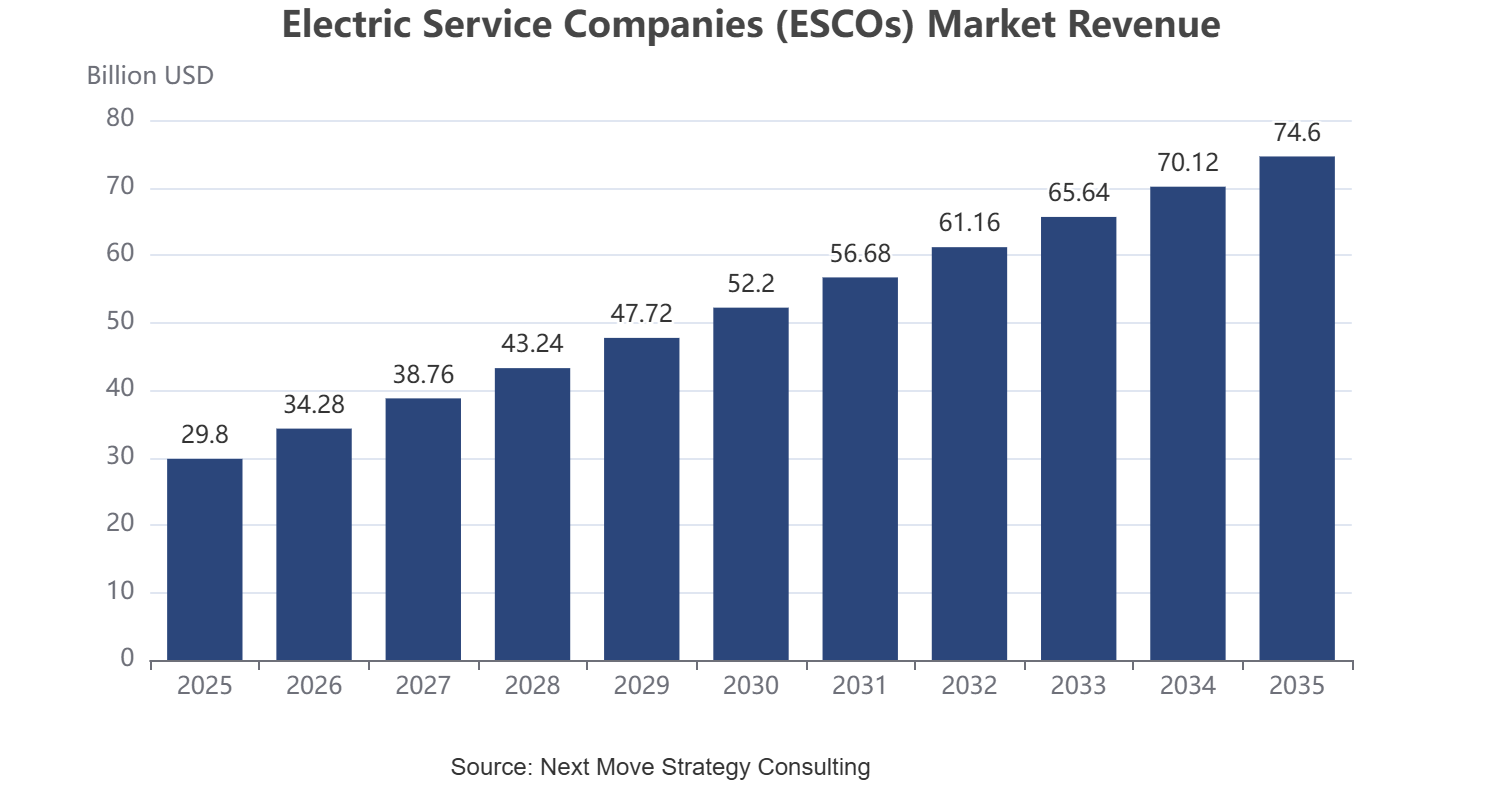
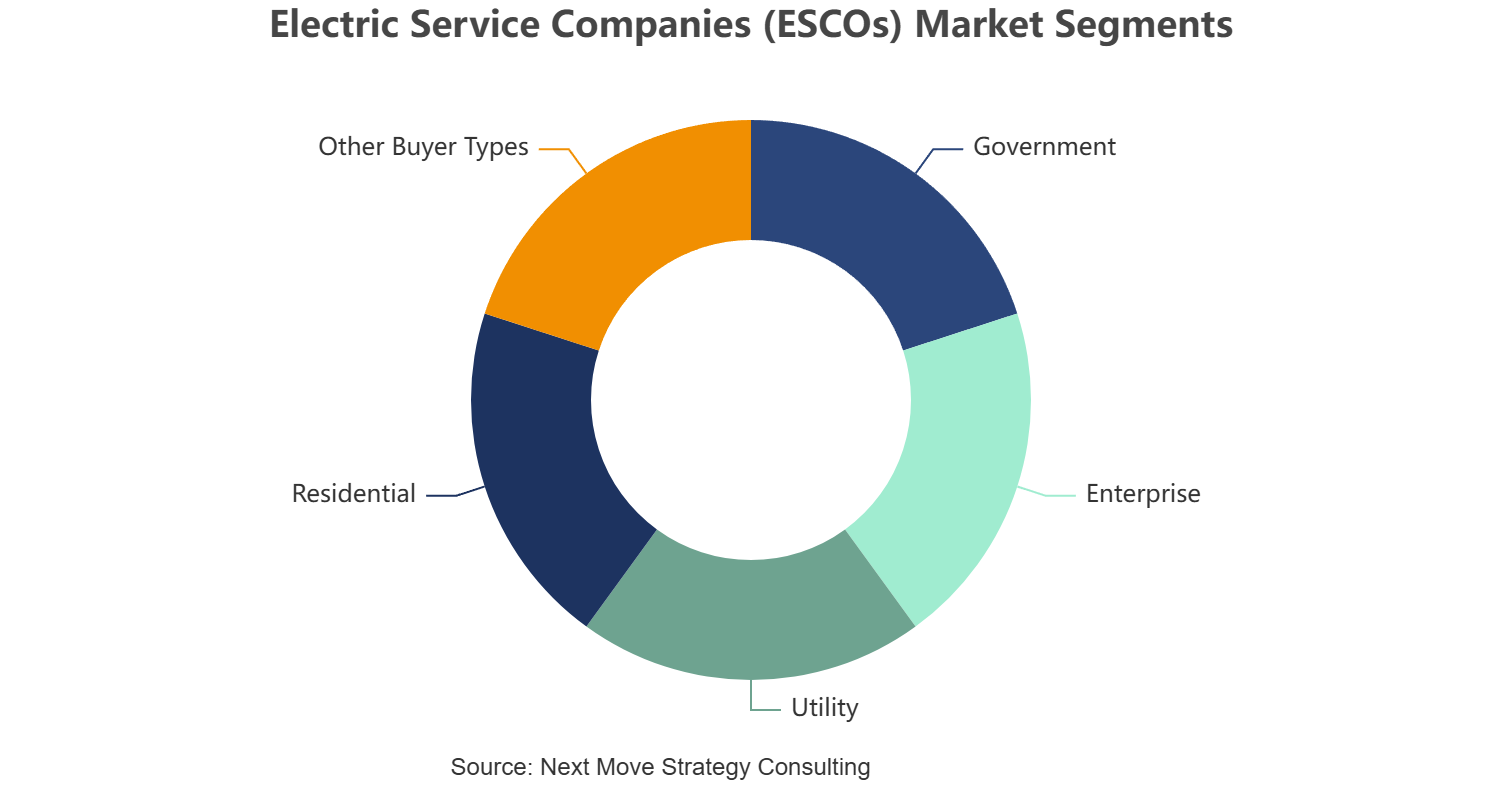
About the Author
 Saista Faiyaz
— Saista Faiyaz is Research Associate at Next Move Strategy Consulting, where she has covered consumer markets and healthcare technologies for 3 years. Her work includes primary interview review, secondary-source validation, market sizing, and structured analysis of company and industry data. She supports research by comparing evidence across sources, organizing findings into market narratives, and documenting assumptions used in analysis. Her scope includes cross-market benchmarking, and reports.
Saista Faiyaz
— Saista Faiyaz is Research Associate at Next Move Strategy Consulting, where she has covered consumer markets and healthcare technologies for 3 years. Her work includes primary interview review, secondary-source validation, market sizing, and structured analysis of company and industry data. She supports research by comparing evidence across sources, organizing findings into market narratives, and documenting assumptions used in analysis. Her scope includes cross-market benchmarking, and reports.
About the Reviewer
 Supradip Baul
— Supradip Baul is an accomplished business consultant and strategist with over a decade of rich experience in market intelligence, strategy, technology, and business transformation. His work has included rigorous qualitative and quantitative analysis across multiple industries, helping clients shape investment decisions and long-term roadmaps. Earlier in his career, he was associated with Gartner, where he contributed to industry-leading reports and market share analyses. He has worked with leading global companies and holds an MBA with a dual specialization in Marketing and Finance.
Supradip Baul
— Supradip Baul is an accomplished business consultant and strategist with over a decade of rich experience in market intelligence, strategy, technology, and business transformation. His work has included rigorous qualitative and quantitative analysis across multiple industries, helping clients shape investment decisions and long-term roadmaps. Earlier in his career, he was associated with Gartner, where he contributed to industry-leading reports and market share analyses. He has worked with leading global companies and holds an MBA with a dual specialization in Marketing and Finance.
At Next Move Strategy Consulting, we understand that insightful market research is the cornerstone of successful business decisions. That's why we employ a robust and multifaceted approach, combining various methodologies to deliver the most accurate and actionable data for our clients.

Research Landscape
We navigate the world of research with two primary approaches:
Qualitative Approach
Our qualitative research methodologies involve immersive techniques such as in-depth interviews, focus groups, and observational studies. By engaging directly with individuals and stakeholders, we uncover valuable insights that quantitative data alone may overlook.

Quantitative Research
In tandem with qualitative methodologies, NMSC leverages the power of Quantitative Research to provide a robust foundation of numerical insights. Through systematic data collection and analysis, we quantify patterns, preferences, and market trends, offering a comprehensive view of the business landscape.
Our quantitative research approach employs diverse tools, including surveys, experiments, and statistical modelling. These methodologies enable us to gather data from a large and representative sample, ensuring the statistical significance of our findings. By employing structured questionnaires and standardized data collection methods, we guarantee the reliability and validity of the information we present to our clients.
Quantitative research is particularly effective in measuring the prevalence of trends, assessing market size, and gauging the impact of various factors on consumer behavior. The numerical precision attained through this approach equips our clients with actionable insights, facilitating data-driven decision-making and strategy formulation.


Our Specialized Toolbox for Industry-Specific Market Research
We deploy a specialized arsenal of techniques tailored to meet your unique requirements. Here's a glimpse into our comprehensive toolbox:

Information Procurement
The stage entails acquiring market data or relevant information through various sources and methodologies.


Market Research Approach
We utilize both top-down and bottom-up approaches in market research analysis to achieve a comprehensive understanding of the market dynamics, leveraging the broad perspective of industry trends and macroeconomic factors alongside detailed insights from specific segments and individual companies.

Porters Five Forces Analysis
We conduct Porter's Five Forces analysis to evaluate the competitive landscape of an industry, providing us with insights into factors that affect profitability and strategic positioning.

SWOT Analysis

Forecasting
We utilize a forecasting model to predict future consumption by considering parameters like population, economics, regulations, market competition, drivers, constraints, technology, and pricing. We also employ statistical techniques such as multilinear regression, exponential smoothing, moving average, ARIMA, and Monte Carlo simulations for accurate predictions. In econometric forecasting, we analyzed short-term and long-term event impacts, attributing values based on regulatory frameworks, economic factors, and market events.





 Speak to Our Analyst