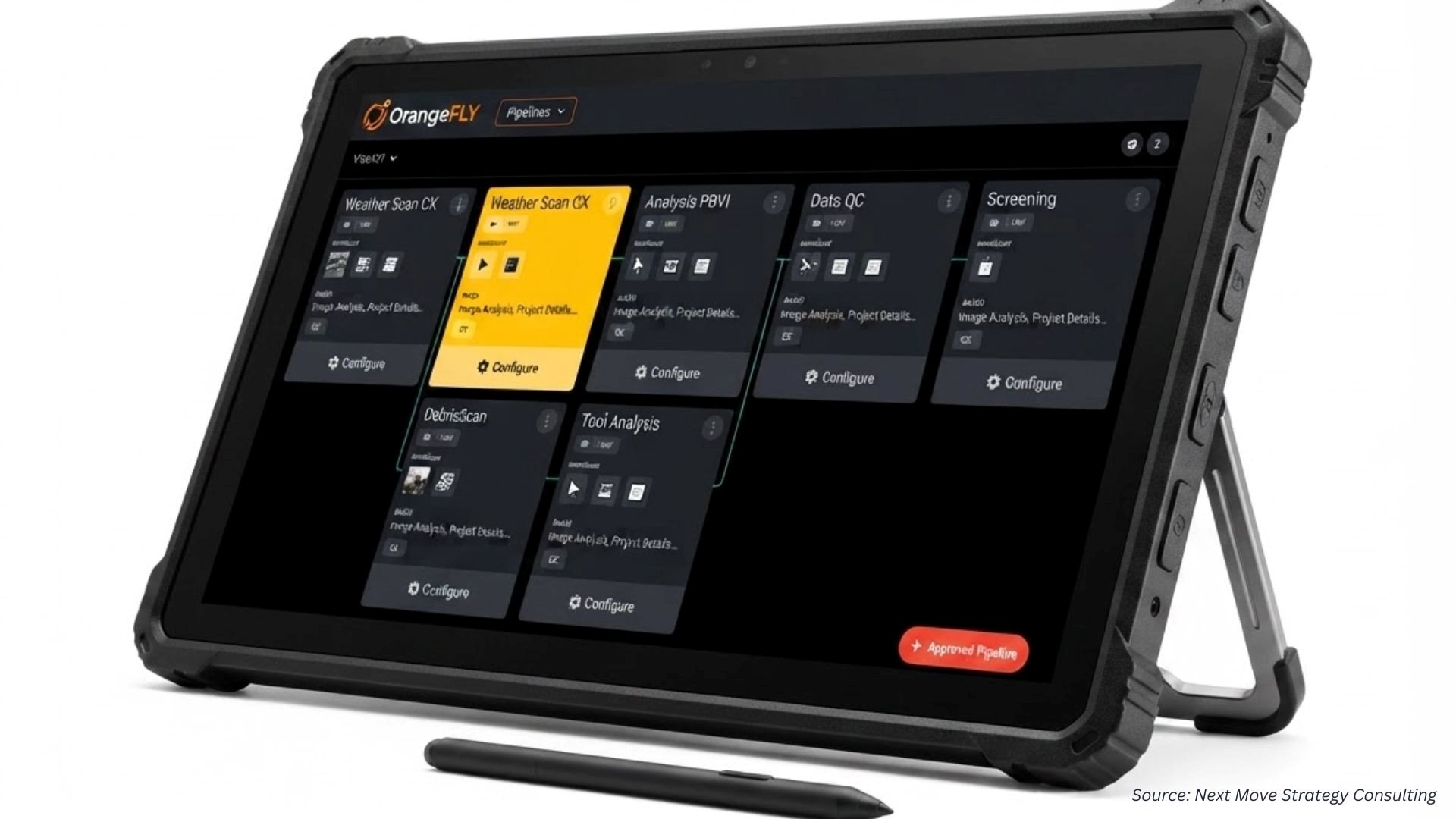
Issue Tracking Software Market Size, Share, Growth & Forecast by Revenue Stream (Software: Standalone Tracker, Integrated DevOps, ITSM, Customer Support, Work Management, Error Monitoring; Services), Deployment (SaaS: Multi-Tenant, Single-Tenant; Self-Hosted: On-Premise, Private Cloud, Hybrid), Commercial Model (Subscription, Perpetual, Open-Source, Consumption, Freemium), Organization Size, Buyer Function, Sales Channel, and End User Industry — Global Analysis 2025–2035
Industry: ICT & Media | Publishing Date: July 6, 2026 | Last Updated: September 30, 2026 | No of Pages: N/A | No. of Tables: N/A | No. of Figures: N/A | Format: PDF | Report Code: IC4963
What Is the Issue Tracking Software Market Size?
The global Issue Tracking Software Market was valued at USD 1.78 billion in 2025 and is projected to reach USD 1.97 billion in 2026. Accelerating cloud-native software development, enterprise digital transformation, and the widespread adoption of Agile and DevOps methodologies are expected to propel the market to USD 5.12 billion by 2035, advancing at a CAGR of 11.2% from 2026 to 2035. Key growth catalysts include the integration of artificial intelligence into issue triage workflows, rising demand for IT service management platforms, expanding remote engineering teams, and the proliferation of open-source issue tracking tools across mid-market and enterprise organizations worldwide.
|
Parameters |
Details |
|
Market Size in 2025 |
USD 1.78 Billion |
|
Market Size in 2026 |
USD 1.97 Billion |
|
Revenue Forecast in 2035 |
USD 5.12 Billion |
|
Growth Rate |
CAGR of 11.2% from 2026 to 2035 |
|
Analysis Period |
2025–2035 |
|
Base Year Considered |
2025 |
|
Forecast Period |
2026–2035 |
|
Market Size Estimation |
Billion USD |
|
Companies Profiled |
20 |
|
Countries Covered |
38 |
|
Market Share |
Top 10 |
Issue Tracking Software Market Overview
What Is the Issue Tracking Software Market?
The Issue Tracking Software Market encompasses software solutions and associated professional services that enable organizations to capture, assign, prioritize, track, and resolve issues, bugs, tasks, incidents, and project work items across engineering, IT operations, quality assurance, customer support, and business operations functions. These platforms range from standalone bug trackers and commercial open-source tools to deeply integrated DevOps platforms, IT service management suites, customer support systems, and collaborative work management environments. The market supports organizations of all sizes, from micro-businesses to large enterprises, across industries including technology, financial services, healthcare, manufacturing, and government.
How Has the Issue Tracking Software Market Evolved?
The Issue Tracking Software Market has progressed through several distinct technological waves. The first phase was defined by standalone, on-premise bug tracking tools designed primarily for software development teams. The second phase introduced web-based and SaaS delivery models, enabling collaborative multi-team access and cross-functional adoption beyond engineering. The third and current phase integrates artificial intelligence, natural language processing, and machine learning capabilities directly within issue tracking workflows, enabling automated issue classification, predictive sprint planning, AI-assisted root cause analysis, and conversational interfaces embedded within developer toolchains and ITSM environments.
How Do Regulations Influence the Issue Tracking Software Market?
Regulatory requirements are increasingly influencing procurement and deployment decisions in the Issue Tracking Software Market. The European Union's General Data Protection Regulation (GDPR) mandates strict data handling and residency controls that affect cloud-based issue tracking deployments for European organizations. In the United States, sector-specific regulations including HIPAA in healthcare and FedRAMP in federal government procurement are shaping which platforms qualify for enterprise adoption. The EU Cyber Resilience Act, introduced in 2024, places new obligations on software vendors regarding vulnerability disclosure and secure software development practices, directly impacting the operational requirements of integrated DevOps and issue management platforms.
How Is Technology Adoption Expanding Across the Issue Tracking Software Market?
Technology adoption across the Issue Tracking Software Market is broadening as organizations modernize software development and IT operations infrastructure. Cloud-native and SaaS deployment models now account for the dominant share of new deployments, driven by subscription economics, zero-infrastructure maintenance requirements, and seamless integration with CI/CD pipelines, version control systems, and observability platforms. Artificial intelligence is the most transformative adoption vector, with leading vendors embedding generative AI features for issue summarization, duplicate detection, smart assignment, and predictive backlog management. Open-source platforms and consumption-based pricing models are further accelerating adoption among SMB and mid-market segments globally.
|
Key Takeaways |
|
By revenue stream, Software Revenue held the dominant share of the Issue Tracking Software Market at USD 1.38 billion in 2025, driven by enterprise adoption of integrated DevOps, ITSM, and work management platforms. Integrated DevOps Platforms are the fastest-growing software product category at a CAGR of 14.3% from 2026 to 2035, fueled by CI/CD adoption, AI-assisted code review, and shift-left testing practices. |
|
Services Revenue is the fastest-growing primary segment within the Issue Tracking Software Market at a CAGR of 11.6% from 2026 to 2035, reaching USD 1.16 billion by 2035, driven by rising demand for implementation, migration, and managed services as enterprises modernize their issue management ecosystems. |
|
By deployment model, SaaS holds the dominant share at USD 1.28 billion in 2025, accounting for 71.9% of total market revenue, supported by subscription pricing flexibility, rapid deployment cycles, and seamless integration with cloud-native development toolchains across enterprise and mid-market organizations. |
|
Self-Hosted deployment is experiencing renewed interest among regulated industries and government buyers at a CAGR of 10.1% from 2026 to 2035, as data sovereignty requirements and compliance mandates in healthcare, financial services, and public sector drive demand for on-premise and private cloud issue tracking configurations. |
|
By commercial model, Subscription Licensing leads at USD 0.89 billion in 2025, representing the most widely adopted model due to predictable cost structures and continuous feature access. Consumption-Based Pricing is the fastest-growing commercial model at a CAGR of 15.9% from 2026 to 2035, as cloud marketplace procurement and AI-enhanced usage patterns drive workload-based spend growth. |
|
Open-Source Commercial Support is the second-fastest-growing commercial model at a CAGR of 13.1% from 2026 to 2035 in the Issue Tracking Software Market, reflecting growing enterprise preference for open-source platforms backed by professional vendor support and managed cloud deployment options. |
|
By organization size, Enterprise organizations account for the dominant segment at USD 0.71 billion in 2025, underpinned by complex multi-project environments, high security requirements, and platform consolidation strategies. Micro Business is the fastest-growing segment at a CAGR of 13.2% from 2026 to 2035, driven by freemium adoption and low-cost SaaS models enabling rapid onboarding for small engineering teams. |
|
By buyer function, Engineering holds the largest buyer share at USD 0.62 billion in 2025, representing the primary adopter base for issue tracking software globally. IT Operations is the second-largest buyer segment, reflecting expanding ITSM platform adoption as incident management, change management, and service desk workflows converge with developer-centric issue tracking ecosystems. |
|
By sales channel, Direct Sales remains the dominant channel at USD 0.71 billion in 2025, supported by enterprise account management and strategic consulting relationships. Cloud Marketplace is the fastest-growing channel at a CAGR of 14.8% from 2026 to 2035, enabling frictionless procurement through AWS Marketplace, Azure Marketplace, and Google Cloud Marketplace within enterprise cloud spending frameworks. |
|
By end user industry, Technology is the largest vertical in the Issue Tracking Software Market at USD 0.54 billion in 2025, accounting for the highest platform adoption density among software companies, SaaS vendors, and digital product organizations globally. |
|
North America holds the largest regional share in the Issue Tracking Software Market at USD 0.72 billion in 2025, projected to reach USD 2.05 billion by 2035 at a CAGR of 11.0%, supported by the highest concentration of enterprise software companies, advanced DevOps ecosystems, and deep cloud marketplace integration. |
|
Asia-Pacific is the fastest-growing region in the Issue Tracking Software Market at a CAGR of 11.6% from 2026 to 2035, driven by rapid digitalization across India, China, and Southeast Asia, expanding technology sector workforces, and growing enterprise adoption of cloud-native development and ITSM platforms. |
|
The United States is the single largest country market in the Issue Tracking Software Market, home to the headquarters of Atlassian (US operations), ServiceNow, Microsoft, Salesforce, Zendesk, and Asana, alongside the world's densest concentration of enterprise software development organizations and digital-native companies. |
|
India is the fastest-growing national market within Asia-Pacific in the Issue Tracking Software Market, driven by the world's second-largest technology workforce, expanding startup ecosystem, government-backed digital transformation programs, and deep enterprise adoption of Jira, Freshdesk, and Zoho-based issue management solutions. |
Key Emerging Trends in the Issue Tracking Software Market
How Is Generative AI Transforming Issue Triage and Resolution in the Issue Tracking Software Market?
Generative AI is fundamentally reshaping issue management workflows across the Issue Tracking Software Market. Atlassian's Jira AI, released in May 2025, embeds large language model capabilities directly within project boards to enable automated issue categorization, sprint planning recommendations, and natural language querying. GitLab Duo extends this capability with AI-assisted root cause analysis and automated merge request summaries within its integrated issue tracker. From our research, we found that AI-native issue triage reduces average resolution time and improves engineering team throughput by automating repetitive classification and assignment tasks across large-scale software development environments.
How Is DevSecOps Integration Reshaping Platform Requirements in the Issue Tracking Software Market?
The convergence of development, security, and operations practices under the DevSecOps framework is redefining platform requirements in the Issue Tracking Software Market. Engineering teams increasingly require issue trackers that natively integrate with security scanning tools, vulnerability management systems, and compliance reporting workflows. GitLab's single-application DevSecOps platform exemplifies this trend by embedding security issue detection, vulnerability tracking, and compliance dashboards within its issue management layer. Based on NMSC's research, we found that enterprises adopting DevSecOps frameworks are prioritizing platforms that unify code, security findings, and operational incidents within a single traceable issue management environment.
What Role Is the Rise of Distributed Engineering Teams Playing in the Issue Tracking Software Market?
The global shift toward distributed and hybrid engineering workforces has become a structural demand driver for cloud-native issue tracking platforms. Remote-first software companies and enterprises with globally distributed development centers require platforms that support asynchronous collaboration, time-zone-aware sprint management, and real-time visibility into cross-team progress. Tools such as Linear and monday.com have gained significant traction among distributed technology organizations by offering streamlined interfaces, fast performance, and deep Slack and GitHub integrations. Through our market assessment, we observed that the normalization of remote work has expanded the total addressable market for cloud-native issue tracking platforms well beyond traditional enterprise software buyers.
How Is the Cloud Marketplace Distribution Model Accelerating Growth in the Issue Tracking Software Market?
Cloud marketplace channels are emerging as a high-velocity distribution mechanism within the Issue Tracking Software Market, enabling vendor-neutral procurement through existing enterprise cloud spending commitments on AWS Marketplace, Azure Marketplace, and Google Cloud Marketplace. This model eliminates traditional procurement bottlenecks by allowing IT and DevOps buyers to activate subscriptions within hours and consolidate vendor costs within pre-negotiated hyperscaler contracts. NMSC's analysis indicates that vendors offering FedRAMP-authorized marketplace listings gain simultaneous access to commercial enterprise and U.S. federal government buyers through a single compliance investment, creating a structurally advantaged distribution position.
Porter's Five Forces Analysis of the Issue Tracking Software Market
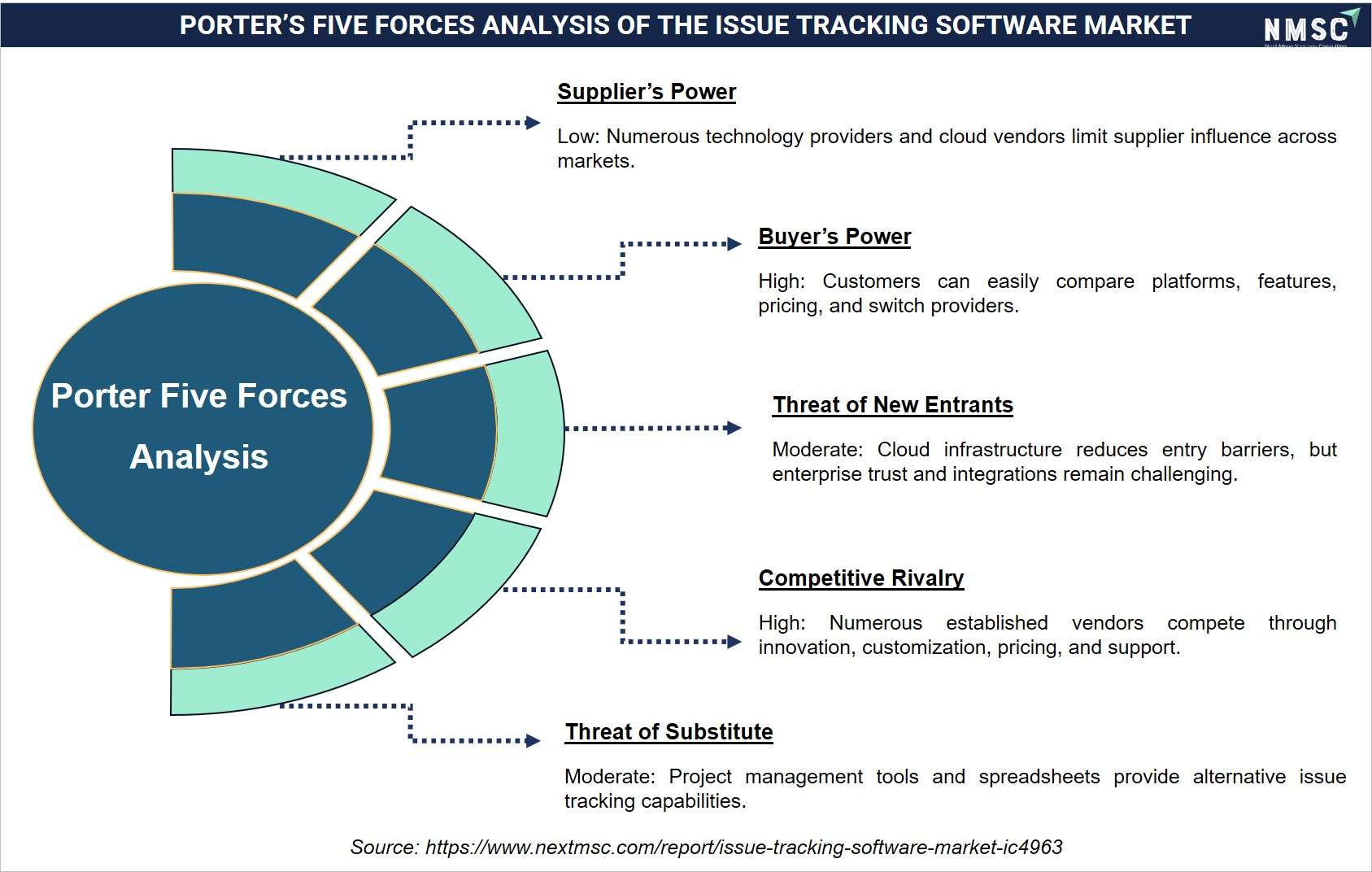
Porter's Five Forces analysis indicates that competitive rivalry remains high due to the presence of established vendors and continuous product innovation. Our analysis suggests that buyer bargaining power is increasing as organizations demand scalable, integrated solutions. Meanwhile, moderate supplier influence, evolving substitute technologies, and entry barriers created by advanced features, ecosystem integration, and customer trust collectively shape long-term market competitiveness.
What Are the Key Market Drivers, Breakthroughs, and Investment Opportunities that Will Shape the Issue Tracking Software Industry in the Next Decade?
|
Drivers / Trends / Restraints |
(+/-) % Impact on CAGR Forecast |
Geographic Relevance |
Impact Timeline |
|
Cloud-Native DevOps Adoption |
+2.1% |
Global (led by North America, APAC) |
2025–2030 |
|
Rising Software Complexity and Agile Adoption |
+1.8% |
North America, Europe, APAC |
2025–2032 |
|
AI-Powered Issue Detection and Resolution |
+1.6% |
Global |
2026–2035 |
|
Surge in Remote and Distributed Engineering Teams |
+1.4% |
North America, Europe, Australia |
2025–2030 |
|
Expansion of IT Operations and ITSM Workflows |
+1.2% |
Global |
2025–2035 |
|
Open-Source Platform Adoption |
+0.9% |
APAC, Europe, Latin America |
2025–2030 |
|
Data Privacy and Compliance Complexity |
-1.1% |
Europe, APAC, North America |
Ongoing |
|
Legacy System Integration Costs |
-0.8% |
SMB, Mid-market globally |
2025–2028 |
|
Vendor Lock-in and Migration Friction |
-0.6% |
All regions |
Ongoing |
|
Cloud Marketplace Distribution Growth |
+1.3% |
North America, Europe |
2025–2032 |
|
Emerging Market Digital Workforce Expansion |
+0.8% |
MEA, Latin America, Southeast Asia |
2026–2035 |
What Are the Growth Drivers of the Issue Tracking Software Market?
How Is the Global Expansion of Cloud-Native DevOps Adoption Driving the Issue Tracking Software Market?
Cloud-native DevOps adoption is the most powerful structural driver of the Issue Tracking Software Market. Organizations transitioning to continuous integration and continuous delivery (CI/CD) pipelines require integrated issue tracking systems that connect code commits, automated test results, and deployment events to individual work items in real time. The Linux Foundation's 2024 Open Source Software report documents broad enterprise adoption of open-source DevOps toolchains, which directly increases demand for interoperable and API-accessible issue tracking platforms. From our analysis, we found that DevOps-mature organizations maintain significantly higher issue tracking platform utilization rates, driving deeper per-seat engagement and accelerated upsell to premium AI-enhanced tiers.
How Is the Proliferation of Agile Methodologies Across Industries Fueling Issue Tracking Software Market Growth?
The adoption of Agile project management methodologies has expanded from its software development origins into financial services, healthcare, manufacturing, and government sectors, creating a broadening buyer base for issue tracking platforms. The Agile Alliance and Project Management Institute both document sustained growth in enterprise Agile practice adoption as organizations seek faster delivery cycles, iterative feedback integration, and cross-functional team coordination. NMSC's analysis indicates that organizations operating under Scaled Agile Framework (SAFe) and Large-Scale Scrum (LeSS) require enterprise-grade issue tracking platforms with portfolio-level visibility, dependency mapping, and capacity planning features, expanding average contract values within the Issue Tracking Software Market.
How Is the Growing Integration of Artificial Intelligence in Workflow Automation Driving Adoption in the Issue Tracking Software Market?
Artificial intelligence capabilities embedded within issue tracking platforms are accelerating enterprise platform consolidation and expansion, driving revenue growth in the Issue Tracking Software Market. AI-powered features including automated issue duplicate detection, smart assignment based on historical workload patterns, predictive cycle time estimation, and natural language issue creation are reducing manual overhead for engineering and IT operations teams. The U.S. National Institute of Standards and Technology (NIST) AI Risk Management Framework, published in 2023 and updated in 2024, establishes governance expectations for AI-assisted workflows, which are influencing enterprise procurement criteria for AI-integrated issue tracking tools, particularly within regulated industries.
What Are the Growth Inhibitors of the Issue Tracking Software Market?
How Does the Complexity of Cross-Platform Integration Constrain Adoption in the Issue Tracking Software Market?
The fragmentation of enterprise software development toolchains represents a significant adoption barrier in the Issue Tracking Software Market. Organizations operating heterogeneous environments with multiple version control systems, CI/CD pipelines, monitoring platforms, and communication tools face substantial integration complexity when deploying or migrating issue tracking solutions. The U.S. Government Accountability Office (GAO) has documented analogous integration challenges in federal digital modernization programs, noting that data siloing and tool fragmentation are primary cost drivers for enterprise IT transformations. These integration challenges extend implementation timelines, increase total cost of ownership, and slow platform consolidation decisions among mid-market and enterprise buyers.
How Does Vendor Lock-in and Migration Friction Limit Competitive Switching in the Issue Tracking Software Market?
Vendor lock-in remains a persistent structural constraint on competitive dynamics within the Issue Tracking Software Market. Organizations that have built extensive custom workflows, automation scripts, and third-party integrations around platforms such as Jira or ServiceNow face substantial migration costs in terms of configuration redesign, data migration, user retraining, and productivity disruption. NMSC's assessment indicates that high switching costs reduce competitive responsiveness and suppress market pricing competition, particularly at the enterprise segment where deep workflow customization and organizational change management requirements make platform transitions multi-year, multi-million-dollar programs.
What Are the Growth Opportunities in the Issue Tracking Software Market?
How Does the Expansion of IT Service Management Across Enterprise Functions Create Structural Opportunity in the Issue Tracking Software Market?
The convergence of software development issue tracking with IT service management (ITSM) workflows is creating a structural revenue expansion opportunity within the Issue Tracking Software Market. Organizations are consolidating incident management, change management, service request, and problem management workflows within unified platforms that share underlying data models with developer-facing issue trackers. The IT Infrastructure Library (ITIL) v4 framework, maintained by Axelos, provides the process architecture that enterprises use to govern ITSM platform deployments, and its adoption is accelerating as organizations pursue digital service excellence. Our findings suggest that platforms capable of bridging developer-centric and ITSM-centric workflows are winning enterprise consolidation deals worth three to five times the value of single-function issue tracker contracts.
How Does the Rise of AI-Native Startups and Open-Source Ecosystems Create Disruption Opportunities in the Issue Tracking Software Market?
The emergence of AI-native issue tracking startups, exemplified by Linear's AI-powered project intelligence and Nulab's Backlog platform, is creating a new competitive tier within the Issue Tracking Software Market that challenges incumbent platform pricing and user experience paradigms. Open-source platforms such as GitLab (open-core) and community editions of issue trackers enable organizations to deploy capable solutions with zero licensing cost, generating commercial support and managed service revenue streams for vendors. The Apache Software Foundation's open-source governance model provides a reference framework for enterprise confidence in community-maintained software, supporting open-source issue management adoption among cost-sensitive technology and startup buyers globally.
How Is the Expanding Digital Workforce in Emerging Markets Presenting Growth Opportunities in the Issue Tracking Software Market?
Rapid technology sector expansion across India, Southeast Asia, Latin America, and Africa is generating a structurally growing buyer base for entry-level and mid-tier issue tracking platforms. India's Ministry of Electronics and Information Technology (MeitY) documents sustained growth in the domestic IT and software services sector, with the industry supporting over five million direct technology professionals. This expanding workforce generates organic demand for engineering-grade issue tracking tools as startups, digital agencies, and captive development centers of multinational organizations scale their software delivery capabilities. Our assessment indicates that freemium and self-service web models are the most effective acquisition channels in emerging markets, where procurement formality is lower and individual developer adoption drives bottom-up platform growth.
How Is the Issue Tracking Software Market Segmented in This Report, and What Are the Key Insights from the Segmentation Analysis?
How Does Revenue Stream Segmentation Reveal the Commercial Architecture of the Issue Tracking Software Market?
|
Revenue Stream Segment |
2025 (USD Bn) |
2035 (USD Bn) |
CAGR (%) |
|
Software Revenue |
1.38 |
3.96 |
11.2% |
|
Services Revenue |
0.40 |
1.16 |
11.6% |
|
Total |
1.78 |
5.12 |
11.2% |
NMSC's analysis indicates that the Issue Tracking Software Market is bifurcated into Software Revenue and Services Revenue streams, with Software Revenue maintaining the dominant position at USD 1.38 billion in 2025. Within Software Revenue, Integrated DevOps Platforms represent the fastest-growing product category due to the increasing enterprise preference for unified toolchains that consolidate source control, CI/CD, security scanning, and issue tracking within a single platform. Integrated ITSM platforms are the second-strongest growth segment, driven by enterprise IT consolidation. Standalone Issue Trackers retain relevance among smaller organizations and specialized teams seeking purpose-built, lightweight tools. Services Revenue is growing at a premium rate as implementation, migration, and managed services expand alongside enterprise platform complexity.
How Does Deployment Model Segmentation Reflect Enterprise Platform Preferences in the Issue Tracking Software Market?
|
Deployment Model Segment |
2025 (USD Bn) |
2035 (USD Bn) |
CAGR (%) |
|
SaaS |
1.28 |
3.82 |
12.9% |
|
Multi-Tenant SaaS |
0.98 |
2.87 |
12.7% |
|
Single-Tenant SaaS |
0.30 |
0.95 |
13.6% |
|
Self-Hosted |
0.50 |
1.30 |
11.2% |
|
On-Premise |
0.22 |
0.52 |
10.1% |
|
Private Cloud |
0.18 |
0.48 |
10.3% |
|
Hybrid Deployment |
0.10 |
0.30 |
13.0% |
|
Total |
1.78 |
5.12 |
11.2% |
Based on our market evaluation, we observed that SaaS deployment dominates the Issue Tracking Software Market at USD 1.28 billion in 2025, representing 71.9% of total market revenue. Multi-Tenant SaaS is the primary deployment choice for the majority of commercial organizations due to its lower operational overhead, automatic updates, and rapid provisioning capabilities. Single-Tenant SaaS adoption is expanding among enterprise and regulated industry buyers requiring data isolation without full on-premise management complexity. Self-Hosted deployments retain a meaningful share driven by government, defense, and highly regulated financial services organizations with strict data residency requirements. Hybrid Deployment is the fastest-growing self-hosted sub-segment as organizations balance compliance controls with cloud-native scalability benefits.
How Do Commercial Model Preferences Reflect the Pricing Evolution Within the Issue Tracking Software Market?
|
Commercial Model Segment |
2025 (USD Bn) |
2035 (USD Bn) |
CAGR (%) |
|
Subscription License |
0.89 |
2.66 |
12.9% |
|
Perpetual License |
0.28 |
0.51 |
6.9% |
|
Open-Source Commercial Support |
0.24 |
0.72 |
13.1% |
|
Consumption-Based Pricing |
0.19 |
0.72 |
15.9% |
|
Freemium |
0.18 |
0.51 |
12.3% |
|
Total |
1.78 |
5.12 |
11.2% |
From our assessment, we observed that Subscription Licensing dominates the Issue Tracking Software Market commercial model landscape at USD 0.89 billion in 2025, reflecting enterprise preference for predictable annual or monthly costs alongside continuous feature access and vendor support. Consumption-Based Pricing is the fastest-growing commercial model at a CAGR of 15.9%, driven by AI-assisted feature usage patterns and cloud marketplace procurement dynamics where organizations pay for actual platform utilization rather than seat counts. Open-Source Commercial Support is expanding rapidly as enterprises adopt open-core platforms and require professional support, managed hosting, and compliance certifications. Perpetual Licensing is declining as cloud economics and continuous update requirements reduce its attractiveness relative to subscription alternatives.
How Does Organization Size Influence Platform Adoption and Spending in the Issue Tracking Software Market?
|
Organization Size Segment |
2025 (USD Bn) |
2035 (USD Bn) |
CAGR (%) |
|
Enterprise |
0.71 |
2.05 |
12.5% |
|
Mid-Market |
0.49 |
1.38 |
12.2% |
|
Small Business |
0.36 |
1.02 |
12.3% |
|
Micro Business |
0.22 |
0.67 |
13.2% |
|
Total |
1.78 |
5.12 |
11.2% |
Our analysis shows that Enterprise organizations account for the largest share of the Issue Tracking Software Market at USD 0.71 billion in 2025, driven by complex multi-team environments, cross-functional workflow requirements, high security standards, and strong platform consolidation motivations. Mid-Market organizations represent the second-largest segment, with adoption accelerating as cloud-native platforms reduce the implementation complexity historically associated with enterprise-grade issue tracking tools. Small Business and Micro Business segments are growing at premium CAGR rates as freemium and self-service web models remove onboarding friction. Micro Business is the fastest-growing segment, reflecting the global expansion of engineering teams at early-stage technology companies and digital agencies adopting low-cost SaaS issue tracking tools.
Which Buyer Functions Are Generating the Highest Demand in the Issue Tracking Software Market?
|
Buyer Function Segment |
2025 (USD Bn) |
2035 (USD Bn) |
CAGR (%) |
|
Engineering |
0.62 |
1.79 |
12.5% |
|
IT Operations |
0.36 |
1.02 |
12.3% |
|
Quality Assurance |
0.28 |
0.82 |
12.7% |
|
Customer Support |
0.27 |
0.77 |
12.4% |
|
Business Operations |
0.25 |
0.72 |
12.5% |
|
Total |
1.78 |
5.12 |
11.2% |
Through NMSC's assessment, we found that Engineering is the dominant buyer function in the Issue Tracking Software Market at USD 0.62 billion in 2025, as software developers and engineering managers represent the primary users and decision influencers for issue tracking platforms globally. IT Operations is the second-largest buyer function, driven by expanding ITSM platform adoption for incident, change, and problem management workflows. Quality Assurance teams generate strong demand for integrated test case management and defect tracking capabilities embedded within issue tracking environments. Customer Support and Business Operations buyer segments are growing rapidly as platforms such as Zendesk, Freshdesk, and monday.com extend issue tracking capabilities beyond engineering into cross-functional enterprise workflows.
How Are Sales Channels Evolving to Reflect Go-to-Market Shifts in the Issue Tracking Software Market?
|
Sales Channel Segment |
2025 (USD Bn) |
2035 (USD Bn) |
CAGR (%) |
|
Direct Sales |
0.71 |
1.94 |
11.8% |
|
Self-Service Web |
0.48 |
1.49 |
13.4% |
|
Cloud Marketplace |
0.31 |
1.07 |
14.8% |
|
Channel Partner |
0.28 |
0.62 |
9.2% |
|
Total |
1.78 |
5.12 |
11.2% |
Based on our research, we found that Direct Sales remains the dominant channel for the Issue Tracking Software Market at USD 0.71 billion in 2025, supported by enterprise account management structures, strategic consulting relationships, and complex multi-year contract negotiations. Self-Service Web is the fastest-growing traditional channel as freemium and trial-to-paid conversion models expand market reach efficiently among small business and mid-market buyers. Cloud Marketplace is the fastest-growing overall channel at a CAGR of 14.8%, reflecting the growing preference for cloud-committed spend consolidation among enterprise buyers on AWS, Azure, and Google Cloud. Channel Partner revenue growth is comparatively moderate as direct and digital channels capture a larger share of new business activity in the software delivery era.
Which Industry Verticals Are Generating the Most Demand Within the Issue Tracking Software Market?
|
End User Industry Segment |
2025 (USD Bn) |
2035 (USD Bn) |
CAGR (%) |
|
Technology |
0.54 |
1.54 |
12.3% |
|
Financial Services |
0.25 |
0.72 |
12.5% |
|
Healthcare |
0.21 |
0.62 |
12.8% |
|
Manufacturing |
0.18 |
0.51 |
12.2% |
|
Retail and E-commerce |
0.16 |
0.46 |
12.5% |
|
Telecommunications |
0.13 |
0.36 |
12.0% |
|
Government and Public Sector |
0.12 |
0.31 |
11.1% |
|
Professional Services |
0.09 |
0.26 |
12.5% |
|
Education |
0.04 |
0.10 |
10.7% |
|
Transportation and Logistics |
0.03 |
0.10 |
14.4% |
|
Energy and Utilities |
0.02 |
0.10 |
19.6% |
|
Other Industries |
0.01 |
0.04 |
16.6% |
|
Total |
1.78 |
5.12 |
11.2% |
Our analysis shows that the Technology vertical dominates the Issue Tracking Software Market at USD 0.54 billion in 2025, reflecting the highest platform adoption intensity among software companies, SaaS vendors, cloud service providers, and digital product organizations. Financial Services is the second-largest vertical, driven by regulatory compliance requirements, complex software development environments, and the need for auditable change management workflows. Healthcare is the fastest-growing traditional vertical as digital health platforms, electronic health record vendors, and medical device software teams adopt issue tracking tools with HIPAA-compliant hosting options. Energy and Utilities is the fastest-growing segment overall at a CAGR of 19.6%, driven by digital grid modernization, operational technology integration, and software-defined infrastructure adoption programs.
Regional Outlook
Geographic Performance Snapshot
|
Region |
2025 (USD Bn) |
2035 (USD Bn) |
CAGR (%) |
Key Driver |
|
North America |
0.72 |
2.05 |
11.0% |
Enterprise DevOps adoption, cloud marketplace growth |
|
Europe |
0.44 |
1.24 |
10.9% |
GDPR compliance tooling, ITSM platform consolidation |
|
Asia-Pacific |
0.39 |
1.17 |
11.6% |
Technology workforce expansion, digital transformation |
|
Middle East & Africa |
0.12 |
0.38 |
12.2% |
Vision 2030 digitalization, cloud infrastructure build-out |
|
Latin America |
0.11 |
0.28 |
10.9% |
Nearshoring wave, startup ecosystem growth |
North America Issue Tracking Software Market
North America is the largest regional market for Issue Tracking Software at USD 0.72 billion in 2025, projected to reach USD 2.05 billion by 2035 at a CAGR of 11.0%. The region benefits from the highest global concentration of enterprise software development organizations, advanced DevOps ecosystem maturity, and the headquarters presence of Atlassian US operations, ServiceNow, Microsoft, Salesforce, Zendesk, Asana, and Wrike. Strong enterprise technology budgets, mature cloud adoption, and deep CI/CD pipeline integration drive sustained market leadership. U.S. federal procurement programs, including FedRAMP, are creating structured demand for compliant cloud-based issue tracking platforms across government agencies.
U.S. Issue Tracking Software Market
Based on our engagements, the United States is the world's single largest national market for Issue Tracking Software, representing approximately 86% of North American market revenue in 2025. The U.S. benefits from the highest concentration of Fortune 500 enterprise technology buyers, a mature venture capital ecosystem supporting DevOps startups, and the presence of leading platform vendors across all price tiers. The National Institute of Standards and Technology (NIST) Secure Software Development Framework (SSDF) mandates traceable development workflows for federal software suppliers, driving structural demand for auditable issue tracking systems. Industry adoption spans all major verticals, with technology, financial services, and healthcare representing the three largest buyer segments.
Canada Issue Tracking Software Market
Through our analysis, Canada represents approximately 10% of North American Issue Tracking Software Market revenue. Canadian financial institutions, insurance firms, and government agencies are among the most sophisticated enterprise issue tracking buyers in the region, investing in platforms with strong ITSM and DevOps integration capabilities. The Government of Canada's Digital Ambition strategy and cloud adoption policy are accelerating public sector platform modernization. Canadian data sovereignty considerations regarding cross-border data flows to U.S. hyperscalers are supporting adoption of Canadian cloud region offerings on AWS, Azure, and Google Cloud with data residency guarantees relevant for regulated industry deployments.
Mexico Issue Tracking Software Market
From our assessment, Mexico is the fastest-growing market within North America in the Issue Tracking Software sector, driven by the expansion of nearshoring technology centers from North America and Asia that have established software development operations in Mexican cities including Guadalajara, Monterrey, and Mexico City. The government's national digital transformation strategy and growing fintech ecosystem are generating demand for structured issue tracking and ITSM platforms. Regulatory developments under Mexico's Ley Federal de Protección de Datos Personales are compelling enterprise buyers to prioritize platforms with configurable data residency and access control capabilities relevant to Mexican compliance requirements.
Europe Issue Tracking Software Market
Europe is the second-largest region in the Issue Tracking Software Market at USD 0.44 billion in 2025, projected to reach USD 1.24 billion by 2035 at a CAGR of 10.9%. Europe's regulatory environment, shaped by GDPR, the EU Cyber Resilience Act, and the NIS2 Directive for cybersecurity, is a key structural demand driver for compliant, auditable issue tracking platforms. Sovereign cloud investment, enterprise ITSM platform consolidation, and public sector digital transformation programs are reinforcing regional market stability. UK, Germany, and France represent the three largest individual country markets within Europe.
U.K. Issue Tracking Software Market
According to our evaluation, the United Kingdom is Europe's largest individual country market for Issue Tracking Software, representing approximately 25% of European revenue in 2025. Post-Brexit, the UK maintains data protection standards through UK GDPR while pursuing regulatory flexibility that has attracted fintech and digital services investments. The Financial Conduct Authority and UK Government Digital Service both emphasize traceable and auditable software development practices, reinforcing enterprise demand for structured issue tracking environments. London's technology sector density and the broader UK startup ecosystem support high platform adoption across engineering-led organizations of all sizes.
Germany Issue Tracking Software Market
Based on our market evaluation, Germany is the second-largest European country market for Issue Tracking Software, accounting for approximately 21% of European revenue in 2025. German manufacturing enterprises, automotive technology divisions, and financial services organizations represent primary demand drivers for enterprise-grade ITSM and DevOps-integrated issue tracking platforms. The German Federal Office for Information Security (BSI) Grundschutz compliance framework mandates structured software change management practices, supporting platform adoption among regulated enterprise buyers. Industry 4.0 digitalization programs are also driving demand for issue tracking integration within operational technology and industrial software development environments.
France Issue Tracking Software Market
Through our analysis, France represents approximately 15% of European Issue Tracking Software Market revenue in 2025. French technology companies, government agencies operating under DINUM digital strategy guidelines, and industrial enterprises pursuing digital transformation are the primary demand sources. The French national cybersecurity agency (ANSSI) SecNumCloud certification framework influences cloud platform procurement among sensitive government and defense-adjacent buyers, supporting adoption of compliant SaaS and sovereign cloud issue tracking configurations. France's growing startup ecosystem within Station F and other innovation hubs also contributes to platform adoption among engineering-led digital ventures.
Italy Issue Tracking Software Market
From our assessment, Italy's Issue Tracking Software Market is driven by manufacturing technology, financial services digitalization, and public sector IT modernization programs under Italy's National Recovery and Resilience Plan (NRRP), which allocates significant digital transformation investments. Italian enterprises are adopting integrated ITSM and issue tracking platforms as part of broader digital infrastructure modernization. SMB adoption is expanding through cloud-based subscription platforms that reduce implementation barriers for mid-sized technology and professional services organizations across Northern Italian industrial districts.
Spain Issue Tracking Software Market
According to our evaluation, Spain's Issue Tracking Software Market is supported by a growing technology startup ecosystem in Barcelona and Madrid, expanding financial services digitalization, and telecommunications sector software development investments. The Spanish government's Digital Spain 2026 strategy is driving public sector IT platform modernization, creating demand for structured issue management and ITSM tools among government digital service organizations. Enterprise and mid-market adoption of cloud-native issue tracking platforms is increasing as Spanish organizations align software development practices with EU Cyber Resilience Act requirements.
Sweden Issue Tracking Software Market
Based on our engagements, Sweden is one of Europe's most digitally advanced markets for Issue Tracking Software, supported by a high-density technology sector including Spotify, Klarna, and a mature startup ecosystem in Stockholm. Swedish enterprises maintain high DevOps maturity, driving demand for integrated platform solutions that connect source control, CI/CD, and issue tracking within unified toolchains. The Swedish public sector digital strategy emphasizes open-standard and interoperable software infrastructure, supporting adoption of open-source and cloud-native issue tracking platforms among government agencies and public health organizations.
Denmark Issue Tracking Software Market
Through our analysis, Denmark's Issue Tracking Software Market is characterized by a digitally mature enterprise environment with strong adoption among financial services, pharmaceutical, and technology organizations. The Danish government's digital strategy and Digitaliseringsstyrelsen guidelines promote structured software lifecycle management practices that align with enterprise issue tracking platform capabilities. Denmark's high per-capita technology sector density and strong agile software development culture support above-average issue tracking platform adoption rates relative to regional peers.
Finland Issue Tracking Software Market
From our assessment, Finland's Issue Tracking Software Market benefits from a strong legacy of technology sector development, gaming industry software engineering, and telecommunications technology leadership. Nokia's enterprise engineering ecosystem and the broader Helsinki startup corridor contribute to structured issue tracking platform demand. Finnish public sector organizations are adopting cloud-native ITSM and issue tracking tools aligned with national digital strategy programs, while the gaming industry's unique software development workflows drive adoption of specialized project and task tracking configurations within integrated DevOps environments.
Netherlands Issue Tracking Software Market
According to our evaluation, the Netherlands represents a structurally significant market for Issue Tracking Software due to its position as a European cloud infrastructure hub, with major hyperscaler data centers hosted within the Amsterdam metropolitan region. Dutch financial services organizations, including ING and ABN AMRO, alongside logistics and e-commerce companies such as Booking.com and Bol.com, drive enterprise issue tracking platform demand. The Netherlands' advanced digital economy and high enterprise cloud adoption rate support robust multi-year platform subscription growth within the Issue Tracking Software Market.
Rest of Europe Issue Tracking Software Market
Based on our market evaluation, the Rest of Europe segment encompasses emerging and developing technology markets including Poland, Czech Republic, Romania, Austria, Portugal, Belgium, and Switzerland. Poland's rapidly expanding IT outsourcing sector and growing startup ecosystem are generating significant issue tracking platform demand, while Switzerland's financial services and pharmaceutical sectors drive adoption of enterprise-grade, compliance-oriented ITSM platforms. Central and Eastern European technology hubs are experiencing accelerating digital transformation, creating expanding mid-market demand for affordable SaaS issue tracking solutions.
Asia-Pacific Issue Tracking Software Market
Asia-Pacific is the fastest-growing region in the Issue Tracking Software Market at USD 0.39 billion in 2025, projected to reach USD 1.17 billion by 2035 at a CAGR of 11.6%. The region's technology workforce expansion, rapid enterprise digitalization, government-backed digital transformation programs, and growing startup ecosystems across India, China, Southeast Asia, and Australia are the primary demand drivers. Adoption of cloud-native development practices, Agile methodologies, and ITSM platforms is accelerating across APAC enterprise and mid-market organizations, supported by increasing availability of regional cloud infrastructure from AWS, Azure, and Google Cloud.
China Issue Tracking Software Market
Based on our engagements, China represents the largest country market within Asia-Pacific for Issue Tracking Software, driven by the world's largest technology sector workforce and a deep enterprise software development ecosystem across Beijing, Shanghai, Shenzhen, and Hangzhou. Domestic vendors including Alibaba's DevOps platform, Tencent Cloud, and CODING DevOps compete alongside international platforms. The Chinese government's digital economy strategy and Made in China 2025 industrial digitalization program are driving enterprise demand for structured issue management tools within manufacturing and industrial software development environments. Data localization requirements shape deployment preferences strongly toward domestic cloud and private cloud configurations.
India Issue Tracking Software Market
Through our analysis, India is the fastest-growing national market within Asia-Pacific in the Issue Tracking Software Market, supported by the world's second-largest technology workforce, a rapidly expanding startup ecosystem, and deep enterprise adoption of Jira, Freshdesk, and Zoho-based issue management solutions. India's Ministry of Electronics and Information Technology (MeitY) documents sustained growth in domestic IT services exports, which drives issue tracking platform adoption across India's large and globally integrated software services sector. Freshworks, headquartered in Chennai, represents India's most significant domestic contribution to global issue tracking platform competition. Affordable SaaS subscription pricing and strong self-service web adoption characterize the Indian market growth model.
Japan Issue Tracking Software Market
From our assessment, Japan represents a mature but steadily growing market for Issue Tracking Software, supported by significant enterprise technology investment across manufacturing, automotive, and financial services sectors. Japanese organizations are increasingly adopting Agile methodologies, supported by government digital transformation programs including the Digital Agency's (デジタル庁) technology modernization initiatives. Enterprise demand for ITSM-integrated issue tracking platforms is particularly strong among Japan's large enterprise conglomerates modernizing legacy IT infrastructure. Cultural preference for structured documentation and process traceability aligns well with the audit trail and workflow governance capabilities offered by enterprise issue tracking platforms.
South Korea Issue Tracking Software Market
According to our evaluation, South Korea's Issue Tracking Software Market is driven by a highly sophisticated technology sector including Samsung, LG, SK Telecom, and Kakao, alongside a vibrant gaming and fintech startup ecosystem. South Korean enterprises maintain high DevOps maturity and are active adopters of integrated issue tracking and CI/CD platforms. The Korean Ministry of Science and ICT's digital innovation programs are accelerating cloud adoption across both public sector and enterprise organizations. Atlassian, ServiceNow, and GitHub are among the most commonly deployed platforms within Korean enterprise engineering and IT operations environments.
Taiwan Issue Tracking Software Market
Based on our market evaluation, Taiwan's Issue Tracking Software Market is shaped by its position as the world's leading semiconductor and hardware manufacturing hub, with TSMC, MediaTek, and Foxconn representing significant enterprise demand sources for structured engineering issue management platforms. Hardware and embedded systems development workflows require specialized bug tracking and issue management capabilities. Cloud adoption is increasing among Taiwanese technology enterprises, with SaaS platforms gaining traction among software and services organizations within the island's growing startup ecosystem and digital services sector.
Indonesia Issue Tracking Software Market
From our assessment, Indonesia is the fastest-growing Southeast Asian market for Issue Tracking Software, driven by one of the world's largest digital economy growth trajectories, a rapidly expanding startup ecosystem including Gojek, Tokopedia, and Traveloka, and accelerating enterprise digital transformation across banking and retail sectors. The Indonesian government's digital transformation strategy, supported by the Ministry of Communication and Information Technology, is driving public sector cloud platform adoption. Cloud-native SaaS issue tracking platforms with freemium and low-cost subscription models are the primary growth vector in Indonesia's price-sensitive mid-market and startup segments.
Vietnam Issue Tracking Software Market
Through our analysis, Vietnam's Issue Tracking Software Market benefits from the country's emergence as a major technology outsourcing destination, with FPT Software, VNG, and a rapidly growing startup ecosystem driving demand for engineering-grade issue tracking tools. Vietnam's government digital economy strategy targets 20% digital economy contribution to GDP by 2025, supporting software sector growth. Low-cost and freemium SaaS platforms are primary adoption vehicles, with Jira, Trello, and GitHub Issues representing the most widely deployed issue tracking tools across Vietnamese software development organizations.
Australia Issue Tracking Software Market
Based on our engagements, Australia is the most mature Issue Tracking Software market within Southeast Asia and Oceania, supported by Atlassian's headquarters in Sydney, a sophisticated enterprise technology buying environment, and advanced DevOps adoption across financial services, government, and technology sectors. The Australian Government's Digital Transformation Agency emphasizes modern software delivery practices for public sector digital services, supporting structured issue tracking platform adoption. Australia's financial services regulatory environment, overseen by APRA and ASIC, drives demand for auditable and compliant ITSM platforms among banking and insurance enterprises.
Philippines Issue Tracking Software Industry
According to our evaluation, the Philippines' Issue Tracking Software Market is driven by the country's large and globally integrated IT-BPM (information technology and business process management) sector, which employs over 1.5 million professionals. Manila, Cebu, and Clark host major software development operations for international organizations, generating structured demand for cloud-based issue tracking and project management platforms. The Philippine government's digital transformation roadmap and startup ecosystem in QC's Diliman Science and Technology Park are contributing to domestic enterprise platform adoption. SaaS and freemium models are the dominant acquisition channels in the Philippine market.
Malaysia Issue Tracking Software Industry
From our assessment, Malaysia's Issue Tracking Software Market is supported by the country's Multimedia Super Corridor (MSC) technology development zone, a growing fintech and e-commerce sector, and government digitalization programs under Malaysia Digital and MyDIGITAL. Malaysian enterprises are adopting cloud-native issue tracking platforms alongside broader digital infrastructure modernization. The presence of major multinational technology operations and shared services centers in Kuala Lumpur and Penang generates structured demand for enterprise-grade issue management tools with ITSM integration capabilities across engineering and IT operations buyer functions.
Rest of APAC Issue Tracking Software Industry
Based on our market evaluation, the Rest of APAC segment encompasses New Zealand, Thailand, Singapore, Bangladesh, Pakistan, Sri Lanka, and other emerging technology markets. Singapore's position as a regional fintech and enterprise technology hub drives sophisticated issue tracking platform demand among financial services and government digital service organizations. Thailand's growing software development sector and New Zealand's strong cloud adoption environment are contributing to market expansion. Across the broader APAC tail, freemium and low-cost SaaS models are the primary growth vectors as digital workforce expansion continues.
Middle East & Africa Issue Tracking Software Industry
The Middle East and Africa region is the second-fastest-growing regional market for Issue Tracking Software at USD 0.12 billion in 2025, projected to reach USD 0.38 billion by 2035 at a CAGR of 12.2%. Saudi Arabia's Vision 2030 digitalization program, UAE's Smart Government and Smart City initiatives, and growing technology sector development across Israel and South Africa are the primary regional growth catalysts. Cloud infrastructure investment by AWS, Azure, and Google Cloud in Gulf region data centers is expanding SaaS platform availability and supporting enterprise adoption of cloud-based issue management tools.
Saudi Arabia Issue Tracking Software Industry
Based on our engagements, Saudi Arabia is the largest Middle Eastern market for Issue Tracking Software, driven by Vision 2030's mandate for digital economy development, government technology modernization programs, and the growth of technology-focused organizations including Saudi Aramco's digital transformation division and NEOM smart city development. The Saudi Authority for Data and Artificial Intelligence (SDAIA) oversees digital governance frameworks that influence enterprise software procurement. Large government-linked enterprises and infrastructure programs are driving demand for enterprise-grade ITSM and DevOps issue tracking platforms with local cloud deployment options.
UAE Issue Tracking Software Industry
Through our analysis, the UAE is the most digitally advanced market within the Middle East for Issue Tracking Software, supported by Dubai's Smart Government initiative, Abu Dhabi's Hub71 startup ecosystem, and the high concentration of multinational technology company regional headquarters. The UAE's digital economy strategy targets 20% digital economy contribution to GDP by 2031, driving enterprise software platform investment. ITSM and integrated DevOps issue tracking platforms are actively adopted by UAE-based financial services institutions, telecommunications companies, and government digital service organizations operating within a highly competitive, cloud-first technology environment.
Egypt Issue Tracking Software Industry
From our assessment, Egypt's Issue Tracking Software Market is supported by a growing technology outsourcing sector centered in Cairo and Alexandria, government digital transformation programs under Egypt's Digital Egypt 2030 strategy, and an expanding startup ecosystem. Egyptian technology companies serving regional and European clients require structured issue tracking tools to manage software delivery workflows and client-facing service management processes. Cloud-based SaaS platforms with affordable pricing tiers represent the primary adoption vehicle, with government procurement increasingly shifting toward cloud-based digital service delivery.
Israel Issue Tracking Software Industry
According to our evaluation, Israel's Issue Tracking Software Market reflects the country's world-class technology sector density within Tel Aviv's Silicon Wadi ecosystem. Israeli technology companies, cybersecurity vendors, and deep-tech startups require sophisticated issue tracking and DevOps integration platforms to manage rapid product development cycles. High AI and developer tool adoption rates make Israel an early adopter market for AI-native issue tracking features. Israeli enterprise buyers represent a technically sophisticated and premium-tier segment within the broader MEA Issue Tracking Software Market.
Turkey Issue Tracking Software Industry
Based on our market evaluation, Turkey's Issue Tracking Software Market benefits from a large and growing software development sector, a significant fintech ecosystem in Istanbul, and government digitalization programs under Turkey's 2023-2030 National Technology Initiative. Turkish technology companies serving both domestic and international clients are increasingly adopting cloud-based issue tracking platforms aligned with Agile software development practices. Data localization requirements under Turkey's Personal Data Protection Law (KVKK) influence enterprise deployment preferences, with increasing demand for cloud platforms offering Turkish local hosting or data residency configurations.
Nigeria Issue Tracking Software Industry
Through our analysis, Nigeria represents the largest Sub-Saharan African market for Issue Tracking Software, driven by Lagos's rapidly expanding fintech startup ecosystem, growing technology outsourcing sector, and enterprise digital transformation across banking and telecommunications. Flutterwave, Paystack, and a growing cohort of Nigerian technology companies require structured engineering issue management tools for software product development. SaaS platforms with mobile-accessible interfaces and affordable pricing tiers are the primary adoption pathway in the Nigerian market, where enterprise cloud adoption is in early but accelerating stages.
South Africa Issue Tracking Software Industry
From our assessment, South Africa is the most mature Sub-Saharan African market for Issue Tracking Software, supported by a sophisticated financial services sector, established telecommunications companies, and a growing technology hub in Johannesburg and Cape Town. South African enterprises operating under Protection of Personal Information Act (POPIA) requirements are investing in auditable software development workflows and compliant issue tracking platforms. The government's digital economy strategy and expanding startup ecosystem within Cape Town's Silicon Cape corridor contribute to mid-market platform adoption across engineering and IT operations buyer segments.
Rest of MEA Issue Tracking Software Industry
Based on our engagements, the Rest of MEA market includes Kuwait, Qatar, Bahrain, Oman, Jordan, Ethiopia, Kenya, Ghana, and other developing digital economies. Gulf Cooperation Council (GCC) nations beyond Saudi Arabia and UAE are accelerating enterprise software platform adoption through government-mandated digital transformation programs. East African markets led by Kenya's Nairobi startup ecosystem are early-stage but high-growth contributors to regional Issue Tracking Software demand, driven by fintech expansion, mobile-first digital services, and enterprise cloud infrastructure investment from international hyperscalers.
Latin America Issue Tracking Software Industry
Latin America is a growing market for Issue Tracking Software at USD 0.11 billion in 2025, projected to reach USD 0.28 billion by 2035 at a CAGR of 10.9%. The nearshoring technology expansion, driven by North American organizations establishing software development centers in Brazil, Mexico, Colombia, and Argentina, is the primary structural demand driver. A rapidly growing startup ecosystem, increasing enterprise digital transformation investment, and expanding technology sector workforces are supporting regional market development. SaaS and self-service web adoption models are gaining significant traction among Latin American mid-market technology organizations.
Brazil Issue Tracking Software Industry
Based on our engagements, Brazil is the largest Latin American market for Issue Tracking Software, supported by São Paulo's dense enterprise technology ecosystem, a rapidly growing fintech sector including Nubank and PagSeguro, and significant government digital transformation investment under the Brazilian Federal Government's Digital Government Strategy. Brazil's Lei Geral de Proteção de Dados (LGPD) privacy regulation is driving enterprise demand for compliant, auditable software development and issue tracking platforms. Large Brazilian banks, telecommunications companies, and e-commerce organizations represent the primary enterprise buyer segments within the Issue Tracking Software Market.
Argentina Issue Tracking Software Industry
Through our analysis, Argentina is an increasingly important contributor to the Latin American Issue Tracking Software Market, driven by the country's large and internationally recognized software engineering talent pool. Argentina's technology services export sector generates significant demand for professional issue tracking and project management tools as local firms deliver software development services to North American and European clients. Despite economic volatility, the Argentine technology sector maintains strong platform adoption rates, supported by government technology export incentives and a vibrant startup ecosystem in Buenos Aires.
Chile Issue Tracking Software Industry
From our assessment, Chile represents a stable and growing market for Issue Tracking Software, supported by Santiago's maturing technology startup ecosystem, strong financial services sector digitalization, and government programs under Chile's Digital Agenda. Chilean organizations operating in mining, financial services, and retail sectors are adopting structured ITSM and DevOps platforms as part of broader operational digitalization. Chile's regulatory environment, including data protection obligations under Ley N° 19.628 and its pending reform, is influencing enterprise demand for compliant cloud-based issue tracking deployments.
Colombia Issue Tracking Software Industry
According to our evaluation, Colombia is one of the fastest-growing Latin American markets for Issue Tracking Software, driven by Bogotá's emerging startup ecosystem, expanding technology outsourcing sector, and government digital transformation programs under Colombia's Digital Government Policy. Colombian fintech companies, software development firms, and multinational nearshoring operations generate structured demand for cloud-native issue tracking platforms. Affordable SaaS pricing tiers and self-service web adoption models are the dominant growth vectors, with enterprise-grade platform adoption concentrated among larger financial services and telecommunications organizations.
Rest of LATAM Issue Tracking Software Industry
Based on our market evaluation, the Rest of Latin America segment encompasses Peru, Ecuador, Uruguay, Venezuela, Costa Rica, Panama, and other developing digital economies. Costa Rica and Uruguay represent relatively advanced technology markets with high software development outsourcing activity, driving structured demand for professional issue tracking and DevOps platform tools. Peru and Ecuador are in earlier stages of enterprise cloud adoption, with SaaS and freemium model adoption representing the primary market entry vector. Regional growth is supported by expanding digital infrastructure investment and the continued normalization of cloud-based software development practices.
SWOT Analysis of the Issue Tracking Software Market
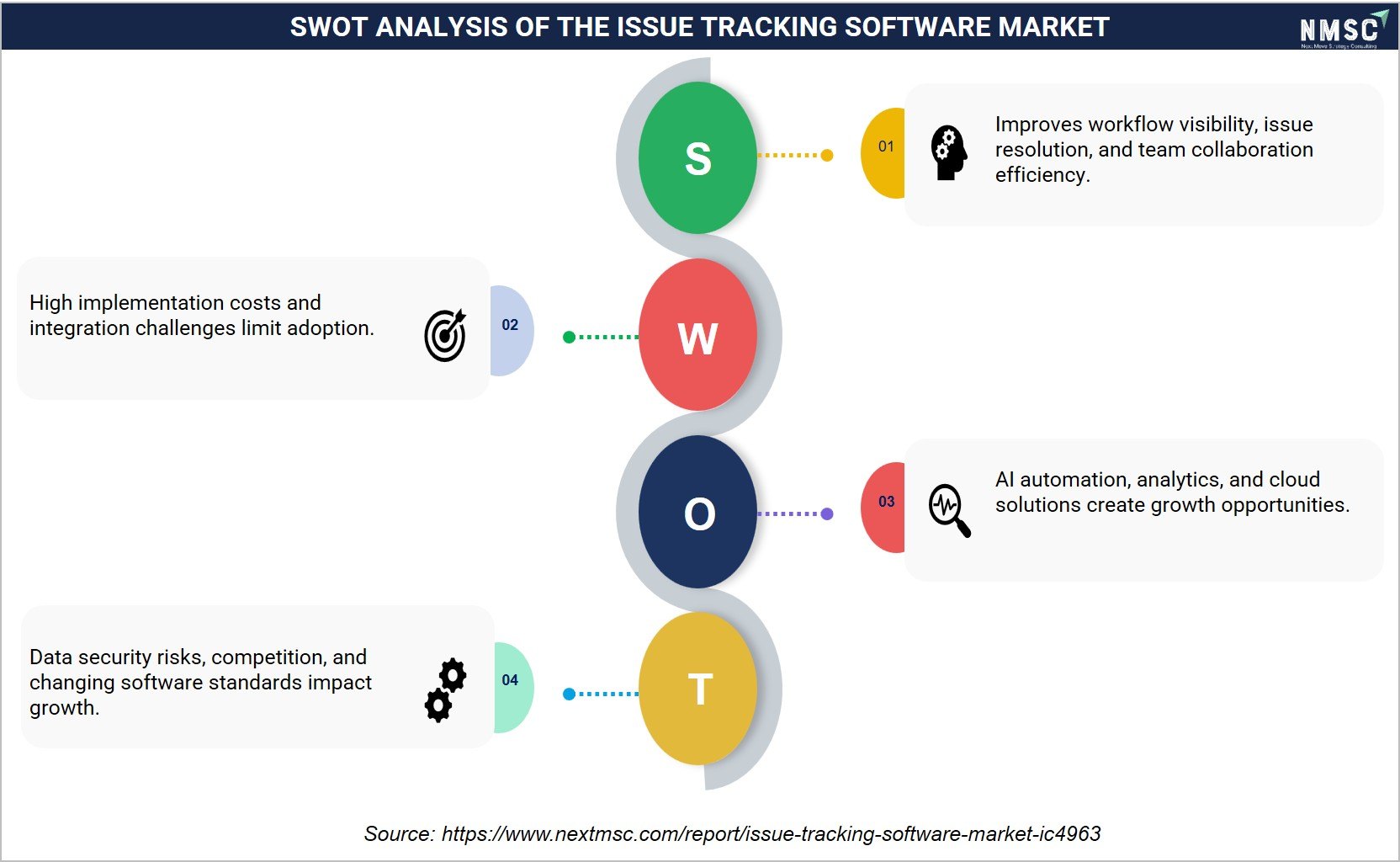
The SWOT analysis highlights the market's strong ability to improve workflow visibility, issue resolution, and cross-functional collaboration across software development and IT operations. Based on our assessment, increasing AI integration, cloud deployment, and advanced analytics create substantial growth opportunities. However, implementation costs, cybersecurity concerns, evolving compliance requirements, and intense vendor competition continue to influence long-term adoption and competitive positioning.
Competitive Landscape
Competitive Dynamics and M&A Landscape
|
Key Takeaways |
Details |
|
Market Structure |
The Issue Tracking Software Market features multi-tiered competition among enterprise platform vendors (Atlassian, ServiceNow, Microsoft), cloud-native DevOps specialists (GitLab, Linear, JetBrains), and customer support-oriented platforms (Zendesk, Freshworks, Zoho), each competing on distinct workflow integration, AI capability, and pricing models. |
|
Innovation Focus |
Innovation in the Issue Tracking Software Market centers on AI-native issue detection and triage, automated root cause analysis, natural language processing for issue creation, deep DevSecOps pipeline integration, and conversational interfaces embedded within developer toolchains. |
|
M&A Activity |
Broadcom's acquisition of VMware in 2023 consolidated enterprise workflow and ITSM capabilities. OpenText's acquisition of Micro Focus in 2023 expanded its ALM and issue management portfolio. Strategic consolidation around AI-driven DevOps platforms and ITSM integrations is expected to continue through 2026–2028. |
How Do Companies Compete in the Issue Tracking Software Market?
The Issue Tracking Software Market is characterized by multi-tiered competition across enterprise platform vendors, cloud-native DevOps specialists, ITSM platform providers, and customer support platforms. Atlassian's Jira dominates enterprise and mid-market engineering team adoption through deep ecosystem integrations with Confluence, Bitbucket, and third-party DevOps tools via the Atlassian Marketplace. ServiceNow and Microsoft compete on ITSM breadth and enterprise workflow consolidation, targeting IT operations and business operations buyer functions. GitLab and Linear represent the DevOps-native competitive tier, competing on developer experience quality, pipeline integration depth, and AI-powered productivity features.
Which Kind of Companies Dominate the Issue Tracking Software Market?
Three distinct company categories dominate the Issue Tracking Software Market. First, enterprise platform vendors including Atlassian, ServiceNow, and Microsoft leverage broad ecosystem integration, enterprise account coverage, and established compliance certifications to maintain leadership. Second, DevOps-native specialists including GitLab, JetBrains, Linear, and Nulab compete on developer workflow depth, AI-native capabilities, and open-source community credibility. Third, multi-function work management platforms including Salesforce, monday.com, Asana, Wrike, and Zoho extend issue tracking capabilities within broader CRM, project management, and collaborative workflow environments targeting cross-functional enterprise buyers.
AI-Native Differentiation and Open Standards Drive Market Success in the Issue Tracking Software Market
Innovation focus across the Issue Tracking Software Market is concentrated in AI-native triage and resolution capabilities, deep DevSecOps pipeline integration, natural language processing for issue creation and querying, and cross-platform interoperability through open APIs and webhooks. Vendors embedding generative AI features within existing workflow interfaces are capturing premium pricing and accelerating seat expansion within existing enterprise accounts. Open standards adoption, including OpenTelemetry for observability integration and REST/GraphQL APIs for third-party connectivity, is differentiating platforms that offer broad ecosystem compatibility and avoiding proprietary lock-in for enterprise engineering organizations.
Market Players to Opt for Merger and Acquisition Strategies to Expand Their Presence in the Issue Tracking Software Market
Mergers and acquisitions are reshaping the competitive dynamics of the Issue Tracking Software Market. Broadcom's acquisition of VMware in 2023 reinforced enterprise workflow and digital infrastructure management capabilities relevant to ITSM platform expansion. OpenText's acquisition of Micro Focus in 2023 consolidated application lifecycle management (ALM) and software quality management tools within a broader enterprise content management portfolio. Strategic acquisitions of AI-powered developer tools, error monitoring platforms, and observability vendors are expected to continue as major platform vendors seek to differentiate through end-to-end software delivery intelligence capabilities within the broader Issue Tracking Software Market competitive landscape.
Who Are the Key Market Players in the Issue Tracking Software Market?
-
Atlassian Corporation
-
Microsoft Corporation
-
Zendesk, Inc.
-
Salesforce, Inc.
-
GitLab Inc.
-
monday.com Ltd.
-
Asana, Inc.
-
Zoho Corporation Private Limited
-
JetBrains s.r.o.
-
Mango Technologies, Inc.
-
Wrike, Inc.
-
Broadcom Inc.
-
BMC Software, Inc.
-
OpenText Corporation
-
SmartBear Software Inc.
-
Functional Software, Inc. (Sentry)
-
Linear, Inc.
-
Nulab Inc.
What Are the Latest Developments in the Issue Tracking Software Market Industry?
|
Date |
Event |
|
May 2026 |
Sentry (Functional Software, Inc.) announced the general availability of Application Metrics. This feature integrates high-cardinality metrics directly into the debugging workflow, allowing engineers to move from an error spike to a root-cause trace in a single click without manual context-switching. |
|
March 2026 |
Linear, Inc. launched Linear Agent, an AI-powered feature that automatically creates issues from Slack conversations, triages bugs, identifies duplicates, and drafts detailed issue descriptions to streamline engineering velocity. |
|
March 2026 |
Atlassian Corporation scaled its Rovo AI agents, which have surpassed 5 million monthly active users. Rovo is currently focusing on automating incident documentation and streamlining help desk responses, targeting a 30% reduction in manual administrative work for development and IT teams. |
What Are the Investment Opportunities in the Issue Tracking Software Market?
Capital Inflows and Venture Activity
The Issue Tracking Software Market continues to attract strategic investment from venture capital firms and corporate investors focused on DevOps, software engineering productivity, and AI-enabled enterprise applications. Capital inflows are increasingly directed toward AI-native issue tracking platforms offering automated issue classification, intelligent bug prioritization, predictive sprint planning, and root cause analysis capabilities. We noticed that investor interest has expanded across startups developing developer productivity tools, workflow automation platforms, and application lifecycle management solutions, reflecting growing confidence in AI-driven software engineering technologies. Sustained venture activity is supporting innovation across cloud-native issue tracking platforms and strengthening the competitive landscape.
Infrastructure Investment
Cloud infrastructure investment remains a fundamental growth catalyst for the Issue Tracking Software Market as enterprise software vendors continue expanding scalable SaaS delivery capabilities. Major cloud providers are investing heavily in AI infrastructure, secure cloud services, and global data center capacity to support enterprise DevOps workloads. Moreover, we found that these investments improve application performance, security, and service availability while enabling issue tracking vendors to deliver advanced analytics, AI-assisted workflows, and seamless integrations with software development ecosystems. Continuous investment in cloud infrastructure strengthens platform scalability and supports long-term market expansion.
ESG and Sustainable Software Infrastructure
Environmental, Social, and Governance (ESG) priorities are increasingly influencing enterprise software procurement decisions within the Issue Tracking Software Market. Organizations are prioritizing cloud platforms powered by renewable energy, carbon-efficient data centers, and sustainable digital infrastructure while evaluating enterprise software vendors. We further analysed that vendors demonstrating alignment with corporate sustainability objectives through responsible cloud operations, efficient resource utilization, and transparent governance practices are strengthening their competitive positioning during procurement evaluations. ESG-focused technology strategies are creating additional opportunities for software providers delivering sustainable cloud-based issue tracking solutions.
Digital Transformation Enablement
Enterprise digital transformation initiatives continue to generate long-term investment opportunities across the Issue Tracking Software Market. Organizations modernizing software development environments, IT service management processes, and enterprise workflow automation increasingly require integrated issue tracking platforms to improve collaboration, governance, and operational efficiency. We found that the growing adoption of Agile development, DevOps methodologies, AI-assisted software engineering, and enterprise automation is strengthening demand for advanced issue tracking capabilities across financial services, healthcare, manufacturing, telecommunications, and public sector organizations. These digital transformation investments support sustained demand throughout multi-year enterprise modernization programs.
Private Equity and Strategic M&A Activity
Private equity firms and strategic technology vendors continue to pursue acquisitions within the Issue Tracking Software Market to strengthen product portfolios and expand enterprise customer reach. Investment activity is focused on mid-market issue tracking vendors, Agile project management providers, DevOps software companies, and AI-powered workflow automation platforms that offer scalable subscription revenue models. We assessed that consolidation strategies centered on AI capability enhancement, geographic expansion, cybersecurity integration, and adjacent workflow management solutions will remain attractive investment themes throughout the forecast period. Strategic partnerships with major cloud marketplaces also provide scalable growth opportunities while reducing customer acquisition costs for SaaS vendors.
Key Benefits for Stakeholders
This Issue Tracking Software Market report provides comprehensive intelligence for technology vendors, enterprise buyers, investors, channel partners, and policymakers seeking data-driven insights into market dynamics, competitive positioning, and long-term growth opportunities. The report delivers detailed market sizing, segmentation analysis, competitive benchmarking, and regional performance assessment across the forecast period from 2025 to 2035.
For Market Vendors and Technology Providers
Market vendors and technology providers gain detailed insights into revenue streams, deployment models, organization size, buyer functions, pricing models, and sales channels to identify high-growth opportunities, optimize product strategies, strengthen competitive positioning, and prioritize geographic expansion within the Issue Tracking Software Market.
For Enterprise IT and DevOps Buyers
Enterprise IT and DevOps buyers obtain structured intelligence on technology adoption trends, AI-enabled issue tracking capabilities, deployment preferences, vendor positioning, and integration strategies, supporting informed software procurement decisions and long-term digital transformation planning.
For Investors and Financial Analysts
Investors and financial analysts receive comprehensive analysis of market growth, competitive dynamics, investment trends, merger and acquisition activity, and company positioning to support portfolio evaluation, investment strategy development, and identification of emerging growth opportunities within the Issue Tracking Software Market.
For System Integrators and Channel Partners
System integrators and channel partners benefit from detailed assessments of high-growth industry verticals, regional demand patterns, customer adoption trends, and enterprise modernization initiatives, enabling the development of targeted service offerings and effective go-to-market strategies.
For Government and Regulatory Bodies
Government agencies and regulatory bodies gain structured insights into enterprise software adoption, cloud deployment preferences, cybersecurity requirements, regulatory compliance trends, and digital economy initiatives influencing the evolution of the Issue Tracking Software Market, supporting evidence-based policy formulation and digital infrastructure planning.
Key Market Segments
By Revenue Stream
-
Software Revenue
-
Product Category
-
Standalone Issue Tracker
-
Commercial Proprietary
-
Commercial Open Source
-
-
-
Integrated DevOps Platform
-
Integrated ITSM Platform
-
Integrated Customer Support Platform
-
Integrated Work Management Platform
-
Error Monitoring Platform
-
Other Integrated Platform
-
-
Services Revenue
-
Implementation Services
-
Migration Services
-
Training Services
-
Managed Services
-
Consulting Services
-
By Deployment Model
-
Saas
-
Multi-Tenant Saas
-
Single Tenant Saas
-
-
Self-Hosted
-
On Premise
-
Private Cloud
-
Hybrid Deployment
-
By Commercial Model
-
Subscription License
-
Perpetual License
-
Open-Source Commercial Support
-
Consumption Based Pricing
-
Freemium
By Organization Size
-
Micro Business
-
Small Business
-
Mid-Market
-
Enterprise
By Buyer Function
-
Engineering
-
Quality Assurance
-
It Operations
-
Customer Support
-
Business Operations
By Sales Channel
-
Direct Sales
-
Self Service Web
-
Cloud Marketplace
-
Channel Partner
By End User Industry
-
Technology
-
Financial Services
-
Healthcare
-
Manufacturing
-
Retail and Ecommerce
-
Telecommunications
-
Government and Public Sector
-
Professional Services
-
Education
-
Transportation and Logistics
-
Energy and Utilities
-
Other Industries
By Region
-
North America (U.S., Canada, Mexico)
-
Europe (UK, Germany, France, Italy, Spain, Sweden, Denmark, Finland, Netherlands, Rest of Europe)
-
Asia-Pacific (China, India, Japan, South Korea, Taiwan, Indonesia, Vietnam, Australia, Philippines, Malaysia, Rest of APAC)
-
Middle East & Africa (Saudi Arabia, UAE, Egypt, Israel, Turkey, Nigeria, South Africa, Rest of MEA)
-
Latin America (Brazil, Argentina, Chile, Colombia, Rest of LATAM)
Conclusion and Recommendations
Long-Term Outlook
The Issue Tracking Software Market is positioned for sustained long-term growth through 2035, supported by enterprise-wide adoption of Agile and DevOps methodologies, increasing software development complexity, AI-driven engineering productivity initiatives, and the growing integration of issue tracking platforms with broader application lifecycle management ecosystems. The market is expected to expand steadily as organizations continue modernizing software development workflows and prioritizing automation, collaboration, and real-time project visibility. AI-powered issue management, predictive analytics, and cloud-native deployment models are anticipated to remain the highest-growth segments throughout the forecast period.
Strategic Positioning Recommendations
Issue tracking software vendors should prioritize investment in AI-native capabilities, including intelligent issue categorization, automated bug triaging, predictive sprint planning, and generative AI-assisted developer workflows to strengthen long-term competitive differentiation. Cloud-native SaaS delivery with seamless integration across DevOps, ITSM, CI/CD, and collaboration platforms should remain a strategic priority for enterprise customer acquisition. Multi-workflow platform capabilities that unify issue tracking, project management, service management, and software development lifecycle management within a single environment will strengthen vendor positioning. Geographic expansion through compliance-ready cloud deployments supporting regional data sovereignty and industry-specific regulatory requirements represents a significant opportunity for long-term international growth.
Investment Attractiveness
The Issue Tracking Software Market represents an attractive investment environment characterized by recurring subscription revenue models, high customer retention, expanding enterprise software modernization initiatives, and increasing demand for AI-enabled developer productivity solutions. Investment opportunities are strongest within AI-powered issue intelligence, cloud-native enterprise platforms, DevSecOps integration, and workflow automation technologies. Private equity firms and strategic investors are expected to continue targeting established SaaS vendors with scalable business models, differentiated AI capabilities, and opportunities for geographic expansion and adjacent workflow management integration.
Market Shifts and Key Risks
The most significant structural shift within the Issue Tracking Software Market is the transition from standalone issue tracking applications toward unified software development and enterprise workflow management platforms integrating AI, DevOps, ITSM, project management, and collaboration capabilities. Key risks include intense competition from integrated software development platforms, pricing pressure from open-source and freemium solutions, evolving cybersecurity and data privacy regulations, and rapid advances in generative AI requiring continuous product innovation. Vendors that fail to maintain interoperability, automation capabilities, and enterprise-grade security are likely to face increasing competitive pressure.
Growth Pathways
Organizations seeking to maximize value from the Issue Tracking Software Market should adopt a phased modernization strategy. In the near term (2025–2027), enterprises should prioritize migration to cloud-native issue tracking platforms while integrating Agile planning, DevOps pipelines, and collaboration tools to improve software delivery efficiency. During the mid-term (2027–2031), organizations should expand AI-assisted issue management, predictive analytics, automated workflow orchestration, and enterprise-wide software governance to enhance operational performance. In the long term (2031–2035), enterprises should establish intelligent software engineering ecosystems leveraging autonomous issue resolution, advanced analytics, and unified application lifecycle management platforms to support increasingly complex digital transformation initiatives.
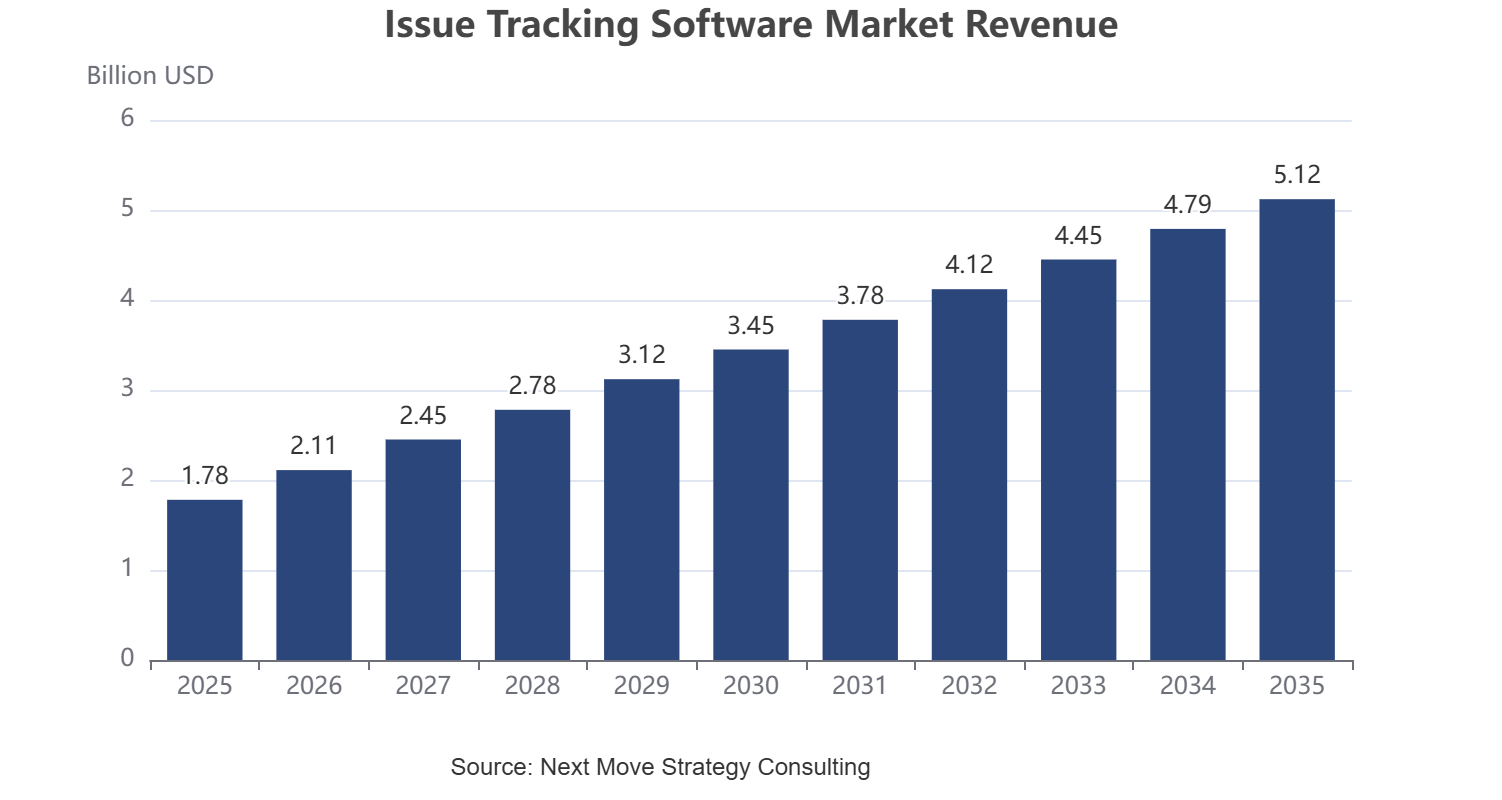
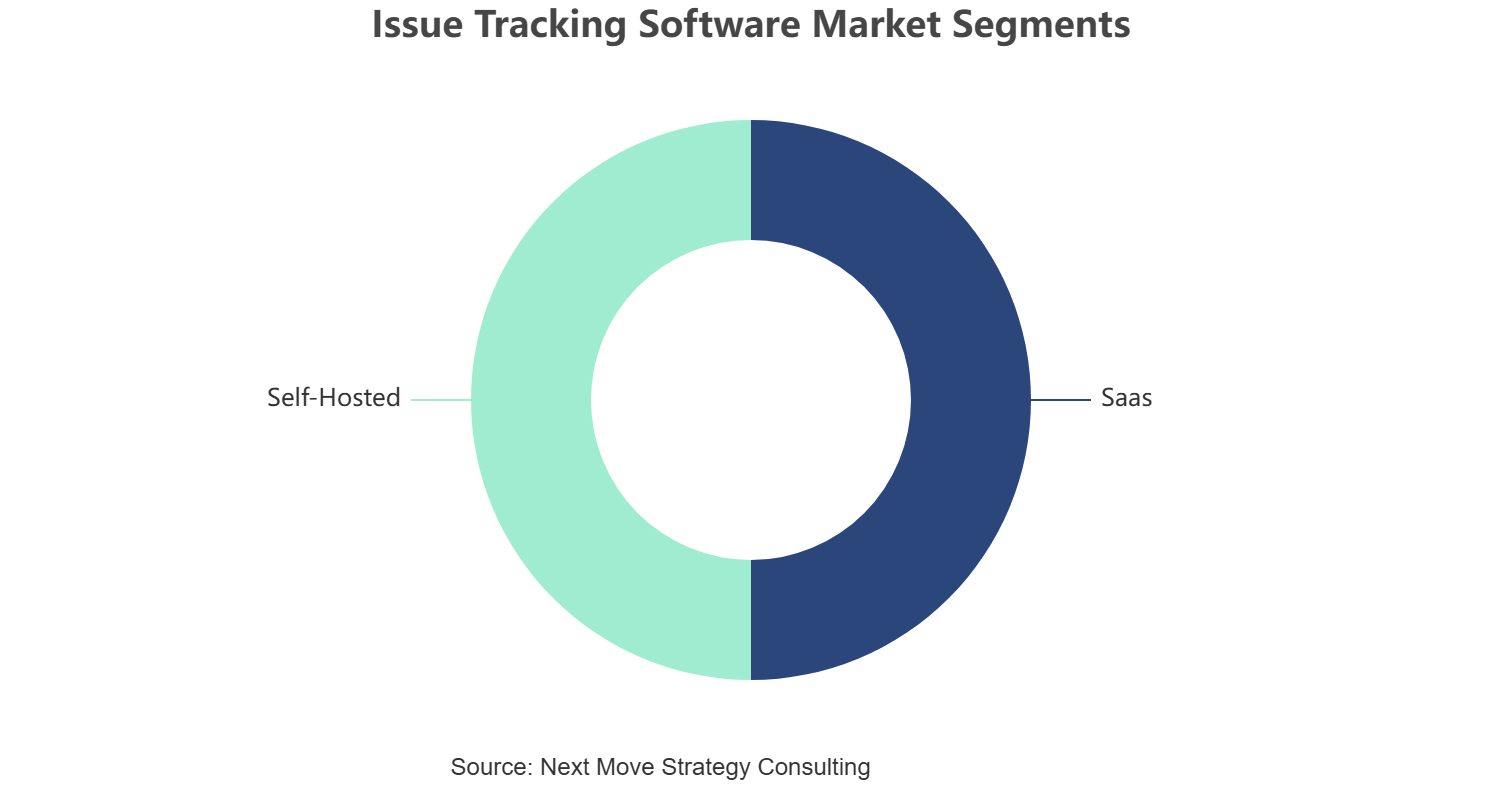
About the Author
 Saista Faiyaz
— Saista Faiyaz is Research Associate at Next Move Strategy Consulting, where she has covered consumer markets and healthcare technologies for 3 years. Her work includes primary interview review, secondary-source validation, market sizing, and structured analysis of company and industry data. She supports research by comparing evidence across sources, organizing findings into market narratives, and documenting assumptions used in analysis. Her scope includes cross-market benchmarking, and reports.
Saista Faiyaz
— Saista Faiyaz is Research Associate at Next Move Strategy Consulting, where she has covered consumer markets and healthcare technologies for 3 years. Her work includes primary interview review, secondary-source validation, market sizing, and structured analysis of company and industry data. She supports research by comparing evidence across sources, organizing findings into market narratives, and documenting assumptions used in analysis. Her scope includes cross-market benchmarking, and reports.
About the Reviewer
 Supradip Baul
— Supradip Baul is an accomplished business consultant and strategist with over a decade of rich experience in market intelligence, strategy, technology, and business transformation. His work has included rigorous qualitative and quantitative analysis across multiple industries, helping clients shape investment decisions and long-term roadmaps. Earlier in his career, he was associated with Gartner, where he contributed to industry-leading reports and market share analyses. He has worked with leading global companies and holds an MBA with a dual specialization in Marketing and Finance.
Supradip Baul
— Supradip Baul is an accomplished business consultant and strategist with over a decade of rich experience in market intelligence, strategy, technology, and business transformation. His work has included rigorous qualitative and quantitative analysis across multiple industries, helping clients shape investment decisions and long-term roadmaps. Earlier in his career, he was associated with Gartner, where he contributed to industry-leading reports and market share analyses. He has worked with leading global companies and holds an MBA with a dual specialization in Marketing and Finance.
At Next Move Strategy Consulting, we understand that insightful market research is the cornerstone of successful business decisions. That's why we employ a robust and multifaceted approach, combining various methodologies to deliver the most accurate and actionable data for our clients.

Research Landscape
We navigate the world of research with two primary approaches:
Qualitative Approach
Our qualitative research methodologies involve immersive techniques such as in-depth interviews, focus groups, and observational studies. By engaging directly with individuals and stakeholders, we uncover valuable insights that quantitative data alone may overlook.

Quantitative Research
In tandem with qualitative methodologies, NMSC leverages the power of Quantitative Research to provide a robust foundation of numerical insights. Through systematic data collection and analysis, we quantify patterns, preferences, and market trends, offering a comprehensive view of the business landscape.
Our quantitative research approach employs diverse tools, including surveys, experiments, and statistical modelling. These methodologies enable us to gather data from a large and representative sample, ensuring the statistical significance of our findings. By employing structured questionnaires and standardized data collection methods, we guarantee the reliability and validity of the information we present to our clients.
Quantitative research is particularly effective in measuring the prevalence of trends, assessing market size, and gauging the impact of various factors on consumer behavior. The numerical precision attained through this approach equips our clients with actionable insights, facilitating data-driven decision-making and strategy formulation.


Our Specialized Toolbox for Industry-Specific Market Research
We deploy a specialized arsenal of techniques tailored to meet your unique requirements. Here's a glimpse into our comprehensive toolbox:

Information Procurement
The stage entails acquiring market data or relevant information through various sources and methodologies.


Market Research Approach
We utilize both top-down and bottom-up approaches in market research analysis to achieve a comprehensive understanding of the market dynamics, leveraging the broad perspective of industry trends and macroeconomic factors alongside detailed insights from specific segments and individual companies.

Porters Five Forces Analysis
We conduct Porter's Five Forces analysis to evaluate the competitive landscape of an industry, providing us with insights into factors that affect profitability and strategic positioning.

SWOT Analysis

Forecasting
We utilize a forecasting model to predict future consumption by considering parameters like population, economics, regulations, market competition, drivers, constraints, technology, and pricing. We also employ statistical techniques such as multilinear regression, exponential smoothing, moving average, ARIMA, and Monte Carlo simulations for accurate predictions. In econometric forecasting, we analyzed short-term and long-term event impacts, attributing values based on regulatory frameworks, economic factors, and market events.





 Speak to Our Analyst