Gold Market By Application (Jewellery, Investment Products, Industrial and Decorative Fabrication, Official Sector Reserve Additions), By Source (Mined Gold, Recycled Gold, Official Sector Net Release), By Purity Level (24 karat, 22 karat, 18 karat, 14 karat, 10 karat, Below 10 karat), By Distribution Channel (Jewellery Retailers, Bullion Dealers and Wholesalers, and Others), By End User (Individual Retail Consumers, Jewellery Manufacturers, and Others) – Global Analysis & Forecast, 2025–2035
Industry Outlook
The global Gold Market size was valued at USD 249.5 billion in 2025 and is expected to reach USD 263.97 billion by 2026. Looking ahead, the industry is projected to expand significantly, reaching USD 438.45 billion by 2035, registering a CAGR of 5.8% from 2026 to 2035.
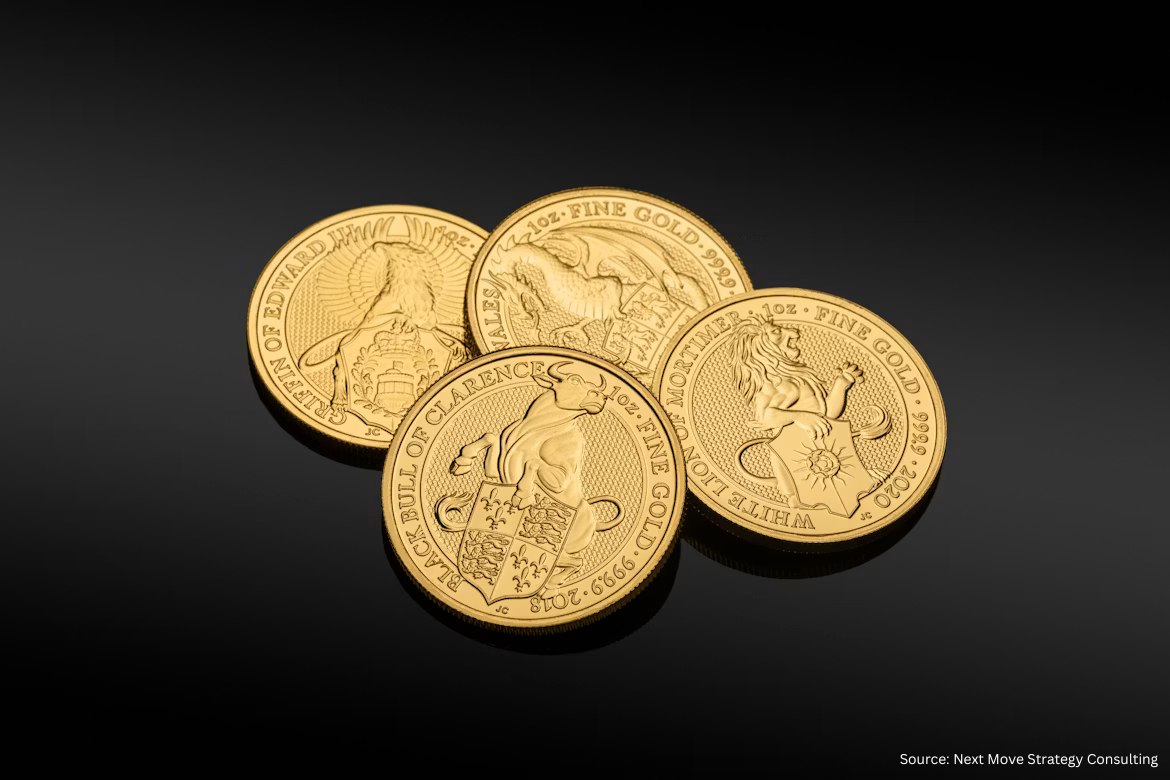
The gold market today occupies a unique position at the intersection of culture, finance, and industry. Financially, gold serves as a liquidity reserve and a portfolio diversifier for investors and institutions, accessible through physical bars and coins as well as through financial products. Gold Industrial demand, though smaller than other uses, remains important for electronics, medical devices, and precision engineering, where gold’s conductivity and corrosion resistance are prized.
Looking ahead, the gold market is expected to balance its traditional functions with emerging growth avenues. Ongoing cultural preference for gold jewelry and its role as a safe-haven asset are likely to sustain baseline demand, while investment flows will continue to fluctuate in response to monetary policy changes and broader macroeconomic uncertainty. Advances in electronics and medical technologies may support gradual growth in industrial gold usage, while enhanced recycling practices and more responsible mining standards influence supply-side dynamics.
Moreover, Urban population growth is closely linked to the gold market because expanding cities concentrate income, savings, and financial activity, which increases both the demand and accessibility of gold as an asset. As urbanisation rises, more people shift into formal employment and banking systems, enabling higher disposable incomes and easier participation in gold purchases through jewelry stores, banks, ETFs, and digital gold platforms. Urban consumers also tend to view gold not only as traditional jewelry but as a hedge against inflation, currency volatility, and economic uncertainty, strengthening investment demand.

The above chart, illustrating higher urbanisation rates in developed countries like France,and South Korea. Signal mature urban economies with elevated incomes and a shift toward financial assets over physical gold jewelry, potentially capping consumer gold demand growth compared to emerging markets. This maturity fosters stable investment demand for gold as a portfolio diversifier amid economic uncertainties, though lower relative urbanisation in countries like Australia sustains some jewelry traditions. Overall, the chart indicates a balanced but non-explosive impact on global gold market, supporting steady prices without sharp demand surges from these high-income nations.
What Are the Key Trends in the Gold Industry?
How is Strong Price Momentum Driving the Global Gold Market Expansion?
Gold’s strong price momentum is acting as a major driver of the global market, reinforcing investor confidence and sustaining elevated demand across financial and physical channels. According to the World Gold Council’s Gold Outlook 2026, gold delivered an exceptional performance through 2025, recording more than 50 new all-time highs and generating over 60% total returns, largely supported by positive price momentum, expectations of lower interest rates, a softer U.S. dollar, and heightened macroeconomic and geopolitical uncertainty. This sustained upward trajectory has attracted strong inflows into gold-backed ETFs while also reinforcing speculative and momentum-based trading, creating a feedback loop where rising prices strengthen bullish sentiment and forecasts from major financial institutions. For companies operating across the gold value chain, such as refiners, ETF issuers, bullion dealers, and trading platforms, this environment highlights the opportunity to align product offerings, inventory strategies, and investor communications with momentum-driven demand, as strong price signals continue to position gold as a preferred hedge and portfolio stabiliser in the near to medium term.
How is Central Bank Accumulation & Reserve Diversification Driving the Global Gold Market?
Central bank accumulation and reserve diversification have emerged as a powerful structural driver of the global gold market growth, providing long-term demand support beyond short-term price fluctuations. According to the World Gold Council, central banks have remained net buyers of gold for multiple consecutive years. 2024 was the third consecutive year of purchases exceeding 1,000t, staying well above pre-pandemic averages as monetary authorities actively diversify reserves away from U.S. dollar-denominated assets. This shift is being driven by heightened geopolitical risk, concerns over currency volatility, and the desire to strengthen financial resilience amid evolving global trade and sanctions dynamics. Gold’s lack of credit risk and its role as a neutral reserve asset make it particularly attractive for emerging and developing economies seeking to rebalance their foreign exchange holdings. For companies operating within the gold ecosystem, this sustained institutional demand signals a stable and strategic demand base, encouraging long-term capacity planning, enhanced transparency, and compliance-focused services that align with sovereign procurement standards, while reinforcing gold’s position as a cornerstone asset in global reserve management strategies.

The above chart showing high levels of household disposable income in markets such as Japan, Germany, the United Kingdom, Canada, and South Korea directly contributes to market growth, as greater disposable income increases consumers’ ability to purchase luxury items, particularly gold jewelry and investment gold higher income also signifies greater financial resilience, fostering demand for gold as a safe-haven asset and supporting robust sales both in retail and institutional segments within affluent economies.
How is Gold Market Changing Retail Jewelry and Consumer Demand Through Traceability and Digital Services?
Retail patterns in the gold market are shifting as consumers demand provenance, lower price friction, and digital experiences. Jewelry demand softened in recent years even as investment flows rose, prompting brands to rethink product and service models. In response, retailers and refiners that combine a certified chain of custody with digital services such as authenticated provenance tags, buy-back and recycling programs, and fractional ownership portals gain consumer trust and repeat business. From an operational standpoint, integrating blockchain or secure registry solutions for provenance, training sales staff on certification claims, and offering transparent buy-back pricing help reclaim lost volume and capture margin through service differentiation. Companies that move quickly to pair attractive design with verifiable sourcing and easy digital ownership stand to convert cautious buyers and tap premium pricing for certified goods.
What Are the Key Market Drivers, Breakthroughs, And Investment Opportunities That Will Shape the Gold Industry in the Next Decade?
The gold market today sits at the nexus of cultural demand, industrial use, and global finance. Jewelry and ceremonial consumption remain important in many regions, while industry uses gold for electronics and medical devices because of its conductivity and corrosion resistance. Financial demand has strengthened as investors and central banks use gold for diversification and liquidity, and new distribution models are widening access to ownership. Overall, the market combines stable end uses with financial drivers that respond to macroeconomic and geopolitical shifts.
In the near term, the market is shaped by central bank purchases, investment flows into ETFs and physical bars, mine output and recycling performance, and changing technology needs. Policy moves and geopolitical risk drive safe haven buying, while advances in recycling and responsible mining affect supply. Together, these forces make gold resilient but sensitive to shifts in interest rates, currency moves and sovereign reserve strategies.
Growth Drivers:
Could Expanding B2B E-Commerce Channels Strengthen Supply-Chain Efficiency and Stimulate Growth in the Gold Market?
The rapid digitalisation of wholesale trading is reshaping the B2B gold ecosystem, enabling refiners, bullion banks, jewellers and manufacturers to transact through secure online platforms with greater price transparency and faster order fulfilment. Digital procurement portals streamline bulk purchasing, automate compliance documentation, and integrate real-time inventory and logistics data, reducing operational friction across the value chain. These platforms also broaden supplier options for fabricators and retailers, improving liquidity and strengthening competitive sourcing. As leading refiners and mints adopt blockchain-backed verification and API-linked trading systems, B2B buyers gain enhanced traceability and risk mitigation. With cross-border digital wholesale trade expanding, B2B e-commerce is becoming a structural driver of efficiency, scalability and long-term growth across the global market.

The above charts shows, the sharp and consistent rise in global B2B e-commerce market value, as shown in the chart, facilitates greater digital trade in commodities like gold by streamlining transactions between manufacturers, wholesalers, and retailers this digitalization lowers entry barriers, expands buyer and seller networks, and enables faster, more transparent procurement and supply chain integration, collectively driving up demand and market efficiency in the gold sector as businesses increasingly leverage online platforms for bulk gold purchases and distribution.
Could Broadened Investor Access Through ETFs, Digital Gold and Tokenized Products Increase Financial Demand for Gold?
Financial innovation has expanded how investors access gold, from exchange-traded funds and custody services to tokenized digital gold products. These instruments lower barriers to ownership, reduce transaction frictions, and allow fractional exposure for retail and institutional investors alike. When liquidity and custody infrastructure are strong, investor flows respond quickly to macro signals such as inflation expectations and real yield moves, accelerating price discovery and inflows. The higher transparency and standardisation of regulated ETF markets also make gold more portfolio-friendly for asset managers, pension funds and sovereign wealth funds. As these vehicles mature and regulatory frameworks clarify, easier access will sustainably lift investment demand and integrate digital gold more tightly into mainstream asset allocation.
Growth Inhibitors:
Could a Sustained Rise in Real Interest Rates and a Stronger US Dollar Materially Dampen Gold’s Appeal?
Gold’s relative attractiveness depends on real interest rates and currency strength because higher real yields increase the opportunity cost of holding non-yielding assets. A persistent rise in real rates or a firmer US dollar tends to reduce demand from investors who seek yield or prefer dollar-denominated assets, pressuring gold prices and ETF flows. Central bank communications, successful anti-inflation policies, or a prolonged economic expansion lift yields and shift allocations away from safe-haven metals. Additionally, stronger fiat currencies reduce the hedging incentive for countries and private savers. While gold benefits from geopolitical and structural buyers, an extended high-interest rate environment would be a clear headwind to near-term speculative and some institutional demand.
Could Green Mining, Recycled Bullion and Responsible Supply Chain Certifications Create Investable Niches Within the Gold Space?
Sustainability is reshaping investor preferences and mine permitting outcomes, opening a potential investment theme around greener and traceable gold. Companies that reduce carbon intensity, adopt low-impact extraction, or scale certified recycled gold gain premium market access and lower regulatory risk. Similarly, funds and products that explicitly source verified responsible gold attract ESG-sensitive capital and premiums from conscientious consumers in jewelry and tech supply chains. This creates opportunities across equity, private investment and structured product layers from miners advancing low-emission projects to service providers offering a verified chain of custody and recycling platforms. As regulation and consumer scrutiny grow, early movers in certified sustainable gold could capture both valuation upside and differentiated demand.
How Gold Industry Segmented in This Report, and What Are the Key Insights from the Segmentation Analysis?
By Product Form sights
Is Product Form Segmentation Shaping the Gold Market Today?
On the basis of product form, the gold market share is segmented into finished consumer gold products, physical investment gold, and semi-fabricated and industrial gold.
Finished consumer gold products remain dominant in overall gold market demand, reflecting deep cultural and aesthetic drivers, especially in India and China. Investment gold, however, has gained notable traction, increasingly closing the gap as economic uncertainty and price surges push investors toward bullion forms. Semi-fabricated gold underpins the jewelry supply chain but isn’t typically measured as an independent demand driver in major WGC reporting, while industrial gold, though essential to tech and specialised applications, accounts for the smallest share of global gold consumption. The interplay of these segments suggests jewelry leads in volume, investment is rising in importance, and industrial use provides a stable but modest baseline in demand.
Semi-fabricated gold refers to cast, rolled, or partially processed metal that functions as an intermediate input for downstream manufacturing, particularly within the jewelry industry. In parallel, industrial gold represents a much smaller but strategically important segment, supporting applications across electronics, dentistry, and advanced technological uses. While its overall share of total gold demand is limited compared with jewelry and investment, industrial gold plays a vital role in high-precision manufacturing and remains increasingly relevant as emerging technologies continue to rely on gold’s unique conductive and durability properties
By Purity Level Insights
Is the Gold Market Dominated by Traditional Purity Levels in 2026?
On the basis of purity level, the market is segmented into 24 karat, 22 karat, 18 karat, 14 karat, 12 karat, 10 Karat, 9 Karat, 8 karat and below.
22 karat gold leads as the dominant purity segment, driven by cultural traditions and jewelry preferences, especially in the Asia Pacific (India, China, Middle East), where high-purity gold holds cultural and ceremonial significance in bridal demand. 18 K gold also captures a substantial share thanks to a balance between beauty and durability, gaining traction in both Western and premium global markets. Higher purity 24 K is significant mainly for investment and specific cultural uses, while lower karat levels (14 K, 12 K, 10 K, 9 K & below) serve niche cost-conscious and fashion trends. Demand varies strongly by region, price pressures, and consumer age groups.

By Application Insights
Is Application Usage Redefining the Gold Market in 2026?
On the basis of application, the market is segmented into jewelry, industrial and technology, monetary and official uses, and decorative & other fabricated products.
Jewelry continues to be the largest application for gold by volume, driven by deep cultural consumption patterns, though its share is facing pressure from high prices that dampen purchases in key markets. Monetary & official uses are increasingly prominent as central banks and sovereign entities aggressively accumulate gold for reserves, reflecting gold’s core role as a financial asset under uncertainty, while industrial & technology applications show moderate growth tied to electronics and advanced manufacturing. Decorative and other fabricated products, though smaller in scale, enrich the spectrum of gold applications. Overall, gold’s application mix is diversifying, with investment-linked and official demand becoming more pronounced alongside traditional jewelry usage.
By Distribution Channel Insights
Is Distribution Channel Strategy Driving the Gold Market in 2026?
On the basis of distribution channel, the market is segmented into jewelry retailers, bullion dealers & banks, online trading platforms, exchange-based trading channels, and government mints.
Jewelry retailers and online trading platforms are among the most influential distribution channels in the market. Traditional jewelry retailers continue to dominate physical sales, especially in markets with strong cultural affinities for gold, by providing personalised service and tangible assurance. However, online platforms are rapidly expanding, driven by digital convenience, competitive pricing, and broader access for investors and retail buyers. Bullion dealers and banks remain foundational intermediaries in the supply chain, ensuring the movement of gold from import and refining to distribution. Exchange-based trading channels and exchange-cleared brokers cater to institutional and sophisticated buyers seeking regulated access to gold markets via spot and derivatives. Government mints support authenticity and official products, reinforcing trust in distributed gold offerings. Together, these channels create a diversified and resilient distribution ecosystem, balancing traditional retail strengths with digital and institutional market innovation.
By End-User Insights
Is End-User Demand Rebalancing the Gold Market in 2026?
On the basis of end-user, the market is segmented into individual/retail consumers, institutional investors, central banks and government, and industrial and commercial enterprises.
The market is increasingly shaped by institutional investors and central banks, which together account for a substantial and growing share of total demand. Central banks & governments dominate from a strategic and volume perspective, driven by reserve diversification and geopolitical risk management, while institutional investors exert short-term influence through financial flows and price discovery. Individual and retail consumers remain the largest group by participation, sustaining long-term demand through jewelry and small-scale investment, though their buying behaviour is more price-sensitive. Meanwhile, industrial and commercial enterprises provide a steady baseline demand anchored in technological necessity rather than investment sentiment. Collectively, this diversified end-user structure enhances the market’s resilience across economic cycles.
Central banks, governments, and industrial and commercial enterprises together represent structurally important end users of gold, supporting long-term demand beyond jewelry and retail investment. In parallel, industrial and commercial enterprises consume gold for functional and technical applications across electronics, electrical components, medical devices, dentistry, and specialised manufacturing. Although smaller in volume than jewelry or investment demand, this segment is economically significant due to gold’s unique physical properties, including superior conductivity and corrosion resistance, with technology-related gold demand annually supported by ongoing growth in electronics and advanced manufacturing, making it a stable and largely non-cyclical component of global gold demand.
Regional Outlook
The market is geographically studied across North America, Europe, Asia Pacific, the Middle East & Africa, and Latin America, and each region is further studied across countries.
Gold Market in North America
North America’s market is shaped by strong investment demand, deep ETF liquidity, and a mature bullion ecosystem that supports trading, custody and exports. The United States drives most regional activity, institutional inflows into US-listed ETFs and brisk bullion trade keep physical and paper markets highly liquid, while technology demand in electronics and specialised industrial uses provides steady industrial off-take. Canada complements this with significant mine production and a growing emphasis on sustainable mining practices that appeal to ESG investors. Regional price sensitivity is influenced by US monetary policy and the dollar, which affect both domestic investment flows and export competitiveness.
Gold Market in the United States
The market is largely investment-centric, with ETFs, futures, and institutional allocations predominating alongside niche retail bullion demand. Recent data show US ETF and bullion flows playing a major role in global investment totals, and bullion exports from the US have been robust. Market drivers include expectations for monetary policy, inflation hedging demand and safe haven buying during geopolitical uncertainty, while domestic electronics and medical device sectors sustain industrial demand. Regulatory clarity around digital gold products and tokenization shapes future distribution models.
Gold Market in Canada
Canada’s gold landscape is defined by significant mine production, downstream refining and a well-regulated capital markets environment that supports miners and bullion services. Mining exports and exploration activity mean Canada is a net supplier into global markets, and its policy focus on permitting, Indigenous engagement and greener extraction techniques increasingly determines project timelines and investment risk. Domestic investment demand is modest compared with the US, but Canadian firms benefit from cross-border custody and proximity to major refiners. Natural Resources Canada provides country-level mining facts that contextualise Canada’s role as a producer rather than a large consumer.
Gold Market in Europe
Europe’s gold market combines investment holdings in ETFs and vaults with jewelry demand concentrated in Southern Europe and significant refining and trading hubs in Switzerland and the UK. While institutional and retail investors use gold for diversification, Europe overall saw ETF holdings contract in some markets even as global ETF flows remained strong. Currency moves, regional inflation expectations and the ECB’s policy path influence investor appetite, and regulatory developments on sustainability and supply chain transparency are reshaping sourcing and product certification.
Gold Market in the United Kingdom
The UK serves as an important trading, refining and vaulting centre for gold in Europe, with London’s market structure deeply integrated into global price discovery and settlement. Investment demand in the UK is influenced by sterling movements and the broader European economic outlook, while the bullion market benefits from well-established custodial services and insurance capacity. Post-Brexit regulatory adjustments and ongoing scrutiny of supply chain due diligence have nudged firms toward more transparent sourcing and audit standards. London’s role in wholesale markets means shifts in global flows show up quickly in UK volumes and liquidity metrics tracked by industry bodies.
Gold Market in Germany
Germany presents a unique mix of robust retail appetite for physical bullion and a sophisticated institutional investor base that uses gold for portfolio diversification. Germans historically hold substantial private gold savings and exhibit a strong interest in bars and coins. Industrial demand from the automotive and electronics sectors adds a steady baseline. Macroeconomic concerns and inflation sensitivity drive retail purchases, and German refiners and vault operators play a key role in European distribution.
Gold Market in France
France’s gold demand is characterised by a balanced mix of retail bullion purchases and investor exposure through funds, with cultural and investment motives influencing buy patterns. While jewelry consumption is less dominant than in Asia, French investors use gold as a hedge against inflation and currency risk. Regulatory emphasis on transparency and anti-money laundering enforcement affects retail distribution channels, and refiners servicing the domestic market lean on European vault networks.
Gold Market in Italy
Italy retains a strong cultural affinity for gold jewelry and physical ownership, which supports stable retail demand despite price cycles. Consumers treat gold as both an adornment and informal savings. Investment demand like bars and coins spikes when macro uncertainty rises, reflecting the traditional use of gold as a store of value. Local demand is also sensitive to domestic economic performance and tourism flows that influence jewelry purchases. Italy’s role is best viewed in the broader European consumption cluster, where Southern markets display higher jewelry shares compared with northern peers.
Gold Market in Spain
Spain’s gold market shows modest retail jewelry consumption and a reliance on broader European bullion distribution networks. Spanish buyers participate in the wider trend toward certified and traceable jewelry, but on a smaller scale than India or China. Economic sensitivity and seasonal tourism patterns influence demand, and Spain benefits from access to European vaulting and refining infrastructure when serving investment buyers.
Gold Market in the Nordics
Nordic countries show relatively lower jewelry consumption and higher investor sophistication, with gold used chiefly for portfolio diversification and niche industrial uses in technology and medical sectors. Strong institutional frameworks, high financial literacy and ESG considerations push demand toward certified recycled gold and transparent custody solutions. Sweden and Finland host technology manufacturers that drive small but high-value industrial gold use, while Norway’s sovereign wealth approach and regional investors factor into institutional allocations.
Gold Market in the Asia-Pacific
Asia-Pacific dominates the global jewelry and consumer demand, with China and India together accounting for a very large share of global consumption. Their behaviour sets the tone for jewelry markets worldwide. Rapid digital adoption has also accelerated flows into ETFs and digital gold in parts of Asia, while robust electronics manufacturing supports industrial demand. Policy shifts, import duties and festival seasons repeatedly influence regional volumes.
Gold Market in China
China remains the world’s largest consumer of gold in value and tonnage terms and has seen record retail and fund inflows as investors sought alternatives amid equity and property volatility. Industrial demand is driven by electronics manufacturing, while central bank accumulation supports official demand. Policy, capital controls and local market structures such as the Shanghai Gold Exchange influence how domestic flows interact with global markets.
Gold Market in Japan
Japan’s gold market features steady investment demand tempered by lower jewelry consumption compared with Asian peers. Investors use gold in smaller allocations for diversification and as a hedge against yen volatility. Industrial uses in electronics are significant given Japan’s manufacturing base, and corporate and retail adoption of digital investment channels is growing slowly. Monetary policy and exchange rate movements are key drivers for domestic sentiment.
Gold Market in India
India's Golds market is experiencing rapid growth, driven by the country's rich heritage of traditional medicine and increasing consumer awareness of the health benefits of Gold ingredients. The Market is characterised by rising demand for herbal supplements, functional foods, and natural cosmetics. This growth is supported by favorable regulatory frameworks and a well-established distribution network, facilitating the widespread availability of gold products.
Gold Market in South Korea
South Korea presents a market with comparatively modest jewelry consumption but substantive industrial gold use in electronics and semiconductors. Investors also allocate to ETFs and funds for diversification. Strong export-oriented tech industries underpin stable industrial demand, and corporate purchasing for manufacturing offsets softer retail trends. Financial innovation and digital platforms are expanding retail access to gold products. For industrial demand figures and national trends.
Gold Market in Taiwan
Taiwan’s gold dynamics mirror its advanced electronics sector where gold is a critical input for high reliability connectors and semiconductor packaging, generating consistent industrial demand despite limited jewelry consumption. Corporate procurement cycles and export demand for electronic components influence domestic tonnage usage, and recycling initiatives in electronics be a growth vector for reclaimed gold. Local industrial statistics alongside WGC technology sector data illuminate Taiwan’s role in the supply chain.
Gold Market in Indonesia
Indonesia is both a growing consumer market for jewelry and an emerging producer in the mining landscape, with local consumption influenced by cultural use and rising incomes. Policy on mining permits and export taxes shapes the supply side, while regional demand follows festival cycles and domestic wealth trends. The country’s position in Southeast Asia makes it a meaningful regional market, though smaller than China or India in absolute terms.
Gold Market in Australia
Australia is a significant gold producer with a strong mining industry and export orientation. Much of its domestic activity centres on production, refining and investment rather than large jewelry consumption. The Australian market benefits from high-quality ore, technologically advanced mining, and investor interest in domestic mining stocks and ETFs. Mine production data and national resource reports from government agencies highlight Australia’s role as a supplier into global markets.
Gold Market in Latin America
Latin America’s market is diverse, as some countries are major producers with export-oriented mining sectors, while others have growing domestic consumption and investor interest. Political risk, regulatory frameworks and artisanal mining dynamics strongly affect regional supply and formalization efforts. Countries such as Peru and Mexico play material roles in mine output, and regional trends are shaped by commodity cycles and foreign investment into mining projects.
Gold Market in the Middle East & Africa
The Middle East shows growing investment demand in some Gulf states where sovereign wealth dynamics and liquidity favour allocation to gold, while Africa remains both a vital production base and a region grappling with artisanal mining, supply chain traceability and regulatory development. South Africa and West African producers are key to global mine supply, even as political and infrastructure challenges influence output. Increasing interest in certified supply chains and conflict-free sourcing is reshaping how global buyers engage African producers.
Competitive Landscape
Which Companies Dominate the Gold Industry and How do they Compete?
Global competition is shaped by large refiners and regional specialists competing on credibility, capacity and channel reach. Swiss refiners such as Valcambi and MKS PAMP combine LBMA accreditation and product branding to serve institutional buyers and retail investors, while Heraeus leverage recycling and industrial ties to supply both technology and bullion markets. National players such as Rand Refinery and The Perth Mint dominate local supply chains and sovereign or retail demand, and Asahi and Tanaka extend reach through North American and Asian footprints. Mid-tier regional refiners like Al Etihad and Nadir focus on Middle East and South Asian trade corridors, competing on speed, certifications and regional relationships.
Market Dominated by Gold Giants and Specialists
Competition is geographic and niche-driven. India and the Middle East remain Jewelry-dominated, favouring local refiners and retailers. China and Europe combine retail demand with large refinery throughput, and Western markets tilt toward investment bars and ETF liquidity. Perth Mint anchors Australia’s sovereign and retail flows, while Rand Refinery is central to southern Africa’s mine-to-market pipeline. Swiss refiners act as global processing hubs, handling cross-border flows and bespoke products. Regional players win on local licensing, balance sheet trust and cultural preferences, whereas global houses win institutional volumes through LBMA standing and export capacity.
Innovation and Adaptability Drive Market Success
Leading firms pursue recycling, traceability, regional expansion and product differentiation. Heraeus expanded recycling capacity and regional operations in Canada and India to secure feedstock and downstream sales. Asahi has strengthened its North American presence through strategic acquisitions, and Perth Mint focuses on compliance and product diversification to protect margins. Across the board, companies’ pair technical upgrades with ESG and chain of custody credentials to capture both institutional reserve flows and retail premium customers.
Market Players to Opt for Merger & Acquisition Strategies to Expand their Presence
Refiners expand via acquisitions and auctions to secure processing capacity and regional access. In India, Ravindra Heraeus bought Arora Matthey’s catalyst and recycling operations in Vizag in September 2024 to deepen local service lines. Philoro, along with the University of St. Gallen, released a new precious metals study showing gold and silver have surged in popularity as investment assets, with 71 % of Swiss respondents viewing them positively. This reflects wider investor interest in precious metals and high demand, which impacts on gold prices, trading volumes and refinery activity.
List of Key Gold Companies
-
Newmont Corporation
-
Barrick Gold Corporation
-
Agnico Eagle Mines Limited
-
Navoi Mining and Metallurgical Company (NMMC)
-
Polyus PJSC
-
AngloGold Ashanti Limited
-
Zijin Mining Group Co., Ltd.
-
Kinross Gold Corporation
-
Gold Fields Limited
-
Northern Star Resources Limited
-
Harmony Gold Mining Company Limited
-
Shandong Gold Mining Co., Ltd.
-
Endeavour Mining plc
-
Freeport-McMoRan Inc.
-
B2Gold Corp.
-
Evolution Mining Limited
-
Sibanye-Stillwater Limited
-
Fresnillo plc
-
Alamos Gold Inc.
-
Lundin Gold Inc.
What Are the Latest Key Industry Developments?
-
December 2024- Heraeus projected gold could continue its record run into 2025, USD 2,450–2,950/oz, driven by further rate cuts, central bank demand, and geopolitical risk signalling bullish macro tailwinds for refiners.
-
October 2024- MKS PAMP launched a mine-to-market traceable 1oz Lady of Liberty gold bar made from Newmont-mined gold, using its Provenance solution. This boosts supply-chain transparency and aligns with the rising demand for responsibly sourced gold
-
August 2024- Asahi launched a fractional gold bar product line, 1g & 2.5g, from its Miami mint, democratizing access to physical gold and expanding its retail investor base.
-
April 2024- Umicore introduced Nexyclus, guaranteeing 100% recycled precious metals sourced from industrial waste, strengthening its circular economy credentials and catering to sustainability-driven demand.
The Key Factors Influencing Investment Analysis & Gold Market Opportunities
Investment opportunities in the gold market are increasingly shaped by shifting funding themes, expanding digital channels and evolving risk-hedging strategies among both institutional and private investors. Venture and strategic funding are moving toward technology-enabled gold platforms, secure trading infrastructure, recycling innovations and traceability solutions, as investors prioritise transparency, sustainability and compliance-driven models. Refiners, digital vaulting providers and integrated bullion ecosystems are attracting interest as they enable more efficient sourcing, custody and retail engagement without reliance on traditional physical channels.
Valuation sentiment in the sector is influenced less by short-term price cycles and more by structural factors such as geopolitical hedging demand, central-bank reserve strategies and long-term supply constraints. Investment hotspots include responsibly sourced refining, digital gold investment products, ecosystem partnerships between refiners and fintechs, and expansions into high-growth demand regions where consumer and institutional interest converge. These areas continue to provide strong upside for investors seeking defensive yet innovation-aligned exposure.
Key Benefits for Stakeholders:
Next Move Strategy Consulting (NMSC) presents a comprehensive analysis of the Gold Market, covering historical trends from 2020 through 2025 and offering detailed forecasts through 2035. Our study examines the market at regional and country levels, providing quantitative projections and insights into key growth drivers, challenges, and investment opportunities across all major gold segments.
The gold industry offers clear advantages to both investors and customers by combining financial stability with cultural and practical value. Investors benefit from gold’s long-standing role as a safe-haven asset, enabling wealth preservation, diversification and protection against inflation or currency fluctuations. They also gain access to multiple formats from physical bullion to digital gold and ETFs, allowing flexible portfolio strategies. Customers, on the other hand, enjoy gold as a durable and culturally significant product used in jewelry, gifting and savings, while also benefiting from expanding retail innovations such as lightweight designs, certified purity, and transparent digital purchase platforms. Together, these benefits enhance trust, accessibility and long-term value for all participants in the gold ecosystem.
Report Scope
|
Parameters |
Details |
|
Market Size in 2026 |
USD 263.97 Billion |
|
Revenue Forecast in 2035 |
USD 438.45 Billion |
|
Growth Rate |
CAGR of 5.8% from 2025 to 2030 |
|
Analysis Period |
2025–2035 |
|
Base Year Considered |
2025 |
|
Forecast Period |
2026–2035 |
|
Market Size Estimation |
Billion (USD) |
|
Growth Factors |
|
|
Companies Profiled |
15 |
|
Countries Covered |
33 |
|
Market Share |
Available for 10 companies |
|
Customization Scope |
Free customization (equivalent to up to 80 analyst-working hours) after purchase. Addition or alteration to country, regional & segment scope. |
|
Pricing and Purchase Options |
Avail customized purchase options to meet your exact research needs. |
|
Approach |
In-depth primary and secondary research; proprietary databases; rigorous quality control and validation measures. |
|
Analytical Tools |
Porter's Five Forces, SWOT, value chain, and Harvey ball analysis to assess competitive intensity, stakeholder roles, and relative impact of key factors. |
Gold Market Key Segments
By Application
-
Jewellery
-
Bridal Jewellery
-
Western Bridal Sets
-
South Asian Bridal Sets
-
East Asian Wedding Jewellery
-
Wedding Bands
-
-
Fashion Jewellery
-
Fine Fashion Jewellery
-
Designer Collections
-
Mass Market Fashion Pieces
-
-
Traditional and Cultural Jewellery
-
Indian Traditional
-
Chinese Cultural
-
Middle Eastern Cultural
-
Festival Specific Jewellery
-
-
Investment Jewellery
-
High Purity Bangles
-
Large Gold Chains
-
Custom Bullion Pieces
-
-
Lightweight Jewellery
-
Contemporary Daily Wear
-
Minimalist Pieces
-
-
-
Investment Products
-
Bars and Ingots
-
Large Institutional Bars
-
Retail Small Bars
-
Cast and Minted Bars
-
Branded Bars
-
-
Coins
-
Sovereign Bullion Coins
-
Private Mint Coins
-
Commemorative Coins
-
-
Medals and Commemoratives
-
-
Industrial and Decorative Fabrication
-
Electronics Manufacturing
-
Semiconductor Packaging
-
Printed Circuit Boards
-
Connectors and Components
-
-
Medical and Dental Applications
-
Dental Alloys
-
Medical Implants
-
Diagnostic Equipment
-
-
Aerospace and Defense
-
Satellite Components
-
Jet Engine Electronics
-
Military Grade Connectors
-
-
Automotive Industry
-
Engine Control Unit Components
-
Airbag System Connectors
-
Luxury Vehicle Electronics
-
-
Industrial Chemistry and Catalysis
-
Nitric Acid Production Catalysts
-
Vinyl Acetate Monomer Catalysts
-
Pollution Control Catalysts
-
-
Nanotechnology and Advanced Materials
-
Conductive Inks and Pastes
-
Nanowires and Nanoparticles
-
Medical Diagnostic Nanoparticles
-
Quantum Dot Components
-
-
Renewable Energy Technologies
-
Hydrogen Fuel Cell Catalysts
-
Solar Cell Conductors
-
Advanced Battery Components
-
-
Architectural and Specialty Glass
-
Energy Efficient Window Coatings
-
Aircraft Window De-icing Layers
-
-
-
Official Sector Reserve Additions
-
Central Bank Reserves
-
Foreign Reserve Diversification
-
Strategic Economic Hedging
-
-
Sovereign and Governmental Purchases
-
Intergovernmental Monetary Operations
-
Inter Central Bank Settlements
-
Gold Swaps and Deposits
-
IMF Related Transactions
-
-
By Source
-
Mined Gold (Primary)
-
Recycled Gold (Secondary)
-
Scrap Jewelry
-
Industrial Scrap
-
E-waste Recovery
-
-
Official Sector Net Release
By Purity Level
-
24 karat (999+ fine)
-
22 karat (916 fine)
-
18 karat (750 fine)
-
14 karat (585 fine)
-
10 karat (417 fine)
-
Below 10 karat
By Distribution Channel
-
Jewellery Retailers
-
Bullion Dealers and Wholesalers
-
Banks and Custodial Institutions
-
Online Marketplaces and Digital Platforms
-
Mints and Sovereign Issuers
-
Exchanges and Institutional OTC Trading
-
Industrial Suppliers and OEM Distributors
-
Auction Houses and Numismatic Dealers
-
Refiners and Recyclers Acting as Sellers
By End User
-
Individual Retail Consumers
-
Jewellery Manufacturers
-
Industrial and Commercial Users
-
Institutional Investors
-
Central Banks and Sovereigns
-
Dealers, Wholesalers and Traders
-
Refiners and Recyclers
-
Numismatics and Collectors
Geographical Breakdown
-
North America: U.S., Canada, and Mexico.
-
Europe: UK, Germany, France, Italy, Spain, Sweden, Denmark, Finland, the Netherlands, and rest of Europe.
-
Asia Pacific: China, India, Japan, South Korea, Taiwan, Indonesia, Vietnam, Australia, Philippines, Malaysia and rest of APAC.
-
Middle East & Africa (MEA): Saudi Arabia, UAE, Egypt, Israel, Turkey, Nigeria, South Africa, and rest of MEA.
-
Latin America: Brazil, Argentina, Chile, Colombia, and rest of LATAM.
Conclusion & Recommendations
The strategic outlook for the gold market underscores a sector strengthened by structural demand, technological evolution and expanding stakeholder participation. With refiners scaling responsible sourcing, digital channels widening access, and institutional entities maintaining strong reserve interest, the market is positioned for steady long-term resilience. Innovation in recycling, traceability and investment platforms will further shape competitive dynamics, while regional demand centres across Asia and the Middle East continue to anchor global consumption. Overall, the industry’s trajectory suggests stable growth supported by both traditional cultural drivers and modern financial adoption patterns.
Executives, investors and policymakers act on these insights by aligning strategies with transparency, digital enablement and resilient supply chains. Executives prioritise ESG-led sourcing and technology-forward distribution to stay competitive, investors leverage the expanding range of structured and digital gold instruments to capture stable, defensive returns, and policymakers strengthen regulatory frameworks that promote market integrity, consumer protection and responsible trade. Together, these actions reinforce a sustainable and future-ready gold ecosystem.


About the Author
 Koena Paul is a focused professional with a strong interest in research-driven analysis and insight development across diverse business domains. She supports structured inquiry through careful data review, thoughtful validation, and clear communication of findings that aid informed decision-making. With a keen interest in writing and collaboration, she enjoys presenting complex ideas in an engaging and accessible manner. Beyond her professional interests, she values community involvement and continuous learning, which contribute to her personal and creative growth.
About the Reviewer
 Supradip Baul is an accomplished business consultant and strategist with over a decade of rich experience in market intelligence, strategy, technology, and business transformation. His work has included rigorous qualitative and quantitative analysis across multiple industries, helping clients shape investment decisions and long-term roadmaps. Earlier in his career, he was associated with Gartner, where he contributed to industry-leading reports and market share analyses. He has worked with leading global companies and holds an MBA with a dual specialization in Marketing and Finance.
At Next Move Strategy Consulting, we understand that insightful market research is the cornerstone of successful business decisions. That's why we employ a robust and multifaceted approach, combining various methodologies to deliver the most accurate and actionable data for our clients.

Research Landscape
We navigate the world of research with two primary approaches:
Qualitative Approach
Our qualitative research methodologies involve immersive techniques such as in-depth interviews, focus groups, and observational studies. By engaging directly with individuals and stakeholders, we uncover valuable insights that quantitative data alone may overlook.

Quantitative Research
In tandem with qualitative methodologies, NMSC leverages the power of Quantitative Research to provide a robust foundation of numerical insights. Through systematic data collection and analysis, we quantify patterns, preferences, and market trends, offering a comprehensive view of the business landscape.
Our quantitative research approach employs diverse tools, including surveys, experiments, and statistical modelling. These methodologies enable us to gather data from a large and representative sample, ensuring the statistical significance of our findings. By employing structured questionnaires and standardized data collection methods, we guarantee the reliability and validity of the information we present to our clients.
Quantitative research is particularly effective in measuring the prevalence of trends, assessing market size, and gauging the impact of various factors on consumer behavior. The numerical precision attained through this approach equips our clients with actionable insights, facilitating data-driven decision-making and strategy formulation.


Our Specialized Toolbox for Industry-Specific Market Research
We deploy a specialized arsenal of techniques tailored to meet your unique requirements. Here's a glimpse into our comprehensive toolbox:

Information Procurement
The stage entails acquiring market data or relevant information through various sources and methodologies.


Market Research Approach
We utilize both top-down and bottom-up approaches in market research analysis to achieve a comprehensive understanding of the market dynamics, leveraging the broad perspective of industry trends and macroeconomic factors alongside detailed insights from specific segments and individual companies.

Porters Five Forces Analysis
We conduct Porter's Five Forces analysis to evaluate the competitive landscape of an industry, providing us with insights into factors that affect profitability and strategic positioning.

SWOT Analysis

Forecasting
We utilize a forecasting model to predict future consumption by considering parameters like population, economics, regulations, market competition, drivers, constraints, technology, and pricing. We also employ statistical techniques such as multilinear regression, exponential smoothing, moving average, ARIMA, and Monte Carlo simulations for accurate predictions. In econometric forecasting, we analyzed short-term and long-term event impacts, attributing values based on regulatory frameworks, economic factors, and market events.





 Speak to Our Analyst