Hydraulic Elevator Market Global Industry Analysis and Forecast (2026-2035)

Hydraulic Elevator Market size was USD 20.90 billion in 2025, projected to reach USD 36.54 billion by 2035, growing at a CAGR of 5.8% from 2026 to 2035. Key drivers include rising modernization and retrofit demand, sustained low-rise residential and commercial construction, and growing adoption of energy-efficient hydraulic power units, with Asia-Pacific leading the market.
Download Free Sample PDF
Base Year (2025)
$20.90 Billion
Forecast (2035)
$36.54 Billion
CAGR (2026-2035)
5.8%
Top Region
Asia-Pacific

What Is the Hydraulic Elevator Market Size?

The global hydraulic elevator market size was valued at USD 20.90 billion in 2025 and is estimated at USD 22.00 billion in 2026, forecast to reach USD 36.54 billion by 2035, expanding at a 5.8% CAGR between 2026 and 2035. Asia-Pacific leads with approximately 49% share, while hole-less hydraulic elevators dominate all other types with approximately 39% share.

We observed that growth is broad-based across every segmentation axis, with modernization and retrofit demand and industrial end user adoption driving the dominant structural shifts through 2035.

Hydraulic Elevator Market Global Industry Analysis and Forecast (2026-2035) Revenue Forecast
Values in USD Billion

2025 $20.90 Billion
2025
2026 $22.00 Billion
2026
2027 $23.28 Billion
2027
2028 $24.63 Billion
2028
2029 $26.05 Billion
2029
2030 $27.57 Billion
2030
2031 $29.16 Billion
2031
2032 $30.86 Billion
2032
2033 $32.65 Billion
2033
2034 $34.54 Billion
2034
2035 $36.54 Billion
2035

Key Takeaways

By Type: Hole-less Hydraulic Elevators held the largest share of approximately 39% (USD 8.15 billion) in 2025; Hole-less Hydraulic Elevators is also the fastest-growing sub-segment at 7.1% CAGR from 2026–2035.

By End User: Residential held the largest share of approximately 44% (USD 9.20 billion) in 2025; Industrial is the fastest-growing sub-segment at 7.8% CAGR from 2026–2035.

By Application: Passenger held the largest share of approximately 78% (USD 16.30 billion) in 2025; Freight is the fastest-growing sub-segment at 6.8% CAGR from 2026–2035.

By Installation Type: New Installation held the largest share of approximately 66% (USD 13.80 billion) in 2025; Modernization and Retrofit is the fastest-growing sub-segment at 8.5% CAGR from 2026–2035.

By Rise: Low Rise held the largest share of approximately 71% (USD 14.85 billion) in 2025; Mid Rise is the fastest-growing sub-segment at 7.0% CAGR from 2026–2035.

By Distribution Channel: Direct Sales held the largest share of approximately 61% (USD 12.75 billion) in 2025; Distributor and Dealer Sales is the fastest-growing sub-segment at 6.5% CAGR from 2026–2035.

Dominant Region: Asia-Pacific dominated with approximately 49% revenue share (USD 10.24 billion) in 2025.

Fastest-Growing Region: Middle East & Africa is expected to register the highest CAGR of 8.9% during 2026–2035.

Dominant Country: China led with approximately USD 4.85 billion in 2025.

Fastest-Growing Country: Saudi Arabia is the fastest-growing country at approximately 9.7% CAGR from 2026–2035.

What Does the Hydraulic Elevator Market Encompass?
The hydraulic elevator industry encompasses fluid-driven piston and cylinder vertical transportation systems, spanning hole-less, holed, and roped configurations, deployed primarily in low-rise and select mid-rise residential, commercial, institutional, and industrial buildings. Our assessment indicates that the scope covers new installation and modernization and retrofit activity sold through direct and distributor channels for both passenger and freight applications worldwide. The category has evolved from a dominant vertical transportation technology into a specialized solution for low-rise construction and heavy-load freight applications as traction and machine-room-less systems capture more mid-rise and high-rise new construction.
Building safety codes such as the American Society of Mechanical Engineers' ASME A17.1 Safety Code for Elevators and Escalators and the European Union's Lifts Directive 2014/33/EU shape design, installation, and modernization requirements for hydraulic systems. We observed that technology adoption is shifting toward energy-efficient hydraulic power units and IoT-enabled predictive maintenance platforms. NMSC's analysis indicates that this structural shift, combined with aging installed base modernization requirements, is redefining vendor selection criteria across the hydraulic elevator market.

Market Drivers & Dynamics

Interactive Dataset
Sustained low-rise residential and commercial construction demand driver +1.9% Asia-Pacific, Latin America 2026-2035
Rising modernization and retrofit activity in aging building stock driver +1.6% North America, Europe 2026-2035
Accessibility and aging-in-place regulatory requirements driver +1.2% North America, Europe 2026-2033
Industrial and warehouse freight elevator demand growth driver +1.0% Global 2026-2035
Infrastructure investment in Middle East construction projects driver +0.8% Middle East & Africa 2026-2032
Energy-efficient hydraulic power unit adoption driver +0.6% North America, Europe 2026-2032
Competitive displacement by machine-room-less traction systems restraint -1.3% North America, Europe 2026-2035
Environmental concerns tied to hydraulic fluid leakage restraint -0.8% Europe 2026-2032
Height and speed limitations restricting mid-rise and high-rise use restraint -0.6% Global 2026-2035
Source: Next Move Strategy Consulting

Growth Drivers

What Is the Primary Growth Driver of the Hydraulic Elevator industry?

Sustained low-rise residential and commercial construction activity is the primary driver of the market. Otis Worldwide's full year 2025 results disclosed New Equipment segment sales of USD 4,989 million, reflecting continued global demand for new elevator installations across residential, commercial, and infrastructure projects. We observed that this construction-linked demand, reinforced by hydraulic systems' cost advantage for buildings up to five or six stories, continues to anchor baseline procurement across developed and emerging economies alike.

How Is Modernization Activity Driving Hydraulic Elevator Industry’s Growth?

Rising modernization and retrofit activity is accelerating market growth as building owners upgrade aging hydraulic installations to meet current safety and efficiency standards. Otis Worldwide reported that modernization orders surged 22% during the second quarter of 2025, pushing its modernization backlog up 19% year over year. Our assessment indicates that this modernization momentum, combined with tightening accessibility compliance requirements, is compressing upgrade timelines across aging low-rise building stock in North America and Europe.

Growth Inhibitors

What Is Restraining Hydraulic Elevator Industry’s Expansion?

Competitive displacement by machine-room-less traction systems restrains hydraulic elevator adoption in new low-rise construction. KONE Corporation's own product documentation states that its EcoSpace machine-room-less traction elevator, designed for two to four story buildings, was developed specifically as an energy-efficient alternative to hydraulic elevators and can fit within an existing hydraulic elevator hoistway. We found that this substitution risk disproportionately affects hydraulic elevator suppliers in energy-conscious European and North American markets.

Porter’s Five Forces Analysis of the Hydraulic Elevator Industry

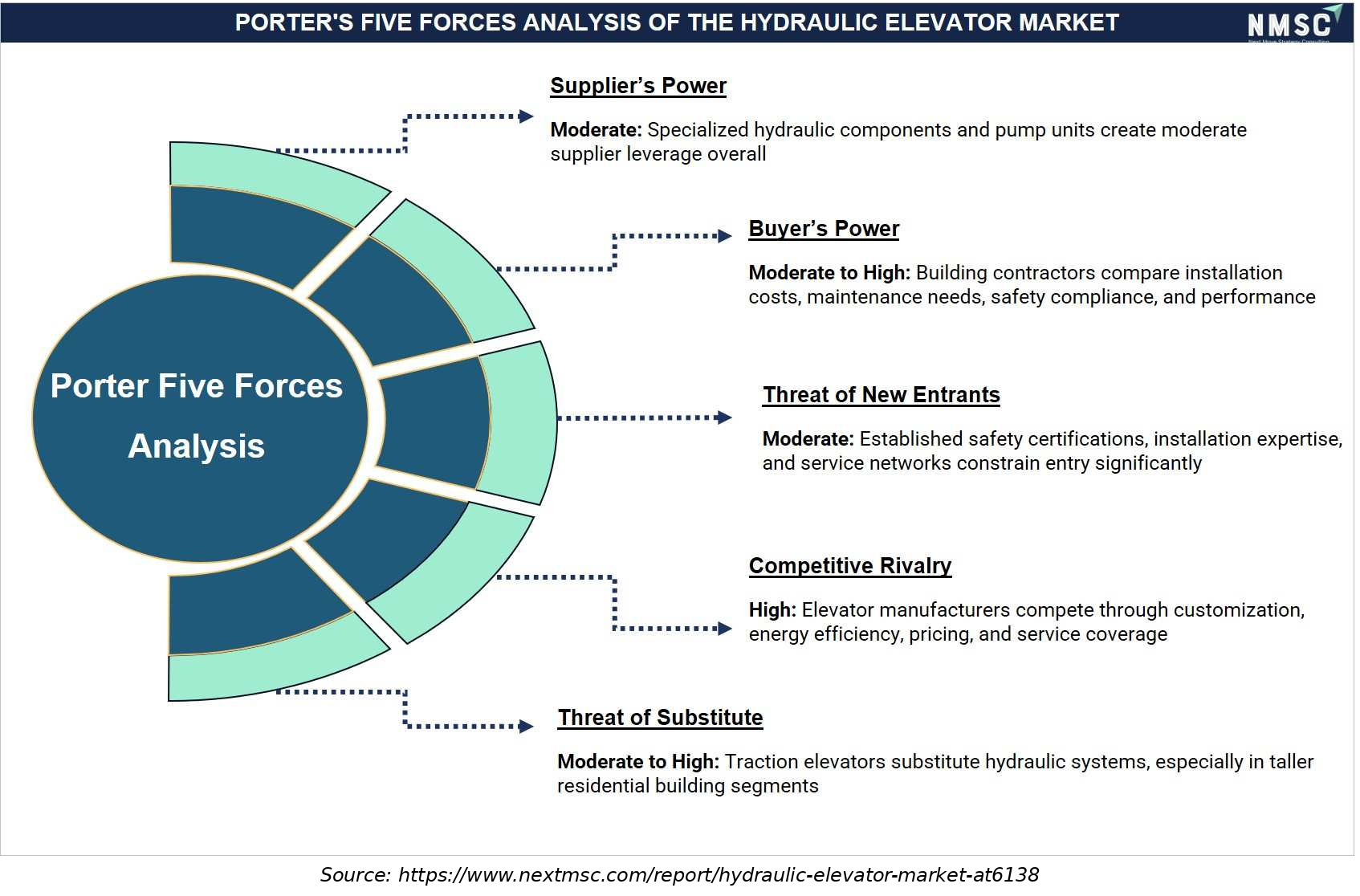
The hydraulic elevator market exhibits moderate competitive intensity, shaped by established manufacturers, technology requirements, and project-specific customization. Supplier power remains moderate due to specialized hydraulic components and control systems, while buyer power varies with project scale and procurement volumes. Substitution is limited for certain low-rise applications, although traction elevators and alternative lifting technologies create competitive pressure.

Segmentation Analysis

2025 (USD Billion)
2035 (USD Billion)
Hole-less Hydraulic Elevators 2025: $8.15 Billion | 2035: $15.89 Billion
Hole-less Hy
Holed Hydraulic Elevators 2025: $7.10 Billion | 2035: $10.96 Billion
Holed Hydrau
Roped Hydraulic Elevators 2025: $5.65 Billion | 2035: $9.69 Billion
Roped Hydrau
Hole-less Hydraulic Elevators $8.15 Billion $15.89 Billion 7.1%
Holed Hydraulic Elevators $7.10 Billion $10.96 Billion 4.3%
Roped Hydraulic Elevators $5.65 Billion $9.69 Billion 5.6%

Which Type Segment Dominates the Hydraulic Elevator Market?

Hole-less Hydraulic Elevators, which eliminate the need for an underground cylinder casing, led the market with USD 8.15 billion in 2025, supported by installation advantages and adaptability to modern construction constraints where excavation is impractical. We observed that Hole-less Hydraulic Elevators are also the fastest-growing type, expanding at a 7.1% CAGR from 2026 to 2035, as retrofit projects in existing low-rise buildings increasingly favor configurations that avoid deep pit excavation.

2025 (USD Billion)
2035 (USD Billion)
Residential
Commercial
Institutiona
Industrial
Segment Item 2025 (USD Billion) 2035 (USD Billion) CAGR
Residential $10.0 USD Billion $40.0 USD Billion 25.0%
Commercial $17.1 USD Billion $51.1 USD Billion 11.0%
Institutional $24.2 USD Billion $62.2 USD Billion 25.0%
Industrial $31.3 USD Billion $73.3 USD Billion 11.0%

Segment-wise data is locked

Unlock complete segment-wise numbers for By End User.

Unlock Full Data

Which End User Is Growing Fastest in the Hydraulic Elevator Market?

Residential remained the dominant end user, valued at USD 9.20 billion in 2025 on sustained low-rise apartment and multi-family housing construction across Asia-Pacific and accessibility-driven home elevator demand in developed markets. Our findings suggest that Industrial is the fastest-growing end user, registering a 7.8% CAGR from 2026 to 2035, as warehouse and logistics facility expansion drives demand for heavy-duty freight hydraulic elevators capable of handling high-capacity loads.

2025 (USD Billion)
2035 (USD Billion)
Passenger
Freight
Segment Item 2025 (USD Billion) 2035 (USD Billion) CAGR
Passenger $10.0 USD Billion $40.0 USD Billion 27.0%
Freight $17.1 USD Billion $51.1 USD Billion 9.0%

Segment-wise data is locked

Unlock complete segment-wise numbers for By Application.

Unlock Full Data
2025 (USD Billion)
2035 (USD Billion)
New Installa
Modernizatio
Segment Item 2025 (USD Billion) 2035 (USD Billion) CAGR
New Installation $10.0 USD Billion $40.0 USD Billion 14.0%
Modernization and Retrofit $17.1 USD Billion $51.1 USD Billion 24.0%

Segment-wise data is locked

Unlock complete segment-wise numbers for By Installation Type.

Unlock Full Data

Which Installation Type Leads Hydraulic Elevator Market Demand?

New Installation remained the leading installation type, valued at USD 13.80 billion in 2025 on sustained low-rise residential and commercial construction activity across Asia-Pacific and Latin America. Based on research conducted by NMSC, we found that Modernization and Retrofit is the fastest-growing installation type, at an 8.5% CAGR from 2026 to 2035, as building owners in North America and Europe upgrade aging hydraulic installations to meet current safety, accessibility, and energy efficiency standards.

2025 (USD Billion)
2035 (USD Billion)
Low Rise
Mid Rise
Segment Item 2025 (USD Billion) 2035 (USD Billion) CAGR
Low Rise $10.0 USD Billion $40.0 USD Billion 24.0%
Mid Rise $17.1 USD Billion $51.1 USD Billion 22.0%

Segment-wise data is locked

Unlock complete segment-wise numbers for By Rise.

Unlock Full Data
2025 (USD Billion)
2035 (USD Billion)
Direct Sales
Distributor
Segment Item 2025 (USD Billion) 2035 (USD Billion) CAGR
Direct Sales $10.0 USD Billion $40.0 USD Billion 23.0%
Distributor and Dealer Sales $17.1 USD Billion $51.1 USD Billion 9.0%

Segment-wise data is locked

Unlock complete segment-wise numbers for By Distribution Channel.

Unlock Full Data
2025 (USD Billion)
2035 (USD Billion)
North Americ
Canada
Mexico
Europe: UK
Germany
Segment Item 2025 (USD Billion) 2035 (USD Billion) CAGR
North America: U.S. $10.0 USD Billion $40.0 USD Billion 21.0%
Canada $17.1 USD Billion $51.1 USD Billion 23.0%
Mexico $24.2 USD Billion $62.2 USD Billion 25.0%
Europe: UK $31.3 USD Billion $73.3 USD Billion 15.0%
Germany $38.4 USD Billion $84.4 USD Billion 16.0%

Segment-wise data is locked

Unlock complete segment-wise numbers for By Region.

Unlock Full Data

Growth Opportunities

Our analysis shows that three forward-looking opportunities stand out for stakeholders positioning within the hydraulic elevator market over the 2026-2035 forecast period.

How Can Energy-Efficient Power Unit Retrofits Unlock Value for Suppliers?

Energy-efficient hydraulic power unit retrofits present a whitespace opportunity for suppliers serving building owners seeking to reduce operating costs without full elevator replacement. Suppliers that offer variable-frequency-drive retrofit packages compatible with existing hydraulic installations stand to capture recurring modernization revenue as energy costs and sustainability reporting requirements rise.

Where Does Industrial Freight Capacity Expansion Create New Demand?

Warehouse and logistics facility expansion represents an underpenetrated opportunity for suppliers offering heavy-duty freight hydraulic elevators engineered for high-capacity industrial loads. Suppliers that develop validated, ruggedized freight platforms for distribution center and manufacturing facility operators can secure long-term contracts as e-commerce-driven logistics infrastructure investment continues.

How Can IoT Retrofit Packages Benefit Aging Installed Base Owners?

Building owners operating aging hydraulic elevator fleets create an opportunity for suppliers offering IoT-enabled connectivity retrofit packages that extend predictive maintenance capability without full system replacement. Early movers that bundle connectivity upgrades with routine modernization contracts can differentiate with commercial and institutional building owners pursuing downtime-reduction goals across their vertical transportation portfolios.

Regional Outlook

2025 (USD Billion)
2035 (USD Billion)
Asia-Pacific
North Americ
Europe
Latin Americ
Middle East
Region 2025 (USD Billion) 2035 (USD Billion) CAGR (%)
Asia-Pacific $10.0 USD Billion $40.0 USD Billion 9.0%
North America $17.1 USD Billion $51.1 USD Billion 27.0%
Europe $24.2 USD Billion $62.2 USD Billion 25.0%
Latin America $31.3 USD Billion $73.3 USD Billion 23.0%
Middle East & Africa $38.4 USD Billion $84.4 USD Billion 12.0%

Regional data is locked

Unlock complete regional numbers for this market.

Unlock Full Data

Competitive Landscape

We observed that the hydraulic elevator market features a moderately fragmented competitive landscape, with diversified global elevator conglomerates competing alongside specialized low-rise, home elevator, and platform lift manufacturers.

Dimension Description
Market Structure Moderately fragmented; Otis Worldwide, Schindler, and TK Elevator maintain the broadest global new equipment and modernization footprints, while regional Asian manufacturers and specialized home elevator suppliers serve differentiated low-rise and residential segments.
Innovation Focus Energy-efficient hydraulic power units, hole-less configuration engineering, and IoT-enabled predictive maintenance retrofit packages dominate current investment priorities across leading suppliers.
M&A Activity Selective consolidation, exemplified by Otis Worldwide's October 2025 acquisition of the remaining noncontrolling stake in its Otis Electric joint venture with Xizi Elevator Group in China.

How Do Companies Compete in the Hydraulic Elevator Market?

Companies compete primarily on installation cost efficiency, modernization service network depth, and regional manufacturing presence across the industry. Global conglomerates such as Otis Worldwide and Schindler leverage extensive service networks and multinational manufacturing to serve commercial and institutional building owners, while specialized manufacturers including Cibes Lift Group and Savaria Corporation compete on residential accessibility and platform lift expertise.

Which Competitive Archetypes Dominate the Hydraulic Elevator Market?

Two archetypes dominate the market: diversified global elevator conglomerates offering full new equipment and modernization portfolios, and specialized low-rise or accessibility-focused manufacturers. Otis Worldwide and TK Elevator exemplify the diversified conglomerate archetype through broad service networks, while Cibes Lift Group and Aritco Lift exemplify the specialized archetype serving residential platform lift and home elevator demand.

How Are Companies Differentiating Through Innovation in Hydraulic Elevator Systems?

Innovation and differentiation strategy increasingly center on energy-efficient power unit design and digital connectivity retrofits that extend the service life of aging hydraulic installations. Otis Worldwide's Arise MOD Prime and Arise MOD Plus modernization solutions, launched in February 2026, enable building owners to upgrade low- and mid-rise elevators in phases. Our analysis shows that suppliers unable to demonstrate credible modernization and energy efficiency roadmaps risk losing aging installed base contracts to more innovation-focused competitors.

What M&A and Expansion Activity Is Shaping the Hydraulic Elevator Market?

Selective consolidation and manufacturing footprint expansion continue to reshape supplier strategy within the industry. Otis Worldwide's October 2025 acquisition of the remaining noncontrolling shareholder stake in its Otis Electric joint venture with Xizi Elevator Group in China illustrates how global suppliers are consolidating regional manufacturing control, while Fujitec's continued expansion of manufacturing facilities across Japan, South Korea, India, Taiwan, and China illustrates sustained investment in low-rise-focused production capacity.

Key Market Players

Our assessment indicates that the following 16 companies are actively shaping product innovation, modernization capacity, and regional manufacturing strategy within the global hydraulic elevator market.

Schindler Holding AG TK Elevator GmbH Mitsubishi Electric Corporation Fujitec Co., Ltd. Hyundai Elevator Co., Ltd. Hitachi, Ltd. Toshiba Elevator and Building Systems Corporation Canny Elevator Co., Ltd. Savaria Corporation Cibes Lift Group Aritco Lift AB Stannah Group Kleemann Hellas S.A. Orona Group S. Coop. Johnson Lifts Private Limited

Latest Developments

We found that recent product and portfolio activity within the hydraulic elevator market is concentrated on modernization solutions and low-rise platform expansion, reflecting the industry's shift toward aging installed base upgrades.

Date Event
May 2026 Schindler introduced ReStore and ReNew in the United States as pre-engineered modernization packages for aging hydraulic elevators. The solutions replace outdated controls with microprocessor technology and advanced components, while ReNew additionally incorporates a submersible power unit and noise-suppression features to improve reliability and ride performance.
March 2026 KLEEMANN introduced the Hydro VVVF Kit as a modernization solution for existing hydraulic elevators. The system adds inverter-based motor control while retaining the existing panel, with the company stating potential annual energy savings of up to 35%, smoother rides, reduced component wear and rapid installation.

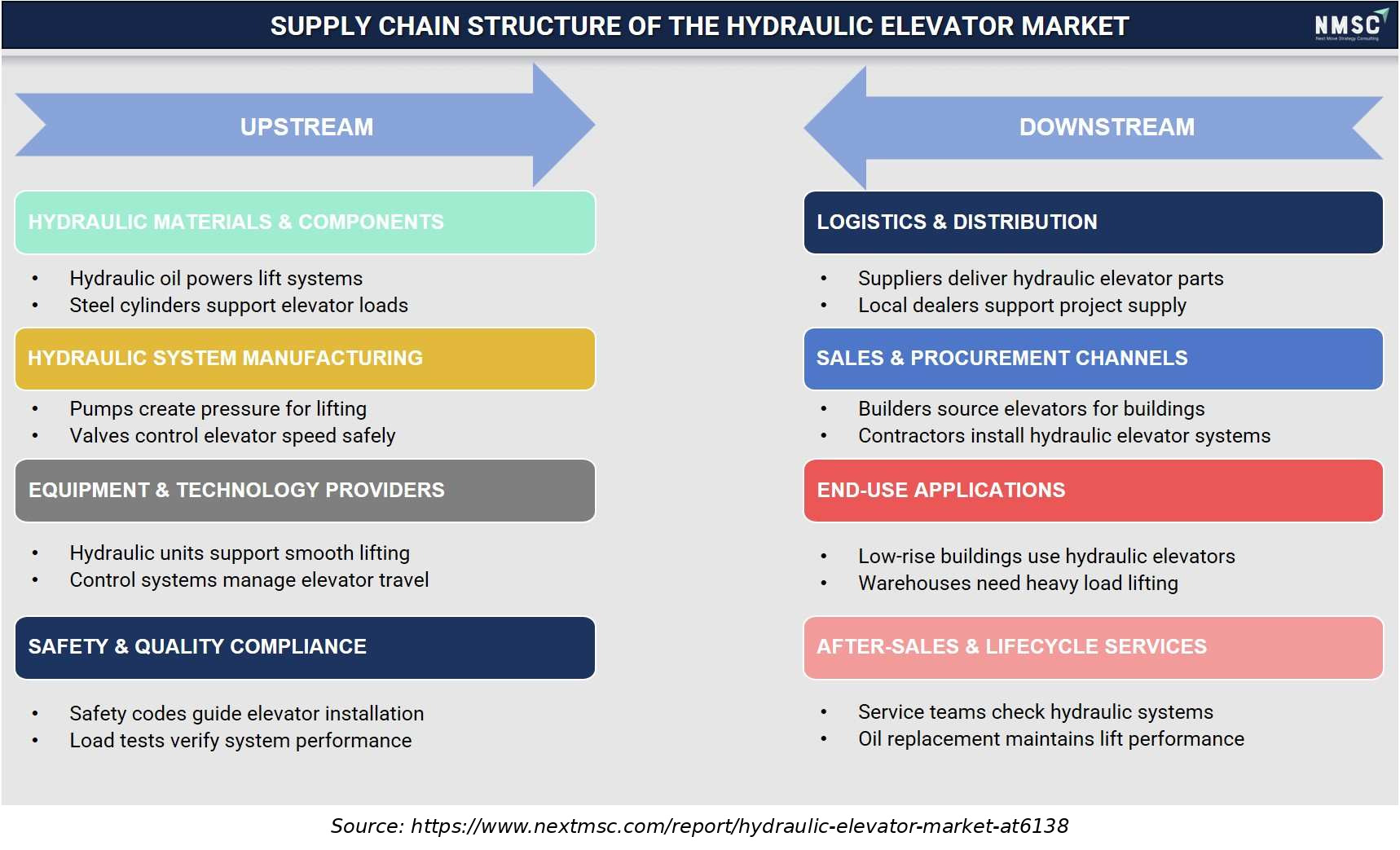
Supply Chain Structure of the Hydraulic Elevator Market

Supply Chain Structure of the Hydraulic Elevator Market

The hydraulic elevator market supply chain spans hydraulic material suppliers, component manufacturers, equipment providers, distributors, contractors, and end users. Upstream participants provide pumps, valves, cylinders, hydraulic units, and control systems, while downstream channels manage logistics, installation, and maintenance. Safety standards, component availability, project specifications, and after-sales servicing significantly influence supply-chain efficiency and procurement decisions.

Investment Opportunities

What Capital Inflows Are Targeting the Hydraulic Elevator Market?

Capital inflows into the hydraulic elevator market are increasingly directed toward modernization service capacity and regional manufacturing consolidation. Otis Worldwide's acquisition of full ownership in its Otis Electric China joint venture illustrates continued strategic investment in regional manufacturing control. We observed that investors favor suppliers demonstrating rising modernization backlogs, viewing recurring upgrade revenue as a proxy for long-term earnings stability relative to cyclical new equipment sales.

How Is Infrastructure Investment Supporting Hydraulic Elevator Demand?

Infrastructure investment is expanding low-rise residential and hospitality construction capacity across Middle Eastern and Asia-Pacific markets. Our findings suggest that Gulf Cooperation Council Vision 2030-linked construction programs are driving sustained hydraulic elevator procurement in Saudi Arabia and the UAE, supporting the region's above-average forecast growth rate through 2035.

What ESG Considerations Are Shaping Hydraulic Elevator Investment Decisions?

Environmental, social, and governance considerations are increasingly relevant to investment decisions, with hydraulic fluid environmental risk and energy efficiency cited as key criteria. KONE Corporation's own product documentation cites hydraulic elevators' higher energy consumption, estimated at 30 to 40% more than machine-room-less traction alternatives, as a factor shaping building owner technology choices. We found that investors increasingly favor suppliers offering energy-efficient power unit retrofits, treating this capability as a governance-linked differentiator against traction system substitution risk.

Key Benefits for Stakeholders

How Does This Report Benefit Enterprise and Industry Leaders?

Enterprise and industry leaders gain access to validated segmentation, competitive benchmarking, and regional demand forecasts that support product-portfolio and modernization-service decisions across the hydraulic elevator industry. Our analysis shows that detailed type, end user, and installation type breakdowns help commercial and product teams align investment with aging installed base modernization timelines while identifying underserved regions for service network expansion.

How Does This Report Benefit Investors and Financial Analysts?

Investors and financial analysts benefit from consistent, single-point market size and CAGR estimates that support valuation and capital-allocation decisions across the hydraulic elevator supply chain. We observed that the report's regional and segment-level growth differentials help identify which manufacturers are best positioned to capture above-market growth in Middle Eastern construction and modernization and retrofit categories through 2035.

How Does This Report Benefit Technology Vendors and Product Teams?

Technology vendors and product teams gain insight into emerging energy efficiency, connectivity, and modernization requirements that are reshaping the industry. Our findings suggest that this analysis helps R&D teams prioritize development roadmaps around energy-efficient hydraulic power units and IoT retrofit packages increasingly required by building owners managing aging vertical transportation portfolios.

Key Market Segments Evaluated

By Type

  • Hole-less Hydraulic Elevators
  • Holed Hydraulic Elevators
  • Roped Hydraulic Elevators

By End User

  • Residential
  • Commercial
  • Institutional
  • Industrial

By Application

  • Passenger
  • Freight

By Installation Type

  • New Installation
  • Modernization and Retrofit

By Rise

  • Low Rise
  • Mid Rise

By Distribution Channel

  • Direct Sales
  • Distributor and Dealer Sales

By Region

  • North America 
    • U.S.
    • Canada
    • Mexico
  • Europe 
    • UK
    • Germany
    • France
    • Italy
    • Spain
    • Sweden
    • Denmark
    • Finland
    • Netherlands
    • Rest of Europe
  • Asia-Pacific 
    • China
    • India
    • Japan
    • South Korea
    • Taiwan
    • Indonesia
    • Vietnam
    • Australia
    • Philippines
    • Malaysia
    • Rest of APAC
  • Middle East & Africa 
    • Saudi Arabia
    • UAE
    • Egypt
    • Israel
    • Turkey
    • Nigeria
    • South Africa
    • Rest of MEA
  • Latin America 
    • Brazil
    • Argentina
    • Chile
    • Colombia
    • Rest of LATAM

Conclusion & Recommendations

The long-term outlook for the market remains positive, with global revenue projected to grow from USD 20.90 billion in 2025 to USD 36.54 billion by 2035 at a 5.8% CAGR. We observed that sustained low-rise construction in Asia-Pacific, rising modernization activity in North America and Europe, and expanding Middle Eastern infrastructure investment will continue underpinning demand through the forecast period.

What Strategic Positioning Should Hydraulic Elevator Suppliers Pursue?

Suppliers should prioritize modernization service capacity while pursuing energy-efficient power unit innovation to secure long-term building owner contracts. Our assessment indicates that manufacturers investing early in connectivity-enabled retrofit packages will be best positioned to capture premium modernization revenue within the hydraulic elevator market.

How Attractive Is the Hydraulic Elevator Market for New Investment?

The hydraulic elevator industry presents an attractive investment case, supported by a USD 14.54 billion absolute dollar opportunity between 2026 and 2035 and above-average growth in Middle Eastern and modernization categories. We found that investment attractiveness is highest for manufacturers combining modernization service depth with regional manufacturing presence across high-growth Asia-Pacific and Middle Eastern markets.

What Market Shifts and Key Risks Should Stakeholders Monitor?

Stakeholders should monitor competitive displacement by machine-room-less traction systems, hydraulic fluid environmental regulation, and height limitations restricting mid-rise and high-rise applications as key risks to the hydraulic elevator market. Our analysis shows that suppliers unable to differentiate through energy efficiency risk losing new installation share to traction alternatives, particularly within Europe's increasingly environmentally conscious regulatory environment.

What Are the Key Growth Pathways for the Hydraulic Elevator Market?

Key growth pathways include expanding modernization and retrofit service capacity, scaling energy-efficient hydraulic power unit offerings, and deepening industrial freight elevator penetration. NMSC's analysis indicates that suppliers pursuing these pathways while maintaining cost competitiveness in low-rise new installation categories will be best positioned to capture the hydraulic elevator market's projected growth through 2035.

FAQs

About the Author

Mihul Sharma

Mihul Sharma

Mihul Sharma is Research Associate at Next Move Strategy Consulting, where he has covered technology, industrial, and healthcare markets for 3 years. His work applies structured business research, market analysis, and secondary-source review to assess market trends, competitive developments, and growth opportunities. He supports report development by fully synthesizing industry data, company information, and market signals into concise findings for strategy and investment-focused research teams.

About the Reviewer

Supradip Baul

Supradip Baul

Supradip Baul is an accomplished business consultant and strategist with over a decade of rich experience in market intelligence, strategy, technology, and business transformation. His work has included rigorous qualitative and quantitative analysis across multiple industries, helping clients shape investment decisions and long-term roadmaps. Earlier in his career, he was associated with Gartner, where he contributed to industry-leading reports and market share analyses. He has worked with leading global companies and holds an MBA with a dual specialization in Marketing and Finance.

Download Free Sample

Gustaf Hummel Burstrom

GUSTAF HUMMEL BURSTROM

Founder

Revline Tools AB

Joseph and the team at Next Move Strategy Consulting have been excellent to work with, in supplying us with relevant market data and forecasts for our specific category. We had some special requirements and they were able to do a custom package to suit our needs. We would definitely recommend them to any other company needing market data and forecasts

Rishabh Jogani

RISHABH JOGANI

Strategy Analyst

Accenture Japan

We are incredibly impressed with the market report on the real estate market in India provided by Next Move Strategy Consulting. The report was thorough, insightful, and well-structured, offering deep analysis and actionable recommendations. It not only captured the current trends and dynamics but also provided a forward-looking perspective that has been invaluable for our strategic planning. Their team demonstrated exceptional professionalism, attention to detail, and a profound understanding of the industry. The data-driven insights and clarity of presentation exceeded our expectations, making complex market trends easy to understand. We highly recommend Next Move Strategy Consulting to anyone looking for reliable and comprehensive market research services. Their expertise has given us the confidence to navigate the complexities of the Indian real estate market with clarity and foresight.

Melanie Samko

MELANIE SAMKO

Director of Marketing

TOSOH BIOSCIENCE, INC.

The information provided by NMSC is incredibly valuable, thank you so much for such a excellent work. I really appreciate it. I will make sure to reference all of it, in my summary document.

Semih Kavaklioglu

SEMIH KAVAKLIOGLU

Co-Founder & Sales Manager

Decortie

I work a lot in the marketing industry and I know that research is an essential part of any campaign. I have used Market research reports for my own products and I found them to be very informative and well-researched. The team here produces insightful reports for a good price

Pratyush Kumar Das

PRATYUSH KUMAR DAS

Assistant Manager

Polycab India Limited

We would like to express our appreciation for the data and insights provided by nextmsc. We are very pleased with the quality and depth of the information, which has proven to be highly valuable and beneficial for our business decision-making.

Custom Market Research Services

We will customize the research for you if the listed report does not fully match your requirements.

Get 30% Free Customization

Select License

This website uses cookies to ensure you get the best experience on our website. Learn more

✖